SAEZ-PONS, Joan, ALBOUL, Lyuba <http://orcid.org/0000-0001-9605-7228>
and PENDERS, Jacques <http://orcid.org/0000-0002-6049-508X>
Available from Sheffield Hallam University Research Archive (SHURA) at:
http://shura.shu.ac.uk/3601/
This document is the author deposited version. You are advised to consult the
publisher's version if you wish to cite from it.
Published version
SAEZ-PONS, Joan, ALBOUL, Lyuba and PENDERS, Jacques (2011). Experiments
in cooperative human multi-robot navigation. In: Robotics and Automation (ICRA),
2011 IEEE International Conference on. IEEE Explore, 5615 -5621.
Copyright and re-use policy
See
http://shura.shu.ac.uk/information.html
Sheffield Hallam University Research Archive
Abstract— In this paper, we consider the problem of a group of autonomous mobile robots and a human moving coordinately in a real-world implementation. The group moves throughout a dynamic and unstructured environment. The key problem to be solved is the inclusion of a human in a real multi-robot system and consequently the multiple robot motion coordination. We present a set of performance metrics (system efficiency and percentage of time in formation) and a novel flexible formation definition whereby a formation control strategy both in simulation and in real-world experiments of a human multi-robot system is presented. The formation control proposed is stable and effective by means of its uniform dispersion, cohesion and flexibility.
I. INTRODUCTION
n recent years, considerable research efforts have been conducted towards the control of a group of autonomous robots. The appeal for this discipline is well supported by the plethora of advantages that multi-robot systems over single autonomous robots and well backed up by the advancements in robot technologies. A human moving cooperatively with a group of robots (Fig. 1 shows its conceptual illustration) could as well broadly benefit in several applications (e.g. moving a large object or human guiding) but as far as the authors know, no experimental work has been conducted in this research area. Naturally, multi-robot systems (MRS) are the first place to look for inspiration, and more specifically formation control of distributed multi-robot systems. When considering a human and a MRS working together, referred as human multi-robot system (HMRS), many questions arise: seeking simplicity yet reliability through local sensing,
what distributed control framework for HMRS formation navigation is the most suitable? And to compare among
methods and algorithms, what metrics can be utilized?
Several approaches to establish and maintain formations can be found in the literature of MRS. In [1] artificial forces are used to control individual robot’s motion. In [2] the problem of formation generation is treated in terms of distributed algorithms using idealized robots with perfect sensors and no physical dimension. Some other authors [3], improve these algorithms with regard to usefulness for
Manuscript received January 5, 2011.
J. Saez-Pons is with the Sheffield Hallam University, UK (corresponding author e-mail: [email protected]).
physical robots and propose a method to move a group of mobile robots in strict formation.
In [5] a behavior-based approach to robot formation keeping is presented. Reactive behaviors, implemented as so-called motor schema, correspond to the different influences, which have an effect on the movements of the robots, based on a potential field method and which can be used to define uniform and structured geometric formations. In [4] a potential field approach is presented, where the robot group has to get into a certain formation at a specified goal point. It is not clear if the formation can move as a whole. Contrary to our approach only static obstacles are assumed.
In [6] a distributed approach that uses behavioral modules to control formation is used. For each formation, every robot has a pre-assigned ordering, which determines the angle it should keep between its front direction and the direction of its friend.
This paper is organized as follows. Section II gives an overall description of the system with a focus on the distributed control strategy employed and the exemplary metrics selected for performance evaluation. In section III an explanation of the experimental design and the implementation is given. Section IV describes the formation control employed in this work. Finally, section V discusses the results and section VI concludes the paper.
II.AIM AND TEST CRITERIA
This section provides an overview of the framework for distributed formation control of a group of robots to navigate with a human, the Social Potential Field method, which belongs to the group of “virtual physics”. The term “virtual” (sometimes referred as artificial) is used because this framework is motivated by natural physical forces and robots act as if they are real. Formation is defined as a group of elements establishing and maintaining a certain
flexible configuration. Thereafter, the performance metrics employed in the forthcoming experiments are selected.
A. Social Potential Fields as a Distributed Control
Within the distributed control framework, artificial potential fields are proposed to be used as control laws. The controller is allowed to define pair-wise potential laws for pairs of components (i.e. robots, obstacles or human) of the system. Each robot senses the resultant potential field from all other components, at least the components within its sensor boundary (SB), also known as neighboring components (NC), and acts under the resultant force Fi (see
Fig. 2). Once the force laws are defined, force calculations can be carried out by individual robots in a distributed manner.
At a fixed time, the overall artificial force applied by the NC upon a robot i is
I
Experiments in Cooperative Human Multi-Robot Navigation
Joan Saez-Pons, Lyuba Alboul and Jacques Penders
[image:2.595.119.234.526.617.2]∑
≠=
j i
j i
i f
F
The force laws are inverse-power laws of distances incorporating both attraction and repulsion, similar to those found in molecular dynamics. For example, in our force law, attraction dominates over long distances and repulsion dominates over short distances. Using force laws, the resulting system displays ‘social’ behaviors such as clustering, guarding, and escorting. Thus the method is called social potential fields (SPF) [1]. However, there is no known procedure for designing potential force laws to derive a given specified set of behaviors. Nevertheless, we propose a control method based on the usage of social potential fields, Formation Control (FC)in section IV.
B. Exemplary Metrics for Formation Navigation.
In order to compare methods and algorithms is crucial to dispose of measurements that allow meaningful evaluation of the experimental data. In the literature only sparse discussions of metrics in this field are found. Selecting the right metrics requires a careful analysis of the experimental setup. Every setup is different even if it is “a typical office environment” or “an empty soccer field”. Nevertheless, since the goal is a discussion of usability of general formation approaches, robot systems, and environmental conditions, suitable metrics have been chosen, which one can find in the majority of the related work.
1) System efficiency (SE) is the average distance traveled by the robots divided by the straight-line distance of the course [5]. This metric gives a measurement of the distance ratio between the human and the robots, where a ratio of 1 means that equal distance is traveled by humans and robots. 2) Percentage of time in formation (%tif) [5-8]. This metric evaluates the stability performance of the system.
Other exemplary metrics have been discarded to quantify the results of our experiments. The reason is mainly due to the fact that they require the knowledge of specific parameters. For example, this is the case of the formation position error [5] [8] which requires to know the final positions of the robots in the formation, data that in our approach is not available.
In order to use the aforementioned metrics a systematic and practical definition of formation must be laid out. In the literature there exist different formation definitions but always according to the formation approach, the
environmental conditions, and the robot system employed. We go a step forward and define formation as a group of components (robots and humans) establishing and maintaining a certain “flexible configuration”. The configuration does not have predefined shape but the components have to stay close by and adapt to the geometrical constraints of the environment. Therefore we state the following definition:
Definition 1. Given the position of N components of a group, these are considered to be in a flexible formation if the following two conditions hold:
(1) Given the NC Rj of a robot R, there exists a
distance d, such that for all pairs of NC (R, Rj)
with Euclidean distance ds(R, Rj), |d-ds(R, Rj)|<εd,
where εd is the maximum tolerance for distance
measurements.
(2) There exists a connected graph, where nodes are components of the group and edges are virtual links between NC.
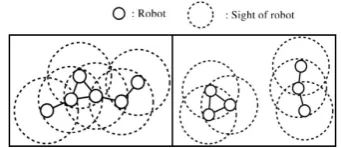
Condition 1 states the same distance is kept among NC with a maximum tolerance εd. In other words that the
components are uniformly dispersed (Fig. 3 left). The usage of condition 1 by itself is not sufficient to have a flexible formation. In the example of the torn formation (Fig. 3 right), the components are uniformly dispersed and condition 1 still holds. However, this is an undesired situation, therefore the need of a second criterion. Condition 2 states that the group is in a flexible formation if there exists a connected graph, which is not the case in the torn formation situation. Initial considerations definitions about the aforementioned flexible formation are introduced in our previous work [9-11].
III. EXPERIMENTAL DESIGN AND IMPLEMENTATION
The experimental goal of this work is to demonstrate human multi-robot navigation by developing and implementing a formation control algorithm. The equipment and procedures described here are designed as the minimum system required to achieve this goal.
The autonomous mobile robots employed are the ERA-MOBI mobile robot provided by Videre Design, a compact platform carrying a PC and a laser range-finder (LRF) by Hokuyo. The SB of each robot, set by the LRF characteristics, is 240 degrees with a range of 5.6 meters.
[image:3.595.117.251.88.200.2]To test the performance of the control strategy a simulation was carried out using the simulation software Player/Stage. Models of the real ERA-MOBI platform and the LRF device were used and the human was simulated as an independent agent that can move freely in the
Fig. 2. Distributed control framework. Robot i can detect and identify the components (obstacles, robot mates and humans) within its SB.
[image:3.595.344.515.474.548.2]environment, which is a map of a real environment used for the real-world trials. This architecture (Fig. 4) has been designed to implement different robot behaviors (formation and following), handle communication, run distinct robot navigation algorithms (localization and collision avoidance), define different agent types, interact with the hardware involved (actuators and sensors), interface with the users, and everything combined with different software platforms (Player, Javaclient and JADE).
The robots are provided with a map of the environment, where they localize using the Adaptive Monte-Carlo Localization algorithm [12] and employing a central repository agent; the localization information is stored and distributed. Using this distributed architecture the system is able to share the robots and human poses with the team, allowing for the implementation of our FC method.
IV. FORMATION CONTROL
This section presents a formation control (FC) algorithm which is assessed in a set of experiments. According to the requirements of the system, it becomes clear that the human cannot simply be a component of the group. Some sort of priority or leadership has to be given to the human in order to dictate the motion of the robot group. It is needed somehow to combine simple behaviors to obtain a more complex global behavior, which has been shown to be easy to implement in real robots. Therefore, taking into account existing methods in the literature, it is proposed a FC through the combination of the social potential field method with the popular behavior-based approach.
The main problem with the behavior-based approach is to decide when to switch among the simple behaviors in an optimized way. In our case, the decision is clearly imposed by the key component of the robot group: the human. The presence or absence of the human within the SB of each robot dictates the switching behavior factor. Therefore, the robot with the human in SB, is attracted-repulsed only by the human and repulsed by the rest of components. The robot without human within SB, is attracted-repulsed by other robots (referred as ‘mates’) and repulsed by obstacles. Let us define the social potential force considering N components denoted with Rn, where n = 1, 2...N, the
nearest obstacle denoted with O and a human denoted by H, in a two dimensional plane R2.
The SPF
( )
FGS of Rn is defined as⎪ ⎪ ⎪ ⎩ ⎪⎪ ⎪ ⎨ ⎧ > + ≤ + + = =
∑
∑
≠ = ≠ = SB H if U d P U d P SB H if U d P U d P U d P R F j n j n n n j n j n n n n n R R R R N n j j Mat O R O R Obs R R R R N n j j Rob H R H R Hum O R O R Obs n S ˆ ) ( ˆ ) ( ˆ ) ( ˆ ) ( ˆ ) ( ) ( ; 1 ; 1 Gwhere PObs is the robot-obstacle function, PMat is the
robot-mate function, PHum is the human-robot function, d is the
relative distance of Rn with the component denoted by the
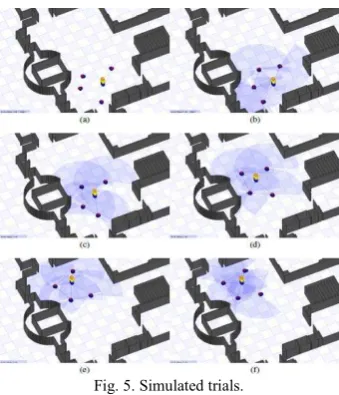
corresponding upper index, and UGis the unit vector. The experiment was repeated ten times in simulation and real-world trials. Fig. 5 shows snapshots of the simulator during a trial in time sequence. As it begins (a) the robots are placed at random positions and the human will be placed at the same starting location. Notice that the robots are placed in a dispersed way, but keeping a connected graph. The simulation begins and the human is kept still whereas the robots’ motion goes under FC. The robots and the human are aggregated (b). It is important to notice that the robots get dispersed in the environment according the robot mates and obstacles positions within each robot SB. The robots settle for a minute (referred as the “formation generation” stage). Afterwards, the human starts moving towards the top side of the scene in straight line pulling the group with him (c). The platforms follow the human’s movement through the environment whereas avoiding collision with other mates and surrounding walls/objects (d). Note the group self organizes to occupy the empty space. Once the human reaches the final position on the top side after traveling for 7 meters, they stop moving (e). The robots are allowed to continue moving until they reach a stable situation (f). This second stage will be referred as “Formation maintenance”.
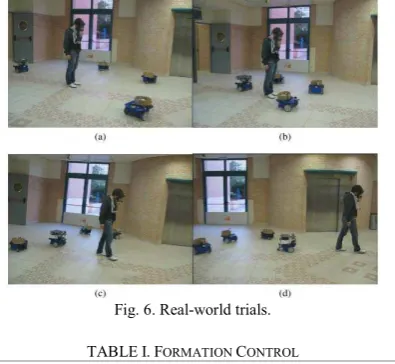
The real-world experiment was then repeated using the human multi-robot architecture explained before. The mobile robots were placed loosely at the same positions as in simulation and the human still at its initial location. Fig. 6. shows snapshots of the real-world trial. The % tif and the
[image:4.595.357.527.493.691.2]SE metrics are presented in Table I.
V.DISCUSSION
Table I indicates that in simulation FC eight out of ten trials perform full time in formation and the average %tif is as high as 98,51%. In the real-world trials the performance is lower but still the average is 72,41.
Considering the performance results, there is a performance difference between simulations and real-world experiments. All parameters in real-world controllers for the experiments were identical to those used in the simulations, therefore the difference in behavior must be due to the dynamics of the real-world system (i.e. zero delay in the control loop, uncertainty provided by sensors, robot dynamics, inertia, friction, etc.), errors in the localization system and the human localization inaccuracy.
VI. CONCLUSIONS
Our FC represents a simple yet sufficient control framework to achieve human multi-robot system navigation. It has been shown that a flexible formation can be achieved by exploiting the “social relations” among robots, whereby the formation is generated directly from the attraction/repulsion interaction between human and robots, and the repulsion with the obstacles of the scene. Moreover, it has been shown that with FC a group of robots can move according to the human’s movement and that a simulated formation control can be used to design and test a formation controller, which has been transferred to the control of the real robots. The presented FC, to the best of
our knowledge is the first decentralized multi-robot control to navigate with a human.
Adapting FC in a style of a behavior-based controller improves the cohesion of the group and gives an improved performance. FC is stable and effective by means of its uniform dispersion and flexibility, and is therefore an appropriate solution. The reason for that is due to the priority given to the human, causing the robots to uniformly disperse during the formation generation stage. The latter means that the robots do spread more in the empty environment which can be observed in both simulations and real-world trials. During the formation maintenance stage in both simulation and real-world trials the robots move cohesively with the human. This happens because of the condition introduced by the human’s presence, which causes the robots within its area of influence to occupy the empty space, causing the far away robots to come closer to human’s position. Moreover, with our FC, the flexibility of the formation is kept; the robots are able of performing properly in a scenario cluttered with dynamic (e.g. moving obstacles) and static objects (e.g. walls) whereas keeping and maintaining formation.
REFERENCES
[1] J. Reif and H. Wang, ‘Social potential fields: ‘A distributed behavioral control for autonomous robots’, Robotics and Autonomous Systems, 27, 171–194, 1999.
[2] I.Suzuki and M.Yamashita,‘Distributed anonymous mobile robot: formation and geometric patterns’, SIAM Journal of Computing, 28, 1374–1363, 1999.
[3] Qin Chen and J.Y.S. Luh. ‘Coordination and control of a group of small mobile robots’, 1994.
[4] P. Song and V. Kumar. ‘A potential field based approach to multirobot manipulation’, 2002.
[5] T. Balch and R.C. Arkin, ‘Behavior-based formation control for multirobot teams’, IEEE Rob. Aut., 14; 14(6), 926–939, 1998. [6] J. Fredslund and M.J. Mataric, ‘A general algorithm for robot
formations using local sensing and minimal communication’, IEEE Trans. on Robotics and Automation.,18;18(5), 837–846, 2002. [7] M. Lemay, F. Michaud, D. Letourneau, and J. M Valin.’Autonomous
initialization of robot formations’. Robotics and Automation, 2004. Proc. ICRA’04. 2004 IEEE Int. Conf. on, 3:3018–3023, 2004. [8] Gaurav S. Sukhatme David J. Naffin and Mehmet Akar. ‘Lateral and
longitudinal stability for decentralized formation control’. Proc. Int. Sym. Distributed Autonomous Robotic Systems, 421–430, 2004. [9] Lyuba Alboul, Joan Saez-Pons, Jacques Penders, and Leo
Nomdedeu. ‘Challenges of the multi-robot team in the guardians project’. ICIRA’09: m 2nd Int. Conf. on Intelligent Robotics and Applications, 112–125, Berlin, Heidelberg, 2009.Springer-Verlag.
[10]J. Saez-Pons, L. Alboul, J. Penders, and L. Nomdedeu. Multi-robot team formation control in the GUARDIANS project. Industrial Robot: An International Journal, 37(4): 372–383, 2010.
[11]Jacques Penders, Lyuba Alboul, Ulf Witkowski, Amir Naghsh, Joan Saez-Pons, Stefan Herbrechtsmeier, and Mohamed El-Habbal. ‘A robot swarm assisting a human fire fighter’. Advanced Robotics, Vol. 25, Numbers 1-2, 93-117(25) 2011.
[12]D. Fox, ‘Kld-sampling: Adaptive particle filters’, Advances in Neural Information Processing Systems,14, 2001.
TABLEI.FORMATION CONTROL
Simulation Real-world SE %tif SE %tif
Trial 01 0,98 100,00 0,93 60,51 Trial 02 0,83 100,00 1,06 72,65 Trial 03 0,96 100,00 0,89 61,09 Trial 04 0,99 100,00 1,03 57,92 Trial 05 0,96 100,00 1,03 93,58 Trial 06 1,04 100,00 1,04 79,14 Trial 07 0,97 100,00 0,93 73,50 Trial 08 1,08 92,07 0,99 63,41 Trial 09 1,09 93,05 1,01 82,38 Trial 10 0,93 100,00 0,87 79,91
Mean 0,98 98,51 0,97 72,41
Std. Dev. 7,57 3,15 6,94 11,60
[image:5.595.71.291.62.393.2]Performance parameters, SE and %tif with their averages and standard deviation for Simulation and Real-world trials.
[image:5.595.83.281.72.254.2]