East Tennessee State University
Digital Commons @ East
Tennessee State University
Electronic Theses and Dissertations Student Works
5-2011
Parental Involvement: Parent Perceptions and
Teacher Perceptions.
Penelope Odum Herrell
East Tennessee State University
Follow this and additional works at:https://dc.etsu.edu/etd
Part of theCurriculum and Social Inquiry Commons, and theSocial and Philosophical Foundations of Education Commons
This Dissertation - Open Access is brought to you for free and open access by the Student Works at Digital Commons @ East Tennessee State University. It has been accepted for inclusion in Electronic Theses and Dissertations by an authorized administrator of Digital Commons @ East Tennessee State University. For more information, please [email protected].
Recommended Citation
Herrell, Penelope Odum, "Parental Involvement: Parent Perceptions and Teacher Perceptions." (2011).Electronic Theses and Dissertations.Paper 1248. https://dc.etsu.edu/etd/1248
Parental Involvement: Parent Perceptions and Teacher Perceptions _____________________
A dissertation presented to
the faculty of the Department of Educational Leadership and Policy Analysis East Tennessee State University
In partial fulfillment of the requirements for the degree
Doctor of Education _____________________
by
Penelope Odum Herrell May 2011
_____________________ Dr. Catherine H. Glascock, Chair
Dr. Cecil Blankenship Dr. Don Good Dr. Pamela Scott
ABSTRACT
Parental Involvement: Parent Perceptions and Teacher Perceptions
by
Penelope Odum Herrell
The purpose of this study was to examine the perceptions of parents and teachers regarding effective parental involvement with elementary students based on Epstein et al.’s (2009) 6 typologies of parental involvement. The population consisted of 77 teachers in a particular east Tennessee school district and the parents of 889 students enrolled in kindergarten through 6th grade. Parents and teachers were asked to indicate the effectiveness of 4 activities within each of the 6 parental involvement categories: parenting, communicating, volunteering, learning at home, decision making, and collaborating with the community. Parents and teachers were asked to rank each activity numerically with 1 indicating not effective and 5 indicating highly effective. A ranking of 2, 3, or 4 indicated an activity between not effective and highly effective. In a separate section, parents and teachers were asked to rank the 5 most important activities from a list of specific parental involvement activities.
Findings indicated that parents and teachers in this study have some similar views and some differing views regarding effective parental involvement. Parents and teachers in this study shared similar perspectives by ranking the top 5 specific parental involvement activities from a list of 10
activities from Epstein et al.’s (2009) 6 typologies: parenting, communicating, volunteering, learning at home, decision making, and collaborating with the community. The t-test indicated significant differences in the perceptions of parents and teachers regarding effective parental involvement in 5 of the 6 typologies. ANOVA and post hoc analysis revealed significant differences among the parent population based on age, education level, gender, and race. No significant differences were identified among the teacher population based on the 4 demographic areas examined: age, education level, teaching experience, and gender. This study revealed that parents and teachers surveyed had some similar perceptions and some differing perceptions regarding effective parental involvement, but both groups identified communicating as the most important typology from Epstein et al.’s (2009) 6 major types of involvement.
DEDICATION
Phillipians 4:13 says, “I can do all things through Christ who gives me strength”. Without the strength of Christ, my Lord and Savior, I could have never accomplished this long-time dream.
This study is dedicated to those who have greatly impacted my life and encouraged me. This study is dedicated to first and foremost God for giving me the ability to accomplish this great endeavor. This study is also dedicated to Rob, Trey, Ty, Trent, Dad, Mom, Robert, Bonnie, my sweet family, and dearest friends.
To my husband Rob and my sons Trey, Ty, and Trent thank you for your encouragement, patience, and prayers. I appreciate all your sacrifices in support of this endeavor. I love you and pray that this adventure has been an example of the importance of education to our children.
To my precious parents Calvin and Barbara Odum, thank you for never giving up on me. I appreciate your prayers and encouragement throughout life and along this journey. Without you both, I would have never made it this far! I love you both!
To my father-in-law and mother-in-law Robert and Bonnie, thank you for all your assistance with my boys. Without your prayers and support, I could not have accomplished this dream. I love you and am thankful for you.
To my sweet family and dearest friends, thank you for your understanding, support, and prayers. I love you and treasure your friendship even as I’ve been in a world of my own the last several years while pursuing this dream.
ACKNOWLDEGMENTS
I would like to thank God for providing me with the gifts, talent, and support that allowed me to accomplish this long-time dream.
I would like to thank my committee chair Dr. Catherine Glascock for her continued support and encouragement. She encouraged me to push forward when I was ready to throw in the towel. I would like to thank my committee Dr. Cecil Blankenship, Dr. Don Good, and Dr. Pamela Scott for their support and encouragement. I would like to thank everyone on my
committee for their time, wealth of experiences, and incredible knowledge that they so willingly shared with me.
I would like to thank two very special educators in my life who have influenced me as a student more than they will ever know. My first grade teacher Mrs. Doris Sheffield has had a lasting impact on my career as a student as she always encouraged me to keep trying. Dr. Sandra Richardson, an education professor from The University of Virginia – College at Wise, was a strong example of how to be a mother and a teacher while pursuing a dream of obtaining a doctorate degree. Thank you ladies for your dedication to the field of education and to me as one of your many students!
Thank you Rob, Trey, Ty, Trent, Dad, Mom, Robert, and Bonnie. Thank you to all my family and friends who have supported me throughout this journey. Thank you for your love and your prayers. Thank you for encouraging me to continue this adventure and trust in the Lord to help me through.
CONTENTS Page ABSTRACT ... 2 DEDICATION ... 4 ACKNOWLEDGMENTS ... 5 LIST OF TABLES ... 9 LIST OF FIGURES ... 10 Chapter 1. INTRODUCTION... 11
Statement of the Problem... 16
Research Questions ... 16
Significance of the Study ... 17
Definitions of Terms ... 17
Delimitations and Limitations ... 19
Summary ... 19
2. LITERATURE REVIEW ... 21
Introduction ... 21
History of Parental Involvement ... 22
Benefits to Parental Involvement ... 30
Barriers to Parental Involvement ... 36
Perceptions Regarding Parental Involvement ... 39
Theoretical Framework ... 41
Six Types of School-Family-Community Involvement ... 43
Chapter Page
Volunteering ... 46
Learning at Home ... 48
Decision Making ... 50
Collaborating with the Community ... 52
Summary ... 53
3. RESEARCH METHODOLOGY ... 55
Introduction ... 55
Research Questions and Hypotheses ... 55
Researcher’s Role ... 60
Population ... 61
Data Collection ... 61
Data Analysis ... 63
Validity and Reliability ... 64
Ethical Considerations ... 65
Summary ... 65
4. DATA ANALYSIS ... 66
Introduction ... 66
Analysis of Research Questions ... 67
Research Question 1 ... 67 Research Question 2 ... 68 Research Question 3 ... 69 Research Question 4 ... 70 Research Question 5 ... 72 Research Question 6 ... 81
Chapter Page
5. FINDINGS, CONCLUSIONS, AND RECOMMENDATIONS ... 91
Introduction ... 91
Statement of the Problem ... 91
Summary of the Findings ... 92
Conclusions ... 93
Recommendations for Practice ... 97
Recommendations for Further Research ... 99
Summary ... 101
REFERENCES ... 102
APPENDICES ... 111
Appendix A: Permission to Adapt Survey ... 111
Appendix B: Letter to Director of Schools ... 113
Appendix C: Letter to Principals ... 114
Appendix D: Letter and Survey to Parents ... 115
Appendix E: Letter and Survey to Teachers ... 120
LIST OF TABLES
Table Page
1. Participation of Population ... 67
2. Parents’ Ranking of the Most Effective Parental Involvement Activities ... 68
3. Teachers’ Ranking of the Most Effective Parental Involvement Activities ... 68
4. Parents’ Perceptions of Most Effective Parental Involvement Typologies ... 69
5. Teachers’ Perceptions of Most Effective Parental Involvement Typologies ... 70
6. Perceptions of Parents and Teachers Regarding Effective Parental Involvement ... 71
7. Descriptive Statistics for t-test: Parent and Teacher Perceptions ... 72
8. Descriptive Statistics for ANOVA: Parents’ Perception Based on Age ... 73
9. Descriptive Statistics for ANOVA: Parents’ Perceptions Based on Education ... 75
10. Descriptive Statistics for ANOVA: Parents’ Perception Based on Gender ... 77
11. Descriptive Statistics for ANOVA: Parents’ Perception Based on Race... 79
12. Descriptive Statistics for ANOVA: Teachers’ Perception Based on Age... 82
13. Descriptive Statistics for ANOVA: Teachers’ Perception Based on Education ... 84
14. Descriptive Statistics for ANOVA: Teachers’ Perception Based on Teaching Experience ... 86
LIST OF FIGURES
Figure Page
1. Overlapping Spheres of Influence – External Structure ... 42 2. Overlapping Spheres of Influence – Internal Structure ... 43
CHAPTER 1 INTRODUCTION
“When schools work together with families to support learning, children tend to succeed not just in school, but throughout life.”
(Henderson & Berla, 1994, p. 1).
There is evidence that suggests parental involvement positively influences student achievement and overall well-being (Bauch, 1990; Epstein et al., 2009; Flaxman & Inger, 1991; Henderson & Mapp, 2002; Myers & Monson, 1992; Shumow & Lomax, 2002; Shumox & Miller, 2001). Academic achievement of students has been of great interest in America for many years and higher student achievement provides hope for a brighter future for American students (Epstein et al., 2009). Several factors such as socioeconomic level, geographic location, family attitudes, education level of family members, and parent and community involvement have been identified that influence academic achievement and student success. Family involvement appears to be a better predictor of student achievement than any other factor (Chavkin & Williams, 1988; Comer, 1986; Fan & Chen, 2001; Henderson & Berla, 1994).
Educators and parents play important roles in the educational success of students. Students need a positive learning experience to succeed in school: an experience providing support, motivation, and quality instruction. With the increasing demands on the family, parental support in the education of students extends beyond the school building. Many families are faced with overwhelming and unpredictable schedules and circumstances while juggling school, sports, family situations, family time, work schedules, and other responsibilities, allowing minimal time to provide support in any one given area (Swap, 1993).
Parental involvement and home-school partnerships have been researched and addressed at the national, state, and local levels. Despite the research of this topic, there is still concern
regarding parental involvement and what constitutes effective parental involvement in the education of students. Educators, parents, and community members may have different opinions regarding effective involvement practices and the ways each can contribute to the educational process. Definitions of parental involvement have been determined by schools, with little or no input from parents or members of the community. These school-centered definitions can be found in both research and practice, and many agree that they do not fully express the variety of parental involvement practices (Jordan, Orozco, & Averett, 2002).
Parental involvement in the education of students begins at home with the parent(s) providing a safe and healthy environment, appropriate learning experiences, support, and a positive attitude about school. Several studies indicate increased academic achievement with students having involved parents (Epstein et al., 2009; Greenwood & Hickman, 1991; Henderson & Berla, 1994; Rumberger, Ghatak, Poulos, Ritter, & Dornbusch, 1990; Swap, 1993; Whitaker & Fiore, 2001). Studies also indicate that parental involvement is most effective when viewed as a partnership between educators and parents (Comer, 1984; Davies, 1996; Emeagwali, 2009; Epstein et al., 2009; Williams & Chavkin, 1989). By examining parents’ and teachers’ perceptions, educators and parents should have a better understanding of effective parental involvement practices in promoting student achievement.
Numerous researchers such as Becker and Epstein (1982), Berger (2008), Comer (1986), Davies (1996), Epstein et al. (2009), and Henderson and Mapp (2002) have studied parental involvement and its effects on the educational process over the years. A leading researcher of parental involvement is Joyce Epstein, the founder and director of the National Network of Partnership Schools at Johns Hopkins University. With numerous studies and work in over 100 publications, Epstein focuses on school, family, and community partnership programs that will
improve policy and practice in an effort to increase student academic achievement and student success. Epstein has identified six major types of parental involvement: parenting,
communicating, volunteering, learning at home, decision making, and collaborating with the community (Epstein et al., 2009).
With great debate in the field of education regarding a clear definition of parental
involvement, the federal government has identified parental involvement as part of the No Child Left Behind Act (NCLB), the reauthorization of the Elementary and Secondary Education Act (ESEA). In the 2004 publication of NCLB, Parental Involvement: Title I, Part A Non-Regulatory Guidance, the federal government defined parental involvement as parents’ participation in regular and meaningful two-way communication involving student academic learning and other school activities including:
• Parents assisting their child’s learning;
• Encouraging parents to be actively involved in the child’s education at school; • Parents as full partners in their child’s education and appropriately being included in
decision making and serving on advisory committees to assist in the education of their child; and
• Carrying out other activities including those described in section 1118 of the ESEA
Section 9101(32) (United States Department of Education, 2004).
It is the responsibility of local school districts to implement parental involvement as defined by the federal government. Local school districts and individual schools receiving Title I money are accountable for creating a written parental involvement plan and complying with the guidelines developed in NCLB. As part of the written parental involvement plan, schools have been directed to provide a more welcoming atmosphere to parents and to provide a variety of opportunities for parents to become involved while developing a partnership to assist students in improving their academic achievement and achieve the state’s high standards. NCLB specifically
Each school must have a school-parent compact that shall:
(1) describe the school’s responsibility to provide high-quality curriculum and instruction in a supportive and effective learning environment that enables the children served under this part to meet the State’s student academic achievement standards, and the ways in which each parent will be responsible for supporting their children’s learning, such as monitoring attendance, homework completion, and television watching; volunteering in their child’s classroom; and participating, as appropriate, in decisions relating to the education of their children and positive use of extracurricular time; and
(2) address the importance of communication between teachers and parents on an ongoing basis through, at a minimum
(A) parent-teacher conferences in elementary schools, at least annually, during which the compact shall be discussed as the compact relates to the individual child’s achievement;
(B) frequent reports to parents on their child’s progress; and
(C) reasonable access to staff, opportunities to volunteer and participate in their child’s class, and observation of classroom activities (United States
Department of Education, 2004).
With the guidelines of NCLB in place, schools are continuously seeking ways to involve parents, as well as members of the community, in educating students.
While the federal government has defined parental involvement and schools have established parental involvement plans to promote parent participation in the educational
process, there is still a discrepancy between educators and parents as to what constitutes effective parental involvement. Although parental involvement has been an issue of interest to researchers and there have been multiple strategies suggested for ways to involve parents in the education of students, there is a need for additional research as to what parents and teachers believe are effective practices of parental involvement that promote student achievement and effectively connect schools, families, and communities.
Epstein’s model has been reviewed extensively by the research community and has been approved by numerous practitioners (Jordan et al., 2002). Epstein’s work is cited throughout literature regarding parental involvement and used by schools across the country as a framework
for developing partnerships. Therefore, this study uses Epstein’s parent involvement model in examining parent and teacher perceptions regarding parent involvement. Following are the six major types of parental involvement as defined by Epstein et al. (2009):
Parenting (Type 1). Parenting, assisting families with basic parenting skills and encouraging home conditions to support children in the educational process, and assisting schools to understand families.
Communicating (Type 2). Communicating refers to parent-initiated and school-initiated contact regarding school programs and student progress.
Volunteering (Type 3). Volunteering refers to organizing volunteers to support the school and students. Volunteering includes providing volunteer opportunities at school events or other community events related to education.
Learning at Home (Type 4). Learning at home refers to the involving families in learning activities at home including homework and extracurricular learning activities.
Decision Making (Type 5). Decision making refers to families participating in school decision making and possibly developing parent leaders and representatives.
Collaborating With the Community (Type 6). Collaborating with the community refers to coordinating resources and services from the community for families, students, and the school to support learning.
“When parents, teachers, students, and others view one another as partners in education, a caring community forms around students and begins its work” (Epstein et al., 2009, p. 9).
Parental involvement is essential to academic achievement of students and correlates to student success (Emeagwali, 2009). Not only do researchers and educational leaders believe that parental
involvement is significant, but parents and teachers also agree that it is essential. What is effective parental involvement? How do teachers and parents agree on effective parental involvement practices? What factors might affect the perceptions of parents and teachers regarding effective parental involvement?
Statement of the Problem
Researchers have found that family and community involvement in the educational process can significantly impact schools and student success (Comer, 1984; Davies, 1996; Epstein et al., 2009; Gordon & Louis, 2009; Henderson & Mapp, 2002; Jordan, Orozco, & Averett, 2002; Shumow & Lomax, 2002). According to NCLB schools are to provide parental involvement opportunities in the schools (United States Department of Education, 2004). The purpose of this study was to compare and contrast parent and teacher perceptions regarding effective parental involvement based on Epstein et al.’s (2009) six typologies of parental involvement and to examine differences within the parent population and teacher population based on demographic factors.
Research Questions
To examine the perceptions of parents and teachers regarding effective parental involvement in educating elementary school students, the following research questions were posed:
Question 1: What constitutes parental involvement in a particular district? Question 2: What involvement activities do parents consider most effective? Question 3: What involvement activities do teachers consider most effective?
Question 4: Are there significant differences in the perceptions of parents and teachers regarding effective parental involvement?
Question 5: Are there significant differences in parents’ perceptions of effective parental involvement activities based on demographic factors (age, education level, gender, race)? Question 6: Are there significant differences in teachers’ perceptions of effective parental involvement activities based on demographic factors (age, education level, experience, gender)?
Significance of the Study
The significance of this study was to examine the perceptions of parents and teachers regarding effective parental involvement with elementary students based on Epstein et al.’s (2009) six typologies of parental involvement. This study may provide information for school districts when planning partnership programs. It may also provide a glimpse of parent and teacher perceptions regarding effective parental involvement practices. Results from this study may indicate to schools more effective ways of meeting parental involvement requirements of the No Child Left Behind Act. Results may indicate ways to improve communication between parents and educators and encourage effective involvement by parents in an effort to achieve student academic success.
Definitions of Terms
Elementary and Secondary Education Act (ESEA). The Elementary and Secondary Education Act of 1965, reauthorized as the No Child Left Behind Act of 2001, is the main federal law influencing kindergarten through high school education. ESEA is built on four
principles: accountability for results, more choices for parents, greater local control and flexibility, and an emphasis on doing what works based on scientific research (United States Department of Education, 2010).
No Child Left Behind (NCLB). The No Child Left Behind Act of 2001 is the reauthorization of Elementary and Secondary Education Act. It is a federally mandated bill designed to improve student achievement and change the culture of America’s schools (United States Department of Education, 2004).
Parent. In addition to the natural parent, a parent is the legal guardian or other person standing in loco parentis, such as a grandparent or stepparent with whom the child lives, or a person who is legally responsible for the child (United States Department of Education, 2004). Parental Involvement. The participation of parents in regular and meaningful two-way
communication involving student academic learning and other school activities (United States Department of Education, 2004).
Pre-kindergarten. The school year immediately preceding Kindergarten.
Teacher. An individual who has obtained a certificate to teach school and is currently teaching. Title I. A federal program to ensure that all children have an opportunity to obtain a high-quality
education and reach proficiency on challenging state academic standards and assessments (United States Department of Education, 2010).
Title I School. A public school that receives funding from the federal Title I program based on the number of students receiving free or reduced-priced lunches (United States
Delimitation and Limitations
This study was delimited to parents and teachers of three elementary schools in an east Tennessee city school system during the 2010-2011 academic year. The researcher sampled the entire population of parents and teachers.
The perceptions of parents and teachers from three elementary schools are also a
delimitation. Results of this study are only generalizable to the population used for this study and findings may or may not be applicable to other schools and school districts.
Limitations for this study include parents and teachers in an east Tennessee school district with varying demographic backgrounds. Based on the 2000 U.S. Census Bureau, the city population was 9,332 (U.S. Census Bureau, American FactFinder, 2000). The ethnicity of the city population consisted of 2.7% African American, 0.3% American Indian or Native Alaskan, 0.4% Asian, 95.5% White, 0.3% other, and 0.8% being two or more races (U.S. Census Bureau, American FactFinder, 2000). The ethnicity of the teacher population was 1.25% African
American and 98.75% White.
This study was limited to parents and teachers who chose to participate by completing a survey. Lack of honesty when completing the survey may also be a limitation.
Summary
Chapter 1 presented an introduction, statement of the problem, research questions, significance of the study, definitions of terms, delimitations and limitations in the study, and a summary. Chapter 2 contains a review of the literature. Chapter 3 addresses the research methodology including data collection and data analysis. Chapter 4 presents the data analysis.
Chapter 5 contains the summary of the findings, conclusions, and recommendations for practice and further research on the subject.
CHAPTER 2 LITERATURE REVIEW
“There is no program and no policy that can substitute for a parent who is involved in their child’s education from day one.”
– President Barack Obama
(United Stated Department of Education, 2010, p. 1) Introduction
The purpose of this study was to examine perceptions of parents and teachers regarding parental involvement in educating children. This literature review was organized into several sections. The history of parental involvement and issues regarding parental involvement have been discussed; benefits and barriers to parental involvement have been explored; the
perspectives of parental involvement have been examined; and the theoretical framework used in this study has been discussed.
Garrett (2008) reported that educators’ and researchers’ greatest interest on the impact of parental involvement on student academic achievement was during the 1980s and 1990s. There is agreement in the field of education for the need of parent and community involvement
(Epstein et al., 2009). Today’s concern for parental involvement in a child’s education is a result of building interest over several decades of the need for parental participation that was
emphasized by the Elementary and Secondary Education Act of 1965 (Berger, 2008). “The importance of parental involvement in a child’s academic success is inarguable” (Flynn, 2007, p. 27).
History of Parental Involvement
From the beginning of time, parents have nurtured their children, modeled for their children, and educated their children. It has been stated that parents are the child’s first teacher and that the home is a child’s first classroom (Berger, 1991).
In the 14th century the earliest of the English private schools, better known as the public schools, began and were supported by donations and tuition fees from parents. These elite boarding schools were known as public schools in contrast to other primary means of early schooling known as the private tutor. The education of children was fully accommodated in the family and was a learning experience through the productive activities of the household and through learned trades in neighboring households (Coleman, 1987).
The private tutor was an addition to the family for upper class families, where instruction was given within the home and parental involvement was routine. The boarding school, however, created a disconnection for families as educational activities were transferred from the home environment to a setting that brought boys together from many families for instruction (Coleman, 1987). Until this time, parental involvement was fundamental and consisted of providing for their child’s food, health, safety, shelter, clothing, and well-being (Epstein, 1987).
In Colonial America Pilgrims insisted that education be taken care of by parents. As early as 1642 the General Court of Massachusetts came to the conclusion that many parents were neglecting this responsibility; therefore, the court ordered every town to require all parents and masters assume the education of their children. Due to the lack of success of this provision, in 1647 the General Court passed the Old Deluder Satan Act that required every town to set up its own school or support a school in the next larger town (Pulliam & Patten, 2007).
Even though English private schools began in the 14th century and Colonial America’s attempt to provide for education took place in the 1600s, mass state-supported schooling did not begin until the late 19th and early 20th centuries (Coleman, 1987). Children were schooled by, in, or near their families. In the United States this primarily remained the case through the 1940s (Comer, 1986).
The community and parents significantly controlled decisions regarding school in the early 19th century. Parents and the community were involved in decisions regarding the employment of teachers, the school calendar, and the school curriculum (Epstein, 1986). The church, home, and school generally supported the same instructional program and educational issues (Comer, 1986).
Several women’s groups were formed during the 19th century. While formation of these groups was initially intended as a means for women to express political views, some of these groups became parent support groups, such as the Parent Teach Association (PTA), which was originally formed as Congress of Mothers in 1897 (Woyshner, 2003).
During the period up to 1940, the relationship of parental involvement and the schooling process was possible because the United States was mostly made up of rural areas and small towns (Comer, 1986). Television was nonexistent and transportation was limited. Cultural uniformity prevailed, and trust and mutual respect between parents and schools were taken for granted (Fantini, 1980). The principal economic activities were within the household or neighboring households. The family was the basic building block for social and economic organization during this time (Coleman, 1987).
World War II produced technological and scientific changes that also brought about social changes including changes in the relationship between the home and the school (Comer,
1986). Economically productive activities moved outside the home and away from the family (Pulliam & Patten, 2007). Transportation, communication, and technological opportunities encouraged men to leave the farm (Coleman, 1987). The typical American family was affected by women leaving home and entering the workplace, and this brought about an increase in the number of children enrolled in schools. Parents played a large role in educating children by volunteering and supporting but were leaving the basic teaching of reading, writing and
arithmetic to the schools (Brim, 1965). By the late 1950s most teachers believed that they should teach and the parents should just be supportive (Berger, 2008).
The overall acceptance of teaching as a profession began to change the face of parental involvement in schools (Berger, 2008; Epstein, 1996; Zellman & Waterman, 1998). School staff members no longer had to live near their schools, and television presented visual information from around the world directly to children (Comer, 1986). These changes decreased the level of trust and agreement that had previously been present between the home and the school (Comer, 1986).
Throughout the history of education parental involvement has played a primary role in the schooling of children. As early as 1956, the Public Education Association, an advocacy group comprised of citizens, received a grant from the Ford Foundation, allowing the directors of school volunteer programs to recruit, train, and place volunteers in the classroom to help students with reading and language (Merenda, 1989). In 1964 the Public Education Association received another grant, allowing volunteer efforts to expand into 20 cities, and by 1982 an estimated 4.3 million parents and other interested citizens were regularly providing volunteer services in schools (Merenda, 1989). By 1965 the PTA had a membership of almost 12 million (National PTA, 2009).
Many changes affecting education took effect in 1965 as a result of the Elementary and Secondary Education Act (ESEA), the Civil Rights Act of 1965, and the formation of Head Start (Berger, 2008). President Lyndon Johnson signed the Elementary and Secondary Education Act in 1965 as part of his War on Poverty. ESEA was a legislative act marking the beginning of federally funded legislation linking parental involvement and education, and the primary purpose was to ensure adequate materials to children from low-income families (Pulliam & Patten, 2007). This legislation was the basis for Title I that introduced the provision for funding to support educationally deprived children, emphasized the importance of involving parents of low-income children, and required parents to serve on school committees and participate in classroom activities (Pulliam & Patten, 2007).
The Civil Rights Act of 1965 influenced education in America and greatly affected the family. The demand of equal rights for minorities and women impacted the desire for equal opportunities, which directly affected family relationships (Berger, 2008).
Headstart began in the summer of 1965 as a part of the War on Poverty and provided early intervention that assisted many economically disadvantaged families learn about health, nutrition, and education. This intervention program gave many children a head start on formal schooling (Nedler & McAfee, 1979).
Families were greatly impacted by the Vietnam War and the 1970s were filled with uncertainty (Pulliam & Patten, 2007). Inflation was high, the economy was weak, and families were frightened causing more than 20 million mothers to join the workforce in an effort to strengthen the family (Pulliam & Patten, 2007). Many families faced troubling issues during the 1970s with diverse values concerning drugs, war, and moral responsibilities (Berger, 2008).
Despite multiple social, political, and educational issues, educators and political leaders searched for ways to involve parents and improve education across the country (Berger, 2008).
A reported decline in student scores prompted the school reform movement during the 1980s (Education Week, 1985). The White House Conference on Families was held in
Baltimore, Minneapolis, and Los Angeles, and sparked the interest of many American families by focusing on numerous issues such as child-care services, job schedules, and family support (Steiner, 1981). The 1983 Nation at Risk report, issued by the National Commission on Excellence in Education, reminded parents that the education of children begins at home and called on parents to actively participate in the schools and in their child’s learning (U.S. Dept. of Education, 1983). By 1984, the PTA membership had declined to approximately 5.4 million (National Parent Teacher Association, 2009).
Goals 2000: Educate America Act (Public Law 103-227) was signed into law in March 1994 by President Bill Clinton (U.S. Department of Education, 1996). The act stated that
America’s parents were foremost to the plan’s implementation and future success and stated that by the year 2000 “every school will promote partnerships that will increase parental involvement and participation in promoting the social, emotional, and academic growth of children” (U.S. Department of Education, 1996, p. 1). Years of research have indicated that schools cannot take the place of parents and lack of parental responsibility greatly hinders the teacher’s ability to educate the child (Bennett, Finn, & Cribb, 1999).
In the 1990s parental involvement increased and was viewed by many as the most important factor in the education of children (Berger, 2008). PTA memberships had increased to approximately 7 million (National PTA, 2009). The Department of Education emphasized strong partnerships between families and schools and continued to encourage family participation
through federal programs such as Title I, Even Start, and the Elementary and Secondary Education Act (Berger, 2008). Choice was important during the 1990s as charter schools and home schooling became more popular, giving families additional options in the educational process (Berger, 2008).
In 1995 the National Network for Partnership Schools was established by Epstein to assist in connecting research, policy, and practices in education (Epstein et al., 2009). Epstein et al. (2009) defined a framework of six major types of involvement and included different
practices, challenges, redefinition of terms, and possible results for students, parents, and schools for each type. The six types of involvement identified by Epstein et al. (2009) are:
• Parenting (Type 1) – Assist families with basic parenting skills and encourage home
conditions to support children in the educational process and assist schools in understanding families.
• Communicating (Type 2) – Parent-initiated and school-initiated contacts regarding school
programs and student progress.
• Volunteering (Type 3) – Organize volunteers to support the school and the students.
Provide volunteer opportunities at school events or other community events related to education.
• Learning at Home (Type 4) – Involve families in learning activities including homework
and extracurricular learning activities at home.
• Decision Making (Type 5) – Include families as participants in school decision making
and possibly develop parent leaders and representatives.
• Collaborating with the Community (Type 6) – Coordinate resources and services from
Increased diversity in the 21st century introduced greater challenges as emphasis on parental involvement and the education of children continued. The Elementary and Secondary Education Act was reauthorized when President George W. Bush signed the No Child Left Behind Act (NCLB) into law in January 2002 in an effort to close the achievement gap among American students. With a focus on parental involvement, section 1118 of NCLB states:
A local educational agency may receive funds under this part only if such agency implements programs, activities, and procedures for the involvement of
parents…build the schools’ and parents’ capacity for strong parental
involvement….conduct, with the involvement of parents, an annual evaluation of the content and effectiveness of the parental involvement policy in improving the academic quality of the schools served under this part, including identifying barriers to greater participation by parents in activities authorized by this section (with particular attention to parents who are economically disadvantaged, are disabled, have limited English proficiency, have limited literacy, or are of any racial or ethnic minority background), and use the findings of such evaluation to design strategies for more effective parental involvement, and to revise, if
necessary, the parental involvement policies described in this section; and involve parents in the activities of the schools served under this part (United States
Department of Education, 2004, p. 40).
NCLB requires school districts receiving Title I funding to implement programs,
activities, and procedures for parental involvement. The Act required annual testing on all third through eighth grade students in math and reading and parents were to be well informed of their child’s progress. Parents of children in schools not performing up to standards had other
educational options, such as transferring to another traditional school or charter school (Berger, 2008). The law also required states and school districts to assume accountability and provide annual report cards (United States Department of Education, 2004). Despite the emphasis on family involvement, the 2009 PTA year-end report announced a decline in membership to 5 million (PTA, 2009).
President Obama has declared that parents are a child’s first teacher and that shared partnerships are essential to improve schools in America (United States Department of Education, 2010). In March 2010 the Obama administration released its blueprint for the reauthorization of the Elementary and Secondary Education Act. Obama’s blueprint supports state, district, and school efforts in engaging families by:
• Supporting comprehensive district approaches to family engagement • Enhancing district capacity around family engagement
• Providing for a new Family Engagement and Responsibility Fund • Identifying and supporting best practices
The blueprint calls for states to provide parents with a clear and understandable report card noting important information about their child’s school, student achievement levels, graduation rates, school climate, and school funding. States and districts will be required to publish an annual report card including information on effectiveness of teachers and leaders, providing parents with information regarding the quality of educators working in their child’s school. Families will still be notified of the accountability status of their district and school, which is a current Title I requirement (United States Department of Education, 2010).
Obama’s proposal supports engaging families and community members more effectively by providing professional development programs to improve the skills of educators in working with families and community members. The importance of family literacy is recognized by allocating funds to support family literacy activities (United States Department of Education, 2010).
Benefits to Parental Involvement
Parents are considered key players in the process of student learning (Epstein, 2001). Education begins before formal schooling, and parents are recognized as a child’s first educator. Lightfoot (1978) stressed the importance of building positive relationships between home and school, stating:
Productive collaborations between family and school will demand that parents and teachers recognize the critical importance of each other’s participation in the life of a child. This mutuality of knowledge, understanding, and empathy comes not only with the recognition of the child as the central purpose of the
collaboration, but also with a recognition of the need to maintain roles and relationships with children that are comprehensive, dynamic, and differentiated (p. 200-221).
Schools, families, and communities that work together and share the responsibility for educating children are more likely to provide better programs and opportunities for students (Henderson, Mapp, Johnson, & Davies 2007). “When parents, teachers, students, and others view one another as partners in education, a caring community forms around students and begins its work” (Epstein et al., 2009, p. 9). Epstein et al. (2009) concluded that through frequent, meaningful interactions between families, schools, and communities, students are more likely to realize the importance of school, of working hard and helping others, and of staying in school to continue their education.
Epstein et al.’s (2009) six major types of involvement encourage positive outcomes for students, parents, and educators. Epstein et al. clearly explained that some types of involvement activities could influence students’ skills, achievement, and test scores while other types of involvement may influence attitudes, attendance, and behavior. She also stated that poorly designed involvement activities could have a negative result; therefore, schools must carefully
choose practices that meet the needs of the students, families, and community (Epstein et al., 2009).
Parental involvement is documented as having a variety of positive results such as increased school attendance, increased sense of well-being among students, more positive perceptions of the school, and higher academic achievement (Greenwood & Hickman, 1991). Because most schools measure effectiveness by student achievement, parental involvement influencing student achievement requires recognition. One of the initial studies to examine school, teacher, and family variables dealing with achievement was the 1966 Coleman report. Nedler and McAfee (1979) reported Coleman’s conclusion that the single most important factor in student achievement was the home background of the child, with an additional important variable being family attitude toward achievement and school. Though the conducting of program comparisons and the process of identifying the kinds of involvement that produce the most positive academic results are difficult, Henderson and Mapp (2002) reported that the most effective programs and practices when engaging families should focus on student learning.
Smith and Brache (1963) conducted a study in which parents attended discussion groups that emphasized the importance of parents setting examples for their children. Parents were asked to read daily to their children, to listen to their children read, and to provide a routine quiet time at home for reading and studying. They were also asked to be sure that their children had proper school supplies. Over the program’s 5-month period, children showed overall gains of 5.4 months in reading compared to 2.7 months in a comparison school that did not communicate with parents on a daily basis. In 1975 Bittle reported daily communication with parents resulted in dramatically improved test scores in spelling.
Dorothy Rich, founder and director of the Home and School Institute in Washington, DC, wrote priority should be given to involving parents in their child’s learning activities
(Admundson, 1988). Rich indicated learning begins in the home and learning which takes place in the home directly impacts learning that occurs in the schools (Admundson, 1988). Rankin reported that children who are high achievers in school are much more likely to have interested and involved parents (as cited in Linney & Verberg, 1983). A study by Becher (as cited in Admundson, 1988) supports the positive effects on student achievement by concluding:
Children with higher scores on measures of achievement, competence, and intelligence had parents who held higher educational expectations and aspirations for them than did parents of children who did not score as high. Parents of the former children also exerted more pressure for achievement, provided more academic guidance, and exhibited a higher level of general interest in their children (p. 82).
Gillum, Schooley, and Novak conducted a study of three Michigan school districts that involved parents in performance contracts (as cited in Henderson & Berla, 1994). They found that the districts with the most comprehensive parent programs scored the greatest gain. Data gathered from 135 schools indicated a positive relationship between high reading and math scores and a supportive environment in which parents were involved (Henderson & Berla, 1994).
In a study of students in 14 elementary classrooms where teachers used a variety of techniques to involve parents in home learning activities, Epstein found a significantly positive effect on the reading achievement of students (Epstein, 1991). Epstein compared student achievement test scores in the fall and again in the spring and found that students made gains when parents were encouraged to help their children at home (Epstein, 1991). Epstein stated parents are a valuable, unused resource in educating children and wrote:
Parents are one available but untapped and undirected resource that teachers can mobilize to help more children master and maintain needed skills for school….this required
teachers’ leadership in organizing, evaluating, and continually building their parent involvement practices (as cited in Henderson & Berla, 1994, p. 62).
In a study of factors relating to student achievement among high school students, Eagle (1989) examined the effects of socioeconomic status, family structure, and parental involvement. Eagle looked at family composition, parental involvement during high school, parents’ reading to the student in early childhood, mother’s employment status, and the family having a special place for the student to study in the home. She found parental involvement had the most impact on student achievement (Eagle, 1989). She defined parental involvement during high school as parents talking to teachers, parents involved in planning for postsecondary activities, and parents’ monitoring of school work (Eagle, 1989).
Meaningful parental involvement significantly impacts achievement (Emeagwali 2009; Epstein, 2003; Griffith, 1996; National PTA, 2004). Olmsted and Rubin (1983) reported a significant relationship between parent behaviors and attitudes and student achievement in a study of the Parent Education Follow Through Program. It is demonstrated that parents’ interest and support affect student achievement, attitudes, and aspirations (Epstein, 1987; Haynes, Comer, & Hamilton, 1989; Henderson & Mapp, 2002).
Parents may support schools by providing volunteer assistance, cooperating in home learning, acting as audience for programs, serving as members of governing bodies, and by participating in the decision making process by providing input on school policies (Williams & Chavkin, 1989). Parents in these roles may not only affect their own child, other children in the school may benefit from their involvement as well (Henderson & Berle, 1994). Teachers can greatly impact parents and encourage parental involvement in the educational process (Epstein, 1991; Sheldon, 2009).
Parents often develop more positive attitudes about school, become more involved with school activities, experience increased self-confidence, and enroll in other educational programs as a result of involvement in their child’s education (Becher, 1984). Herman and Yeh (1983) surveyed parents and found those who participated in schools expressed higher levels of satisfaction with both the school and their own child’s achievement. Studies have confirmed parent attitudes and behaviors change as a result of involvement with their child’s learning experiences (Epstein, 1983; Henderson & Berle, 1994; Lightfoot, 1978).
Research clearly supports that parent attitudes and behaviors are influenced by
involvement with schools (Epstein, 1991; Epstein et al., 2009; Henderson & Berla, 1994; Swap, 1993). Parents’ positive attitudes get communicated to children and serve to shape a child’s school performance (Comer, 1986; Herman & Yeh, 1983). Parental involvement produces changes in parents, and parents who are involved have a more positive view of schools than parents who are not involved (Epstein, 1986). Some programs involve parents directly in home-learning or as tutors, while other programs involve parents in a support role or in an audience role rather than a direct teaching role (Berger, 2008; Epstein, 2001; Shumow & Miller, 2001). Regardless of the role, a more informed and participatory parent largely benefits the school, the students, and the parents (Becher, 1984; Comer, 1986; Flaxman & Inger, 1991).
National organizations have also recognized the importance of parental involvement and have taken initiatives that encourage effective partnerships between the home, school, and community (National ParentNet Association, 2007). The National Education Association, the National Coalition for Parent Involvement in Education, the National Parent-Teacher
Organization along with other groups, have also addressed the issue of parental involvement by publishing parenting guides, providing resources, and offering suggestions on how and why
involvement is important to education (Williams & Chavkin, 1989). There are many parent-community educational support and monitoring groups in different cities across the country that provide information and services to parents in attempt to promote public awareness and support public schools (Davies, 1991, National ParentNet, 2007).
The significance of parental involvement in education is based on years of study and research by Becker and Epstein (1982), Davies (1987), Epstein (1986, 1987, 1991, 1995), Henderson and Berla (1994), and others. The importance of parental involvement and the home-school-community connection has been recognized at all levels of government. Legislation and mandates have addressed the need for increased parental involvement and home support in education. Parental involvement in a child’s education continues to be addressed at the national, state, and local levels. The federal government has included parental involvement elements in several compensatory education programs and made parental involvement mandatory in a number of programs such as Title I, Headstart, and P.L. 94-142 (the Education for All Handicapped Children Act).
With the strategic application of legislation, policies, and guidelines, states have
expressed their concern for the importance of parental involvement and their commitment to it. Local school districts have required and encouraged the promotion of parental involvement. Parental involvement is recognized by researchers, educational leaders, teachers, and parents as significantly important to the educational achievement of children; therefore, many schools have experienced high levels of parental involvement, yet many are still attempting to overcome the obstacles and build bridges for effective partnerships (Flynn, 2007).
Barriers to Parental involvement
Although parental involvement is recognized as significantly important in the education of children, there remains great diversity concerning parental involvement. Some factors exist over which schools have little control, and these factors have become of great interest to educational decision makers (Feurstein, 2000).
Today’s parents are often preoccupied with the distractions and demands of daily life (Brandt, 1989). Burdened by low-income, custodial care, inflexible work hours, and language barriers, some parents are unable to attend school activities or participate in the schooling of their children on a regular basis (Ascher, 1988; Lindle, 1989). A study in two Washington, DC high schools, conducted by Leitch and Tangri, found that employed parents were more involved than unemployed parents, yet the two main reasons for lack of participation were work and poor health (Greenwood & Hickman, 1991). While these issues may not be easily affected, the barriers can be overcome (Feurstein, 2000). Research has indicated that great schools have effective partnerships with parents (Davies, 1996); therefore, school, family, and community partnerships are a critical component in educating students.
Davis (1989) found that many parents suffer from low self-esteem and others did not experience success in school themselves and therefore lack the knowledge and confidence to help their children. Parents who did not experience success in school may view the school negatively (Greenwood & Hickman, 1991; Whitaker & Fiore, 2001). Parents may be intimidated by the language, the curriculum, and the staff; consequently they avoid communication with the school (Flynn, 2007).
Boyer (1989) reported in a national survey that teachers in America are greatly concerned that children do not receive support from their parents. Ascher (1988) reported low-income urban
parents can and want to participate in the education of their children as much as middle class parents. She also went on to report that often, single-parent participation is hindered by inflexible leave policies and child-care responsibilities. Many school officials tend to decide in advance that single and low-income working parents cannot be approached or relied upon. They are not expected to participate in the classroom of their children, attend meetings, or provide assistance with home learning activities (Ascher, 1988).
Students are a critical component for successful school, family, and community
involvement and can create a barrier for partnerships when they fail to fulfill their duty (Epstein, 1995). Students are often responsible for delivering information and communicating with their parents regarding school programs, activities, and events (Epstein, 1995). In strong involvement programs, teachers help students understand their role and the importance of actively
participating in the family, school, and community partnership (Epstein, 1995).
Given decreased budgeted funds in education and increased expectations, school administrators and teachers must take the initiative to involve parents in an effort to assist the educational achievement of students (Wherry, 2009). Some school administrators and teachers may not know how to involve parents; therefore, educators lacking this knowledge could be taught techniques for involving parents and creating partnerships (Greenwood & Hickman, 1991). Administrators and teachers may not fully understand the importance of parental involvement and the effects of parental involvement on student achievement (Flynn, 2007). Often, teachers believe parents do not support the school and do not discipline children when there has been a problem at school (Henderson, Marburger, & Ooms, 1986). When teachers do not feel parental support, they often believe it is a waste of their time to contact parents (Flynn, 2007).
In an effort to overcome the barriers preventing parental involvement, schools need to provide a welcoming climate where the school staff is respectful and responsive to parents (Wherry, 2009). It is critical that administrators and teachers encourage respectful two-way communication between the school and home (Wherry, 2009). Bouie, an educational consultant stated, “The answer is to stop treating parents like ‘clients’ and start treating them like ‘partners’ in helping children learn” (as cited in Wherry, 2009, p. 7). A survey of parents in four school systems concluded that parents want to be treated with respect and do not want a professional-client relationship (Lindle, 1989).
Failure to sufficiently train preservice teachers is a significant obstacle in promoting parental involvement in the schools (Epstein, 1995). Preservice teachers could work with parents as part of their teacher education program and internship (Greenwood & Hickman, 1991).
Classes could be incorporated into teacher education programs and advanced degree programs to assist in defining an educator’s role in school, family, and community partnerships (Epstein, 1995).
Some school systems have employed parent involvement coordinators to lead and coordinate parental involvement activities and programs within the system in an effort to overcome obstacles between the home and school (Epstein, 1991). Epstein (2001) described the role of parent involvement coordinators as a way to get more parents involved in a variety of aspects of the school. Parent involvement coordinators often conduct workshops for parents to inform them of the school curriculum and remind them that they are their child’s most important teacher (Epstein, 2001).
Perceptions Regarding Parental Involvement
Not only do researchers and educational leaders believe that parental involvement is significant, but parents and educators also agree that it is essential (Epstein et al., 2009). Parents want their children to succeed (Brandt, 1989; Henderson & Mapp, 2002). The majority of parents are concerned about their children and can contribute to their child’s education, regardless of race, ethnic background, or socioeconomic status (Brandt, 1989; Davies, 1987; Mapp, 2002). A national poll examining the attitudes of U.S. residents toward their local public schools found that respondents valued involvement in the schools and were willing to become more involved themselves (Public Education Network, 2000).
Lindle (1989) reported educators are mistaken if they think parents do not care. Her researched showed that parents of all races and social classes want to help their children if they can, but many do not know how. Data from parents in economically depressed communities reported that they needed the school’s assistance to know what to do to help their children (Epstein, 1995).
Feeling welcome and respected by educators is an important link with parents and their willingness to become involved (Henderson et al., 2007). Parents are more likely to become actively involved in their child’s education if they are invited (Hoover-Dempsey et al., 2005). Invitations are powerful motivators and relay a message to parents that they are valued and important in their child’s education (Hoover-Dempsey et al., 2005). Parents want to feel trusted and comfortable with their child’s teachers, the school setting, and the outcome of their effort (Finders & Lewis, 1994).
Phillips, Smith, and Witted (as cited in Henderson & Berla, 1994) reported that the majority of elementary and secondary teachers surveyed felt that school and family interaction
was necessary for maximum educational achievement. Phillips et al. (as cited in Henderson & Berla, 1994) later reported that teachers believe students do better if parents enrich the learning process and strengthen the home-school relationship. Henderson and Mapp (2002) recognizing the importance of the home and school relationship, stated:
When parents talk to their children about school, expect them to do well, help them plan for college, and make sure that out-of-school activities are constructive, their children do better in school. When schools engage families in ways that are linked to improving learning, students make greater gains. When schools build partnerships with families that respond to their concerns and honor their contributions, they are successful in sustaining connections that are aimed at improving student achievement (p. 8).
Communication between parents and teachers increases achievement and enhances the learning process (Epstein, 1986). Despite the attention given to the importance of parental involvement, teachers reported lack of parental involvement as a major obstacle (Langdon & Vesper, 2000). Finders and Lewis (1994) encouraged a review of our assumptions about parents and the absence of some parents from school related activities. They concluded that educators may find their interpretations of parents who are concerned about their child’s education may simply be the parents who feel comfortable at school and who experienced success during their own schooling.
Lawson (2003) suggested that parents and teachers have different perceptions of parental involvement. Parents had a tendency to be community centric, focusing their attention on
children as members in the community and in society. Teachers were more inclined to be school centric, focusing their attention on children within the school setting.
Rose and Gallop (2004) reported in the 36th Annual Phi Delta Kappa/Gallop Poll of the Public’s Attitudes Toward the Public Schools that students’ parents were most important in determining how well or how poorly students performed in schools. The poll revealed 97% of
the public favored encouraging more parental involvement as a way to close the achievement gap between racially diverse students.
The 42nd Annual Phi Delta Kappa/Gallop Poll of the Public’s Attitudes Toward the Public Schools included a question asking which was more important school or student’s parents in determining whether students learn in school. The poll concluded that student’s parents are the most important factor in determining whether students learn in school (Bushaw & Lopez, 2010).
Theoretical Framework
Parents, schools, and communities have a shared interest and responsibility in educating children (Epstein et al., 2009). Epstein’s school-family-community partnership model
emphasized the roles of the school, the family, and the community in working collaboratively to influence the development and learning of children (Epstein et al., 2009). She referred to this partnership model as an overlapping influence between the school, family, and community in educating children in an effort of achieving academic success (Epstein, 1995).
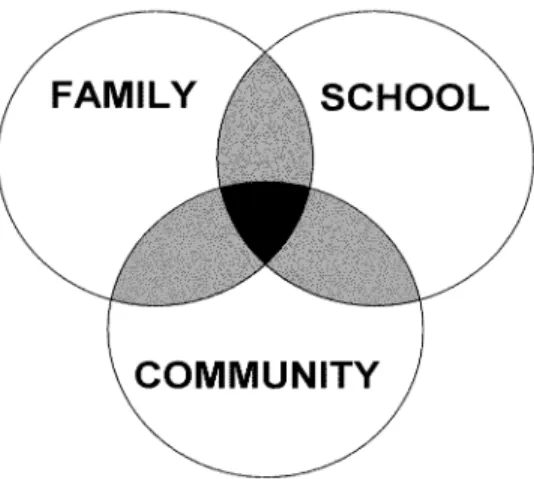
The overlapping spheres of influence model demonstrates shared responsibility of the school, family, and community for a child’s success in school (Epstein et al., 2009). The external structure of the overlapping spheres of influence model recognizes the child at the center as the focus within the family, school, and community (Figure 1). Various experiences, philosophies, practices, and other forces push the spheres together or pull the spheres apart resulting in the amount of overlap between the school, family, and community (Epstein et al., 2009). The amount of overlap change, yet there is never complete overlapping as families, schools, and communities conduct some practices separately (Epstein, 1995).
Figure 1. Overlapping Spheres of Influence - External Structure
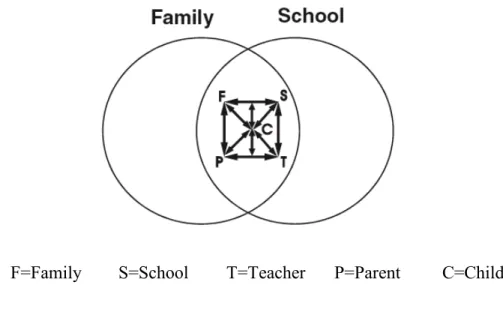
Children interact with, influence, and are influenced by their families, their schools, and their communities (Epstein, 1995). The internal structure of the overlapping spheres of influence model demonstrates the interactions that may occur as a result of families, schools, and
communities working together (Figure 2). These interactions may be at an institutional level involving all families, children, educators, and the entire community or at an individual level involving just one parent, child, teacher, or community partner (Epstein et al., 2009).
The theory of overlapping spheres of influence suggests that educators provide family-like schools, families create school-family-like homes, and community encourage school-family-like
opportunities and family-like services. Educators create family-like schools by recognizing children as individuals and making them feel valuable (Epstein et al., 2009). Parents create school-like families by recognizing the importance of school and school-related activities while encouraging their child’s educational success (Epstein et al., 2009). Communities provide school-like opportunities by reinforcing and recognizing the efforts and success of students. Communities also provide family-like settings and events by encouraging and assisting families
F=Family S=School T=Teacher P=Parent C=Child
Figure 2. Overlapping Spheres of Influence – Internal Structure
in supporting their child’s educational success (Epstein et al., 2009).
Epstein has identified six important types of involvement between schools, families, and the community (Epstein et al., 2009). The six types of involvement are based on the results of many studies over many years of work by educators on families in elementary, middle, and high school (Epstein et al., 2009).
Six Types of School-Family-Community Involvement Parenting
The first type of involvement is parenting and includes helping families with basic
parenting skills, encouraging home conditions to support children in the educational process, and assisting schools to understand families. Schools can assist families in meeting their
responsibilities as parents of children at every age level by providing activities that increase their knowledge and strengthen their skills in an effort to influence their child’s growth and
development (Epstein et al., 2009). Activities that may strengthen parents’ understanding of development, assist with parenting skills, and improve home conditions that may support learning may include but are not limited to family support programs, parent education
workshops, and home visits (Epstein, 2001). Activities should include information for parents and from parents about their families (Epstein et al., 2009). It is critical to provide information to all families, not just the families who attend the workshops or meetings at school. Often families who do not attend or cannot attend are the families who really need the information (Epstein, 2001).
It is important for schools to gather information from families to help educators
understand students and their families, including their backgrounds, goals, strengths, and needs (Epstein, 2001). When parents share this type of information with the school, it creates an awareness of challenges in parenting and builds a strong and trustworthy relationship between the family and the educators (Epstein, 2001). A challenge associated with parenting is ensuring that all information sent to families is clear, useful, and relevant regarding the success of each child in the school. This can be a difficult task as the abilities and needs within the school may be greatly diverse and varied (Epstein, 2001).
Students, parents, and schools can benefit with successful parenting practices in place. Student attendance can improve when families are informed of policies and are involved (Epstein, 2001). Students can have an increased awareness of the importance of school and respect for education (Epstein et al., 2009). Parents can benefit from successful parenting practices by increasing their knowledge of each development stage in their child’s life, which can increase self-confidence about parenting (Epstein, 2001). With successful parenting practices in place, parents may have a greater feeling of support from the school and other parents