The Infusion of Emerging Technologies in Complex Higher Education Settings Juliet Stoltenkamp, André Siebrits
University of the Western Cape (UWC), Bellville, Republic of South Africa [email protected]
Abstract: In the context of an increasing reliance on, and integration of, Information and Communication Technologies (ICTs) into the Higher Education (HE) sector, innovative approaches are being sought in response to infrastructural and resource limits, and mounting pressures to increase participation and throughput rates. This is particularly evident in South Africa, given its history of exclusion and marginalisation. Here, the potential of eLearning has been recognised in expanding access to educational opportunities and in equipping university staff and students with the eSkills and ePedagogy needed to make full use of emerging technologies. At the University of the Western Cape, the Centre for Innovative Education and Communication Technologies (CIECT) was established in 2005 to champion the adoption of emerging technologies at that institution in support of teaching-and-learning practices, and to provide support and training to staff and students in their use. After nearly a decade of experience and refinement, the Centre’s activities are structured according to a systemic framework that drives the infusion of emerging technologies into its particular complex higher education setting. The framework encompasses the areas of Teaching-and-Learning, Research, Community Engagement, and Collaboration, and aligns all eLearning activities with institutional and national policy. The goal of this case study is to share these activities in a complex HE setting, since in order to successfully drive the adoption of emerging eLearning technologies, a systemic framework aligned to institutional and national policy goals is required.
Keywords: eLearning Framework, Higher Education, Infusing Emerging Technologies, eTools Application, Policy Alignment
1. Introduction
In the 21st century, education has increasingly come to depend upon the incorporation of Information and Communication Technologies (ICTs), with much literature reflecting on the emergence and rise of eLearning (for example, Cross 2004; Nicholson 2007). Sangrà, Vlachopoulos and Cabrera (2012: 152) provide an inclusive and comprehensive definition of eLearning, which is a useful starting point, and which understands it as an approach “that is based on the use of electronic media and devices as tools for improving access to training, communication and interaction and that facilitates the adoption of new ways of understanding and developing learning.” Among Higher Education Institutions (HEIs), the adoption of eLearning is particularly evident, given the widespread expectation that the higher education (HE) sector will continue to play a fundamental and critical role in the global development agenda, not only by disseminating the skills required for full participation in the modern Information Economy, but also by producing the professionals who are in short supply, particularly in the Global South (Teferra 2014). In Africa, there has been a rapid increase in enrolments in online HE programmes, with a growing demand for self-paced eLearning, to the extent that it has been classified as the world’s “most dynamic e-learning market” (Sawahel 2013). While eLearning has been perceived as a means to increase participation in HE, infrastructural and cost barriers cannot be ignored, while the rift between those with access to ICTs and those without – known as the digital divide – remains a major issue of concern and an impediment to the transformative potential of ICTs (Sims, Vidgen, and Powell 2008).
In the context of South Africa’s HE sector, with both limited resources and growing pressures to increase the participation and throughput of students and to equip them with the skills necessary for social transformation, particularly from racial groups marginalised before 1994, the adoption of ICT and effective eLearning practices have become crucial policy goals (Jaffer, Ng’ambi & Czerniewicz 2007). For example, in 2004 the Department of Education stated that South Africa’s e-Education policy goal would be the following: “Every South African learner in the general and further education and training bands will be ICT capable (that is, use ICTs confidently and creatively to help develop the skills and knowledge they need to achieve personal goals and to be full participants in the global community) by 2013” (Department of Education 2004: 17).
The goal was subsequently adopted into the National Development Plan (NDP), which sets out the vision for South Africa’s future by 2030, and states: “At the most fundamental level, e-literacy needs to
be improved through training in schools, at tertiary-education facilities and adult-education colleges, as well as through supplier training” (Department of the Presidency 2012: 192). The University of the Western Cape (UWC), as a historically disadvantaged institution, exemplifies the complexities involved in realising this goal in South Africa’s HE sector. UWC has remained committed to striving for excellence in teaching, learning and research (University of the Western Cape 2009).
However, challenges include limited resources, growing pressures to increase student numbers and throughput, and a school system that often does not adequately prepare learners for HE, particularly those from historically marginalised groups. In support of this goal, and with realisation of the demands of the Information Economy, the Centre for Innovative Education and Communication Technologies (CIECT) was established to drive emerging technologies for effective application of eTools and ePedagogy (Stoltenkamp, Kies and Njenga 2007; Stoltenkamp, Taliep and Braaf 2011). Despite these challenges, CIECT has succeeded in infusing emerging technologies into teaching-and-learning practices, research, community engagement, and collaboration, which is reflected within an evidence-based, systemic framework. The goal of this case study is to share these activities in a complex HE setting, in order to successfully drive the adoption of emerging eLearning technologies, a systemic framework aligned to institutional and national policy goals is required.
2. CIECT’s framework for the infusion of emerging technologies in a complex
HE setting
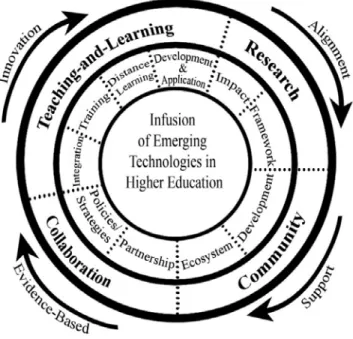
Within this broader context, CIECT’s operation is reflected in a systemic, non-linear framework, Figure 1. The first of these is innovation in the area of Teaching-and-Learning, to ensure that CIECT remains up to date with emerging developments in educational technologies, and to drive these among staff and students while equipping them with the skills required for successful implementation. The second is alignment in the area of Research, so that teaching-and-learning activities are in line with the latest research, and that CIECT’s own research efforts contribute to broader knowledge generation. The third is support in the area of Community Engagement, in recognition of the immense need for ICT and eLearning expertise and skills in South Africa. The fourth and final is evidence-based practice in the area of Collaboration, with a focus on measurability and accountability, and that potential partnerships can lead to third stream income.
Figure 1: Impact of CIECT’s activities in a context of a framework of the infusion of emerging technologies in a complex HE setting (Model by Dr J. Stoltenkamp, September 2014)
The following sections will explore and will present selected practical and measurable examples of CIECT’s activities, starting with its core mandate – supporting effective teaching-and-learning practices at UWC.
3. Teaching-and-Learning
The area of Teaching-and-Learning focuses on the integration of eTools to supplement blended learning environments, understood as a combination of traditional face-to-face classroom learning environments, and electronic eLearning environments (Lanham & Zhou 2003). Training and support of academics and students across faculties regarding the application of eTools for teaching-and-learning is critical. Furthermore, CIECT supports the effective use of emerging technologies to provide flexible learning environments, which entail the combination of new technologies supporting contact and online learning that is student-centred while enabling lecturers to engage with growing student numbers (Alberta Government n.d.).
3.1 Integration
Lecturers across faculties at UWC are engaging in the use of various innovative communication, content creation and assessment eTools within the institutional Learning Management System (LMS), as well as within Google Applications and other Personal Learning Environments (PLEs). As UWC is a member of the Sakai Consortium, it employs iKamva as its particular brand of the Sakai LMS, connecting UWC with a dynamic global partnership.
3.1.1 eTools and mobile integration
This institutional LMS and other Google Applications provide mobile integration, where users are able to access the platform with any mobile device (with internet connectivity). Staff and students are able to access and download notes, view videos, engage in polls and discussion forums, as well as complete tests and quizzes via mobile devices. By the end of 2013, sub-Saharan Africa had a mobile penetration rate of 70%, and by 2014 the number of cellular phones surpassed the number of people in South Africa (Alexander 2014; Southafricaweb.co.za 2014). Projections indicate an expected 20-fold increase in mobile data traffic by 2019 (Alexander 2014).
3.1.2 Marketing effective application
Within this context, the CIECT team regularly blogs about the use of various eTools, affordances and their pedagogical value for teaching-and-learning within the institutional portal, available on the UWC website. In addition, CIECT hosts an annual eLearning colloquium, providing lecturers with the opportunity to share their experiences of adoption and access to educational technologies.
3.2 Training – Continuous Support and Development
CIECT caters for the effective use of eTools and development of ICT applications – for academics, non-academic units, and students across faculties. Training and support are grounded within established research regarding learning processes within an online environment, which emphasises the importance of the first level of development within an online environment (i.e. the critical level of access and motivation), as well as online socialisation (Salmon 2000). CIECT’s current reflection of the quantitative statistics relates to the voluntary requests for training and support workshops, which entail the use of eTools within the LMS and other Personal Learning Environments (PLEs), such as Google Applications, which include ePortfolio, Google Drive, Google Survey, Blogger, Goobric and Doctopus. Additional PLEs include digital stories, podcasts, vodcasts and video productions.
3.2.1 Lecturer: Application of eTools for Teaching-and-Learning
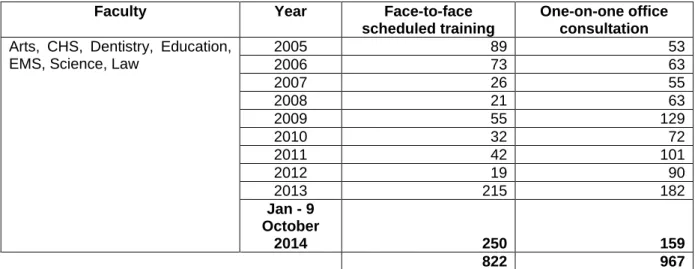
Since September 2005 – October 2014, a number of 1789 academics have received face-to-face scheduled training workshops, as well as personal one-on-one office consultations. The Instructional Design team within CIECT keeps a detailed record of names and departments. A number of 892 online modules have been created due to increasing demand, since the launch of the new institutional LMS in 2012. Furthermore, the Sakai (iKamva) platform is aligned to the institutional Student Administration System Integration (SASI), which contains a database of registered modules for all registered students.
Table 1: Lecturer training - Use of eTools (face-to-face scheduled training and one-on-one office consultations)
Faculty Year Face-to-face scheduled training
One-on-one office consultation Arts, CHS, Dentistry, Education,
EMS, Science, Law
2005 89 53 2006 73 63 2007 26 55 2008 21 63 2009 55 129 2010 32 72 2011 42 101 2012 19 90 2013 215 182 Jan - 9 October 2014 250 159 822 967
Due to CIECT’s continuous drive of the effective use of educational technologies, to date 57% of academics have employed eTools for teaching-and-learning, communication, assessment and marketing purposes within a voluntary context. Lee (2006: 538) acknowledges that the most important factor in increasing adoption of any eLearning system is mandatory usage, and in the absence of this, the provision of high content quality with a simple and easily accessible system, the extensive marketing of the popularity of the system to entice further adoption, and the emphasis on planned future expansions are the most important driving factors in the adoption of eTools and eLearning.
3.2.2 Student training and development: Digital Academic Literacy Programme
CIECT also offers the Digital Academic Literacy (DAL) Programme, which equips students across UWC with basic computer literacy skills in software packages such as Microsoft Word and Excel, email clients, and internet browsers. The training is provided via a semester programme, and is essential in providing eSkills to students, many of whom never had the opportunity to use a computer before entering HE, and who would otherwise struggle to word-process their assignments and do online research. This is closely aligned with UWC’s Institutional Operating Plan (University of the Western Cape 2009:14), which calls for improved opportunities for students to be equipped with academic literacy skills and knowledge necessary for full participation in the job market after graduation (Goal 2, Strategies 2-4). A number of 7231 students were trained during the period 2013 to 16 September, 2014. Table 2 presents the number of students trained for the period 2005 – 2014. Table 2: Students trained – DAL Programme (2005 – 16 September 2014)
Faculty: DAL 2005 2006 2007 2008 2009 2010 2011 2012 2013 2014 EMS 116 731 895 750 2136 1719 1777 1414 1791 2031 Arts 187 374 121 497 587 355 398 400 434 433 CHS 781 413 303 375 530 475 516 452 406 403 Dentistry 31 33 26 28 27 126 135 106 152 121 Science 97 116 0 0 0 0 0 0 0 123 Law 615 473 423 503 488 731 593 0 0 613 Education 0 0 0 0 0 620 815 386 304 401 Total Trained 1827 2140 1768 2153 3768 4026 4234 2758 3106 4 125
In addition, the students also receive training within the LMS and other PLEs. For the period 2013 to October 2014, a number of 4925 students were trained. This data indicate how the definition of basic computer literacy continuously expands according to new technological advances.
Furthermore, the students are exposed to the use of Turnitin (Tii), an internet-based anti-plagiarism detection software, aimed at promoting quality academic writing within learning institutions. This enables students to develop their writing skills, as it facilitates rich, significant feedback on their submitted work, and increases levels of student engagement (Stoltenkamp and Kabaka 2014; iParadigms 2014). Since the adoption of the platform in 2010, 1594 students have received training on request by lecturers, and this entails access, familiarisation, and functionality of application, as well as discussion of the interpretation of reports to revise submissions.
3.2.3 Development of instructional material
The CIECT team produces instructional material, such as video, in collaboration with subject-matter experts and other stakeholders to support teaching-and-learning and marketing events. Training and support are also provided to students from various departments on video editing, image editing, creating screencasts, interactive presentations and concept mapping for assessment purposes.
3.2.4 ICT skills for academic and non-academic staff
ICT skills training and support packages have been provided to UWC academic and non-academic staff members since 2005, and examples of these include IT and Security Awareness, mobile devices, Microsoft Office, Turnitin, and Marks Administrator Training. Since 2010, a total of 3157 staff members have requested training on various packages. Qualitative and quantitative measures indicate the benefits of ICT skills for all staff in terms of acquisition of eSkills, the effective use thereof within the workplace and their personal lives, and access via various geographical spaces.
3.3 ‘Distance Learning’
There is a required expansion in the use of distance education and employment of ICTs to “help overcome the infrastructure limits to further expansion of higher education”, although the expansion of institutional preparedness will require more “upfront investment … in technology, curriculum design, quality assurance and monitoring” (Department of the Presidency 2012: 320). Research emphasises that the success of blended learning courses is based on the institution’s preparedness. The necessary infrastructure needs to be in place, including the designing and redesigning of courses as per student needs, online support for course participants, and monitoring and evaluation measures (Stacey & Gerbic, 2008). Institutions need to set up support structures, including “well-designed hybrid (blended) courses” for the development of faculty (Kaleta, Garnham and Aycock 2005: 2).
CIECT has recognised the call from the Department of Higher Education and Training (DHET) surrounding the “growing convergence of the ways in which traditionally face-to-face and traditionally distance education institutions offer their programmes, largely on account of the increasing use of ICT” (DHET 2014: 8). The realities of challenges faced in the HE setting are emphasised by Xu and Jaggars (2011: 2), who note that students enrolled for purely online courses were found to be “more likely to fail or withdraw”, as compared to those enrolled in face-to-face courses, while Doolittle (2013) notes that blended learning courses were found to have a much higher pass rate.
Here follows examples of ‘distance learning’ initiatives at UWC that are almost ‘purely online’:
3.3.1 Masters Course: Labour Law in the Global Market (2009 – 2014)
This online course provides students access to learning material and discussions, making use of various eTools. The course has been successful due to the structured design, ‘visibility’ and online engagement of a small group of learners (15 students in 2014) who only attend four days face-to-face instruction.
3.3.2 School of Government: Short Course Online Executive Leadership Programme (2011 – 2014)
A blended learning environment has been created for working professionals (134 local Councillors in Government since 2011). Monthly face-to-face lectures are supported by accessible, structured online learning material and assessments.
3.3.3 Social Work Programmes for working professionals (2009 – 2014)
Online environments have been created for the Masters in Child and Family Studies Programme and Postgraduate Diploma in Child and Family studies. A small student group engages in a structured online environment, developed in the LMS. Learners attend contact sessions two to three times annually.
3.4 Development: LMS and stand-alone applications (2015 – 2020)
CIECT is currently undertaking training related to the development of the institutional LMS. The basic fundamentals of this professional development (e.g. Java language – Syntax) will be applied to the maintenance of the Sakai platform, and other stand-alone applications within UWC’s context. These development activities relate to CIECT’s deliverables and practices, which inform research and vice versa.
4. Research
Research ensures quality assurance and review processes within specific contexts. Moreover, Browne’s (1915: 209) statement, that “The intersection between these two roads [pedagogy and research] is undoubtedly one of the most important strategic points along the entire front [of the University]”, emphasises the dialectic relationship. CIECT’s research and publications since 2007 include impact studies related to the institutionalisation of eLearning at UWC, change management strategies, training interventions, effective design of blended learning environments, and ePedagogy. CIECT’s research emphasises open access publications, which play an important role in increasing access to research information and challenging the traditional exclusionary paradigm of barrier-based journals (Taylor 2012).
The focus on impact studies within a complex HE setting leads to the development and sharing of frameworks and models, which impact implementation strategies regarding teaching-and-learning and assessment, related to student development and graduate attributes. These studies are aligned to Browne’s (1915: 108) call that within a HE setting, it is imperative to “be not merely a distributor or disseminator, but also a producer or discoverer of the truth”. This further links to UWC’s IOP (Goal 3: Research and Innovation, Strategies 1-3), which calls for the establishment of distinctive research niche areas, the expansion of existing collaboration, community engagement, research partnerships, and the improvement of research capacity through realignment of internal research funding resources (University of the Western Cape 2009: 17-18).
5. Community Engagement
CIECT supports the development of the UWC community, as well as external communities. Following are examples of developments and engagements embedded within the larger ecosystem shaped by Government policy.
Community engagement aligned to Basic Education:
CIECT’s community partnerships are informed by the NDP: “As a middle-income country, South Africa has to compete on the basis of excellent products and brands, and effective entry into global distribution channels” (Department of the Presidency 2012: 41).
CIECT collaborated with the South African National Bioinformatics Institute (SANBI) to develop a ‘Digital Resource Toolkit’: How to be a Health Activist (Grade 8 – 12 learners). Prior to this partnership, the CIECT team collaborated with a German capacity building organisation to enskill staff members. In turn, they were responsible for transferring skills related to the production of online and off-line learning material, making use of Open Source Software.
The partnership included other stakeholders (subject-matter experts, digital illustrators) to produce a digital resource (interactive DVD). SANBI aims to roll out this resource throughout the Western Cape Province. Moreover, partnerships such as these will require critical discussions in order to emphasise agreements related to Intellectual Property (IP).
Collaboration with the Community Engagement Unit (CEU) - Database Project
The Director of Community Engagement (UWC) requested the development of an institutional database, which includes information related to community projects within faculties and support units. This is visible to staff and potential (public) funders.
Community engagement aligned to Basic and Higher Education
CIECT designed and developed a blended learning Professional Development Programme for educators, rated at level 6 in the National Qualifications Framework (NQF) of South Africa, namely: Design an Instructional Event. The Programme has been delivered to educators in primary and high-school, as well as HE settings, and focuses on the principles of instructional design within online and offline environments. Hence, educators from various levels and disciplines from both urban and rural settings could partake in the programme, and focus on the application of the eTools for teaching-and-learning.
This programme takes place in a context of recognising that while “enrolment rates across sub-Saharan Africa have doubled in the last generation, completion rates are still under 70 percent, compared to over 90 percent for North Africa and East Asia” (Department of the Presidency 2012: 34 & 85).
Continuous professional development course for supervisors (internal and external)
CIECT collaborated with UWC’s Social Work Department to design and develop a programme for supervisors which entailed the alignment of subject-matter to a blended learning environment. The effective integration of eTools and its affordances, will lead to a joint publication regarding the benefits of this programme and its broader applicability to other disciplines.
These community projects, aligned to both Basic and Higher Education, take place within the national context of developing “a post-school system that provides quality-learning opportunities to young people, adults who want to change careers or upgrade skills, people who have left school before completing their secondary education and unemployed people who wish to start a career” (Department of the Presidency 2012: 315).
CIECT’s deliverables and practices inform collaboration with internal and external partners, and in turn these are further strengthened by such collaboration.
6. Collaboration
CIECT’s partnerships open boundaries across disciplines and geographical borders in alignment with UWC’s IOP, aimed at harvesting third stream income.
Following are examples of partnerships to create blended learning environments and training programmes: (i) collaboration with a lecturer (English for Educational Development/EED Programme) to create an online environment for students, which led to joint publication (Bharuthram & Kies 2013); (ii) University of Stellenbosch and UWC Economics Department; (iii) Astronomy Long-term Strategy Collaborative Project (7 Directories of the strategic plan); (iv) Utrecht University of Applied Science and UWC; (v) Missouri University and UWC; (vi) Multi-disciplinary University Traditional Health Initiative (MUTHI) (shared among 8 universities from Africa and Europe), (vii) and African Natures-cultures (collaboration on a book with various stakeholders – located globally).
In addition, partnerships with the South African Government, for example the Departments of Communication (DOC) and Economic Development and Tourism (DEDAT), reflect on evidence-based community projects aligned to the National eSkills Plan of Action (Department of Communications 2012).
These partnerships inform strategies and policies related to the support of online environments for student and professional development, and teaching-and-learning practices (including flexible working hours, incentives and online ‘visibility’). Moreover, these will extend to critical discussions of online assessment, digital inclusion, joint research projects, and other change management strategies.
7. Conclusion
The complex challenges facing the HE sector, particularly in the Global South, have multiplied as the world became more interconnected. In Africa, the digital divide has threatened to exclude much of the continent from the benefits offered by eLearning. However, these challenges are being met with a dynamism, adaptability, and determination within specific contexts. The rapid explosion in online connectivity despite fixed-line infrastructural limits is evidence of this.
In the South African context, the White Paper for Post-School Education and Training (Department of Higher Education and Training 2013: 31-32) sets out the challenges facing the HE sector regarding attrition. This systemic framework is a response to this challenge within a complex HE setting. The case study reflected on the need for effective flexible and measurable teaching and learning practices characterised by effective design. The value of such practices is visible through the various international, national, and internal collaborative partnerships. These collaborations enable the sharing of expertise, and encourage interaction between diverse communities.
Furthermore, this framework reflected the impact of CIECT’s activities, which have reached beyond the provision of training workshops, and is indicative of reiterative processes and approaches related to the areas of Teaching-and-Learning, Research, Community Engagement, and Collaboration. Moreover, it responds to the need for HEIs to expand access to learning opportunities through innovative and flexible technologies and practices.
References
Alberta Government (n.d.) Foundational Principles for High School Redesign: Flexible Learning Environments, [Online], Available: https://ideas.education.alberta.ca/media/74565/flexiblelearning.pdf [15 Oct 2014].
Alexander, M. (2014) ‘Mobile Phone Boost to African Internet’, Media Club South Africa, 10 Jun, Available: http://www.mediaclubsouthafrica.com/africa/3867-mobile-phone-boost-to-african-internet?tmpl=component&print=1&layout=default&page= [16 October 2014].
Bharuthram, S., and Kies, C. (2013) ‘Introducing e‐learning in a South African Higher Education Institution: Challenges arising from an intervention and possible responses’, British Journal of Educational Technology, vol. 44, no. 3, pp. 410-420.
Browne, A. W. (1915) ‘The Goals of Scientific Research: President's Address Read Before the Cornell Chapter of the Sigma Xi’, Sigma Xi Quarterly, vol. 3, no. 4, pp. 108-116.
Cross, J. (2004) ‘An Informal History of eLearning’, On the Horizon, vol. 12, no. 3, pp. 103-110. Department of Communications (2013) National e-Skills Plan of Action (NeSPA 2012), [Online], Available: http://www.doc.gov.za/documents-publications/category/14-e-skills-documents.html [14 October 2014].
Department of Education (2004) ‘White Paper on e-Education: Transforming Learning and Teaching through Information and Communication Technologies (ICTs)’, Government Gazette, no. 26734. Department of Higher Education and Training (2013) White Paper for post-School Education and Training: Building an Expanded, Effective and Integrated Post-School System, [Online], Available: www.gov.za/documents/download.php?f=207591 [14 October 2014].
Department of Higher Education and Training (2014) ‘Policy for the Provision of Distance Education in South African Universities in the Context of an Integrated Post-School System’, Government Gazette, no. 37811.
Department of the Presidency (2012) National Development Plan 2030: Our Future – Make It Work, Pretoria: National Planning Commission, [Online], Available: http://www.npconline.co.za/pebble.asp?relid=25 [14 October 2014].
Doolittle, T. (2013) UT Austin to Expand Blended Learning Offerings to Improve Student Success and First-Year Experience, [Online], Available: http://www.utexas.edu/news/2013/05/28/ut-austin-to-expand-blended-learning-offerings-to-improve-student-success-and-first-year-experience/ [16 October 2014].
iParadigms, LLC (2014) Survey Finds Turnitin Saves Time and Improves Feedback, [Online], Available: http://turnitin.com/en_us/resources/blog/421-general/2034-survey-finds-turnitin-saves-time-and-improves-feedback [16 October 2014].
Jaffer, S., Ng’ambi, D. and Czerniewicz, L. (2007) ‘The Role of ICT’s in Higher Education in South Africa: One Strategy for Addressing Teaching and Learning Challenges’, International Journal of Education and Development using Information and Communication Technology (IJEDICT), vol. 3, no. 4, pp. 131-142.
Kaleta, R., Garnham, C and Aycock, A. (2005) Hybrid Courses: Obstacles and Solutions for Faculty
and Students, [Online], Available:
http://www.uwex.edu/disted/conference/Resource_library/proceedings/03_72.pdf [15 October 2014]. Lanham, E. and Zhou, W. (2003) ‘Cultural Issues in online Learning – Is Blended Learning a Possible Solution?’, International Journal of Computer Processing of Oriental Languages, vol. 16, no. 4, pp. 275-292.
Lee, Y. (2006) ‘An Empirical Investigation into Factors Influencing the Adoption of e-Learning System’, Online Information Review, vol. 30, no. 5, December, pp. 517-541.
Nicholson, P. (2007) ‘A History of E-Learning: Echoes of the Pioneers’, in Fernández-Manjón, B. et al. (eds.) Computers and Education: E-Learning, From Theory to Practice, pp. 1-11, Dortrecht: Springer. Salmon, G. (2000) E-moderating: The Key to Teaching and Learning Online, London: Kogan Page. Sangrà, A., Vlachopoulos, D. and Cabrera, N. (2012) ‘Building an Inclusive Definition of E-Learning: An Approach to the Conceptual Framework’, The International Review of Research in Open and Distance Learning, vol. 13, no. 2, pp. 146-159.
Sawahel, W. (2013) ‘Africa is Most Dynamic E-Learning Market on the Planet’, University World News Global Edition, Issue 256, 25 Jan, [Online], Available: http://www.universityworldnews.com/article.php?story=20130125105755921 [15 October 2014]. Sims, J., Vidgen, R. and Powell, P. (2008) ‘E-Learning and the Digital Divide: Perpetuating Cultural and Socio-Economic Elitism in Higher Education’, Communications of the Association for Information Systems, vol. 22, no. 23, pp. 429-442.
Southafricaweb.co.za (2014) South Africans and their cell phones, 5 February, [Online], Available: http://www.southafricaweb.co.za/article/south-africans-and-their-cell-phones [16 October 2014]. Stacey, E., and Gerbic, P. (2008) ‘Success factors for blended learning. Hello! Where are you in the landscape of educational technology?’, Proceedings ascilite Melbourne, Melbourne, pp. 964-968. Stoltenkamp, J. Kies, C. and Njenga, J. (2007) ‘Institutionalising the eLearning Division at the University of the Western Cape (UWC): Lessons Learnt’, International Journal of Education and Development using Information and Communication Technology (IJEDICT), vol. 3, no. 4, pp. 143-152. Stoltenkamp, J., and Kabaka, M. (2014) 'Turnitin Adoption and Application at a HEI: A Developmental Approach', Creative Education, vol. 5, no. 12, pp. 1043-1052.
Stoltenkamp, J., Taliep, T. and Braaf, N. (2011) ‘Exponential Growth and Pain: Implementing eLearning at a Higher Education Institution’, International Journal of Instructional Technology and Distance Learning, vol. 8, no. 6, pp. 77-90.
Taylor, M.P. (2012) ‘Persistent myths about open access scientific publishing’, The Guardian, 17 April, [Online], Available: http://www.theguardian.com/science/blog/2012/apr/17/persistent-myths-open-access-scientific-publishing [16 October 2014].
Teferra, D. (2014) ‘Critical to Include HE in Post-2015 Development Agenda’, University World News Global Edition, Issue 327, 4 Jul, [Online], Available: http://www.universityworldnews.com/article.php?story=20140703102652995&query=elearning [15 October 2014].
University of the Western Cape (2009) Institutional Operating Plan: 2010-2014. Greymatter & Finch #5845.
Xu, D., and Jaggars, S.S. (2011) ‘Online and Hybrid Course Enrolment and Performance in Washington State Community and Technical Colleges’, CCRC Working Paper, no. 31, Columbia University: Community College Research Centre.