Theses & Dissertations Boston University Theses & Dissertations
2018
Designing energy-efficient
computing systems using
equalization and machine learning
https://hdl.handle.net/2144/27408 Boston University
BOSTON UNIVERSITY
COLLEGE OF ENGINEERING
Dissertation
DESIGNING ENERGY-EFFICIENT
COMPUTING SYSTEMS USING EQUALIZATION AND
MACHINE LEARNING
by
ZAFAR TAKHIROV
Specialist, Russian-Tajik (Slavonic) University, 2008
M.S., Boston University, 2012
Submitted in partial fulfillment of the
requirements for the degree of
Doctor of Philosophy
2018
Approved by
First Reader
Ajay J. Joshi, PhD
Associate Professor of Electrical and Computer Engineering
Second Reader
Venkatesh Saligrama, PhD
Professor of Electrical and Computer Engineering Professor of Systems Engineering
Professor of Computer Science
Third Reader
Ayse K. Coskun, PhD
Associate Professor of Electrical and Computer Engineering
Fourth Reader Joseph Wang, PhD Research Scientist, Amazon.com, Inc. Fifth Reader Michel Kinsy, PhD
Acknowledgments
First and foremost, I am endlessly thankful to two people without whom this work would not have been possible – my advisor, professor Ajay Joshi, and my lovely wife, Alice. Their help and support, despite my constant resistance, was the only thing that brought me where I am right now. Ajay’s guidance and help was crucial in every aspect of my academic work, while Alice’s unconditional support will be the sole reason I managed to survive this confusing, head-bashing, excruciating path.
I would like to express gratitude to my parents, Gulnara and Mahmadzahir, as they were the ones who encouraged me to take on this path, and were very helpful both morally and financially throughout my life. Both of my brothers, Akbar and Askar, were there when I needed them the most, and thus should always be thanked for believing in me. On the same note, I would like to thank the Department of Electrical and Computer Engineering of Boston University, and especially the administration and the advisors of the Late Entry Accelerated Program (LEAP) for providing me with an opportunity to achieve something I never hoped to engage.
I would also like to use these pages to mention the people I collaborated with academically and professionally. It goes without saying that without numerous dis-cussions with Joe Wang and Marcia S. Louis, the later part of this work would have been dull and unimpressive. My only regret is that I didn’t meet them earlier in my career. Also, Yuhong Huang was incredibly supportive both as a manager and as a friend during my time at Analog Devices, Inc. She was an incredible mentor, and she is continuing being a great family friend. I would like to mention my colleagues in the infamous PHO 340 who I spent great amount of time with: discussing completely irrelevant topics (Boyou), being roommates and three-am-walk-home buddies (Chao), partying like it was the last thing in our life (Mahmoud), arguing till our noses started bleeding (Schuyler), learning how to curse in Chinese (Yenai), playing chess (Saiful
PHO 340, where I spent the last several years and made a lot of friends. This goes to all members of the PEAC and CAAD labs without exception.
Many more people played an indirect, but crucial role during my work. In partic-ular without the help of Aksana, Sveta, Leo, and Vlad I would probably spend a lot more nights sleeping on Fenway park benches. Ato and his team were the motivation and inspiration for all those sleepless nights me working with them, and still having the energy to work on more projects in the morning.
DESIGNING ENERGY-EFFICIENT
COMPUTING SYSTEMS USING EQUALIZATION AND
MACHINE LEARNING
ZAFAR TAKHIROV
Boston University, College of Engineering, 2018
Major Professor: Ajay Joshi, PhD
Associate Professor of Electrical and Computer
Engineering
ABSTRACT
As technology scaling slows down in the nanometer CMOS regime and mobile com-puting becomes more ubiquitous, designing energy-efficient hardware for mobile sys-tems is becoming increasingly critical and challenging. Although various approaches like near-threshold computing (NTC), aggressive voltage scaling with shadow latches, etc. have been proposed to get the most out of limited battery life, there is still no “silver bullet” to increasing power-performance demands of the mobile systems. Moreover, given that a mobile system could operate in a variety of environmen-tal conditions, like di↵erent temperatures, have varying performance requirements, etc., there is a growing need for designing tunable/reconfigurable systems in order to achieve energy-efficient operation. In this work we propose to address the energy-efficiency problem of mobile systems using two di↵erent approaches: circuit tunability and distributed adaptive algorithms.
Inspired by the communication systems, we developed feedback equalization based digital logic that changes the threshold of its gates based on the input pattern. We
We also achieved 30% reduction in energy dissipation for pass-transistor digital logic (PTL) with equalization while maintaining performance. In addition, we proposed a mechanism that leverages feedback equalization techniques to achieve near optimal operation of static complementary CMOS logic blocks over the entire voltage range from near threshold supply voltage to nominal supply voltage. Using energy-delay product (EDP) as a metric we analyzed the use of the feedback equalizer as part of various sequential computational blocks. Our analysis shows that for near-threshold voltage operation, when equalization was used, we can improve the operating fre-quency by up to 30%, while the energy increase was less than 15%, with an overall EDP reduction of ⇡10%. We also observe an EDP reduction of close to 5% across entire above-threshold voltage range.
On the distributed adaptive algorithm front, we explored energy-efficient hardware implementation of machine learning algorithms. We proposed an adaptive classifier that leverages the wide variability in data complexity to enable energy-efficient data classification operations for mobile systems. Our approach takes advantage of varying classification hardness across data to dynamically allocate resources and improve energy efficiency. On average, our adaptive classifier is ⇡100⇥ more energy efficient but has ⇡1% higher error rate than a complex radial basis function classifier and is ⇡10⇥ less energy efficient but has ⇡40% lower error rate than a simple linear classifier across a wide range of classification data sets. We also developed a field of groves (FoG) implementation of random forests (RF) that achieves an accuracy comparable to Convolutional Neural Networks (CNN) and Support Vector Machines (SVM) under tight energy budgets. The FoG architecture takes advantage of the fact that in random forests a small portion of the weak classifiers (decision trees) might be
sufficient to achieve high statistical performance. By dividing the random forest into smaller forests (Groves), and conditionally executing the rest of the forest, FoG is able to achieve much higher energy efficiency levels for comparable error rates. We also take advantage of the distributed nature of the FoG to achieve high level of parallelism. Our evaluation shows that at maximum achievable accuracies FoG consumes⇡1.48⇥,
⇡24⇥, ⇡2.5⇥, and ⇡34.7⇥ lower energy per classification compared to conventional RF, SVMRBF, Multi-Layer Perceptron Network (MLP), and CNN, respectively. FoG
is 6.5⇥less energy efficient than SVMLR, but achieves 18% higher accuracy on average
across all considered datasets.
1 Introduction 1
1.1 Background and Motivation . . . 1
1.2 General Principles for Energy-Efficient System Design . . . 4
1.3 Related Work . . . 12
1.3.1 Circuits and Architectures that Trade-O↵Performance, Energy, and Error Rate . . . 12
1.3.2 Adaptive Systems and Machine Learning Hardware . . . 15
1.4 Contributions . . . 20
2 Error Mitigation in Digital Logic Using Feedback Equalization 25 2.1 Introduction . . . 25
2.2 Error Manifestations in Digital Logic . . . 26
2.3 Equalization Techniques . . . 28
2.3.1 Feedback circuit . . . 29
2.3.2 Schmitt trigger . . . 30
2.3.3 Feedback Equalization with Schmitt Trigger (FEST) . . . 31
2.4 Experimental Results . . . 33
2.4.1 Kogge-Stone Adder . . . 33
2.4.2 Finite Impulse Response Filter . . . 36
2.5 Experimental Results for Near-Threshold Design . . . 38
2.5.1 Experimental Setup . . . 38
2.5.2 Experimental Results . . . 39
2.6 Conclusion . . . 41
3 Energy Efficient Pass-Transistor Logic Using Decision Feedback Equal-ization 45 3.1 Introduction . . . 45
3.2 Equalized Pass-Transistor Logic . . . 47
3.3 Modeling and Design Automation of E-PTL . . . 50
3.3.1 Power Modeling . . . 50
3.3.2 Error Rate Modeling . . . 51
3.3.3 Delay Modeling . . . 56
3.3.4 Optimization Tool-flow . . . 56
3.3.5 Modeling vs. Simulation . . . 57
3.4 Evaluation . . . 58
3.5 Conclusion . . . 60
4 Adaptive Classification: Energy-Efficient Design for Machine Learn-ing 61 4.1 Introduction . . . 61
4.2 Adaptive Classifier – Theory . . . 64
4.2.1 Hardness of an Input and Penalty for Misclassification . . . . 64
4.2.2 Training the “chooser” for a fixed energy budget . . . 67
4.2.3 Training the “chooser” for a changing energy budget . . . 71
4.3 Adaptive Classifier – Microarchitecture Description . . . 73
4.4 Evaluation . . . 76
4.4.1 Experimental Setup . . . 78
4.4.2 Experimental Results of an approach with static energy budget 81 4.4.3 Experimental Results of the approach with dynamic energy budget . . . 85
5 Random Forest and the Field of Groves 91
5.1 Introduction . . . 91
5.2 Energy-Efficient Computing using Random Forests . . . 93
5.2.1 Field of Groves Algorithm . . . 96
5.2.2 Micro-architecture . . . 100
5.3 Evaluation . . . 106
5.3.1 Experimental Setup . . . 106
5.3.2 Experimental Results . . . 112
5.4 Conclusion . . . 116
6 Conclusion and Future Work 118 6.1 Summary of Contributions . . . 118
6.1.1 Feedback Equalization . . . 118
6.1.2 Machine Learning Accelerators . . . 120
6.2 Future Research Directions . . . 122
6.2.1 Feed-Forward Equalization in Pass-Transistor Logic . . . 122
6.2.2 Specialized Architectures for Machine Learning Acceleration . 123 6.2.3 Bridging the gap between Hardware and Machine Learning . . 124
References 125
Curriculum Vitae 141
List of Tables
2.1 Inverter threshold values . . . 29
2.2 Switching thresholds of di↵erent designs . . . 32
2.3 Evaluation results of di↵erent designs . . . 44
3.1 Minimum energy comparison of di↵erent designs . . . 60
4.1 Notation and variables used in the current work . . . 64
4.2 Pseudo-label assignment example: given di↵erent inputs “8”, we gen-erate pseudo-labels depending on the correct predictions of the “core”. 65 4.3 Datasets used and the number of inputs misclassified during the train-ing phase. . . 66
4.4 Energy and Delay for the adaptive classifier and conventional classifiers for di↵erent data sets. Each row corresponds to subplots in Figure 4·5. Energy results are shown in J/classification and delay is represented asµs. . . 77
4.5 Comparison of the proposed and SEC approaches (Venkataramani et al., 2015a) trained for low energy subject to error rate budget. The time is in seconds. . . 78
5.1 Notation used in section 5.2.2 . . . 100
5.2 Datasets used for FoG evaluation . . . 107
5.3 Accuracy and Energy dissipation for FoG . . . 110
5.4 CPU, GPU, and FPGA Results for FoG . . . 117
1·1 Low-power parallel and pipelined computing . . . 5
1·2 Order of Execution matters . . . 6
2·1 DC response of the feedback equalizer circuit. . . 27
2·2 Variable threshold inverter circuit (Sridhara et al., 2008). . . 28
2·3 Inverting Schmitt trigger circuit (Baker, 2004). . . 30
2·4 Pipelined combinational logic with FEST circuit. . . 31
2·5 Transients of KSA . . . 34
2·6 4-bit KSA . . . 35
2·7 4-bit, 3-tap FIR . . . 36
2·8 EDP results across entire above-threshold range . . . 40
2·9 Distribution of 24-bit multiplier . . . 41
2·10 Distribution of AES-256 . . . 42
2·11 Distribution of RS Decoder . . . 43
2·12 Distribution of an FFT . . . 43
3·1 Schematic diagram of a Equalized Pass-Transistor Logic (E-PTL) . . 47
3·2 Transients of equalized and non-equalized . . . 47
3·3 PDF of noisy PTL . . . 51
3·4 Model of the proposed E-PTL . . . 53
3·5 Model vs. Simulation for 16-bit CLA . . . 55
3·6 16-bit Carry-Look Ahead Adder . . . 57
3·7 Monte-Carlo simulation results for CLA . . . 59 xiv
4·1 EDP and Error rate vs. the budget of an adaptive classifier: (a) trained with EDP budget as a feature; (b,c,d) trained to maximize the accuracy while meeting an energy constraint of 10 20, 10 18, and 10 16respectively. 72 4·2 Block diagram of the adaptive classifier. “Chooser” function is marked
as ? , and its microarchitecture is the same as the “Easy” block. Data paths are shown as solid lines, while control path is dashed. The linear classifier is implemented as a multiply-accumulate (MAC) block and is equivalent to equation (4.9). The polynomial function implementa-tion uses a MAC to compute higher order components ↵p(·)x(·)p as per
equation (4.10). The RBF classifier also uses and MAC and its the exponential function is implemented as a look up table. . . 74 4·3 Energy delay products for di↵erent adaptive classifier designs generated
by Aladdin (Shao et al., 2014). . . 78 4·4 Average overheads of di↵erent types of “chooser” functions. The EDP
overhead is average EDP contribution of the “chooser” with respect to an adaptive classifier where this “chooser” is implemented. The error rate overhead is the error rate contributed by the “‘chooser” function itself. . . 82 4·5 Error rate vs. Energy Delay Product (EDP) for adaptive classifier and
conventional classifiers. Adaptive classifier can be tuned to achieve any of the intermediate error rate values. . . 83 4·6 Energy dissipation distribution and the total energy dissipation vs.
error rate for di↵erent classification problems. . . 85 4·7 Relative area distribution of subblocks in adaptive classifier (bars) as
well as the total area (solid line). . . 86
5·1 Example of a Random Forest . . . 93
5·2 Common Machine Learning Algorithms . . . 94
5·3 Accuracy degradation for MLP and RF . . . 94
5·4 Logical view of RF and FoG. . . 99
5·5 Field of Groves implementation . . . 101
5·6 FoG processing element (PE) . . . 102
5·7 FoG system design flow diagram . . . 108
5·8 Accuracy and Energy dissipation of di↵erent classifiers . . . 111
5·9 Accuracy and EDP of FoG . . . 114
5·10 Example of FoG run-time tuning using the “threshold” variable. . . . 115
5·11 Computational performance comparison between GPU, FPGA, and SIMD CPU . . . 116
List of Abbreviations
AC . . . Alternating Current ACU . . . Analog Computing Unit AGC . . . Automatic gain control AI . . . Artificial Intelligence ALU . . . Arithmetic Logic Unit ANN . . . Artificial Neural Network
API . . . Application Programming Interface ASIC . . . Application-specific Integrated Circuit BJT . . . Bipolar Junction Transistor
BLAS . . . Basic Linear Algebra Subprograms BSD . . . Berkeley Software Distribution BU . . . Boston University
CMOS . . . Complimentary Metal-oxide-semiconductor CNN . . . Convolutional Neural Network
CORDIC . . . Coordinate Rotation Digital Computer CPU . . . Central Processing Unit
CUDA . . . NVIDIA’s Parallel Programming API for GPUs DBN . . . Deep Belief Network
DC . . . Direct Current
DNN . . . Deep Neural Network DSP . . . Digital Signal Processor
DVFS . . . Dynamic Voltage and Frequency Scaling E-PTL . . . Equalized Pass-Transistor Logic
EDEP . . . Energy-delay-error Product EDP . . . Energy-delay Product
EMC . . . Or Dell EMC2 – Egan-Marino Corporation EU . . . Arbitrary energy dissipation unit
FANN . . . Fast Artificial Neural Network library FEST . . . Feedback Equalization with Schmitt Trigger FFE . . . Feedforward Equalization
FoG . . . Field of Groves accelerator FPGA . . . Field Programmable Gate Array GPU . . . Graphics Processing Unit
HDL . . . Hardware Description Language HW . . . Hardware
IEEE . . . The Institute of Electrical and Electronics Engineers IDC . . . International Data Corporation
ISA . . . Instruction Set Architecture IoT . . . Internet of Things
JPEG . . . Joint Photographic Experts Group
LEAP . . . Boston U. Late Entry Accelerated Program LSTM . . . Long Short Term Memory
MAC . . . Multiply Accumulate ML . . . Machine Learning
MLP . . . Multilayer Perceptron Neural Network
MOSFET . . . Metal-oxide-semiconductor Field-e↵ect-transistor MSE . . . Mean Squared Error
NASA . . . The National Aeronautics and Space Administration NN . . . Neural Network NTC . . . Near-Threshold Computing NTV . . . Near-Threshold Voltage OS . . . Operating System PC . . . Personal Computer PE . . . Processing Element PTL . . . Pass Transistor Logic
PVT . . . Process, Voltage, Temperature (variations) RBF . . . Radial Basis Function
RISC . . . Reduced Instruction Set Computer
RISC-V . . . Fifth Generation of RISC Instruction Sets RNN . . . Recurrent Neural Network
RTL . . . Register-transfer Level RoCC . . . Rocket Custom Coprocessor SIMD . . . Single Instruction Multiple Data SNR . . . Signal-to-Noise Ratio
SVM . . . Support Vector Machine TPU . . . Tensor Processing Unit
UART . . . Universal Asynchronous Receiver/Transmitter VCD . . . Value Change Dump
VLSI . . . Very Large Scale Integration
Chapter 1
Introduction
1.1
Background and Motivation
As we enter the ‘Internet of Things’ (IoT) regime, the computing industry is placing more and more emphasis on designing energy-efficient mobile systems (Wu, 2015). This increasing emphasis on energy-efficiency is driven by the need for the mobile systems to be able to process large quantities of data in real time (which requires proportional amount of energy) and also the slow development in battery technology. Moreover, these mobile systems are expected to operate in a variety of environments, and hence there is a need to develop tunable/adaptive systems that can dynamically adapt and maximize the system energy efficiency. The focus of this research is to address this energy efficiency problem by developing tunable digital logic circuits as well as developing hardware based on adaptive data processing algorithms.
In addition to IoT, emerging paradigm of “Big Data” is also driving research to-wards more energy-efficient designs. Big Data is a general name for data sets so large and complex that traditional approaches to computation become inadequate. A good example of “Big Data” is social media analysis – information whether someone “lik-ing” company pages on Facebook or tweeting complaints about products needs to be harvested and processed in order to deliver the best customer interaction. Widespread access to information as well as ever increasing rate of information generation require new energy-efficient data-processing computation units (IDC and EMC2, 2012, Bell et al., 1972).
This problem of Big Data and IoT is non-trivial - devices are getting smaller 100 times every decade (TSensors, 2013), and every year the number of active nodes connected to the Web is increasing by hundreds of thousands (Hilbert and Lopez, 2011, IDC and EMC2, 2013, TSensors, 2013). Fundamentally, this creates a demand for a new design paradigm in the area of mobile computing. Miniaturization of energy sources and “intelligent” power management, although being of research interest, is not growing as fast as the demand for computation, making energy-efficiency an immediate requirement.
Currently, there are multiple parallel e↵orts in place to design energy-efficient computing systems. At the device level, Complementary Metal Oxide Semiconductor (CMOS) technology scaling enabled us to lower power and improve performance ev-ery two years. However, CMOS technology scaling has slowed down and is expected to end in the next 10 years, thus limiting the improvements in energy efficiency (Williams, 2017). Hence, alternate switching devices like Tunnel Field E↵ect Tran-sistors (TFETs), Carbon Nanotube FETs (CNFETS) are being explored (Richter et al., 2014, Paul et al., 2006). Other emerging technologies such as graphene FETs (Iannazzo et al., 2015, Khan et al., 2014), silicon NanoWire FETs (Turkyilmaz et al., 2013, Yazeer et al., 2016), Spintronics (Bishnoi et al., 2017), and Memristor-based systems (Zangeneh and Joshi, 2014a) have also shown promising results in pushing the boundaries of the Moore’s law.
At the circuit level, (Zhai et al., 2004) and (Calhoun and Chandrakasan, 2004) have shown that there exists a minimum energy supply voltage, which lies in the subthreshold region (Wang and Chandrakasan, 2004). Although subthreshold design enables ultra-low energy dissipation, the drawback of subthreshold design is that energy reduction comes at a price of significant performance degradation, which lowers the energy efficiency. A better approach is to operate the circuits near the threshold
3
voltage. This operating point provides the best balance between energy dissipation and performance (Dreslinski et al., 2010). However, we would like to note that this balanced operating point is highly dependent on the application and environmental conditions. As a result, the solution to this energy efficiency problem should 1) have the ability to operate at-or-near the maximum energy efficiency point, 2) have the ability to adapt to changing environmental conditions while satisfying condition 1, and 3) have the mechanism to change the current operating figures-of-merit if the environment (i.e. battery state) change. To tackle these requirements, we propose a multilayer approach to energy-efficient computing. In particular, we laid the grounds for the development of circuit-, architecture-, and algorithm-level mechanisms as given below:
• Circuit-level mechanism: While designing a circuit, we use a lot of opti-mization parameters, such as technology node, device dimensions, architecture, routing topology, etc. These parameters can be seen as pre-fabrication knobs for “static optimization”. However, it is difficult to predict the exact operating conditions of a circuit. Hence it is necessary to provide a tuning capability in the circuit. In this work we developed a feedback equalization mechanism for computation blocks. In particular we have shown that feedback equaliza-tion with Schmitt Trigger and feedback equalizaequaliza-tion in pass-transistor logic are viable solutions for energy-efficient computation. We expanded this work to enable tunability (details in Chapters 2 and 3), which enables a more robust operation in changing environmental conditions.
• Algorithm-level mechanisms: Generally algorithmic approaches are appli-cation specific, however, we showed that is it possible to develop an adaptive system that would utilize machine learning in order to achieve adaptability. For example a mobile processor, that is manufactured without prior knowledge of
operating conditions might utilize machine learning algorithms to adapt to the changing environment. In this case the machine learning approach creates a “tuning knob” for trading o↵ energy, performance, as well as error rate, where applicable. As shown in Chapter 4, machine learning algorithms can be uti-lized to adapt to changing operating conditions, such as change in workload, change in performance requirements, energy budget, etc. In our work we show that using machine learning approaches, a more energy-efficient operating point for supply voltage is achievable. We also show the implementation of a recon-figurable machine learning approach to enable adaptability for changing input data-sets.
• Architecture-level mechanisms:Ideally, one would like to have sight of the entire computing stack, and without the discussion of the architecture-level mechanisms the picture of energy-efficient computing is incomplete. In Chap-ter 5 we propose the use of distributed architecture to achieve lower energy dissipation using decision forest. In general we show that machine learning sys-tems that benefit from graceful degradation of accuracy are logical choice to operate in ever-changing energy-budget conditions in mobile systems.
1.2
General Principles for Energy-E
ffi
cient System Design
To provide a little more general background on energy efficiency, let us share some insights that we have gathered with regard to the energy-efficient and low-power hardware design. In this subsection we would like to summarize some high level ideas that one must always consider, as well as some general “tips” that might be useful as stated in (Sarpeshkar, 2010, Rabaey, 2009, Lee, 2004, Chandrakasan, 1996). Note, that there is no “silver bullet” in designing energy-efficient circuits, architectures, and algorithms. However, the following key ideas might be a good starting point towards
5 PE 1 PE 2 PE ... Dem u lti p le xer M u lti p le xer PE 1 RE G PE 2 ... PE R E G R E G (a) (b)
Figure 1·1: Conceptual diagrams of low-power computing architec-tures. (a) Parallel architecture with N low voltage slow processing elements (PEs); (b) Pipelined version of the computing unit with N
slow elements operating at low voltage.
improving the energy related figures-of-merit (FoMs).
Two of the most popular ideas for energy-efficient circuit designs are parallelism
and pipelining. Circuit level parallelism uses a demultiplexer to redirect a high-bandwidth serial input to many low-throughput identical slow-and-parallel computing units. The outputs are then sequentially sampled by a fast multiplexer to recreate the high-throughput serial output. Figure 1·1(a) shows an illustration of this concept as proposed in (Chandrakasan and Brodersen, 1995). N processing elements (PEs) are operating at lower voltage and frequency (Vlow
DD and fclk/N respectively). This
architecture has a multiplexer and a demultiplexer that operate at high voltageVDDhigh
in order to support higher frequency fclk. Figure 1·1(b) shows the pipelined version
of the computing system. This architecture does not need to serialize the inputs and deserialize the outputs, and thus has no need for fast, high-voltage components. The
dynamic power dissipation for parallel and pipelined architectures can be written as
Pnominal =↵fclkCbigVDDhigh
2 (1.1) Pparallel =↵fclk ⇣ CP EVDDlow 2 +CM U XVDDhigh 2⌘ (1.2) Ppipeline =N ·↵fclkVDDlow 2 (CP E +CREG), (1.3)
whereCbig,CP E,CM U X, andCREGare the parasitic capacitances for a nominal
(non-parallel, non-pipelined), small-and-slow PE, multiplexer/demultiplexer, and register designs respectively. Note that the pipelined version of the architecture introduces factor N in the dynamic power consumption, but does not include the high-voltage
CM U X as does the parallel architecture. The design choice between parallel and
pipelined versions depends on how many slow PE elements are available and what the power dissipation of individual components in the system is.
The order in which the computations are done in an architecture also a↵ects overall energy efficiency of a system. In general terms, computations that reduce the information bandwidth of the data should occur as early as possible. For example, spatial filtering or convolution that allows image information to be encoded in a compressed representation should occur early in the computational pipeline. One of the often overlooked principles of energy-efficient computing is the use of
intelligent-(a) PE 1 PE 2 PE 3 PE'1 PE 3 PE'2 (b)
Figure 1·2: Order of execution is defined by the use of an applicable intelligent-and-efficient algorithm, especially in conditional execution: (a) Processing elements are arranged sequentially, and the results are identified conditionally after each PE; (b) Same results with modified conditional PEs arranged in a tree.
7
and-efficient algorithms with inherently low operation count. In general, this idea dictates the trade-o↵s that govern the choice of level of parallelism, pipelining, order of execution, and architecture topology. As a general example, algorithms with operations organized in a conditional tree may lead to only a logarithmic number of computing operations, which might be considered intelligent-and-efficient, and in a nutshell represents choice between pipelined vs. parallel execution. Figure 1·2 shows conceptual diagram of di↵erent ordering of the processing elements. In this example, if we assume conditional execution, we might choose either (a) sequential or (b) tree-like architecture. The average energy cost for executing architectures (a) and (b) could roughly be estimated as E(a) = EP E ·(PW ·1 +PX ·2 +PY ·3 +PZ ·3) and E(b) =EP E·(PW ·2 +PX ·2 +PY ·2 +PZ·2) respectively, whereEP E is the average
energy dissipation per conditional PE, and P{W,X,Y,Z} is the probability of di↵erent
conditionals.
To illustrate the choice between di↵erent architectures for conditional execution shown on figures 1·2 (a) and (b), consider an example when the cost of all PEs is 1 en-ergy unit (EU), and conditionsW,X,Y, andZ are equiprobable (P{W,X,Y,Z} = 0.25).
In that case the average energy cost for (a) would beE(a) = 2.25 EUs. However, the
use of tree-like architecture (b) would yield E(b) = 2.0 EUs. As a counter exam-ple, let us assume that the conditions happen with probabilities PW = 0.5, PX =
0.25, P{Y,Z} = 0.125. In that case, E(a) = 1.75 EU, while E(b) = 2.0 EU. This exam-ple, although over-simplified, shows how the choice of architectures and algorithms can improve the overall energy efficiency.
In addition to the general ideas mentioned above, we can identify several principles or “tips” for low-power design. Although there is some overlap and redundancy in these principles, we are hoping these principles will capture the essence of the underlying idea of energy efficiency. The principles, in no particular order, are
1. Exploit preprocessing in an optimal way. Preprocessing a high-throughput input often improves all FoMs in a low-power or energy-efficient system. The preprocessing was shown to be very efficient in analog domain (Sarpeshkar et al., 2005, Avestruz et al., 2008). In digital domain convolutional layers in CNNs ef-fectively preprocess the input to extract more information (Simard et al., 2003), thus improving the accuracy. Chapter 4 describes an adaptive classifier that has a “chooser” function that can be seen as preprocessing the input by identifying its “hardness” and selectively enabling di↵erent computational paths.
2. Find a technology that “encodes” your computation. Some functions, such as simple integration or even RBF (Tsividis et al., 1990) is possible to implement using a single bypolar junction transistor (BJT), which could signif-icantly improve energy-efficiency. Another example is the use of emerging tech-nologies such as memristive crossbar networks to mitigate the processor-memory bottleneck (Velasquez and Jha, 2014). “Technology encodings” were shown to be efficient in both analog and digital domains (Rabaey, 2009, Sarpeshkar, 2010)
3. Use parallel and pipelined architectures. As described earlier, parallel and pipelined systems implement complex computational systems through divide-and-conquer approach. The speed, complexity, and accuracy of each PE can be significantly less than that needed in the overall computation. Chapter 5 describes an energy-efficient way of implementing random forest and field of groves algorithms using parallelization and pipelining.
4. Balance computation and communication costs. A frequent trade-o↵
in many mobile and embedded systems is the balance between communication and computation energy costs. If one computes too little, there is too much information to transmit, increasing the communication cost. On the other hand,
9
if computing too much, one might be passing on the opportunity to save some energy by computing in the “cloud”. The optimal solution for this problem is still in its infancy, and requires extensive analyses.
5. Use hybrid systems. In the mixed-signal domain, the concept of hybrid (Sarpeshkar, 1998) and collective analog (Mandal et al., 2009) is widely used to combine the best of the analog and digital worlds to design ultra low-power systems. The main idea is to separate the computation into multiple simpler blocks that communicate with each other, thus using parallelization and rebal-ancing the computation vs. communication costs. This principle overlaps with the principle of parallelism but does not assume that the processing elements in the system are identical. Expanding the definition of the hybrid systems, we would also include the notion of specialized accelerators under this bullet. A complex system can be separated into two parts:
(a) General purpose processor: high ignorance of what is important; limited adaptation; no learning; highly energy-efficient for general tasks;
(b) Specialized accelerator: high knowledge of what is important; supporting adaptation and live reprogrammability; high use of analog and mixed-signal components in addition to digital; highly energy-efficient for spe-cialized tasks.
Chapters 4 and 5 describe accelerators that are specialized for machine learning classification, and achieve high energy-efficiency compared to general purpose processors.
6. Reduce the amount of information to be processed. Energy and in-formation are naturally linked, and the overarching principle of inin-formation reduction could encompass all principles in low-power or energy-efficient design
listed here. This principle is rather abstract, and its concrete implementation requires the knowledge of the algorithms, signal processing, architectures, cir-cuit topologies, as well as prior knowledge of the types of data that would be processed, and application for the design.Many examples could be placed un-der this principle, ranging from purely analog circuits such as automatic gain control (AGC) (Baker and Sarpeshkar, 2006) and ending with efficient digital algorithms like clock gating (Rabaey, 2009). Adaptive classifier described in chapter 4 can be loosely seen as utilizing this principle by adaptively selecting how much information should be processed by linear, polynomial, or infinite order RBF blocks.
7. Use feedback and feedforward architectures. Feedback is an important concept in improving both the efficiency and robustness of an energy-efficient system. The energy-efficiency of the feedback stems from three primary mech-anisms (Sarpeshkar, 2010): 1) a lowpass or integrator transfer function in a feedback path provides di↵erentiation, delta encoding, highpass filtering, or “adaptation” such that unwanted information (usually DC) is removed, while desirable information (usually AC) is propagated; 2) non-linear feedback imple-ments automatic gain control or compression, which allows relatively constant average information (as current or SNR) to be mapped from input to output even if environmental conditions change; 3) feedback attenuation of the device noise statistics. Chapters 2 and 3 describe our view of how the feedback loop is incorporated in the computational channels.
8. Separate speed and precision/accuracy. Recent advances in the domain of machine learning (Wang et al., 2017) have shown drastic improvement in all FoMs of energy-efficient approximate computing (see chapter 1.3). However, energy-efficiency is still a major bottleneck in the mobile and embedded systems.
11
Thus, it is important to remember that it costs power to be simultaneously fast and accurate (whether we are performing analog/digital processing, sensing, or actuating). It is advantageous to design architectures (as far as possible) where speed and precision are not simultaneously needed. For example, in case of the machine learning, it is possible to design systems where only the latch is precise, while the rest of the architecture would utilize low-power approximate comput-ing units. This principle can be seen in nature: neurons “discretize” continuous analog vector inputs into a set of digital outputs. The process of sampling is performed using current-integrating comparator (Sarpeshkar et al., 1992), and is equivalent to an approximate integrator combined with accurate comparator. A typical neuron in the human brain operates on a ⇡6000-input vector with
⇡0.5nW of power, such that ⇡22 billion neurons in the brain consume ⇡15W of power (Aiello, 1997). Nature inspired a lot of theoretical and practical work (see chapter 1.3).
9. Use subthreshold operation if possible. Although not the best tip for high-performance computing modes, operating in subthreshold regime is advanta-geous from the point of view of low-power operation. According to (Sarpeshkar, 2010, Mead, 1989, Enz and Vittoz, 2006) the main power dissipation reducing traits of operating in the subthreshold regime are 1) maximized speed per watt; 2) lower saturation voltage; 3) no velocity saturation; 4) low resistive and induc-tive drops dues to parasitics; 5) possibility of implementing machine learning computing blocks in this regime in a highly energy-efficient fashion – blocks such as exponential/radial basis function (RBF), tanh, cosh, sinh, etc. can profitably use “leakage” currents as “analog computing units” (ACU).
10. Operate slowly and/or adiabatically. Although not necessarily energy effi -cient, operating slowly might be power efficient. One of the reasons why natural
neurons are extremely power efficient is because they operate relatively slowly, and do not dissipate power with the surrounding cells – so called adiabatic process. Operating far below nominal frequency fnom was shown to be power
efficient (Lee, 2004) in digital circuits. It is suggested that following this princi-ple one must try and operate at a frequency the is at least five times belowfnom
and because this principles assumes low computational performance, it is best suited to work well in subthreshold regimes as shown in (Sarpeshkar, 2010).
It is worth pointing out that the “No Free Lunch” theorem (Wolpert and Macready, 1997) is universal, and in our case robustness, flexibility, accuracy, and performance always trade-o↵ with energy efficiency: the extra degrees of freedom necessary to maintain robustness or flexibility invariably hurt efficiency; increase in accuracy or performance almost always requires an increase in complexity, thus making the sys-tem less efficient. With that said, we employ the reader to accept the listed principles with a grain of salt – keeping the trade-o↵ game in mind.
1.3
Related Work
1.3.1 Circuits and Architectures that Trade-O↵ Performance, Energy, and Error Rate
The tunability and adaptability of a system is best described in the context of its operating condition. For example, in high performance computing it is rarely expected for performance to be tuned down, while in medical applications, implant systems are almost always expected to operate in low energy dissipation modes. Mobile systems, however, need and can take advantage of tunability and adaptability where we can trade o↵ for low power dissipation or high performance. A mobile device that is running out of battery can reduce its energy requirements by turning o↵ some of its components to save power. A more intelligent and efficient algorithm for a mobile
13
device would be to collect run-time statistics in order to be able to predict which parts of the system it is more optimal to switch o↵.
Mobile computing makes an ideal candidate application for dynamically tunable and adaptable systems which could determine the optimal trade o↵ between power dissipation and computational performance at run-time (Gautschi et al., 2017). One can switch the voltage anywhere between nominal voltage to achieve high compu-tational performance and near-threshold voltage (NTC) to achieve the most energy savings (Dreslinski et al., 2010). Operating in the near-threshold regime provides the best energy-performance trade o↵. One of the main challenges to be addressed in the NTC region is the PVT variability as well as finding the right combination of circuit and architecture solutions that meet the energy-performance specifications. Seok et al. (Seok et al., 2011) have shown several established techniques in mitigating vari-ability from di↵erent perspectives: logic, memory, and clock distribution. They have shown that techniques such as body biasing and soft edge clocking are good circuit techniques to minimize the e↵ects of the variability. Karpuzcu et al. (Karpuzcu et al., 2013) proposed an algorithmic approach to NTC, while it was also shown that the en-ergy could be traded-o↵for reliability and vice versa (Takhirov et al., 2013, Zangeneh and Joshi, 2014b). Although their work does not focus on variability, the algorithm is tunable to trade-o↵ energy for reliability, thus making the trade-o↵ problem three dimensional: while designing a system in near-threshold regime, it is possible to sac-rifice one of the three FoMs (energy, performance, or error rate) while improving the other two. Dynamic voltage and frequency tuning (DVFS) is an important part of the run-time tunability, and its precision su↵ers from temperature variations. Kiamehr et al. have shown that ambient temperature has a huge impact on DVFS in NTC (Kiamehr et al., 2017). The have also proposed a low-cost, ambient temperature aware voltage scaling technique to reduce the unnecessary energy overhead caused
by temperature variation. Some recent works provide analysis of process variation e↵ect on the adiabatic logic in NTC (Lu and Kazmierski, 2016), as well as impact of FinFET on NTC scalability (Pinckney et al., 2017).
As the performance of a digital system is limited by error rates, some works are focused on mitigating or detecting and correcting errors due to timing faults in the system. Timing errors happen when some of the timing constraints, such as setup or hold time, are violated (Valadimas et al., 2013). In tunable systems and NTC that happens when the data path delay increases due to aggressive voltage scaling. A number of existing techniques were shown to manage timing errors at the circuit level. For example, Razor is a mechanism to tolerate PVT variation induced errors and soft errors by flagging spurious transitions followed by recovery at the architecture level (Ernst et al., 2004, Das et al., 2005, Das et al., 2009). he Razor based approach requires an extra memory element per flip-flop and su↵ers from high silicon area cost and power consumption. Moreover, in order to treat metastability phenomena in the main flip-flop, a metastability detector is required to guarantee high levels of reliability. Other approaches introduce the use of spatial or temporal computation redundancy at the circuit level (Naeimi and DeHon, 2008, Bowman et al., 2009), timing and delay redistribution (Kahng et al., 2010, Mohapatra et al., 2011), and even circuit level error correcting codes (Lala, 2001, Mathew et al., 2008, Poolakkaparambil et al., 2011). To monitor and mitigate degradation due to HCI, BTI, and dielectric breakdown (TDDB), numerous techniques, such as silicon odometer, in-situ sensors, etc. were proposed (Agarwal et al., 2007, Karl et al., 2008, Keane et al., 2010, Qi and Stan, 2008).
At the architectural level N-modular redundancy with voting mechanism has been widely used to tolerate error (Avirneni et al., 2009, Chen et al., 2011, Sar-tori et al., 2009). Other approaches used on the architecture level of hierarchy is
15
the use of stochastic processing platform with multiple functional units (Leem et al., 2010, Narayanan et al., 2010) and instruction-level error correction used in NTC to achieve timing error resilience (Wang et al., 2017), while (Pan and Teodorescu, 2014) presented energy-efficient STT-RAM implementation. These approaches avoid the timing errors by utilizing error-resilient algorithms and their architectural im-plementations in many-core and many-processor systems. Given the multitude of the approaches to error mitigation and power-performance trade-o↵ techniques, we can combine some of those techniques while using the error rate as a figure-of-merit rather than a constraint: consider an example, where the architecture has some level of error correction. In that case the circuit level constraints could be relaxed in or-der to achieve better power-specifications (Akturk et al., 2015). At the same time, some applications are error-tolerant by nature, which could allow for error rate to be another dimension in the “trade-o↵ game” (Tagliavini et al., 2016). Our feedback equalization technique (described in chapters 2 and 3) uses variable threshold to mit-igate timing errors while maintaining the goal power-performance specifications. In addition to that it enables the possibility of dynamic threshold voltage readjustment by biasing the feedback into the base of the CMOS transistors, which would widen the power-performance tunability range in digital circuits.
1.3.2 Adaptive Systems and Machine Learning Hardware
Apart from the circuit level tunable systems described in this section, it is also impor-tant to look into the research performed in the area of adaptive systems. In particular those related to energy efficient adaptive machine learning algorithms. This is mo-tivated by the “Big Data” problem as combined with the problem of “Internet of Things” (IoT), where massive amount of data is being generated, and its processing is required in an energy-constrained environment. Machine Learning (ML) algorithms are one of the most useful tools in the age of the “Big Data” and IoT and are
get-ting more pervasive in the mobile space (ComScore Report 2016, 2016, Abadi et al., 2015). However, because the operating conditions of the mobile devices constantly change during the run-time, the figures-of-merit also change. This means that it is very important to improve the run-time parameters adaptively, rather than statically. There has been prior work in the implementation of the machine learning algo-rithms in all levels of abstraction of the hardware design. Some works have focused on application-specific solutions (Kaul et al., 2012, Lin et al., 2005). In general, ap-proximate computing (Grigorian et al., 2015, Venkataramani et al., 2013, Narayanan et al., 2010, Sidiroglou-Douskos et al., 2011, Esmaeilzadeh et al., 2012) leverages the fact that computational e↵ort can be scaled at di↵erent levels of abstraction by ex-ploiting the resilience of applications to inexact solutions (D¨uben et al., 2015, Chippa et al., 2010, Chippa et al., 2011). However, generalizing such approaches to a broader spectrum of applications is a non-trivial task, that current research focuses on.
Recent works have shown that although GP-GPUs are still the most commonly used platform in accelerating machine learning algorithms (Cire¸san et al., 2011, Yaz-danbakhsh et al., 2015), other platforms are also a viable option. Specifically, neuro-morphic approaches are getting more traction, and more works focus on accelerating neural networks. Emulation of the biological linear-leak integrate-and-fire (LLIF) spiking neurons was shown to be possible in basic digital circuits (Nere et al., 2013). It is possible to achieve similar neuromorphic functionality using analog computing with resistive crossbars (Liu et al., 2015), which adopts a rate-coding scheme where pre- and post-neuron signals are represented in digitized pulses. Unfortunately, due to their large computational requirements, purely digital hardware implementations of larger neuromorphic architectures prove to be challenging (Du et al., 2015).
Multiple works tackle the large-scale neuromorphic architectures from di↵erent angles. Rahman et al. (Rahman et al., 2016) proposed a flexible and highly efficient
17
3D neuron array architecture on an FPGA and is a natural fit for convolutional lay-ers of a neural network. One of the main challenges with such an approach is the size of the network, and memory requirements for their acceleration. Techniques like factorization and pruning were proposed to compress the neural network models as well as maintain the form of the models for the execution of neuromorphic archi-tectures (Chung and Shin, 2016). Another way to reduce the size of a model is to remove the near-zero weights, which was shown in (Kim et al., 2016) to improve the energy efficiency of the design without loss in accuracy. In their work, the weights in a neural network were also scaled, and the activation function was embedded in the accumulator, which makes this approach suitable for ultra low power accelera-tor design. Cambricorn-X (Zhang et al., 2016) exploits sparsity and irregularity in neural networks to achieve energy-efficient neural network acceleration. Their work utilizes an indexing module that efficiently selects and transfers needed neurons to appropriate processing elements. A more general purpose accelerators such as DaDi-anNao (Chen et al., 2014) uses multiple multi-stage processing elements to achieve energy-efficient acceleration of machine-learning algorithms in general. This approach inspired a whole family of DianNao accelerators (Chen et al., 2016a).
Another field that is of high interest in hardware design, is the application of the emerging technologies in neuromorphic computing and in machine learning in general (Panda et al., 2016b). Memristive devices have been proven to be useful in mimicking spiking neurons, and were used in memristive crossbar structures to speed up the executions of artificial neural networks (Xia et al., 2016, Liu et al., 2015). A more general work by Hu et al. (Hu et al., 2016) have shown that memristive devices are useful in accelerating matrix-vector multiplication in general. In their work they proposed a memristive crossbar array programming for arbitrary matrix values multiplication. This would allow for any machine learning algorithm to be
accelerated. Other works focus more on emerging applications such as Resistive RAM (ReRAM or RRAM) to either implement supervised (Chi et al., 2016) or unsupervised (Bojnordi and Ipek, 2016) machine learning algorithms to achieve better energy-performance metrics. These works use metal-oxide ReRAM to store the synaptic weights and improve the efficiency of the matrix dot product, which is in the core of neural computing. ReRAM uses memristors as a memory unit, and recent works show that it could be used as an in-memory computing device (Tang et al., 2015, Song et al., 2017, Hamdioui et al., 2015).
Recent research has shown that adaptive machine learning acceleration is a pos-itive step towards energy efficient computing. The classification system proposed by Venkataramani et al. (Venkataramani et al., 2015b) centers on using increasingly complex classifiers in a pipeline fashion on examples close to the decision bound-ary. Their approach assumes that complex classifiers will always correctly classify examples, potentially using multiple complex classification functions on inherently noisy examples. That means that if the input “hardness” is very high, all classififiers have to try to identify the labels, before sending the input to the complex classifier. Panda et al. (Panda et al., 2015, Panda et al., 2017) introduce an object detec-tion mechanism using energy-efficient neural computing. The hierarchical framework of classifiers were set up in an increasing level of complexity, making the dynamic trade-o↵ between classification performance and energy efficiency hard. Similarly, the classification system proposed by Park et al. (Park et al., 2015a) uses dynamic threshold adjustment in deep neural networks (DNN) to achieve low power operation. In this work, a “little” DNN is used, and if it fails, a “big” DNN is used, etc. Because of the little-big topology it is not possible to automatically enable the appropriate DNN without running all other DNNs (Sampson, 2015).
19
learning problem, which in turn is a variation of the problem of learning under test-time budgets (Trapeznikov and Saligrama, 2013, Wang et al., 2014b, Wang et al., 2014a). Here, learning under test-time budgets is a family of approaches that focus on minimizing the costs at test time. In general, these approaches focus on selecting sensors as opposed to energy expenditure and ignore the energy usage associated with selection system. As the main obstacle in the test-time budget problem is the sequential revelation of information, the energy expenditure of the selection system is generally not accounted for. Additionally, many approaches to test-time budgeted learning require design of both the resource allocation as well as the classification functions, preventing the use of optimized modular systems (Xu et al., 2013, Kusner et al., 2014, Nan et al., 2015).
Our work could be contrasted by other works that focus on adaptive classification. In (Judd et al., 2016) authors propose an adaptive neural network that allows on-the-fly trade-o↵ among accuracy, performance, and energy. Similarly Panda et al. (Panda et al., 2016a) focus on dynamic adjustment of computational e↵orts in neural networks. Unlike these works, our work is not restricted to using one type of machine learning algorithm such as neural networks. We use a notion of a “core” classifier, which we treat as a black box, and use another classifier (“chooser”) to achieve the adaptive functionality.
Our work on adaptive systems is closely related to works on learning under test-time budgets (Wang et al., 2014b, Trapeznikov and Saligrama, 2013). Although our work falls in the same category as the works by Venkataramani et al., Panda et al., and Park et al., and we cast the energy efficiency learning problem in a similar fashion, our approach is fundamentally di↵erent as it does not ignore the energy usage associated with selecting a classification model. We also don’t focus on the sequential learn-ing problem as new information is revealed, but consider a non-sequential selection
process and account for the energy consumed in selecting the most energy-efficient classifier.
The contribution of the current work also includes the use of distributed and parallel architectures. Algorithmically, our proposed approach is based on random forest (RF) classifiers (Breiman, 2001). Traditionally, energy efficiency has not been considered when designing random forests; however, recent work has studied learning of the RFs as a subject to test-time constraints (Nan et al., 2015). This approach centers on reducing feature/sensor acquisition cost, however it does not address the system energy constraints. Similar approaches to learning decision rules to minimize error subject to a budget constraint during prediction-time have been proposed (Kus-ner et al., 2014, Xu et al., 2012, Wang et al., 2015). Although closely related, these approaches also ignore the energy usage and disregard computational cost, making them of limited use in an energy constrained settings.
The state of the art machine learning techniques for image processing, video pro-cessing, object recognition, etc. are CNN and DNN, and custom hardware accelerator design have been proposed for the same (Chakradhar et al., 2010, Park et al., 2015b). In addition to that, a variety of techniques including stochastic computing (Kim et al., 2016), dataflow architecture (Chen et al., 2016b, Nowatzki et al., 2015), data reuse (Rahman et al., 2016), custom sparse matrix-vector multiplication (Han et al., 2016) and run-time adaptivity (Venkataramani et al., 2015a, Takhirov et al., 2016) have been adopted to achieve energy-efficient machine learning based operation.
1.4
Contributions
In the light of the current developments in the field of energy-efficient computing described in subsection 1.1, and the principles of energy-efficient system design rules laid out by us in subsection 1.2, we developed several mechanisms to achieve better
21
energy-related figures-of-merit in digital design.
The following work was completed leading up to this dissertation:
Error Avoidance using Feedback Equalization and Schmitt Trigger
In this work we have implemented the feedback equalizer to improve the per-formance of digital CMOS logic. The improvement is achieved by eliminating the inter-symbol interference (ISI) between successive outputs of the digital logic. Our simulations have shown that at nominal frequency fnom and 0%
error rate the design with the feedback was able to operate at the voltages close to the threshold, while the baseline design (without feedback) saw higher degradation in error rates at voltages other than super-threshold. The results of the work were presented at the 13th International Symposium on Quality
Electronic Design 2012. The work has shown that a system with feedback equalization achieves lower energy dissipation while maintaining the error rate and computational performance. For example, in complex circuit blocks like FIR, the use of feedback equalization reduced the energy dissipation by up to 40% when operating at threshold voltageVT = 0.55V and nominal frequency of
fnom = 500M Hz. This work was extended to evaluate the use of equalization
for entire voltage range above threshold voltageVT. The use of equalized FF at
above threshold voltage enables an increase in operating frequency (up to 30%) and decrease in the overall energy-delay product (up to 10%) making it possible to operate the digital block at its near-optimal operating point from the EDP perspective over the entire above-threshold voltage range.
Decision Feedback Equalization in Pass-Transistor Logic
We proposed a novel di↵erential “equalized pass-transistor-logic” (E-PTL) cir-cuit that enables aggressive voltage scaling to lower energy consumption. Con-versely the same approach could be used to enable aggressive overclocking to
improve performance at the cost of error rate and/or energy dissipation. In our approach a di↵erential Flip-Flop based Strong-Arm register was modified to accommodate for equalization. For a 16-bit Kogge Stone Adder (KSA), using convex optimization toolbox (CVX Research, Inc., 2012, Grant and Boyd, 2008) the minimum energy design point for a given performance and error rate goal was found and implemented. It was shown that the proposed design reduces energy consumption by up to 30% while operating close to the threshold voltage (a.k.a. near-threshold). The results of the work were published in the IEEE International Symposium on Low Power Electronics and Design in 2013.
Machine Learning on a Budget using Adaptive E↵ort Classifiers
In this work we have investigated adaptive machine learning classification sys-tems and their implementation in digital hardware. The results of this work have shown that adaptive systems can be tuned along the energy efficiency vs. accuracy curve at run-time. Here, the data throughput (number of classifica-tions per unit time) of adaptive system could be readjusted to be anywhere between 0.5x to 3x as compared to non-adaptive approaches. The same way the energy dissipation is adjustable (post-fabrication) from 0.01x to 10x as com-pared to the non-adaptive classifiers. The readjustment in adaptive classifier is as simple as changing a bias variable to enable more frequent use of one clas-sifier vs. another. This allows for machine learning techniques to be used to adapt to changing environment while maintaining optimal power-performance metrics. This work was released for public in International Symposium on Low Power Electronics and Design 2016, and was further extended by allowing the host CPU report the current environmental conditions which is used as extra information in deciding the best operating mode. This enabled the adaptive classifier to be aware of the current energy reserves, which further optimized
23
the trade-o↵between energy-dissipation and accuracy rates. This work is being prepared to be submitted to the Transactions on VLSI systems.
Distributed Computing using the Field of Groves approach
We also introduced a field of groves (FoG) implementation of random forests (RF) that achieves an accuracy comparable to Convolutional Neural Networks (CNN) and Support Vector Machines (SVM) under tight energy budgets. The FoG architecture takes advantage of a property of random forests that a small portion of the weak classifiers (decision trees) might be sufficient to achieve high statistical performance. By dividing the random forest into smaller forests (Groves), and conditionally executing the rest of the forest, FoG is able to achieve much higher energy efficiency levels for comparable error rates. We also take advantage of the distributed nature of the FoG to achieve high level of parallelism. Our evaluation shows that at maximum achievable accuracies1FoG consumes ⇡1.48⇥, ⇡24⇥, ⇡2.5⇥, and ⇡34.7⇥ lower energy per classification compared to conventional RF, SVMRBF, Multi-Layer Perceptron (MLP), and
CNN, respectively. FoG is 6.5⇥ less energy efficient than SVMLR, but achieves
18% higher accuracy on average across all considered datasets.
The remainder of the current dissertation is outlined as follows: Chapter 2 provides a detailed analysis of the feedback equalization in CMOS circuits. It also provides a comparison of sequential logic with feedback equalization with Schmitt trigger (FEST) circuit and sequential logic without FEST circuit. Chapter 3 introduces the feedback mechanisms in pass-transistor logic (PTL). It includes the modeling of the energy, performance, and error rate of an equalized system. We also present a comparison of
1Maximum achievable accuracies are di↵erent for all classifiers. Although highly dependent on the
datasets, we can assume (with great caution) that RF, SVMRBF, MLP, and CNN have comparable
maximum accuracies; the accuracy of SVMLR is generally much lower than the other presented
static CMOS logic with equalized and non-equalized PTL circuits. Chapter 4 and 5 present novel machine learning architectures and algorithms: an adaptive classifica-tion algorithm and evaluaclassifica-tion of its implementaclassifica-tion in digital hardware and Field of Groves implementation of RF algorithms and the detailed evaluation of its hardware implementation. Chapter 6.2 concludes the current dissertation and discusses the future directions for the completed research.
Chapter 2
Error Mitigation in Digital Logic Using
Feedback Equalization
2.1
Introduction
Inter-symbol Interference (ISI) is a common problem in the long-distance1 wired dig-ital communication systems, which emerges due to finite rise and fall times of the logicalHIGHandLOW. Parasitic resistances and capacitances in a long wire reshape the square-wave signals of the digital logic to have long “tails”. This causes increased delays in the circuit, and conversely limits the minimum operating voltage, as delay in digital CMOS is a function of the supply voltage. A commonly used approach to the timing problems caused by ISI in communication systems is to use equalization.
Getting an inspiration from the communication system, we proposed a feedback-based technique for mitigating timing errors in computational blocks. Many of the timing errors observed after voltage scaling are due to residual e↵ects from the pre-vious computation, which in e↵ect is the same as ISI problem in the long-wire com-munication. We developed an equalization system that could be used in the critical paths of the computational blocks. The system uses feedback equalization to elimi-nate the “ISI” as well as a Schmitt Trigger to clean the signal of any artifacts and glitches. Feedback Equalization with Schmitt Trigger (FEST) adjusts the switching thresholds in the critical path based on the prior outputs. Specifically, if the input to
1For example core-to-core bus
a flip-flop is switching, the FEST circuit provides a faster charging (or discharging) path for the input capacitance of the flip-flop to ensure correct sampling of data. Overall, this makes the system more robust to timing errors and enables more power savings through voltage scaling. It should be noted that the FEST circuit can also be used to provide fast charging/discharging paths for the one or more gates in the critical path preceding the flip-flop to further reduce the power dissipation.
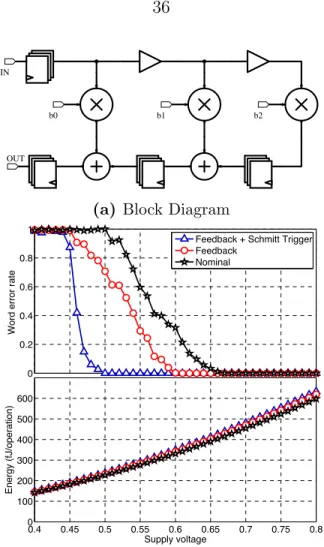
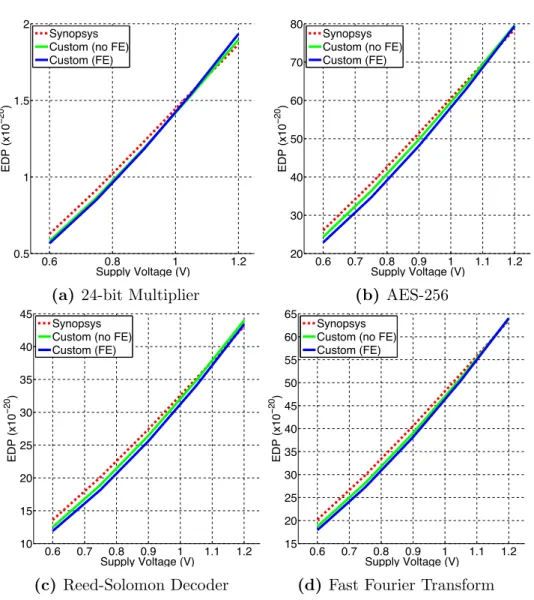
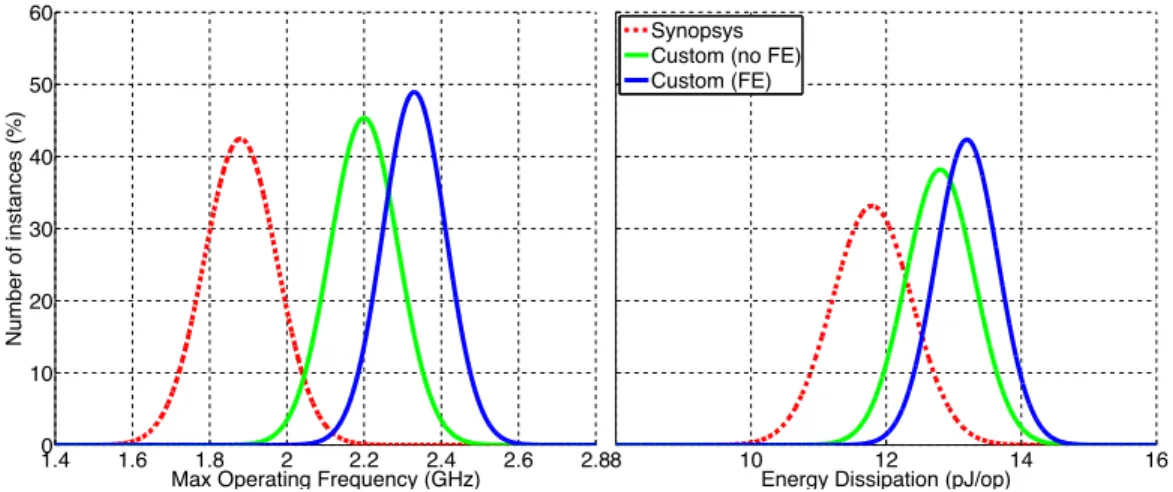
In this chapter I will describe the FEST circuit as well as its analysis. In or-der to analyze the proposed circuit, several designs were consior-dered: as a first step 4-bit Kogge-Stone Adder (KSA) and a 3-tap 4-bit finite impulse response (FIR) fil-ter were designed. Affil-ter achieving promising results, more complex functions were implemented in a more aggressive technology node: 24-bit multiplier, AES-256, Reed-Solomon decoder, and Fast-Fourier Transform blocks.
2.2
Error Manifestations in Digital Logic
A CMOS circuit can have permanent faults (due to irreversible physical changes such as a gate output stuck at one or zero, short, or electromigration-induced open circuits), transient faults (due to temporary changes in supply voltage and temperature) and/or intermittent faults (due to unstable or marginal hardware) (Constantinescu, 2003). These faults manifest themselves into bit errors and might cause catastrophic system failures. We focused exclusively on timing errors due to supply voltage scaling. These timing errors can be traced to the fact that voltage scaling increases the switching time of the transistors, which in turn leads to timing constraint violations that result in incorrect sampling of the data by the flip-flop/latch. We proposed circuit-level technique that can mitigate these errors, thus permitting further voltage scaling and a reduction in energy consumption. For the purposes of this work, we assumed that the application layer is able to tolerate some errors, so long as the probability is
27
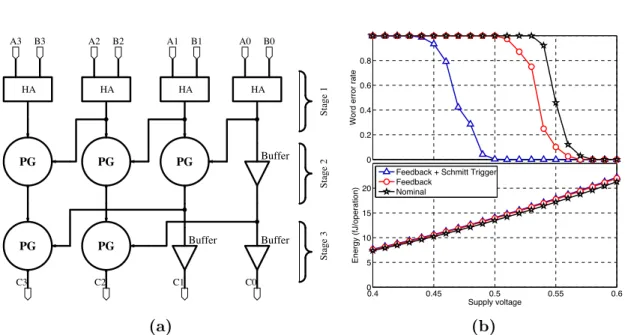
very low – this assumption was made with a more complex future systems in mind. Understanding the interaction between our circuit technique and higher layer error-resiliency is an interesting subject for future study. Given a complex digital logic block, its critical paths are the ones that define the timing violations. The errors are expected to arise when the transitioning outputs of a gate do not have enough time to charge/discharge the parasitic capacitances due to reduced supply voltage (in case of NTC). To verify this simple hypothesis, we simulated a 4-bit Kogge-Stone Adder (KSA) in HSPICE. We designed the adder to run (without errors) at 2GHz
at a nominal supply voltage (800mV for 22nm PTM). The supply voltage was then scaled to 490mV and the KSA was tested by providing 1000 randomly generated input patterns and observing the timing errors. These observed error manifestations closely
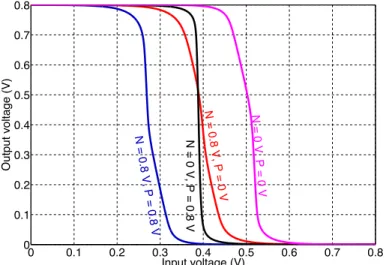
0 0.1 0.2 0.3 0.4 0.5 0.6 0.7 0.8 0 0.1 0.2 0.3 0.4 0.5 0.6 0.7 0.8 Input voltage (V) Output voltage (V) N = 0 V, P = 0 V N = 0.8 V, P = 0 V N = 0 V, P = 0.8 V N = 0.8 V, P = 0.8 V
Figure 2·1: DC response of the feedback equalizer circuit.
mirror the inter-symbol interference (ISI) errors that arise in communication channels. In this setting, a decision feedback equalization (DFE) mechanism is commonly used to combat ISI at the receiver end. The basic idea is that the receiver subtracts a weighted estimate of the prior bit before making a decision on the current bit. In the next section, we explore a circuit that mimics this technique for use in arithmetic logic.
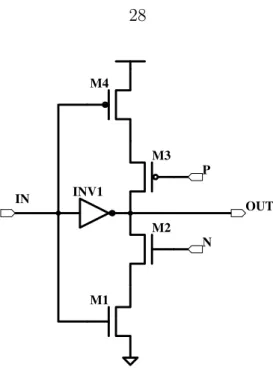
P N IN INV1 OUT M4 M3 M1 M2
Figure 2·2: Variable threshold inverter circuit (Sridhara et al., 2008).
2.3
Equalization Techniques
In a communications system, DFE is often implemented by multiplying the estimate of the previous bit by an appropriate scaling factor and subtracting this quantity from the channel output. In our considerations, the multiply-accumulate circuits required for DFE far exceed the complexity of the digital arithmetic logic we are trying to protect. From a digital circuit design perspective, DFE can be viewed as a mechanism to vary the switching threshold of a logic gate based on the prior gate output. If the prior output is a zero, then the switching threshold is decreased to facilitate a transition to a one. Conversely, if the prior output is a one, then the switching threshold is increased. Below, we describe a variable threshold inverter that can be used as a basic feedback equalizer. Afterwards, we argue that coupling this circuit with a Schmitt trigger leads to a robust equalizer that is well-suited for over-scaling arithmetic logic to save energy.
29
2.3.1 Feedback circuit
Sridharaet al. employed feedback equalization to overcome the ISI encountered in on-chip communication channels (Sridhara et al., 2008). They used a variable threshold inverter (depicted in Figure 2·2) to implement feedback equalization on a bus. The switching threshold of this inverter depends upon the values of the inputs at nodes
P and N as detailed in Table 2.1 with Vth < V0
th < Vth+. The sizes of transistors M1,
M2, M3, and M4 are chosen depending on the desired values for Vth+ and Vth. This circuit can be used as a feedback equalizer in digital logic by simply connecting the
P and N nodes to the previous output sampled by the flip-flop (see Figure 2·4). In this configuration, the circuit adjusts the switching threshold and facilitates faster high-to-low and low-to-high transitions. Note that the inverter (INV1) should be fairly weak to ensure that the output does not float (Sridhara et al., 2008). The DC response of the variable threshold inverter is shown in Figure 2·1.
P N Vth
LOW HIGH Vth0
LOW LOW Vth+
HIGH HIGH Vth
Table 2.1: The inverter threshold depends on the inputs P and N. Our system varies the threshold using feedback.
One drawback of using this circuit in low power digital logic is that, in the deep sub-micron regime, it becomes susceptible to glitches after voltage scaling. This is mainly due to the di↵erence in switching times of the di↵erent nodes in the circuit. At nominal voltage, these glitches can be tolerated and the correct output will be sampled by the succeeding flip-flop. However, these glitches widen with voltage scaling and eventually get incorrectly interpreted as valid signals.