An open access repository of
Middlesex University research
http://eprints.mdx.ac.uk
Zou, Longhao and Trestian, Ramona and Muntean, Gabriel-Miro
(2013) A utility-based priority scheduling scheme for multimedia
delivery over LTE networks. In: IEEE International Symposium on
Broadband Multimedia Systems and Broadcasting (BMSB), 4-7 June
2013, London, UK.
Available from Middlesex University’s Research Repository at
http://eprints.mdx.ac.uk/12134/
Copyright:
Middlesex University Research Repository makes the University’s research available electronically.
Copyright and moral rights to this thesis/research project are retained by the author and/or
other copyright owners. The work is supplied on the understanding that any use for
commercial gain is strictly forbidden. A copy may be downloaded for personal,
non-commercial, research or study without prior permission and without charge. Any use of the
thesis/research project for private study or research must be properly acknowledged with
reference to the work’s full bibliographic details.
This thesis/research project may not be reproduced in any format or medium, or extensive
quotations taken from it, or its content changed in any way, without first obtaining permission
in writing from the copyright holder(s).
If you believe that any material held in the repository infringes copyright law, please contact
the Repository Team at Middlesex University via the following email address:
[email protected]
mm13-27
1
Abstract—With the mobile networks migrating towards LTE-Advanced and all-IP networks, people expect to connect to the Internet anytime, anywhere and from any IP-connected device. Moreover, nowadays people tend to spend much of their time consuming multimedia content from various devices with heterogeneous characteristics (e.g., TV screen, laptop, tablet, smartphone, etc.). In order to support uninterrupted, continuous, and smooth video streaming with reduced delay, jitter, and packet loss to their customers, network operators must be able to differentiate between their offerings according to device characteristics, including screen resolution. This paper proposes a novel Utility-based Priority Scheduling (UPS) algorithm which considers device differentiation when supporting high quality delivery of multimedia services over LTE networks. The priority decision is based on device classification, mobile device energy consumption and multimedia stream tolerance to packet loss ratio. Simulation results demonstrate the benefits of the proposed priority-based scheduling algorithm in comparison with two classic approaches.
Index Terms—Long Term Evolution, Scheduling Algorithm, Utility Functions, Quality of Service, Energy Consumption.
I. INTRODUCTION
HE increasing demand for interactive multimedia-based applications, such as video streaming, social networking, live gaming, e-learning, navigation and cloud sync, with strict Quality of Service (QoS) requirements, puts a lot of pressure on the next generation mobile networks [1][2][3][4]. For this purpose, the new Long Term Evolution (LTE) standard which aims at designing the all-IP network architecture, highly improves the spectrum efficiency and significantly reduces the transfer latency. According to the white paper released by
Informa Telecom & Media1 , in 2011 there were only 6.4% of
LTE deployments all over the world, reaching the highest peak of 34.1% in 2012, while for 2013 there are 25.4% LTE deployments planned [5]. Thus, it is obvious that LTE has been the fastest-growing technology among the 4G standards.
This work was supported in part by China Scholarship Council, the Irish Research Council and Lero - the Irish Software Engineering Research Centre, Ireland (Grant no. 10/CE/I1855).
Utility-based Priority Downlink Scheduling for Multimedia Streams over LTE Networks
Longhao Zou, Ramona Trestian and Gabriel-Miro Muntean are with the Network Innovations Center and Performance Engineering Laboratory, School of Electronic Engineering, Dublin City University, Dublin 9, Ireland. E-mail: [email protected], {ramona, munteang}@eeng.dcu.ie.
1 Informa Telecom & Media - http://www.informatandm.com
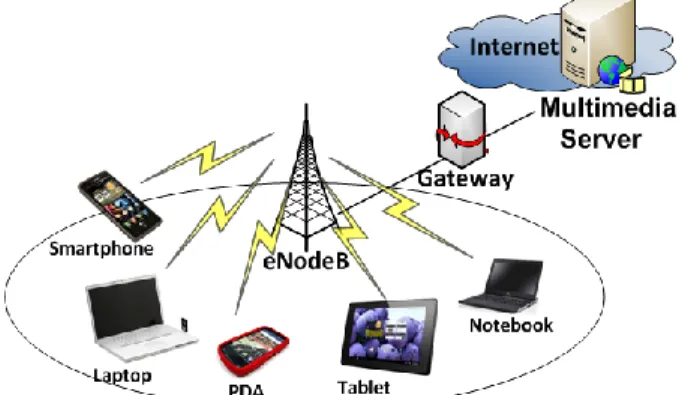
Moreover, with the advances in technologies, mobile computing devices such as smartphones, PDAs, small netbooks, etc. have become more affordable and powerful, mobile users expecting anywhere connectivity, seamless services, and high quality levels. A study reported by Google [6] says that 90% of all media interactions of the users on a daily basis are screen based, meaning that a person spends on average 4.4 hours of the leisure time per day, in front of screens (e.g., smartphone, laptop/PC, tablet, television, etc.). In this context the main challenge that the mobile network operators are facing is the ability to differentiate between the multiscreen offerings in order to provide seamless multimedia experience with minimal delay, jitter, and packet loss, to their customers. An example of a multiscreen diversity scenario within a LTE Network is illustrated in Figure 1.
Because of the popularity of high-performance mobile devices, the scheduling schemes should take into account, apart from the conventional constraints, the mobile device characteristics as well, such as display resolution and battery lifetime.
This paper proposes a novel Utility-based Priority
Scheduling (UPS) algorithm for multimedia streaming over
LTE networks. The proposed UPS mechanism takes into account the QoS constraints of the multimedia application, the information about the device display resolution and the energy consumption of the mobile device in order to prioritize the resource allocation and ensure the best multimedia experience to the mobile users. The remainder of the paper is structured as follow: Section II summarizes the related work, and a framework of the proposed scheduling mechanism and the detailed procedure of the proposed scheduling algorithm are
A Utility-based Priority Scheduling Scheme for
Multimedia Delivery over LTE Networks
Longhao Zou,
Student Member, IEEE
, Ramona Trestian,
Member, IEEE
and
Gabriel-Miro Muntean,
Member, IEEE
T
described in Section III. The numeric example-based analysis and simulation configuration are presented in Section IV and Section V, respectively. Section VI presents the proposed solution’s performance evaluation in comparison with well-known algorithms and conclusions are in Section VII.
II. RELATED WORKS
A very well-known scheduling scheme for OFDM-based systems was proposed by Knopp et al. in [7]. First, the scheme defines the maximum overall rate as the rate allocated to a user with the best channel gain, and then it allocates a higher transmission power to the same user. The authors in [8] look at the downlink scenario with limited dynamic power range, and propose a Maximum Sum Rate (MSR) scheduling scheme without transmission power adaptation. The proposed MSR mechanism is simple and efficient in terms of optimal data traffic scheduling. However, in the case of unfair sharing of the radio resources and strict latency requirements, such scheduling methods are unsuitable. In [9], a cumulative distribution function based on the proportional fair scheduling scheme is proposed. The scheme allocates to the users high transmission power while their average rates achieve their peak rates. Delay-aware downlink scheduling schemes for OFDMA-based systems are proposed in [10] and [11], respectively. These schemes define the user with the highest priority based on the current channel conditions and the amount of queuing delay for real-time or non-real-time services. Furthermore, Ramli et al. [11] took into account packet loss tolerance as another constraint in their priority function definition. In this way, the packet loss of delay-sensitive applications is kept below a threshold. Comsa et al. in [12], propose a Q-learning based scheduling scheme that enables fair throughput provision for different classes of users.
However, most of the previous works do not consider the characteristics of the devices used at the end-user side. The improvements in the device display resolution together with the
limitation of the batteries lifetime, restrict the long-term use of the mobile devices. Therefore, this paper proposes a novel
Utility-based Priority Scheduler (UPS) based on to the device
display resolution, device energy consumption and estimated QoS requirements of the transmitted video stream.
III. UTILITY-BASED PRIORITY SCHEDULING MECHANISM
A. LTE Architecture Overview
The LTE network architecture includes two parts: Evolved Universal Terrestrial Radio Access (E-UTRA) and the Evolved Packet Core (EPC). The E-UTRA provides downlink/uplink interface for User Equipment (UE), such as smartphones, laptops or tablets. The EPC structure consists of Evolved Node B (eNodeB), gateways (e.g. Serving GW/PDN GW) and core network (e.g. Internet) which is based on all-IP architecture. For the downlink transmission the Orthogonal Frequency-Division Multiple Access (OFDMA) is exploited. The unit of OFDMA is the Resource Block (RB) which contains 12 consecutive subcarriers of 180 kHz bandwidth in the frequency domain, and
in the time domain it accounts for 0.5 millisecond time slot [13]. Two consecutive RBs (referred to as Physical Resource Block (PRB) in this work) are assigned to a user for a Transmission Time Interval (1 millisecond). Moreover, a brief description of downlink resource allocation strategy over OFDMA is
illustrated in Figure 2. Considering a number of N UEs
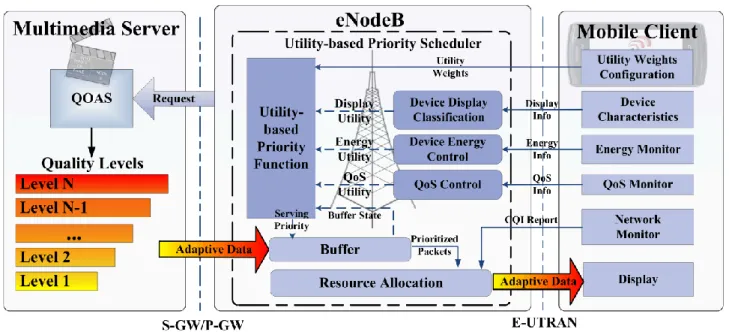
Figure 3. Utility-based Priority Scheduling Mechanism - Framework
---DL Stream for UE 1 DL Stream for UE 2 DL Stream for UE N Sch ed u le r F u n ct io n Time Frequency Physical Resource Block TTI
mm13-27
3 competing for resources, by using a scheduler function, each UEwill get allocated PRBs on the physical channel in the time-frequency domain based on some specified conditions, such as channel states, QoS requirements or fairness conditions.
B. Framework of the proposed Scheduling Mechanism
The framework of the proposed solution is illustrated in
Figure 3. The Utility-based Priority Scheduling Mechanism is
distributed and consists of server-side, eNodeB-side and mobile client-side components.
At the Mobile Client-side the UEs are represented by LTE compatible devices and they are attached to eNodeB. The UEs integrate several functional blocks, such as: the Utility Weights Configuration block, which allows the user to set his preferences towards energy savings or required video quality level, and sends the utility weights to the eNodeB; the Device Characteristics block which provides information about the device resolution; the Energy Monitor block which provides information about the energy consumption of the mobile device, the QoS Monitor which provides information about the packet loss ratio; and the Network Monitor which provides the Channel Quality Indicator (CQI) Reports. According to the standard [14], the CQI reports could contain aperiodic CQI or periodic CQI by using the Subband or the Wideband, respectively. The proposed mechanism makes use of the Subband aperiodic CQI. Consequently, each UE collects CQI information on each physical resource block and sends this CQI Report to eNodeB together with Display Information, Energy Information and QoS Information. This information is sent periodically at every Transmission Time Interval (TTI).
The Server-side integrates the Quality-oriented Adaptation Scheme (QOAS) [15] which adaptively transmits the multimedia streams. The server either stores different quality levels (e.g., N levels) of the pre-recorded multimedia streams, from lowest (e.g., level 1) to highest (e.g., level N) or is able to transcode existing multimedia content into any of the N quality levels. Based on the feedback received from eNodeB, QOAS adjusts the data rate dynamically.
The core of the proposed mechanism Utility-based Priority Scheduler (UPS) is located at the eNodeB-side between the OSI MAC and physical (PHY) layers. UPS can be divided into two main conceptual phases: utility-based prioritization and resource allocation.
The Utility-based Prioritization phase consists of several
functional blocks as illustrated in Figure 3: The Device Display
Classification block makes use of the device resolution
information in order to compute the Display Utility;the Device
Energy Control block which makes use of the device energy
consumption information in order to compute the Energy Utility;
the QoS Control block which makes use of the device QoS
information in order to compute the QoS Utility; and the
Utility-based Priority Function block makes use of a
multiplicative utility function in order to compute the priorities of the service requests based on the Display Utility, Energy Utility, QoS Utility, and the information about the buffer state. This information is then used in order to provide priority-based dynamic scheduling.
The Resource Allocation phase is triggered once the utilities
for all UEs are calculated. The UE with the largest utility will be prioritized resulting in higher bandwidth share to be allocated to it. In order to do this, the Physical Resource Blocks (PRBs) with the highest bit rate located in the buffer will be mapped to the highest priority user in each TTI.
C. Message Flow Exchange of the proposed Scheduling
Mechanism
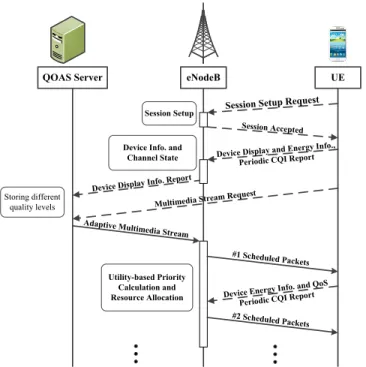
In order to illustrate how the proposed scheduling mechanism works, a sequence diagram of the message flow exchange is illustrated in Figure 4. Initially, the UE sends a Session Setup Request to the eNodeB. Once the session request is accepted, the UE sends information about the display and the energy consumption of the mobile device to the eNodeB. The scheduler located at the eNodeB makes use of this information in order to classify the UE devices and assign priorities. The resource allocation is then done based on the computed priorities, such as the devices with higher priority will get more resources. Additionally, the UE will start sending the CQI reports to eNodeB as well. The Multimedia server integrates the QOAS mechanism which based on the received feedback adapts the multimedia stream dynamically. In the eNodeB, the scheduler assigns the prioritized PRBs to physical channel and transmits them to UEs. Afterwards, the QoS reporting per TTI for transmission starts.
D. Utility Function
Previous studies [16] have shown that the received bandwidth can be mapped to the user satisfaction for multimedia streaming applications by making use of utility functions. According to the principle of the proposed scheduling mechanisms, the scheduler makes use of the attribute of devices display, energy consumption rate and QoS of the multimedia stream transmission to prioritize the resource allocation. However, these three criteria are based on different range of values and
eNodeB UE QOAS Server
Session Setup Request
Session Accepted
Multimedia Stream Req uest
Adaptive Multimedia Stream
#1 Scheduled Packets
Device Display Info. Report
Utility-based Priority Calculation and Resource Allocation
Session Setup
Device Info. and
Channel State Device Display anPeriodic CQI Red Energy Info., port
Storing different quality levels
#2 Scheduled Packets
Device Energy Info. and QoS Periodic CQI Report
of utility functions. We propose an overall utility function based on the multiplicative exponential weighted (MEW) [17] method as given in equation (1):
, ( ) [ , ( )]wr [ , ( )]we [ . ( )]wplr
i j i j i j i j
r e plr
U t u t u t u t (1)
where U is the overall utility for stream j of UE iat current scheduling instant t. i j, r u , i j, e u and i j, plr
u are the utility functions
for resolution of device display, energy and packet loss ratio for UE i, stream j at instant t, respectively. In addition,wr,we andwplr are the weights for those three criteria, and their sum is
1. The values for the weights can be defined by the user in the Utility Weights Configuration block as illustrated in Figure 3.
The overall utility is calculated for each UE, and the UE with the highest score will have assigned the highest priority.
1) Display Utility
In order to ensure good quality of experience to the mobile user, the multimedia stream should be played out on a display with an adequate resolution. Additionally, there are other factors that may impact the quality of the video, such as the available bandwidth, the performance of the receiver, etc. As various devices have different characteristics and hence different multimedia stream requirements, we take into account the device resolution when deciding on the device priority. For example, if the device resolution is high, the scheduler will assign a higher priority and the multimedia server will select a high quality level for the multimedia stream. According to the classification in [18], we define the display utility based on the different range of resolutions as illustrated in Table I.
2) Energy Utility
Depending on the device type and characteristics, as well as the network condition and the type of application, the estimated
energy consumption ratio for UE i can be described as in
equation (2) [19]. , , d i j t i j c r D r c e E (2)
where Dj is amount of data of stream j of UE i required to
transmission (Mbit), rd is the energy consumption rate over
transmitted data (Joule/Mbit), rt is the energy consumption rate
while the UE device is on standby status per unit of time (Watt),
is the transaction time or the duration of the multimedia stream (e.g. length of video clip), c is the constant, and Ec is the current residual energy capacity of the UE device. The energy states are reported to the scheduler periodically.
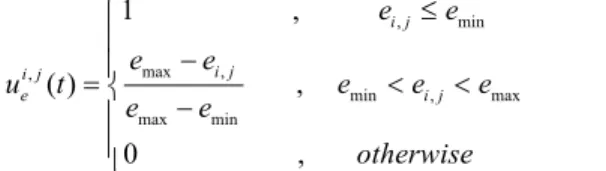
preferable. Therefore, the energy consumption utility is defined as below: , min max , , min , max max min 1 , ( ) , 0 , i j i j i j e i j e e e e u t e e e e e otherwise (3)
where emax is the maximum energy consumption ratio and
min
e is the minimum energy consumption ratio among the UEs.
3) QoS Utility
The study presented in [20] and [21] shows that the quality of the received videos (encoded with H.264 and MPEG 2) over IP networks have an acceptable user perceived quality if the packet loss ratio is lower than 2%. Based on this, and making use of the packet loss ratio classification from [18], the QoS Utility is illustrated in Figure 5. The QoS utility is represented by a s-shape curve which describes the tolerance of the multimedia streams to the packet loss ratio We define five levels for the impact of the packet loss rate on the quality of the multimedia stream quality.
It is noteworthy that plrmin (e.g. 0.1%) is the essential packet
loss ratio tolerance for the multimedia stream with excellent quality. And if the packet loss ratio goes above plrmax(e.g. 5%), the quality of the multimedia stream becomes unacceptable. In addition, good level and acceptable level of the multimedia quality are defined by plr1 (e.g. 1%) and plr2 (e.g. 2%),
respectively.
Since low packet loss represents better quality for the multimedia stream, we consider the shape of the QoS utility to be concave as the packet loss ratio increases. Therefore, the equation of the s-shape curve for stream jof UE i at instant t
is given as below: , min , min max ( ) max 1 , 1 ( ) 1 , 1 0 , i j i j plr plr t j plr plr u t plr plr plr e plr plr (4) TABLEI.
UTILITIES OF DISPLAY RESOLUTIONS
Level 1 Level 2 Level 3 Level 4 Level 5
Resolution ≥1024×768 (1024×768, 768×480] (768×480, 480×360] (480×360, 320×240] <320×240
, ( ) i j r
u t 1 0.75 0.5 0.25 0
Excellent Good Acceptable Poor Unacceptable
0 1 plrmin plr2 plrmax PLR(%) P ac ke t L os s R at io U ti lit y E xc el le nt L ev el G oo d L ev el A cc ep ta bl e L ev el P oo r L ev el U na cc ep ta bl e L ev el plr1
mm13-27
5 , , , ( ) t i j t w i j t i j t w Loss plr t Transmitted
(5)where 0 and 0 determine the slope and the location
of the refection point of the function, respective. In equation (5),
, i j
plr represents the packet loss ratio of stream j of UE i measured during the transmission windoww, Lossi j, is the
packet loss (bytes) of stream j measured in UE iduring the
transmission window and Transmittedi j, is the amount of data
(bytes) of stream j transmitted to UEi.
E. Utility-based Priority Scheduling Scheme
Using equation (1), the overall utility for all the UEs with active multimedia stream in the scheduling buffer is calculated. Then by using the Utility-based Priority Scheduling function defined in equation (6), the priorities of the streams with respect to UEs are computed.
, ( ) , ( ) , ( )
i j i j i j
P t Th t U t (6)
where Pi j, ( )t is the priority of the multimedia stream j for
UE i at scheduling instant t, and Thi j, ( )t (see Eq. 6) is the
average instantaneous rate of the multimedia stream j of UE i
over all the unallocated physical resource blocks.
, ( , ) , ( , ) ( ) ( , ) URB i j m M m t i j URB C m t Th t M m t
(7)where MURB( , )m t is the set of the unallocated physical
resource blocks at scheduling instant t in the buffer, and
, ( , )
i j
C m t is the instantaneous rate of stream j of UE i with
physical resource block m at instant t.
According to the priority function described above, the
highest priority is given to the stream j of the UE i which has
both the highest priority and the highest average instantaneous rate. A pseudo-code of the proposed utility-based priority scheduling scheme is shown in Algorithm 1.
IV. NUMERIC EXAMPLE-BASED ANALYSIS
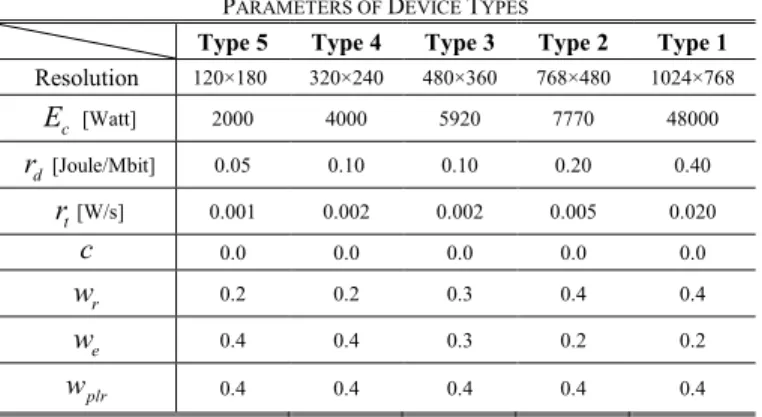
In this section, we define a simple scenario to analyze the proposed scheduling scheme and present a series of numerical results to see how the scheduler works. As shown in Table II, we assume a set of parameters for five different types of mobile devices. The weights of the different utilities are depending on user requirements.
If the five devices request the same content video, the QOAS server first receives the classification of request service from eNodeB, and then it delivers the videos encoded at five different quality levels, depending on the resolutions of these five devices. The formats and QoS requirements of these video delivery sessions are illustrated in Table III.
The proposed scheduler computes the default QoS utilities by using the packet loss ratio values required for the five quality level video deliveries, respectively. The values of the utilities
Algorithm 1 Utility-based Priority Scheduling Scheme 0
t
WHILE(1)
FOR i1TO No. of UEs DO
FOR j1TO No. of Streams of UE i DO
calculate i j, ( ) r
u t at instant t, according to Table I calculate i j, ( )
e
u t at instant t, according to Eq. (3) calculate plr ti j, ( )at instant t, according to Eq. (5)
calculate i j, ( ) plr
u t at instant t, according to Eq. (4)
WHILE MURB( , )m t 0DO calculate Thi j, ( )t at instant t
, according to Eq. (7) calculate Ui j, ( )t at instant t, according to Eq. (1)
calculate Pi j, ( )t at instant t, according to Eq. (6)
END WHILE END FOR END FOR * , arg max i j( ) i P t * , arg max i j( , ) m C m t where m M URB( , )m t
The Physical Resource Block m* will be scheduled
t t TTI
END WHILE
TABLE II.
PARAMETERS OF DEVICETYPES
Type 5 Type 4 Type 3 Type 2 Type 1
Resolution 120×180 320×240 480×360 768×480 1024×768 c E [Watt] 2000 4000 5920 7770 48000 d r [Joule/Mbit] 0.05 0.10 0.10 0.20 0.40 t r[W/s] 0.001 0.002 0.002 0.005 0.020 c 0.0 0.0 0.0 0.0 0.0 r w 0.2 0.2 0.3 0.4 0.4 e w 0.4 0.4 0.3 0.2 0.2 plr w 0.4 0.4 0.4 0.4 0.4 TABLE III.
CLASSIFICATION OF THE REQUESTED VIDEO AT THE QOAS SERVER Class 5 Class 4 Class 3 Class 2 Class 1
Video Resolution 120×180 320×240 480×360 768×480 1024×768 Bitrate [kbps] 120 240 480 960 1920 Length [s] 100 TABLE IV.
PRIORITY FOR DIVERSE DEVICE TYPES
Type 5 Type 4 Type 3 Type 2 Type 1
r u 0.00 0.25 0.50 0.75 1.00 e u 1.000 0.277 0.374 0.000 0.737 plr u (=2.418, =4.436 ) 1 1 1 1 1 Overall U 0.000 2.356 2.557 0.000 2.941 P 0.0 565.4 1227.3 0.0 1618.6
(1)-(4). Additionally, we assume the transmission between the server and the eNodeB as being error free and the channel state of UEs as good enough, and therefore CQI and the modulation scheme are at the highest levels. The average instantaneous rate of the scheduled multimedia stream delivered to the UE equals to the bit rate of the multimedia stream.
It can be seen in Table IV how the highest priority is given to Type 1 device because the utilities of the resolution and packet loss ratio tolerance are the highest. Type 3 device gets the second highest priority due to the fact that its energy model is more efficient than that of Type 4 devices. Type 2 and Type 5 devices get the lowest priority.
V. SIMULATION ENVIRONMENT
In this section, we describe the simulation environment for the proposed scheduling mechanism. First of all, we assume the CQI reporting are error free and that equal downlink transmitting power is allocated to each Physical Resource Block. A brief illustration of the simulation scenario is presented in Figure 6. The scenario involves a QOAS server, one eNodeB and several different types of UEs.
We make use of the LTE-Sim [22] for the simulation platform, and the parameters of simulator configuration are listed in Table V. The simulation scenario consists of a 250 meter single cell with 1 eNodeB serving a varying number of UEs (e.g., from 10 to 150) with random distribution. These UEs are divided into five different types according to Table II. Based on the UPS mechanism the QOAS server will adapt between five quality levels video streams when transmitting to the UEs. When UPS is not invoked, the highest bitrate video stream will be transmitted to all the UEs. The performance of the proposed scheduler UPS is compared against the Proportional Fair (PF) Scheduler and the M-LWDF scheduler [11], in terms of average system throughput, average packet loss ratio and average PSNR.
VI. SIMULATION RESULTS
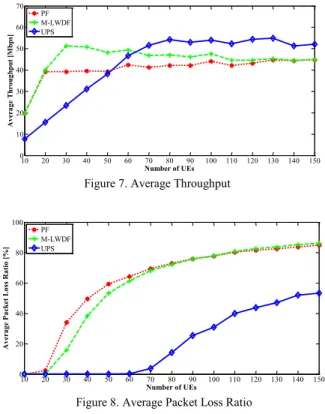
Figure 7 and Figure 8 present the average throughput and packet loss ratio of the downlink video traffic over the whole system for various numbers of UEs. By using UPS mechanism the QOAS transmits different quality levels of the video stream to different UE types. When using PF or M-LWDF only the highest quality video stream is delivered to the UEs. Thus, the system throughput when using M-LWDF and PF tend to achieve
the maximum as the number of UEs is greater than 20 and 30 respectively. However, UPS achieves 10% increase in the system throughput with a 60% decrease in packet loss ratio when the number of UEs reaches 70. Hence, UPS can accommodate a larger number of users and still provide increase in the system throughput and decrease in packet loss.
In order to analyze the quality of received video stream, we make use of the Peak Signal-to-Noise Ratio (PSNR), based on an estimation method introduced in [23]. The PSNR estimation is given in equation (8).
10 2 _ 20 log _ _ MAX Bitrate PSNR EXP Thr CRT Thr (8) SIMULATION PARAMETERS Parameter ValueeNodeB Configuration 1 eNodeB; Single Cell; Radius=250m
UEs Configuration Min No.=10; Max No.=150; Interval=10; Random Direction; 3 km/h
Physical Configuration
Carrier frequency=2.0 GHz; Bandwidth=20 MHz; Cyclic prefix=7 Symbols; Modulation: QPSK, 16QAM, 64QAM;
Transmission Mode: SISO
Path Loss Model Friis Propagation Model
Video Traffic Model
Five Quality Levels (Bitrate: 1920kbps, 960kbps, 480kbps,
240kbps, 120kbps)
TTI 1 millisecond
w
t 10 TTIs
Figure 6. Simulation Topology and Scenario
10 20 30 40 50 60 70 80 90 100 110 120 130 140 150 0 10 20 30 40 50 60 70 A vera ge Thro ug hpu t [M bps ] Number of UEs PF M-LWDF UPS
Figure 7. Average Throughput
10 20 30 40 50 60 70 80 90 100 110 120 130 140 150 0 20 40 60 80 100 A vera ge P acket Lo ss R ati o [%] Number of UEs PF M-LWDF UPS
mm13-27
7where MAX Bitrate_ is the average encoded bitrate of the
video traffic, EXP Thr_ is the average throughput expected to
be achieved when delivering the adaptive video traffic and _
CRT Thr is the actual measured throughput during the
transmission.
Figure 9 illustrates the average PSNR for various numbers of UEs and for each of the scheduling algorithms. For example in case of 60 UEs, there are improvements of 26dB and 24dB when using UPS in comparison with M-LWDF and PF, respectively. As the number of UEs is increasing, the competition for resource is increasing as well, however UPS provides a better video quality with respect to the other two scheduling schemes. This is because of the joint usage of the scheduling algorithm and adaptive multimedia server.
VII. CONCLUSION
This paper has proposed a Utility-based Priority Scheduling (UPS) mechanism for video delivery in LTE downlink systems. The proposed solution makes use of the device display resolution and energy consumption rate of the mobile device to efficiently allocate the resources for the transmission channel. The simulation results show how the proposed UPS algorithm accommodates a higher number of UEs while providing good quality levels within a single cell in comparison with other existing solutions such as M-LWDF and PF. Future work will consider the scheduling buffer delay and the fairness between different service types.
REFERENCES
[1] A. N. Moldovan, A. Molnar , C. H. Muntean, “EcoLearn: Battery Power Friendly e-Learning Environment for Mobile Device Users”, in Learning-Oriented Technologies, Devices and Networks, A. Lazakidou and I. Omary (Eds), Lambert Academic Publishing, pp.273-296, 2011 [2] G.-M. Muntean, G. Ghinea, T. N. Sheehan, “Region of Interest-based
Adaptive Multimedia Streaming Scheme”, IEEE Transactions on
Broadcasting, vol. 54 no. 2, pp. 296-303, 2008
[3] A. N. Moldovan, C. H. Muntean, ”Towards Personalised and Adaptive Multimedia in M-learning Systems”, AACE World Conference on E-Learning in Corporate, Government, Healthcare, & Higher Education (E-Learn 2011), Hawaii, USA, 2011
[4] C. Xu, E. Fallon, Y. Qiao, L. Zhong, G.-M. Muntean, “Performance Evaluation of Multimedia Content Distribution over Multi-homed Wireless Networks”, IEEE Transactions on Broadcasting, vol. 57, no. 2, pp. 204-215, June 2011
[5] Informa Telecom & Media. “White paper-Successful LTE strategies-How to use LTE to build a Compelling Broadband Strategy”, 2012.
[6] Google, “The New Multi-screen World: Understanding Cross-platform Consumer Behavior”, Google Report, August 2012, [Online]. Available: http://services.google.com/fh/files/misc/multiscreenworld final.pdf [7] R. Knopp and P. A. Hamblet, “Multiuser Diversity”, Technical Report,
Eurecom Institute, Sophia Antipolis, France, 2002.
[8] R. Knopp and P.A. Humblet, “Multiple-accessing over
frequency-selective fading channels”, Wireless: Merging onto the Information Superhighway., Sixth IEEE International Symposium on Personal, Indoor and Mobile Radio Communications (PIMRC), vol..3, pp.1326, 1995.
[9] Seo, H. and B. Lee, “A proportional-fair power allocation scheme for fair and efficient multiuser OFDM systems,” IEEE Conference on Global Telecommunications (GLOBECOM), vol.6, pp. 3737- 3741, 2004. [10] S. Sun, Q. Yu, W. Meng; C. Li, “A configurable dual-mode algorithm on
delay-aware low-computation scheduling and resource allocation in LTE downlink”, Wireless Communications and Networking Conference (WCNC), 2012 IEEE, vol., no., pp.1444-1449, 1-4 Apr. 2012. [11] H. A. M. Ramli, R. Basukala, K. Sandrasegaran, R. Patachaianand,,
“Performance of Well Known Packet Scheduling Algorithms in the Downlink 3GPP LTE system”, IEEE Malaysia International Conference on Communications (MICC), pp.815-820, 2009.
[12] I. S. Comsa, S. Zhang, M. Aydin, “A Novel Dynamic Q-Learning-Based Scheduler Technique for LTE-Advanced Technologies Using Neural Networks”, IEEE Conference on Local Computer Networks (LCN), Oct. 2012.
[13] 3GPP, Tech. Specif. Group Radio Access Network - Physical Channels
and Modulation, 3GPP TS 36.211, Dec. 2009.
[14] 3GPP, Tech. Specif. Group Radio Access Network - Physical layer
procedures, 3GPP TS 36.213, Sept. 2009.
[15] G.-M. Muntean., P. Perry, L. Murphy, “Objective and subjective evaluation of QOAS video streaming over broadband networks”,
Network and Service Management, IEEE Transactions on, vol.2, no.1,
pp.19-28, Nov. 2005.
[16] R. Trestian, A. Moldovan, C.-H. Muntean, O. Ormond, and G.-M. Muntean, “Quality Utility modelling for multimedia applications for Android Mobile devices”, in IEEE International Symposium on Broadband Multimedia Systems and Broadcasting (BMSB), pp. 1–6, June, 2012,
[17] R. Trestian, O. Ormond, G.-M. Muntean, “Power-friendly access network selection strategy for heterogeneous wireless multimedia networks”, 2010 IEEE International Symposium on Broadband Multimedia Systems and Broadcasting (BMSB), pp.1-5, Mar. 2010.
[18] Z. Yuan, H. Venkataraman, and G.-M. Muntean, "iPAS: An User Perceived Quality-based Intelligent Prioritized Adaptive Scheme for IPTV in Wireless Home Networks", IEEE International Symposium on Broadband Multimedia Systems and Broadcasting (BMSB), Shanghai, China, pp.1-6. Mar. 2010,
[19] K. Mahmud, M. Inoue, H. Murakami, M. Hasegawa and H. Morikawa, “Measurement and usage of power consumption parameters of wireless interfaces in energy-aware multi-service mobile terminals,” in Personal, Indoor and Mobile Radio Communications, PIMRC 15th IEEE International Symposium on, vol. 2, pp. 1090-1094, 2004.
[20] A. Raake, M. Garcia, S. Möller, J. Berger, F. Kling, P. List, J. Johann, and C. Heidemann, “T-V-model: Parameter-based prediction of IPTV quality”,.. IEEE International Conference on Acoustics, Speech and Signal Processing (ICASSP) pp.1149-1152, 2008.
[21] J. Gustafsson, G. Heikkila, M. Pettersson, “Measuring multimedia quality in mobile networks with an objective parametric model”,2008. 15th IEEE International Conference on Image Processing (ICIP), pp.405-408, 2008. [22] G. Piro, L. A. Grieco, G. Boggia, F. Capozzi, and P. Camarda, “Simulating LTE Cellular Systems: an Open Source Framework”,, IEEE
Transactions on Vehicular Technology, vol. 60, no. 2, Feb. 2011.
[23] S.-B. Lee, G.-M. Muntean and A. F. Smeaton, "Performance-aware replication of distributed pre-recorded IPTV content", IEEE Transactions
on Broadcasting, vol. 55, no. 2, pp. 516-526, June 2009.
10 20 30 40 50 60 70 80 90 100 110 120 130 140 150 0 5 10 15 20 25 30 A vera ge P SN R [dB] Number of UEs PF M-LWDF UPS