UNIVERSITY OF LATVIA
FACULTY OF EDUCATION, PSYCHOLOGY
AND ART
FOREIGN LANGUAGE STUDIES IN THE
CONTEXT OF HIGHER EDUCATION
INTERNATIONALIZATION
Promotion to the degree of Doctor of Pedagogy
Author: Anna Stavicka
Scientific Adviser: Indra Odiņa, Dr. paed., asoc. professor, University of Latvia
Riga, 2014
Šis darbs izstrādāts ar Eiropas Sociālā fonda atbalstu projektā «Atbalsts doktora studijām Latvijas Universitātē».
This work has been supported by the European Social Fund within the project «Support for Doctoral Studies at University of Latvia».
Table of Contents
INTRODUCTION 1
1. Conceptualizing Internationalization: Theoretical Perspectives 24 1.1 Main Concepts within the Internationalization Perspective 25 1.2 Research Trends and Perspectives within the International Dimension
in Higher Education
30 1.3 The Impact of Globalization and Internationalization on Higher
Education
44 1.4 Types of Internationalization, Rationales and Strategies for the
Internationalization of Higher Education
46
1.5 Conclusions 56
2. English as a Global Language and a Lingua Franca for the
International Higher Education 59
2.1 Approaches to the Explanation of the Spread of English 61 2.2 Factors Affecting the Spread of the English Language 69
2.3 English as the Language of Science 73
2.4 Towards the Multilingual and Multicultural Learning Space 76 2.5 The Place of Languages in the Internationalization of Higher Education 83
2.6 Conclusions 86
3. Languages within the Curriculum and Faculty Staff’s Professional Development for the Development and Implementation of International Curriculum
89
3.1 Conceptualizing International Curriculum 89
3.2 Faculty Staff’s Professional Development for the Design and Implementation of International Curriculum
100
3.3 The International Dimension in the Professional Development of Faculty Staff
105
3.4 The Role of Languages within the International Curriculum and Professional Development of Faculty Staff
3.5 Conclusions 123
4. EMPIRICAL RESEARCH 125
4.1. Research Design 125
4.2 Research Stage 1: Case Study 127
4.2.1 Research Context and Research Methodology 128
4.2.2 Research Findings and Discussion 132
4.2.3 Implications for Further Research Implementation 139 4.3 Research Stage 2: Questionnaire Survey, Focus-Group Discussion,
Documentary Analysis
141 4.3.1 Research Context
4.3.1.1 Introduction: Country Overview 141
4.3.1.2 Language Policy in Latvia and its Implications for HEIs 145
4.3.2 Research Methodology 148
4.3.3 Research Findings
4.3.3.1 General Background of the HEIs and Statistical Data in terms of the Volume of the Implementation of the Internationalization process
155
4.3.3.2 Language profiles and language practices of HEIs 162 4.3.3.3 HE Policies and Strategies in the Implementation of the
International Dimension, Internationalization Support Mechanisms
175 4.4 Narrative Analysis 4. 4.1 Research Methodology 179 4.4.2. Research Findings 4.4.2.1 Conceptualizing Internationalization 184
4.4.2.2 Narrators' International Experience 188
4.4.2.3 Languages Issues within the Internationalization Perspective 201 5. Language Studies Within the Higher Education Internationalization
Perspective: Findings, Implications for the Latvian Higher Education Sector and Recommendations for the Elaboration of the Language Study Implementation
217
5.1 Typology of Linguistic Scenarios within HEIs 218 5.2 Recommendations for the Elaboration of Language Study
Implementation in Latvian HEIs
226
REFERENCES 241
LIST OF TABLES AND FIGURES 253
INTRODUCTION Research Topicality
The development of the common European Higher Education Area and the internationalization of higher education have led to challenges many higher education institutions (HEI) have never encountered before. Internationalization of higher education affects the processes linked to higher education provision, implementation, management, etc. at all levels. As a consequence, every single individual involved in these processes has to both consider and find solutions to problems or challenges rooted in the change of the educational paradigm and the transformation of higher education.
The evolving educational paradigm takes roots in significant changes in the political, economic, etc. systems of Latvia, first due to regained independence of the Latvian state and the change of its ideological paradigm in the beginning of the 1990-ies, later due to the accession of Latvia to the European Union in 2004. Latvia has become part of the Bologna process concerning higher education, of the Copenhagen process which concerns vocational education and training; in 2009 the strategic framework for European cooperation in education and training (“ET 2020”) was adopted concerning pre-school, primary, basic, secondary, higher and vocational education in the EU countries. Introduction of the European Qualifications Framework (EQF) led to the opportunity to understand and compare qualifications awarded in different countries and by different education and training systems. All these developments are crucial contributors to the foundation and promotion of international education in Latvia. The issues of internationalization of higher education and problems linked to it are one of the most topical research directions given the current goals put forward by and for the higher education both in the EU countries and worldwide (e.g. Altbach & Knight, 2007; Blight, Davis, & Olsen, 2000; Bowser, Jones & Young, 1995; de Wit, 1995; Van der Wende, 2007; etc.). Latvia is not an exception, as these issues are discussed, researched and promoted at state, institutional and individual levels (e.g. Blūma, 2013; Krūze, 2006; Koķe, 2006; etc.). Therefore, the necessity to study the policies and practices which are undertaken by academic systems, institutions and individuals involved in the education process to cope with the global academic environment in the context of internationalization of higher education
is apparent, as exploration and critical analysis of the existing practices is necessary to work out the strategy appropriate and effective for the local setting to cope with the processes of globalization and internationalization and to use their strengths and benefits for the development of the Latvian education system and the sustainable development of the Latvian state and the society in general.
The reasons for the internationalization of higher education are numerous. Among those most highlighted are the contribution of every single nation to a global economy and society, and the labour market need for the people educated to operate in international and intercultural contexts (Blight, Davis, & Olsen, 1999; Kenney & Mowery, 2014). The contribution of the international community to the formation and development of the knowledge society, exchanging, gaining and sharing global knowledge are viewed as other crucial objectives set for all the nation states.
Alongside the apparent benefits rooted in the internationalization of higher education, challenges and problematic questions are encountered at all the internationalization stages. The world practices provide brilliant examples of successful practices as well as introduce solutions to problems the involved parties face. Therefore, the urgent need to study, analyze and adjust these practices to local contexts is apparent.
Approaching the conceptions around and within the internationalization processes, the concept of language as one of the most crucial tools of international communication is highlighted. Basically, the issue of global language is central for all the processes linked to internationalization. According to Crystal (2003: 4), a crucial distinctive feature of a global language is that it has a special place in the countries worldwide regardless whether it is native or mother-tongue for the local people, as it may have few or no mother-tongue speakers at all in the particular community. It is crucial to explore the issues of languages (e.g. language practices and maintenance and/or promotion of particular language/languages in higher education institutions) in Latvia in order to identify the dominating languages and the levels of language proficiency in Latvia to define the language state with the view to work out the crucial strategic reference points appropriate for the context of Latvia to facilitate the successful higher education internationalization process, which defines the scope of the Doctoral Thesis.
The research problem is determined by the indispensable and urgent necessity to explore the potential and the actual state of internationalization process implementation in the sector of higher education in Latvia placing language issues (global and local language/-s) as the main research focus. In general, the two major trends within the higher education sector are crystalized, which might be rooted in HEI missions, visions and strategies among other factors explored in the framework of the thesis:
• Preference given to an English-only or “English-as-the-dominant-language” environment
Some HEIs at the institutional level, or even the whole nation states at the state level give preference to an English-only or “English-as-the-dominant-language” environment where English has become or is becoming the foreign language of choice, and where HEIs offer their degree programs in English. This strategy may be chosen for different reasons and a variety of purposes, which might be directly or indirectly outlined in documentation, etc. This choice might be well - planned and elaborated or it may also be a spontaneous decision made under certain circumstances. It may also be partly elaborated, as a particular HEI may have both strong and weak sides in the process of implementing the objectives set.
• A revived and purposeful interest in local languages
A revived and purposeful interest in local languages, their use (e.g. as the language of instruction in HEIs within a variety of scientific disciplines), maintenance, elaboration, dissemination and promotion of the correct usage, in other words, the appreciation of linguistic diversity. This aspect is now viewed as vitally important within the EU member countries when negotiating the reference points for the international dimension within the HE sector, as languages are viewed as complex issues comprising also cultural alongside with other elements. At first sight, these new developments might seem contradictory. Moreover, both of them are mainly based on the ideologies dominating in particular settings or scenarios. However, this is not necessarily so, as the reasonable management of the situation based on the timely identification of challenges and issues to be addressed may ensure the reasonable balance and diminish negative consequences of the main ideological stance promoted within a particular setting or scenario. The case of Latvia regarding the language situation reveals the potential for supporting the benefits of
both the above-mentioned scenarios, but not necessarily excluding one of the options offered by the globalizing modern society. This stance is taken as the starting point for exploring the actual situation in the implementation of internationalization strategies in Latvian HEIs and serves as the position defining the scope of the thesis.
Other notions gaining topicality in the modern educational discourse alongside with the concept of linguistic diversity are the notions of multilingualism and multiculturalism. The apparent characteristics of a multicultural society, stating that it is distinguished by a plurality of cultures, leads to the necessity for all the members of this society to deal with different signification systems. Different systems of meaning -making result in different life structures. “Unlike a culturally homogeneous society, members of a multicultural society do not share a common substantive vision of the good life, and disagree about the value to be assigned to different human activities and relationships” (Parekh, 2005: 13). Therefore, one of the major objectives set for education within the dimension of multiculturalism is educating members of this society for successful and efficient functioning in this society. The consideration of this dimension within the higher education curriculum planning should become the general practice, as “almost all societies today are multicultural - some, no doubt, more so than others” (Ibid.).
Multilingualism is one more crucial concept in view of the focus of the thesis, as multilingualism and the mobility of labour are the two aspects actively promoted at the EU level. The world experience reveals that modern education is capable of organizing the appropriate environment for the development of competence in at least two foreign languages upon a number of conditions (Phillipson, 2003: 63). Latvia reveals the potential as well as provides the example of successful practices in a number of activities (e.g. bilingual education, etc.). To expand on the “stories of success” and to mark the examples of good practice, Latvia as a representative of “small” countries (alongside with, for instance, Nordic countries) can boast a significant development – already at secondary school level, schoolchildren generally
gain competence in at least two foreign languages
(http://izm.izm.gov.lv/education/general-education/basic-educationprogram.html). However, there are challenges still unresolved and the cases of other countries may
serve as the grounds for the elaboration of the local internationalization scenario under the local circumstances.
To proceed, another significant characteristics of the world language landscape is the inevitable predominance of the English language at all levels worldwide. There are numerous factors affecting the spread of the English language nowadays (economic, political, etc.). However, it should be highlighted that this phenomenon is not unique to the modern developments, as, for instance, lively communication between scientists across Europe was witnessed already in the seventeenth century. To communicate internationally, the participants of the scientific discussions had to be multilingual. This is not the only evidence of multilingualism (Phillipson, 2003: 80). However, it should be once again highlighted that the phenomenon of multilingualism has gradually been replaced by the English language gaining the position of the global language of scientific communication. The present-day pressure to communicate the scientific knowledge in English is a widely disputed issue and the obligations to communicate research to the wider scientific and scholarly community rather than promote research findings locally are intense, and are evidenced among scholars of the majority of scientific disciplines (Phillipson, 2003; Ferguson, 2004; Skutnabb-Kangas, 2014a, 2014b). The danger of such a situation is seen in the neglect of local and national topics (Phillipson, 2003: 81). Given the realities of the modern academic world, the phenomenon of English as a way to be productive for a scholar should not be neglected. The attitudes to this phenomenon are different. Still, it is apparent that it is hardly possible to function in the world of science and humanities without the sufficient level of foreign language proficiency. Moreover, although the scholarly community (e.g. Phillipson 2013, 2014; Skutnabb-Kangas, 2000, 2014a, 2014b; and others) is advocating numerous measures (e.g. multilingual abstracting, etc.) to be taken to promote linguistic diversity over the dominance of English, many issues still need to be considered at both national and international levels.
As already highlighted, language issues within the higher education sector have taken the central position in view of the current internationalization trend. Language policy in European higher education institutions is impacted by current trends in commerce, science, and culture, as well as the guidelines provided in numerous documents issued by the Council of Europe emphasizing the centrality of languages within any
curricula (e.g. Beacco et. al., Guide for the Development and Implementation of Curricula for Plurilingual and Intercultural Education, Council of Europe, 2010). Being the EU member state, Latvian state education is a key national domain and is taking the leading role in the formation and implementation of language policy and the consolidation of the national language. Still, alongside with other countries it should beneficially resolve challenges associated with the spread of English and use this phenomenon in the most productive way. Therefore, everyone involved in the higher education sector (management, academic staff, students, etc.) should be well - equipped with the necessary skills and competences to face and become active participants of the learning network and the knowledge society.
The reasons for highlighting language issues in the Latvian context are many. For instance, since Latvia joined the EU in 2004, it has been involved in a number of programmes, such as ERASMUS, LEONARDO DA VINCI, SOCRATES, ERASMUS+, etc. aimed at the promotion of Europeanization, international mobility and cultural diversity. It has led to the urgent necessity to use English in scientific, academic and daily communication. Attracting students (both local and foreign) in higher education is one more way to ensure both the diversity of cultures, views and standpoints. It is apparent that within the international classroom, choice should be made concerning the language or the languages of instruction. Another important aspect highlighted within the literature is the pressure to work “in an increasingly entrepreneurial fashion, and become more self-funding. A professor’s ability to attract private investment is now often more important than academic qualifications or teaching ability” (Phillipson, 2003: 93), which is not possible without maintaining international contacts and thus foreign language proficiency.
As widely acknowledged, English is the most privileged language of international communication, as it is most widely learned as a second or foreign language worldwide (Dovring, 1997; Crystal, 2003; Mair, 2003, etc.), which is also true for the case of Latvia (data of the Central Statistical Bureau, 2014). There is also much exposure to English outside the classroom. Therefore, it can be said that the English language is acquired through different channels: through formal, informal and non-formal education in Latvia.
Summarizing the data on the role of English in Latvia, the conclusion can be drawn that the English language is one of the central school subjects within the Latvian curricula; proficiency in the English language is a requirement for continuing into higher and further education. Within the higher education sector, in the demographically small European countries, textbooks in English are widely used in all subjects as the main or additional literature; proficiency in English is required for many types of employment; there is considerable exposure to English in the media, pop culture, public and private life.
Based on the fundamental conceptions underlying the thesis, the major research perspectives are crystallized. A variety of linguistic and cultural scenarios for the internationalization of higher education across Europe make the basis for the exploration and statement of the place of Latvian higher education sector within these scenarios. Since Latvia has joined the European Union in 2004, the objectives of the EU member countries have become of fundamental importance for Latvia as well.
To proceed, international students seem to prefer to learn through English or another major language, but at the same time some HEIs also see a (renewed) interest in the learning of other foreign languages, as students are aware of the fact that they will have to be proficient in more languages than their first language and English (or another major language) if they are to avail themselves of the mobility opportunities on the European or, indeed, international labour market, to work in international businesses or organizations, or to otherwise cross linguistic and cultural borders for professional or private reasons. It should also be highlighted that local languages are now placed in the centre of attention. For instance, the promotion of the use of local language/languages and the preservation of cultural heritage are stated as fundamental objectives within the ideological stance of some countries (e.g. Latvia). As a consequence, one of the major challenges is to maintain the proper balance between the two dominating trends – the development towards the international learning environment and cultivation of national heritage, values and language.
Recent research (e.g. Weeks & Fugate, 2012; Smith, 2013; Baker, 2014, Druviete, 2014, etc.) reveals that the language issues introduced above related to the
development towards the international learning space present challenges that go beyond the promotion, maintenance and elaboration of local language/languages or second language acquisition and learning of a foreign language (FL) and developing a sufficiently high proficiency in the FL in question. There are other aspects which need to be investigated and critically analyzed in the effort towards the development of the international HEI, among other ones involved, these are, most pertinently, the cultural backgrounds of students as well as educators and other parties involved in the educational process, the educational cultures, etc. In other words, in an international HEI, the main objective for every individual involved in the process is to learn to navigate in the transforming environment of the country and culture in which the HEI is situated, and of the students and the faculty staff. This type of environment is frequently termed the Multilingual and Multicultural Learning Space.
Therefore, the research question underlying the Doctoral Thesis is formulated as follows - what changes should be introduced to language studies within the higher education curriculum and professional development programmes for the faculty staff in view of the internationalization of higher education.
In view of the research question, the following research goal is set:
- to explore how internationalization impacts language studies within the higher education curriculum and faculty staff professional development in order to identify types of linguistic scenarios in Latvian HEIs and work out a substantive framework for the elaboration of higher education curriculum and faculty staff professional development programmes placing language studies in the focus of attention to facilitate the implementation of the higher education internationalization.
The following objectives have been set:
• To explore and analyze theoretical literature on higher education internationalization, languages and language studies within the international dimension, higher education curriculum and faculty staff professional development with the aim to build theoretical grounds for the implementation of the empirical research;
• To map the challenges rooted in the new direction of HE towards the international learning space as they unfold in Latvia and identify the needs in terms of language proficiency of students and faculty staff within the dimension of internationalization; to identify the strategies appropriate for the Latvian type of setting for providing quality language teaching and facilitate quality language learning in the relatively new and complex learning multilingual and multicultural space;
• To design a typology of linguistic scenarios in Latvian HEIs identifying the peculiarities of these Latvian scenarios and identify pertinent reference points that define language studies within the HE curriculum and faculty staff professional development offered in the context of these scenarios;
• To design a substantive framework for the elaboration of higher education curriculum and faculty staff professional development related to language studies to facilitate the implementation of the higher education internationalization process;
• To work out recommendations for Latvian HEIs to cope with linguistic problems rooted in the new direction towards the global academic environment in the context of internationalization of higher education. Research Object: Foreign Language Studies
Research Context: Higher Education Internationalization Research Methodology
The analysis of theoretical literature was performed with the aim to design the theoretical framework for the implementation of the empirical research. Theoretical research of trends and perspectives within the research on the internationalization of higher education was carried out applying content analysis of theoretical sources as a research method.
The empirical research was carried out in the pragmatic paradigm referring to a philosophical position with a long-established history originating in the works of Pierce, James, Dewey and revived in the work of Rorty (e.g. Rorty, 1999). Mixed-methods or multy-strategy research was used as the approach to research design. The
concurrent triangulation design was chosen as a type of multi-strategy designs. The following research strategies were used within the 3 stages of the empirical research:
1. Case Study; 2. Survey;
Focus group discussion and documentary analysis were used to amplify and gain thorough understanding of the findings from a questionnaire survey. 3. Narrative Analysis.
The following data collection methods were used:
Questionnaire, focus-group discussion, documentary analysis, the testing technique adapted from Horst & Meara (1999), narratives.
The data analysis and processing methods included:
Content analysis and thematic coding approach for qualitative data analysis; SPSS 20 software for quantitative data analysis.
Research Sample
Within the three above-stated empirical research stages, the sampling procedure was performed in accordance with the research sampling methodology (Robson, 2011). Within the Research Stage 1, the research sample comprised 100 respondents (students of the University of Latvia, the Faculty of Education, Psychology and Art) and 3 experts (2 professors of the University of Latvia, the Faculty of Education, Psychology and Art and 1 professor affiliated to the Faculty of Humanities, the University of Latvia).
Within the Research Stage 2, the research sample comprised 7 Latvian HEIs, 108 questionnaire respondents and 11 participants of the focus-group discussion affiliated to these HEIs. The respondents represented the following groups within the higher education sector: affiliated to these HEIs
Within the Research Stage 3, 20 narratives were collected from 20 narrators representing the following target audiences: academic staff (affiliated to HEIs explored during the previous research phase), students (affiliated to HEIs explored during the previous research phase), employers (working outside the higher education
sector, having higher education) and employees (working outside the higher education sector, having higher education) provided their narratives.
The purposive sampling was performed in accordance with sampling methodology (Robson, 2011). The detailed sampling procedures are described in the corresponding subchapters of the empirical research.
Research Limitations
The research does not aim to provide the full generalizable report on the internationalization initiatives in the Latvian higher education sector, as the research sample may not be representative of the practices within all the higher education institutions and the involved individuals at large. However, the typology of linguistic scenarios identified within the Latvian higher education sector may be used as the basis for further research. The substantive framework introduced based on the findings of the theoretical and empirical research may be used as the basis or the reference point for the elaboration of higher education curriculum and faculty staff professional development related to language studies to facilitate the implementation of the higher education internationalization process within the Latvian higher education sector and the higher education sectors of other countries.
Theoretical and Methodological Research Foundation
1. Conceptualization of higher education internationalization (e.g. main concepts within the internationalization perspective; the impact of globalization and internationalization on higher education; types of internationalization; rationales (existing and emerging) for the internationalization of higher education; internationalization strategies): Knight 1993, 1994, 1995, 1996, 2003, 2004, 2005, 2008, Knight and de Wit 1997; Liempd, Howard, & Wit, 2013; Van der Wende, 1999, 2001, 2007; Currie, Deangelis, De Boer, Huisman, & Lacotte, 2003; Held 1991, 2004; Luke & Luke, 2000; Torres & Rhoads, 2006; Scholte, 2000; De Ridder-Symoens, 1992; Brock & Tulasiewicz, 2000, Altbach, 1989, etc.; Altbach, Berdahl, 1994; Buckley and Casson, 1976; Rugman, 1982; Ahokangas, 1998; Fraser & Lane, 2011; Brunello, Garibaldi, & Wasmer, 2007; Dunne, 2005; Reich, 2005; El-Khawas, 2002; McNamara & Harris, 1997; Guttel, 2006; Wagner, Yezril, & Hassell, 2001; Carayannis & Campbell, 2006; Phillipson, 2003; etc.
2. Conceptualizing languages in international higher education (e.g. English as a global language and a lingua franca for the international higher education; approaches to the explanation of the spread of English; factors affecting the spread of the English language (e.g. structural, ideological); ideology and language; English as the language of science; multilingual and multicultural learning space; mother tongue; monolingualism; bilingualism; multilingualism): Dovring, 1997; Druviete, 1997, 1999, 2000; Crystal, 1997, 2003; Freimane 1993; Nītiņa, D., 2004; Ammon, 1998, 2001; Barry, 2002; De Swaan, 2001; Ferguson, 2004; Edwards, 1994; Elgin, 2000; Silverstein, 1998; Skutnabb-Kangas, 2000, 2014; Phillipson, 1992, 2000, 2003; Phillipson, Skutnabb-Kangas, 1996, 1997; Tollefson, 2002; Yildiz, 2012; etc.
3. Social and intercultural aspects in the conceptualization of international higher education (e.g. HE and society; the role of HE in building and shaping the society; personal, cultural identity; living (learning to live) together; diversity; life-long learning): Ahier, Beck, Moore, 2003; Attewell, Newman, 2010; Blandford & Shaw, 2001; Drennen, 2002; Hamburg & Hamburg, 2004; Hill, 2002; Koķe, 2008; etc. 4. Conceptualization of the curriculum/international curriculum (e.g. the concept of curriculum; international dimension within the curriculum; curricula relevance; professional development of the faculty staff for the design and implementation of international curriculum; languages within the international curriculum and professional development of the faculty staff): Žogla, 2001, 2006; Apple, 1990; Blandford, Shaw, 2001; Drennen, 2002; Hill, 2002; Skelton, 2002; Groenings, Wiley 1990; Marsh, 2004; Reeves, 2004; Ross, 2000; Van der Wende, 1999, 2001; etc. 5. Conceptualization of the faculty staff and the professional development of the faculty staff (e.g. the international dimension in the professional development of faculty staff; faculty staff’s professional development for the design and implementation of international curriculum): Austin, 2002; Baume, Kahn, 2004; Day, 1999; Drennen, 2002; Holderness, 2002; Holloway, Wheeler, 2002; Green, Shoenberg, 2006; Sanderson, 2008; Blūma, 2013; etc.
6. Research methodology in education; Approaches to research; Data processing and interpretation (e.g. the context of educational research; the nature of science; the tools; the scientific method; the ethics of educational research; recent developments in educational research; quantitative and qualitative research traditions; research
paradigms; research question; pragmatic approach; multi-strategy research designs; research strategies; data collection methods; data analysis vs. data interpretation; integration of quantitative and qualitative data in multi-strategy designs; using specialist software; reporting on multi-strategy design studies): Geske, Grīnfelds, 2006; Fowler, 1993; Kitzinger, 1995; Koch, 1998; Lasmanis, 2002; Robson, 2011; Žogla, Lasmanis 2009; etc.
Other significant information sources used for the research purpose include the national normative acts and regulations of the Republic of Latvia, statistical data provided by the Central Statistical Bureau of Latvia, as well as EU documents referred to and cited in the corresponding chapters.
In accordance with the classification of the sub-branches of the science of pedagogy proposed by the Latvian Scientific Council, the research was conducted in the sub-branch “Higher Education” of the science of pedagogy („Zinātņu nozaru un apakšnozaru anotācija” LZP, 1999).
Research stages
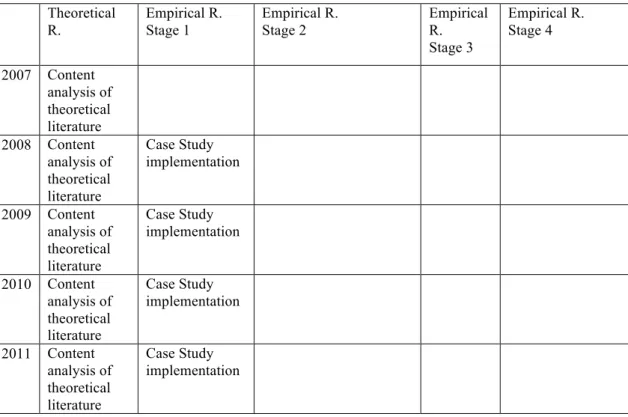
The Doctoral Thesis was elaborated in the following stages summarized in Table 1: Table 1. Research Stages
Theoretical R. Empirical R. Stage 1 Empirical R. Stage 2 Empirical R. Stage 3 Empirical R. Stage 4 2007 Content analysis of theoretical literature 2008 Content analysis of theoretical literature Case Study implementation 2009 Content analysis of theoretical literature Case Study implementation 2010 Content analysis of theoretical literature Case Study implementation 2011 Content analysis of theoretical literature Case Study implementation
2012 Content analysis of theoretical literature Case Study implementation Survey implementation; data processing 2013 Content analysis of theoretical literature Survey; focus-group discussion; documentary analysis of websites; data processing and interpretation; drawing conclusions Narrative analysis Design of the typology of linguistic scenarios in HEIs; building a substantive framework 2014 Review and updating
Final review and proofreading of the results Drawing conclusions; final review and proofreading Theoretical Research:
In the years 2007-2013, literature analysis aimed at identifying the main research trends and theoretical perspectives and building the theoretical and methodological research framework was performed, in order to place the study into the context of previous research and the theoretical perspectives that inform its conceptual framework. In 2014, some relevant information (e.g. statistical data provided by the Central Statistical Bureau of Latvia) was reviewed and updated.
Empirical Research Stage 1
The pre-doctoral empirical research stage (Stage 1) describing the area the research stems from was performed in the period from 2007-2012. The findings of the research stage revealed specialized terminology as a particularly significant aspect to be included and focused on within higher education study content in the context of internationalization of higher education. The implementation of the case study was the starting point for the whole research process. It provided the data defining one of the directions of the research field, as well as served as the point of departure for the further research. The topicality of the problem detected within the research Stage 1 led to the following conclusions to be considered within the broader research framework (within the research Stages 2 and 3):
• English as the dominant language in many professional fields worldwide impacts language use in professional communication in Latvia;
• inconsistency in the use of professional terminology may lead to challenges in professional communication;
• educators should recognize and acknowledge the need to address the issue of officially recognized terminology in both the local language (Latvian) and the source or target one (English) and terminological practice in the framework of their study courses in view of the internationalization of higher education. Stage 2 (2012-2014)
The objective of the research Stage 2 implemented using survey, focus-group discussion and documentary analysis of websites as research strategies was to identify Latvian HE setting for the International HEI with the view to identify strengths and challenges of Latvian internationalization scenarios focusing on issues related to language studies for both students and faculty staff.
The present methodology was agreed upon the experts in the framework of the IntlUni project “The Challenges of the Multilingual and Multicultural Learning Space at the International University” (An ERASMUS Academic Network – 1 October 2012 – 30 September 2015: 526646-LLP-1-2012-1-DK-ERASMUS-ENW). The network has grown out of a Special Interest Group under the European Language Council (CEL – ELC). It has 38 partners in 27 countries. The author of the Doctoral Thesis is the local coordinator of the project in Latvia and represents the University of Latvia, Faculty of Education, Psychology and Art.
The quantitative and qualitative data for the Latvian sample were collected and processed by the author of the Doctoral Thesis. The quantitative and qualitative analyses introduced in the framework of the Doctoral Thesis were performed by the author of the Doctoral Thesis and the data presented in the framework of this paper were not used for the purposes of the IntlUni project. The data collected for the survey of the case of Latvia were fully performed by the author of the present paper. The data were used solely to achieve the objectives set in the framework of the present research.
• Identification of the various types of settings (scenarios) for the International HEI with a view to establish a typology of such scenarios;
• Identification of the strengths and challenges related to language studies in the Latvian setting;
• Identification of possible ways to meet these challenges by identifying examples of successful practice in different settings as well as identifying issues that still need to be addressed;
• Identification of a set of quality criteria and reference points that should characterize language teaching and learning in the M&MLS, which can be applied to the Latvian HE setting;
• Identification of the reference points aimed at qualitative teaching and learning within the multilingual and multicultural learning space aimed at facilitating successful professional language acquisition focusing on academic language proficiency in both the local and a foreign language in a particular type of setting (Latvia) within the perspectives of internationalization and multilingualism.
Stage 3 (2013)
Within the Research Stage 3, narrative analysis as a research method was chosen in order to attain a condensed and broad description of the phenomenon of internationalization and the language issues linked to internationalization as appeared in the narratives of particular target audiences. Twenty narrators representing the following target audiences: academic staff (affiliated to HEIs explored during the previous research phase), students (affiliated to HEIs explored during the previous research phase), employers (working outside the higher education sector, having higher education) and employees (working outside the higher education sector, having higher education) provided their narratives. Within the narratives, the following common themes were identified:
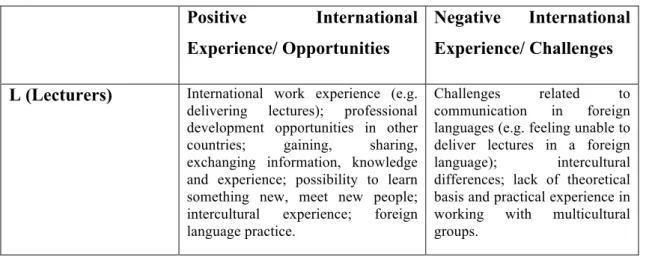
• participation in international activities; • positive international experience; • negative international experience; • personal solutions to challenges;
• international experience of others: family members, colleagues; • phenomenon of English as a global language;
• languages other than English (e.g. mother tongue, other foreign or local languages);
• personal strengths related to language issues;
• difficulties and challenges related to language issues;
• Solutions and actions to be taken to resolve the challenges and difficulties related to language issues.
The implementation of the Research Stage 3 resulted in the identification of the gaps in the knowledge gained during the previous research stages.
Stage 4 (2013-2014)
During the Research Stage 4, based on the theoretical and empirical research findings, the typology of linguistic scenarios in Latvian HEIs was designed and a substantive framework for the implementation of language studies within the higher education curriculum and faculty staff professional development was introduced.
Based on the research findings, a set of recommendations which should be undertaken by HEIs involved in the education process in the Latvian setting to cope with linguistic problems rooted in the new direction towards the global academic environment in the context of internationalization of higher education was developed. Structure of the Doctoral Thesis
Chapter 1 reviews the conceptions related to globalization and internationalization of higher education, as well as introduces the terminology and working definitions relevant in the framework of the doctoral thesis. The concepts under investigation are explored within the perspective relevant for the higher education sector providing the critical analysis of the concept of internationalization if applied to the domain of higher education, the existing practices at all levels, in order to work out the strategy applicable for the Latvian setting to cope with the processes of globalization and internationalization and to use their benefits for the benefit of the higher education sector in Latvia. The chapter also presents the analysis of theoretical literature revealing the most topical research directions within the internationalization
perspective placing the study into the context of previous research and the theoretical perspectives that inform its conceptual framework. Based on the analysis, the conclusions are drawn to be applied in the framework of the empirical research. The main focus of Chapter 2 is English as a Global language, a Lingua Franca, a language of global communication. The theories related to its spread are discussed. The affective factors and the implications of the wide spread of English for the sector of higher education are analyzed. Based on the analysis, the conclusions are drawn to be applied in the framework of the empirical research.
Chapter 3 is built around the fundamentals of international education, its ideology, utility and pedagogy that play important roles in the rationale for the international curriculum. It also reveals the crucial place of languages as fundamental tools within the international study process. It both highlights and builds the theoretical basis for the professional development of faculty staff paying special attention to the role of languages within the HE internationalization perspective.
Chapter 4 presents the empirical research. It outlines the methodological procedures placing the empirical research within the accepted methodological framework relevant to achieve the objectives set in the research framework. The research problem is specified. The overview of the research background and the rationale for its choice are outlined. The research procedure is described and the choice of research methodology is substantiated. The thorough analysis of the data obtained is performed and presented.
Chapter 5 introduces the typology of linguistic scenarios in Latvian HEIs and a substantive framework for the implementation of language studies within the higher education curriculum and faculty staff professional development. A set of recommendations which should be undertaken by HEIs involved in the education process in the Latvian setting to cope with the linguistic problems rooted in the new direction towards the global academic environment in the context of internationalization of higher education is presented. Conclusions are drawn.
Research Novelty and Implications for the Higher Education Sector in Latvia An international HEI is not one specific and well-defined entity. It may take various forms in different linguistic and cultural settings at national, regional level and international level. Therefore, the need for mapping the field mentioned above is apparent. The research follows the Europe 2020 Strategy to enhance the performance of “Youth on the Move” as well as the Bologna Process towards 2020 and aims at supporting HEIs in their efforts to enhance the quality of their teaching and prepare students for a career in a constantly changing labour market. To be competitive in the globalized world, it is crucial for the HEI to empower their students, graduates and faculty staff to study and work across national, linguistic and cultural borders.
The Doctoral Thesis provides the typology of linguistic scenarios in Latvian HEIs and presents a substantive framework for the implementation of language studies in view of higher education internationalization. The research outcomes will contribute to the development of quality lifelong learning and promote high performance, innovation and a European dimension in HE teaching and learning in Latvia; support the implementation of the EU objectives for the promotion of common European learning space; help improve the quality and attractiveness of HEIs in Latvia; contribute to social cohesion and intercultural dialogue; promote employability of HE graduates; and encourage the learning of and learning through multiple languages this way using the benefits of linguistic and cultural diversity.
The research results can be used in the elaboration of the curriculum and modification of faculty staff’s professional development programmes at the University of Latvia and other higher education institutions.
Based on the findings of the theoretical and empirical research, the following theses are put forward for the defence:
• Higher education internationalization and the dominance of the English language as the language of international communication/lingua franca/global language shape language policy and practices within higher education institutions in Latvia based on the internationalization rationales relied upon by a particular HEI.
academic, economic, political) relied upon by HEIs in Latvia predetermine the formation of a monolingual, bilingual and multilingual type of learning space with a certain linguistic scenario being implemented within a HEI: within the monolingual learning – Scenarios 1, 2, 3 (Scenario 1 – state language as the dominant language; Scenario 2 – English as the dominant language of instruction within the study programme implementation with the state language being the basic communication language; Scenario 3 – English as the dominant language of instruction and communication at all levels); within the bilingual learning space – Scenarios 4 and 5 ( Scenario 4 – the majority of the programmes implemented in the state language, some programmes are implemented in the English language; Scenario 5 – the majority of the programmes implemented in the English language, some programmes are available in the state language); within the multilingual learning space – Scenario 6 (simultaneous use of multiple languages in study programme implementation).
• Study programmes in all the professional disciplines and professional development programmes for the faculty staff focusing on expert proficiency in the state language alongside with advanced proficiency in at least one foreign language enhance the quality of higher education and promote the sustainable development of the knowledge society, as members of the knowledge society can not function effectively in one language only, whether it be their mother tongue or a foreign, world language, e. g. English.
Approbation of the Research Findings Published Research Findings:
A. Stavicka Internationalization of Higher Education and Its Impact on Higher Education EFL (English as a Foreign Language) Curriculum. [Augstākās izglītības internacionalizācija un tās ietekme uz angļu valodaskā svešvalodas mācību programmu augstskolā]. „Valoda dažādu kultūru kontekstā” Nr. 24 and „Komparatīvistikas almanahs. Journal of Comparative Studies” ( EBSCO) Nr. 34/4
I. Odiņa, A. Stavicka Initiatives Towards the Development of an International Learning Space in the Context of Internationalization of Higher Education in Latvia [Starptautiskas mācību telpas izveides iniciatīvas Latvijas augstākās izglītības internacionalizācijas kontekstā]. “Internationalization in Teacher Education”, ed. Rabensteiner: Scheider Verlag, Baltmannsweiler Hohengehren, Germany, 2014 A. Stavicka Language Studies in the Context of Higher Education Internationalization in Latvia. SGEM Conference Proceedings Volume 3, STEF92 Technology Ltd., 2014. Pp. 491- 498. Nr. ISBN 978-619-7105-24-7 (included in EBSCO, Thomson Reuters, ISI Web of Knowledge, ISI Web of Science, ELSEVIER Products - SCOPUS)
A. Stavicka, I. Odiņa, E. Doroshenko Terminology Development in the Field of Education in the Context of Common European Education Space in The Perspectives of Pedagogy: Innovative Solutions. Rubene, Z., Drinck, B. LU Akadēmiskais apgāds, 2013
Z. Rubene, I. Vanaga, A. Stavicka Challenges for Teacher Education in the Context of Media Culture in Teachers Training in the European Space of Higher Education (edited by I. Nowosad, E. Kobylecka) International Forum for Education ISBN 978-83-7780-549-7 Adam Marzcalek, 2012, pp. 150-169.
A. Stavicka, I. Odiņa, J. Dorošenko Terminological Aspect in EFL (English as a Foreign Language) Teacher Education for Vocational Schools. ATEE 2011 Conference Proceedings, 2012, pp. 639-647..
I. Odiņa, A. Stavicka, J. Dorošenko Language Planning and Proficiency in the field of ICT -the Case of Latvia. Hermeneia, AXIS Academic Foundation Press, Iasi, Romania, 2011, pp. 88-97.
A. Stavicka Raising Awareness of Standard Usage in the Context of ESP Course for ICT Specialists. E-publication in Conference Proceedings: Applied Linguistics for Specialised Discourse. 2009. Nr. ISBN 978-9984-39-789-4
A. Stavicka Word Formation Models in ICT Terminology. Publikācija rakstu krājumā XVII. Valoda dažādu kultūru kontekstā. Daugavpils: Daugavpils Universitātes Akadēmiskais apgāds „Saule”, 2008, pp. 411-420.
Reports on the Research Findings:
A. Stavicka Language Studies in the Context of Higher Education Internationalization in Latvia. International SGEM Conference on Social Sciences and Arts. September 3-9, 2014 (Albena, Bulgaria).
A. Stavicka Internationalization of Higher Education and Its Impact on Higher Education EFL (English as a Foreign Language) Curriculum. International Scientific Conference XXIV ZINĀTNISKIE LASĪJUMI/Scientific Readings. January 30-31, 2014 (Daugavpils, Latvia).
A. Stavicka, I. Kangro, I. Odiņa The Challenges of the Multilingual and Multicultural Learning Space in the International University: the Case of Latvia. 72 International Scientific Conference of the University of Latvia, February 11, 2014 (Riga, Latvia). I. Kangro, I. Odiņa, A. Stavicka Benefits and Challenges of Multilingual and Multicultural Learning Space in the Context of Internationalization of Higher Education – the Case of Latvia. International Scientific Conference ECER, September 9-13, 2013 (Istanbul, Turkey) .
I. Kangro, I. Odiņa, A. Stavicka, S. Vaļka Teaching Foreign Languages in the Context of Internationalization of Higher Education. 71 International Scientific Conference of the University of Latvia, February 7, 2013 (Riga, Latvia).
A. Stavicka ESP (English for Specific Purposes) for Education Specialists in the Context of Internationalization of Higher Education. 71 International Scientific Conference of the University of Latvia, February 7, 2013 (Riga, Latvia).
A. Stavicka, S. Vaļka The Impact of Globalization on Professional Discourse in the field of Education 70 International Scientific Conference of the University of Latvia, February 9, 2012 (Riga, Latvia).
A. Stavicka, S. Vaļka Foreign Language Teacher Training for Vocational Schools in Latvia. 70 International Scientific Conference of the University of Latvia, February 9, 2012 (Riga, Latvia).
A. Stavicka EFL Teacher Preparation for Vocational Schools ATEE Annual Conference 2011 Riga: Teachers’ Life-cycle from Initial Teacher Education to Experienced Professional, August 24-28, 2011 (Riga, Latvia).
A. Stavicka Acquisition Planning for Standard Professional Terminology at Tertiary Level. 69 International Scientific Conference of the University of Latvia, February 3, 2011 (Riga, Latvia).
A. Stavicka Raising Awareness of Standard Usage in the Context of ESP Course for ICT Specialists. International Scientific Conference: Applied Linguistics for Specialised Discourse, May 22-23, 2009 (Riga, Latvia).
A. Stavicka Towards the Consistent Use of Specialist Terminology: Problems and Solutions 67 International Scientific Conference of the University of Latvia, February, 11, 2009 (Riga, Latvia).
A. Stavicka Discrepancies between the Officially Recognized IT Terms and Terms in Use: Problems and Solutions. Scientific Conference ZINĀTNISKIE LASĪJUMI. January, 30-31, 2009 (Daugavpils, Latvia).
A. Stavicka Latvian Official Terminology vs Field Specialist Terminology: a Functional View of Language Change. Scientific Conference The World in the Language. October, 2008 (Šiauliai, Lithuania).
CHAPTER 1
Conceptualizing Internationalization: Theoretical Perspectives
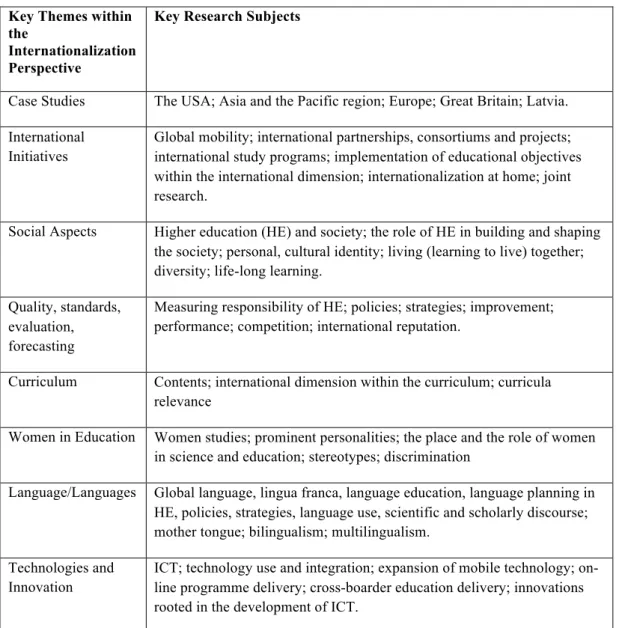
The chapter focuses on the concept, meaning, rationales, approaches, and strategies for the internationalization of higher education and identifies core issues through the analysis of theoretical literature. The theoretical background behind the internationalization and the processes related to it is used for building the framework for analyzing the international dimension of higher education in Latvia in the empirical research conducted in the framework of the Doctoral Thesis. In sum, this chapter attempts to present an in-depth and holistic look at the concept of internationalization within the modern transformative higher education environment. It is both apparent and widely documented that the world of higher education is undergoing significant changes and transformations. There are numerous reasons discussed and debated about worldwide. However, the majority of the interested parties assume, following the phrasing of Knight (2005: 1), that the key drivers of these changes include the rapid development of information and communication technologies, “increased international labour mobility, greater emphasis on the market economy and trade liberalization, the focus on the knowledge society, increased private investment and decreased public support for education, and the growing importance of lifelong learning.” Within all these changes, the international dimension of higher education is gaining an increasingly important place. It is crucial to highlight that “One area that is still underdeveloped is the study of internationalization of higher education itself: researching and analyzing trends, rationales, comparative developments at the regional and global scale, and outcomes and impacts of internationalization” (Liempd, Howard, & Wit, 2013). Liempd, Howard and Wit (2013) draw attention to the regrettable fact that policies are frequently implemented “without proper knowledge and understanding of the consequences of these actions and policies” (Ibid.). Therefore, they emphasize the necessity to research the impact of international activities. In general, despite the popularity and significance of this research theme in its current interpretation, which has become particularly obvious already in the late 1980-ies (e.g. Christenson, 1988; Aigner, et al. 1992; Davies, 1992; Blok, 1995; Bowser, Jones & Young, 1995, etc.), many questions still need to be explored and found answers to. For instance, it is
crucial to explore whether the quality of host institution’s programmes is improved through the involvement of international students in these programmes and whether internationalized curriculum improves the quality of educational programmes. Liempd, Howard and Wit (2013) also highlight the importance of exploring the topics related to languages within the higher education internationalization. They pose a question what the impact of non-natives on teaching and learning in English is and what the role of the study of foreign languages and of intercultural and international competencies in the current global knowledge society is. These are just a few questions among many others.
1.1 Main Concepts within the Internationalization Perspective
The issue of internationalization of higher education is widely discussed and is one of the most topical research directions given the current goals put forward for the higher education worldwide. The increasing importance of internalization as a research direction is obviously rooted in the emphasis put on the dimension of internationalization within supra-national and national policy-making and in institutional strategic management (Van der Wende, 2001).
This sub-chapter introduces the concepts and working definitions relevant in the framework of the Doctoral Thesis. In view of the research focus, the study is placed into the context of previous research and the theoretical perspectives that inform its conceptual framework.
It is crucial to clarify the definitions of the concepts under investigation at the outset, as there is much overlap in the concepts of internationalization, Europeanization and globalization. The confusion around these concepts may lead to inconsistency in the attempts to research these phenomena.
In view of the research focus, the concepts will be explored within the perspective relevant for the higher education sector.
Knight (2004: 5), an acknowledged theoretician of internationalization and the processes linked to it within the higher education perspective, provides an eloquent message uncovering the principle difference and interconnection of the concepts of globalization and internationalization:
Internationalization is changing the world of higher education, and globalization is changing the world of internationalization.
This statement can be seen as the starting point in searching for the working definition of the concepts discussed in the framework of the research. Following the acknowledged authors, it can be stated that the terms globalization and internationalization are contested (e.g. Knight, 2004; McNamara, Harris, 1997; Scholte, 2000). This implies that they may have and they do have different meanings and interpretations for different people and in different contexts, as “globalization tends to segment and divide societies and the world into three types of players: those who globalize, those who are globalized, and those who are excluded by globalization” (Yang & Vidovich, 2001). There are “winners and losers in the globalization process. Globalization is not a simple, neutral term, and needs to be explored in its ideological and material forms” (Currie, Deangelis, De Boer, Huisman, & Lacotte, 2003: 1).
The definitions and interpretations of the terms “globalization” and “internationalization” found within the literature are numerous and frequently overlapping. To start with, globalization is frequently explored in political terms, from the economic or cultural perspectives. Therefore, within these perspectives, a number of concepts are crystalized, e.g. the global economy, fast capitalism, market forces, economic liberalization and free trade regimes, Westernization, Americanization, modernization, and homogenization of values, democratization or the spreading of democratic practices, the information society and the knowledge society, etc. In addition, there are global communication tools, such as the Internet, etc. To proceed, globalization has been defined as “the intensification of worldwide social relations which link distant localities in such a way that local happenings are shaped by events occurring many miles away and vice versa” (Held 1991: 9). Another source defines globalization as “a feature of late capitalism, or the condition of postmodernity, and, more important, …the emergence of a world system driven in large part by a global capitalist economy” (Luke and Luke 2000: 287). Other definitions emphasize the positive gain within the definition of globalization: “the flow of technology, economy, knowledge, people, values, ideas…across borders. Globalization affects each country in a different way due to a nation’s individual history, traditions, culture and priorities” (Knight and de Wit 1997: 6). Even though
the impact of globalization may be both positive and negative, this particular definition does not aim to highlight its negative effects. Moreover, it may be assumed that the actors involved in the processes linked to globalization may direct or manage them in their preferred way to achieve the goals set. Therefore, it may be assumed that globalization and the processes related to it are multifaceted and multi-perspective and may lead to different consequences under different conditions. It should also be highlighted that, in general, globalization is described as being both a positive and negative force, depending extensively upon ones vantage point (Currie, Deangelis, De Boer, Huisman, & Lacotte, 2003: 9).
To proceed, some authors see global relations as distinct from international relations in the sense that “International relations are cross-border exchanges over distance, while global relations are trans-border exchanges without distance. Thus global economics is different from international economics; global politics is different from international politics, and so on. Internationality is embedded in territorial space; globality transcends that geography” (Scholte, 2000: 49). In general, internationalization involves agreements between at least two countries or among nations or regions, such as, for instance, the European Union, furthering cultural or diplomatic exchanges (Currie, Deangelis, De Boer, Huisman, & Lacotte, 2003: 9). Therefore, it may imply “a positive exchange of ideas and people contributing to a more tolerant world” (Ibid.) Moreover, in its ideal manifestation, “internationalization should lead to a world where neither one culture nor economic system dominates, but rather, where a plurality of cultures and ethnic diversity are recognized and valued” (Ibid.).
To extend the idea and to uncover the difference between the notions of globalization and internationalization, globalization can be thought of as the catalyst while internationalization is the response, albeit a response in a proactive way. The key element in the term internationalization is the notion of between or among nations and cultural identities. A country’s unique history, indigenous culture(s), resources, priorities, etc., shape its response to and relationship with other countries. Thus national identity and culture are key to internationalization (Knight, 1997: 6). This idea is crucial for the research goal implies the study of the language related issues which are closely tied with both the national identity and culture in being their core elements.
To proceed to the interpretation of the term “international” when applied to higher education, it is also crucial to clarify what is meant by the term “higher education” in the framework of the research. In the Doctoral Thesis, the term higher education is used to mean educational institutions, providers, and programs that lead to award at the undergraduate or graduate levels through full-time, part-time, or continuing education.
In general, international higher education traditionally implies students, who are residents of one country studying at universities in another country. However, the conceptions around this phenomenon are much more complex. At this point it should be highlighted that internationalization of higher education is not a recent research phenomenon. For instance, De Ridder-Symoens (1992: 281) describes the mobility opportunities for students and academic staff in the Middle Ages. A crucial role of the Latin language as a language of scientific communication within the internationalization of higher education in the Middle Ages should be highlighted as the role of the Latin language as compared to the role of the English language will be outlined in Chapter 2 of the Doctoral Thesis. The use of Latin as the common language for scientific communication and academic purposes, the uniform study programmes and examination system encouraged international mobility and ensured degree recognition providing opportunities for continuing the studies in foreign countries at any academic level (De Ridder-Symoens 1992: 281).
At present and corresponding to the research focus, the term “internationalization” if applied to higher education is increasingly used “to discuss the international dimension of higher education and, more widely, postsecondary education” (Knight, 2004: 5). Moreover, it is already widely acknowledged and documented that the use of the term varies across institutions and “it means different things to different people” (Ibid.). The trends in the interpretation of the term are multi-perspective, as internationalization is characterized by diversity and complexity, but Knight’s generic definition of internationalization will serve the purpose of defining the context of this research:
Internationalization at the national/sector/institutional level is the process of integrating an international, intercultural or global
dimension into the purpose, functions or delivery of higher education at the institutional and national levels. (…) International carries the sense of relationships between and among nations, cultures and countries. However, internationalization is also about relating to the diversity of cultures that exist within countries, communities, institutions, and classrooms, so intercultural seems the best term for addressing aspects of cultural diversity. Finally, global is included to provide the sense of worldwide scope (Knight 2008: 21f;).
The proposed definition (“the process of integrating an international, intercultural or global dimension into the purpose, functions or delivery of postsecondary education” (Knight 2003: 2) was several times updated and explained. As Knight (Knight, 2005: 13-14) herself suggests, this definition is intentionally neutral, as a definition should be objective “to describe a phenomenon that is universal but that has different purposes and outcomes depending on the actor or stakeholder.” Knight uses the term “process” to convey the idea of “continuing and ongoing effort.” The concept of integration implies the embedding of the international dimension into both policies and programmes. Moreover, she emphasizes the centrality of the international dimension within the programmes and policies. She claims that the terms international, intercultural, and global reflect the broad scope of internationalization, as they comprise “relationships between nations, cultures, or countries, cultural diversity in the home environment, while global provides the sense of worldwide scope” (Knight, 2005: 13-14).
Consideration of all the terms related to or forming collocations with the concept of internationalization is beyond the scope of the Doctoral Thesis, however, some of the selected terms having their rightful place within the research will be defined. The term international cooperation takes numerous directions in the effort to describe the phenomenon. It should be highlighted that the meanings and interpretation of the term differ across the countries, the actors and the stakeholders. Within the Doctoral Thesis, the term will be used in accordance with the statement proposed by Knight – “as a generic term to describe the myriad relationships an institution or sector has with partners in other countries” (Knight, 2005: 4).