Downloaded By: [Straker, Leon M] At: 01:57 22 March 2008
A comparison of posture and muscle activity during tablet computer, desktop
computer and paper use by young children
L.M. Strakera*, J. Colemana, R. Skossa, B.A. Maslena, R. Burgess-Limerickb and C.M. Pollockc
aSchool of Physiotherapy, Curtin University of Technology, Australia;bSchool of Human Movement Studies, University of Queensland, Australia;cSchool of Psychology, Curtin University of Technology,
Australia
Computers are now widely used by children. Tablet computers are becoming widely available and promoted for use by school children. The primary objective of this study was to compare the posture and muscle activity of children using a tablet computer to the posture and muscle activity of children using a desktop computer and paper technology. Eighteen children (mean age 5.6 years) performed a colouring-in task in tablet, desktop and paper conditions. 3-D posture and muscle activity around the neck and shoulder was assessed. Tablet computer use was similar to paper use, with less neutral spinal posture, more elevated scapular posture and greater upper trapezius and cervical erector spinae activity. This was offset by greater variability of posture and muscle activity. Tablet computer use clearly results in different musculoskeletal stresses than desktop computer use. Computer use guidelines need to be appropriate to traditional and emerging technologies. Tablet computers are being promoted for use by adults and children. However, the physical impact of using this type of technology is not known. The findings of this study provide the first tablet-specific evidence to inform guidelines on wise use of tablet computers by children.
Keywords: computer; children; musculoskeletal disorder; guidelines; information technology; posture; muscle activity
1. Introduction
Computers are firmly established as part of everyday life for both adults and children in many countries. More than 900 million desktop personal computers were in use worldwide in 2006 (Computer Industry Almanac 2006). Computers are being used both at home and in the workplace – in the year to June 2005, 89% of Australian businesses used computers (Australian Bureau of Statistics 2006), whilst slightly earlier (2003) statistics for the USA showed that 62% of households had at least one home computer (Cheeseman Dayet al.
2005). The percentage was higher for households with children, and this appears to be a global trend. In a survey of 22 European countries, Demunter (2005) reported that the proportion of households with a computer was 50% greater when children resided in the home.
*Corresponding author. Email: [email protected]
ISSN 0014-0139 print/ISSN 1366-5847 online
!2008 Taylor & Francis DOI: 10.1080/00140130701711000 http://www.informaworld.com
Downloaded By: [Straker, Leon M] At: 01:57 22 March 2008
Children are making use of the available computers frequently and for considerable durations. In 2002, 94.5% of Hong Kong students aged between 6 and 12 years had knowledge of using a computer (Education Commission 2006). The time spent using a computer at home doubled from 1999 to 2004 for 8–18 year-olds from the USA (Roberts et al. 2005). Harris and Straker (2000) studied the computer use of Australian students attending schools with mandatory laptop programmes. The mean weekly duration of self-reported use was 16.9 h, but a maximum of 80 h was recorded. Even very young children are participating in computer-based activities. Straker et al.
(2006) found that more than half of five-year-old Western Australian children used a computer each week.
With such widespread use of computers, the potential impact of computer use on health, particularly in relation to musculoskeletal discomfort and disorders, has been of concern to researchers. Sillanpa¨a¨ et al. (2003) studied the association between computer use and musculoskeletal symptoms of the neck and upper limbs in 56 office workplaces. They found that musculoskeletal symptoms were common and that these symptoms were related to ergonomic and postural considerations. Marcus et al. (2002) also reported an association between workstation configuration and musculoskeletal symptoms of the neck and shoulders. The increasing use of computers across younger age groups has led to concern that children and adolescents may also be at risk of computer-related health problems. A total of 60% of the children studied by Harris and Straker (2000) reported discomfort whilst using their laptop and a similar proportion experienced discomfort while carrying the computer. It was also evident that children adopted a wide range of postures during laptop use, with desk-sitting accounting for only one-third of usage time. Breen
et al. (2008) observed that children using computers at school adopted poor postures. Similarly, a questionnaire study of New York school children (Ramos et al. 2005) suggested that children adopt different postures to adults when using computers and confirmed that children do experience discomfort, particularly in the neck region, as a result of computer use. In addition, these authors reported that the time spent on computers was significantly greater at home rather than at school, with most children using the computer every day at home but only once per week at school. A questionnaire study was also conducted by Hakalaet al. (2006) in response to an observed increase in neck, shoulder and low-back pain in Finnish adolescents during the 1990s and in early 2000. Results of this study suggested that 2–3 h per day of computer use seemed to be a threshold for neck and shoulder pain.
Concerns that computer use may affect musculoskeletal health have prompted health authorities to provide guidelines for factors such as workstation configuration. Such guidelines include the international standard ISO-9241 in addition to national guidelines such as ANSI/HFES 100 (USA) and CSA-Z412-M89 (Canada). In the last few decades, research and related guidelines have focused primarily on desktop, and to a lesser extent, laptop computers. Given the rapid pace of technological change it is difficult to keep these standards current. Newer forms of technology such as light pens, palmtop and tablet computers may not be adequately addressed in the guidelines. In addition, published guidelines tend to consider adult populations only and it can be difficult to locate recommendations relating to children’s computer use. Broad guidelines relating to children’s desktop and laptop computer use can be found on the website for the International Ergonomics Association technical committee ‘Ergonomics for Children and Educational Environments’ (http://www.education. umn.edu/kls/ecee/).
Downloaded By: [Straker, Leon M] At: 01:57 22 March 2008
Mobile forms of technology are becoming increasingly available. In 2005, mobile computers (laptops/notebooks) comprised about one-quarter of the computers in use worldwide. If current trends persist, this is expected to grow to approximately 36% by 2010 (Computer Industry Almanac 2005). In a review of the available literature concerning the use of mobile computers, Heasman et al. (2000) reported a tendency for mobile computer use to be associated with greater head and neck flexion and shorter viewing distances than desktop computers.
Another form of mobile computing is the palmtop or ‘personal digital assistant’ and the convergence of this technology with phone technology in ‘smart phones’. During the third quarter of 2006, a total of 40.7 million UK users reportedly accessed the Internet with their mobile phones (Mobile Data Association 2006). There have been reports of musculoskeletal symptoms resulting from mobile phone use, in response to which Virgin Mobile published exercises to help prevent injuries associated with text messaging (Virgin Mobile 2006).
Tablet computers are another relatively new development in mobile computing. Tablets are typically the size of laptops, but input is via a digital pen directly onto the screen. Although it is difficult to locate information on global market share, tablet computers are increasingly being trialled in schools – a simple Internet search with keywords ‘tablet’, ‘school’ and ‘trial’ shows the extent to which teachers and students are being encouraged to embrace this new technology. For example, a trial of tablet computer use in two Singaporean schools (SRI International 2005) found that more than half of the students thought it positive to have the tablet computers because they were convenient, portable, efficient or easy to use. Two of the top four ‘dislikes’ were factors related to musculoskeletal comfort–the ‘weight’ of the computer ranked second (after battery life) in the list of concerns and ‘physical discomfort’ ranked fourth. Sommerich et al. (2007) recently reported that 60% of a group of 16–18 year old students with ubiquitous access to tablet computers at school and home reported associated neck discomfort. Tablet use was self-reported to be more than 4 h per day during the week for two-thirds of the students and more than 2 h each weekend day for nearly one-half of the students.
No research on the posture and muscle activity during tablet computer use could be located, although several studies on graphics tablet input devices have been reported. A study of mouse vs. digital pen use (Global Ergonomic Technologies 1998) found that the digital pen was held in a similar manner to a writing pen and more neutral forearm and hand postures were observed during pen compared to mouse use. The pen was typically moved with the arm for tasks requiring large cursor movements and with the hand for smaller movements. Kotani and Horii (2003) examined differences in muscular load in the trapezius and three upper limb muscle groups during tracing and click-drag-drop tasks using a mouse and an input pen. There were some differences in muscle load across task: the pen-tablet resulted in lower muscle loading in the forearm for both tasks, and in the biceps brachii for the click-drag-drop task when compared to mouse use. There was no difference in trapezius activity across input devices; however, trapezius activity was high (between 33 and 35% maximum voluntary exertion (MVE)) for both input devices and both tasks. The authors concluded that the use of the pen reduced stress on the fingers when compared with mouse use, but did not alter the load required to stabilise the upper limb. Therefore, the input aspect of tablet computers may have some benefits, but the display impact has not been investigated.
Downloaded By: [Straker, Leon M] At: 01:57 22 March 2008
The aim of this study was to compare for the first time the posture and muscle activity loads during a brief period of time when using a tablet computer compared to a traditional desktop computer and using pencil and paper.
2. Method
2.1. Study design
A mixed model design was used to test the effects of tablet, desktop and paper information technology (IT) and gender on mean head, neck and upper limb posture, mean muscle activity and variability of posture and muscle activity during a familiar task.
2.2. Participants
A total of 18 healthy children (nine male) aged 5–6 years (mean 5.8 (SD 0.6) years) were recruited through personal contacts. This young age group was selected as children are starting compulsory school, the majority are already using computers and prior studies on this age group were limited. The children regularly used computers (at least twice per week for a total of at least 2 h per week.) Children were excluded from the study if they had a history of musculoskeletal disorders or pain. All participants were right-hand dominant and had normal or corrected-to-normal vision. Characteristics of the participants are summarised in Table 1. The study was approved by the Human Research Ethics Committee of Curtin University of Technology.
2.3. Tablet, desktop, and paper
The within-subjects independent variable was the type of technology used to complete a 5 min colouring-in task. The tablet computer condition involved the use of an HP Compaq tc4200 computer (Hewlett-Packard, Palo Alto, CA, USA) (2856 235 6 34 mm) with the screen in ‘slate’ mode covering the keyboard (see Figure 1). The tablet was placed directly in front of the child. The desktop computer condition involved the use of an adjustable height display arm to position the 37.5 cm (1500) display
(model LM520; AOC, Fremont, CA, USA) such that the top of the display was at eye height, with the display located at the rear edge of the desk. The keyboard was not used by the child at all and was set away. The mouse was positioned by the child. For both tablet and desktop conditions, a full screen outline picture was presented to the child using Microsoft1Paint (version 5.1; Microsoft Corporation, Redmond, VA, USA) software. A stylus (‘digital pen’) pointing device was used for colour selection and colouring in the tablet condition and a mouse was used to select a colour then colour in during the desktop condition. The software colouring-in tool was set to a brush of similar width to the colour pencil lines (see Figure 1). The paper condition involved an A4 page printed with the same outline images as used with the drawing software. The page was laid flat on the desk surface Table 1. Participant characteristics: mean (SD).
Female Male All
Age (years) 5.8 (0.67) 5.9 (0.60) 5.8 (0.62)
Height (cm) 116.3 (6.5) 119.2 (6.4) 117.7 (6.4)
Downloaded By: [Straker, Leon M] At: 01:57 22 March 2008
directly in front of the child in the same position as the tablet was placed, with a selection of pencils of different colours placed to the left of the paper. Electronic and paper versions of three colouring pictures were randomised for the three conditions. Children were free to move the mouse, tablet and paper where they chose. Although children tended not to move the tablet, some did move the paper around when colouring different parts of the picture.
2.4. Posture
3-D posture of the head, neck and upper limbs was assessed using a seven-camera, infra-red motion analysis system (Peak Motus version 8; Peak Performance Technologies Inc., Figure 1. Photographs of a participant working in desktop, tablet and paper conditions.
Downloaded By: [Straker, Leon M] At: 01:57 22 March 2008
Centennial, CO, USA.) Retro-reflective markers were adhered to the skin over C7 and bilaterally over the outer canthus of the eyes, external auditory meatus, posterior acromial shelf, lateral epicondyle of the humerus and the femoral greater trochanter. Markers were also positioned at the four corners of the desktop computer display and the desk. The motion analysis software calculated virtual marker locations corresponding to the midpoint of the outer canthi (‘Cyclops’), mid tragi (representing the occiput-cervical joint ‘OC1’), mid trochanter and the centres of the desk and computer display. Gaze angle, from ‘Cyclops’ to the centre of the desk/display, was also calculated. Data were sampled at 50 Hz and smoothed using a Butterworth filter with a cut-off frequency of 4 Hz. Output from the kinematic analysis included the 3-D orientations of the head, neck, trunk and upper limb segments using previously published definitions (Straker et al. 2008a). Angles (referenced to the vertical for sagittal and coronal angles and the anterior sagittal plane for transverse angles) over the final 2 min of data collection for each 5-min task were utilised for the current analysis.
2.5. Muscle activity
Surface myoelectric activity (sEMG) was collected from bilateral cervical erector spinae (CES) and upper trapezius (UT) muscles. Pairs of 12 mm diameter Ag-AgCl disposable surface electrodes (Uni-Patch, Wabasha, MN, USA) were placed 25 mm centre-to-centre distance apart. Prior to application of the electrodes, the skin was thoroughly prepared by shaving, lightly abrading and cleaning with surgical spirit. Impedances were checked after attachment of the electrodes and only values of 55 kO were deemed acceptable. In order to permit normalisation of sEMG data, isometric MVEs were performed for both of the muscle groups using previously described methods (Straker et al. 2008b). For the UT, this entailed the child lifting the shoulders towards their ears as strongly as possible with motion resisted by a cable attached to handles held in each hand and attached to the floor. For the CES, a harness was positioned around the head, with a cable attaching the front of the harness to a fixed point at the child’s head height. The child attempted to pull the head back (away from the fixture) as strongly as possible. In order to elicit a maximal contraction, verbal encouragement was provided by the tester and biofeedback from the sEMG was available on a computer display. Data acquisition was controlled using a customised software program (LabView V71; National Instruments, Austin, TX, USA). Electromyographic (EMG) signals were sampled at 1000 Hz via an eight channel AMT-8 EMG cable telemetry system with analogue differential amplifiers (frequency response: 10–1000 Hz, common mode rejection ratio: 115dB). The sEMG over the final 2 min for each condition was amplitude normalised to the appropriate MVE before being used for statistical analysis.
2.6. Data analysis
Posture and sEMG were visually inspected for quality control. Mean postures and muscle activity (amplitude normalised root mean square) over the recording period were calculated. Two parameters were used to summarise the variability of posture and muscle activity. The difference between the 90th and 10th percentiles of the amplitude probability distribution function (APDF) (Jonsson 1982) for each variable provided a measure of the amplitude range (APDF(90–10)). A greater APDF(90–10)denotes a more substantial change in posture or muscle activity, thereby reflecting increased variability (less monotony) of
Downloaded By: [Straker, Leon M] At: 01:57 22 March 2008
movement. Exposure variation analysis (EVA) (Mathiassen and Winkel 1991) encom-passes both amplitude and duration variation. The standard deviation of the EVA matrix (EVA(sd)) was used to condense this variation for statistical analysis (O’Sullivan et al. 2006). There were seven amplitude categories for EMG (0–1% MVE, 1–3%, 3–7%, 7–15%, 15–31%, 31–63% and463% MVE) and 10 for posture (each representing 10% of the usual range of motion, for example, 40–468, 46–528, 52–588, etc. for neck flexion). There were seven period categories for EMG and posture (0–1 s, 1–3, 3–7, 7–15, 15–31 31–63 and 463 s). With greater monotony of posture or muscle activity there is a more concentrated distribution over the intensity and duration classes described by the EVA matrix, hence a more monotonous movement pattern is reflected by a greater EVA(sd).
Mixed model ANOVA with IT type (within-subjects) and gender (between subjects) as the factors was performed on each dependent variable. Huynh-Feldt epsilon corrections were used if Mauchly’s test indicated lack of sphericity. Post hoc pairwise comparisons were calculated using a critical alpha level of 0.01 to balance family-wise error and power.
2.7. Protocol
Each child completed a colouring-in task with each IT condition. A balanced ordering of IT conditions was implemented across participants. Children were instructed to colour in the picture as they normally would and to have fun. They were also told they were not being tested on how good they were at colouring. A break of 5 min was provided between test conditions. A height-adjustable stool and a footstool were used to ensure that the child was seated with the desk at elbow height with feet supported. The study was conducted in a climate and lighting controlled motion analysis laboratory. Statistical analysis was conducted using SPSS for Windows1 version 13 (SPSS Inc., Chicago, IL, USA).
3. Results
There were no significant gender effects or gender6 IT type interactions; therefore, only the IT type effects are presented.
3.1. Mean postures
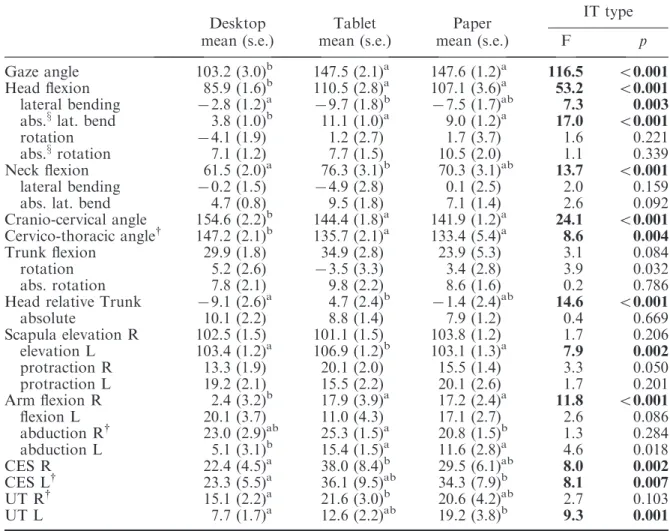
Use of the desktop computer was associated with a more upright, less flexed posture than use of either the tablet or paper (see Table 2). This was reflected in lesser values of gaze angle, head flexion, neck flexion (only a trend for paper) and greater cranio-cervical and cervico-thoracic angles. There were also some spinal asymmetry differences. The desktop had less head lateral bending than tablet or paper (trend only for directional lateral bending for paper). Rotation of the head in relation to the trunk showed a greater relative deviation for the desktop; however, this was an effect of more systematic, directional displacement, as the difference disappeared when absolute deviations (magnitude of the deviation irrespective of direction) were examined.
The right arm was less flexed with desktop use (2.48) than for either tablet (17.98) or paper (17.28). The tablet was associated with slightly more left scapula elevation and right arm abduction than desktop and paper.
Downloaded By: [Straker, Leon M] At: 01:57 22 March 2008
3.2. Mean muscle activity
Use of the desktop was associated with reduced activity of the CES and UT muscle groups compared with tablet and paper (see Table 2). Tablet and paper muscle activities were not significantly different.
3.3. Posture variability
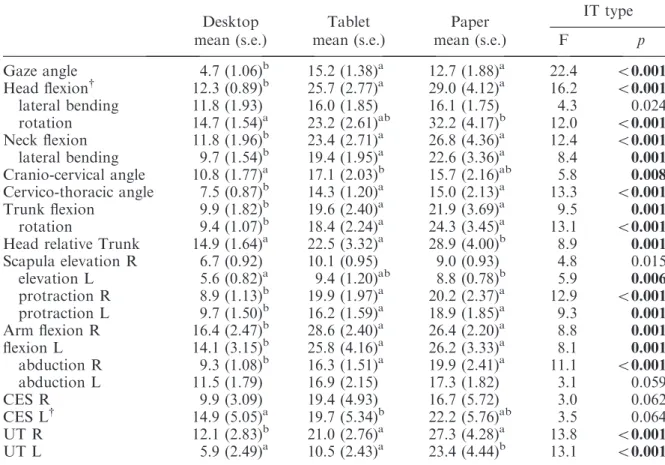
Analysis of APDF(90–10) showed that use of a desktop computer was associated with a more constrained, monotonous posture. This was reflected by smaller amplitude ranges for most spinal and upper limb postural variables (Table 3). In many cases, the amplitude ranges for the desktop condition were less than half those of the other two IT types. The sole difference in postural variability between the tablet and paper conditions was a greater variation in the position of the head relative to the torso under the paper condition.
Table 2. Mean posture and muscle activity in three information technology (IT) type conditions (mean, standard error and ANOVA main effect statistics).
Desktop Tablet Paper IT type
mean (s.e.) mean (s.e.) mean (s.e.) F p
Gaze angle 103.2 (3.0)b 147.5 (2.1)a 147.6 (1.2)a 116.5 50.001
Head flexion 85.9 (1.6)b 110.5 (2.8)a 107.1 (3.6)a 53.2 50.001
lateral bending 72.8 (1.2)a 79.7 (1.8)b 77.5 (1.7)ab 7.3 0.003
abs.xlat. bend 3.8 (1.0)b 11.1 (1.0)a 9.0 (1.2)a 17.0 50.001
rotation 74.1 (1.9) 1.2 (2.7) 1.7 (3.7) 1.6 0.221
abs.xrotation 7.1 (1.2) 7.7 (1.5) 10.5 (2.0) 1.1 0.339
Neck flexion 61.5 (2.0)a 76.3 (3.1)b 70.3 (3.1)ab 13.7 50.001
lateral bending 70.2 (1.5) 74.9 (2.8) 0.1 (2.5) 2.0 0.159
abs. lat. bend 4.7 (0.8) 9.5 (1.8) 7.1 (1.4) 2.6 0.092
Cranio-cervical angle 154.6 (2.2)b 144.4 (1.8)a 141.9 (1.2)a 24.1 50.001
Cervico-thoracic angle{ 147.2 (2.1)b 135.7 (2.1)a 133.4 (5.4)a 8.6 0.004
Trunk flexion 29.9 (1.8) 34.9 (2.8) 23.9 (5.3) 3.1 0.084
rotation 5.2 (2.6) 73.5 (3.3) 3.4 (2.8) 3.9 0.032
abs. rotation 7.8 (2.1) 9.8 (2.2) 8.6 (1.6) 0.2 0.786
Head relative Trunk 79.1 (2.6)a 4.7 (2.4)b 71.4 (2.4)ab 14.6 50.001
absolute 10.1 (2.2) 8.8 (1.4) 7.9 (1.2) 0.4 0.669 Scapula elevation R 102.5 (1.5) 101.1 (1.5) 103.8 (1.2) 1.7 0.206 elevation L 103.4 (1.2)a 106.9 (1.2)b 103.1 (1.3)a 7.9 0.002 protraction R 13.3 (1.9) 20.1 (2.0) 15.5 (1.4) 3.3 0.050 protraction L 19.2 (2.1) 15.5 (2.2) 20.1 (2.6) 1.7 0.201 Arm flexion R 2.4 (3.2)b 17.9 (3.9)a 17.2 (2.4)a 11.8 50.001 flexion L 20.1 (3.7) 11.0 (4.3) 17.1 (2.7) 2.6 0.086 abduction R{ 23.0 (2.9)ab 25.3 (1.5)a 20.8 (1.5)b 1.3 0.284 abduction L 5.1 (3.1)b 15.4 (1.5)a 11.6 (2.8)a 4.6 0.018 CES R 22.4 (4.5)a 38.0 (8.4)b 29.5 (6.1)ab 8.0 0.002 CES L{ 23.3 (5.5)a 36.1 (9.5)ab 34.3 (7.9)b 8.1 0.007 UT R{ 15.1 (2.2)a 21.6 (3.0)b 20.6 (4.2)ab 2.7 0.103 UT L 7.7 (1.7)a 12.6 (2.2)ab 19.2 (3.8)b 9.3 0.001
{Mauchly’s sphericity¼0.xabs.¼absolute value (disregarding left or right direction). a or b
Downloaded By: [Straker, Leon M] At: 01:57 22 March 2008
EVA(sd) showed a similar pattern to the APDF(90–10) results, although with fewer significant differences (Table 4).
3.4. Muscle activity variability
The APDF(90–10) for muscle activity results are presented in Table 3, with corresponding EVA(sd) in Table 4. Despite the marked differences for postural variability, the effect of IT type on muscle loading variability was less clear. The overall tendency was for the desktop condition to be associated with reduced variability of muscle loading compared to the tablet and paper conditions. For the
APDF(90–10), a more variable activity pattern for left UT was evident with paper
compared to both desktop and tablet. Otherwise, tablet and paper were similar but one or both of these were greater than desktop for LCES and both UT. As for postural variables, EVA(sd) differences were less than APDF(90–10) differences. There were no significant differences between tablet and paper, but paper was significantly less monotonous than desktop for both UT. There were no apparent differences between IT types for left CES EVA(sd).
Table 3. Variability (amplitude probability distribution function (APDF)(90-10)) of posture and
muscle activity in three information technology (IT) type conditions (mean, standard error and ANOVA main effect statistics).
Desktop Tablet Paper IT type
mean (s.e.) mean (s.e.) mean (s.e.) F p
Gaze angle 4.7 (1.06)b 15.2 (1.38)a 12.7 (1.88)a 22.4 50.001 Head flexion{ 12.3 (0.89)b 25.7 (2.77)a 29.0 (4.12)a 16.2 50.001 lateral bending 11.8 (1.93) 16.0 (1.85) 16.1 (1.75) 4.3 0.024 rotation 14.7 (1.54)a 23.2 (2.61)ab 32.2 (4.17)b 12.0 50.001 Neck flexion 11.8 (1.96)b 23.4 (2.71)a 26.8 (4.36)a 12.4 50.001 lateral bending 9.7 (1.54)b 19.4 (1.95)a 22.6 (3.36)a 8.4 0.001 Cranio-cervical angle 10.8 (1.77)a 17.1 (2.03)b 15.7 (2.16)ab 5.8 0.008 Cervico-thoracic angle 7.5 (0.87)b 14.3 (1.20)a 15.0 (2.13)a 13.3 50.001 Trunk flexion 9.9 (1.82)b 19.6 (2.40)a 21.9 (3.69)a 9.5 0.001 rotation 9.4 (1.07)b 18.4 (2.24)a 24.3 (3.45)a 13.1 50.001
Head relative Trunk 14.9 (1.64)a 22.5 (3.32)a 28.9 (4.00)b 8.9 0.001
Scapula elevation R 6.7 (0.92) 10.1 (0.95) 9.0 (0.93) 4.8 0.015 elevation L 5.6 (0.82)a 9.4 (1.20)ab 8.8 (0.78)b 5.9 0.006 protraction R 8.9 (1.13)b 19.9 (1.97)a 20.2 (2.37)a 12.9 50.001 protraction L 9.7 (1.50)b 16.2 (1.59)a 18.9 (1.85)a 9.3 0.001 Arm flexion R 16.4 (2.47)b 28.6 (2.40)a 26.4 (2.20)a 8.8 0.001 flexion L 14.1 (3.15)b 25.8 (4.16)a 26.2 (3.33)a 8.1 0.001 abduction R 9.3 (1.08)b 16.3 (1.51)a 19.9 (2.41)a 11.1 50.001 abduction L 11.5 (1.79) 16.9 (2.15) 17.3 (1.82) 3.1 0.059 CES R 9.9 (3.09) 19.4 (4.93) 16.7 (5.72) 3.0 0.062 CES L{ 14.9 (5.05)a 19.7 (5.34)b 22.2 (5.76)ab 3.5 0.064 UT R 12.1 (2.83)b 21.0 (2.76)a 27.3 (4.28)a 13.8 50.001 UT L 5.9 (2.49)a 10.5 (2.43)a 23.4 (4.44)b 13.1 50.001 {Mauchly’s sphericity¼0.
Downloaded By: [Straker, Leon M] At: 01:57 22 March 2008
4. Discussion
This is the first study to compare the postures and muscle activities of tablet computing to traditional desktop computing and paper IT use. The results therefore provide the best evidence to date on the relative musculoskeletal stresses associated with tablet computer use.
4.1. Tablet vs. desktop
The tablet computer was associated with a more flexed and asymmetrical spine and a more elevated (left) and flexed (right) shoulder than the traditional desktop computer. A more flexed upper spine is likely to be associated with a greater gravitational moment, due to movement of the head centre of mass away from the corresponding centre of rotation. It may be postulated that this higher gravitational load imposes greater musculoskeletal demands on the body and is therefore likely to pose a greater risk of injury or discomfort. However, this risk has been shown to depend on many variables, including workstation design and exposure variables, such as the duration of computer use (Marcuset al.2002). In fact, a greater downward head tilt (lower than horizontal) and/or a lower computer display placement have been shown in epidemiological studies to be associated with a Table 4. Variability (exposure variation analysis (EVA)(sd)) of posture and muscle activity in three
information technology (IT) type conditions (mean, standard error and ANOVA main effect statistics).
Desktop Tablet Paper IT type
mean (s.e.) mean (s.e.) mean (s.e.) F p
Gaze angle 9.9 (0.48)b 5.4 (0.27)a 6.1 (0.40)a 39.7 50.001 Head flexion{ 4.9 (0.16) 5.0 (0.42) 4.8 (0.33) 0.2 0.796 lateral bending 5.4 (0.40)a 4.6 (0.33)ab 4.4 (0.24)b 3.4 0.049 rotation{ 4.6 (0.17) 4.0 (0.24) 4.3 (0.54) 0.9 0.386 Neck flexion 5.6 (0.29)b 4.2 (0.18)a 4.2 (0.22)a 11.6 50.001 lateral bending 5.7 (0.25)b 4.2 (0.13)a 4.2 (0.21)a 14.6 50.001 Cranio-cervical angle{ 4.3 (0.25)ab 4.4 (0.33)a 4.9 (0.29)b 2.2 0.151 Cervico-thoracic angle{ 6.6 (0.35)a 4.8 (0.19)b 5.0 (0.59)ab 6.0 0.014 Trunk flexion 7.4 (0.65)b 4.7 (0.24)a 5.5 (0.61)a 10.3 50.001 rotation 5.8 (0.50)a 4.5 (0.23)ab 4.4 (0.44)b 5.0 0.014
Head relative Trunk{ 4.7 (0.38) 4.0 (0.16) 3.8 (0.18) 3.6 0.059
Scapula elevation R 6.9 (0.36)b 5.3 (0.22)a 5.8 (0.32)a 10.3 50.001 elevation L 7.3 (0.50) 6.0 (0.47) 5.8 (0.26) 3.6 0.040 protraction R 7.1 (0.55)b 4.5 (0.20)a 4.8 (0.40)a 13.8 50.001 protraction L 6.5 (0.39)b 4.9 (0.27)a 4.4 (0.19)a 17.3 50.001 Arm flexion R{ 5.9 (0.45)a 5.2 (0.42)ab 4.3 (0.20)b 4.6 0.028 flexion L 7.5 (0.48)b 5.3 (0.42)a 4.9 (0.31)a 11.7 50.001 abduction R{ 6.1 (0.54)a 4.6 (0.19)ab 4.3 (0.26)b 9.1 0.004 abduction L 7.7 (0.50)b 4.8 (0.19)a 5.1 (0.39)a 21.1 50.001 CES R 8.4 (0.59) 9.0 (0.62) 8.2 (0.45) 1.4 0.271 CES L{ 8.0 (0.52) 7.4 (0.41) 7.1 (0.39) 1.4 0.254 UT R 7.0 (0.33)a 5.8 (0.40)ab 5.5 (0.19)b 6.5 0.005 UT L 8.2 (0.72)a 6.9 (0.44)ab 5.8 (0.37)b 5.3 0.012 {Mauchly’s sphericity¼0.
Downloaded By: [Straker, Leon M] At: 01:57 22 March 2008
decreased risk of discomfort and disorders (Marcuset al. 2002, Fostervoldet al.2006). In a recent review (Strakeret al.2008a) it was suggested that additional factors, including the load on deep, sub-capital muscles and the degree of monotony or variability of movement, need to be considered.
The greater spinal asymmetry associated with the tablet condition could also be expected to increase the risk for development of musculoskeletal symptoms. Head rotation away from the midline was found to be related to more severe pain and stiffness in the upper torso amongst computer operators (Faucett and Rempel 1994). Similarly, a relationship between head rotation and clinical findings in the neck and shoulder area was reported in a field study of computer operators by Hu¨ntinget al.(1981). Spinal asymmetry postures may be a common risk factor in children, as Saarni et al. (2008) and Geldhof
et al. (2008) recently both reported observations of children in classrooms and noted marked asymmetry was common.
Upper limb postures during tablet use may also pose a risk to the musculoskeletal system. Shoulder flexion greater than 258has been shown to be a risk factor for neck and shoulder symptoms in adults (Marcus et al. 2002). Whilst the mean dominant-side shoulder flexion for the tablet condition was slightly lower than this value in the current study (17.98), it was significantly greater than the mean of 2.48associated with the desktop condition. In addition, five of the 18 participants had values greater than 258 during the tablet condition, thereby exceeding this threshold. A further difference between the desktop and tablet conditions was the slightly greater scapula elevation on the non-dominant side during tablet use. Shoulder elevation and abduction have been shown to affect the load on the UT and rotator cuff muscles (Hagberg and Wegman 1987). Whilst statistically significant, however, the shoulder differences between desktop and tablet were only a few degrees; hence, they are likely to be of little clinical significance.
Potentially offsetting the poorer mean postures was the greater postural variation of the tablet compared to the desktop computer. The APDF(90–10)values presented in Table 2 show that the range of movement of the cervical and thoracic spine and the upper limbs was consistently higher in the tablet condition. This greater postural variation is also evident in the EVA(sd) values (Table 4), which consider the added dimension of the durations that postures are held. The less monotonous postures adopted during tablet use may have a protective effect to offset the less neutral postures. A relationship between ‘static work posture’ and neck and shoulder discomfort was described by Bergqvist et al.
(1995) for adult workers. Additionally, limited rest break opportunity was a major factor for several musculoskeletal problems reported in that study. The importance of considering the time components of exposure in addition to the mean values has also been highlighted by Westgaard and Winkel (1996) in a review of occupational musculoskeletal load. Geldhof et al. (2008) have recently reported that children in classrooms sat statically for 85% of the time, highlighting the importance of variation for this population. Previous studies have tended to focus on variation in muscular load (as discussed next) rather than posture; however, the two are obviously interdependent.
The muscle activity evidence paralleled the posture evidence, with the tablet computer eliciting greater mean muscle activity levels than the desktop computer, suggesting greater risk during tablet use.
All muscle activity mean values reported for this sample are high in comparison to adult values recorded by previous researchers. Differences in the magnitudes may be partly a factor of the normalisation procedures. As discussed in a previous report (Strakeret al.
2008b), we have used a protocol designed to provide a high degree of consistency and this may result in a lower MVE magnitude than that of other researchers and hence higher
Downloaded By: [Straker, Leon M] At: 01:57 22 March 2008
proportional values during the task. The values in the current study are also slightly greater than the mean values reported by Greiget al. (2005) for children of a similar age using a desktop and laptop computer and a book placed flat on the desk, which used similar normalisation procedures. However, the task for that study was limited to reading whereas the current study involved input as well and was therefore a more active task. Given that children could be expected to have slightly greater neck muscle activity levels due to a proportionally greater head mass, the slightly higher values in the current study could be expected.
Jonsson (1978) suggested an increase in risk if median muscle activity exceeded thresholds of 10–14% MVE for tasks of reasonable duration and Aaras (1990) reported an increase in risk for UT activity above 5% MVE. If applied directly to children, this suggests there is a risk with each IT type, but the lower mean values for the desktop computer would suggest that this IT type may pose less of a risk for musculoskeletal disorders.
In line with the postural results, however, it is important to examine exposure variation in addition to the mean magnitude. A recognition that muscle load cannot be considered in isolation is increasingly apparent in the literature. Treasteret al. (2006) proposed that traditional ergonomics injury models, whereby the magnitude of the load on the tissue predicts injury, are unlikely to apply to ‘low level static exertions’ such as computer work, because the muscle as a whole is unlikely to be functioning near its maximum capacity. These authors also reported that even low level muscle contractions were capable of causing injury, through the development of trigger points in the muscle in response to visual and postural stressors. While the aetiology of muscle pain is clearly complex, the ‘Cinderella hypothesis’ proposed by Hagg (1991), whereby sustained contraction of specific motor units occurs even at low force levels, does have some supporting evidence (Forsman et al. 2002, Zennaro et al. 2003). If this mechanism is important for the development of musculoskeletal symptoms among computer users, variation in muscle loading is likely to play a role in the prevention of injury. The desktop computer tended to have a lesser range of muscle activity amplitude than the tablet (Table 3), although this was not consistent across muscle groups. This greater variability during tablet use is in line with the postural results and may at least partially offset any effects of greater load magnitudes. Differences in the EVA(sd) were not significant, suggesting that the temporal pattern of muscle load alteration was broadly similar for the desktop and tablet conditions. EVA(sd) is also not sensitive to where on the matrix the data sit, only how distributed they are. It cannot be determined from the available data whether the muscle activity variation under the tablet condition is sufficient to completely offset any effects of the less neutral postures and higher mean muscle loading, which were evident compared to the desktop condition.
4.2. Tablet vs. paper
In many ways the biomechanical and physiological responses to tablet computer use were more like paper use than desktop computer use. The spinal posture was essentially the same for tablet and paper, being more flexed than for the desktop computer, as described earlier. There were small differences in upper limb posture, including a slightly elevated scapula for the non-input side and a more abducted dominant arm during tablet use compared to paper use. The clinical significance of these differences is difficult to determine, as the magnitude in both instances was less than 58. They may be a result of slight differences in task – for example, while colour pencils were being selected for the
Downloaded By: [Straker, Leon M] At: 01:57 22 March 2008
paper condition, change of colour was from an on-screen palette for the tablet. Differences may also be related to the geometric parameters of the tablet computer, including its greater thickness and the stylus having different dimensions from the pencils. However, the postures clearly were more similar than different and were less neutral than during desktop use.
There were no differences between tablet and paper use for mean muscle activity; however, the left UT showed a considerably greater amplitude range during paper use compared to either tablet or desktop use. This result, together with the less monotonous craniocervical angle EVA(sd), may again be related to the specific task requirements or the difference in thickness of the paper and tablet.
Both the tablet and paper were associated with less neutral postures and greater postural and muscle activity variation than the desktop use. These results reinforce the need to consider both mean and variation data when assessing the risk of musculoskeletal disorders. Sole consideration of the mean values would have resulted in a clear recommendation of the desktop computer over tablet and paper; however, this does not match the results of epidemiological studies, which have shown an association between lower displays during desktop use and musculoskeletal discomfort or disorders (Bergqvist
et al. 1995, Marcus et al. 2002).
4.3. Posture and muscle activity
The results of this study also provide evidence that both posture and muscle activity should be components of any detailed ergonomic assessment of technology use. The differences between conditions were more obvious with posture and this may be related to the relative precision of sEMG and postural analysis, or it may be a result of inter-individual variation with muscle activity and motor control.
Mathiassen and Aminoff (1997) used cluster analysis to illustrate that different motor control strategies were evident between individuals for a task involving sustained action of the trapezius muscle. It was thought that the different motor control scenarios may explain why some individuals developed disorders over time while others did not. Different muscle recruitment strategies have also been recorded for symptomatic and asymptomatic office workers by Szeto et al. (2005). Postural analysis may be useful for the comparison of IT demands, but muscle activity may be most useful for identifying individual risk.
4.4. Limitations
The results of this study should be interpreted in view of the limitations of the research design. The study involved very young children, which placed limitations on both the period for adjustment to the task and the length of time for each condition. However, previous research has shown a quick adjustment to pen-tablet input (Kotani and Horii 2003) and that the digital pen tends to be held in a similar manner to normal pen/pencil (Global Ergonomic Technologies 1998) so it can be expected that this task was reasonably familiar to the participants. The colouring task, while obviously age-appropriate for this sample, may not be representative of tasks performed by older children or adults. In addition, the desktop condition was limited to mouse input and it has been demonstrated that mouse use and keyboard use result in different stresses (Dennerlein and Johnson 2006). Tablets are likely to be used in situations other than at a desk, as previously reported for laptops (Harris and Straker 2000). In view of these limitations, it is
Downloaded By: [Straker, Leon M] At: 01:57 22 March 2008
recommended that further analysis of tablet computer use be conducted for adults, in non-desk situations and with more diverse tasks.
4.5. Implications for tablet computer use
Given the evidence presented here, it is apparent that interacting with a tablet computer results in very different musculoskeletal stresses than interacting with a desktop computer. It is difficult to locate information relating to the prevalence of use of tablet computers specifically; however, considering the interest in tablet computers, which is emerging in the education sector, it is important that guidelines for computer use explicitly address tablet computers. This form of technology may be particularly appropriate for children; hence, recommendations for the wise use of tablet computers must be provided in order to protect rapidly developing musculoskeletal systems.
Tablet computer use risk appears to be related to flexed and asymmetrical spinal postures and elevated scapular mean postures. Users should therefore aim to minimise these non-neutral postures where possible. Whilst posture and muscle activity variation was greater during tablet computer use, encouraging moderate exposure duration is probably still relevant, as is encouraging task variation. This could be achieved with limited periods of tablet use interspersed with other activity requiring different posture/ muscle actions.
Further research should examine the use of tablet computers by adults, to perform different tasks and taking account of different levels of skill. Further research should also examine the effects of tablet use for prolonged durations and in natural settings.
5. Conclusion
Compared with a desktop computer, tablet computer use by young children is associated with more flexed and asymmetrical trunk and more flexed and elevated shoulders and greater muscle activity around the neck. However, the greater risk associated with non-neutral posture and higher mean muscle activity may be offset by greater variation of both posture and muscle activity. Tablet computer use was actually very similar to paper use. These first results comparing posture and muscle activity during tablet computer use with other IT illustrate the significant physical impact of changes in IT and reinforce the need for guidelines appropriate to traditional and emerging technologies.
Acknowledgements
The authors would like to thank the Australian National Health and Medical Research Council (project #229011) for supporting this study.
References
Aaras, A., 1990. Acceptable muscle load on the neck and shoulder regions assessed in relation to the incidence of musculo-skeletal sick leave.International journal of human-computer interaction, 2, 29–39.
Australian Bureau of Statistics, 2006.8129.0 Business use of information technology. Available from: http://www.abs.gov.au/AUSSTATS/ [Accessed 08 January 2008].
Bergqvist, U., Wolgast, E., Nilsson, B., and Voss, M., 1995. Musculoskeletal disorders among visual display terminal workers: Individual, ergonomic and work organizational factors. Ergonomics, 38, 763–776.
Downloaded By: [Straker, Leon M] At: 01:57 22 March 2008
Breen, R., Pyper, S., Rusk, Y., and Dockrell, S., 2008. An investigation of children’s posture and discomfort during computer use. Ergonomics, 50, 1582–1592.
Cheeseman Day, J., Janus, A., and Davis, J., 2005.Computer and internet use in the United States: 2003. Washington, DC: US Department of Commerce: Economics and Statistics Administra-tion, US Census Bureau.
Computer Industry Almanac Inc., 2005. Mobile PCs in use surpass 200M: over 25% of worldwide PCs are mobile PCs. Available from: www.c-i-a.com/pr0605.htm [Accessed 21 February 2007].
Computer Industry Almanac Inc., 2006.PCs in-use surpassed 900M in 2005. Available from: www. c-i-a.com/pr0605.htm [Accessed 31 October 2006].
Demunter, C., 2005. The digital divide in Europe. Available from: http://epp.eurostat.cec.eu.int/ [Accessed 24 April 2007].
Dennerlein, J.T. and Johnson, P.W., 2006. Different computer tasks affect the exposure of the upper extremity to biomechanical risk factors.Ergonomics, 49, 45–61.
Education Commission Hong Kong, 2006.Education Statistics. Hong Kong Special Administrative Region of The People’s Republic of China. Available from: http://www.e-c.edu.hk/eng/reform/ Edu%20stat%20(Eng)%202006.pdf [Accessed 08 January 2008].
Faucett, J. and Rempel, D., 1994. VDT-Related musculoskeletal symptoms: interactions between work posture and psychosocial work factors.American journal of industrial medicine, 26, 597–612. Forsman, M., Taoda, K., Thorn, S., and Zhang, Q., 2002. Motor-unit recruitment during long-term isometric and wrist motion contractions: a study concerning muscular pain development in computer operators. International journal of industrial ergonomics, 30, 237–250.
Fostervold, K.I., Aaras, A., and Lie, I., 2006. Work with visual display units: long term health effects of high and downward line-of-sight in ordinary office environments. International journal of industrial ergonomics, 36, 331–343.
Geldhof, E., De Clearcq, D., De Bourdeaudhuji, I., and Cardon, G., 2008. Classroom postures of 8–12 year old children. Ergonomics, 50, 1571–1581.
Global Ergonomic Technologies, 1998. Comparison of postures from pen and mouse use. Available from: ftp://ftp.wacom-europe.com [Accessed 26 April 2007].
Greig, A., Straker, L., and Briggs, A., 2005. Cervical erector spinae and upper trapezius muscle activity in children using different information technologies.Physiotherapy, 91, 119–126. Hagberg, M. and Wegman, D.H., 1987. Prevalence rates and odds ratios of shoulder-neck diseases in
different occupational groups. British journal of industrial medicine, 44, 602–610.
Hagg, G.M., 1991. Lack of relation between maximal force capacity and muscle disorders caused by low level static loads: a new explanation model. In:Designing for everyone: Proceedings of the 11th congress of the International Ergonomics Association. 1991, Paris. Philadelphia: Taylor and Francis, 9–11.
Hakala, P.T., Rimpela¨, A.H., Saarni, L.A., and Salminen, J.J., 2006. Frequent computer-related activities increase the risk of neck-shoulder and low back pain in adolescents.European journal of public health, 16, 536–541.
Harris, C. and Straker, L., 2000. Survey of physical ergonomics issues associated with school children’s use of laptop computers. International journal of industrial ergonomics, 26, 337–346.
Heasman, T., Brooks, A., and Stewart, T., 2000. Health and safety of portable display screen equipment.Contract Research Report 304/2000. London, UK: Health and Safety Executive. Hu¨nting, W., La¨ubli, T., and Grandjean, E., 1981. Postural and visual loads at VDT workplaces I.
Constrained postures.Ergonomics, 24, 917–931.
Jonsson, B., 1978. Kinesiology: with special reference to electromyographic kinesiology.
Contemporary clinical neurophysiology EEG supplement, 34, 417–428.
Jonsson, B., 1982. Measurement and evaluation of local muscular strain in the shoulder during constrained work.Journal of human ergology, 11, 73–88.
Kotani, K. and Horii, K., 2003. An analysis of muscular load and performance in using a pen-tablet system.Journal of physiological anthropology, 22, 89–95.
Downloaded By: [Straker, Leon M] At: 01:57 22 March 2008
Marcus, M., Gerr, F., Monteilh, C., Ortiz, D.J., Gentry, E., Cohen, S., Edwards, A., Ensor, C., and Kleinbaum, D., 2002. A prospective study of computer users; ii. Postural risk factors for musculoskeletal symptoms and disorders.American journal of industrial medicine, 41, 236–249. Mathiassen, S.E. and Aminoff, T., 1997. Motor control and cardiovascular responses during
isoelectric contractions of the upper trapezius muscle: evidence for individual adaptation strategies.European journal of applied physiology, 76, 434–444.
Mathiassen, S.E. and Winkel, J., 1991. Quantifying variation in physical load using exposure-vs-time data.Ergonomics, 34, 1455–1468.
Mobile Data Association, 2006.Latest text and mobile internet page impressions statistics. Available from: http://www.themda.org/PressReleases/Page_Press_PressReleases.asp [Accessed 27 March 2007].
O’Sullivan, P., Dankaerts, W., Burnett, A.F., Straker, L., Bargon, G., and Maloney, N., 2006. Lumbopelvic kinematics and trunk muscle activity during sitting on stable and unstable surfaces.
Journal of orthopaedic and sports physical therapy, 36, 19–25.
Ramos, E.M.A., James, C.A., and Bear-Lehman, J., 2005. Children’s computer use: are they at risk of developing repetitive strain injury?Work, 25, 143–154.
Roberts, D.F., Foehr, U.G., and Rideout, V., 2005. Generation M: media in the lives of 8–18 year olds. Menlo Park, CA: A Kaiser Family Foundation Study.
Saarni, L., Nygard, C., Kaukiainen, A., and Rimpela, A., 2008. Are the desks and chairs at school appropriate?Ergonomics, 50, 1561–1570.
Sillanpa¨a¨, J., Huikko, S., Nyberg, M., Kivi, P., Laippala, P., and Uitti, J., 2003. Effect of work with visual display units on musculo-skeletal disorders in the office environment. Occupational medicine, 53, 443–451.
Sommerich, C.M., Ward, R., Sikdar, K., Payne, J., and Herman, L., 2007. A survey of high school students with ubiquitous access to tablet PCs.Ergonomics, 50, 706–727.
SRI International, 2005.Singapore Tablet PC Program Study Executive Summary. Available from: http://ctl.sri.com/projects/projects.jsp [Accessed 21 February 2007].
Straker, L., Burgess-Limerick, R., Pollock, C., Murray, K., Netto, K., Coleman, J., and Skoss, R., 2008a. Computer display height and desk design impact on 3D posture during IT work by young adults.Journal of electromyography and kinesiology, 18, 336–349.
Straker, L., Pollock, C., Burgess-Limerick, R., Skoss, R., and Coleman, J., 2008b. Computer display height and desk design impact on muscle activity during it work by young adults. Journal of electromyography and kinesiology, In Press.
Straker, L., Pollock, C., Zubrick, S.R., and Kurinczuk, J.J., 2006. The association between information and communication technology exposure and physical activity, musculoskeletal and visual symptoms and socio-economic status in 5-year-olds.Child: Care, health and development, 32, 343–351.
Szeto, G.P.Y., Straker, L., and O’Sullivan, P.B., 2005. EMG median frequency changes in the neck-shoulder stabilizers of symptomatic office workers when challenged by different physical stressors.Journal of electromyography and kinesiology, 15, 544–555.
Treaster, D., Marras, W.S., Burr, D., Sheedy, J.E., and Hart, D., 2006. Myofascial trigger point development from visual and postural stressors during computer work. Journal of electro-myography and kinesiology, 16, 115–124.
Virgin Mobile, 2006. Are you in danger of text message injury? Available from: http://about. virginmobile.com/aboutus/media/news/2006/2006–02–21 [Accessed 27 March 2007].
Westgaard, R.H. and Winkel, J., 1996. Guidelines for occupational musculoskeletal load as a basis for intervention: A critical review.Applied ergonomics, 27, 79–88.
Zennaro, D., Laubli, T., Krebs, D., Klipstein, A., and Krueger, H., 2003. Continuous, intermitted and sporadic motor unit activity in the trapezius muscle during prolonged computer work.