10
ANIMAL PEST MANAGEMENT
PROGRAMMES
Introduction
10.
1.
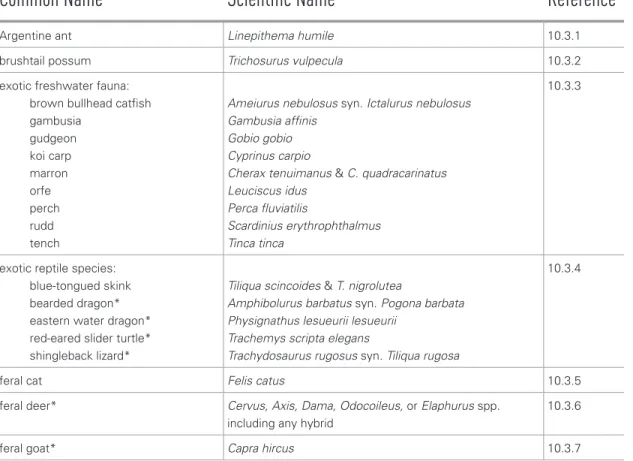
The following sections of the Strategy detail the management programmes to be applied as part of the control of individual or groups of animal pests within the Auckland region. The animal species declared as pests in this Strategy are summarised in Table 10.1a below.
Table 10.1a Summary of Pest Animals
Note: Species marked with an asterisk (*) are declared pests only when not held in secure containment.
Common Name
Scien
tiÞ
c Name
Reference
Argentine ant Linepithema humile 10.3.1
brushtail possum Trichosurus vulpecula 10.3.2
exotic freshwater fauna: brown bullhead catfi sh gambusia gudgeon koi carp marron orfe perch rudd tench
Ameiurus nebulosus syn. Ictalurus nebulosus Gambusia affi nis
Gobio gobio Cyprinus carpio
Cherax tenuimanus & C. quadracarinatus Leuciscus idus
Perca fl uviatilis
Scardinius erythrophthalmus Tinca tinca
10.3.3
exotic reptile species: blue-tongued skink bearded dragon* eastern water dragon* red-eared slider turtle* shingleback lizard*
Tiliqua scincoides & T. nigrolutea
Amphibolurus barbatus syn. Pogona barbata Physignathus lesueurii lesueurii
Trachemys scripta elegans
Trachydosaurus rugosus syn. Tiliqua rugosa
10.3.4
feral cat Felis catus 10.3.5
feral deer* Cervus, Axis, Dama, Odocoileus, or Elaphurus spp. including any hybrid
10.3.6
Common Name
Scien
tiÞ
c Name
Reference
feral pig* Sus scrofa 10.3.8
hedgehog Erinaceus europaeus occidentalis 10.3.9
magpie Gymnorhina spp. 10.3.10
mouse Mus musculus 10.3.11
mustelids ferret stoat weasel Mustela furo Mustela erminea Mustela nivalis vulgaris
10.3.12
myna Acridotheres tristis 10.3.13
rabbit Oryctolagus cuniculus cuniculus 10.3.14
rats: ship rat Norway rat kiore26 Rattus rattus Rattus norvegicus Rattus exulans 10.3.15
rook Corvus frugilegus 10.3.16
sulphur-crested cockatoo* Cacatua galerita 10.3.17
wallabies Macropus, Petrogale or Wallabia spp. 10.3.18
wasps:
common wasp German wasp Asian paper wasp Australian paper wasp
Vespula vulgaris Vespula germanica Polistes chinensis Polistes humilis
10.3.19
With respect to individual or groups of animal pests, the ARC has determined that different pests warrant different types and levels of regional intervention. The level of intervention adopted for one or a group of pest animals takes into account the most appropriate means for addressing the present and potential adverse impacts of the animal(s). It also recognises that the desired end results of pest management may take longer than the duration of the Strategy.
Due to the complexity of management options for animal pests in the Strategy, the designation categories used for plants (total control, containment, surveillance) have not been used to categorise pest animals.
Each management programme is specifi c to each pest animal, and includes:
A Description of the Problem •
The Animal Pest Designation •
The Reasons for the Strategy •
Objectives •
Principal measures of achievement •
Rules •
Pest animal control in the Auckland region will be undertaken in a prioritised manner with the majority of funding targeted to prevent ecological damage. Support will be given to the DoC Wild Deer Control Programme and pests such as mustelids and rats will be controlled
at specifi c mainland island sites. Where communities are undertaking animal pest control, support will be given to assist them to achieve their goals. Advice and information on all pest animals in the Strategy will be provided to individuals and groups who request it. Priorities for pest animal control have, in part, been determined by assessing the vulnerability of “indicator” species preferred by introduced browsing mammals. The Council has focused resources on vulnerable areas of High Conservation Value (HCV), and surrounding buffer areas, to slow pest reinvasion. Examples of HCV areas include the Waitakere and Hunua Ranges. The pest animals listed in Table 10.1a above may also be controlled under the Council’s site-led pest initiatives (refer section 17 of this document).
Additional Controls on Animal
10.
2.
Species
In addition to the provisions contained within this Strategy, there are further controls that may apply to some animal species (either declared pests within this Strategy or not). While these additional controls do not form part of the Strategy provisions, they are briefl y outlined here for information and clarity.
10.
2.1 Provisions of the Wild Animal Control
Act
The conveyance and liberation of any wild animal is prohibited under section 11 of the Wild Animal Control Act 1977, which is administered by DoC. ‘Wild animal’ is defi ned in section 2 of that Act as:
“Wild animal
-(a) Means –
(i) Any deer (including wapiti or moose);
(ii) Any chamois, thar, wallaby, or possum (Trichosurus vulpecula);
(iii) Any goat that is not—
(A) Held behind effective fences or otherwise constrained; and
(B) Identifi ed in accordance with an identifi cation system registered under section 3 of the Animal Identifi cation Act 1993 or, in accordance with an identifi cation system approved under section 50 of the Biosecurity Act 1993 and approved by the Director-General for the purposes of this Act;
(iv) Any pig that is living in a wild state and is not being herded or handled as a domestic animal or kept within an effective fence or enclosure for farming purposes;
(v) Any member of any species or class of land mammals that the Governor-General may from time to time, by Order in Council, declare to be wild animals for the purposes of this Act; and
(b) Includes the whole or any part of the carcass of any such animal;
(c) Except for deer lawfully kept in captivity for the purposes of farming, does not include any animal kept in captivity pursuant to a permit or licence that is effective for the purposes of section 12 of this Act during the currency of the permit or licence and the observance of all conditions under which the permit or licence has been issued.”
10.
2.2 Other introduced organisms that may
be pr
esen
t i
n the Auckland region
There are a number of additional introduced organisms present in the region that are not described specifi cally in the Strategy. These include newly arrived insects such as the painted apple moth (Teia anartoides) and southern saltmarsh mosquito (Ochlerotatus camptorhynchus), and amphibians such as the banjo frog (Limnodynastes dumerilii). Many of these new incursions are managed by Biosecurity New Zealand, some with support from other agencies.
The following table lists some of the additional introduced organisms in the Auckland region and the key management agency or contact points for them. The Council is able to provide information and advice on these species. As part of its wider biosecurity and biodiversity functions, ARC undertakes surveillance for these (and other) species, and liaises with the relevant management agencies.
Table 10.2.2a Additional Introduced Organisms in the Auckland Region
Key: UO = Unwanted Organism NO = Notifi able Organism
Common name
Scien
tiÞ
c Name
Management agency*
Amphibians
Banjo frog (UO) Limnodynastes dumerilii Biosecurity NZ, ARC & DoC
Insects
Gypsy moth (NO) Lymantria dispar Biosecurity NZ
Black crazy ant (NO) Paratrechina longicornis Biosecurity NZ
Fall webworm (UO) Hyphantria cunea Biosecurity NZ
Gum leaf skeletoniser (NO) Uraba lugens Biosecurity NZ
Painted apple moth (NO) Teia anartoides Biosecurity NZ
Red imported fi re ant (NO) Solenopsis invicta Biosecurity NZ
Southern salt marsh mosquito (NO) Ochlerotatus camptorhynchus Biosecurity NZ & MoH Varroa bee mite (NO) Varroa destructor Biosecurity NZ & National
Beekeepers Association of NZ Yellow crazy ant (UO) Anoplolepis gracilipes Biosecurity NZ & DoC
Freshwater
Didymo (UO) Didymosphenia geminata Biosecurity NZ
Freshwater ghost shrimp Callianassa species Biosecurity NZ
Marine
Colonial tunicate Didemnum vexillum Biosecurity NZ
Exotic seaweed (UO) Undaria pinnatifi da Biosecurity NZ & MFish
Sea squirt (UO) Styela clava Biosecurity NZ
Birds
Indian ring-necked parakeet Psittacula krameri mallinensis Biosecurity NZ
Rainbow lorikeet (UO) Trichoglossus haematodus DoC
Red vented bulbul (UO) Pycnonotus cafer Biosecurity NZ & ARC
Other
Avian infl uenza (NO) Orthomyxoviridae family Biosecurity NZ & MoH
Dieback fungi Phytophthora spp. Biosecurity NZ
Dutch elm disease (NO) Ophiostoma ulmi Biosecurity NZ
Pig post weaning mortality & wasting
syndrome Porcine circovirus Biosecurity NZ
*Contact details: Phone Web site
Animal Pest Species
10.
3.
10.
3.1
Argentine ant
(Linepithema humile)
(i) Description of the problem
Argentine ants are a pest in temperate and Mediterranean climates around the world, and are considered by the World Conservation Union as one of 100 of the world’s worst invasive alien species27. Impacts to native invertebrate
fauna, birds and plants in many countries have
contributed to severe population declines and even local extinctions. In the United States, this ant has locally eliminated lizard, honeybee and many insect species. Argentine ants were fi rst recorded in New Zealand in 1990 and are now well established on the mainland of the Auckland region. They have also spread to several outlying islands including Tiritiri Matangi, Waiheke and Kawau. In February 2006, Argentine ants were recorded on Great Barrier Island.
(ii) Animal pest designation
Argentine ant (Linepithema humile) is declared a pest in the Auckland region.
(iii) Reason for strategy
The ARC considers that regional intervention is necessary to prevent and reduce the spread of
Argentine ants to new locations in the Hauraki Gulf. This will reduce overall impacts and delay the point at which all islands would be infested. Emphasis could also be placed on protecting areas of greatest conservation or other values.
Community support and engagement remains a vital component of such programmes. Movement controls normally rely more on community support, as resources are optimised away from regulatory activities to community engagement activities.
(iv) Objectives
a) To prevent the spread of Argentine ants to Hauraki Gulf islands so that environmental impacts are minimised.
b) To assist community groups with Argentine ant control through the provision of coordination, advice and information regarding funding sources.
c) To prevent or slow the spread of Argentine ants into uninfested areas of the Auckland region.
(v) Principal measures of achievement
Service Delivery The ARC may at its discretion, carry out Argentine ant control in areas of High Conservation Value, as a component of integrated site-led pest management programmes. The ARC, in conjunction with DoC, will implement hygiene measures to protect the Hauraki Gulf islands. Education &
Advice
The ARC will provide information, education and advice as set out in section 19 of this RPMS.
Research The ARC will support research and monitoring or other activities associated with fi nding suitable control measures.
Monitoring The ARC may undertake monitoring to determine the extent, spread and likely potential extent of Argentine ants within the Hauraki Gulf and greater Auckland region.
Lowe S., Browne M., Boudjelas S., De Poorter M. (2000)
27 100 of
the World’s Worst Invasive Alien Species A selection from the Global Invasive Species Database. Published by The Invasive Species Specialist Group (ISSG) a specialist group of the Species Survival Commission (SSC) of the World Conservation Union (IUCN), 12pp. First published as special lift-out in Aliens 12, December 2000. Updated and reprinted version: November 2004.
(vi) Rules
Rule 10.3.1.1
No person shall:
a) Knowingly transfer, cause to be transferred, release, or cause to be spread, Argentine ant to any uninfected area within Auckland region; or
b) Knowingly transfer, cause to be transferred, or move any object contaminated with Argentine ant within the Auckland region.
Rule 10.3.1.2
Hauraki Gulf Controlled Area restrictions are also applicable (refer section 17.2.2 of this Strategy).
A breach of these Rules will create an offence under section 154(r) of the Act, or may result in default work under section 128 of the Act, or both.
10.
3.2
Brushtail possum
(Trichosurus vulpecula)
(i) Description of the problem
The impacts of possums on native fl ora and fauna are well documented. Not only do possums affect indigenous fauna by competing for limited food resources, they also directly prey on native birds and invertebrates, including kereru, North Island kokako and käkä. Possums are also the main vector for bovine tuberculosis. Possums are therefore one of the most damaging pests in New Zealand.
It should be noted that this RPMS is separate from the National Bovine Tuberculosis Pest Management Strategy. The ARC has for many years had an Agency Contract with the Animal Health Board (Inc) to control animal vectors under the National Bovine Tuberculosis Pest Management Strategy.
(ii) Animal pest designation
The brushtail possum (Trichosurus vulpecula) is declared a pest in the Auckland region.
(iii) Reason for strategy
The ARC considers that regional intervention and co-ordination is necessary to limit environmental and economic damage caused by possums. The ARC will encourage landowners/occupiers to take responsibility for controlling possums and advise them on appropriate techniques. The ARC possum control operations will primarily target areas of signifi cant environmental and conservation value (e.g. large tracts of native forest, coastal forest, peninsulas, and large buffer areas around them). The principal reason for such targeting is the potential regional benefi t. Community groups and individuals will be given advice and assistance with possum control operations throughout the region, with priority placed on those within the targeted areas. The ARC has been carrying out possum control in a number of signifi cant areas for many years, e.g. Waitakere and Hunua Ranges. It is essential that there is a mechanism in place to ensure that the possum populations in these areas do not rise to damaging levels following control. For this reason, the ARC, through the term of this Strategy, will implement a Rule placing obligation on landowners/occupiers to maintain possum control at post-management levels through the creation of possum control areas.
Possum Control Areas
Possum Control Areas will be set up at the ARC’s discretion in areas where the following criteria are met: a) Previous ARC funded control work has achieved a possum Residual Trap Catch level below 5%; and b) A majority of land occupiers (75% based on area,
or a lesser percentage at ARC’s discretion) agree to either:
(i) maintain low possum densities (to an agreed level) over their land (refer to section 11); or
(ii) pay an additional rate*, from which ARC will maintain low possum densities (to an agreed level) over their land.
* Imposition of an additional rate for Possum Control Areas will be subject to the ARC Annual Plan and Long Term Council Community Plan, and may include subsidisation of possum control costs by ARC.
The ARC will assist landowners/occupiers committed to controlling possums, to establish Possum Control Areas. Information about the need to control possums, appropriate methods of possum control, and the responsibilities of the ARC and landowners/occupiers, as set out in this Strategy, will be provided to all landowners/occupiers within each proposed Possum Control Area.
Following the cessation of ARC funded possum control, all landowners/occupiers within a Possum Control Area will be responsible for the ongoing maintenance of possum densities at or below 5% residual trap catch. The ARC will provide resources and expertise to facilitate landowner/occupier control programmes, on a case-by-case basis.
The ARC will establish the boundaries for each Possum Control Area. Landowners/occupiers within the Possum Control Area will be required to allow access over their land so that monitoring of possum numbers may be undertaken.
The fi rst monitoring will be at ARC expense. Where monitoring shows the agreed level has not been met, Council may either:
a) undertake control works and subsequent monitoring, and recover the cost from the landowner/occupier (either through direct cost-recovery, or through a subsidised rate imposed on landowners within the Possum Control Area, depending on the approach agreed to by landowners/occupiers); or
b) require the landowner/occupier to control to the agreed level, at their expense. The ARC will carry out subsequent monitoring at the landowner/ occupier’s expense.
(iv) Objectives
a) To manage possum population levels in areas of signifi cant environmental or High Conservation Value to minimise impacts on these values; b) To assist community groups and individual
landowners/occupiers in areas of signifi cant environmental and conservation value, with possum control through the provision of materials and advice;
c) To progressively reduce and control possum infestation levels in the region through an integrated control programme; and
d) To ensure that within selected areas of the region where possum numbers have been reduced to low levels through ARC funded control programmes, these levels are maintained through establishment of Possum Control Areas.
(v) Principal measures of achievement
Service Delivery
The ARC will carry out possum control operations in areas of high conservation value, and surrounding buffer areas, and begin a programme of control on key peninsulas in conjunction with community input.
The ARC will actively assist people that have areas of signifi cant environmental and conservation value (including areas of privately covenanted bush), and surrounding buffer areas, to undertake ongoing possum control measures which complement work undertaken by the ARC.
Community Assistance
The ARC will actively assist community groups that are controlling possums to ensure an integrated approach. Education &
Advice
The ARC will provide information, education and advice as set out in section 19 of this RPMS.
Research The ARC will encourage continuing research into possum control methods. Monitoring The ARC shall undertake inspections,
(vi) Rules
Rule10.3.2.1
No person shall:
a) Cause or permit brushtail possums (Trichosurus vulpecula) to be in a place where they are offered for sale, or exhibited (without a permit); or b) Sell or offer brushtail possums (Trichosurus
vulpecula) for sale; or
c) Breed, or multiply brushtail possums (Trichosurus vulpecula) or otherwise act in such a manner as is likely to encourage or cause the breeding or multiplication of brushtail possums (Trichosurus vulpecula).
Rule10.3.2.2
Where a Possum Control Area has been created, landowners/occupiers shall control brushtail possums (Trichosurus vulpecula) to the agreed residual trap catch density.
Rule10.3.2.3
Hauraki Gulf Controlled Area restrictions are also applicable (refer section 17.2.2 of this Strategy).
Rule 10.3.2.2 is not applicable for Possum Control Areas that are funded through an additional rate on landowners within the Possum Control Area, as described in Section 10.3.2(iii)(b)(ii) above.
A breach of these Rules will create an offence under section 154(r) of the Act, or may result in default work under section 128 of the Act, or both.
10.
3.3
Exotic freshwater fauna:
brown bullhead catfi sh (Ameiurus nebulosus syn. Ictalurus nebulosus)
gambusia (Gambusia affi nis)
gudgeon (Gobio gobio)
koi (Cyprinus carpio)
marron (Cherax tenuimanus &
C. quadracarinatus)
orfe (Leuciscus idus)
perch (Perca fl uviatilis)
rudd (Scardinius
erythrophthalmus)
(i) Description of the problem
There are few freshwater ecosystems within the Auckland region that do not have established exotic freshwater fauna populations; many have more than 5 species present. Some exotic freshwater fauna have been in the Auckland region for over a century (rainbow and brown trout, brown bullhead catfi sh), others are more recent arrivals (gudgeon and orfe). The impacts of exotic freshwater fauna, on indigenous biodiversity, water quality, recreation, tourism, amenity values and the rural economy, are suspected or implied, but not well quantifi ed.
Studies conducted by the ARC, the National Institute of Water and Atmospheric Research (NIWA) and other organisations have found that some exotic freshwater fauna may pose a signifi cant threat to native fauna, water quality, and to recreational and commercial use of some freshwater environments.
Environmental impacts caused by exotic freshwater fauna may include:
Decline in native fi sh abundance and diversity •
through competition and abundance;
Changes in the distribution of native fi sh due to •
interactive segregation;
Changes to submerged aquatic plant community •
structure; Hybridisation; •
Parasites and diseases; •
Food web impacts through changes to plankton •
community composition;
Water quality impacts and habitat degradation from •
de-vegetation or bio-perturbation.
Note: Perch, tench and rudd are identifi ed as sports fi sh in the First Schedule of the Freshwater Fisheries Regulations 1983. Fish and Game councils are responsible for the management of sports fi sh under the Conservation Act 1987. Therefore ARC will consult with the NZ Fish and Game Council on all matters concerning the management of perch, tench and rudd in the Region.
(ii) Animal pest designation
a) The following species are declared pests throughout the Auckland region:
brown bullhead catfi sh (
• Ameiurus nebulosus
syn. Ictalurus nebulosus) gambusia (
• Gambusia affi nis) gudgeon (
• Gobio gobio) koi (
• Cyprinus carpio) marron (
• Cherax tenuimanus & C. quadracarinatus)
orfe (
• Leuciscus idus)
b) The following species are declared pests within the High Conservation Value waterbodies and their catchments (as defi ned in Maps 6 and 7 of Appendix 3) and within the Hauraki Gulf Controlled Area (refer section 17.2):
perch ( • Perca fl uviatilis) rudd ( • Scardinius erythrophthalmus) tench ( • Tinca tinca) (iii) Reason for strategy
Exotic freshwater fauna exert a number of impacts on water bodies within the Auckland region. Exotic freshwater fauna feed on native species and also compete for food. The feeding habits of some exotic freshwater fauna have a serious effect on water quality through disturbance of the waterbed, and in extreme cases may increase the risk of bank erosion. Active illegal distribution continues largely unimpeded by existing regulations, therefore a regionally coordinated approach is required to manage existing populations and to protect high conservation value waterbodies.
There is no intention in this Strategy of restricting or in any way affecting the traditional and/or commercial harvest of eels and other native fi sh.
Note: In addition to these provisions of the RPMS, the following other legislation should also be considered in relation to the management of exotic freshwater fauna:
Conservation Act 1987 & Freshwater Fisheries Regulations 1983
The provisions of the Conservation Act 1987 are applicable in relation to perch, tench and rudd, which are classifi ed as ‘sports fi sh’ under the Freshwater Fisheries Regulations.
Fisheries Act 1996
The Fisheries Act 1996, and various regulations promulgated under that Act, may also be applicable with respect to some exotic freshwater fauna, particularly brown bullhead catfi sh.
(iv) Objectives
a) Contain, and where practicable, reduce or eradicate pest exotic freshwater fauna populations; and b) Raise public and sector group awareness of the
effects of exotic freshwater fauna on high value freshwater ecosystems, water quality, recreation and tourism, amenity values and the rural economy; and
c) Gather information on effective means to control pest freshwater fauna populations.
(v) Principal measures of achievement
Service Delivery
The ARC will undertake species-specifi c management of pest exotic freshwater fauna. In particular:
Koi, catfi sh, gambusia, gudgeon, marron and orfe: – Contain and control where appropriate at the discretion of the ARC. Perch, tench and rudd: – Prevent establishment in designated High Conservation Value waterbodies (as defi ned in Maps 6 and 7 of Appendix 3) and in the Hauraki Gulf Controlled Area. Where established, identify methods to reduce adverse impacts.
Education & Advice
The ARC will provide advice and information on the threat of exotic pest freshwater fauna on highly valued freshwater ecosystems, including freshwater fi shing sector liaison, contributions to signage and production of educational materials.
The ARC will establish an inter-regional exotic freshwater fauna co-ordination group comprising representatives from the ARC, Fish and Game NZ, DoC, MFish, NIWA, tangata whenua, neighbouring regional councils and other interested parties.
Monitoring The ARC, in conjunction with Fish and Game NZ, neighbouring regional councils, Biosecurity New Zealand, MFish, DoC, tangata whenua and other interested parties, will undertake monitoring and surveillance of priority exotic freshwater fauna to determine the extent of populations.
(v) Rules
Rule 10.3.3.1
No person shall, unless authorised to do so under the Conservation Act 1987, the Freshwater Fisheries Regulations 1983 or any regulation promulgated under the Fisheries Act 1996:
a) Sell or offer for sale, (or cause or permit to be in a place where they are offered for sale or exhibited), any live gambusia (Gambusia affi nis), gudgeon (Gobio gobio), koi (Cyprinus carpio), marron (Cherax tenuimanus & C. quadracarinatus), or orfe (Leuciscus idus); or
b) Breed, or multiply or otherwise act in such a manner as is likely to encourage or cause the breeding or multiplication of brown bullhead catfi sh (Ameiurus nebulosus syn. Ictalurus nebulosus), gambusia (Gambusia affi nis), gudgeon (Gobio gobio), koi (Cyprinus carpio), marron (Cherax tenuimanus & C. quadracarinatus), or orfe (Leuciscus idus); or c) Release, or cause to be released, brown bullhead
catfi sh (Ameiurus nebulosus syn. Ictalurus nebulosus), gambusia (Gambusia affi nis), gudgeon (Gobio gobio), koi (Cyprinus carpio), marron (Cherax tenuimanus, C. quadracarinatus), or orfe (Leuciscus idus) into any waterbody within the Auckland region; or
d) Release, or cause to be released, perch (Perca fl uviatilis), rudd (Scardinius erythrophthalmus) or tench (Tinca tinca) into any of the High Conservation Value waterbodies and their catchments, as defi ned in Maps 6 and 7 of Appendix 3; or
e) Conduct any pest, coarse, sport or marron fi shing activities whatsoever (unless exempted by the Auckland Regional Council under section 80D of the Biosecurity Act) in or on the High Conservation Value waterbodies and their catchments, as defi ned in Map 6 of Appendix 3; or
f) Conduct any pest, coarse, sport or marron fi shing activities (unless exempted by the Auckland Regional Council under section 80D of the Biosecurity Act), in or on the High Conservation Value waterbodies and their catchments, as defi ned in Map 7 of Appendix 3; other than for brown trout (Salmo trutta) or rainbow trout (Onchorhynchus mykiss) using only artifi cial fl y or spinner methods, and holding a valid fi shing licence pursuant to the Conservation Act 1987 or the Freshwater Fisheries Regulations 1983.
Rule 10.3.3.2
Hauraki Gulf Controlled Area restrictions are also applicable to perch, rudd and tench (refer section 17.2.2 of this Strategy).
Rule 10.3.3.3
With respect to perch (Perca fl uviatilis), rudd (Scardinius erythrophthalmus) and tench (Tinca tinca), Rules 10.3.3.1 d), e) and f) above are not applicable until such time as the High Conservation Value waterbodies and catchments (defi ned in Maps 6 and 7 of Appendix 3 of this Strategy) are declared as restricted fi shing areas by the Director General of Conservation, under Section 26ZL(1) of the Conservation Act 1987.
A breach of these Rules will create an offence under section 154(r) of the Act, or may result in default work under section 128 of the Act, or both.
Please note that the possession and sale of live brown bullhead catfi sh (Ameiurus nebulosus syn. Ictalurus nebulosus) is regulated by the Ministry of Fisheries under the Fisheries (Commercial Fishing) Amendment Regulations 2007 and Fisheries (Amateur Fishing) Amendment Regulations 2007. Therefore this species is not included within Rule 10.3.3.1(a) above.
It is noted that the Department of Conservation has agreed in principle to declaring the High Conservation Value waterbodies (defi ned in Maps 6 and 7 of Appendix 3 of this Strategy) as ‘no fi shing zones’ under 26ZL(1) of the Conservation Act 1987, but that a number of matters need to be resolved before such a declaration can be made, including consultation with the Auckland/Waikato Fish and Game Council. ARC will work with the Department of Conservation and other agencies to resolve these matters as quickly as possible.
10.
3.4
Exotic reptile species:
blue-tongued skink
(Tiliqua scincoides
& Tiliqua nigrolutea) and, when not held in secure containment:
bearded dragon (Amphibolurus barbatus syn. Pogona barbata) eastern water dragon (Physignathus lesueurii lesueurii) red-eared slider turtle (Trachemys scripta elegans) shingleback lizard (Trachydosaurus rugosus syn. Tiliqua rugosa)
(i) Description of the problem
The sale of exotic reptile species for the pet trade has grown in popularity over recent years. New Zealand has very few reptiles and there is the potential for some exotic reptiles to impact on New Zealand ecology. In many cases however there is little information on the likelihood of these exotic reptiles establishing in the wild.
Several exotic reptile species have been identifi ed in the pet trade that may potentially have adverse impacts on the ecology of the region if they escape from containment. These impacts may include:
May carry endoparasites and diseases, which pose •
a risk to native lizard populations (blue-tongued skink, shingleback lizard)
Predation on eggs and chicks of ground nesting •
birds and other smaller lizards (blue-tongued skink) Direct and indirect competition with native species •
for food and other resources (bearded dragon) Adverse impacts on indigenous lowland aquatic •
plant and aquatic invertebrate (insects and molluscs) species (red-eared slider turtle)
(ii) Animal pest designation
a) Blue-tongued skinks (Tiliqua scincoides & Tiliqua nigrolutea) are declared Surveillance pest species throughout the entire Auckland region.
b) The following species are declared pests within the Auckland region, only where they are not held within secure containment:
bearded dragon (Amphibolurus barbatus syn. •
Pogona barbata),
eastern water dragon (Physignathus lesueurii •
lesueurii),
red-eared slider turtle (
• Trachemys scripta elegans),
shingleback lizard (Trachydosaurus rugosus syn. •
Tiliqua rugosa).
It is noted that the four species listed above are also listed as species to be researched (refer section 22.3.2).
(iii) Reason for strategy
Of the fi ve exotic reptile species above, there is suffi cient information relating to blue-tongued skink to place restrictions on the sale or breeding. Additional research is required on the other four species to establish their potential impacts and the likelihood of establishment in the wild. It is considered prudent to take a precautionary approach to prevent the release of these species from containment into the Auckland environment. It is noted that additional research is also required with respect to rainbow skink(Lampropholis delicata)as discussed in section 22.3.2 below, however this species is not declared a pest under the Strategy.
(iv) Objectives
a) To prevent the escape, release, spread, and establishment in the wild of blue-tongued skink; and b) To prevent the escape or release of bearded dragon
(Amphibolurus barbatus syn. Pogona barbata), blue-tongued skink (Tiliqua scincoides & Tiliqua nigrolutea), eastern water dragon (Physignathus lesueurii lesueurii), red-eared slider turtle
(Trachemys scripta elegans) and shingleback lizard (Trachydosaurus rugosus syn. Tiliqua rugosa) into the wild in the Auckland region; and
c) To carry out further research on the potential impacts of bearded dragon (Amphibolurus barbatus
syn. Pogona barbata), eastern water dragon (Physignathus lesueurii lesueurii), red-eared slider turtle (Trachemys scripta elegans) and shingleback lizard (Trachydosaurus rugosus syn Tiliqua rugosa). (v) Principal measures of achievement
Service Delivery
The ARC may at its discretion carry out control of blue-tongued skink.
The ARC may carry out control of bearded dragon, eastern water dragon, red-eared slider turtle and shingleback lizard, where animals are found in the wild.
Education & Advice
The ARC will provide education and advice regarding possible environmental threats posed, and provision of a recovery service for unwanted pet reptiles.
Research The ARC will carry out research into the potential impacts and likelihood of establishment of bearded dragon, eastern water dragon, red-eared slider turtle and shingleback lizard (refer to section 22.3.2 for more information). Monitoring ARC will liaise with DoC, Biosecurity NZ and other agencies to allow for coordinated record keeping in relation to exotic reptile species.
(vi) Rules
Rule 10.3.4.1
No person shall:
a) Cause or permit blue-tongued skinks (Tiliqua scincoides & Tiliqua nigrolutea) to be in a place where they are offered for sale or exhibited; or b) Sell or offer blue-tongued skinks (Tiliqua scincoides
& Tiliqua nigrolutea) for sale; or
c) Breed, or multiply, or otherwise act in such a manner as is likely to encourage or cause the breeding or multiplication of blue-tongued skinks (Tiliqua scincoides & Tiliqua nigrolutea); or d) Release: bearded dragon (Amphibolurus barbatus
syn. Pogona barbata), blue-tongued skink (Tiliqua scincoides & Tiliqua nigrolutea), eastern water dragon (Physignathus lesueurii lesueurii), red-eared slider turtle (Trachemys scripta elegans), or shingleback lizard (Trachydosaurus rugosus
syn. Tiliqua rugosa), from containment within the Auckland region.
Rule 10.3.4.2
Hauraki Gulf Controlled Area restrictions are also applicable to blue-tongued skinks only (refer section 17.2.2 of this Strategy).
A breach of these Rules will create an offence under section 154(r) of the Act, or may result in default work under section 128 of the Act, or both.
Rules 10.3.4.1 and 10.3.4.2 do not affect the keeping of existing blue-tongued skinks as pets for the term of their natural life.
Containment in the context of Rule 10.3.4.1 and Section 10.3.4 (ii) is defi ned as held within a cage or suitable facility suffi cient to prevent escape or involuntary release into the wild.
10.
3.5
Feral cat
(Felis catus)
(i) Description of the problem
Feral cats are widely distributed throughout the three main islands of New Zealand, and on a number of offshore islands. They live in most terrestrial habitats in New Zealand including sand dunes, pasture, tussock, scrub, exotic plantations and native forest28.
Feral cats eat a range of animals including rabbits, rats and mustelids, as well as native birds, lizards and invertebrates. Their impacts on native ecosystems are complex, as their removal of rabbits and rats can have benefi cial effects, while predation of native birds and insects is deleterious. Their negative impacts have been well documented on offshore islands, where there are records of native species disappearing from islands after the arrival of cats (e.g. saddlebacks from Little Barrier, Cuvier and Stephens Islands), and marked native species recovery after cats have been eradicated29.
Feral cats are defi ned as cats that have none of their needs provided by humans, and their population size fl uctuates largely independently of humans. Feral cats generally do not live around centres of human habitation. The feral cat population is self-sustaining and requires no input from the domestic cat population. Cats that are not given regular preventative treatments can pose a public health risk through the spread of zoonotic diseases (e.g. toxocariasis or toxoplasmosis). Feral cats may also carry and suffer from feline enteritis or conjunctivitis.
(ii) Animal pest designation
Feral cat (Felis catus) is declared a pest in the Auckland region.
(iii) Reason for strategy
Feral cats are known to have signifi cant impacts on native bird species, and also native lizards and invertebrates. They may be subject to site-led control in High Conservation Value areas in the region. ‘Cat free’ areas may also be established where there is clear support from a community and there is an existing pest management programme (refer section 11 of this Strategy).
Note: The abandonment of any cat is also an offence under section 14(2) of the Animal Welfare Act 1999,
which states:
“A person commits an offence who, being the owner of, or person in charge of, an animal, without reasonable excuse, deserts the animal in circumstances in which no provision is made to meet its physical, health and behavioural needs.”
(iv) Objectives
a) To reduce the negative impacts of feral cats in selected High Conservation Value areas and Hauraki Gulf Islands, where programmes for managing other animal pests have been implemented.
(v) Principal measures of achievement
Service Delivery
The ARC may at its discretion carry out feral cat control in areas of high conservation value, including Hauraki Gulf Islands, as a component of integrated site-led pest management programmes.
The ARC will work with central and local government and other agencies to investigate and advocate ‘cat free’ areas, islands or subdivisions as a component of integrated site-led pest management programmes.
Education & Advice
The ARC will provide information, education and advice as set out in section 19 of this RPMS.
The ARC will also work with local and central government and other agencies to promote awareness of the ecological risks of cats, and to encourage owners and the community to take appropriate measures to reduce these risks. Research The ARC will support research on feral
cat impacts in high conservation value areas.
Integrated Programme
The ARC will support the Royal Society for Prevention of Cruelty to Animals efforts in developing effective solutions to the problem of cat abandonment.
(vi) Rules
Rule 10.3.5.1
No person shall:
a) Knowingly transfer or cause to be transferred, any feral cat into or within any area in the Auckland region; or
b) Knowingly abandon, or cause to be abandoned, any cat within the Auckland region.
Rule 10.3.5.2
Hauraki Gulf Controlled Area restrictions are also applicable (refer section 17.2.2 of this Strategy).
A breach of these Rules will create an offence under section 154(r) of the Act, or may result in default work under section 128 of the Act, or both.
10.
3.6
Feral deer species
(Cervus, Axis, Dama, Odocoileus
or
Elaphurus
spp. including any hybrid
)
(i) Description of the problem
There are currently three species of feral deer known to be present in the Auckland region. Fallow and red deer are the most common species, wapiti are less common and sika deer are believed to be absent. Deer are selective browsers, tending to target particular forest species over others. This can result in a signifi cant change in the forest make-up and subsequent effects on fauna that rely on these plants. Deer destroy the understorey of native forest by overbrowsing, grazing, bark stripping and trampling, which in turn may increase soil erosion. Conventional farm fences do not contain deer, and they roam at will once they have escaped deer-proof fences.
Note: Deer are defi ned as “wild animals” under the Wild Animal Control (WAC) Act 1977, administered by DoC, which has a number of responsibilities under that Act. Farming of deer and other wild animals is controlled by DoC under section 12A of the WAC Act. There are three Exclusion Zones set up under the WAC Act in the Auckland region where the farming of deer is prohibited:
Waitakere Ranges and buffer; •
Hunua Ranges and buffer; •
All outlying Islands. •
DoC is also responsible for ensuring that deer fences are adequate to contain deer, and DoC can act to destroy deer on private land where they pose a threat to the natural environment.
(ii) Animal pest designation
Feral deer (Cervus, Axis, Dama, Odocoileus, or
Elaphurus spp. including any hybrid) are declared pests in the Auckland region. Deer are considered feral wherever they are not:
a) held behind fencing that meets the requirements of the Deer Farming Regulations; and
b) identifi ed as required by those Regulations.
(iii) Reason for strategy
While feral deer are considered a recreational resource by deer hunters there is low public awareness of the potential impacts feral deer have on the ecology of High Conservation Value areas in the region. The ARC considers a regionally coordinated approach is necessary, to prevent the establishment of feral deer in areas currently free of them, and to reduce populations in areas where feral deer threaten High Conservation Value sites.
(iv) Objectives
a) Progressively work to eradicate feral deer from all areas of the region over the fi ve year period of this Strategy, except within that area of the South Kaipara Peninsula which is subject to an ARC approved deer management plan; and
b) Minimise the adverse effects of feral deer in areas of High Conservation Value areas; and
c) Promote community awareness of the impacts of feral deer on native species and habitats; and d) Assist DoC with its feral deer removal programme
under the Wild Animal Control Act 1977.
(v) Principal measures of achievement
Service Delivery The ARC will carry out feral deer control operations in areas of High Conservation Value, and in a 5km buffer zone around the areas of High Conservation Value, where priority for feral deer control exceeds the priority for control of other pests. ARC may also, at its discretion, control feral deer in other areas of the region.
Integrated Programme
The ARC will work with DoC in the implementation of its Feral Deer Control Programme for the Auckland region.
Education & Advice
The ARC will provide information, education and advice as set out in section 19 of this RPMS.
Monitoring Feral deer numbers and impacts will be monitored through reports of deer sightings, ground sign, and vegetation assessments.
Research The ARC will continue to support research on the impacts of feral deer in High Conservation Value areas.
(vi) Rules
Rule 10.3.6.1
No person shall release from containment any deer (Cervus, Axis, Dama, Odocoileus, or Elaphurus spp. including any hybrid) in any part of the Auckland region.
Rule 10.3.6.2
Hauraki Gulf Controlled Area restrictions are also applicable (refer section 17.2.2 of this Strategy).
A breach of these Rules will create an offence under section 154(r) of the Act, or may result in default work under section 128 of the Act, or both.
10.
3.7
Feral goat
(Capra hircus)
(i) Description of the problem
Feral goats are widespread throughout the region. Populations are generally highest in exotic and indigenous forest areas, however goats are also found in poor pasture and scrubland. They prefer rocky substrate where, being very agile, they can exploit places that deer and sheep cannot reach. Feral goats (along with possums and feral deer) are the most destructive animals found in native and plantation forests. Being opportunist browsers, goats destroy the understorey of vegetation (up to 2m above ground) and, when combined with possum damage in the upper canopy, cause severe deterioration of native forests. Feral goats also damage vegetation planted on land retired for soil conservation purposes and in newly planted or young trees in exotic forests. They are hardy survivors with the ability to exist in areas that other animals would abandon.
DoC also has responsibility for feral goat management under the Wild Animal Control Act 1977.
(ii) Animal pest designation
The feral goat (Capra hircus) is declared a pest in the Auckland region. A goat is declared feral wherever it is not:
a) held behind effective fences or otherwise constrained; and
b) identifi ed in accordance with an identifi cation system registered under section 3 of the Animal Identifi cation Act 1993 or, if no such system is, for the time being, in force, in accordance with any provisions having effect by virtue of section 11 of that Act.
(iii) Reason for strategy
Despite the fl uctuating value of goats as a farming resource, the feral goat pest potential is undiminished. Goats are notoriously hard to fence in and, on hill
country farms and lifestyle blocks bordering forests, they are a constant source of reinfestation. Because of the serious impacts goats can have on natural areas, control of feral goats in areas of signifi cant ecological and conservation value, and their buffers is necessary.
(iv) Objectives
a) To manage feral goat population levels in areas of High Conservation Value and buffer areas; and b) To prevent establishment of feral goats in areas of
ecological signifi cance within the Auckland region; and
c) To assist community groups with feral goat control, through the provision of materials, labour and advice.
(v) Principal measures of achievement
Service Delivery In areas of High Conservation Value, where priority for feral goat control exceeds or equals the priority for other animal pest control, and in buffer areas beyond the High Conservation Value, the ARC will carry out feral goat control operations.
Integrated Programme
The ARC will initiate programmes to eradicate feral goats from Waiheke Island and the Hunua Ranges. Education &
Advice
The ARC will provide information, education and advice as set out in section 19 of this RPMS.
Research The ARC will assess the effectiveness of its Sentinel goat programme within the Hunua Ranges, and investigate improved techniques for feral goat management.
Monitoring Damage caused by feral goats is assessed by Council staff. Performance assessments for contractors are based on feral goat population in randomly sampled blocks.
(vi) Rules
Rule 10.3.7.1
No person shall farm or keep feral goats on any island within the Hauraki Gulf.
Dairy goat breeds (e.g. Alpine, British alpine, Nubian, Nubian/Anglo, Saanen, Sable, Toggenburg) are exempt from Rule 10.3.7.1, as long as they are contained or tethered (to prevent escape or involuntary release into the wild), and clearly identifi ed in accordance with section 3 of the Animal Identifi cation Act 1993.
Rule 10.3.7.2
No person shall release from containment any goat (Capra hircus) in any part of the Auckland region.
Rule 10.3.7.3
Hauraki Gulf Controlled Area restrictions are also applicable (refer section 17.2.2 of this Strategy).
A breach of these Rules will create an offence under section 154(r) of the Act, or may result in default work under section 128 of the Act, or both.
Council will use cost recovery powers under the Biosecurity Act 1993 where breaches of these Rules occur, providing ownership of the goat(s) can be determined.
10.
3.8
Feral pig
(Sus scrofa)
(i) Description of the problem
Feral pigs were among the fi rst feral animals to become well established in New Zealand. Currently, in the Auckland region, they occur in larger areas of native forest (e.g. Hunua Ranges) and in exotic plantations. Feral pigs are very destructive in native bush areas, rooting up the ground, eating the fruits, seeds, roots, stems or leaf-bases of native plants; plus native insects, snails, earthworms, frogs, lizards, and ground nesting birds and their eggs. Feral pigs can also adversely affect primary production, causing damage to fences, pastures and livestock.
Pig hunters consider feral pigs to be a recreational resource, and there have been many releases of pigs into forested areas of the region. There is low public awareness of the potential impacts feral pigs have on the ecology of High Conservation Value forest areas in the region. Feral pigs are known to be carriers of bovine tuberculosis and leptospirosis and thus could act as a vector of these diseases into the region.
(ii) Animal pest designation
Feral pig (Sus scrofa) is declared a pest in the Auckland region.
(iii) Reason for strategy
The ARC considers it necessary to carry out a regionally co-ordinated programme to eradicate feral pigs from designated High Conservation Value areas and to prevent the release of feral pigs into other parts of the Auckland region.
(iv) Objectives
a) Minimise the adverse effects of feral pigs in areas of High Conservation Value; and
c) Prevent the spread of feral pigs into areas of the region that are currently free of the species.
(v) Principal measures of achievement
Service Delivery The ARC will carry out enhanced control of feral pigs in the Waitakere Ranges, selected parts of the Hunua Ranges and other High Conservation Value sites. The ARC will lead a programme to eradicate feral pigs from Waiheke Island and any new releases on the mainland of the Auckland region. Education &
Advice
The ARC will provide information, education and advice as set out in section 19 of this Strategy, and will identify areas more appropriate for pig hunting, to discourage the release of pigs into more sensitive areas.
Research The ARC will investigate a range of feral pig control methods.
Monitoring Feral pig numbers and impacts will be monitored through reports of pig sightings and ground sign.
(vi) Rules
Rule 10.3.8.1
No person shall release, or cause to be released, any pig (Sus scrofa) into the wild in any part of the Auckland region.
Rule 10.3.8.2
Hauraki Gulf Controlled Area restrictions are also applicable (refer section 17.2.2 of this Strategy).
A breach of these Rules will create an offence under section 154(r) of the Act, or may result in default work under section 128 of the Act, or both.
10.
3.9
Hedgehog
(Erinaceus europaeus occidentalis)
(i) Description of the problem
Hedgehogs are mainly insectivorous, but their varied diet includes plant material (e.g. fruit, grass roots, and leaves). They also prey on mice, birds, lizards, frogs and the chicks and eggs of ground nesting birds. They live in a range of habitats in New Zealand, including pasture, sand dunes, riparian areas, urban and suburban areas. Dry nesting sites, suffi cient food and cooler temperatures are the main limiting factors to their distribution.
(ii) Animal pest designation
Hedgehog (Erinaceus europaeus occidentalis) is a declared pest in the Auckland region.
(iii) Reason for strategy
Hedgehogs are a potentially signifi cant threat to native invertebrates (e.g. snails, weta, slugs, moths), skinks, geckos, and ground nesting birds in some parts of the region. They may also compete with kiwi for food and nesting sites. Therefore, site-led management of hedgehogs, as part of an integrated pest management control programme, may be appropriate. Preventing hedgehogs from establishing on off-shore islands where they are currently absent is also recognised as a priority.
(iv) Objectives
To reduce the impacts of hedgehogs in natural areas with signifi cant ecological/conservation values, and the chance of hedgehogs establishing on offshore islands where they are currently absent.
(v) Principal measures of achievement Education &
Advice
The ARC will provide information, education and advice as set out in section 19 of this RPMS.
Research The Council will support research on the impacts of hedgehogs in high conservation value areas.
(vi) Rules
Rule 10.3.9.1
Hauraki Gulf Controlled Area restrictions are applicable (refer section 17.2.2 of this Strategy).
A breach of this Rule will create an offence under section 154(r) of the Act, or may result in default work under section 128 of the Act, or both.
10.
3.10
Magpie
(Gymnorhina
spp.
)
(i) Description of the problem
There are two species of magpie present in New Zealand. Magpies are widespread throughout the region and both species have interbred. They prefer grassland farming areas associated with tall shelterbelts of pines and gums, but also live on forest edges, gardens and in urban areas.
Magpies are territorial birds and show aggression to anything that may pose a threat to their territory. They can be a nuisance during the breeding season, swooping on and occasionally attacking humans, especially children. There is anecdotal evidence that magpies affect native birds by excluding them from breeding territories and by predating native bird chicks and eggs to feed to their own young.
(ii) Animal pest designation
Magpies (Gymnorhina spp.) are declared pests in the Auckland region.
(iii) Reason for strategy
Magpies can be a minor human health issue. They have been implicated in restricting native bird movement between forest patches and competing with and displacing native species for food and nesting sites.
(iv) Objective
To minimise the adverse effects of magpie infestations, by promoting community awareness and raising awareness of available control methods.
(v) Principal measures of achievement
Education & Advice The ARC will provide and make available information on control and avoidance of magpies as set out in section 19 of this RPMS. Research Scientifi c data on magpie impacts
and distribution will be collated. Community
Assistance
The ARC will provide traps on a hire basis for magpie control. (vi) Rules
Rule 10.3.10.1
No person shall:
a) Cause or permit magpies (Gymnorhina spp.) to be in a place where they are offered for sale or exhibited; or
b) Sell or offer magpies (Gymnorhina spp.) for sale; or c) Breed, or multiply magpies (Gymnorhina spp.)
or otherwise act in such a manner as is likely to encourage or cause the breeding or multiplication of magpies (Gymnorhina spp.).
10.
3.11 Mouse
(Mus musculus)
(i) Description of the problem
Mice are omnivorous, eating both plant and animal matter. They will feed on almost anything, including grains, seeds, fruit, meat, insects and rubbish. Mice are prolifi c breeders, reaching sexual maturity at fi ve weeks, and having up to 5 to 10 litters of 5 to 6 young per year. Mice compete with native species for food sources and also prey on native insects (such as weta), lizards, eggs, bird chicks and other fauna.
(ii) Animal pest designation
Mouse (Mus musculus) is declared a pest within the Hauraki Gulf Controlled Area (refer section 17.2.2 of this Strategy).
(iii) Reason for strategy
The ARC considers that regional intervention is necessary to prevent and reduce the spread of mice to new locations in the Hauraki Gulf area. This will reduce overall impacts of pests particularly in areas where other mammalian pests have or are being controlled.
(iv) Objective
To prevent the spread of mice to selected areas within the Hauraki Gulf where they are not known to be present.
(v) Principal measures of achievement
Service Delivery The ARC may at its discretion carry out mouse control in areas of High Conservation Value, as a component of integrated site-led pest management programmes. Education &
Advice
The ARC will provide information, education and advice as set out in section 19 of this RPMS.
Monitoring The ARC may at its discretion, monitor for presence of mice on and around docks, ferry terminals and other risk areas.
Research ARC will support research on the impacts of mice in High Conservation Value areas.
(vi) Rules
Rule 10.3.11.1
Hauraki Gulf Controlled Area restrictions are applicable (refer section 17.2.2 of this Strategy).
A breach of this Rule will create an offence under section 154(r) of the Act, or may result in default work under section 128 of the Act, or both.
10.
3.12
Mustelid species:
Ferret (Mustela furo)
Stoat (Mustela erminea)
Weasel (Mustela nivalis vulgaris)
(i) Description of the problem
Ferrets, stoats and weasels belong to a group of animals known as mustelids. All have the characteristics of long bodies, short legs and sharp pointed faces. They are considered together in this RPMS as their effects on the environment are very similar.
The impacts of these species can be devastating to native bird life and other fauna. Recorded effects of the pests show that some native bird species, lizards, frogs and large native insects (e.g. weta) are particularly susceptible to mustelid attack.
(ii) Animal pest designation
Mustelids (ferrets (Mustela furo), stoats (Mustela erminea) and weasels (Mustela nivalis vulgaris)) are declared pests in the Auckland region.
(iii) Reason for strategy
Mustelids are known to attack native birds and a range of other fauna and have been included in this Strategy to allow for their control under site-led programmes. Ferrets are also carriers of bovine tuberculosis.
Note: Ferrets are Unwanted Organisms under the Biosecurity Act 1993. Following the enactment of the Biosecurity Amendment Bill 2001, it is now illegal to farm and/or sell ferrets in New Zealand without an exemption from a Central Government Chief Technical Offi cer. However, people who currently have pet ferrets will be allowed to keep them until the ferrets die naturally.
(iv) Objectives
a) Minimise the adverse effects of mustelids on the environment and primary production; and b) Prevent the spread of mustelids to Hauraki Gulf
Islands.
(v) Principal measures of achievement
Service Delivery The ARC will provide a user pays service where mustelids are a problem for landowners/ occupiers due to predation on poultry or livestock.
The ARC will carry out mustelid control in areas of High Conservation Value, as a component of integrated site-led pest management
programmes. Community
Assistance
The ARC will actively assist community groups throughout the region that are actively controlling mustelids.
Education & Advice
The ARC will provide information, education and advice as set out in section 19 of this RPMS.
Research The ARC will continue to contribute to mustelid research and will disseminate fi ndings to the community.
Tindall, S.D. 1996: Ecological Impacts and Management of the 30
Common Myna Acridotheres tristis. MSc Thesis, Auckland University.
(vi) Rules
Rule 10.3.12.1
No person shall:
a) Cause or permit a ferret (Mustela furo) to be in a place where it is offered for sale or exhibited; or b) Sell or offer a ferret (Mustela furo) for sale; or c) Breed, or multiply, or otherwise act in such a manner as is likely to encourage or cause the breeding or multiplication of ferrets (Mustela furo); or
d) Release a ferret (Mustela furo) from containment into any area within the Auckland region.
Rule 10.3.12.2
Hauraki Gulf Controlled Area restrictions are applicable to ferrets, stoats and weasels (refer section 17.2.2 of this Strategy).
A breach of these Rules will create an offence under section 154(r) of the Act, or may result in default work under section 128 of the Act, or both.
10.
3.13
Myna
(Acridotheres tristis)
(i) Description of the problem
Mynas are widespread throughout the Auckland region. They roost communally throughout the year with the largest fl ocks seen in winter. They feed mainly from the ground, often at roadsides. Preferred habitats include parks, gardens, orchards, farmland, and forest margins. Mynas have a varied diet, including invertebrates, fruit and scraps found at rubbish tips and on roads. They also eats eggs, chicks and lizards. One study has shown that some native bird species (e.g. fantails, grey warblers and tui) increase in abundance following myna control30.
(ii) Animal pest designation
Myna (Acridotheres tristis) is declared a pest in the Auckland region.
(iii) Reason for strategy
Mynas are territorial birds but shows aggression only to other birds within their territory. They are also known to evict other birds from their nests and eat eggs, chicks, invertebrates and lizards.
(iv) Objective
To minimise the adverse effects of mynas by promoting community awareness of their impacts and control methods available.
(v) Principal measures of achievement
Education & Advice
The ARC will provide and make available information on control and avoidance of mynas as set out in section 19 of this RPMS.
Community Assistance
The ARC will provide traps on a hire basis for myna control.
(vi) Rules
Rule 10.3.13.1
No person shall:
a) Cause or permit any myna (Acridotheres tristis) to be in a place where it is offered for sale or exhibited; or
b) Sell or offer any myna (Acridotheres tristis) for sale; or
c) Breed, or multiply mynas (Acridotheres tristis) or otherwise act in such a manner as is likely to encourage or cause the breeding or multiplication of mynas (Acridotheres tristis).
A breach of these Rules will create an offence under section 154(r) of the Act, or may result in default work under section 128 of the Act, or both.
10.
3.14 Rabbit
(Oryctolagus cuniculus cuniculus)
(i) Description of the problem
Rabbit densities in the Auckland region range from less than one per hectare to fi ve per hectare. The average rabbit density across the whole region has been estimated at three per hectare. Rabbits can tolerate a wide range of climatic conditions, however, high rainfall can greatly reduce the ability of rabbit populations to thrive and such seasonal variations in rabbit populations make the long-term management of rabbits diffi cult to plan for.
Throughout New Zealand, rabbits can cause considerable physical and economic damage.
Commercial gardens are particularly vulnerable to rabbit attack, as nibbled or chewed crops are unsaleable. On farms, rabbits compete with stock for pasture, as ten rabbits can eat as much pasture as one sheep. Also, in places such as the Awhitu Peninsula where there are large rabbit populations and sandy, barren soils, there is often an increase in soil erosion.
In late winter and early spring, rabbits target plantation and forestry tree seedlings for the roughage and sugar they need during the winter months.
(ii) Animal pest designation
Rabbit (Oryctolagus cuniculus cuniculus) is declared a pest in the Auckland region.
The following domestic varieties, when in proper confi nement, are excluded from the RPMS: New Zealand white, angora, Flemish giant, rex, chinchilla, Californian, Netherland dwarf, Dutch, tan, and silver fox.
(iii) Reason for strategy
The release of rabbit calicivirus disease (RCV) in 1997 has had a signifi cant effect on rabbit management in New Zealand. It was released at several sites throughout the Auckland region in 2000. In 2006, as part of a nationwide collective of regional councils, the ARC released RCV at twenty peri-urban sites across the region.
A cost benefi t analysis of the cost of rabbit control and the damage caused by rabbits has shown that rabbits are an economic problem only on some land types. Generally the people that benefi t most from rabbit control are those who are directly affected and therefore they should be the ones to pay for the cost of rabbit control.
Nevertheless it is considered necessary to prevent the spread of rabbits from already infested areas into those areas that are currently free of rabbits, such as some Hauraki Gulf Islands.
(iv) Objectives
Minimise the adverse effects of rabbits by:
a) Supplying advice and information on rabbit control to landowners/occupiers; and
b) Provide a referral service to landowners/occupiers who wish to pay for rabbit control; and
c) Where specifi c values are compromised by rabbit infestations, enter into partnerships with communities to control them;
d) Preventing the movement of rabbits into and within the Hauraki Gulf Controlled Area (refer Chapter 17.2 of this Strategy).
(v) Principal measures of achievement
Education & Advice
The ARC will provide information, education and advice as set out in section 19 of this RPMS.
The ARC will provide a referral service for rabbit control at the landowners/occupiers cost. Community
Assistance
The ARC will enter into partnerships with community groups in areas where rabbit infestations are compromising ecological values.
(vi) Rules
Rule 10.3.14.1
Hauraki Gulf Controlled Area restrictions are applicable (refer section 17.2.2 of this Strategy).
A breach of this Rule will create an offence under section 154(r) of the Act, or may result in default work under section 128 of the Act, or both.
10.
3.15
Rat Species:
Ship Rat Rattus rattus
Norway Rat Rattus norvegicus
Kiore Rattus exulans
(i) Description of the problem
All three species of rat are mainly nocturnal. They have a varied diet that includes large quantities of native seeds (e.g. of nikau, hinau, miro, matai, karaka, supplejack, kohia), either from the ground or straight from the tree (in the case of ship rats and kiore). Kiore also eat the fl owers, stems, and leaves of some plants. This has signifi cant consequences for species diversity and regeneration in natural areas. Rats also eat native bird eggs, nestlings, invertebrates, native snails, frogs, and lizards.
Since their arrival in New Zealand, kiore, ship and Norway rats have all had a signifi cant impact on the native fl ora and fauna. They have been implicated in the decline of many native species including the bellbird, robin, stitchbird, saddleback, native thrush and red and yellow parakeets, fl ightless weevil, and giant weta. The potential impacts of ship and Norway rats on the remaining kokako, tomtit, bellbird and kereru populations are now well documented.
Note: Representatives of Ngati Wai have stated that they regard kiore as a taonga. TheARC recommends consultation with Ngati Wai before any rat control is undertaken that may impact on kiore. Kiore are present on several outer offshore islands in the Hauraki Gulf.
(ii) Animal pest designation
Ship rats (Rattus rattus), Norway rats (Rattus norvegicus) and kiore (Rattus exulans) are declared pests in the Auckland region.
(iii) Reason for strategy
Ship, Norway, and kiore rats are known to have signifi cant impacts on our native fl ora and fauna, in particular native bird species, native lizards and invertebrates. They may be subject to site-led control in High Conservation Value areas of the region. Several islands in the Hauraki Gulf (e.g. Great Barrier Island and Kawau Island) are currently free of Norway rats; while others (e.g. Tiritiri Matangi, Motuora, Motuihe, Rakino and Browns Islands) are free of all rats.