Awareness in Context-Aware Information Systems
Tom Gross, Marcus Specht
GMD-FIT, St. Augustin, {tom.gross, marcus.specht}@gmd.de
Abstract
The paper describes the idea of bringing awareness to nomadic users. Based on a discussion of different context models and approaches to model context, several scenarios for awareness in context-aware systems are presented. We describe the combination of a context aware guidance system and an awareness platform to enable awareness for nomadic users about other users that are either in a similar electronic of spatial context. This could enhance the communication and interaction facilities for nomadic users by localisation, user modelling and an awareness platform to monitor state and events of the electronic and the physical environment.
1
Introduction
New technologies like wireless communication and wireless device tracking enable new types of applications like nomadic information systems and information appliances that are contextualised to their current context of use.
Nomadic information systems include mobile devices as well as stationary desktop
computers or kiosk systems, with all having access to information spaces relevant for the user. Users will increasingly be nomads [Makimoto & Manners 1997]. Just as they always wear a bunch of keys in their pocket to have access to physical spaces future nomads will have an electronic appliance to get access to information spaces no matter which device they currently are working with.
Awareness information environments help to support the coordination of workgroups.
Typically, they provide application-independent information to geographically dispersed members of a workgroup about the members at the other sites such as their presence, availability, past and present activities; about shared artefacts; and about various other things that exist or happen at the other sites. Often they consist of sensors capturing information, a server that processes the information, and indicators to present the information to the interested users. Sensors like tracking technologies can be used to track the physical context of a nomadic user. This facilitates new possibilities for contextualised services and awareness for the nomadic user.
Several approaches from the field of location based services and location aware systems try to integrate physical artefacts in the real world with information artefacts in the information space [Kanter 2000; Oppermann & Specht 2000]. The underlying idea is a direct connection of the physical space and the so-called information space where the artefacts in the physical world are connected with information artefacts in the information space. Context aware systems provide services and information to mobile users that are adapted to the current context of use (i.e., physical location, other persons nearby, etc.). Furthermore, the current context of the user is used to facilitate contacts and communication between users [Kanter 2000; Schmidt et al. 1999].
The prototypes presented in this paper try to bring these ideas together in the sense that context aware systems can take into account a lot of different aspects of the current user context for adapting the information presented and for providing awareness about his/her context to a nomadic user or a third party. A location-based service can use the current information about the physical environment to provide awareness to a third party. A simple example of such a service could inform a user that one of his friends is currently in his favourite pub. Additionally a context-aware system can take into account relations of physical artefacts, electronic artefacts, and similarity between users or their history of movements in physical or electronic space.
In the first section of this paper we will introduce some underlying ideas about our notion of awareness in context-aware systems. This will allow us to systematically describe existing approaches that use context information for providing awareness to nomadic users. In the following section we will introduce a nomadic guidance system and an awareness platform. By combining them we are able to implement some examples of advanced awareness services in nomadic information systems that will be presented in the last section of this paper.
2
Context and Context-Aware Systems
2.1 Context in Handheld and Ubiquitous Computing
Several approaches have defined context models and described different aspects of context taken into account for context-aware systems. Schilit et al. [1994] have mentioned: where you are, who you are, and what resources are nearby. Dey and Abowd [1999] discuss several approaches for taking into account the computing environment, the user environment, and the physical environment and distinguish primary and secondary context types. Primary context types describe the situation of an entity and are used as indices for retrieving second level types of contextual information. In most definitions of context four main dimensions of a context are considered:
• Location: We consider location as a parameter that can be specified in electronic and
physical space. An artefact can have a physical position or an electronic location described by URIs or URLs. Location-based services as one type of context aware applications [Shilit et al. 1994] can be based on a mapping between the physical presence of an artefact and the presentation of the corresponding electronic artefact.
• Identity: The identity of a person gives access to second level contextual information.
In some context-aware applications highly sophisticated user models hold and infer information about the user’s interests, preferences, knowledge and detailed activity logs of physical space movements and electronic artefact manipulations. As described in the following section the identity of a context can also be defined by the group of people that shares a context.
• Time: Time is an important dimension for describing a context. Beside the
specification of time in CET format categorical scales as an overlay for the time dimension are mostly used in context-aware applications (e.g., working hours vs. weekend). For nomadic information systems a process oriented approach can be time dependent (similar to a workflow).
• Environment or Activity: The environment describes the artefacts and the physical
location of the current situation. In several projects approaches for modelling the artefacts and building taxonomies or ontology about their interrelations are used for selecting and presenting information to a user.
2.2 Contexts in Awareness Information Environments
As mentioned above, awareness information environments capture various types of information and events from the physical world and from the electronic world and present the information to the members of workgroups. As these environments can potentially have a big number of sensors that constantly capture a vast amount of information, some structuring of the information is required. Furthermore, the members of the workgroup need a common reference on the shared world—a common ground as a basis for communication and cooperation [Clark & Brennan 1991]. Contexts can be used to structure awareness information and to provide users with this common reference.
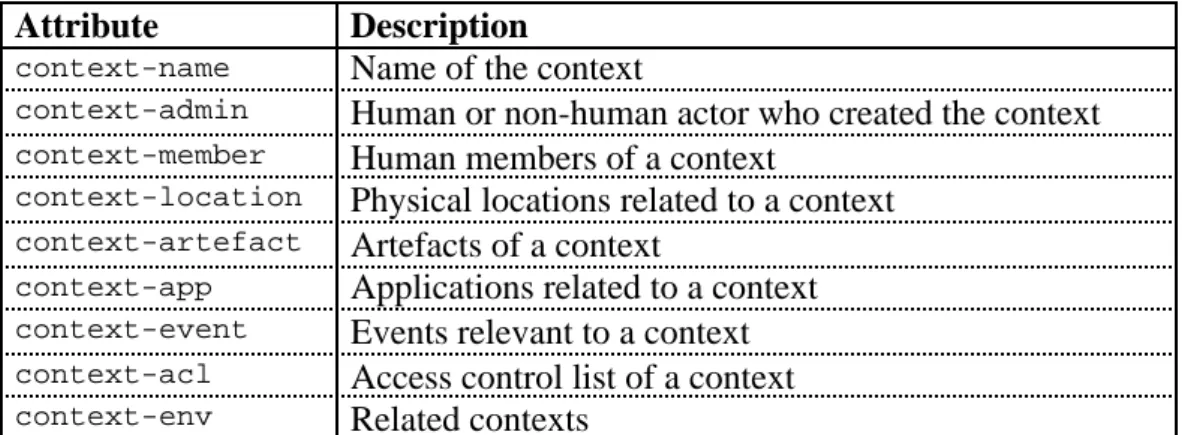
In general, a context can be defined as the interrelated conditions in which something exists or occurs [Merriam-Webster Incorporated 1999]. Gross & Prinz [2000] define an awareness context as ‘the interrelated (i.e., some kind of continuity in the broadest sense) conditions (i.e., circumstances such as time and location) in which something (e.g., a user, a group, an artefact) exists (e.g., presence of a user) or occurs (e.g., an action performed by a human or machine)‘. In awareness information environments this context information is used to provide users with information that is related to their current context and therefore of most value for the coordination of the group activities. In our concept awareness contexts are described by a set of attributes (cf. Table I).
Attribute Description
context-name Name of the context
context-admin Human or non-human actor who created the context context-member Human members of a context
context-location Physical locations related to a context context-artefact Artefacts of a context
context-app Applications related to a context
context-event Events relevant to a context context-acl Access control list of a context context-env Related contexts
Table I. Attributes of awareness contexts.
These attributes are used to describe awareness contexts. For instance, an awareness context could be defined for a project and would then contain the project’s name, the administrator, who creates and maintains the awareness context; the project’s members, locations, artefacts, applications, event types such as read, write, delete, and the access control list that contains the access rights to information related to the project as well as the relations to other awareness contexts.
According to Dey and Abowd, ‘a system is context-aware if it uses context to provide relevant information and/or services to the user, where relevancy depends on the user’s task’ [1999]. We would like to generalise this definition and extend the user’s task to
contain information about the user’s whole work context. When an event occurs, the system analyses to which awareness context it can be matched, adds context information, and stores it. The system then analyses the current work context of the respective user; if the context of the event matches with the work context of the user, the system informs the users accordingly. So, all users who share an awareness context are informed likewise—no matter where they are and whether they are at the same place.
3
Awareness in Context-Aware Systems
3.1 Electronic Space and Physical Space
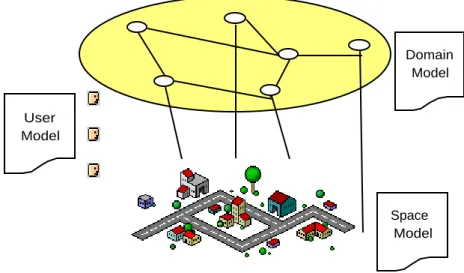
Figure 1 shows a schematic representation of the real space with the physical artefacts contained, the electronic space and the electronic artefacts contained, and the users that can actively navigate in real space and in electronic space.
Space Model Domain Model User Model
Figure 1. Schematic representation or physical and electronic space.
For describing the physical space some kind of geographical model (space model) for describing entities in the real world and their interrelations is needed, this is shown in Figure 1 as the space model. The domain model describes the electronic artefacts in the electronic space. All electronic artefacts and their interrelations are described herein. In the user model properties and the history of the user are stored. A context-aware information system can take into account the physical environment of a user and the properties of a user model to select and present electronic artefacts to a user. For proving awareness in context-aware systems a model of the physical space, the electronic space, and the user model is required. In the following we will describe several single user and multiple user scenarios where users move either in physical or electronic space. Later we will show how context-based awareness services can be provided to them based on our combination of systems.
As the simplest case a single user browses the electronic space. The user model and the model of the electronic space can be matched to provide user-adaptive information services. When a single user browses the physical space user tracking in physical space
can provide location-aware information selection and presentation. Furthermore a system can take into account the user model and the physical environment to generate adaptive recommendations that can either recommend information artefacts or physical artefacts that could be of special interest for the user.
When two users browse the electronic space and if both users access the same electronic entity, the system provides awareness information about their co-location. When two users browse the physical space and when both users are in different places, their information appliances provide awareness information about the other user’s current location and activities. If both users are in the same location but at different times the system could use the location history to provide route recommendations based on the other users experience.
When one user (A) explores the physical space and the other user (B) moves in electronic space. If the location detection activates an electronic artefact for user A, which is viewed by user B, then awareness information can be given to both. If user B visits an electronic artefact, which is connected to an awareness indicator close to user A in the physical space, then awareness information can be given to both.
Additionally, in all scenarios the system can recommend locations or electronic entities to similar users based on their user model.
4
Combining Context-Aware Devices and User Awareness
In the following section we will describe our starting points and main input by two implemented systems. HIPPIE is a nomadic information system that adapts to the Context of Use [Oppermann & Specht 2000]. As mentioned above, ENI is an event-based awareness environment, which includes various sensors for the capturing of events and various indicators for their presentation [Prinz 1999]. In the following we will introduce the basic ideas of HIPPIE and ENI and show up new possibilities that we see in their combination.
4.1 HIPPIE—A Context-Aware Nomadic Information System
Hippie is a context aware nomadic information system that supports users with location aware information services. Beside the adaptation of information presentation and selection based on the users location the system tries to utilise the context of use for adaptation. The context of use is defined by the physical environment, the geographical position, social partners, user tasks, and personal characteristics. The more context parameters are considered for the information selection and presentation, the more effective, efficient and satisfactory the user interaction will be. Hippie offers added value to current information facilities by supporting all along the process of mobile activities. Process support is made possible by the nomadic characteristic of the system that allows the user to have access to his or her personal information space from wherever they are, independently from specific devices. The information selected and presented to the visitor reflects the location (at home or in front of an exhibit), the interests, the knowledge and the presentation preferences of the user. Dynamic elements for animated interpretation and audio presentations complement the visual modality preoccupied by the physical environment. The user is equipped with a handheld computer and a headphone to listen to
explanations of the current artefact and environment to immerse into the subject of interest. The user is left alone with the physical environment, and the complementary explanations; via the communication function of the system, he or she can also get in touch with other individuals present in the real or virtual exhibition for appointments or suggestions.
In the following we mention the main features of the system to explain the benefit for the users: the process support by permanent system accessibility, the location awareness of the system to present information suitable to the current position of the visitor, multimodal information presentation to exploit the range of human perception, and information adaptation to the user’s knowledge and interests. These features are just described shortly, for additional information see [Oppermann & Specht 2000].
Location Awareness: By infrared infrastructure the position and by an electronic compass
the direction of the visitor are identified and transmitted from the handheld computer to the server, so that the server can automatically send the appropriate information for the visitor. By these means, a continuous localisation of the user can be used for information selection and be displayed on an electronic map, if the visitor user support for the navigation in the physical space, e.g., to find a place of interest. If a new item of interest is detected by infrared the system presents an “earcon” combined with a blinking click sensitive “News” icon on the screen.
Multimodal Information Presentation: The system adapts the presentation of information
to the current mobile context of use. The default information presentation for visitors during the preparation and evaluation phases is unimodal, containing pictures and text. The default information presentation during the movement in physical space is multimodal containing written text on the screen and spoken language via headphones, and multicodal, including text, graphics and animations. The visitor’s visual attention is free for the physical environment. Most information is presented aurally without requiring the user to look at the screen.
Information Adaptation to User’s Knowledge and Interest: The adaptive component runs
a user model describing the knowledge and the interests of the user. The user model contains a history of the user’s information selection from the system and the user’s roaming in the physical space. The history is continuously evaluated for user-preferred items or user-preferred attributes to identify particular interests comparing the user’s selection with the taxonomy of the domain. For the following presentations it can adapt the information to the user’s assumed prior knowledge and interests. Adaptive tips provide adaptation to the assumed interests of the user. Especially his or her knowledge and understanding of the exhibition in general and the exhibits in particular, but also the richness of experience, which can be intensified by personalised information.
Annotation, Explanation and Communication: Hippie provides additional features to
support the individual user and a user group moving in physical or electronic space. By the combination of features described above, Hippie makes use of Weiser’s vision, called calm technology by ubiquitous computing [Weiser 1991]. The equipment used and the information and communication interface is designed to let the visitor walk in the physical space while getting access to a contextualised information space tailored to the individual needs and the current environment.
4.2 TOWER—An Awareness Information Environment
Users who have to cooperate as a group need to coordinate their activities; for this coordination they need information. The pervasive knowledge of who is around, what these other users are doing, how available they are, what they are doing with electronic artefacts, and so forth is in the CSCW literature often called awareness (sometimes with prepositions such as group awareness [Begole et al. 1999; Gross to appear] or workspace awareness [Gutwin et al. 1996]). If the cooperating individuals are at the same physical place this information is obvious and can be gathered easily; if individuals who are at different places have to cooperate as a group technological support is essential.
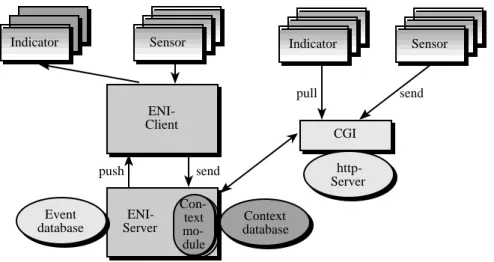
We have developed an event-based awareness environment, which includes various sensors for the capturing of events and various indicators for their presentation [Gross & Prinz 2000]. Figure 2 shows the architecture of ENI (event notification infrastructure).
a ENI-Client Event database push Indicator ENI-Server send CGI http-Server Indicator Sensor Sensor pull send Con-text mo-dule Context database
Figure 2. The ENI architecture.
Sensors are associated with actors, shared material, or any other artefact constituting or
influencing a cooperative environment. Sensors can capture actions in the electronic (e.g., changes in documents, presence of people at virtual places) and in the physical space (e.g., movement or noise in a room). Some examples of sensors we have realised so far are presence sensors checking for the logins of users in electronic space; web presence sensors checking visits on Web sites; web content watchers checking updates to Web pages; sensors for office documents; and sensors for shared workspace system.
The generated events are sent to the ENI server—either via an http server or via an ENI client. They are described as attribute-value tuples. The ENI server stores the events in an event database. Users can use the ENI clients to subscribe to events at the ENI server and to specify indicators for the presentation of the awareness information. Subscriptions have the form of event patterns. The client registers these patterns at the server. When the server receives an event that matches the pattern, the event is forwarded to the respective client. Additionally, users can specify how they want to be informed about the event; that is, which indicators should be used for the presentation.
Indicators are offered in various shapes ranging from a 3D graphical presentation of a
multi-user environment to pop-up windows, to applets in Web pages, to ticker tapes, and so forth. For the presentation of information in the real world ENI has some Ambient Interfaces such as a balloon, a plastic fish tank, and lamps.
The context database contains the descriptions of the awareness contexts. The context module analyses the context of origin of an event and adds this information to the respective event. It also analyses the work context of the user and stores information about it in the context database. If the context of origin of an event and the work context of a user match, the user is informed accordingly.
A context description in ENI does not require the specification of all attributes. For instance, a context can be created and some attributes like locations or applications are specified only later on; or a context could have no locations or no applications at all. Nevertheless, the more details are available for a context, the better events can be matched to the context. In many cases the attributes of a context can be generated automatically. For instance, if a context consists of a shared workspace the list of members and artefacts of the context can be dynamically gained from information about the shared workspace.
4.3 Awareness for Nomadic Users
For the purpose of supporting multiple user scenarios where an information system can take into account sensors from physical space (like in hippie) and sensors from the electronic space (mostly used in ENI) we combined the two systems for providing awareness to nomadic users. Taking into account a wide range of sensors in physical and electronic space allows supporting awareness about interesting events in physical and electronic space. As an interesting scenario to realise the combination of ENI and HIPPIE we decided to extend an exhibition guide at Castle Birlinghoven at the GMD campus [Oppermann & Specht 2000]. In the art exhibition at Castle Birlinghoven we have around 75 exhibits with multimodal information prepared for them. There is an infrared installation for locating visitors and different types of wearable and mobile computing devices can be used for visiting the exhibition. Sensors for the current location and the orientation (electronic compass) of the user are attached to the mobile devices. In this scenario we integrated the domain model of the art exhibition, the localisation infrastructure, the user modelling component, and the awareness environment to enable new forms of awareness in context-aware appliances.
Visitors of the exhibition can be either moving in the information space about the exhibition remotely (remote visitors) or move in Castle Birlinghoven looking at the real artworks (real visitors). When a real visitor moves in the exhibition space his mobile hippie client sends out an event about the current position, the orientation, and the physical, and electronic entities the user interacts with. For displaying awareness information remote visitors can use classical ENI clients for real visitors we are using ambient sounds in an auditory display that is overlaid with the information presentation in the HIPPIE client. The combination of HIPPIE and ENI allows for additional scenarios where awareness information can be given to nomadic users:
• Real visitors moving in the exhibition can be informed about remote users looking at the same artwork: The experience of an artwork in an exhibition could often be enhanced by discussing aspects of the artwork with experts or other visitors. In this case the artefact in the real world is the common cue that brings together people in different spaces.
• Remote visitors can ask real visitors to ask questions about the artwork from a real world perspective. An abstraction of this scenario is already used in commercial e-shopping sites, where remote visitors ask a local e-shopping assistant equipped with a
camera for a special view.
• Real visitors can be informed about similar tracks of previous real visitors. The system keeps track of the users movements in physical and electronic space and therefore could give information about recent visitors that took similar tracks in the physical space.
• Remote visitors can specify situations for awareness contexts in the preparation of a visit, e.g., inform me when an expert in the art of the 13th century accesses the exhibition guide either remote or real, or inform me when I pass this artwork in the real world.
These scenarios exemplify the general idea behind the combination of contexts in the physical space and in the electronic space—that is, to combine the strength of both areas. In today’s offices users work in the physical environment with physical artefacts (e.g., printed papers, books, received letters) and in the electronic environment with electronic artefacts (e.g., electronic documents, shared workspaces). In order to fulfil their tasks they have to orient in both worlds. Groupwork adds further challenges to this orientation: users have to orient in their own physical and electronic world and need to know what is going on in the physical and electronic world of their colleagues as well as in the shared world (e.g., physical libraries, shared electronic workspaces). A combination of HIPPIE and ENI provides a shared frame for orientation, which allows users to coordinate their tasks and to act and react based on up-to-the-moment knowledge of the situation.
5
Conclusions and Future Work
We have introduced a combination of a nomadic information system (HIPPIE) and an awareness environment (ENI) to allow for awareness of nomadic users. Combining real world user tracking, user modelling techniques, and an event based awareness environment allows us to support scenarios where real users and remote users can experience an exhibition jointly. The prototype for supporting art exhibitions is a starting point and can be generalised to many useful and powerful application fields. Generally many applications fields where nomadic users need to be aware of the state and the activities related to electronic and physical entities to fulfil a task are a rich basis for further developments. Awareness information in this sense could be used to monitor complex multivariable processes while moving in physical space. To target this area of activities we will especially enhance our awareness clients based on ambient sound to enable awareness where the physical environment occupies the user’s visual sense. Because users are members of several awareness contexts and want to be informed about several awareness contexts at the same time, we need mechanisms for merging information from different awareness contexts and displaying it in one indicator such as a ticker tape. This leads also to a problem of prioritising awareness contexts; that is, it has to be constantly decided which kind of information from which awareness context is to be displayed immediately and which kind of information of which awareness context can be displayed after a delay. Algorithms could calculate the current actuality of an awareness context form information like the number of present users (in absolute figures and relatively to the whole number of members of an awareness context), the fluctuation of an awareness context, the frequency of changes to documents in an awareness context (either
with equally important documents or with a hierarchy of importance of documents). Furthermore, the current awareness context a user is in will vastly influence the type of information to be displayed and also the means of presentation.
Furthermore the cooperation of nomadic workers shows up several needs for awareness about co-workers and their activities. Nomadic workers in the field can be either made aware of remote experts for support of their field task, or of electronic artefacts like manuals or detail information available. Cooperative problem solving in the field is another interesting area where awareness about the activities of other nomadic workers in different physical locations is essential.
The ENI system is being developed in the IST-10846 project TOWER, partly funded by the EC. We would like to thank all our colleagues from the TOWER team.
References
Begole, J., Rosson, M.B. and Shaffer, C.A. Flexible Collaboration Transparency: Supporting Worker Independence in Replicated Application-Sharing Systems. ACM Transactions on Computer-Human Interaction 6, 6 (June 1999). pp. 95-132.
Clark, H.H. and Brennan, S.E. Grounding in Communication. In Resnick, L.B., Levine, J.M. and Teasley, S.D., eds. Perspectives on Socially Shared Cognition. American Psychological Association, Washington, DC, 1991. pp. 127-149.
Dey, A.K. and Abowd, G.D. Towards a Better Understanding of Context and Context-Awareness. GIT-GVU-99-22, College of Computing, Georgia Institute of Technology,
ftp://ftp.cc.gatech.edu/pub/gvu/tr/1999/99-22.pdf, 1999. (Accessed 12/12/2000).
Gross, T. Towards Ubiquitous Awareness: The PRAVTA Prototype. In Ninth Euromicro Workshop on Parallel and Distributed Processing - PDP 2001 (Feb. 9-11, Mantova, Italy). IEEE Computer Society Press, Los Alamitos, CA, to appear.
Gross, T. and Prinz, W. Gruppenwahrnehmung im Kontext. In Verteiltes Arbeiten - Arbeit der Zukunft, Tagungsband der Deutschen Computer Supported Cooperative Work Tagung - DCSCW 2000 (Sept. 11-13, Munich, Germany). Teubner, Stuttgart, 2000. pp. 115-126.
Gutwin, C., Greenberg, S. and Roseman, M. Supporting Workspace Awareness in Groupware. In
Proceedings of the ACM 1996 Conference on Computer-Supported Cooperative Work - CSCW'96 (Nov. 16-20, Boston, MA). ACM, N.Y., 1996. pp. 8-8.
Kanter, T. Event-Driven, Personalisable, Mobile Interactive Spaces. In Second Symposium on Handheld and Ubiquituous Computing - HUC2K (Springer, 2000. pp. 1-11.
Makimoto, T. and Manners, D. Digital Nomad. John Wiley & Sons, 1997.
Merriam-Webster Incorporated. WWWebster Dictionary. http://www.m-w.com/dictionary, 1999. (Accessed 6/7/1999).
Oppermann, R. and Specht, M. A Context-Sensitive Nomadic Exhibition Guide. In Second Symposium on Handheld and Ubiquituous Computing - HUK2K (Bristol, UK). Springer, 2000. pp. 127-142.
Prinz, W. NESSIE: An Awareness Environment for Cooperative Settings. In Proceedings of the Sitxth European Conference on Computer-Supported Cooperative Work - ECSCW'99 (Sept. 12-16, Copenhagen, Denmark). Kluwer Academic Publishers, Dortrecht, NL, 1999. pp. 391-410.
Schmidt, A., Beigl, M. and Gellersen, H.-W. There is more to Context than Location. Computer & Graphics Journal 23, 6 (Dec. 1999). pp. 893-902.
Shilit, B.N., Adams, N.I. and Want, R. Context-Aware Computing Applications. In Proceedings of the Workshop on Mobile Computing Systems and Applications (IEEE Computer Society, Santa Cruz, CA, 1994. pp. 85-90.