Study on Assessing the
Research Management
Performance of Framework
Programmes Projects
Final Report
Edited by
Wouter Jansen PhD (PwC)
Bas Warmenhoven (PwC)
Derek Jan Fikkers PhD (Technopolis Group)
Martijn Poel PhD (Technopolis Group)
Reviewed by
Jan-Hendrik Schretlen (PwC)
15 October 2014
The information and views set out in this report are those of the author(s) and do not
necessarily reflect the official opinion of the Commission. The Commission does not
guarantee the accuracy of the data included in this study. Neither the Commission nor any
person acting on the Commission’s behalf may be held responsible for the use which may
be made of the information contained therein.
Abstract
This study explores the variety of research management structures, roles, tasks, responsibilities, activities and styles in relation to research management performance (RMP) and project success in the FP6 and FP7 research funding programmes of the European Commission. The key findings indicate six enabling factors of high RMP. The effects on RMP and project success of six management styles have been studied. Interestingly, management tools do not appear to influence project success. In about one third of the projects, the composition of the consortium changes along the way. The Commission would do well to focus on personal interaction with Project
Coordinators rather than the administrative side of projects and create more flexibility, if it wants to improve the success of FP projects. Also, currently offered EC-provided project management tools and matchmaking instruments should be critically reviewed, as these do not work as intended. Finally, the Commission is cautioned that current frameworks for intellectual property are out of sync with international standards, such as those of the WTO.
We make recommendations to the Commission (for implementation in the Horizon 2020 programme) and to Project Coordinators. We also provide suggestions for further research based on the findings of this exploratory study.
Résumé
Cette étude porte sur la variété des structures de gestion de la recherche, des rôles, tâches, responsabilités, activités et types de gestion, quant à la performance de la gestion de la recherche (PGR) et le succès des projets sous programmes de
financement PC6 et PC7 de la Commission Européenne. Les principaux résultats indiquent six facteurs permettant une gestion performante. Les effets sur la PGR sous six types de gestion ont été étudiés. L’étude démontre que les outils de gestion n’influencent pas la réussite du projet. Pour environ un tiers des projets, la composition du consortium est modifiée lors du projet.
La Commission devrait davantage se concentrer sur les interactions personnelles avec les coordinateurs de projets que sur leur côté administratif, et encourager sa
flexibilité. Les outils de gestion de projet et instruments de rapprochement proposés devraient être soumis à un examen critique, puisqu’ils n’ont pas les effets prévus. Enfin, le système actuel de propriété intellectuelle n’est pas adapté aux normes internationales comme celles de l’OMC.
Des recommandations pour la mise en œuvre d’ Horizon2020 sont développées pour la Commission et les coordinateurs de projet, ainsi que des suggestions pour de
Executive Summary
In October 2013 the European Commission, DG RTD mandated PwC EU Services EEIG (“PwC”) and Technopolis Group to assess the research management performance of collaborative projects in Framework Programme (FP) 6 and 7. It was expected that a better understanding of management processes within these projects will benefit the performance of research management in Horizon 2020, and can contribute to more successful projects in Horizon 2020.
The report at hand presents the most important findings of PwC and Technopolis Group. In section 6 we present our conclusions and recommendations to respectively the European Commission, and to those responsible for the management of collaborative projects under Horizon 2020.
Research management is a people business
FP6 and FP7 consortia come in many different shapes and sizes. They are formed in a process that is largely based on existing networks and relationships of researchers, followed by the search for the types of organisations or competencies in a consortium that are still missing in comparison with the Commission’s call for proposals. A clear tendency exists to form sequential consortia with (mostly) the same partners. This tendency comes at a risk, as consortia that do not include new partners tend to perform worse than those that do.
Existing inter-personal networks play a significant role in the formation of FP consortia
The Project Coordinator is not necessarily the one researcher that took the initiative to form a consortium and respond to a call for proposals. Consortium initiators are usually experienced researchers, most commonly working for universities or RTOs. The vast majority originates from Western Europe.
In his search for participants, the project initiator is fully aware that the call text, designed by the European Commission, roughly dictates the framework within which the size and composition of the consortium is defined. In particular, the need for specific skills, competencies, areas of expertise or specialities recognised through analysis of a project’s aim in the light of the call texts, drives the search for suitable collaboration partners.
The initiators use their existing inter-personal networks and some second-tier relations to compose a consortium. They prefer to use their own personal networks. Yet, relatively early on in the process, they start seeking for ‘friends-of-friends’ as well. Excellence in the field concerned is however the main criterion for selection as potential consortium partner. In the third instance, the consortium initiators start discovering new networks. PubMed, ScienceDirect, and Scopus are typical sources. EU supported sources (NCPs; CORDIS) are hardly used and are associated with underperforming participants.
Project Coordinators spend considerable time on research management tasks After a proposal has been successful and the grant has been awarded, the real work in terms of research management starts. For the Project Coordinator, this implies that several management tasks will start consuming considerable amounts of his time. Consensus-based decision-making is usually the main paradigm. Internal communication in the consortium, meeting project milestones and quality control of deliverables take up most of the time of the Project Coordinator. One of the reasons
that Project Coordinators put so much effort in these tasks is that they consider them to be of crucial importance for the success of the project.
The Project Coordinator does not necessarily conduct all these tasks himself. Often, a certain division and delegation of tasks can be observed. The division of tasks in projects is often established during the proposal phase of the project. The division and delegation is usually based on merit. Being responsible for a supportive management task in an FP project is considered a good learning trajectory for ambitious junior researchers. Tasks and responsibilities regarding quality assurance, evaluation, and validation are often decentralised to the level of the WP leaders. They often set up a variety of formal and informal monitoring processes. Other tasks typically stay at the central level of the Project Coordinator.
Financial management is typically a task that shows a mixed picture in terms of centralisation versus putting things at arm’s length. The most straightforward mode of financial management has the formal Project Coordinator handling all financial management by himself, compiling information received from consortium partners and reviewing overall finances (which need to be reported on to the EC), using Microsoft Excel-based tools and trying not to burden consortium partners too much with financial matters. As a second mode, the Project Coordinator may be supported by an internal team of administrative and finance experts. The third mode of financial management features a financial expert alongside the formal Project Coordinator, who handles all financial aspects of the project.
Decision-making processes that build trust and focus on consensus appear to work best in FP research management
In most FP6 and FP7 projects with a high performance rating, the coordinator tried to share information with other consortium members in a timely fashion, trusting them to deliver as needed, and discussing any issues person to person. Referencing contractual obligations and discussing individual accountability played a small role in these consortia.
On the other hand, FP7 projects with a low performance score show more emphasis on top-down decision making and less on a consensus-oriented decision-making style. Contractual obligations and discussing individual accountability are important tools for research management in such projects. FP6 projects with a low average performance score emphasise a consensus orientation, with coordinators relying on trust and timely sharing of information to allow consortium partners to get their job done
The use of professional project management tools is very limited
For research management, several tools are being used. These include document sharing tools, several types of communication tools, and financial monitoring tools. Document sharing tools are used most often – by a little more than 50% of all Project Coordinators– whereas about one third of FP project managers use EC-provided tools. This is closely followed by communication tools other than phone and e-mail, examples of which named in case study interviews are conference call systems and Skype. The selection of specific project management tools does little to affect research management performance, or project success. No good practices emerge that set high performance projects apart from their low performance counterparts with regard to the tools they do or do not use.
Furthermore, the extent to which tools provided by the European Commission are used is limited. Also, a majority of the project managers have recommendations for improving the tools. The tools provided by the European Commission are clear to more experienced FP coordinators, but require relatively high efforts for less experienced coordinators to master. Online systems are considered too rigid by Project
Coordinators, and the writing style of EC documentation is perceived to be less comprehensible than it could be.
We recommend that the European Commission reviews the tools it currently provides, to focus on the mandatory tools that really matter, and to improve them to such an extent that they start adding value to projects. When doing so, the European Commission should be aware that most tools can already be found on the market and are already widely used by consortia. It should therefore not design something separate (stand-alone) if this is not absolutely necessary. The European Commission should also be aware of the low numbers of Project Coordinators who consider themselves proficient in working with mandatory EC-provided tools. The EC should require that project coordinators are proficient in the use of the (improved) mandatory EC tools. Development of proper instructional materials should be taken into account when considering a more intensive account management approach and when revising the current European Commission-provided tools.
What is good research management and what is not?
Our data show that good research management performance and project success go hand in hand. This makes it important to have a close look at what constitutes good research management.
Research management performance is enabled by a high frequency of contact, involvement of key partners in substantial decision-making and certain management styles. Involvement of partners in substantial decisions about the project is good for management performance and thus for project success. Alignment of the interests of consortium partners with the project objectives also adds to RMP. It is particularly important for Project Coordinators to pay attention to this aspect in projects where consortium partners’ interests may diverge in relation to the utilisation of intellectual property developed in the FP project.
Moreover, certain management styles contribute to successful project management and thus to project success. A Project Coordinator who wants to be successful should consider managing by continuously building relationships and high trust levels, and invest in one-to-one communication. Management styles that should be avoided are: depending on contractual agreements and holding partners responsible for implementing agreed-upon tasks by holding them accountable; relying on established relationships and high trust levels; and using network power such as positions in other consortia and in high-level committees.
Several research management practices that were encountered are particularly effective. These practices are aimed at three major goals of research management: 1. increasing trust and building relationships between consortium partners;
2. ensuring frequent communication between the Project Coordinator and consortium partners, while involving at least all main consortium partners in important decisions;
3. facilitating the work that is to be performed by consortium partners, by providing structure and information.
Project coordinators should build a consortium based on merits rather than on existing relationships. As a result, at the beginning of the project trust may be low as partners need to get used to each other.
This is absolutely fine, as long as the project manager invests in trust throughout the project life-cycle to achieve high trust levels at the end of the project.
Project coordinators should favour a consensus-based decision making model, rather than a hierarchical or formal management style. This should be complemented with an all-inclusive approach. In addition to the abovementioned consensus-based decision-making, this also requires frequent communication with the consortium. Frequency of communication is much more important than mode or intensity. These activities serve to align consortium partners’ interests and contribute with project success.
FP consortia have an inherent variety and dynamism; structures and
interventions imposed on consortia should respect this
About one third of consortia experience changes in their composition (i.e. consortium partners leaving or joining the consortium). In FP6 and FP7 projects, project managers experienced a lot of difficulty in having such changes accepted and administratively processed by the Commission’s project officers. Changes in consortium composition are associated with lower project success.
Size does matter; larger projects are more difficult to manage. The “basic” management structure (i.e. the simplest appropriate structure respective to size and complexity of the research tasks at hand) increases research management performance.
It was also found that consortia that have made use of EC-provided matchmaking instruments, such as the CORDIS database or matchmaking events organised by the Commission, are generally not among the highest performing projects.
The European Commission and its agencies should increase their capacity in terms of the number and capabilities of project officers and set up a structured ‘account management’ approach.
This could help assist the consortia in several ways, including coping with inevitable changes in their composition. It would also enable the European Commission and its agencies to simplify the administrative requirements associated with consortium composition and/or project course amendments that are now too high.
The European Commission should critically review currently offered matchmaking instruments, like the CORDIS partner search function and matchmaking events, as these do not contribute to better performing FP consortia. Instead the European Commission and its agencies should focus on developing other instruments to achieve the objective of creating high-performing consortia, such as networking events at conferences and social media-based communication.
Project Coordinators should avoid overly complex management structures, and clearly define roles and responsibilities. Roles and responsibilities in the project should be awarded based on proven competencies for the role, not because of status or hierarchical reasons. Project Coordinators should communicate pro-actively to the Commission’s project officer about all aspects of their project, including about expected or upcoming changes in the composition of the consortium. Such communication would not only
result in clear benefits on the part of the Commission. Our study clearly shows that informing the project officer well in advanced and in an informal manner – instead of waiting until the deadline of a progress report a couple of months later – allows the project officer room for a more flexible and tailored approach that decreases administrative burdens on the part of the consortium.
FP7 and Horizon 2020 better facilitate effective research management
structures then previous FPs…
Several EC instruments have been changed for the better at the start of FP7 and Horizon 2020 respectively. One example is letting go of the 7 per cent maximum budget for research management costs at the start of FP7. Another is putting less emphasis on the management structure of consortia in evaluating project proposals under Horizon 2020, thereby creating fewer incentives for consortia to propose overly complex management and governance structures. However, some evaluators have not yet adopted this new practice.
The European Commission should communicate to reviewers and project coordinators that overly complex management models should be avoided. As the Horizon 2020 evaluation procedure tends to puts less emphasis on management of the project, incentives for overly complex management structures may already have been diminished. Nevertheless, reviewers should be instructed to evaluate management structures against their simplicity, clarity and efficiency, to favour the more basic management structure relative to the complexity of the project.
…but intellectual property rights and performance measurement
remain an issue
Intellectual property rights (IPRs) have been a problem area in a large number of FP projects. Our expert interviews indicate that in a large majority of the collaborative FP projects, IPRs are of no relevance. In those consortia where IPRs are relevant, the project participants and coordinators find the rules too complex. Also clear misalignments with anti-competition law and WTO rules have been reported in our expert interviews. It is not clear whether the current IPRs regulations in Horizon 2020 help solve the problems or whether they sometimes exacerbate or even create them.
The European Commission should explore the possibilities of simplifying the IP rules in Horizon 2020 and ensure a better alignment with WTO/TRIPS and anti-trust rules. It could be considered to have a structure in place that would only work as checklist of points to be considered and leave actual contract wording and drafting with respect to IPRs to the parties involved. However, these are very general recommendations. We warn against taking a quick shot at this complex and – in its important details – not well-understood topic.
The European Commission should develop better indicators for project officers to monitor and assess projects. This could help to draw a more consistent line in project reviewing by project officers. Changes in project officers and especially the manner in which they assess projects (different aims and attitudes) are detrimental to project management, and success. These indicators should be made available for future studies as more objective measurements of project performance.
This exploratory study is only a first step towards a better
understanding of the management of collaborative FP projects
This study is the first attempt to come to a clear empirical understanding of the management of collaborative research projects under FP6 and FP7 and to differentiate empirically between all aspects of these heterogeneous projects. As a consequence, the study is exploratory in nature. This implies that we have looked for common patterns and the rationale behind them. We draw preliminary conclusions about these patterns, but we do so with caution. We recommend to the European Commission to further investigate several patterns that we have identified.
Our findings are based on more than 100 interviews, 30 case studies and a large scale survey (N = 7,980) of FP participants
Our complete methodological approach consists of: a literature review and 25 exploratory interviews;
a large-scale survey of project managers and participants in a large number of FP6 and FP7 projects;
30 mixed-method case studies at the level of individual FP6 and FP7 projects; additional expert interviews, interviews with serial FP participants and
interviews with coordinators of projects with a low number of responses in the survey;
a round table with experts in the field, to critically assess, validate and enrich our findings, conclusions and recommendations.
Further research is proposed on four topics
We suggest a study on the institutional and practical structures of the FP programmes in comparison with those in other parts of the world to gain
broader insights beyond the European realm. There are differences between the
FPs and research funding programmes in third countries, such as the United States and Japan, for example in the governance structures of projects and the requirements on IPRs. Study of research funding programmes in other countries would shed more light on the relative effectiveness and efficiency of research management in the context of the FPs.
The performance of FP projects would benefit from further study into the relationship between changes in consortium composition and project
performance. Not only the full range of trajectories between the two phenomena
bears further investigation, also the potential for mitigating measures clearly warrants more study, as adequate solutions in these cases will increase the likelihood of greater success of these projects under Horizon 2020.
A study should be performed on the relationship between the importance of intellectual property (IP) in FP projects and RMP, as IP is becoming more important in Horizon 2020 and is crucial in reaping the societal benefits of
EU-funded research. Our findings indicate that the interests of researchers are at
risk of not being aligned with the interests of industry partners when it comes to IP. The proposed study should be targeted at identifying those project and consortium characteristics in which aligning interests around IP becomes particularly challenging for research managers. We would not recommend a purely legal review, as this would leave again much of the topic and its actual economic significance as a black box. Research management performance appears to be negatively influenced when less than 20 per cent of the consortium partners do not have an existing relationship with other partners. A final topic for further study is whether this effect applies in specific types of projects, what causes this relationship, and what it might imply for future call texts.
Résumé opérationnel
En octobre 2013, la Direction Générale RTD de la Commission Européenne (CE) a mandaté PwC EU Services EEIG (PwC) et Technopolis Group pour évaluer la performance de la gestion de la recherche (PGR) des projets collaboratifs des Programmes Cadres (PC) 6 et 7. Cette étude devait permettre une meilleure compréhension des processus de gestion des projets, afin d’accroître la performance de la gestion de la recherche (PGR) et la réussite des projets sous Horizon 2020. Ce rapport présente les résultats les plus importants de PwC et Technopolis Group. Dans la section 6, nous présentons nos conclusions et recommandations à la CE, ainsi qu’aux responsables de la gestion de projets collaboratifs sous Horizon 2020.
La gestion de la recherche repose sur les personnes qui la mènent
Les consortia des PC6 et PC7 s’articulent sous différentes formes et tailles. Ils se forment selon un processus basé sur des réseaux de chercheurs déjà mis en place et leurs interactions. S’ensuit alors une recherche pour les organisations ou compétences qui manquent au consortium en comparaison aux appels à propositions de la CE. Une tendance nette existe qui consiste à former des consortia dont la plupart des partenaires sont similaires. Cependant, ceci présente certains risques, puisque les consortia qui n’intègrent pas de nouveaux partenaires ont tendance à être moins performants.
Les réseaux interpersonnels déjà mis en place jouent un rôle significatif dans la formation des consortia sous PC
Le Coordinateur de Projet n’est pas nécessairement le chercheur qui prend l’initiative de former un consortium et de répondre aux appels d’offres. Les personnes qui forment un consortium sont généralement des chercheurs expérimentés, issus d’universités ou d’OTR, la plupart d’Europe de l’Ouest.
Dans sa recherche de participants, l’initiateur du consortium est conscient du texte de l’appel, rédigé par la CE, et définit approximativement la taille et la composition du consortium. La recherche de collaborateurs adéquats se base en particulier sur le besoin d’aptitudes particulières, de compétences, de domaines d’expertise reconnus importants suite à l’analyse des objectifs d’un projet.
Les initiateurs du projet ont recours à leur propre réseau interpersonnel existant et à leurs relations de second niveau pour composer le consortium. Assez tôt dans le processus, ils commencent notamment à contacter les « amis d’amis ». Le critère principal à la sélection d’un partenaire potentiel au consortium reste l’excellence dans le domaine considéré. En troisième lieu, les initiateurs du consortium ont recours à de nouveaux réseaux. Des sources classiques sont PubMed, ScienceDirect et Scopus. Les sources Européennes (NCPs; CORDIS) sont rarement utilisées et associées à des participants peu performants.
Les Coordinateurs de Projets passent un temps considérable sur les tâches de gestion de la recherche
Une fois le projet attribué, le véritable travail de gestion de la recherche peut commencer. Pour le Coordinateur, ceci implique que diverses tâches de gestion vont commencer à prendre un temps considérable. Ce travail repose généralement sur la prise de décision par consensus. La plupart du temps du Coordinateur est allouée à la communication interne au consortium, à la réalisation des étapes importantes du projet et au contrôle de qualité des éléments livrables. Les Coordinateurs réservent un
effort important à ces tâches puisqu’ils les considèrent comme cruciales à la réussite du projet.
Le Coordinateur ne conduit pas nécessairement toutes ces tâches lui-même. En général, la division et la délégation des tâches sont prévues. La division des tâches du projet est souvent établie lors de la phase d’offre et se base souvent sur le mérite. Pour les jeunes chercheurs ambitieux, être responsable du soutien d’une tâche de gestion est considéré comme un bon moyen d’apprentissage. Les tâches et responsabilités concernant le contrôle de qualité, l’évaluation et la validation sont souvent décentralisées au niveau des leaders. Ceux-ci établissent une variété de processus de contrôle formels et informels. Les autres tâches restent d’habitude au niveau central du Coordinateur.
La gestion financière est une tâche particulière car elle peut être centralisée ou non. Selon la gestion financière la plus évidente, le Coordinateur de Projet s’occupe de toute la gestion financière par lui-même, en regroupant l’information soumise par ses partenaires du consortium ainsi qu’en révisant l’ensemble des finances (ensuite rapportées à la CE), au moyen d’outils tels que Microsoft Excel, en essayant de ne pas trop charger les partenaires du consortium au sujet des questions financières. Une autre façon de réaliser la gestion financière consiste à recourir à une équipe interne d’experts administratifs et financiers, en support au Coordinateur. Finalement, une dernière méthode est d’avoir à disposition un expert financier, qui s’occupe de tous les aspects financiers du projet.
Les processus de prise de décision qui instaurent la confiance et s’opèrent par consensus semblent mieux fonctionner pour la gestion de la recherche sous PC
Dans la plupart des projets performants de PC6 et PC7, le Coordinateur essaie de partager les informations avec les autres membres du consortium en temps voulu, avec l’espoir qu’ils remettent leur travail suivant le timing prévu et en abordant les problèmes en personne. Les obligations contractuelles de référencement ainsi que les discussions se rapportant aux responsabilités individuelles de chacun ne jouent qu’un petit rôle dans ces consortia.
Les projets peu performants du PC7 ont davantage recours à un processus de prise de décision par les supérieurs, et peu axé sur le consensus. Les obligations contractuelles et les discussions sur les responsabilités individuelles sont un instrument important. Les projets sous PC6 avec une performance moyenne peu élevée s’opèrent par consensus, et leur Coordinateur base leur travail sur la confiance et le partage d’information suivant un timing raisonnable pour permettre aux partenaires du consortium d’effectuer leurs tâches.
L’utilisation d’outils professionnels de gestion de projet est très limitée
De multiples instruments sont utilisés pour la gestion de la recherche, à savoir des instruments de partage de documents, différents types d’outils de communication ainsi que des instruments de suivi financier. Les outils de partage de documents sont utilisés la plupart du temps – par un peu plus de 50% des Coordinateurs de Projet – tandis qu’un tiers des managers de PC ont recours aux instruments fournis par la CE. A ceux-ci suivent les outils de communication, autres que téléphone et e-mail, comme par exemple les systèmes de téléconférence et Skype. La sélection d’outils spécifiques n’affecte que peu la performance la réussite d’un projet. Aucune bonne pratique n’émerge pour définir des standards de haute performance quant aux outils utilisés. De plus, la CE ne fournit des outils que de manière très limitée et la plupart des managers de projets recommandent de les améliorer. En effet, les outils de la CE sont clairs pour les Coordinateurs les plus expérimentés mais demandent des efforts
relativement importants pour leur maitrise par des Coordinateurs moins expérimentés. Les systèmes en ligne sont souvent considérés comme trop rigides, et le style d’écriture de la documentation de la CE est perçue comme rendant la compréhension difficile.
Nous recommandons que la Commission Européenne revoie avec critique les outils qu’elle propose, qu’elle se concentre sur les outils qui sont véritablement indispensables, et qu’elle les améliore afin qu’ils apportent de la valeur ajoutée aux projets. En agissant de la sorte, la CE doit être consciente que la plupart de ces outils se trouvent déjà sur les marchés et sont largement utilisés par les consortia. Ainsi, elle ne devrait pas élaborer de produits autonomes, si cela n’est pas perçu comme absolument nécessaire. La CE devrait notamment exiger que les Coordinateurs de Projet soient tous compétents quant à l’utilisation de ces instruments (améliorés) obligatoires de la CE. La rédaction d’instructions appropriées devrait être envisagée pour une approche de la gestion plus intensive.
Les éléments qui rendent la gestion de la recherche performante ou non Nos données indiquent que la bonne gestion de la recherche et la réussite de projets vont de paire. Des éléments tels que la haute fréquence de contact, l’implication des partenaires clés dans les prises de décision importantes, et certains styles de management stimulent la performance de la gestion de la recherche. L’alignement des intérêts au sein du consortium sur les objectifs du projet influence aussi la PGR de manière positive et est particulièrement important lorsque les intérêts des différents acteurs du consortium divergent quant à l’utilisation de la propriété intellectuelle développée dans les projets.
De plus, certains styles de gestion contribuent davantage à la réussite d’un projet. Un Coordinateur de Projet doit envisagée sa gestion en construisant des relations et niveaux de confiance élevés de manière continue, et doit investir dans la communication individuelle et personnalisée. Les styles de gestion qui doivent être évités sont les suivants : dépendre d’accords contractuels et tenir ses partenaires pour responsables de l’implémentation de tâches convenues par avant, se reposer sur des relations déjà établies et sur de haut niveaux de confiance, ainsi qu’utiliser le pouvoir de réseaux tels des positions dans d’autres consortia ou des comités de haut-niveau. De nombreuses pratiques de gestion rencontrées lors de l’étude sont particulièrement efficaces et mènent à trois objectifs :
1. Augmenter la confiance et instaurer des relations entre les partenaires du consortium ;
2. Assurer une communication fréquente entre le Coordinateur du Projet et les partenaires du consortium, tout en impliquant les principaux membres du consortium dans les décisions importantes ;
3. Faciliter le travail fourni par les partenaires du consortium en fournissant la structure et l’information.
Les Coordinateurs de Projet doivent établir un consortium basé sur le mérite plutôt que sur des relations existantes. Ainsi, lors des débuts de projets, la confiance peut s’avérer faible, le temps que les partenaires s’adaptent les uns aux autres. Ceci est considéré comme absolument normal, tant que le manager du projet investit dans cette confiance à travers tout le cycle du projet afin d’atteindre des niveaux de confiance élevés à la fin du projet.
Les Coordinateurs de Projet devraient favoriser une approche de consensus dans leur modèle de prise de décision, plutôt qu’un style de gestion formel ou hiérarchique. Ceci doit être complété par une approche globale, ainsi qu’une communication fréquente avec le consortium. La fréquence de communication est beaucoup plus importante que son mode ou son intensité. Ces activités servent à aligner les intérêts des partenaires et contribuent à la réussite du projet.
Les structures et interventions imposées aux consortia doivent
respecter la variété inhérente de ceux-ci ainsi que leur dynamisme
Environ un tiers des consortia altère leur composition (par exemple, des partenaires du consortium qui le quittent ou en rejoignent un autre). Dans les projets sous PC6 et PC7, les managers de projets ont rencontré beaucoup de difficultés pour accepter ces changements et dans leur traitement administratif par les agents du projet issus de la Commission. Des changements dans la composition des consortia sont associés avec une moindre réussite de projet.
La taille de ces consortia est importante : les projets les plus larges sont les plus difficiles à gérer. La structure de gestion « basique » (la structure la plus simple et appropriée quant à la taille et la complexité de la recherche) augmente la performance de la gestion de la recherche.
Les résultats indiquent notamment que les consortia qui ont recours aux instruments de rapprochement de la CE, comme la base de données CORDIS ou les évènements de rapprochement organisés par la Commission, ne sont généralement pas parmi les projets les plus performants.
La CE et ses agences devraient augmenter le nombre et la capacité des agents sur les projets et devraient établir une approche structurée de la gestion. Ceci devrait venir en assistance aux consortia sous de nombreuses manières, entre autre pour gérer les changements inévitables dans leur composition. Cela permettrait notamment à la Commission et ses agences de simplifier les exigences administratives associées à la composition du consortium et/ou les changements en cours de projets qui sont trop fréquents.
La CE devrait revoir de manière critique les instruments actuels de rapprochement, comme la fonction de recherche partenaire CORDIS ou les évènements de rencontre, puisqu’ils ne contribuent pas à la meilleure performance des consortia sous PC. La CE et ses agences devraient développer d’autres instruments pour atteindre les objectifs de créer des consortia très performants, comme des évènements de réseautage aux conférences et une communication orientée médias.
Les Coordinateurs de Projets devraient éviter les structures de gestion trop complexes et clairement définir les rôles et responsabilités. Les rôles et responsabilités doivent être définis en fonction des compétences assurées, et non pour des raisons de statuts ou hiérarchiques.
Les Coordinateurs de Projets devraient communiquer de manière proactive aux agents de la Commission à propos des aspects de leur projet, notamment quant aux changements attendus ou à venir dans la composition des consortia. Une telle communication
servirait à la Commission. De plus, informer les agents de la CE en avance et d’une manière informelle – au lieu d’attendre la date limite d’un compte-rendu quelques mois plus tard – permettrait d’augmenter la flexibilité des agents de la CE sur le projet ainsi qu’une approche personnalisée qui réduirait les charges administratives du côté du consortium.
Le PC7 et Horizon 2020 facilitent davantage les structures efficaces de
gestion de la recherche que les PC précédents…
Plusieurs instruments de la CE ont été améliorés au début du PC7 et d’Horizon 2020. Par exemple, la limite de 7% des coûts de gestion de la recherche a été abandonnée au début du PC7 et moins d’importance est donnée á la structure de la gestion des consortia lors de l’évaluation des offres sous Horizon 2020, ce qui permet aux consortia d’éviter des structures de gestion et gouvernance trop complexes. Cependant, certains évaluateurs n’ont pas encore adopté cette nouvelle pratique.
La CE devrait communiquer aux réviseurs et aux coordinateurs de projets que des modèles de gestion trop complexes doivent être évités. Ces structures compliquées devraient déjà être réduites puisque la procédure d’évaluation d’Horizon 2020 accorde moins d’importance à la gestion de ces projets. Cependant, les réviseurs devraient être formés à l’évaluation des structures de gestion pour stimuler leur simplicité, clarté et efficience, et favoriser une structure plus basique.
… mais les droits de propriété intellectuelle et la mesure de la
performance restent problématiques
Les droits de propriété intellectuelle (PI) sont un domaine problématique dans un grand nombre de projets sous PC. Les experts interviewés indiquent que dans une majorité des projets sous PC, les droits de PI ne sont pas importants. Mais pour ces consortia pour lesquels les droits de PI sont pertinents, les participants au projet et les coordinateurs trouvent les règles trop complexes.
La CE devrait explorer les possibilités de simplifier les règles de PI sous Horizon 2020 et assurer un meilleur alignement avec l’OMC/ADPIC et les règles anti-trust. Une liste de vérification devrait être mise en place avec les points à considérer et la formulation et la rédaction du contrat devraient être laissées aux parties impliquées. Il s’agit de recommandations générales. Nous mettons donc en garde contre ce sujet complexe et peu compris.
La CE devrait développer de meilleurs indicateurs pour ses agents pour suivre et évaluer les projets. Ceux-ci pourraient rendre la révision des projets plus consistante. Des changements d’agents et plus particulièrement la manière dont ils évaluent les projets (avec différents objectifs et attitudes) viennent au détriment de la gestion du projet et de sa réussite. Ces indicateurs devraient être disponibles pour de futures études comme étant des outils de mesure objectifs de la performance d’un projet.
Cette étude exploratoire est une première étape vers une meilleure
compréhension de la gestion de projets sous PC
Cette étude tente pour la première fois d’aboutir à une meilleure compréhension de la gestion de projets de recherche collaboratifs sous les PC6 et 7 et de différencier de manière empirique les aspects de ces projets hétérogènes. Ainsi, cette étude peut être considérée comme exploratoire. Nous avons donc cherché des modèles communs et leurs raisonnements. Nous avons émis avec prudence des conclusions préliminaires sur base de ces modèles. Nous recommandons à la CE d’investiguer davantage plusieurs de ces modèles identifiés.
Nos résultats sont basés sur plus de 100 interviews, 30 études de cas et une enquête à grande échelle (N=7,980) de participants sous PC
Notre méthodologie complète est la suivante:
Une revue de la littérature et 25 interviews exploratoires;
Une enquête à grande échelle de managers de projets et de participants aux PC 6 et 7;
30 études de cas à méthode mixe sur des projets individuels de PC6 et PC7; Des interviews additionnelles avec experts, plusieurs participants de PC et
Coordinateurs de Projet qui ont obtenu un faible taux de réponse lors de l’enquête;
Une table ronde avec des experts dans le domaine, pour évaluer de manière critique, valider et enrichir nos résultats, conclusions et recommandations. Davantage de recherche doit être menée sur quatre sujets
Nous suggérons une étude sur les structures institutionnelles et pratiques des PC en comparaison avec le reste du monde pour obtenir une vision plus
large au-delà des réalités européennes. Il existe des différences entre les PC et
les programmes de financement de la recherche dans des pays tiers, comme les Etats-Unis et le Japon, par exemple pour les structures de gouvernance des projets et des exigences en termes de droits de PI. Cette étude pourrait être nécessaire pour évaluer l’efficacité et l’efficience de la gestion de la recherche dans le contexte des PC.
L’étude des rapports entre la composition d’un consortium et la performance
d’un projet pourrait être bénéfique á la performance de ces projets. Les
différentes relations entre ces deux phénomènes devraient être analysées ainsi que le potentiel de mesures atténuées comme solution adéquate, permettant une plus grande réussite parmi ces projets sous Horizon 2020.
Une étude devrait être menée sur la relation entre l’importance de la PI au sein des projets sous PC et de la performance de la gestion de la recherche, puisque la PI est un élément primordial pour récolter les bénéfices de la
recherche financée par l’UE. Nos résultats indiquent que les intérêts des chercheurs
risquent de ne pas être alignés avec ceux des partenaires de l’industrie quant à la PI. L’étude suggérée devrait identifier les caractéristiques des projets pour lesquels aligner les intérêts qui touchent à la PI devient une tâche particulièrement compliquée pour les managers en recherche. Nous ne recommandons pas une étude purement légale, car celle-ci ne prendrait pas en compte la plupart des aspects du sujet et sa véritable importance économique.
La performance de la gestion de la recherche semble influencée de manière négative lorsque nous constatons que moins de 20% des partenaires en consortium sont en relation avec des autres partenaires. Analyser si cet effet s’applique dans certains types de projets spécifiques, quelles sont les causes de ces relations et leurs implications pour les appels d’offres à venir est un autre sujet susceptible de requérir davantage de recherche.
List of abbreviations and acronyms used
171 Article 171 of the TreatyBSG Research for the Benefit of Specific Groups CA Coordination Action
CLR Collective Research Projects CRAFT Cooperative Research Projects CP Collaborative Project
CSA Coordination and Support Action CP-CSA Combination of CP & CSA
DG Development group
DG RTD The Research and Innovation Directorate-General of the European Commission
E-CORDA External Common Research DAta Warehouse (containing data on FP projects)
EC European Commission
ECGA European Commission Grant Agreement ERA European Research Area
ERC Support for Frontier Research
EU European Union
FP EU Framework Programme for research
FP HRC Study Study on the impact of Framework Programmes on Human Research Capacity
FP6 The Sixth EU Framework Programme for Research and Technological Development
FP7 The Seventh Framework Programme for EU Research GA General Assembly
HES Higher or secondary education organisation (participating in FP) HRM Human resource management
I3 Integrated Infrastructure Initiative IP Integrated Project
IP(R) Intellectual property (rights)
JRC The European Commission’s Joint Research Centre MCA Marie Skłodowska-Curie Action
NCP National Contact Point NoE Network of Excellence
OTH Other type of organisation (participating in FP)
PRC Private for profit (excluding education) (participating in FP)
PUB Public body (excluding research and education) (participating in FP) REC Research organisation (participating in FP)
RMP Research management performance RTO Research and technology organisation SME Small or medium-sized enterprise SSA Specific Support Action
STReP Specific Targeted Research Project TRL Technology Readiness Level
UK United Kingdom
WP Work package
7.A.SP1 Cooperation programme of FP7
7.A.SP2 IDEAS programme of FP7, implemented through ERC
7.A.SP3 PEOPLE programme of FP7, implemented through Marie Skłodowska-Curie
7.A.SP4 CAPACITIES programme of FP7
List of tables and figures
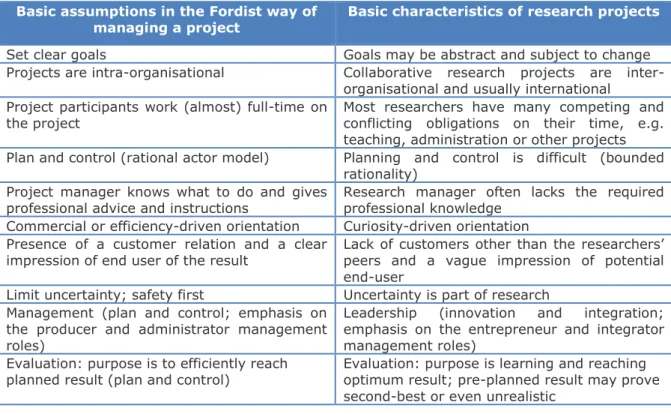
In order of appearanceTable 1-1: Comparison of conventional Fordist project management and basic characteristics of research projects
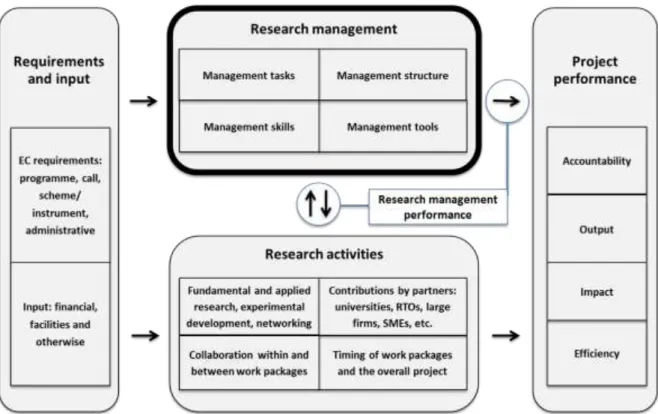
Figure 2-1: Conceptual framework
Table 2-1: An overview of the types of projects included for the case studies: Figure 3-1: Relative distribution of nationalities of Project Coordinators (by
European sub-regionor “other”)
Table 3-1: Nationalities of Project Coordinators, in order of most to least prevalent among the survey respondents
Figure 3-2: Relative distribution of the type of organisations Project Coordinators work for
Figure 3-3: Relative distribution of nationalities of project participants (by European sub-regionor “other”)
Table 3-2: Nationalities of project participants, in order of most to least prevalent among the survey respondents
Figure 3-4: Relative distribution of the type of participant organisations
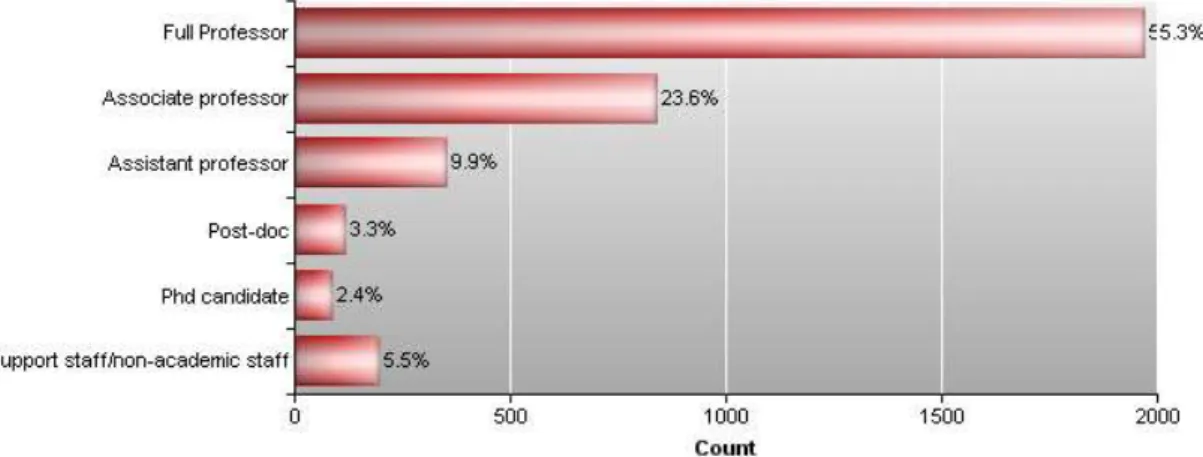
Figure 3-5: Relative distribution of functional levels across university participants and industry participants
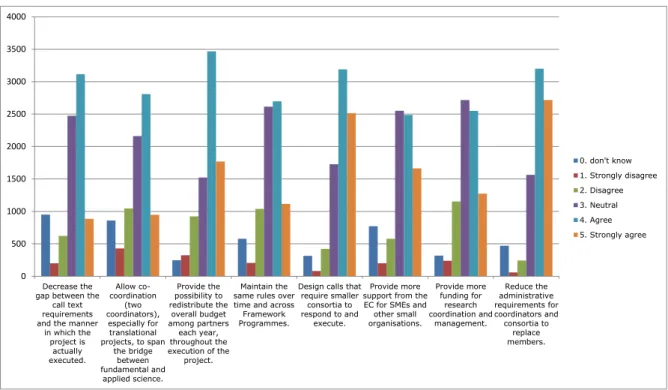
Figure 3-6: The degree to which participants agree with a selection of eight pre-defined recommendations to the EC for enabling better research management
Figure 3-7: Second phase of the process: identifying consortium partners
Figure 3-8: How consortia identified partners, both organisations and individuals Figure 3-9: Frequency of changes in consortium composition (n=2,301)
Figure 3-10: Number of partners that changed in project where changes in consortium composition occurred (n=2,301)
Figure 3-11: Degree of personal acquaintances found in consortia Figure 3-12: The ‘basic model’ of an FP project’s management structure
Figure 3-13: Example of a complex model of an FP project’s management structure Figure 4-1: The top project management tasks in order of the time spent
Figure 4-2: The top project management tasks in order of the importance for project performance
Table 4-1: Extent to which Project Coordinator or project manager involved partners in substantial decisions about the project (FP6 and FP7) Figure 4-3: Extent to which the General Assembly functioned effectively, according
to its formal tasks as described in the EC grant agreement
Figure 4-4: Percentage of the total budget devoted to research coordination and management (FP6)
Figure 4-5: Percentage of the total budget devoted to research coordination and management (FP7)
Figure 4-6: Tools used for project management tasks
Figure 4-7: Perceived added value of tools provided by the EC by coordinators (FP6 vs FP7)
Figure 4-8: Participants’ thoughts on the tools provided by the EC
Figure 5-1: The basic model for consortium management structure vs. the complex model in terms of management performance
Figure 5-2: T-test for project success (industry coordinators vs. researchers) Figure 5-3: T-test for project success (SME vs. large industry coordinators) Figure 5-4: T-test for project success (universities vs. research institutes)
Figure 5-5: T-test for research management performance (industry coordinators vs. researchers)
Figure 5-7: T-test for research management performance (universities vs. research institutes)
Figure 5-8: Independent variables that have a significant (positive = green, negative = red) relationship with RMP, project success, or both Table 5-1: Results of the ordered logistic regression for Research Management
Performance
Table 5-2: Regression results of ordered logit model for Project Success
Table 5-3: Correlations between the Project Coordinator’s region of origin and the management styles observed in the project
Table A-1 Research questions with section references
Table C-1: Number of FP6 and FP7 projects and participants per project after first step in the sampling process
Table C-2: Number of retained FP7 projects after the second step in the sampling process
Table C-3: Comparison of survey sample for FP7 projects (N=2,701) with FP7 population (N=4,585)
Table C-4: Descriptive characteristics of the FP6 sample (N=5,600, being the actual sample taken for the study which equals the total FP6 sample)
Table C-5: Survey response at the level of individual FP6 and FP7 participants Table C-6: Survey response at the level of individual FP6 and FP7 projects Figure C-1: Process from survey sample through to case study findings Table C-7: Basic characteristics of case study projects
Table D-1: Comparative analysis on nationality FP7 Table D-2: Comparative analysis on nationality FP6 Table E-1: Survey questionnaire
Table F-1: Comparing gender among Project Coordinators in the survey with Project Coordinators in the E-CORDA database
Table F-2: Comparing type of organisation among Project Coordinators in the survey with Project Coordinators in the E-CORDA database
Table F-3: Comparing type of organisation among Project Coordinators in the survey with Project Coordinators in the E-CORDA database
Figure G-1: Output of hierarchical cluster analysis
Table H-1: Results of the ordered logistic regression for research management performance, with FP6 and FP7 themes as independent variables Table H-2: Results of the ordered logistic regression for research management
performance, with FP6 and FP7 schemes as independent variables Table H-3: Results of the ordered logistic regression for project success, with FP6
and FP7 themes as independent variables
Table H-4: Results of the ordered logistic regression for project success, with FP6 and FP7 schemes as independent variables
Table I-1 Research questions for the case studies Table J-1: Case study interviews
Table J-2: Non-case study interviews Table K-1: Participants of the round table
Table of Contents
Abstract ... 3
Résumé ... 3
Executive Summary ... 4
Résumé opérationnel ...10
List of abbreviations and acronyms used ...17
List of tables and figures ...18
Table of Contents ...20
1. Introduction ...22
1.1. Management of collaborative research projects versus management of conventional projects ...22
1.2. Key objectives of the study ...25
1.3. The authors of this report ...25
1.4. The content of this report ...25
2. Research methodology ...26
2.1. Scope and focus of the study...26
2.2. Synthesis, triangulation and reporting ...29
2.3. Limitations ...29
3.Description, organisation and typology of teams involved in FP research projects ..31
3.1. Functions and roles in FP project teams ...31
3.2. The profile of Project Coordinators ...33
3.3. The profile of FP participants ...36
3.4. Size and composition of consortia ...39
3.5. The setting up of FP project consortia ...42
3.6. Stability of FP project teams...44
3.7. Forming sequential consortia with the same partners ...46
3.8. Main models of partnerships ...48
4. Management processes and supporting instruments ...50
4.1. The organisation of work ...50
4.2. Management processes ...51
4.3. Division and delegation of tasks ...53
4.4. Top-down decision taking versus consensus decision-making ...53
4.5. Detecting and solving problems ...55
4.6. Financial management ...56
4.7. Quality control, evaluation and validation ...57
4.8. Monitoring the projects and reporting ...58
4.9. Human resource management ...59
4.10. Internal communication, external communication and dissemination of results ...59
4.11. Knowledge transfer and intellectual property rights ...61
4.12. Well-established vs. less emphasised processes ...62
4.13. Project management costs ...63
4.14. Project management tools ...65
4.15. Project management tools provided by the European Commission ...66
5. Performance and efficiency of research management ...69
5.1. Efficiency of research management models ...69
5.2. Efficiency of Project Coordinators ...70
5.4. Good management practice for FP projects ...84
5.5. Suggestions regarding structures and models put in place by the European Commission ...85
6. Concluding Remarks and Recommendations ...89
6.1. Good practices in research management are aimed at building trust and relationships, ensuring frequent communication and facilitating the consortium partners ...90
6.2. How consortium composition comes about and subsequently changes can be considered a given; what matters is how Project Coordinators and EC project officers are able to respond to it ...91
6.3. Several specific adjustments of FP7 vs. FP6 and Horizon 2020 vs. FP7 appear to have worked out well; on the other hand IP remains an issue ...93
6.4. Tools seem to be of little relevance to research management; EC-provided tools can be improved ...94
7. Suggestions for further research ...95
Annexes ...97
A. Research questions posed by the European Commission and sections where they are addressed ...98
B. Sources used ... 100
C. Methodological approach ... 103
D. Comparative analysis with respect to organisational nationality in survey sample ... 114
E. Survey questionnaire ... 120
F. Survey non-response analysis ... 137
G. Methodological details of our statistical analyses ... 143
H. Results of statistical analysis of FP6 and FP7 themes and schemes ... 145
I. Case study protocol ... 151
J. List of interviewees ... 153
1.
Introduction
This report is the final deliverable of the study by PwC EU Services EEIG (in the remainder of this report referred to as “PwC”) and Technopolis Group on Assessing the research management performance of EU Framework Programmes projects. Assignor of the study is the European Commission, DG Research and Innovation (DG RTD). In this section we provide a short introduction to the study. First we present a theoretical overview of the main differences between the management of conventional (i.e. non research, yet collaborative) projects and the management of research projects. In section 1.1 we show the main consequences of this difference: the management of large research projects comes with substantial and specific challenges. In section 1.2 we present the aims of the study. The authors of the study are presented in section 1.3. Finally section 1.4 introduces the structure of this report.
1.1.
Management of collaborative research projects versus
management of conventional projects
From a management point of view, one should be aware of a fundamental difference between research projects on the one hand, and implementation projects, deployment projects and other types of projects on the other hand. Project management has traditionally been thought of in the context of business and industry, and has generally followed Fordist (and Taylorist) approaches. This paradigm has been labelled the technical-rational model of project management and is based on a set of assumptions e.g. that projects are repetitive, that projects can be easily divided into distinct phases and sub-tasks, that projects can be planned rationally, that clear goals can be set, that the environment can be controlled, that there is a customer relation or clear impression of end user of the result, and – moreover – that the project manager often knows what to do and gives professional advice and instructions concerning the concrete work. This paradigm has later been further developed by a large population of scholars.1
1.1.1. The traditional project management paradigm
Table 1-1 gives us a first impression that collaborative research projects show some characteristics that differ significantly from traditional project characteristics. This implies that the management of these projects might require some different tools and skills.
The two different ends of the spectrum are made relatively explicit since we interpret the Fordist paradigm in its most conventional sense. It more or less neglects the fact that the traditional approach has been taken along the road, and was further developed to allow for the explanation of phenomena that we see in many aspects of our networked and dynamic society.
1 E.g. Das, Tarun K., and Bing-Sheng Teng. "Between trust and control: developing confidence in partner cooperation in alliances." Academy of management review 23.3 (1998): 491-512;
Table 1-1: Comparison of conventional Fordist project management and basic characteristics of research projects2
Basic assumptions in the Fordist way of
managing a project Basic characteristics of research projects
Set clear goals Goals may be abstract and subject to change Projects are intra-organisational Collaborative research projects are
inter-organisational and usually international Project participants work (almost) full-time on
the project Most researchers have many competing and conflicting obligations on their time, e.g. teaching, administration or other projects Plan and control (rational actor model) Planning and control is difficult (bounded
rationality) Project manager knows what to do and gives
professional advice and instructions Research manager often lacks the required professional knowledge Commercial or efficiency-driven orientation Curiosity-driven orientation
Presence of a customer relation and a clear
impression of end user of the result Lack of customers other than the researchers’ peers and a vague impression of potential end-user
Limit uncertainty; safety first Uncertainty is part of research Management (plan and control; emphasis on
the producer and administrator management roles)
Leadership (innovation and integration; emphasis on the entrepreneur and integrator management roles)
Evaluation: purpose is to efficiently reach
planned result (plan and control) Evaluation: purpose is learning and reaching optimum result; pre-planned result may prove second-best or even unrealistic
However, Table 1-1 also shows that the traditional paradigm in project management theory might not be the most useful paradigm for addressing the challenges of research management. We are fully aware that the table sketches a dichotomy. To some extent, recent management literature does address the technological uncertainties and risks of unique projects3, and the increased importance of collaboration with external actors.4
Nonetheless, it is clear that the management of large international collaborative research projects is significantly different from conventional project management. It requires a different approach, different tools, and different skills. Moreover, managers of research projects face different management challenges than those who manage conventional projects. Also, the application of a uniform project management approach throughout the project life-cycle is inappropriate, as has been established in recent studies of FP-financed collaborative research projects in the area of information systems.5 These same studies also indicate that successful research management of collaborative projects needs to overcome three paradoxes:6
2 Based on: Ernø-Kjølhede, A. (2000), Project Management Theory and the Management of Research Projects. MMP Working Paper No. 3/2000, Copenhagen Business School.
3 Shenhar, A.J. and Dvir, D. (2007), Reinventing Project Management: The Diamond Approach to Successful Growth and Innovation, Harvard Business School Press.
4 Chesbrough, H. (2003), Open Innovation: The New Imperative for Creating and Profiting from Technology, Harvard Business School Press.
5 Lippe, S., Vom Brocke, J. and Stanoevska-Slabeva, K. (2013), A conceptualisation of management situations relevant for collaborative IS research projects. 34th International Conference on Information Systems (ICIS2013). Milan, Italy.
6 Vom Brocke, J. and Lippe, S. (forthcoming), Managing collaborative research projects: A synthesis of project management literature and directives for future research, International Journal of Project Management.
Generating innovative results requires freedom and flexibility, while firm structures are needed to deliver widely usable project outcomes.
Heterogeneity of partners is required to achieve excellence, but also results in challenges of inter-cultural, inter-organisational, and inter-disciplinary management.
Research partners require autonomy, but research management requires a certain amount of consensus.
1.1.2. A first introduction to aspects of the management of collaborative research projects
Within the context of this study we define research management as the management of collaborative research projects. Hence when we refer to research managers and research management within the context of this study, this refers to management of collaborative research projects in Sixth and Seventh Framework Programmes (FP6 and FP7, respectively). The challenges for the managers of large collaborative research projects, including FP6, FP7, and Horizon 20207 projects, are manifold.
Leadership is an important challenge for research managers. This is due in part to the limited value of managing research projects by traditional planning and control approaches. Leadership skills for research management purposes may include scientific or technological expertise, skills needed to integrate technology and business, and entrepreneurial skills. As a consequence, managers of research projects may include professional managers that lack the in-depth scientific or professional knowledge of project participants. The other way around, managers may possess the in-depth knowledge, being a research professional, but lacking professional management skills. This raises challenges for managers as well as those that are managed.
Challenges in terms of leadership increase because of the intrinsic uncertainty in research projects. Such uncertainty requires a high level of autonomy of project participants with specific expertise on specialist domains. They know best how to find or develop the most relevant theories, technologies and solutions within their specialist domain. One of the first challenges for a research manager is to find the right balance between controlling participants (e.g. steering and instructing), facilitating individual participants (e.g. informing and assisting) and stimulating them to collaborate.
At the same time, research managers face challenges in terms of organisational design and planning of projects. Phases are overlapping, and non-linear. Tasks are interdependent, and the need for managing two-way interaction between researchers working on different tasks is clear. As such, interaction and collaboration are important features of collaborative research projects, which impose substantial challenges on research managers. The nature of collaborative project teams is another complicating factor. Because research projects are often inter-organisational and inter-disciplinary, challenges arise in finding partners, developing consortia, finding effective and efficient ways of collaboration, and ensuring that the results are relevant for all partners involved. In EU Framework Programmes, these challenges may be more substantial, due to requirements (or expectations) in terms of involving actors from different countries, sectors and disciplines, and involving actors from industry (Small and Medium Enterprises (SMEs) and large firms), academia, public sector, etc. As researchers in general have tight time schedules including many competing and conflicting obligations, an important aspect of research management is to ensure that
7 Horizon 2020 is the eighth consecutive Framework Programme and, as such, the successor of FP7.