Information Systems Research
Articles in Advance, pp. 1–23 issn1047-7047eissn1526-5536inf
orms
® doi10.1287/isre.1080.0205 © 2009 INFORMSResearch Note
The Role of Organizational Controls and Boundary
Spanning in Software Development Outsourcing:
Implications for Project Performance
Anandasivam Gopal
Robert H. Smith School of Business, University of Maryland, College Park, Maryland 20910, [email protected]
Sanjay Gosain
Capital Group Companies, Inc., Irvine, California 92618, [email protected]
P
ast research has studied how the selection and use of control portfolios in software projects is based on environmental and task characteristics. However, little research has examined the consequences of control mode choices on project performance. This paper reports on a study that addresses this issue in the context of outsourced software projects. In addition, we propose that boundary-spanning activities between the vendor and the client enable knowledge sharing across organizational and knowledge domain boundaries. This is expected to lead to facilitation of control through specific incentives and performance norms that are suited to client needs as well as the vendor context. Therefore, we argue that boundary spanning between the vendor and client moderates the relationship between formal controls instituted by the vendor on the development team and project performance. We also hypothesize the effect of collaboration as a clan control on project performance. We examine project performance in terms of software quality and project efficiency. The research model is empirically tested in the Indian software industry setting on a sample of 96 projects. The results suggest that formal and informal control modes have a significant impact on software project outcomes, but need to be finely tuned and directed toward appropriate objectives. In addition, boundary-spanning activities significantly improve the effectiveness of formal controls. Finally, we find that collaborative culture has provided mixed benefits by enhancing quality but reducing efficiency.Key words: software outsourcing; organizational control; software quality; project overruns; boundary spanning; partial least squares; surveys
History: Vallabh Sambamurthy, Senior Editor; Shaila Miranda, Associate Editor. This paper was received on September 8, 2006, and was with the authors 10 months for 5 revisions. Published online inArticles in Advance.
1.
Introduction
Software development outsourcing is a multifaceted and complex activity in which clients and vendors interact in many different ways to produce and de-liver the software services required. Most outsourced software projects involve significant technical activi-ties combined with a social process of acquiring and integrating knowledge from various stakeholders such as users, project managers, developers, and clients. In such a context, appropriate organizational controls are
vital in reconciling the interests of stakeholders and improving project performance. Much of the recent work in the information systems discipline related to organizational controls has focused on control port-folios in projects and the role of various technical and organizational factors in determining the choice of control modes (Kirsch 1996, 1997). However, there is little work that has explicitly studied the effect of the controls on project performance. Indeed, a recent meta-analysis (Narayanaswamy et al. 2007, p. 2)
1 Cop yright: INFORMS holds cop yr ight to this Ar ticles in Adv ance version, which is made av ailab le to institutional subscr ibers . The file ma y not be posted on an y other w ebsite ,including the author’s site . Please send an y questions regarding this policy to per missions@inf or ms .org.
points out that the “focus has been on identifying the factors that lead to the choice of controls and not the results that come from the use of controls. Even when performance outcomes are considered, the relation-ship to the use of various forms of control is often not clear.” This study tries to address this gap in the liter-ature by studying the effect of organizational controls on project performance.
Although organizational controls have been stud-ied in some prior research, a significant proportion of this work has been limited to in-house projects, wherein the controller and the controllee operate within organizational boundaries. Relatively less work has examined controls in software outsourcing, par-ticularly in relating controls to project outcomes in outsourced projects. In studying the impact of con-trols in the context of outsourcing, two differenti-ating factors from the in-house context need to be considered. First, there are two organizational inter-faces that appear in outsourced projects. The first interface lies between the vendor project management and the vendor development team. The second inter-faces lies at the organizational boundary between ven-dor and client organizations. Although prior research on controls in outsourcing hints at these multiple interfaces (Choudhury and Sabherwal 2003, Kirsch et al. 2002), they are not explicitly separated in the-oretical treatment. The second difference from prior research on control is in recognizing that vendors and clients in outsourcing arrangements may have radically different knowledge domains and expertise (Levina 2005). Vendors have strong technical knowl-edge but typically lack business domain knowlknowl-edge, whereas clients have strong business domain knowl-edge but not deep technical knowlknowl-edge and do not directly engage with technical artifacts. Therefore, to successfully manage an outsourced project, it is important for both parties to collaborate on sharing this knowledge across knowledge boundaries, thereby necessitating boundary spanning (Carlile 2002). The vendor’s ability to control the project is facilitated by the extent to which it is informed by the client on client expectations, knowledge, and input (Levina and Ross 2003).1 Explicating the role of boundary span-ning across client-vendor organizational interface in 1Levina and Ross (2003) call the former the vendor’smethodology
com-petence, which is influenced by the vendor’srelationship management
shaping the effectiveness of controls applied at the management-vendor team interface is an important contribution of our study.
Boundary spanning has emerged as an impor-tant concern in the context of knowledge sharing across fields of work or practice (Carlile 2002). Fields of practice refer to concentrated collections of knowledge in a given context that enables agents to specialize in them while also distinguishing them from other fields (Levina and Vaast 2005). In out-sourced projects, it is necessary to not only span geo-graphical and cultural boundaries, but also the more relevant boundary of knowledge domains. We pro-pose that boundary spanning plays a particularly sig-nificant role in enabling the vendor organization to apply control more effectively to manage the develop-ment team. The extent of boundary spanning between the vendor and the client allows the vendor to insti-tute controls that are more effective for the specific context and to effectively leverage relevant control parameters. The distinction between the two organi-zational interfaces inherent in outsourcing is thus cap-tured in our research model; we show that boundary spanningbetweenvendor and client significantly mod-erate the relationship between formal controls and project performance within the vendor organization. This approach bridges prior work studying controls in in-house development (Kirsch 1996, 1997) and bound-ary spanning in software outsourcing (Levina and Vaast 2005, Levina 2005) into one parsimonious model of project performance.
Our work in this paper makesthreesignificant con-tributions. First, we study the role of formal con-trols instituted within the vendor organization on project performance in the understudied, but increas-ingly prevalent, context of software outsourcing, thereby extending Kirsch’s (2004) and Choudhury and Sabherwal’s (2003) work. Our work helps us understand the implications of organizational controls in the IT services outsourcing industry, estimated at about $78 billion in 2007 by TPI,2 of which cross-functional application development (specifically our focus) represented about roughly $35 billion. Second,
competence, which encompasses our notion of boundary spanning in this paper. We are grateful to a reviewer for this point.
2http://www.tpi.net/newsevents/news/releases/080116-TPI.html. Cop yright: INFORMS holds cop yr ight to this Ar ticles in Adv ance version, which is made av ailab le to institutional subscr ibers . The file ma not be posted on an y other w ebsite ,including the author’s site . Please send an y questions regarding this policy to per missions@inf or ms .org.
we explicitly include boundary spanning as a moder-ator into the controls-based model of software devel-opment (Kirsch 1996, Choudhury and Sabherwal 2003). We propose a parsimonious measure of bound-ary spanning in the outsourcing context, drawing from existing qualitative research on boundary span-ning and knowledge transfer (Levina and Vaast 2005). Ourthirdcontribution is to study organizational con-trols as an antecedent to project performance rather than explaining the choice of controls. Existing stud-ies have mainly used the case study method to iden-tify the choice of control portfolios on a small set of projects (Kirsch 1996). Although this approach pro-vides a rich dataset of microlevel interactions between the development team and the user community, there are few clear linkages made to project performance (Narayanaswamy et al. 2007). In this paper, we not only show that outcome-based controls have positive impacts on the focal outcomes, but also show that these controls may impose negative externalities on other outcomes.
In outsourced projects, the most commonly ob-served performance parameters are software qual-ity and team efficiency. Qualqual-ity, i.e., product perfor-mance, is a key outcome of software development activities (Henderson and Lee 1992). Additionally, adherence to budgeted cost and schedule, i.e., process performance, represents an important outcome mea-sure (Wallace et al. 2004). Our paper provides a quan-titative analysis of the link between controls and product and process performance and also enables us to tease out which type of controls have, on the margin, a greater impact on performance. We tested our hypotheses on data from a sample of 96 offshore software projects, collected using a questionnaire and company databases, from software-outsourcing ven-dors in India. The Indian software industry is a lead-ing outsourclead-ing destination for firms across the world (Meyer 2006) and forms an appropriate context to study outsourcing. Our results confirm that bound-ary spanning between the client and the vendor sig-nificantly moderates the efficacy of formal controls instituted within the vendor organization to direct the project team. In addition, we find support for the observations made in prior research about the dom-inance of outcome controls over behavior controls— outcome controls in this setting are associated with better project outcomes than behavior controls.
2.
Background Theory and
Hypotheses
The research model proposed integrates a basic framework of organizational control theory with a boundary-spanning perspective that draws on the knowledge-based view of firms. In the following sec-tion we review the conceptual bases of this study and position its contributions in relation to the extant liter-ature, followed by the development of the hypotheses to be tested.
2.1. Organizational Controls
Our research model is rooted in organizational con-trol theory, which posits that four main modes of control may be used in managing economic activity— behavior-based controls, outcome-based controls, clan-based controls, and self-control (Ouchi 1979, Eisenhardt 1985). Outcome controls and behavior controls are classified asformalcontrol modes because they can be purposefully instituted based on the underlying needs of the task at hand. In outcome-based controls, the controller specifies the parameters of the desired outcome; the controllee’s rewards are based on the observed outcome. In contrast, behavior-based controls are used when specific rules and procedures are established for the controllee to follow, thereby leading to the desired outcome. Controllers observe the behavior of the controllees and reward them on the basis of their adherence to such rules and procedures.
In contrast to formal control, informal controls, i.e., clan control and self-control, are based on social strategies that stress interpersonal and individualis-tic dynamics. Clan controls are implemented by pro-moting a set of common values and beliefs within the organization, such that the agent’s desire to be identi-fied as a valid member of the “clan” induces desired behavior. Clan controls include undocumented but socially accepted methods of activity, informal codes of conduct with respect to vendor-client relationships, and accepted behaviors that facilitate desired working conditions within the firm (Ouchi 1979). Managers can strategically induce desired behavior or outcomes by introducing socialization processes and normative methodologies within the organization. However, not all clan controls may be consistent with organizational goals, hence, considering clan controls at an abstract
Cop yright: INFORMS holds cop yr ight to this Ar ticles in Adv ance version, which is made av ailab le to institutional subscr ibers . The file ma not be posted on an y other w ebsite ,including the author’s site . Please send an y questions regarding this policy to per missions@inf or ms .org.
level may not help understand links to performance. Our work in this paper considers a specific type of clan control, collaborative culture, which refers to a value-based system emphasizing shared purpose in working towards common goals.
Although extant literature also points to self-control, allowing for individual discretion and intrin-sic motivation as providing a basis for managing organizations (Eisenhardt 1985), they are less of a strategic tool in the manager’s toolkit, being difficult to accurately assess and influence.
The study of controls in software development, emerging from Henderson and Lee (1992), has been developed in the Informaton Systems literature to the point where a significant body of work exists. Kirsch (1996, 1997) pioneered the study of control in IS devel-opment by analyzing the choice of control portfolios in in-house projects based on controllee behavior observability and outcome measurability. In subse-quent work, she extends her analysis to understand how dimensions of control portfolios change over the course of the project (Kirsch 2004). In much of this lit-erature, the controller is the IS manager/user contact while the controllee is the development team. Extend-ing this literature to the outsourcExtend-ing domain requires cognizance of the existence of two interfaces—one between the vendor manager and the vendor team and the other between the client and the vendor. In their analysis of controls in outsourcing, Choudhury and Sabherwal (2003) refer to individuals in the client organization as controllers and individuals on the vendor site as controllees (p. 292), but do not explicitly distinguish between interactions occurring at the vendor-client interface and those at the project manager-project team interface. This represents a gap in the literature.
Although the focus on much of the controls lit-erature in IS research has been on establishing the choice of control portfolios, there is little by way of establishing the impact of chosen controls on project performance (Narayanaswamy et al. 2007). Behavioral controls can be likened to software processes in that both require adherence to a set of prescribed activi-ties and methods to develop and maintain software (Paulk et al. 1993, Kirsch 1996). Thus, some of the existing research of the positive effect of processes on outcomes (Krishnan et al. 2000, Gopal et al. 2002a)
could be seen as indicative of the positive effects of behavioral control. Similarly, some existing work that attests to the beneficial impacts of strong incentives on vendors to achieve quality and efficiency tar-gets is suggestive of the positive effects of outcome-based controls (Gopal et al. 2003, Banerjee and Duflo 2000). However, the aggregate effects of these differ-ent forms of controls have not been studied together in a holistic manner in the outsourcing domain. It is possible that they have differing effects on dimen-sions of performance when evaluated together—this represents another gap in the literature.
The above discussion suggests three unexplored avenues in the IS literature on controls. First, much of the current work pertains to in-house software development, with the exception of Choudhury and Sabherwal (2003). The increasing prevalence of out-sourcing would indicate a need to extend the study of controls to outsourced projects. Second, most exist-ing work has studied the performance implications of software processes and incentives in isolation; a more holistic approach to evaluating their perfor-mance implications within an organizational control framework could provide additional insights. Third, extending controls literature to outsourcing requires recognition of the two interfaces that exist in most software-outsourcing engagements. We augment the conceptual model of control in view of these gaps in the literature by incorporating the impact of the inter-actions between the client and the vendor, which we treat as manifestations of boundary spanning, on the performance implications of different types of con-trols examined together.
2.2. Boundary Spanning
Software development is a knowledge-intensive activ-ity wherein firms’ competitive advantage emerges from their unique ability to recombine individual and organizational knowledge (Kogut and Zander 1992). The effectiveness with which firms can collate, share, and build on individual knowledge bases depends on the scope and the flexibility of the knowledge inte-gration activities (Grant 1996). The firm’s integrative abilities need to combine the appropriate forms of knowledge with the suitable vehicles for knowledge sharing. Thus, successful firms can create and manage inimitable and flexible models for knowledge sharing.
Cop yright: INFORMS holds cop yr ight to this Ar ticles in Adv ance version, which is made av ailab le to institutional subscr ibers . The file ma not be posted on an y other w ebsite ,including the author’s site . Please send an y questions regarding this policy to per missions@inf or ms .org.
In software outsourcing, the vendor is a repository of both declarative and procedural technical knowl-edge. This typically includes understanding of the base platforms, enterprise-level software applications, operating systems, and the user-facing applications that will be developed according to specifications (Pressman 2001). However, the vendor requires exten-sive knowledge about the business domain that the system will support (and be embedded in) from the client. Traditional requirements analyses are limited in the extent to which they can capture the true complexity of the business domain that the clients operate in Wallace et al. (2004). Furthermore, require-ments may also change or evolve over time. The client’s business domain contains large amounts of tacit knowledge that may not be adequately captured in the declarative knowledge elements traditionally used, such as a priori functional specifications. Thus, a large part of the typical outsourcing relation-ship revolves around knowledge integration activi-ties between the vendor and client, aimed at bridging the gap between their respective knowledge domains. These activities are thus reflective of boundary span-ning as an organizational capability (Carlile 2002).
Empirical work studying boundary-spanning activ-ities has focused on three important facets of bound-ary spanning—boundbound-ary spanners, boundary objects, and boundary-spanning processes (Star 1989, Carlile 2002). Boundary spanners refer to individuals who are responsible for ensuring that the required knowledge is able to flow across the boundaries. Spanners “facil-itate the sharing of expertise by linking two or more groups of people separated by hierarchy, location, or function” (Levina and Vaast 2005). Boundary span-ners in practice may be nominated or may emerge without nomination (Levina and Vaast 2005).
In addition to spanners, boundary objects that can be used to share knowledge are needed. Star (1989) defines boundary objects as “objects that are plas-tic enough to adapt to local needs and constraints of several parties using them yet robust enough to maintain a common identity across sites.” Bound-ary objects include physical prototypes, accounting ledgers, design documents, software, and engineer-ing sketches (Levina and Vaast 2005). In the IT con-text, boundary objects can refer to document archives, software code, and design artifacts (Pawlowski and
Robey 2004, Levina 2005). Effective boundary objects should establish a shared syntax between parties, provide a concrete means for individuals to specify and learn about their differences and represent these differences in the object itself for better understand-ing. Like boundary spanners, it is possible to differen-tiate between designated boundary objects from actual boundary objects in use (Levina and Vaast 2005).
Finally, it is important to establish a process by which individuals can jointly transform their knowl-edge or share knowlknowl-edge. Carlile (2002, 2004) describes the need for a process using which members across knowledge domains can share information bidirectionally to integrate, transform, or apply exist-ing knowledge to the economic activity at hand. The presence of a boundary-spanning process also reduces the cognitive costs on individuals by establishing a common syntax for the boundary-spanning activities. Our definition of boundary spanning in the outsourc-ing context thus draws from these three buildoutsourc-ing blocks of boundary spanning—spanners, objects, and processes.
2.3. Software-Outsourcing Project Performance
Software project performance has been broadly char-acterized in terms of effectiveness and efficiency (Hoegl and Gemuenden 2001, Wallace et al. 2004). The effectiveness dimension assesses the degree to which the developed software meets the requirements of the customer, and is also referred to as product performance (Henderson and Lee 1992). This con-struct captures the quality-specific attributes of the developed software. One approach views software development as indicative of a service with certain properties provided to clients. Wallace et al. (2004) use five Likert-scaled items to capture this attribute with the focus being on reliability, maintainability, meeting requirements, and response time of the application developed. An alternative line of research attempts to capture this information through objective data such as defects per line of code (LOC) (Ethiraj et al. 2005) or modification requests (Herbsleb and Mockus 2003). In contrast, the efficiency dimension captures the extent to which the development process is well managed, i.e., process performance (Hoegl and Gemuenden 2001). The construct addresses whether the software was developed on time and within bud-get. Past research has studied efficiency by focusing
Cop yright: INFORMS holds cop yr ight to this Ar ticles in Adv ance version, which is made av ailab le to institutional subscr ibers . The file ma not be posted on an y other w ebsite ,including the author’s site . Please send an y questions regarding this policy to per missions@inf or ms .org.
on project effort and cycle times (Harter et al. 2000), project profitability (Gopal et al. 2003), and project costs (Krishnan et al. 2000). Cost and schedule over-runs have been used to characterize efficiency (Ethiraj et al. 2005, Tiwana 2004) and allow for better compar-isons across projects—we use reverse-coded overrun-based measures in assessing project efficiency.
Although it is possible to study the antecedents of project performance along the two dimensions of per-formance individually, as seen in the literature, we argue that to fully understand the efficacy of con-trol on performance, it is important to study both dimensions of project performance together. It is often easy to cut costs (and enhance efficiency) by under-performing on quality (Pressman 2001). Similarly, the practitioner press has discussed the prevalent prac-tice of cutting cycle times and releasing software prod-ucts with known quality issues to enhance efficiency (Thibodeau and Rosencrance 2002). In this paper, we thus study the effect of control on both performance dimensions together. The research hypotheses are dis-cussed next.
2.4. Hypotheses Development
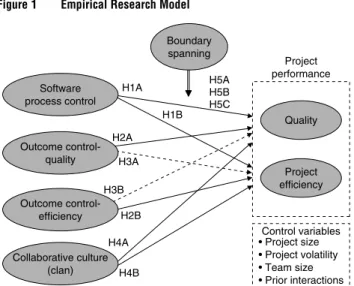
We first present hypotheses related to the effects of control and then moderation by boundary spanning, based on the research model (Figure 1).
Effect of Formal Controls. We first address our
hypotheses pertaining to behavioral control and then describe those with respect to outcome controls.
Figure 1 Empirical Research Model
Control variables • Project size • Project volatility • Team size • Prior interactions H1B H1A H2A H2B H5A H5B H5C H4B H4A H3A H3B Quality Project efficiency Boundary spanning Project performance Software process control Outcome control-quality Outcome control-efficiency Collaborative culture (clan)
Behavioral control involves managers prescribing appropriate procedures that have to be followed by agents in carrying out their activities. The reason-ing for institutreason-ing such control is that adherence to prescribed behavior norms will lead, under the right contingencies, to higher performance. Absent such behavior control, instrumental behaviors leading to desired outcomes may not be apparent to individual participants; the presence of such control leads to more focused efforts and performance.
In the outsourcing context, appropriate behav-ior controls can include development methodology specification (Necco et al. 1987, Choudhury and Sabherwal 2003), clearly defined procedures, and documentation-related behaviors (Kirsch 1997). This reasoning is also reflected in software process man-agement in software organizations, wherein pro-cess initiatives lay out disciplined and metrics-based methodologies that are required to be followed in all projects. Research has shown that controlled and disciplined processes, analogous to strict behavior controls, have resulted in higher quality for in-house software products (Krishnan et al. 2000). We extend this reasoning to the outsourcing domain and test for similar effects of behavioral control on project out-comes. To the extent that adherence to process and methodologies within the project team on the vendor side are associated with better quality, we propose
Hypothesis 1A (H1A). Higher levels of behavioral
(process specifications-based) control will be associated with higher levels of software quality.
Software development is an uncertain activity with a high degree of risk surrounding the causal rela-tionship between input and output (Pressman 2001). Therefore, it is possible to have all requisite inputs into the development process and still experience technical or managerial issues during the project that adversely affect the ability to complete the project on time or within budgeted costs. Behavioral con-trols aim to mitigate this inefficiency by encapsulat-ing appropriate plannencapsulat-ing templates and development practices most suited to the industry context. This has also been empirically shown to enhance the efficacy of the development process (Krishnan et al. 2000, Gopal et al. 2002a). Indeed, the prevalent process models such as the ISO 9000 and the CMM are collections
Cop yright: INFORMS holds cop yr ight to this Ar ticles in Adv ance version, which is made av ailab le to institutional subscr ibers . The file ma not be posted on an y other w ebsite ,including the author’s site . Please send an y questions regarding this policy to per missions@inf or ms .org.
of best practices culled from experience (Paulk et al. 1993). Hence, we propose that,
Hypothesis 1B (H1B). Higher levels of behavioral
(process specifications-based) control will be associated with higher levels of project efficiency.
Organizations implementing outcome control spec-ify desired goals, and employees are rewarded based on the extent to which they meet these goals. A cyber-netic view of control suggests that individuals and teams would be motivated to take corrective action if they failed to meet project goals on an ongoing basis, thereby leading to higher output quality and efficiency (Jaworski 1988). Alternatively, a behavioral view of outcome control indicates that once the con-trollee has been provided with information about desired outcomes, his/her incentives should ensure appropriate behavior to meet these goals (Kirsch 1997). This view is supported by agency theory, wherein the presence of incentive alignment between the principal and agent leads to better outcomes by enabling the appropriate agent behavior (Jensen and Meckling 1976).
In software outsourcing, appropriate outcomes used in predicating agent control or rewards include software quality. It is possible for vendor managers to stipulate quality benchmarks for the project, and hence incentivize appropriate actions from the devel-opment team. Anecdotal evidence from the Indian outsourcing context indicates that this is often the case (Thibodeau 2004). Software project participants can then be rewarded or sanctioned based on their indi-vidual or team’s performance in meeting these goals. In the presence of established outcome control and the resulting incentives, the output from the project should, correspondingly, be of higher quality: Hence,
Hypothesis 2A (H2A). Higher levels of quality-based
outcome control will be associated with higher levels of soft-ware quality.
Agents may be incentivized along different dimen-sions in their activities (Jensen and Meckling 1976, Allen and Lueck 1999). Certain projects can be heavily incentivized along quality for mission-critical appli-cations, whereas for other projects, time to mar-ket or time to delivery are more critical. Therefore, the dimension along which the outcome control is
deployed will also play a role in determining out-comes, whereas the other dimension of performance should not be impacted. Efficiency-based controls are often applied in offshore settings (Thibodeau 2004). Research has shown that appropriate incentives for developers can lead to motivation of developer per-formance in software developer settings (Henderson and Lee 1992). Therefore, we expect that variance in the level of efficiency-based outcome controls will be associated with varying levels of efficiency.
Hypothesis 2B (H2B). Higher levels of
efficiency-based outcome control will be associated with higher levels of project efficiency.
An interesting but unexplored implication of outcome-based controls that we consider in this study is the effect of one type of outcome-based control on the other dimension of performance.3Specifically, we consider the spillover effects ofquality-based outcome controls on efficiencyand vice versa. There is little in the controls literature that has explicitly addressed these dynamics, although Choudhury and Sabherwal (2003) allude to these effects. There are two lines of research in the literature to suggest that the external-ities of instituted outcome-based controls may nega-tively affect other outcomes. The first line of reasoning is based on the attention-based view of managerial action (Ocasio 1997). The fundamental premise of the attention-based theory is that managers’ actions and behaviors depend on the issues that trigger their attention. What issues draw such attention as well as the consequent actions by the manager is a func-tion of the context in which the manager is embed-ded (Ocasio 1997) and the limited information and capacities available to him/her. This perspective high-lights the managerial tendency to focus on some lim-ited aspects of a problem, possibly to the detriment of other considerations (March and Shapira 1987). Thus, a focus of managerial attention on quality as an out-come and the resulting quality-based controls could lead to inadequate attention (whether intentionally or otherwise) paid to efficiency parameters on the project. This would imply a negative effect of quality-based outcome control on efficiency and vice versa. 3We thank the AE for bringing this unexplored avenue of analysis
to our attention. Cop yright: INFORMS holds cop yr ight to this Ar ticles in Adv ance version, which is made av ailab le to institutional subscr ibers . The file ma not be posted on an y other w ebsite ,including the author’s site . Please send an y questions regarding this policy to per missions@inf or ms .org.
The second line of reasoning emerges from soft-ware engineering, wherein researchers have always addressed the dichotomy between quality and effi-ciency as outcomes. Krishnan et al. (2000) suggest that software processes that strongly focus on quality out-comes often lead to higher overruns and detrimental impact on productivity metrics because of uncertainty and causal ambiguity in the software improvement efforts. Similar arguments are made in other work (cf. Harter et al. 2000 and Westland 2004). On the basis of this reasoning, we postulate the following hypothesis:
Hypothesis 3A (H3A). Higher levels of quality-based
outcome control will be associated with lower levels of project efficiency.
A similar negative externality could be found in the effects of efficiency-based outcome controls on qual-ity. Indeed, it has been argued that strong incentives to reduce costs in a project could allow the forma-tion of perverse incentives to underprovide on quality (Westland 2004). From a practitioner viewpoint, it is often observed that interventions that seek to mini-mize cycle time or duration on a project (indicative of project efficiency) often result in code that underper-forms on quality (Thibodeau and Rosencrance 2002, Pressman 2001). Therefore, it is likely that outcome-based controls that focus on and incentivize team activities around quality might result in compromis-ing efficiency. Thus, we propose:
Hypothesis 3B (H3B). Higher levels of
efficiency-based outcome control will be associated with lower levels of software quality.
Effect of Informal Control. Informal or clan-based controls operate through social norms such that the controlled entities internalize organizational goals and act in a manner consistent with the control-ling entities expectations (Covaleski et al. 1998, Ouchi 1979). Clan control operates when all members of the work group embrace the same values, adopt similar problem-solving approaches, and commit to achieving group goals (Ouchi 1979). Although it is difficult to study and observe clan controls directly because they are deeply embedded in the minds and practices of participants, a collaborative team culture can be seen as an important specific manifestation of clan control. Collaborative culture leads mem-bers to freely share resources and ideas with others.
Because the success of work conducted in software teams depends on how well team members collab-orate (Hoegl and Gemuenden 2001), a collaborative team culture will facilitate the achievement of project objectives. Because of likely heterogeneity in skills and expertise within a project team, with collabora-tive exchanges, the team can leverage the competence of each member in their area of expertise and bring it to bear on relevant task activities. Also, in a col-laborative culture, team members will be less defen-sive about exposing their individual work outcomes to scrutiny by others in the team. This is expected to reduce defects and improve software quality. Thus, we propose:
Hypothesis 4A (H4A). Higher levels of collaborative
culture-based clan controls will be associated with higher levels of software quality.
Because of mutual expectations of helpful behav-iors, enabling individuals to be more open about their deficiencies and get help from others as needed, collaborative culture can reduce the need for costly rework. Also, helpful behaviors are expected to elim-inate situations where the team may be suboptimal in leveraging its resources because individuals may act in their own interest and hoard resources or not respond in a timely manner to requests from others (Guzzo and Dickson 1996). A collaborative culture helps by mitigating these tendencies and fostering mutually beneficial joint work, thereby enhancing effi-ciency. Therefore,
Hypothesis 4B (H4B). Higher levels of collaborative
culture-based clan controls will be associated with higher levels of project efficiency.
Moderating Influence of Boundary Spanning.
Cli-ent organizations have knowledge of the business domain relevant to the project. This knowledge is marshalled through a requirements definition process that converts the requirements to functional specifica-tions. However, the process of acquiring the specific knowledge, needed for creating functional specifica-tions, is often inefficient and open to contingencies that unfold over time (Pressman 2001, Thibodeau and Rosencrance 2002). Therefore, even after require-ments elicitation, continued dialogue with the client is necessary to address open issues about the business
Cop yright: INFORMS holds cop yr ight to this Ar ticles in Adv ance version, which is made av ailab le to institutional subscr ibers . The file ma not be posted on an y other w ebsite ,including the author’s site . Please send an y questions regarding this policy to per missions@inf or ms .org.
domain for vendor managers (Gopal et al. 2002a). From the vendor side, vendors have deep technical knowledge required for making decisions about tech-nology choices for the project. In most cases, the rele-vant knowledge about the technological details have to be shared with the client to make informed deci-sions throughout the project. Thus, there is clearly a need for sustained bidirectional knowledge sharing across respective knowledge domains of the client and the vendor. This requires the presence of spe-cific persons on the vendor team that are responsi-ble for knowledge sharing between vendor and client (Gopal et al. 2002a) and who can act as a conduit for this knowledge to percolate down to the development team. Thus, the importance of the boundary span-ner in this role is crucial to the process of knowledge sharing.
There are significant benefits to knowledge sharing carried out through boundary spanning. Important project-level information necessary for successful exe-cution of the project is shared between the vendor and the client. In addition to these direct gains, which are not the primary focus of this study, knowledge inte-gration enables vendor managers to create facilitating conditions that increase the efficacy of applied con-trols. This includesoperationalizingthe control param-eters for the specific project context and instantiating controls to the specific context of the project. The access to knowledge about the project’s business domain (and the resulting knowledge integration) will better inform vendor management about criti-cal aspects of the project from the client’s viewpoint. In addition, this interaction will also provide ven-dor management with an enhanced understanding of both the technical issues surrounding the project as well as the touch points between the technical and the business aspects. For instance, the use of a prototype could deepen the client’s appreciation for exactly how the proposed system can enable existing business pro-cesses or, in some cases, lead to enhanced business processes that takes advantage of the new technol-ogy (Pressman 2001). This enhanced understanding of client requirements will enable vendor managers to translate this knowledge into a more fine-tuned set of control parameters and facilitating conditions that can be applied to the development team. These artifacts (prototype code, design documents), viewed through
the lens of boundary spanning objects, are highly instrumental in enabling the fine-tuning of behavioral control because they enable higher-order knowledge to be shared between clients and vendors, particu-larly in cases where there might be significant gaps in understanding between the vendor’s view of the desired system and that of the client (Pressman 2001). With behavioral control, enhanced knowledge shar-ing from boundary spannshar-ing could result in more appropriate methodologies and procedures applied to the team. Boundary spanning activities enhance com-munication and coordination between the vendor and the client, which leads to quicker resolution of open issues (Gopal et al. 2002a) as well as allows for adjust-ments to the behavioral specifications that are insti-tuted as the context evolves (Kirsch 2004, Krishnan et al. 2000). Boundary spanning will also allow control to be calibrated to conditions of the project’s context and given the greater knowledge sharing, such con-trol will be less likely to be seen as imposed without basis or understanding (Levina 2005). Therefore, we propose
Hypothesis 5A (H5A). Boundary-spanning activities
between the vendor and the client will positively moder-ate the relationship between behavioral control and project performance.
In the case of outcome controls, the importance of client input and knowledge in determining the right set of requirements has already been estab-lished (Pressman 2001, Kirsch et al. 2002). In addi-tion, boundary spanning provides vendor managers with two additional benefits. First, it helps vendor management choose the right outcomes in the project and link these outcomes to the appropriate business-level metrics required for the project. In many cases, the outcome benchmark changes over the course of the project as more knowledge between the vendor and the client is shared and a clearer shared men-tal model of the required software emerges (Levina 2005, Choudhury and Sabherwal 2003). This process requires not only the use of appropriate boundary objects, but also the presence of a boundary-spanning process, particularly in the case of outcome con-trols. Without systematic and consistent feedback based on an established process, it would be hard to reach a shared mental model and thereby apply the
Cop yright: INFORMS holds cop yr ight to this Ar ticles in Adv ance version, which is made av ailab le to institutional subscr ibers . The file ma not be posted on an y other w ebsite ,including the author’s site . Please send an y questions regarding this policy to per missions@inf or ms .org.
appropriate metrics. Second, it enables the vendor to create the appropriate outcome control that reflects the trade-off between quality and efficiency (or cost) in the project.
Boundary spanning between the vendor and the client team would help ensure that when outcome controls based on quality are applied, they are appro-priate to the requirements of the client. Quality is a multidimensional attribute, and the client may value different attributes to a varying extent. There-fore, knowledge gained through boundary spanning would ensure that the appropriate mix of attributes is identified and that outcome controls direct incen-tives towards the appropriate outcomes valued by the client. The use of outcomes controls is thus enhanced by the use of appropriate boundary objects that emphasize the right attributes and thereby apply the right incentives. For instance, prototypes can be used within such situations to great effect because they can be used to convey not only what the client requirements are, but also to clarify where design-level trade-offs can be made to enhance client value. Because much of outsourced development tends to be based on specific client requirements, unlike products where the requirements are more general, the ability to fine-tune quality aspects to the specific expectations of the client and the business domain are critical. This capability is enhanced through boundary spanning. Thus, we propose the following.
Hypothesis 5B (H5B). Boundary-spanning activities
between the vendor and the client will positively moderate the relationship between quality-based outcome control and software quality.
In addition to quality, boundary-spanning activities between the vendor and the client would similarly ensure that the specific efficiency parameters valued by the client are identified and incentives are directed towards achieving appropriate cost or duration tar-gets. In some cases, the client may prioritize a set of intermediate milestones that need to be met. Appro-priate boundary-spanning activities would ensure that outcome controls are specifically directed and operationalized to match these needs. Within the gamut of boundary spanning, the importance of the appropriate boundary-spanning processes are high-lighted here; the presence of a process that conveys
the right level of knowledge about project progress using efficiency metrics (such as cycle times, costs, and project management information) will signifi-cantly enhance the ability of the vendor to leverage efficiency-based controls. Hence, we propose that:
Hypothesis 5C (H5C). Boundary-spanning activities
between the vendor and the client will positively moderate the relationship between efficiency-based outcome control and project efficiency.
The concept of boundary spanning can be seen as being determined by (or formed from) the individ-ual elements (process, boundary-spanning roles, and boundary objects) without any assumptions as to the patterns of intercorrelation between these elements. Prior research has shown that boundary-spanning processes may exist by themselves to add value to a project (Levina 2005). In addition, the software engi-neering literature has shown that the use of proto-types and code-related artifacts enhance the output on software development projects (Gopal et al. 2002b, Choudhury and Sabherwal 2003), without there nec-essarily being a boundary spanner or process in place. As Levina and Vaast (2005) propose, an undesignated boundary spanner may arise in projects when there are no processes in place. Although each of these indi-vidual boundary-spanning components add value, it is not necessary that they should coexist in all cases of boundary spanning. In effect, we argue that boundary spanning can be viewed as aformativeconstruct, with each component adding to the boundary-spanning capability. The presence of all three components will significantly enhance the extent to which an outsourc-ing engagement can gain from knowledge sharoutsourc-ing between vendor and client.
Turning to informal controls, there is little leeway to reorient organizational values over the duration of a project. Research has shown that informal controls are relatively “sticky” and more difficult to strategi-cally influence (Eisenhardt 1985). Thus, these controls may not be specifically conditioned to the project con-text and may not operate differently under different levels of boundary spanning.4 Our research model 4We do, however, estimate a PLS model incorporating interactions
between collaborative clan values and boundary spanning. We see no significant results, in individual coefficients or increases inR2.
Cop yright: INFORMS holds cop yr ight to this Ar ticles in Adv ance version, which is made av ailab le to institutional subscr ibers . The file ma not be posted on an y other w ebsite ,including the author’s site . Please send an y questions regarding this policy to per missions@inf or ms .org.
controls for variables such as project size, team size, prior interactions, and project volatility that important antecedents of project performance in past research (Harter et al. 2000, Ethiraj et al. 2005). Including these variables allows us to estimate the specific and rela-tive contribution of organizational controls to perfor-mance beyond those effects seen in the literature.
3.
Research Design and Data Analysis
To capture information on modes of control and boundary spanning observed in software outsourcing, we felt that a field study in a single organization (cf. Ethiraj et al. 2005) may not capture adequate variance reflective of the industry. On the other hand, a broad-based survey targeted at the industry as a whole gen-erally results in low response rates and inadequate control over the final sample. Therefore, we chose a focused survey methodology; data were collected from a small set of organizations using structured sur-veys administered personally onsite.
We chose to draw on Indian firms in collecting data for this study. From a database of about 600 soft-ware firms maintained by NASSCOM (an industry-level software services trade association), companies assessed at or above CMM Level 3 were selected. Lim-iting our respondent pool to CMM Level 3 companies had three significant advantages in this study. First, it allows us to reduce some heterogeneity in the sam-pling distribution. Although there were nearly 900 outsourced vendors in the Indian market identified by NASSCOM at the time of data collection, many of these companies were marginal players. Including them would necessitate the use of stringent controls to account for heterogeneity and would also enhance the risk of bias in the sample. Second, restricting the sample to Level 3 companies provided us with greater assurance that these firms would have incorporated the focal constructs in our study in some measure. In other words, the firms would have some level of formal control, boundary spanning, and informal con-trols in place. It is often the case that smaller and newer vendor firms do not incorporate the range of
In addition, we also test the moderation of boundary spanning and quality-based (efficiency-based) outcome controls on efficiency (quality). These results are insignificant as well. The detailed anal-ysis results are available from the authors.
organizational controls, but function in a more ad hoc manner. Furthermore, firms at lower CMM levels do not have generally have stringent methods and sys-tems to accurately report on variables of interest such as quality. Thirdly, the more mature organizations are typically also the ones with a number of different con-temporaneous projects, and this allowed us to obtain data from different projects while controlling for orga-nizational factors. The downside of this approach is in a possible range restriction issue because of our sampling framework, and this may reduce the gener-alizability of the findings.
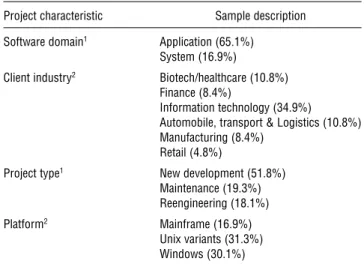
A total of 267 software companies met the criterion of Level 3 certification. From these 267 companies, 45 firms were randomly selected and senior manage-ment at these firms was contacted with a request to participate in the research study. Once they agreed to participate, the executives were requested to pro-vide us with a list of projects completed in the pre-vious six months. Recently concluded projects reduce the effect of recall bias. All projects chosen were out-sourced in entirety to the vendor firm and were car-ried out by the vendor firm. The executives granted access to individual project managers on projects who provided the responses for each project. A total of 23 firms finally agreed to participate in our research, for a response rate of 51%. These firms had, on average, 3,200 employees, with the smallest firm having 450 employees at the time of data collection. To ensure coverage of a broad range of projects from each orga-nization, we only retained projects from firms where we had at least four or more projects. Our final sam-ple for this study consisted of a total of 96 projects from 10 firms. Table 1 provides a descriptive sum-mary of our sample, showing the breakdown of the sample by client industry, software domain, type of project, and the technical platform used.
The questionnaire used for data collection was cre-ated by adapting scales from prior research. The objective data such as project-level metrics on project efficiency and project size were obtained from the company databases. The questionnaire was pretested in two ways. First, the questionnaire was presented to a set of quality auditors certified by the Soft-ware Engineering Institute (SEI). Their comments on the questionnaire were elicited and incorporated into the questionnaire. Second, a Web-based version of
Cop yright: INFORMS holds cop yr ight to this Ar ticles in Adv ance version, which is made av ailab le to institutional subscr ibers . The file ma not be posted on an y other w ebsite ,including the author’s site . Please send an y questions regarding this policy to per missions@inf or ms .org.
Table 1 Sample Description
Project characteristic Sample description Software domain1 Application (65.1%)
System (16.9%)
Client industry2 Biotech/healthcare (10.8%)
Finance (8.4%)
Information technology (34.9%) Automobile, transport & Logistics (10.8%) Manufacturing (8.4%)
Retail (4.8%)
Project type1 New development (51.8%)
Maintenance (19.3%) Reengineering (18.1%) Platform2 Mainframe (16.9%) Unix variants (31.3%) Windows (30.1%) Notes.n=96.
1Remaining projects could not be clearly classified into one of these
categories.
2Remaining projects belong to additional categories.
the questionnaire was created and a pilot survey was conducted using 15 software organizations (not in final sample). Respondents to the pilot were asked to fill out the survey and their feedback was incorpo-rated into the final survey. The specific measures are described next.
Operationalization of Constructs.
1. Software Quality: The quality construct measures the extent to which the final software product con-forms to client requirements. Because the primary focus of the outsourcing industry is to provide IT ser-vices and not a software product per se, we choose to measure quality subjectively. Although prior work has measured quality through defect rates per line of code (Krishnan et al. 2000) or modification requests (Herbsleb and Mockus 2003), in the outsourcing domain these measures may not capture the service-oriented, iterative nature of the interaction between the client and the vendor. Moreover, given the vari-ety of applications and projects executed by ven-dors, there is no consistent definition of defects, lines of code, or indeed, technological platform across firms and projects.5 Many firms in our sample did 5Much of the prior work that uses defect rates to measure quality is
based on in-house IT development, where technologies, program-ming languages, and platforms are controlled for. Alternatively,
not track defect-rate metrics on their projects, possi-bly because of the limited ability of defect-rate data to capture product performance. Therefore, we cre-ated a measure of quality based on a taxonomy of software quality attributes proposed by Szejko (1999) to identify four important quality attributes required in the outsourcing context. We then adapted prior items measuring product performance (Tiwana 2004, Ravichandran and Rai 2000) to capture these four quality attributes. To verify the validity of our mea-sure, we reran a short survey for software quality from the same respondents about 18 months after the original data collection. We received 20 complete responses. The new quality measures using our qual-ity items were highly correlated with the old qualqual-ity data for these projects (r=063,p <001). In addition, we collected defect density data (postrelease bugs per line of code) where available for a subset of projects from the largest category of projects in our sample (Windows platform-based development projects). Our subjective quality measure was significantly corre-lated with the objective defects measure of this subset of projects (r= −0498,p <0001), providing strength to our quality measure.
2.Project Efficiency: Measured as the project’s over-runs on actual schedule, person-month effort, and cost overruns as a proportion of duration of the project in calendar weeks, the budgeted effort, and budgeted cost provided by the project managers. The overrun measures are multiplied by −1 (reverse coded) to create the measure such that numerically higher values represent greater project efficiency.
3.Behavioral Control: As discussed before, the con-ceptual model of behavioral control in software development matches well with the software pro-cess literature. We therefore use prior scales measur-ing behavioral process control (Kirsch 1996, Krishnan et al. 2000) and augment these with items pertain-ing to measurement in software projects (Gopal et al. 2002b). Eisenhardt (1985) observes that control con-sists of three dimensions: measurement, evaluation, and rewards. Consistent with this definition, we use six items that pertain to the presence of a process
these quality measures are useful in cases of software products (Krishnan et al. 2000), where bug rates are noted before the product ships. Cop yright: INFORMS holds cop yr ight to this Ar ticles in Adv ance version, which is made av ailab le to institutional subscr ibers . The file ma not be posted on an y other w ebsite ,including the author’s site . Please send an y questions regarding this policy to per missions@inf or ms .org.
methodology in the project and the extent to which the methodology was used in evaluating the progress in the project.
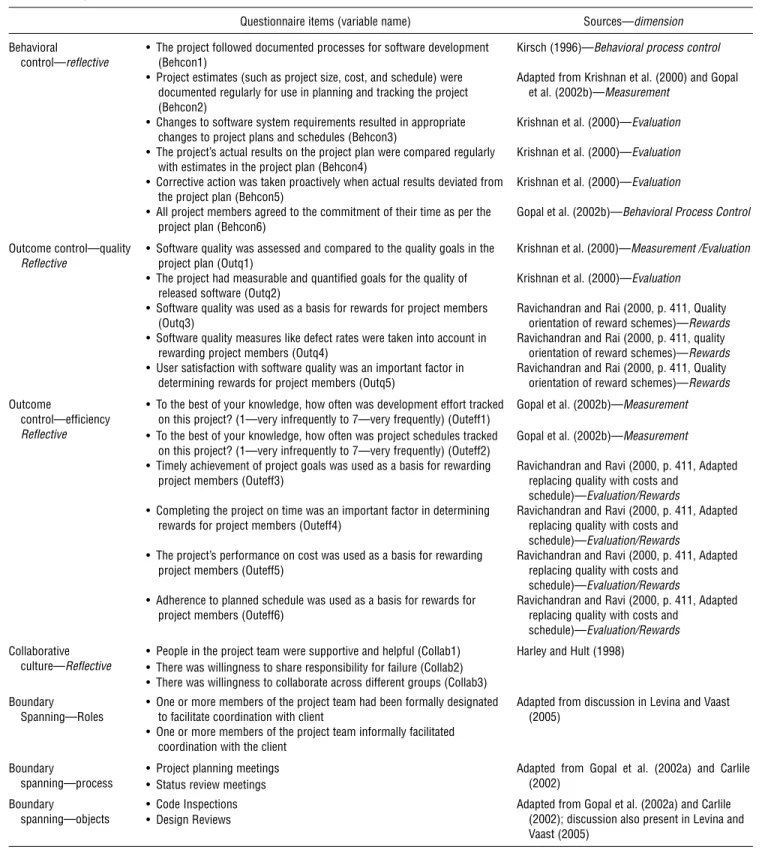
4. Outcome Controls: We focus on two kinds of out-come control—quality-based outout-come and efficiency-based outcome controls, captured by two sets of items. Quality-based outcome control and efficiency-based outcome control were measured by five and six questionnaire items, respectively, adapted from prior work (Ravichandran and Rai 2000, Kirsch et al. 2002). Existing scales did not adequately capture all three dimensions of outcome control. Therefore, we adapted existing scales by adding dimensions of mea-surement and evaluation from Krishnan et al. (2000) and Gopal et al. (2002b) to the existing scales, as shown in Table A.1 in the appendix.
5. Collaborative Culture. Three questionnaire items were adapted from Hurley and Hult (1998) to mea-sure the extent to which the project team had a col-laborative culture.
6. Boundary Spanning. Our operationalization of boundary spanning captures the role of spanners, objects, and processes. Given the complexity of our research model and the sample size, we do not model boundary spanning as a second-order construct. Instead, we average measures reflecting each aspect and then treat the averages as formative indicators of boundary-spanning construct. We measure bound-ary spanners through two questionnaire items per-taining to whether formal and informal boundary spanners were appointed on the vendor side for the project. Objects were measured by the extent to which code inspections and design reviews were jointly conducted between the vendor and the client. Prior research in boundary spanning has established that code and design documents may become key bound-ary objects in use (Levina 2005, Levina and Vaast 2005). Finally, processes were measured by the extent to which project management meetings and status review meetings were held over the life of the project between the vendor and the client. Project manage-ment meetings and status review meetings often are forums in which client and vendor liaison share knowledge through the use of “boundary objects in use” such as design documents and code walk-throughs (Gopal et al. 2002a, Levina and Vaast 2005). These meetings are reflective of the extent to which
a process was in place to share knowledge about the project across organizational and domain boundaries. We define boundary spanning as a formative con-struct comprising these three dimensions.
7.Project Volatility. This control variable is mea-sured as a formative construct with three dimensions capturing requirements uncertainty, personnel turn-over, and employee retention on the project.
8.Prior Interactions. Prior research has shown that prior interactions between client and vendor influences vendor capabilities, and hence project performance (Ethiraj et al. 2005). We model this control variable as a formative construct with two dimensions—number of projects completed and number of concurrent projects being executed for the same client.
9.Project Size. The project-size variable measures the total project effort in person-days. This variable exhibited some nonnormality. Therefore, consistent with previous work (Ethiraj et al. 2005), we use log of total effort in our analysis. Project size is an impor-tant control variable in most performance models in software development outsourcing; in general, larger projects are more difficult to manage, with implica-tions for project performance (Pressman 2001).
10.Team Size. The size of the core team has been studied as a relevant control variable in outsourcing and software projects (Gopal et al. 2003, Wallace et al. 2004). Specifically, prior research has postulated that larger teams increase the communication overheads in projects and therefore could have a detrimental impact on outcomes (Guzzo and Dickson 1996). In other research, scholars have postulated an optimal team size for a given project (Pressman 2001), with the understanding that suboptimal team size could have implications for team productivity and efficiency.
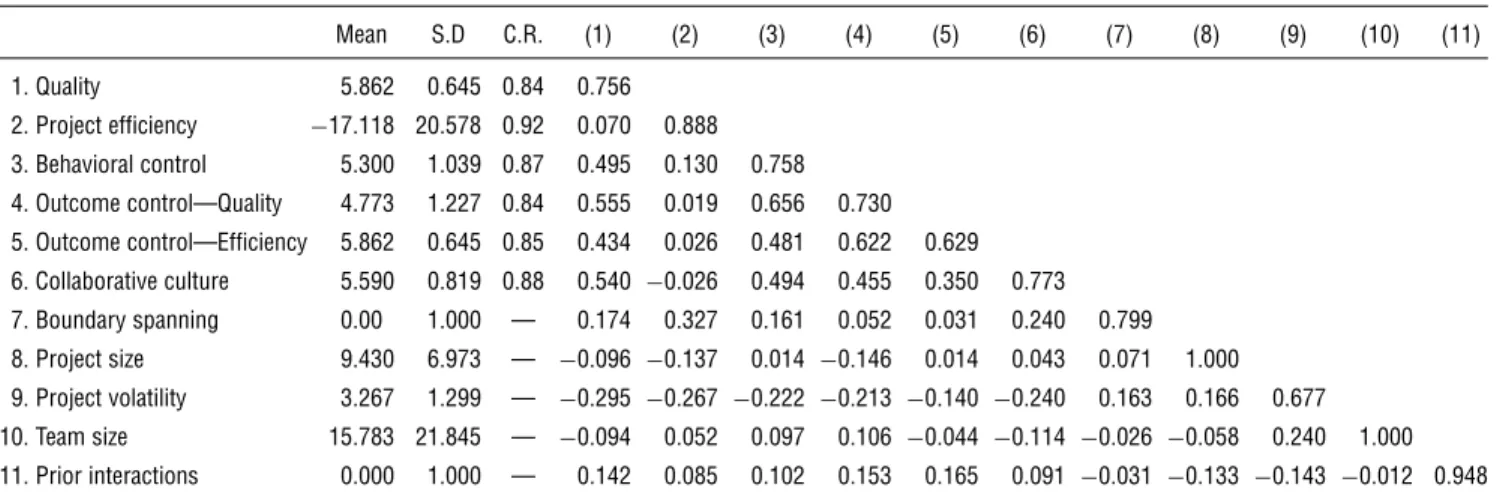
The questionnaire items used, along with their sources, are shown in Table A.1 in the appendix to this paper. Table 2 provides summary statistics and interconstruct correlations for our variables. For multi-item reflective constructs, the composite relia-bilities are indicated and all are above the 0.70 thresh-old. All constructs show composite reliabilities higher than 0.50, thereby establishing their reliability. Diver-gent validity is confirmed as the average variance extracted (i.e., the average variance shared between a construct and its measures, AVE) is greater than the
Cop yright: INFORMS holds cop yr ight to this Ar ticles in Adv ance version, which is made av ailab le to institutional subscr ibers . The file ma not be posted on an y other w ebsite ,including the author’s site . Please send an y questions regarding this policy to per missions@inf or ms .org.
Table 2 Descriptive Statistics, Composite Reliability, and Correlations Among Constructs Mean S.D C.R. (1) (2) (3) (4) (5) (6) (7) (8) (9) (10) (11) 1. Quality 5862 0645 084 0756 2. Project efficiency −17118 20578 092 0070 0888 3. Behavioral control 5300 1039 087 0495 0130 0758 4. Outcome control—Quality 4773 1227 084 0555 0019 0656 0730 5. Outcome control—Efficiency 5862 0645 085 0434 0026 0481 0622 0629 6. Collaborative culture 5590 0819 088 0540 −0026 0494 0455 0350 0773 7. Boundary spanning 000 1000 — 0174 0327 0161 0052 0031 0240 0799 8. Project size 9430 6973 — −0096 −0137 0014 −0146 0014 0043 0071 1000 9. Project volatility 3267 1299 — −0295 −0267 −0222 −0213 −0140 −0240 0163 0166 0677 10. Team size 15783 21845 — −0094 0052 0097 0106 −0044 −0114 −0026 −0058 0240 1000 11. Prior interactions 0000 1000 — 0142 0085 0102 0153 0165 0091 −0031 −0133 −0143 −0012 0948
Notes. 1. Diagonal elements show the square-root of average variance extracted for each construct. 2. Boundary spanning is a formative construct with three dimensions: process (mean=2723), objects (mean=1356) and boundary-spanning roles (mean=511). 3. Project volatility is a formative construct with three dimensions: requirements volatility (mean=408), personnel turnover (mean=265), and retention (mean=306). 4. Prior interactions is a formative construct with two dimensions: prior projects (mean=22487) and concurrent projects (mean=3650).
variance shared with other constructs in the model (Fornell and Bookstein 1981).
As a first step in establishing the psychometric properties of our measures, we subject the reflective constructs to an exploratory factor analysis using vari-max rotation and a threshold eigenvalue of 1.0. Each set of items pertaining to an underlying construct loaded well together on the construct, as shown in column two of Table A.2 in the appendix. A more stringent test of scale validity is to use oblique rota-tion techniques that allow individual factors to be correlated (Ford et al. 1986). Although the oblique rotated factor structure is typically harder to interpret, it is a more accurate representation of real-world com-plexity of the examined variables. We conducted fac-tor analysis on our scales using maximum-likelihood extraction and applying promax rotation. The anal-ysis provides us with five distinct factors captur-ing collaborative culture, overruns, quality, behavioral control, and a composite factor that accounted for both quality-based outcome control and efficiency-based outcome control. In other words, the higher interitem correlation between the items capturing the outcome-based controls did not separate out as expected. This is not entirely surprising because it is possible that a firm that implements outcome-based controls along the quality dimension will have a higher probability of implementing outcome-based
controls along efficiency as well. This factor analysis procedure, however, attests to the scale validity of our other constructs and suggests that our measures meet the psychometric properties required for further analysis.6
To further verify the factor structure of our reflec-tive constructs, we subjected the data to confirma-tory factor analysis (CFA) using LISREL, shown in last column of Table A.2. All the hypothesized paths from the indicator variables to the hypothesized latent variables are significant at p <005. In addition, we assessed convergent and discriminant validity of our constructs with Partial Least Squares (PLS) using cor-relations between items and latent factor scores. These results (not reported here) were consistent with the LISREL-based CFA and establish the psychometric properties of our items.7
We used PLS to estimate the research model used to test our hypotheses. PLS was used in estimating the research model because it is appropriate for situ-ations where sample sizes are small and models are complex, and the goal of the research is explaining variance (Fornell and Bookstein 1982, Gefen et al. 6We are grateful to the AE for pointing out the benefits of
non-orthogonal rotation to us.
7Detailed results of all the psychometric properties for our
mea-sures are available on request from the authors.
Cop yright: INFORMS holds cop yr ight to this Ar ticles in Adv ance version, which is made av ailab le to institutional subscr ibers . The file ma not be posted on an y other w ebsite ,including the author’s site . Please send an y questions regarding this policy to per missions@inf or ms .org.
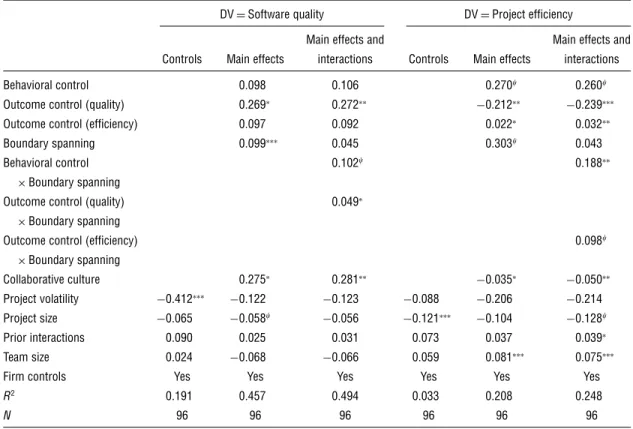
Table 3 Model Estimation: PLS
DV=Software quality DV=Project efficiency
Main effects and Main effects and
Controls Main effects interactions Controls Main effects interactions
Behavioral control 0098 0106 0270 0260
Outcome control (quality) 0269∗ 0272∗∗ −0212∗∗ −0239∗∗∗
Outcome control (efficiency) 0097 0092 0022∗ 0032∗∗
Boundary spanning 0099∗∗∗ 0045 0303 0043
Behavioral control 0102 0188∗∗
×Boundary spanning
Outcome control (quality) 0049∗
×Boundary spanning
Outcome control (efficiency) 0098
×Boundary spanning Collaborative culture 0275∗ 0281∗∗ −0035∗ −0050∗∗ Project volatility −0412∗∗∗ −0122 −0123 −0088 −0206 −0214 Project size −0065 −0058 −0056 −0121∗∗∗ −0104 −0128 Prior interactions 0090 0025 0031 0073 0037 0039∗ Team size 0024 −0068 −0066 0059 0081∗∗∗ 0075∗∗∗
Firm controls Yes Yes Yes Yes Yes Yes
R2 0191 0457 0494 0033 0208 0248
N 96 96 96 96 96 96
p <010,∗p <005,∗∗p <001,∗∗∗p <0001.
2000). It also supports the modeling of formative constructs.8
Because moderation models require the use of inter-action terms, we use the approach recommended by Chin (2000) in this paper. For interactions involving reflective indicators, we centered indicators for the main and moderating constructs and created all pair-wise product indicators where each indicator from the main construct is multiplied with each indicator from the moderating construct. For interactions involving formative constructs, we used the following sug-gested two-step process. The first step entails using the formative indicators in conjunction with PLS to create underlying construct scores for the predictor and moderator variables. Step two consists of taking 8Survey-based data collection approaches raise the potential issue
of common method bias. We test for this using both the Harmon’s one-factor test as well as the more stringent test described in Podsakoff et al. (2003). In both cases, we see no support for the influence of method bias on our results, indicating that this issue may not affect our results.
those single composite construct scores to create a sin-gle interaction term. Recent work in the IS area has used this approach in modeling interactions in PLS analysis (see http://e-companions.pubs.informs.org/ ISR/1526-5536-2003-02-SupplA.pdf). The results of the PLS analysis are shown in Table 3. The path coeffi-cients in the model were assessed using the jackknife routine.
4.
Results and Discussion
The results from PLS shown in Table 3 provide broad support for the impact of organizational con-trol on project performance. We follow Carte and Russell’s suggested approach (2003) by first provid-ing the model with control variables, followed by the main effects and the interaction models. We dis-cuss results for the main effects in the quality model first. These are displayed for quality in the first two columns of Table 3. Our results show no significant effect of behavioral control on quality, indicating no support for H1A. Hypothesis 2A pertains to the direct
Cop yright: INFORMS holds cop yr ight to this Ar ticles in Adv ance version, which is made av ailab le to institutional subscr ibers . The file ma not be posted on an y other w ebsite ,including the author’s site . Please send an y questions regarding this policy to per missions@inf or ms .org.