Modular Conversational Agent Framework
A thesis submitted for the degree of Doctor of Philosophy
Daniel Mac´ıas-Galindo, B.Eng., M.Sc,
School of Computer Science and Information Technology, College of Science, Engineering, and Health,
RMIT University.
I certify that except where due acknowledgement has been made, the work is that of the author alone; the work has not been submitted previously, in whole or in part, to qualify for any other academic award; the content of the thesis is the result of work which has been carried out since the official commencement date of the approved research program; any editorial work, paid or unpaid, carried out by a third party is acknowledged; and, ethics procedures and guidelines have been followed.
Daniel Mac´ıas-Galindo
School of Computer Science and Information Technology RMIT University
Acknowledgments
First and foremost, this dissertation would not have been possible without the continuous involvement and support of my supervisors, Dr Lawrence Cavedon, Dr John Thangarajah, and Dr Wilson Wong. Their guidance from the initial stages of my Candidature until the late stages of my writing have helped me grow as a more confident person and scholar; I also consider my friends. I must also thank Prof Michael Winikoff and Prof Lin Padgham for accepting my application for a Candidature, giving me the possibility of making RMIT University and the School of Computer Science and Information Technology (CS&IT) the place where I pursued my Doctorate degree.
For the technical support with respect to the Intelligent Interactive Toy, I must acknowl-edge the support received from Realthing Entertainment Pty Ltd. under the Australian Research Council Linkage grant number LP0882013. In addition, I also thank staff involved with the Toy project, who helped me with technical issues at some stage of my candida-ture: Andrew Hodgson, Dr Ralph R¨onquisst, Dr Carole Adam, Dr Patrick Ye, and Murray Henderson. Moreover, to the staff and students from the Intelligent Systems Discipline at RMIT University who got, to a lesser or greater extent, involved in the development of the Toy. Special thanks go to Aidan Martin, who helped design the GUI for collecting judges described in Chapters 4, 5 and 6.
For the financial support required in this venture, I acknowledge the support from CONA-CYT, my main sponsor for both the Masters and PhD Candidature. Funding for conducting the experiments described in this thesis was obtained from my supervisors. Financial support for the presentation of the papers produced in this research was mostly obtained from the School of Graduate Research at RMIT University.
I want to acknowledge my Undergraduate and Masters supervisors, Dr Darnes Vilarino and Dr Fabiola Lopez for encouraging me to pursue a Doctorate degree. My gratitude also goes to people who helped me make my journey more enjoyable. To my office mates Dhiren-dra, LavinDhiren-dra, Nitin, Dave, Stephen, Mahmud, Yoosef, and Borhan. To the research staff from the Intelligent Systems Group and the School of CS&IT for your valuable suggestions and comments. To close friends who I met through these years: Patricia, Mardi, Naimah, Vidura, Dhiah, Ayman, Ermyas, Rodrigo, Peter and Jessica, for sparing part of your time outside uni. To the administrative staff of the School of CS&IT for being so helpful when administrative processes were required. To the School of Statistics and Geospatial Science, for providing support for Statistical Consultancy, and to the Writing Circle under the super-vision of Jennifer Anderson for helping me improve my writing. And also to everyone in the SAPI team in Sensis Pty Ltd, where I currently continue my endeavors.
part-ner, Lorena, who has been with me all this time, even before we thought about living in Melbourne. Also to my parents Rafael and Guadalupe, my brother Federico and my family back in Mexico, who have been in my mind all this time and supported me from the dis-tance. Special thanks to my friends from high school: Carlos, Emilio, Erwin, Hector, Ivan, Javier, Manuel, Pepe, Rafael, Raul S, Raul M, and Rodrigo; thanks to my friends from uni: Alejandra, Chelo, Gesuri, Karina R, and Karina S. And to the anonymous reviewers who have been involved in the reading of this dissertation and the papers that were written from parts of it.
Credits
Portions of the material in this thesis have previously appeared in the following publications: • D. Macias-Galindo, L. Cavedon, J. Thangarajah, and W. Wong. Effects of domain on measures of semantic relatedness. Journal of the American Society for Information
Science and Technology, To appear (ERA Rank: A*)
• D. Macias-Galindo, W. Wong, L. Cavedon, and J. Thangarajah. Coherent topic transi-tion in a conversatransi-tional agent. InProceedings of INTERSPEECH, pages 1–4, Portland, OR, USA, 2012 (ERA Rank: A)
• D. Macias-Galindo, W. Wong, L. Cavedon, and J. Thangarajah. Using a lexical dictio-nary and a folksonomy to automatically construct domain ontologies. InProceedings of the Australasian Joint Conference on Artificial Intelligence (AI), pages 638–647, Perth, WA, Australia, 2011b (ERA Rank: B)
• D. Macias-Galindo, L. Cavedon, and J. Thangarajah. Building Modular Knowledge Bases for Conversational Agents. InIJCAI Workshop on Knowledge Representation and Reasoning for Practical Dialogue Systems (KRPDS), pages 16–23, Barcelona, Spain, 2011a (ERA Rank: Unranked)
This work was supported by the Consejo Nacional de Ciencia y Tecnolog´ıa (CONACYT), scholarship number 201228.
The thesis was written in Texlipse under Windows 7 and Ubuntu, and typeset using the LATEX 2ε document preparation system.
All trademarks are the property of their respective owners.
Note
Unless otherwise stated, all fractional results have been rounded to the displayed number of decimal figures.
Abstract 1
1 Introduction 3
1.1 Context . . . 4
1.2 Challenges in Open-ended Conversational Agents . . . 5
1.3 Contributions . . . 6
1.4 Publications . . . 8
1.5 Thesis Structure . . . 8
2 Background and Related Work 11 2.1 Conversational Agents . . . 12
2.1.1 The Intelligent Interactive Toy . . . 14
2.1.1.1 Architecture . . . 14
2.1.1.2 Input and Output Processing in the Toy . . . 16
2.1.1.3 Topic Management . . . 17
2.1.2 Dialogue Coherence in the Toy . . . 18
2.2 Knowledge Representation in Conversational Agents . . . 19
2.2.1 Knowledge Structures . . . 20 2.2.1.1 Ontologies . . . 20 2.2.1.2 Taxonomies . . . 23 2.2.1.3 Folksonomies . . . 23 2.2.2 Classification of Ontologies . . . 24 2.2.3 Construction of Ontologies . . . 24 2.2.3.1 Expert-constructed Ontologies . . . 25 2.2.3.2 Community-driven Ontologies . . . 30
2.2.3.3 Automatic Ontology Construction . . . 35
2.3 Text and Dialogue Coherence . . . 40
2.3.1 Text Coherence . . . 40 v
2.3.2 Analysis of Dialogue Coherence . . . 42
2.4 Semantic Relatedness . . . 44
2.4.1 Measuring Semantic Relatedness or Similarity . . . 46
2.4.1.1 Taxonomy-based Measures . . . 46
2.4.1.2 Folksonomy-based Measures . . . 51
2.4.1.3 Web-based Measures . . . 53
2.4.2 Datasets for Semantic Analysis . . . 55
2.4.2.1 Datasets for Analysing Semantic Similarity . . . 56
2.4.2.2 Datasets for Analysing Semantic Relatedness . . . 57
2.5 Influence ofDomain on Semantic Analysis Tasks . . . 58
2.5.1 Domain in Semantic Analysis . . . 59
2.5.2 Domain Information for Word Sense Disambiguation . . . 60
2.5.3 Domain-specific Semantic Relatedness . . . 60
2.6 Summary . . . 62
3 Semantic Relatedness and Coherence in Dialogue: A Pilot Experiment 63 3.1 Motivation . . . 63
3.2 Conversational Fragments Used in this Chapter . . . 64
3.3 Hypothesis of the Experiment . . . 66
3.3.1 Interaction Sequence . . . 67
3.3.2 Nearest-Context Approach [Gandhe and Traum, 2007] . . . 68
3.3.3 Proposed Approach using Semantic Relatedness . . . 70
3.4 Comparing Approaches for Conversational Fragment Selection . . . 71
3.4.1 Experimental Setup . . . 72
3.4.2 Constructing Sample Conversations . . . 72
3.4.3 Results and Discussion . . . 74
3.4.4 Failure Analysis . . . 76
3.5 Summary . . . 77
4 M-OntoBUILD: Constructing Domain-specific Ontologies 79 4.1 Modular Ontologies . . . 80
4.2 The Architecture of Modular Ontologies . . . 81
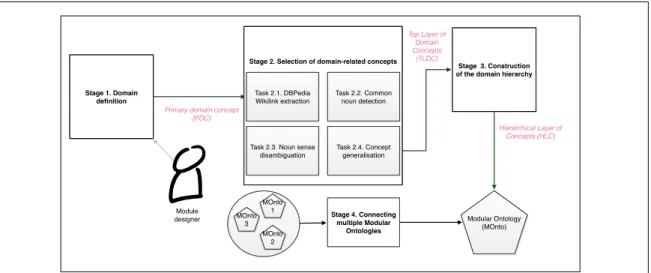
4.3 Stages of M-OntoBUILD . . . 82
4.3.1 Stage 1. Definition of the Primary Domain Concept . . . 85
4.3.2 Stage 2. Automatic Extraction of Domain-related Concepts . . . 86
4.3.3 Stage 3. Hierarchy Construction . . . 99
4.4 Example Extracted . . . 101
4.5 M-OntoBUILD as a Java Tool . . . 101
4.6 Evaluating the M-OntoBUILD Process . . . 103
4.6.1 Design of theDomain Appropriateness experiment . . . 105
4.6.2 Data Collection . . . 107 4.6.3 Evaluation Metrics . . . 107 4.6.4 Participants’ Inter-agreement . . . 110 4.6.5 Results . . . 111 4.6.6 Error Analysis . . . 114 4.7 Summary . . . 116
5 A Framework for Evaluating Domain-based Semantic Relatedness 118 5.1 An Overview of Semantic Relatedness . . . 119
5.2 Assessing Term Relatedness . . . 119
5.3 Constructing a Domain-aware Dataset for Evaluating Semantic Relatedness . 120 5.3.1 Steps in the Construction of the Dataset . . . 121
5.3.2 Contrasting Properties of the Dataset with Other Testbeds . . . 123
5.4 Behaviour of Semantic Relatedness in Concepts from the Same Domain . . . 127
5.4.1 Design of theSame-Domain Exploration . . . 128
5.4.2 Relatedness Measures compared in the Exploration . . . 129
5.5 Results . . . 133
5.5.1 Statistical Tests . . . 133
5.5.2 Agreement between Assessors . . . 134
5.5.3 Distributions of Pairs by Type . . . 134
5.5.4 Performance of Automatic Relatedness Measures . . . 135
5.6 Summary . . . 138
6 Influence of Domain on Semantic Relatedness 140 6.1 Domain . . . 141
6.2 Motivation for the Domain-Influence Experiment . . . 142
6.3 Construction of theSubset with Cross-domain Pairs . . . 143
6.4 Design of the Domain-Influence Experiment . . . 145
6.4.1 Obtaining Judgements using the Web interface . . . 146
6.4.2 Obtaining Judgements using CrowdFlower . . . 146
6.5 Results . . . 147
6.5.1 Analysis by Categories . . . 148
6.5.1.2 Analysis by Pair Classification . . . 148
6.6 Domain Influence for Pairs Very Similarly Scored by Automatic Measures . . 150
6.6.1 Comparison using Other Measures . . . 154
6.6.2 Correlation with Automatic Relatedness Measures . . . 157
6.6.3 Validating Domain Influence using Other Domain Resources . . . 159
6.7 Learning a Relatedness Metric with Domain as a Feature . . . 160
6.7.1 Learning a Baseline Metric . . . 161
6.7.2 Adding Domain Information as a Feature . . . 162
6.8 Summary . . . 163
7 Implementation of a Real-Time Topic Selection Mechanism using Semantic Relatedness 165 7.1 Motivation . . . 165
7.2 Output Selection using Semantic Relatedness . . . 168
7.2.1 The[Wong et al., 2012b] Selection Mechanism . . . 168
7.2.2 The Semantic Relatedness Selection Mechanism . . . 170
7.2.2.1 Context Expansion . . . 170
7.2.2.2 Output Selection Using Semantic Relatedness . . . 171
7.3 Measuring Execution Time . . . 173
7.3.1 Optimising the Toy Module . . . 174
7.3.1.1 The Topic Transition Network . . . 174
7.3.2 Evaluation using the Enhanced Module . . . 176
7.4 Summary . . . 176
8 Conclusions 178 8.1 Summary of Contributions . . . 178
8.1.1 Contributions in Ontology Construction . . . 179
8.1.2 Contributions in Semantic Relatedness . . . 179
8.1.3 Contributions in Conversational Agents . . . 180
8.2 Future Work . . . 181
8.2.1 Future Work in Ontology Construction . . . 181
8.2.2 Future Work in the Effects of Domain over Semantic Relatedness . . . 181
8.2.3 Future Work in Mixed-initiative Conversational Agents . . . 181
A Top-level domain concepts used in theDomain Appropriatenessuser study183 A.1 Concept Terms Selected for DomainAmusement park . . . 183
A.3 Concept Terms Selected for DomainBeach . . . 184
A.4 Concept Terms Selected for DomainCar . . . 185
A.5 Concept Terms Selected for DomainComputer . . . 186
A.6 Concept Terms Selected for DomainEconomy . . . 189
A.7 Concept Terms Selected for DomainFood . . . 190
A.8 Concept Terms Selected for DomainMuseum . . . 193
A.9 Concept Terms Selected for DomainMusic . . . 193
A.10 Concept Terms Selected for DomainSchool . . . 194
A.11 Concept Terms Selected for DomainSoccer . . . 195
A.12 Concept Terms Selected for DomainSport . . . 196
A.13 Concept Terms Selected for DomainTheatre . . . 196
A.14 Concept Terms Selected for DomainZoo . . . 197
B The Same-Domain Testbed 198 B.1 Characteristics of theSubset with Same-domain Pairs . . . 198
B.2 Additional Considerations while Constructing the Dataset . . . 201
B.3 Hierarchically-similar Pairs (Subset h) . . . 201
B.4 Hierarchically-dissimilar Pairs (Subset d) . . . 203
B.5 Nearly-similar Pairs (Subset s) . . . 205
B.6 Wikilink Pairs (Subset w) . . . 206
B.7 Extended Results from theSame-Domain Exploration . . . 213
B.7.1 Analysis by Classes . . . 213
B.7.1.1 Nearly-similar Pairs . . . 213
B.7.1.2 Hierarchically-similar and Dissimilar Pairs . . . 214
B.7.1.3 Wikilink Pairs . . . 216
C The Domain Influence testbed 222 C.1 Same-Domain Pairs . . . 222
C.2 Cross-Domain Pairs . . . 224
C.3 Wikilink Cross-Domain Pairs . . . 227
C.4 Clusters with Nearly-identical Relatedness Score Pairs . . . 228
C.4.1 Same-domain, Jiang and Conrath [1997], Range [0.12-0.13] . . . 228
C.4.2 Cross-domain, Jiang and Conrath [1997], Range [0.13-0.14] . . . 230
C.4.3 Same-domain, Adapted Lesk [Lesk, 1986], Range [21] . . . 232
C.4.4 Cross-domain, Adapted Lesk [Banerjee and Pedersen, 2002], Range [22] 233 C.4.5 Same-domain, Wikipedia Link Measure [Milne and Witten, 2008], Range [0.06-0.07] . . . 235
C.4.6 Cross-domain, Wikipedia Link Measure [Milne and Witten, 2008], Range [0.06-0.07] . . . 237 C.4.7 Same-domain, Related Article Category Overlap [Grieser et al., 2011],
Range [0.12-0.13] . . . 238 C.4.8 Cross-domain, Related Article Category Overlap [Grieser et al., 2011],
Range [0.12-0.13] . . . 240 C.4.9 Same-domain, Normalised Bing Relatedness between Concepts [Gracia
and Mena, 2008], Range [0.23-0.24] . . . 241 C.4.10 Cross-domain, Normalised Bing Relatedness between Concepts [Gracia
and Mena, 2008], Range [0.23-0.24] . . . 243
2.1 Example of a conversation with the Toy. . . 15
2.2 General architecture of the Toy. . . 16
2.3 Overview of contents in a Toy module. . . 18
2.4 The relation structure of an ontology. . . 22
2.5 Classification of ontologies by complexity. . . 25
2.6 Four synsets available in WordNet for word form “lion”. . . 27
2.7 A sample of WordNet’s noun organisation. . . 28
2.8 An example where WordNet’s granularity affects coverage of a word form. . . 29
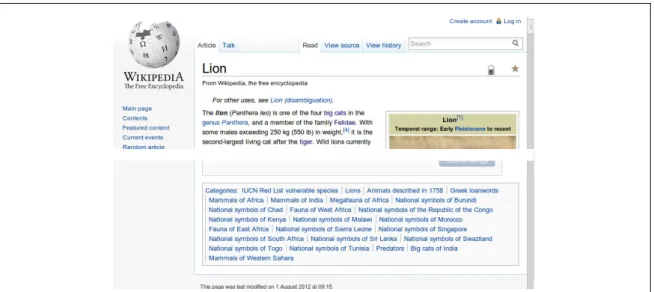
2.9 The set of categories in Wikipedia for the article about “lion”. . . 31
2.10 Linking Open Data cloud diagram . . . 34
2.11 Some examples of facts stored in YAGO. . . 35
2.12 An example of the syntactic view of text coherence . . . 41
2.13 Examples of coherent and incoherent dialogue acts . . . 43
2.14 The semiotic analysis of word relatedness. . . 45
2.15 Enhancing word sense disambiguation with domain information. . . 61
3.1 Examples of sequential conversational fragments . . . 65
3.2 Components of a sequential conversational fragment . . . 66
3.3 Examples of coherence and less coherent conversation continuations . . . 67
3.4 Example of a starter selected with the nearest-context approach . . . 69
3.5 Example of starter selection using semantic relatedness . . . 71
3.6 An example of a conversation continuation. . . 73
3.7 The survey presented to judges in the pilot experiment of coherence. . . 74
3.8 Distribution of scores for each approach. . . 75
3.9 An example of a more coherent transition using semrel . . . 77
3.10 An example of a failure allowed by the semantic relatedness approach. . . 78
4.1 An example of aM-Onto containing the domain Zoo. . . 81
4.2 A summary of theM-OntoBUILD system . . . 83
4.3 An example of a Wikipedia disambiguation page . . . 86
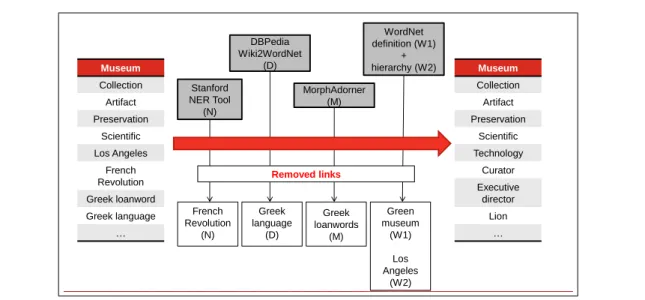
4.4 An overview of the filtering process executed in Task 2.1. . . 90
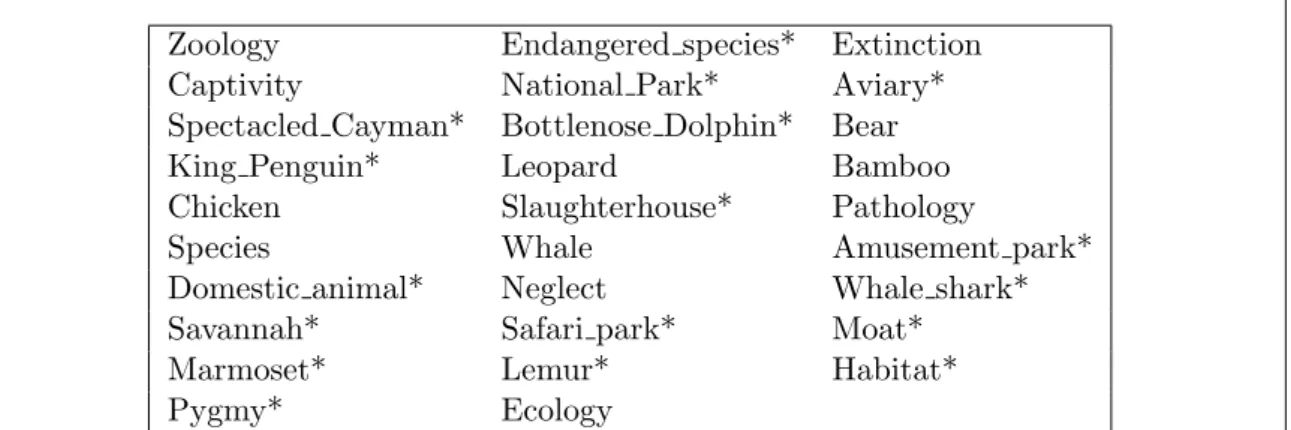
4.5 Candidate concepts of the M-Ontoabout Zoo . . . 96
4.6 Detection of more general classes via WordNet . . . 98
4.7 A snippet of the M-Ontoproduced with M-OntoBUILD . . . 102
4.8 A screen shot ofM-OntoBUILD. . . 102
4.9 An excerpt of the OWL definition of the ZooM-Onto. . . 104
4.10 A screen shot of theDomain Appropriateness study interface . . . 108
4.11 Distribution of the concepts suggested by participants. . . 115
5.1 Density plot of idfweights for existing datasets . . . 122
5.2 Density plot of idfweights from word forms in testbeds . . . 124
5.3 Number of senses for terms employed in the Subset with Same-domain Pairs 126 5.4 The Web interface to conduct the Domain-Influence Experiment. . . 130
5.5 The general top-level concept of M-Ontos . . . 132
5.6 Boxplots showing the distribution of hierarchical and wikilinked pairs. . . 136
6.1 Distribution of same- and cross-domain pairs forjcn . . . 146
6.2 Distribution boxes of average judges’ scores . . . 149
6.3 Box plots of average scores deemed by judges for different pair types . . . 150
6.4 Distribution of average scores for different pairs and measures . . . 151
6.5 Pairs of concepts within the range nwrc=[0.23-0.24]. . . 152
6.6 Another visualisation of the range nwrc=[0.23-0.24] . . . 153
6.7 Box plots for automatic and human assessment usingnwrc . . . 154
6.8 Distribution of pairs within a range for different measures . . . 156
6.9 Distribution of pairs within a range for different measures . . . 157
6.10 Domain effect in WordNet-353 dataset usingWordNet Domains . . . 161
7.1 (a) An original question-answer pair; (b) a modified question; and (c) a mod-ified answer used by the system as outputs. . . 167
7.2 An example of a stand-alone conversational fragment . . . 168
7.3 The current process conducted by the Toy is enumerated in red, while the extended steps of the Semantic Relatedness Module are shown in yellow. . . . 171
7.4 Context expansion using the input term “lion” . . . 172
7.6 Distribution of measurement of execution time required by the different ver-sions of the Toy. Note the logarithmic scale for the Y axis. . . 177 B.1 Examples of categories for concepts in theSubset with Same-domain Pairs. . 199 B.2 Average scores assigned by judges to pairs in the relatedness exploration. . . 214 B.3 Overall statistics for nearly-similar pairs in theSubset with Same-domain Pairs215 B.4 Overall statistics for hierarchically similar pairs . . . 217 B.5 Distribution of relatedness for hierarchically dissimilar pairs . . . 218 B.6 Distribution of pairs by class and average score . . . 219 B.7 Average relatedness scores deemed by participants to pairs of wikilinked pairs. 220 B.8 Distribution of relatedness for wikilinked pairs. . . 221
2.1 An example of the Lesk measure. . . 48
2.2 Example of the Klebanov and Shamir [2006] experiment . . . 58
3.1 Average scores deemed by judges for each approach. . . 76
4.1 A subset of Wikipedia article names that the Zoo article target to via wikilinks. 88 4.2 Concept names obtained after Task 2.2 . . . 92
4.3 Classification of Zoo-related terms by number of synsets . . . 93
4.4 Number of hierarchical and wikilink relationships in someM-Ontos. . . 101
4.5 Commands employed to construct automatically an M-Onto. . . 103
4.6 Number of concepts in the TLDC in theDomain Appropriateness experiment 106 4.7 Average Pearson correlation (ρ) by domain. Correlation scores are defined by Evans [1996] as follows: .00−.19: very weak; .20−.39: weak; .40−.59: moderate; .60−.79: strong;.80−1.0: very strong. . . 111
4.8 Precision, recall and F1 obtained per domain . . . 113
5.1 p-valuefrom average Wilcoxon rank-sum tests comparing each dataset’sidfweights.125 5.2 p-value average Wilcoxon rank-sum test comparing number of senses per term. 127 5.3 Summary of datasets employed for semantic relatedness. . . 128
5.4 Measures employed in theSame-Domain Exploration. . . 131
5.5 Constants for relative depths of eachM-Onto inM-Onto-based relatedness measures. . . 133
5.6 Average inter-judge Pearson correlation between participants . . . 135
5.7 p-valueaverage Wilcoxon rank-sum test with standard error comparing classes of pairs defined in theSubset with Same-domain Pairs, with a significance level of 0.05 (significant differences shown in bold). . . 135
5.8 Pearson correlation between automatic relatedness measures and humans . . 137
6.1 A subset of pairs from the exploration of semantic relatedness presented in Chapter 5. . . 143 6.2 Ranges of automatic semantic relatedness measures . . . 144 6.3 p-values of the Wilcoxon rank-sum test for ranges . . . 158 6.4 Pearson correlation between automatic relatedness measures and humans . . 159 7.1 Execution time (in seconds) measured for 50 turns with an output retrieved,
for the original and the extended Toy settings. . . 173 7.2 Number of QA-fragments associated to at least oneM-Onto concept. . . 176 7.3 Execution time (in seconds) measured for 50 retrieval turns for each of the
three Toy settings. . . 176 B.1 Distribution of pairs by class and domain . . . 201 B.2 Subset of hierarchically-similar pairs in theSubset with Same-domain Pairs. . 203 B.3 Subset of hierarchically-dissimilar pairs in theSubset with Same-domain Pairs. 205 B.4 Subset of nearly-similar pairs in theSubset with Same-domain Pairs. . . 206 B.5 Subset of wikilink pairs in theSubset with Same-domain Pairs. . . 213
Flexible nontask-oriented conversational agents require content for generating responses and mechanisms that serve them for choosing appropriate topics to drive interactions with users. Structured knowledge resources such as ontologies are a useful mechanism to represent con-versational topics.
This thesis describes the design and implementation of a mechanism for topic selection for a conversational agent with a modular architecture. This architecture allows the agent, embodied as a physical Toy that interacts with children via speech, to cover new conversa-tional domains, which are added into the system as addiconversa-tional units ormodules encapsulating domain-specific knowledge. The core of the topic selection mechanism is based on seman-tic relatedness between topics, and it helps the agent to produce responses, as well as to drive a conversation in new directions that users perceive as coherent with respect to the conversation flow.
In order to develop the topic-management mechanism, we addressed a number of research issues related to the development of the required infrastructure. First, we address the issue of heavy human involvement in the construction of knowledge resources by proposing a three-stage automatic process for building domain-specific ontologies. These ontologies are comprised of a set of subtaxonomies obtained from WordNet, an electronic dictionary that arranges concepts in a hierarchical structure. The roots of these subtaxonomies are obtained from Wikipedia’s article links or wikilinks; this under the hypothesis that wikilinks provide a sense ofrelatedness from the article consulted to their destinations.
With the knowledge structures defined, we explore the possibility of using semantic relat-edness over these domain-specific ontologies as a mean to propose conversational topics in a coherent manner. For this, we examine different automatic measures of semantic relatedness to determine which correlates with human judgements obtained from an automatically con-structed dataset. We then examine the question of whether domain information influences the human perception of semantic relatedness in a way that automatic measures do not repli-cate. This study requires us to design and implement a process to build datasets with pairs of concepts as those used in the literature to evaluate automatic measures of semantic
relat-edness, but with domain information associated. This study shows, to statistical significance, that existing measures of semantic relatedness do not take domain into consideration, and that including domain as a factor in this calculation can enhance the agreement of automatic measures with human assessments.
Finally, this artificially constructed measure is integrated into the Toy’s dialogue man-ager, in order to help in the real-time selection of conversational topics. This supplements our result that the use of semantic relatedness seems to produce more coherent and interesting topic transitions than existing mechanisms.
Introduction
Conversational agents (CAs) are becoming more pervasive in our world due to the increasing use of mobile devices (e.g. Siri1). CAs can be described as computer systems that interact
with users via speech and/or natural language. Such systems replace current mechanisms for interaction with interfaces based on input keystrokes or hand gestures with a touch screen. The premise behind these systems is the use of human language, a more natural way for engaging or instructing a program on how to address user needs [Allen et al., 2001].
Depending on the purpose, CAs can be eithertask-oriented ornontask-oriented [Jokinen and McTear, 2009]. A task-oriented CA assists users in performing an activity: for example, providing instructions or information regarding a service [Abella and Gorin, 1999; Cassell, 2001; Hurtado et al., 2006] or collaborating with users on a task [Allen et al., 2001; Dzikovska et al., 2008]. A nontask-oriented CA, on the other hand, engages with users in conversations where goals are more vague or less explicit. These kind of systems have been proposed as virtual therapists [Weizenbaum, 1966], for entertainment purposes [Wallace, 2009; Shibata et al., 2009; Waltinger et al., 2012] or as companions for elderly people [Dingli et al., 2009].
This thesis investigates topic management in CAs mixing both types of interactions. While the task-oriented behaviour is governed by clear goals (e.g. telling a story or preparing a recipe), the nontask-oriented behaviour deals with conversations where agents focus on interacting with users viaengaging dialogue. Initial approaches for CA dialogue applied input paraphrasing [Weizenbaum, 1966] or handcrafted associations between inputs and system outputs [Wallace, 2009]. Such chatbot-style approaches are still used in many CA systems; however, more sophisticated CAs, especially when spoken dialogue is the main research focus, use more powerful natural language processing and generation techniques. While we use a similar shallow approach as in chatbot-style CAs, these generally focus on users driving the
1http://www.apple.com/ios/siri/
conversation, making the former reactive to the user’s inputs. This poses a challenge with respect to topic management, as the CA relies on the user to transition to other topics, which may lead to immediate topic exhaustion or not using a set of topics at all.
In this dissertation, we propose techniques for CAs to become proactive by enabling co-herent topic switching. We explore this over the Intelligent Interactive Toy, an embodied CA with a modular architecture that uses domain-specific modules to store its contents. While the language processing is simple, the topic management enables the possibility of engag-ing behaviours. We develop resources and techniques for domain-aware topic management, including methods for constructing domain-ontologies and demonstrate results of semantic relatedness involving domain specificity. These are used to define the mechanism for coherent topic management, following the work of Lapata and Barzilay [2005].
1.1 Context
We study coherent selection of conversational topics in a particular application known as the Intelligent Interactive Toy, or simply the Toy. The Toy is a joint project, developed in parallel to the work of this dissertation, between RMIT University and Realthing Entertain-ment Pty. Ltd. It is a CA with a modular architecture and a target audience of children aged from 8 to 12 years old [Adam et al., 2010b; Wong et al., 2012a;b]. The Toy aims to interact with children using structured conversation-based activities (e.g. storytelling, games) and unstructured, free-flowing, unpredictable dialogue, thus combining behaviours of both a playmate and a tutor. In general, the conversational capabilities of a CA reflect its architec-ture, which can be constrained to a specific domain (e.g. movies [Shibata et al., 2009]. One of the main characteristics of theToy is its modular architecture: this enables the Toy to use an initial set of capabilities, which can be later complemented and extended by “plugging” new modules into it [Adam et al., 2010b]. Modularity can range from additional knowledge domains to new capabilities or behaviours of the Toy, such as story-telling or becoming a math tutor.
Regarding its conversational capabilities, theToydoes not perform deep natural language processing over user inputs. Rather, it performs light processing and identifies keywords and user behaviours, which allow it to choose a course for continuing an interaction. In terms of the system output, the Toy uses pre-scripted conversational fragments to respond to users. The pool of conversational fragments used by the Toy can either be authored for conversational purposes or automatically constructed from context mined from the Web. We provide more details of the architecture and conversational capabilities of the Toy in Section 2.1.1.
1.2 Challenges in Open-ended Conversational Agents
This thesis is concerned with two challenges of nontask-oriented CAs:
• assembling coherent dialogue by selecting stand-alone conversational outputs; and, • the construction and organisation of knowledge and conversational topics to support
the above.
With respect to the first challenge, dialogue openness requires the agent to be more proactive when interacting with users, in order to promote engaging conversations with users (e.g. to suggest conversational topics or to find user interests). That is, in a model such as the one defined for theToy, the system should not expect users to initiate every interaction. This requires the agent to have the capability to start conversations, continue conversations with the same topic, or change the topic when required, all in such a way that users perceive dialogue sequences to be coherent. Previous research points to the use of syntactic and se-mantic analysis in order to detect coherence in text [Lapata and Barzilay, 2005] and dialogue [Purandare and Litman, 2008]. The semantic analysis leverages a measurement of semantic relatedness between words contained by adjacent sentences, in order to determine if these flow coherently [Lapata and Barzilay, 2005; Purandare and Litman, 2008]. Semantic relat-edness represents the degree to which two terms are associated due to similarity of meaning or other contextual relationships. However, we need to enable topic selection using semantic relatedness generatively; that is, where the conversationis currently happening.
We explore the use of semantic relatedness to manage conversational topics in dialogue while maintaining the interaction coherence. By using semantic relatedness instead of term overlap, as used by Gandhe and Traum [2007], we aim to extend the selection of outputs to not only those with the same terms from the input, but also those with other related terms as well. Two factors are of specific interest in this dissertation regarding the application of semantic relatedness in dialogue: (a) its performance in a domain-specific setting; and (b) its application towards coherent generation of dialogue in real-time.
The challenge of knowledge and topic organisation is related to the computability and coverage of information. Conversational systems are commonly provided with structured knowledge fromontologies [Allen et al., 2001; Milward and Beveridge, 2003; Dzikovska et al., 2008; Pardal and Mamede, 2011]. Ontologies can be manually constructed, involving groups of experts deliberating on a shared view of the world [Gruber, 1995]. In more recent years, some approaches to address this challenge include input from a community (folksonomies, e.g. [Ponzetto and Strube, 2007a]), as well as the automatic extraction of text from domain-specific documents [Missikoff et al., 2002; Fortuna et al., 2008; Navigli et al., 2011]. The
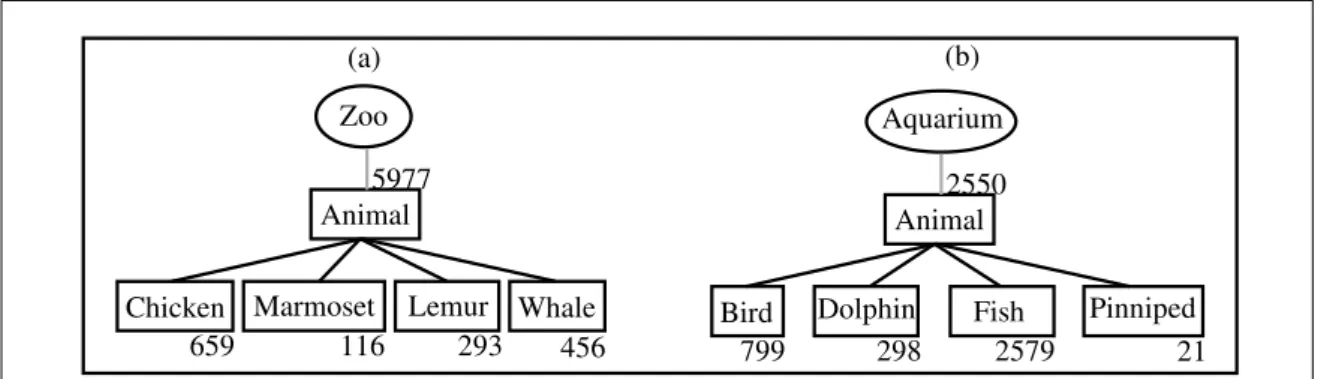
automatic construction of domain-specific resources has recently become a well-explored re-search field [Missikoff et al., 2002; Fortuna et al., 2006; 2008; Kozareva and Hovy, 2010; Navigli et al., 2011]. This relies on the extraction of domain-relevant terminology and its correct induction into a linked structure, both of these tasks using unstructured text. These approaches generally require a considerable amount of human involvement to validate the information contained within the ontology. We propose using ontologies to define the concep-tualisations that are relevant to a conversational domain, so the agent can use them as topics in dialogue. Our approach incorporates WordNet’s taxonomy, user-defined associations in Wikipedia and term frequency statistics in a tool that requires a minimum degree of human input and produces resources that contain appropriate concepts to their respective domain. In summary, in this dissertation we first explore the feasibility of using a semantic re-latedness measure for choosing outputs to coherently continue a conversation. As applying semantic relatedness between all possible combinations of concepts proves to be inefficient in real-time, and due to the modular architecture of our conversational agent, we propose a methodology and a tool to build self-contained knowledge units. These units are structured as modular ontologies and contain concepts highly related to a specific domain. These on-tologies are used to explore the influence of domain on the human perception of semantic relatedness: we demonstrate the important result that automatic measures do not take into consideration such an effect in the way humans do. Along with our findings, we propose an extension for a conversational agent that uses semantic relatedness and other mechanisms to coherently (and in real-time) drive a conversation in an open scenario where outputs are not interlinked.
1.3 Contributions
This thesis investigates the construction of mechanisms and resources to manage topic selec-tion in an open-ended conversaselec-tional agent. In particular, we focus on two outcomes: (i) ap-plying semantic relatedness between concepts to perform topic-selection and topic-switching in a coherent manner; and (ii) domain-specific ontologies for knowledge organisation. With respect to these, our main contributions in this dissertation are the following:
• A process for constructing domain-specific ontologies for topic organisation in a con-versational agent. We propose a technique and a tool to create structures of concepts and relationships with minimal human involvement. These ontologies are based on the handcrafted taxonomy provided by WordNet [Fellbaum, 1998], and Wikipedia [Wales and Sanger, 2007]. For the latter resource, we focus on wikilinks (a user-defined re-lationship between two articles), while we also make use of its indexed contents as a
general corpus.
The process is implemented inM-OntoBUILD,a Java tool for automatically construct-ing domain ontologies for the Toy. This tool alleviates the task of module designers for theToy of hand-constructing the knowledge relevant to a certain domain. A
Mod-ular Ontology (M-Onto) is the outcome produced by the tool. Our evaluation of
M-Ontos shows that these resources accurately represent a domain and make the module designer a knowledge validator for the resource built, rather than a knowledge engineer. This contribution is described in detail in Chapter 4.
• A result demonstrating that domain poses an effect on the measurement of semantic re-latedness between concepts. This is an important outcome as automatic approximations of semantic relatedness is still an open area with room for improvement. Our study shows that for pairs of concepts from the same and from different domains for which a measure of semantic relatedness assigns very similar scores, human judges assess re-latedness significantly differently to the automatic measures. This is complemented with a machine learning analysis where taking domain information into consideration increases the correlation of an automatic measure with human judgements. Along with the effect of domain information, we also show that the presence ofwikilinks between concepts boost the perception of semantic relatedness, not only within but also across domains. These contributions are described across Chapters 5 and 6.
To conduct the aforementioned study, existing testbeds used to evaluate measures of semantic relatedness cannot be used due to the absence of domain information. There-fore, we were required to design a process to construct a testbed for measures of se-mantic relatedness over pairs of concepts that explicitly takes domain information into consideration2. Our dataset exhibits similar properties to existing datasets in terms of:
commonality of words (measured by the inverse document frequency idf), and word
polysemy (i.e. the multiple senses of a word).
• A mechanism for coherent topic selection in an open-ended conversational system based on semantic relatedness between relevant topics. First, we demonstrate in Chapter 3 that a mechanism to select conversational outputs using semantic relatedness is per-ceived as more coherent than a technique using word frequency statistics proposed by Gandhe and Traum [2007]. Then, in Chapter 7, we implement a mechanism based on semantic relatedness for output selection that operates under real-time constraints in a version of theToy. Our mechanism leverages the domain-sensitive measure of semantic
2
relatedness defined in Chapter 6 to automatically bias conversations to remain within a domain.
These contributions are tied together as follows: the M-Ontos of Chapter 4 are used for creating the domain-based dataset, and for organising the Conversational Fragments and knowledge infrastructure for the CA. These ontologies are used for making the computation of semantic relatedness real-time in Chapter 7, as they constrain the universe of candidate topics to derive conversations to. The measure of semantic relatedness learned with machine learning in Chapter 6 is used to manage topics in the implementation described in Chapter 7.
1.4 Publications
Part of the material in this thesis have previously appeared in the following publications: • D. Macias-Galindo, L. Cavedon, J. Thangarajah, and W. Wong. Effects of domain on
measures of semantic relatedness. Journal of the American Society for Information
Science and Technology, To appear (ERA Rank: A*)
• D. Macias-Galindo, W. Wong, L. Cavedon, and J. Thangarajah. Coherent topic transi-tion in a conversatransi-tional agent. InProceedings of INTERSPEECH, pages 1–4, Portland, OR, USA, 2012 (ERA Rank: A)
• D. Macias-Galindo, W. Wong, L. Cavedon, and J. Thangarajah. Using a lexical dictio-nary and a folksonomy to automatically construct domain ontologies. InProceedings of the Australasian Joint Conference on Artificial Intelligence (AI), pages 638–647, Perth, WA, Australia, 2011b (ERA Rank: B)
• D. Macias-Galindo, L. Cavedon, and J. Thangarajah. Building Modular Knowledge Bases for Conversational Agents. InIJCAI Workshop on Knowledge Representation and Reasoning for Practical Dialogue Systems (KRPDS), pages 16–23, Barcelona, Spain, 2011a (ERA Rank: Unranked)
1.5 Thesis Structure
This thesis is structured as follows: in Chapter 2 (Background and Related Work), we discuss previous research regarding the main areas covered by this thesis. First, we provide an overview of conversational agents, focusing on the Toy and its implementation. Second, we describe work representative of three typical approaches for the construction of ontologies: (i) expert handcrafted; (ii) community-driven; and (iii) automatic ontology construction. Third,
we describe work on coherence in text and dialogue, as this is our major motivating aim for developing CAs that can manage topic coherence, in particular to manage and switch topics. Finally, we present the area of semantic relatedness and discuss three types of approaches for measuring it: (a) using a taxonomy; (b) using Wikipedia; and (c) using the Web as a corpus. We also outline several testbeds that are used to evaluate the performance of automatic measures of semantic relatedness, in order to contrast them to our proposed testbed in Chapter 5.
In Chapter 3 (Semantic Relatedness and Coherence in Dialogue: A Pilot Experiment), we develop a pilot evaluation of using semantic relatedness for topic and utterance selection in the Toy. This is to validate our motivating assumption that semantic relatedness is an appropriate mechanism for driving conversations and proposing topic-switching. We evaluate this approach by contrasting it to a word overlap approach proposed by Gandhe and Traum [2007]. The results of this chapter provide validity for our overall approach.
In Chapter 4 (M-OntoBUILD: Constructing Domain-specific Ontologies), we describe our methodology and tool for building domain-specific ontologies, termed M-OntoBUILD. The approach starts with a concept defining the domain of interest, and it automatically creates a collection of taxonomies of concepts related to that domain. Our approach leverages the handcrafted taxonomy implemented in WordNet, along with a set of more arbitrary rela-tionships between concepts found in Wikipedia. Our methodology requires minimal human involvement. Modular Ontologies produced by this application are evaluated against human assessments, showing that the tool provides a module designer with an accurate representa-tion of a domain.
Chapter 5 (A Framework for Evaluating Domain-based Semantic Relatedness) explores properties of semantic relatedness data testbeds, such as the inverse document frequency
(reflecting common usage) and the number of senses of the terms in these testbeds. These properties are used to help designing a dataset that is appropriate for detecting the influence of domain information in the measurement of semantic relatedness. We also perform an exploratory study with a subset of this dataset where human judgements are obtained from a Web interface and crowd-sourcing using CrowdFlower. In particular, we demonstrate that the presence of a wikilink (a connection between Wikipedia articles suggested by its contributors) boosts the human perception of semantic relatedness by humans,
Chapter 6 (Influence of Domain on Semantic Relatedness) extends the exploration con-ducted in the previous chapter by considering the influence of domain in the automatic approximation of semantic relatedness across domains. Our main hypothesis is that domain plays a significant role in the human perception of semantic relatedness that is not detected by current automatic measures. The pairs of concepts in the dataset constructed in the previous
chapter are assessed by volunteers and crowd-sourced workers. In this chapter, we demon-strate that, for pairs of concepts obtained from the same domain, humans perceive them as more related than pairs from different domains; this effect of domain, which is unsurprising for humans, however, is not present in automated measures of semantic relatedness proposed in the literature. This is the first time to our knowledge that this property has been demon-strated to a significant level, though previous authors have mentioned this possibility. We further validate our hypothesis by conducting an experiment using machine learning, where domain is regarded as a feature that increases the correlation between semantic relatedness measures and human assessments.
Chapter 7 (Implementation of a Real-Time Topic Selection Mechanism using Semantic Relatedness) ties the work of previous chapters altogether, by describing the implementation and evaluation of a mechanism based on semantic relatedness to select output utterances for the Toy. As a continuation of the exploration made in Chapter 3, this chapter improves performance in the calculation of semantic relatedness in order to make the process less computationally expensive to execute it in real-time, as part of theToy requirements.
Finally, Chapter 8 (Conclusions) concludes the thesis by summarising our contributions and proposing some lines of future work.
Background and Related Work
This dissertation is concerned with three major areas of research: conversational agents,
ontology construction andsemantic relatedness. In this chapter, we describe prior work and current approaches in each of these areas. For conversational agents (Section 2.1.1), we focus on both current research, as well as in describing the system that provides the context for this thesis: theIntelligent Interactive Toy, or simply theToy [Adam et al., 2010b; Wong et al., 2012b]. One approach for representing structured knowledge for conversational agents is using ontologies. Therefore, in Section 2.2, we center our discussion around different methodologies for building ontologies, particularly those that are domain-specific. We also analyse semantic relatedness in Section 2.4 as a component of coherent texts and dialogue, and discuss several automatic measures to approximate relatedness that are proposed in the literature. We also introduce some testbeds that have been used in the past to evaluate automatic measures of semantic relatedness. Finally, we discuss the use of domain information (Section 2.5) in tasks such as word sense disambiguation and measuring semantic similarity between words.
One class ofconversational agents is comprised of those designed to cooperate with users in accomplishing tasks via dialogue. Such agents are known as task-oriented. With these agents, a purpose or goal is envisioned from the start of the interaction [Allen et al., 2001; Jokinen and McTear, 2009]. This dissertation involves an example of a conversational agent, hereafter called the Toy, which not only uses task-oriented dialogue, but also interacts with users using a collection of defined tpics; this is known as nontask-oriented dialogue [Joki-nen and McTear, 2009]. This type of interaction is challenging, as user inputs tend to be unpredictable. In Section 2.1.1, we describe theToy, which displays several characteristics relevant to this thesis. We put special emphasis on two requirements of theToy: a modular knowledge architecture, which allows multiple developers to create specific knowledge and interactive domains; and the need for a coherent conversation flow, which is provided by a mechanism that selects topics given user input and the context of dialogue.
The requirement of modular knowledge architecture is examined in Section 2.2, where we analyse ontologies as a selected approach for representing theuniverse of discourse [Gruber, 1995] that the agent can handle. In particular we focus on domain-specific ontologies and their application in spoken systems. We discuss the fact that building ontologies is a process that has traditionally been delegated to knowledge engineers. This has made the development and maintenance of these resources expensive, in terms of time and human involvement. Other approaches involve the knowledge created by a community of contributors, and (semi-)automated text analysis over preselected corpora.
To address coherent conversational flow, we present in Section 2.3 research related to text and dialogue coherence. Coherence has been studied as a property that makes texts understandable, and this property can be also found in dialogues where there is a clear interaction between speakers. We argue that having a coherent topic can be used to not only react towards user behaviours, but also to propose topics that users may deem to be related to the conversation history; this is required to supportmixed initiativeconversational behaviour. We subscribe to the hypothesis of Lapata and Barzilay [2005] that semantic relatedness is an important factor found across sentences in coherent texts.
Semantic relatedness can be regarded as the degree to which two concepts (especially nouns) are alike or related given the common attributes or context that they share [Budan-itsky and Hirst, 2006; Strube and Ponzetto, 2006]. For instance, concepts car and gasoline
can be considered related because the former uses the latter. The relative simplicity of ac-quiring the resources for calculating semantic relatedness measurement, notwithstanding its computational cost, makes this an ideal approach for detecting coherence in conversations. In Section 2.4 we present and describe different existing measures of semantic relatedness.
One approach to evaluating the effectiveness of semantic relatedness measures consists of using testbeds containing pairs of words with human-judged scores; we explore existing testbeds and their characteristics. Finally, due to domain-specific context in which this research is based, we discuss current trends in studying the influence of domain with respect to semantic relatedness and dialogue coherence. This closes the chapter in Section 2.5.
2.1 Conversational Agents
A conversational system is a computer system capable of interacting with human users via speech to provide some service [Jokinen and McTear, 2009]. Such systems are employed to substitute current mechanisms for interaction with interfaces, based on input via keystrokes or point-and-click interfaces. Spoken language is used since it is a more human and natural means of communication [Allen et al., 2001]. However, this type of input allows for ambiguity in the instructions provided, as well as the requirement for powerful language processing and
understanding techniques.
Conversational systems using AI-based techniques (e.g. planning, collaborating, inferenc-ing) can also be called conversational agents (CA). These are provided with a model of the world where they interact and learn from users to help solving their needs [Jokinen and McTear, 2009; Maes, 1994]. In terms of the intention of the dialogue, CAs can be classi-fied into two types: task-oriented and nontask-oriented. Task-oriented CAs use dialogue for addressing requests from users to accomplish tasks. This use of dialogue is defined in the literature aspractical dialogue [Allen et al., 2001]. Some tasks that have been addressed with task-oriented CAs are: planning escape routes in disaster scenarios [Dzikovska et al., 2004; 2008], channeling patients according to their symptoms [Milward and Beveridge, 2003], and providing tutorials on cooking [Pardal and Mamede, 2011]. More recently, these kinds of systems have gained popularity in the form of personal assistants for smartphones, such as Siri1 and Google Now2. These systems are characterised for operating in constrained do-mains. The cost of applying such projects to other domains is sometimes high, as the system needs to acquire the semantics of the intended domain [Dzikovska et al., 2008]. Moreover, task-oriented approaches regularly have a clear goal to be achieved, with the conversational agent collecting relevant information to satisfy that goal [Abella and Gorin, 1999; Milward and Beveridge, 2003; Hurtado et al., 2006; Dzikovska et al., 2008]. This additional informa-tion can be obtained by requesting it, e.g. using a frame-like structure that the system fills out in collaboration with the user.
Nontask-oriented CAs, on the other hand, are concerned with the engagement with users in an open conversation (i.e. about any topic). Given the lack of a clear purpose for the dialogue, two challenges are of particular interest for this kind of CAs: managing mixed-initiative interaction with users (being capable of both driving the conversation and allowing users to drive it); and making the users perceive the interaction as coherent. The sim-plest conversational systems of this type are chatbots. While chatbots partially address the challenge of engaging with users, they use linguistic patterns to rephrase users’ input, thus simulating empathy while producing interactions generally lacking feedback with respect to the input [Shibata et al., 2009]. Some examples of chatbots are ELIZA [Weizenbaum, 1966] and ALICE [Wallace, 2009]. Agent-based approaches to nontask-oriented CAs (which can be considered hybrid as they combine both approaches) can be found in projects such as the Senior Companion [Dingli et al., 2009]. Other approaches have focused on open-ended dialogue providing feedback to users by collecting information from specific text resources, such as Web pages and question-answering repositories [Shibata et al., 2009; Waltinger et al.,
1
http://www.apple.com/au/ios/siri/
2012].
2.1.1 The Intelligent Interactive Toy
This thesis proposes a mechanism for addressing the problem of maintaining coherence in open-ended dialogue between a conversational agent and its user. We use the Intelligent Interactive Toy [Adam and Ye, 2009; Adam and Cavedon, 2009; Adam et al., 2010a;b; Wong et al., 2012a;c] as a platform for testing our hypotheses formulated below. The Intelligent Interactive Toy, or simply the Toy, is a joint project between RMIT University and Re-althing Entertainment Pty Ltd to produce a module-based conversational agent, which can be embodied into a physical toy. The target audience for the Toy is children aged 8 to 12 years. The Toy can interact with users via conversational activities ranging from struc-tured activities such as storytelling and playing games, to unbounded “chatty” dialogue like responding to questions or talking about any topic that its knowledge units handle. The
Toy’s capabilities for pre-processing user inputs use shallow natural language processing techniques, while its responses are built from a pre-defined pool of conversational fragments. Part of a conversation using both task- and nontask-oriented interaction and conversational fragments is shown in Figure 2.1. We provide more details on the Toy’s architecture and speech capabilities in the following sections3.
2.1.1.1 Architecture
The Toy is modelled using aBelief-Desire-Intention (BDI) approach, which defines conver-sational goals that the agent attempts to achieve via multiple strategies. Goals in this context include: activating interactive activities; addressing commands or requests; and participat-ing in open-ended conversations about a given topic [Wong et al., 2012a]. The difference between these goals relies on speakers leading the system to achieve these using their inputs. For instance, a cooking tutorial’s goal (describe the preparation method of a dish) is reached when the last instruction is confirmed (see turns 35 and 36 in Figure 2.1).
Two requirements of the Toy provide central motivation to this thesis: a modular ar-chitecture for knowledge that allows its architecture to be extensible; and a mechanism for enhancing the conversation flow capable of managing topic transitioning (i.e. switching from one topic to another) in acoherent manner. We describe these requirements below.
A prominent aspect of the Toy rests in its modularity, not only of its architecture but also of its knowledge organisation; the context of this dissertation is related to the latter. The architecture of the Toy is distributed in modules, as shown in Figure 2.2. In this
04: SYSM: do you likechocolate? 05: USER: i lovechocolate.
06: SYSM: i love it too. i wish i could eat it forbreakfast... 07: USER:chocolateforbreakfast? yuck!
08: SYSM: what do you eat forbreakfastinstead ofchocolate? 09: USER:toast.
10: SYSM: what do you like to eat on yourtoast. 11: USER:ice cream.
12: SYSM: yum yum! delicious.
13: SYSM: do you want to make someice cream? 14: USER: yeah.
15: SYSM: do you have the recipe with you? 16: USER: can you please tell me a story?
17: SYSM: sure. susie theice cream moosewas... . . .
23: SYSM: that’s the end of the story.
24: SYSM: let’s continue with ourcooking. so, do you have the recipe? 25: USER: no.
26: SYSM: you’ll needmilkandchocolate. 27: USER: where doeschocolatecome from? 28: SYSM:chocolatecomes fromcacaotrees.
29: SYSM: let’s continue with ourcooking, do you need to get out apan? . . .
34: USER: it’s done!
35: SYSM: yum yum! yourice creamis ready. 36: SYSM: now, let’s talk about thezoo, ok?
Figure 2.1: A fragment of a conversation between the Toy and a user. Source: Wong
et al. [2012c].
architecture, a central component (the Interactor) processes user input, delegates messages and hands control of the conversation to the appropriate modules. Input and output via voice are performed at the User-agent client (e.g. a mobile application). The Toy can be upgraded by “plugging” into it new Conversational-activity modules [Adam et al., 2010b; Wong et al., 2012c], each module containing its own knowledge for the capability it is built upon. For the purpose of this dissertation, a capability module is comprised of a knowledge representation structure, which we term a Modular Ontology, and a pool of conversational fragments associated with the module domain. The Modular Ontology is used to define the vocabulary that the system can understand and converse about, and is also used as a classification mechanism for the conversational fragments featured in the module. We describe the construction of these resources in Chapter 4.
Interactor
User-agent
Role-games capability Chat Storytelling capability
Text-to-speech ASR User Processing unit Input points Output points Triggers Processing unit Input points Output points Triggers Processing unit Input points Output points Triggers
Figure 2.2: General architecture of the Toy.
2.1.1.2 Input and Output Processing in the Toy
In terms of input analysis, theToy uses shallow natural language processing based on simple shallow parsing and keyword-spotting techniques [Adam et al., 2010b]. As theToyis capable of dealing with task-oriented activities and nontask-oriented conversation, each user utterance is processed as “chat” unless it matches an activity represented as a BDI plan. Each input is processed in terms of keyphrases, topics, sentiments and requests, using parsing tools and lemmatisers [Wong et al., 2012c]. At the same time, inputs are parsed against a collection of input grammars, which are defined for each domain-capability module. These grammars enable the Toy to detect potential triggers to start dialogue activities [Wong et al., 2012c]. For instance, the input grammar for a story-telling activity is “* tell * story *”, where
* represents a wildcard matching a set of words that specify the activity (in this case, the story that the user wants to hear, e.g. “please tell me the story of Snow White”).
To produce a response in a dialogue, the Toy does not generate utterances; rather, it selects an output from a library of pre-scripted utterance “templates” calledConversational
Fragments (CFs) [Adam et al., 2010b; Wong et al., 2012c]. Conversational Fragments are pieces of dialogue that were originally authored by Creative Media students at RMIT Uni-versity [Adam et al., 2010b] and, in more recent work [Wong et al., 2012b], mined from question-answering websites. The use of CFs in dialogue is activated by triggers, which are in general based on the user inputs and word frequency statistics to determine the most appropriate fragment to be used next. CFs can be either sequences or stand-alone pieces, according to the type of dialogue activity that the Toy is performing. This also relates to the source of the CFs: authored pieces of dialogue are assembled in a sequential way, while question-answer sentences are generally independent from each other. For instance, a story such as “Snow White” can be assembled as a sequential set of CFs, whereas the CFs used to respond to user questions about this story (e.g. “what were the names of the seven dwarves?”) are not necessarily part of the sequence. Rather, they are stand-alone pieces of dialogue that can be used without a specific reference to the story; in other words, the user may formulate a question like this at any time, and the system must be able to address it, regardless of the running dialogue activity. We describe CFs in more detail in Chapter 3.
Due to the modular architecture of the Toy, CFs are also distributed in modules. Each module has its own processing unit, which is used to interpret the way to proceed a con-versation as planned by the module designer. The processing unit can choose, given a user response, to continue the story, to stop responding to a question, or to finalise the activity. CFs can also be templates, containing variables that are replaced by instances from user input or conversational context. For instance, the utterance “I know that the $ANIMAL is your favourite animal!”, where the variable$ANIMALcan be instantiated with any specialisation of the concept Animal, such asLion or Zebra.
2.1.1.3 Topic Management
Conversational Fragments are organised using the set of terms appearing in them, which we use to represent conversational topics. In this dissertation, we subscribe to the defini-tion of topic of Bublitz [1989] (p. 39): “[. . . ] an independent, usually continuous category which centres the attention of the participants in the conversation, links their linguistic con-tributions and establishes a connection between them (and with them)”. To us, a topic is a conceptualisation that responds to the questionWhat have you been talking about? [Bublitz, 1989].
For example, conversational topics in Figure 2.1 are represented as bold-formatted words. From this figure, it can be observed that topics are maintained and exchanged according to inputs from users. These topics were originally classified using a handcrafted taxonomy [Adam et al., 2010b]. We improve the construction of these taxonomies ahead in Chapter 4,
Capability Module
Modular Ontology (MOnto)
Other Conversational Fragments CF1 CF2 CFn ... Domain-specific ontology components Question-Answer Pairs QAP1 QAP2 QAPm ...
Figure 2.3: Overview of contents in a module. The M-Ontoand the conversational
frag-ments help to the cognitive part of the Toy, while other components enrich the interactive experience using multimedia or other resources.
using a domain-specific ontology, which we called Modular Ontology or M-Onto. Modular Ontologies can be combined with otherM-Ontos from available capability modules and the core ontology contained in the Toy. Figure 2.3 shows an overview of the architecture of M-Ontos.
Modular Ontologies contribute to the Toy architecture by providing information con-tained in a particular domain, thus delimiting the information space that dialogue may cover. Adding moreM-Ontos into theToyenables it not only to consider topics from other domains, but also to find connections between domains. However, managing a conversation requires maintaining a certain degree of coherence; theToy should not jump randomly be-tween topics, otherwise the context may become unpredictable and users will find it hard to follow conversations. We analyse this requirement below.
2.1.2 Dialogue Coherence in the Toy
Coherence is an attribute related to the quality of a “logical, orderly, and aesthetically consistent relationship of parts”4. For instance, a coherent text is one where co-located sentences hold some structure and meaning, which enables a reader to understand them,
4
The American Heritage Dictionary of the English Language, Fourth Edition copyright 2000 by Houghton Mifflin Company. Updated in 2009.
in contrast to a sequence of randomly ordered sentences. While there are many ways in which information can be presented in a text to be perceived as coherent, some of these arrangements will be deemed as incoherent by humans [Lapata and Barzilay, 2005]. This phenomenon is also present in dialogue, when analysing the arrangement of utterances in a conversation [Purandare and Litman, 2008].
The Toy maintains interaction coherence by choosing outputs with topics recently men-tioned during a conversation. However, this approach will eventually fail as the library of conversational fragments is limited. Therefore, our approach consists of proposing topic switches without disrupting the perceived coherence during a conversation. In this disserta-tion, we are concerned with the following challenge regarding open-ended dialogue: enhancing the selection of the most adequate output to the user input while maintaining dialogue co-herent. We propose to address this challenge by using a topic-selection mechanism based on semantic relatedness between concepts. We describe coherence more broadly in Section 2.3, in particular how it is measured in applications such as evaluating machine-generated text [Lapata and Barzilay, 2005] or dialogue [Purandare and Litman, 2008; Gandhe and Traum, 2008], and scoring human-produced summaries [Higgins et al., 2004]. In Chapter 7, we present our approach using semantic relatedness to coherently select conversational topics in a progressing conversation.
The rest of this chapter describes work in two areas: ontology construction, discussed in Section 2.2, and dialogue coherence, in Section 2.3. The latter uses semantic relatedness as a mechanism for determining coherence, following the work of Lapata and Barzilay [2005]. Section 2.4 contains an overview of different approaches to measuring semantic relatedness, in order to supply the agent with a mechanism to coherently propose conversational topics.
2.2 Knowledge Representation in Conversational Agents
As discussed in Section 2.1.1, an open-ended conversational agent as theToy needs a mech-anism that enables both the representation and classification of a domain-specific set of topics. Such a mechanism enables the agent to understand its domain of discourse, which makes it capable of understanding user input and responding with relevant information. We are specifically interested in domain-specific ontologies for this purpose. In this section, we define ontologies and distinguish them from other knowledge structures, such as taxonomies and folksonomies. We survey different approaches to construct these resources, in partic-ular expert-based, community-based and text-mining-based approaches. We also highlight strengths and shortcomings of resources constructed with each approach, in order to under-stand their application in the classification of topics for open-ended conversational agents, as used in Chapter 3.
2.2.1 Knowledge Structures
Due to recent advances in digital communications, particularly attributed to the Web, there has been an increased interest in the generation, acquisition and exchange of information. However, keeping the pace in understanding, analysing and interpreting the vast information available in multiple sources is impossible for humans; hence, computer systems take a role as either facilitators or decision makers on behalf of humans. Still, the challenge of making these actors interact is that each of them uses different semantic representations. Early research in AI has focused on designing such a language that enables effective communication between computer systems [Roche, 2003]. The aim of such a language is to represent a consensual meaning about a conceptualisation between the systems involved. One of the knowledge structures for achieving such a desired level of communication is ontologies [Gruber, 1995; Studer et al., 1998; Berners-Lee et al., 2001; Horrocks, 2007].
In this section we explore ontologies and other knowledge resources such as taxonomies and folksonomies. We also outline representation languages for ontologies, a classification of ontologies and different processes for constructing ontologies, along with some examples.
2.2.1.1 Ontologies
The termOntology was coined by Greek philosophers, particularly Aristotle who attempted to classify all the things in the world. This motivation was adopted by the AI community, which adopted the name and regarded ontologies as a way to make computer systems capable of representing, reasoning and exchanging knowledge. Anontologycan be stated as “a formal, explicit specification of a shared conceptualisation” [Gruber, 1995]. In this definition, four parts are crucial to understand ontologies: conceptualisation, explicitness, formality and
shared understanding [Studer et al., 1998; Uschold and Gruninger, 2004; Guarino et al., 2009]. The conceptualisation of an ontology refers to modelling objects as abstractions in the form of concepts, which can be represented by a natural language noun phrase and comprise both an idea and a meaning. This conceptualisation has to be self-contained; that is, ontologies must be able to “explain” themselves, without the help of other resources. Concepts in an ontology have to beexplicit; that is, they must have a unique interpretation, as well as a specific level of detail according to the world that they represent. In terms of
formalityand given that ontologies have the purpose of communicating to systems and users, these resources must use a well-constructed set of machine-understandable semantics. This automatically discards natural language as an alternative representation, due to it being ambiguous by nature. Shared understanding acknowledges that the model structured in an ontology is agreed and understood by a group of individuals, which can then be adopted and implemented in their systems.
Ontologies are comprised of objects defined in a given domain or subject area [Uschold and Gruninger, 2004]. These objects are known as classes or concepts, and are arranged in a lattice that may resemble a hierarchical structure. Concepts have sets of properties
that define their attributes, values and restrictions over them. Some ontologies may contain
instances of concepts, which refer to a particular element of a concept, or even axioms
based on logical formalisms that enable computer systems to reason about the information contained in the ontology. The amount and type of information contained in ontologies determines the complexity of the ontology; this is discussed in more detail in Section 2.2.2. In the rest of this section we focus on the representation of an ontology rather than on its reasoning capabilities.
As mentioned above, the contents of an ontology are generally structured in a lattice of concepts connected by relationships. This can be seen in the example provided in Figure 2.4, where concepts (nodes in the network) encase abstractions: for instance, the concept Lion defines all the gregarious carnivores where the male has a mane5. Relations, which are the edges in the structure, are abstract connections between concepts. The most used type of relationship in ontologies is known as subsumption, that is, the generalisation of concepts (e.g. Big cat subsumes Lion, or inversely Lion is a Big cat). In the figure, subsumption is represented by a solid line connecting two concepts. For instance, both concepts Lion and Tiger are subsumed by concept Big cat. This means that Lion and Tiger share some characteristics as both are big cats, such as body size, paws, and other properties inherited from the class Mammal (e.g. having warm blood and fur) and other super-concepts. Conversely, both have their own specific attributes: lions have a solid colour in their body, while tigers have a striped body pattern.
Ontologies are widely used as a mechanism for organising knowledge in enterprises [Studer et al., 1998], user-tailored personalisation and recommendation systems [Maes, 1994; Middle-ton et al., 2009], and for spoken dialogue systems [Allen et al., 2001; Milward and Beveridge, 2003; Dzikovska et al., 2008; Pardal and Mamede, 2011]. Moreover, ontologies are being used as the pillars for constructing the Semantic Web [Berners-Lee et al., 2001; Gilchrist, 2003; Horrocks, 2007]. Currently the Web is a pool of textual, interlinked documents that can be easily interpreted by humans. However, the ease of adding contents to the Web means that the amount of information available in it is so large that searching for specific content becomes challenging. This is performed by using search engines where users input strings. The main drawback of this approach is that users search for information that can be easily thought of, but hardly specified in a query that only identifies string matches. Moreover, search engines return a set of results that users have to manually analyse and deem whether
![Figure 2.5: Classification of ontologies by complexity. Source: Wong et al. [2012d].](https://thumb-us.123doks.com/thumbv2/123dok_us/11002229.2987748/41.892.125.786.131.352/figure-classification-ontologies-complexity-source-wong-et-al.webp)