POUR L'OBTENTION DU GRADE DE DOCTEUR ÈS SCIENCES
acceptée sur proposition du jury: Dr D. Gillet, président du jury
Prof. B. Faltings, Dr P. Pu Faltings, directeurs de thèse Prof. B. Liu, rapporteur
Prof. Ph. Cudré-Mauroux, rapporteur Prof. D. Gatica-Perez, rapporteur
Acquiring Broad Commonsense Knowledge for Sentiment
Analysis Using Human Computation
THÈSE N
O7240 (2016)
ÉCOLE POLYTECHNIQUE FÉDÉRALE DE LAUSANNE
PRÉSENTÉE LE 7 OCTOBRE 2016À LA FACULTÉ INFORMATIQUE ET COMMUNICATIONS LABORATOIRE D'INTELLIGENCE ARTIFICIELLE
PROGRAMME DOCTORAL EN INFORMATIQUE ET COMMUNICATIONS
Suisse 2016 PAR
Marina BOIA
“Knowledge is like a sphere, the greater its volume, the larger its contact with the unknown” — Blaise Pascal
Acknowledgements
In chronological order, as much as possible. . . I would like to thank my parents for always loving and supporting me. My brother, for helping me with my first steps in computer science. Aunt Delia, for encouraging me to choose EPFL, for sharing some of her optimism along the way. The EPFL Doctoral School, for awarding me a first year Ph.D. fellowship. Prof. Boi Faltings and Dr. Pearl Pu, for giving me a chance as their Ph.D. student, for precious guidance, feedback, and discussions. But most of all, for invaluable encouragement, patience, and understanding when I needed it most. Alexandra and Stefan, for their pointers with my first Ph.D. milestone -the candidacy exam. Claudiu, for highly appreciated guidance and feedback through most of my Ph.D. years. Bao-Duy, for help with the initial implementation and launches of my games. Prof. Bing Liu, for believing in the potential of my research, for helping me choose a direction to further develop it, for guidance on this new topic. Google, for financially supporting my Adwords experiments and for a great internship experience. Goran, Valentina, and all the LIA and HCI lab members that I have met along the way, for pointers on how to refine my work. Grégoire and Maxime, for their help with translating my games in French. Régis, for the help with translating this thesis’s abstract to French. Sylvie, for always being a great help with logistic-related issues, and for always putting a smile on my face when doing so. My defense committee members, for agreeing to review this thesis and for their valuable feedback on how to improve it. Last but not least, my friends. Alina, for being a great flatmate and my partner in travel. Immanuel, for being Big Ngeker. Adrian and Daniel, for accepting me in their long-time friendship circle. Andrew and Valentina, for our lunches, coffee breaks, and nice trips. Régis, for debating tennis matches with me. All, for being my safety net.
Abstract
While artificial intelligence is successful in many applications that cover specific domains, for many commonsense problems there is still a large gap with human performance. Automated sentiment analysis is a typical example: while there are techniques that reasonably aggregate sentiments from texts in specific domains, such as online reviews of a particular product category, more general models have a poor performance.
We argue that sentiment analysis can be covered more broadly by extending models with com-monsense knowledge acquired at scale, using human computation. We study two sentiment analysis problems. We start with document-level sentiment classification, which aims to deter-mine whether a text as a whole expresses a positive or a negative sentiment. We hypothesize that extending classifiers to include the polarities of sentiment words in context can help them scale to broad domains. We also study fine-grained opinion extraction, which aims to pinpoint individual opinions in a text, along with their targets. We hypothesize that extraction models can benefit from broad fine-grained annotations to boost their performance on unfamiliar domains. Selecting sentiment words in context and annotating texts with opinions and targets are tasks that require commonsense knowledge shared by all the speakers of a language. We show how these can be effectively solved through human computation. We illustrate how to define small tasks that can be solved by many independent workers so that results can form a single coherent knowledge base. We also show how to recruit, train, and engage workers, then how to perform effective quality control to obtain sufficiently high-quality knowledge. We show how the resulting knowledge can be effectively integrated into models that scale to broad domains and also perform well in unfamiliar domains.
We engage workers through both enjoyment and payment, by designing our tasks as games played for money. We recruit them on a paid crowdsourcing platform where we can reach out to a large pool of active workers. This is an effective recipe for acquiring sentiment knowledge in English, a language that is known by the vast majority of workers on the platform. To acquire sentiment knowledge for other languages, which have received comparatively little attention, we argue that we need to design tasks that appeal to voluntary workers outside the crowdsourcing platform, based on enjoyment alone. However, recruiting and engaging volunteers has been more of an art than a problem that can be solved systematically. We show that combining online advertisement with games, an approach that has been recently proved to work well for acquiring expert knowledge, gives an effective recipe for luring and engaging volunteers to provide good quality sentiment knowledge for texts in French.
compe-tence of artificial intelligence systems in other domains as well.
Key words: commonsense knowledge acquisition, human computation, crowdsourcing, gam-ification, games with a purpose, sentiment analysis, sentiment classgam-ification, fine-grained opinion extraction
Résumé
Malgré le succès de l’intelligence artificielle dans de nombreuses applications propres à certains domaines, il y a toujours un écart important avec l’intelligence humaine dans beau-coup de problèmes demandant du bon sens. L’analyse automatique de sentiments en est un exemple typique : bien qu’il existe des techniques qui permettent de raisonnablement rassembler les sentiments de textes pris d’un domaine spécifique, les modèles généraux ont des performances plutôt limitées.
L’analyse de sentiments peut être traitée de façon plus vaste en élargissant les modèles exis-tants avec des connaissances de sens commun acquises à grande échelle à l’aide du calcul humain. On étudie deux problèmes d’analyse de sentiments. Nous commençons avec la clas-sification de sentiments au niveau des documents, dont le but est de déterminer si un texte exprime dans l’ensemble un sentiment positif ou négatif. En élargissant des classificateurs avec les polarités des mots de sentiments dans le contexte correspondant, on peut les amener à l’échelle de domaines plus généraux. Nous étudions aussi la fouille d’opinions à granularité fine, qui essaie d’identifier des opinions individuelles dans un texte, avec leurs cibles. Les modèles d’extraction peuvent être améliorés par l’acquisition d’annotations à granularité fine pour un vaste domaine, ce qui peut ensuite mener à de meilleures performances quand appliquées à des domaines nouveaux. Sélectionner des mots de sentiments dans le contexte et annoter des textes avec les opinions et leurs cibles sont des tâches qui nécessitent du bon sens. Nous montrons comment ces tâches peuvent être résolues à l’aide du calcul humain. Nous illustrons comment définir des petites tâches qui peuvent être complétées par de nombreux travailleurs, puis assemblées en une base cohérente de connaissances. Nous montrons aussi comment recruter, former, et captiver des travailleurs, puis comment vérifier efficacement leur travail pour obtenir des connaissances de qualité élevée. Nous montrons comment ces connaissances peuvent être efficacement intégrées dans des modèles qui peuvent s’appliquer à des domaines généraux et également avoir de bonnes performances dans des domaines nouveaux.
Nos tâches sont conçues en tant que jeux avec possibilité de gagner de l’argent en récom-pense, ce qui permet de garder les travailleurs impliqués dans l’activité. Nous recrutons les travailleurs sur une plateforme payante de crowdsourcing, où nous pouvons atteindre un grand nombre de travailleurs actifs. C’est une recette efficace pour acquérir des connaissances en anglais, une langue connue par la majorité des travailleurs sur la plateforme. Pour acquérir des connaissances sur les sentiments dans d’autres langues nous soutenons qu’il y a un besoin de concevoir des tâches suffisamment attrayantes pour des travailleurs volontaires externes à
la plateforme de crowdsourcing, en se basant uniquement sur le plaisir d’accomplir la tâche. Cependant, recruter et captiver des volontaires s’est révélé être plus un art qu’une science. Nous montrons que la combinaison de publicité en ligne avec des jeux, une approche qui a été récemment démontrée comme fonctionnant bien pour acquérir des connaissances expertes, donne une recette efficace pour obtenir des connaissances de bonne qualité pour des textes en français.
Nos solutions pourraient montrer la voie pour utiliser le calcul humain pour élargir les compé-tences des systèmes d’intelligence artificielle à d’autres domaines.
Mots clefs :acquisition de connaissances, calcul humain, crowdsourcing, gamification, games with a purpose, analyse de sentiments, classification de sentiments, fouille d’opinion à granu-larité fine
Contents
Acknowledgements i
Abstract (English/Français) iii
List of figures xi
List of tables xiii
1 Introduction 1
2 Background 7
2.1 Sentiment Analysis . . . 7
2.1.1 Document-level Sentiment Classification . . . 8
2.1.2 Fine-grained Opinion Extraction . . . 16
2.2 Human Computation . . . 23
2.2.1 Overlap with Crowdsourcing . . . 23
2.2.2 Worker Recruitment and Motivation . . . 24
2.2.3 Task Understanding . . . 26
2.2.4 Quality Assurance . . . 26
2.3 Sentiment Knowledge Acquisition with Human Computation . . . 27
2.3.1 Text Corpora . . . 27
2.3.2 Sentiment Lexicons . . . 28
2.3.3 Fine-grained Annotations . . . 29
2.3.4 Sentiment Knowledge Acquisition with Volunteers . . . 30
3 Knowledge Acquisition for Scalable Sentiment Classification 31 3.1 Introduction . . . 31
3.2 Document-level Sentiment Classification . . . 34
3.2.1 Bigrams Context . . . 34
3.2.2 Human-generated Context . . . 35
3.3 Human Computation Task . . . 38
3.3.1 Task Structure . . . 38
3.3.2 Worker Motivation . . . 39
3.3.3 Tutorial . . . 40
3.3.5 Worker Recruitment . . . 46
3.4 Empirical Results . . . 46
3.4.1 Dataset . . . 46
3.4.2 Task Setup . . . 48
3.4.3 Context Statistics . . . 50
3.4.4 Context and the Lexicon-based Method . . . 51
3.4.5 Context and the Supervised Learning Method . . . 52
3.5 Conclusions . . . 55
4 Knowledge Acquisition for Generalizable Opinion Extraction 63 4.1 Introduction . . . 63
4.2 Fine-grained Opinion Extraction . . . 65
4.2.1 Opinion and Target Pairs . . . 66
4.2.2 Targets Alone . . . 68
4.3 Human Computation Task . . . 69
4.3.1 Task Structure . . . 69 4.3.2 Quality Assurance . . . 70 4.4 Empirical Results . . . 73 4.4.1 Dataset . . . 73 4.4.2 Task Setup . . . 73 4.4.3 Annotation Evaluation . . . 74 4.4.4 Model Evaluation . . . 76 4.5 Conclusions . . . 80
5 Sentiment Knowledge Acquisition with Volunteers 83 5.1 Introduction . . . 83
5.2 Recruiting and Engaging Volunteers . . . 86
5.2.1 Task Design Exploration . . . 86
5.2.2 Game Metaphor Comparison . . . 93
5.2.3 Worker Recruitment . . . 94
5.3 Empirical Results . . . 95
5.3.1 Dataset . . . 95
5.3.2 Exploratory Phase . . . 95
5.3.3 Game Metaphor Comparison . . . 102
5.4 Conclusions . . . 108
6 Conclusions 109 6.1 Summary . . . 109
6.2 Limitations . . . 110
6.2.1 In Context Acquisition and Integration . . . 110
6.2.2 In Fine-grained Annotation Acquisition and Integration . . . 111
6.2.3 In Sentiment Knowledge Acquisition with Volunteers . . . 111
Contents
Bibliography 126
List of Figures
2.1 Background. Example of a digital camera review from Amazon.com . . . 8 2.2 Background. Example of a hotel review from TripAdvisor.com . . . 8 2.3 Background. Example of a vacuum cleaner review from Amazon.com . . . 9 2.4 Background. Example of a digital camera review containing pros and cons
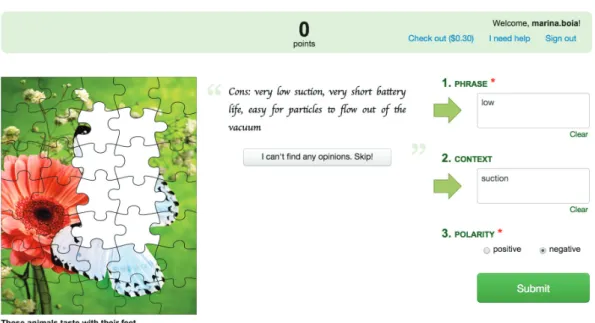
summaries from Epinions.com . . . 21 3.1 Context acquisition. Main game interface . . . 38 3.2 Context acquisition. Tutorial quiz that asks workers to identify a phrase with a
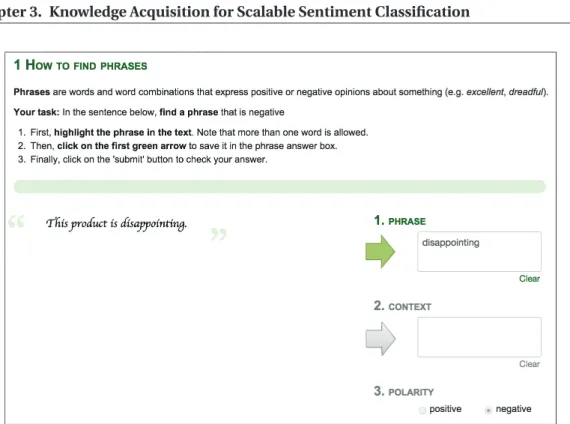
negative polarity . . . 40 3.3 Context acquisition. Tutorial quiz that asks workers to identify a context which
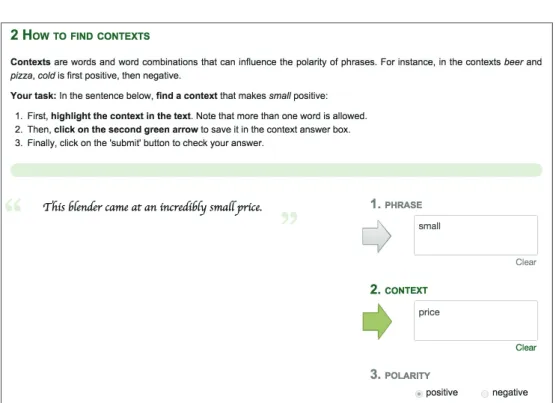
makes a phrase positive . . . 41 3.4 Context acquisition. Tutorial explanation of the game rounds, scoring, and puzzles 42 3.5 Context acquisition. A simple example of how the score updates vary in time as
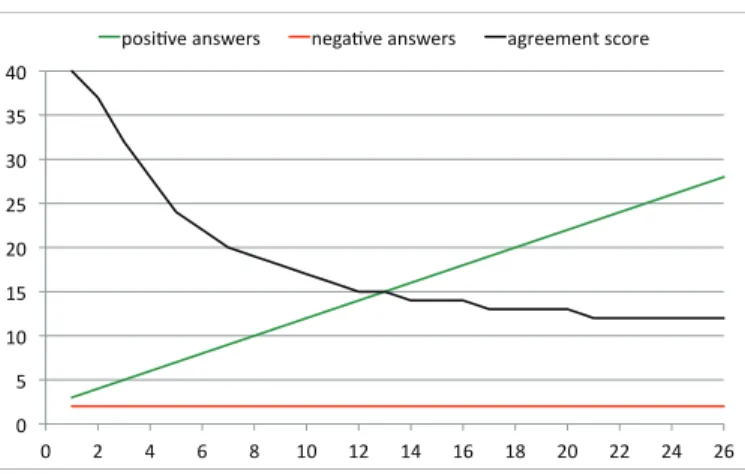
workers keep submitting the answer(good, , positive). . . 44 3.6 Context acquisition. A more complex example of how the score updates vary
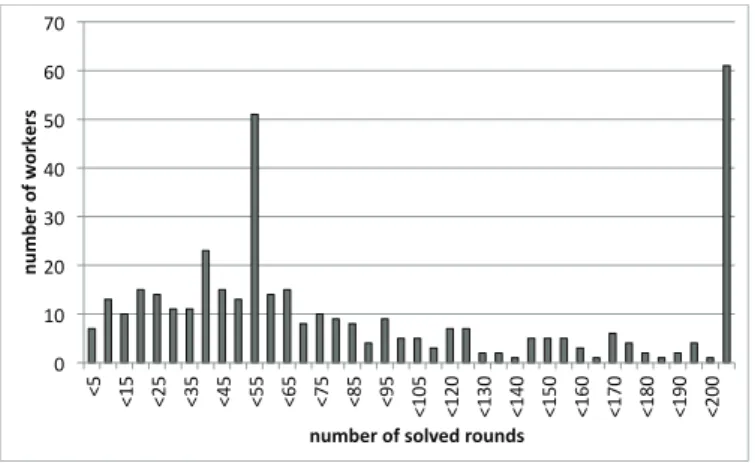
in time as workers mostly submit the answer(small, room, negative)with some exceptions stating the reverse polarity . . . 44 3.7 Context acquisition. Hierarchical structure of the training set . . . 48 3.8 Context acquisition. Distribution of workers in terms of the number of solved
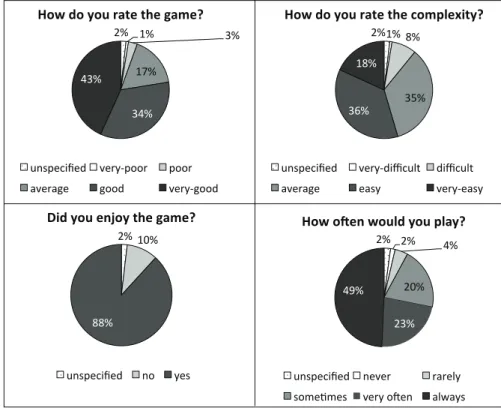
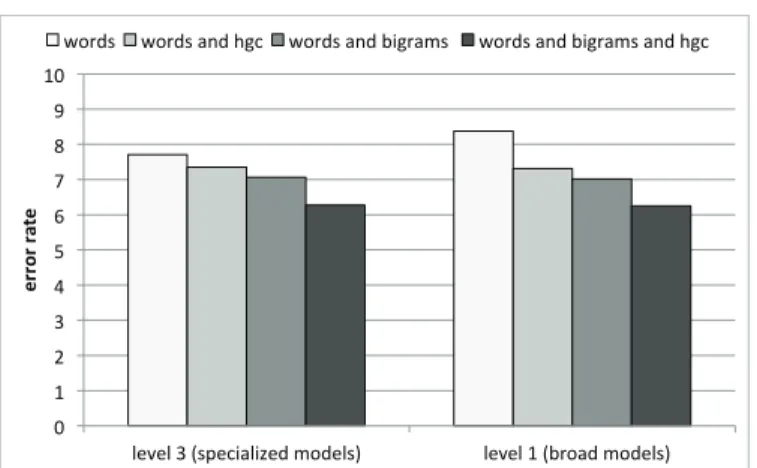
rounds (for the hotels game launch) . . . 49 3.9 Context acquisition. Summary of the game quality survey . . . 51 3.10 Context acquisition. Error of the lexicon with the sentiment model extension.
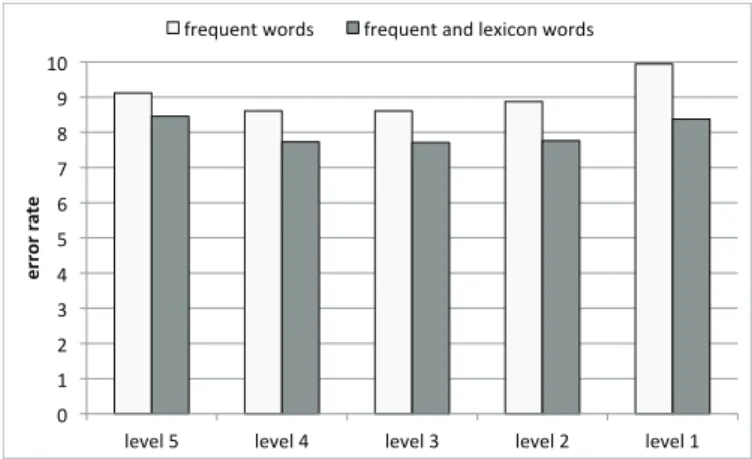
The Hu and Liu lexicon alone, then extended with the separate human-generated context (hgc) at level 3, and finally with the combined hgc at level 1 . . . 52 3.11 Context acquisition. Error of supervised models trained at the five hierarchy
levels, from level 5 (individual categories) to level 1 (products and hotels combined) 53 3.12 Context acquisition. Error of supervised models with the feature space extension.
First, word models extended with hgc. Then, extension of word and bigram models 55 4.1 Annotation acquisition. Main game interface . . . 71 4.2 Annotation acquisition. Example of a training round in the sandbox stage . . . 71 4.3 Annotation acquisition. Average annotation f-scores . . . 76
4.4 Target extraction f-scores for models trained with syntax and full features, in the individual domains (id), union of domains (ud), and cross-domain (cd) setups 78 5.1 Volunteer participation. Animal puzzles game in the design exploration phase 87 5.2 Volunteer participation. Village explorer game in the design exploration phase 89 5.3 Volunteer participation. Labyrinth explorer game in the design exploration phase 90 5.4 Volunteer participation. Animal puzzles game in the metaphor comparison phase 91 5.5 Volunteer participation. Village explorer game in the metaphor comparison phase 92 5.6 Volunteer participation. Labyrinth explorer game in the metaphor comparison
phase . . . 93 5.7 Volunteer participation. Examples of advertisements for the games ran in the
exploratory phrase . . . 96 5.8 Volunteer participation. Sentiment classification performance in the exploratory
phase . . . 101 5.9 Volunteer participation. Advertisement text used in the metaphor comparison
phrase . . . 101 5.10 Volunteer participation. Sentiment classification performance in the metaphor
List of Tables
2.1 Background. Sample words from the Hu and Liu [40] sentiment lexicon . . . 9
2.2 Background. Sample word weights identified by a Support Vector Machine trained on digital camera reviews . . . 13
2.3 Background. Sample opinions and targets extracted from hotel reviews . . . 17
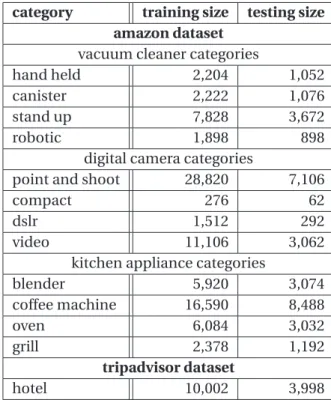
3.1 Context acquisition. Sizes of the training and test sets for each category . . . 47
3.2 Context acquisition. Details of the game launches . . . 48
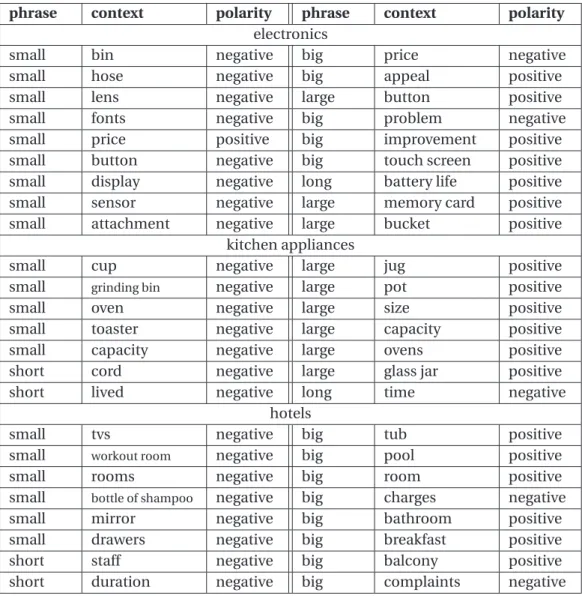
3.3 Context acquisition. Sample phrase and context pairs obtained with human computation . . . 57
3.4 Context acquisition. Error of the lexicon with the sentiment model extension. Left, Hu and Liu [40] lexicon alone. Middle, improvement with the separate hgc at level 3. Right, improvement with the combined hgc at level 1 . . . 58
3.5 Context acquisition. Error of the lexicon with the sentiment model extension. Left, Hu and Liu lexicon extended with the individual words in the context at level 3 (hgc-iw), then with all the context at level 3 (hgc-all). Right, extended with hgc at level 1 . . . 58
3.6 Context acquisition. Error of the supervised method with the sentiment score extension. Left, individual words model at level 1. Right, extended with hgc at level 1 . . . 59
3.7 Context acquisition. Error of the supervised method with the sentiment score extension. Left, individual words model at level 1 extended with hgc-iw at level 1. Right, extended with hgc-all at level 1 . . . 59
3.8 Context acquisition. Error of supervised models with the feature space extension. Left, individual words model at level 3, then improvement with hgc at level 3. Right, models at level 1 . . . 60
3.9 Context acquisition. Error of the supervised method with the feature space extension. Left, individual words model at level 3 extended with hgc-iw at level 3, then with hgc-all at level 3. Right, models at level 1 . . . 60
3.10 Context acquisition. Error of the corpus method with the feature space extension. Left, words and bigrams model at level 3, then improvement with hgc at level 3. Right, models at level 1 . . . 61 4.1 Annotation acquisition. Features of the Pair SVM for opinion and target extraction 66
4.2 Annotation acquisition. Example of a game round and individual annotations obtained, along with the final aggregate annotations (in bold) . . . 73 4.3 Annotation acquisition. Number of sentences and opinion target pairs in the
gold annotations and in workers’ aggregate annotations . . . 75 4.4 Annotation acquisition. First, annotation f-scores based on agreement on the
opinion and target components, respectively. Next, joint agreement on both the opinion and the target (opn-trg). Finally, full agreement on all annotations components (full) . . . 75 4.5 Annotation acquisition. Opinion and target extraction f-scores of Double
Propa-gation and the three variants of the Pair SVM model: individual domains (id), union of domains (ud), and cross-domain (cd) . . . 76 4.6 Annotation acquisition. Target extraction f-scores for models trained on the
individual domains . . . 79 4.7 Annotation acquisition. Target extraction f-scores for models trained on the
union of domains . . . 79 4.8 Annotation acquisition. Target extraction f-scores for models tested across
domains . . . 79 4.9 Annotation acquisition. Sample annotations obtained for camera, mattress, and
restaurant reviews . . . 81 5.1 Volunteer participation. Statistics of the advertisement campaigns we ran in the
exploratory phrase (in 2015) . . . 97 5.2 Volunteer participation. Overlap between the three lexicons generated during
the exploratory phase and the reference lexicon . . . 100 5.3 Volunteer participation. Statistics of the first advertisement campaign run in the
metaphor comparison phrase . . . 103 5.4 Volunteer participation. Statistics of the second advertisement campaign run in
the metaphor comparison phrase . . . 104 5.5 Volunteer participation. Statistics of the lexicons generated during the metaphor
comparison phase . . . 105 5.6 Volunteer participation. Overlap between the lexicons generated during the
1
Introduction
Why Commonsense Knowledge?
As Cambria et al. [16] point out, human intelligence is “the human ability to harness common-sense knowledge gleaned from a lifetime of learning and experience to make informed deci-sions. This allows humans to adapt easily to novel situations”. Knowledge acquisition is thus central to bridging the gap between human and artificial intelligence (AI), and this has always been the most important challenge for AI. So far, successes have been obtained for specific domains, both through knowledge engineering, as in expert systems, and through machine learning, as in speech recognition for a single speaker. However, acquiring knowledge that is valid over a broad domain of application has remained elusive. As Cambria et al. further remark, in novel situations, AI “fails catastrophically due to a lack of situation-specific rules and generalization capabilities”. Personal assistants such as Siri [5] cannot handle general conversations, while speech recognition for the general population still has very high error rates. As an example of a problem that would benefit from more broadly applicable common-sense knowledge, we consider automated sentiment analysis: the problem of aggregating the sentiments (opinions) expressed in a text.
Why Sentiment Analysis and Why Human Computation?
Sentiment analysis has many practical applications. Internet users frequently post their thoughts on blogs, Facebook, Twitter, or other social media platforms. They also write reviews in which they share their experiences with products and services. Properly aggregating the sentiments expressed in these texts would offer priceless insight into what people think: manufacturers could better understand how to improve their products to meet their clients’ needs; hotel managers could learn how to better their services; doctors could figure out where to adapt their patient skills; politicians could better understand their electorate and what is expected from them. The general population would also profit, by improved understanding of the options available to them in various life circumstances: what brand to choose for a particular product? what DVD to rent on a movie night? what family doctor to decide on?
what candidate to vote for in an election? Sentiment analysis can even offer insights into what people expect about the future: who will win a particular election [87]? what actors and movies will win at the Oscars [123]? how will stock prices fluctuate [12]? Knowing what to anticipate might spoil the fun when one is reading a book or watching a movie. In general, though, it is a useful advantage to have when one is trying to choose an optimal strategy, which is why we have election polls, betting rates, or meteo forecasts.
There is thus great value in effectively aggregating sentiments from texts, and this has prompted researchers to develop automated solutions. Sentiments have been mined at different granu-larity levels: at the document or sentence-level [90], or at the finer-grained level of expressions and even individual words [115]. Existing techniques perform reasonably well on texts from specific domains, such as online reviews of a particular product category, but drop in per-formance when they need to handle a broader domain. Nevertheless, humans can use their common sense to easily identify sentiments in texts regardless of their topic. We thus argue that sentiment analysis can be covered more broadly by extending models with commonsense knowledge acquired at scale, using human computation (see Chapter 2 for an introduction to sentiment analysis and human computation, as well as an overview of existing attempts to acquire sentiment knowledge with human computation).
Main Contribution
In this thesis, we target two sentiment analysis problems: document-level sentiment classifi-cation and fine-grained opinion extraction. The former problem aims to establish whether a text as a whole expresses a positive or a negative sentiment. Fine-grained opinion extraction focuses on extracting individual opinion expressions from a text, along with their correspond-ing targets. On the one hand, sentiment classifiers could benefit from knowledge about the contexts that impact the orientation (polarity) of the sentiments expressed by particular words. This would allow them to scale and effectively aggregate text sentiments in a broader domain. On the other hand, opinion extraction models could benefit from fine-grained annotations for texts in a broad domain. If properly exploited, these annotations would allow to identify patterns for opinion and target extraction that are more effective on unfamiliar domains. As our overall contribution, we show: how such knowledge can be effectively obtained using human computation; and how it can be integrated into sentiment analysis approaches to expand their coverage.
Scalable Sentiment Classification with Human-generated Context We first focus on the sentiment classification problem. Classifiers for sentiment fall into two categories. In super-vised methods, a classifier is trained using machine learning on a corpus of text. To keep the learning complexity manageable, features are generally limited to the most frequent words in the training corpus. Such classifiers can obtain good performance as long as their application domain remains relatively small. The other line of work is lexicon-based. These approaches rely on sentiment lexicons - lists that summarize the sentiment words most common in a
language, along with their positive or negative polarities. Here, a text is classified by matching the sentiment words it contains. An overall label is then inferred based on the proportion of the two word categories. These approaches can be applied broadly, but their accuracy is much lower than that of supervised methods and generally insufficient for practical tasks.
A key to improving scalability lies in how these methods model sentiment knowledge. Both methods consider words individually. This does not work so well on texts containing sentiment words whose polarity is ambiguous outside their context. For example, the wordcolddoes not express a concrete sentiment on its own. However, in contexts likebeer orpizza, it gains a positive and negative polarity, respectively [31]. Sentiment lexicons typically do not refine the polarities of words with contexts. This is why they consistently perform poorly on broad domains. Conversely, supervised methods can automatically learn polarity scores for individual words. On a narrow domain, words appear in only a few contexts, so these methods perform well by learning context-dependent polarities. For instance, a machine learning algorithm separately trained on pizza and beer reviews might pick up the wordcoldas positive and negative, respectively. However, this is no longer the case on broader domains, where these methods also harm performance. When trained on reviews of pubs, generally expected to serve both pizza and beer, the algorithm will not know whether to considercoldas positive or as negative. This general model will thus perform worse than its specialized counterparts. Therefore, sentiment classifiers should incorporate context by including longer word com-binations. However, this makes the feature space increase substantially and, while these longer features could be learned from data, one would need a huge corpus. This is why, so far, even attempts restricted to learning the polarities of word pairs have reported mixed results. To help lexicon and supervised approaches scale, we need to find a way to reliably acquire context. Here, we acknowledge that, unlike machines, humans can use their common sense to correctly select both sentiment words and their disambiguating contexts, even from very short sentences. For instance, given the text:I had cold pizza and warm beer for dinner, how sad, human can easily spot thatcoldis negative in the context ofpizzaand thatwarmis also negative in the context ofbeer. As a first contribution, we show: how such knowledge can be effectively acquired using human computation; and how it can enhance sentiment classifiers such that these scale to a broad domain. This line of work is presented in detail in Chapter 3 and has been in part published in [9, 10, 11]:
[9] Boia, M., Musat, C. C., and Faltings, B. Acquiring commonsense knowledge for sentiment analysis through human computation. InProceedings of the Companion Publication of the 23rd International Conference on World Wide Web(2014), pp. 225–226
[10] Boia, M., Musat, C. C., and Faltings, B. Acquiring commonsense knowledge for sentiment analysis through human computation. InProceedings of the 28th AAAI Conference on Artificial Intelligence(2014), pp. 901–907.
[11] Boia, M., Musat, C. C., and Faltings, B. Constructing context-aware sentiment lexi-cons with an asynchronous game with a purpose. InProceedings of the 15th International
Conference on Computational Linguistics and Intelligent Text Processing(2014), pp. 32–44.
Generalizable Opinion Extraction with Human-generated Annotations We next focus on the fine-grained opinion extraction problem. Here, existing approaches fall under two cate-gories. Unsupervised methods are used to generate lexicons of frequent opinion expressions, as well as lexicons with the targets of opinions (in product reviews, these would be parts or properties of the reviewed items). These methods usually apply hand-crafted syntactic rules. For instance, they rely on the observation that opinions are typically adjectives and that their targets are usually nouns (e.g.wonderful flavor). Unsupervised approaches work well within their training domain, but only when they are applied to a small corpus. On the other hand, supervised methods are used to pinpoint the exact location of opinion expressions in a text, as well as that of their targets. Many approaches are only partially supervised: they use opinion and target lexicons to highlight candidate passages in the text, and only then apply supervision to find which opinions correspond to which targets, based on the syntactic properties of the text. Some approaches are fully supervised, bypassing the need for lexicons in candidate extraction. Similar to the unsupervised approaches, supervised methods only have a high accuracy within their training domain.
A key to improving generalization lies in the scope of the training corpus. Many opinion and target words are specific to particular domains and do not transfer to others. For example, the wordstasteoraromamight be the target of opinion in beer reviews but they will most probably not appear in reviews of electronic products. By broadening the training corpus, extraction models should become familiar with more varied opinion and target features, thus increasing their efficiency on new domains. However, because they are based on hand-crafted heuristics, unsupervised methods pick up many false positives when applied to large text collections. Moreover, even if the training corpus is broad, the generated lexicons are still likely to have an incomplete coverage on a new domain. Therefore, these methods harm both precision and recall. On the other hand, supervised methods require a training corpus of sentences meticulously annotated with the opinions and targets they contain. So far, such detailed annotations have been expensive to obtain, with only a handful of participants needing to go over thousands of texts. Even if these were available at scale, supervised approaches would still generalize poorly. The partially supervised methods rely on opinion and target lexicons that are often generated with unsupervised approaches. They are thus likely to similarly harm performance. In particular, these methods harm recall by remaining within the bounds of these lexicons, even though, on domains with reduced lexicon coverage, syntactic cues could by themselves restrict the number of false negatives. Conversely, the fully supervised methods tend to primarily involve word features in the decision making process, even if syntax cues are also included. Therefore, on new domains, these methods also generate many false negatives, similar to their partially supervised counterparts.
Given the inherent limitations of unsupervised approaches, we can more realistically hope to improve generalization through fully supervised methods. Here, a first hurdle is obtaining
fine-grained annotations at scale. A second hurdle is how to better integrate syntax features, such that these take the lead when word features do not have coverage on new domains. We acknowledge that, similar to the context acquisition task, humans can rely on their common sense to correctly pinpoint opinion and target passages in texts. For example, given the sentenceThis beer has a wonderful fruity taste, humans can easily highlightwonderful fruity
as the opinion expressed about the targettaste. As a second contribution, we show: how fine-grained annotations can be efficiently acquired at scale using human computation; and how supervised methods can better exploit the syntactic patterns revealed by these annotations to improve generalization. We describe this line of work in detail in Chapter 4 (note that, at the time of writing, this work was not published).
Sentiment Knowledge Acquisition with Volunteers To tackle the context and fine-grained label acquisition problems, we define small tasks that can be independently solved by many human workers so that their answers can be aggregated into a single coherent knowledge base. We show how to lure these workers to our tasks, how to engage them to participate, and how to quickly train them so that they understand what is required from them. We also show how to effectively perform quality control to obtain sufficiently high-quality knowledge.
In particular, we rely on a paid crowdsourcing platform, where we can reach out to a large pool of active workers. Moreover, we engage them not only with payments but also through enjoyment, by designing our tasks as games played for money. This combination gives an effective recipe for acquiring sentiment knowledge in English, a language that is known to the vast majority of workers on this platform. However, given the demographics of crowdsourcing platforms, other languages are less accessible to paid workers. This hints that, for the moment, our solution would be less effective when acquiring knowledge in other languages, which in sentiment analysis have received comparatively little attention. We thus argue that we also need to design tasks that reach out to workers outside the paid crowdsourcing platform. The problem is that recruiting and engaging volunteers has so far been more of an art than a problem that can be systematically approached to achieve good results. There have been several success stories, most notable of which are Wikipedia or Duolingo, platforms that engage Internet users to maintain a free online encyclopedia or translate the Web. Such tasks can gain momentum through word of mouth or though exposure in the media. Moreover, they appeal to workers by touching on their altruistic side or by hooking them with game elements. Nevertheless, these examples are more of an exception rather than the rule. More recently though, it has been shown that volunteer workers can be effectively recruited by advertising tasks online, on sites such as Google Search. It seems that this is an effective method to reach out to workers likely to participate in tasks for expert knowledge acquisition. Moreover, it appears that extending the advertised tasks with game elements engages workers to provide such knowledge with high accuracy. We thus inquire whether this can also be an effective solution for acquiring commonsense knowledge. To underline the advantage of relying on volunteers, we aim to acquire sentiment knowledge in French. As a third contribution, we show
that combining online advertisements with games that engage workers through puzzles or exploration metaphors is an efficient recipe for acquiring such knowledge with good accuracy. This line of work is presented in Chapter 5 (note that, at the time of writing, this work was not published).
Our solutions could point the way to how to use human computation to broaden the com-petence of artificial intelligence systems in other domains as well.
2
Background
The goal of this thesis is to investigate how human computation can be employed to acquire commonsense knowledge for sentiment analysis. We start by introducing the sentiment analysis problem, focusing on the two sub-problems that we aim to tackle: document-level sentiment classification and fine-grained opinion extraction. We then present the human computation paradigm along with the main concerns involved in designing tasks that effec-tively harness the power of workers. Finally, we describe how human computation has so far been used to acquire knowledge for sentiment analysis.
2.1 Sentiment Analysis
The sentiment analysis problem (also referred to as opinion mining) aims to automatically interpret and summarize the sentiments (also called opinions) expressed in user-generated texts, such as online reviews of products or services or social media posts. A substantial part of the sentiment analysis research has been conducted on online reviews, and these are the types of text we deal with in this thesis as well.
Bing Liu [69] gives a thorough formalism of the sentiment analysis problem, which we exem-plify here on review texts. The author defines an entity as the product or service with respect to which sentiments are expressed, such as the digital camera described by the review in Figure 2.1 or the hotel reviewed by the text in Figure 2.2. An entity is comprised of several aspects, which can be its parts or its properties. For example, aspects of a digital camera include: its zoom and its viewfinder as parts, as well as its image quality or size as properties. Bing Liu then moves on to explain that a sentiment is an expression likesharporextremely clear, which appear in the review in Figure 2.1. A sentiment can target either the entity itself or one of its aspects. For example, the previous sentiment expressions are about the picture quality. Moreover, a sentiment has a polarity that can be positive (expressing a favorable attitude) or negative (expressing an unfavorable attitude). For instance, the two sentiment expressions above are positive. Furthermore, a sentiment pertains to its holder (the person expressing it, typically the author of the review) and is conveyed at a particular point in time.
Figure 2.1: Background. Example of a digital camera review from Amazon.com
Figure 2.2: Background. Example of a hotel review from TripAdvisor.com
Within this formalism, the sentiment analysis problem aims to summarize texts in terms of the sentiments it contains, and all their defining attributes: target, polarity, holder, and timestamp.
Depending on how the sentiments expressed in a text are aggregated, we can distinguish several sentiment analysis sub-problems. Opinions can be mined at different granularity levels: at the document or sentence level, or at the finer-grained level of individual opinion ex-pressions. In this thesis, we are concerned with two sub-problems: document-level sentiment classification and extraction of individual opinion expressions along with their targets. In what follows, we review these two sub-problems and their existing approaches. Our exposition is partially based on the work of Bing Liu [69], to which we refer the interested reader for a more detailed literature review.
2.1.1 Document-level Sentiment Classification
At the document level, the goal is to automatically infer the polarity of a piece of text: whether the sentiments expressed in the text are overall positive or negative. For example, for the text shown in Figure 2.3, one would aim to infer an overall positive polarity. This task is typically studied on reviews, which are texts that tend to discuss the advantages and disadvantages of a single entity - the item being reviewed. This problem becomes more challenging or may even be ill-posed on other types of texts, such as blog posts, whose less restricted format does not guarantee that these express sentiments regarding a single entity.
The polarity of a review is typically derived by reasoning about the polarity expressed through the sentiment words that it contains. More specifically, if the text contains words that are predominantly positive, we can infer that, on the whole, it expresses a positive sentiment,
2.1. Sentiment Analysis
Figure 2.3: Background. Example of a vacuum cleaner review from Amazon.com
word polarity adequate +1 blissful +1 clean +1 erroneous -1 adverse -1 conceited -1
Table 2.1: Background. Sample words from the Hu and Liu [40] sentiment lexicon
and vice versa. Therefore, it is common for sentiment classification approaches to rely on knowledge about positive and negative sentiment words. For example, if we know that the wordsgoodandpowerfulare positive and thattroubleis negative, we can derive that the vacuum cleaner review in Figure 2.3 has an overall positive polarity. Depending on where the knowledge about the polarities of sentiment words comes from, we can distinguish lexicon-based and supervised learning approaches.
Lexicon-based Approaches
Lexicon-based methods use existing sentiment lexicons, which enumerate sentiment words along with their positive or negative polarities. There are several sentiment lexicons available that one can readily use, such as the General Inquirer lexicon [110], the OpinionFinder lexicon [130], or the lexicon of Hu and Liu [40] (Table 2.1 shows some sentiment words sampled from the Hu and Liu lexicon). If such a lexicon is available, then one can classify a document by summing up the polarities of the sentiment words it contains. If the result is greater than zero, the text can be labeled with a positive polarity, otherwise it can be considered negative. Sentiment lexicons can be manually compiled by a handful of annotators, who can be either experts in the field or specially trained to understand the task. For example, OpinionFinder has been, at least partially, created by annotating the words from a predefined vocabulary with their polarities. Kim and Hovy [54] relied on three annotators to label a set of adjectives and adverbs. Similarly, Hatzivassiloglou and Mckeown [34] labeled adjectives.
Sentiment lexicons can also be created with automatic methods. One option is to exploit the knowledge captured in resources such as traditional dictionaries or WordNet [82] (further described below). For example, one can use synonymy and antonymy relations between words or the dictionary definitions of terms. An approach is to start from a few sentiment words whose polarities are known (likegoodandbad) and to iteratively expand the set of
known sentiment words by propagating their polarities to their synonyms and antonyms. The intuition is that words that are synonyms with positive terms are also likely to have a positive polarity. Similarly, terms that are synonyms with negative sentiment words are likely to be negative themselves. On the other hand, words that are linked through antonymy relations are likely to have opposing polarities. For instance, Hu and Liu [40] used this heuristic to compute the polarities of the adjectives occurring in a corpus of electronics reviews. This choice was based on the intuition that adjectives are very likely to express sentiments. Similarly, Kim and Hovy [54] applied this heuristic to a seed list containing both adjectives and verbs. In addition, they extended this approach with a method that assessed the polarity strength of newly discovered words. Blair-Goldensohn et al. [8] proposed a similar method. Another possibility is to additionally exploit term dictionary definitions. For instance, Adreevskaia et al. [1] started by bootstrapping sentiment words through synonymy and antonymy relations. They then extracted additional sentiment words whose definitions included sentiment terms that had been picked up during the previous step.
An alternative is to learn sentiment lexicons from data. Some approaches use the intuition that positive sentiment words are more strongly associated with other words that are positive than with words that are negative, and vice versa. For instance, Turney [115] computed the polarities of words as the difference between the strength of their semantic association with the positive wordexcellentand with the negative wordpoor. He estimated the semantic association of two words as their Pointwise Mutual Information [22], which was computed based on the terms’ frequencies in the Web pages returned by a search engine. Other approaches generate sentiment lexicons by exploiting syntactic patterns in text corpora (further detailed on below). For example, a possible heuristic is that sentiment words that are linked by conjunctions (e.g.
and) tend to have the same polarity, whereas words that are linked by disjunctions (e.g.but) tend to have opposite polarities. This idea was verified by Hatzivassiloglou and McKeown [34]. Based on this, the authors proposed a model that learned to distinguish whether two adjectives had the same or opposite polarities depending on whether they were linked by a conjunction or a disjunction. They then described a method that clustered words with similar polarities. The algorithm generated two clusters such that, as much as possible, words that were predicted to have the same polarity were placed in the same cluster. Therefore, positive sentiment words were segregated from negative ones.
Popescu and Etzioni [93] combined these alternatives. They applied Turney’s method to generate an initial set of sentiment words and used this set to assess how positive, negative, and neutral words were distributed in their data. Based on this, they assigned an initial probability distribution for the polarity of each word. They then iteratively refined these polarity distributions. In every iteration, the distribution of each word was updated such that is was consistent with those of its neighboring terms (established based on synonymy and antonymy relations or conjunctions and disjunctions consistency rules). The authors applied this method to compute the polarities of words that were likely to convey sentiments, which they identified through their syntactic relations with a set of known aspect terms.
2.1. Sentiment Analysis
WordNet and Syntactic Patterns WordNet is a lexical database for the English language. It organizes words in synonym sets (synsets) - groups of semantically related words. Each sysnset comes with a definition (gloss), listing the possible meanings of the words it contains. Moreover, synsets are linked through various semantic relations. These links can mark part-of, is-a, or antonymy relations between synsets. Because WordNet captures word definitions as well as their synonymy and antonymy relations, it has often been employed in sentiment lexicon generation.
Syntax studies the principles that dictate sentence construction in a language [129, 88]. The rules indicating what sentences are correct are normally enumerated in a grammar. The most basic elements of a grammar are called parts of speech - categories of words that play a similar role in the construction of sentences [128, 88]. For example, in English, nouns tend to be subjects or objects of verbs, adjectives tend to describe nouns, and adverbs tend to modify verbs. Based on part of speech classes, a grammar could for example specify how the subject, verb, and object follow one another in a sentence [129].
The structure of a sentence can be automatically determined using a natural language parser [109]. A parser can identify the words that are the subjects or the objects of verbs, which adjectives modify nouns, which adverbs modify verbs, or which words are connected through prepositions and conjunctions. Therefore, in the process, a syntactic parser also identifies the parts of speech of the words in a sentence. A commonly used tool is the Stanford Parser [109, 55, 76]. When presented with a sentence likeThe camera takes beautiful pictures and videos, this parser may output the tree below:
The (DT) camera (NN) takes (VB) beautiful (JJ) pictures (NN) and (CC) videos (NN)
det nsubj amod
conj_and dobj
dobj
cc
The tree nodes are the words in the sentence, tagged with their part of speech. The links are called syntactic dependencies. A dependency links a dependent word (also called modifier) to the term it modifies - the governor (also called head). These dependencies are typed [75]. For instance:nominal subject(nsubj)dependencies link a subject to its predicate, the subject typically being a noun or pronoun and the predicate either a verb or adjective (preceded by a copula);adjectival modifier (amod)dependencies link an adjective to a noun;adverbial modi-fier (advmod)dependencies connect an adverb to its verb;direct object (dobj)dependences link an object to its verb;negation (neg)dependencies link a negation adverb to the word it modifies, often an adjective;conj_andmarks a link between two words created by anand. We have seen lexicon generation approaches that rely on syntactic patterns, which can be matched in sentences with the help of a parser. Many other sentiment analysis approaches do so as well. It is common to reason about word part of speech tags and how these interact in a
sentence through adjacency or through the dependencies that link them. Section 2.1.2 gives more details about syntax heuristics that have been used to extract opinions and their targets.
Supervised Learning Approaches
Another approach is to apply supervised machine learning algorithms, such as Naive Bayes, Maximum Entropy, or Support Vector Machines (SVMs) [23]. If a corpus of texts annotated with positive or negative polarities is available, these algorithms can be used to learn a sen-timent classifier that knows how to label new, unseen documents. When presented to the learning algorithm, a text is typically represented as a bag of features: a vector marking the presence or frequency of various features within the document. Very often, these features are words from a predefined vocabulary, such as the most frequent words in the training corpus or the terms from an existing sentiment lexicon. Learning algorithms will typically assign a polarity weight to each feature, based on their distribution in the positive and negative training texts. When presented with an unseen document, the learned classifier will reason about the weights of the features it contains to derive an overall polarity. For example, when enhanced with a linear kernel, a Support Vector Machine learning on digital camera reviews could identify feature weights similar to those shown in Table 2.2. To classify an unseen document, the model will weight the presence or frequency of each feature, sum up these values, then threshold the result at zero. Pang et al. [90] were the first to treat document-level sentiment classification as a supervised learning problem, and the approach has since been widely used [125, 133, 50, 68].
Text Corpora for Sentiment Classification
To train supervised methods and to evaluate all sentiment classification approaches, one needs a corpus of texts annotated with their overall polarity. A lot of corpora for document-level sentiment classification consist of online reviews. As mentioned previously, these texts have the advantage of expressing sentiments about a single entity. Moreover, reviews typically come with a title, a main body of text, and a star (numerical) rating, in the range of one to five or one to ten. This rating indicates the author’s overall attitude towards the reviewed item. Therefore, another advantage of using reviews is that their star rating can be used as a gold standard. It is also possible to manually label documents using a few annotators. However, this is typically done for shorter texts, such as individual sentences [54, 8, 29].
Need for Better Scalability
Sentiment classification approaches do not scale well to broad domains. This is because both lexicon and supervised learning methods tend to only reason about the polarities of individual words. However, some texts are more challenging to classify, given that they contain sentiment words that are ambiguous by themselves and require context for their polarity to be correctly
2.1. Sentiment Analysis word weight pleased 0.52 glad 0.41 excellent 0.36 atrocious -0.63 disappointment -0.69 returning -0.77
Table 2.2: Background. Sample word weights identified by a Support Vector Machine trained on digital camera reviews
interpreted. For instance, we cannot say anything about the polarity of the wordlong, but in the context ofbattery lifewe can interpret it as positive, whereas in the context offocus timeit becomes negative [25]. Another issue is that even unambiguous sentiment words, likegood, can have their polarities flipped by neighboring terms. For example,not goodorhardly any goodconvey a negative polarity. In broad domains, sentiment words can appear in multiple contexts, which is why sentiment classifiers that rely on individual words do not scale well.
Context in Lexicon-based Approaches In general, existing sentiment lexicons do not detail the polarities of sentiment words in specific contexts. Because sentiment words can have multiple relevant contexts, the required level of details makes it tedious to acquire contextual knowledge from a handful of annotators (as an exception, Popescu and Etzioni [93] used two annotators to label combinations consisting of either adjectives or adverbs along with aspects; Lu et al. [72] also described a similar annotation process). Moreover, the above lexicon generation approaches typically derive the polarities of individual words (one exception is the work of Turney [115], who proposed a raw model context, by learning the polarity of word pairs matching a few syntactic patterns, such as combinations of adjectives and nouns or of adverbs and verbs). Because most sentiment lexicons do not explicitly model context, these methods typically have a low performance.
A few dictionary and data methods that generate context-independent lexicons can also be used to obtain context-dependent ones. For example, Popescu and Etzioni [93] mined online reviews to automatically identify the polarities of sentiment words in the context of aspects. As previously described, they first used an algorithm that iteratively updated the context-independent polarities of sentiment words such that they were consistent with those of its neighboring terms. They then further refined these polarities by using a similar iterative algorithm, this time applied to pairs consisting of sentiment words and aspects.
Ding et al. [25] approached the same task. They used the intuition that people write reviews in a coherent way. This means that: the sentiment words within a sentence are likely to have the same polarity (unless a disjunction is used); consecutive sentences are also likely to convey sentiments with the same polarity. Therefore, the authors learned the polarities of sentiment words in the context of aspects by relying on their vicinity with unambiguous sentiment words
whose polarities were already known. They then used synonymy and antonymy relations to propagate the learned context-dependent polarities to new sentiment words.
Lu et al. [72] also learned the polarities of sentiment words in the context of aspects. To construct a lexicon, the authors proposed several heuristics. First of all, they employed the polarities of sentiment words from context-independent lexicons. Secondly, the authors used the intuition that the polarities of sentiment words appearing in a review are indicative of the star rating attached to that review. Thirdly, they also relied on sentiment consistency heuristics involving conjunctions, disjunctions, and negations. Moreover, they exploited synonymy and antonymy relations between words. They used these four signals to define a set of constraints over the polarities of sentiment words in context. The authors learned the polarities that best satisfied these constraints.
Makki et al. [73] produced a similar lexicon. They described an iterative approach that started from a few seed sentiment words with known polarities. The authors considered: nouns and noun phrases to be aspects; words modifying aspects through specific syntactic patterns to be sentiment words. In each iteration, new sentiment words and aspect pairs were identified based on the known ones. Once a pair was extracted, its polarity was computed based on known sentiment words that modified the same aspect in the same review. Here, the main intuition was that, within the same document, a reviewer will consistently refer to an aspect through sentiment words that carry identical polarities.
Wu and Wen [131] also learned context-dependent polarities. The authors focused only on a very limited set of sentiment words that are typically used as quantifiers, such asbig or
small. The goal was to identify nouns in the context of which such words gain a polarity that is positive or negative. Their intuition was that, for some nouns likesalary, people have a positive expectation. That is, they expect the entity referred to by the noun to appear in a large quantity. Conversely, some nouns likepricehave a negative expectation, and people expect the referenced entity to appear in small amounts. Therefore, when such nouns are combined with quantifier words, the resulting phrase conveys a positive or negative polarity:big salary
versussmall salary. The authors proposed several word patterns that people normally use in order to express such expectations. They instantiated these patterns with several nouns and used a search engine to estimate the saliency of the resulting phrases. Based on this, they were able to learn the expectation of nouns, which in turn allowed them to compute the context-dependent polarities of the quantifier words. Other methods for context-dependent lexicon generation were proposed by Fahrni and Klenner [26] and by Bross and Ehrig [14]. In another attempt to model context, some approaches used supervised learning to predict the polarities of sentiment words in the context of a longer phrase or a sentence. For example, Wilson et al. [130] remarked that the prior polarities of sentiment words (as indicated by traditional sentiment lexicons) may change due to the influence of neighboring terms within a sentence. The authors described an annotation scheme in which subjective expressions appearing in sentences were labeled with their contextual polarity (positive, negative, or
2.1. Sentiment Analysis
neutral). They then proposed a supervised learning approach for predicting the polarities of subjective expressions in context. They achieved this by combining two classifiers: a first one distinguishing whether an expression was neutral or conveyed a polarity; a second model aiming to predict the polarity of an expression. The second model used various features such as the subjective expression to be classified, its prior polarity according to a sentiment lexicon, whether the expression was negated, or whether the expression was connected through specific syntactic relations to other sentiment expressions in the sentence. Similarly, Choi and Cardie [20] tried to predict the polarity of longer sentiment expressions by using compositional semantics to model how individual words within a sequence interacted with each other to give an overall polarity. On a similar note, Socher et al. [107] modeled sentiment compositionality at the sentence level. They proposed a recursive neural network that learned: how to represent words as weight vectors; and how the weight vectors corresponding to the words in a sentence could be gradually combined to predict the polarities of longer phrases, eventually outputting the polarity of the whole sentence. It is also possible to derive contextual polarities using hand-crafted heuristics. For example, Kennedy and Inkpen [50] employed a set of rules that adjusted the original polarity and strength of sentiment words when these were in the vicinity of contextual valence shifters [91] from a predefined list. These are special terms like negations, intensifiers, and diminishers, which can inverse, strengthen, or alleviate the polarity of a sentiment word.
Context in Supervised Learning Approaches Supervised learning approaches use individual words as features. In very narrow domains, the lexicons that are learned from data can identify words that have domain-specific polarities. For example, in reviews about compact digital cameras, the wordsmallmight only appear in contexts that give it a positive polarity, since small compact cameras are desirable when traveling. Therefore, a supervised learning algorithm might assign a positive weight to this feature and will correctly use it to classify unseen reviews. However, this approximation of context will not be sufficient on larger domains, where sentiment words can have both positive and negative polarities, depending on their context. For instance, in a domain that also includes vacuum cleaner reviews, the word
smallmight be negative in the context of canisters, given that this is not a desirable property for vacuums. As a result, a model learning on this larger domain will not know whether this feature is positive or negative, thus harming performance. This is why supervised learning approaches have a good performance on narrow domains, but degrade as their application domain broadens.
In an attempt to incorporate a raw model context, some supervised learning approaches also experiment with other features such as longer word combinations, or incorporate negations or other types of syntactic relations between words. Pang et al. [90] tried to combine individual words (unigrams) with pairs of consecutive words appearing in the corpus (bigrams). How-ever, they remarked that adding longer word combinations did not have a positive effect on performance. On the other hand, Wang and Manning [125] also studied bigrams and proved the opposite. Xia and Zong [133] also analyzed the effect of longer word combinations. More
specifically, they defined features based on bigrams or syntactic relations between words. To improve performance, they generalized these word pair features such that the first term was replaced with its part of speech tag. They remarked that simply combining unigrams with these generalized features did not help performance. Instead they proposed to have separate classifiers for these feature sets and to combine their output using an ensemble method. They found this approach to work better than simple feature combination.
Kennedy and Inkpen [50] also tried to model context by complementing unigrams with longer word combinations. However, they focused on those bigrams that contained a regular word along with contextual valence shifters. The authors remarked that adding these special bigrams had a small but statistically significant impact on performance. Li et al. [67] also experimented with contextual valence shifters. However, rather than spotting them with predefined keywords or other heuristics, they trained a model to identify sentences that contained contextual valence shifters. They then created two datasets, one based on texts with contextual valence shifters and one not. They trained separate models on these datasets and combined their output to produce a final classification.
Human-generated Context for Better Scalability We have seen approaches that generated context-dependent lexicons or extended supervised learning methods with features that captured context to some extent. However, reliably learning contextual knowledge from data is hard. Modeling context means extending the feature space from individual words to at least word pairs. This means that the number of features increases substantially. To make things more manageable, previous approaches limited the feature space based on syntactic patterns or based on adjacency. However, this means that valuable word combinations were probably missed. Moreover, even when the feature space is restricted, it is still hard to learn reliable polarities from data, as one would still need a very large annotated corpus. And indeed, as we have seen, bigrams have so far led to mixed results. On the other hand, humans can use their common sense to easily identify sentiment words and their contexts. Therefore, we use human computation to acquire contextual knowledge that helps sentiment classification methods scale to broad domains.
2.1.2 Fine-grained Opinion Extraction
At the finer-grained level, the goal is to identify all the individual opinion expressions that appear in texts, along with their corresponding targets. As it was previously mentioned, the target of an opinion can be an entity or an aspect of an entity. Similar to document-level sentiment classification, this problem has been mostly studied on reviews, where entities are the reviewed items, and aspects are its parts or properties. Given a text collection, one facet of this problem is to construct two lexicons: one containing the most salient opinion expressions appearing in the corpus, and another containing the most frequent opinion targets. For example, given some hotel reviews, we could extract the opinions and targets shown in Table 2.3. A second facet of the problem aims to pinpoint the occurrence of each
2.1. Sentiment Analysis opinion target loved kitchen spacious elevator accommodating shower renovated bathroom upgraded bedroom smelled breakfast stained lunch
Table 2.3: Background. Sample opinions and targets extracted from hotel reviews
opinion expression in the corpus and to find the target that each opinion refers to. For instance, given this sentence from a hotel review:The check-in took forever and the staff was not helpful, we would ideally locate one opiniontook foreverabout the targetcheck-in, and a second one
was not helpfulabout the targetstaff.
There are two types of approaches to this problem. Some are unsupervised and tend to solve the first facet of the problem - generating lexicons with opinions and targets. These methods also help with solving the second facet - pinpointing opinion expressions in texts as well as their corresponding targets. This is because opinions and targets can be matched in texts using lexicons and then paired using hand-crafted syntax or proximity heuristics. Other approaches are supervised, and tend to solve the second facet of the problem. Some methods are only partially supervised and pair opinions and targets matched with lexicons, while others are fully supervised and bypass the need for dictionaries.
Unsupervised Learning Approaches
Unsupervised approaches usually rely on syntax heuristics. A first intuition is that some of the most frequent adjectives, such asgoodorexcellent, are likely to be opinions. Moreover, the nouns and noun phrases most often mentioned in reviews, such aszoomorbattery life, are likely to be targets. A second intuition is that opinions are typically used to refer to targets, and thus opinions and targets appear in each other’s vicinity. For example, Hu and Liu [40] extracted the most frequent targets from product reviews. They considered a set of noun or noun phrases occurring together in a review sentence to be an itemset. They applied association rule mining [2] to this itemset and considered the resulting frequent itemsets to be targets. The authors also extracted infrequent aspects. As mentioned in Section 2.1.1, they generated an opinion lexicon by selecting the adjectives appearing in sentences that contained frequent targets. Using this opinion lexicon, they identified infrequent targets as the nouns and noun phrases found in the vicinity of opinions, restricting to those sentences that did not already contain a frequent aspect.
Popescu and Etzioni [93] studied the same problem. They improved on the approach of Hu and Liu by making sure not to extract nouns and noun phrases that were not actually
aspects. For a candidate aspect, the authors computed the strength of its association with the considered product class. They used word patterns that captured the part-whole relation between an aspect and the product class. For instance, for the scanner class, they used patterns like[aspect] of scanner,scanner comes with [aspect],scanner has [aspect]. They instantiated these patterns with candidate aspects, then assessed how plausible they were by running Web queries. As mentioned in Section 2.1.1, the authors also generated a lexicon of opinions by iteratively refining the polarities of words participating in certain syntactic relations with known aspects.
Blair-Goldensohn et al. [8] also improved the idea of Hu and Liu. They extracted nouns and noun phrases only from sentences that had been labeled as positive or negative by a sentence-level sentiment classifier, or from sentences that contained candidate targets that participated in syntactic patterns indicative of the presence of an opinion, such as a noun following an adjective. As previously mentioned, the authors also generated a lexicon of opinions by exploiting word synonymy and antonymy relations.
Rather than separately computing opinion and target lexicons, Wang and Wang [124] exploited the idea that these can be jointly extracted in an iterative process. Their algorithm started from a small set of opinion seeds. At each iteration, the method first identified targets based on the known opinions. The authors considered nouns and noun phrases as candidate targets and extracted those that often co-occurred with the set of known opinion words. An iteration then proceeded to extract opinions from known targets. Adjectives were considered to be candidate opinions, and the authors extracted those that frequently co-occurred with the known targets. Qiu et al. [94] described a similar iterative approach, called Double Propagation. However, instead of exploiting opinion and target adjacency, the authors used a parser and defined sev-eral syntactic dependency patterns. More specifically, they defined patterns for the extraction of word pairs that would include an opinion and a target, two opinions, and two targets. These patterns referred to dependency types that linked nouns to adjectives, adjectives to adjectives, and nouns to nouns, respectively. Using these patterns, the method started from a small set of seed opinion words and iteratively expanded the sets of known opinions and targets. In each iteration, four steps were performed: extracting new opinions using the known opinions and the defined dependency patterns, extracting new targets using the known opinions, extracting new opinions using the known targets, and extracting new targets using the known targets. Zhang et al. [137] extended the Double Propagation approach with additional patterns meant to increase the recall of target extraction. In addition, they introduced a post-processing step that ranked target candidates by their importance and frequency.
On a different note, rather than relying on adjacency or syntax heuristics, Liu et al. [70] mined alignments between opinions and targets with a word-based translation model in a monolingual setup. The authors also proposed an additional step in which they ranked candidate targets according to a confidence score. In [71], this model was extended by guiding the alignment of words connected though certain dependency types.