ISSN: 1814-6627 (Print) 1753-5921 (Online) Journal homepage: https://www.tandfonline.com/loi/raer20
Disrupting a learning environment for promotion
of geometry teaching
Zingiswa Jojo
To cite this article: Zingiswa Jojo (2017) Disrupting a learning environment for promotion of geometry teaching, Africa Education Review, 14:3-4, 245-262, DOI: 10.1080/18146627.2017.1314175
To link to this article: https://doi.org/10.1080/18146627.2017.1314175
Published online: 19 Sep 2017.
Submit your article to this journal
Article views: 110
httpd://doi.org/10.1080/18146627.2017.1314175 ISSN 1753-5921 (Online), ISSN 1814-6627 (Print) Africa education Review
Volume 14 | Issue 3-4 | 2017 | pp. 245–262
DISRUPtING A LeARNING eNVIRONMeNt fOR
PROMOtION Of GeOMetRY teACHING
Zingiswa Jojo Mathematics education
University of South Africa, South Africa [email protected]
ABStRACt
Creating a classroom learning environment that is suitably designed for promotion of learners’ performance in geometry, a branch of mathematics that addresses spatial sense and geometric reasoning, is a daunting task. this article focuses on how grade 8 teachers’ action learning changed the learning environment for the promotion of geometry teaching. this was an exploratory study in which a sample of 13 grade 8 mathematics teachers from the rural schools of a district in the eastern Cape Province in South Africa participated in a project aimed at creating mathematical learning environments through action learning while supporting and promoting the teaching of geometry. the study was qualitative and data was collected using questionnaires, classroom observations and semi-structured interviews with the teachers on a participatory action research conducted in two cycles. Results indicated that 92% of teachers changed their classroom environments by modifying instructional strategies, learner -interactions, and engagements, but could not change how they managed the classrooms due to some factors related to power dynamics andthe education policy. It is recommended that teachers be workshopped on modifying their classroom learning environments while they undergo learning in action on the promotion of teaching and learning
geometry in their school defining contexts.
Keywords: geometry; teaching; learning environment; action learning; van Hiele levels; change
INtRODUCtION
The learning environment is more than just the physical learning space, but constitutes the entire setting for productive mathematics education to take place. The existing
learning environments of most of the mathematics classrooms of the schools that formed part of the sample in this study signified the dominance of the teacher and his/her own motives. Furthermore, the physical working spaces testifiedy to distorted and chaotic conditions that were found demotivating to the teaching and learning of mathematics. These traditional hegemonies are challenged in this article with a view of learning environments that are characterised by individual non-sequenced lessons, and the abstraction of mathematics knowledge that accommodates diverse learning styles in disadvantaged and non-conducive learning environments.
This research represents an explorativeon study designed to explain how a shift from a classroom learning environment to action learning can promote the teaching of geometry. The origins of the larger study, of which this study represents a small part, lie in the following puzzle: despite various efforts invested in professional development of mathematics teachers, there appears to be very little change towards learning environments conducive to geometry teaching. Consequently, performance in mathematics continues to be poor. Earlier surveys suggest that a significant part of the environment that the teacher creates in the classroom for the learners through goal-setting, appropriate challenges, and empathy for the learners may makhave some contribution to learner achievement (Fast et al. 2010). The purpose of this article is to use workshop-based evidence, semi-structured interviews, and classroom observations to address the research question: How does change in classroom learning environment affect the teaching of geometry? I will not repeat the considerable evidence pointing to the challenges experienced in teaching geometry within South African schools, since it was reinstated as part of the (FET) Further Education and training curriculum in 2012. Such evidence is available in abundance (Siyephu and Mthonjeni 2014; Jones 2000; De Villiers 2014). What areis lacking in the available literature arethe new explanations of how action learning promotes the teaching of geometry through a shift in the classroom learning environment.
In the first part of this article I provide the evidence for understanding the mathematics classroom environment. Next I will venture into examples from classrooms to explain how social and socio-mathematical norms characteristic of inquiry mathematics instruction contribute to students’ development of mathematical argumentation, intellectual autonomy, memory activation, and mathematical power. And finally I will conclude by evaluating the learning environments used in the past for teaching mathematics in contrast to those that favour teaching the subject in the twenty-first century.
LIteRAtURe ReVIeW
Researchers (Fraser 2012; Harris Helm, Beneke and Steinheimer 2007; OWP/P Architects, VS Furniture and Bruce Mau Design 2010) note that in order to develop students’ independent and rigorous thought requires an art and a science to design a
learning environment that fosters discovery and reflection, dialogue and the sharing of ideas for both teachers and learners. In particular, Fraser (2012, 67) refers to a kind of learning environment that optimises the learners’ potential to respond creatively and meaningfully to experienced challenges as a “third teacher”. Furthermore, such a classroom environment is responsive to learners’ interests, provides opportunities for learners’ visible thinking and encourages further learning and lesson engagements. Biehler and Snowman (1993) suggest that an effective learning environment can be maintained when the teacher (i) gives clear instructions, holds students accountable for carrying out those instructions, and provides feedback, (ii) continually demonstrates competence, and (iii) is professional, supportive and establishes a business-like atmosphere. Unfortunately, the classroom environments encountered in the schools sampled were greatly affected by disadvantaging prevailing socio-economic issues such as that the only available instructional materials most teachers used were just chalk and a chalkboard. Some were privileged to teach in schools with machinery that afforded them production of worksheets photocopies that acted as substitutes for unavailable textbooks for mathematics. However, the Literacy and Numeracy Secretariat (2007) notes that within a nurturing environment, given sufficient time and, developmentally appropriate goals, with well-considered learning materials, strategic instruction, and assessment, all learners and teachers can learn significant mathematics. The prevailing instructional environments in the schools visited, however, fell short of helping all learners to develop the fluency needed to perform cognitive tasks, (LaBerge and Samuels 1974). This fluency is an important aspect of learning in recognizsing problem types in particular aspects of mathematics such that learners can be able to retrieve these appropriately from their memories.
In particular, Bransford et al. (1999) advocate for learning environments that are (i) learner centered, (ii) knowledge centered, (iii) assessment centered, and (iv) community centered. Only learner- and knowledge-centred environments are discussed in this article. Learner-centered environments are those that pay careful attention to the knowledge, skills, attitudes, and beliefs that students bring to the educational setting. In action learning teachers build on and connect conceptual and cultural knowledge based on students’ acquired skills and experiences. Researchers(Bell 1982a, 1982b, 1985 Bell et al., 1986; Bell et al.) suggest that mathematics instruction should be driven by selected critical tasks that test students’ thinking, embody known misconceptions, and help them to engage in cognitive conflicts that teach them how to discuss about conflicting viewpoints. Sensitivity to cultural practices of students, application of such practices ion classroom learning (Bransford, Brown and Cocking 1999), together with respect and recognition of students’ prior experience as foundations to build bridges to new understandings (Duckworth 1987), characterisze rich learning environments. Moreover, Robinson (2010) recommends: (i) learner empowerment through collaboration, (ii) learners’ voices being engaged through dialogue, (iii) learners’ solutions and interpretations being made the main focus in each lesson, (iv) learners’ responses being
probed through enquiry, and (v) use of real-world problem solving relevant to them to secure a rich learning environment. Moreover, when learners synthesise their ideas around a concept through clarifications, articulations, and justifications, they develop critical thought which provides growth in their understanding. The learners’ natural curiosity is activated as they engage intellectually in activities promoting higher-order thinking skills and habits of mind that lead to deep learning. The creation of this classroom environment lies with the teacher’s choice of instructional strategies designed to encourage collaborative learning while promoting the creation of intellectual spaces for learners to engage in rich talk about big ideas across the mathematics curriculum. The creation of suitable intellectual spaces requires understanding learners’ expertise which according to Bransford, Brown and Cocking (1999) is important because it provides insights into the nature of thinking and problem solving.
For the knowledge-centered environments the focus is on (i) the kinds of information and activities that help students develop an understanding of disciplines (Prawat et al. 1992), (ii) making of mathematics (Palincscar and Brown 1984; Schoenfeld 1983, 1985, 1991), (iii) depth rather than breadth, (iv) students thinking mathematically (Cobb et al. 1992), using their own words, pictures, or diagrams to describe mathematical situations, and (v) students’ organiszation of their own knowledge and work andto explaining their own strategies. Ly and Malone (2010) assert that in studying geometry, teachers must encourage learners to communicate their understanding of geometrical concepts and expressions using their own words, diagrams, and the relationships between symbols and diagrams that form basic geometrical knowledge. This is to enhance a successful pedagogical practice within a diverse classroom population such that the ideas behind culturally relevant pedagogy are translated from theory into practice (Baker and Digiovanni 2005) and reinforced. Ding and Jones (2006) propose that teachers use instructional strategies for teaching geometry that involve drawing diagrams as well as guessing and matching words and geometrical figures; doing simple work on the chalkboard and quizzes on paper to show step-by-step the explanations of mathematical problems; solving geometrical problems and brainstorming the meanings of key words and mathematical terminologies, to contribute favourably to an effective learning environment. In addition, Cetner (2015), who examined the weaving together of geometry and algebra together, notes that when thinking about student reasoning and sense making, teachers must consider the nature of tasks given to students along with planning on how to use them in the classroom. In the learning environments initially observed, learners’ conjectures could not be accessed, nor was there an attempt made to examine their reasoning skills. Also the culture of the communities surrounding the schools where this study was conducted does not allow analysis of errors to be shared with other learners. This deprives the discussion of errors which could deepenthe understanding and allow learners to be skilled at learning from each other and respect the fact that analysis of errors is fruitful for learning.
Marchis (2012) notes that some teachers have insufficient geometry knowledge and fail to define basic geometry shapes nor are they able to present constructions and content in the classrooms. Studies all around the world (Fujita and Jones 2006; Knight 2006; Çontay and Paksu (2012) associate this lack of geometric knowledge with misconceptions about planar shapes in students. Garrett (2008) suggests questioning as one of the easiest ways to convert instruction from a passive to an active learning experience, but cautions that the instruction must be planned and purposeful. For example, questions in the lesson can be used to develop learners’ critical thinking skills, and provide an opportunity for learners to elaborate and adjust their responses based on their interaction with each other and the teacher, as well as to express their own ideas, while guiding them through the task to be completed. Ma (1999, 136) cautions that, “One thing is to study whom you are teaching, the other thing is to study the knowledge you are teaching.” This author further suggests that the teacher must interpret learners’ written work, analysze their reasoning, and respond to the different methods they might use in solving problems. Teachers are advised to create a classroom learning environment conducive to questioning where learners are able to express themselves without fear of giving right or wrong responses. In this way, the teacher presses learners to clarify or justify their assertions while analysing, synthesising, and evaluating their knowledge and encouraging them to generate original and unconventional new ideas. None of these features initially prevailed in the classroom learning environments observed. Observation conducted after the intervention workshops on teachers’ action learning told a different story, promising effective teaching of geometry.
tHeORetICAL fRAMeWORK
Yackel and Cobb, (1996) argue that social norms are general classroom expectations such as cooperation in collaborative discussions, while; socio-mathematical norms regulate mathematical argumentation and influence learning opportunities. Learners’ explanations of the methods followed when working out their solutions correspond to social norms, but also provide an acceptable, meaningful explanation that justifies understanding of a mathematical concept that corresponds to a socio-mathematical norm. In this article I advocate for a classroom learning environment that accommodates both social and socio-mathematical norms negotiated through a participation structure that maintains a discourse of an enquiry-oriented classroom where both the teacher and the learner are part of learning in action.
Numerous theoretical frameworks (Piaget 1967; Burger and Shaughnessy 1986; van Hiele 1986; Fischbein 1993; Vighi 2003) have guided research on the learning of geometry within the field of mathematics education. Piaget (1967) suggests that drawing should be conceived as the representation, while Burger and Shaughnessy (1986) characterisedthe van Hiele’s (1986) levels of development in geometry. The van Hieles developed a model of geometric thinking through hierarchical levels, while Fischbein
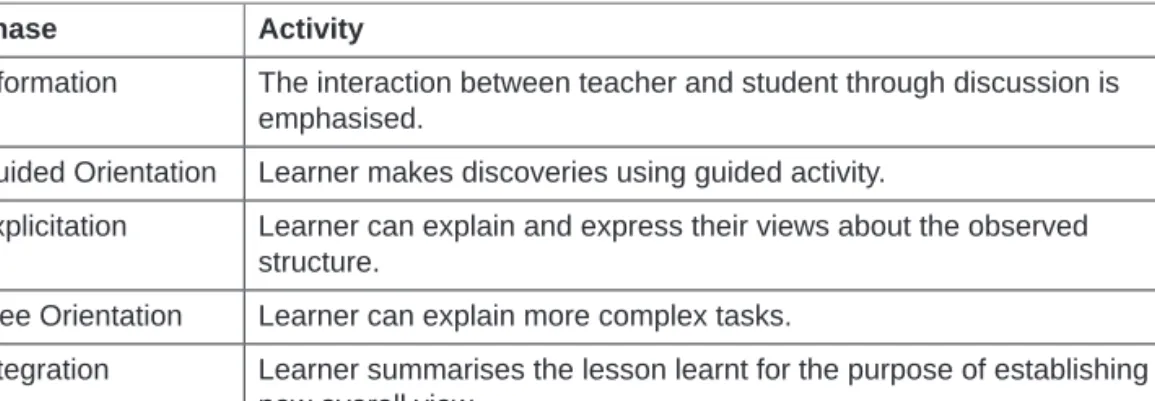
(1996) identified geometrical figures which deal with mental entities possessing simultaneously conceptual and figural characters known as visual images. I have chosen the van Hiele levels of thought as a lens through which this study is seen. Way (2011) asserts that out of the original five, the van Hieles consider the first three levels relevant for learners at school where the main focus is on the classifications of, and deductive reasoning on, 2-D and 3-D shapes. The original sequential and hierarchical discrete levels are (i) recognition or visualisation, (ii) analysis or descriptive, (iii) informal deduction, (iv) deduction, and (v) rigor (van Hiele 1986). Crowley (1987) asserts that instruction should occur at the same level of the learners, while Usiskin (1982) found that learners almost finish the secondary school curriculum with a level of geometric thinking equivalent to their primary school knowledge. Table 1 illustrates the van Hiele phases of learning geometry.
Table 1: van Hiele phases of geometry learning
Phase Activity
Information the interaction between teacher and student through discussion is emphasised.
Guided Orientation Learner makes discoveries using guided activity.
explicitation Learner can explain and express their views about the observed structure.
free Orientation Learner can explain more complex tasks.
Integration Learner summarises the lesson learnt for the purpose of establishing a new overall view.
Other researchers (Abdullahr and Zakaria 2013) identified that some learners operate at a level lower than the van Hiele level on recognition, and therefore suggest a preceding level called the pre-visualisation level. The existing classroom environment in this study was modified to accommodate the aforementioned geometry phases of learning suggested by Crowley (1987) since it was characterised by learners unable to recognise geometric figures at a grade 8 level.
MetHODOLOGY
This article reports specifically on the data collected during the first year of a three-year study aimed at exploring teachers’ challenges experienced in teaching grade 8 geometry in 13 secondary schools in a district of Eastern Cape in South Africa. The study was located within an interpretivist paradigm, which seeks to understand the situation from the perspective of the participants (Ary, Jacobs and Razavieh 2002). A qualitative research approach was followed in a participatory action research (PAR) study designed to explain how a shift from a classroom learning environment to action learning can
promote the teaching of geometry. A sample of 13 teachers out of a population of 30 grade 8 teachers in the district participated in this study.
Two phases made up this empirical study. The first was a familiarisation phase, where the researcher visited the schools to observe how teachers utilised the existing classroom learning environments while teaching geometry. Initially, all 13 teachers were visited and observed teaching geometry during two weeks of the second term. According to the Curriculum and Assessment Policy Statement (CAPS), all grade 8 learners are taught constructions, classification, and investigation of properties of geometric figures together with solution of geometric problems involving unknown sides and angles in triangles and quadrilaterals, using known properties of triangles and quadrilaterals, as well as properties of congruent and similar triangles (Department of Basic Education DoBE 2012) during the second term. Data was collected through classroom observations, questionnaires, and semi-structured interviews conducted with each teacher on the classroom learning environment envisaged for promoting the teaching of geometry. During the first cycle after observing teachers teaching geometry in their natural setting, a workshop on geometry teaching which exposed teachers to creation and use of action geometry learning environments was conducted in a central venue in the district for two days. During the second cycle I visited the schools for observations and then conducted interviews with the teachers. All the activities were done through participatory action research PAR design which contributes to sustained teacher learning and becomes a way for teachers to teach other teachers (Feldman 1993). I adapted Miles and Huberman’s (1994) technique to analyse data collected from observations and interviews conducted with the teachers. After the data reduction process, constant comparison analysis together with content analysis, were applied in the coding and identification of underlying themes. PAR was chosen such thatas it could channel teachers to support each other intellectually and grow pedagogically, such that their professional standing is increased by recogniszing their ability to add to knowledge about teaching mathematics.
ReSULtS AND DISCUSSIONS
In phase 1, a total of three out of 13 lessons were video-recorded because the other ten lessons were not different in any form of presentation. The latter participants used ‘chalk and talk’ to present examples copied from textbooks where the teacher dominated the discussions unilaterally without recognizsing or testing learners’ involvement in the lesson. Only one such presentation was video-recorded. An observation schedule was used to look at how the teachers (i) developed the learning objectives, (ii) selected instructional materials, (iii) set the environment for learning, (iv) used a variety of instructional activities, (v) used instructional methods, (vi) provided opportunity for learners’ participation, (vii) individualised instruction, and (viii) provided feedback to learners’ feedback (Bell 1982a).
Semi-structured interviews were then conducted with the teachers after each presentation on (i) topics teachers found difficult to teach in grade 8 geometry, (ii) workshops attended and topics discussed in those workshops, (iii) resources used in teaching geometry, (iv) familiarity with the CAPS documents, and (v) general challenges teachers had in teaching geometry.
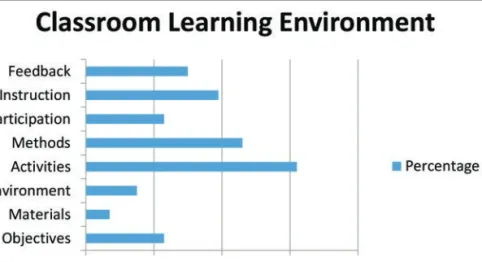
Figure 1 summarises the activities observed and displayed in the 13 classroom learning environments of the different schools. Data collected during phase 1 indicated clearly that the participating teachers did not recognise that application ofed creativity ion their classroom learning environments could have an effect on the understanding of geometric concepts. A workshop was then conducted with the teachers on constructions and drawing of a wide range of geometric figures and solids, hands-on, using appropriate geometric instruments. This was done as a prescription outlined in the CAPS outlines howwhere learners have to be taught to identify, classify, and write definitions of triangles, quadrilaterals, and 3-D shapes.
Figure 1: Activities observed in Cycle 1
The diagram indicates that only 23% of the teachers gave verbally the intended outcomes of the lesson presented, while one out of 13 teachers observed used instructional material in presenting his geometry lesson. That teacher introduced basic geometric concepts using paper folding usingwith A4-size paper, and folded it into various shapes while the learners were watching. The activity was teacher initiated and mastered while the learners were not given an opportunity to experience the creation of the different geometric shapes. None of the skills, knowledge, attitudes, and beliefs that learners brought to the classroom (Bransford et al. 1999) were considered and/or utiliszed. The process where the teacher attempts to discover what learners think in relation to the problems on hand was overlooked. Also, none of their misconceptions were discussed,
and there was no exposure to situations that would challenge them to adjust their ideas (Bell, 1982a). The most popular observed instructional method (62%) used activities as examples to introduce the geometric concepts, showcase how best the teacher understood the concepts, then as classwork practice and assigned as homework. Also non-routine examples were not used in the observed classrooms. In one of the observed lessons the teacher said:
if I had chalkboard drawing instruments, I would demonstrate for you how to bisect a straight line and then show you the resulting figures after the process. Now I can’t. We will skip that part.
Let me just draw the results on the board and we discuss.
The construction practice skipped in that lesson deprived learners of an informed creation of perpendicular bisectors, congruent triangles, self-discovery of isosceles triangle features, and learners’ creation of argument.
Learners in 12 of the 13 lessons observed were not active: they sat and listened without any interruptions until the teacher instructed them to copy from the chalkboard. The instructions were teacher-centred and just exposing learners to geometry. For 90% of the lesson the teacher talked using direct instruction, demonstrated without engaging the learners, explained, and posed questions, the bulk of which were, “Do you understand?” Learners replied in a chorus form and said, “yes”. Obviously this had nothing to do with their understanding or making connections with the content presented in the lesson. This is criticiszed by Bell and Purdy, (1985) who suggest that learners should be engaged in cognitive conflict and must have discussions about their conflicting viewpoints. Aspects of learner-centred environments like instructional sequencing, guided practice, interaction with learners, and grading of tasks were also lacking. For example, in some classrooms the review of the homework done at the beginning of the lesson as introduction was not connected to the lesson intended to be taught.
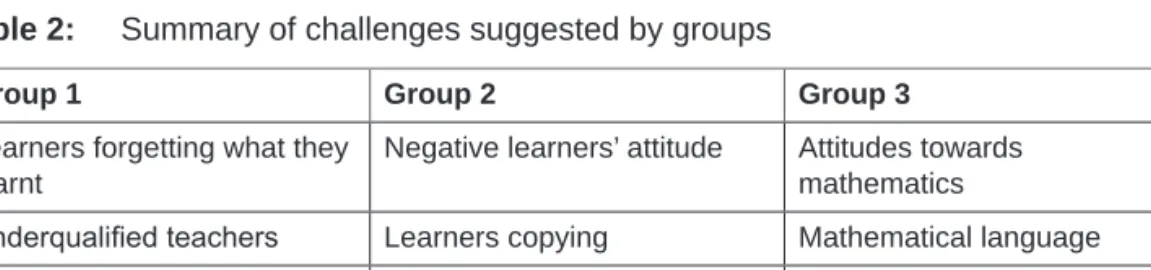
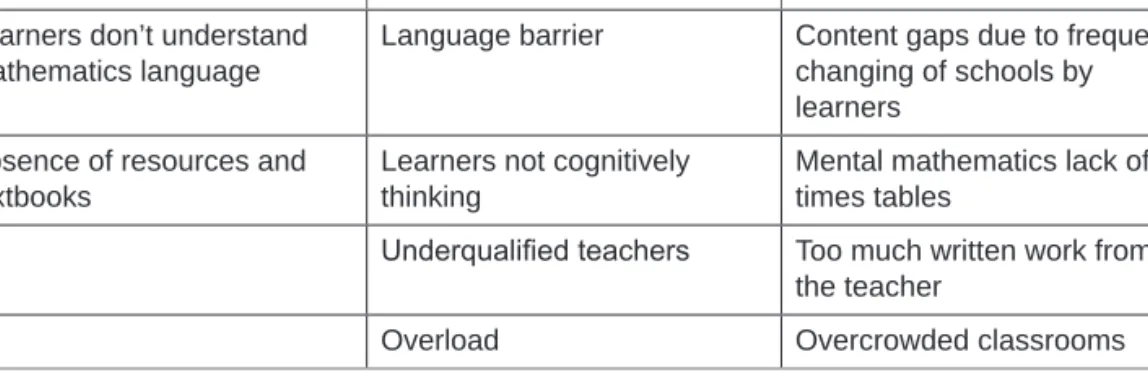
In the second phase a workshop was organised for all 30 grade 8 mathematics teachers in the district. The teachers were first divided into three groups of ten each. They were then requested to list all the weaknesses and challenges experienced in the teaching of grade 8 geometry. The summary of the challenges listed by the groups is presented in Table 2.
Table 2: Summary of challenges suggested by groups
Group 1 Group 2 Group 3
Learners forgetting what they learnt
Negative learners’ attitude Attitudes towards mathematics
Underqualified teachers Learners copying Mathematical language Overcrowded classes Lazy learners - – bored when
given more exercises
Group 1 Group 2 Group 3 Learners don’t understand
mathematics language
Language barrier Content gaps due to frequent changing of schools by learners
Absence of resources and textbooks
Learners not cognitively thinking
Mental mathematics lack of times tables
Underqualified teachers too much written work from the teacher
Overload Overcrowded classrooms
In the next exercise the different groups were requested to suggest solutions to the identified problems. The general suggestions made by teachers are summarised in Table 3.
Table 3: Suggested solutions of challenges identified
Group 1 Group 2 Group 3
employment of more mathematics teachers
Motivational speakers from outside
Motivation and rewards for best-performing learners Motivation and rewards for
best-performing learners
Parent involvement in the learners’ work
frequent use of mathematical language Mathematics teachers to
attend workshops
teachers to stick to the medium of instruction
Deal with fear of doing mathematics
explanation of concepts before doing calculations
One teacher per subject
Interaction with management such that learners are equipped with maths kits and workbooks
Interestingly, none of the suggestions referred to improvement or considerations of classroom learning environments conducive to action learning of geometry. Most of them blamed the underperformance of learners in mathematics onto the absence of motivation and lack of mathematics learning resources.
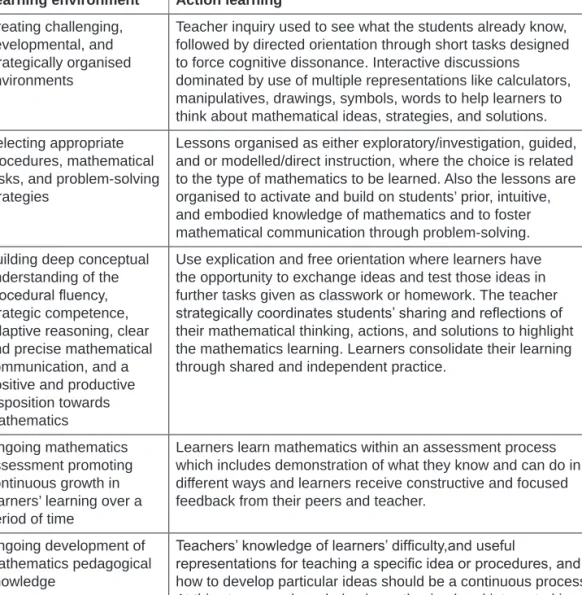
The next stage involved the intervention which covered three levels. During the first level, the teachers were motivated with some suggested actions to be implemented in their classrooms for effective mathematics teaching and learning. It was at this level that teachers were introduced to the conditions for effective mathematics teaching
and learning discussed in Literacy and Numeracy Secretariat (2007). Discussions and suggestions are summarised in Table 4.
Table 4: effective mathematics learning Learning environment Action learning Creating challenging,
developmental, and strategically organised environments
teacher inquiry used to see what the students already know, followed by directed orientation through short tasks designed to force cognitive dissonance. Interactive discussions dominated by use of multiple representations like calculators, manipulatives, drawings, symbols, words to help learners to think about mathematical ideas, strategies, and solutions. Selecting appropriate
procedures, mathematical tasks, and problem-solving strategies
Lessons organised as either exploratory/investigation, guided, and or modelled/direct instruction, where the choice is related to the type of mathematics to be learned. Also the lessons are organised to activate and build on students’ prior, intuitive, and embodied knowledge of mathematics and to foster mathematical communication through problem-solving. Building deep conceptual
understanding of the
procedural fluency,
strategic competence, adaptive reasoning, clear and precise mathematical communication, and a positive and productive disposition towards mathematics
Use explication and free orientation where learners have the opportunity to exchange ideas and test those ideas in further tasks given as classwork or homework. the teacher
strategically coordinates students’ sharing and reflections of
their mathematical thinking, actions, and solutions to highlight the mathematics learning. Learners consolidate their learning through shared and independent practice.
Ongoing mathematics assessment promoting continuous growth in learners’ learning over a period of time
Learners learn mathematics within an assessment process which includes demonstration of what they know and can do in different ways and learners receive constructive and focused feedback from their peers and teacher.
Ongoing development of mathematics pedagogical knowledge
Teachers’ knowledge of learners’ difficulty,and useful
representations for teaching a specific idea or procedures, and
how to develop particular ideas should be a continuous process. At this stage new knowledge is synthesised and integrated in action.
At each stage during the workshop some geometric examples, strategies, and disruptions were demonstrated as actions that could be effected to change the classroom learning environment for an achievement in geometry learning. For example, a flexible seating arrangement that allows learners space for explorations, drawings, and use of manipulatives without hindrances. In this way teachers would focus on controlled changes of structure in a fixed context or on deliberate transfer of structure from one
context to another (Bell, 1985). Teachers had to learn how they determine what learners are learning and, the sustaining of ongoing learning while developing learners’ interest and growing confidence in doing mathematics. During the workshop they were also trained on how to use the material in conjunction with the work schedule drawn up for them by the department. Whilst the teachers followed the suggested work schedule common to all schools in this grade, they were supplied with additional challenging tasks compiled and included in training manuals. Such tasks were developed to enhance teachers’ action learning while they sort and use geometry problems that enable learners to construct their own meaning (Duckworth, 1987), figure things out on their own, and try alternative solutions while being flexible in exploring mathematical ideas and being willing to persevere in their pursuit of new knowledge.
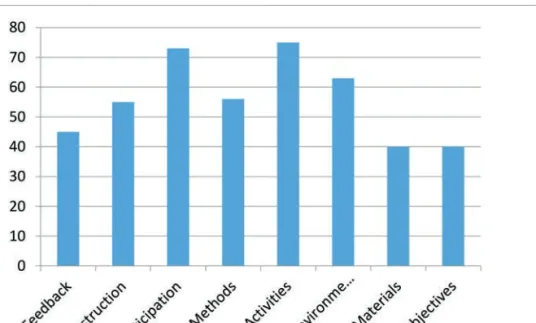
Phase 2 commenced with the researcher revisiting the schools to conduct classroom learning environment observations on how teachers’ action learning affected the teaching of geometry.
Figure 2: Activities observed in phase 2
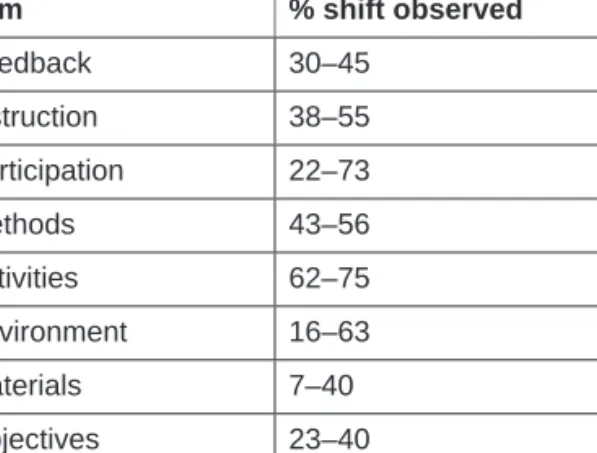
The percentage shifts in classroom learning deliberations observed are illustrated in Table 5. Those shifts occurred in the type of questions asked from, “Do you understand?” to specific questions that led the learners to engage in constructive arguments. Questions now were like, “Why do you think so?”; “Is this always the case?”; “Can you explain how you got your answer?” Inquiry was used to urge learners to justify responses they provided for questions posed. Also other learners were given chances to express and respond to an enquiry in the best way that gave generated sound understanding in their minds. Verification on multiple -ways in which problems could be represented was also
observed in some classrooms. This was done to help learners become metacognitive by making sense of new information and asking for clarification when it doesn’t make sense to them (Palincscar and Brown 1984; Schoenfeld 1991).
Table 5: Observed shift in phase 2
Item % shift observed
feedback 30–45 Instruction 38–55 Participation 22–73 Methods 43–56 Activities 62–75 environment 16–63 Materials 7–40 Objectives 23–40
One of the teachers conducted a practical lesson on the bisecting of a straight line. All the concepts attached to the cutting of a line segment into two equal parts were built whilst learners followed a list of instructions listed on how to do the exercise on a worksheet. Initially they did not know that they were bisecting a line. Some learners followed the instructions on describing arcs while others drew up full circles. A very interesting argument ensued between the two groups, with the latter group convincing others that arcs are short versions of full circles. What made the discussion much more interesting was the development and extension of the lesson beyond the intended objectives. The teacher posed one open-ended question that stimulated the discussion:
Teacher: What are the observed figures that result when joining points along the bisecting line with points A and B of the line bisected? Why?
Learner 1: Equal triangles on both sides? Teacher: Why do you say they are equal?
Learner 1: I can see them.
Teacher: What if I disagree with you, how can you prove that?
Learner 2: In my own case, lines from the centre are equal, I made them using my compass, so I am sure. And I suppose that the other lines are equal for both triangles. Teacher: Let everybody measure each of these lines to verify what [learner 2] is saying.
After confirmation through practical measurement, learners used their own words, to describe mathematical situations to organisze their own knowledge and work and to explain the strategies used (Bransford et al. 1992). Then the teacher extended the vocabulary by referring learners to congruency of triangles. Many issues like the types
of triangles made, right-angled isosceles triangles created, and why, became part of the classroom discourse.
In another classroom where very few learners had mathematical measuring instruments, the teacher used paper folding to illustrate the same experiment on bisecting a line. This illustrates that teachers learnt in action that barriers of absence of material resources and manipulatives cannot stop them from creativity. This was remedial to learners who operated below the level of recognition in van Hiele’s levels of geometrical thinking (Abdullahr and Zakaria, (2013). The prevailing classroom learning environment assisted them with free orientation to experience the discovery of basic properties of resulting figures by following instructions on what to do in the worksheets provided. In this way the teacher invested for the future participation of such learners in geometric lessons since the fear of ridicule from peers was addressed. Classroom discourse in these lessons was used to promote recognition of connections among ideas and extended learners’ knowledge whilst re-organising it (Lampert 1986).
Cobb and Yackel, (1996) assert that when learners propose mathematical ideas and evaluate their thinking and that of others, they develop mathematical reasoning skills, while learning with understanding is enhanced by classroom interactions in a free social free environment. Also Bransford et al. (1999) asserts that learning is influenced in fundamental ways by the context in which it takes place. These authors stress that, in the community-centered approach, norms for the classroom and school, as well as connections to the outside world, that support core learning values must be developed. In the environment created by teachers learning in action in spite of prevailing conditions, learners learnt through spatial visualisation of objects provided to them in class to build and manipulate mental representations of 2-D and 3-D objects and perceived objects from different perspectives as their hands-on experience formed an important aspect of geometric thinking.
CONCLUSIONS
Through action learning teachers learnt to use instructional designs that equip the learners in each mathematics lesson with skills to: (a) think for themselves, (b) adapt to unfamiliar and unpredictable situations, (c) promote interest, common sense, and power to discriminate, (d) persevere in the face of failure, and (e) construct their own ideas about mathematics while they take responsibility for their own learning. Mathematics teachers can change the classroom learning environments by recogniszing the mathematical possibilities in a geometrical task, and reworking it such that it is adapted to a unique group of learners and context. This involves the structuring of activities such that learners explore, explain, extend, and evaluate while they appreciate the relevance of new knowledge making sense of what they learn. The challenge is that teachers need to create an environment that strikes an appropriate balance between activities designed to promote understanding and those designed to promote the automaticity
of skills necessary to function effectively without being overwhelmed by attentional requirements. The implication is that teachers need to resource and deploy a wide range of instructional methods that are varied from lesson to lesson to support the acquisition of mathematical proficiency.
ACKNOWLeDGeMeNtS
Thanks to the Women in Research grant from UNISA that enabled and provided for data collection during this study.
RefeReNCeS
Abdullah, A. H. and E. Zakaria. 2013. The effects of van Hiele’s’ phases of learning geometry on students’ degree of acquisition of van Hieles’ levels. Procedia – Social and Behavioral Sciences 102: 251–266. Ary, D., L. C. Jacobs and A. Razavieh. 2002. Introduction to research education. 6th ed. Australia:
Wadsworth Thomson Learning.
Baker, P. B. and L. W. Digiovanni. 2005. Narratives on culturally relevant pedagogy: Personal responses to the standardized curriculum. Current Issues in Education 8 (22). https://cie.asu.edu/ojs/index.php/ cieatasu/article/view/1611 (accessed 28 February 2010).
Bell, A. W. 1982a. Diagnosing students’ misconceptions. The Australian Mathematics Teacher 38 (1): 6–10. Bell, A. W. 1982b. Treating students’ misconceptions. The Australian Mathematics Teacher 38 (3): 11–13. Bell, A. W. 1985. Some implications of research on the teaching of mathematics. In Theory, Research
and Practice in Mathematical Education, ed. A. Bell, B. Low and J. Kilpatrick. 61–79. Proceedings of Fifth International Congress on Mathematical Education, Adelaide, South Australia. Nottingham, UK: Shell Centre for Mathematical Education, University of Nottingham.
Bell, A. W. and D. Purdy. 1985. Diagnostic teaching: Some problems of directionality. Nottingham, UK: Shell Centre for Mathematical Education, University of Nottingham.
Bell, A. W., K. Pratt and D. Purdy. 1986. Teaching by conflict discussion: A comparative experiment. Nottingham, UK: Shell Centre for Mathematical Education, University of Nottingham.
Biehler, R. F. and J. Snowman. 1993. Psychology applied to teaching (7th ed.). Boston: Houghton Mifflin Company
Bransford, J., A. Brown and R. Cocking 1992. How people learn: Brain, mind, experience, and school. Washington, DC: National Academy Press.
Bransford, J. D., A. L. Brown and R. R. Cocking. 1999. How people learn: brain, mind, experience and school. Washington DC: The National Academy of Sciences.
Burger, W. F. and J. M. Shaughnessy. 1986. Characterizing the van Hiele levels of development in geometry. Journal for Research in Mathematics Education 7 (1): 31–48.
Cobb, P. and E. Yackel. 1996. Constructivist, Emergent, and Sociocultural Perspectives in the Context of Developmental Research. Educational Psychologist, 31 (3/4): 175-190. Lawrence Erlbaum Associates, Inc.
Cobb, P., E. Yackel and T Wood. 1992. A constructivist alternative to the representational view of mind in mathematics education. Journal for Research in Mathematics Education 23 (1): 2–33.
Cetner, M. 2015. Weaving geometry and algebra together. Mathematics Teacher 108 (8): 584–590. Çontay, E. G. and A. D. Paksu. 2012. Preservice mathematics teachers’ understandings of the class inclusion
between kite and square. Procedia – Social and Behavioral Sciences 55: 782–788.
Crowley, M. L. 1987. The van Hiele model of the development of geometric thought. In Learning and Teaching Geometry, K-12, ed. M. M. Lindquist. 1–16. Reston, VA: National Council of Teachers of Mathematics.
Department of Basic Education. 2012. Integrated strategic planning framework for teacher education and development in South Africa. Pretoria: Department of Basic Education.
Ding, L. and K. Jones. 2006. Teaching geometry in lower secondary school in Shanghai, China. Proceedings of the British Society for Research into Learning Mathematics 26 (1): 41–46.
Duckworth, E. 1987. “The having of wonderful ideas” and other essays on teaching and learning. New York: Teachers College Press, Columbia University.
Fast, L. A., J. L. Lewis, M. J. Bryant, K. A. Bocian, R. A. Cardullo, M. Rettig and K. A. Hammond. 2010. Does math self-efficacy mediate the effect of the perceived classroom environment on standardized math test performance? Journal of Educational Psychology 102 (3): 729–740.
Feldman, A. 1993. Teachers learning from teachers: Knowledge and understanding in collaborative action research. Unpublished doctoral dissertation. Stanford University.
Fischbein, E. 1993. The interaction between the formal, the algorithmic and the intuitive components in a mathematical activity. R. Biehler, R. W. Scholz, R. Straser, and B. Winkelmann. Eds., Didactics of Mathematics as a Scientific Discipline. 231-245. Netherlands, Dordrecht: Kluwer
Fischbein, E. 1996. The theory of figural concepts. Educational Studies in Mathematics 24 (2): 139–162. Fraser, S. 2012. Authentic childhood. Toronto, ON: Nelson Education.
Garrett, B. 2008. Judging innocence. Columbia Law Review 108: 55–142.
Harris Helm, J., S. Beneke and K. Steinheimer. 2007. Windows on learning: Documenting young children’s work. University of Michigan, MI: Teachers College Press.
Jones, K. 2000. Critical issues in the design of the geometry curriculum. In Readings in Mathematics Education, ed. B. Barton, 75–90. Auckland, New Zealand: University of Auckland.
Knight, K. C. 2006. An investigation into the change in the van Hiele levels of understanding geometry of pre-service elementary and secondary mathematics teachers. M.Sc. dissertation. The University of Maine.
LaBerge, D., and S. Jay. Samuels. 1974. Toward a theory of automatic information processing in reading. Cognitive Psychology, 6 (2): 293–323
Lampert, M. 1986. Teachers’ thinking about students’’ thinking about geometry: The effects of new teaching tools. Technical Report 88-1. Washington, DC: Office of Educational Research and Improvement. Literacy and Numeracy Secretariat. 2007. Learning blocks for literacy and numeracy. Originally published
as Special Edition #1 What Works? Research into Practice. Reprinted as Special Edition #1, Capacity Building Series. Ontario Legislative Library eArchive
Ly, R. K. and J. A. Malone. 2010. Teachers’ perceptions of geometry instruction and the learning environment in Years 9-10 ESL classrooms.[AQ19]
L. Sparrow, B. Kissane, and C. Hurst. Eds. Shaping the future of mathematics education: Proceedings of the 33rd annual conference of the Mathematics Education Research Group of Australasia. 367-374. Fremantle. WA: Merga.
Ma, L. 1999. Knowing and teaching mathematics: Teachers’’ understanding of fundamental mathematics in China and the United States. Mahwah, NJ: Lawrence Erlbaum Associates.
Marchis, I. 2012. Preservice primary school teachers’ elementary geometry knowledge. Acta Didactica Napocensia 5 (2): 33–40.
Miles, M. B. and A. M. Huberman. 1994. Qualitative data analysis. Thousand Oaks, CA: Sage.
OWP/P Architects, VS Furniture and Bruce Mau Design. 2010. The third teacher: 79 ways you can use design to transform teaching and learning. New York, NY: Abrams.
Palinscar, A. S. and A. L. Brown., 1984. Reciprocal teaching of fostering and comprehension-monitoring activities. Cognition and Instruction 1 (2): 117–175.
Piaget, J. 1967. Psychology of intelligence. Totowa, NJ: Littlefield, Adams and Co.
Prawat, R. S., J. Remillard, R. T. Putnam and R. M. Heaton. 1992. Teaching mathematics for understanding: Case study of four fifth-grade teachers. Elementary School Journal 93 (2): 145–152.
Robinson, K. 2010. ‘The third teacher’: Designing the learning environment for mathematics and literacy, K to 8. Capacity building series. Special Edition 27. www.edu.gov.on.ca/eng/literacynumeracy/ inspire/. Ontario.
Schoenfeld, A.H. 1983. Problem Solving in the Mathematics Curriculum: A Report, Recommendations and an Annotated Bibliography. The Mathematical Association of America. MAA Notes. No. 1.
Schoenfeld, A. H. 1991. On mathematics as sense making: An informal attack on the unfortunate divorce of formal and informal mathematics. In Informal Reasoning and Education, ed. J. F. Voss, D. N. Perkins and J. W. Segal. 331–343. Hillsdale, NJ: Erlbaum.
Schoenfeld, A.H. 1985. Mathematical Problem Solving. New York: Academic Press.
Siyephu, S. W. and T. Mthonjeni. 2014. Geometrical concepts in real-life context: A case of South African traffic road signs. Lebitso, M. and A. Maclean. 20th AMESA Annual Conference Proceedings, . 1 (7): 7th-11th July 2014. Kimberley, South Africa.
Usiskin, Z. 1982. Van Hieles’ levels andof achievement in secondary school geometry: CDASSG Project., Chicago, IL: Chicago University.
Van Hiele, P. M. 1986. Structure and insight: A theory of mathematics education. Orlando, FL: Academic Press.
Vighi, P. 2003. The triangle as a mathematical object. Paper presented at the Proceedings of the European Research in Mathematics Education III Congress. 28 February–3 March. Bellaria, Italy.
Way, J. 2011. The development of spatial and geometric thinking: The importance of instruction. Featured early years of geometric foundations. University of Cambridge. http://www.nrich.maths.org, Millennium Mathematics Project
Yackel, E. and P. Cobb. 1996. Socio-mathematical norms, argumentation, and autonomy in mathematics. Journal for Research in Mathematics Education 27 (4): 458–477.