1
Designing a Continuing Professional Development MOOC on OER and OEP
Shironica P. Karunanayaka
1, Som Naidu
2, J.C.N. Rajendra
1, and S. A. Ariadurai
11
The Open University of Sri Lanka,
2The University of the South Pacific
Abstract
There is growing interest in the adoption of open educational resources (OER) and open
educational practices (OEP) in a variety of contexts. Continuing professional development
(CPD) among practitioners in the effective adoption of OER and OEP is critical in this scenario.
Massive open online courses (MOOCs), which also grew as part of the open education
movement, provide a feasible means for this purpose. MOOCs are considered a ‘disruptive
innovation’ in making free and open learning opportunities accessible to large numbers. Yet, the
design of an effective massive online course that is as robust as a great online course with
smaller student numbers where good principles of teaching and learning are maintained, is very
challenging. Most contemporary MOOCs tend to have a content-driven focus of knowledge
transmission, deviating from its original focus of knowledge generation. With the intention of
providing learning experiences to promote learner engagement with OER, rather than
presenting content about OER, we designed a CPD MOOC to support the integration of OER
and adoption OEP by practitioners based on a scenario-based learning (SBL) approach. This
paper presents the analysis and design phases of this process, discussing the challenges faced
and innovative strategies adopted in our pursuit to answer the question, ‘“How best to design an
effective MOOC on OER and OEP for continuing professional development of practitioners?”
Key Words
MOOC design; Continuing Professional Development; Open Educational Resources; Open
Educational Practices; Scenario-based Learning; Learning Experience Design
Introduction
In order to develop capacity among educators in the integration of OER in their teaching
practices, the Open University of Sri Lanka (OUSL) implemented a professional development
(PD) course on OER-based e-Learning (OEReL), with the support of the Commonwealth
Educational Media Centre for Asia (CEMCA). This fully online course of 24 weeks comprised
five modules adapted from a core set of modules in a course on OER-based e-Learning that
was developed by CEMCA, in collaboration with the Wawasan Open University, Malaysia, as
part of its institutional capacity building programme to promote use of OER (CEMCA, 2014). At
the successful completion of its implementation, there was an imperative for the continuation of
this PD course beyond OUSL to other Universities and higher educational institutions in Sri
Lanka, and in the region. The re-designed course would take the form of a MOOC (Massive
Open Online Course).
As revealed by research conducted in relation to the OEReL course, (see Karunanayaka,
Naidu, Rajendra, & Ratnayake, 2017; Karunanayaka, Rajendra, Ratnayake, & Naidu, 2016;
Karunanayaka, Naidu, Rajendra, & Ratnayake, 2015), it had much strength as a PD online
course for educators on OER-based eLearning. However, a common issue faced by the
participants as full-time academics, was the difficulty to engage in and complete all required
learning and assessment tasks within the stipulated time-frames. Due to this, many participants
dropped out during the course, and the completion rate of the full course was only 29%. In order
Karunanayaka, S.P., Naidu, S., Rajendra, J.C.N., & Ariadurai, S.A. (2018). Designing a Continuous Professional Development MOOC on OER and OEP. Paper accepted to be presented at the Open Education Global 2018 Conference. 24-26 April, Delft, the Netherlands, and recommended for publication in the journal Open Praxis (FINAL DRAFT).
2
to extend the existing course to a wider audience, while addressing these issues, it was decided
to substantially re-design the OEReL course as a MOOC for continuing professional
development (CPD) on OER and OEP for practitioners, containing four independent CPD
MOOCs of a shorter duration.
While the concept of MOOCs has gained significant attention in making free and open learning
opportunities accessible to large numbers, the real challenge lay in the design of an effective
massive online course that is as robust as a great online course with smaller student numbers
where good principles of teaching and learning are maintained. To deal with this challenge, a
design-based research (DBR) approach is adopted in this project, which comprises an iterative
process of analysis, design, development, and implementation while testing theory and
producing design principles (Reeves, 2006). This paper reports on the analysis and design
phases of this DBR process, during which the learning experience design of the CPD MOOC
took place, adopting innovative theoretical constructs, and using a scenario-based learning
(SBL) approach.
Review of Literature
MOOCs grew out of an interest in open and flexible learning. Since its emergence in 2008, the
MOOC phenomenon has gained rapid attention and wide recognition as a promising
educational innovation, and is considered a model of free, open and life-long learning.
(Anderson, 2013; Bates, 2015; Daniel, 2012; Downes, 2012). Trends in MOOC development
indicates significant changes in MOOC types in relation to their pedagogical designs, from “c”
(connectivist) MOOCs to “x” (extended) MOOCs and further to various hybrid/dual layer MOOCs
(Bozkurt, Akgun-Ozbek & Zawacki-Ritcher, 2017; Liyanagunewardena, Adams & Williams,
2013).
The first generation of cMOOCs supported a connectivist theory of learning that viewed
knowledge as distributed and learning as a social process, focusing on ‘knowledge creation and
generation’, while the second generation of xMOOCs focused on ‘knowledge duplication’
(Siemens, 2014). Key design principles for cMOOCs are: autonomy of the learner- in terms of
learners choosing what content or skills they wish to learn; diversity- in terms of the tools,
participants and content; interactivity- in terms of co-operative learning and communication; and
openness- in terms of access, content, activities and assessment (Bates, 2014). In contrast,
common design features of xMOOCs comprise transmitting information through video lectures,
computer-marked assessments and peer assessments, automation of all key transactions, and
no or very light discussion moderation (Bates, 2015).
The current dominance of xMOOCs in education indicates a transformation of MOOCs from its
original intention of knowledge sharing among networked learners, back to the conventional
transmission of information from an expert to novices. This implies a deviation in the purpose of
MOOCs from a humanitarian motive to a more business-oriented motive (Bozcurt et al., 2017;
Yuan & Powell, 2013). This change of focus of MOOCs from a ‘distributed knowledge network’
to a ‘hub and spoke model’ of learning (Seiman, 2012) raises concerns about the real purpose
of MOOCs. However, it is argued that this c/x MOOC binary is no longer representative or
useful (Bayne & Ross, 2014), and that the design of MOOCs are evolving with all kinds of
variations (Bates, 2015). If the main purpose of a MOOC is to ensure meeting learner needs
and support learners achieve the intended learning outcomes, such course design essentially
requires application of sound principles and practices of online teaching and learning.
3
The four key dimensions of MOOCs– Massive, Open, Online, Course - implies their main
characteristics and required design features. Foremost, a MOOC is a large ‘online course’. Its
‘openness’ element is not only about cost and access, but also about the flexibility in choices of
content, activities, assessments and interactions by learners (Bates, 2014). While the
‘massiveness’ of these courses is often interpreted only in terms of the large student numbers
enrolled, other dimensions of massiveness such as diversity among learners and their
interconnections are just as significant. This complex nature of MOOCs essentially requires
making critical pedagogical decisions in the design of MOOCs. However, despite increasing
number of MOOCs, many such initiatives lack the expected rigor of a full course, and face
various pedagogical challenges. Most contemporary MOOCs exhibit models of conventional
lecture-based practices, disregarding widely known and sound principles of online learning
(Naidu, 2015).
Given the expectation of MOOC learner characteristics such as autonomous, independent,
self-motivated, and self-directed, MOOCs are ideal for providing higher education (HE)
opportunities. MOOCs’ help to democratize HE, with a preference towards a continuing
education model (Evans & Myrick, 2015). MOOCs have a vast potential to support CPD and
thus transform professional practices, provided the learning environments are designed in
appropriate ways (Laurillard,2014; Littlejohn & Milligan, 2015; Pickering & Swinnerton, 2017).
Pedagogical design of CPD MOOCs thus requires crucial attention, intensely supported with
theory of learning, while more creative and open-minded approaches are desirable (Bayne &
Ross, 2014; Laurillard, 2014).
Conceptual Framework
The adoption of OER and OEP requires an understanding of the concepts, and skills in finding,
identifying, and creating OER, as well as how best to integrate OER to support the
teaching-learning process. This requires practitioners to move beyond a mere focus on access to OER,
and engage in various scholarly practices of openness, resulting in OEP which are participatory,
collaborative and innovative in nature (Andrade et al., 2011; Ehlers, 2011; Beetham, Falconer,
McGill & Littlejohn, 2012).
A Scenario-based approach to Learning (SBL) which models situated cognition (Brown, Collins
& Duguid, 1989) is adopted in this project to provide the conceptual framework for the design of
the CPD MOOC on OER and OEP. This approach is grounded in constructivist pedagogy
(Jonassen, Peck & Wilson, 1999) where learners are placed in authentic real world learning
scenarios that provide the context and scaffolding for all learning activities (Naidu, Menon,
Gunewardena, Lekamge & Karunnayaka, 2007).
The SBL approach contains three basic attributes: A Learning Scenario – where learners are
situated in authentic learning scenarios; Learning Activities – where learners assume key roles,
and face various challenges; and Assessment Tasks – where learners demonstrate developed
competencies, and enable teachers to assess their achievement of the intended learning
outcomes. The development of SBL seeks to promote the design of effective, efficient, engaging
learning experiences based on innovative pedagogical models, and supported with OER (Naidu
& Karunanayaka, 2014). Several theoretical guidelines based on first principles of instruction
(Merrill, 2002) and good practices of online learning (Anderson, 2008) also provided useful
insights in the design process of the CPD MOOC.
Karunanayaka, S.P., Naidu, S., Rajendra, J.C.N., & Ariadurai, S.A. (2018). Designing a Continuous Professional Development MOOC on OER and OEP. Paper accepted to be presented at the Open Education Global 2018 Conference. 24-26 April, Delft, the Netherlands, and recommended for publication in the journal Open Praxis (FINAL DRAFT).
4
The design and development of this CPD MOOC on OER and OEP adopted a design-based
research (DBR) approach. DBR is a systematic and flexible methodology aimed at improving
educational practices through an iterative process of analysis, design, development, and
implementation. It therefore serves as a useful approach where researchers function as
designers, to design solutions/strategies, in collaboration with the practitioners, in order to
improve their educational practices in real life situations.
The DBR process includes four phases: analysis of existing levels of practices by researchers
and practitioners; designing, developing and implementing solutions as appropriate; testing and
refining solutions in practice; and reflection by researchers and practitioners on authentic
problems to produce design principles and enhance solution implementation (Reeves, 2006).
This paper focuses on the analysis and design phases of the DBR process, during which the
learning experience design of the CPD MOOC occurred during a series of interactive course
design workshops conducted at the OUSL.
At a time when ICT-integrated teaching and learning is gaining wider popularity within the
education system in Sri Lanka, and with the growing need for raising awareness on the
potentials of OER and promoting OEP among educators, the OUSL has embarked on this novel
venture to develop a CPD MOOC to support adoption of OER and OEP by practitioners. The
course design team engaged in a sequence of systematic and carefully structured activities,
keeping in line with the appropriate theoretical constructs and the conceptual framework
adopted.
Research Questions
Based on the broad key research question, “How best to design an effective CPD MOOC on
OER and OEP?” the following sub-research questions guided this inquiry.
1. How innovative theoretical constructs can be adopted in the design of CPD MOOC on OER
and OEP?
2. What challenges were faced in the design of learning experiences of the CPD MOOC on
OER and OEP?
3. How were these challenges met and overcome?
Participants
The learning experience design process of the CPD MOOC took place with the participation of
eleven members in the course team, comprising four researchers and seven resource persons,
who are practitioners in the higher education sector with significant professional experience.
Their interest and commitment in promoting open, online and flexible learning and teaching was
a common characteristic which motivated their voluntary participation and engagement in this
novel endeavor at OUSL.
Process
Stage 1 of the DBR approach commenced with an analysis of the problem and existing
practices, by researchers and practitioners in collaboration. The team engaged in reviewing the
modules of the existing OEReL course and discussing at length, the design strategies to be
5
adopted in the CPD MOOC on OER and OEP, based on their experiences and good principles
of online learning.
Next, in stage 2 of the DBR approach, development of solutions to address the key problem
“How best to design an effective CPD MOOC on OER and OEP?” occurred, informed by
existing design principles and technological innovations. Here, the team engaged in a highly
challenging and dynamic process of designing efficient, effective and engaging online learning
experiences in the four CPD MOOCs, in accordance with the SBL pedagogical approach,
supported with relevant theoretical constructs.
Collection and analysis of data
Throughout the course design process, a variety of data was collected using several methods -
concept mapping, written self-reflections, focus group discussions, and analysis of the designed
artefacts.
Concept mapping was used as a strategy to visualize the concept formation by organizing and
representing relationships between them (Novak & Cañas, 2007), which also helped in planning
the structure of the CPD MOOC. Three versions of concept maps were created- individual
concept maps of team members; two small group concept maps combining individual ideas and
a final group concept map merging all agreed design features. Further, the members engaged
in writing self-reflections at various stages of the process. Reflective writing was guided by
answering three questions- ‘What?’ ‘So what?’ and ‘Now what?’ (Rolfe, Freshwater, & Jasper,
2001). In addition, focus group discussions among participants were held at the interactive
workshops.
During these activities, the learning outcomes and key content areas were identified with the
constructive alignment of all, and the course team arrived at consensus in the specific CPD
MOOC design features to be adopted, considering the needs and purposes of the target group.
These resulted in several versions of various artefacts such as course maps, learning
scenarios, learning activities, assessment rubrics, learner support documents, which
demonstrated the conceptual development during the design process, in line with the guiding
principles of teaching and learning.
The content analysis of concept maps, self-reflections, focus group discussion transcripts and
designed artefacts reveal how innovative theoretical constructs were adopted in the CPD
MOOC design, what challenges were faced during the process and how those were overcome
by the participants.
Results and Discussion
How innovative theoretical constructs can be adopted in the design of CPD MOOC on
OER and OEP?
The key focus during the analysis stage was understanding the purpose of a CPD MOOC, and
conceptualising the specific requirements, accordingly. The final group concept map presented
in Figure 1 illustrates a summary of the conceptualized overall plan of the CPD MOOC.
Karunanayaka, S.P., Naidu, S., Rajendra, J.C.N., & Ariadurai, S.A. (2018). Designing a Continuous Professional Development MOOC on OER and OEP. Paper accepted to be presented at the Open Education Global 2018 Conference. 24-26 April, Delft, the Netherlands, and recommended for publication in the journal Open Praxis (FINAL DRAFT).
6
Figure 1: The final group concept map illustrating the conceptualization of the CPD MOOC
7
Revisiting the existing OEReL course and based on prior experience, it was decided to design
four stand-alone CPD MOOCs focusing on the key content areas of the overall CPD MOOC on
OER and OEP. Since these are meant for practitioners and professionals in the field, the
duration of each CPD MOOC is to be limited to four weeks, with an expectation of 3-5 hours of
learning time per week.
Considering the fact that a MOOC is an online course, the basic requirements such as having
an organized structure with start and end dates, course materials, learning and assessment
activities constructively aligned with the learning outcomes, and adequate learner support
features were identified. At the same time, recognizing that a MOOC should not only promote
independent learning but also provide an opportunity for learners to connect, collaborate, and
engage in the learning process, key features such as making the learning environment flexible,
facilitative, challenging, motivating, interactive, resourceful, contextualized and personalised
were thought-out. In order to maintain the ‘openness’ and ‘massiveness’ of a MOOC, it was
decided to provide free and open access, multiple/lateral entry options (for the four CPD
MOOCs), multiple options in learning and assessment tasks, and varied multimedia formats to
cater to diverse learner needs and individual differences.
A summary of the learning experience design of the CPD MOOC in line with guiding principles
of effective, efficient, and engaging (e
3)
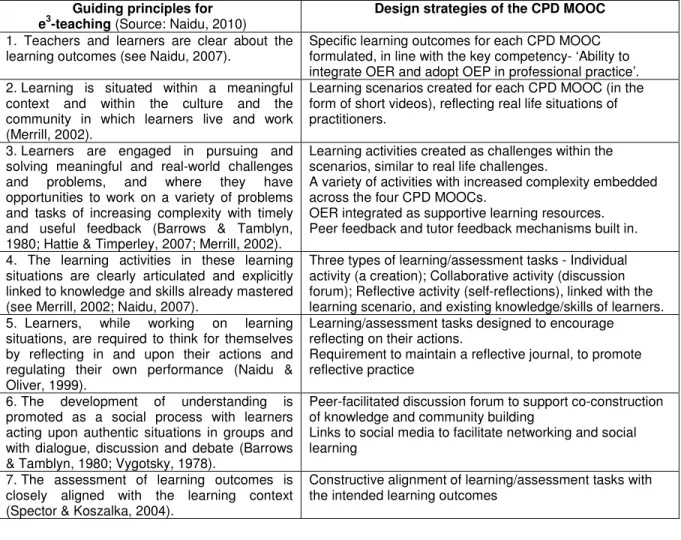
teaching is presented in Table 1.
Table 1: Design strategies of the CPD MOOC in line with guiding principles for e
3-teaching
Guiding principles for
e3-teaching (Source: Naidu, 2010) Design strategies of the CPD MOOC 1. Teachers and learners are clear about the
learning outcomes (see Naidu, 2007). Specific learning outcomes for each CPD MOOC formulated, in line with the key competency- ‘Ability to integrate OER and adopt OEP in professional practice’. 2. Learning is situated within a meaningful
context and within the culture and the community in which learners live and work (Merrill, 2002).
Learning scenarios created for each CPD MOOC (in the form of short videos), reflecting real life situations of practitioners.
3. Learners are engaged in pursuing and solving meaningful and real-world challenges and problems, and where they have opportunities to work on a variety of problems and tasks of increasing complexity with timely and useful feedback (Barrows & Tamblyn, 1980; Hattie & Timperley, 2007; Merrill, 2002).
Learning activities created as challenges within the scenarios, similar to real life challenges.
A variety of activities with increased complexity embedded across the four CPD MOOCs.
OER integrated as supportive learning resources. Peer feedback and tutor feedback mechanisms built in. 4. The learning activities in these learning
situations are clearly articulated and explicitly linked to knowledge and skills already mastered (see Merrill, 2002; Naidu, 2007).
Three types of learning/assessment tasks - Individual activity (a creation); Collaborative activity (discussion forum); Reflective activity (self-reflections), linked with the learning scenario, and existing knowledge/skills of learners. 5. Learners, while working on learning
situations, are required to think for themselves by reflecting in and upon their actions and regulating their own performance (Naidu & Oliver, 1999).
Learning/assessment tasks designed to encourage reflecting on their actions.
Requirement to maintain a reflective journal, to promote reflective practice
6. The development of understanding is promoted as a social process with learners acting upon authentic situations in groups and with dialogue, discussion and debate (Barrows & Tamblyn, 1980; Vygotsky, 1978).
Peer-facilitated discussion forum to support co-construction of knowledge and community building
Links to social media to facilitate networking and social learning
7. The assessment of learning outcomes is closely aligned with the learning context (Spector & Koszalka, 2004).
Constructive alignment of learning/assessment tasks with the intended learning outcomes
Karunanayaka, S.P., Naidu, S., Rajendra, J.C.N., & Ariadurai, S.A. (2018). Designing a Continuous Professional Development MOOC on OER and OEP. Paper accepted to be presented at the Open Education Global 2018 Conference. 24-26 April, Delft, the Netherlands, and recommended for publication in the journal Open Praxis (FINAL DRAFT).
8
8. The assessment of learning outcomes is linked to meaningful problems and tasks, and aimed at helping students further develop their knowledge, skills and problem-solving abilities (Spector & Koszalka, 2004).
The learning activities directly linked with the learning scenario, function as assessment tasks - Individual activity (a creation); Collaborative activity (discussion forum); Reflective activity (self-reflections).
9. The assessment of learning outcomes is designed to develop self-regulatory and meta-cognitive skills (Spector & Koszalka, 2004).
Assessment rubrics created for each assessment task to facilitate development of self-regulatory and meta-cognitive skills among learners.
The SBL pedagogical approach provided a useful framework to plan the design strategies in line
with appropriate theoretical constructs indicated in Table 1. The process involved identifying the
overall key competency, formulating specific learning outcomes for the four CPD MOOCs,
creating learning scenarios reflecting real life challenging situations and developing a variety of
learning/assessment tasks supported with OER integration as learning resources, based on the
‘learning engine’ framework (Naidu & Karunanayaka, 2014).
Several innovative design features were incorporated here. The learning scenarios which act as
‘triggers’ to activate learning, are to be presented in short video form, to gain learners’ attention
and situate them in the learning context in a motivating manner. At the end of each video, the
role to be played by the learner will be indicated as a challenge faced. This is the first task in the
form of a ‘creation’ of an artefact, enhancing individual efforts in finding solutions to the
challenge in a creative way, to promote creative learning.
The second task requires sharing of their creation in the peer-facilitated discussion forum, to
receive and provide peer feedback, encouraging collaborative learning and co-construction of
knowledge. Links will also be provided to social media (eg. Facebook closed group) to facilitate
networking and social learning.
To support learner engagement in these activities, various media forms of carefully selected
OER will be linked appropriately. These will offer the relevant and specific content, to support
individual and group knowledge construction.
The third and the final task is writing a self-reflection at the end of learning experience, to
promote reflective learning. Assessment rubrics are provided for each task that will help
facilitate self-regulated learning and meta-cognition. As evident by Table 1, all these innovative
design features are supported by theoretical constructs and guiding principles of effective,
efficient, and engaging teaching and learning.
What challenges were faced in the design of learning experiences of the CPD MOOC on
OER and OEP and how were these challenges met and overcome?
Designing specific strategies in accordance with the complex nature of a CPD MOOC,
maintaining its participatory and distributed nature, while promoting independent, self-regulated
and life-long learning was very challenging. However, various strategies were adopted to
overcome these challenges. Table 2 presents a summary of the key challenges faced by the
participants and what strategies supported overcoming those, as revealed by the self-reflections
and focus group discussions.
9
Table 2: Key challenges faced and strategies to overcome them
Challenges Strategies to overcome
Supportive quotes
Expert guidance …By actively participating I have gathered good knowledge about
MOOCs. Never knew how a MOOC should be…
…Team leaders’ guidance, discussions, emails…supported… …That is a very good experience for me to get the views of a professional group of researchers as well as academics…
Novelty of the concepts – MOOCs; OEP; SBL
Concept mapping …Now I have a clearer idea about the CPD MOOC and how it should
be developed. The process so far was really rewarding with lot of experiences and knowledge that will sharpen our way of thinking and acting…
Creation of learning scenarios
Peer group discussions
…Challenge was to think…how, different levels and professions are addressed by a scenario…
…We had to revise our outputs several times...
Distributed work …First going through the activities individually and then pooling our
ideas together as a team was highly productive…
… Assigning work to each member led me to understand the process well…
Collaborative work …Most of the time we used the collaborative group work in designing
of activities in the course...
…Development was done step by step with group discussions...
Structured
workflow ..We have been regulated by learning outcomes, constructivism, feasibility, customer attraction, being realistic, time and simplicity etc..
Development of learning/assessment tasks
Reflective practice …Also we got an opportunity to do the presentations on what we
have developed in the group. The recap sessions and collaborative activities helped us to improve the way we think …
Interactive
workshops …It took some time to get into the correct track. The time that needed to allocate for the work is one of the major barrier for me… …Difficult to find time to do all the work. Whatever done during the interactive workshops was the most productive…
Time constraints
Constant email
communication …email communication kept us informed about the next stage…
For the majority of the participants the MOOC concept was novel, and some of them were not
familiar with the concepts of OEP and SBL too. The constant guidance provided by the team
leaders via email, and engaging in group discussions and concept mapping were supportive for
them to become familiar with these concepts. Development of learning scenarios was found to
be quite challenging, and it took several rounds of very intensive work, producing many versions
of individual and group efforts to achieve consensus.
While the focused and structured workflow during the interactive workshops supported
development of learning/assessment tasks constructively aligned with the learning outcomes, it
was challenging as well. All participants appreciated the interactive workshops during which
everyone was able to actively participate and collectively contribute towards the CPD MOOC
design. Time constraints was a common factor for all participants. Engaging in distributed
individual work, presenting and receiving peer feedback, and collaborative group work during
the interactive workshops were emphasized as very supportive strategies to minimize and
overcome the challenges.
Karunanayaka, S.P., Naidu, S., Rajendra, J.C.N., & Ariadurai, S.A. (2018). Designing a Continuous Professional Development MOOC on OER and OEP. Paper accepted to be presented at the Open Education Global 2018 Conference. 24-26 April, Delft, the Netherlands, and recommended for publication in the journal Open Praxis (FINAL DRAFT).
10
A major purpose of the work that is reported in this article is to push the boundaries of the
design of MOOCs and especially for continuing professional development of practitioners.
These are people, often with very little disposable time, and in need for just-in-time learning
opportunities in open and flexible formats. They need a lot more than subject matter content
knowledge, which is often what they are fed. They need to know how to approach problem
solving in situ.
The majority of contemporary MOOCs are failing to adequately meet these needs. This project
is an example of how we can do better with smarter learning experience designs and without
placing undue strain on limited resources, as is often the case. This project also lifts the
conversation around the role of MOOCs in the continuing professional development of
practitioners to another level of sophistication. It points out that contemporary MOOCs are
failing to learn from the lessons of learning and teaching online and repeating many of the
mistakes. It suggests that we can do better with attention on better design of the learning
experience of practices on a large scale.
Our thesis is that the next generation of MOOCs have to be better than what we have seen. And
this project is a step in that direction. This is the first paper on this work that has only just begun.
Its focus is on the analysis and the design aspects of this project. In the coming months and
years, we look forward to offering our readership more insights on our innovations and
initiatives.
Acknowledgements
The work that is reported in this paper has been supported with funding from the
Commonwealth Educational Media Centre for Asia (CEMCA), New Delhi, India.
References
Anderson, T. (2008). Towards a theory of online learning In T. Anderson (Ed.)
The theory and
practice of online learning
(2
nded.). (pp 45-74). Edmonton, Canada: Athabasca University
Press. Retrieved from
http://biblioteca.ucv.cl/site/colecciones/manuales_u/99Z_Anderson_2008-Theory_and_Practice_of_Online_Learning.pdf
Anderson, T. (2013) Promise and/or Peril: MOOCs and Open and Distance Education.
Retrieved from
http://citeseerx.ist.psu.edu/viewdoc/download?doi=10.1.1.363.4943&rep=rep1&type=pdf
Andrade, A., Ehlers, U. D., Caine, A., Carneiro, R., Conole, G., Kairamo, A. K., Koskinen, T.,
Kretschmer, T., Moe-Pryce, N., Mundin, P. & Nozes, J. (2011).
Beyond OER: Shifting focus to
open educational practices.
OPAL Report 2011. Essen, Germany: Open Education Quality
Initiative. Retrieved from
https://oerknowledgecloud.org/sites/oerknowledgecloud.org/files/OPAL2011.pdf
Barrows, H.S. & Tamblyn, R. (1980). Problem-based learning: An approach to medical
education. New York: Springer
Bates, A.W. (2014). Comparing xMOOCs and cMOOCs: philosophy and practice. Weblog
October 13, 2014. Retrieved from
https://www.tonybates.ca/2014/10/13/comparing-xmoocs-and-cmoocs-philosophy-and-practice/
11
Bates, A.W. (2015).
Teaching in a Digital Age: Guidelines for Designing Teaching and Learning.
Vancouver BC: Tony Bates Associates Ltd. Retrieved from
https://opentextbc.ca/teachinginadigitalage/
Bayne, S. & Ross, J. (2014).
The pedagogy of the Massive Open Online Course: the UK view
.
Retrieved from
https://www.heacademy.ac.uk/system/files/hea_edinburgh_mooc_web_240314_1.pdf
Beetham, H., Falconer, I., McGill, L., & Littlejohn, A. (2012). JISC open practices: Briefing
paper. (1 – 12). Retrieved from
https://oersynth.pbworks.com/w/file/fetch/58444186/Open%20Practices%20briefing%20paper.
Bozkurt, A., Akgün-Özbek, E. & Zawacki-Ritcher, O. (2017). Trends and Patterns in Massive
Open Online Courses: Review and Content Analysis of Research on MOOCs (2008-2015).
International Review of Research in Open and Distributed Learning
. 18(5) Retrieved from
http://www.irrodl.org/index.php/irrodl/article/view/3080/4284
Brown, J. S., Collins, A., & Duguid, P. (1989). Situated cognition and the culture of learning.
Educational Researcher, 18
(1), 32-41
CEMCA (2014). Professional development programme on OER-based eLearning. New Delhi:
CEMCA Retrieved from
http://cemca.org.in/ckfinder/userfiles/files/OER%20-%20Modules_Low.pdf
Daniel, J. (2012). Making sense of MOOCs: Musings in a maze of myth, paradox and possibility.
Journal of interactive Media in Education
, 2012(3), Art-18. Retrieved from
https://www-jime.open.ac.uk/articles/10.5334/2012-18/
Downes, S. (2012). Connectivism and connective knowledge: Essays on meaning and learning
networks. National Research Council Canada. Retrieved from
http://www.downes.ca/files/books/Connective_Knowledge-19May2012.pdf
Ehlers, U. D. (2011). Extending the territory: From open educational resources to open
educational practices.
Journal of Open, Flexible and Distance Learning
,
15
(2), 1-10
Evans, S and Myrick, J G (2015). How MOOC instructors view the pedagogy and purposes of
massive open online courses.
Distance Education
36(3): 295–311, DOI:
https://doi.org/10.1080/01587919.2015.1081736
Hattie, J., & Timperley, H. (2007). The Power of Feedback.
Review of Educational Research
,
77(1), 81-112
Johnson, L., Adams Becker,S., Cummins, M., Estrada, V., Freeman, A., and Ludgate, H.
(2013). NMC Horizon Report: 2013 Higher Education Edition. Austin,Texas: The New Media
Consortium. Retrieved from
https://www.nmc.org/system/files/pubs/1360189731/2013-horizon-report-HE.pdf
Karunanayaka, S.P., Naidu, S., Rajendra, J.C.N., & Ariadurai, S.A. (2018). Designing a Continuous Professional Development MOOC on OER and OEP. Paper accepted to be presented at the Open Education Global 2018 Conference. 24-26 April, Delft, the Netherlands, and recommended for publication in the journal Open Praxis (FINAL DRAFT).