Active
Learning
Training
and
Classroom
Renovation:
Exploring
Student
and
Faculty
Perceptions
in
Health
and
Human
Performance
Disciplines
Mary
Odum
Texas State University
Karen
Meaney
Texas State University
Duane
V.
Knudson
Texas State University
Active learning spaces form an important part of university learning environments and have the potential to enhance student learning, yet studies on student and faculty perceptions of collaborative learning pedagogies indicate that many remain resistant. To overcome this resistance, an academic department developed and implemented an active learning initiative to assist faculty who are preparing to teach in a classroom newly renovated for active learning pedagogies. Five semi‐structured focus groups explored perceptions of faculty and students in the inaugural classes meeting in the renovated space to identify what they perceived to have enhanced or detracted from faculty delivery of content and student learning experiences. Thematic analysis revealed three themes: positive improvements in the physical classroom environment, enhanced student engagement, and improved instructional methodology because of faulty training and classroom renovation. Key findings indicated primarily positive perceptions of the renovated physical environment, especially the tables and mobile white boards; however, participants also noted frustrations with the furniture, classroom layout, and technology influencing student engagement and effectiveness of active learning strategies. Overall, data supported the conclusion that the classroom renovation and faculty training program effectively facilitated positive learning experiences and student‐instructor interactions.
Introduction
Lecture halls advocating the teacher‐centric style have
existed as a means of providing religious education to
clergy since as early as 1079 (Beichner, 2014). Within the
instructor‐centered lecture, students are passive receivers of
information and the teacher is recognized as the expert who
disseminates information, typically via oration, to students.
This mode of instruction still prevails in today’s institutions
of higher education (Park & Choi, 2014), enabling one
professor to instruct large numbers of students.
Consequently, the need for multiple sections of the same
course is eliminated, faculty have time to devote their
attention to other pressing demands of academia (i.e.,
research and grant writing), and the university preserves
financial resources.
Conversely, the educational environment in an active
learning classroom is student centered: instruction is
purposefully designed to stimulate individual, student‐to‐
student, and student‐to‐instructor interactions with content
(Sabagh & Saroyan, 2014). The primary role of the
instructor in active learning is to facilitate and mediate
student learning. While the instructional strategies within
an active learning setting may vary, the ultimate goal is to
foster student construction of knowledge. Systematic
reviews of active learning and team‐based learning report
significantly greater student mastery of content compared
to lecture (Freeman et al., 2014; Swanson et al., 2019).
In recent years, research documenting the positive
impact of active learning on student academic performance
has heightened interest in, and support for, incorporating
active learning pedagogies and spaces in higher education
(Baepler, Walker, Brooks, Saichaie, & Peterson, 2016;
Brooks, 2012; McConnell et al., 2017). Incorporating active‐
learning strategies within instruction has resulted in
significantly larger student learning gains (e.g.,
improvement in problem solving, conceptual
understanding, and examination scores) compared to
lecture‐based instruction (Baepler et al., 2016; Freeman et
al., 2014). For example, the infusion of technology within
active learning instruction combined with classroom re‐
design has been reported to “scale‐up” student learning
improvements in high enrollment undergraduate science,
engineering, technology, and math (STEM) courses
(Beichner et al., 2007). Mary Odum is Assistant Professor of Public Health, Dept. of Health and Human Performance, Texas State University. Karen Meaney is Professor and Chair of the Dept. of Health and Human Performance, Texas State University. Duane V. Knudson is University Distinguished Professor of Biomechanics in the Dept. of Health and Human Performance, Texas State University.
Despite university efforts to create active learning spaces
(Park & Choi, 2014; Savin‐Baden et al., 2008) and offer
faculty active learning development opportunities (Baepler
et al., 2016), some students and faculty remain resistant to
active learning instruction. Multiple studies report that
student resistance to group‐based active learning
instruction (Cavanagh, 2011; Knudson & Wallace, 2019;
Machemer & Crawford, 2007; Sharma et al., 2013; White et
al., 2015). Interestingly, Knudson and Meaney (2018)
reported a small minority (i.e., 5‐7%) of students disliked
active learning instruction, while a larger proportion (17%)
believed they were not responsible for helping other
students learn. This finding is troubling given the
importance of team‐based approaches in active learning
paradigms. Additionally, faculty have cited multiple
barriers to implementing active learning strategies,
including: time constraints; lack of resources; lack of
training; disconnect between researchers and faculty; non‐
supportive university culture; large class size; satisfaction
and comfort with current instruction modes; and fear of
unfavorable student evaluations of teaching (Brownell &
Tanner, 2012; Ebert‐May et al., 2011; Henderson & Dancy,
2008; Henderson et al., 2018; McCrickerd, 2012; Miller &
Metz, 2014; Pundak & Herscovitz, 2009; Sabagh & Saroyan,
2014).
Professional development programs in STEM disciplines
have successfully empowered faculty to overcome
perceived challenges, increase knowledge and confidence,
and initiate active learning instruction within academic
courses (e.g., Pelletreau et al., 2018; Sirum et al., 2009).
Specifically, establishing learning communities comprising
experienced and new faculty minimized apprehension of
faculty to try new approaches to teaching (Sirum et al.,
2009). While investigations examining the impact of active‐
learning strategies on student learning have historically
been conducted in STEM disciplines (e.g., Beichner et al.,
2007; Eddy & Hogan, 2014; Prince, 2004), recent research
has expanded in other disciplines, such as education (Dag,
Sumuer, & Durdo, 2019), kinesiology (Knudson & Meaney,
2018), and biomechanics (Knuson & Wallace, 2019).
Similarly, published reports of professional development
programs created to impact faculty adoption of active
learning instructional techniques were historically limited
to STEM faculty, but in recent years have been expanding
to include university‐wide programs (e.g., Birdwell &
Uttamchandani, 2019; Rands & Gansemer‐Topf, 2017). This
transition signals a need to engage students across a myriad
of disciplines within evidence‐based learning processes to
enhance acquisition, retention, and transfer of academic
content (Ambrose et al., 2010). Therefore, students and
faculty in a variety of academic disciplines may benefit
from the adoption, implementation, and assessment of
active learning instruction.
Study
Purpose
The purpose of this qualitative study was to explore
perceptions of faculty and students in health and human
performance disciplines who participated in active learning
instruction in a recently renovated active learning space.
The overarching study research question was: What aspects
of the active learning classroom detracted from or enhanced
student learning experiences? To this end, we purposefully
probed participants to identify aspects of the space that
enhanced or detracted from faculty delivery of content
and/or student learning experiences in the inaugural
semester teaching and learning in a newly renovated, active
learning classroom.
Methods
Setting
This study occurred in one academic department at a
public, Hispanic‐Serving Institution with the Carnegie
classification doctoral university: higher research activity.
At the time of data collection, more than half of the
university’s approximately 39,000 students identified as a
racial or ethnic minority. Housed within a college of
education, the academic department included four
academic disciplines (athletic training, exercise and sports
science, public health, and recreation), 51 full‐time faculty,
and approximately 3,300 students. The department
partnered with the university and classroom equipment
vendors to transform one classroom into an active learning
space during the summer prior to the study. The classroom
renovation consisted of new mobile furniture, multiple
projection units, mobile whiteboards, and accessible
electrical outlets to support computers and mobile
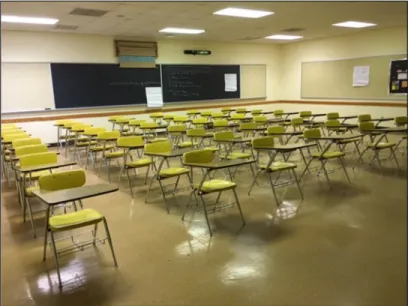
technology devices (see Figures 1 and 2 for before and after
photos). Built‐in computers were excluded in this
renovation because students often use their own smart
devices and the department has mobile carts with laptop
computers for use in the classroom.
Faculty were eligible to teach in the inaugural semester
the renovated classroom was utilized (fall 2017) if they
completed the department’s active learning professional
development training. The six‐hour training program,
Promoting Active‐Learning Instruction and Research
(PALIR), was delivered via a blended session format (i.e.,
two virtual, one face‐to‐face meeting) between April and
August 2017 (for a complete description of the program, see
Knudson & Meaney, 2018). Eighteen faculty members
taught 109 graduate and 411 undergraduate students in 19
number of courses taught within each discipline factored
into classroom assignment by department leadership:
athletic training (12%), exercise and sports science (11%),
public health (15%), and recreation (23%). Graduate courses
met weekly for 170 minutes. Most undergraduate classes
(76.9%) met twice a week for 80‐minute class sessions, two
hybrid classes (15.4%) met weekly for an 80‐mintue class
session, and one class (7.7%) met three times per week for
50‐minute class sessions. Average enrollment for graduate
courses was 18 students (range 7‐22) and 33 students (range
15‐42) for undergraduate courses.
Reflexivity
To improve credibility of findings, the authors engaged
in reflexive practices to identify assumptions, experiences,
and positions that could impact data interpretation (Probst
& Berenson, 2014). The lead author regularly utilizes
flipped classroom, team‐based learning, and other active‐
learning methodologies in undergraduate and graduate
courses. The second member of the research team is a
pedagogist who both teaches courses and conducts
research encompassing teaching and learning. The third
author has published research on learning biomechanical
concepts, effectiveness of low‐tech active learning
exercises, and student beliefs about learning.
Collectively, the research team’s overarching
assumption related to this study was that the
professional development training and classroom
redesign would positively impact participants’
perceptions of, and engagement in, active learning
instruction.
Given the researchers’ potential bias for active
learning pedagogies, the data analysis process
included continuous conversations about the
researchers’ position and how to avoid influencing
data analysis. In order to capture perspectives contrary
to the researchers’ position, a thematic codebook was
developed to distinguish between participants’
thoughts on the positive, negative, and neutral impact
of the active learning classroom on instruction and
learning. Additionally, the lead author recorded a
detailed audit trail on research processes, including
data collection, analysis decisions and processes, as
well as researcher reflections and interpretations
regarding study decisions.
Focus
Group
Protocols
The social cognitive principle of triadic reciprocity
(Bandura, 1986) informed the development of semi‐
structured interview protocols. Triadic reciprocity
suggests that human learning occurs within a
dynamic framework and initiates interaction between
one’s personal factors (e.g., motivation, knowledge),
environment (i.e., active learning classroom), and
behaviors (e.g., engaging in collaborative learning).
Bandura (1999) identified three specific stages of the
environment: imposed, selected, and constructed. The
imposed environment represents the current state of
the situation that an individual interacts with daily.
When one chooses to react and interact with these
perceived imposed factors, the selected environment
is created, which nurtures the creation of one’s
constructed environment. The act of constructing
Figure 1. Traditional lecture‐style classroom space before the
renovation.
Figure 2. Active‐learning classroom space after the renovation
with movable tables, chairs, white‐boards, and dual projector
one’s environment mandates active engagement in
situations and settings and often gives way to the
attainment of new knowledge and behaviors. Specifically,
focus group questions focused on participants’ perceptions
of the active learning space and whether those perceptions
impacted their personal factors or collaborative learning
behaviors (see Table 1).
Table 1. Sample focus group questions
Sample Faculty Focus Group Questions
How did the set‐up of the room influence your
instruction?
How did the set‐up of the room influence student
participation?
What instructional strategies did you perceive to
be particularly effective/in‐effective for students in
the classroom?
Sample Student Focus Group Questions
How did the set‐up of the room influence your
participation in the class?
How was team‐based learning in this classroom
compared to traditional classes?
Do you think team‐based learning
enhanced/detracted from your experience this
semester?
Participant
Recruitment
and
Sample
Faculty (n=18) who taught in the active learning
classroom during the fall 2017 semester received invitations
to participate via email. One faculty member declined
because they are a researcher in the study. Of the remaining
17 faculty members, 15 volunteered to participate. Student
recruitment entailed purposeful sampling of students
(n=520) enrolled in at least one class that met in the active
learning classroom during the semester of the study. A
member of the research team visited each class in person
and read a script informing potential student participants
that agreeing to engage in the focus group was voluntary
and no negative consequences would result from non‐
participation. Sixteen students volunteered to participant,
13 of whom attended a focus group.
Participating faculty represented all four department
academic disciplines: athletic training (26.7%); exercise and
sports science (26.7%); public health (20.0%); and,
recreation (26.7%). Participating students (n=13) included
majors from all four department academic disciplines:
athletic training (46.2%); exercise and sports science
(23.1%); public health (15.9%); and, recreation (15.9%). At
least one graduate student (n=5) and one undergraduate
student (n=8) from each academic discipline participated.
Tables 2 and 3 present participant characteristics.
Table 2.
Demographic characteristics of participating
faculty (n=15) Faculty participants Age in years Sex Teaching experience in years Academic discipline1 Participant 1 60+ F 20+ PH Participant 2 40‐49 M 5‐9 REC Participant 3 30‐39 M 5‐9 AT Participant 4 50‐59 F 50‐59 REC
Participant 5 30‐39 F 5‐9 AT; ESS
Participant 6 30‐39 F 5‐9 AT Participant 7 30‐39 F 5‐9 ESS Participant 8 40‐49 F 10‐14 ESS Participant 9 30‐39 M 5‐9 ESS Participant 10 40‐49 M 15‐19 PH; ESS Participant 11 60+ F 20+ REC Participant 12 30‐39 F 10‐14 ESS Participant 13 30‐39 M <5 REC
Participant 14 40‐49 F 15‐19 AT; ESS
Participant 15 60+ F 15‐19 PH
1AT=athletic training; ESS=exercise and sports science;
PH=public health; REC=recreation
Data
Collection
and
Analysis
Focus group interviews. Data collection occurred via five
in‐person focus groups with students (2 focus groups) and
faculty (3 focus groups). Students volunteered to
participant in one of two established student focus group
sessions. Faculty shared their availability and faculty focus
groups were scheduled accordingly. Focus groups for
students occurred at the end of the semester and for faculty
at the start of the following semester. Two study authors
led the student focus groups. One study author led the
faculty focus groups because the second person was the
direct supervisor of participating faculty and the power
differential could have potentially impacted participant
responses. A graduate level trained colleague took
descriptive and reflective field notes during all focus
groups. Focus group sessions were audio‐recorded; no
compensation was provided to participants (student focus
groups included food). Focus groups lasted, on average, 42
(student) and 53 (faculty) minutes. Study procedures
received approval by the Texas State University
Institutional Review Board and participants provided
written informed consent to participate and to be audio‐
recorded.
Table 3.
Demographic characteristics of participating students (n=13) Student participants Age in years Sex Academic status Major 1 Participant 16 19 F undergraduate AT Participant 17 unreport ed F undergraduate REC Participant 18 24 F graduate PH Participant 19 21 F undergraduate AT Participant 20 28 F graduate REC Participant 21 22 F graduate AT Participant 22 23 M undergraduate AT Participant 23 22 F undergraduate ESS Participant 24 21 F undergraduate PH Participant 25 26 F graduate AT Participant 26 21 F undergraduate ESS Participant 27 23 F graduate ESS Participant 28 20 F undergraduate AT
1AT=athletic training; ESS=exercise and sports science;
PH=public health; REC=recreation
Transcriptions. The colleague who took field notes
during focus group sessions transcribed the audio
recordings with cleaned up speech (Riessman, 1993). A
graduate research assistant was trained by the lead author
to check the transcriptions, noting discrepancies using the
track changes tool in Microsoft® Word. The lead author
reviewed, corrected, and finalized the transcriptions.
Investigator triangulation. To enhance the credibility of
findings, multiple investigators collected and analyzed the
data (Merriam & Tisdell, 2015). The two lead authors
conducted the student focus groups and took descriptive
and reflective field notes. The lead author and a graduate‐
trained colleague participated in the faculty focus. The
graduate‐trained colleague took field notes during all five
focus groups to accurately record descriptive (e.g., factual
data like date and time; nonverbal behaviors and actions of
participants) and reflective (e.g., personal reflections and
questions that arise during the focus group) data. The two
lead authors independently analyzed all five focus groups.
Thematic analysis. The two lead authors served as the
analysis team and thematically examined transcripts, audio
recordings, and field notes simultaneously to increase
effectiveness of data analysis (Tessier, 2012). The lead
author listened to the audio recordings and recorded key
ideas from each focus group into the study audit trail. The
two lead authors independently reviewed transcripts and
field notes, met to compare key ideas, drafted a codebook,
and carried out iterative thematic coding on the focus
group transcriptions. Each analyst independently coded
focus group transcripts in NVivo 12 and periodically met to
compare coding results, refine the codebook, and resolve
coding discrepancies until consensus was reached. Five
analysis meetings occurred during the ten weeks of data
analysis.
Results
Three overarching themes emerged during thematic
analysis: physical environment of classroom; enhanced
student engagement with peers and instructors; and, the
renovated space impacting instructional strategies.
Descriptions of themes with representative quotes follow.
Theme
1:
Physical
Environment
of
Classroom
Participants reported physical aspects of the active
learning classroom positively contributed to the learning
environment. Each focus group concentrated on perceived
positives of the physical environment, with less attention
paid to perceived negatives. Participants spent more time
discussing the modular tables than any other classroom
feature. Nearly 30% of transcription content was included
in codes related to tables, with faculty focus groups having
considerably higher proportions of table‐related codes
(nearly 40% of transcription content) compared to student
focus groups (approximately 12%). Faculty liked the idea of
rearranging the modular table layout to meet the specific
needs of the class; however, in practice, they found the
process to be cumbersome and time‐consuming:
I felt like the tables were, they are designed to move but
they don’t move very easily, and there are quite few in
class. I wanted to change the configuration of the room
because I have different numbers of groups in different
[classes], but it would take 5‐10 minutes to move once
and 5‐10 minutes to move back. If you’re doing that,
that’s about 15 minutes of every class; 15 minutes of class
is lot of time. Participant 3, faculty
Student comments about tables focused primarily on the
usefulness of the electrical and USB outlets located in the
floor and in the table tops, as illustrated by the following
quote:
The outlets right on the table really helps [sic], especially
charged it the night before, you could just charge it while
the teacher was lecturing and it wasn’t distracting; you
don’t have to play around with the wires. Participant 19,
student
A primary complaint from both faculty and students was
that table outlets worked inconsistently:
There was one day when I pushed [the tables] all
together, but they couldn’t get their plug‐ins to work, so
something wasn’t working. Participant 3, faculty
Yeah, but sometimes, I don’t know if it was something
with the outlets socket, but sometimes they wouldn’t
work. Participant 20, student
Several students also noted difficulties when seated due
to the table configuration:
If you’re sitting on the sides of the table where the bars
are, you can’t really slide under the table so much, like
your feet are kinda locked by those. Participant 26, student
I’m the taller individual, so the table height whenever I
sit down, I either have to a stretch my legs all the way
underneath the table and impinge on other people’s foot
space to keep my knees from hitting the table top.
Participant 16, student
All focus groups identified the two‐sided, mobile, dry
erase boards as useful tools in the active learning space.
Specifically, participants highlighted both how the mobile
boards helped students collaborate with, and learn from,
each other as well as facilitate faculty assessment of student
knowledge:
I really like the portable white boards because there are
almost mini‐quizzes, when you give [students] a specific
thing they have to accomplish and they have limited time
and they turn around and share, it’s about, in my class,
it’s about testing application, here’s the information, now
apply in this way, that’s almost like a mini‐quiz.
Participant 4, faculty
We were in our group, but what we came up with we put
on each white board, and then once we were finished,
you got to look at the whole room, like, “Okay, this
group thought that; oh, I didn’t think about this”. And so
that, with the whiteboards, I guess helped bring
everyone together. Participant 24, student
The double projector screens placed on opposite
classroom walls also emerged as positively contributing to
the active nature of the learning space:
I think my students liked [the double screens] because
it’s different. I think anything that’s different is gonna
change student perspective a little bit and they thought it
was cool and they told me over and over how much they
loved the two screens. Participant 6, faculty
My favorite part was the two screens. I mean you don’t,
especially for the classes that I took in our graduate
program, we are constantly moving around, we’re doing
all sorts of stuff. And so, it’s comforting to know that you
can sit anywhere, and still be able to effectively learn I
guess. Participant 25, student
However, some participants mentioned the projector
screen placement made it cumbersome for students in some
seats to simultaneously view the screen and the instructor:
That the screens were in the front and the back of the
classroom really helped as far as where you sat, but then
the con was the teacher didn’t always walk around the
room, they were in the front. If you happen to be sat [sic]
in the front of the table, your back was constantly [to the
instructor] and you have to turn around a lot. Participant
18, student
There are two screens, back and front, and when I’m
presenting, some have to look at the back screen [and
are] not paying attention. It’s hard to get eye contact with
some students because they keep looking at back screen,
not the front. Participant 2, faculty
Theme
2:
Enhanced
Student
Engagement
with
Peers
and
Instructors
Participants indicated that the active learning classroom
facilitated student engagement with course content, the
instructor, and their peers. All five focus groups discussed
perceived higher student engagement in the active learning
space compared to traditional classroom settings, as the
following quotes exemplify:
I remember the first day of class. I noticed students were
facing each other, they were in a circle and so I think that
atmosphere, I noticed the difference compared to regular
classroom, that they were ready to discuss and talk to
each other. Participant 12, faculty
I feel like the kind of openness of the room allows for
[engagement] to happen. I forgot who said it, but when
in traditional settings, when you’re sitting at the back of
class, you may not be as inclined to raise your hand and
ask questions […] But this openness of the classroom
allows you to ask your neighbor or to speak up and ask
the professor just because of the discussion‐based aspect
of the classroom. Participant 20, student
Students reported that engagement with peers positively
impacted their learning experience in the active learning
space, as the following quotes summarizes:
I really do feel, though, like the environment really
helped our class interact with each other, and really get
to know each other because you’re constantly talking […]
everybody’s constantly interacting with each other, but
it’s in a positive way. It’s, you know, “Hey, how did you
do on your article?” You know, “what did you put for
this?” So, I don’t know, I just feel like it’s, I think it
benefited me in a positive way and it really did enhance
I think [the active learning classroom] definitely
enhances that active portion of learning, which I feel is
super necessary, just because it allows you to gather the
insights from different people within your group, then
your pod. That discussion taking place, it allows you to
express your thoughts that you are having to help you
find better ways of thinking, better solutions, things like
that, as opposed to sitting and looking at a lecture slide,
and trying to retain it all and get, I guess, the main points
out of it. Participant 20, student
However, it was noted that sometimes peer‐to‐peer
communication could take over the discussion, detracting
from the learning environment:
There’s sometimes difficulty with focusing, because it’s
really easy to be like, “Hey, I didn’t understand this, can
you help me out?” It’s also really easy at the same time,
especially with grad classes that are three hours [long], to
veer that conversation. Participant 22, student
But the other thing that’s kind of negative for me, maybe
this is my instruction style, but [students] start talking
among themselves a lot; […] it makes it hard to pull them
back together. Participant 1, faculty
Additionally, students shared that the active learning
classroom enhanced the instructor‐student relationship by
providing engagement opportunities, as the following
quote illustrates:
I feel like I’ve gotten to know [faculty member] a lot
better and I feel I can go to her outside of class and, when
she’s in her office, ask her questions and feel comfortable
being around her. Or maybe even started feeling
comfortable enough around her to, even if it’s not class
related, going and talking to her about grad school stress
and things like that. So, I think [the active learning
classroom] kinda helps start that relationship. Participant
28, student
Theme
3:
Renovated
Space
Impacting
Instructional
Strategies
The idea that the renovated space, itself, impacted
instructional strategies emerged as a theme during the
thematic analysis, as the following faculty participants
communicated:
I think for me it was like a visual reminder to incorporate
more active learning tools. So, just being in that
classroom was an extra reminder; it was always in my
mind that I should incorporate some different tools, help
[students] do some active learning. I think I used lots of
different types of tools throughout that class; we did
some small groups, some big groups, people on one table
are sharing other things like tablet and little online
interactive things. […] even if was something I did the
previous semester in the last classroom which seemed
like a normal time to lecture for, but it’s like too long in
the active learning [classroom] where I felt pressure from
the environment, like, “okay, they are ready to do
something different”. Participant 12, faculty
When I’m teaching in a more traditional classroom
setting, one or two group discussions would be enough
in the class. But last semester I used that active learning
environment to focus more on group discussion, more
group exercise for students. I feel less obligated, but
encouraged more group work, because the setting helped
me create more active learning outcome activities.
Because of the setting, I applied more group discussions
for the students. Participant 2, faculty
Participants believed active‐learning and team‐based
strategies worked better in the active learning classroom
compared to traditional classrooms; specifically, faculty
reported think‐pair‐share, jigsaw, and case study activities
as especially effective. The following quotes reveal how the
space positively contributing to team‐based learning
activities:
I feel like my class was much more productive in the
active learning [classroom] and they got more out of it.
We had more conversation instead of me just standing in
front lecturing. Because they are not as mobile in other
classrooms, it’s hard doing some other things that I like
to do, like team‐based learning. It’s hard for me to do
that in those other classrooms, I still do it, and I didn’t
think that’s as productive; I don’t think I would get as
good an outcome [if] I was doing it back in those other
classrooms. Participant 5, faculty
I also think that the team‐based learning has helped
develop communication skills as well as working with
the team […] and I think that develops really important
life skills that you’re gonna need, especially when you
get out of college, because you’re gonna be working with
people every day, and having to be on a collaborative
team, and a lot of the activities that happened in the
[active learning] room, we had to work together in order
to come to a solution […] was really helpful in the room.
Participant 21, student
Some faculty stated traditional, teacher‐centric lectures
and delivery of individual examinations were ineffective
in the active learning space, as the following quote
illustrates:
I think the lecture is less effective, it doesn’t match with
that classroom just because [students] are not facing in
the same direction and if I can’t see their faces, they’re
probably gonna lose interest quicker, get distracted by
other things, or talk a little bit more because they are
facing their friends. So, that’s probably a less conducive
format for lecturing […] I thought it was hard to give
close to each other there’s no way that you can really…
[Participant #12 interjecting: See if they are not looking at
each other] …yeah. Participant 13, faculty
Discussion
This qualitative study explored perceptions of students
and faculty who taught or attended class in a newly
renovated active learning space as part of an academic
department’s active learning initiative. Key findings from
thematic analysis indicated primarily positive perceptions
of the renovated physical environment, especially the
modular tables and mobile white boards. This positive
perception was consistent with quantitative ratings of the
furniture and classroom layout as positive by over 90% of
students in an earlier study phase (Knudson & Meaney,
2018). Perceived increases in student engagement and
enhancements to instructional methods also emerged as
salient themes. Additionally, students and faculty noted
frustrations with the furniture, classroom layout, and
technology that may influence student engagement and
effectiveness of active learning pedagogies.
The impact of physical learning spaces on student
attitudes and behaviors has long been considered an
important factor in learning (Weinstien,1979). As higher
education has shifted from teacher‐centric to student‐
centric methods in recent years, research on active‐learning
spaces has expanded (Brooks, 2012; Park & Choi, 2014).
Students and instructors in the current study perceived an
increase in student cooperative learning behaviors in the
active learning classroom compared to their previous
experience in traditional classrooms. This positive
perception of facilitated interaction from active learning
classrooms is consistent with prior studies (Clinton &
Wilson, 2019; Parsons, 2017; Sawyers et al., 2016). For
example, students in science disciplines had more positive
attitudes about movable tables and chairs over fixed
auditorium seats (Young et al., 2017). Similarly, students in
this study reported that the modular tables facilitated their
ability to engage with classmates and instructors more
easily than in a traditional layout.
Additionally, students and faculty in the current study
reported that the classroom design, tables, and mobile
white boards enhanced the learning environment by
facilitating peer‐to‐peer and student‐to‐instructor
interactions. This finding connects to prior assertations that
spaces designed for active learning processes can facilitate
learning behaviors and pedagogical practices to support
student engagement (Rands & Gansemer‐Topf, 2017).
Future studies should explore whether student
collaborative learning behaviors increase compared to
traditional classroom spaces and furniture, as only a few
studies have directly measured these behaviors in active
learning classrooms (Brooks, 2012). Such inquiry would
help separate actual benefits from positive opinions about
new, moveable furniture.
Participants reported that the faculty training program
and renovated classroom improved instructional methods,
suggesting that the program was successful in encouraging
faculty to utilize active learning strategies. This interaction
of instructional space and equipment with instruction is
consistent with prior reports (Choi et al., 2014; Sawyers et
al., 2016) and underscores the necessity of policies and
trainings to support faculty development of pedagogical
approaches in active learning spaces (McDavid, Parker,
Burgess, Robertshaw, & Doan, 2019). We agree with
Herrmann’s (2013) call for exploring how collaborative
learning might promote a deep approach to learning and
the role and impact of the teacher in the collaborative
learning process. Future research should explore this theme
of the interaction of renovation of classroom spaces with
instructors and the instructional methods they implement.
While student and faculty perceptions of facilitated
collaboration and engagement from the renovated
classroom support the faculty training program, data are
needed on student learning. There are few studies
attempting to separate effects of classroom design and
active learning pedagogies on student learning, and their
results are inconsistent (Brooks, 2012). Some studies
reported significant improvements in learning attributable
to classroom design (Brooks, 2011; Cotner et al., 2013) while
others report no improvement (Choi et al., 2014; Stoltzfus &
Libarkin, 2016), or impacts moderated by the instructor
(McArthur, 2015). Given the interaction of space design,
technology, students, instructors, and pedagogy, future
investigations including all of these factors show the most
promise in advancing our understanding of the
effectiveness of instructional innovations.
Faculty and students in the current study lamented that
classroom technology functioned inconsistently, wasting
limited class time. Given the relatively high cost for active‐
learning classrooms, it is prudent for universities to invest
in user‐friendly technology that functions consistently or
emphasize low‐tech options that preliminary evidence
reports to be just as effective as high‐technology classrooms
(Knudson & Wallace, 2019; Nicol et al., 2018). Weighing the
cost of implementation of electronic technology in active
learning spaces should consider both the anticipated
reliability of the technology and the student learning
outcomes when used by large numbers of students in many
classes. We noted that some frustrations did not result from
furniture and classroom design, but from facility software
and wireless network difficulties.
Study
Limitations
and
Strengths
Limitations include the inherent constraints of time and
context of qualitative inquiry, which does not aim to be
generalizable (Lincoln & Guba, 1985). Regarding sampling
of student participants, those who self‐selected to be in the
focus groups may not be representative of all students who
took a course in the active learning classroom. For example,
previous quantitative analysis of perceptions of most
students in the renovated classroom indicated that some
students had negative perceptions of working with or
helping other students to learn (Knudson & Meaney, 2018).
It is unclear whether students with negative perceptions of
active learning would be as likely to volunteer for a focus
group as students more accepting of collaborative learning
would be. Additionally, the pre‐determined focus group
dates may have excluded otherwise willing participants.
Despite these limitations, the current study adds to the
literature on the experiences and perceptions of university
students and faculty in active learning spaces. It also
provides evidence from a relatively diverse group of
academic disciplines.
Study strengths include use of multiple strategies to
promote robustness and credibility of data of study
findings. First, authors engaged in reflective practices
individually and as a research team (Probst & Berenson,
2014) throughout all stages of the study to identify and
describe relevant biases, assumptions, and theoretical
foundations guiding and impacting the study. Second, a
multi‐person analysis team allowed for multiple possible
interpretations and disagreements, which strengthen
coding and analysis processes (Barbour, 2001). Third, the
lead author kept a detailed audit trail of study procedures
and methodology decisions made throughout the study.
Finally, authors provided rich descriptions to contextualize
the study in an effort to help others determine whether
findings are transferrable to other contexts.
Conclusion
Findings of this qualitative study revealed participants
teaching and learning in a newly renovated active learning
classroom believed the space effectively created positive
learning experiences and facilitated student‐student and
student‐instructor engagement. This study observed
positive perceptions of the active learning classroom within
three emergent themes: positive improvements to the
physical space, enhanced student engagement with others
and course content, and impacts of the renovated space on
instructional methodology. Overall, data support the
conclusion that the learning space renovation and
supporting faculty training program were effective in
creating positive experiences and interactions with students
and faculty in several academic disciplines related to health
and human performance.
References
Ambrose, S. A., Bridges, M. W., & Lovett, M. C. (2010). How
learning works: Seven research‐based principles for smart
teaching. San Francisco: Josey‐Bass.
Baepler, P., Walker, J. D., Brooks D. C., Saichaie, K., &
Peterson, C. L. (2016). A guide to teaching in the active
learning classroom. Sterling: Stylus Publishing.
Bandura, A. (1986). Social foundations of thought and action: A
social cognitive theory. Englewood Cliffs: Prentice‐Hall.
Bandura, A. (1999). Social cognitive theory: An agentic
perspective. Asian Journal of Social Psychology, 2(1), 21‐41.
doi:10.1111/1467‐839X.00024
Barbour, R. S. (2001). Checklists for improving rigour in
qualitative research: A case of the tail wagging the dog?
British Medical Journal, 322(7294), 1115‐1117.
doi:10.1136/bmj.322.7294.1115
Beichner, R. J., Saul, J. M., Abbott, D. S., Morse, J. J.,
Deardorff, D. L., Allain, R. J., …Risley, J. S. (2007). The
student‐centered activities for large enrollment programs
(SCALE‐UP) project. Reviews in Physics Education
Research, 1. Retrieved from
https://www.compadre.org/per/per_reviews/volume1.cf m#V1I1A4
Beichner, R. J. (2014). History and evolution of active
learning. New Directions for Teaching and Learning, 137, 9‐
16. doi:10.1002/tl.20081
Birdwell, T., & Uttamchandani, S. (2019). Learning to teach
in space: Design principles for faculty development in
active learning classrooms. Journal of Learning Spaces, 8(1),
19‐27.
Brooks, D. C. (2011). Space matters: The impact of formal
learning environments on student learning. British
Journal of Educational Technology, 42(5), 719‐726.
doi:10.1111/j.1467‐8535.2010.01098.x
Brooks, D. C. (2012). Space and consequences: The impact
of different formal learning spaces on instructor and
Brownell, S. E., & Tanner, K. D. (2012). Barriers to faculty
pedagogical change: Lack of training, time, incentives
and, tensions with professional identity? CBE‐Life
Sciences Education, 11(4), 339‐346. doi:10.1187/cbe.12‐09‐
0163
Choi, H. H., van Merriënboer, J. J. G., & Paas, F. (2014).
Effects of the physical environment on cognitive load
and learning: Towards a new model of cognitive load.
Educational Psychology Review, 26, 225‐244.
doi:10.1007/s10648‐014‐9262‐6
Clinton, V., & Wilson, N. (2019). More than chalkboards:
Classroom spaces and collaborative learning attitudes.
Learning Environments Research. Advance online
publication. doi:10.1007/s10984‐019‐09287‐w
Cotner, S., Loper, J., Walker, J. D., & Brooks, C. (2013). “It’s
not you, it’s the room”: Are high‐tech, active learning
classrooms worth it? Journal of College Science Teaching,
42(6), 82‐88.
Dag, F., Sumeur, E., & Durdu, L. (2009). Pre‐service
teachers’ perceptions and experiences: Courses based on
the active learning model and environment. Journal of
Learning Spaces, 8(2), 41‐56.
Ebert‐May, D., Derting, T. L., Hodder, J., Momsen, J. L.,
Long, T. M., & Jardeleza, S. E. (2011). What we say is not
what we do: Effective evaluation of faculty development
programs. BioScience, 61(7), 550‐558.
doi:10.1525/bio.2011.61.7.9
Eddy, S. L., & Hogan, K. A. (2014). Getting under the hood:
How and for whom does increasing course structure
work? CBE ‐ Life Sciences Education, 13(3), 453‐468.
doi:10.1187/cbe.14‐03‐0050
Freeman, S., Eddy, S. L., McDonough, M., Smith, M. K.,
Okoroafor, N., Jordt, H., & Wenderoth, M. P. (2014).
Active learning increases student performance in science,
engineering, and mathematics. Proceedings of the National
Academy of Sciences, 111(23), 8410‐8415.
doi:10.1073/pnas.1319030111
Henderson, C., & Dancy, M. H. (2008). Physics faculty and
educational researchers: Divergent expectations as
barriers to the diffusion of innovations. American Journal
of Physics, 76(1), 79‐91. doi:10.1119/1.2800352
Henderson, C., Kahn, R., & Dancy, M. (2018). Will my
student evaluation decrease if I adopt an active learning
instructional strategy? American Journal of Physics, 86(12),
934‐942. doi:10.1119/1.5065907
Herrmann, K. J. (2013). The impact of cooperative learning
on student engagement: Results from an intervention.
Active Learning in Higher Education, 14(3), 175‐187.
doi:10.1177/1469787413498035
Knudson, D., & Meaney, K. S. (2018). Promoting active
learning instruction and research (PALIR) in Kinesiology.
Kinesiology Review, 7(4), 328‐331.
doi:10.1080/14763141.2019.1570322
Knudson, D., & Wallace, B. (2019). Student perceptions of
low‐tech active learning and mastery of introductory
biomechanics concepts. Sports Biomechanics.
doi:10.1080/14763141.2019.1570322
Lincoln, Y. S., & Guba, E. G. (1985). Naturalistic Inquiry.
Newbury Park: Sage.
Machemer, P. L., & Crawford, P. (2007). Student
perceptions of active learning in a large cross‐
disciplinary classroom. Active Learning in Higher
Education, 8(1), 9‐30. doi:10.1177/1469787407074008
McArthur, J. A. (2015). Matching instructors and spaces of
learning: The impact of space on behavioral, affective
and cognitive learning. Journal of Learning Spaces, 4(1).
McConnell, D. A., Chapman, L., Czajka, C. D., Jones, J. P.,
Ryker, K. D., & Wiggen, J. (2017). Instructional utility and
learning efficacy of common active learning strategies.
Journal of Geoscience Education, 85(4), 604‐625.
doi:10.5408/17‐249.1
McCrickerd, J. (2012). Understanding and reducing faculty
reluctance to improve teaching. College Teaching, 60(2),
56‐64. doi:10.1080/87567555.2011.633287
McDavid, L., Parker, L. C., Burgess, W., Robertshaw, B., &
Doan, T. (2018). The combined effect of learning spaces
and faculty self‐efficacy to use student‐centered practices
on teaching experiences and student engagement. Journal
of Learning Spaces, 7(1), 29‐44.
Merriam, S. B., & Tisdell, E. J. (2015). Qualitative research: A
guide to design and implementation (4th edition). San
Francisco: Jossey‐Boss.
Miller, C. J., & Metz, M. J. (2014). A comparison of
professional‐level faculty and student perceptions of
barriers. Advances in Physiology Education, 38(3), 246‐252.
doi:10.1152/advan.00014.2014
Nicol, A., Owens, S. M., Le Coze, S., MacIntyre, A., &
Eastwood, C. (2018). Comparison of high‐technology
active learning and low‐technology active learning
classrooms. Active Learning in Higher Education, 19(3),
253‐265. doi:10.1177/1469787417731176
Park, E. L., & Choi, B. K. (2014). Transformation of
classroom spaces: Traditional versus active learning
classroom in colleges. Higher Education, 68(5), 749‐771.
doi:10.1007/s10734‐014‐9742‐0
Parsons, C. S. (2017). Reforming the environment: The
influence of the roundtable classroom design on
interactive learning. Journal of Learning Spaces, 6(3), 23‐33.
Pelletreau, K. N., Knight, J. K., Lemons, P. P., McCourt, J. S.,
Merrill, J. E., Nehm, R. H., …Smith, M. K. (2018). A
faculty professional development model that improves
student learning, encourages active‐learning
instructional practices, and works for faculty at multiple
institutions. CBE‐Life Sciences Education, 17(5), 1‐11.
doi:10.1187/cbe.17‐12‐0260
Prince, M. (2004). Does active learning work? A review of
the research. Journal of Engineering Education, 93(3), 223‐
231. doi:10.1002/j.2168‐9830.2004.tb00809.x
Probst, B., & Berenson, L. (2014). The double arrow: How
qualitative social work researchers use reflexivity.
Qualitative Social Work, 13(6), 813‐827.
doi:10.1177/1473325013506248
Pundak, D., & Herscovitz, O. (2009). Instructors’ attitudes
toward active learning. Interdisciplinary Journal of E‐
Learning and Learning Objects, 5(1), 215‐232.
Rands, M. L., & Gansemer‐Topf, A. M. (2017). The room
itself is active: How classroom design impacts student
engagement. Journal of Learning Spaces, 6(1), 26‐33.
Riessman, C. K. (1993). Narrative Analysis. Thousand Oaks:
Sage.
Sabagh, Z., & Saroyan, A. (2014). Professors’ perceived
barriers and incentives for teaching improvement.
International Education Research, 2(3), 18‐40.
doi:10.12735/ier.v2i3p18
Savin‐Baden, M., McFarland, L., & Savin‐Bade, J. (2008).
Learning spaces, agency and notions of improvement:
What influences thinking and practice about teaching
and learning in higher education? An interpretative
meta‐ethnography. London Review of Education, 6(3), 211‐
227. doi:10.1080/14748460802489355
Sawada, D., Piburn, M. D., Judson, E., Turley, J., Falconer,
K., Benford, R., & Bloom, I. (2002). Measuring reform
practices in science and mathematics classrooms: The
reformed teaching observation protocol. School Science
and Mathematics, 102(6), 245‐253. doi:10.1111/j.1949‐
8594.2002.tb17883.x
Sawers, K. M., Wicks, D., Mvududu, N., Seeley, L., &
Copeland, R. (2016). What drives student engagement: Is
it learning space, instructor behavior, or teaching
philosophy? Journal of Learning Spaces, 5(2), 11‐12.
Sharma, S., Ahluwalia, P. K., & Sharma, S. K. (2013).
Students’ epistemological beliefs, expectations, and
learning physics: An international comparison. Physics
Education Research, 9.
doi:10.1103/PhysRevSTPER.9.010117
Sirum, K. L., Madigan, D., & Klionsky, D. J. (2009).
Enabling a culture of change: A life science faculty
learning community promotes scientific teaching. Journal
of College Science Teaching, 38(3), 38‐44.
Stoltzfus, J. R., & Libarkin, J. (2016). Does the room matter?
Active learning in traditional and enhanced lecture
spaces. CBE‐Life Sciences Education, 15(4).
doi:10.1187/cbe.16‐03‐0126
Swanson, E., McCulley, L. V., Osman, D. J., Lewis, N. S., &
Solis, M. (2019). The effect of team‐based learning on
content knowledge: A meta‐analysis. Active Learning in
Higher Education, 20(1): 39‐50.
doi:10.1177/1469787417731201
Tessier, S. (2012). From field notes, to transcripts, to tape
recordings: Evolution or combination? International
Journal of Qualitative Methods, 11(4), 446‐460.
doi:10.1177/160940691201100410
Weinstein, C. S. (1979). The physical environment of the
school: A review of the research. Review of Educational
Research, 49(4), 577‐610. doi:10.2307/1169986
White, P. J., Larson. I., Styles, K., Yuriev, E., Evans, D. R.,
Short, J. L, …Eise, N. (2015). Using active learning
strategies to shift student attitudes and behaviours about
learning and teaching in a research intensive educational
Young, K. E., Young, C. H., & Beyer, A. (2017). Does the
classroom matter? How physical space affects learning in
the introductory undergraduate science courses. Journal
of College Science Teaching, 46(6), 80‐87.