Agricultural and Biosystems Engineering
Conference Proceedings and Presentations Agricultural and Biosystems Engineering
6-2013
Exploring Early College Credit Implications for
Engineering
Karen A. Zunkel
Iowa State University, [email protected] Jason L. Pontius
Iowa State University, [email protected] Thomas J. Brumm
Iowa State University, [email protected]
Follow this and additional works at:http://lib.dr.iastate.edu/abe_eng_conf
Part of theAgriculture Commons,Bioresource and Agricultural Engineering Commons,
Engineering Education Commons, and theHigher Education Commons
The complete bibliographic information for this item can be found athttp://lib.dr.iastate.edu/ abe_eng_conf/406. For information on how to cite this item, please visithttp://lib.dr.iastate.edu/ howtocite.html.
This Conference Proceeding is brought to you for free and open access by the Agricultural and Biosystems Engineering at Digital Repository @ Iowa State University. It has been accepted for inclusion in Agricultural and Biosystems Engineering Conference Proceedings and Presentations by an authorized administrator of Digital Repository @ Iowa State University. For more information, please [email protected].
Paper ID #6058
Exploring Early College Credit Implications for Engineering
Dr. Karen Zunkel, Iowa State UniversityDr. Karen Zunkel is Director of Undergraduate Programs in the Office of the Senior Vice President and Provost and Director the Program for Women in Science and Engineering at Iowa State University. In 2009-2011 she chaired an institutional task force on early college credit. She has previously served as a non-tenure track faculty member and Manager of Undergraduate Programs in the College of Engineering at Iowa State University. In additional she has industry experience in product and sales engineering. Dr. Zunkel earned a B.S.in Industrial Engineering from Iowa State University, a M.S. in Industrial Engineer-ing from the University of Oklahoma, and a Ph.D. in Higher Education from Iowa State University.
Dr. Jason Pontius
Jason Pontius, Ph.D. is the Coordinator of Continuous Academic Program Improvement within the Office of the Senior Vice President and Provost at Iowa State University. Jason helped with the statistical analysis for early credit task force. Jason has a Ph.D. in Higher Education Administration from Iowa State Uni-versity, an M.S. in Higher Education Administration from Indiana University and a B.A. in Psychology from the University of Virginia.
Dr. Thomas J Brumm, Iowa State University
Dr. Tom Brumm is associate professor in the Department of Agricultural and Biosystems Engineering at Iowa State University (ISU) and Professor-in-Charge of Online Learning for the Colleges of Engineering and Liberal Arts and Sciences. He is also the Director of Assessment for the College of Engineering. Brumm is a leader in learning communities, competency-based learning, and assessment at ISU, incorpo-rating them into engineering and technology curricula at Iowa State. He leads the development and deliv-ery of online learning activities for two colleges. His disciplinary research examines systems approaches for capturing value and creating sustainability from biorenewable processes such as biofuel production from grains, oilseeds and alternative crops.
Brumm is a member of the ASEE divisions of Biological and Agricultural Engineering and Continuing Professional Development.
c
Exploring Early College Credit Implications for Engineering
Abstract
In the past decade, increasing numbers of students are taking college credit courses while still in high school, through programs such as Advanced Placement or through agreements with the local community colleges. Recognizing this trend, an Iowa State University task force researched the impact that this early college credit (ECC) was having on both the student
experience and the university. The study methodology included both quantitative and qualitative analyses, using student academic records, student surveys and focus groups, faculty focus
groups, and review of institutional materials. This paper disaggregates institutional findings to compare the experiences of engineering and engineering students. Similar to
non-engineering students, non-engineering students with ECC had higher one-year retention rates, took fewer credits their first semester of enrollment, graduated after eight semesters of enrollment and graduated in fewer semesters overall than did engineering students without ECC. However, there were differences in the experiences between engineering students and non-engineering students. Engineering students did not see an increase in GPA or graduation rates; and, they were more likely to repeat courses taken as ECC and to have their ECC courses not count toward their degree programs. Strategies to increase the effectiveness of ECC for engineering students could include offering of key entry-level engineering courses to students in high school, a review of the engineering curriculum for sequencing and flexibility, increased attention on issues of mathematics curriculum alignment with feeder institutions, and improved communication with high school students, parents and counselors.
Background
Over the past decade, there has been increased emphasis by parents, legislators, and state education leaders to expand opportunities for students to earn college credit prior to graduating from high school. Reasons cited for this increased emphasis have included a desire to increase the rigor of the high school experience, to allow students to jump start their college education, to increase the post-graduation enrollment of students in 2- and 4-year schools by giving them confidence/experience in college credit in high school, and to shorten students’ time in college, thereby reducing college costs for students and families. There are many different options for high school students to earn college credit, including the following:
Concurrent/dual enrollment (college courses offered and taught within the high schools by either certified high school teachers or college instructors, as well as high school students taking college courses on the college campus)
Credit from passing Advanced Placement (AP) [1] or International Baccalaureate (IB) [2] examinations at certain levels after taking AP or IB courses in high school.
Courses taken directly from a 2- or 4-year institution (either on the college campus or on-line)
Placement testing, including College Level Examination Program (CLEP) [3] or institutional exams/processes.
According to National Center for Education Statistics”, [4] in 2002-2003 school year, 72% of public high schools in the U.S. offered dual credit courses, 67% offered AP courses, and 3%
offered IB courses. The report also states that in 2002-03 “there were an estimated 1.2 million enrollments in courses for dual credit, 1.8 million enrollments in AP courses, and 165,000 enrollments in IB courses
Researchers in Oregon[5] found that students who earned concurrent or dual credit had higher first year GPA’s and persisted to their second year at higher rates that students without dual credit. When controlling for academic strength (as measured by GPA, SAT scores, and
receiving Advanced Placement credit) and student demographics, finding that “the odds that dual credit students would be predicted to persist to the second year of college are increased by 17% compared to students who did not take dual credit.” The study also examined student
performance in subsequent courses in a sequence in writing, mathematics, and Spanish: “When dual credit students who take the prerequisite in high school and the final course in college are compared to their college classmates who take the entire sequence in college, it turns out that they pass the final course in proportions that are substantially equivalent to those of their college-prepared classmates”.
A more recent trend is the development of early college high schools. With the first schools opening in 2003, in 2011 there were more than 230 high schools based on early college designs, serving 50,000 students in 28 states and the District of Columbia. In 2009, about 3,000 students graduated from the 64 early college schools that had been open for four or more years. These students earned an average of 20 to 30 college credits by the end of their high school senior year.[6]
Early Credit Task Force at Iowa State University
To determine the impact of early college credit at Iowa State University, a task force was formed in 2009 to investigate the impact of early college credit on student academic success from both the student and institution perspective. To gain a deeper understanding of the issue, the task force analyzed institutional data and solicited feedback from both students with early college credit and institutional faculty and staff. Complete institutional findings are available in the Early Credit Task Force Final Report.[7] A summary of some key institutional findings at Iowa State University are provided below:
Numbers and types of early credit students are bringing into college: Iowa State experienced significant growth in the percentage of students entering with ECC and the number of credits those students brought in over the last past decade. In Fall 2010, 62% of entering first-year students had earned some college credits while in high school, compared to 34% in Fall 2000. The median number of early college credits (ECC) for Fall 2010 new students was 13 compared to 6 in Fall 2000. In Fall 2010, at least half of the students in each of the six undergraduate colleges at Iowa State entered with ECC. The highest percentage was 69% in the College of Agriculture and Life Sciences followed by the College of Engineering at 65%. The most
significant growth in ECC has been associated with in-state residents bringing in transfer credits through dual/concurrent credit programs offered through community colleges.
Student academic success: When incoming characteristics (i.e., residency, ACT scores, high school rank, high school GPA, field of academic interest, and first fall semester enrolled credit hours) are controlled, statistically significant results identified that:
students with any amount of ECC have statistically significant, yet only slightly higher GPA in their first semester and first year than students without ECC;
students with any amount of ECC have a somewhat shorter time to graduation than those without ECC. (For example, students entering Fall 2005 with 19+ credits had an average time to graduation of 4.1 years compared to 4.5 years for their peers without ECC); students with any amount of ECC were significantly more likely to have a minor
compared to students without ECC. Also, students earning 1-10 early credits were more likely to earn a minor than students with greater amounts of ECC;
students with any amount of ECC are less likely to change their majors than similar students without ECC;
students with 19 or more early credits are significantly more likely to graduate with second majors compared to students with other amounts of ECC; and
an increasing amount of early credit does not have a significant impact on academic success outcomes (e.g. increased first term GPA, first year GPA, first year retention, second year retention). The only significant impacts of increased credit levels of ECC were an increased chance of graduating within four years and shorter time to graduation.
Student success in subsequent courses: The task force investigated student success in subsequent courses for sequenced courses at entry level areas (calculus I to calculus II, calculus II to
calculus III, composition I to composition II, etc.). The only significant finding was that for both the calculus I to calculus II sequence and the calculus II to calculus III sequence, students who took the first course in the sequence as ECC then completed the subsequent course at Iowa State performed at a third of a letter grade lower than expected (e.g. B- compared to a B) compared to students who took both the first and second course at Iowa State.
Results from student survey and focus groups:
Approximately three-quarters of the ECC courses were taught by high school faculty during regular school hours in the high school.
Over half of the students reported that at least some of their credits did not apply to their degree requirements for their major.
Seventeen percent of the ECC students repeated at least one ECC course at Iowa State. Of the ECC students responding, 97% said that if they could repeat high school, they would take ECC courses again.
Themes identified in the open responses on the survey and in the focus groups included the following:
o Students identified “course topic gaps” between what they learned in their ECC courses and where the sequential Iowa State course began as being an issue that the institution could address to improve their academic experience.
o Students overwhelming re-iterated that even if it didn’t shorten their time to degree or they ended up repeating a course, it was still worth it for them and they would
Results from faculty and staff from interviews:
There are many processes that create challenges for ECC students and Iowa State that affect student experience, first semester schedule, etc. (Examples include: courses available to students in summer orientation, timing of when transfer evaluations for students with early credit are posted on their student record, lack of appropriate courses in for first-year learning communities.)
There are misperceptions among incoming students, parents, and K-12 counselors about how ECC courses are applied to a student’s degree requirements and how they may influence time to graduation. There is also a general lack of awareness about the process involved in transferring ECC to Iowa State.
Policies/programs that use student credit hours earned (classification: freshman, sophomore, etc.) as a determining factor need to be revisited based on the ECC trend. Research Questions
While there is a growing body of research of the impact of early college credit at the
institutional-level or on student success as a whole, research specifically related to early college credit within a College of Engineering or for engineering students is lacking. By further
analyzing the data collected as a part of the Early Credit Task Force, this paper will answer three broad research questions:
1. Do engineering students see the same success effects of early credit as non-engineering students?
2. Are the experiences of engineering students with early college credit significantly different than non-engineering students?
3. Are there unique aspects about engineering that differentially effect engineering students with early college credit?
Methodology
Data from the Office of the Registrar at Iowa State University (Iowa State) were used to analyze enrollment and student success for direct from high school students who entered Iowa State between Fall 2002 and Fall 2010. For this report, Early College Credit (ECC) includes the these five types of college credit earned while in high school: (1) community college transfer credit (both college credits and technical credits), (2) Transfer credit for 4-year institutions, ; (3) Advanced Placement credit; (4) credit taken at Iowa State through Post-Secondary Enrollment Opportunity/Senior Year Plus; (5) College Level Examination Program (CLEP); and (6) International Baccalaureate credit.
Early credit for the quantitative analysis was defined as a combination of all early credit options listed in Table 1 below. The reasons for combining all early credit together were twofold. The first is that many students have earned their early college credits from multiple sources and it would be difficult to parse out those different effects. The second reason was that our analysis focused more on the impact of additional earned credit hours on entering college students and less on the merits of one type of early credit versus another. However, as Advanced Placement (AP) and two year college credit, predominately from concurrent or dual enrollment, were the two largest sources of early credit, we performed an additional institutional-level analysis. This
analysis was done after the completion of the Early Credit Task Force Final Report and
examined two groups of students with “pure” early credit. We compared the 3,434 students from all majors whose early credit was earned exclusively from AP credits and the 8,482 students whose early credit was granted exclusively by two year colleges. Using propensity score analysis, described in greater detail below, we found that students with AP-only early credit had significantly higher first fall and first year college GPAs (0.08 and 0.07 GPA points,
respectively) and significantly more first semester credit hours (0.31 credit hours) when
controlling for the amount of early credit, high school GPA, high school rank, residency status, and ACT scores. There was no difference found between the two groups in other measures (e.g., persistence, graduation rates, time to degree, minors, double majors).
Table 1. Distribution of types of early college credit.
Propensity score analysis was used to consider the impact of early credit while controlling for student characteristics such as ACT score, high school GPA, and high school rank. Propensity score matching has several benefits over multivariate regression and is used to determine the treatment effect of programs or interventions in which participants were not randomly assigned to treatment or control groups. [8],[9],[10],[11]
For this analysis, we examined 36,658 direct from high school undergraduate students who entered the university between Fall 2002 and Fall 2010 (Table 2). The 19,573 students with early credit, of which 5,924 were engineering majors, were matched to 17,085 students with no early credit, of which 4,150 were engineering majors, who had very similar entry characteristics (i.e., residency, ACT scores, high school rank, high school GPA, first major, and first semester enrolled credit hours).
N % Mean* N % Mean* N % Mean*
2 year college credit 3,382 57.1% 12.3 10,113 74.1% 11.5 13,495 68.9% 11.7
AP credit 2,541 42.9% 10.3 3,042 22.3% 8.3 5,583 28.5% 9.2
Technical credit 1,017 17.2% 6.2 2,634 19.3% 5.2 3,651 18.7% 5.5
4 year college credit 984 16.6% 8.4 1,671 12.2% 7.8 2,655 13.6% 7.9
CLEP credit 86 1.5% 10.6 197 1.4% 10.0 283 1.4% 10.2
IB credit 27 0.5% 6.8 55 0.4% 6.1 82 0.4% 6.4
Some early credit** 5,924 100.0% 14.1 13,651 100.0% 12.5 19,575 100.0% 13.0
* = mean of those with credit
** = less than total of columns because students may have multiple types of early credit Type of early credit
Table 2. Distribution of early college credit: engineering students vs. non-engineering students
Analysis was done using the psmatch2 module [12] for the STATA 12.0 statistical software package to create logistic propensity scores and conduct near-neighbor matching with no
replacement within a caliper. Caliper values of 0.05 were set as ε ≤ .25 of the standard deviation of the estimated sample propensity scores.[13] As the order of observations within the dataset can influence propensity score matching results, each student was assigned a random number id and data were sorted by that id prior to matching.[11]
Thousands of one-to-one matches provided statistically-generated sets of “twins” whose available academic profile data differed only by the amount of earned early college credit. For the purposes of this study, the differences in dependent variable outcomes between these matched pairs are considered to represent the impact of early college credit. These differences between groups were then analyzed for statistical significance using paired t-tests (α =
0.05).[11],[12] We recognize that there are student characteristics beyond those available for examination in this study that may also influence the differences between students with and without ECC.
To gain additional insights about early college credit directly from students, in spring 2011 a randomly selected sample of 4,000 direct from high school undergraduate students received an invitation to complete a survey about their experiences earning and applying early college credit (ECC). These students entered Iowa State in Fall 2008, Fall 2009, or Fall 2010 and brought with them six credits or more of ECC. The electronic survey was available to the students from March 21 – April 15. Survey information was received from 925 students for a return rate of 23%. The percentage of student respondents from all colleges and in all entry cohorts were representative of their percentages in the overall university population. In spring 2012, two focus groups with a subset of survey respondents were conducted to further explore themes identified in the open format questions of the initial survey. Qualitative analysis was conducted using a grounded theory method of open coding and reduction to obtain underlying concepts and themes.[14] Coding was done manually for the open-ended questions within the survey.
Triangulation and review of coding, concept, and theme development by multiple task force members was implemented to confirm findings. The emergent content of the qualitative data was used to provide context for understanding and interpreting the meaningfulness of the quantitative data.
N % N % N %
Early Credit 5,924 58.8% 13,649 51.3% 19,573 53.4%
No Early Credit 4,150 41.2% 12,935 48.7% 17,085 46.6%
Total 10,074 100% 26,584 100% 36,658 100%
The understand the perspective of Iowa State University faculty and staff members related to the ECC issue and the student experience, members of the Early Credit Task Force conducted 24 individual interviews and focus groups with faculty and staff across the Iowa State campus during the 2010-11 academic year. Participation was included from the following groups and offices:
Academic advising committees from all six undergraduate colleges Office of Admissions
New Student Programs Department of Residence Student Athlete Services Student Financial Aid University Honors Program Learning Communities
Scholarship Administrators: College Committee and the Iowa State University Foundation
Course Availability Committee Course Release Working Group Office of the Registrar
University Career Services Council Academic Success Center
Departments of Mathematics and English (Departments representing courses most frequently brought in by students)
Each group responded to a set of semi-structured questions focused on the challenges and
opportunities for both the students and the institution associated with students entering with early college credit. Each focus group lasted or interview lasted approximately 60 minutes.
Participants also asked to identify any existing policies, processes, or institutional practices that merit review based on their experiences working with early college credit students. Researchers structured and facilitated the focus groups with the concept of identifying both common themes across the institution and also unique concerns from the various stakeholders participating.[15] All interviews and focus groups were conducted by a team of task force members, providing a
dedicated note-taker to collect field notes and note-taker transcripts for using in subsequent coding and transcriptions. Similar to the survey data, manual coding by multiple task force members for triangulation was used.
Analysis and Results for Engineering Students Student success measures
Many of the statistically significant findings for student success measures identified at the institutional level by the task force did not translate into statistically significant findings when the data was disaggregated down to look specifically at engineering students with early college credit (ECC) compared to engineering students without ECC.
Table 3 shows the significant differences in student success measures comparing engineering students entering with ECC against engineering students without ECC. Table 4 shows the same
measures for non-engineering students. As shown in Table 4, all student success measures were significant for non-engineering students, which mirrors the institutional findings contained in the task force report. However, the student success measures for engineering students were not significant across the board. Engineering students with any amount of ECC, compared to engineering students without ECC, had a slight but statistically significant higher first-year retention rate (an increase in retention of 1.7% percentage points), and took slightly fewer, yet significantly, credits their first semester (-0.18 fewer credits). For students graduating with an engineering degree, students with ECC were also more likely (10.2% percentage point
difference) to graduate with an engineering degree at the end of the 8th semester of enrollment compared to engineering students without ECC, and engineering graduates with ECC were enrolled fewer semesters to complete their degree than engineering graduates without ECC (graduating in 0.3 semesters less than students without ECC).
Table 3. Significant differences in student success measures engineering students with some ECC vs. no ECC.
However, unlike the results found at the institutional level or among non-engineering students, engineering students with ECC did not have significantly higher first semester GPA, first year GPA, or retention rate to the second year than similar engineering students without ECC. Also, the percentage of engineering students who earned an engineering degree (graduation rate) was not different when comparing engineering students with ECC to engineering students without ECC.
No ECC Some ECC
First Semester GPA 2.64 2.63 -0.51
First Year GPA 2.66 2.66 -0.14
First Semester Credit Hours† 13.6 13.4 -3.39
First Year Retention† 91.1% 92.8% 2.24
Second Year Retention 82.6% 84.0% 1.31
Overall Graduation Rate 75.9% 77.9% 1.20
Earned ENGR degree rate 52.3% 56.2% 1.89
Time to Degree <= 8 Enrolled Semesters† 12.2% 22.3% 5.82
Time to ENGR Degree <= 10 Enrolled Semesters 62.5% 66.5% 1.80
Enrolled Semesters to ENGR Degree† 9.5 9.2 -5.14
Propensity score matching on residency, ACT Math & English, HS Rank, HS GPA, first semester credits, & entry major
† = Statistically significant difference, α=0.05
Student success measure
Adjusted Means for ENGR
Table 4. Significant differences in student success measures non-engineering students with some ECC vs. no ECC.
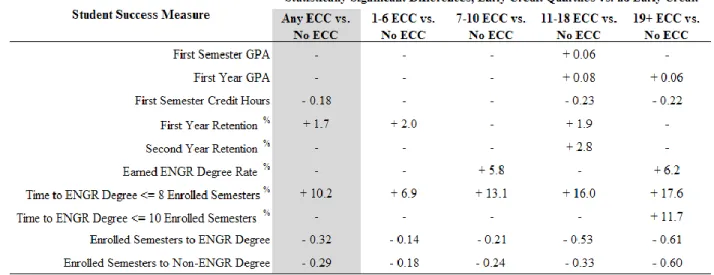
The task force also analyzed whether the amount of ECC, among those students with some ECC, impacted their outcomes. Students were grouped into quartiles based on amount of early credit they brought into the institution. At the institutional level, students with ECC showed
significantly higher outcomes compared to students without ECC. However, as shown in Table 5, the same results were not found among engineering students. For example, first semester and first year GPA were not differ significantly when comparing engineering students with any amount ECC to those without ECC, as shown in Table 3 and the first column of Table 5. However, engineering students bringing in 11-18 credits did have significantly higher first semester GPA and first year GPA compared to engineering students without ECC.
Not surprising, the more ECC an engineering student brings in, the shorter their time to degree. However, while those engineering students in the top quartile of ECC (19+ credits) reduced the number of semesters enrolled by 0.61 semesters compared to students without ECC, they still took 8.9 semesters to graduate. . In comparison, non-engineering students in the top quartile were able to bring their average semesters to degree down to 8.2 semesters.
No ECC Some ECC
First Fall GPA† 2.68 2.72 2.50
First Year GPA† 2.68 2.72 3.16
First Fall Credit Hours† 13.4 13.1 - 7.30
First Year Retention† 88.7% 90.5% 3.37
Second Year Retention† 79.0% 82.0% 4.48
Overall Graduation Rate† 71.8% 77.1% 5.36
Earned ENGR degree rate n/a n/a
Time to Degree <= 8 Enrolled Semesters† 54.3% 66.1% 9.12
Time to Degree <= 10 Enrolled Semesters† 94.0% 95.6% 2.56
Enrolled Semesters to Degree† 8.8 8.5 - 9.26
Propensity score matching on residency, ACT Math & English, HS Rank, HS GPA, first semester credits, & entry major
† = Statistically significant difference, α=0.05
Student success measure
Adjusted Means for
Table 5. Statistically significant differences in student success measures for engineering students, any amount of ECC vs. no ECC and quartiles vs. no ECC.
Academic experiences
As shown in Table 6, engineering students with any amount of ECC did not add minors at a higher rate than engineering students without ECC. However, among all majors the Task Force found that students with at least some ECC added minors at a higher rate than students without ECC. Engineering students with 19+ credits of ECC did add both minors and majors at a higher rate; whereas at the institutional level, for students with 19+ credits, adding a major was
significant but adding a minor was not significant.
Table 6. Statistically significant differences in student participation measures by engineering students, any amount of ECC vs. no ECC and quartiles vs. no ECC.
Any ECC vs. No ECC 1-6 ECC vs. No ECC 7-10 ECC vs. No ECC 11-18 ECC vs. No ECC 19+ ECC vs. No ECC In a learning community % - + 5.9 + 3.7 + 3.5 -Earn a minor % - - - - + 7.0
Earn second major % - - - - + 4.8
Change majors % - - - - -5.5
Propensity score matching on residency, ACT Math & English, HS Rank, HS GPA, first semester credits, & entry major
% = Differences are shown in terms of percentage points
All table entries, statistically significant difference, α=0.05
Measure
Similar to institutional level data, engineering students with any amount of ECC did not participate in learning communities at a significantly different rate as compared to engineering students without ECC. However, within the engineering student population, students with 1-18 credits of ECC participated in learning communities at a higher level than students without ECC. At the institutional level students with any amount of ECC (and for all the various quartiles of ECC) were less likely to change their majors than students without ECC. This finding did not hold true for engineering students With the exception of engineering students with 19+ credits of ECC, engineering students with ECC were as likely to change their majors as engineering
students without ECC.
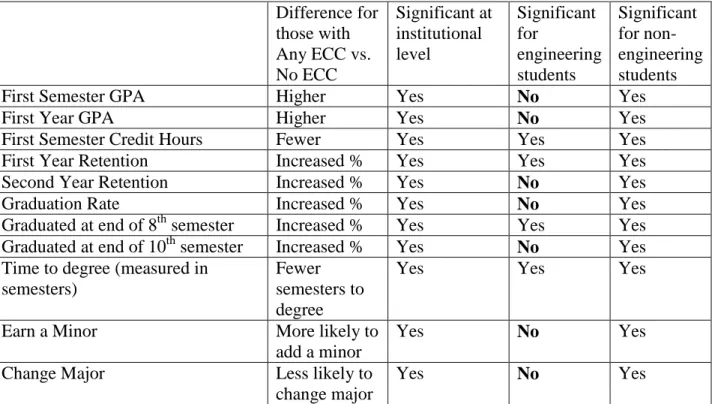
Table 7 provides a summary of the statistically significant findings ( =0.05), comparing students with any amount of ECC to those students without any ECC, at the institutional level, for
engineering students, and for non-engineering students.
Table 7. Summary comparison of student success and participation measures based on having Any ECC vs. No ECC.
Difference for those with Any ECC vs. No ECC Significant at institutional level Significant for engineering students Significant for non-engineering students
First Semester GPA Higher Yes No Yes
First Year GPA Higher Yes No Yes
First Semester Credit Hours Fewer Yes Yes Yes
First Year Retention Increased % Yes Yes Yes
Second Year Retention Increased % Yes No Yes
Graduation Rate Increased % Yes No Yes
Graduated at end of 8th semester Increased % Yes Yes Yes
Graduated at end of 10th semester Increased % Yes No Yes
Time to degree (measured in semesters)
Fewer semesters to degree
Yes Yes Yes
Earn a Minor More likely to
add a minor
Yes No Yes
Change Major Less likely to
change major
Yes No Yes
Student survey results
For most student survey questions, there were no significant differences between responses for engineering students and non-engineering students. Their responses mirrored the findings
among all majors regarding where students take their early credit, whether they would do it again if they were to go back in time, whether they would recommend taking early credit to others, and issues of course gaps were cited by both engineering and non-engineering students.
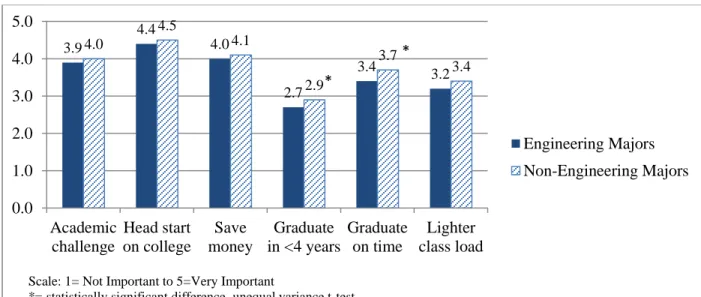
In general, the factors students identified as important in their decision to earn ECC were fairly similar between engineering and non-engineering majors (see Figure 1). However, engineering students were slightly less likely than non-engineering students to indicate that “graduating in less than four years” or “graduating on time” were important factors. However, another factor related to completing college more quickly, “saving money” engineering students were as likely to rate that as an important factor as non-engineering students.
Figure 1. Student rating of importance of factors in decision to earn ECC.
However, when students were asked about whether they had experienced specific unintended outcomes associated with ECC, there were significant differences between engineering students and non-engineering students. As shown in Figure 2, engineering students with early college credit were more likely to have repeated a course taken as early credit, to have taken early credits that did not apply to degree requirements or major, to say that their early college credits did not shorten their time to degree or save them money.
Engineering faculty and staff observations
Engineering faculty and staff expressed the institutional themes related to misperceptions among incoming students and parents about how ECC courses would be applied, policies that use student credits hours, and advising challenges for students with ECC. However, there were three themes that emerged from engineering faculty and staff that did not emerge at the same level with other groups across campus. First, with the foundational mathematics courses required of engineering, engineering faculty and staff shared a concept related to the negative consequences for students taking mathematics courses as early college credit, with themes in the area of course pace and structure and time gaps between taking mathematics courses. These themes were not raised in any substantial way by other groups across campus. Exemplar quotes from engineering are provided below.
3.9 4.4 4.0 2.7 3.4 3.2 4.0 4.5 4.1 2.9 3.7 3.4 0.0 1.0 2.0 3.0 4.0 5.0 Academic challenge Head start on college Save money Graduate in <4 years Graduate on time Lighter class load
Scale: 1= Not Important to 5=Very Important
*= statistically significant difference, unequal variance t-test
Engineering Majors Non-Engineering Majors
*
Figure 2. Percentage of students of students with ECC who experienced unintended outcome
“We see some students that take AP calculus as a junior [in high school] that want to take calculus II here as freshman. The time lag between when they took Calc[ulus] I and Calc[ulus] II is too long for them to do well.”
“AP is a semester course at the university that is taught over an entire year – so they aren’t used to college pace. I almost always encourage students to repeat Calc[ulus] I, unless they are really exceptional students.”
“College courses taught in high school may use the same book, but they aren’t the same as taking the course in college. They meet five days a week, have more extra credit
opportunities – are treated like they are in high school – which they are. It is not the same as if they had taken it on a college campus.”
The second and third themes that had unique aspects within engineering were related to
curriculum and building student schedules. The impact ECC had on the ability of the student to build an appropriate first semester schedule was shared broadly across the institution.
Individuals from groups such as orientation, the registrar’s office, and faculty/staff from all academic colleges addressed this theme. However, engineering faculty and advisers were unique in identifying the impact that ECC had on a student’s ability to build a reasonable full-time student schedule after the first year. This theme was closely related to the theme that the limited number of social science and humanities (SSH) courses accepted towards meeting engineering curriculum requirements caused students difficulty in building reasonable schedules, when they brought in significant numbers of ECC in the SSH area.
“Engineering is so structured and does not include many electives. Students bringing in large numbers of credit have already met all their SSH [social science/humanities] requirements before they get here. It makes it difficult to create a full schedule of courses
28.9 61.8 52.1 47.5 27.9 12.2 46.1 30.4 37.2 17.4 0.0 10.0 20.0 30.0 40.0 50.0 60.0 70.0 Repeated course Didn't apply to major Didn't apply to degree Didn’t reduce time to degree Didn't save money
* = statistically significant difference, unequal variance t-test
Engineering Majors Non-Engineering Majors * * * * *
that will allow them to make progress towards their degree – that isn’t filled with too many difficult courses.”
“It affects their schedule all the way through. The student can’t balance out hard/time intensive engineering courses with easier SSH courses.”
“We struggle to build a first semester schedule. They already have enough SSH courses and that leaves only calc[ulus], science and engineering courses – a brutal first semester. If we can’t get them into a diversity or IP [international perspective] course [university required SSH courses], we may recommend that they take an SSH course that they may not need but gets them a more reasonable schedule and gets them to full-time status.”
Discussion
Reflecting on the initial research questions, while engineering students see some of the benefits that non-engineering students see from taking early college credit, there are many notable differences.
Research question (1): Do engineering students see the same success effects of early credit as non-engineering students?
For engineering students, there were no statistically significant differences between students with ECC and those with no ECC in first-semester GPA, first-year GPA, graduation rates, and second-year retention rates.
For non-engineering students, having some amount of ECC provided a positive and statistically significant impact on all of these student success measures.
Research question (2): Are the experiences of engineering students with early college credit significantly different than non-engineering students?
For engineering students, having ECC is not significantly related to students earning minors; it is significant for non-engineering students.
For engineering students, having ECC is not significantly related to a reduction in changing majors after enrolling; it is significant for non-engineering students. Taking ECC to graduate in less than four years or ‘on time’ is not as significant for engineering students as it is for non-engineering students.
Engineering students say they retake early credit courses, have ECC courses not apply to their degree or major, do not see ECC shortening their time to degree, and do not feel ECC saved them money significantly more than non-engineering students.
Research question (3): Are there unique aspects about engineering that differentially effect engineering students with early college credit?
The combination of the engineering curriculum including the calculus courses and the institutional finding that students taking the first sequence in a mathematics course as early credit do slightly poorly in the subsequent course impacts engineering students differently compared to students in curriculum not as dependent on mathematics. The structured nature of the engineering curriculum and lack of electives causes
throughout their academic career that are not experienced by students in less structured majors.
The sequenced nature of the engineering curriculum creates a critical path that limits the feasibility of students graduating in less than four years, even if they bring in large amounts of ECC.
Curriculum Issues
Many of the challenges that students and faculty/advisers cited for engineering students are tied to the lack of flexibility in the engineering curriculum. Whether it is due to course availability or student interest, many of the courses that students bring in as early college credit are in social science, humanities, English, and mathematics. Courses brought in the mathematics, social science and humanities areas present unique challenges for engineering students.
Mathematics: Since mathematics courses are foundational to engineering, compared to other colleges at Iowa State, engineering faculty/advisers many times recommended that students retake mathematics courses previously taken in high school to ensure a strong mathematics foundation. Advising decisions about whether students should continue in or repeat courses are made on an individual basis, weighing all factors. The institutional-level finding that math students who took math courses as ECC performed at a third of a letter grade lower in the subsequent course might support this recommendation to students. Another math issue was the qualitative theme from students about experiencing “gaps” between the courses they took as early credit in high school and subsequent courses at the university. To address this issue, students suggested that the university should begin each course with a review of the previous materials to bridge these gaps. The feasibility of this would need to be addressed by each instructor as they develop their course. However, there are other approaches that colleges may take to address this issue. One option would be to encourage discussions between mathematics faculty members at the university with mathematics faculty members at key feeder institutions to align curricular content and improve academic rigor. Another option would be to use
competency-based assessment tools that include learning modules for students (such as
ALEKS),[16] to allow students to refresh their skills and/or provide content for the gaps between courses.
Social science/humanities: Other than mathematics and English, many of the courses students bring in as ECC are in the areas of social science and humanities (e.g. psychology, history, political science, world languages, etc.). In many engineering degree programs, these types of courses comprise a fairly small percentage of the total credits required for an engineering degree. It is quite possible that students bringing in large number of ECC will bring in enough credits to have met their degree requirements in these areas before they arrive on the university campus. As engineering faculty members develop the curriculum, they may anticipate that students will be taking a mixture of math, science, engineering, and SSH courses, creating a balance of
courses in a given semester. When students earn a significant number of these SSH courses prior to enrolling at the university, it creates scheduling challenges for engineering academic advisers and students. An option faculty might consider is to engage in discussions on the role, quantity, and flexibility built into the curriculum for these SSH (or general education) type courses. Any such review would need to be done in the context of a number of constraints beyond a perceived
need to accommodate students starting with early college credit but could also address other issues surrounding curricular flexibility. This can be a difficult, but not impossible, discussion within the faculty. There are some models for curricular revision that could be utilized to address needs for additional curricular flexibility.[17]
Curriculum critical path: Most engineering curricula have been developed in a manner where for a student to be successful in achieving the learning outcomes of a particular engineering course, the student must have knowledge gained in a pre-requisite course. It is quite common to have a scaffolding of courses built upon each other, creating a pre-requisite driven critical path of sequenced courses. As an example, for computer engineering at Iowa State there is currently a six-semester sequence of required pre-requisite courses that starts with students taking an
introductory digital logic course and ends with a two semester senior design capstone experience. In addition, before students can take the introductory digital logic course they must have
completed 30 college credits.[18] Curriculum sequencing creates a lack of flexibility and challenges for students with ECC. Any discussions by faculty on the feasibility of curricular revisions to shorten or change the critical path, similar to the discussion on social science and humanities, would need to be done with a full understanding of multiple constraints that impact both individual courses and the entire engineering curriculum.
Engineering courses offered for early credit: To address both the social science/humanities issue and the critical path issue of ECC, there is an opportunity for engineering colleges to consider proactively addressing the issue by evaluating what engineering courses are available for students to take as ECC. While many high schools across the country have implemented pre-engineering curriculum, like Project Lead the Way,[19] there are few opportunities for students in high school to take credit-bearing, entry–level engineering courses as ECC. Where appropriate, engineering colleges might consider offering entry-level engineering courses as an ECC option for students, either by partnering with local community colleges or by developing
on-line/distance education options for students.
Curriculum impact on student choices: Although engineering students were less likely to identify time to degree or graduating in less than four years as a decision factor in of why they took ECC, they did state that reducing costs was a factor that influenced their decision to take ECC.
Creating opportunities for students to graduate in fewer semesters, by shortening the critical path or applying more of their ECC courses towards their engineering degree program, would result in reduced tuition costs for students. We do not know if the lack of flexibility within an
engineering curriculum is impacting student selection of majors or institutions. Is it possible that students might be self-selecting majors and/or institutions based on their ability to graduate earlier? If students could graduate earlier from a college of engineering that offers more flexibility with the pre-requisites critical path, or that applied more of their ECC towards the degree requirements, might students select that institution over another? Or if they can graduate in 3 or 3.5 years with a computer science or physics degree but it will take them 4 or 4.5 years to graduate with a computer engineering degree, will they choose a different major? These are questions related to early credit that merit additional research.
Lower participation in minors: Additional research is needed to better understand why engineering students with ECC do not take advantage of minors compared to non-engineering
students ECC. Is this due to lack of interest or awareness about minors available? Or is it due to the fact that by repeating ECC courses and many of their ECC not applying, engineering students with ECC are not really as far along on their degree programs as non-engineering students, so they don’t have as much flexibility to add the minors as non-engineering students? If students in fact have the space in their schedule but are opting to not pursue minors, institutions might explore developing or encouraging students to take minors that align with ABET student outcomes.
Messaging and educating for parents, students, and counselors
Since experiences of engineering students with early college credit are different than non-engineering students, there is important that non-engineering colleges are engaged in the
development of messages that are shared with high school students, parents, and counselors about early college credit. Engineering colleges need to help create realistic expectations of application of early college credit within various engineering degree programs. It is important for universities or colleges to consider providing access to, e.g. on-line, planning tools that allow high school students to enter their intended early college credit courses and see the impact on their engineering degree plans. Access to these types of tools will allow students to realize before they take 30 credits of general education coursework that their intended engineering degree only requires 18 credits. It is also important for engineering colleges to share the message from current ECC students that “even if students repeat courses or their courses don’t apply there are still benefits to taking early college credits.” Use of qualitative research
exemplars or testimonials from students could inform that messaging. Colleges of engineering should consider reaching out to prospective students and families providing information and/or early academic advising so students can make informed decisions in high school about ECC courses.
One of the institutional task force’s initial questions was to investigate whether there was a recommended “sweet spot” for number of credits students should bring in, where students see the greatest positive outcomes. The hypothesis was if students brought in one or two classes, that maybe their early credit experiences were not extensive enough to generate significant positive outcomes. Conversely, if students brought in too many credits, it might advance them into difficult higher level courses that they may be quite ready to tackle as direct from high school graduates and they may not see the same GPA/retention benefits. At the institutional level, no sweet spot was identified. All student success measures were significant at all four quartiles of ECC. However, for engineering students the data appear to identify a potential sweet spot at the 11-18 credit level, where engineering students see significant positive outcomes not seen in other ECC quartiles. While further investigation is recommended, these findings give an early indication of an opportunity for colleges of engineering to be able to answer questions from parents and students about “How much early credit do you recommend a high school student take?”
Future research
While the task force report and this subsequent analysis for engineering students provide data that can help inform discussions, practice and curricular reviews within colleges of engineering,
it is important to note the limitations of this study. Many of the findings at the institutional level are supported by other research across the country. However, the findings specific to
engineering are limited to a single institution. While many of the findings may be applicable to other institutions, expansion of the research to include other institutions would be valuable. In addition, there are potential research questions raised in the discussion, such as whether ECC affects student potential engineering students’ choices of institution/major or understanding why engineering students with ECC do not add minors at rates comparable to non-engineering students that merit additional study.
References
[1] College Board, 2012a. Advanced Placement. http://www.collegeboard.com/student/testing/ap/about.html, accessed December 29, 2012.
[2] International Baccalaureate, 2012, http://www.ibo.org/informationfor/universitiesandgovernments/universities/ accessed December 31, 2012.
[3] College Board, 2012b. College-level examination program. http://clep.collegeboard.org/exams/about, accessed December 29, 2012.
[4] National Center for Education Statistics (2005). Dual Credit and Exam-Based Courses in U.S. Public High Schools: 2002-2003. U.S. Department of Education.
[5] Office of Institutional Research, Oregon University System (2010). Dual Credit in Oregon, 2010 Follow-up: An Analysis of Students Taking Dual Credit in High School in 2007-08.
[6] Vargas, Joel H., and Miller, Marc C. (June 2011). “Early College Designs: An increasingly popular college-readiness strategy for school districts to reach more traditionally underserved students”, The School Administrator. 68 (6): 18-25.
[7] Iowa State University, Early College Credit Task Force Final Report. 2011.
http://www.provost.iastate.edu/sites/default/files/uploads/reports/2011EarlyCreditTaskForceFinalReport.pdf accessed December 1, 2012.
[8]Rubin, D.B. (1974), "Estimating Causal Effects of Treatments in Randomised and Non-Randomised Studies", Journal of Educational Psychology 66, 688-701.
[9] Rosenbaum, P.R. and Rubin, D.B. (1983), "The Central Role of the Propensity Score in Observational Studies for Causal Effects", Biometrika 70, 1, 41-55.
[10] Heckman, J.J., Ichimura, H. and Todd, P.E. (1998), "Matching as an Econometric Evaluation Estimator", Review of Economic Studies 65, 261-294.
[11] Guo, G. and Frasner, M. W. (2010). “Propensity score analysis: Statistical methods and applications”, Advanced Quantitative Techniques in the Social Sciences Series 11. Thousand Oaks, CA: Sage Publications, Inc.
[12] Leuven, E. and Sianesi, B. (2003). "PSMATCH2: Stata module to perform full Mahalanobis and propensity score matching, common support graphing, and covariate imbalance testing".
http://ideas.repec.org/c/boc/bocode/s432001.html. Version 4.0.6.
[13] Rosenbaum, P.R. and Rubin, D.B. (1985), "Constructing a Control Group Using Multivariate Matched Sampling Methods that Incorporate the Propensity Score", The American Statistician 39(1), 33-38. [14] Thornberg, R., & Charmaz, K. (2012). Grounded theory. In S. D. Lapan, M. Quartaroli, & F. Reimer (Eds.),
Qualitative research: An introduction to methods and designs (pp. 41-67). San Francisco, CA: John Wiley/Jossey-Bass.
[15] Carey,M. A. (1994). The group effect in focus groups: planning, implementing, and interpreting focus group research. In J.M. Morse (Ed.) Critical issues in qualitative research methods ( 225-241). Thousand Oaks, CA. Sage Publications Inc.
[16] ALEKS (2013). http://www.aleks.com/, accessed March 20, 2013.
[17] Felder. R.M., Brent, R., Prince, M.J.,(2011) Engineering Instructional Development: Programs, Best Practices, and Recommendations. Journal of Engineering Education. 100 (1): 89-122.
[18] Iowa State University, Computer Engineering Flowchart, 2012-2103 Catalog, http://www.ece.iastate.edu/wp-content/blogs.dir/11/files/2011/08/CprE_12-13_flowchart.pdf, accessed March 20, 2013.