Documents from malicious terminals
István Zsolt Berta and István Vajda
Laboratory of Cryptography and Systems Security,
Budapest University of Technology and Economics, Budapest, Hungary
ABSTRACT
The user wishes to communicate with a remote partner over an insecure network using a terminal. Cryptographic algorithms running on the terminal may provide authenticity for the user’s messages. In this paper the problem of sending authentic messages from untrusted terminals is analyzed. If attackers are able to gain total control over the terminal, the user must consider the terminal a potential attacker. Smart cards are often considered the ultimate tool for this problem. However, their lack of user interface enables man-in-the middle attack from the terminal. The user is a human with limited memory and computational power, only exceptional users can authenticate messages without a trusted device. Several biometric media encapsulate the content of the message and the identity of the sender, such as speech, video and handwriting. The authors suggest, that such media are far more difficult to counterfeit than plaintext, so users should rely on their biometric resources. In the protocol proposed by the authors, the user sends messages in a biometric format, strengthened by simple algorithmic authenticators. The smart card functions as a secure time gate ensuring, that the attacker has extremely little time to counterfeit both the biometric and the algorithmic protection on the message. The authors claim, that with the proper calibration of the biometric method and the time gate of the smart card, their protocol is strong enough for practical use.
Keywords: authentication, smart card, malicious terminal, biometry
1. INTRODUCTION
Sending authentic messages to remote partners has gained great importance with the spreading of digital signatures and electronic commerce. Smart cards are tamper-resistant personal microcomputers with great cryptographic potential. These devices are often considered the perfect tool for generating, storing and using cryptographic keys. Unfortunately, smart cards lack user interface, and they are only able to communicate with the user via terminals. If the terminal is malicious, various new attack possibilities arise. In this paper the problem of untrusted terminals is examined, and a solution is proposed to block the terminal’s man-in-the middle attacks.
2. THE PROBLEM
2.1. Authentication
The userU wishes to send the mmessage to the remote partnerR. In order to gain authenticity,U transformsm to f(m), and sends thef(m)message on the channel. IfRis able to invert the received message using thef−1, then accepts them=f−1(f(m))as a valid one. Unfortunately, the attacker has full control over the channel and is able to observe, intercept and replace packages, and is also able to send messages in the name ofU. This is why thef transformation must have a secret parameterk, that is unknown to the attacker. An attack takes place, if the attacker sendsX toRin the name ofU. The attack is successful ifRacceptsm0=f−1(X)as a valid message originating fromU, andm06=m.
R may consider themmessage authentic, ifRaccepts thatmwas sent byU (partner identification) andmarrived unmodified (integrity). If eachm message contains a fresh element (such as a timestamp), the attacker is not able to replay previously recorded messages without having to modify it. Thus is the protection against replay attacks a question of integrity. While in case of encryption, perfect secrecy1exists, in case of authenticity the problem has no theoretically perfect solution. It is impossible to guarantee, that messages from the attacker are never accepted by the receiver as valid messages from the user, so only probabilistic solutions exist.2
Further author information:
I. Zs. Berta: Email: [email protected], Telephone: +36302483630, Address: Department of Telecommunications, Budapest University of Technology and Economics, Po. Box 91, Budapest, Hungary
I. Vajda: Email: [email protected], Telephone: +3614631603 Address: Department of Telecommunications, Budapest University of Technology and Economics, Po. Box 91, Budapest, Hungary
2.2. Untrusted terminals
In order to communicate with the remote partnerR, the userUneeds the terminalTto communicate on the network. Since sensitive information is transmitted, various cryptographic protocols (e.g.: MAC, digital signature3) are used to guarantee the authenticity of the messages. SinceU has little computational power, these protocols are performed byT. However, in many casesT cannot be considered secure. Sometimes, the party operatingTis not trusted byU. Certain software or hardware componens ofT might have hidden features. Moreover, even if the intentions of the party operatingT are clear, the integrity of the terminal often cannot be guaranteed.
To provide security, another party is introduced. C is a smart card possessed byU, responsible for managing thek secret key required for the used cryptographic protocol. Today smart cards have cryptographic hardware that enables the keys to spend their entire lifecycle onC. They are generated, stored, used and finally destroyed on the card. Since the key never leavesC,T is not able to intercept it, so an authentic message can only be sent ifCis present.
2.3. Assumptions
1. Limitations of resources
(a) U is a human being, who can perform at most 10 additions (between bytes) in a minute, and can memorize at most random 10 characters (10 bytes). Although this latter may seem little, it is an optimistic approach. The information memorized byUshould not be regular words, (because they can be guessed by the attacker) cannot be written anywhere, and should be changed regularly.
We also assume, thatU does not possess any trusted computational device. (IfU can use such a device, there is no need to use a smart card.)
(b) Ris (or has access to) a trusted computer.Rcan perform one billion (109) additions in a second, and has many gigabytes of memory.
(c) Cis a smart card. The computational power of cards with crypto-coprocessor is in a similar magnitude toR, while their memory is measured only in kilobytes (e.g. 64k).
2. U,RandCmay only communicate throughT, they are not connected to each-other directly. 3. The partiesU,RandCare not malicious, and their integrity can be guaranteed.
4. The attacker can take full control ofT.∗
2.4. Models
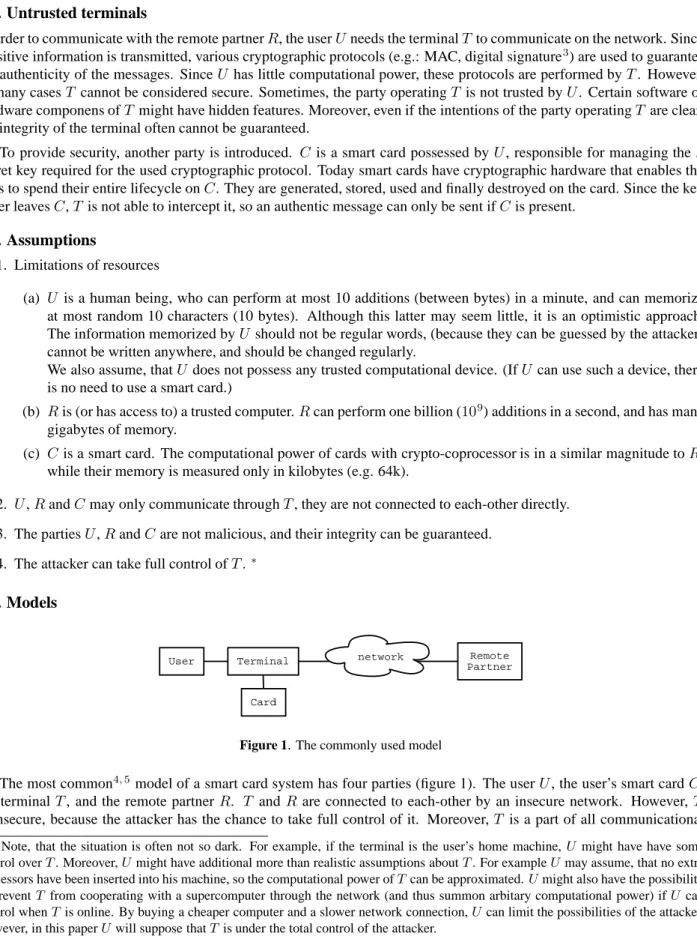
User Terminal Card Remote Partner networkFigure 1.The commonly used model
The most common4, 5model of a smart card system has four parties (figure 1). The userU, the user’s smart cardC, the terminalT, and the remote partnerR. T andR are connected to each-other by an insecure network. However,T is insecure, because the attacker has the chance to take full control of it. Moreover,T is a part of all communicational
∗Note, that the situation is often not so dark. For example, if the terminal is the user’s home machine,U might have have some
control overT. Moreover,Umight have additional more than realistic assumptions aboutT. For exampleU may assume, that no extra
processors have been inserted into his machine, so the computational power ofTcan be approximated.Umight also have the possibility
to preventT from cooperating with a supercomputer through the network (and thus summon arbitary computational power) ifU can
control whenT is online. By buying a cheaper computer and a slower network connection,Ucan limit the possibilities of the attacker.
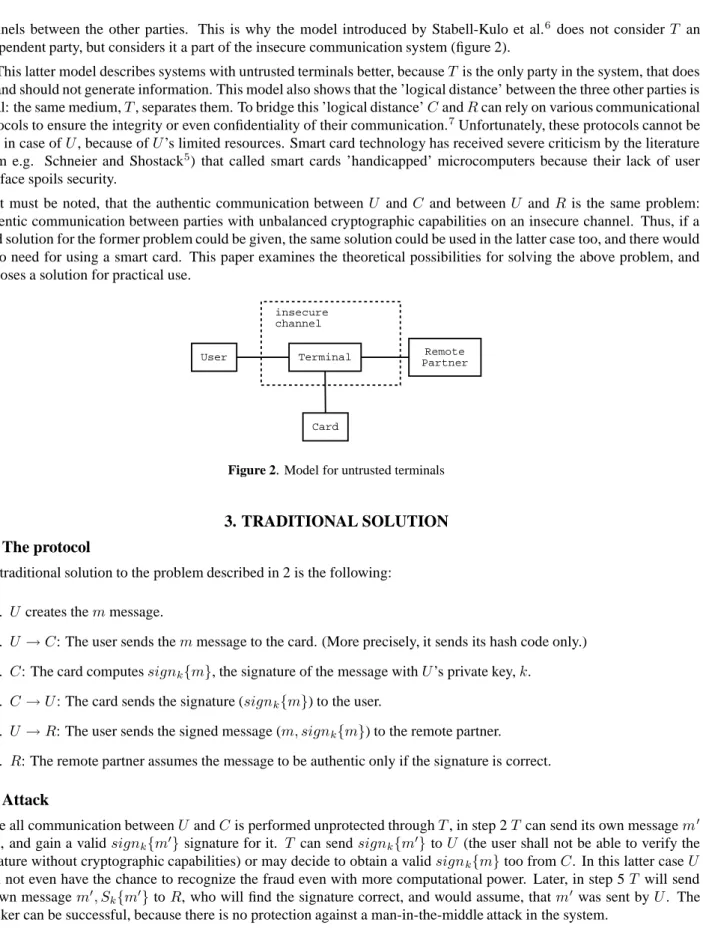
channels between the other parties. This is why the model introduced by Stabell-Kulo et al.6 does not consider T an independent party, but considers it a part of the insecure communication system (figure 2).
This latter model describes systems with untrusted terminals better, becauseT is the only party in the system, that does not and should not generate information. This model also shows that the ’logical distance’ between the three other parties is equal: the same medium,T, separates them. To bridge this ’logical distance’CandRcan rely on various communicational protocols to ensure the integrity or even confidentiality of their communication.7Unfortunately, these protocols cannot be used in case ofU, because ofU’s limited resources. Smart card technology has received severe criticism by the literature (from e.g. Schneier and Shostack5) that called smart cards ’handicapped’ microcomputers because their lack of user interface spoils security.
It must be noted, that the authentic communication between U andC and betweenU andR is the same problem: authentic communication between parties with unbalanced cryptographic capabilities on an insecure channel. Thus, if a good solution for the former problem could be given, the same solution could be used in the latter case too, and there would be no need for using a smart card. This paper examines the theoretical possibilities for solving the above problem, and proposes a solution for practical use.
User Terminal Card Remote Partner insecure channel
Figure 2.Model for untrusted terminals
3. TRADITIONAL SOLUTION
3.1. The protocol
The traditional solution to the problem described in 2 is the following:
1. U creates themmessage.
2. U →C: The user sends themmessage to the card. (More precisely, it sends its hash code only.) 3. C: The card computessignk{m}, the signature of the message withU’s private key,k.
4. C→U: The card sends the signature (signk{m}) to the user.
5. U →R: The user sends the signed message (m, signk{m}) to the remote partner.
6. R: The remote partner assumes the message to be authentic only if the signature is correct.
3.2. Attack
Since all communication betweenU andCis performed unprotected throughT, in step 2T can send its own messagem0 toC, and gain a validsignk{m0}signature for it. T can sendsignk{m0}toU (the user shall not be able to verify the
signature without cryptographic capabilities) or may decide to obtain a validsignk{m}too fromC. In this latter caseU
shall not even have the chance to recognize the fraud even with more computational power. Later, in step 5T will send its own messagem0, Sk{m0}toR, who will find the signature correct, and would assume, thatm0 was sent byU. The attacker can be successful, because there is no protection against a man-in-the-middle attack in the system.
3.3. Attempts to block MIM attacks
• Today it is common that smart cards are protected by PIN code. While this may be useful if the card is stolen, it does not help against untrusted terminals. Since the PIN passes throughT, it may intercept it. The idea of one-time PIN code already guarantees thatUhas to be present whenCis used. However,Umay still not know, if in step 2T transmits the same message toCthat it received fromU.
• It may happen, that the user has to confirm whenever the terminal turns to the card. Even if this can be implemented (assumption 4),T can still perform a man-in-the-middle attack.
• A similar idea is, that the user should remove the card if not using it. Unfortunately, this does not prevent the man-in-the-middle attack either.
However, in its own limitations, this solution is very powerful. By disconnecting the card from the terminal, the user can guarantee, that no-one tampers with it.8state, that smart cards thus transfer the sense of security from the electronic world to the physical one.
• The area on the disk of the terminal that turns to the card can be made read-only (e.g. used from a CD ROM). In this case the attacker may create a tampered copy of this area and modify the references to the original area. To prevent this, the whole binary area of the terminal needs to be made read-only. Although, this is a workable solution, it is most uncomfortable. It contradicts customization and prevents the terminal manufacturer from correcting (or patching) its products. We do not deal with this option, because it contradicts our assumption (#4), that the attacker may take full control ofT.
• Biometric solutions of user identification exist and may provide additional security. Even the most closely integrated solutions (where the finger print reader is on the card itself) do not prevent man-in-the-middle attacks.
• The user may ask help from a trusted third party to verify that the correct message was signed.6However, ifU can only communicate with this third party throughT,T may intercept and modify these messages too. In this case the same problem arises: authentic communication should be provided on an insecure channel not betweenU andC, but betweenU and the third party.
• Using more developed smart cards could improve security. E.g. Abadi et al9prove that a smart card with a display device would enable secure two-way communication betweenUandC. The approach of Clarke et al10also consume singnificantly more resources. Unfortunately, such solutins would massively increase costs. This is why no such cards exist yet.
• Another good solution would be to protect the integrity of messages betweenU andCwith e.g. a MAC.6 Unfortu-nately, this is not possible due to the limited resources ofU. This topic is further explained in the next section.
4. LIMITED POSSIBILITIES OF THE USER
As it is described in section 2.3, the resources of the user are limited. U has a small amount of memory and little computational power. Moreover,Ualso makes mistakes during calculations, soUcan be considered a ’poor cryptographic device’.
4.1. Dead ends
4.1.1. Signature on a hash value
The user U cannot carry out complex computations on his own, which are needed for calculation of a hash value, a cryptographic checksum. If we consider a general transformation from binaryN bit input to binaryM bit output, such that in average at least half of the inputs has effect on each output, then in average at leastN∗M/2binary operations has to be performed. For instance, ifN = 1000,M= 64, it means at least32000operations, far out of the capacity of userU taking into account the time restrictions and the reliability problems ofU. (The needed number of calculations remains too high even in case if we assume character level operations, say with decimal characters). Easy linear transformations might be handled byU(like CRC), but those are inappropriate in making cryptographic checksums. In this caseT – knowing the mmessage and the weak transformation – would be able to prepare anm0message with the same hash value easily.
4.1.2. Encryption of the whole message
Performing a strong block-cipher on the whole message is also beyond the capabilities ofU. If we considerM-bit-long blocks,N/Mtransformations has to be performed. In order to make a transformation strong, it needs to meet the criteria of completeness and that of avalanche effect. Thus,Uneeds to perform at leastM∗Moperations for each block, which means altogetherN∗Moperations. Another option could be the one proposed by Stabell-Kulo et al6: using a one-time-pad in cascade with an additional nonlinear operation, like a character level substitution table, which can also be easily performed by the user. However,Udoes not have enough storage capacity to perform a one-time-pad on the whole message.
4.2. Pencil-and-paper solutions
4.2.1. Book cipher
The book cipher11, 12 is one of the oldest strong ciphers. It transforms characters of the message m into pointers to characters in a given bookB.
BookCipher(m[i]) :m[i]7→j, whereB[j] =m[i]. The key in a book cipher is the bookB.
However, if the attacker has information onm, the book cipher alone does not provide authenticity, because the attacker is able to e.g. swap characters in the message. The book cipher should be strengthened by the structure of the document to provide authenticity.
4.2.2. One-time-pad
The one-time-pad1is the only known algorithm, that provides perfect secrecy, and it its also simple enough forU to perform. OT P(m[i]) = m[i]⊕k[i], wherekis a one-time random key, andlength(k) = length(m). However, the modular addition (⊕) is a linear operation, so messages encrypted with one-time-pad are subject to linear manipulations.6 propose that the one-time-pad can be used for authenticity if it is strengthened by a secret substitution tablet. U has to memorizetandkas secret keys. The main drawback of this method is, thatkcan be very long, soU can only use it if he can use significantly large secure storage.
4.2.3. Solitaire
Solitaire13 is merely an imperfect one-time-pad, where the ’one-time key’ is the output of a pseudo-random number generator. Solitaire uses a deck of cards to generate random. The key is the seed of the PRNG, which is an ordering of the deck. The key islog256!≈248bits long, that is already far beyond the memory capacity of the userU. Solitaire provides strong secrecy but weak authenticity, just like one-time-pad, so it should be strengthened e.g. by a substitution table, that will addlog226!≈88bits to the key length in case of a 26-character-long alphabet. The PRNG of Solitaire is very slow for commercial use. Schneier proposed it for secret agents.
4.2.4. Visual methods
Visual cryptography was introduced by Shamir and Naor.14 It enables the user to recieve encrypted messages from the remote partner. This method relies on a one-time-pad, where the ⊕operation is accelerated by the user’s eye via transparencies placed on the terminal’s screen. Naturally, the key of the one-time-pad is a transparency, that can be used one-time only. Naor and Pinkas15 extended visual cryptography to support user identification and recieving authentic messages. However, each visual cryptography method (except for partner identification) is unidirectional: they only work from the remote partner towards the user. Matsumoto16, 17has also developed a user identification method that has visual accelerations, but does not protect the session itself.
4.3. Summary of algorithmic possibilities
In order to give a perfect solution for the problem of insecure terminals, an authentication method would be needed that gives similar functionality to public key cryptosystems (RSA or ECC). However, in order to be used by ’weak computers’ like humans, this algorithm should have a shorter key and should require dramatically less computational power. If an algorithm like this would exist, then it would be used in computer-environment too.
Although U possesses abilities like good quality random number generation, memorization of passphrases and ’common sense’, finding a purely algorithmic solution for the problem of insecure terminals seems hopeless. In order to solve the above problem, non-algorithmic abilities ofUshould be exploited.
5. PROPOSED SOLUTION
5.1. Extensions to the model
In section 2.3 we modeledU,RandCas three independent computational devices wishing to communicate with each-other, whereU has limited resources that prevent the application of advanced cryptography. Our model can be extended here by not considering the userUmerely a slow computer, but a human being with the following abilities:
• U can be identified by means of biometry. Moreover,Ucan identify other humans known toUusing biometry.
• We may assume, thatUhas a timer independent fromT(e.g. a watch), soUis able to measure time.
• By removing the cardUis able to block the channel betweenCandT.
5.2. Biometric signatures
Most biometric features only enable the identification of humans, but some can also be used to transmit information. For example, fingerprint verification can only identify people, but the recorded voice combines the identity of the individual with the content of the speech. Out of the known biometric methods speaker verification, audiovisual verification and handwriting verification can fulfill such criteria.
In this paper the concept of time is used (with the assumption, that manipulating a biometric message requires a certain amount of time or even user interaction) to reinforce biometric authenticity. Since handwriting is less connected to time, in this paper the two others shall be used as ’biometric methods’.
5.2.1. Security
The userU transforms the messagemto a biometric format to ensure its authenticity. Thebio(m)message is in a format that carries the biometric features of the sender too. We suppose, it is ’safer’ than the plaintext messagem. In this section the extent of this ’safety’ is analyzed.
1. Unconditional security would mean, thatbio(m)messages cannot be counterfeited or manipulated.
2. Practical safety: This means that the attacker needs considerably more time to counterfeitbio(m), than to counterfeit mitself.
3. No significant security: The other extreme case would be to considerbio(m)messages as secure asm(plaintext messages), so attackers do not need considerably more time to manipulate them.
Unconditional security is not a realistic assumption. We assume, that if the attacker has enough time and resources, it can manipulate anybio(m), so considering them perfectly secure, is out of the question. We also assume, that it is possible to calibrate a biometric method (bio) to give practical safety.
5.2.2. ’Key space’
A biometrically signed message – just like a cryptographically signed one – is a result of a transformation based on some secretk. While in case of cryptography,kis a set of bits, in case of biometric signatureskUbio is more complex: it is a
combination of the biometrical characteristics ofU. However, these can be affected by the following factors:
• Biometric identity: time-invariant biometric characteristics ofU
• Current condition: Ever-changing factors, that cannot be pre-planned in any way. E.g.: mood, illnesses, fatigue, aging, etc.
• Conscious alterations: Various attempts ofU to influence the current sample.
Although the above represent an infinitely large key space, only factors known to theRcan be used as secret key. Moreover, the above factors have to be measured, and the precision of measurement limits the size of the key too. Biometric systems are constructed on the assumption, that the measured biometric identity of each individual is different. This means, that the key space of biometric identities is considered extremely large, even if their value cannot be measured exactly.
5.2.3. Attacks
If the attacker has observed the previousbio(m1),bio(m2),...,bio(mn), and wishes to prepare a counterfeitedbio(m0)
message, two kind of attacks are possible:
1. The attacker may observe the biometrical characteristics ofU and try to extractkbiofrom the recorded messages in
order to synthesize a completebio(m0). In this case the attacker tries to masquerade itself asU, and trick the partner identification method ofR. Fortunately, this attack is far beyond the capabilities of most attackers.
2. Not being able to synthesize abio(m0)message, the attacker may choose to create it using cut-and-paste from one or more previousbio(mi)messages sent byU. Thus, the attacker violates the integrity of the message, while every
part ofbio(m0)originates fromU.
5.2.4. Integrity
The main weakness ofbio(m)messages is that the biotransformation does not have the completeness property. This means, that modification of one part ofbio(m)does not require modifications in any other parts. What is the smallest part an attacker may try to modify? Sincebio(m)does not consist of blocks, the attacker may try to manipulate segments of any size. However, since the aim of the attacker (section 2.1) is more than successfully modifyingbio(m), but to make RacceptX wherebio−1(X) =m0 6=m. Ifmconsists of characters, no attack onbio(m)can be called successful, that does not modify at least one character inm. Although, thebiotransformation does not satisfy the criteria of completeness, biometric messages have an internal structure, that chains segments ofbio(m)together. On an audio message this can be the changes in amplitude of the voice or the tone of the speaker. On a video message this can be the changes in the facial expressions or the position, behavior or even clothes of the person.
While checking these properties using algorithms could be very awkward, the human brain triggers for any sudden or unpredicted changes in the biometrical characteristics of the speaker. The task of the attacker can be made especially hard if the biometric method is calibrated using other artificial methods to chain blocks of thebio(m)together. Good examples for the audio channel could be a different systematic background noise or music under the message. On the video channel a clock or television in the background can be used to harden cut-and-paste attacks. The method to preserve the structure of the message need not be secret: U can announce the method at the beginning ofbio(m), since the method only has to be one-time and consistent in the wholebio(m). If the attacker wishes to paste together segments frombio(mi)and bio(mj), the manipulation of the biometric structure of the messages is needed. Although, this is not impossible, it requires
a significant amount of resources and human interaction too.
We assume, that the attacker needs significantly more time, to prepare such an attack, thanU needs to createbio(m).
5.2.5. Partner identification
In case of plaintext messagesmcontains no algorithmic protection, an attacker is able to send a validm0message in the name of any userU without any information on the person. Viruses, that spread by email in the name of the user use this simple principle. However, every part ofbio(m)itself carries the identity ofU. Since the key spacekbiois large, no
attacker has realistic chances of creating a validbio(m0)message without having any a priori information onU. Thus, an attacker has to plan the attack against each specific userU. Messages ofU has to be observed and recorded in order to synthesize a validbio(m0)message.
Biometric messages are very hard to counterfeit. However, if we suppose, that the attacker is able to extractkbiofrom bio(m1),bio(m2),...,bio(mn), and is able to synthesize abio(m0)message usingkbio,bio(m)does not provide proper
partner identification. On one hand, neither of the above is true for most attackers, on the other hand, since the integrity of messages can be guaranteed, even the simple algorithmic protection (section 5.7) is able to prevent attacks.
5.3. Our protocol
We consider it a critical error in the traditional approach, that the smart card signs the transmitted message on behalf of U, while the card cannot make sure that the message truly originates from the user. In our solutionmis ’signed’ byU biometrically. The biometric ’signature’ ofbio(m)certifies thatmcomes from the personU. Ccontains the private key kc, and signs the message with its own (C’s) signature.Calso puts a header containing timestamps on the message before
signing it. (The waysCcan use to obtain secure timestamps are described in section 5.6.)C’s signature only states thatC was present at the given time, and that the message has not been altered from the time of signing.
1. U →C:U inserts the card,Cobtains thetstarttimestamp,U removes the card.
2. U creates theM= (tbeginning, bio(fk(m)), tend)message in one of the above biometric formats.
3. U →C:U inserts the card and sends a hash ofMtoC,Cobtains thetsigntimestamp.
4. Ccalculates thesignkC{IU, VU, tstart, tsign, k, M}signature.
5. C→U:IU, VU, tstart, tsign, k, signkC{IU, VU, tstart, tsign, k, M}
6. U →R:IU, VU, tstart, tsign, k, M, sign{IU, VU, tstart, tsign, k, M}
7. Rverifies the message using biometric verification and by checking the digital signature and the timestamps. The verification is detailed in the next section.
5.4. Details of our protocol
1. U →C: Before the creation of the biometric message,U notifiesCby inserting the card.U must removeCafter it has acquired a secure timestamp (tstart).Cstores thetstartvalue. In the moment, whenU removes the card from
the terminal, begins the recording of the biometric message.
The notification, and the fixedtstarttimestamp ensure, thatTcannot prepare a completem0message before starting
the recording, because thetbeginning biometric timestamp should match thetstarttimestamp, which is not known
before the recording.
The removal of the card is necessary, because otherwiseT may delayU’s notification toC, soC would obtain a tstarttimestamp chosen byT. This would giveT more time to prepare a manipulated message. Thus, if the card
does not respond to the user, it should be removed after a short time (e.g. 30 seconds), to prevent this kind of attack. We emphasize the significance of card removal in general too, since it is a robust method for the user to prevent the terminal from accessing the card. However, the user still cannot know how manyT-Ctransactions were performed while the card was in the reader.
2. Since the integrity of a plaintext message cannot be guaranteed,Uhas to preparemin a biometric format. Thus,U prepares the messageM, whereM = (bio(tbeginning, fk(m), tend). Biometry ensures integrity, andf is a simple
transformation (section 5.7) that protects against attackers who can synthesize a counterfeitbio(m0). (section 5.2) The transformationf has a one-time secret parameterk, that is a secret key betweenU andC. (see 5.7)
The timestampstbeginning andtendshould be produced byU’s own timer (e.g. watch) at the beginning and at the
end of the recording ofbio(fk(m)). Since the message is being created onT, the terminal may try to manipulate at
this point.
3. U → C: U inserts the card, and sends theM message to it. (More precisely, it sends the hash value only, where the hash is calculated by the terminal.) This is the last point, whereTmay tamper with the message. After this, the digital signature will be computed behind the hardware firewall ofC, andTwill not be able to manipulate the signed M.UinsertsCintoTonly for a short time again. If the signature (step 5) does not arrive in e.g. 30 seconds, there is a high chance of an attack similar to the one described in step 1, so the card should be removed.Tmust forward the message toCnow, since it cannot do it whenU insertsCnext time, because then thetendbiometric timestamp in M would be considerably different from thetsigntimestamp of the signing. After the hash code ofMhas arrived, Cobtains another secure timestamptsign.
4. Cadds a header includingtstartandtsignto the message and signs both the message and the header with it’s own
private keykc. From this point further manipulation of the message withoutkcimpossible.
The headerCadds should contain the following:
IU The name of the userU and the public key ofC(with a certificate).
VU Information required for the biometrical identification ofU.IU andVU make this protocol ’public key’, so
that it can work withoutU andRhaving to agree onU’s biometric features using a secure channel. tstart The time, when the recording of the biometric message was started. This is acquired in step 1.
tsign The time, when the recording of the biometric message was finished, and the message was signed. This
timestamp is acquired in this step.
k The secret parameter off in step 2. (section 5.7)
Thus the signature computed byCbecomes:signkc{IU, VU, tstart, tsign, k, M}
5. C→U:IU, VU, tstart, tsign, k, signkc{IU, VU, tstart, tsign, k, M}
6. U →R:Uremoves the card from the terminal and forwards the above message toRtogether withM. 7. Rhas to verify the following:
(a) Ifm=bio−1(f−1
k (m)), the message has been tampered with.
(b) Ifmbio = (tbeginning, m, tend), is it true, thattend−tbeginning =length(bio(m))? This forces the attacker,
to prepare am0manipulated message wherelength(bio(m)) =length(bio(m0)).
(c) Is it true, thattstart < tbeginning < tend < tsign? This checks for causality. Any naturally and correctly
created message must have this feature. If not, than the message has obviously been tampered with.
(d) Is tbeginning −tstart < tsaf ety1 and is tsign −tend < tsaf ety2, wheretsaf ety1 andtsaf ety2 are system parameters that should be scaled properly. Both of them are relatively small, approximately a few seconds. Their impact is critical on the security of the system, their role is detailed in section 6.1.
Whiletstart andtsign are securely acquired by the card, tbeginning andtend are acquired by the user and
transferred to C with no other protection than the biometric features of U. So, while the attacker cannot modifytstartandtsign, there is a chance, thattbeginning andtend have been tampered with. In this point,R
checks iftbeginningandtendare close enough totstartandtsign.
(e) If the message came fromU, was it correctly signed byU’s card,C? (This is the normal PKI problem, that has to be solved in the traditional approach.)
The digital signature certifies, thatCwas present, and the message has not been modified from the time it was signed. TheIU parameter also serves as a secure way to identifyU. However, the digital signature ofCdoes
not certify integrity.
(f) Was the message created by the person, whose characteristics are described byVU?
Since theVU parameter originates fromC, it can be assumed to be authentic. This enables, thatU andRdo
not have to agree onU’s biometric features before the transaction using a secure channel. (g) Was themmessage signed by thefktransformation correctly? (see 5.7)
(h) Is the structure of the biometric message consistent or has it been tampered with? (E.g. Do the lips of the person on the video move, when the speech is heard? Is the background music consistent?)
(i) Was the theft ofCnot reported byU?
If all the above have been ensured,Rknows, that:
• The message was created byU.
• The message was signed byU’s card.
• The message was created betweentstartandtsign.
• The attacker had extremely little (onlytsaf ety2) time to alter the message.
5.5. The function of the card
In the above protocol the card does not certify the users identity, and does not prove the authenticity of the message either. It has only one function: the card is a secure time gate. In section 5.2 we assumed that attackers are able to manipulate biometric messages if they have enough time. The card limits the attacker’s time for this manipulation. Moreover messages can only start when the time gate opens and can only finish when the gate closes.
5.6. How can
C
obtain a secure timestamp?
Today’s smart cards do not have a timer. However, certain secure computational devices, such as iButtons (18), do have a built-in secure clock. These devices can safely use their own timer to obtain a secure timestamp. Other cards need to get a secure time from a ’secure time server’ (ST S) with the following protocol:
1. C→ST S:n, wherenis a nonce value. 2. ST S→C:t, signkST S{n, t}
The purpose of this protocol is to obtain (trequest), the time of step 1. However, communication withST Stakes time, so ST Swill returntinstead oftrequest. It also takes time for the message in step 2 to return toC, soCwill receivetonly at tanswer. Note, thatCcan only communicate with theST SthroughT. WhileTis not able to modify the timestamp, it may
delay any message. Thus,Ccan only be sure, thattanswer ≥t≥trequest. Alas,C– not having a timer – cannot know
the exacttrequest. IfT delays step 1,trequest toccurs, and the terminal has more time to forge abio(m0)message. If T delays step 2,ttanswerwould occur, butT would gain no advantage of this.
However, in the above protocol, not only steps 1 and 2 can be delayed. SinceCis always a slave in theT-C communi-cation,8 step 1 is also initiated by the terminal. We shall call this initiation step 0 that takes place after the user inserted the card attU. A delay in step 0 causestU trequest, which also givesT more time to forge abio(m0)message. It is
trivial, that no protocol is totally invulnerable to delays of step 0 and step 1. The fact, thatChas to request the secure time, induces, that this request can be delayed. The practical solution for this is timeout. However,Ccannot timeout this operation, becauseChas no timer, soU has to. U must remove the card from the terminal after a given time uncondi-tionally (as it is described in our protocol in section 5.3), and reset the above protocol. Naturally, connecting to aST S takes time, and requires highertsaf etyparameters (we suppose, 30 seconds would be enough for the entire process). In the
protocol described in section 5.3, devices with their own timer are more secure.
5.7. Algorithmic protection (
f
k)
In section 5.2 we have shown, that biometric messages can provide authenticity, ifRis able to make sure, that the message originates fromU. To ensure this, we can exploitU’s computational capabilities even if they are far from being excellent. To provide algorithmic protection, a secret keykis needed. U must knowkto use it for identification, andRmust know it to checkU’s identity. We wish to avoid, thatU andRhas to agree onk, so in our protocol the key is known toUandC (kcan be issued toUtogether withCjust likeC’s PIN code).Cis able to sendktoRon a secure channel if needed.
In our solution the attacker has a very short time to counterfeitm. Moreover, the results of thef function has to be extracted frombio(fk(m)), and performing the bio−1 transformation is difficult forT. Thus, we suggest, thatfk(m)
should mean, that a certain amount of random characters should be inserted intomat locations determined byk. Naturally, a human can extract thekkey frombio(fk(m))if enough time is given, sokmust be one-time. Ifmis 1000 characters
long, and a known character is inserted into three different locations, there are
1000 3
= 108different possibilities, so if the attacker synthesizes anm0, it has a1 : 108chance of being accepted byRas a valid message. (In this number, the protection provided by biometry, and the secure time gate of the smart card are not included.) To gain this security,Uhas to memorize three numbers between 1 and 1000. If the message is short, solutions provided by Stabell-Kulo et al6can be used too.
6. ANALYSIS
6.1. The importance of
t
saf ety1and
t
saf ety2After the message reached the card the attacker does not have the possibility to manipulate it without having to crack the digital signature, so the message can only be modified before it is sent to the card. Since the card puts thetstart and tsign timestamps onto the message right before signing it, these two cannot be modified by the attacker. The attacker
does not have the chance to obtain additional – considerably different – timestamps, because the card is only inserted into the terminal at tstart and attsign. Moreover, the exact value oftstartis not known beforeU starts recording the
thebio(t0
beginning)andbio(t0end)manipulated biometric timestamps that carry the biometric characteristics ofU and also
satisfy thet0
beginning−tstart< tsaf ety1andtsign−t0end < tsaf ety2criteria. The attacker may have the following strategies:
1. The attacker may try to guesststartandtsign, and createbio(m0)messages with properbio(t0beginning)andbio(t0end)
satisfying the above criteria. Iftsaf ety1andtsaf ety2are small, there are but minor chances that both timestamps are correct.
2. The attacker may do the manipulations online. WhileU is recording thebio(m)message, the attacker may manipu-late it onT. This requires the attacker to load all the tools for the precise manipulation of the biometric message onto T. Not all terminals are capable of this. Moreover,bio(m0)should have the same length as thebio(m)messageU is preparing, because the card’s presence is needed for the signature, and the card is only present attsign. SinceT has
the time of the recording for manipulation, long messages are more vulnerable. However if the biometric message contains a checksum (even a very simple one) at the end, the attacker may only manipulate if the message is finished. This brings us to the next point.
3. The attacker may also try to manipulate the already finished message. That means, that afterUfinishesbio(m), the attacker may intercept it, and modify certain parts before forwarding it toC. The attacker has onlytsaf ety2time for this, and iftsaf ety2is small. According to section 5.2 this is almost impossible.
As it can be seen, the exact setting of thetsaf etyparameters is critical for the security of the whole system.
6.2. Chances of the attacker
In section 6.1 we have shown, that the manipulation of the finished message is almost impossible. So, the attacker can only have the chance to preparebio(m0
1),bio(m02),...,bio(m0n)with variousbio(t0begin)andbio(t0end). WhenUsendsmtoC,
the attacker checks if one of thebio(m0)matches the timestamps ofU’sbio(m). If yes, the attacker sends the matching bio(m0
i) message instead. In this section we shall analyze the chances of this. We suppose, that at least one message is
sent in every hour with the maximum length of 10 minutes. We also suppose, thatC does not have a secure timer, so network connection toST S is needed (section 5.6), sotsaf ety x = 30sec. This means that the attacker should prepare
120bio(t0
begin)timestamps. Since the maximum length is 10 minutes, for each beginning timestamp 20 endingbio(t0end)
timestamps should be prepared. Altogether this means 2400bio(m0)messages. This can be increased further by using algorithmic protection like the one described in section 5.7.
6.3. Limits of our protocol
1. It enablesU to send authentic messages toR. However, theU is still unable to recieve authentic messages. E.g. visual cryptographic methods14, 15could be used for recieving messages.
2. It does not provide encryption. According to Stabell-Kulo et al,6 providing encryption is not possible in case of untrusted terminals.
3. It does not protect against DoS attacks. It is trivial, that in case of untrusted terminals, no protocol protects against DoS attacks.
6.4. Advantages of our protocol
1. Unlike the traditional protocol, it operates with untrusted terminals with great practical safety. 2. The proper manipulation of biometric messages is beyond the capabilities of most attackers. 3. The manipulation of biometric messages requires the attacker to prepare for each specific target. 4. The presence of the card is needed for the protocol.
6. The protocol operates with cards, that exist today.
7. The protocol does not require the user to perform cryptographic operations.
8. The parties in the communication need not agree on parameters using an authentic channel.
9. The remote partner in the communication need not have large computational power. Even two humans may communicate this way.
7. CONCLUSION
Sending authentic messages using untrusted terminals is a practical problem, for which smart cards are often considered the ultimate tool. Unfortunately, their lack of user interface enables man-in-the-middle attacks of malicious terminals. In this paper various algorithmic and technological methods were considered to block the above attacks. Finally, the authors proposed a practically safe solution that relies on biometric features, and supports it with a smart card functioning as a secure time gate.
REFERENCES
1. C. E. Shannon, “Communication Theory of Secrecy Systems.” Bell Systen Technicl Journal, vol 28, pp 656–715, 1949, 1949.
2. G. Simmons, “Authentication theory / coding theory.” Advances in Cryptology – CRYPTO 84, Lecture Notes in Computer Science, No. 196, Berlin: Springer Verlag, 1985, pp 411-431, 1985.
3. B. Schneier, “Applied Cryptography.” John Wiley & Sons, ISBN: 0471117099, 1996.
4. N. Asokan, H. Debar, M. Steiner, and M. Waidner, “Authenticating Public Terminals.” Computer Networks, 1999, 1999.
5. B. Schneier and A. Shostack, “Breaking up is Hard to do: Modelling security threats for smart cards.” USENIX Workshop on Smart Card Technology, Chicago, Illinois, USA, http://www.counterpane.com/smart-card-threats.html, 1999.
6. T. Stabell-Kulo, R. Arild, and P. Myrvang, “Providing Authentication to Messages Signed with a Smart Card in Hostile Environments.” Usenix Workshop on Smart Card Technology, Chicago, Illinois, USA, May 10-11, 1999., 1999.
7. T. Ylönen, T. Kivinen, M. Saarinen, T. Rinne, and S. Lehtinen, “SSH Protocol Architecture.” Internet Engineering Task Force, Network Working Group, draft-ietf-secsh-architecture-07.txt, 1 2001. http://www.ietf.org/internet-drafts/draft-ietf-secsh-architecture-07.txt.
8. I. Berta and Z. Mann, “Smart Cards – Present and Future.” Híradástechnika, Journal onC5, 2000., vol 12, 2000. 9. M. Abadi, M. Burrows, C. Kaufman, and B. Lampson, “Authentication and Delegation with Smart-cards.” Theoretical
Aspects of Computer Software: Proc. of the International Conference TACS’91, Springer, Berlin, Heidelberg, 1992. 10. D. Clarke, B. Gassend, T. Kotwal, M. Burnside, M. v. Dijk, S. Devadas, and R. Rivest, “The Untrusted Computer
Problem and Camera-Based Authentication,” 2002.
11. D. Kahn, “The Codebreakers: The story of secret writing.” Macmillan Publishing Company, New York, USA, 1967, 1967.
12. S. Singh, “The Code Book : The Science of Secrecy from Ancient Egypt to Quantum Cryptography.” Anchor Books; ISBN: 0385495323, 2000.
13. B. Schneier, “The Solitaire Encryption Algorithm.” http://www.counterpane.com/solitaire.htm, 1999.
14. M. Naor and A. Shamir, “Visual Cryptography.” Lecture Notes in Computer Science, vol 950, pp 1–12, 1995, http://citeseer.nj.nec.com/naor95visual.html, 1995.
15. M. Naor and B. Pinkas, “Visual Authentication and Identification.” Lecture Notes in Computer Science, volume 1294, 1997.
16. T. Matsumoto, “Human-Computer cryptography: An attempt.” In ACM Conference on Computer and Communications Security, pp 68-75, 1996.
17. T. Matsumoto, “Human identification through insecure channel.” In Theory and Application of Cryptographic Techniques, pp 409-421, 1991.