Efficacy of point-of-entry copper
e
silver ionisation
system in eradicating
Legionella pneumophila
in
a tropical tertiary care hospital: implications for
hospitals contaminated with Legionella in both
hot and cold water
Y.S. Chen
a,b, Y.E. Lin
b,*
, Y.-C. Liu
a, W.K. Huang
a, H.Y. Shih
b,
S.R. Wann
a, S.S. Lee
a, H.C. Tsai
a, C.H. Li
a, H.L. Chao
a,
C.M. Ke
a, H.H. Lu
a, C.L. Chang
a aKaohsiung Veterans General Hospital, Kaohsiung, Taiwan, ROC
b
National Kaohsiung Normal University, Kaohsiung, Taiwan, ROC
Received 3 October 2007; accepted 25 October 2007 Available online 14 January 2008
KEYWORDS Point-of-entry ionisation; Legionella disinfection; Hospital infection control
Summary A medical centre in Southern Taiwan experienced an outbreak of nosocomial Legionnaires’ disease, with the water distribution system thought to be the source of the infection. Even after two superheats and flush, the rate of Legionella positivity in distal sites in hospital wards and intensive care units (ICUs) was 14% and 66%, respectively. Copperesilver
ionisation was therefore implemented in an attempt to control Legionella colonisation in both hot- and cold-water systems. Environmental cultures and ion concentration testing were performed to evaluate the efficacy of ionisation. When the system was activated, no significant change in rate of Legionella positivity in the hospital wards (20% vs baseline of 30%) and ICUs (28% vs baseline of 34%) of the test buildings over a three-month period was found, although all Legionella positivity rates were below 30%, an arbitrary target for Legionnaires’ disease prevention. When ion concentrations were increased from month 4 to month 7, however, the rate of Legionella positivity decreased significantly to 5% (mean) in hospital wards (P¼0.037) and 16% (mean) in ICUs (P¼0.037). Legionella positivity
* Corresponding author. Address: Graduate Institute of Environmental Education, National Kaohsiung Normal University, Rm 613 Chemistry Bldg, 62 Shen-chong Rd, Yanchao, Kaohsiung, Taiwan 824, ROC. Tel.:þ886 7 6051036; fax:þ886 7 6051379.
E-mail address:[email protected]
0195-6701/$ - see front matterª2007 The Hospital Infection Society. Published by Elsevier Ltd. All rights reserved. doi:10.1016/j.jhin.2007.10.020
Available online at www.sciencedirect.com
was further reduced to 0% in hospital wards and 5% (mean) in ICUs while 50% sites were still positive for Legionella in a control building. Although Legionella was not completely eradicated during the study period, no cul-ture- or urine-confirmed hospital-acquired Legionnaires’ disease was reported. Ionisation was effective in controlling Legionella for both hot and cold water, and may be an attractive alternative as a point-of-entry systematic disinfection solution for Legionella.
ª2007 The Hospital Infection Society. Published by Elsevier Ltd. All rights reserved.
Introduction
The major source for hospital-acquired Legion-naires’ disease is the potable water system, though outbreaks of hospital-acquired Legionnaires’ dis-ease have rarely been reported from Taiwan. We first reported a large outbreak of hospital-acquired Legionnaires’ disease, in which Legionella pneu-mophila serogroup 6 in the hospital water supply was responsible.1L. pneumophilaserogroups 1, 6, 7, 10 were isolated from both hot- and cold-water faucets in the hospital water system. We also docu-mented that two attempts of superheat-and-flush failed to control the Legionella colonisation in our institution. Furthermore, the replacement of the faucets and showerheads in the intensive care units (ICUs) did not have any effect on mini-mising the Legionella colonisation.1 An effective long-term disinfection for controlling Legionella from both hot and cold water was therefore needed for prevention of hospital-acquired Legion-naires’ disease.
The efficacy of copperesilver ionisation in
erad-icating Legionella from hospital water distribution systems has been well documented by many in-vestigators worldwide.2e7
A multi-hospital survey also documented the efficacy and the robustness of copperesilver ionisation in 16 US hospitals for
a period of 5e11 years.8Ionisation has been
recom-mended as the best available technology for con-trol of Legionella in hospital hot-water systems.9
Most reports document that ionisation systems were installed at hot-water recirculating systems in hospitals. No publication has documented the effi-cacy of ionisation in which the ionisation system is installed at the point of entry to treat a large volume of both hot and cold water. Furthermore, the maximum allowable level for silver in drinking water is 0.05 mg/L in Taiwan. This limit may compromise the efficacy of ionisation, for which the manufac-turers recommend a silver level of 0.02e0.08 mg/L.
Thus, we conducted a prospective study to evaluate the efficacy of ionisation for eradication
of Legionella in a large tertiary care medical centre in Kaohsiung, Taiwan.
Methods
Study hospital
The study hospital is a 1266-bed medical centre, located in Kaohsiung, Taiwan, which provides a full range of medical services and transplantation pro-grammes for kidney, heart, lung and bone marrow. The hospital consists of three buildings: Building A, a clinical building (nine stories and a basement) including all patient wards and intensive care units (ICUs); Building B, an outpatient building (four stories and a basement) including clinics and offices for outpatient services; Building C, an emergency building (six stories with basement) including the emergency department and a Burn ICU.
Water distribution systems
All buildings in the study hospital used chlorinated domestic water, consumingw1200 m3of water per
day. There are four water storage tanks, built at the point of entry. Buildings A and B were supplied from three underground 500 m3 water storage tanks which were interconnected to each other. Building C was supplied from a separate 250 m3 water storage tank. Buildings A and B were the test buildings for ionisation. Building C was the control building without ionisation.
Ionisation system
Three copperesilver ionisation systems (LiquiTech
Inc., Bolingbrook, IL, USA) were installed at the water storage tanks that supplied Buildings A and B. Each system contained a flow through chamber that housed eight electrodes made from specially formulated copperesilver alloy. Each chamber was
connected to a pump that recirculated water through a 500 m3storage tank. The output current was set at 4 A/60 V. The electrodes were cleaned twice a month to prevent scale accumulation on the surface of electrodes.
The release of copper and silver ions was controlled by a controller with solid-state micro-processor circuitry. From month 1 to month 6, the controller was set at continuous mode which the ionisation chamber was supplied at 4 A continuous. From month 7 to month 12, the controller was set at ‘Copper Analyzer’ mode. An on-line copper analyser (colorimeter) (APA 6000 Copper Analyzer, Hach USA, Loveland, CO, USA) was attached to the controller to measure copper ion concentration in water storage tanks. The analyser measured the copper concentration and the value was relayed to the controller that regulated the current automatically to increase or decrease the ion production to meet the target ion concentration in the storage tanks.
Environmental monitoring for Legionella
Twenty-five distal sites (21 in test buildings, four in the control building) were cultured for Legionella. The swab samples were taken from the culture sites before the ionisation start-up, monthly for the first six months and bi-monthly thereafter. Historical baseline cultures showed that 50% (3/6) of distal sites were positive for L. pneumophila. The most recent baseline cultures before activa-tion of ionisaactiva-tion were 32% (6/19) and 50% (2/4) distal site positive for Legionella at test buildings and the control building, respectively.We followed the standardised culture method for
L. pneumophila that has been documented else-where.8 Suspected colonies were subcultured in parallel onto buffered charcoal yeast extract (BCYE) and blood agar plate (BAP) media. Colonies that grew after subculture on BCYE medium but not on BAP were tested with a latex test (Oxoid Ltd, Basingstoke, Hants, UK) and confirmed using a DFA monoclonal antibody (Monoclonal Technolo-gies, Inc., Alpharetta, GA, USA). Isolates categor-ised as L. pneumophila serogroup 1 on the latex test were confirmed using a polyvalentL. pneumo-philaserogroup 1 antibody; isolates categorised as
L. pneumophila serogroup 2e14 were confirmed
with a monovalent L. pneumophila individual se-rogroup antibody; and Legionella-like organisms were tested with monovalentL. micdadeiantibody.
Monitoring of ion concentration
Copper and silver ion concentrations were vali-dated twice a month for the months 1, 2, 3,
monthly for the months 4, 5, 6, and bi-monthly thereafter by an inductively coupled plasmae
optical emission spectrophotometer (Perkine
Elmer, Waltham, MA, USA).
Statistical analysis
The Legionella positivity and ion concentration results from test (hospital wards and ICUs) and control buildings were compared usingt-test (two-sample, assuming unequal variances) by Microsoft Excel.
Results
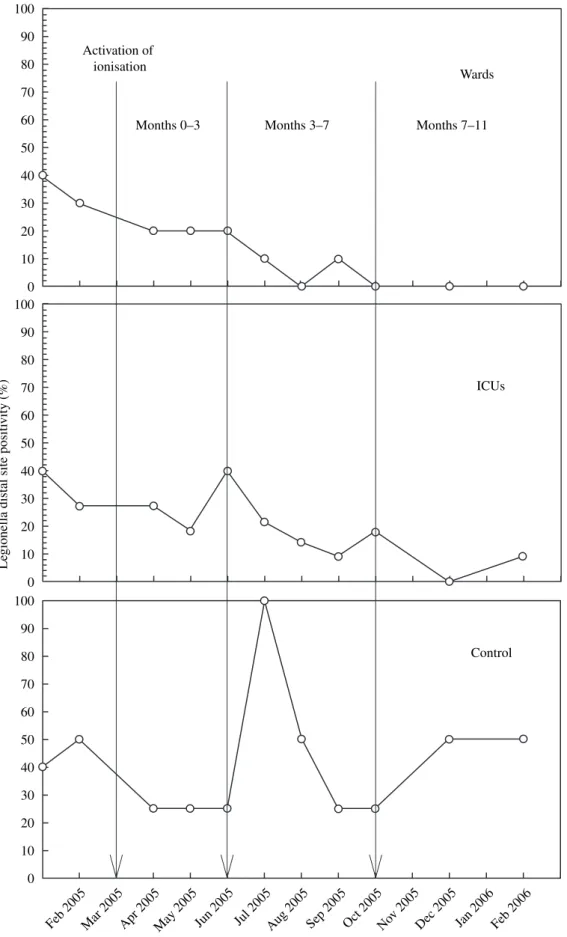
When the ionisation system was activated, the copper/silver ion concentrations at distal sites of hospital wards were 0.094/0.020, 0.114/0.014 and 0.110/0.007 mg/L at months 1, 2 and 3, respec-tively. During this period, there was no significant change in the rate of Legionella positivity in hospi-tal wards [20% (mean) vs baseline of 30%] although all rates of Legionella positivity were below 30%, an arbitrary target for Legionnaires’ disease preven-tion. The copper/silver ion concentrations were in-creased significantly to 0.143/0.008, 0.157/0.011, 0.180/0.017 and 0.212/0.014 mg/L at months 4, 5, 6 and 7 (P¼0.027). Rate of Legionella positivity decreased significantly to 5% (mean) vs 20% from month 3 (P¼0.019) (Figure 1). Legionella positivity was further reduced to 0% while 50% sites were still positive for Legionella in the control building. After month 7, no Legionella was found in water from the hospital wards.
Whereas ionisation was successful in eradica-ting Legionella in hospital wards, it did not achieve the same efficacy in the ICUs. When the ionisation system was activated, the copper/silver ion concentrations at distal sites of ICUs were 0.076/0.012, 0.087/0.008 and 0.086/0.011 mg/L at months 1, 2 and 3, respectively. During this period, there was no significant change in rate of Legionella positivity in the ICUs [28% (mean) vs baseline of 34%] although it was below 30%. The copper/silver ion concentrations were in-creased to 0.132/0.005, 0.052/0.014, 0.091/ 0.013 and 0.115/0.010 mg/L at months 4, 5, 6 and 7. Rate of Legionella positivity decreased to 16% (mean) vs 40% from month 3 (P¼0.020) (Figure 1). Legionella positivity was further re-duced to 5% while 50% sites were still positive for Legionella in the control building. Although this reduction of Legionella positivity was statis-tically significant (P¼0.02), Legionella was not
Le
gionella distal site positi
vity (%) 100 90 80 70 60 50 40 30 20 10 0 100 90 80 70 60 50 40 30 20 10 0 100 90 80 70 60 50 40 30 20 10 0 Activation of ionisation
Months 0–3 Months 3–7 Months 7–11 Wards
ICUs
Control
Feb 2005Mar 2005Apr 2005May 2005 Jun 2005 Jul 2005Aug 2005 Sep 2005Oct 2005Nov 2005Dec 2005 Jan 2006 Feb 2006
Figure 1 Distal site positivity of Legionella in the study hospital water distribution system. ICUs, intensive care units.
completely eradicated and one distal site in ICUs remained positive.
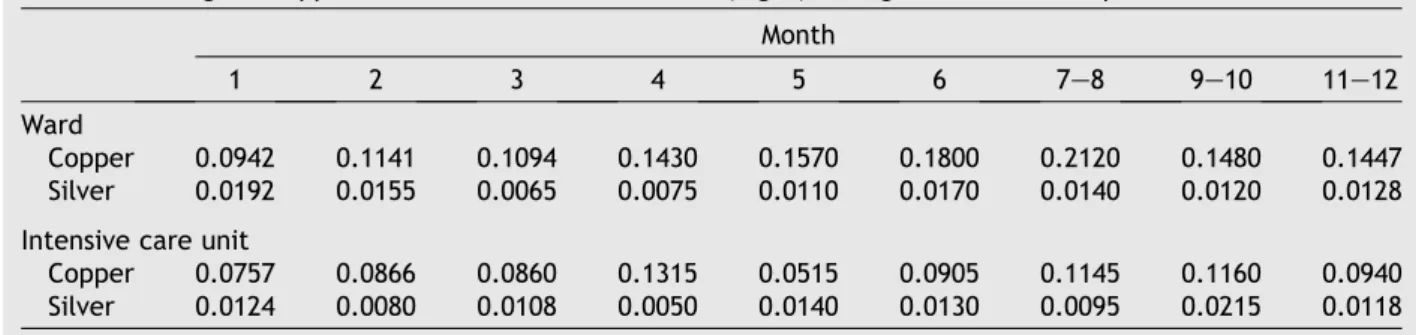
When we compared the difference in rate of Legionella positivity and ion concentrations be-tween ICUs and hospital wards in the test building, we found that the mean copper ion concentration in ICUs (0.094 mg/L) was significantly lower than that in hospital wards (0.145 mg/L) (P¼0.0012) (Table I). Mean silver ion concentration in ICUs (0.0124 mg/L) was lower than that in hospital wards (0.0192 mg/L) but no significant difference was found (P¼0.439) (Table I). Further investiga-tion found that the water from an on-site purifica-tion system using a reverse osmosis process was mixed with the tap water in ICUs. This on-site pu-rification system was first designed 17 years ago to provide purified water for the ICUs. However, after several renovations and plumbing modifications, the waterlines of the purification system had been partially connected with the tap-water lines in ICUs by mistake. This may explain the low ion concentrations found in the ICUs.
It was noteworthy that the size of the elec-trodes was 50% smaller than the original at month 3. After examination, the vendor deter-mined that the electrodes had been eroded due to the high shear velocity of the water flow by the recirculating pumps, not due to the electrolytic consumption of the electrodes. A bypass valve was installed in each recirculating loop that only allowed 50% of the water through the ionisation chamber while the remaining 50% was through the bypass loop. This implementation reduced the erosion of the electrodes substantially.
Discussion
Disinfection of hospital water system for Legion-ella is a well-established infection control prac-tice to prevent hospital-acquired Legionnaires’ diseases. Our previous effort of superheat-and-flush had failed to control Legionella colonisation.
Copperesilver ionisation was chosen because of its
advantages over the conventional modalities.9 Most copperesilver ionisation installations in
the USA and Europe were installed only onto the hot-water systems because Legionella prefers a warm environment in which to reproduce; the temperature of cold water (<10C) is
unfavour-able. However, the ambient temperature in Tai-wan, an island with subtropical temperatures, is high, so cold-water temperature can easily exceed 30C during the summertime. Our environmental
surveillance showed that cold water lines were also colonised with Legionella. Thus, both hot-and cold-water systems needed disinfection. The most economical way to treat both hot and cold water was to install a disinfection system at the point of entry. Four months after the coppere
sil-ver ionisation system was activated, a significant decline on the rate of Legionella positivity was observed (Figure 1). After one year of evaluation, the rate of Legionella positivity in hospital wards and ICUs of the test buildings was 0% (0/10) and 9% (1/11), respectively, compared to the control building of 50% (2/4). Although L. pneumophila
was not completely eradicated during this one year study period, no case of hospital-acquired Legionnaires’ disease was reported from the hospi-tal-acquired infection surveillance.
Direct ingestion of ions from water is a major concern. Since most ionisation installations in the USA and Europe were only in hot-water systems, direct consumption of ions via hot water was minimal. Releasing metallic ions into drinking water was not appealing to the hospital adminis-trators. A copperesilver ionisation system
instal-lation was approved, but the ion concentration applied into the water system was predeter-mined. The target ion concentrations for copper and silver were set at 0.2 and 0.02 mg/L, res-pectively, which are the lowest concentrations (0.2e0.8 mg/L for copper; 0.02e0.08 mg/L for
silver) recommended by the manufacturers and others.10,11 This was a compromise between
Table I Change in copper and silver ion concentrations (mg/L) during the disinfection period Month
1 2 3 4 5 6 7e8 9e10 11e12
Ward
Copper 0.0942 0.1141 0.1094 0.1430 0.1570 0.1800 0.2120 0.1480 0.1447
Silver 0.0192 0.0155 0.0065 0.0075 0.0110 0.0170 0.0140 0.0120 0.0128
Intensive care unit
Copper 0.0757 0.0866 0.0860 0.1315 0.0515 0.0905 0.1145 0.1160 0.0940
effectiveness of ionisation and the potential health hazards to the patients and employees of the hospital. Nevertheless, significant decline of Legionella positivity was achieved at copper and silver ion concentrations (mean copper: 0.16 mg/ L; silver: 0.014 mg/L) below the recommend levels. Our finding confirmed a previously pub-lished study that the successful control of hospi-tal-acquired Legionnaires’ disease was achieved at suboptimal ion concentrations below recom-mended level.2 The 58% distal site colonisation rate (baseline) of Legionella was reduced to 17% after the installation of copperesilver ionisation
at mean copper concentration of 0.25 mg/L in cold water and 0.08 mg/L in hot water (silver data not reported).2
Copperesilver ionisation is a relatively new
disinfection technology in Asia. The local vendor’s knowledge and technical support would be an important factor for its success. We chose an American vendor who has a local distributor in Taiwan. Though it was their first sale and installation of an ionisation system in Taiwan, we found their system expertise and technical sup-port to be highly satisfactory. The distributor detected a problem with erosion of electrodes and was able to fix it using a simple and low-cost bypass valve.
The weakness of this study was that we did not intensively screen every hospital-acquired pneumonia for Legionnaires’ disease. The link between reduction of Legionella positivity in hos-pital water systems and the reduction of hoshos-pital- hospital-acquired Legionnaires’ disease has been well established.12e14
We decided to focus on the en-vironmental surveillance for Legionella which was more economical. Infectious disease physicians would make their request on the clinical speci-mens to include Legionella testing based on their evaluation as a routine hospital-acquired pneumo-nia monitoring programme in the hospital. During the study period, 122 clinical specimens were tested for Legionella and none of them yielded a positive result.
In conclusion, copperesilver ionisation was
effective in eradicating Legionella for both hot and cold water at the point-of-entry installation. A significantly reduced rate of Legionella positivity in test buildings was achieved in the study hospi-tal. Copperesilver ionisation may be an attractive
alternative as a point-of-entry systematic disin-fection solution for Legionella. Our results may be useful for hospitals in regions where both hot-and cold-water systems are colonised with Legion-ella. To our knowledge, this is the first report that has documented the efficacy of ionisation at
point-of-entry installation for control of Legionella in hospitals for both hot and cold water.
Conflict of interest statement
None declared.
Funding sources
This study was supported in part by a Career Development Grant (NHRI-EX94-9206PC) from National Health Research Institute, Kaohsiung Veterans General Hospital, and National Kaoh-siung Normal University, Taiwan.
References
1. Chen YS, Liu YC, Lee SS, et al. Abbreviated duration of superheat-and-flush and disinfection of taps forLegionella
disinfection: lessons learned from failure. Am J Infect Control2005;33:606e610.
2. Biurrun A, Caballero L, Pelaz C, Leon E, Gago A. Treatment of aLegionella pneumophila-colonized water distribution system using copperesilver ionization and continuous
chlorination. Infect Control Hosp Epidemiol 1999;20: 426e428.
3. Colville A, Crowley J, Dearden D, Slack RC, Lee JV. Outbreak of Legionnaires’ disease at University Hospital, Nottingham. Epidemiology, microbiology and control.
Epidemiol Infect1993;110:105e116.
4. Kusnetsov J, Iivanainen E, Elomaa N, Zacheus O, Martikainen PJ. Copper and silver ions more effective against legionellae than against mycobacteria in a hospital warm water system. Water Res2001;35:4217e4425.
5. Rohr U, Senger M, Selenka F. Effect of silver and copper ions on survival of Legionella pneumophila in tap water.
Zentralbl Hyg Umweltmed1996;198:514e521.
6. Mietzner S, Schwille RC, Farley A,et al. Efficacy of ther-mal treatment and copperesilver ionization for
control-ling Legionella pneumophila in high-volume hot water plumbing systems in hospitals. Am J Infect Control
1997;25:452e457.
7. Lee JV, Surman SB, Kirby A, Seddon F. Eleven years of expe-rience with novel strategies for Legionella control in a large teaching hospital. In: Marre R, Bartlett C, Cianciotto NP, Fields BS, Frosch M, Hacker J, Luck PC, editors.Legionella. Washington, DC: American Society for Microbiology; 2002. p. 398e401.
8. Stout JE, Yu VL. Experiences of the first 16 hospitals using copperesilver ionization for Legionella control:
implica-tions for the evaluation of other disinfection modalities.
Infect Control Hosp Epidemiol2003;24:563e568.
9. Lin YS, Stout JE, Yu VL, Vidic RD. Disinfection of water dis-tribution systems forLegionella.Semin Respir Infect1998;
13:147e159.
10. Landeen LK, Yahya MT, Gerba CP. Efficacy of copper and silver ions and reduced levels of free chlorine in inactiva-tion of Legionella pneumophila. Appl Environ Microbiol
1989;55:3045e3050.
11. Liu Z, Stout JE, Tedesco L,et al. Controlled evaluation of copperesilver ionization in eradicatingLegionella pneumo-philafrom a hospital water distribution system.J Infect Dis
12. Best M, Yu VL, Stout J, Goetz A, Muder RR, Taylor F. Legion-ellaceae in the hospital water-supply. Epidemiological link with disease and evaluation of a method for control of nos-ocomial legionnaires’ disease and Pittsburgh pneumonia.
Lancet1983;2:307e310.
13. Yu VL, Stout JE. Hospital characteristics associated with colonization of water systems by Legionella and risk of
nosocomial legionnaires’ disease: a cohort study of 15 hospitals. Infect Control Hosp Epidemiol 2000;21: 434e435.
14. Fiore AE, Butler JC, Emori TG, Gaynes RP. A survey of methods used to detect nosocomial legionellosis among par-ticipants in the National Nosocomial Infections Surveillance System.Infect Control Hosp Epidemiol1999;20:412e416.