D.Ed. Special Education
(Deafblind)
NORMS
&
GUIDELINES
REHABILITATION COUNCIL OF INDIA
(Statutory Body Under Ministry of Social Justice & Empowerment)
B-22, Qutab Institutional Area
New Delhi – 110 016
2014
D.Ed. Special Education (Deafblind)
1.0 Preamble / Overview
Deafblindness is a unique and the most complex disability, which brings enormous challenges to the individuals, their families and those who support them. Deafblindness affects people of all ages in different ways. It is estimated that there are approximately 425,000 persons with deafblindness in India {Sense International (India)}.
Deafblindness is a combination of vision and hearing loss. Individuals who have a combined vision and hearing loss have unique communication, learning, and mobility challenges due to their vision and hearing loss.
Deafblindness is a unique and diverse condition due to the wide range of vision and hearing losses, presence of additional disabilities, and the age of onset for the vision and hearing loss. Each has his or her own likes, dislikes and educational challenges. Deafblind learners are a heterogeneous population however they all have significant communication needs. They cannot be taught in schools solely for the blind or deaf. They require specialized educational programmes with highly skilled teachers trained in deafblindness.
Very few children with deafblindness are totally deaf and totally blind and many have additional disabilities such as cerebral palsy, mental retardation, etc. Most children with deafblindness have some amount of useful vision and/or hearing that they can be helped to develop with competent teachers.
Human resource development is one of the major objectives of Rehabilitation Council of India. Diploma in Special Education (Deafblindness) is a major step towards generating teachers across the country to teach children with Deafblindness from primary to prevocational level. It aims at generating quality teachers who could meet the challenges of all round development of the children.
The teacher training course in deafblindness is geared towards developing knowledge, skills and desirable attitudes in teachers to facilitate children with deafblindness to blossom to their fullest potential in different settings like home, schools and communities.
This revised course is designed to provide the teacher trainee a comprehensive understanding of various areas and exposure to various ancillary services in urban and rural settings. The graduating teacher trainees will also have competencies to teach learners with vision impairments with additional disabilities.
2.0 Nomenclature of the Course
Diploma in Education Special Education (Deafblindness): D.Ed.Spl.Ed(Db).
3.0 Overall Goal and Objectives of the Course
Goal and Objectives are set with special reference to children with deafblindness and children with vision impairments with additional disabilities.
D.Ed.Spl.Ed.(Db)-2014 3
3.1 Goal: To prepare special teachers who can provide services to children who are deafblind and children with vision impairment with additional disabilities and their families from infancy to pre-vocational levels in the following settings:
1) Early intervention Programmes
2) Special Schools – Day Care/Residential 3) Integrated \ Inclusive Schools
4) Home Based Programmes
5) Community Based Rehabilitation Programmes 6) Pre-vocational Programmes
3.2 General Objective
To build knowledge and skills in the following areas:
1) Develop communication and language abilities of the child (e.g., Total Communication, calendars, objects, pictures, augmentative and alternative communication devices, words in print and Braille).
2) Understand the areas of child development and how deafblindness and vision with additional disabilities (e.g., Mental Retardation, Cerebral Palsy, Autism) impact normal development.
3) Build partnerships with families of children.
4) Knowledge of senses, sensory losses, their impact on learning, and ability to maximize the child’s use of residual senses (e.g, vision, hearing, touch).
5) Basic understanding of clinical and medical assessments and conditions to interpret findings (e.g., audiogram, eye report, medical reports).
6) Assess the educational needs of children with deafblindness and children with vision impairment with additional disabilities to provide appropriate interventions.
7) Develop a team approach with families and related interactors (e.g., therapists, doctors, professionals) to provide the child a meaningful programme.
8) Adapting environments to maximize learning.
9) Knowledge of best practices in education (e.g., communication, curricula, IEP, team approach).
10)Develop indigenous assessment and educational materials.
11)Make appropriate transition and vocational plans for the adult lives. 12)Advocate for the rights of people who are deafblind and their families.
13)Understand Governmental legislations and concessions provided to people with disabilities. 14)Need for teachers to develop self evaluation and professional ethics and standards on an
ongoing basis.
4.0 Entry Requirements/Eligibility
Minimum qualification for admission is successful completion of 10+2 or Higher Secondary Examination or equivalent from a recognized Board of Education with minimum 50% marks.
5.0 Admission Procedure
Merit for admission to this course will be prepared from 100 marks. The division of the marks is as follows:
i. 50% weightage to 10+2 marks (50 marks) ii. 10% to parents and siblings of the persons with disabilities (10 marks) iii. 10% to additional higher qualifications (10 marks) iv. 10% to written examination (10 marks) v. 20% to the interview (20 marks)
Total 100 marks 6.0 Trainee Teacher Intake Capacity
Each training centre can admit a total of 25 candidates to the course. Maximum - 25 (per batch)
7.0 Medium of Instruction
Primarily English with need based translation support in Hindi and regional language of the state where TTC is based.
8.0 Duration of the course
Two full academic years (commencing on second Monday of June for both the years) and comprising of 220 working days for each year.
9.0 Teacher Student Ratio
The minimum criterion of student teacher ratio is prescribed as 1:10, so ideally one teacher must be available per ten students.
10.0 Minimum Attendance Required
Eighty per cent minimum attendance is required both in theory and practical to be eligible to appear in the semester end examination.
11.0 Minimum Requirement of Faculty and Staff
(Excluding the staff of practice teaching schools)
1) Training coordinator cum lecturer (full time) : 01 2) Lecturer cum supervisor in Education (full time) : 03 3) Guest faculty - as per the requirement
Note:
• 1, 2 and 3 positions from above are collectively responsible for theory, practical and full time teaching practice of D.Ed.Spl.Ed (Db).
D.Ed.Spl.Ed.(Db)-2014 5
11.1 Essential and Desirable Qualifications of Course Coordinator, Faculty and Staff S.
No.
Staff Qualification
1 Course Coordinator
M.A. /M.Sc., with M.Ed (Special education – VI, HI), D.Ed (Db) and special training in teaching Deafblind and Multi sensory Impaired children. 2
Lecturer-cum-Supervisor
M.A. /M.Sc. with B.Ed. Spl Ed- (VI/ HI) / D.Ed. Spl Ed- (Db) and special training in teaching Deafblind and Multi sensory Impaired children.
All the position is to be fulfilled as per the norms of the RCI and reservations of the position as per the guidelines of Government of India.
11.2 Staff (Non teaching)
1. Computer Typist-cum-accountant 2. Librarian
3. Peon 4. Watchman
12.0 Minimum Requirement for Labs, Tools and Equipments 12.1 Library
The training centre should have a minimum of 10 books per subject covering the syllabus and a minimum of 2 journals subscribed periodically pertaining to education of Deafblind and Multi sensory impaired children. In addition, an equal number of books on general education, educational psychology, curriculum development, methods of teaching and methods of evaluation should be available in the library as prescribed in the list of references given after each course paper.
13.0 Space for Conducting the Course 13.1 Space
Sl.No. Type of Facilities Area Remarks
1. Class Room – 2 40 sq. m. each 2. Class Room – 2 25 sq. m. each 3. Multipurpose Room/Hall -1 60 sq. m.
4. Library-1 60 sq. m. 5 Computers & Internet
5. Toilet (Male-1, Female-1) 04 sq.m. each 6. Principal’s Room -1 15 sq. m. 7. Resource Room- 1 60 sq. m. 8. Staff Room-1 40 sq. m. 9. Office Room-1 25 sq. m. 10. Store Room-1 25 sq. m. 11. Lab. for Psychology/ICT-1 60 sq. m.
12. Hostel for Boys and Girls (Separately) - Optional 13. Playground for Outdoor games like
football, cricket, etc. If not available, then collaboration with nearby Institute/ University
500 sq. m.
13.2 Material Furniture for Staff
1. Full time staff Tables - 4 Chairs - 4
Cupboards (steel) 4
2. Visiting Staff Tables - 2 Chairs - 2 3. Computer Typist-cum-Accountant Table - 1
Chair - 1
4. Librarian Table - 1
Chair - 1
5. Peon Chair - 1
Stool - 1
Furniture and Equipment for the Office
1. Cupboards (Steel) 04 2. Filing Cabinet 01 3. Computer with Printer 01
4. Phone 01
5. Xerox Machine 01
6 .Wall Clock one each in every room 7. Fans two each in every room 8. Electrical fittings (lights etc) two each in every room
Furniture and Equipment for Classroom
1. Tables (for students) 25
2. Chairs (for students) 25 3. Audio Visual equipments 02
4. Black Board 02
5. Teaching material (Demonstration) - Montessori set 01
- Kindergarten set 01
- Nursery set 01 - TLM as per requirement’ 01
Furniture for Library
1. Library cupboards 10 2. Library tables (large) 04
D.Ed.Spl.Ed.(Db)-2014 7
3. Library chairs 25
Furniture for demonstration class (to teach 6 children)
1. Tables 2. Chairs
3. Teaching Material
4. Programme plan material
14.0 Duration of the Course
The duration of the course will be two years (four semesters) (220 days consisting of 1320 hrs. each year, thus having a total of 440 days consisting of 2640 hours for theory and practicum)
15.0 Examination Scheme: As per RCI's Scheme of Examination
16.0 Certification as Registered Personnel
It is mandatory for every rehabilitation professional / personnel to obtain a “Registered Personnel / Professional Certificate” from the Rehabilitation Council of India to work in the field of special education in India. As continuous professional growth is necessary for the renewal of the certificate, the rehabilitation professional / personnel should undergo in-service programme periodically to update their professional knowledge.
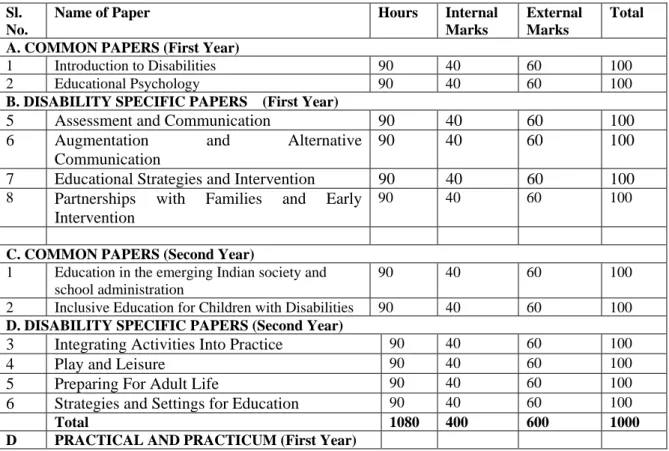
17.0 Scheme of papers (Theory and Practical) for both the years Table I: Course Structure & Scheme of Examination
Sl. No.
Name of Paper Hours Internal
Marks
External Marks
Total A. COMMON PAPERS (First Year)
1 Introduction to Disabilities 90 40 60 100 2 Educational Psychology 90 40 60 100
B. DISABILITY SPECIFIC PAPERS (First Year)
5 Assessment and Communication 90 40 60 100 6 Augmentation and Alternative
Communication
90 40 60 100
7 Educational Strategies and Intervention 90 40 60 100
8 Partnerships with Families and Early Intervention
90 40 60 100
C. COMMON PAPERS (Second Year)
1 Education in the emerging Indian society and school administration
90 40 60 100 2 Inclusive Education for Children with Disabilities 90 40 60 100
D. DISABILITY SPECIFIC PAPERS (Second Year)
3 Integrating Activities Into Practice 90 40 60 100
4 Play and Leisure 90 40 60 100
5 Preparing For Adult Life 90 40 60 100
6 Strategies and Settings for Education 90 40 60 100
Total 1080 400 600 1000
1 Communication 250 120 80 200 2 Practice Teaching 200 120 80 200 3 Orientation and Mobility 150 90 60 150 4 Use of aids and appliances 130 60 40 100 5 Preparing Needs based Teaching-Learning
Material (TLM)
200 120 80 200
E PRACTICAL AND PRACTICUM (Second Year)
1. Case Study 200 120 80 200
2. Assessment and Evaluation 180 120 80 200
3. Developing IEP 250 150 100 250
Total 1560 900 600 1500
TOTAL (THEORY + PRACTICUM) 2640 2500
Practical
a) Full time teaching practice
b) Teaching practice (school based, home based, CBR & inclusive setups) c) Individualized teaching
D.Ed.Spl.Ed.(Db)-2014 9
1st Year—(COMMON PAPER)
THEORY PAPER I: Introduction to Disabilities
Total Marks: 75 Total hours: 90 Objectives:
After completion of this paper, the learner is expected to:
1. Understand the differences disability and functioning
2. Understand the educational needs of various categories of persons with disabilities. 3. Know the common causes and preventive aspects of different kinds of disabilities 4. Know the importance of early identification and intervention
5. Understand the importance of different agencies in human resource development
Unit 1: Understanding Disability (15 Hours)
1.1Historical development in understanding disability
1.2Emerging trends: Concept and Definition of Impairment, Disability, Handicap(ICIDH) and Functioning(ICF)
1.3Definition and Categories of Disability as per National laws 1.4Prevalence and demographic profile
1.5Causes and prevention of disability
Unit 2: Definition, types and educational needs of children with disabilities (15 Hours)
2.1. Hearing Impairment: Definition and types 2.2. Visual Impairment: Definition and types 2.3. Mental Retardation: Definition and types 2.4. Neuro–muscular: Definition and types
2.5. Autism Spectrum Disorder: Definition and types
Unit 3: Definition, types and educational needs of children with disabilities (15 Hours)
3.1. Mental Illness: Definition and types
3.2. Specific Learning Disabilities / Difficulties: Definition and types 3.3. Deafblindness: Definition and types
3.4. Locomotor Disabilities: Definition and types 3.5. Multiple Disabilities: Definition and types
Unit 4: Early Identification and intervention (15 Hours)
4.1Concept and need of early identification 4.2Screening and referral
4.3Involvement of parents and the community
4.4Role of special teacher/ educator in Early Intervention and related matters 4.5Models of Early Intervention- Home based and centre based
Unit 5: Human Resource in Disability Sector (15 Hours)
5.1 Concept and need of Human Resource in disability sector 5.2 Role of National Institutes
5.3 Role of International bodies 5.4 Role of NGOs and the Community 5.5 Status of Human Resource in India
Experiential Learning (15 Hours)
1. Prepare a checklist for identification of at least one disability.
2. The students are expected to visit at least two institutes for disabilities and observe children with disabilities learning, and submit a report of their observation.
Reference material:
1. Madhavan, T. Kayla, M. Naidu, S. Peshawaria, R and Narayan, J (1989) Mental Retardation – A Manual for Psychologists
2. Wallace, P.M. and Goldstein, J.M. (1944) An Introduction to Psychology (3rd Edition) Madison: Brown and Benchmark Publishing
3. Lindgren H (1988) Educational Psychology in the Classroom, Harper and Raw
4. Panda, KC (1997) Education and Exceptional Children, Vikas Publishing House, New Delhi
5. Smith, D.D, and Luckasan, R.(1992), Introduction to Special Education, Allyn and Bacon, Boston
6. Alan H. and Ravic R. (1998). Best and promising Practices in Developmental Disabilities, Texas, PRO – ED, Inc
7. Hegarty S. (2002). Education and Children with Special Needs in India: Sage Publications, India Pvt. Ltd.
8. Myron G. Eisenberg, Robert L. Glueckauf, Herbert H. Zaretsky (1999) Medical Aspects of Disability: A Handbook for the Rehabilitation
9. Arthur E. Dell Orto, Paul W. Power (2007) The Psychological and Social Impact of Illness and Disability
10.Vicki L. Schwean, Donald H. Saklofske (1999) Handbook of Psychosocial Characteristics of Exceptional Children
11.Seamus Hegarty, Mithu Alur (2002) Education and Children with Special Needs: From Segregation to Inclusion
D.Ed.Spl.Ed.(Db)-2014 11
1st Year—(COMMON PAPER) PAPER–II: Educational Psychology
Total Marks: 75 Total Hours: 90 Objectives: After completion of this paper, the students are expected to:
1. Clearly delineate the nature of child development including delayed development.
2. Gain insights into various aspects of growth and development including personality development.
3. Acquire and apply knowledge about cognition and intelligence.
4. Demonstrate clear comprehension of different perspectives of learning.
5. Acquire knowledge of different behavior problems among children and their management.
Unit I: Psychology and Theories of Learning (15 Hours)
1.1Educational Psychology – Nature, Importance and Scope.
1.2Individual differences and methods of dealing with the differences
1.3Importance of principles of psychology for the educators of children with disabilities.
1.4Theories of Learning: Behaviorist (Classical & Operant), Social Learning (Bandura), Cognitive Learning (Information Processing).
1.5Role of teacher and learner in different teaching-learning situations- Learning Styles and Learning in Constructivist Perspective
Unit II: Nature of Child Development (15 hours)
2.1 Child Development: meaning and nature 2.2 Principles of growth and development
2.3 Significance of child development for special educators in understanding the learner with disability
2.4 Concept of developmental delay and / differences
2.5 Factors influencing development: heredity and environmental
Unit III: Major Aspects of Development (20 hours)
3.1Physical and Motor Development: meaning, growth and maturation, gross and fine motor development skills in infancy and pre-school children
3.2Social Development: meaning, significance, stages, psycho-social development 3.3Emotional Development: meaning, development of emotions at different stages 3.4Personality Development: meaning, definition and factors affecting
3.5Language Development: meaning and significance, bilingual and multilingual language situations, implications for teachers
Unit IV: Cognition and Intelligence (15 hours)
4.1Cognitive Development: Concept, Piaget's stages of cognitive development 4.2 Understanding socio-cultural difficulties and factors influencing cognition 4.3 Role of cognition in learning
4.4 Intelligence: meaning, definition and measurement of IQ. 4.5 Howard Gardner's theory of Multiple Intelligence
Unit V: Behaviour Problems and Management (10 hours)
5.1 Common behaviour problems in children 5.2 Assessment of problem behaviour 5.3 Functional analysis
5.4 Behaviour management techniques
5.5 Planning, Implementation and Evaluation of Behavioural Management Programme
Experiential Learning (15 Hours)
The student learner is expected to observe problem behaviour of two children with disability and write a report.
Reference material:
1. Kaul, V (1993) Early Childhood Education Programme, New Delhi, NCERT
2. Madhavan, T. Kalyan, M. Naidu, S. Peshawaria, R and Narayan, J (1989) Mental Retardation – A Manual for Psychologists,
3. Muralidharan R (1990) Early Stimulation Activities for Young Children, New Delhi NCERT
4. Panda, KC (2001) Elements of Child Development (Sixth Revised Edition), Ludhiana Kalyani Publishers.
5. Sharma, P (1995) Basics on Development and Growth of a Child. New Delhi: Reliance Publishing House.
6. Sharma, R and Sharma, R (2002) Child Psychology Atlantic: New Delhi. 7. Mohan Mathew (1972) Child Psychology in Indian Perspective
8. Jan Borms (1984) Human Growth and Development
9. Madhavan, T. Kayla, M. Naidu, S. Peshawaria, R and Narayan, J (1989) Mental Retardation – A Manual for Psychologists
10.Wallace, P.M. and Goldstein, J.M. (1944) An Introduction to Psychology (3rd Edition) Madison: Brown and Benchmark Publishing
11.Lindgren H (1988) Educational Psychology in the Classroom, Harper and Raw
12.Panda, KC (1997) Education and Exceptional Children, Vikas Publishing House, New Delhi
13.Arthur E. Dell Orto, Paul W. Power (2007) The Psychological and Social Impact of Illness and Disability
14.Vicki L. Schwean, Donald H. Saklofske (1999) Handbook of Psychosocial Characteristics of Exceptional Children
D.Ed.Spl.Ed.(Db)-2014 13
First Year (Disability Specific Paper)
Paper -III: Assessment and Communication Total Marks: 75
Total Theory Hours: 90 Total Practical Hours:160 Objectives:
On completion of this paper the trainee shall:
1. Demonstrate understanding of observation techniques and consideration, various types of assessment, and factors responsible for behaviours.
2. Develop an understanding of the development of communication in a normal and Deafblind individual as well as its impact
3. Be able to conduct an assessment of communication for a Deafblind child and will be able to develop a communication plan for the child
4. Have information about the different modes of communication (Linguistic, non-linguistic, using technology) and be able to apply them with Deafblind
5. Understanding of functional assessment of communication
6. Knowledge of techniques of assessment and principles of intervention
Unit -1: Assessment Approaches 15 Hours
1.1 Introduction to Assessment, Concept and definition - Approaches to assessment 1.2 Purpose of Assessment - Limitation of Assessment - Various tool for assessment
1.3 Different forms of assessment- norm reference tests and criterion reference test and informal measures
1.4 Observational, ecological, behavioural, Clinical, functional and vocational assessment 1.5 Interview strategies for parents and significant others.
1.6 Assessment of child’s likes and dislikes, strengths and challenges, what works and what does not work.
1.7 Strategies to be considered before assessment, during assessment after assessment (e.g., positioning, materials, environment, persons).
1.8 Challenges in assessment of children with deafblind and children with vision impairment with additional disabilities.
1.9 Observation of child interaction with different people.
1.10 Van Dijk and Robbie Blaha approaches for children with deafblindness. 1.11 Methods and techniques of observation and recording (e.g., video, notes). 1.12 Identifying and assessing delayed development
o Ecological assessments
o Callier Azuza scale for assessment o Oregon Project Inventory
o INSITE Model
1.13 Normal developmental assessment (e.g., Upanayan, Portage Guide, BASIC MR)
1.14 Assessing needs across different areas – Personal, Motor, Social, Communication, Sensory, O and M, Academics.
Practicum 50 hours
1. Conduct assessment of two children with deafblindness of different ages. Write and present assessment report of these children.
2. Develop a profile and develop an IEP for one child.
3. Develop low cost assessment kit to be used in homes, schools and community.
4. Do an observational assessment of two children’s likes, dislikes, strengths, challenges and what works and what does not work.
5. Make recommendations
6. Use the Nelson and Van Dijk’s protocol on assessment on two children.
Unit – 2: Functional Vision Assessment 15 hours
2.1Vision Screening – Need – Purpose – Methodology – Risk factor
2.2Observation and appearance of eyes – Observations of visual behaviours and reading & Writing behaviour– History from parents and family members.
2.3Losses of vision – Visual Acuity – Visual Field – Contrast Sensitivity – Oculomotor movements – Visual processing.
2.4Various visual functions – Reflexive behaviour- Awareness of light – Visual Focus – Visual Fixation – Visual Tracking – Visual Scanning – Shift of Gaze – Visual Discrimination – Object Recognition – Visual Closure – Visual Memory & Imagery – Figure/Ground Perception – Eye hand coordination, Visual response continuum
2.5Vision testing – Clinical and Functional
2.6Preparations before assessment – Review of medical and other records – Environmental considerations – Developmental stage and milestones.
2.7Factors considered during functional assessment/Philosophy of assessment – Rapport - Involvement of parents – Time consideration – Team work – Child’s need and level – Qualitative and quantitative visual skill development.
2.8Training of deafblind child before vision testing – accommodating 2.9Assessing environment related to visual functioning
2.10 Steps in functional vision assessment (FVA). 2.11 Material and aids for conducting assessment
Practicum 30 hours
1. Conduct functional vision assessment for 2 children with deafblindness of different ages, characteristics and level. Write and present assessment report of these children.
2. Prepare vision profile for at least two children based on observation and assessment findings. Give details like cause of VI, result of last ophthalmologic assessment, prescribed aids, effect of visual condition on the child, inference from FVA, effect on visual skills and effect of environment on visual functions, recommendations.
3. Assess current environment of these children and its impact on visual skills; suggest modifications in position, materials and illumination and other factors in environment.
Unit – 3: Functional Hearing Assessment 15 hours
3.1 Hearing Screening – Need – Purpose – Methodology – Risk factors
3.2 Observation and appearance of ears – Observations of auditory behaviours – History taking from parents and family members.
D.Ed.Spl.Ed.(Db)-2014 15
Losses of Hearing – Categories and types.
Various auditory functions – Reflexive behaviour- Awareness of Sound – localisation of sound – auditory Discrimination (Gross & Fine)– Identification through sound – Auditory Closure – Auditory Perception – Auditory response continuum.
3.4 Hearing testing – Clinical and Functional
3.5 Preparations before assessment – Review of medical and other records – Environmental considerations – Developmental stage and milestones.
Factors considered during functional assessment/Philosophy of assessment – Rapport - Involvement of parents – Time consideration – Team work – Child’s need and level – Qualitative and quantitative auditory and speech skill development.
Routine based functional assessment – Auditory responses – General Guidelines – Behavioural State and Temperament – Behaviour Descriptions (Breathing patterns, startle, muscle tone, eyes, activity, motor response, vocalization or Quieting, Search/Localisation, Smiling/laughing/frowning/crying, Habituation, Anticipation, or latency of response).
Training of deafblind child before hearing testing – accommodating Assessing environment related to hearing functioning
Steps in functional hearing assessment (FHA). 3.10 Material and aids for conducting assessment
Practicum 30 hours
1. Conduct functional hearing assessment for 2 children with deafblindness of different ages, characteristics and level. Write and present assessment report of these children.
2. Prepare auditory profile for at least two children based on observation and assessment findings. Give details like cause of HI, result of last audiological assessment, prescribed hearing aids, effect of hearing impairment on the child, inference from FHA, Effect of environment, noise and reverberation on use of hearing, Recommendations.
3. Assess current environment of these children and its impact on hearing; suggest modifications in these factors in environment.
4. Read an eye and ear report and interpret it in simple terms to parents
Unit – 4: Motor Assessment 30 Hours
Placing communication devices so they are accessible in different environments. Motor Development (e.g., head to foot, centre to periphery)
Normal postural control mechanism and movement control mechanism
• Tone
• Reflexes
• Types of gait
• Balance Reactions
Abnormal Motor development
Causes of abnormal motor development (e.g., cerebral palsy, polio, accidents, infections, syndromes).
Types of muscle tone
• Hypertonic
• Hypotonic
• Fluctuating tone
Types of Cerebral Palsy
Current approaches for treatment of neuro-developmental disorders Basic principles of Neuro Developmental Therapy/Bobath
Hydrotherapy
4.11 Basic strategies for positioning
4.12 Basic strategies for handling the child and its importance
• Lifting
• Carrying
• Transferring
4.13 Functional Assessment Guidelines 4.14 Assessing Priorities
4.15 Goal setting in a class room
4.16 Identifying compensated patterns and applying various reasons behind neurodevelopment approaches.
4.17 Importance of integrating normal movements in functional activities 4.18 Handling /Helping the children in different environments
4.18 Making the child safe and comfortable to encourage communication and learning 4.19 Massage techniques
4.20 Sitting, standing, walking
4.21 Importance of changing the child’s position
4.22 Use of equipments to support posture and movement (e.g., chair, wheelchair, walker, standing frames).
4.23 Basic Exercises depending on needs that can be incorporated in homes/classroom for different motor disabilities.
4.24 Simple Do’s and Don’ts
4.25 Using indigenous materials for appropriate positioning (e.g., pillows, blanket, bolsters, hammocks)
Practicum 15 Hours
1. Suggest handling, positioning, and postural corrections for a deafblind child. 2. Suggest environmental and equipment support for a given child.
3. Suggest appropriate position for the child to access communication devices.
Unit – 5: Communication Assessment 20 hours
5.1Child guided strategies for assessment 5.2Why do we assess communication
o Selection of communication modes,
o Factors that lead to change of communication modes, o Use of different approaches
o Using the assessment results to develop communication goals and objectives o Making communication profiles and personal/communication passports.
5.3Assessment of receptive and expressive communication, modes child uses and modes child understands.
5.4Assess child’s topics of interest
5.5Assessment of communication skills – Methods of communication used – Functions of communication and Environment of communication.
D.Ed.Spl.Ed.(Db)-2014 17
5.7Expression of feelings – How the child expresses feelings?
5.8Assessment of levels of communication (Pre symbolic to symbolic)
5.9Child’s use of body language, facial expressions and vocalisations to communicate.
5.10 Child’s use of natural gestures (e.g., pulling and tugging behaviour, directing person’s hand to desired objects, pointing towards object and people).
5.11 Child’s preferred communication partners 5.12 Childs receptive and expressive vocabulary.
5.13 Grammatical structures in language – Use of word or combination of words for communication.
5.14 Assessing activities for opportunities for communication (e.g., motivating, opportunities for initiation, turn taking).
Practicum 35 hours
1. Conduct communication assessment for one deafblind child in different settings (e.g., home, school, community).
2. Write and present assessment report of the child with recommendations.
3. Prepare communication profile for one child based on assessment findings. Recommend intervention approaches for the child.
4. Assess current educational activities for at least three children in terms of opportunities for communication. Recommend modification for these activities to increase opportunities for communication.
References:
1. A Resource Manual for Understanding and Interacting with Infants, Toddlers and Preschool Age Children with Deaf-Blindness. By the Ski-Hi Institute. Published in 1993 by HOPE Publishing, North Logan, Utah.
2. A Resource Manual for Understanding and Interacting with Infants, Toddlers and Preschool Age Children with Deaf-Blindness. by the Ski-Hi Institute. Published in 1993 by HOPE Publishing, North Logan, Utah.
3. Alsop, Linda. Understanding deafblindness: issues, perspectives, and strategies.Logan, UT: SKI-HI Institute, Utah State University, 2002. (Available from Hope Publishing, Inc., and 1856 North 1200 East, Logan, UT 84321.
4. Analyzing Teacher/Child Interactions: What Makes Communication Successful? --Amaral, Isabel. DBI REVIEW, vol. 32, July-December 2003, pp. 12-18. (2003)
5. Analyzing the Communication Environment to Increase Functional Communication Rowland, Charity Schweigert, Philip. JASH, vol. 18, no. 3, 1993, pp. 161-176.. 1993.
6. Assessing and Developing the Communications Abilities of Deaf-Blind Children Schein, Jerome D., Ph.D. Kates, Linda, M.A., M.Ed. Wolf, Enid, G., Ed.D. Theil, Linda, M.A. JOURNAL OF VISUAL IMPAIRMENT & BLINDNESS, vol. 77, #4, April 1983, pp.152-157. 1983.
7. Callier-Azusa Scale (H), Scales for the Assessment of Communicative Abilities. by Robert Stillman and Christy Battle. Published in 1985 by the University of Texas at Dallas.
8. Communication At Home and In the Community: Helpful Strategies & Suggestions From Parents & Families With a Child Who is Deaf-Blind - The National Family Association for Deaf-Blind (NFADB) ; The National Technical Assistance Consortium for Children and Young Adults Who Are Deaf-Blind (NTAC), 2000.
9. Communication Development in Children who are Deaf-Blind: The Role of Grandparents in Family Centered Intervention: Shaw, Sherry L., Ed.D.. 2001.
10.Communication Development in Young Children with Deaf-Blindness: : Literature Review: Bullis, Michael (Ed.) Fielding, Glen (Ed.). Monmouth, Oregon: Oregon State System of Higher Education, Teaching Research Institute 1988.
11.Communication Fact Sheets for Parents - Stremel, Kathleen; Bixler, Betsy; Morgan, Susanne; Layton, Kristen. — National Technical Assistance Consortium for Children and Young Adults Who Are Deaf-Blind (NTAC), 2002.
12.Communication Matrix: Especially for Parents Rowland, Charity. — Oregon Health & Science University: 2004.
13.Cooley, E. (1987). Getting in touch with a child who is deaf-blind. [Videotape]. Research Press.
14.Deafblind Intervention Strategies for the Home – DISH: A resource for parents of children with deafblindness - Hill, Corry (Ed.) — Utah Schools for the Deaf and the Blind, Deafblind Services Division: 2001.
15.Dimensions of Communication: An Instrument to Assess the Communication Skills and Behaviors of Individuals with Disabilities - Mar, Harvey H., Ph.D; Sall, Nancy, Ed.D. 1999.
16.Early Focus. by Rona Pogrund and Diane Fazi. Published in 1992 by the American Foundation for the Blind, New York.
17.Enhancing the Quality of Interaction between Children with deafblindness and Their Educators --Janssen, Marleen J.; Riksen-Walraven, J. Marianne; van Dijk, Jan P.M. JOURNAL OF DEVELOPMENTAL AND PHYSICAL DISABILITIES, vol. 14, #1, March 2002, pp. 87-109. (2002)
18.Hand in Hand, Essentials of Communication, Orientation, and Mobility forYour Students Who are Deaf-Blind. By Kathleen Mary Heubner, Jeanne Glidden Prickett, Therese Rafalowski Welch and Elga Joffee. Published in 1995 by AFB Press, New York.
19.Hand In Hand: Essentials of Communication and Orientation and Mobility for Your Students Who Are Deaf-Blind: Volume I - Huebner, Kathleen Mary (Ed.); Prickett, Jeanne Glidden (Ed.); Welch, Therese Rafalowski (Ed.); Joffee, Elga (Ed.) — AFB Press: 1995, xliv, 687.
20.Huebner, Kathleen Mary, and others. Hand in hand: essentials of communication and orientation and mobility for your students who are deafblind: volumes I and II. New York: AFB Press, 1995.
21.Klein, M. Diane, Deborah Chen, and Michelle Haney. Promoting learning through active interaction: a guide to early communication with young children who have multiple disabilities. (Book and Video Baltimore: Paul Brookes, 2000.
22.Making the Most of Early Communication. By Deborah Chen. Published in 1995 by the California State University at Northridge, Northridge, California. 34-minute VHS tape. 23.Stremel, K., & Wilson, R. (1988) providing services for learners with severe handicaps:
Module for developing communication. Hattiesburg: The University of Southern Mississippi.
Learner’s Outcome: On completion of this paper the trainee will have following
1. Skills in undertaking communication assessment for children with deafblindness. 2. Proficiency in writing assessment report for communication.
3. The trainee will understand what is communication and factors responsible for enhancing communication among children with deafblindness.
4. The trainee will appreciate the various methods for developing communication in children with deafblindness
D.Ed.Spl.Ed.(Db)-2014 19
First Year (Disability Specific Paper)
Paper -IV: Augmentation and Alternative Communication Total Marks: 75
Total Theory Hours: 90 Total Practical Hours: 240 Objectives:
On completion of this paper the trainee shall:
1. Develop an understanding of the development of communication in a person without a disability and a deafblind individual as well as its impact.
2. Understand augmentative communication and apply it to children with deafblindness 3. Understand the meaning of behaviours and related needs
4. Acquaintance with the different modes of communication
5. Knowledge about different ways to develop effective communication 6. Importance of literacy for deafblind and different approaches to promote it
Unit – 1: Developing Early Communication 15 hours
1.1Normal development of communication – Birth to 1 year 1.2Deafblindness and its implications on communication.
1.3Definition of communication, levels of communication from pre symbolic to symbolic. 1.4Communication: receptive and expressive, modes (How), reasons (Why), and context
(when and where) and content (What). 1.5Elements of a good conversation 1.6Having conversations without words
1.7Role of hands in developing trust with communication partners. 1.8Use of hand under hand versus hand over hand.
1.9 Introduction to communication and influence of deafblindness on communication 1.10 What does communication mean to a deafblind child?
1.11 How to respond to a deafblind child’s communication.
1.12 Communication development in a congenitally Deafblind child and adventitiously Deafblind individual
1.13 Modelling higher level of communication and developing anticipation with touch and object cues by using the learner’s modes
1.14 Importance of relationship, conversations and using conventional approaches 1.15 Environment and experiences
Practicum 30 hours
1. Trainees will practice a conversational approach with the students of all ages in dormitory and in the school on an ongoing basis throughout the two years
2. They will do weekly reflection papers on their conversations
3. At least twice during the two years the trainees will make a video tape for the portfolio of them practicing a conversational approach
Unit – 2: Communication Processes 15 hours
2.1Communication and language development – 1 to 5 years o Components and functions of language.
2.2Guiding principles for interactions with children with deafblindness which would include o Interactions with Children with deafblindness turn taking, etc.
o How to make interactions successful,
o Rules for interactions with children with deafblindness, taking turns. o Using objects naturally throughout the day.
2.3Importance of routines
2.4Types of Calendars and schedule systems – Anticipation, Daily, Weekly, Monthly, Yearly 2.5Encouraging literacy through:
• Early reading for children (e.g., calendars, meanings of objects)
• Exposure to print and/or Braille for children
• Exposure, perception, understanding and expression
• Different approaches for teaching reading (e.g., whole language, phonetics)
• Need for experiential learning as a basis for reading (e.g., making shopping lists, stories about their families)
• Creating diaries to encourage reading and support for the child’s memory
Practicum 35 hours
1) Trainee will work with the child to make a diary on a daily basis for a month. The diary will be based on the child’s interests and experiences.
2) Trainee will provide opportunities for a group of children to share their diaries with each other
3) Trainee will make recipe books for cooking with the child, memory boxes and experience stories
4) Trainees will use a conversational approach and reflect the child’s thoughts and emotions
Practicum 30 hours
1. Design a schedule system for a child who is at the object level of communication 2. Design a schedule system for a child who is at the picture level of communication
3. Routine based assessment of interaction of children with deafblindness with family and teachers and make recommendations for changes.
4. How would you work with families or significant others so children understand anticipation and when an activity is finished.
Unit – 3: Sign Language 15 hours
Introduction to Sign Language and nature of Sign Language
o Introducing Sign Language to Deafblind and modifications to person specifics
o Different methods of Sign Language such as Visual Frame Signing, Tactile Sign Language, etc.
3.2 Overview of manual systems
o Effective communication with people with deafblindness: Becoming a good signer o Manual communication systems (Pidgin sign, Signed English/Hindi, ISL, ASL). o Various methods of manual alphabets.
3.3 Basic concept of interpreting
o Characteristics of good interpreters. o Categories/techniques of interpreting
D.Ed.Spl.Ed.(Db)-2014 21
o Professional attitudes and ethics
o Particulars of sigh language interpreting
o Issues of communication access and accessibility
Practicum 55 hours (Will extend over two years)
1. Throughout the year teacher trainee will use their sign language skills in meaningful situations, in and out of the classroom with children.
2. Trainees will be given sign language proficiency tests at regular intervals during the training.
Unit – 4: Augmentative and Alternative Communication 15 hours
Introduction to Augmentative and Alternative Communication (AAC)
Difference between aided communication (a device) and unaided communication (body). No technology, low technology and high technology, choosing the right devices and making changes on ongoing basis.
Designing low technology communication devices (e.g., communication boards, communication cards, objects, pictures).
Organising vocabulary (people, verbs, things, feelings, places, time). Overview of high technology.
Practicum 35 hours
1. Make an AAC device (low technology) for a child.
2. Observe a child using a communication system and make recommendations for changes.
Unit – 5: Braille 15 hours
5.1 Introduction to Braille 5.2 Pre-Braille Skills
o Tactile skills
o Gross discrimination o Fine discrimination
5.3 Who is good candidate for learning Braille? o Readiness of a Deafblind person for Braille? 5.4 Teaching of Braille
o Strategies for reading readiness
o Methods of teaching Braille reading (Letter, words, sentence method) use of flash cards o Introduction of Braille writing
o Teaching of Braille contractions 5.5 Use of assistive devices
o Taylor’s Frame and Abacus o Braille Writing Devices o Geometry Devices
o Low cost/No cost teaching - learning materials and tactile maps and diagrams and three dimensional models
5.6 Learning media assessment
Practical: Braille (over two years) 30 hours
1. Make communication cards, stories in Braille
2. Transcription exercises (Braille to print and print to Braille)
3. Trainees will demonstrate proficiency in Braille at regular intervals.
4. Use the learning media assessment to find who can use Braille and who can use large print.
Unit – 6: Challenging Behaviours and Communication 15 hours
Assessing challenging behaviour (e.g., medical reason, need for more or less stimulation, communication functions).
Communication basis of challenging behaviours.
Assessing the adequacy and appropriateness of AAC (aided and unaided). Principles of behaviour management and positive behaviour support.
Need for behaviour management - Steps involved in behaviour management – Assessing communication function.
Ethics of behaviour management - Re-enforcement strategies and inappropriateness of aversive techniques.
Behaviour management - a team approach
Gather information and Antecedent, Behaviour and Consequence analysis. Make a consistent behaviour plan with the team.
6.10 Developing communication strategies for behaviour management.
Practicum 30 hours
1) Assessment of function of behaviour and communication intent related with a challenging behaviour.
2) Behaviour assessment and planning for two cases.
References
1. Augmenting Basic Communication in Natural Contexts. By Jeanie M. Johnson, Diane Baumgart, Edwin Hemstitcher and Chris Curry. Published in 1996 by Paul H. Brookes, Baltimore, Maryland.
2. Understanding Deafblindness: Issues, Perspectives, and Strategies - Alsop, Linda, M.Ed. (Ed.) — SKI-HI Institute, Utah State University: 2002.
3. What Do I Do Now? Communication Skills and Strategies for Individuals Working with Young Children Who Have Sensory Impairments - SKI*HI. HOPE Inc. 1997, various paginations. Reichle, J., York, J., & Sigafoos, J. (1991). Implementing augmentative and alternative communication strategies for learners with sever disabilities. Baltimore: Paul H. Brooks.
4. Remarkable Conversations. By Barbara Miles and Marianne Riggio, Perkins School for the Blind. Published in 1999 by the Hilton Foundation, Massachusetts.
D.Ed.Spl.Ed.(Db)-2014 23
5. Signs for Me: Basic Sign Vocabulary for Children, Parents, and Teachers. by Ben Bahan and Joe Dannis. Published in 1990 by Dawn Sign Press, San Diego. Musselwhite, C. R., & St. Louis, K. L. (1982).
6. Communication programming for the severely handicapped: Vocal and non-vocal strategies. San Diego: College-Hill Press. Introduction to Tactile Communication. By the Ski-Hi Institute. Published by HOPE, Inc., North Logan, Utah. VHS tape.
7. McConnell. J. V & Philapchel, R. P (1992). Understanding human behaviours, Philadelphia: Harcourt brace, Jovanovich College Publishers.
8. Braille Teaching Course – Book – 1 (for Beginners only) by Anand S. Athalekar, NAB, India, Mumbai.
9. Teaching Braille to Deafblind students, by Denise Ford, Sense East. 10.Joy of Signing, learning ASL
11.Talking Hands by HKIDB.
12. Motor Development in Children by Britta & Holle, Black Well Scientist
Learner’s Outcome: On completion of this paper the trainee will have following:
1. Learners will be aware of communication technologies used with children with deafblindness
2. Learners will be able to assess and manage and record various challenging behaviours among children with deafblindness.
3. Able to use abacus, Taylor frame and Brailler and able to teach children with deafblindness using these appliances.
4. Able to write grade – I Braille in English and/or regional languages 5. Develop skills for teaching reading, writing to children
6. Able to interpret Sign Language fluently with Deafblind persons at semi professional levels.
7. Develop understanding of Augmentative & Alternative Communication.
First Year (Disability Specific Paper)
Paper -V: Educational Strategies and Intervention Total Marks: 75
Total Theory Hours: 90 Total Practical Hours: 150 Objectives:
On completion of this paper the trainee shall:
1. Develop an understanding of the concept of an Individualised educational programme and skills required to develop an IEP
2. Develop an understanding of a wide range of teaching strategies to work with children with deafblindness in different settings.
3. Develop an understanding of basic curriculum and adaptations and instructional strategies required to teach children who are deafblind.
4. Demonstrate understanding of learning process, motivation, emotional development 5. Understanding about the techniques for orientation and mobility for deafblind
Unit – 1: Effective Teaching Strategies 15 hours
1.1Teaching strategies considerations o Developing trusting relationships
o Involving the child in the entire process of the activity
o Activities and interactions must have clear beginnings, middles and ends. o Anticipation and importance of routines
o Concept development through real life experiences o Offering choices
o Pause and response time
o Use of calendars for conversation o Responding to child’s initiation o Individual and group teaching
o Hand over hand and hand under hand o Meaningful repetition
o Task analysis o Shaping o Chaining
o Cues and prompts o Turn taking o Consistency
o Positive reinforcement
o Meaningful and motivating schedule
1.2Multi-sensory approach – Using multi-sensory approach in a variety of activities of daily living and classroom participation
Practicum 40 hours
1. Develop and implement lesson plans detailing teaching strategies used and evaluate what worked and what did not work.
D.Ed.Spl.Ed.(Db)-2014 25
3. Make activity based timetables.
Unit – 2: Individualised Educational Plan 10 hours
IEP- Concept, Definition, Importance and legal implication
Developing an IEP – Current level, Goals and Objectives, Reinforcement, Strategies, recording and evaluation
Implementing IEP -Planning activities based on IEP; Using IEPS across a range of educational settings (centre based, CBR, inclusive education, home based, Vocational, residential) and ages (young babies to adulthood)
Understanding components – Skills, behaviour, goals, objectives, tasks, activity, task analysis, SMART goals, etc.
Write a profile beginning with one positive statement about the child.
IEP and team and effective team practices – role of child, families, therapists, community people etc.
Practicum 35 hours
1. Develop complete IEPs for at least two children of different ages based on your assessment results.
2. Role play of IEP team
Unit – 3: Curriculum Development and Implementation 20 hours
Definition and components of a curriculum.
Types of curricula (e.g., Developmental, Spiral, Academic, Expanded core curriculum and Functional).
Functional Curriculum
To live, to love, to play, to work.
Need for children to have meaningful age appropriate activities.
Need for children to have functional activities to benefit them throughout life. Age appropriate materials
Implemented in natural environment
Rationale of functional curriculum is appropriate for all ages
Implement opportunities for daily living skills, social relationships, leisure activities, and chores for all children through functional curriculum.
Assess and access the community for functional learning opportunities.
3.12 Consider how functional activities can address the regular school curriculum. 3.13 Thematic curricula.
3.14 Curriculum adaptations for learning in regular schools. 3.15 Academic curriculum for high functioning deafblind students 3.16 Developing language and communication
3.17 Developing basic language forms
3.18 Access to language and experience, concepts and vocabulary 3.19 Increasing language, language activities
3.20 Provide the learner with access to regular curriculum, peers and life of the school. 3.21 Developing language and concepts related to academic curriculum.
3.23 Use of computers to access the curriculum when appropriate.
3.24 Advocate for adequate and appropriate support for the child in regular schools.
Practicum 35 hours
1. Trainees will complete activities and assignments that will demonstrate the trainee’s ability to show how functional curriculum activities address the regular curriculum areas (e.g., How does washing clothes address science, maths, language and Social Science).
2. Develop functional individualised schedule for a child that covers a week.
3. Develop a thematic curricula related to Diwali, or Monsoon season for a 5 year old children and a 14 year old child.
Unit 4: Curricular adaptations for inclusive settings 15 hours
Familiarizing with regular curriculum (National/ state) Identifying corresponding skill levels in the child
Developing the core learning concepts of matching, sorting, sequencing and counting Using the core learning concepts for skill acquisition/ development
Aligning the regular curriculum goals with goals identified in the IEP Continuous, comprehensive evaluation
Unit – 5: Orientation and Mobility 30 hours (15 Days) 5.1 Introduction to O&M
• Definition of orientation and mobility
• Concept development and O&M for deafblind (e.g., body awareness, awareness of other persons, directions, spaces)
• Importance of all areas in O&M (e.g., motor, cognitive, communication, social, senses)
• Conditions impacting orientation and mobility (e.g., Cerebral Palsy, health problems, mental retardation).
5.2 Basics of O&M
• Orientation and Mobility for Infants and young children
• Sighted guide skills
o Establishing contact, grip, speed control o Transferring sides, turns, narrow spaces o Ascending and descending stair ways
o Doorways, seating, walking in crowded areas with guide and travelling in train/Bus.
• Rural mobility
• O & M for wheelchair bound children with Deafblindness
• Pre-cane skills
• Protective skills
o Upper body/lower body protection and combined techniques
• Trailing and room familiarising
5.3 Pre cane Skills
• Pushing chairs, carts, walkers etc. 5.4 Cane skills
• Introduction of cane and its parts
D.Ed.Spl.Ed.(Db)-2014 27
• Touch, tap, drag technique
• Use of a cane to ascend and descend stairs and explore
• Features of good white and red cane
5.5 Outdoors travel skills
• Landmark and Clues
• Shoreline – line up and square up
• Sound masking and sound shadow situation
• Clock direction
• Road/Street crossing
• Residential area orientation
• Use of public transportation
• City travel
5.6 Aids for mobility training
• Primary and Secondary Aids
• Communication devices and use of communication cards for mobility
5.7 Mobility training in rural areas
• Orientation in large open spaces
• Use of long cane in marshy places
• Methods of identifying different objects
• Use of cane in protective techniques
• Changing landmarks
5.8 Daily living skills and home management
• Brushing teeth – using toilet – bathing dressing- hair, face and body
• Bed making – folding
• Washing – clothes/utensils, ironing, folding
• Eating – stitching – shoe polishing etc
• Home management – orientation to kitchen, use of kitchen equipment
• Cooking – gas/fire/stove etc.
• Domestic tasks
• Table manners/Services
• Cleaning dining tables/vessels and sweeping of floors.
• Safety issues
Practicum 40 hours
1. Under blind fold the trainee will have simulation sessions, practice and demonstrate competency in the following
• Sighted guide
• Long cane skills
• Outdoor travel skills
• Mobility for low vision persons
• Rural mobility
References:
1. A Sensory Approach for very special people: a practical approach to curriculum planning by Flo Longhorn
2. Alsop, Linda. Understanding deafblindness: issues, perspectives, and strategies - Vol I & II, Logan, UT: SKI-HI Institute, Utah State University, 2002. (Available from Hope Publishing, Inc., and 1856 North 1200 East, Logan, UT 84321.
3. An educational curriculum for deafblind multiply handicapped persons by Van Dijk J. 4. An orientation and mobility primer for families and young children by Dodson Burk and
Everett W. Hill : American Foundation for the Blind, New York
5. Education of children with Deafblindness and Additional Disabilities – Source book for Master Trainers – National Institute for the Mentally Handicapped, Secunderabad, India 6. Hand in Hand – Essentials of Communication and Orientation and Mobility for your
students who are Deafblind - Volume II by Kathleen Mary, Jeanne Glidden, Therese Welch and Elga Joffee : American Foundation for the Blind, New York
7. Resources for Teaching Children with Diverse Abilities - Birth through Eight by Penny Row Deiner
8. Teaching children who are deafblind – Contact communication and learning edited by Stuart Aitken, Marianna Buultjens, Catherine Clark, Jane Eyre and Laura Pease
9. The Education of Dual Sensory Impaired Children: recognising and developing ability by Etheridge D.
10.Handbook of educational psychology / edited by Patricia A. Alexander, Philip H. Winne, 2nd ed., Mahwah, N.J.: Lawrence Erlbaum, 2006.(paper V)
11.Learning through doing- A manual for parents and care givers of children who are visually impaired with additional disabilities, BPA and NIVH, Dehradun, 2002.
Learner’s Outcome: On completion of this paper the trainee will have following
1. Develop skills of teaching basic O & M, protection skills, indoor skills to children with deafblindness.
2. Develop skills to teach outdoor mobility to a deafblind person.
3. The trainee teacher will get skills for assessing a deafblind child for educational planning 4. The trainee teacher will develop appropriate IEPs for children across different ages and
educational settings
5. Comprehensive understanding of various principles of learning and its application in the deafblind field.
6. The trainee teacher will get information and experience of using a combination of teaching strategies to teach children with deafblindness.
D.Ed.Spl.Ed.(Db)-2014 29
First Year (Disability Specific Paper)
Paper -VI: Partnerships with Families and Early Intervention Total Marks: 75
Total Theory Hours: 90 Total Practical Hours: 140 Objectives: On completion of this paper the trainee shall:
1. Develop knowledge of development of infants and young children
2. Develop skills to partner effectively with families and determine family needs
3. Inculcate expertise to intervene appropriately with infants and young children in a variety of settings.
4. Develop understanding of the ethics, standards, and guidelines for special teachers 5. Importance of the role of the family and community in the life of a deafblind person
Unit – 1: Developing Family Partnerships 25 hours
1.1 Families in the Indian context oFamily beliefs
oImpact of parent’s beliefs on child rearing (e.g., beliefs about education, acceptance of the child with disability in the family and community)
1.2 Respect for acceptable family beliefs while giving them information about support services (e.g., medical, CBR, education).
1.3 Help families to look at the child’s strengths.
o Help families go through the process of coping (e.g., denial to adjustment). 1.4 Assessing family needs and respect their priorities.
Unit – 2: Strategies to create partnerships with family members 20 hours
2.1Parents as partners – strategies and challenges
2.2Support parents for creating dreams for their child (e.g., person centred planning).
2.3Overview of national networks that support families (e.g., PRAYAAS, UDAAN, and ABHI-PRERNA).
2.4Empowering families to advocate for their and their child’s rights.
Practicum 35 hours
1 Presentation by family members and discussion with trainees. 2 Reflection paper on presentation and discussion.
3 Observation of an intake interview with family members.
4 Role-play and to demonstrate strategies of creating partnerships (e.g., active listening, sharing feelings, coping with conflicts).
5 Home visits and conversations with family members. 6 Empathise with family members
7 Celebrate child’s strengths 8 Create person centred plan.
9 Participate in family groups/family network meetings. 10 Provide respite care to families.
Unit – 3: Early Intervention 15 hours
3.1 Definition of early Intervention 3.2 Importance of early intervention 3.3 Understanding neonatal screening
3.5 Service delivery models
• Hospital
• Home
• Community
• Centres
Assessment and goal setting for infants and young children across all settings.
Promoting parent child interaction (e.g., to facilitate bonding, communication, social relationships, play and independence).
Practical 25 hours
1. Integrate intervention plans into the child’s and family routines through case studies. 2. Reflection paper after placement in early intervention programmes.
Unit – 4: Creating Enabling Environments 15 hours
4.1 Principles of enabling participation 4.2 Accessibility
4.3 Partial participation
4.4 Creating a communication rich environment
o Environmental adaptations to promote interaction
Designing classrooms to enable learning (e.g., learning areas, play area, snack area). Creating low cost indigenous and age appropriate materials.
Environmental adaptations to promote independence
Practical 25 hours
1. Assess a classroom
2. Design classroom for children (three to five) 3. Develop low cost materials
Unit – 5: Ethics and Best Practices 15 hours
5.1 What are ethics?
5.2 What are best practices in education?
5.3 What is child and family focused education? 5.4 What are the issues concerning abuse?
5.5 What qualities should a teacher who works with children with deafblindness and children with vision impairments with additional disabilities possess?
Practical 55 hours
For Ethics the practical will be throughout the course and must get reflected in all the practical work and submissions of the student teacher, in his conduct and approach to work. 1. Review of articles, assignment on some specific deafblind case studies/literatures for ethics
and best practises point of view throughout the course.
2. A case study to be developed throughout the course, which addresses a process of not only evaluating the progress of the child, but also self-evaluates the skills of the teacher as well.
D.Ed.Spl.Ed.(Db)-2014 31
References:
1. Alsop, L., Blaha, R. and Kloos, E. (2000) The intervener in early intervention and educational settings for children and youth with deafblindness.
2. Brown, N. McLinden, M. and Porter, J. (1998) Sensory needs. In: P. Lacey and C. Ouvry (eds.) People with Profound and Multiple Learning Difficulties: A Collaborative Approach to meeting Complex Needs. London: David Fulton.
3. Chen, D. and Haney, M. (1999) Promoting learning through Active interaction. Project PLAI, Final report. ERIC Document Reproduction Service No. ED 432118.
4. Child Development by Hurlock E. B., International Book Co. 5. Handbook on Deafblindness, Sense International (India)
6. Child Development by Murray Krantz, Wadswroth Publication.
7. Freeman, P. (1985) The Deaf/Blind Baby: A Programme of Care. London: Heinemann. 8. Infants in crisis by Glenn Affleck H. T., Springer Ver Leg.
9. Kaul, V (1993) Early Childhood Education Programme – NCERT, New Delhi
10.Muralidharan R (1990) Early Stimulation Activities for Young Children – NCERT, New Delhi.
11.Sharma, P (1995) Basic on Development & Growth of a child – Reliance Publishing House, New Delhi.
12.Van Dijk, J. (1999) Development through relationships: Entering the social world. Proceedings of the 12th DBI World Conference on Deafblindness, Lisbon, Portugal, 20-25 July.
13.Murdoch, H. (1994) The development of infants who are deafblind: A case study, Journal of visual Impairment and Blindness, 88, 357-367.
14.Breach Of Ethics-Teacher’s code of Ethics by A.Osobka.
Learner’s Outcome: On completion of this paper the trainee will have following
1. Comprehensive understanding among learners regarding child development and variations. 2. Sensitivity towards the impact of sensory impairment on learning and development of
deafblind child and orientation towards the various ways of supporting the child in early years involving families.
3. Skills on developmental assessment and knowledge of principles of goal setting for young deafblind child.
4. Understanding of the families, their needs and determine support areas
5. Expertise to intervene appropriately with infants and young children in any given settings. 6. .Comprehend ethics, standards& guidelines for special teachers.
2nd Year—(COMMON PAPER)
THEORY PAPER I: Education in the Emerging Indian Society and School Administration
Total Marks: 75 Total hours: 90 Objectives: After completion of this paper, the students are expected to:
1. Understand the different facets of education in India.
2. Describe various philosophies and their educational implications. 3. Appreciate the role of various agencies of education.
4. Know various significant legal policies initiative concerning education of children with disabilities.
5. Acquire proficiency in school-administration and documentation matters.
Unit I: Nature and Emerging Priorities of Education (15 Hours)
1.1. Meaning, Definition and Scope of Education
1.2. Aims and objectives of general education and special education with reference to pre-primary and elementary level(Primary and upper primary)
1.3. Value education
1.4. Gender-equity (women’s education) with particular reference to special education 1.5. Prevocational education
Unit II: Philosophies and Educational Implications (15 Hours)
2.1. Idealism 2.2. Naturalism 2.3. Pragmatism 2.4. Humanism
2.5. Implications of Educational Philosophies in special education
Unit III: Agencies of Education (15 Hours)
3.1. Formal – special and regular schools
3.2. Informal – family, community and mass media
3.3. Open and distance education with reference to special education
3.4. Roles of governmental and non-governmental agencies in general and special education
3.5. Equalization of educational opportunities
Unit IV: Significant Legal/Policy Initiatives Concerning Education of Children with Disabilities (15 Hours)
4.1. United Nations Convention on the rights of Persons with Disabilities (UNCRPD) and Incheon Strategy
4.2. The Persons with Disabilities (Equal Opportunities, Protection of Rights and Full Participation) Act 1995/ Replacement Legislation