education, better interface design, and secu-rity-conscious defaults. With software im-plementation flaws, however, the problems are typically both preventable and well understood.
Analyzing reports of security attacks quickly reveals that most attacks do not re-sult from clever attackers discovering new kinds of flaws, but rather stem from re-peated exploits of well-known problems. Figure 1 summarizes Mitre’s Common Vul-nerabilities and Exposures list of 190 entries from 1 January 2001 through 18 September
2001.1Thirty-seven of these entries are
stan-dard buffer overflow vulnerabilities (includ-ing three related memory-access vulnerabili-ties), and 11 involve format bugs. Most of the rest also reveal common flaws detectable by static analysis, including resource leaks (11), file name problems (19), and symbolic links (20). Only four of the entries involve
cryptographic problems. Analyses of other vulnerability and incident reports reveal sim-ilar repetition. For example, David Wagner and his colleagues found that buffer over-flow vulnerabilities account for approxi-mately 50 percent of the Software
Engineer-ing Institute’s CERT advisories.2
So why do developers keep making the same mistakes? Some errors are caused by legacy code, others by programmers’ care-lessness or lack of awareness about security concerns. However, the root problem is that while security vulnerabilities, such as buffer overflows, are well understood, the tech-niques for avoiding them are not codified into the development process. Even conscien-tious programmers can overlook security is-sues, especially those that rely on undocu-mented assumptions about procedures and data types. Instead of relying on program-mers’ memories, we should strive to produce
focus
Improving Security Using
Extensible Lightweight
Static Analysis
David Evans and David Larochelle, University of Virginia
Security attacks
that exploit
well-known
implementation
flaws occur with
disturbing frequency
because the software
development process
does not include
techniques for
preventing those
flaws. The authors
have developed an
extensible tool that
detects common
flaws using
lightweight
static analysis.
B
uilding secure systems involves numerous complex and
challeng-ing problems, rangchalleng-ing from buildchalleng-ing strong cryptosystems and
designing authentication protocols to producing a trust model
and security policy. Despite these challenges, most security
at-tacks exploit either human weaknesses—such as poorly chosen passwords
and careless configuration—or software implementation flaws. Although
it’s hard to do much about human frailties, some help is available through
tools that codify what is known about com-mon security vulnerabilities and integrate it directly into the development process.
This article describes a way to codify that knowledge. We describe Splint, a tool that uses lightweight static analysis to detect likely vulnerabilities in programs. Splint’s analyses are similar to those done by a com-piler. Hence, they are efficient and scalable, but they can detect a wide range of imple-mentation flaws by exploiting annotations added to programs.
Mitigating software vulnerabilities “Our recommendation now is the same as our recommendation a month ago, if you haven’t patched your software, do so now.” —Scott Culp, security program manager for Microsoft’s security response center
In this quotation, Culp is commenting on the Internet Information Server’s buffer overflow vulnerability that was exploited by the Code Red worm to acquire over 300,000 zombie machines for launching a denial-of-service attack on the White House Web site. The quotation suggests one way to deal with security vulnerabilities: wait until the bugs are exploited by an attacker, produce a patch that you hope fixes the problem with-out introducing new bugs, and whine when system administrators don’t install patches quickly enough. Not surprisingly, this ap-proach has proven largely ineffective.
We can group more promising approaches for reducing software flaw damage into two categories: mitigate the damage flaws can cause, or eliminate flaws before the software is deployed.
Limiting damage
Techniques that limit security risks from software flaws include modifying program binaries to insert runtime checks or running applications in restricted environments to
limit what they may do.3,4 Other projects
have developed safe libraries5 and compiler
modifications6 specifically for addressing
classes of buffer overflow vulnerabilities. These approaches all reduce the risk of secu-rity vulnerabilities while requiring only mini-mal extra work from application developers.
One disadvantage of runtime damage-limitation approaches is that they increase performance overhead. More importantly,
such approaches do not eliminate the flaw but simply replace it with a denial-of-service vulnerability. Recovering from a detected problem typically requires terminating the program. Hence, although security-sensitive applications should use damage-limitation techniques, the approach should not sup-plant techniques for eliminating flaws. Eliminating flaws
Techniques to detect and correct software flaws include human code reviews, testing, and static analysis. Human code reviews are time-consuming and expensive but can find conceptual problems that are impossible to find automatically. However, even extraordi-narily thorough people are likely to overlook more mundane problems. Code reviews de-pend on the expertise of the human review-ers, whereas automated techniques can ben-efit from expert knowledge codified in tools. Testing is typically ineffective for finding se-curity vulnerabilities. Attackers attempt to exploit weaknesses that system designers did not consider, and standard testing is unlikely to uncover such weaknesses.
Static analysis techniques take a different approach. Rather than observe program ex-ecutions, they analyze source code directly. Thus, using static analysis lets us make claims about all possible program tions rather than just the test-case execu-tion. From a security viewpoint, this is a sig-nificant advantage.
There are a range of static analysis tech-niques, offering tradeoffs between the
re-Malformed input 16% Resource leaks 6% Format bugs 6% Buffer overflows 19% Access 16% Pathnames 10% Other 16% Symbolic links 11% Figure 1. Common Vulnerabilities and Exposures list for the first nine months of 2001. Most of the entries are common flaws detectable by static analysis, including 37 buffer overflow vulnerabilities.
quired effort and analysis complexity. At the low-effort end are standard compilers, which perform type checking and other sim-ple program analyses. At the other extreme, full program verifiers attempt to prove com-plex properties about programs. They typi-cally require a complete formal specification and use automated theorem provers. These techniques have been effective but are al-most always too expensive and cumbersome to use on even security-critical programs. Our approach
We use lightweight static analysis tech-niques that require incrementally more ef-fort than using a compiler but a fraction of the effort required for full program verifica-tion. This requires certain compromises. In particular, we use heuristics to assist in the analysis. Our design criteria eschew theoret-ical claims in favor of useful results.
Detecting likely vulnerabilities in real pro-grams depends on making compromises that increase the class of properties that can be checked while sacrificing soundness and completeness. This means that our checker will sometimes generate false warnings and sometimes miss real problems, but our goal is to create a tool that produces useful results for real programs with a reasonable effort. Splint overview
Splint (previously known as LCLint) is a lightweight static analysis tool for ANSI C. Here, we describe Splint, version 3.0.1, which is available as source code and bina-ries for several platforms under GPL from www.splint.org.
We designed Splint to be as fast and easy to use as a compiler. It can do checking no compiler can do, however, by exploiting an-notations added to libraries and programs that document assumptions and intents. Splint finds potential vulnerabilities by checking to see that source code is consistent with the properties implied by annotations. Annotations
We denote annotations using stylized C
comments identified by an @ character
fol-lowing the /*comment marker. We
associ-ate annotations syntactically with function parameters and return values, global vari-ables, and structure fields.
The annotation /*@notnull@*/, for
ex-ample, can be used syntactically like a type qualifier. In a parameter declaration, the notnull annotation documents an assump-tion that the value passed for this parameter
is not NULL. Given this, Splint reports a
warn-ing for any call site where the actual
param-eter might be NULL. In checking the function’s
implementation, Splint assumes that the not-null-annotated parameter’s initial value is not
NULL. On a return value declaration, a
not-null annotation would indicate that the
func-tion never returns NULL. Splint would then
report a warning for any return path that
might return NULL, and would check the
call-site assuming the function result is never
NULL. In a global variable declaration, a
not-null annotation indicates that the variable’s
value will not be NULLat an interface point—
that is, it might be NULLwithin the function’s
body but would not be NULLat a call site or
return point. Failure to handle possible NULL
return values is unlikely to be detected in nor-mal testing, but is often exploited by denial of service attacks.
Annotations can also document assump-tions over an object’s lifetime. For example,
we use the onlyannotation on a pointer
ref-erence to indicate that the refref-erence is the sole long-lived reference to its target storage (there might also be temporary local aliases).
An onlyannotation implies an obligation to
release storage. The system does this either by passing the object as a parameter
anno-tated with only, returning the object as a
re-sult annotated with only or assigning the
object to an external reference annotated
with only. Each of these options transfers
the obligation to some other reference. For
example, the library storage allocator
mal-locis annotated with onlyon its result, and
the deallocator freealso takes an only
pa-rameter. Hence, one way to satisfy the
obli-gation to release malloc’s storage is to pass
it to free.
Splint reports a warning for any code path that fails to satisfy the storage-release obliga-tion, because it causes a memory leak. Al-though memory leaks do not typically consti-tute a direct security threat, attackers can exploit them to increase a denial-of-service at-tack’s effectiveness. In the first half of 2001, three of the Common Vulnerabilities and Ex-posures entries involved memory leaks (0017, 0041 and CVE-2001-0055). Some storage management can’t be
Splint finds
potential
vulnerabilities
by checking
to see that
source code is
consistent with
the properties
implied by
annotations.
modeled with only references, as the
pro-grams must share references across procedure and structure boundaries. To contend with this, Splint provides annotations for
describ-ing different storage management models.7
Analysis
There are both theoretical and practical limits to what we can analyze statically. Pre-cise analysis of the most interesting properties of arbitrary C programs depends on several undecidable problems, including reachability
and determining possible aliases.8Given this,
we could either limit our checking to issues like type checking, which do not depend on solving undecidable problems, or admit to some imprecision in our results. Because our goal is to do as much useful checking as pos-sible, we allow checking that is both unsound and incomplete. Splint thus produces both false positives and false negatives. We intend the warnings to be as useful as possible to programmers but offer no guarantee that all messages indicate real bugs or that all bugs will be found. We also make it easy for users to configure checking to suppress particular messages and weaken or strengthen checking assumptions.
With static analysis, designers face a tradeoff between precision and scalability. To make our analysis fast and scalable to large programs, we made certain compromises. The most important is to limit our analysis to data flow within procedure bodies. Splint an-alyzes procedure calls using information from annotations that describes precondi-tions and postcondiprecondi-tions. We made another compromise between flow-sensitive analysis, which considers all program paths, and flow-insensitive analysis, which ignores control flow. Splint considers control-flow paths, but, to limit analysis path blowup, it merges possible paths at branch points. It analyzes loops using heuristics to recognize common idioms. This lets Splint correctly determine the number of iterations and bounds of many loops without requiring loop invariants or abstract evaluation. Splint’s simplifying as-sumptions are sometimes wrong; this often reveals convoluted code that is a challenge for both humans and automated tools to an-alyze. Hence, we provide easy ways for pro-grammers to customize checking behavior lo-cally and suppress spurious warnings that result from imprecise analysis.
Buffer overflows
Buffer overflow vulnerabilities are per-haps the single most important security problem of the past decade. The simplest
buffer overflow attack, stack smashing,
over-writes a buffer on the stack, replacing the return address. Thus, when the function returns, instead of jumping to the return address, control jumps to the address the attacker placed on the stack. The attacker can then execute arbitrary code. Buffer over-flow attacks can also exploit buffers on the heap, but these are less common and harder to create.
C programs are particularly vulnerable to buffer overflow attacks. C was designed with an emphasis on performance and simplicity rather than security and reliability. It provides direct low-level memory access and pointer arithmetic without bounds checking. Worse, the ANSI C library provides unsafe
func-tions—such as gets—that write an
un-bounded amount of user input into a fixed-size buffer without any bounds checking. Buffers stored on the stack are often passed to these functions. To exploit such vulnerabili-ties, an attacker merely enters an input larger than the buffer’s size, encoding an attack pro-gram binary in the input.
Splint detects both stack and heap-based buffer overflow vulnerabilities. The simplest detection techniques just identify calls to of-ten misused functions; more precise tech-niques depend on function descriptions and program-value analysis.
Use warnings
The simplest way to detect possible buffer overflows is to produce a warning whenever the code uses library functions susceptible to
buffer overflow vulnerabilities. The gets
func-tion is always vulnerable, so it seems reason-able for a static analysis tool to report all uses
of gets. Other library functions, such as
str-cpy, can be used safely but are often the source
of buffer overflow vulnerabilities. Splint
pro-vides the annotation warn flag-specifier
message, which precedes a declaration to
in-dicate that declarator use should produce a warning. For example, the Splint library
de-clares getswith
/*@warn bufferoverflowhigh “Use of gets leads to … “@*/
Buffer overflow
vulnerabilities
are perhaps
the single most
important
security
problem of the
to indicate that Splint should issue a
warning message whenever gets is used
and the bufferoverflowhighflag is set.
Several security scanning tools provide sim-ilar functionality, including Flawfinder (www.
dwheeler.com/flawfinder), ITS4,9 and the
Rough Auditing Tool for Security (www. securesw.com/rats). Unlike Splint, however, these tools use lexical analysis instead of pars-ing the code. This means they will report spu-rious warnings if the names of the vulnerable functions are used in other ways (for example, as local variables).
The main limitation of use warnings is that they are so imprecise. They alert hu-mans to possibly dangerous code but pro-vide no assistance in determining whether a particular use of a potentially dangerous function is safe. To improve the results, we need a more precise specification of how a function might be safely used, and a more precise analysis of program values. Describing functions
Consider the strcpy function: it takes
two char * parameters (s1 and s2) and
copies the string that the second parameter points to into the buffer to which the first
parameter points. A call to strcpywill
over-flow the buffer pointed to by the first pa-rameter if that buffer is not large enough to hold the string pointed to by the second pa-rameter. This property can be described by
adding a requiresclause to the declaration of
strcpy: /*@requires maxSet(s1)>= maxRead(s2) @*/.
This precondition uses two buffer
attrib-ute annotations, maxSetand maxRead. The
value of maxSet(b) is the highest integer i
such that b[i]can be safely used as an lvalue
(that is, on the left side of an assignment
ex-pression). The value of maxRead(b) is the
highest integer i such that b[i]can be safely
used as an rvalue. The s2parameter also has
a nullterminatedannotation that indicates
that it is a nullterminatedcharacter string.
This implies that s2[i]must be a NUL
char-acter for some i<= maxRead(s2).
At a call site, Splint produces a warning if a precondition is not satisfied. Hence, a call
strcpy (s, t)would produce a warning if
Splint cannot determine that maxSet(s)>=
maxRead(t). The warning would indicate
that the buffer allocated for smight be
over-run by the strcpycall.
Analyzing program values
Splint analyzes a function body starting from the annotated preconditions and checks that the function implementation ensures the postconditions. It generates preconditions and postconditions at the expression level in the parse tree using internal rules or, in the case of function calls, annotated descriptions. For
ex-ample, the declaration char buf[MAXSIZE]
generates the postconditions maxSet(buf) =
MAXSIZE – 1and minSet(buf) = 0.
Where the expression buf[i]is used as
an lvalue, Splint generates the precondition
maxSet(buf) >= i. All constraint variables
also identify particular code locations. Be-cause a variable’s value can change, the analysis must distinguish between values at different code points.
Splint resolves preconditions using post-conditions from previous statements and any annotated preconditions for the func-tion. If it cannot resolve a generated precon-dition at the beginning of a function or sat-isfy a documented postcondition at the end, Splint issues a descriptive warning about the
unsatisfied condition. Hence, for the buf[i]
example above, Splint would produce a warning if it cannot determine that the value
of iis between 0and MAXSIZE – 1.
Splint propagates constraints across state-ments using an axiomatic semantics and sim-plifies constraints using constraint-specific
al-gebraic rules, such as maxSet(ptr + i) =
maxSet(ptr) - i.
To handle loops, we use heuristics that
rec-ognize common loop forms.10Our experience
indicates that a few heuristics can match many loops in real programs. This lets us ef-fectively analyze loops without needing loop invariants or expensive analyses.
Extensible checking
In addition to the built-in checks, Splint provides mechanisms for defining new checks and annotations to detect new vul-nerabilities or violations of application-spe-cific properties. A large class of useful checks can be described as constraints on attributes associated with program objects or the global execution state. Unlike types, however, the values of these attributes can change along an execution path.
Splint provides a general language that lets users define attributes associated with
Splint resolves
preconditions
using
postconditions
from previous
statements and
any annotated
preconditions
for the function.
different kinds of program objects as well as rules that both constrain the values of at-tributes at interface points and specify how attributes change. The limited expressiveness of user attributes means that Splint can check user-defined properties efficiently. Be-cause user-defined attribute checking is inte-grated with normal checking, Splint’s analy-sis of user-defined attributes can take advantage of other analyses, such as alias and nullness analysis.
Next, we illustrate how user-defined checks can detect new vulnerabilities using a taintedness attribute to detect format bugs. We have also used extensible check-ing to detect misuses of files and sockets (such as failing to close a file or to reset a read/write file between certain operations) and incompatibilities between Unix and
Win32.11
Detecting format bugs
In June 2000, researchers discovered a
new class of vulnerability: the format bug.12
If an attacker can pass hostile input as the format string for a variable arguments
rou-tine such as printf, the attacker can write
arbitrary values to memory and gain control over the host in a manner similar to a buffer
overflow attack. The %ndirective is
particu-larly susceptible to attack, as it treats its
corresponding argument as an int *, and
stores the number of bytes printed so far in that location.
A simple way to detect format vulnerabil-ities is to provide warnings for any format string that is unknown at compile time. If the +formatconstflag is set, Splint issues a
warning at all callsites where a format string is not known at compile time. This can pro-duce spurious messages, however, because there might be unknown format strings that are not vulnerable to hostile input.
A more precise way to detect format bugs is to only report warnings when the format string is derived from potentially malicious data (that is, when it comes from the user or
external environment). Perl’s taint option13
suggests a way to do this. The taint option, which is activated by running Perl with the
-T flag, considers all user input as tainted
and produces a runtime error, halting exe-cution before a tainted value is used in an unsafe way. Untainted values can be derived from tainted input by using Perl’s regular expression matching.
Taintedness attribute
Splint can be used to detect possibly dan-gerous operations with tainted values at compile time. To accomplish this, we define a taintednessattribute associated with char
* objects and introduce the annotations
tainted and untainted to indicate
as-sumptions about the taintedness of a refer-ence. Umesh Shankar and his colleagues
used a similar approach.14Instead of using
attributes with explicit rules, they used type qualifiers. This lets them take advantage of type theory, and, in particular, use well-known type-inference algorithms to auto-matically infer the correct type qualifiers for many programs.
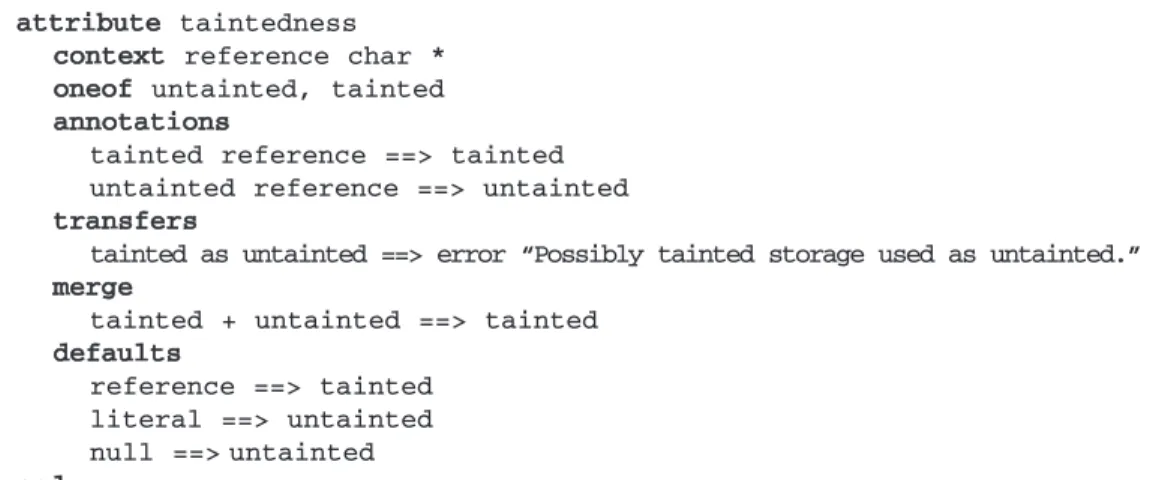
Splint’s attributes are more flexible and expressive than type qualifiers. Figure 2 shows the complete attribute definition. The first three lines define the taintedness
attrib-ute associated with char * objects, which
can be in one of two states: untainted or
tainted. The next clause specifies rules for
transferring objects between references, for example, by passing a parameter or returning
a result. The tainted as untainted ==>
errorrule directs Splint to report a warning
when a taintedobject is used where an
un-taintedobject is expected. This would
oc-Figure 2. Definition of the taintedness attribute. a attttrriibbuuttee taintedness c coonntteexxtt reference char * o onneeooff untainted, tainted a annnnoottaattiioonnss
tainted reference ==> tainted untainted reference ==> untainted t
trraannssffeerrss
tainted as untainted ==> error “Possibly tainted storage used as untainted.” m
meerrggee
tainted + untainted ==> tainted d deeffaauullttss reference ==> tainted literal ==> untainted null ==> untainted e enndd
cur if the system passed a taintedobject as
an untaintedparameter or returned it as an untainted result. All other transfers (for
example, untainted as tainted) are
im-plicitly permitted and leave the transferred object in its original state.
Next, the merge clause indicates that
com-bining taintedand untaintedobjects
pro-duces a taintedobject. Thus, if a reference
is tainted along one control path and un-taintedalong another control path,
check-ing assumes that it is tainted after the two
branches merge. It is also used to merge taint-edness states in function specifications (see the strcatexample in the next section).
The annotations clause defines two an-notations that programmers can use in dec-larations to document taintedness assump-tions. In this case, the names of the annotations match the taintedness states. The final clause specifies default values used for declarators without taintedness annotations. We choose default values to make it easy to start checking an tated program. Here we assume unanno-tated references are possibly tainted and Splint will report a warning where unanno-tated references are passed to functions that
require untainted parameters. The
warn-ings indicate either a format bug in the code
or a place where an untaintedannotation
should be added. Running Splint again af-ter adding the annotation will propagate the newly documented assumption through the program.
Specifying library functions
When the source code for library code is unavailable, we cannot rely on the default annotations because Splint needs the source code to detect inconsistencies. We must therefore provide annotated declarations that document taintedness assumptions for standard library functions. We do this by providing annotated declarations in the
tainted.xhfile. For example, int printf
(/*@untainted@*/ char *fmt, ...);
indicates that the first argument to printf
must be untainted. We can also use ensures clauses to indicate that a value is tainted after a call returns. For example, the first
parame-ter to fgetsis tainted after fgetsreturns:
char *fgets
(/*@returned@*/ char *s, int n, FILE *stream)
/*@ensures tainted s@*/ ;
The returned annotation on the
parame-ter means that the return value aliases the
storage passed as s, so the result is also
tainted (Splint’s alias analysis also uses this information).
We also must deal with functions that might take tainted or untainted objects, but where the final taintedness states of other parameters and results might depend on the parameters’ initial taintedness states. For
example, strcatis annotated this way:
char *strcat
(/*@returned@*/ char *s1, char *s2)
/*@ensures s1:taintedness = s1:taintedness | s2:taintedness@*/
Because the parameters lack annotations, they are implicitly tainted according to the default rules, and either untainted or tainted references can be passed as parameters to
strcat. The ensures clause means that after strcatreturns, the first parameter (and the
result, because of the returnedannotation
on s1) will be taintedif either passed
ob-ject was tainted. Splint merges the two taint-edness states using the attribute definition
rules—hence, if the s1 parameter is
un-tainted and the s2parameter is tainted, the
result and first parameter will be tainted af-ter strcatreturns.
Experience
Using Splint is an iterative process. First, we run Splint to produce warnings and then change either the code or the annotations accordingly. Next, we run Splint again to check the changes and propagate the newly documented assumptions. We continue this process until Splint issues no warnings. Be-cause Splint checks approximately 1,000 lines per second, running Splint repeatedly is not burdensome.
Splint’s predecessor, LCLint, has been used to detect a range of problems,
includ-ing data hidinclud-ing15 and memory leaks, dead
storage usage, and NULL dereferences7 on
programs comprising hundreds of thou-sands of lines of code. LCLint is widely used
Using Splint is
an iterative
by working programmers, especially in the
open-source development community.16,17
So far, our experience with buffer over-flow checking and extensible checking is limited but encouraging. We have used Splint to detect both known and previously unknown buffer overflow vulnerabilities in wu-ftpd, a popular ftp server, and BIND, the libraries and tools that comprise the Domain Name System’s reference implementation.
Here, we summarize our experience ana-lyzing wu-ftpd version 2.5.0, a 20,000 line program with known (but not known specifically to the authors when the analysis was done) format and buffer overflow bugs. We detected the known flaws as well as finding some previously unknown flaws in wu-ftpd. It takes Splint less than four sec-onds to check all of wu-ftpd on a 1.2-GHz Athlon machine.
Format bugs
Running Splint on wu-ftpd version 2.5.0 produced two warnings regarding tainted-ness. The first one was:
ftpd.c: (in function vreply)
ftpd.c:4608:69: Invalid transfer from implicitly tainted fmt to untainted (Possibly tainted storage used as untainted.):
vsnprintf(..., fmt, ...) ftpd.c:4586:33: fmt becomes implicitly
tainted
In tainted.xh, vsnprintfis declared with
an untainted annotation on its format
string parameter. The passed value, fmt, is a
parameter to vreply, and hence it might be
tainted according to the default rules. We
added an untaintedannotation to the fmt
parameter declaration to document the as-sumption that an untainted value must be
passed to vreply.
After adding the annotation, Splint re-ported three warnings for possibly tainted
values passed to vreplyin replyand
lre-ply. We thus added three additional
annota-tions. Running Splint again produced five warnings—three of which involved passing
the global variable globerras an untainted
parameter. Adding an untaintedannotation
to the variable declaration directed Splint to
ensure that globerris never tainted at an
in-terface point. The other warnings concerned
possibly tainted values passed to lreply in
site_exec. Because these values were
ob-tained from a remote user, they constituted a serious vulnerability (CVE-2000-0573).
The second message Splint produced in the first execution reported a similar invalid
transfer in setproctitle. After adding an
annotation and rerunning Splint, we found two additional format string bugs in wu-ftpd. These vulnerabilities, described in CERT CA-2000-13, are easily fixed using
the %sconstant format string.
We also ran Splint on wu-ftpd 2.6.1, a version that fixed the known format bugs.
After adding eight untaintedannotations,
Splint ran without reporting any format bug vulnerabilities.
Buffer overflow vulnerabilities
Running Splint on wu-ftpd 2.5 without adding annotations produced 166 warnings for potential out-of-bounds writes. After adding 66 annotations in an iterative process such as the one we described above for checking taintedness, Splint produced 101 warnings. Twenty-five of these warnings in-dicated real problems and 76 were false (summarized in Table 1).
Six of the false warnings resulted because Splint was unaware of assumptions external to the wu-ftpd code. For example, wu-ftpd allocates an array based on the system
con-stant OPEN_MAX, which specifies the
maxi-mum number of files a process can have open. The program then writes to this buffer using the integer value of an open file stream’s file descriptor as the index. This is safe because the file descriptor’s value is
al-ways less than OPEN_MAX. Without a more
detailed specification of the meaning of file descriptor values, there is no way for a static analysis tool to determine that the memory access is safe.
Ten false warnings resulted from loops that were correct but did not match the loop heuristics. To some extent, we could address this by incorporating additional loop
Table 1
False warnings checking wu-ftpd
Cause Number Percent
External assumptions 6 7.9 Arithmetic limitations 13 17.1 Alias analysis 3 3.9 Flow control 20 26.3 Loop heuristics 10 13.2 Other 24 31.6
heuristics into Splint, but there will always be some unmatched loops. The remaining 60 spurious messages resulted from limita-tions in Splint’s ability to reason about arithmetic, control flow, and aliases. We’re optimistic that implementing known tech-niques into Splint will overcome many of these limitations without unacceptable sac-rifices in efficiency and usability. It is im-possible, though, to eliminate all spurious messages because of the general undecid-ability of static analysis.
L
ightweight static analysis is aprom-ising technique for detecting likely software vulnerabilities, helping pro-grammers fix them before software is de-ployed rather than patch them after attack-ers exploit the problem.
Although static analysis is an important approach to security, it is not a panacea. It does not replace runtime access controls, systematic testing, and careful security as-sessments. Splint can only find problems that are revealed through inconsistencies be-tween the code, language conventions, and assumptions documented in annotations. Occasionally, such inconsistencies reveal se-rious design flaws, but Splint offers no gen-eral mechanisms for detecting high-level de-sign flaws that could lead to security vulnerabilities.
The effort involved in annotating pro-grams is significant, however, and limits how widely these techniques will be used in the near future. Providing an annotated standard library solves part of the problem. However, it does not remove the need to add annotations to user functions where correctness depends on documenting as-sumptions that cross interface boundaries. Much of the work in annotating legacy pro-grams is fairly tedious and mechanical, and we are currently working on techniques for automating this process. Techniques for combining runtime information with static analysis to automatically guess annotations
also show promise.18
No tool will eliminate all security risks, but lightweight static analysis should be part of the development process for secu-rity-sensitive applications. We hope that the
security community will develop a tool suite that codifies knowledge about security vul-nerabilities in a way that makes it accessible to all programmers.
Newly discovered security vulnerabilities should not lead just to a patch for a specific program’s problem, but also to checking rules that detect similar problems in other programs and prevent the same mistake in future programs. Lightweight static checking will play an important part in codifying secu-rity knowledge and moving from today’s and-patch model to a penetrate-patch-and-prevent model where, once under-stood, a security vulnerability can be codified into tools that detect it automatically.
Acknowledgments
David Evans’ work is supported by an NSF Career Award and a NASA Langley Research Grant. David Larochelle’s work is supported by a Usenix Student Research Grant.
References
1. Common Vulnerabilities and Exposures, version 20010918, The Mitre Corporation, 2001; http://cve.mitre.org (current Nov. 2001).
2. D. Wagner et al., “A First Step Towards Automated De-tection of Buffer Overrun Vulnerabilities,” Proc. 2000 Network and Distributed System Security Symp., Inter-net Society, Reston, Va., 2000; www.isoc.org/ndss2000/ proceedings (current Nov. 2001).
3. I. Goldberg et al., “A Secure Environment for Untrusted Helper Applications: Confining the Wily Hacker,” Proc. Sixth Usenix Security Symp., Usenix Assoc., Berkeley, Calif., 1996; www.cs.berkeley.edu/~daw/papers/ janus-usenix96.ps (current Nov. 2001).
4. D. Evans and A. Twyman, “Flexible Policy-Directed Code Safety,” IEEE Symp. Security and Privacy, IEEE CS Press, Los Alamitos, Calif., 1999, pp. 32–45. 5. A. Baratloo, N. Singh, and T. Tsai, “Transparent
Run-Time Defense Against Stack-Smashing Attacks,” Proc. Ninth Usenix Security Symp., Usenix Assoc., Berkeley, Calif., 2000; www.usenix.org/events/usenix2000/ general/baratloo.html (current Nov. 2001).
6. C. Cowan et al., “StackGuard: Automatic Adaptive De-tection and Prevention of Buffer Overflow Attacks,” Proc. Seventh Usenix Security Symp., Usenix Assoc., Berkeley, Calif., 1998; http://immunix.org/ StackGuard/usenixsc98.pdf (current Nov. 2001). 7. D. Evans, “Static Detection of Dynamic Memory
Er-rors,” SIGPLAN Conf. Programming Language Design and Implementation, ACM Press, New York, 1996, pp. 44–53.
8. G. Ramalingam, “The Undecidability of Aliasing,” ACM Trans. Programming Languages and Systems, vol. 16, no. 5, 1994, pp. 1467–1471.
9. J. Viega et al., “ITS4 : A Static Vulnerability Scanner for C and C++ Code,” Proc. Ann. Computer Security Applications Conf., IEEE CS Press, Los Alamitos, Calif., 2000; www.acsac.org/2000/abstracts/78.html (current Nov. 2001).
10. D. Larochelle and D. Evans, “Statically Detecting
No tool will
eliminate all
security risks,
but lightweight
static analysis
should be
part of the
development
process for
security-sensitive
applications.
Likely Buffer Overflow Vulnerabilities,” Proc. 10th Usenix Security Symp., Usenix Assoc., Berkeley, Calif., 2001; www.usenix.org/events/sec01/larochelle.html (current Nov. 2001).
11. C. Barker, “Static Error Checking of C Applications Ported from UNIX to WIN32 Systems Using LCLint,” senior thesis, Dept. Computer Science, University of Virginia, Charlottesville, 2001.
12. C. Cowan et al., “FormatGuard: Automatic Protection From printf Format String Vulnerabilities,” Proc. 10th Usenix Security Symp., Usenix Assoc., Berkeley, Calif., 2001; www.usenix.org/events/sec01/cowanbarringer. html (current Nov. 2001).
13. L. Wall, T. Christiansen, and J. Orwant, Programming Perl, 3rd edition, O’Reilly & Associates, Sebastopol, Calif., 2000.
14. U. Shankar et al., “Detecting Format String Vulnerabili-ties with Type Qualifiers,” Proc. 10th Usenix Security Symp., Usenix Assoc., Berkeley, Calif., 2001; www. usenix.org/events/sec01/shankar.html (current Nov. 2001).
15. D. Evans et al., “LCLint: A Tool for Using Specifica-tions to Check Code,” SIGSOFT Symp. Foundations of Software Eng.,ACM Press, New York, 1994; www.cs. virginia.edu/~evans/sigsoft94.html (current Nov. 2001). 16. D. Santo Orcero, “The Code Analyzer LCLint,” Linux
Journal, May 2000; www.linuxjournal.com/article. php?sid=3599 (current Nov. 2001).
17. C.E. Pramode and C.E. Gopakumar, “Static Checking of C programs with LCLint,” Linux Gazette, Mar. 2000; www.linuxgazette.com/issue51/pramode.html (current Nov. 2001).
18. M.D. Ernst et al., “Dynamically Discovering Likely Program Invariants to Support Program Evolution,” Proc. Int’l Conf. Software Eng., IEEE CS Press, Los Alamitos, Calif., 1999, pp. 213–224.
For more information on this or any other computing topic, please visit our Digital Library at http://computer.org/publications/dlib.
About the Authors
David Evansis an assistant professor in University of Virginia’s Department of Computer Science. His research interests include annotation-assisted static checking and programming swarms of computing devices. He received BS, MS, and PhD in computer science from the Massachusetts Institute of Technology. Contact him at the Department of Computer Science, School of Engineering & Applied Science, University of Virginia, 151 Engineer’s Way, P.O. Box 400740; Charlottesville, VA 22904-4740; [email protected] or www.cs.virginia.edu/evans.
David Larochelleis a PhD student in University of Virginia’s Department of Computer Science, where he works on lightweight static analysis with a focus on security. He has a BS in computer science from the College of William and Mary in Williamsburg, Virginia, and an MCS in computer science from the University of Virginia. Contact him at the Department of Com-puter Science, School of Engineering & Applied Science, University of Virginia, 151 Engineer’s Way, P.O. Box 400740, Charlottesville, VA 22904-4740; [email protected] or www.ds. virginia.edu/larochelle.
What do software engineering professionals need to know, ac-cording to those who hire and manage them? They must be able to produce secure and high-quality systems in a timely, predictable, and cost-effective manner.
This special issue will focus on the methods and techniques for enhancing software education programs worldwide—academic, re-education, alternative—to give graduates the knowledge and skills they need for an industrial software career.
Potential topics include
• balancing theory, technology, and practice • experience reports with professional education • software processes in the curriculum
• teaching software engineering practices (project management, requirements, design, construction, …)
• quality and security practices • team building
• software engineering in beginning courses • computer science education vs. SE education • undergraduate vs. graduate SE education
• nontraditional education (distance education, asynchronous learning, laboratory teaching, …)
• innovative SE courses or curricula • training for the workplace
For more information about the focus, contact the guest editors; for author guidelines and submission details, contact the magazine assistant at [email protected] or go to http:// computer.org/software/author.htm.
Submissions are due at [email protected] on or before 1 April 2002. If you would like advance editorial comment on a proposed topic, send the guest editors an extended abstract by 1 February; they will return comments by 15 February.
Manuscripts must not exceed 5,400 words including figures and tables, which count for 200 words each. Submissions in excess of these limits may be rejected without refereeing. The articles we deem within the theme's scope will be peer-reviewed and are subject to editing for magazine style, clarity, organization, and space. We reserve the right to edit the title of all submissions. Be sure to include the name of the theme for which you are submitting an article.
Guest Editors:
Watts S. Humphrey, Software Engineering Institute Carnegie Mellon University, [email protected]
Thomas B. Hilburn, Dept. of Computing and Mathematics Embry-Riddle Aeronautical University [email protected]