FACULDADE DE
ENGENHARIA DA
UNIVERSIDADE DO
PORTO
ArgMine:
Argumentation Mining from Text
Gil Filipe da Rocha
Mestrado Integrado em Engenharia Informática e Computação Supervisor: Henrique Daniel de Avelar Lopes Cardoso (Ph.D.) Co-Supervisor: Jorge Filipe Pinheiro Guerra de Ribeiro Teixeira
ArgMine:
Argumentation Mining from Text
Gil Filipe da Rocha
Mestrado Integrado em Engenharia Informática e Computação
Approved in oral examination by the committee:
Chair: Doctor Ana Paula Cunha da Rocha
External Examiner: Doctor Bruno Emanuel da Graça Martins Supervisor: Doctor Henrique Daniel de Avelar Lopes Cardoso Co-Supervisor: Jorge Filipe Pinheiro Guerra de Ribeiro Teixeira
Abstract
The aim of argumentation mining is the automatic detection and identification of the argumenta-tive structure contained within a piece of natural language text. An argument is an ancient and well studied rhetorical structure. In a general form, arguments are justifiable positions where pieces of evidence (premises) are offered in support of a conclusion.
The ambiguity of natural language text, different writing styles, implicit context and the com-plexity of building argument structures are some of the challenges which make argumentation mining very challenging.
By automatically extracting arguments from text, we are able to tell not just what views are being expressed, but also what are the reasons to believe those particular views. Therefore, ar-gumentation mining has the potential to improve some research topics such as opinion mining, recommender systems and multi-agent systems.
In this thesis the ArgMine Framework is presented, which aims to integrate the creation of an annotated corpus with arguments and the semi-automated process of selection and experimenta-tion of different models and relevant features in different subtasks of the argumentaexperimenta-tion mining process.
The full task of argumentation mining can be decomposed into several subtasks. This thesis focuses on the automatic detection and identification of the argumentative components presented in the original text, using supervised and semi-supervised machine learning algorithms. The target corpus used to train the supervised machine learning algorithms was manually annotated and is composed of Portuguese news articles, to which argumentation mining does not seem to have been applied before.
The predictive capabilities of the models developed to address the first two subtasks of the argumentation mining process are being exploited to suggest, in unannotated texts, potential argu-ments to users in the annotation platform.
Resumo
O objetivo da prospeção de argumentos a partir de texto é a deteção e identificação de forma automática da estrutura argumentativa contida num texto escrito em linguagem natural. Um ar-gumento é uma estrutura retórica que é estudada desde à muitos anos e que se encontra bem fundamentada. De uma forma geral, argumentos são posições justificáveis onde factos (premis-sas) são apresentados em suporte de uma conclusão.
A ambiguidade do texto escrito em linguagem natural, diferentes estilos de escrita, contexto implícito e a complexidade em construir estruturas argumentativas são alguns dos desafios que fazem desta tarefa muito desafiadora.
Extraindo de forma automática argumentos a partir de texto, somos capazes de saber não apenas quais são os pontos de vista que estão a ser expressos, mas também quais são as razões para acreditar nesses pontos de vista. Assim sendo, a prospeção de argumentos de forma au-tomática tem o potencial de trazer avanços em algumas áreas de investigação tais como prospeção de opiniões, sistemas de recomendação e sistemas multi-agente.
Nesta tese apresentamos aArgMine Framework, a qual tem como objetivo de integrar a criação de um conjunto de dados anotados com argumentos e o processo semi-automático de seleção e ex-perimentação de diferentes modelos efeaturesrelevantes em diferentes sub-tarefas do processo de prospeção de argumentos.
A tarefa de prospeção de argumentos pode ser decomposta em várias sub-tarefas. Esta tese aborda a deteção e identificação, de forma automática, dos componentes argumentativos presentes no texto, usando algoritmos de aprendizagem máquina supervisionada e semi-supervisionada. O conjunto de dados alvo que será usado para treinar os algoritmos de aprendizagem máquina su-pervisionada foram manualmente anotados e são constituídos por notícias escritas na língua Por-tuguesa, na qual a prospeção de argumentos não parece ter sido ainda explorada.
As capacidades preditivas dos modelos desenvolvidos para abordar as primeiras duas sub-tarefas do processo de prospeção de argumentos estão a ser aplicadas para sugerir, em textos não anotados, potenciais argumentos a utilizadores na plataforma de anotação.
Acknowledgements
First of all, I would like to show my gratitude to my supervisors, Professor Henrique Lopes Cardoso and Jorge Teixeira.
I would also like to thank my family and friends for all the support until this moment of my life. Finally, I would like to thank my parents for supporting me all the time and for supporting me in my academic pursuits.
“Give a man a fish, and you feed him for a day. Teach a man to fish, and you feed him for a lifetime.”
Contents
1 Introduction 1
1.1 Motivation . . . 2
1.2 Research Goals . . . 4
1.3 Thesis Structure . . . 5
2 State-of-the-Art in Argumentation Mining 7 2.1 Argumentation Fundamentals . . . 7
2.2 Argumentation Theory . . . 9
2.3 Argumentation Mining Process . . . 13
2.4 Approaches to Argumentation Mining . . . 14
2.4.1 Supervised Learning . . . 14 2.4.2 Semi-Supervised Learning . . . 17 2.5 Argumentation Tools . . . 18 3 ArgMine Framework 21 3.1 Annotation Platform . . . 24 3.2 ArgMine Corpus . . . 27
3.3 Machine Learning Module . . . 29
3.4 Models Integration . . . 31
4 Models 33 4.1 Argumentative Sentence Detection . . . 34
4.1.1 Algorithms . . . 36
4.1.2 Features . . . 36
4.1.3 Results . . . 39
4.1.4 Error Analysis . . . 40
4.1.5 Conclusions . . . 41
4.2 The role of keywords . . . 42
4.3 ADU Boundary Detection . . . 44
4.3.1 Algorithms . . . 48 4.3.2 Features . . . 49 4.3.3 Results . . . 50 4.3.4 Error Analysis . . . 50 4.3.5 Conclusions . . . 51 5 Conclusions 53 5.1 Lessons Learned . . . 54 5.2 Future Work . . . 56
CONTENTS
References 59
List of Figures
2.1 Example of an argument diagram . . . 9
2.2 Freeman’s approach to convergent (left) and linked (right) arguments, [Fre91] . . 11
3.1 ArgMine Framework general architecture. The full-line area delimits the Corpus Creation Module, while the dashed-line area delimits the Machine Learning Module. 23 3.2 “Anotar Argumentos" section of the Annotation Platform, in which some informa-tion related to the annotainforma-tion process is available. . . 24
3.3 Opinion article annotated with arguments . . . 26
3.4 Opinion article annotated with arguments obtained from the suggestions given by the models developed in this thesis . . . 32
4.1 Two different writing styles expressing the same argument [PS13] . . . 36
4.2 Opinion article annotated with one argument . . . 37
4.3 Example of lexical clue contained in non argumentative sentence . . . 40
4.4 Example of argumentative sentences without lexical clues . . . 41
4.5 One example of a training instance extracted from CSTNews corpus for the task of EDU Boundary Detection . . . 46
4.6 Graphical structure of linear chain CRF for sequences. An open circle indicates that the variable is not generated by the model [LMP01] . . . 49
LIST OF FIGURES
List of Tables
4.1 Argumentative Sentence Detection Scores . . . 40
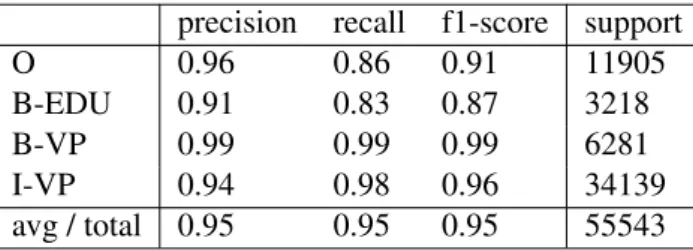
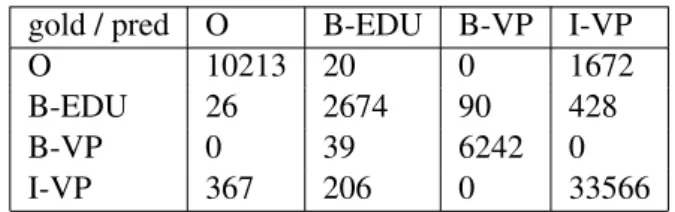
4.2 EDU Boundary Detection Scores . . . 50
LIST OF TABLES
Abbreviations
ADU Argumentative Discourse Unit EDU Elementary Discourse Unit SVM Support Vector Machine AIF Argument Interchange Format JSON JavaScript Object Notation OVA Online Visualization of Argument
Chapter 1
Introduction
Argumentation is the process whereby arguments are constructed, presented and evaluated. An argument is composed by a set of propositions, where some of them (the premises) are pieces of evidence offered in support of a conclusion. The conclusion is a proposition that has truth-value (which is either true or false), put forward by somebody as true on the basis of the premises.
The ability to engage in the process of argumentation is essential for human beings. Humans use argumentation to communicate and defend their justifiable positions (or opinions), to under-stand new problems and to perform scientific reasoning. The process of argumentation is com-monly used in several areas and plays an important role in some activities. Many professionals (e.g. scientists, lawyers, journalists, politicians) implicitly or explicitly use argumentation in their daily activity. In these situations, argumentation can be used in different phases of the decision process: to analyze a problem or situation, to identify the pros and cons and, to make a decision.
Verbal communication and written texts are the means by which humans communicate their arguments. Thus, we can find arguments almost everywhere: scientific texts, legal texts and court decisions, biomedical texts, patents, reviews, debates, dialogs, news, and so on.
The aim of argumentation miningfrom text, a sub-domain of text mining, is the automatic detection and identification of the argumentative structure contained within a piece of natural lan-guage text. As input, this process receives a piece of natural lanlan-guage text. If the text under analysis contains argumentative content, we aim to detect all the arguments that are present in the text document, the relations between them and the internal structure of each individual argu-ment. In the end, this process should be able to output the correspondingargument diagram: the visual representation of the arguments presented in the text. An argument diagram is a compact and intuitive representation of the arguments presented in the text, which helps in the process of understanding the points of view that are being expressed, and more interestingly, what are the reasons to believe those particular views.
When argumentation mining is applied on free text, some characteristics of natural language text and from the argumentation process itself make argumentation mining a very challenging task.
Introduction
The ambiguity of natural language text, different writing styles, implicit context and the complex-ity of building argument structures from free text are some of the main challenges. As an example, writers typically do not follow the strict rules of grammar because their human readers posses cognitive abilities to interpret the semantic and contextual meaning of the text. As a consequence, when a logic reasoning is being expressed, some parts of the process can be omitted from the text, making the automatic detection of this reasoning process much more challenging.
In order to successfully approach argumentation mining from text, knowledge from different research areas, such as text mining and argumentation theory, will be required. In this thesis, some of the essential concepts and theories of argumentation will be presented. This basic background on argumentation theory will be used throughout this thesis to properly formulate and describe some of the sub-tasks that will be addressed.
1.1
Motivation
The skill of distinguishing argument from non-argument spans of text and, the skill of extracting the argumentative structure from free text are sophisticated and require some training. These skills are a typical learning outcome of an undergraduate course on critical thinking that are commonly taught in some graduation degrees, such as philosophy. In this kind of courses, one of the main objectives is to teach students how to interpret and analyze text documents correctly. One of the most useful skills to achieve these goals, is the ability to extract arguments contained within the text and represent them in a intuitive and systematic way. For instance, the ability to properly represent the arguments contained in a piece of text in the form of argument diagrams. In this sense, investigating at which level we can perform this task using a machine learning approach comparing to the human performance is a very interesting question to explore. Also, from the analysis of the results obtained and from the conclusions to be drawn, it will be interesting to discover what patterns that are present in free text are most relevant for the task of argumentation mining.
By automatically extracting arguments from text, we are able to tell not just what views are being expressed, but also what are the reasons to believe those particular views. This is potentially relevant to any kind of text mining application that is directed to argumentative text. Therefore, interesting practical applications become visible in the horizon, such as:
• Legal cases and court decisions: Palauet al. [PM09] worked with texts in the legal domain with the aim of automatically detecting and identifying arguments that are presented by the parties involved (e.g., in a court trial), which may significantly enrich the information retrieval capabilities on legal databases, as well as help professionals to evaluate and analyze arguments in the legal domain;
• Scientific text: In the scientific community, every accepted proposition must be supported by facts that can be proven. Therefore, the scientific domain is argumentative in nature.
Introduction
For instance, in the biomedical domain it is common to find documents presenting support-ive evidences when trying to prove that a new experiment is more successful or relevant than another one. The extraction and evaluation of arguments from scientific text can have interesting applications in the process of scientific reasoning;
• User-generated content: argumentation mining can be seen as a natural extension of opinion mining. The aim of opinion mining is to detect user’s appreciations or disappointments in relation to something (products or services, for instance). A natural extension is to automat-ically find the reasons that users provide to justify their point of view [SW12]. Another re-search community that can benefit from advancements in argumentation mining rere-search is the recommendation systems community. Typically, recommendations presented by recom-mender systems are based on the classifications that users give to some products or services (e.g., using a 5-star classification). If we are able to know the reasons behind those clas-sifications, we could build systems that better understand user preferences and, therefore, would be able to give better recommendations [CMG09];
• Debates: Discussions of political issues, newspaper articles and opinion articles, are some of the means where we can find relevant arguments for the general public, where tools that help us to visualize, to understand and to evaluate arguments can have interesting applications. Some researchers have explored this direction, including [GLPK14,BD10];
• Education: essays and exams are some of the documents that are written by students during their academic activities, which constitute educational data that can be mined for purposes of assessment and instruction. Other possible applications are: pedagogical tool for argumen-tation courses, computer-supported peer review, computerized essay grading and large-scale online courses [AS11];
• Multi agent systems: reasoning agents need to communicate with each other and apply argumentation-based reasoning mechanisms to undertake the conflicts arising from their different views of goals, beliefs, and actions [PM09]. Acquisition of knowledge in form of arguments from external resources is also a possible application to this research area. Preliminary research performed so far yield interesting results, motivating the exploration of more applications in the field. However, before the rise of such applications, the state-of-the-art on argumentation mining must be improved.
Research in the area of argumentation mining is very recent. Initial studies started to appear only a few years ago and within specific domains such as legal texts, online reviews, and debates [Sai12,MP11, CV12]. The growing interest in the topic is tangible. Only in the year 2014, at least three international events occured: the firstACLworkshop on the topic in Baltimore1 and meetings dedicated to the topic in both Warsaw2and Dundee3).
1http://www.uncg.edu/cmp/ArgMining2014/ 2http://argdiap.pl/argdiap2014
Introduction
Argumentation Mining is a growing research topic that spans across different research areas. Some characteristics of natural language text and from the argumentation process make tation mining a very challenging task and, therefore, an engaging problem. In addition, argumen-tation mining is a research topic with potential for several applications.
1.2
Research Goals
The fundamental research questions that will be addressed in this thesis are the following:
• Given a text document, how to automatically segment the text into argumentative zones? • How can the Argumentative Discourse Units (ADUs) boundaries be automatically identified
in free text?
• Is it possible to learn, from an annotated corpora, how to identify and extract arguments?
In this thesis, we aim to work on argumentation mining from text written in the Portuguese language using supervised machine learning algorithms to automatically address some of the sub-steps of the complete argumentation mining process. To achieve this goal using supervised ma-chine learning algorithms, a set of labeled data (corpus) is required. To the best of our knowledge, no such corpus exists. In this thesis, the creation of a corpus with arguments annotated from text written in the Portuguese language will be introduced. To integrate the creation of a corpus with the process of experimentation and creation of the models that we aim to build in order to address some of the sub-steps of the argumentation mining process, theArgMine Frameworkwas created and a detailed description of the components will be presented.
In sum, we have contributed in the following respects:
• computational models addressing the first two research questions mentioned above;
• critical analysis of the obtained results from the previously mentioned models, to answer the third research question;
• creation of an annotated corpus with arguments from text written in Portuguese;
• an alignment of tools and processes that facilitate and partially automate argumentation mining research (ArgMine Framework).
Furthermore, to the best of our knowledge, this is the first work in argumentation mining based on the Portuguese language and, this is the first attempt to build a corpora annotated with arguments obtained from text written in Portuguese.
Introduction
1.3
Thesis Structure
The thesis is structured as follows:
Chapter2follows this introduction and presents the state-of-the-art in argumentation mining. It introduces some important concepts and definitions that are central to understand the contents of this thesis. In addition, some of the most influential work is presented.
Chapter3describes the ArgMine Framework, one of the major contributions of this work. Chapter4 describes the models that were built to address the first two subtasks of the argu-mentation mining process. To address the first subtask of the arguargu-mentation mining process, Ar-gumentative Sentence Detection(Section4.1), a binary classifier is trained to detect argumentative sentences from free text, using semi-supervised machine learning algorithms. From the critical analysis of the obtained results from the taskArgumentative Sentence Detection, we concluded that the ambiguity associated to lexical clues transformed this intuitive set of features into an ir-relevant set of features for the classifiers. In Section4.2, we investigate if there is an additional property (besides lexical information) that should be verified to consider a word as argumentative keyword (namely, the syntactic role of the word in a given sentence). To address the second sub-task of the argumentation mining process, ADU Boundary Detection(Section4.3), a sequential classifier is trained using supervised machine learning algorithms to identify the exact boundaries of the ADU’s, given an argumentative sentence.
Introduction
Chapter 2
State-of-the-Art in Argumentation
Mining
This chapter focuses on the concepts and topics that are considered essential to the understanding of the problem, research goals and position of this thesis in relation to other work in the field.
The chapter starts with an introduction to the fundamental concepts about argumentation. Next, some of the most influential argumentation theories for the task of argumentation mining are presented. Afterwards, the detailed argumentation mining process is explained. Then, the state-of-the art on machine learning techniques used to address the task of argumentation mining is presented. Finally, the state-of-the-art on argumentation tools is presented.
2.1
Argumentation Fundamentals
In this section some of the fundamental concepts about argumentation are presented. These con-cepts will be repeatedly mentioned in this thesis and, therefore, a proper definition must be pre-sented.
Argumentation is an ancient and vast topic that has been influenced by many fields such as logic, philosophy and linguistics. Consequently, in the literature, there are several definitions for each of the concepts presented in this section. The following definitions are based on the formu-lation presented in [MP11,PM09]:
Definition 2.1. Argumentation Argumentation is the process by which arguments are con-structed and handled. Handling arguments may involve comparing arguments, evaluating them in some respects, and judging a constellation of arguments and counterarguments to consider whether any of them are warranted according to some principled criterion.
State-of-the-Art in Argumentation Mining
Definition 2.2. PropositionA Proposition is a simple declarative sentence that has a truth-value (which is either true or false). A proposition is used to make a statement or assertion.
Definition 2.3. ArgumentAn argument is composed by a set of at least two propositions, being all of them premises, except maximum one, which is a conclusion. The conclusion corre-sponds to the claim of the argument and can be obtained by one or more reasoning steps (i.e. steps of deduction) from the premises. The premises, also called assumptions, are pieces of evidence offered in support of a conclusion.
Definition 2.4. PremiseA premise is a proposition that is a reason for, or objection against, some claim. A premise is a statement presumed true within the context of an argument toward a conclusion.
Definition 2.5. ConclusionA conclusion is a proposition that is supposed to be supported by the premises. In the context of ordinary argumentation, the rational acceptability of a disputed conclusion depends on both the truth of the premises and the soundness of the reasoning from the premises to the conclusion.
In a general form, arguments are justifiable positions that are composed by at least two propo-sitions (the conclusion and, at least one premise). The relation of support between the premises and conclusion is the key characteristic that distinct arguments from other discourse structures.
As an example of an argument, consider the following two sentences:
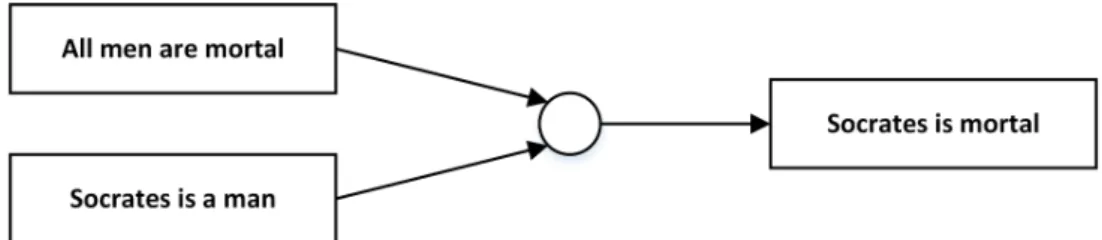
“All men are mortal and Socrates is a man. Therefore, Socrates is mortal."
The conclusion presented in this example is“Socrates is mortal"and, the premises are“All men are mortal"and“Socrates is a man". In this simple example, the relations of support between the premises and conclusion are evident.
We can graphically represent an argument using anArgument Diagram. In an argument dia-gram, nodes contain propositions (premise or conclusion) and, the indication of support or conflict relations is made using arrows, which connect the premise node to the conclusion node. This rep-resentation leads to the visualization of an argument as a graph structure. The corresponding argument diagram for the example previously presented is shown in Figure2.1.
An argument can be good or bad based on:
• how well the premises support the conclusion;
• the truth-value of the premises.
It is important to realize the difference between the structure of reasoning and the evaluation of the quality of reasoning. In the former, the main concern is related with the principles of building good argument structures and will be the subject of study in this thesis. But these principles do
State-of-the-Art in Argumentation Mining
Figure 2.1: Example of an argument diagram
not guarantee that the argument is good. The evaluation of an argument’s quality brings further considerations and different research questions that are outside the scope of this thesis.
2.2
Argumentation Theory
The discipline of argumentation has ancient roots in dialectics and philosophy and has been influ-enced by many and diverse areas of knowledge, such as logic, rhetoric, law and computer science. As a consequence, literature in argument representational models is rich and diverse.
The current state-of-the-art in argumentation does not afford a universally accepted theory and, neither a theory that could be applied to every scenario. Currently, there exists a variety of approaches that differ considerably in conceptualization, scope and degree of theoretical refine-ment [vE01].
In this section, we will introduce some of the most influential proposed annotation theories for argumentation, focusing on theories that highly influenced the development of argumentation min-ing. Therefore, some important and influential research in argumentation theories that have been designed to fulfill the requirements of other research areas, such as multi-agent systems research, will not be described in this section. For instance, Dung [Dun95] proposed argumentation graphs, which are superficially similar to the kinds of graphs used in this thesis, but were formulated for different purposes. Dung representation of arguments allows for formally modeling the reasoning process but, our concern, on the other hand, is related to the explicit representation of arguments as they are presented in text documents. Similarly, van Eemeren and Grootendorst [vEG04] pre-sented interesting aspects for argumentation but their goals are somewhat different.
One of the first examples to illustrate argumentative processes using argument diagrams was presented by Richard Whately in 1836 [Wha36]. The method described by Whately consists of figuring out the conclusion in the first place, and then trace the reasoning backward, in order to retrieve the grounds (premises) in which the assertion was made. This process can be repeated recursively, obtaining what Whately described as “chain of arguments". The diagram has many of the basic characteristics of modern argument diagrams: statements are represented as nodes and are connected by lines to make up a graph structure [RWM07].
One of the most influential works in the history of argumentation theory was the work devel-oped by Stephen E. Toulmin [Tou58]. Since Toulmin did not agree with the simplistic view of an argument as composed of premises and conclusions, he investigated the actual use of arguments
State-of-the-Art in Argumentation Mining
in order to identify different roles that argument components can play in argumentation. Toulmin proposed an argumentation scheme containing six functional roles:
• Claim: The statement being argued;
• Data: The facts or evidence used to prove the claim;
• Warrant: The general (and hypothetical) logical statement authorizing our movement from the data to the claim;
• Backing: Statements that serve to support the warrants;
• Rebuttal: Counter-argument or statement recognizing the circumstances when the general argument does not hold true;
• Qualifier: Statements expressing the speaker’s degree of force or certainty concerning the claim.
In 1991, Freeman integrated Toulmin’s ideas into the argument diagramming techniques of the informal logic tradition [Fre91]. One of the most innovative features introduced by Freeman diagrams was the indication of supposition. A premise can be considered valid only provisionally in order to allow the dialog to continue, and the conclusion can be considered only hypothetical (depending on the stated assumptions). However, one of the most important features introduced by Freeman, in the perspective of argumentation mining, is the distinction between linked and conver-gent arguments. He recognized two different structures for arguments that should be distinguished in the argument diagram representation:
• convergent arguments: the premises are independent lines of reasoning supporting the con-clusion;
• linked arguments: the premises must be combined (they work together) in order to support the conclusion.
In Figure2.2, the difference in terms of graphical representation between these two kind of argu-ment structures is shown, as defined by Freeman.
Finally, the argumentation theory proposed by Walton defines the theory of argumentation schemes [Wal96]. This theory defines stereotypical patterns of reasoning and has been used ex-tensively for the analysis of argumentative text.
Argumentation schemes are argument forms that represent general inferential structures of ar-guments. They could be seen as templates for different types of arar-guments. Arguments found in texts are understood as instances of abstract argumentation schemes. A large catalog of these schemes is provided in [Wal96].
Each argumentation scheme is typically defined by a set of abstract templates for sequence of premises, an abstract template for the conclusion proposition, a set of keywords and a set of
State-of-the-Art in Argumentation Mining
Figure 2.2: Freeman’s approach to convergent (left) and linked (right) arguments, [Fre91]
critical questions. Each abstract template of propositions is described in the general case contain-ing some variables that need to be instantiated in a concrete example. One of the most interestcontain-ing characteristics of argumentation schemes is the set of critical questions associated to each of them. These critical questions can be used to validate the applicability of that specific argumentation scheme to a specific example or, to evaluate a given argument in a particular case and in relation to the context in which the argument occurred. Besides helping in the evaluation of arguments, argumentation schemes can also be used to add missing parts of arguments (often, in the form of implicit propositions, also known as enthymemes). Comparing the argumentation scheme with the argument presented in the text, the missing parts can be easily derived. This observation can have applications in refinement of argument structures or in the detection of missing steps in the reasoning that originated the argument.
From all theories of argumentation that were analyzed, we conclude that most of them assume that the elementary units of an argument can be classified as premises and conclusions. How-ever, over the years, more complex representations have been presented. A detailed overview of the use of argument diagramming techniques to represent the structure of arguments is presented in [RWM07].
So far, theories of argumentation and diagramming techniques were presented to represent the structure of arguments in a general and abstract way. However, when Argumentation Mining is applied to free text, it is dependent of the characteristics and discourse structure of the text. There-fore, further considerations should be made, when it comes to represent the arguments contained in free text. While argumentation theories often assume that the argumentative components are given, a practical and segment-based argumentation mining system has to cope with the linguistic style of the author and the peculiarities of the segmentation process [PS13]. In linguistics, theories of discourse structure have been studied for a long time and several theories have been formalized [Coh87,MT88,Mar00]. Most of these discourse theories assume that any text can be partitioned into a sequence of non-overlapping elementary textual units and that a discourse structure can be associated with the text to represent the relations between elementary textual units. These theories differ mainly in the definition of elementary units and, in the nature and number of different types of relations.
State-of-the-Art in Argumentation Mining
The authors of this theory formulated a set of 23 rhetorical relations that hold between two el-ementary units of text, such as evidence, contrast, elaboration, amongst others. Each relation defines a specific role that an elementary unit plays in relation to the other. One of the essential steps in characterizing the discourse structure of a text is to determine the elementary discourse units (EDUs), which are the building blocks of a discourse tree. In RST, the elementary units are classified betweennucleusandsatellite. The nucleus is more central to the writer’s purpose and is interpretable independently. The satellite is less central and generally is only interpretable with respect to the nucleus. A manual for EDU segmentation that follows the principles of RST is presented in [CM01]. As defined in this annotation manual, the elementary discourse units are non-overlapping spans of text (denominated as “clauses" in the manual). A sentence can contain several EDUs but, on the other side, an EDU cannot contain a span of text from more than one sen-tence. A set of lexical and syntactic discourse segmentation rules were defined, which are mainly based on discourse markers, conjunctions, verbal forms and punctuation marks. These rules help the annotator in the process of finding the boundaries that separate two adjacent EDUs and, help on understanding the characteristics that are required to consider a span of text as an EDU. For in-stance, one of the rules indicates that an EDU always has to include a verb. Another rule indicates that if a sentence includes a discourse marker (e.g. “because", “if", “but", amongst others) it has to be separated into two EDUs (if the resulting EDUs include a verb).
The elementary units are related pair-wise and can be hierarchically organized into an entire discourse tree that represents the full text.
Even though the tasks of explaining the coherence of text (the goal of RST) and capturing the argumentative content found in a text are not identical, some researchers employed RST to represent the argumentation structure contained in the text [Gre10,Aza99]. Namely in [Aza99], the author adopted the RST framework, determining the five RST relations (from the twenty-three originally defined by Mann and Thompson [MT88]) that are of interest to represent the argumenta-tive structure. As pointed in [PS13] there are some limitations when adapting the RST to represent the arguments contained in the text.
The formalism followed in this thesis to define the internal structure of an argument deter-mines that each elementary unit can be classified between premise and conclusion. To represent relations between elementary units we define that they can be related using convergent and linked arguments, as introduced by [Fre91].
We have chosen this formalism as the basis of our work due to the following reasons:
• it is the simplest argumentation structure that allows to express the arguments contained within a piece of natural language text;
• it is the most used and accepted argumentation theory by current research in argumentation mining;
• in order to make the process of annotating arguments from text more intuitive for annotators.
State-of-the-Art in Argumentation Mining
2.3
Argumentation Mining Process
The full task of argumentation mining can be decomposed into several subtasks. The formulation of the argumentation mining process used in this thesis is based on the work presented in [PS15]. The subtasks to be addressed are the following:
• Text segmentation:splitting the original text in elementary discourse units (EDUs). This is a step commonly performed in discourse parsing tasks. Typically an EDU corresponds to a sentence or clause, depending on the task being addressed;
• Identification of argumentative discourse units (ADUs): Identification and extraction of the minimal units of arguments (ADUs). It involves discarding argumentatively irrelevant EDUs, joining adjacent EDUs to form larger ADUs or partition of EDUs into several ADUs;
• ADU type classification:determining the type of argumentative unit. Classification of each ADU into the different types of argument components;
• Relation identification:establish the relations between individual ADUs, leading to a set of incomplete argument diagrams (the arrows are unlabeled for each argument diagram);
• Relation type classification: classify the type of argumentative relation, leading to a set of complete argument diagrams.
In theText segmentationsubtask, typically performed in natural language problems, is similar in nature to that of finding the elementary discourse units in discourse parsing. Commonly, sen-tence boundaries are considered to be EDU boundaries but, in addition, complex sensen-tences may be broken into several EDUs, which generally correspond to clauses.
For the specific case of argumentation mining, [PS13] refers to these “minimal unit of analy-sis” as Argumentative Discourse Units (ADUs).
Definition 2.6 Argumentative Discourse Units (ADUs)Argumentative Discourse Units are non-overlapping spans of text corresponding to the minimal units of arguments.
An ADU may not always be as small as an EDU, for example, "when two EDUs are joined by some coherence relation that is irrelevant for argumentation, the resulting complex might be the better ADU, when it collectively plays some specific role in the argumentation." [PS13, p. 21]. However, on the other side, it can also happen that an EDU should be broken in several ADUs, for example, when premises and conclusions are presented in the same sentence. For this reason, methods to automatically identify and extract ADUs from free text or methods that extract the ADUs from the EDUs previously obtained, have both to be explored specifically for the task of argumentation mining (Identification of argumentative discourse unitssubtask).
Following the formalism to represent an argument that will be used in this thesis, ADUs can be further classified between premise or conclusion, depending on the role that each ADU is playing
State-of-the-Art in Argumentation Mining
in the argument (ADU type classificationsubtask). Therefore, the definition of ADU used in this thesis is completed with the definitions ofPremise(Definition 2.4) andConclusion(Definition 2.5) presented in Section2.1.
The last two substeps of the argumentation mining process are related to the connection be-tween premises and conclusions in order to build the final argument diagram. First, from all the premises and conclusions extracted from the text in the previous substeps, we have to connect premises to the conclusions that they support or attack (Relation Identificationsubtask). After this step, we will obtain a set of incomplete argument structures. Finally, in the subtaskRelation type classification, each connection is classified between the type of relations defined by the formalism used to represent the argument structure. Following the argumentation structure that will be used in this thesis, we aim to classify each relation between support or attack. A relation of support means that the premise contains evidence in support of the conclusion and, on the other side, a relation of attack means that the premise presents evidence that contradict the conclusion.
In this thesis, we will address the first two subtasks of the argumentation mining process de-scribed above. Therefore, in the end, instead of the complete argument diagram we aim to identify and extract the argumentative discourse units presented in the text. This implies determining the sentences of the text that contain argumentative content and the identification of the exact bound-aries of the argumentative discourse units presented in argumentative text.
2.4
Approaches to Argumentation Mining
The aim of machine learning is the study of algorithms that at some taskT improve their perfor-manceP, based on the experienceE [Mit97]. Based on a set of examples, a learning algorithm creates a model relating outputs to inputs that fits these examples and, the goal is to learn a model that generalizes well for unseen examples.
Next, we will introduce the current state-of-the-art in relation to the approaches that have been used to address the task of argumentation mining. Current approaches to automatic analysis of argumentative content in text usually follow the supervised machine learning paradigm. After, we present the current state-of-the-art using semi-supervised machine learning techniques and we motivate the use of this paradigm to approach the problems that we are trying to solve.
2.4.1 Supervised Learning
The aim of supervised machine learning is to create a model that maps inputs to outputs given a set of input and desired output pairs. The supervised machine learning algorithm analyzes the training examples and infers a function, which can be used to map new examples. In order to obtain good performances in unseen data, the model should be able to generalize well from the training data.
One of the first works devoted to the identification of arguments in text wasArgumentative Zoning[TM02], whose aim is the segmentation of a discourse into discourse segments or zones, each playing a specific rhetoric role in the text. Teufelet al.presented an algorithm which, on the
State-of-the-Art in Argumentation Mining
basis of the annotated scientific articles, classifies the content into a fixed set of seven rhetorical categories.
The aim of argumentation mining is different from argumentative zoning. In the former, we are not only interested in classifying each text segment by their argumentative function, but we also aim to automatically identify the argumentative relations between each argumentative com-ponent, leading to the detection of full argument diagrams.
One of the first attempts to apply this kind of techniques to the task of argumentation mining and, one the most influential is presented in [MBPR07,PM09]. In their work, they analyze the main research questions of the entire argumentation mining process. Also, they present the differ-ent methods studied and developed in order to approach the challenges of argumdiffer-entation mining applied to legal texts. They used two corpora to develop their work: the Araucaria corpus [Ree06] and the ECHR corpus. The first corpus is a general corpus where the data was collected from 19 newspapers, 4 parliamentary records, 5 court reports, 6 magazines and 14 further online discussion boards and “cause" sources. The second corpus is composed by a set of documents extracted from legal texts of the European Court of Human Rights (ECHR). The ECHR developed a standard type of reasoning and structure of argumentation. Therefore, its documents are an interesting test set for argumentation analysis. The set of annotated arguments from both corpora were manually annotated by experts.
The first task addressed by Mochales and Moens, the detection of argumentative sentences, is seen as a classification problem. In their work, they made the assumption that theADUs are complete sentences. Due to the fact that legal texts “normally present premise and conclusion in subordinate sentences or independent sentences instead of subclauses" [PM09, p. 101], they argue that this assumption is viable. Then, each sentence is represented as a vector of features and a classifier is trained on examples that were manually annotated. They used generic features involving lexical, syntactic, semantic and discourse properties that can easily be extracted from the texts. The detailed list of features can be found in [PM09]. They reported 73% of accuracy in the Araucaria corpus and 80% of accuracy in the ECHR corpus, using the maximum entropy model.
Next, Mochales and Moens studied the classification of each argumentative proposition into premise and conclusion. Again, their approach is to formalize this problem as a binary classifica-tion problem and to work with statistical classifiers. For this task, they used a more sophisticated set of features. They preserved three features from the previous task related to the general struc-ture of the text and sentence. In addition, they introduced feastruc-tures related to the argumentative category (among 5 categories defined by the authors of this work), a binary feature indicating the presence of a reference to a law article in the sentence (typically found in premises of legal texts), the type of rhetorical pattern occurring on current, previous and next sentence among 5 types defined by the authors (Support, Against, Conclusion, Other or None), amongst others. The complete description of all the features used can be found in [PM09]. They reported F1-score of 68,12% and 74,07% for proposition classification into premise or conclusion respectively, using a support vector machine (SVM) as classifier.
State-of-the-Art in Argumentation Mining
For the last task, detection of the argumentation structure, Mochales and Moens used a dif-ferent approach. Instead of a machine learning approach, they manually derived rules that are grouped into a context-free grammar (CFG). Since argumentative parsing is a difficult task, they restricted their research to a limited complexity. They focus on the legal domain and they derived the rules for the CFG based on information extracted from 10 ECHR documents. They reported 60% accuracy in detecting the argumentation structures.
As the field of argumentation mining continued its growth, an increasing number of contribu-tions and different methods have been explored by the community in the last years.
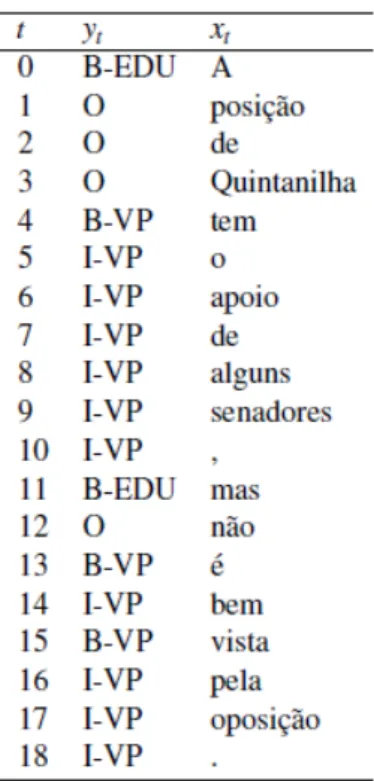
Rosenthal and McKeown [RM12] automatically determined whether a sentence is a claim us-ing logistic regression. They used lexical and sentiment-related features and achieved accuracies between 66% and 71%. Park and Cardie [PC14] classified propositions in user comments into three classes (verifiable experiential, verifiable non-experiential and unverifiable) using SVM and reached 0.69 macro F1-score. Goudaset al. [GLPK14] identified premises in Greek social me-dia texts using a two-step approach. In the first step, they classified each sentence as “sentence containing arguments" and “sentence that don’t contain arguments" (argumentative sentence de-tection). In the second step, they try to identify the exact fragments that contain the premises. They represented each argumentative sentence usingBIO encoding. TheBIOencoding seeks to classify each token with a single tag from the following set:
• “B-X" represents the begin of a segment of type X. It must be applied on the first token of a segment;
• “I-X" represents a token as being inside a segment of type X. It must be applied on any token inside a segment, except the first and last ones;
• “O" represents a token as being outside a segment. It must be applied on any token that is not contained inside a segment.
Utilizing conditional random fields as sequential model, they achieved 0.42 F1-score for iden-tification of premises. Boltuži´c and Snajder [Bn15] employed hierarchical clustering to cluster arguments in online debates using embeddings projection, performing intrinsic evaluation of the clusters. Rooneyet al. [RWB12] classified sentences into four categories (conclusion, premise, conclusion-premise and none) achieving 0.65 of accuracy. They worked with the Araucaria cor-pus and they assume the text is already segmented into argument components. Stab and Gurevych [SG14] classified argument components into four categories (premise, claim, major claim, non-argumentative) using SVM and, achieved 0.73 macro F1-score. Also, they classified argument relations (support and attack) reaching 0.72 macro F1-score. They worked in a dataset of persua-sive essays.
Reed and Lawrence, in [LR15], demonstrated that combining different techniques can lead to significant increases in performance for the task of argumentation mining comparing to the per-formance of any individual technique. These results contrast with some other areas of text mining and machine learning where combining different techniques is either not possible or else yields
State-of-the-Art in Argumentation Mining
only marginal improvements. First, they explored individually three different techniques that have been applied to this problem and drawn some conclusions from the analysis of their performances. The techniques explored were supervised machine learning using argumentation schemes, topic modeling and purely linguistic methods. From the strengths and weaknesses observed for each technique, they conceived an algorithm that combined each of the techniques previously men-tioned. They achieved F1-score of 0.83 for determining connections between propositions and reported results that are very close to a manual analysis of the same text. The results are based on correctly identified connections when compared to the manual analysis. Notice that these results were obtained considering the task of determining the argumentative structure from a piece of text which has already been split into its component propositions.
Then, in the same work [LR15], Reed and Lawrence addressed the subtask of identification of theADUsusing a technique calledPropositional Boundary Learning[LRA+14]. This technique uses two naïve Bayes classifiers, one of them to determine the first word of a proposition and, the other, to determine the last word. First, the original text is split into words. After, a list of features is calculated for each word. The detailed list of features used can be found in [LR15]. Then, the classifiers are trained using a set of manually annotated training data. Using this method they reported a 32% increase in accuracy over simply segmenting the text into sentences, when compared to argumentative components identified by a manual analysis process.
In order to be able to learn, supervised machine learning algorithms need a considerable amount of labeled data. However, annotating arguments in discourse is costly, error-prone and re-quires some training or basic knowledge of argumentation concepts. Therefore, it is very difficult to get an annotated corpora with a sufficient number of annotations to train supervised machine learning algorithms. This is one of the biggest challenges that the argumentation mining com-munity faces currently. Another problem reported by several researchers is that the models are domain dependent. Since some of the features used in current state-of-the-art implementations are based on lexical information (such as keywords, cue phrases, word couples, etc) and the corpora used to train the algorithms are domain specific, the models are unable to generalize well for texts from other domains. To overcome this problem, semi-supervised machine learning algorithms can be applied to gain more information by exploring unlabeled datasets.
Next, we will present the state-of-the-art using semi-supervised learning algorithms for argu-mentation mining.
2.4.2 Semi-Supervised Learning
Semi-supervised falls between unsupervised learning (without labeled training examples) and su-pervised learning (with labeled training examples). In this case, some of the training examples are labeled and others are not labeled. Using semi-supervised learning methods we are able to make use of this additional unlabeled data to better generalize the models to unseen data.
State-of-the-Art in Argumentation Mining
Habernal and Gurevych, in [HG15], studied whether leveraging unlabeled data in a semi-supervised manner can boost the performance of argument component identification and to which extent is the approach independent of domain and register. This corresponds to one of the first works attempting to explore the semi-supervised machine learning paradigm in argumentation mining.
The argumentation model used was a variation of the Toulmin model presented in Section2.2. There are five different components in this model: claim, premise, backing, rebuttal and refutation. Relations between argument components are implicitly encoded in the model. They approach the task of identification of the ADUs as a sequence tagging problem and employ SV Mhmm. They represent the original text usingBIO encoding. Therefore, each token is labeled with one of the 11 possible labels (5 types of argument components * (B or I tag) + one O tag).
They proposed novel features that exploit clustering of unlabeled data from debate portals based on a word embeddings representation.
They divided the feature set into what they call baseline features and unsupervised features. The baseline features are features typically used in the supervised machine learning methods: Lexical baseline (FS0), structural and syntactic features (FS1), sentiment and topic features (FS2), semantic and discourse features (FS3). They enrich the previously mentioned set of features with “unsupervised features”, obtained from external large unlabeled resources. They assume that the posts from unlabeled debate portals contain valuable information that will help classifying argu-ments in labeled data. In order to do so, they employ clustering based on latent semantics, which they formalize as argument space features (FS4). They take data from the debate portals, project them into a latent space using word embeddings and cluster them. They observed that vectors belonging to the same cluster in the latent vector space exhibit some interesting properties, such as semantic similarity. Then, they project each sentence in the labeled data to the latent vector space, compute its distance vector to all cluster centroids, and encode this distance vector directly as real-valued features. Therefore, each sentence can be labeled as belonging to each cluster with a certain weight.
Using this method they significantly improved the performance on the task ofADUtype classi-fication and outperform some state-of-the-art baselines. While the performance of the argumenta-tion mining system decreased in cross-validaargumenta-tion scenario, they gained almost 100% improvement in cross-domain and cross-register settings (different type of data such as news articles, forum posts, blogs, amongst others).
2.5
Argumentation Tools
In this section, some state-of-the-art tools for argumentation will be presented.
OVA(Online Visualization of Argument)1 is a browser based tool developed byARG-tech: Center for Argument Technology 2 that is hosted at the University of Dundee that supports the
1http://ova.computing.dundee.ac.uk 2http://www.arg-tech.org/
State-of-the-Art in Argumentation Mining
visualization and analysis of arguments from text in a web interface and follows the most recent standards on representation of arguments. This tool provides a drag-and-drop interface to ana-lyze arguments from text and visualize the corresponding argument diagram in a user-friendly and intuitive way. We can save the resulting annotation (argument diagram that represents all the argu-ments contained in the text) in aJSONfile, where the information is structured according toAIF
(Argument Interchange Format). Also, we can save it directly intoAIFdb3.
AIFis a specification to represent the structure of arguments that was the result of an interna-tional effort to develop one specification that could allow the exchange of argumentation resources between different platforms and tools [CMM+06].
AIFdbis a database that allows the storage and retrieval ofAIFcompliant argument structures.
AIFdboffers some web services allowing the user to interact with the stored arguments. For in-stance, it offers a search interface to locate and visualize the arguments contained in the database. In addition, this resource is commonly used by researchers to store the annotations, and to make the annotations publicly available for other researchers in the community.
Other argument diagramming tools exist besideOVA, such asRationale4,Carneades5, iLo-gos6, amongst others. From our understanding,OVAis the most user-friendly and intuitive tool to annotate arguments from text, it allows to save the annotations in a standard format, is web based (the annotators do not have to download any specific software, they can do everything on the web) and, because the argumentation diagramming process is according to the argumentation theory that will be used in this thesis,OVAwas the argument diagramming tool chosen to integrate with the annotation platform of the ArgMine Framework, which we describe in Chapter3.
3http://www.aifdb.org
4http://www.reasoninglab.com/rationale/ 5http://carneades.github.io/
State-of-the-Art in Argumentation Mining
Chapter 3
ArgMine Framework
This chapter presents theArgMine Framework, which aims to integrate the process of creating an annotated corpus with arguments and the semi-automated process of selection and experimentation of different models and relevant features in different steps of the argumentation mining process.
Typical approaches to argumentation mining follow the supervised machine learning paradigm, in which a set of labeled data (corpus) is necessary in order to build a model that learns how to map inputs to the desired outputs. For the task of argumentation mining, the inputs are natural language texts, and the outputs are argument diagrams, which represent the structure of the ar-guments contained within the text. In this thesis, we aim to study argumentation mining applied to texts written in the Portuguese language. Therefore, a corpus containing texts annotated with arguments in the Portuguese language is required. However, to the best of our knowledge, no such corpus exists. Thus, we have created an annotation platform, in which the creation of an annotated corpus with arguments from texts written in the Portuguese language is taking place. A detailed description of this annotation platform can be found in Section3.1.
As described in Section2.3, the argumentation mining process can be divided in several sub-tasks. Each subtask is related to a specific problem in the whole argumentation mining process and, the creation of models that can be used to automatically execute each of the subtasks may require the exploration of different machine learning and natural language methods. Besides the differences between each of the subtasks, all of them have to be integrated with the annotation platform, from which the data that will be used to train the machine learning algorithms is gen-erated. Both processes, the creation of an annotated corpus and the creation of models to address some of the subtasks of the argumentation mining process, are in a initial stage and being de-veloped simultaneously, which poses several challenges. One of the main challenges is given by the fact that at the moment that this document was written there was no available corpus contain-ing text documents written in Portuguese and annotated with arguments, which has the followcontain-ing characteristics: stability and inclusion of high quantity and quality of annotations. In the ArgMine corpus, which will be described in Section 3.2, the number of available annotations is low,
al-ArgMine Framework
though increasing over time. Moreover, the quality of the available data may also be changing over time. Since the number of available annotations is low, it is necessary to continually update the dataset used by machine learning algorithms in order to increase the number of examples from which they can learn in a manner that is useful to address a specific task. In this dynamic scenario, some of the assumptions made when creating the models or even what the models learned from the previous version of the dataset, can be not valid for an updated version of the dataset. For this reason, different methods may be required and new experimentations need to be run. In this way, the semi-automation of the process of experimentation can be helpful in the development of models for each of the subtasks in the argumentation mining process.
For these reasons, the ArgMine Framework was created. This framework aims to integrate the creation of a corpus containing news articles annotated with arguments in the Portuguese language and the semi-automated process of selection and experimentation of different models and relevant features for different steps in the argumentation mining process [RCT16].
The main guideline followed for the implementation of the ArgMine Framework was that it should be modular and easy to adapt for different tasks in the argumentation mining process. It should be modular in order to allow experimentation of some components of the framework main-taining the remaining components unchanged. This is particularly important when dealing with a changing corpus and when we aim to understand the influence of some components in the system. In future work, we expect to integrate all the models obtained after addressing each subtask of the argumentation mining process, to automatically identify and extract the arguments contained in texts written in the Portuguese language. In this sense, we aim to continually use this framework when addressing each of the subtasks mentioned in Section2.3.
The main programming language chosen for the implementation of the framework wasPython
due to the following reasons:
• this programming language has been widely used by the natural language processing com-munity and, therefore, some useful linguistic resources are publicly available;
• useful tools to work with machine learning algorithms and techniques are available, such as,
scikit-learn[PVG+11],NumPy,SciPy,matplotlib,CRFsuite, amongst others;
• Python is relatively easy to work with text documents,HTML,XMLandJSONfiles, which are useful to process some of the resources that have to be used in this framework.
To implement the annotation platform, the following programming languages were also used:
SQLite,HTML,CSS,PHPandJavaScript.
In terms of architectural pattern, the framework follows thePipes and Filterspattern, in which a sequence of processing components (Pipes), each performing a specific function, are connected by channels (Filters). Each component receives the data in a specific format from the previous component in the pipeline, transforms it according to its specific function and outputs the resulting data to be processed by the next component in the pipeline.
Designing the framework following the Pipes and Filters architectural pattern has the following advantages:
ArgMine Framework
• captures the natural process of a software implementation that performs natural language processing and uses machine learning algorithms. The process is typically characterized by a set of transformations that are made to the original natural language text in order to trans-form it into a set of representative features suitable as input for machine learning algorithms and techniques;
• allows the reuse of some components that are common to different steps in the argumenta-tion mining process, facilitating the integraargumenta-tion and adaptaargumenta-tion between different subtasks of the argumentation mining process. For instance, the integration of theArgMine corpus
with theData Preparationcomponent in theMachine Learning Module;
• allows the easy integration and experimentation of different methods in each of the compo-nents of the framework, without requiring changes in other compocompo-nents.
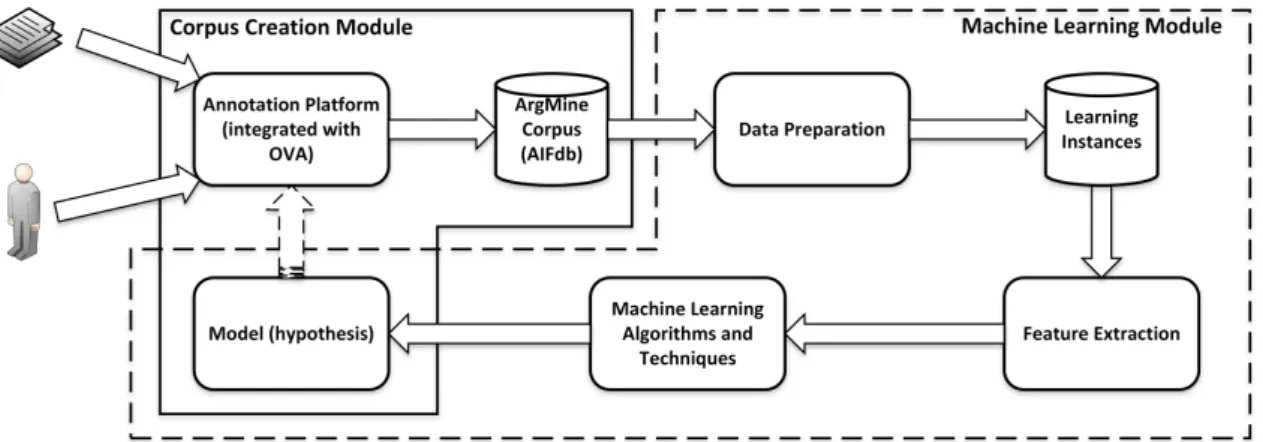
The ArgMine Framework is composed by a set of components depicted in Figure 3.1. We can divide the complete set of components in two high-level modules:
• Corpus Creation Module: set of components related to the creation of an annotated corpus with arguments from Portuguese news articles;
• Machine Learning Module: set of components related to the natural language processing and machine learning process.
Figure 3.1: ArgMine Framework general architecture. The full-line area delimits the Corpus Creation Module, while the dashed-line area delimits the Machine Learning Module.
In the following sections, each component of the ArgMine Framework is described. Section3.1is dedicated to the description of theAnnotation Platform componentand Section3.2to the descrip-tion of theArgMine Corpus, both from theCorpus Creation Module. In Section3.3a description of theMachine Learning Module is presented. Finally, Section3.4 describes the integration of the models created to address some of the subtasks of the argumentation mining process in the
ArgMine Framework
3.1
Annotation Platform
Supervised machine learning algorithms need a set of labeled data (corpus) in order to build a model that learns how to map inputs to the desired outputs. For the task of argumentation mining, the inputs are natural language texts written in Portuguese and the desired outputs are argument diagrams corresponding to the structure of the arguments contained within the text.
To the best of our knowledge, an available corpora satisfying the requirements previously de-scribed does not exist. Since these annotations are required in order to apply supervised machine learning algorithms, we started to gather annotations from human annotators. The outputs of these annotations are argument diagrams, which are graph structures. In order to facilitate the process of annotation an intuitive tool to represent such argument diagrams is required. Thus, we have cre-ated an online and publicly available platform1where annotators can access news articles written in Portuguese and, in an intuitive way, identify and annotate the arguments presented in the text in the form of argument diagrams. In this annotation platform, it is also possible to find educational material that was built with the purpose of presenting valuable information to the annotators about the topic, explaining how to use the platform and to give some tips about argument diagramming, as shown in Figure3.2.
Figure 3.2: “Anotar Argumentos" section of the Annotation Platform, in which some information related to the annotation process is available.
In order to build this platform, we performed a study of the current state-of-the-art on argu-mentation tools that could be useful for this task, as described in Section2.5.
From all the tools analyzed, we decided to integrate the annotation platform with two external
1https://web.fe.up.pt/~ei11124/argmine/
ArgMine Framework
tools, namelyOVA[JLR14] andAIFdb[LR14]. The main advantages to use these tools are the following:
• the annotation process can be performed completely online (which avoids local installations and software setups that could difficult the annotation process);
• OVAinterface allows an intuitive annotation of arguments from text (using a drag-and-drop interface);
• OVAoffers the possibility to save the resulting annotation in theAIF standard and to save these annotations in theAIFdb;
• AIFdboffers web services that allows us to search and visualize the collection of annota-tions;
• both tools have been widely used and are well recognized in the argumentation mining community.
In the annotation platform, each annotator can find a collection of news articles, namely opinion articles. The news articles were provided bySAPO Labs2. From the different types and sources of news provided bySAPO Labswe focused on opinion articles. An opinion article is an article, published in a newspaper, that reflects the author’s opinion about a specific subject. One of the advantages to work with this type of news articles, in relation to other types of articles, is the richer argumentative content that is typically presented in an opinion article text. On the other hand, one of the disadvantages is the fact that authors tend to use refined vocabulary which can make the in-terpretation of the text more challenging. In addition, different authors tend to use different writing styles which creates some variability in the analyzed texts, and in turn complicates the task to the machine learning algorithms. Another typical characteristic of opinion articles is the length of the articles, which are typically longer comparing to other types of news articles. Since the length of text can increase the time consumed in the annotation of each opinion article, we decided to present the opinion articles segmented by paragraphs in order to reduce the complexity of the task. This means that each article is divided in several parts (by paragraph) and each part is presented as a different annotation document to the annotator. This decision can have some drawbacks: when the argument is spread in several paragraphs, it is impossible to annotate it because each part of the argument will be presented in different documents; moreover, in some situations it can happen that some information in the remaining parts of the document could be useful and/or necessary to detect the arguments presented in one of the parts of the document. In the first case, we as-sume that this situation will not occur too often. A paragraph corresponds to a distinct section in a document, usually dealing with a single theme and terminated by a new line. Since arguments have to be about some topic and changes in topic can indicate that different arguments are being expressed, as explored in [LR15], then this assumption seems reasonable. However, in some sit-uations, arguments can in fact be spread in several paragraphs. Typically, in these sitsit-uations, the
ArgMine Framework
arguments that are being presented require complex reasoning and knowledge about the world, since they lack of lexical and syntactic cues (because the parts of each argument are not presented in a contiguous sequence). This kind of arguments are very difficult to address. Since, in this thesis, we assume that argumentative discourse units occur in a contiguous sequence, this kind of arguments are out of scope for the models that we aim to build at this moment. In the second case, negative consequences of this decision were already experienced during the development of this thesis. In these situations some information contained in other paragraphs of the news article are essential or, at least, helpful to the understanding of the arguments in a specific paragraph. For instance, pronouns that are presented in the current paragraph which mention some entity referred in other paragraph in the same news article. Not knowing the entity that the pronoun is referring to, can make the detection and identification of the arguments contained in the paragraph more difficult and/or ambiguous.
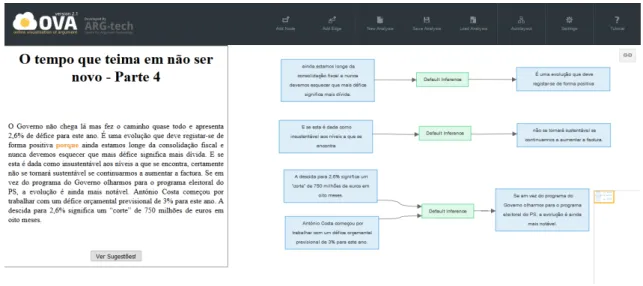
Figure 3.3: Opinion article annotated with arguments
In the annotation platform, after selecting a particular news article, the annotator is redirected to the OVAinterface, as shown in Figure3.3. In the left side of the OVAinterface, the selected news article is presented. As explained in Section2.5, the drag-and-drop interface ofOVAallows users to select a piece of text presented in the left side of the interface (drag) and, after clicking the interface in the right side, the selected text will be inserted in a rectangular figure (representing a node in the argument diagram) on the right side of the interface (drop). In order to complete the annotation, the interface allows the annotator to connect nodes with arrows, which can be used to indicate relations of support or conflict between two nodes. When the annotation of the argu-ments contained within the text is completed, the annotator can save the corresponding argument diagram inAIFdb. We created a corpus in theAIFdbdatabase, theArgMine Corpus3, in which all the annotations obtained from the annotation platform are being collected. Storing the annotations
3http://www.arg.dundee.ac.uk/aif-corpora/ArgMine
![Figure 2.2: Freeman’s approach to convergent (left) and linked (right) arguments, [Fre91]](https://thumb-us.123doks.com/thumbv2/123dok_us/9024641.2800331/31.892.206.735.119.306/figure-freeman-approach-convergent-left-linked-right-arguments.webp)
![Figure 4.6: Graphical structure of linear chain CRF for sequences. An open circle indicates that the variable is not generated by the model [LMP01]](https://thumb-us.123doks.com/thumbv2/123dok_us/9024641.2800331/69.892.369.589.447.579/figure-graphical-structure-linear-sequences-indicates-variable-generated.webp)