Service
Mining
Framework and
Application
Wei-Lun Chang
Quantitative Approaches
to Decision Making Collection
Donald N. Stengel,
Editor
www.businessexpertpress.com
SER
VICE MINING
Service Mining
Framework and Application
Wei-Lun Chang
The shifting focus of service from the 1980s to 2000s has proved that IT not only lowers the cost of service but creates avenues to enhance and increase revenue through service. The new type of service, e-service, is mobile, flexible, interactive, and interchangeable. While service science provides an avenue for future service researches, the specific research areas from the IT perspective still need to be elaborated.
This book introduces a novel concept—service mining—to address several research areas from technology, model, management, and application perspectives. Service mining is defined as “a sys-tematical process including service discovery, ser-vice experience, serser-vice recovery, and serser-vice reten-tion to discover unique patterns and excepreten-tional values within the existing services.”
The goal of service mining is similar to data min-ing, text minmin-ing, or web minmin-ing, and aims to “detect something new” from the service pool. The major difference is the feature of service is quite distinct from the mining target, like data or text. In other words, service is a process of value co-creation and difference by various perceptions of customers. In the concept of service mining, the mining target is not only the traditional services but also IT-based services.
This book devises concepts of service mining and identifies the possible applications. The author pro-vides a roadmap of service mining to researchers, managers, and marketers in service sectors.
Wei-Lun Chang is an Associate Professor in the De-partment of Business Administration in Tamkang University. His interests include service science, CRM, and IT applications in management. He also publishes papers in several international journals, including CACM, Journal of Information Science, Knowledge-Based Systems, and Journal of Computer Information Systems.
www.businessexpertpress.com
Quantitative Approaches to Decision Making Collection
Donald N. Stengel, Editor
For further information, a free trial, or to order, contact:
[email protected] www.businessexpertpress.com/librarians
THE BUSINESS
EXPERT PRESS
DIGITAL LIBRARIES
EBOOKS FOR BUSINESS STUDENTS Curriculum-oriented, born-digital books for advanced business students, written by academic thought leaders who translate real-world business experience into course readings and reference materials for students expecting to tackle management and leadership challenges during their professional careers. POLICIES BUILT BY LIBRARIANS • Unlimited simultaneous usage • Unrestricted downloading and printing• Perpetual access for a one-time fee
• No platform or maintenance fees • Free MARC records • No license to execute
The Digital Libraries are a comprehensive, cost-effective way to deliver practical treatments of important business issues to every student and faculty member.
Service Mining
Framework and Application
Copyright © Business Expert Press, LLC, 2014.
All rights reserved. No part of this publication may be reproduced, stored in a retrieval system, or transmitted in any form or by any means—electronic, mechanical, photocopy, recording, or any other except for brief quotations, not to exceed 400 words, without the prior permission of the publisher.
First published in 2014 by Business Expert Press, LLC
222 East 46th Street, New York, NY 10017 www.businessexpertpress.com
ISBN-13: 978-1-60649-574-2 (paperback) ISBN-13: 978-1-60649-575-9 (e-book)
Business Expert Press Quantitative Approaches to Decision Making Collection
Collection ISSN: 2163-9515 (print) Collection ISSN: 2163-9582 (electronic)
Cover and interior design by Exeter Premedia Services Private Ltd., Chennai, India
First edition: 2014 10 9 8 7 6 5 4 3 2 1
The shifting focus of service from the 1980s to 2000s has proved that IT not only lowers the cost of service but creates avenues to enhance rev-enue through service. In particular, companies increase revrev-enue through IT-based services. The new type of service, e-service, has several features such as being mobile, flexible, interactive, and interchangeable. Addi-tionally, e-services have much to offer in terms of overcoming obstacles faced by a traditional services industry. The concept of service science, which was proposed by IBM, combines several issues into traditional ser-vice management, such as the disciplines of technology and engineering. While service science provides an avenue for future service researches, the specific research areas from the IT perspective still needs to be elabo-rated. This book introduces a novel concept, service mining, to address several research areas from the viewpoints of technology, model, man-agement, and application. Service mining is defined as “a systematical process including service discovery, experience, recovery, and retention to discover unique patterns and exceptional values within the existing services.” The goal of service mining is similar to data mining, text min-ing, or web mining—it aims to “detect something new” from the service pool. The major difference is the feature of service is quite distinct in its mining target such as data or text. In other words, service is a process of value co-creation and difference in the perception of various customers. In the concept of service mining, the target is not only the traditional services but also IT-based services. Service mining is a branch under the big umbrella of service science. The goals of this book are to devise vari-ous concepts of service mining and to identify different possible appli-cations. The contribution is to furnish a roadmap of service mining to researchers, managers, and marketers in service sectors.
Keywords
service mining, service cooperation, service branding, service idealism, pricing, value network
Contents
Introduction ������������������������������������������������������������������������������������������ix
Chapter 1 Framework and Opportunities of Service Mining ...1
Chapter 2 Mining Customer Value on Services ...13
Chapter 3 Mining the Price of Service ...23
Chapter 4 Mining Cooperation of Services...31
Chapter 5 Mining Services in Customer Relationship Management ...41
Chapter 6 Discovering Service Failure and Recovery ...55
Chapter 7 Mining Service Brands ...67
Chapter 8 Toward Service Idealism ...77
Conclusion �������������������������������������������������������������������������������������������89
Notes����������������������������������������������������������������������������������������������������91
References ���������������������������������������������������������������������������������������������95
Introduction
Service industry currently dominates the contribution to GDP for most countries. The focus has shifted from manufacturing to service. Many companies attempted to explore the services sector and as a result many innovative services emerged in the past decade. Therefore, delving deeper to look at services is important to companies. Traditional service market-ing and service science attempted to help companies understand what customers think and how companies dealt with problems. However, a holistic framework and viewpoint to explore services differently is needed. Service mining provides a different perspective into the services industry. Professionals and practitioners also need various mindsets to investigate and analyze the evidence from services. According to the concept of service science, certain areas are involved such as economics, management, computer science, and engineering. This book provides a novel concept to combine the areas of social science and computer science in services. Service mining is a holistic concept covering a service's lifecycle from design, experience, recover to retain. Traditionally, the value of mining is to discover unknown and potential patterns from big data. Service min-ing focuses on the amount of data generated from the value co- creation process and features of services. The goal of service mining is to ana-lyze any step in the service's lifecycle and help enterprises reexamine each one. Companies can also utilize appropriate marketing or management methods to adjust biases and revise the errors of services. This book covers various issues of service mining in eight chapters. Chapter 1 introduces the concept and framework of service mining, which may give readers a holistic view of service mining. In academics or practice, service mining has many opportunities for further investigation. Chapter 2 introduces a new perspective to the discussion of customer value on electronic services. Different from a conventional accounting perspective, a new customer value model is needed to understand what the value of a customer is again. Chapter 3 discusses the pricing model for electronic services. Compared to existing pricing methods, customer-perceived value-based
pricing model is the new trend in service pricing. Particularly, service is different from customers and companies can use dynamic pricing concept to earn more profit based on customer perceptions. Chapter 4 discusses the importance of service cooperation. Services can cooperate based on the same value and vision. A new perspective from a customer's viewpoint is proposed in this chapter. Chapter 5 introduces the prediction of elec-tronic services in customer relationship management. Although customer behavior is difficult to capture and predict, the pattern still exists and is valuable for further investigation. Chapter 6 uses a new notion called sys-tem dynamics to look at the service failure and recovery. Syssys-tem dynamics provides a way to simulate the policy in a long-term period. Companies can track and understand what would occur if they adjust services and benefit in the long run. Chapter 7 mentions the issue of service brand-ing. In this chapter, the customers apparel is the key factor to build the service brand image. Traditionally, a brand image is delivered by a com-pany based on vision and mission. Service mining provides a different perspective to explore what a service brand looks like based on customer viewpoint. Chapter 8 provides a new mindset when looking for the ideal services, which is service idealism. In this chapter, customer viewpoint is the basis to construct the elements of an ideal service. Readers can have a comprehensive knowledge and the basic framework of service mining. In this book, the selected areas of service mining come from various perspec-tives, which are also the potential and hot topics by far. Such areas enfold different stakeholders for service mining, including customers (Chapters 2, 3, and 5) as well as service providers (Chapters 3, 4, 5, 6, 7, and 8). Except for the phase of design in the service lifecycle, Chapters 2 to 8 synthesizes the concepts of four phases. For example, discovery (Chapters 2, 5, and 8), experience (Chapters 3, 4, 6, and 8), recovery (Chapter 6), retention/loyalty (Chapter 5). By examining different issues, readers can understand the potential development of service mining and obtain new applications in service industry. With this book, readers can have a new mindset to experience services. Companies can also reconsider the prob-lems in services by matching the service lifecycle. Different mining meth-ods can also be used to diagnose and analyze the real problems in design, experience, and failure. Surely, good services will also be discovered to retain for more profit. In summary, this book not only provides a new
mindset for researchers but also furnishes certain applications for firms to reexamine the services. Professionals and practitioners can look into services from different viewpoints and use different methods for analysis based on the concept of service mining. Additionally, new issues may be explored, based on the provided topics and applications, to construct a more comprehensive skeleton of service mining in the future.
Framework and
Opportunities of Service
Mining
The evolution of services from the 1980s to 2000s has proved that infor-mation technology (IT) not only lowers the cost of service but also creates avenues to enhance revenue through services.1 Companies now increase their revenue through IT-based services and they face marketing chal-lenges for e-service through different channels.2 The new type of services (IT-enabled) and e-services have several features, such as being mobile, flexible, interactive, and interchangeable.3 E-services provide a viable alter-native for overcoming obstacles faced by traditional services industry. The essential change in the way services are delivered also forces companies to innovate, design, and deliver services through new channels.
Service science is a novel concept that offers a new paradigm for the future of service industry. The concept of service science was proposed by IBM, which solves several issues in traditional service management using technology and engineering.4 For example, the focus of call centers has been shifted from collaborate to automate with IT assistance over the last decades (Figure 1.1). The paradigm of service has undergone a trans-formation from the traditional services industry to an IT-based services industry. FedEx presents an excellent example of a switch to e-services, which includes self-service, customization, search engine, flexibility, and automatic response.5 Google is another great example of a global enter-prise providing IT-based services (i.e., e-services) in the new paradigm.6 Information technology helps automate services to allow more interac-tions between service providers and customers. Such interacinterac-tions result in increasing the significance of value co-creation for both sides.
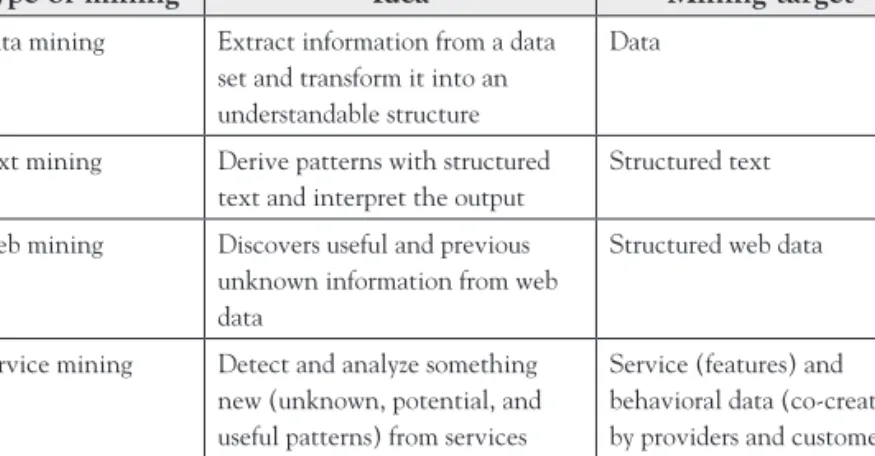
The history of mining techniques starts from 1990s. The first concept to appear was data mining, which aims to extract information from a dataset and transform it into an understandable structure for future use. After data mining, researchers and practitioners extended to text and web mining. Text mining, the second mining concept to be described, aims to derive patterns in a structured text and interpret the output accordingly. The third concept, web mining, discovers useful and previous unknown information from web data. While the mining techniques still exist, a new paradigm of mining from services perspective needs to be explored and investigated.
The concept of service science encompasses several areas such as design, marketing, computer science, system engineering, economics and law, and operations. This book provides perspectives from computer science and marketing as a holistic viewpoint by injecting traditional data mining mindset. Hence, this book proposes a novel concept, service mining, to cover several aspects from the viewpoints of technology, model, manage-ment, and application. Service mining is defined as “a systematical process including service discovery, service experience, service recovery and ser-vice retention to discover unique patterns and exceptional values within the existing services.” The goal of service mining, which is similar to data mining, text mining, or web mining, is to “detect and analyze something new (unknown, potential, and useful patterns)” from services (Table 1.1). The major difference is the “feature of service,” which is quite distinct from mining targets such as data or text. Data and text are generated pas-sively but service is a collaborative activity. Service is a process of value co-creation and differentiation using various perceptions of the customer.
According to the roadmap of service science, management, and engineering (SSME), service mining emphasizes on “systems that focus on flows of things” and “systems that support people’s activities.” Ser-vice mining focuses on stakeholders (e.g., providers and customers) and
Collaborate (1970) Augment (1980) Delegate (2000) Automate (2010)
Figure 1.1 Example of changes of service paradigm
resources (e.g., people, technology, and information). Service mining assists in observing and analyzing the behaviors of stakeholders as well as in resources allocation. This book expects to add the value of service min-ing to business and society, particularly, contributmin-ing to service industry.
Service mining focuses on two types of mining targets: feature of ser-vice and the combined behavioral data of providers and customers. Feature of service means the various elements of service such as service alliance, cooperation, and competition from the provider perspective. Behavioral data is most likely the same as data mining in the traditional sense. How-ever, the difference is service data takes into account more interactive behavior whereas traditional mining data focuses on fixed behavior. For example, customers exhibit different attitude or behavior toward differ-ent service providers, resulting in dynamic service data. Service mining not only covers the area of traditional services but also IT-based services. Under the big umbrella of service science, service mining is considered as a new branch and extension of data mining application.
Service Mining Basis: Service Lifecycle
Figure 1.2 demonstrates a process of service lifecycle, including design, experience, recovery, and retention/loyalty. Service lifecycle synthe-sizes and derives the idea from service blueprinting.7 Service design and discovery is more technology-oriented and service recovery and Table 1.1 Comparison of different mining approaches
Type of mining Idea Mining target
Data mining Extract information from a data
set and transform it into an understandable structure
Data
text mining Derive patterns with structured
text and interpret the output
Structured text
web mining Discovers useful and previous
unknown information from web data
Structured web data
Service mining Detect and analyze something
new (unknown, potential, and useful patterns) from services
Service (features) and behavioral data (co-created by providers and customers)
retention/loyalty are more management oriented. Particularly, service experience includes both these orientations:
• Service design
The purpose of this phase is to use design thinking concept to come up with innovative services. Experts from design, technology, management, and art areas can work together to simulate what how services need to be defined. Service design is the beginning phase of service lifecycle and necessary for following processes.
• Service discovery
The purpose of this phase is to discover potential services for customers from existing services. Service discovery also aims to explore service products in the market. Traditionally, web service is a hot topic in this category. However, web service is designed for machine-to-machine cooperation that mainly relies on technology. Other than web services, traditional services or IT-enabled services are the main focus in this phase. • Service experience
This phase facilitates the engineering and delivery of service. Service experience emphasizes on “how to provide appropriate services to right customers” by collaboration. The reason to use “appropriate” is that service is different for different customers by perception. It is difficult to justify “right services” in general. The ultimate goal is to collaborate with customers to co-create service value.
Discovery Experience Recovery Retention/loyalty Failed Succeed Design Services
Management oriented issue Technology oriented issue
• Service recovery
In this phase, service recovery mostly focuses on how to recover services when a service fails. Customers may be dissat-isfied with companies if the recovery process does not happen on time. Customer complaints also occur at this moment. The goal is to provide in-time services to recover failure and adjust the mistakes made. Generally, service recovery is extremely important for enterprises to maintain customer satisfaction and loyalty.
• Service retention and loyalty
The last phase of service lifecycle is service retention and loy-alty. Service retention/loyalty specifies retaining appropriate services for customers. Companies may provide many services; however, only a few services are appropriate and useful to customers. The goal of this phase is to recognize and retain helpful and proper services that may create profits for firms. Service mining covers the whole service lifecycle. Technology can be used to assist any phase in the lifecycle. Service retention and loyalty pro-vide the most valuable information in service lifecycle. This information will be passed to the service design phase to help companies design bet-ter services. Taking an example of a city tour service for a customer in Chicago, there are certain designed services (e.g., city segway tour, speed-boat, tastebud food tour, etc.). Customers have different preferences; therefore, discovering appropriate services that suit them is extremely important. Customer feedback and perception may be generated during the service experience. Spontaneous and instant responses can help adjust services for the tour guide. In addition, many companies ask customers to provide positive feedback and credit on TripAdvisor (e.g., city segway tour and tastebud food tour). After experiencing services, customers may rate the service as a success or a failure. If services failed, recovery is sig-nificant to reduce negative customer perception. The company can revise the service instantly. For example, a customer complained about why the raincoat needs $1 because the tour already charged $70, the city segway company instantly cancelled the policy and started to provide free raincoat and bottles of water. If services succeeded, keeping retention and loyalty
of services are needed. Some companies e-mailed coupons for next-time purchase or experience to keep customers (e.g., California Pizza Kitchen).
The concept of service lifecycle covers exploratory service to service maintenance, which also provides the opportunities to people in both IT and management to get involved in service mining.
A Conceptual Framework of Service Mining
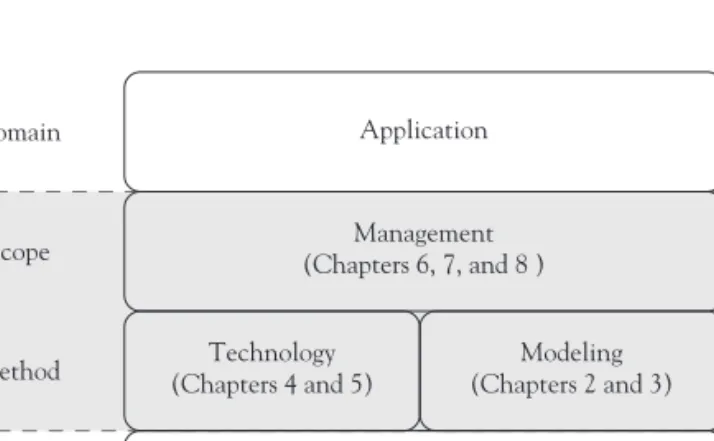
In addition to service lifecycle, a conceptual framework for service mining is also needed (Figure 1.3). From bottom to top, service mining covers five elements: infrastructure, technology, modeling, marketing/management, and application:
• Infrastructure
Infrastructure indicates the basic elements and covers the necessary software and hardware in the service lifecycle. The software and hardware can be tangible or intangible assets. Service mining is based on services furnished by required software and hardware (IT infrastructure).
• Technology
Technology indicates the techniques used to analyze for services in service mining, such as artificial intelligence or computer science. Examples of artificial intelligence include genetic algorithm, neural network, reinforcement learning,
Application Management (Chapters 6, 7, and 8 ) Infrastructure Technology (Chapters 4 and 5) Modeling (Chapters 2 and 3) Basis Method Scope Domain
fuzzy theory, and so on. Computer science techniques include algorithm, graphical method, petri net, and so forth. IT- oriented researches to solve service problems (e.g., service dis-covery and redis-covery) can be classified into this building block. • Modeling
Modeling includes the areas of statistics and operations research. Statistics includes quantitative methods to analyze services such as regression, SEM, and so on. Modeling also provides a different viewpoint of analytic tools such as the operations management or management science. Modeling the service problems is also a significant and novel issue for service mining, especially in the service domain. Mathematic models also enable companies to look in detail into the service problems.
• Management
Management is at the higher level of service mining frame-work, which takes into account management issues such as service alliance/cooperation, service branding, service pric-ing, service innovation, and so on. Traditional discipline of service management mostly investigates the issues of service quality, service failure/recovery, and satisfaction and loyalty of services. In the framework of service mining, the research/ practical areas need to go beyond conventional topics. In other words, more management topics such as economics, marketing, and strategy can be included in this level. • Application
Application specifies the domain of service mining, for exam-ple, social network services, IT-enabled services, or traditional services. Other sectors such as telecommunication, restau-rant, online service in e-commerce, airline, and so forth, can also make use of application. Service mining aims to solve service problems in a specific domain by combining different technologies or modeling methods.
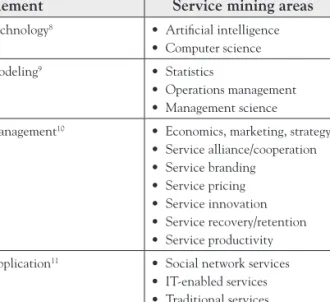
Table 1.2 synthesizes the elements, research areas of service mining, and relevant researches so far. The trends also reveal leading journals in
management information systems (MIS) or management fields to inves-tigate service issue for many years. In the level of method, technology and modeling are more technical and mathematical-oriented researches. In the level of scope, more management issues are involved. The focus of service mining is to cover these two levels predominantly. Under the big umbrella of service mining, either technical or managerial researches and practices is applicable.
Looking Back at the Trends
Figure 1.4 demonstrates the trend of service researches between 1990 and 2011 based on the collected data from ISI Web of Knowledge database. There are two key factors to separate service researches in that period are web service and service science. The first period is between 2000 and 2005. The concept of web service was proposed a decade ago. W3C defines a web service as “a software system designed to support interoperable machine-to-machine interaction over a network.” Web service research increased dramatically at 2000; in particular, the issue of service discovery was investigated for 5 years. The reason is web services create opportuni-ties for computer science researchers and help explore service researches
Table 1.2 Service mining elements
Element Service mining areas
technology8 • Artificial intelligence
• Computer science
Modeling9 • Statistics
• operations management • Management science
Management10 • Economics, marketing, strategy
• Service alliance/cooperation • Service branding • Service pricing • Service innovation • Service recovery/retention • Service productivity
Application11 • Social network services
• It-enabled services • traditional services
over the Internet. In the first period, the topics of service discovery, expe-rience, and recovery are popular since doing busines over the Internet for companies is well acceptable. However, service research got saturated by 2006. However, service discovery research decreased significantly from 2004 to 2006. Hence, service science provides another opportunity for service researches in the second period (2005 to 2011). The concept of service science, management, and engineering (SSME) was proposed by IBM. The idea is to bring different disciplines together to focus on the service domian.
The topic of web service is mostly investigated by computer sci-ence researchers and focuses on Internet service. Since the Internet has become popular and stablized, research of Internet services (web services) decreased. Instead, service science covers not only web services but also traditioanl services by including mutiple disciplines such as engineering, management, and computer science. Service mining aims to provide a new roadmap for service researchers in the coming years (after 2011). The opportunities for service mining research will be broader and deeper. Based on the topics of service discovery, experience, recovery, and reten-tion, researchers can investigate different levels of service research. For example, scholars can apply IT to solve service probems (e.g., technology, model, and management).
Figure 1.4 Number of service researches
Source: ISI Thomson. 0 1990 1992 1994 1996 1998 2000 2002 2004 2006 2008 2010 10 20 30 40 50 60 70 80 90 100 Service discovery Service experience Service recovery Service retention
Figure 1.5 illustrates the total number of service researches based on four topics for the past 20 years from the database of ISI web of knowl-edge. Service discovery is the most researched topic (530) and following by service experience (274), service recovery (216), and service retention/ loyalty (8). Since most researchers fully emphasized on how to explore online services and how to make them work (composition) at the begin-ning of Internet, service discovery is the leading topic that drew atten-tion in the first place. Once the services are explored and mature, service experience and recovery attracts researchers. The numbers in Figure 1.5 reveal that service retention/loyalty (merely 8 researches) still lacks much attention and may be the potential issue for service research in the future.
Looking Forward to the Future
This book proposes a novel research area, service mining, that differs from the notion of service science and provides a comprehensive framework for future researches. Service mining involves five elements: infrastructure, technology, model, management, and application. The iterative process of service mining includes service discovery, service experience, service recovery, and service retention. This book also addresses the research topics among five elements that combine technology and management
0 100 200 300 400 500 600 530 216 8 Service discovery Service experience Service recovery Service retention
274
Figure 1.5 Number of service research for four topics
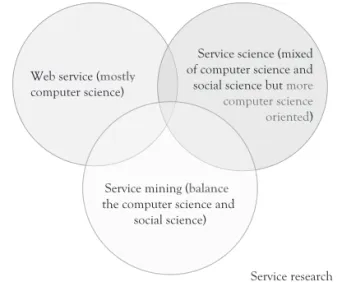
perspectives. Compared to web service and service science researches, service mining combines computer science and social science perspec-tives (Figure 1.6). In early researches on services, most researchers mainly focused on web services owing to the emergence of Internet. Service sci-ence combines different perspectives but is still dominated by computer science and engineering areas. Hence, service mining aims to provide a new viewpoint by encompassing computer science and social science equally to contribute to service industry.
According to the statistics of published opportunities, service discov-ery research is purely computer science oriented while service experience is half computer science and half social science. Meanwhile, pure social science envelopes service recovery and service retention researches. In other words, service mining proves that the combined processes cover two major disciplines and extend to minor subdisciplines such as service, business, and management.
Service mining covers beyond the existing service management and is considered as a branch of service science. Service mining is also different from data mining in the service domain. Based on the entities of service science, this book covers customers (Chapters 2, 5, 6, and 7), service
Web service (mostly
computer science)
Service science (mixed of computer science and social science but more computer science oriented)
Service mining (balance
the computer science and social science)
Service research
Figure 1.6 Difference between web service, service science, and service mining
providers (Chapters 3-6), partners (Chapter 4), and employees (Chapters 6 and 8). The concept of data mining focuses on data collected from ser-vice sectors. However, the concept of serser-vice mining not only investigates data from the service sector but also focuses on the features of services. Mining services is a different goal from mining derived data from services by interacting with human beings. Hence, the process and framework of service mining aims to help researchers from multiple disciplines identify potential opportunities under the umbrella of service research.
This book provides several perspectives on services by utilizing the concept of service mining. Chapter 2 introduces the estimation of cus-tomer value of electronic services based on the accounting perspective. Chapter 3 introduces how to price a service based on psychology and marketing perspectives. Chapter 4 introduces the cooperation of elec-tronic services based on value network concept. Chapter 5 introduces the prediction of customer demand on services by using artificial intelligence concepts. Chapter 6 introduces how customers perceive a service brand by optimization. Finally, Chapter 7 introduces the concept of service idealism from customers by prediction.
Mining Customer Value
on Services
This chapter introduces the way of predicting customer value on services from the accounting perspective. The method of prediction of customer value is through a modeling approach. This chapter covers the method (modeling), scope (service management), and domain (electronic ser-vices) as given in Figure 1.3. In this chapter, service mining is used to help enterprises estimate and predict the customer value on services.
Recently, companies have changed their focus from product-oriented approach within marketing (1960s) to demand-oriented approach within quality improvement (1980s) to an emphasis on customer services, cus-tomer loyalty, and cuscus-tomer profitability such that cuscus-tomers drive future strategies and are an important part of the assets of most companies. The benefits of customer loyalty and long-term relationships are no longer a matter of debate.
High customer value will result in superior customer satisfaction and impact customer loyalty.1 When customers are loyal to products or services, the benefit to the company is enormous. Moreover, enterprises operate more efficiently if they realize maximum value from the consum-ers and therefore retaining loyal customconsum-ers is the foundation of profit from either the cost or the revenue perspective; good customer relation-ships drive the survival of companies.
The significance of customer-centric services is undisputed. A frame-work for service design was proposed in terms of modeling, designing, and developing e-service systems.2 The proposed framework also fulfills (semi-)automated value coproduction between the service providers and the customers in a service. In addition, a great deal of research has inves-tigated the effect of customer lifetime value (CLV), but it has focused on
the lifetime value of existing customers only, and mostly has focused on physical products or services, rather than on e-services.
In this chapter, we propose a customer value (CV) model, a new model that combines customer and enterprise perspectives to predict customer value for the e-service industry.3 The CV model complements the existing CLV model by addressing customer value from a different perspective and provides clues to short-term customer value for e-service providers.
A New Customer Value Model for Services
We construct a prediction model for short-term customer value, which is also a type of deterministic model and defines e-services as the coverage of free or charged services over the Internet.4 In this chapter, we focus on B2C and C2C e-services, such as weather, stock, or auction e-services. The concept of our model is as follows:
Customer value Profit Time usage
= (2.1)
The concept is separated into two blocks: profit and time usage. Profit uses the variables of original profit and the ones that influence profit. The variable of original profit is the same concept as that of CLV, which estimates the value that customers can create for firms over the customers’ lifetimes. The additional variable of influence on profit takes into account both the customer and the enterprise perspectives. In the enterprise per-spective, we use reach rate as the primary indicator for advertisements over the Internet and portals (e.g., Yahoo), which may include free or paid e-services, because the reach rate is easy to collect for portals. In con-sidering the customer perspective, we take into account the effect of per-ceived quality for e-services—that is, the difference between expectation and perception—and consider time usage to be appropriate to access cost because of the characteristics of e-services. Hence, our model estimates the customer value per unit of time and is different from previous models that predict CLV per unit of cost.
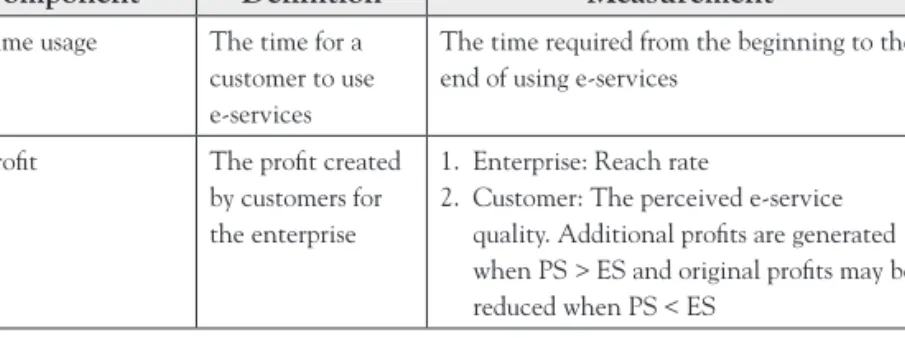
We define the variables in our model as shown in Eq. (2.1) and Table 2.1. Time usage indicates the time required for a customer to use
e-services, measured from the beginning to the end of a transaction. Profit denotes the net value of revenue that is generated by customers using e-services, measured by (1) reach rate of advertising (from the enterprise) and (2) perceived e-service quality (from the customer). Reach rate may result in extra benefits for the enterprise, and any gap between perceived quality and expected quality will impact the additional benefits; if the gap is negative, the additional benefits will decline and if the gap is positive, the additional benefits will increase. Hence, our model proposes that cus-tomer value is a function of reach rate and perceived quality per unit of time required to use the e-service. This concept differs from conventional measures of CLV, which take into account only the financial perspective.
Eq. (2.1) can be unfolded into Eq. (2.2), which extends time usage and profit to the customer and the enterprise perspective, respectively (Table 2.2), such that
CV NV PS ES TU = + + ( − )
∑
∑
1 W Ri m (2.2) where CV denotes the profit generated by a customer per unit of time, NV is the net value of revenue, R is the ratio of information that is deliv-ered to the customers (also known as reach rate), m indicates different types of media (e.g., Yahoo, MSN), W is the weight for each media, PS is the perceived value of e-service(s) for a customer, ES is the expected value of e-service(s) for a customer, and TU is the average time required for a customer to use e-service(s).Table 2.1 Definition of profit and time usage
Component Definition Measurement
time usage the time for a
customer to use e-services
the time required from the beginning to the end of using e-services
Profit the profit created
by customers for the enterprise
1. Enterprise: reach rate
2. Customer: the perceived e-service quality. Additional profits are generated when PS > ES and original profits may be reduced when PS < ES
T
able 2.2
Definition of all variables in the model
V
ariable
Customer value Net value of revenue
Reach rate Medium W eight Perception of service Expectation of service T ime usage Symbol CV NV R M W PS ES t U Definition t he profit
generated by a customer per unit of time
t
he net
income; the income minus cost
t
he rate of
information delivered to customers Different types of media
t
he weight for
each medium
t
he perceived
value of e-service(s) for a customer
t
he expected
value of e-service(s) for a customer
A
verage time
Customer Segmentation
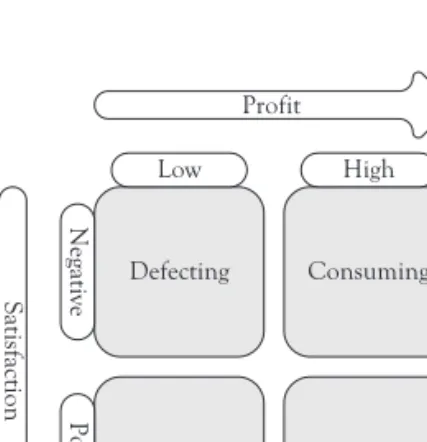
We segment customers based on profit (enterprise perspective) and sat-isfaction (customer perspective). Profit indicates the total revenue that customers generated in the past, which is also the concept of NV in our model. Satisfaction denotes the difference between perception and expec-tation, which is the difference between ES and PS in our model. We seg-ment four types of customers, based on high and low profit and positive and negative satisfaction (Figure 2.1): Defecting customers, consuming customers, potential customers, and best customers.
Best customers generate high profits and have positive satisfaction since positive satisfaction results in high loyalty and repeat purchases. For customers in this category, companies need to provide personal services in order to maintain customer loyalty and retain these valuable customers. Potential customers generate low profits but have positive satisfaction. Customers in this category are satisfied that the e-services they use meet their needs, and they have a good image of the company. Although the profit from these customers is low, companies have a significant oppor-tunity to increase profits from these customers, so the companies need to maintain positive satisfaction in order to increase the customers’ loy-alty and create more profits. Consuming customers generate high profits but have negative satisfaction. Customers in this category are at risk for attrition, so companies need to increase use time for these customers in
Defecting Consuming Potential Low High Satisfaction Best Profit Negative Positive
order to raise the satisfaction and loyalty and transfer the customers from the consuming type to the best type. Defecting customers generate low profits and have negative satisfaction. In this category, customers used the e-services for a short time and created limited profits. These are the most difficult customers—and perhaps the most costly to retain. If a company decides to invest in them, it should investigate the reasons for their dissat-isfaction, correct any shortcomings, and communicate those shortcom-ings to the customers in the hope that they will eventually become more satisfied and more profitable.
An Example of Simulation
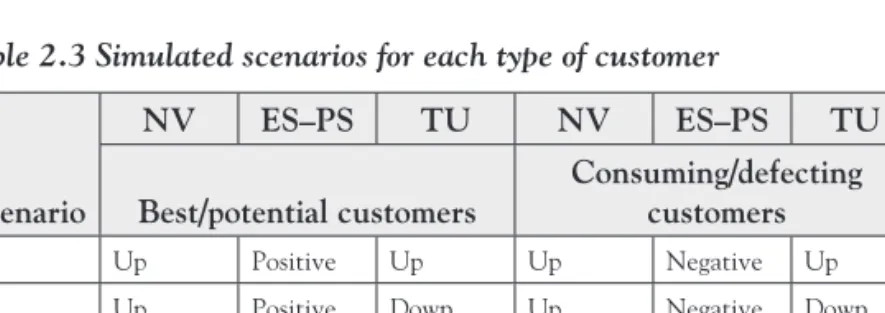
The real data is not easy and mostly needs a long time period to collect. This book simulated customer behavior based on real-world patterns. The simulated data is closer to what we are looking for and explainable in the model. We created four scenarios in terms of NV, TU, and ES–PS. Each of the four types of customer (best, potential, consuming, and defecting) is used to simulate four scenarios (Table 2.3). The simulated historical data (from past to present) for NV and TU trends gradually up in scenario I. The simulated historical data for NV trends gradually up, and TU trends gradually down in scenario II. The simulated historical data for NV trends gradually down and TU trends gradually up in sce-nario III. The simulated historical data for NV and TU both trend gradu-ally down in scenario IV. We also simulated positive differences for best/ potential customers and negative differences for consuming/defecting customers. Figure 2.2 illustrates the trend of historical data and predicted
Table 2.3 Simulated scenarios for each type of customer
Scenario
NV ES–PS TU NV ES–PS TU
Best/potential customers Consuming/defecting customers
I Up Positive Up Up Negative Up
II Up Positive Down Up Negative Down
III Down Positive Up Down Negative Up
customer value, which is reversed in the predicting process. That is, if the trend for historical data is down (up), the trend for predicted CV will be up (down).
The simulated results (Figure 2.3) reveal that the best result is sce-nario II and the worst result is scesce-nario III, while scesce-narios I and IV give similar results. The estimated percentage of the distribution of customer value for each type is 48% for scenario II, 21% for scenarios I and IV, and 10% for scenario III. Thus, scenario II is superior to scenario I and scenario IV is superior to scenario III. The results also show that best type, not surprisingly, has the best customer value, the defecting type has the worst, and the consuming and potential types are in between, with the consuming type superior to the potential type in our simula-tion. In short, our simulation generates 16 different results with four types of customers and four types of scenarios. The best result is the best type of customer (high profit, high satisfaction) in scenario II (historical data for NV trends gradually up, and TU trends gradually down) and the worst result is the defecting type of customer (low profit, low sat-isfaction) in scenario III (historical data for NV trends gradually down and TU trends gradually up). The best result of the defecting type, in scenario II, is superior to that of the potential type in scenarios I and III and the consuming type in scenario III. Thus, defecting customers still need to be taken into account in terms of their potential for creating more profit. Predicted CV Historical data Present Up Down Down Up
Insights From New Model of Customer Value
The model by which to measure customer value has changed with the onset of technology revolution. In this section, we compare the differ-ence between our CV model and the existing CLV model (Table 2.4). The extant literature has investigated the relationships among products, service quality, and customer value in direct marketing, but we propose a different perspective of a model for customer value in the Internet envi-ronment.5 The proposed model combines two perspectives to predict future customer value based on historical data. The model which provides clues for measuring customer value is simpler and easier to understand than existing mathematical models and takes into account e-service qual-ity, which is often difficult to measure and quantify. Some of the extant research has emphasized the relationship between the customer and ser-vice quality, but it has not predicted customer value.6
Existing researches estimated CLV from financial indicators and strengthened CLV by proposing a variety of marketing strategies.9 In pre-dicting customer value over the short-term (within 12 months), our CV model is the complement of CLV, which predicts long-term customer value (a few years). Our results also support the idea that e-services have the potential to impact customer value.
Generally, reach rate is the most useful measure with which compa-nies can execute marketing strategies. Some research has indicated that
0 Best (II) Consuming (II) Consuming (I & IV) Consuming (III)
Best (I & IV) Best (III) Defecting (II) Defecting (III) Defecting (I & IV)
Potential (II) Potential (I & IV) Potential (III)
200 400
Customer value
600 800 1000 1200
word-of-mouth can affect CLV, but problems in the measures may be caused by over-involvement of customers (e.g., ethical crises). The current work considers how advertising influences customer satisfaction/loyalty and places reach rate as a variable in the model. We focus on e-services that customers can consume over the Internet, but the proposed model can be applied to other industries as well; future research can investigate different types of markets (e.g., the completely perfect market) in order to observe and predict changes in CV.
The CV model and the CLV model both come from the customer perspective, but CLV measures CLV without prediction while the CV model provides an avenue by which to consider customer and enterprise perspective simultaneously. Thus, the CV model not only complements the CLV but also assists enterprises in identifying customer value and generating superior benefits.
In this chapter, the concept of service mining provides a different perspective to look at customer value on services. Traditionally, CLV is Table 2.4 Major differences between CV and CLV
Customer value (CV) Customer lifetime value (CLV)
Environment Internet (e-services) Physical (Products/Services)
Concept Utilize e-service quality and
reach rate to measure customer value
Evaluate CLV
Perspective Customer and enterprise Enterprise
Difference Short-term prediction Long-term prediction
Advantages7 1. Financial perspective (net
value of revenue) 2. Designed for e-services 3. Combination of customer and
enterprise perspectives 4. Easy to apply
1. Financial perspective (Dwyer, 1989)
2. Utilizes customer retention rate (Nadeem, 2006) 3. Customer value table
(Mulhern, 1999) 4. Need more information to
apply
Limitations8 1. A limited model
2. E-service quality is not easy to measure
3. Ignores the differences among various types of markets
1. Complicated computation 2. Ignores satisfaction
(Nadeem, 2006) 3. Appropriate only for a
used in accounting to predict customer value for better management. The proposed customer value model is a new viewpoint to refine customer value especially on services. By modeling customer value, enterprises can get closer and better understanding of customers on services. This also results in superior service management and dealing with customer responses.
Mining the Price of Service
This chapter introduces how to estimate the price of service based on customer-perceived value. The method to price the services is through a modeling approach using behavioral psychology as the basis. This chapter covers the method (modeling), scope (service pricing), and domain (elec-tronic services) in Figure 1.3. In this chapter, service mining is used to help enterprises get a better understanding of fair price of services.
The development of information technology has triggered the trans-formation of traditional services concept into the new array of online services (electronic service). E-services reduce costs and enhance the effi-ciency to build strong customer relationships.1 E-service is defined as “providing services through an electronic network.”2 Research on tradi-tional services mostly focus on quality issues, particularly E-SERVQUAL was proposed to measure service quality, and some devised constructs were used to measure online shopping quality.3 However, the synthesized perspective of pricing and quality issues is still scant. In addition, existing literature on pricing issues also focuses on digital products. The essen-tiality of e-services is to provide a customer-centric quality of services, which is simultaneously influenced by a customer’s perceived quality.4 Hence this research considers e-service quality to build an e-service pric-ing model.
In service marketing, the difficulty of pricing services is higher than that of products. A comprehensive e-service pricing method is also scant. The traditional cost-oriented pricing approach is not applicable to the e-service domain due to the features of e-services (e.g., storable and divid-able).5 Furthermore, studies have frequently investigated the relationships between price, quality, and perceived value to examine consumer inten-tions based on existing research.6 In this chapter, we seek to propose a pricing model for a particular e-service based on customer perceived qual-ity and observe the relationship between price and the perceived value.
In other words, the proposed pricing model generates an appropriate price and examines the influence of the perceived value from the price.
According to a report by InsightXplorer in Taiwan (August 2009), the market share of blogs in Taiwan is as follows: Wretch (57.9%), Yahoo (14.7%), Pixnet (5.6%), Windows Live Spaces (4.4%), and Yam (3.8%). We collected data from existing paid e-services. Yahoo and Yam provide free online space to registered users, and Windows Live Spaces provides free limited space to registered users. Wretch and Pixnet both provide free and paid memberships. Meanwhile, Wretch has the most members in Taiwan (officially 6.5 million users) compared to Pixnet (officially 1.45 million users), including 5% paid members. Hence, we selected Wretch (http://www.wretch.cc/) as an example to test the proposed model.
Discovering Service Price
In this chapter, we investigate two parts: the pricing model and the perceived value, and propose an e-service pricing model based on per-ceived e-service quality, as well as utilizing transaction utility theory as the basis to discuss the relationship between price and the perceived value for e- services. We use the concept of the extended cost-oriented pricing approach for traditional services to build a new pricing model, which is based on e-service quality. In Eq. (3.1), C is the total cost of an e-service (i.e., fixed cost and variable cost), GP is the expected profit of the e-service, and Q is the score of the customer-perceived e-service quality based on e-SERVQUAL. P a is the revised price, and P m is the average market price.
Pα=Pm+(C+GP 1)* ( +Q) (3.1)
Eq. (3.1) can be divided into two parts: pricing basis (C and GP) and user benefit (Q). The idea is to consider the average market price (P) and perceived e-service quality simultaneously to generate a new price. In the pricing basis part, this study defines cost to include variable cost and fixed cost as a monetary value. A variable cost indicates the changeable cost of a specific e-service based the increment or decrement of users, such as
maintenance cost. Fixed cost indicates the total amount of fixed costs of a specific e-service in a time period. Expected profit is the financial benefit that an e-service provider aims to gain in a time period.
In the user benefit part, this book utilizes seven constructs from e-SERVQUAL (efficiency, fulfillment, reliability, privacy, responsiveness, compensation, and contact) to measure customer-perceived e-service quality, and to estimate the gap between perception and expectation. We define the concept as shown in Eq. (3.2). i stands for i th construct,
Pi indicates the perceived e-service quality of the i-th construct, and Ei is the expected e-service quality of the i th construct.
qi=
(
Pi−Ei)
(3.2)We employ multiattribute utility theory (MAUT) to sum the score of each construct as a final score. The customer also provides the weight of each construct simultaneously. MAUT is a decision-based approach for evaluating the value of a product. Each user has his or her own value and weight based on perception. Eq. (3.3) shows the concept of MAUT for this research. In this study, n is equal to 7, which indicates the seven constructs. wi indicates the relative value of weight for the
i-th construct compared to other constructs from customer perception
and ∑ = = i n i w 1 1. Q w qi i i n =
(
)
=∑
* 1 (3.3) In addition to the price, we investigate the relationship between price and perceived value, employing transaction utility theory to estimate the perceived value of a specific e-service based on the generated price. Trans-action utility theory employs two functions as the basis: value function and utility function. The concept of transaction utility theory is shown in Eq. (3.4), in which v(p – p)indicates the acquisition utility, which is the gap between actual paid price (p) and perceived value equal to productwhich is difference between actual paid price ( p) and reference price (p*) for Product z. Hence, the total utility is W (z, p, p*).
W z p p
(
, , *)
=v p p(
,−)
+ − −v(
p: p*)
(3.4) The original definition for transaction utility theory is the utility of a specific product. We consider e-service to be a type of information prod-uct that can be applied to this model. Thus, Prodprod-uct z can be changed to e-service z. p is the actual paid price for purchasing e-service z, p* is the reference price for z, which is also the average paid price for z or similar e-services, and p is the perceived value for purchasing the e-service z. Additionally, the value function is also applied to the proposed model, as shown in Figure 3.1. The value function presents the mapping relation-ship between value and gains/losses. This study investigates and analyzes the changes of perceived value from the generated price.An Example to Price Services
We utilized a simple questionnaire to collect data from paid members (sil-ver, golden, and super golden). The purpose was to obtain the expectation and perception of e-service quality between prepurchase and postpurchase
x (Gain)
(Losses)
(Value)
v(x)
Figure 3.1 Value function
of the members. We utilized a 7-point Likert scale, with a score of 1 indi-cating “very poor” to 7 indiindi-cating “very good.” The expected price and equivalent value were obtained simultaneously as a monetary value. The question to obtain the expected price was, “What was the expected price for this e-service before purchasing the membership?” The question to obtain the equivalent value was, “What is the price based on perceived e-service performance after purchasing the membership?”
A total of 105 samples were collected via an online sampling approach. The valid number of samples was 100, and the valid response rate was 95%. The ratio of gender was even for males and females. The age of members varied between 20 and 25 (70%), and 26 and 30 (21%). Member education levels ranged from university/college (58%) to gradu-ate students (34%). Paying members were mostly students (48%). The income of members was chiefly below 10,000 TWD (36%).
Mining New Prices of Services
We separated 100 data points into six categories with respect to the valid period and membership price as follows: (1) 21% for 30 days silver ($2.75), (2) 42% for 365 days silver ($15.6), (3) 7% for 30 days golden ($5.88), (4) 24% for 365 days golden ($31.25), (5) 2% for 365 days super silver ($64.5), and (6) 4% for super golden ($125). However, the number of samples for super silver and super golden members was insuffi-cient. Therefore, the analysis was mainly based on silver and golden mem-bers. The usage of e-services for 30 days and 365 days for silver or golden members is the same. Therefore, the discussion is combined based on the different periods of membership instead of the types of membership:
1. Silver 30 days
The actual price for this type of membership is $2.75. The aver-age expected price from respondents is $1.8. The averaver-age equivalent value is $2.53. The new estimated price is $1.94.
2. Silver 365 days
The actual price for this type of membership is $15.6. The average expected price from respondents is $10.5. The average equivalent value is $10.94. The new estimated price is $4.69.
3. Golden 30 days
The actual price for this type of membership is $5.88. The average expected price from respondents is $5.13. The average equivalent value is $5.59. The new estimated price is $5.31.
4. Golden 365 days
The actual price for this type of membership is $31.25. The average expected price from respondents is $21.53. The average equivalent value is $19.97. The new estimated price is $9.38.
The results revealed that the average perceived e-service quality of silver and golden members are both negative. The negative effect of perceived quality may generate a low estimated price. Figure 3.2 shows the comparison of the negative effects of average perceived quality. The average number of differences between expectation and perception for e-service quality are –1.3 (30 days silver), –1.7 (365 days silver), –1.1 (30 days golden), and –1.7 (365 days golden). The negative effect of 30 days silver is –30%, which is derived from the sum of 1 and –1.3. Therefore, the total effect of the perceived e-service quality on new price estimation is merely 70%. The impact for 365 days silver and 365 days golden is sig-nificant, which results in –70% perceived e-service quality. The perceived e-service quality is extremely low (both –1.7). The minus effect of 30 days golden is low, which only reduces 10% for the new price estimation.
100% 90% 80% 70% 30% 70% 70% 70% 60% 50% 40% 10% 90% 30% 30% 30% 20% 10% Golden 365 days Golden 30 days Silver 365 days Silver 30 days 0%
Figure 3.2 Comparison of the negative effects of average perceived e-service quality
Members who paid for 365 days (silver or golden) may expect a higher e-service quality compared to members who paid for 30 days. However, the results reveal that the perceived e-service quality is significantly lower than expected.
Insights From Re-Modeling Service Prices
Existing studies mostly investigated the definition, scope, and qual-ity of e-services. The pricing model for e-services still remains scant in the related literature. Although pricing models for traditional services are addressed, the appropriateness for applying them in e-services still requires verification. We proposed a quality-based e-service pricing model, utilizing e-SERVQUAL as the basis to measure e-service qual-ity and combine MAUT to estimate the price. The results reveal that new price can increase perceived value from negative to positive. The new price is also closer to the reference point of the consumers. Furthermore, we investigated the causal relations between perceived quality, price, and perceived value, instead of price, perceived quality, and perceived value, as is the traditional perspective. This book also verified the relationship between old price and new price. The results confirm that price may be the intermediary between perceived quality and perceived value.
In this chapter, the concept of service mining provides a different viewpoint to recheck the service price. In the traditional marketing per-spective, pricing methods are taken into account the expected profit. However, services are different from products as especially customer per-ceptions are different. Hence, dynamic pricing concept is used to explore the appropriate service price for various customers. By remodeling the service price, enterprises may have a different mindset to implement differential pricing. The profits will also improve increasingly in the end.
Mining Cooperation of
Services
This chapter introduces how to use information technology to discover appropriate electronic service partners. Fuzzy theory, which is widely used in artificial intelligence, is used to investigate the fitness between two ser-vice providers. This chapter covers the method (technology), scope (ser-vice cooperation), and domain (electronic ser(ser-vices) given in Figure 1.3. In this chapter, service mining is used to assist enterprises recheck the appropriateness of service partners scientifically.
Due to economic development, the structures of industries have changed. The service industry has recently become the economic core of every country (Figure 4.1). The number is more than 70% in Europe and the United States. The concept of e-service recently extended the business model of e-commerce.1 E-service not only reduces cost, but also increases the efficiency of companies.2
E-service can be divided into two dimensions: category process (B2B, B2C, and C2C) and delivery process (physical, digital, and pure services).3 Based on our knowledge, most users access Internet portals frequently throughout the day (e.g., Yahoo). An Internet portal is the gate that connects websites around the world, providing all types of ser-vices, such as weather, finance, dictionary, or navigation. However, these services are furnished by other allied companies. The existing literature mostly investigates traditional companies.4 Nevertheless, research regard-ing cooperations in the e-service industry is still scant.
The purpose of strategic alliance is to reduce costs and risks, acquire resources and knowledge, or enter foreign countries. A strategic alliance may fail. According to a report from McKinsey, 60% of all strategic alli-ances have failed. The evaluation of a strategic alliance is extremely sig-nificant. Existing literature merely focuses on the demand of enterprises
to earn profits. In this chapter, we investigate the alliance of e-service from the customer’s perspective, utilizing the concept by Allee (2000) to construct a value network of cooperation, including product, service, and intangible asset.5 In addition, complement skills, cultures, and goal compatibility are considered to be crucial for alliances.6 Financial assets, technology, degree of willingness to share, and capital asset were also the criteria for choosing partners.7 The goal of an alliance is to obtain mutual benefits.8 The appropriateness of an alliance is also significant for two allied companies. The performance of an alliance is an indicator to meas-ure the appropriateness of two allied companies.
In this chapter, we aim to trigger an alliance from the customer’s per-spective. In other words, we emphasize the cooperation between e-service providers. In the environment of e-commerce, a customer’s needs are sig-nificant to firms that can help them obtain profit. According to the sub-jective theory of value, the value of a product and service is generated by customer needs. Thus, this study recognizes customer needs by delivering
0.00% USA United Kingdo m Franc e Germany Netherland s Sweden Australi a Country
Japan Taiwan India China
Percentage 10.00% 20.00% 30.00% 40.00% 50.00% 60.00% 70.00% 80.00% 90.00% 76.9% 75%78.9% 72.3%74.9%71.6% 70%76.5% 69.2% 54.9% 42.6%
Figure 4.1 Ratio of service to GDP
value in an e-service alliance. Cooperation features also vary depending on the customers. We consider customer assessment for all features (e.g., score and weight), and use them as the basis for e-service cooperation. To solve this ambiguous problem, we use fuzzy theory to collect the cus-tomer perception of value in an accurate manner.
A Value Network Based Cooperation
We use a value network to present the delivered value between an e-service provider and customer. A value network is an analytic view-point for enterprises.9 The node in the network represents a company or a customer. The line to connect two nodes represents the delivered value. The network that enfolds all nodes and lines is the value network. Meanwhile, the tangible and intangible values are also considered in the value network. A tangible value indicates product, service, and profit. An intangible value, includes knowledge regarding process, technology, and collaborative design. The value of a value network comprises product, service, profit, knowledge, or intangible benefit.
Figure 4.2 shows that A is the website and B is the possible company for cooperation. This study examined a portal (i.e., Yahoo) as the major com-pany that may cooperate with other e-service providers (e.g., weather and finance). A portal is an access point for the Internet and provides fast and updated information.10 Thus, the value of a portal is convenience. Con-sumers can generate traffic for a website and attract advertising income. Furthermore, Company B provides e-services to consumers and earns an income.11 For example, if B is an online bookstore, the delivered value is book and knowledge. We examine the value from an e-service cooperation viewpoint and evaluate the perception of consumers on satisfaction.
Case Illustration: Yahoo! Online Dictionary
Figure 4.3 demonstrates the value network of Yahoo! online dictionary in Taiwan. Online dictionaries can overcome the problem of finding appro-priate meanings of translated sentences when learning a second language.12 Hence, the correctness of an online dictionary is very important for online users because it provides a picture of a reliable service. There is the option
A (Portal) B (e-serviceprovider) Consumer Increase users Content Increase advertisin g
income Increase flow Informatio
n
Convenient
Increase advertising income
Increase flow Cash income
Product Knowledg e de livery e-se rvice delivery Convenient Knowledg e Increase flow
Delivered e-services from cooperation
Tangible value Knowledge Intangible value Cash income
Figure 4.2 Value network
Source: Allee (2000). Yahoo! Customer Increase user Provide information Convenienc e Increase advertisemen t revenc e Increase advertisemen t revenc e Adjust dictionar y Save mone y Language st ud y Reliabilit y Convenienc e Language study Fulfill e-service content Increase flow Increase flow Increase flow
Tangible Knowledge Intangible Online dictionary
company