K 033/521
Curriculum Guide for the Bachelor's Program
C
OMPUTER
S
CIENCE
valid from winter semester 2013/2014
new version as of winter semester 2015/2016
1. Qualification profile ...2
2. Overview ...3
2.1 General structure ... 3
2.2 Academic degree ... 3
2.3 Contents of the mandatory subjects ... 3
2.4 ECTS points ... 4
2.5 Study entrance and orientation phase (valid until December 31, 2015) ... 4
3. Mandatory subjects ...5
4. Computer Science electives ...6
4.1 General electives ... 6 4.2 Special topics ... 7 4.3 Seminars ... 7 5. Free electives ...7 6. Bachelor's thesis ...7 7. Organisational ...8 7.1 Course Types ... 8 7.2 Examinations ... 8
7.3 Recommended course of study ... 9
1. Qualification profile
The Bachelor's program in Computer Science at the Johannes Kepler University (JKU) Linz is based on principles, methods and practice and offers a broad basic competence in computer science. It lays the foundations for the Master's program but also offers a professional education by enabling students to ap-ply scientific methods to practical problems and to acquire new knowledge in a process of life-long learn-ing. Graduates of this program are general-purpose IT professionals.
An important characteristic of this degree program is that theory and practice are tightly coupled. Com-puter science has its roots in mathematics, electrical engineering, and in a number of other areas. At JKU it is considered an engineering discipline, and is therefore neither a branch of pure formal science nor a mere application of ready-made ideas. Being application-oriented, it emphasises the development of methods and tools and uses synergies from industry cooperation.
The degree program aims at problem solving skills. Students are empowered to solve non-trivial tasks systematically using state-of-the-art computer science techniques. They learn to specify and to develop useful and reliable solutions as well as to validate, to maintain and to further develop them.
In addition to technical skills students also acquire social skills. They learn to develop concepts, processes and results in a team and to communicate them to others. They are trained to understand and to use the terminology of clients and partners and to cooperate across multiple disciplines. International student exchange programs as well as courses in English language prepare students for collaboration with interna-tional partners. Students acquire basic skills in business, law and project management and are prepared to assess the impact of computer science to social, psychological and ethical aspects of society.
Further links
• Web page of the JKU CS department http://cs.jku.at
• Announcements of the curriculum committee http://cs.jku.at/teaching/stuko/news/
• Study handbook with lecture descriptions http://www.jku.at/studienhandbuch/
• Web page of the student union http://cs.jku.at/students/
• Official curriculum http://cs.jku.at/teaching/
This Curriculum guide serves as a source of information for students. The full legal regulations of this Bachelor's program are described in the official curriculum.
2. Overview
2.1 General structure
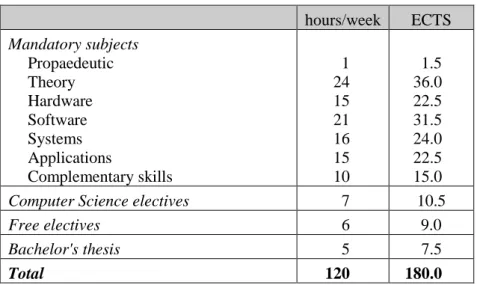
The Bachelor's program in Computer Science is a three years full-time program comprising 180 ECTS points. It is mainly delivered in German. Table 1 shows its overall structure.
Table 1: Structure of the Bachelor's program Computer Science
hours/week ECTS Mandatory subjects Propaedeutic Theory Hardware Software Systems Applications Complementary skills 1 24 15 21 16 15 10 1.5 36.0 22.5 31.5 24.0 22.5 15.0 Computer Science electives 7 10.5
Free electives 6 9.0
Bachelor's thesis 5 7.5
Total 120 180.0
2.2 Academic degree
Graduates of the Bachelor's program Computer Science are awarded the academic degree "Bachelor of Science" (BSc).
2.3 Contents of the mandatory subjects
Propaedeutic: General overview of the topics in computer science and of the Bachelor's program. The propaedeutic also serves as special orientation for first-year students.
Theory: Formal foundations of computer science in mathematics (analysis, algebra, number theory, graph theory, combinatorics, statistics), logic (predicate logic, formal specification, reasoning and proofs) as well as in formal systems and models (automata theory, Turing machines, Petri nets, computability, de-cidability, algorithmic complexity).
Hardware: Digital circuits at gate level, electronics as far as relevant for computer science, architecture of sequential and parallel computers, memory and bus systems, cache hierarchies, superscalar architec-tures, VLIW architecarchitec-tures, assembler programming, and programming of parallel computers.
Software: Solid programming skills in an imperative programming language, object-oriented software development (class libraries, frameworks, design patterns), modern programming techniques (threading, RMI, reflection, JDBC, applets, servlets, web services), algorithms and data structures (searching, sorting, random numbers, exhaustion, lists, trees, graphs, sets, distributed, parallel and heuristic algorithms), as well as software engineering (software processes, requirements engineering, design, testing).
Systems: Applications of computer science at the systems level, e.g. foundations and case studies of op-erating systems (memory management, parallel processes and synchronisation, file systems, event pro-cessing), networks and distributed systems (ISO/OSI reference model, ethernet, TCP/IP, switching, rout-ing), embedded and mobile architectures (ASICs, microcontrollers, Smartcards, wireless communication, sensors, actuators), multimedia systems (media formats, data compression techniques, animation, interac-tive television), as well as compiler construction methods.
Applications: Major application areas of computer science with respect to the strengths and focuses of computer science in Linz, e.g. databases, information systems, computer graphics, artificial intelligence, and bioinformatics.
Complementary skills: A special goal of this curriculum and its qualification profile is to develop the students' personality as scientists and engineers. This includes topics such as ethics, gender awareness, social and cultural competence, scientific working techniques, presentation skills, and project manage-ment skills. Furthermore, students are exposed to fundamanage-mental principles of economy and law.
2.4 ECTS points
According to the European Credit Transfer System the effort of courses is specified in ECTS points, where 1 ECTS points corresponds to 25 full hours of work. This includes the attendance in courses as well as the time for preparation, exercises and practical work at home. The total effort of this degree pro-gram is 180 ECTS points (approximately 30 ECTS points per semester). In this curriculum 1 unit general-ly corresponds to 1.5 ECTS points.
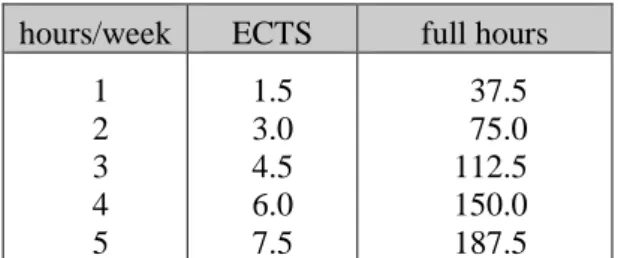
Lecturers have to adjust the effort of every course in such a way that it matches the ECTS points of the course. Table 2 shows the expected work load (in full hours) for different amounts of units and ECTS points.
Table 2: Correspondence between hours/week, ECTS points and full hours
hours/week ECTS full hours 1 2 3 4 5 1.5 3.0 4.5 6.0 7.5 37.5 75.0 112.5 150.0 187.5
2.5 Study entrance and orientation phase
The study entrance and orientation phase (StEOP) consists of freely selected courses with a total of 16 ECTS points from the first two semesters according to Table 3 (with the exception of "Ethik und Gender Studies"). StEOP courses that were acknowledged via credit transfer are considered to be passed.
Other courses can only be selected once the StEOP is completed (with the exception of courses listed under http://cs.jku.at/teaching/curricula/2013/steop.html, which can be studied in parallel to the StEOP).
2.6 Number of students per course
35 students are admitted to labs and to the lab part of combined courses, 15 students are admitted to prac-ticals, and 20 students to seminars. If these numbers are exceeded, parallel courses have to be offered.
3. Mandatory subjects
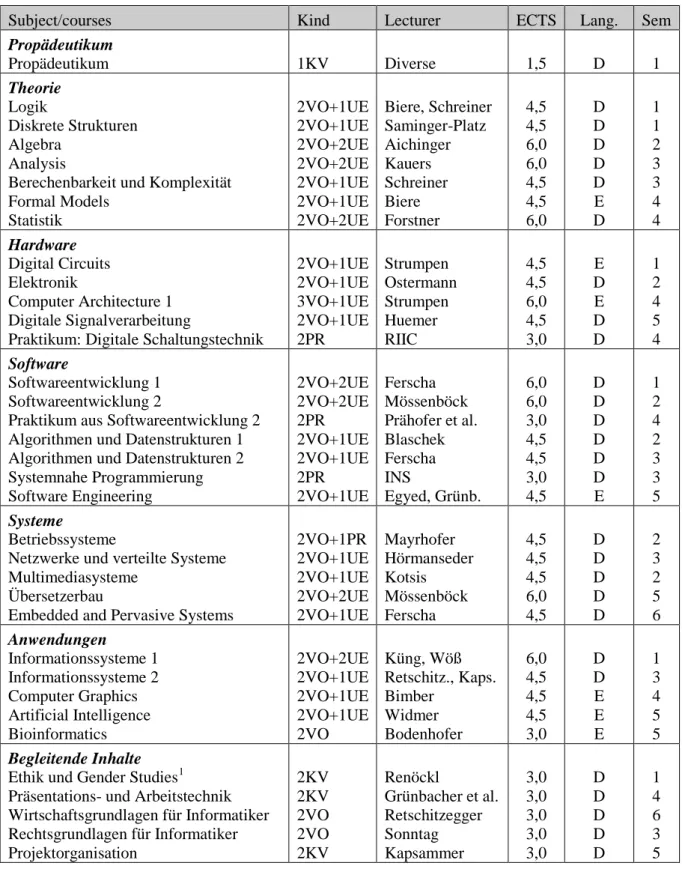
Students have to pass all courses listed in Table 3. The column "Sem" denotes the semester in which the course should be taken.
Table 3: Mandatory subjects and courses
Subject/courses Kind Lecturer ECTS Lang. Sem
Propädeutikum Propädeutikum 1KV Diverse 1,5 D 1 Theorie Logik Diskrete Strukturen Algebra Analysis
Berechenbarkeit und Komplexität Formal Models Statistik 2VO+1UE 2VO+1UE 2VO+2UE 2VO+2UE 2VO+1UE 2VO+1UE 2VO+2UE Biere, Schreiner Saminger-Platz Aichinger Kauers Schreiner Biere Forstner 4,5 4,5 6,0 6,0 4,5 4,5 6,0 D D D D D E D 1 1 2 3 3 4 4 Hardware Digital Circuits Elektronik Computer Architecture 1 Digitale Signalverarbeitung
Praktikum: Digitale Schaltungstechnik
2VO+1UE 2VO+1UE 3VO+1UE 2VO+1UE 2PR Strumpen Ostermann Strumpen Huemer RIIC 4,5 4,5 6,0 4,5 3,0 E D E D D 1 2 4 5 4 Software Softwareentwicklung 1 Softwareentwicklung 2
Praktikum aus Softwareentwicklung 2 Algorithmen und Datenstrukturen 1 Algorithmen und Datenstrukturen 2 Systemnahe Programmierung Software Engineering 2VO+2UE 2VO+2UE 2PR 2VO+1UE 2VO+1UE 2PR 2VO+1UE Ferscha Mössenböck Prähofer et al. Blaschek Ferscha INS Egyed, Grünb. 6,0 6,0 3,0 4,5 4,5 3,0 4,5 D D D D D D E 1 2 4 2 3 3 5 Systeme Betriebssysteme
Netzwerke und verteilte Systeme Multimediasysteme
Übersetzerbau
Embedded and Pervasive Systems
2VO+1PR 2VO+1UE 2VO+1UE 2VO+2UE 2VO+1UE Mayrhofer Hörmanseder Kotsis Mössenböck Ferscha 4,5 4,5 4,5 6,0 4,5 D D D D D 2 3 2 5 6 Anwendungen Informationssysteme 1 Informationssysteme 2 Computer Graphics Artificial Intelligence Bioinformatics 2VO+2UE 2VO+1UE 2VO+1UE 2VO+1UE 2VO Küng, Wöß Retschitz., Kaps. Bimber Widmer Bodenhofer 6,0 4,5 4,5 4,5 3,0 D D E E E 1 3 4 5 5 Begleitende Inhalte
Ethik und Gender Studies1
Präsentations- und Arbeitstechnik Wirtschaftsgrundlagen für Informatiker Rechtsgrundlagen für Informatiker Projektorganisation 2KV 2KV 2VO 2VO 2KV Renöckl Grünbacher et al. Retschitzegger Sonntag Kapsammer 3,0 3,0 3,0 3,0 3,0 D D D D D 1 4 6 3 5
1 Alternatively, the following courses can be selected: "Gender Studies und Soziale Kompetenz" (2KV), "Gender
4. Computer Science electives
These courses allow students to deepen and broaden their knowledge according to individual preferences. Students have to select courses with a total of 7 hours (10.5 ECTS points) from Sections 4.1 to 4.3. These courses must contain at least one seminar from Section 4.3. CS electives should be attended during the last two semesters of the program and cannot be re-selected in a subsequent Master's program.
4.1 General electives
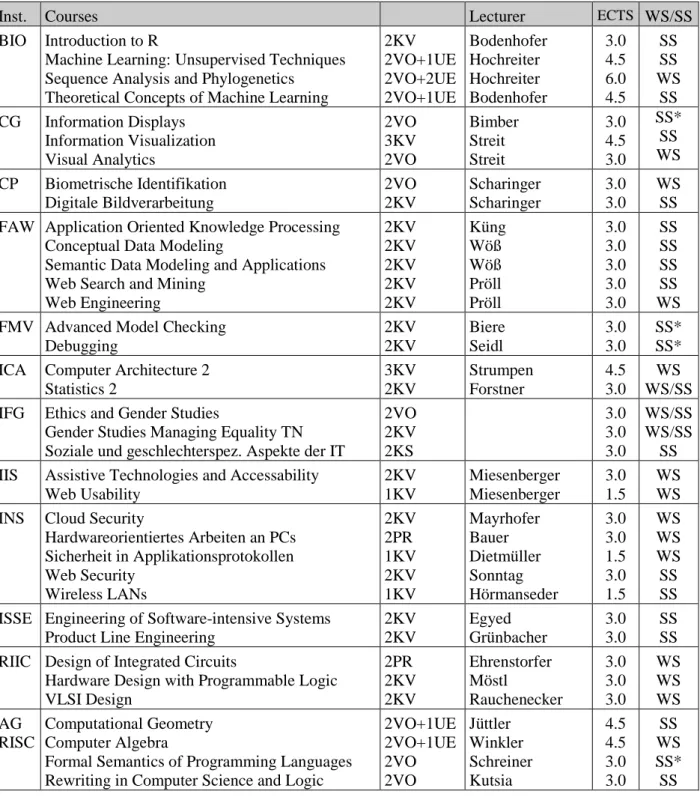
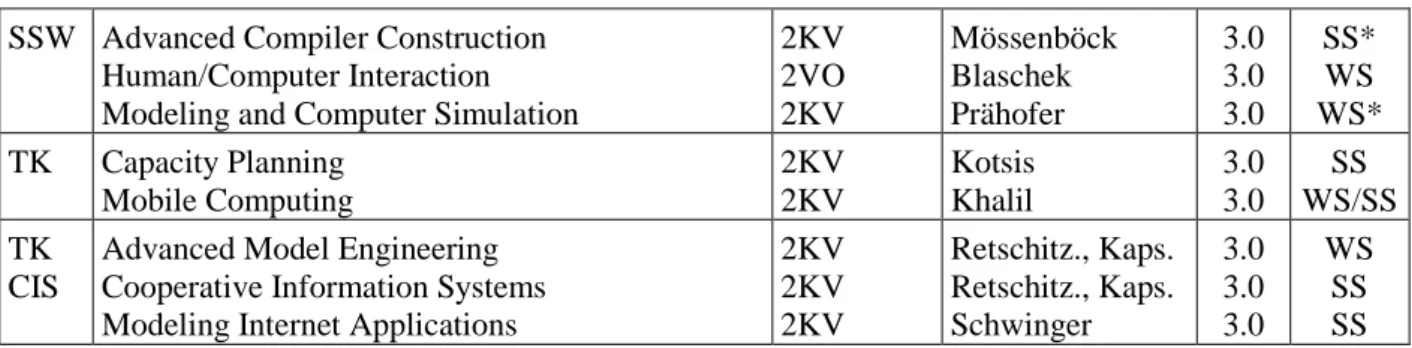
The general electives comprise the courses listed in Table 4. They are regularly offered every year or at least every two years.
Table 4: General electives (* = offered every 2 years)
Inst. Courses Lecturer ECTS WS/SS
BIO Introduction to R
Machine Learning: Unsupervised Techniques Sequence Analysis and Phylogenetics
Theoretical Concepts of Machine Learning
2KV 2VO+1UE 2VO+2UE 2VO+1UE Bodenhofer Hochreiter Hochreiter Bodenhofer 3.0 4.5 6.0 4.5 SS SS WS SS CG Information Displays Information Visualization Visual Analytics 2VO 3KV 2VO Bimber Streit Streit 3.0 4.5 3.0 SS* SS WS CP Biometrische Identifikation Digitale Bildverarbeitung 2VO 2KV Scharinger Scharinger 3.0 3.0 WS SS FAW Application Oriented Knowledge Processing
Conceptual Data Modeling
Semantic Data Modeling and Applications Web Search and Mining
Web Engineering 2KV 2KV 2KV 2KV 2KV Küng Wöß Wöß Pröll Pröll 3.0 3.0 3.0 3.0 3.0 SS SS SS SS WS FMV Advanced Model Checking
Debugging 2KV 2KV Biere Seidl 3.0 3.0 SS* SS* ICA Computer Architecture 2
Statistics 2 3KV 2KV Strumpen Forstner 4.5 3.0 WS WS/SS IFG Ethics and Gender Studies
Gender Studies Managing Equality TN Soziale und geschlechterspez. Aspekte der IT
2VO 2KV 2KS 3.0 3.0 3.0 WS/SS WS/SS SS IIS Assistive Technologies and Accessability
Web Usability 2KV 1KV Miesenberger Miesenberger 3.0 1.5 WS WS INS Cloud Security
Hardwareorientiertes Arbeiten an PCs Sicherheit in Applikationsprotokollen Web Security Wireless LANs 2KV 2PR 1KV 2KV 1KV Mayrhofer Bauer Dietmüller Sonntag Hörmanseder 3.0 3.0 1.5 3.0 1.5 WS WS WS SS SS ISSE Engineering of Software-intensive Systems
Product Line Engineering
2KV 2KV Egyed Grünbacher 3.0 3.0 SS SS RIIC Design of Integrated Circuits
Hardware Design with Programmable Logic VLSI Design 2PR 2KV 2KV Ehrenstorfer Möstl Rauchenecker 3.0 3.0 3.0 WS WS WS AG RISC Computational Geometry Computer Algebra
Formal Semantics of Programming Languages Rewriting in Computer Science and Logic
2VO+1UE 2VO+1UE 2VO 2VO Jüttler Winkler Schreiner Kutsia 4.5 4.5 3.0 3.0 SS WS SS* SS
SSW Advanced Compiler Construction Human/Computer Interaction Modeling and Computer Simulation
2KV 2VO 2KV Mössenböck Blaschek Prähofer 3.0 3.0 3.0 SS* WS WS* TK Capacity Planning Mobile Computing 2KV 2KV Kotsis Khalil 3.0 3.0 SS WS/SS TK CIS
Advanced Model Engineering Cooperative Information Systems Modeling Internet Applications
2KV 2KV 2KV Retschitz., Kaps. Retschitz., Kaps. Schwinger 3.0 3.0 3.0 WS SS SS
4.2 Special topics
Special topics allow institutes to take up current trends in their fields and to use the teaching offer of guest lecturers. Courses from this category can be announced without being listed in the curriculum, and there is no obligation to hold them regularly.
The name of special topics courses consists of a main title ("Special Topics:") and a subtitle denoting the actual contents of the course. The type of such courses (VO, UE, KV, SE) as well as their length in hours can be freely chosen by the lecturers. The ECTS points are calculated as hours × 1.5.
4.3 Seminars
Seminars are courses in which scientific methods are taught and practiced. Students have to write a semi-nar thesis about a research-related topic and present it in a semisemi-nar talk. The name of a semisemi-nar consists of a main title as shown in Table 5 and a subtitle denoting the topic of the seminar. At least 1 seminar has to be selected in the CS electives.
Table 5: Seminars
Seminars ECTS WS/SS
Seminar in Computational Engineering: ... Seminar in Intelligent Information Systems: ... Seminar in Networks and Security: ...
Seminar in Pervasive Computing: ... Seminar in Software Engineering: ...
2SE 2SE 2SE 2SE 2SE 3.0 3.0 3.0 3.0 3.0 WS/SS WS/SS WS/SS WS/SS WS/SS
5. Free electives
Students have to take free elective courses with a total of 6 hours (9 ECTS). These courses can be select-ed from any study at any university and can be taken throughout the whole Master's program. Their goal is to provide students with additional skills beyond the area of Computer Science. Courses in social skills, foreign languages and gender studies are particularly recommended.
For the free electives, students can also select additional courses from the Computer Science electives. These courses, however, cannot be reselected in the Master's program.
6. Bachelor's thesis
As a final work students have to write a Bachelor's thesis, which has to be done in the course "Pro-jektpraktikum" (5PR, 7.5 ECTS). The thesis should have the structure of a scientific publication, i.e.:
• It should be put in its computer science context (specification, definition of terms, related work, etc.).
• Students should demonstrate their knowledge of common methods and notations of computer science.
7. Organisational
7.1 Course Types
Lectures ("Vorlesungen", VO) are courses that introduce students to certain areas and methods of their study.
Labs ("Übungen", UE) are courses which reinforce topics from the corresponding lecture by carrying out practical and concrete exercises. Marking is based on continuous assessment of the students' work.
Combined courses ("Kombinierte Veranstaltungen", KV) are courses consisting of lectures and labs, which are intertwined according to didactic aspects.
Practicals (PR) have similar goals as labs and are continuously assessed. In contrast to labs they can be independent from lectures and usually promote project-oriented work in a team. The project practical that has to be done as a bachelor thesis is a final project with a written part in which students should apply the knowledge that they acquired during their study.
Seminars (SE) are courses involving collaboration between students. Marking of seminars is based on continuous assessment of the students' work, on their preparation of talks (including seminar papers) and on their participation in discussions.
7.2 Examinations
Every course is marked individually. The examination mode (written or oral) of lectures (VO) and com-bined courses (KV) is defined by the lecturer. Labs (UE) and practicals (PR) are assessed by continuous and final evaluations. Seminars (SE) are assessed on the basis of the seminar thesis, the seminar presenta-tion and the cooperapresenta-tion of the student in the seminar.
The examination marks of the mandatory subjects (Section 3) and the Computer Science electives (Sec-tion 4) are computed as the average marks of the individual course examina(Sec-tions.
The Bachelor's examination certificate summarizes the subject examinations of the mandatory subjects (Section 3), the Computer Science electives (Section 4), the free electives (Section 5) and the Bachelor's thesis (Section 6).