energies
ArticleArtificial Learning Dispatch Planning with
Probabilistic Forecasts: Using Uncertainties as
an Asset
Ana Carolina do Amaral Burghi1,* , Tobias Hirsch1 and Robert Pitz-Paal2
1 Institute of Solar Research, German Aerospace Center (DLR), Wankelstrasse 5, 70563 Stuttgart, Germany; [email protected]
2 Institute of Solar Research, German Aerospace Center (DLR), Linder Höhe, 51147 Cologne, Germany; [email protected]
* Correspondence: [email protected]
Received: 18 December 2019; Accepted: 21 January 2020; Published: 1 February 2020
Abstract:Weather forecast uncertainty is a key element for energy market volatility. By intelligently considering uncertainties on the schedule development, renewable energy systems with storage could improve dispatching accuracy, and therefore, effectively participate in electricity wholesale markets. Deterministic forecasts have been traditionally used to support dispatch planning, representing reduced or no uncertainty information about the future weather. Aiming at better representing the uncertainties involved, probabilistic forecasts have been developed to increase forecasting accuracy. For the dispatch planning, this can highly influence the development of a more precise schedule. This work extends a dispatch planning method to the use of probabilistic weather forecasts. The underlying method used a schedule optimizer coupled to a post-processing machine learning algorithm. This machine learning algorithm was adapted to include probabilistic forecasts, considering their additional information on uncertainties. This post-processing applied a calibration of the planned schedule considering the knowledge about uncertainties obtained from similar past situations. Simulations performed with a concentrated solar power plant model following the proposed strategy demonstrated promising financial improvement and relevant potential in dealing with uncertainties. Results especially show that information included in probabilistic forecasts can increase financial revenues up to 15% (in comparison to a persistence solar driven approach) if processed in a suitable way.
Keywords:renewable systems; storage; dispatch; optimization; machine learning; probabilistic forecasts
1. Introduction
Driven by environmental and energy security needs, the global energy transition emphasizes the consideration of renewable energy. As a result, power systems need to integrate large amounts of variable generation resources, such as photovoltaics (PV) and wind without storage. Combined with this large-scale integration, their random nature poses great challenges to energy system operators [1].
In order to predict the possible amount of energy that can be sent to the grid, weather prediction is necessary. This requires information about the wind or solar radiation, for example, depending on the system under operation. These weather variables are usually intermittent, consequently leading to uncertainty in the electricity supply. Several efforts are being made to improve power prediction and, therefore, guarantee energy security and increase potential revenues of renewable systems. PV power output prediction models based on artificial learning were developed e.g., by [2] and [3], in order to learn the underlying relationships between meteorological information and actual power outputs. The relationship between sky appearance and the future PV power output using deep learning has been Energies2020,13, 616; doi:10.3390/en13030616 www.mdpi.com/journal/energies
Energies2020,13, 616 2 of 25
proposed by [4]. A long-term recurrent convolutional network using temporal and spatial weather data was developed by [5] to predict PV production in the 24-h and 48-h forecast horizons. A deep learning-based ensemble approach was proposed by [6] for probabilistic wind power forecasting.
All these studies consider renewable systems whose production is pre-defined by the weather situation. Thus, the primary focus is to get the best possible weather forecast and the dispatch problem is mostly a renewable production prediction problem that results in a dispatch problem for other producers (mostly not renewable) able to increase or decrease their production to meet the load demand. With the ambitions targets for renewable energy production, there is an increasing urge of renewable systems participating in electricity markets in the same manner as conventional energy producers [7]. Consequently, the need for flexible producers flourishes, highly important for the compensation of fluctuating resources and with the significant advantage of economically meeting peak demand. Dispatch planning methods for flexible power prediction for such flexible units are required. The important difference to the above-mentioned approaches is that the dispatch plan does not only depend on the weather forecast for the specific hour but also on energy amounts accumulated e.g., in a storage unit. By this, the dispatch schedule depends more on the demand than on the weather. Compared to conventional, fossil fired power plants, where the fuel is in principle available all the time, renewable producers with storage have a restriction by the amount of energy currently stored. The paper deals with this kind of dispatch problem for a solar thermal electricity producer with integrated large storage (about 10 full load hours) and full participation in the day-ahead market.
Considering storage as a key for the future of the power sector [8], renewable energy systems (RES) with integrated storage are able to provide certain flexibility between collecting energy from the source and sending electricity to the grid. With that, their participation in the spot market could enable relevant economic benefits for such systems, as well as a cleaner electricity trading and a more stable grid. Usually, in such markets, production bids of the amount and price for a certain interval of the day are placed, and the market regulates it by a least cost optimization. In order to participate in wholesale markets, an optimized and accurate dispatch schedule is necessary. This schedule consists on a plan of production for a specific period, determining the timing and rate at which electricity is generated.
Different dispatch optimization strategies have been applied to many types of RES with storage, e.g., Ref. [9] linearly optimized the dispatch of a grid-connected PV+battery storage system that financially over performed a simple off-peak/on-peak (charging/discharging) strategy, and Ref. [10] that implemented a real-time demand linear programming routine for a PV+battery storage system, leveraging solar power and load forecasts to establish a load demand target adjusted throughout the day in response to forecast error. Although positive results are shown under the traditional market scheme for renewable systems, such approaches do not take into account the uncertainties and complexity of wholesale energy markets.
1.1. Flexible Dispatch Planning Existing Solutions and Challenges
Aiming to take part in wholesale markets, RES with storage need to adapt their dispatch to a new market operation. Instead of the usual contractual conditions with high security on produced electricity, such as power purchase agreements or feed-in-tariffs, the operation consists on the production bidding for a certain interval of the day. The schedule of amount and price of electricity produced is usually defined in trading sessions for the day-ahead, with intra-day corrections. Differences between contracted and actual energy production suffer higher penalties in comparison to the traditional schemes. Therefore, forecasts’ accuracy is an important issue [11].
Considering that RES rely on natural resources and that their forecasts include uncertainties, the dispatch planning needs to be robust and take these uncertainties into account. Nonetheless, they still represent a challenge for the users. The atmosphere’s variable nature impacts the output from renewable power producers and also influences the load variability that must be balanced by the power system [12].
Anyway, by considering weather and price forecasts, the dispatch of RES plants with storage can be economically optimized, according to a spot market driven operation. By using observed data, simulations of the real operation can be performed, considering the production schedule based on forecasts and enabling then the evaluation of such schedules. Research on such a market operation was performed, especially considering concentrated solar power (CSP) systems.
Dispatch strategies play an important role for CSP with thermal storage, as they allow extended production of solar electricity to periods without solar irradiation. A mixed-integer linear programming (MILP) for a CSP day-ahead operation was modelled by [13], assuming perfect market price and weather predictions. MILP scheduling approaches were also used by [14], providing an optimized target power generation profile for a CSP tower system in combination with a simulation model that evaluates annual plant performance, and by [15] for a hybrid CSP-fossil fuel plant schedule optimization, including a robustness cost parameter to consider the uncertainties of possible delivery deviations. A robust linear optimization was also introduced by [16,17] to model the solar energy uncertainty, considering a stochastic model to include market prices uncertainties. A dynamic programming CSP bidding strategy was developed by [18] and a heuristic approach for a day-ahead operation was proposed by [19], both considering certain solar resources and price information. An optimum scheduling strategy with incorporation of uncertainty information was suggested by [20], deriving a day-ahead dispatch plan that is calibrated by a machine learning algorithm. This approach combines several relevant parameters with historical data and builds knowledge on dealing with uncertainties based on past events.
In comparison to base-line dispatch strategies, such as solar driven or off-peak/on-peak, these presented optimization algorithms show possible improvement in financial income and load management. While most of these works have the schedule quality exclusively dependent on forecasts quality, only some consider the uncertainties influence on the dispatching plan. Still, all of them are based on strict deterministic rules, considering fixed relationships among states and events, without taking the weather’s random variation into account. In such models, a given input always produces the same output, possibly resulting in sub-optimal solutions, as in reality, deterministic-type forecasts present low, or even null, information about the uncertainties involved.
Uncertainty in weather forecast and power production is a key element of volatility in the market and a driver for competition, playing a role in security constraints and risk management [21]. By intelligently considering uncertainties on the schedule development, a reasonable balance between risk, profit, and energy security is expected to be fulfilled.
1.2. Weather Forecasts: Predicting RES Resource
Traditionally, weather estimation is obtained by numerical weather predictions (NWP), based on a numerical integration of the hydrodynamic equations governing atmospheric motions. According to the current state of the atmosphere, these models propagate information forwards to produce a forecast for future weather. The state of the atmosphere is then described by the spatial distribution of wind, temperature, and other weather variables [11]. Although numerical models have been considered to be the best forecasting approach for the next one to five days [22], they are bound to have an error, due to factors such as the different temporal and spatial scales involved, the insufficient knowledge of the current state of the atmosphere, and the complex non-linearity of the problem [23]. The classical NWP always leads to the same final state given identical initial conditions. Hence, the result of such a model is a deterministic weather forecast product, which is a unique profile of the future weather condition. Such a result represents reduced or no information on the uncertainty of the future weather profile.
As chance is not involved in any future state of the traditional deterministic method, the scientific community has been working on improvements to produce more accurate forecasts [24]. Important advances have been achieved in the presentation of uncertainty information to system operators, enabling additional trust in the forecasts. Under these advances, ensemble and probabilistic forecasting methods are highlighted, being increasingly used due to their ability to better characterize most likely situations, represent potential extreme scenarios, apart from providing an effective a way to quantify
Energies2020,13, 616 4 of 25
uncertainties [12]. While the reference deterministic forecast generates a single-value forecast for every time step in the forecasting horizon, probabilistic forecasts generate a set of values, quantifying the uncertainty in a prediction. Therefore, probabilistic forecasts are essential to support a most probable optimal decision.
Probabilistic forecasts are generated by ensemble prediction systems (EPS), which take the atmosphere’s non-linear behavior into account in a probabilistic way. Such a system generates multiple forecasts considering slightly different but equally probable initial conditions or numerical parametrizations, with the aim to characterize the uncertainty of the prediction [25]. It estimates the time evolution of the probability density function, which specifies the probability of a given variable falling within a particular range of values, being viewed as an ensemble of individual selected atmospheric states. The final result is a set of possible future profiles, each of them with the same physical possibility to happen. Each scenario can be evaluated individually or collectively, to assess extreme situations, establish confidence intervals, or define the likelihood of different cases [12].
Apart from weather and climate prediction, the solution of other critical problems of science and society have been supported by the use of probabilistic forecasts, such as seismic hazard prediction, financial risk management, election outcome prediction, demographic and epidemiological projection, health care management, and predictive and preventative medicine [26].
Probabilistic weather forecasts have been developed with the objective to better represent the uncertainties involved and therefore to increase forecasting accuracy. For dispatch planning, this can highly influence developing a more precise schedule. However, the use of such forecasts for dispatch purposes is still limited. The incorporation of probabilistic information into decision-making and energy management processes is one of the major obstacles to the widespread adoption of such forecasts [12]. Apart from facing cultural acceptance barriers, tools have been usually developed to accept only deterministic forecasts as input, depriving the extraction of full value from probabilistic forecasts [27]. An adaptation to a probabilistic input could be complicated, or in some cases, not even possible. There is a general resistance to change due to current practices, costs, education, and limited resources [21]. Also, the uncertainty information given by probabilistic forecasts has to be interpreted and processed, meaning that these tools would need also new means for dealing with extra information. Apart from a knowledge deficit about how to use such forecasts, assessment on their value for dispatching purposes is still lacking. Currently there is not a direct link between forecast performance metrics and the value provided for a power system [27].
In any case, additional information on future prediction uncertainty is potentially valuable for the system operator as well as market participants. Several research and development efforts are being driven by the need to evaluate forecasts for energy purposes. By simulating the operation of a wind farm with day-ahead clearing and real-time markets for energy and operating reserves, Zhou et al. [28] found that probabilistic forecasts can contribute to improve the performance of the power system, both in terms of cost and reliability. Results showed that the use of dynamic operating reserves derived from probabilistic forecasts gave better performance than fixed reserve requirements, as their levels are better aligned with wind power forecast uncertainty. Gonzalez-Aparicio and Zucker [29] quantified the wind power forecasting uncertainty given by probabilistic forecasts used by a transmission operating system, assessing their influence on the power market prices, and therefore the impact on the power system actor decisions. Relying on probabilistic power profiles forecasts of demand and generation, Appino et al. [30] proposed a framework to ensure dispatch schedule security feasibility. The simulations based on real household production and consumption data present achievable performance improvements. Arriagada et al. [31] modelled the probability distributions of system marginal price, thermal (fuel based), solar, and wind power generation. The model was applied to a case study of the Northern Chilean electrical system and showed to be helpful for multi decision-making regarding renewable energy market effects.
These works examine energy systems problems and propose solutions based on probabilistic forecasting. However, none of these examines the participation of a RES with storage in the wholesale
market in particular. Such systems could potentially benefit from the incorporation of forecast uncertainty into their decision-making. Overall, improved forecasting and corresponding decision support tools are key solutions to enable a clean, reliable, and cost-efficient grid driven by renewable resources [32]. Just as important as improving their underlying accuracy, a crucial issue is to integrate probabilistic forecasts into dispatch operations to obtain their full value.
1.3. Objectives of the Current Work
The hurdle of planning an accurate schedule is to know how to tackle the natural imprecision of forecasting future situations. Uncertainty treatment is then crucial to ensure an optimal dispatch, usually with high dependency on forecasts’ accuracy. While deterministic forecasts are mostly used for the dispatch planning, probabilistic forecasts contain richer uncertainty information, bringing advantages to dealing with forecast inaccuracy, and therefore, potentially reaching a more precise schedule.
This work extends the suggested post-processing method developed by [20] to the use of probabilistic forecasts. Designed to be applied for a renewable energy system with storage, the ALFRED (artificial learning flexible renewable energy system dispatch optimizer) method presented in [20] financially optimizes the dispatch schedule for a day-ahead operation, considering weather and electricity price forecasts as input. It allows a flexible choice of the optimization algorithm for dispatch planning, in combination with an innovative uncertainty post-processing algorithm. Combining the knowledge obtained with historical data in order to deal with uncertainties, ALFRED includes the benefits of machine learning techniques into the dispatch problem. It performs a calibration on the suggested dispatch plan in order to achieve a schedule closer to a perfect operation, considering similar situations learned from the past. However, it is still limited to the use of deterministic forecasts.
Hence, the contribution of this work is to broaden the possibilities of the uncertainty treatment proposed by [20], including the valuable information of uncertainties brought by probabilistic weather forecasts. For that, ALFRED’s strategy had to be adapted, considering new means of operation and decision-making. ALFRED’s probabilistic approach considers all ensemble members into the calculations, with the aim to learn the most probable optimal decision among all the given possibilities.
The analysis of this probabilistic extension is here simulated with a CSP system. CSP plants are a utility scale technology for renewable electricity generation that concentrates solar radiation through the use of mirrors, into heat energy in a fluid, which is then used by a power cycle to generate electricity. Compared to other renewable energy systems, CSP systems have the systematic benefit of efficient thermal storage, allowing electricity production to large periods even when the sun is not shining. The substitution of variable renewable generation resources with CSP can bring considerable reductions in thermal generation fuel and ramping costs, establishing this technology as a significant RES towards renewable-dominated and minimum-cost targets [33].
This work presents a novel dispatch strategy for renewable energy systems with storage considering probabilistic forecasts. Section2describes ALFRED’s methodology in detail, explaining the original deterministic approach and the extension to probabilistic weather input. Section3presents the annual results of a simulated CSP operation following the proposed scheduling plan. Finally, conclusions and outlook are discussed in Section4.
2. Materials and Methods
ALFRED’s strategy has been developed to be applied for any renewable energy system with storage and allows flexible choice of the optimization algorithm. The proposed uncertainty post-processing is applied to obtain the final delivery schedule. This post-processing algorithm is based on a fuzzy decision tree approach, including the benefits of machine learning techniques into the dispatch problem. Machine learning applications to practical tasks are mostly based on constructing a model of the knowledge used by a human expert [34]. The dispatching case consists of a problematic that involves the knowledge of several experts, such as meteorologists, plant operators, and market experts. Therefore, a tool that combines the knowledge from each field in an intelligent way should
Energies2020,13, 616 6 of 25
bring important improvements for dispatch planning. In this context, a fuzzy decision tree was the chosen machine learning methodology, allowing intuitive understanding of the calculations and decision-making process. Fuzzy logic is combined with the decision tree, aiming for a more flexible and accurate method.
Here, the extension of the uncertainty post-processing algorithm for a probabilistic approach is explained. For that, the deterministic ALFRED schedule planning is firstly highlighted, followed by a detailed explanation of the probabilistic extension.
2.1. ALFRED Schedule Planning Based on a Deterministic Forecast
Presented by the authors in [20], ALFRED is a dispatch planning strategy that supports renewable plants with integrated storage to participate in wholesale markets. Initially designed to accept deterministic forecasts, ALFRED derives the electricity delivery schedule for the day-ahead. The reasoning and detailed explanation of the calculations performed by ALFRED’s deterministic approach are out of the scope of this paper. Here, only a general introduction of its main characteristics and findings is outlined, as a basis for the extension presented later on.
Similarly to existing approaches, ALFRED develops a financial optimum schedule based on electricity prices and weather forecasts. Its novel contribution is the incorporation of uncertainty treatment. For that, a partitioned calculation between the optimization algorithm and the uncertainty processing is performed, aiming to draw a schedule with electricity delivery during hours with high electricity price.
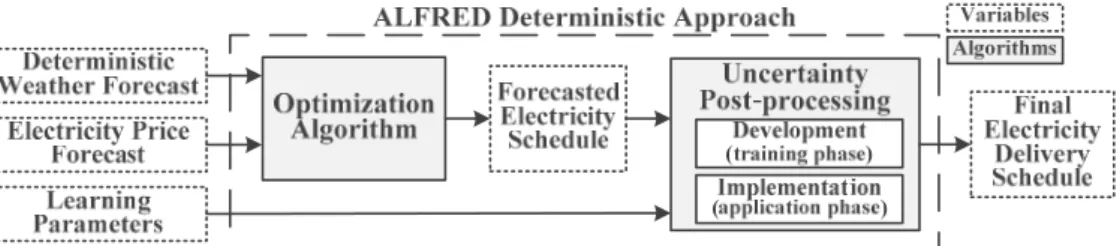
Although deterministic forecasts do not present uncertainty information, in reality, uncertainty exists and can be learned once considering similar situations that happened in the past. Accordingly, the schedule resulting from the optimization algorithm is calibrated by the uncertainty post-processing (UPP), based on the learning from historical data. The learning is applied with the aim to reach a schedule closer to a perfect operation, considered as the real optimum, when no uncertainties come into place. Figure1shows a scheme of the deterministic approach of the ALFRED strategy.
It is essential to select relevant learning parameters to be considered in the process, being suitable for the calculations and related to the problematic, but also with great potential to increase the quality of the learning. The reasoning behind these parameter selections are their relation to the uncertainty involved in predicting an optimal schedule, as well as their influence on the schedule development and on the consequences of committing to the proposed dispatch plan. Considering the values presented by the learning parameters on the past, their relation to a perfect operation can be assimilated, and then performed as a calibration during the development of a new schedule in a real operation.
Energies 2020, 13, x FOR PEER REVIEW 6 of 25
important improvements for dispatch planning. In this context, a fuzzy decision tree was the chosen machine learning methodology, allowing intuitive understanding of the calculations and decision-making process. Fuzzy logic is combined with the decision tree, aiming for a more flexible and accurate method.
Here, the extension of the uncertainty post-processing algorithm for a probabilistic approach is explained. For that, the deterministic ALFRED schedule planning is firstly highlighted, followed by a detailed explanation of the probabilistic extension.
2.1. ALFRED Schedule Planning Based on a Deterministic Forecast
Presented by the authors in [20], ALFRED is a dispatch planning strategy that supports renewable plants with integrated storage to participate in wholesale markets. Initially designed to accept deterministic forecasts, ALFRED derives the electricity delivery schedule for the day-ahead. The reasoning and detailed explanation of the calculations performed by ALFRED’s deterministic approach are out of the scope of this paper. Here, only a general introduction of its main characteristics and findings is outlined, as a basis for the extension presented later on.
Similarly to existing approaches, ALFRED develops a financial optimum schedule based on electricity prices and weather forecasts. Its novel contribution is the incorporation of uncertainty treatment. For that, a partitioned calculation between the optimization algorithm and the uncertainty processing is performed, aiming to draw a schedule with electricity delivery during hours with high electricity price.
Although deterministic forecasts do not present uncertainty information, in reality, uncertainty exists and can be learned once considering similar situations that happened in the past. Accordingly, the schedule resulting from the optimization algorithm is calibrated by the uncertainty post-processing (UPP), based on the learning from historical data. The learning is applied with the aim to reach a schedule closer to a perfect operation, considered as the real optimum, when no uncertainties come into place. Figure 1 shows a scheme of the deterministic approach of the ALFRED strategy.
It is essential to select relevant learning parameters to be considered in the process, being suitable for the calculations and related to the problematic, but also with great potential to increase the quality of the learning. The reasoning behind these parameter selections are their relation to the uncertainty involved in predicting an optimal schedule, as well as their influence on the schedule development and on the consequences of committing to the proposed dispatch plan. Considering the values presented by the learning parameters on the past, their relation to a perfect operation can be assimilated, and then performed as a calibration during the development of a new schedule in a real operation.
Figure 1. Artificial learning flexible renewable energy system dispatch (ALFRED) deterministic dispatch planning tool: a partitioned approach of an optimization algorithm with the machine learning uncertainty post-processing (which includes a development and an implementation phase).
The UPP algorithm is based on a fuzzy decision tree approach. Two main phases are involved in its application: development and implementation. The first phase consists in the training of the algorithm: the learning system is designed with historical data from the specific system in which it is desired to be applied. The second phase consists in the application of the algorithm: the learning system is used to define a final electricity delivery schedule to be cleared by the market. The UPP implementation is applied during the operation of a renewable energy system with storage, to be performed as a calibration after the optimization algorithm.
Figure 1. Artificial learning flexible renewable energy system dispatch (ALFRED) deterministic dispatch planning tool: a partitioned approach of an optimization algorithm with the machine learning uncertainty post-processing (which includes a development and an implementation phase).
The UPP algorithm is based on a fuzzy decision tree approach. Two main phases are involved in its application: development and implementation. The first phase consists in the training of the algorithm: the learning system is designed with historical data from the specific system in which it is desired to be applied. The second phase consists in the application of the algorithm: the learning system is used to define a final electricity delivery schedule to be cleared by the market. The UPP
implementation is applied during the operation of a renewable energy system with storage, to be performed as a calibration after the optimization algorithm.
Considering the characteristics of fuzzy decision-trees, ALFRED’s strategy allows intuitive understanding of the decision-making methodology, expected to be of high acceptability among plant operators. The uncertainty treatment enables an automatic decision pattern to be generated and applied according to different conditions, performing an adjustment to the final delivery schedule. While some existing approaches consider uncertainty as a single parameter, with stochastic or chance constraints, ALFRED combines several relevant parameters with historical data, building knowledge on dealing with uncertainties based on past events. The suggested final electricity delivery schedule is then not designed purely based on forecasts, but also enhanced with the learning from past data. Figure2outlines an example of the deterministic application of the ALFRED strategy.
Energies 2020, 13, x FOR PEER REVIEW 7 of 25
Considering the characteristics of fuzzy decision-trees, ALFRED’s strategy allows intuitive understanding of the decision-making methodology, expected to be of high acceptability among plant operators. The uncertainty treatment enables an automatic decision pattern to be generated and applied according to different conditions, performing an adjustment to the final delivery schedule. While some existing approaches consider uncertainty as a single parameter, with stochastic or chance constraints, ALFRED combines several relevant parameters with historical data, building knowledge on dealing with uncertainties based on past events. The suggested final electricity delivery schedule is then not designed purely based on forecasts, but also enhanced with the learning from past data. Figure 2 outlines an example of the deterministic application of the ALFRED strategy.
Figure 2. ALFRED deterministic application results: forecasted schedule (optimization algorithm result), adjusted schedule (post-processing result/final schedule), and perfect electricity schedule for two example days [20].
The analyses carried out in [20] show that ALFRED performs a beneficial economic energy management with effective treatment of uncertainties. Compared to a dispatch optimization without uncertainty treatment, ALFRED was proven to increase revenues when using the same weather input. Also, the knowledge assimilation from past data was demonstrated to enhance the scheduling independently on the amount of data used for the learning. The results presented in [20] show that ALFRED’s strategy achieves a more accurate schedule, and therefore, higher revenues.
By acquiring knowledge about uncertainties’ influence on weather forecasts, the quality of schedules developed by ALFRED are not exclusively dependent to forecasts quality, as it can be improved by the learning. Its performance is expected to improve once considering probabilistic forecasts, as more information about weather uncertainties becomes available for the learning process. 2.2. ALFRED Schedule Planning Based on a Probabilistic Forecast
The partitioned approach applied by ALFRED of optimum calculation with a post-process for the uncertainty treatment brings the possibility of dealing with other types of forecasts, such as probabilistic ones. In this work, an extension for the ALFRED strategy is proposed, by including the use of probabilistic forecasts into the schedule planning (Figure 3).
Figure 3. ALFRED probabilistic dispatch planning tool. The aspects in which adaptations are implemented for this approach are highlighted in green.
The aim of this paper is not to propose a dispatch optimization algorithm, but to enhance the capabilities of an existing dispatch strategy, which includes a certain optimization algorithm (aiming for revenue maximization) in combination with the ALFRED uncertainty post-processing. The uncertainty treatment can be applied for any selected optimization algorithm and is here extended to a probabilistic approach, without losing the applicability for deterministic forecasts.
Figure 2. ALFRED deterministic application results: forecasted schedule (optimization algorithm result), adjusted schedule (post-processing result/final schedule), and perfect electricity schedule for two example days [20].
The analyses carried out in [20] show that ALFRED performs a beneficial economic energy management with effective treatment of uncertainties. Compared to a dispatch optimization without uncertainty treatment, ALFRED was proven to increase revenues when using the same weather input. Also, the knowledge assimilation from past data was demonstrated to enhance the scheduling independently on the amount of data used for the learning. The results presented in [20] show that ALFRED’s strategy achieves a more accurate schedule, and therefore, higher revenues.
By acquiring knowledge about uncertainties’ influence on weather forecasts, the quality of schedules developed by ALFRED are not exclusively dependent to forecasts quality, as it can be improved by the learning. Its performance is expected to improve once considering probabilistic forecasts, as more information about weather uncertainties becomes available for the learning process.
2.2. ALFRED Schedule Planning Based on a Probabilistic Forecast
The partitioned approach applied by ALFRED of optimum calculation with a post-process for the uncertainty treatment brings the possibility of dealing with other types of forecasts, such as probabilistic ones. In this work, an extension for the ALFRED strategy is proposed, by including the use of probabilistic forecasts into the schedule planning (Figure3).
Energies 2020, 13, x FOR PEER REVIEW 7 of 25
Considering the characteristics of fuzzy decision-trees, ALFRED’s strategy allows intuitive understanding of the decision-making methodology, expected to be of high acceptability among plant operators. The uncertainty treatment enables an automatic decision pattern to be generated and applied according to different conditions, performing an adjustment to the final delivery schedule. While some existing approaches consider uncertainty as a single parameter, with stochastic or chance constraints, ALFRED combines several relevant parameters with historical data, building knowledge on dealing with uncertainties based on past events. The suggested final electricity delivery schedule is then not designed purely based on forecasts, but also enhanced with the learning from past data. Figure 2 outlines an example of the deterministic application of the ALFRED strategy.
Figure 2. ALFRED deterministic application results: forecasted schedule (optimization algorithm result), adjusted schedule (post-processing result/final schedule), and perfect electricity schedule for two example days [20].
The analyses carried out in [20] show that ALFRED performs a beneficial economic energy management with effective treatment of uncertainties. Compared to a dispatch optimization without uncertainty treatment, ALFRED was proven to increase revenues when using the same weather input. Also, the knowledge assimilation from past data was demonstrated to enhance the scheduling independently on the amount of data used for the learning. The results presented in [20] show that ALFRED’s strategy achieves a more accurate schedule, and therefore, higher revenues.
By acquiring knowledge about uncertainties’ influence on weather forecasts, the quality of schedules developed by ALFRED are not exclusively dependent to forecasts quality, as it can be improved by the learning. Its performance is expected to improve once considering probabilistic forecasts, as more information about weather uncertainties becomes available for the learning process. 2.2. ALFRED Schedule Planning Based on a Probabilistic Forecast
The partitioned approach applied by ALFRED of optimum calculation with a post-process for the uncertainty treatment brings the possibility of dealing with other types of forecasts, such as probabilistic ones. In this work, an extension for the ALFRED strategy is proposed, by including the use of probabilistic forecasts into the schedule planning (Figure 3).
Figure 3. ALFRED probabilistic dispatch planning tool. The aspects in which adaptations are implemented for this approach are highlighted in green.
The aim of this paper is not to propose a dispatch optimization algorithm, but to enhance the capabilities of an existing dispatch strategy, which includes a certain optimization algorithm (aiming for revenue maximization) in combination with the ALFRED uncertainty post-processing. The uncertainty treatment can be applied for any selected optimization algorithm and is here extended to a probabilistic approach, without losing the applicability for deterministic forecasts.
Figure 3. ALFRED probabilistic dispatch planning tool. The aspects in which adaptations are implemented for this approach are highlighted in green.
Energies2020,13, 616 8 of 25
The aim of this paper is not to propose a dispatch optimization algorithm, but to enhance the capabilities of an existing dispatch strategy, which includes a certain optimization algorithm (aiming for revenue maximization) in combination with the ALFRED uncertainty post-processing. The uncertainty treatment can be applied for any selected optimization algorithm and is here extended to a probabilistic approach, without losing the applicability for deterministic forecasts.
Considering that, ALFRED’s upgraded framework runs the optimization algorithm deterministically for each available weather scenario, i.e., only once, if the forecast type is deterministic, or once for every scenario, if the forecast type is probabilistic. The main output of the optimization algorithm is the optimal forecasted electricity delivery schedule, in the deterministic case, or several schedules, in the probabilistic case. Subsequently, uncertainties are taken into account: the forecasted electricity schedule is the input for the uncertainty post-processing (UPP), which adjusts and defines a final electricity delivery schedule. In case a probabilistic weather forecast is used, the UPP uses all the forecasted schedules deterministically derived from the optimization algorithm as input. Its objective is to make a selection of a final optimum electricity delivery schedule. In other words, the result of the optimization is a range of possible power schedules, and the uncertainty post-processing is able to generate a single delivery schedule taking into account the energy market characteristics and uncertainties involved.
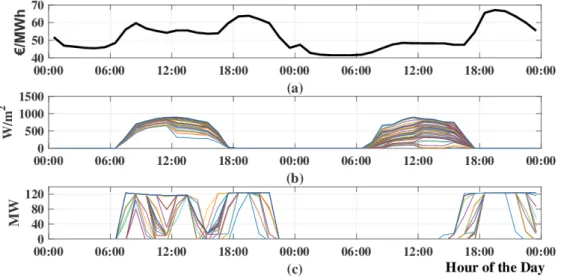
The reasoning behind the UPP probabilistic approach, the implemented adaptations on the learning system and the methodology for selecting a final schedule are described in the following sections. The uncertainty information brought by probabilistic forecasts can be used as an asset to improve dispatch planning. In order to do so, uncertainty information should be assessed during hours when scheduling is desired, as levels of chance or risk should be analyzed during instants with high electricity prices. By considering the optimized schedules, the proposed probabilistic UPP takes this into account: the weather forecast ensemble brings diverse scenarios of future weather, which are then transformed into distinct electricity schedules. By this process, the uncertainty information of the weather forecast is translated into uncertainty information of the electricity schedule. This is interesting and relevant since for the scheduling application it is not primarily relevant to know the uncertainty of the weather but to understand the resulting uncertainty in the production schedule. In general, this leads to shifting the uncertainty from the hours when the resource is available to hours when energy production is desired. Although the uncertainty is derived from the weather forecasts, ALFRED’s strategy changes the uncertainty paradigm to energy aspects. By doing so, the final schedule selection can be based on several influencing parameters, not only considering the possible amount of energy available, but also market characteristics related to the specific moments when scheduling is desired. Figure4exemplifies this principle, outlining an ensemble of forecasted schedules developed by the optimization algorithm. During price peaks, all the schedules tend to plan the same power value for delivery, meaning that the amount of energy considered “certain” is similarly scheduled by all scenarios (e.g., at 20:00 of the first day and from 18:00 to 20:00 of the second day). This “certain” amount can either be related to initial energy in storage or to the minimum forecasted resource, expected to be available for all the scenarios. The energy that is uncertain to be produced, due to the different possible resource values, is then diversely scheduled by the scenarios during other hours of high price.
By shifting the uncertainty to hours when energy production is desired, more possibilities of evaluating a final dispatching value arise. ALFRED treats each delivery hour as a single decision problem, aiming for more flexible decision-making and consideration of the system’s characteristics related to each moment. Hence, according to the parameters involved and the variable risk related to different situations, decision-making under uncertainty can be performed as a combination of factors, considering not only the possible electricity to be scheduled, but also the ensemble variation and the market conditions.
As an example, similar distribution was noticed from 15:00 until 17:00 and at the end of the second day in Figure4. Even though the set of choices were alike, the situations in which the decision-making has to be performed were not. The first differing parameter to be pointed out is the market price. Apart from that, other relevant variables and their relation to historical situations can differ, and therefore, lead to different decisions about the value to be finally scheduled.
These principles have been taken into account in order to extend the ALFRED approach to a probabilistic case. The details of the methodology are presented in the following.
Energies 2020, 13, x FOR PEER REVIEW 9 of 25
Figure 4. Financial profile (a), resource probabilistic forecast (b)—direct normal irradiation, which is the relevant resource for CSP systems—and forecasted (optimized) electricity delivery schedules (c) for two example days.
The main adaptation of the ALFRED strategy in order to accept probabilistic forecasts is performed in the uncertainty post-processing (UPP) algorithm. It treats each delivery hour as a single decision-problem. Accordingly, in a probabilistic approach, each forecasted electricity schedule designed by the optimization algorithm is calibrated individually at each hour. Considering i = 1, 2, …, z and z as the total amount of generated schedules, and the time variable , where j = 1, 2, …, n and n as the time horizon of the schedule optimization, the variable ( ) represent the forecasted electricity delivery value given by the optimization algorithm using forecast i. This is the value to be calibrated by the post-processing algorithm. At first, the approach of treating each time step as a different decision problem can be considered physically contradictory. However, by taking decisions based on the benefit/risk of each decision moment, a more pertinent decision can be taken. Also, by calibrating the schedule to be closer to the perfect one, the UPP corrects the schedule to a more real one, which considers energy conservation laws.
The probabilistic UPP algorithm is based on a fuzzy decision tree and involves the two phases (development and implementation) in its application. A new learning parameter set was implemented for the probabilistic approach. Therefore, the training phase and the application phase had to be adapted. In the following, the main differences implemented for the probabilistic approach are explained. The original approach for deterministic forecasts is only given by its rough ideas since the focus of this paper is on the adaptations to handle probabilistic forecasts.
2.2.1. Learning Parameter Inclusion
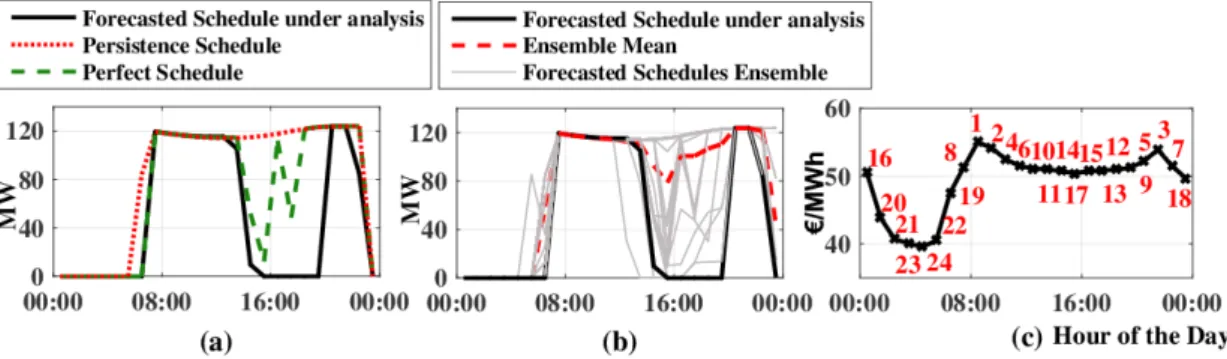
Aiming to consider the full value of probabilistic forecasts, the set of learning parameters was enriched. Table 1 outlines the variables used by the UPP, considering the original deterministic set with one additional variable for the probabilistic approach. The power difference between the forecasted power schedule under analysis ( ) and the mean of all the possible schedules ( ) was added to the set. This parameter (∆ ) describes the position of the forecasted schedule under analysis in relation to the probabilistic set of schedules. A positive value indicates that the scheduled energy in this hour is higher than the average of all ensembles. As an example, the schedule under analysis in Figure 5b was equal to the ensemble mean at 8:00, but underperformed the mean significantly at 16:00. This enables the learning to contemplate the relation of a single scenario among the ensemble: the system tries to learn from historic data if the specific schedule tends to be over or under the mean value. For the deterministic case, this value is always zero, as the mean is equal to the single schedule, and therefore it does not influence the learning in a deterministic application.
Figure 4.Financial profile (a), resource probabilistic forecast (b)—direct normal irradiation, which is the relevant resource for CSP systems—and forecasted (optimized) electricity delivery schedules (c) for two example days.
The main adaptation of the ALFRED strategy in order to accept probabilistic forecasts is performed in the uncertainty post-processing (UPP) algorithm. It treats each delivery hour as a single decision-problem. Accordingly, in a probabilistic approach, each forecasted electricity schedule designed by the optimization algorithm is calibrated individually at each hour. Consideringi=1, 2,
. . .,zandzas the total amount of generated schedules, and the time variabletj, wherej=1, 2,. . .,n andnas the time horizon of the schedule optimization, the variablePforecasti tj
represent the forecasted electricity delivery value given by the optimization algorithm using forecasti. This is the value to be calibrated by the post-processing algorithm. At first, the approach of treating each time step as a different decision problem can be considered physically contradictory. However, by taking decisions based on the benefit/risk of each decision moment, a more pertinent decision can be taken. Also, by calibrating the schedule to be closer to the perfect one, the UPP corrects the schedule to a more real one, which considers energy conservation laws.
The probabilistic UPP algorithm is based on a fuzzy decision tree and involves the two phases (development and implementation) in its application. A new learning parameter set was implemented for the probabilistic approach. Therefore, the training phase and the application phase had to be adapted. In the following, the main differences implemented for the probabilistic approach are explained. The original approach for deterministic forecasts is only given by its rough ideas since the focus of this paper is on the adaptations to handle probabilistic forecasts.
2.2.1. Learning Parameter Inclusion
Aiming to consider the full value of probabilistic forecasts, the set of learning parameters was enriched. Table1outlines the variables used by the UPP, considering the original deterministic set with one additional variable for the probabilistic approach. The power difference between the forecasted power schedule under analysis (Pforecasti ) and the mean of all the possible schedules (Pmean) was added to the set. This parameter (∆Pmeani ) describes the position of the forecasted schedule under analysis in relation to the probabilistic set of schedules. A positive value indicates that the scheduled energy in this hour is higher than the average of all ensembles. As an example, the schedule under analysis in Figure5b was equal to the ensemble mean at 8:00, but underperformed the mean significantly at 16:00. This enables the learning to contemplate the relation of a single scenario among the ensemble:
Energies2020,13, 616 10 of 25
the system tries to learn from historic data if the specific schedule tends to be over or under the mean value. For the deterministic case, this value is always zero, as the mean is equal to the single schedule, and therefore it does not influence the learning in a deterministic application.
Table 1.Description of UPP learning variables for the deterministic and probabilistic approaches.
Variable Description Calculation Deterministic
Approach
Probabilistic Approach Deviation from
ensemble mean
The power difference between the forecasted schedule under analysis
and the mean of the all the possible schedules.
∆Pmean
i =
Pforecasti −
Pmean
Not used Used
Deviation from persistence
schedule
The power difference between the forecasted schedule and the schedule
developed based on a persistence forecast (the benchmark in forecasting,
used when no forecast product is available—it considers that the day tomorrow will be exactly like today).
∆Ppersi =
Pforecast
i −
Ppers
Used Used
Day of the year The number of the day among the year. Used Used
Hour priority
The priority of the hour under analysis according to its market price. Higher price hours have higher priority, in a decreasing order until the lowest price. For hours with same price, higher priority is given to the earlier one, as energy losses are expected to be
avoided if production occurs earlier, and the meteorological forecast is usually more accurate for
prior time instants.
Used Used
Deviation from perfect schedule
The power difference between the forecasted schedule and the schedule developed based on a perfect forecast (ideal forecast that considers weather
observations as the prediction).
∆Pperfi =
Pforecasti −
Pperf
Used Used
The new parameter∆Pmeani together with the other learning parameters were used to train the learning system with past situations. This gives an improved understanding of the schedule’s deviation from the perfect schedule. Figure5presents a graphical explanation of all the learning variables, showing the schedule under analysis, perfect and persistence schedules (Figure5a), the forecasted schedules ensemble (Figure5b), and the hour priority according to the electricity price (Figure5c).
Energies 2020, 13, x FOR PEER REVIEW 10 of 25
Table 1. Description of UPP learning variables for the deterministic and probabilistic approaches.
Variable Description Calculation Deterministic Approach Probabilistic Approach Deviation from ensemble mean
The power difference between the forecasted schedule under analysis and the mean of the all the possible
schedules.
∆ =
− Not used Used
Deviation from persistence
schedule
The power difference between the forecasted schedule and the schedule
developed based on a persistence forecast (the benchmark in forecasting,
used when no forecast product is available—it considers that the day tomorrow will be exactly like today).
∆ =
− Used Used
Day of the
year The number of the day among the year. Used Used
Hour priority
The priority of the hour under analysis according to its market price. Higher price hours have higher priority, in a decreasing order until the lowest price. For hours with same price, higher priority is given to the earlier one, as energy losses are expected to be
avoided if production occurs earlier, and the meteorological forecast is usually more accurate for
prior time instants.
Used Used
Deviation from perfect
schedule
The power difference between the forecasted schedule and the schedule developed based on a perfect forecast (ideal forecast that considers weather
observations as the prediction).
∆ = −
Used Used
The new parameter ∆ together with the other learning parameters were used to train the learning system with past situations. This gives an improved understanding of the schedule’s deviation from the perfect schedule. Figure 5 presents a graphical explanation of all the learning variables, showing the schedule under analysis, perfect and persistence schedules (Figure 5a), the forecasted schedules ensemble (Figure 5b), and the hour priority according to the electricity price (Figure 5c).
Figure 5. Learning parameters explanatory graph: perfect and persistence schedules (a); probabilistic ensemble of possible schedules, ensemble mean and a schedule under analysis (b); expected price and, in red, hour priority (c).
Figure 5.Learning parameters explanatory graph: perfect and persistence schedules (a); probabilistic ensemble of possible schedules, ensemble mean and a schedule under analysis (b); expected price and, in red, hour priority (c).
2.2.2. Adaptation of UPP Development
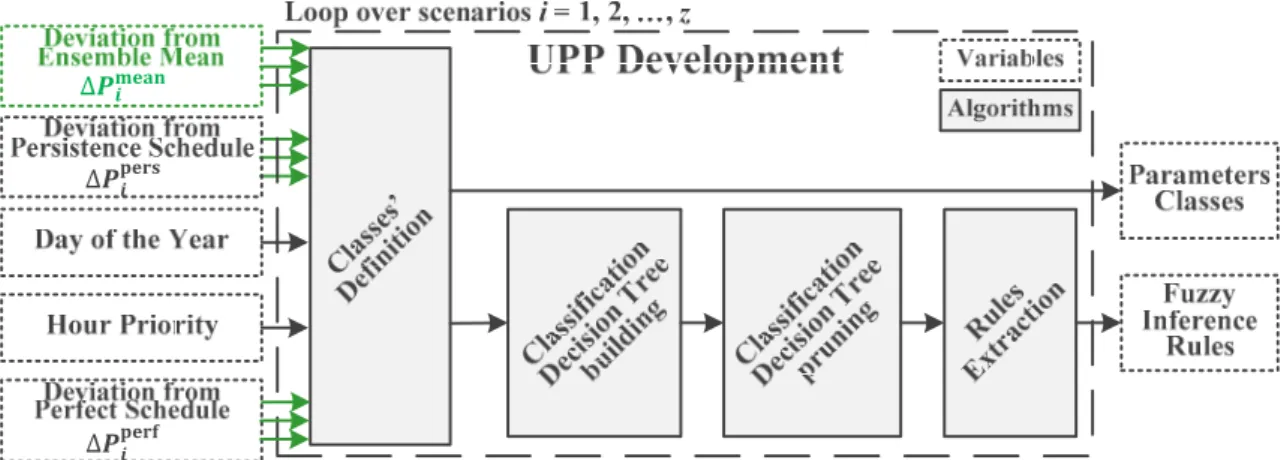
The development phase consisted in the creation of the decision tree and the parameters classes based on a historical data set (also called training set). A scheme of this phase is presented in Figure6. The procedure applied for the probabilistic approach was the same as the original deterministic one. The only new implementation was the inclusion of the extra learning parameter∆Pmeani as an input.
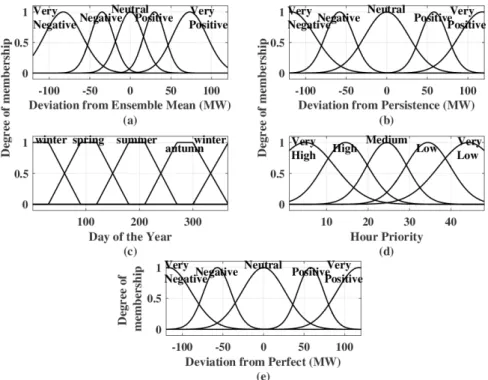
The parameters’ classes are defined in theClasses’ Definitionstep: by fuzzyc-means clustering method for the parametersdeviation from ensemble mean,deviation from persistence schedule,hour priority
anddeviation from perfect schedule, while the classes ofday of the yearare previously defined as the yearly meteorological seasons, in which each season consists of three months. Figure7shows an example of the defined classes for the five parameters. As the learning system is based on a fuzzy approach, all the classes are represented in a fuzzy way, considering that each data point presents a degree of membership for one or more classes, varying from 0 (if the data point does not belong to the class) to 1 (if the data point fully belongs to the class).
Energies 2020, 13, x FOR PEER REVIEW 11 of 25
2.2.2. Adaptation of UPP Development
The development phase consisted in the creation of the decision tree and the parameters classes based on a historical data set (also called training set). A scheme of this phase is presented in Figure 6. The procedure applied for the probabilistic approach was the same as the original deterministic one.
The only new implementation was the inclusion of the extra learning parameter ∆ as an input.
The parameters’ classes are defined in the Classes’ Definition step: by fuzzy c-means clustering
method for the parameters deviation from ensemble mean, deviation from persistence schedule, hour priority
and deviation from perfect schedule, while the classes of day of the year are previously defined as the yearly meteorological seasons, in which each season consists of three months. Figure 7 shows an example of the defined classes for the five parameters. As the learning system is based on a fuzzy approach, all the classes are represented in a fuzzy way, considering that each data point presents a degree of membership for one or more classes, varying from 0 (if the data point does not belong to the class) to 1 (if the data point fully belongs to the class).
Figure 6. Uncertainty post-processing development scheme, with the adaptations of the probabilistic approach highlighted in green.
The Classification Decision Tree Building step designed the decision tree according to the CART
(Classification and Regression Tree) method developed by [35]. It operates based on a recursive partitioning approach, which subsequently divides the data into smaller portions to isolate most important variables. Considering the training data set, each data point is classified according to the previously defined clusters in order to build the tree, selecting each split (represented by the tree node) aiming for more “purity” of the data from the descendant subsets. The goal is to build a tree
that provides as result the deviation from perfect schedule, considering the other four parameters as a
basis for reaching a value for this selected parameter.
∆
∆
∆
Figure 6.Uncertainty post-processing development scheme, with the adaptations of the probabilistic approach highlighted in green.
TheClassification Decision Tree Buildingstep designed the decision tree according to the CART (Classification and Regression Tree) method developed by [35]. It operates based on a recursive partitioning approach, which subsequently divides the data into smaller portions to isolate most important variables. Considering the training data set, each data point is classified according to the previously defined clusters in order to build the tree, selecting each split (represented by the tree node) aiming for more “purity” of the data from the descendant subsets. The goal is to build a tree that provides as result thedeviation from perfect schedule, considering the other four parameters as a basis for reaching a value for this selected parameter.
Energies2020,13, 616 12 of 25
Energies 2020, 13, x FOR PEER REVIEW 12 of 25
Figure 7. Example of classes’ definition for the parameters deviation from ensemble mean (a), deviation from persistence (b), day of the year (c), hour priority (d) and deviation from perfect (e).
The tree building initially results in a very large tree, which is very complex and exact for the training data. However, this does not mean that it will be the best to deal with unseen data and make new predictions. More robust results can be achieved if the tree is reduced to a more accurate and condensed one. The Classification Decision Tree Pruning step reduces the original tree into an appropriate size, by cross-validation.
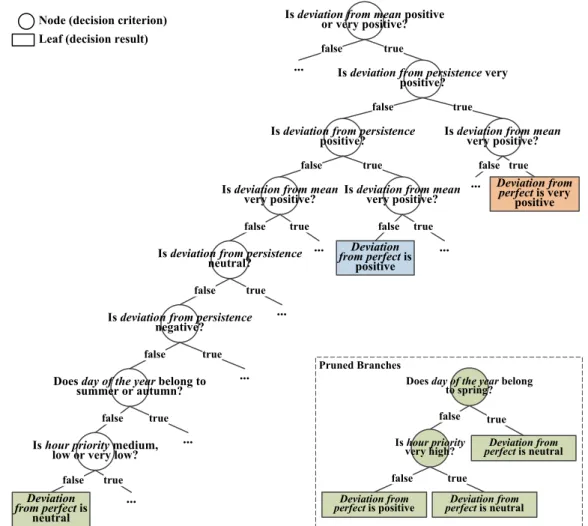
Figure 8 outlines an example of such a decision tree. Considering the classes previously defined in Figure 7, a branch which has been pruned is shown in green. Aiming for a light understanding of the pruning process, not all branches of the built tree are shown, describing with “…” the omitted branches. In this example, as a first decision criterion (first tree node), deviation from ensemble mean was analyzed. If the value under analysis is classified as positive or very positive, the evaluation continues to the right branch. Then, following the branch for the case that all other decision criteria are defined as false, a decision result is reached: deviation from perfect is expected to be neutral. This leaf is the result of cross-validation applied to all branches outlined in the detail in green. In the unpruned tree, although two other decision criteria are taken into account, the majority of leaves result in a neutral deviation from perfect. In the given example, only one leaf resulted in positive expected deviation from perfect. Therefore, by the application of the pruning method, the simplification taken for this final branch is considered to be more effective than the more detailed evaluation, with low probabilities of reaching a different result.
Figure 7.Example of classes’ definition for the parameters deviation from ensemble mean (a), deviation from persistence (b), day of the year (c), hour priority (d) and deviation from perfect (e).
The tree building initially results in a very large tree, which is very complex and exact for the training data. However, this does not mean that it will be the best to deal with unseen data and make new predictions. More robust results can be achieved if the tree is reduced to a more accurate and condensed one. TheClassification Decision Tree Pruningstep reduces the original tree into an appropriate size, by cross-validation.
Figure8outlines an example of such a decision tree. Considering the classes previously defined in Figure7, a branch which has been pruned is shown in green. Aiming for a light understanding of the pruning process, not all branches of the built tree are shown, describing with “. . . ” the omitted branches. In this example, as a first decision criterion (first tree node), deviation from ensemble mean was analyzed. If the value under analysis is classified as positive or very positive, the evaluation continues to the right branch. Then, following the branch for the case that all other decision criteria are defined as false, a decision result is reached: deviation from perfect is expected to be neutral. This leaf is the result of cross-validation applied to all branches outlined in the detail in green. In the unpruned tree, although two other decision criteria are taken into account, the majority of leaves result in a neutral deviation from perfect. In the given example, only one leaf resulted in positive expected deviation from perfect. Therefore, by the application of the pruning method, the simplification taken for this final branch is considered to be more effective than the more detailed evaluation, with low probabilities of reaching a different result.
Energies 2020, 13, x FOR PEER REVIEW 13 of 25
Figure 8. Some branches of an example decision tree. The leaf, in green, is the result of the pruning process and the pruned branches are outlined in detail.
The last step of UPP development consists of Rules Extraction, which extract rules from the developed tree by interpreting the decision nodes. A rule extraction example is outlined, based on the branches represented in Figure 8. Rules 1, 2, and 3 result in the green, blue, and orange leaves, respectively, and are interpreted as the following:
Rule 1 If deviation from ensemble mean is positive AND deviation from persistence is very negative AND day of the year belongs to spring or winter AND hour priority is high or very high, THEN deviation from perfect is neutral.
Rule 2 If deviation from ensemble mean is positive AND deviation from persistence is positive, THEN deviation from perfect is positive.
Rule 3 If deviation from ensemble mean is very positive AND deviation from persistence is very positive, THEN deviation from perfect is very positive.
Notice that in order to reach a result, not all parameters have to be taken into account. Rule 1 expresses a branch in which all the four input parameters are considered, however, the branches translated in rules 2 and 3 already reach a leaf only by the analysis of two input parameter classes. Moreover, the parameter deviation from ensemble mean comes as the top node of the example tree. This means that this newly introduced parameter for the ensemble forecasts is assigned high relevance for the classification of new data. The fact that this parameter appears as the top node indicates the value of information brought by the probabilistic sets. With the rules extracted as shown, the UPP with the new probabilistic functionality is ready to be implemented.
false true false true false true false true false true false Deviation from perfect is neutral
Is deviation from mean
very positive?
Is deviation from persistence
neutral?
Is deviation from persistence
negative?
Does day of the year belong to summer or autumn?
Is hour priority medium, low or very low?
... ... ... ... ... false true false ... true true ... false Deviation from perfect is positive false ... true Deviation from perfect is very positive true Deviation from perfect is neutral Deviation from perfect is positive true false true false Deviation from perfect is neutral Does day of the year belong
to spring?
Is hour priority
very high? Pruned Branches
Node (decision criterion) Leaf (decision result)
Is deviation from persistence very positive?
Is deviation from mean positive or very positive?
Is deviation from mean
very positive? Is deviation from persistence
positive?
Is deviation from mean
very positive?
Figure 8.Some branches of an example decision tree. The leaf, in green, is the result of the pruning process and the pruned branches are outlined in detail.
The last step of UPP development consists ofRules Extraction, which extract rules from the developed tree by interpreting the decision nodes. A rule extraction example is outlined, based on the branches represented in Figure8. Rules 1, 2, and 3 result in the green, blue, and orange leaves, respectively, and are interpreted as the following:
Rule 1 Ifdeviation from ensemble meanis positive ANDdeviation from persistenceis very negative AND
day of the yearbelongs to spring or winter ANDhour priorityis high or very high, THENdeviation from perfectis neutral.
Rule 2 Ifdeviation from ensemble meanis positive ANDdeviation from persistenceis positive, THEN
deviation from perfectis positive.
Rule 3 Ifdeviation from ensemble meanis very positive ANDdeviation from persistenceis very positive, THENdeviation from perfectis very positive.
Notice that in order to reach a result, not all parameters have to be taken into account. Rule 1 expresses a branch in which all the four input parameters are considered, however, the branches translated in rules 2 and 3 already reach a leaf only by the analysis of two input parameter classes. Moreover, the parameterdeviation from ensemble mean comes as the top node of the example tree. This means that this newly introduced parameter for the ensemble forecasts is assigned high relevance for the classification of new data. The fact that this parameter appears as the top node indicates the value of information brought by the probabilistic sets. With the rules extracted as shown, the UPP with the new probabilistic functionality is ready to be implemented.
Energies2020,13, 616 14 of 25
2.2.3. Adaptation of UPP Implementation
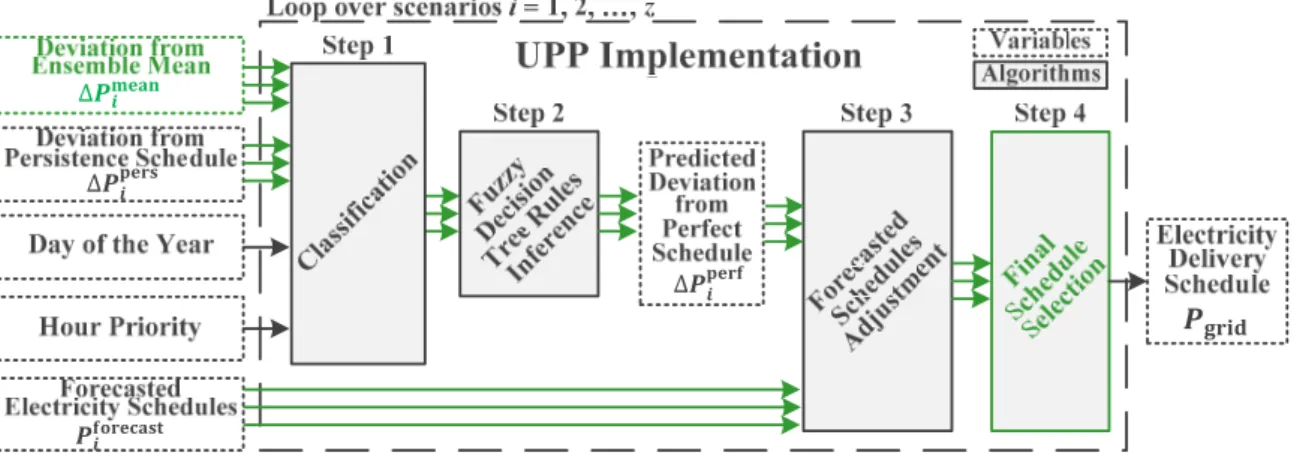
UPP implementation applies the learning system developed by the training phase to determine the final electricity delivery schedule. A scheme of the implementation phase is presented in Figure9. The parametersdeviation from ensemble mean, deviation from persistence schedule, day of the yearand
hour priorityare used as input from the current forecast, while thedeviation from perfect scheduleis the resulting output of the learning system. This deviation evaluated for each schedule of the ensemble is then used to adjust the corresponding electricity delivery schedules, aiming to reach schedules as close as possible to the perfect schedule.
Energies 2020, 13, x FOR PEER REVIEW 14 of 25
2.2.3. Adaptation of UPP Implementation
UPP implementation applies the learning system developed by the training phase to determine the final electricity delivery schedule. A scheme of the implementation phase is presented in Figure 9.
The parameters deviation from ensemble mean, deviation from persistence schedule, day of the year and hour
priority are used as input from the current forecast, while the deviation from perfect schedule is the
resulting output of the learning system. This deviation evaluated for each schedule of the ensemble is then used to adjust the corresponding electricity delivery schedules, aiming to reach schedules as close as possible to the perfect schedule.
Figure 9. Uncertainty post-processing implementation scheme, with the adaptations of the probabilistic approach highlighted in green.
As several possible schedules are developed by the optimization algorithm in the probabilistic case, the learning system is applied for every single schedule. Therefore, the result of the learning system is not yet one single final schedule, but still the same quantity of schedules as weather forecast ensemble members. In order to decide on a final schedule, an additional step was implemented in the probabilistic approach.
In the probabilistic implementation, the first three calculation steps (Classification, Fuzzy Decision
Tree Rules Inference, and Forecasted Schedules Adjustment) were performed in the same manner as in
the deterministic approach. In the Classification step, the input learning parameters were classified
according to the fuzzy clusters defined during the training phase. Membership degrees for the defined class were assigned for each parameter. These values were then analyzed in combination
with the rules derived from the decision tree, in the Fuzzy Decision Tree Rules Inference step. The rules
were analyzed and interpreted in a fuzzy way, resulting in the prediction of the difference between the forecasted electricity schedule developed by the optimizer algorithm and the expected perfect forecast schedule (the detailed explanation of rules inference and deffuzification is explained in [20]). In the probabilistic case, this predicted deviation is obtained for each available scenario. This value derived by the rules inference is applied as an adjustment for each forecasted schedule, by the
Forecasted Schedules Adjustment step. Considering i = 1, 2, …, z and z as the total amount of generated
schedules, and the time variable , where j = 1, 2, …, n and n as the time horizon of the schedule
optimization, the following calculation is applied:
( ) = ( ) − ∆ ( ). (1)
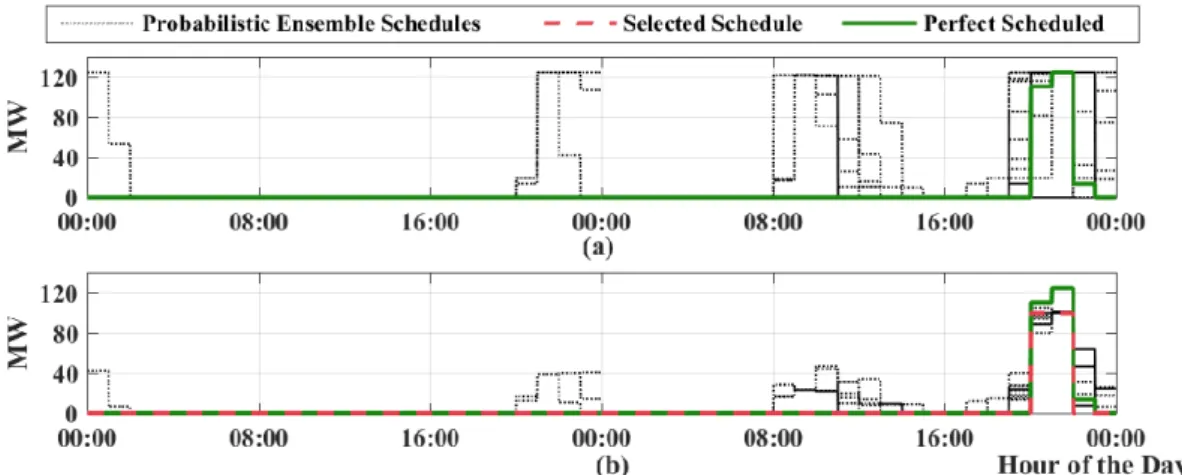
This adjustment performs a calibration of the forecasted schedules, with the expected effect that the selection of a final schedule is then made under a smaller range of variation. Figure 10 shows an example of two-day schedules with and without the UPP adjustment. At Figure 10a, the forecasted probabilistic schedules resulting from the optimization algorithm are outlined, bringing several possibilities of delivery planning which differ quite significantly from a perfect operation. In Figure 10b, the same probabilistic schedules set are shown, but now with the adjustment applied by the UPP.
∆ ∆
∆
Figure 9.Uncertainty post-processing implementation scheme, with the adaptations of the probabilistic approach highlighted in green.
As several possible schedules are developed by the optimization algorithm in the probabilistic case, the learning system is applied for every single schedule. Therefore, the result of the learning system is not yet one single final schedule, but still the same quantity of schedules as weather forecast ensemble members. In order to decide on a final schedule, an additional step was implemented in the probabilistic approach.
In the probabilistic implementation, the first three calculation steps (Classification,Fuzzy Decision Tree Rules Inference,andForecasted Schedules Adjustment) were performed in the same manner as in the deterministic approach. In theClassificationstep, the input learning parameters were classified according to the fuzzy clusters defined during the training phase. Membership degrees for the defined class were assigned for each parameter. These values were then analyzed in combination with the rules derived from the decision tree, in theFuzzy Decision Tree Rules Inferencestep. The rules were analyzed and interpreted in a fuzzy way, resulting in the prediction of the difference between the forecasted electricity schedule developed by the optimizer algorithm and the expected perfect forecast schedule (the detailed explanation of rules inference and deffuzification is explained in [20]). In the probabilistic case, this predicted deviation is obtained for each available scenario. This value derived by the rules inference is applied as an adjustment for each forecasted schedule, by theForecasted Schedules Adjustmentstep. Consideringi=1, 2,. . .,zandzas the total amount of generated schedules, and the time variabletj, wherej=1, 2,. . . ,nandnas the time horizon of the schedule optimization, the following calculation is applied:
Padjustedi (tj) =Pforecastedi (tj)−∆P perf
i (tj). (1)
This adjustment performs a calibration of the forecasted schedules, with the expected effect that the selection of a final schedule is then made under a smaller range of variation. Figure10 shows an example of two-day schedules with and without the UPP adjustment. At Figure10a, the forecasted probabilistic schedules resulting from the optimization algorithm are outlined, bringing several possibilities of delivery planning which differ quite significantly from a perfect operation.