Procedia Engineering 29 (2012) 3424 – 3428 1877-7058 © 2011 Published by Elsevier Ltd. doi:10.1016/j.proeng.2012.01.506 Procedia Engineering 00 (2011) 000–000
Procedia
Engineering
www.elsevier.com/locate/procedia2012 International Workshop on Information and Electronics Engineering (IWIEE)
Study on Linkage Mechanism of IDS and Firewall Based on
SNMP Protocol
Yu Yuanhui
a*, Li Yongmei
a, Deng Ying
baSchool of Computer Engineering,Jimei University,Xiamen,361021, P.R. China bXiamen Institute of Technology,Huaqiao University,Xiamen,361021,P.R. China
Abstract
This paper firstly introduces the characteristics of Firewall and Intrusion Detection Systems (IDS) and points out the shortcomings of the Firewall. Then it analyzes the linkage mechanism of Firewall and IDS based on SNMP Protocol, and puts forward a kind of linkage model based on IDS and Firewall. Finally, the effectiveness of the linkage mechanism is verified by the simulation results.
© 2011 Published by Elsevier Ltd. Selection and/or peer-review under responsibility of Harbin University of Science and Technology.
Keyword: SNMP; Firewall; IDS; Linkage Mechanism
1. Introduction
In recent years, the problem of network security becomes more apparent. So how to take effective safety measures to preventing network from hackers, viruses and other harmful intent attackers become more important. Now Firewall is recognized as the main measures to prevent attacks. But in recent years, hacker technology presents some new features: attack process automation, attack tools intelligence, attack behavior diversity, attack organization collectivization and so on, which make the high security level firewall, appear helpless. Because hackers technologies already have some technology to bypass typical firewall configurations, such as IPP (the Internet Printing Protocol), and WebDAV (Web-based Distributed Authoring and Versioning).It is clearly that a single network security measure cannot guarantee the security of network, so build a linkage mechanism of variety of network security products
* Corresponding author. Tel.: +86-1311-0934-966. E-mail address: [email protected].
Open access under CC BY-NC-ND license.
become the inevitable trend of network security technology. Based on this, the linkage mechanism of intrusion detection system (IDS) and firewall based on SNMP is studied, and the simulation experiment has been taken in the campus network environment.
2. Introduction of Firewall
Firewall is the modern digital adapted version of ancient security facility in the middle ages (dig a very deep moat around the Castle) [1].In the modern network environment, a firewall is a buffer between trusted network and incredible network, and it is also a barrier to prevent from attacks from other networks [2].Firewall can be divided into: packet filtering firewall, application-layer proxy, and state inspection firewall. A firewall's basic function is prevent network from unauthorized accessing by filtering and shielding network communications .At present, the firewall is recognized as an effective means to protect network from hackers, but it also has some flaws and shortcomings, which are mainly as follows [3]:
• prevent blind spots;
• information flows are difficult to control flexible; • configure complex;
3. Introduction of IDS
Intrusion Detection is intrusion behavior detection. It checks whether there exists behavior in violation of security policy and signs of being attacked in the network or system by collecting and analyzing network behavior, security logs, audit data, and information can be got form other network or computer system. Intrusion detection system is a collection of detection, records, alarm, response in one of the dynamic security technology, it belongs a proactive security defending tools. The technology used in intrusion detection system can be divided into the signature-based detection and the anomaly detection. Signature-based detection is to assume that the invaders activities can be expressed by a model, the system's goal is to detect whether the main activities are in line with these patterns. Anomaly Detection is to assume that the intruder activity exceptions to normal body activity.
4. Firewall and IDS linkage
Today, there are three methods about IDS (intrusion detection system) and firewall linkage in general: • Embedding linkage method: that is to say intrusion detection system is embedded in the firewall, data
of intrusion detection system source from the data stream flowing through the firewall.
• Open interface linkage method: that is to say firewall or intrusion detection system open an interface for the other to use, the two sides use fixed protocols to communicate, alert, and transmit, complete transmission of network security events.
Port image linkage method: Firewall images specified part of flow in the network to the intrusion detection system, intrusion detection systems inform the final results to firewall after processing, thefirewall modify and adjust its security policy.
5. Linkage Mechanism
SNMP (Simple Network Management Protocol) of IETF is now commonly used in network management. SNMP model is mainly composed of network management station, management node, SNMP Agent. Network management station complete the vast majority of network computing, which is a
typical centralized management mode [4].Its network management structure model showing as the following figure 1:
Fig.1 SNMP Network Management Structure Model
Network management station is the core of the whole system. Management nodes can be any devices which exchange status information with the outside world such as hosts, routers, printers and so on. Management node must be able to run the SNMP Agent to make sure that communication with the network management stations, at the same time SNMP agent also maintains a Local Database, which store the status of the SNMP agent, historical information, and can affect its operation.Based on the above features of SNMP network management structure, we can set MIB variable to store the packet filtering rules and other state variables in advance in the management node, so that SNMP Agent in a management node can read SNMP commands directly, and complete the operation of actual status of the firewall through loading modules. Now there are many developing toolkit of SNMP on the net, the most famous is the open source development kit of NET-SNMP, these development kits provide SNMP Agent under different operating systems such as Windows and Linux, and most support message format of SNMPvl, SNMPv2c (community string-based), SNMPv2u (user-based) and SNMPv3 protocol .After the SNMP interface implementation, the firewall can use this to communicate with the IDS. When hacker intrusion from external network, it firstly bypass firewall, part intrusion is excluded for violating the rules of safety of firewall, but there may be part of intrusion will bypass firewall or even attack from internal network customers will pass through the firewall. These attacks although escaped but are examined by IDS, and after the suspected data packets are sorted by the pre-treatment module, they are sent to the corresponding module to further examination.IDS discover some data packets correspond to some attack features in the rule library by scanning the rule-tree, and cut off the IP access request immediately or alarm, and sent SNMP command to the firewall to add or modify new security rules. Then firewall sends out the corresponding SNMP response signal to IDS to inform whether the modification of firewall rules is successful. The Linkage model of IDS and Firewall as shown in Figure 2.
6. Firewall and IDS linkage experiment
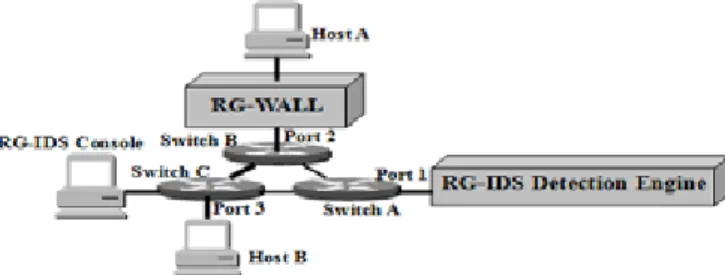
The experiment uses RG-IDS intrusion detection system and RG-WALL firewall which belong to the series security products of Ruijie networks. RG-IDS adopt multi-tier distributed architecture which is composed of five parts of the program components: console, EC (event collector), Log Server (data server) and Sensor (sensor), report and query tool. RG-IDS adopt State-based application layer protocol analysis technology to improve the efficiency and accuracy of detection greatly. RG-WALL is designed by the original classification algorithm of Ruijie networks, supports extended state inspection technology, has high-performance network transport functions; At the same time RG-WALL can provide a strong security channel when dynamic port applications (such as VoIP, H323, and so on) are enable. Linkage simulation experiment respectively arranges RG-WALL (RG-WALL is set to transparent pattern)、RG-IDS inspection engine and RG-IDS console on the laboratory exports, configure 3 switch A、 B、 C, switch B and C all support port mirroring feature among them. Flowing through network port 2 of switch B and network port 3 of switch C all mirrors to network port 1 of switch A. Host A simulates intruders to attack host B, RG-IDS detection engine is responsible for detecting network attacks and malicious traffic, and then communicates with RG-WALL by SSH, sends attacking source address, destination address, source port, destination port, protocol, and other information to RG-WALL, RG-WALL takes appropriate blocking measures based on these information to block the attack outside the network for the full protection of network security. The RG-IDS and RG-WALL firewall Linkage topology is shown in Figure 3 below:
Fig.3 RG-IDS and RG-WALL linkage topology structure
The IP address setting of each network component in laboratory is shown in the following table: Table 1. IP address allocation schedule
Network Components Name Network IP Address RG-IDS Detection Engine 192.168.1.100
RG-IDS Console 192.168.1.101
Host A(Intruder) 192.168.1.102
Host B(Victim) 192.168.1.103
RG-IDS Detection Engine 192.168.1.100
Experimental simulation: host A (intruders) sends text "Ping You Death! ” of ICMP messages to host B (victim) , IDS detects message and sends event information to RG-WALL by SSH, RG-WALL automatically generates a response rule according to attacking information from RG-IDS to block the communication between host A and B. Effect is shown in Figure 4. RG-WALL will writes filtering rule
to block the communication between host A and B into the security rules table after receiving an attack event information from RG-IDS, RG-WALL blocking rules are shown in Figure 5:
Fig.4 ICMP messages are sent failure
Fig.5 RG-WALL blocking rule table
The connection will return fail after host A tries to reconnect host B.From the above simulation we can safely draw a conclusion that security mechanism of network firewall and intrusion detection linkage can make up the deficiency of firewall and improve network security to some extent.
7. Conclusion
It has positive signification in improving network security when adopted the Linkage security mechanisms between IDS and Firewall. But this mechanism is not perfect, in which the security of information transmission channels is critical. In the area of product safety policy rules there is lack of uniform standard in Firewall and IDS, How to select the time to balance Firewall and IDS load remains to be resolved. Because security is always relative. If a user ping server continuously for more than 10 minutes, and how can IDS determine whether the user’s behavior is a malicious attack or actevolontaire.It also needs subjective judgment of the administrator and security requirements of the network to determine how to deal with. After all various kinds of safety products such as the network security and people, firewall, IDS, etc. is closely related, ignore either of these factors can cause threat to network security.
References
[1] A. K. Jain, R. P. W. Duin, and J. Mao, Statistical pattern recognition: a review, IEEE Trans. On Pattern Analysis and Machine Intelligence, 22 (2000) 4–37.
[2] J. liu, and K. C. Chang, Feature-based target recognition with Bayesian inference, Optical engineering, 35 (1996) 701–707. [3] F. Delmotte, P. Smets, Target identification based on the transferable belief model interpretation of Dempster-Shafer model, IEEE Trans. On Systems, Man, and Cybernetics - Part A: Systems and Humans, 34 (2004) 457–471.
[4] H. Leung, J. Wu, Bayesian and Dempster-Shafer target identification for radar surveillance, IEEE Trans. on Aerospace and Electronic Systems, 36(2000): 432–447.