PAPER • OPEN ACCESS
Evaluation of properties on performance and emission to turbocharged
SI engine using fusel oil blend with gasoline
To cite this article: S M Rosdia et al 2019 IOP Conf. Ser.: Mater. Sci. Eng. 469 012113
Content from this work may be used under the terms of theCreative Commons Attribution 3.0 licence. Any further distribution of this work must maintain attribution to the author(s) and the title of the work, journal citation and DOI.
Published under licence by IOP Publishing Ltd 1
Evaluation of properties on performance and emission to
turbocharged SI engine using fusel oil blend with gasoline
SM Rosdia, R Mamata,c, A Azri a , K Sudhakar a,b,c, IM Yusri a
a Faculty of Mechanical Engineering, Universiti Malaysia Pahang, 26600 Pahang, Malaysia
b Energy Centre, Maulana Azad National Institute of Technology Bhopal, M.P., India c Automotive Engineering Center, Universiti Malaysia Pahang, 26600 Pekan, Pahang, Malaysia
Corresponding author: [email protected]
Abstract. Biofuel has the potential to be used as an alternative fuel compared to petroleum gasoline for the purpose increase performance and reducing emissions. The objective of the study is to evaluate performance and emission on properties of 10–30% fusel oil blends with pure gasoline (Ron 95) at 3000 rpm. In this experiment, three fuels were designed from fusel oil to test engine performance and emission. The haltech ECU was an escalation to set ignition, injection timing and injection mass when using fusel oil blends to reach stoichiometric level. In this study, pure gasoline was set as a reference. The experiments were conducted on 1.8L turbocharged 4-cylinder, spark ignition engine, port injection and coupled with 100 kW eddy current dynamometer. During engine testing, the throttle position was applied to 10–40%. As a result, averaged BMEP increase at 11.9%, 17.8% and 21.3% for F10, F20 and F30 respectively compared to gasoline. The VE and BSFC averaged increased 8.3% and 6.17% compared to pure gasoline for 10–40% engine load. The emissions for CO and HC on these observations increased while the NOx decreased when fusel oil blends were utilized. The recommendation used in study is low proportion blends to assess different properties for engine test.
1. Introduction
Nowadays in order to reduce emissions and increase efficiency, engines are designed to downsize and use supercharge/turbocharge. The main challenge for completing the desired fuel economy in optimizing the design and control of the fuel system, engine boosting system, and engine component is the reduction of compartment damage resulting from engine knocking [1]. In the review, gasoline engine downsizing and turbocharging has shown to improve fuel economy by 10~20% in passenger vehicles [2]. Data from a wide range of production vehicles also were compared to provide a comparison to demonstrate fuel consumption reduction of 16–18% [3] using a turbocharger engine.
Biofuel has a higher octane number, an excessive content of oxygen in material as compared to pure gasoline and their single boiling factor cause them to be appropriate for use in SI engine [4][5]. Blends biofuel also lower HRR due to the single boiling. The main reason for this is due to having one type of hydrocarbon [6][7]. The heating value or calorific value is believed to be one of the crucial parameters in the combustion process of biofuel. The heating value of alternative fuel and mainly alcohols is anticipated to be approximately 20-30% lower than that of fossil providing one of the big demanding situations to making use of it in internal combustion engines [8]. The engine utilizes biofuel needs slight modification injection timing and mass to maintain performance due to the oxygen and water content. Fuel
with a better octane rating will preserve higher compression quantitative relation previous the engine knocking, consequently giving the engine an potential to power in greater efficiently [9].
Recently, fusel oil is alcohol by-product of after fermentation at some stage in the distillation technique [10]–[12]. Fusel has the imaginative and prescient of being an alternative fuel blend in internal combustion engine [13]. The composition of the fusel oil depends on the type of carbon used in the alcohol fermentation, the process of fermentation, the activity process, and decomposition process [14]–[16]. Moreover, biofuel burns cleanser than crude oil and convey lesser CO and HC. The heat of vaporization in biofuel is great; as a consequence, the peak temperature within the combustion chamber leading to decrease NOx emissions and improved performance. However, the utilized 100% biofuel to the engine due to performance worsen or rusty to component and part due to water content.
Calam et al. [17] was investigated low proportion blends, spark ignition engine, port injection, single cylinder using gasoline and Fusel oil blends (F0, F10, F20 and F30). In general, the engine performance increased when used the Fusel oil as additive or blends in gasoline engine. Calam et al. mention the oxygen content was one of reason the performance increased due to lean combustion occur in cylinder combustion when engine use Fusel oil blends. The engine performance shown increased by 4.8%, 1.8% and 1.5% respectively for F10, F20 and F30 compared to the F0 (gasoline).
Thus, Solmaz [18] study 100% and 50% fusel oil blends and mention that water content and lower heating value is another impediment of engine performance drop. The engine performance average reduce 6% and 2% for F100 and F50 when fusel oil were used. Solmaz conclude that fusel oil increase Flame development and Flame propagation due to properties of Fusel oil. The emission of CO and HC increased to 21% and 25% respectively. Then the NOx emission decreased about 31% cause the worse combustion in engine cylinder.
In this study, pure gasoline as a reference has been blended with fusel oil at concentrations of 10%, 20% and 30%. The objective of experiments that were carried out tested the engine performance and emission of different fuel properties. In an experiment scoop , the engine speed was run at 3000 rpm and 10–40% throttle position. Then the Haltech ECU was utilized to set the ignition and injection mass to calibrate according to the physicochemical properties. The adjustment timing is gap in this research was used as novel to avoid ignition delay, find optimization efficiency and repair aggravated combustion by water content during engine testing. The novel procedure of using ECU programmable to retune the performance and emission correlation between the timing of ignition and injection mass of fuel has been implemented. The
2. Experimental Setup
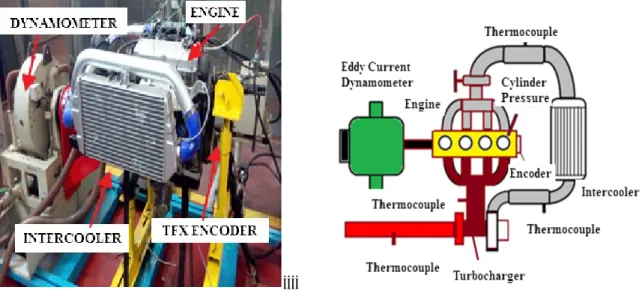
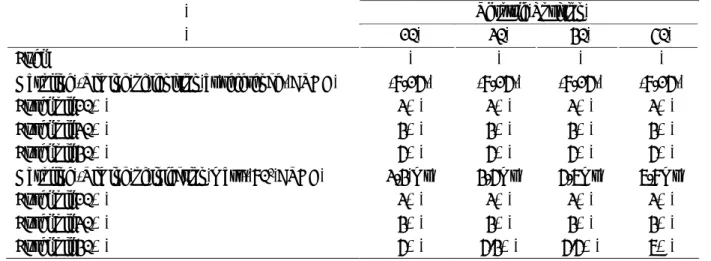
The turbocharged engine was tested using the 1.8L single overhead cam, four cylinders and port injection. Table 1 shows the engine specifications for this study. The engine using 81mm piston bore and 89mm stroke length to produce 88 kW engine power and 159Nm maximum torque. The Haltech ECU was utilized to manage ignition and injection mass at stoichiometric levels. Figure 1 shown the diagram and schematic diagram for engine setup. The injector will trigger the signal at 70° BTDC in millisecond (ms) before the intake valve opens during the end of the exhaust stroke and early suction stroke. Fuel consumption was occupied using AIC fuel flow rate meter with accuracy of 1% reading. Table 2 shown the all fuels properties. Table 3 shown matrix for engine spark timing and injection mass trigger time and spray.
2.1. Fuel
Initially the engine was tested using gasoline. It is used as guide and reference for performance and emission of other fuel blends. The following three fuel blends were used is F10, F20 and F30 as 10%, 20% and 30% respectively blends with gasoline. The blending fusel oil limit to 30% is due to this fuel has higher water content and aggravated combustion. In the experiment setup, two tanks were used; One of tank uses gasoline and another one uses blended fuel tank. The experimental test on each fuel was carried out for an hour. Prior to using of new blends fuel, engine was flushed with gasoline for around 10-15 minute in pipe line to fill up new fuel. A 12 volt inline pump was used to supply fuel from tank to delivery valve. The pressure
3
used in the delivery fuel system is around 35 Psi and was controlled by fuel regulator. The flexible pipe line was use to deliver all kind of fuel to system fuel.
2.2. Dynamometer
The engine was coupled with an eddy-current 100 kW dynamometer to measure the torque and rated speed of engine. Figure 1 shows the dynamometer used in the experiment coupled with engine. The tests were performed on the dynamometer while running the engine at 3000 RPM and 10-40% engine throttle position. The dynamometer also has water cooling tower to reduce high temperature by using adjustment valve to regulate the water flow to stable at 70o-80o C. Two hose was connected at dynamometer and cooling tower: 1) Water inlet 2) Water outlet.
2.3. Emission
Engine emission is major part of this experimental study. Exhaust emission evaluated by KANE Autoplus 5-2 for measuring NOx, HC and CO emission. To precisely measure stoichiometric levels, every fuel metering by the Dynojet brand wide band was utilized. The exhaust emissions of three blending fuel are compared with gasoline at 3000 rpm engine speeds and 10-40% throttle position. All emission results were taken from the tail end of exhaust pipe three time with average.
2.4.Cylinder pressure
Pressure in cylinder and the crank encoder data were recorded by using TFX combustion analyzer software. An Optrand Auto PSI-S model fiber-optic and an optical shaft encoder were installed to monitor the cylinder pressure and crank angle. The pressure sensor measures the pressure with a range of 0–200 bar and 1.12 mV-psi sensitivity. When engine rotation reaches 2000 RPM, the turbocharge increase the boost pressure by supplying more air in the intake manifold. The air passing through the combustion chamber was metered by air flow meter.
Table 1. The 4G93 SOHC engine specifications. Type In-line SOHC 16 V MPI Number of cylinders 4
Combustion of Chambers Pentroof Type Total displacement 1834 cc Cylinder bore (mm) 81 Piston stroke (mm) 89 Compression ratio Maximum output Maximum torque 9.5:1 88kW(120Ps;118bhp) 159Nm (117 ft lbt)
Table 2. Properties pure gasoline and fusel oil blends [17]
Table 3. Matrix test of ignition timing and injection mass for fusel oil at engine speed 3000 rpm
Throttle Position
10 20 30 40
Fuel
Gasoline (Timing of ignition as reference) BTDC (7-15) (7-15) (7-15) (7-15)
Fusel oil 10% 2% 2% 2% 2%
Fusel oil 20% 3% 3% 3% 3%
Fusel oil 30% 5% 5% 5% 5%
Gasoline (Timing of injection mass) 700 BTDC 2-3 ms 3-5ms 5-6ms 6-7ms
Fusel oil 10% 2% 2% 2% 2%
Fusel oil 20% 3% 3% 3% 3%
Fusel oil 30% 5% 5.3% 5.5% 6%
3. Results and discussion
3.1. Brake mean effective pressure (BMEP)
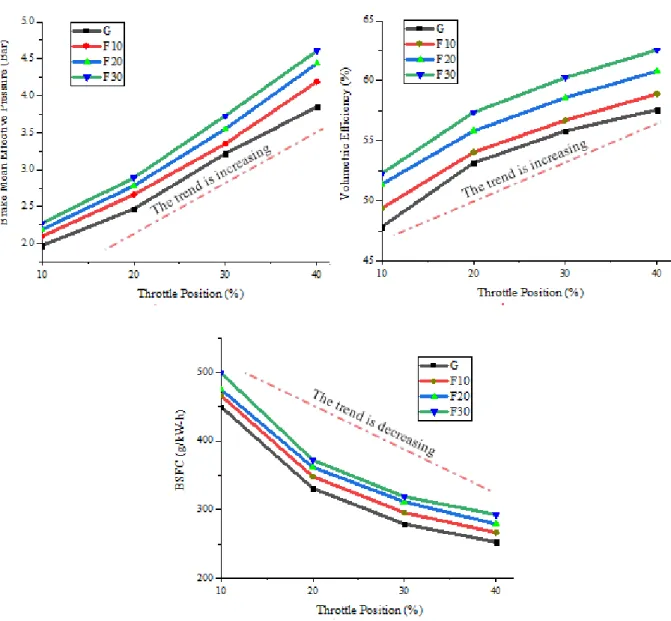
The BMEP is a parameter that reflects the engine power output. Figure 2shows the variation of BMEP for engine study with engine speed of 3000 rpm and throttle positions at 10–40% using pure gasoline and fusel oil blends. At 10% throttle position, the BMEP reached average at 4.7-13.0% for all fuels and linearly increased until at 40% throttle position. From the observation, the BMEP for all fuel blends increased when fusel oil increased compared to pure gasoline. The BMEP increased as the ECU increased ignition at 2-5% compared to gasoline and injection mass 2-6% compared to gasoline then the engine was quite stable during the test. As the result, complete combustion shows in improving the BMEP when the energy of the fusel oil was equivalent to that of the replaced gasoline fuel [19]. Similar results was founded by Solmaz [18]
Properties Gasoline Pure Fusel Fusel 10% Fusel 20% Fusel 30% Test method Density (kg/m3) 754 847 755 761 768 D4052 Stoichiometry 14.7 9.65 14.19 13.69 13.18 Ratio
RON 95 106.85 97.85 97.89 98.3 D2699
Lower heating value 43.5 29.5 42.6 42.1 41.7 D 240 Freezing point (°C) -52 < -50 < -50 < -50 < -50 D 6749
5
mentioned that if the optimized ignition timing is determined for fusel oil, a better performance results may achieved.
3.2. Volumetric efficiency (VE)
Figure 2. BMEP, VE and BSFC versus throttle position at 3000 rpm engine speed.
Figure 2 shows the VE versus throttle position 10–40% for all fuel tests at 3000 rpm engine speed. The VE was increased when fusel oil blends was utilized. The test had shown VE blending of fusel oil increased between 4-11% and 8-13.8% at 10% and 40% throttle position, respectively compared to the gasoline.Fusel oil has higher octane number than gasoline thus it can lead to operation at higher compression ratios therefore improvement in power output and efficiency [20]. Furthermore, it has high latent heat of vaporization. To increase engine performance, the mass of fuel must increase more spray to achieve engine power. As a consequence, effect of lower calorific value and high latent heat of vaporization, engine volumetric efficiency may increase BSFC to maintain power of engine [19].Again, the engine utilized alcohol fuel allows more air into the cylinder, which increases the VE. The intake manifold decrease
temperature due to allow more fuel injection into the chamber. Hence, the maximum brake torque and volumetric efficiency show increase trends [21].
3.3. Brake specific fuel consumption (BSFC)
The effect of BSFC on engine testing obtained with pure gasoline, and fusel oil blends labeled as F10, F20 and F30 at 3000 rpm are shown in Figure 2. More fuel must be sprayed into the same amount of air when fusel oil is used compared to pure gasoline to maintain the engine performance. All fuel blends from fusel oil lead to increase in specific fuel consumption due to the lower stoichiometry number compared to gasoline [20]. The high viscosity and density of Fusel oil is due to the obstruction of vaporization and atomization of fuel and deterioration of the combustion process leading to increase in fuel consumption at all loads. Despite incrising the mass of fuel, it is promising that the specific fuel consumption decreased with the increase of throttle position, for all test fuels. The lower calorific heat values of the test fuels obtained by adding fusel oil into gasoline is lower than that of pure gasoline led to increased BSFC. The lower calorific value of fusel oil is almost 30% that of pure gasoline and difference due to chemical composition [13][15].
3.4. Emission
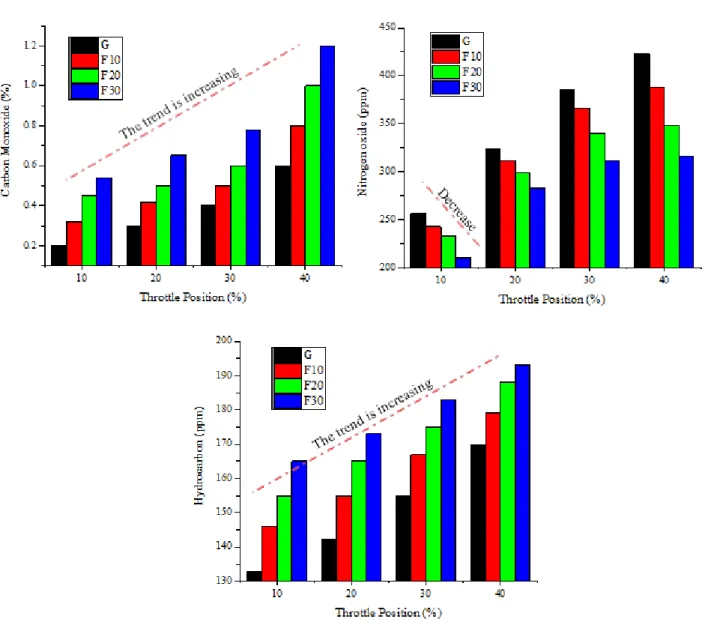
3.4.1. Carbon Monoxide (CO). Figure 3 shows the CO with concentrations of gasoline, F10, F20 and F30 versus throttle positions at 3000 rpm. CO is a product of incomplete combustion and is mainly produced in flame quenching regions[24]. The CO increases when engine utilized fusel oil blends compared to pure gasoline. The formation of the CO at low loads reaches between 0.3–0.5%. When utilizing engine at higher loads, the formation of CO was between 0.8–1.0% due to cooling in-cylinder temperature that are very close to each other. The rich combustion invariably higher CO and result incomplete combustion [25]. The CO emission escalated despite engine running at stoichiometric conditions for all fuels due to in-cylinder temperature that decreased at lower loads. CO emissions are extremely influenced by the combustion temperature in the cylinder and the homogenization of AFR [24].
7
Figure 3. Carbon monoxide, Nitrogen oxide and Hydrocarbon versus throttle position at 3000 rpm.
3.4.2. Nitrogen Oxide (NOx). Figure 3 shows the NOx for blending fuel between pure gasoline, F10 F20 and F30 at 3000 rpm. The testing showed that the NOx decreased when concentration of blends increased compared to pure gasoline. At low throttle positions, the NOx yielded 8.6-19.2% and are close to each other due to ignition timing and injection timing and increment of only 2% mass. When engine reached higher loads, the NOx reaches 8.3-25%. The higher heat of vaporization of the fusel oil causes the decrease in combustion temperature. Similar results were found by Balki et al. [26] with NOx also reducing when using alcohol fuel for their SI engine study. When engine use the alcohol fuel, the cylinder temperature reduce will reduce the emission of NOx [27].
3.4.3. Hydrocarbon (HC). Figure 3 shows the variation of HC using gasoline blends with fusel oil of 10– 30% concentration at 3000 rpm. From observation, the emissions of HC increased linearly when using fusel oil blends compared to pure gasoline. At low loads, the engine produced between 8.3-19.4% of HC while at higher loads, the engine yields 5.5-11.9% of HC. The increase of HC is due to the higher oxygen content of fusel oil, which leads to a more complete and cleaner combustion, thereby increasing HC emissions.
Another reason for higher HC is the engine running at slightly higher mixtures and richer conditions (stoichiometry) to maintain engine performance with pure gasoline. In general, the hydrocarbons in the exhaust are mainly affected by three mechanisms: (a) misfiring or incomplete combustion, which occurs in highly rich or lean AFR, (b) flame quenching effects, which takes place near the combustion chamber surface area or clearance and (c) deposits or oil membranes, which absorb fuel [28]. The higher emission of HC is either low temperature or inadequate oxygen in cylinder combustion or fuel rich mixture [29].
4. Conclusion
In this study, the pure gasoline and fusel oil mixtures have been tested in four-cylinder SI engines under stoichiometric conditions using programmable ECU to increase ignition, injection timing and injection mass. The engine Mitsubishi 1.8L was utilized at 3000 rpm and 10–40% throttle positions. Considering the experimental results, it is possible to draw the following conclusions: 1. The present work demonstrates that the use of fusel oil blends will marginally increase the BMEP compared to pure gasoline due to an increased ignition and injection timing at 3–5% to reach stoichiometry. 2. The engine showed VE of all fusel oil blends increases in concentration compared to pure gasoline due to calibration according the physicochemical properties of fusel oil blends and to preserve the engine performance.
3. The BSFC increased at all engine loads in a wide range compared to pure gasoline due to higher density, lower heating values and higher latent heat of evaporation of fusel oil.
4. The physicochemical properties of fusel oil blends such as the lower heating value, latent heat of vaporization, water content, oxygen content, laminar flame velocity, etc. dominated the NOx, CO and HC formation in the spark ignition engine.
5. The ignition timing average was increased 10-30% compared to gasoline and parallel increase the flame development and flame propagation to increase the engine performance. While injection mass average was increased to 6-10% compared to gasoline for maintain engine performance.
6.The engine emission average was increase for CO and HC at 60% and 20% respectively compared to gasoline. While Nox reduce dramatically when engine used the Fusel oil due to higher water content and reduce the cylinder temperature average at 19% compared to gasoline.
Acknowledgements
The financial support offered by the Universiti Malaysia Pahang under RDU150369, RDU180391 and RDU150124 is gratefully acknowledged.
References
[1] M. Canova, M. Naddeo, Y. Liu, J. Zhou, and Y. Wang, “A Scalable Modeling Approach for the Simulation and Design Optimization of Automotive Turbochargers,” pp. 1616–1628, 2015. [2] S. M. Shahed and K.-H. Bauer, “Parametric Studies of the Impact of Turbocharging on Gasoline
Engine Downsizing,” SAE Int. J. Engines, vol. 2, no. 1, pp. 1347–1358, 2009.
[3] J. K. Woodard, G. E. Johnson, and R. L. Lott, “Minimum Fuel Consumption Design of a Charged V-6 Engine,” J. Mech. Transm. Autom. Des., vol. 111, no. 3, p. 389, 1989.
[4] M. K. Balki and C. Sayin, “The effect of compression ratio on the performance, emissions and combustion of an SI (spark ignition) engine fueled with pure ethanol, methanol and unleaded gasoline,” Energy, vol. 71, pp. 194–201, 2014.
[5] P. Whitaker, Y. Shen, C. Spanner, H. Fuchs, A. Agarwal, and K. Byrd, “Development of the Combustion System for a Flexible Fuel Turbocharged Direct Injection Engine,” SAE 2010 World Congr., vol. 3, no. 2010-1–585, pp. 326–354, 2010.
[6] A. Elfasakhany, “Investigations on the effects of ethanol–methanol–gasoline blends in a ignition engine: Performance and emissions analysis,” Eng. Sci. Technol. an Int. J., vol. 18, no. 4, pp. 713–719, 2015.
[7] M. Eyidogan, A. N. Ozsezen, M. Canakci, and A. Turkcan, “Impact of alcohol–gasoline fuel blends on the performance and combustion characteristics of an SI engine,” Fuel, vol. 89, no. 10,
9
pp. 2713–2720, Oct. 2010.
[8] Y. Li, L. Meng, K. Nithyanandan, T. H. Lee, Y. Lin, C. fon F. Lee, and S. Liao, “Combustion, performance and emissions characteristics of a spark-ignition engine fueled with butanol-ethanol and gasoline blends,” Fuel, vol. 184, pp. 864–872, 2016.
[9] A. M. Pourkhesalian, A. H. Shamekhi, and F. Salimi, “Alternative fuel and gasoline in an SI engine: A comparative study of performance and emissions characteristics,” Fuel, vol. 89, no. 5, pp. 1056–1063, May 2010.
[10] N. Dörmo, K. Bélafi-Bakó, L. Bartha, U. Ehrenstein, and L. Gubicza, “Manufacture of an environmental-safe biolubricant from fusel oil by enzymatic esterification in solvent-free system,” Biochem. Eng. J., vol. 21, no. 3, pp. 229–234, 2004.
[11] A. Özgülsün, F. Karaosmanôglu, and M. Tüter, “Esterification reaction of oleic acid with a fusel oil fraction for production of lubricating oil,” J. Am. Oil Chem. Soc., vol. 77, no. 1, pp. 105–109, 2000.
[12] Z. Küçük and K. Ceylan, “Potential utilization of fusel oil: A kinetic approach for production of fusel oil esters through chemical reaction,” Turkish J. Chem., vol. 22, no. 3, pp. 289–300, 1998. [13] H. Mlay, J. H. Y. Katima, and R. J. A. Minja, “Plant Oil / Fusel Oil Blends as Alternative Fuels in
Low- and Medium Speed Diesel Engines,” vol. 2, no. 2, pp. 9–16, 2015.
[14] A. G. Patil, S. M. Koolwal, and H. D. Butala, “Fusel oil: Composition, removal and potential utilization.,” Int.Sugar J., vol. 104, no. 1238, pp. 51–58, 2002.
[15] P. Taylor, Fı̇. Karaosmanoğlu, A. Işiğigür, and H. A. Aksoy, “Methanol-Unleaded Gasoline Blends Containing Fusel Oil Fraction as Spark Ignition Engine Fuel Methanol-Unleaded Gasoline Blends Containing Fuse1 Oil Fraction as Spark Ignition Engine Fuel,” no. July 2012, pp. 37–41, 2007.
[16] A. A. Andrizhievskii and V. A. Nemtsev, “composition of a typical grapebrandy fusel oil,” vol. 33, no. 6, pp. 1–4, 1977.
[17] A. Calam, H. Solmaz, A. Uyumaz, E. Yilmaz, and Y. Içingür, “Investigation of usability of the fusel oil in a single cylinder spark ignition engine,” vol. 88, pp. 258–265, 2015.
[18] H. Solmaz, “Combustion , performance and emission characteristics of fusel oil in a spark ignition engine,” vol. 133, pp. 20–28, 2015.
[19] Y. Zhuang and G. Hong, “Primary investigation to leveraging effect of using ethanol fuel on reducing gasoline fuel consumption,” Fuel, vol. 105, pp. 425–431, Mar. 2013.
[20] S. Simsek and B. Ozdalyan, “Improvements to the Composition of Fusel Oil and Analysis of the Effects of Fusel Oil–Gasoline Blends on a Spark-Ignited (SI) Engine’s Performance and Emissions,” Energies, vol. 11, no. 3, p. 625, 2018.
[21] S. Phuangwongtrakul, W. Wechsatol, T. Sethaput, K. Suktang, and S. Wongwises, “Experimental study on sparking ignition engine performance for optimal mixing ratio of ethanol-gasoline blended fuels,” Appl. Therm. Eng., vol. 100, pp. 869–879, 2016.
[22] O. I. Awad, R. Bin Mamat, O. M. Ali, and I. M. Yusri, “Effect of fuel oil - gasoline fusel blends on the performance and emission characteristics of spark ignition engine : A review,” vol. 3, no. 5, pp. 31–36, 2016.
[23] O. I. Awad, R. Mamat, O. M. Ali, W. H. Azmi, K. Kadirgama, I. M. Yusri, A. M. Leman, and T. Yusaf, “Response surface methodology (RSM) based multiobjective optimization of fusel oil gasoline blends at different water content in SI engine,” Energy Convers. Manag., vol. 150, no. June, pp. 222–241, 2017.
[24] X. Wang, Z. Chen, J. Ni, S. Liu, and H. Zhou, “The effects of hydrous ethanol gasoline on combustion and emission characteristics of a port injection gasoline engine,” Case Stud. Therm. Eng., vol. 6, pp. 147–154, Sep. 2015.
[25] C. Sayin, “The impact of varying spark timing at different octane numbers on the performance and emission characteristics in a gasoline engine,” Fuel, vol. 97, pp. 856–861, Jul. 2012.
[26] M. K. Balki, C. Sayin, and M. Canakci, “The effect of different alcohol fuels on the performance, emission and combustion characteristics of a gasoline engine,” Fuel, vol. 115, pp. 901–906, Jan.
2014.
[27] P. M. Shameer and K. Ramesh, “Experimental evaluation on performance, combustion behavior and influence of in-cylinder temperature on NOx emission in a D.I diesel engine using thermal imager for various alternate fuel blends,” Energy, vol. 118, pp. 1334–1344, 2017.
[28] C. Park, Y. Choi, C. Kim, S. Oh, G. Lim, and Y. Moriyoshi, “Performance and exhaust emission characteristics of a spark ignition engine using ethanol and ethanol-reformed gas,” Fuel, vol. 89, no. 8, pp. 2118–2125, Aug. 2010.
[29] A. Calam, Y. Içingür, H. Solmaz, and H. Yamk, “A comparison of engine performance and the emission of fusel oil and gasoline mixtures at different ignition timings,” Int. J. Green Energy, vol. 12, no. 8, pp. 767–772, 2015.