Integration of the Epidemic Intelligence
from Open Sources (EIOS) system and
the INFORM suite
Enhancing early warning with
contextual data for informed
decision making
Spagnolo, L., AbdelMalik, P., Doherty, B., Fabbri, M., Linge, J., Marin Ferrer, M., Moussas, C., Osato, F., Petrillo, M., Poljanšek, K., Schnitzler, J., Vernaccini, L.
2020
This publication is a Technical report by the Joint Research Centre (JRC), the European Commission’s science and knowledge service. It aims to provide evidence-based scientific support to the European policymaking process. The scientific output expressed does not imply a policy position of the European Commission. Neither the European Commission nor any person acting on behalf of the Commission is responsible for the use that might be made of this publication. For information on the methodology and quality underlying the data used in this publication for which the source is neither Eurostat nor other Commission services, users should contact the referenced source. The designations employed and the presentation of material on the maps do not imply the expression of any opinion whatsoever on the part of the European Union concerning the legal status of any country, territory, city or area or of its authorities, or concerning the delimitation of its frontiers or boundaries.
Contact information Name: Montserrat Marin Ferrer Address: Via E. Fermi, 21027 Ispra (Italy) Email: [email protected] EU Science Hub
https://ec.europa.eu/jrc JRC121515
EUR 30353 EN
PDF ISBN 978-92-76-21456-4 ISSN 1831-9424 doi:10.2760/958918 Print ISBN 978-92-76-21453-3 ISSN 1018-5593 doi:10.2760/886534
Luxembourg: Publications Office of the European Union, 2020 © European Union, 2020
The reuse policy of the European Commission is implemented by the Commission Decision 2011/833/EU of 12 December 2011 on the reuse of Commission documents (OJ L 330, 14.12.2011, p. 39). Except otherwise noted, the reuse of this document is authorised under the Creative Commons Attribution 4.0 International (CC BY 4.0) licence (https://creativecommons.org/licenses/by/4.0/). This means that reuse is allowed provided appropriate credit is given and any changes are indicated. For any use or reproduction of photos or other material that is not owned by the EU, permission must be sought directly from the copyright holders.
All content © European Union, JRC, 2020 (unless otherwise specified)
How to cite this report: Spagnolo, L. et al. Integration of the Epidemic Intelligence from Open Sources (EIOS) system and the INFORM suite: Enhancing early warning with contextual data for informed decision making, EUR 30353 EN, Publications Office of the European Union, Luxembourg, 2020, ISBN 978-92-76-21456-4, doi:10.2760/958918, JRC121515.
i
Contents
1 Introduction... 3
2 Background ... 5
2.1 The need for public health intelligence ... 5
2.2 Knowledge for risk assessment as a key priority ... 6
3 Becoming more resilient through collaborative approaches to Risk Management ... 7
3.1 Epidemic Intelligence from Open Sources ... 7
3.2 INFORM... 8
3.2.1 INFORM Risk Index ... 10
3.2.2 INFORM Epidemic Risk Index ... 11
4 Collaborative early detection for rapid reaction ... 12
4.1 Supporting the public health intelligence function... 12
4.1.1 Monitoring ... 12
4.1.2 Detection and verification ... 13
4.1.3 Rapid risk assessment and communication ... 13
4.1.4 Triggering and monitoring preparedness and response actions ... 14
4.2 Defining the monitoring and analysis scope of interest: exploring different dimensions... 14
4.2.1 Examples of monitoring and analysis scope ... 14
4.2.2 Available dimensions ... 15
4.2.3 Example of exploration by space and time ... 16
4.3 Collaboration and communication features ... 19
4.4 Future developments: handling information deluge, misinformation and disinformation ... 20
4.5 Future developments: guided structured rapid risk assessment ... 20
5 Knowing more and losing less: reaction of INFORM suite to COVID-19 pandemic ... 21
5.1 INFORM COVID-19 Risk Index ... 21
5.2 INFORM COVID-19 Risk Index methodology and results... 21
5.2.1 Impact of the INFORM COVID-19 Risk Index ... 23
5.3 INFORM COVID-19 Warning ... 25
6 From the early warning system to the rapid risk assessment ... 26
6.1 The need for contextual information to support rapid risk assessment ... 26
6.2 INFORM tools as contextual information ... 27
6.3 Early integration of INFORM tools into the EIOS system ... 27
6.3.1 INFORM country preview ... 27
6.3.2 Selection of INFORM indices ... 28
6.3.3 Contextual information legend ... 28
6.3.4 Sorting and filtering mentioned countries by INFORM metrics ... 29
6.3.5 Detailed country profiles ... 30
ii
7 Conclusions and way forward ... 33
7.1 Beyond the COVID-19 crisis: lessons learnt ... 33
7.1.1 Early detection should be as early as possible, on a global scale ... 33
7.1.2 Early detection must trigger early action ... 33
7.1.3 Every disease can have different impacts and consequences: think and act beyond COVID-19 ... 33
7.1.4 Rapid risk assessment should be oriented towards decision-making support ... 34
7.1.5 Infodemics could also affect science ... 35
7.2 Key priorities for the EIOS system ... 35
7.2.1 Improving early detection and early warning ... 35
7.2.2 Enhancing collaboration and knowledge management ... 36
7.2.3 Expansion to include other stakeholders ... 37
7.3 Future cross-fertilisation between the EIOS system and INFORM ... 37
References ... 38
List of abbreviations and definitions ... 40
List of figures ... 42
Annexes ... 44
Annex 1. Organisations and networks currently involved in the Epidemic Intelligence from Open Sources (EIOS) initiative ... 44
1
Abstract
The coronavirus disease 2019 (COVID-19) pandemic event has shown how communicable diseases can spread faster and further than ever before because of globalisation. The early detection of threats plays a crucial role in reducing their impact. It is essential to combine alert systems with contextual information to trigger adequate measures that may prevent or mitigate the risk in a timely manner. This report illustrates how early warning and rapid assessment activities can be supported by the systematic collection and analysis of publicly available information from official sources and the media.
2
Foreword
This report is a vision paper that, after showcasing recent developments, provides an insight into how to improve early detection tools for better decision-making in the frame of an integrated process for risk management based on collaborative efforts.
Authors Spagnolo, Luigi (1) AbdelMalik, Philip (2) Doherty Brian (3) Fabbri, Marco (4) Jens Linge (3)
Marin Ferrer, Montserrat (1) Moussas, Charalambos (1) Osato, Francesco (5) Petrillo, Mauro (4) Poljanšek, Karmen (1) Schnitzler, Johannes (2) Vernaccini, Luca (6)
(1)European Commission, Joint Research Centre, Unit JRC.E.1 Disaster Risk Management Unit
(2) World Health Organization, WHO Health Emergencies Programme, Health Emergency Information and Risk Assessment, Information Systems and Analytics
(3)European Commission, Joint Research Centre, Unit JRC.I.3 Text and Data Mining
(4) European Commission, Joint Research Centre, Unit JRC.F.7 Knowledge for Health and Consumer Safety (5)Uni Systems S.R.L., external service provider of the European Commission, Joint Research Centre (6)Fincons S.p.A. external service provider of the European Commission, Joint Research Centre
3
1
Introduction
The coronavirus disease 2019 (COVID-19) pandemic event has shown how communicable diseases can spread faster and further than ever before because of globalisation. The early detection of threats plays a crucial role in reducing their impact. It is essential to combine alert systems with contextual information to trigger adequate measures that may prevent or mitigate the risk in a timely manner. This report illustrates how early warning and rapid assessment activities can be supported by the systematic collection and analysis of publicly available information from official sources and the media.
This report is a vision paper that, after showcasing recent developments, provides an insight into how to improve early detection tools for better decision-making in the context of an integrated process for risk management based on collaborative efforts.
The effective management of data, information and knowledge is a critical challenge. Yet, existing knowledge remains scattered, and the generation of new knowledge is still an uncoordinated effort. Although some institutions have effective knowledge management strategies, knowledge is not always shared among them. The multiplicity of information sources/providers, systems, repositories and databases is costly, and it undermines the quality, timeliness, interoperability and traceability of data, resulting in duplication and inconsistency.
One of the key challenges for better regulation is ensuring that evidence is available to support impact assessments and decision-making. This calls for better anticipation of what future policy developments may require in terms of evidence. Moreover, linkages between policy areas (e.g. energy, environment, health) require a holistic approach to deliver a comprehensive answer to societal challenges.
To address these challenges, the Commission officially endorsed the concept of knowledge centres in its Communication on Data, Information and Knowledge Management (European Commission, 2016). These centres bring together experts and knowledge from different locations inside and outside the Commission, creating a new instrument to develop and pursue informed and evidence-based EU policies.
This report illustrates the work carried out in the context of the Disaster Risk Management Knowledge Centre to establish solid partnerships at global level by offering as common ground sound scientific tools that allow the different institutions to reach a common understanding and contribute to a common goal. Within the framework of the all hazards approach and aiming to encourage an integrated risk management, this report presents the first steps towards bridging the gap between two global partnerships in virtue of more integrated scientific tools.
Coordinated by the World Health Organization (WHO), the Epidemic Intelligence from Open Sources (EIOS) initiative brings together new and existing partnerships, networks and systems to create a unified and multi-disciplinary approach to early detection, verification, assessment and communication of public health risk using publicly available information.
Following a long-standing collaboration with WHO, the European Commission’s Joint Research Centre (JRC) leads the continuous scientific development of the EIOS information technology (IT) system that supports the collaborative surveillance ad analysis carried out by the EIOS community of public health experts. In 2013, under the scientific lead of the JRC, INFORM (1) started to develop and publish a global INFORM Risk Index (De Groeve et al., 2014). Since then, INFORM has become a multi-stakeholder forum for developing a shared analysis to help to manage humanitarian crises and disasters. INFORM has partners from across the United Nations system, donors, civil society, the academic/technical community and the private sector. The INFORM Risk Index is a widely recognised and valuable tool that supports the decision-making of INFORM partners and other stakeholders.
INFORM partners believe that the availability of a shared analysis of crises and disasters can lead to better coordination between stakeholders and better outcomes for at-risk and affected people. Specifically, INFORM creates a space and a process for a shared analysis that can support joint strategy development, planning and action that can prevent, prepare for and respond to crises. This can bring together development, humanitarian
,
and other stakeholders so that they can manage risk and respond better when crises do occur.4 Key conclusions
A main priority for the EIOS system is the integration of additional contextual knowledge (including demography, environmental factors, migration and movement patterns, and coping capacity of health systems) to better support the rapid risk assessment of early identified threats and, subsequently, faster and more effective decision-making.
The integration of the contextual information produced under the INFORM umbrella as input for the EIOS collaborative platform could favour strengthened cooperation between the two communities behind these collaborative platforms. On the other hand, a more dynamic assessment of the risk of a humanitarian crisis taking advantage of the expertise developed by the EIOS collaborators could be of clear interest to the humanitarian aid community.
As a candidate for the initial integration of such contextual information, the INFORM suite appeared to be a very suitable choice. INFORM features a suite of quantitative analysis tools – among which the INFORM Risk Index is the most consolidated – combining several indicators to assess exposure to hazards (including epidemics), vulnerability and coping capacity of countries and subnational areas.
As a demonstration of its adaptability to the health domain, INFORM Risk Index has also been successfully adapted to develop specific country profiles assessing the risk of epidemics in general and COVID-19 outbreaks in particular, which could exceed national capacity to respond to the crisis.
The results presented in this report are expected to be the initial step towards a more comprehensive approach. Several additional opportunities for further development are mentioned in the light of a reinforced risk and crisis management.
Main findings
The INFORM Risk Index has been successfully integrated into the current EIOS workflow, providing additional insights when exploring specific contexts of monitoring and analysis, such as those linked to a specific disease in a given area of the world. INFORM metrics are visualised to indicate which aspects in the specific countries are particularly critical (e.g. the presence of vulnerable groups, and high exposure to human-to-human transmissible diseases).
Moreover, the same indicators can be used to prioritise public health intelligence tasks, for example focusing on the most vulnerable countries. This early integration is a promising demonstration of the potentialities of the tool.
A wise combination of artificial intelligence (AI) tools – ones that are able to support the early detection process in a suitably dynamic way –, and contextual information – to provide a more static but solid overview about pre-existing conditions –, in the hands of a network of experts on public health and crisis management will make a notable difference.
Related and future Joint Research Centre work
Further integration of contextual knowledge is envisaged. An important aspect to be taken into account is that different diseases may have specific features that make certain countries more or less at risk in a given scenario, and therefore different containment measures may be required.
The INFORM framework is flexible enough to be adapted to different diseases by combining the most appropriate indicators. A comprehensive library of those indicators should be built, in collaboration with WHO and possibly other scientific partners to cover a wide range of scenarios. Moreover, information about past events may also help identifying the most effective containment measures to be prescribed in a specific case. Finally, integration with other systems in use for rapid risk assessment at WHO and other EIOS stakeholders such as the European Centre for Disease Prevention and Control (ECDC), is also an opportunity to improve and cross-fertilise systems to better support knowledge exchange and more informed decisions.
5
2
Background
2.1
The need for public health intelligence
As demonstrated by the COVID-19 crisis, communicable diseases – especially those caused by respiratory pathogens – can spread further and faster across countries and continents than ever before, in large part because of increased global travel and trade. In the last decades, other diseases such as influenza, severe acute respiratory syndrome (SARS), Middle East respiratory syndrome (MERS), Ebola, Zika, plague and yellow fever have been examples of high-impact, fast-spreading diseases causing frequent outbreaks that are increasingly difficult to manage. Megatrends such as increased urbanisation and population growth, climate change and other environmental issues may also augment the risk of threats having a potentially high cost for human health and a severe impact on economies and societies (Global Preparedness Monitoring Board, 2019)
In rapidly evolving situations, early detection and assessment of potential public health threats play a crucial role in triggering appropriate measures that may prevent or mitigate the risk in a timely manner. Systematic collection and analysis of any relevant publicly available sources of information – including media - are key to better supporting an early detection of public health threats (WHO, 2014).
Figure 1. The EIOS system is the latest step of a long-lasting collaboration between the European Commission’s JRC, the WHO and the Global Health Security Initiative.
Source: JRC, 2020.
In 2008, the Global Health Security Initiative (GHSI) endorsed the development and piloting of the Early Alerting and Reporting (EAR) platform for monitoring, detecting and relaying critical information to decision makers about emerging chemical, biological, radiological and nuclear (CBRN) threats, as well as pandemic influenza threats. The platform was developed by the JRC based on the European Media Monitor (EMM) and the Medical Information System (MEDISYS) technlogies (Linge et al., 2009) and made possible through significant financial and in-kind contributions from GHSI members and the European Commission. The EAR project demonstrated the value of bringing together stakeholders from the international community, building on existing surveillance systems and establishing a trusted network of expertise.
In 2013, the JRC used internal support and resources, as well as support and resources from the European Commission, to develop an information and communications technology platform for the WHO: the Hazard Detection and Risk Assessment System (HDRAS). The HDRAS platform was developed based on the same technology as used for the EAR platform mentioned above. Its purpose was to facilitate the detection and ongoing monitoring of acute public health events and support daily collaboration and information sharing across all WHO levels.
The complementarity of the EAR and HDRAS systems, the fact that they were sharing the same underlying technology built by the JRC, and the need to consolidate efforts and platforms across organizations were key drivers of the establishment of the EIOS Initiative in late 2017 (see Figure 1). Today, the EIOS initiative is a
6
WHO-led network of public health organizations and experts that aims to improve global health and reduce the disruption to communities and economies through early warning for rapid response. The EIOS system – a web platform developed by the JRC – helps analysts and experts to readily identify and analyse health-related publicly available information, as well as to communicate and collaborate with each other to detect, verify and assess potential health threats as early as possible.
2.2
Knowledge for risk assessment as a key priority
In December 2018, during the first EIOS Global Technical Meeting held in Geneva, one of the top four priority areas identified by EIOS stakeholders for developing additional technical tools and solutions in the EIOS system was that of risk assessment and contextual information. Appropriate response and action based on public health intelligence require the evaluation of known and potential threats to estimate associated risks. Appropriate risk assessment requires contextual knowledge of many different aspects, such as health care systems, burden of disease, demography, weather, built and natural environments, and migration and movement patterns. The ability to tap into diverse data sources – whether through acquisition and curation, collaborative exchange or some other mechanism – creates a rich data ecosystem for building knowledge, adding context and confidence to the risk assessment process and enhancing capacity for predictive analytics. One such source of information is the INFORM Risk Index. The INFORM Risk Index is a composite indicator developed by the JRC that identifies countries at risk of humanitarian crises and disasters globally. In the 2019 release, an epidemic hazard component was added.
In response to the COVID-19 pandemic, the JRC released an adapted version of the INFORM Risk Index specific to COVID-19 to support the decision-making needs of humanitarian and other organisations. Furthermore, the INFORM Risk index is only one of the products of the INFORM suite, alongside the INFORM Warning tool and INFORM Severity Index, which together facilitate decision-making at different stages of disaster management. All three tools have shown the flexibility required to support the needs of different partners in relation to COVID-19.
The INFORM Risk Index (and its adapted versions for addressing COVID-19 and epidemic risk) appeared a natural initial choice to start addressing the requirement of the EIOS community for incorporating useful contextual information into the system. INFORM is an appropriate and relevant data source and, as the EIOS system, is developed by the JRC, thus facilitating the development efforts required for integrating the two tools. The integration of these risk indices into the EIOS system is the first step to empowering the early warning system with risk assessment capabilities.
However, the appropriate assessment and response to any event depends on a broader and more specific knowledge of the context within which the event is occurring. Depending on the event, information from different areas or sectors may be needed, and therefore more relevant data sources may need to be incorporated into the EIOS system for effective multi-hazard rapid risk assessment.
The specific way in which the current INFORM data have been integrated, presented and visualized in the EIOS system, as well as the various lessons learned during the implementation of the corresponding end-user interface, represent a valid and useful background for any additional contextual information development activities in the EIOS system.
7
3
Becoming more resilient through collaborative approaches to Risk
Management
3.1
Epidemic Intelligence from Open Sources
The EIOS initiative (2) is a collaboration between several public health stakeholders worldwide (see Annex I), bringing together a number of new and existing initiatives, networks and systems to implement a unified approach to the early detection, verification, assessment and communication of public health threats using publicly available information.
The approach builds on the all hazards, One Health principle, that is, the idea that human, animal and environmental health are correlated and that all possible sources of public health risk should be comprehensively monitored, enhancing collaboration and communication between communities of experts with different focuses, expertise and mandates. Two elements are at the heart of the initiative:
— A community of practice for public health intelligence, under the leadership of the WHO, including Member States, international and regional organisations, and other partners and collaborators.
— An IT system collaboratively developed under the scientific and technical lead of the JRC. The system supports the community of practice in its active performance of the public health intelligence function, not only by extracting article information from publicly available on-line sources, but also by including information from other public health intelligence tools. It collects several thousand articles per hour, automatically classifying them according to potential threats and other topics that are relevant to public health (e.g. measures taken, disease symptoms and outcomes). Eventually, it makes this large amount of information available to the community of analysts for monitoring and assessment.
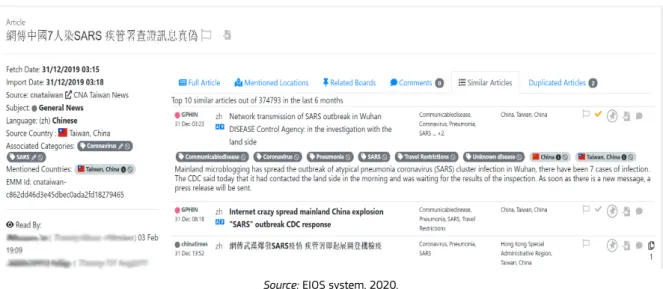
In the COVID-19 context, the detection of the outbreak can be considered a success story for the EIOS initiative. In fact, the EIOS system picked up the first signal of the pneumonia cluster in Wuhan, Hubei Province of China, at 3:15 am Coordinated Universal Time on the 31st of December 2019. The signal came directly into the EIOS system from a media source (3) and within a short time frame, was complemented by other reports from systems connected with the EIOS system (ProMed, Global Public Health Intelligence Network – c, HealthMap), as well as through notification to WHO by the Chinese authorities. Necessary assessment and verification processes were immediately set in motion between the EIOS communities to assess the risk of spread. This example highlights the philosophy behind the EIOS initiative, underlining the value of collaboration rather than viewing early detection as a competition. The strength of the EIOS initiative lies in combining and connecting systems, stakeholders and expertise to pick up signals early and allow a quick assessment, verification and response, to save lives and to protect global health security overall.
However, whatever the context, it is important to emphasize that the EIOS system does not replace established formal communication and reporting channels, such as those put in place under the International Health Regulations, under which all WHO Member States are obliged to formally report health threats that meet certain criteria. Rather, the EIOS system is a set of tools that allows analysts to use other sources of information – namely, publicly available information – to complement traditional surveillance data, to identify and assess potential events that may pose a threat to public health more quickly, and to further facilitate communication across the network of health experts worldwide. Thus, the EIOS initiative aims to augment human expertise and existing relationships, not to replace them.
Today, typical tasks performed by the users of the EIOS system include the following:
— event-based surveillance (EBS) for the identification of new public health threats and monitoring of ongoing threats based on an all hazards approach
— collating updates to communicate to colleagues and partners
— monitoring public health measures
— collaborating and communicating with the network through the EIOS system
— gathering information on vaccine development
(2) www.who.int/eios
8
— including official government sources for verified information and cross-validation
— analysing the impact of COVID-19 on other public health activities
— monitoring impact on the health care system
Most of these tasks contain a strong collaboration component that is in line with the vision of the EIOS initiative. Rapid response to global threats requires a global community of health experts exchanging information and working collaboratively on solutions provided by science and technology that are able to address its needs. This is why collaboration is the cornerstone of the EIOS initiative. Current and future technical developments of the EIOS system are therefore geared towards enhancing collaboration and information sharing between EIOS stakeholders by implementing various new features such as:
— the implementation of a shared workspace across communities for joint monitoring of events
— more granular management of permissions (what can be seen/edited /shared by whom)
— community-shared dashboards visualizing summary information and geographical aggregations
— an improved workflow for information exchange on potential signals between communities
— improved reporting and communication functionality
— tools for collaborative rapid risk assessment: data visualization and exploration, support for standard operation procedures, reports and notifications
— visual analytics for social media
— the identification and classification of mis- and dis-information
— the development and integration of new tools and approaches through collaborations with the private sector and academia
— the integration and sharing of contextual information
— the broadening of geographical and language coverage
— the addition of new categories in view of the One Health approach (e.g. plant health, animal health, chemicals, etc.) and to capture other aspects (disease outcomes, stages of outbreaks, etc.)
— the inclusion of additional sources, for example audio (speech to text from radio and video)
In all these areas, the JRC has been conducting research and development activities for the last 20 years in the broader fields of open source information mining and analysis, integrated systems for collaborative risk analysis and crisis management technologies. Applications built around the JRC’s research serve risk and crisis management needs such as threat detection, situational awareness, early warning and collaborative decision making. Furthermore, as the science and knowledge service of the European Commission, the JRC’s mission is to support EU policies with independent evidence throughout the whole policy cycle. Therefore, through a successful continuation of the collaboration between WHO and the JRC, new collaborative approaches can be identified and developed in the areas of early warning and rapid risk assessment, further contributing to the successful implementation of the EIOS initiative worldwide.
3.2
INFORM
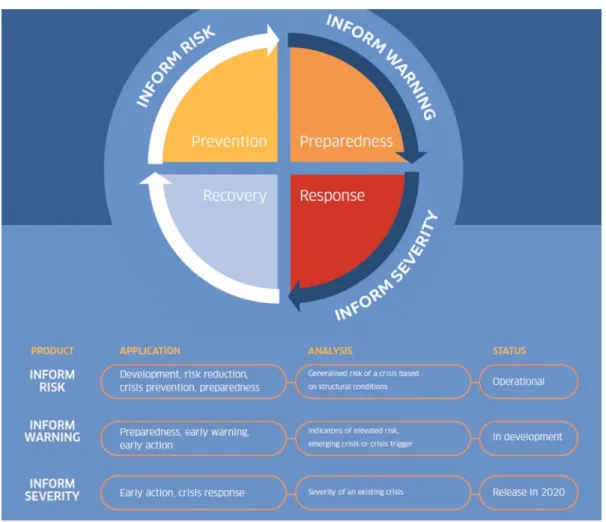
INFORM is a set of three products (Figure 2) that together support decision-making at different stages of the disaster management cycle, specifically prevention, preparedness and response:
— The INFORM Risk Index is the first global, objective and transparent tool for understanding the risk of humanitarian crises and disasters. It can help identify where and why a crisis may occur so that organisations can respond rapidly to reduce the risks, build peoples’ resilience and prepare better for times of crisis.
— The INFORM Warning Tool is intended to provide common, shared, quantitative information that can be used in risk monitoring for preparedness, early warning and early action processes. It collects, aggregates and presents information on crisis-related risks that are dynamic rather than structural or persistent in nature - in other words, changes in risk that occur over a period of less than 1 year.
9
— The INFORM Severity Index is an improved way to objectively measure the severity of humanitarian crises globally. It can help develop a shared understanding of crisis severity and ensure that all those affected get the help they need.
INFORM develops methodologies and tools for use at the global level and also supports their application at subnational levels.
The development of all INFORM products follows the same principles:
— Global. INFORM global products cover 191 countries and sub-national products include all parts of the region or country they cover.
— Open. All INFORM products are freely available and the methodology and sources are open and transparent.
— Reliable. INFORM products use the best available methods and data. INFORM partners are committed to making them available in the long term.
— Flexible. INFORM products can be easily adapted and included in the decision-making processes of users.
Figure 2. INFORM’s vision for a suite of products to support decision-making
Source: Thow et al., 2020.
INFORM’s approach and products are increasingly recognised to support several key components of the post-2015 humanitarian, Disaster Risk Reduction (DRR) and development agenda. Shared analysis and joint humanitarian and development actions are principles recognised by the World Humanitarian Summit outcomes, the Sendai Framework and the Sustainable Development Goals.
According to INFORM partners, the availability of a shared analysis of crises and disasters can lead to better coordination between stakeholders and better outcomes for at-risk and affected people. More specifically, the space and process needed for a shared analysis that is created through the INFORM framework can support joint strategy development, planning and action for prevention, preparedness and response to crises. This allows
10
development, humanitarian and other stakeholders to be brought together, to manage risk and respond better to emerging crises (Thow et al., 2020).
3.2.1
INFORM Risk Index
The INFORM Risk Index is a tool for identifying countries or areas of countries at risk of humanitarian emergencies that could overwhelm national response capacity and lead to a need for international assistance. It supports objective, risk-based decisions to help prevent, prepare for and respond to crises and disasters, and build resilience. It is used by, among other groups, governments, humanitarian, development and DRR sectors. The year 2020 marks the seventh annual release of the global INFORM Risk Index.
Using the INFORM Risk Index allows countries to be prioritised by risk, or any of its components, to decide how best to reduce risk and to monitor risk trends.
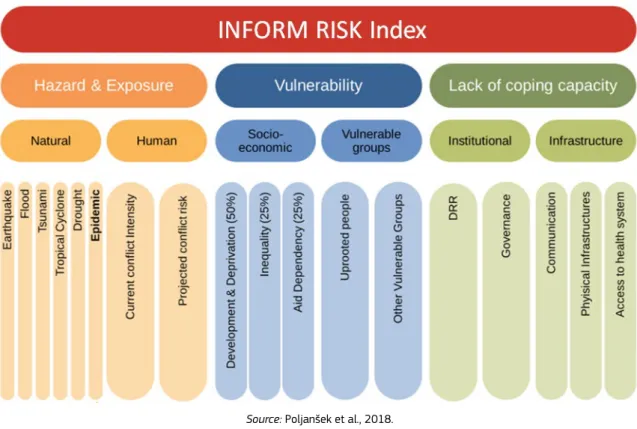
The INFORM Risk Index is based on risk concepts. The model (Figure 3) consists of three dimensions: hazard and exposure, vulnerability and lack of coping capacity. The INFORM Risk Index simplifies information about risk using 50 different indicators, creating a risk profile for every country. Each has a risk rating between 0 and 10 for easy comparison, with 10 representing the highest risk.
Figure 3. The analytical framework of the INFORM Risk Index
Source: Poljanšek et al., 2018.
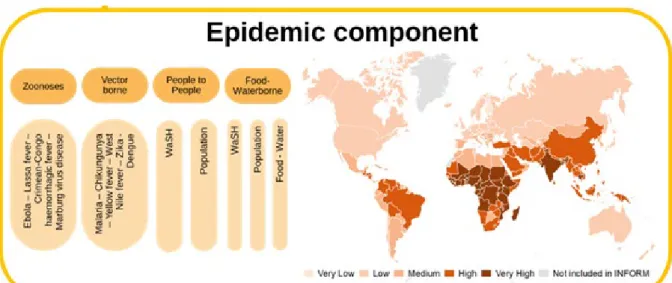
In the sixth release of the INFORM Risk Index, in 2019, an epidemic hazard component (Figure 4) was added. For the first time, within a single framework, the INFORM Risk Index allows the assessment of epidemics in a multi-hazard risk assessment framework at the global level (Poljanšek et al., 2018). This new epidemic component identifies areas with a possible presence of various pathogens and the populations exposed to them, thereby modelling conditions where outbreaks could start. The development of this component benefited from existing models for the transmission of a virus from environmental sources to human populations to establish regions at risk of spillover infections. To calculate the potential exposed population, the Global Human Settlement (GHS) Population Grid was used to estimate the numbers of individuals exposed within each country.
The GHS population grid (Freire et al., 2016; Schiavina et al., 2019) fits all the INFORM’s requirements, as it is global in coverage and an open source, and has a transparent methodology and high resolution.
11
Figure 4. Epidemic component in the Hazard & Exposure dimension of the INFORM Risk Index
Source: Poljanšek et al., 2018.
3.2.2
INFORM Epidemic Risk Index
The INFORM Risk Index methodology is very flexible and it can be adapted to specific focus areas. In 2018, the JRC developed the INFORM Epidemic Risk Index in close collaboration with WHO. Through extensive consultation, WHO experts identified the underlying risk drivers of epidemics, which enabled the development of a conceptual framework for epidemic risk assessment in countries (Figure 5).
The INFORM Epidemic Risk Index (Poljanšek et al., 2018) assesses the risk to countries of outbreaks, that would exceed national capacity to respond to the crisis.
Figure 5. The analytical framework of the INFORM Epidemic Risk Index
12
4
Collaborative early detection for rapid reaction
As mentioned, early detection and monitoring can play a crucial role in reducing the impact of health threats and saving lives by triggering and informing appropriate rapid response. For instance, the early detection of sustained local transmission of SARS-CoV-2 in Europe led certain countries to rapidly implement travel restrictions and lockdown measures, resulting in a lower number of COVID-19 casualties by population (e.g. see Conyon e al. 2020, Moris and Schizas, 2020).
Depending on the specific public health threat, and the risk associated with it, different early preparedness and response measures can be taken. For example, as a first step, a specific situation be simply be put under stricter surveillance to better monitor its development. In other cases, more strict early reactions may be suggested at different levels, such as social distancing, protective equipment and travel restrictions.
Early and detailed information allows for adapted measures and supports planning and preparedness including stockpiling and the deployment of medical equipment and testing kits, and the reorganization of the health system.
4.1
Supporting the public health intelligence function
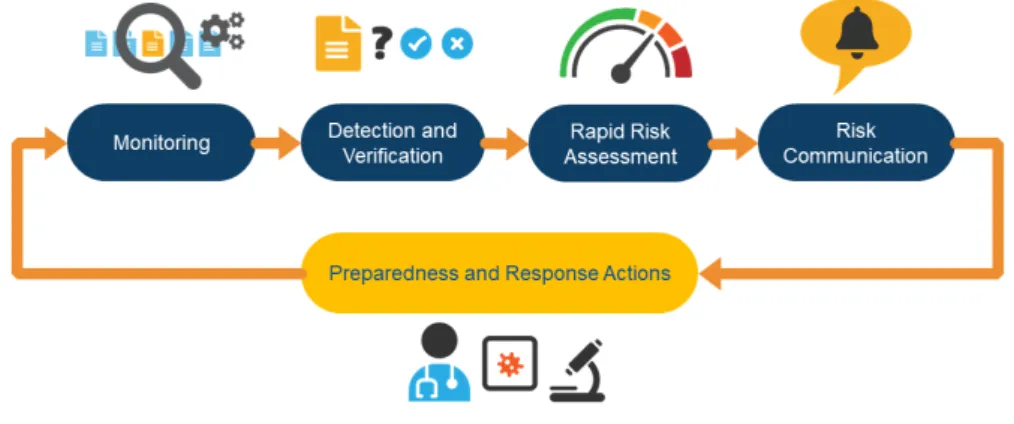
The EIOS system enables and supports the whole public health intelligence function, with particular focus on early detection. As illustrated in Figure 6, public health intelligence encompasses several activities that are discussed further in the following paragraphs. Although in the figure these are represented as a cycle for the sake of simplicity, it is important to stress that these activities are inevitably continuous and parallel in nature.
Figure 6. Public health intelligence activities as supported by the EIOS system
Source: JRC, 2020.
4.1.1
Monitoring
This continuous activity involves reviewing of information available through the EIOS system to find potential signals of public health threats. A monitoring and analysis scope of interest may focus on specific routine surveillance (e.g. priority diseases and sources) or be triggered by specific ongoing events such as the COVID-19 pandemic and other outbreaks, or by other issues.
During the first few months of the COVID-19 crisis, more than 100,000 articles related to COVID-19 were made available to EIOS community analysts through the system on a daily basis from more than 11,000 sources (including mass media, scientific journals, national and local health authorities, and as other systems and networks collaborating on EIOS). This was in addition to tens of thousands of articles related to other potential health threats, all of which were automatically classified by the system based on almost 400 categories defined in multiple languages.
Since the volume of information is huge (especially during pandemics or large events), analysts need to work collaboratively (i.e. in teams) and define specific scopes for monitoring and analysis by combining different filters, as discussed in Section 4.2.
13
4.1.2
Detection and verification
Once specific content or information captures the attention of experts (e.g. it highlights a potential health threat), its reliability and significance needs to be verified, especially in the light of the increasing phenomenon of misinformation and disinformation (which is also discussed in Section 4.4).
Verification can be achieved in different ways on the EIOS system: first, users can look at similar current and past articles suggested by the system (see Figure 7); second, they can modify the current scope of analysis (by changing the filters) to see if other reports available in the system confirm or contradict the identified signal; and finally, teams of analysts can use the communication tools available to post comments and exchange information with other experts (potentially those of other disciplines and other institutions) using the platform to request their advice or initiate further follow up.
Figure 7. The first article about a SARS-cov-2 outbreak in Wuhan detected by the EIOS system (4). The list of similar
articles received subsequently confirmed the early report.
Source: EIOS system, 2020.
4.1.3
Rapid risk assessment and communication
Once a potential health threat has been detected and verified, a rapid assessment of the possible public health risk is needed to inform subsequent action. Experts with different interests (human health, animal health, CBRN, security, etc.) may adopt different methodologies and define different criteria (likelihood and impact of possible spread, etc.) to be taken into account. Depending on the underlying hazard and situation, the experts may need different contextual information.
At present, through the EIOS system’s user interface, information about risk assessment can be exchanged by using the communication tools available in the system, but more structured solutions are envisaged for the future (see Section 4.5).
Moreover, in Chapter 6, we discuss how additional information (either already available or to be integrated in the system) can support analysts in assessing the potential risk as it provides them with a deeper understanding of the context.
This contextual information about the disease and the situation of the geographical area in which the cases are detected (in terms of mobility, demographics, coping capacity of the health care system, etc.) should complement the knowledge of the signals coming from the monitoring and analysis scope.
Finally, the assessed source of risk must be communicated outside the platform to suggest potential actions to be taken. To report the outcome of their analysis, EIOS users can take advantage of the aforementioned communications tools, as well as automatic notifications and digests sent to distribution lists. For the future, more advanced reporting tools and integration with other systems (such as the WHO Emergency Management Suite) are also envisaged.
14
4.1.4
Triggering and monitoring preparedness and response actions
As Figure 6 illustrates, identified signals can eventually trigger specific preparedness and response actions. The implementation of those actions can, in turn, be monitored using the system to follow the development of the crisis, therefore going back to the first stage of the public health intelligence continuous process.
4.2
Defining the monitoring and analysis scope of interest: exploring different
dimensions
4.2.1
Examples of monitoring and analysis scope
As discussed in Section 4.1, the monitoring and analysis scope of interest is fundamental to supporting the different phases of the public health intelligence function in the system. This allows analysts to focus on their specific interests and concerns.
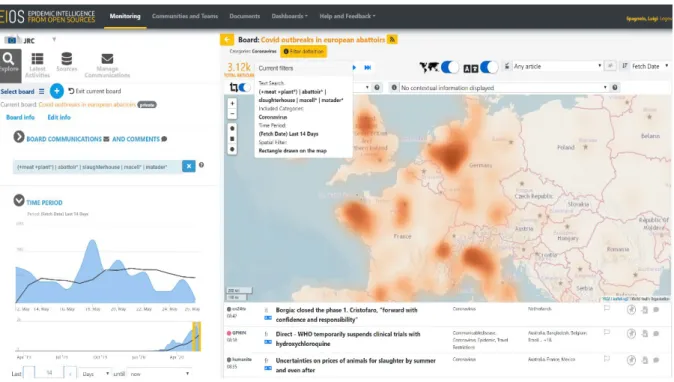
Figure 8. EIOS portal interface: articles mentioning possible COVID-19 cases in abattoirs in Europe, with a moving window covering the previous 14 days.
Source: EIOS system, 2020. Examples of monitoring and analysis scopes include the following:
— evolution of specific disease outbreak(s), globally or in a specific area, for example ‘COVID-19 Global Monitoring’, ‘COVID-19 in the WHO European Region’, and ‘Ebola in the Democratic Republic of Congo’;
— analysis of very specific issues, such as particular symptoms or situations connected to an outbreak, for example ‘Kawasaki syndrome in children’, ‘microcephaly caused by Zika virus’, ‘COVID-19 cases in abattoirs’ (see Figure 8), and ‘COVID-19 cases and migration crisis’;
— routine surveillance: for example ‘WHO priority diseases to monitor beside COVID-19’, and ‘World Organization for Animal Health (OIE) diseases’;
— Surveillance around mass gathering events attracting people (e.g. athletes, tourists) from different countries, for example ‘FIFA World Cup (5) 2018 in Russia’;
15
— detection of unknown diseases with certain characteristics (in terms of symptoms, outcomes, infectivity, etc.) that may pose a significant risk to public health and require further investigation (e.g. novel coronaviruses or other lethal respiratory pathogens);
• research and retrospective analysis, for example ‘Influenza cases in 2019’.
Information about specific events and scopes for monitoring and analysis, including filters and rationale, can be saved for ongoing or subsequent use and sharing.
4.2.2
Available dimensions
In the EIOS system, a monitoring and analysis scope can be defined by combining filters across different options and dimensions, as described in the following paragraphs.
4.2.2.1 Categories
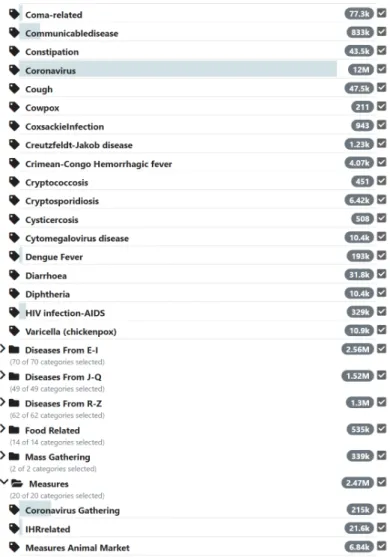
Categories are specific concepts mentioned in the text, according to which articles are automatically classified by the system. They include various diseases (e.g. ‘Coronavirus infection’, ‘Ebola’, ‘Cholera’, and ‘disease of unknown origin’), symptoms, public health measures (e.g. ‘travel and trade restrictions’), other hazards that may trigger public health issues (e.g. natural hazards, conflicts, CBRN threats), reference to mass gathering events, and other potentially relevant topics.
In Figure 9, an example of categories available in the system are shown as visualised in the user interface, The grey bar provides a visual clue to the category’s frequency in the current monitoring scope, as expressed by the other filters applied.
Figure 9. Example of available categories, as visualised in in the system.
16
Categories are defined as combinations of keywords (in all the languages that have been defined) that should appear in the text and are used by the system algorithm for automatic classification. For example an article may be classified as ‘Coronavirus infection’ if it mentions keywords and expressions such as ‘COVID-19’ and ‘SARS-like virus’, or translations such as Κορωνοϊός (‘coronavirus’ in Greek).
Different organisations may be interested in different categories for their day-to-day surveillance (e.g. the World Organisation for Animal Health – OIE is clearly mainly interested in animal diseases). Given this, each organisation has a certain degree of freedom in selecting and organising the specific categories in which their public health experts may be interested.
4.2.2.2 Text search
Users are allowed to search for specific keywords (e.g. ‘Kawasaki syndrome’, ‘abattoirs’, and ‘refugee camps’, etc.) in the text of the article or in its automatic English translation (when provided by the system), thereby focusing on specific concepts that may not (yet) be covered by categories.
Text search looks for exact entries and or slight variants (e.g. plural/singular) in the specific language, whereas categories are designed to systematically cover a larger number of languages as well as possible synonyms in those language.
4.2.2.3 Mentioned countries and locations
Mentioned countries and locations are specific references to countries, cities or sub-national entities appearing in the text. Geographical filters can also be applied by drawing rectangles, polygons and circles on a map to focus on a specific area.
4.2.2.4 Article retrieval and import date
Analysts are allowed to filter by different time periods according to the date and time at which the specific item of information was retrieved and subsequently made available in the system.
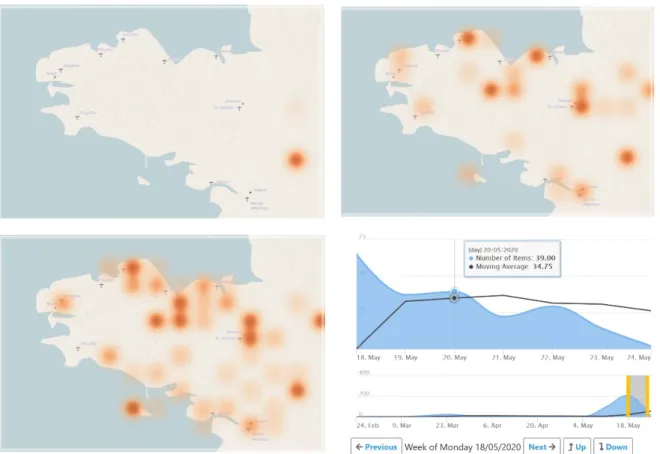
In particular, they can filter by using a specific range of dates (e.g. ‘from 1 January to 31 May’), or by specifying a ‘moving’ time window (e.g. ‘last 14 days’ or ‘last 48 hours’). In addition, they can ‘navigate’ week by week or month by month to gain an understanding of how the situation is evolving, as illustrated in the example shown in Figure 12.
4.2.2.5 Source of information
Analysts can look at specific sources (e.g. ‘Euronews’, ‘Swedish Ministry of Health’, ‘International Journal of Infectious Diseases’) and/or sources by subject (‘General news’, ‘Official medical sources’, ‘Medical news’, etc.), and by the language and country of the source.
4.2.3
Example of exploration by space and time
In Figure 8, a screenshot of the EIOS system shows an example of a monitoring and analysis scope, used to investigate cases of COVID-19 detected among workers in European abattoirs, in a time window covering the previous 14 days.
As illustrated, the scope is defined by the following filters:
— text search – a reference to abattoirs and meat processing plants in some European languages (provided that some of them are also automatically translated into English by the system).
— categories – coronavirus
— time period – last 14 Days
— Spatial Filter – Rectangle drawn on the map (limiting the search to only European locations)
In addition to the list of articles satisfying the filters, the user interface features a chart reflecting the number of relevant articles by date, as well as an interactive heat map showing the distribution of mentioned locations. These two tools can help analysts make sense of a large amount of information, by visually indicating anomalies (peaks in the number of articles in the time chart with respect to a moving average, and/or hot spots in the map) that may warrant further investigation.
17
Aggregated information could be affected by noise; for instance, several articles mentioning cases in abattoirs also refer to the situation in other severely hit regions of Europe in which no cases were reported in meat processing plants during the same period.
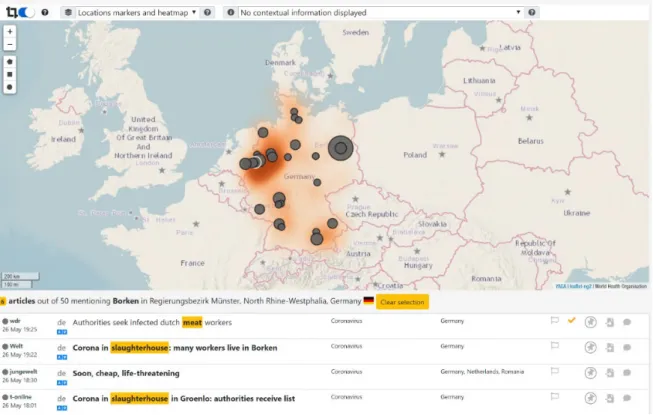
Still, the visualisation is able to capture where and when cases have occurred, guiding the experts’ analysis of the situation. Users can focus on all articles mentioning a specific country and look at specific locations as they appear on the map (see Figure 10).
Analogously, by drawing a different square on the map, the user can focus on a specific sub-national area, and thus discover information about cases occurring in specific locations of that administrative region only (see Figure 11).
In addition, by interacting with the time chart and filtering by specific weeks, it is possible for the analysts to have a grasp on how the situation has evolved in terms of locations mentioned and media coverage (see Figure 12).
Other statistics are also computed and readily visualized while the filters re being changed, such as those about the sources covering the information being retrieved. For instance, the charts in Figure 13 show that cases in Brittany, France, are mainly covered by local, general media sources. Each option can be used to further filter the articles (e.g. only from sources in French and/or from France).
Figure 10. Map of locations mentioned in articles about possible cases of COVID-19 among workers in Germany.
18
Figure 11. Map of locations mentioned in articles about possible cases of COVID-19 among abattoir workers in an area drawn on the map, corresponding to Brittany, France.
Source: EIOS system, 2020.
Figure 12. Combined interaction with visual filters (time chart and map) to investigate the development of a situation.
19
Figure 13. Frequency counts for sources covering information about abattoir-related cases in Brittany, France (May 2020).
Source: EIOS system, 2020.
4.3
Collaboration and communication features
Another key feature of the EIOS system is the possibility for analysts to exchange information about identified threats, as well as communicate across teams and institutions to share knowledge and advice.
Activities such as reading articles, saving the most relevant ones (see Figure 14) for further analysis and annotating them with comments, are all shared across teams of the same organisation either through the interface or, optionally, via email notifications and daily digests, such as the one for the GHSI network.
Figure 14. Example of a saved article within a specific monitoring and analysis scope (COVID-19 cases in Northern Italy). Other possible scopes are proposed by the system based on previous interactions.
Source: EIOS system, 2020.
This feature is meant to enable collaboration; for instance, given the large amount of information to be checked, work can be divided among members of the same team. In addition, knowing that other teams (e.g. a specific task force of experts on a given disease) have read, saved or annotated a certain article, is an indicator of the most relevant information to look at in order to have an up-to-date overview of the situation.
Users are also allowed to send specific communications, even to teams of other communities, so as to share knowledge of possible signals, or ask for advice and collaboration.
Other possible future communication tools may include immediate communication and chats to enable faster and more interactive discussion.
20
4.4
Future developments: handling information deluge, misinformation and
disinformation
From the beginning of the COVID-19 crisis – with the announcement that a novel coronavirus had been isolated and the consequent confirmation of human-to-human transmission – the number of articles imported and made available on the EIOS system rapidly started to increase.
The total volume of articles reached a peak in March (there were more than 1 million articles in the week of Monday 16 March 2020), corresponding to the epidemic wave severely affecting Europe and North America and the generalised lockdown that ensued in many countries. In April, the system was still importing and processing an average of more than 2 articles related to the coronavirus category every second.
Such an ‘infodemic’ – an excessive amount of information – surrounding COVID-19, including relevant updates as well as misinformation and disinformation, has been one of the biggest challenges for analysts around the world, including EIOS users working on COVID-19.
Based on the corresponding lessons learnt, one of the new key priorities for future developments on the EIOS system is addressing this information deluge in the following ways:
— Allow users to better define the monitoring and analysis scope, in particular introducing the possibility of defining a more complex combination of filters – for example several symptoms or public health measures mentioned in the same article AND in relation to the given disease – and establishing new types of categories, such as stages of epidemics (early signals, imported cases, local transmission, peak, etc.). The challenge in this case is to increase the functionality of the user interface while maintaining usability and simplicity. Another option in this regard is the development of chat bots or similar tools capable of translating specific user questions into a set of filters.
— Group articles into stories covering the same event, for example a specific outbreak of cases in a given facility, and the ease of lockdown in a certain country. This may be achieved by applying AI algorithms to cluster similar news articles.
— Introduce automatic misinformation and disinformation detection in the system, using analysis of social media information and classifiers to identify unreliable sources and individual items of disinformation. Unreliable sources will likely remain available on the portal to support specific analyses; however, the system will assign credibility scores that the user can use to further filter information to focus on credible information or on misinformation and disinformation only, depending on the task.
4.5
Future developments: guided structured rapid risk assessment
Structured and formalised risk assessment is currently missing in the EIOS system, even though some early proofs of concept are being explored by WHO.
More specifically, the objective is to introduce a form builder in the system to allow organisations and teams to define forms to guide the assessment of the specific severity, likelihood and impact of a particular public health threat, based on their own specific methodology.
As each community and team may have its own methodology and criteria for risk assessment, it will be important to identify a flexible solution that can not only facilitate the different needs but enable comparative analyses and information sharing where appropriate (e.g. if teams and/or communities have similar mandates and tasks or share jurisdiction).
In addition, as previously described, risk assessments should consider contextual information, such as specific coping capacity and infrastructure in affected areas, and reference to previous similar events.
21
5
Knowing more and losing less: reaction of INFORM suite to COVID-19
pandemic
The COVID-19 emergency has shown the adaptability of the INFORM suite to partner’s needs and the integration of new in-coming knowledge:
— The INFORM Risk Index has been made more specific to COVID-19 and the INFORM COVID-19 Risk Index has been developed.
— INFORM Warning’s development is in its early stages. The development of INFORM COVID-19 Warning (6) acts as an accelerated and conceptually ring-fenced case study that can contribute to the future development of a broader INFORM Warning product.
— The INFORM Severity Index can measure the severity of COVID-19 induced humanitarian crises.
5.1
INFORM COVID-19 Risk Index
When the first signs of the COVID-19 crisis became visible, the JRC adapted the INFORM Epidemic Risk Index for the COVID-19 situation and the first analyses were shared with other Commission services within the framework of the ARGUS general rapid alert system activation. These first analyses were based on the knowledge of the virus that existed at that time (February 2020), combined with the national risk of spreading the disease and the probability of importing cases from China, for which migration statistics and data on air travel were used.
At the end of March 2020, INFORM partners, especially humanitarian and donor organizations, requested special support for their decision-making needs in response to the COVID-19 crisis. The UN Office for the Coordination of Humanitarian Affairs (OCHA), the coordinator of INFORM and the JRC - the scientific and technical lead of INFORM - started developing a new tool based on the previously released INFORM Epidemic Risk Index (Poljanšeket al., 2018).
The results of this collaborative effort involving INFORM partners continued to evolve, and on 17 April 2020 the JRC released the INFORM COVID-19 Risk Index (Poljanšek et al., 2020), a composite indicator that identifies ‘countries at risk from health and humanitarian impacts of COVID-19 that could overwhelm current national response capacity, and therefore lead to a need for additional international assistance’. The INFORM COVID-19 Risk Index has been fully endorsed by INFORM partners that were involved in its development.
5.2
INFORM COVID-19 Risk Index methodology and results
The INFORM Epidemic Risk Index (Poljanšek et al., 2018) is a tool for supporting early warning with additional selected and compiled contextual information about countries. It is highly relevant to the current pandemic. It was developed through an extensive process prior to COVID-19 and can be easily adapted to different scenarios. Therefore, it has been used as the starting point for a COVID-19 specific risk index, with the structure and relevant indicators retained as far as possible.
The INFORM Epidemic Risk Index consists of three dimensions: Hazard & Exposure, Vulnerability and Lack of Coping Capacity. The Person to Person component of Hazard & Exposure is the most relevant to COVID-19 and is used autonomously to focus on risk factors concerning only human-to-human transmission (Figure 15). Vulnerability and Lack of Coping Capacity consist of hazard-dependent (specific to the epidemic hazard) and hazard-independent (relevant to all hazards covered by the INFORM Risk Index) aspects. Both parts are retained.
— There are many indicators or broader vulnerability and lack of coping capacity that are directly relevant to COVID-19.
— COVID-19 will compound existing risks (i.e. it will not happen alone), so broader factors of vulnerability and lack of coping capacity are important when considering the humanitarian impact of the pandemic. The main focus of the adaptation for COVID-19 (Poljanšek et al., 2020) is the improvement of the hazard-dependent parts of the index (i.e. factors specific to COVID-19), but within the existing structure (Figure 16 and Figure 17).
22
Figure 15. The analytical framework of the INFORM COVID-19 Risk Index
Source: Poljanšek, et al., 2020.
Figure 16. Risk factors included in COVID-19 Vulnerability
Source: Poljanšek, et al., 2020.
Figure 17. Risk factors included in COVID-19 Lack of Coping Capacity
Source: Poljanšek, et al., 2020.
The COVID-19 Risk Index (like the other INFORM risk indexes) focuses on structural factors. It does not contain rapidly changing information, for example on cases, government restrictions and changing health system capacity in response to the pandemic. However, INFORM is looking at how dynamic risk information on COVID-19 can be organised and potentially aggregated for use in conjunction with the risk index.
Only risk factors for which there is sufficient evidence are included.
The changes to the analytical framework are based on a literature review and expert input, and take into account (i) the most relevant and certain factors relating to COVID-19 and (ii) availability of comprehensive and quality indicators that measurethe identified factors directly or by proxy.
All of the research around COVID-19 is new. Only factors for which there is sufficient published or pre-publication evidence, or that are widely accepted and publicised by credible organisations are included. The results of INFORM COVID-19 Risk Index are summarised in Figure 18.
23
Figure 18. Results of INFORM COVID-19 Risk Index
Source: Poljanšek et al., 2020.
A specific analysis of the vulnerability dimension of the INFORM COVID-19 Risk Index (Figure 19) has revealed that socio-economic factors will primarily dictate the impacts of COVID-19 in lower income countries and should guide our response in regard to the world's poorest and most vulnerable. The analysis suggests that factors that make individuals vulnerable to COVID-19, such as age and specific pre-existing conditions, drive vulnerability and risk in higher income countries.
However, in countries with the highest risk of humanitarian crisis as a result of COVID-19, which are overwhelmingly low-income and lower-middle-income countries (LICs and LMICs), factors of vulnerability that are highly specific to COVID-19 are less important than broader socio-economic factors or those associated with vulnerable groups such as food insecurity, people in poor health and displaced persons.
Although this conclusion partly derives from the way the risk index is conceptualised, it suggests that – at least in the preparedness and early response phase of the pandemic in countries at high risk of a humanitarian crisis – risk can be reduced by addressing broader vulnerabilities through ‘no regrets’ strategies and interventions. This is also important because impacts on humanitarian operations and the secondary impacts of the pandemic are also likely to have wide-ranging humanitarian consequences beyond the direct health impacts of the disease.
5.2.1
Impact of the INFORM COVID-19 Risk Index
The INFORM COVID-19 Risk Index has gained high visibility and has been used by many organisations in analyses and documents:
— It was mentioned as one of the forward-looking risk analyses at country level in the latest update (May 2020) of the Global Humanitarian Response Plan for COVID-19 (7).
— It was presented in the report ‘How COVID-19 is Changing the World: a statistical perspective’ issued by the Committee for the Coordination of Statistical Activities (8).
(7) UN OCHA, Global Humanitarian Response Plan – COVID-19, 2020 (available at
https://www.unocha.org/sites/unocha/files/Global-Humanitarian-Response-Plan-COVID-19.pdf)
(8) Committee for the Coordination of Statistical Activities, How COVID-19 Is Changing the World: A statistical perspective, 2020 (available
24
— It has been used by humanitarian organizations, such as the UN Global Food Security Cluster (9).
— The Internal Displacement Monitoring Centre (IDMC) used the INFORM COVID-19 Risk Index to identify areas at highest risk of coronavirus-related impacts. Its product (10) shows which countries/territories are most at risk from the health and humanitarian impacts of COVID-19 and is overlaid with displacement data.
Figure 19. Contribution to vulnerability by income groups and regions – in lower-income countries and lower-middle-income countries COVID-specific vulnerability factors are less important than broader vulnerability factors
Source: Poljanšek et al., 2020.
(9) UN Global Food Security Cluster, ‘TWG – COVID-19 meeting’, 4May 2020 (available at
https://fscluster.org/sites/default/files/documents/2020-05-04-twg_-covid_19-meeting.pdf)
(10) IDMC, ‘Coronavirus crisis: internal displacement’ (available at
25
Interest in the INFORM COVID-19 Risk Index is also rising within the Commission services involved in the management of the crisis in developing countries, mainly the Directorate-General for European Civil Protection and Humanitarian Aid Operations (DG ECHO), which is one of the key partners of INFORM.
The European External Action Service (EEAS) has also expressed interest in the tool and consulted the results during its regular early warning assessments as additional contextual information to complement the information provided by the Global Conflict Risk Index11.
This tool was particularly useful in the very first phase of the crisis, when the COVID-19 outbreak had not yet turned into a global pandemic, and the epidemic’s development in most countries was mostly unknown. The rapid evolution of the global pandemic (with extensive local community transmission eventually detected in Europe) changed the scenario, and the containment measures that the governments put in place to reduce the impact of COVID-19 changed the pre-existing risk drivers used in the model. The lockdown dramatically reduced the movement of people and the probability of contact.
5.3
INFORM COVID-19 Warning
In collaboration with UN OCHA, the JRC is developing a tool that can help identify, monitor and anticipate where COVID-19 could compound existing risks to cause new or exacerbate existing humanitarian crises. INFORM COVID-19 Warning (Figure 20) aims to provide analyses that can be used to support decisions on preparedness and anticipatory action to mitigate the direct and indirect humanitarian impacts of the COVID-19 pandemic. The purpose is to provide a more dynamic and up-to-date picture of how the pandemic is evolving and how it interacts with other hazards, vulnerabilities and coping capacities to affect crisis risk. Within this context, the EIOS system, with all of its existing and evolving features, can be enhanced by and significantly contribute (as a possible data source) to INFORM Warning.
Figure 20. The INFORM COVID-19 Warning (beta version) dashboard provides a global overview of the warning status of the selected risk factors
Source: JRC, INFORM, 2020.
26
6
From the early warning system to the rapid risk assessment
6.1
The need for contextual information to support rapid risk assessment
Figure 21. The required elements for performing rapid risk assessment
Source: JRC, 2020.
As previously discussed, the early detection and identification of potential public health threats is only the first step in the public health intelligence function. Once they are detected and identified, it is particularly important to assess the corresponding level of risk, so that any subsequent action, if required, is both adequate and proportionate.
As illustrated in Figure 21, to support an informed rapid risk assessment, a system such as that being developed for the EIOS initiative should provide experts with the information they need to facilitate an assessment of the hazard, the exposure and the context in which acute public health events do occur or could occur (World Health Organization, 2012).
Possible aspects that such informative content should cover are (Mantero and Doherty, 2017):
— agent and disease components, including characterization (how the disease is transmitted, the pathogen’s virulence, existing options for response and mitigation measures, etc.), epidemiological profile (how far the disease has spread worldwide and in the specific areas affected by outbreaks) and expertise available (researchers, clinicians treating the disease);
— host components, including the population’s demographic profile and health status, as well as (for the human population) relevant social and cultural aspects;