On the Influence of Creativity in Basic
Programming Learning in a First-year
Engineering course
ANTONI PEREZ-POCH
1, NOELIA OLMEDO
2, FERMÍN SÁNCHEZ
3, NÚRIA SALÁN
4,
and DAVID LÓPEZ
51Institute of Education Sciences, Department of Computer Science, Barcelona College of Industrial Engineering
(EUETIB). Universitat Politècnica de Catalunya (UPC), Spain. E-mail: [email protected]
2Department of Engineering Presentation, Barcelona College of Industrial Engineering (EUETIB), Universitat
Politècnica de Catalunya (UPC), Spain. E-mail: [email protected]
3Department of Computer Architecture, Barcelona School of Informatics (FIB). Universitat Politècnica de Catalunya
(UPC), Spain. E-mail: [email protected]
4Department of Material Sciences and Metallurgical Engineering, School of Industrial, Aeronautic and Automatic
Engineering of Terrassa (ESEIAAT). Universitat Politècnica de Catalunya (UPC), Spain. E-mail:
5 Institute of Education Sciences, 3Department of Computer Architecture, Barcelona School of Informatics
Universitat Politècnica de Catalunya (UPC), Spain. E-mail: [email protected]
Keywords:
Creativity; Programming; Computing Engineering; Equal Opportunities; Soft Skills; Professional Skills
Abstract
Teaching fundamentals of programming is a complex task that involves student acquisition of diverse knowledge and skills. It is also well known that programming often requires a certain degree of creativity. There are some studies on how to foster creativity with programming, but few have analyzed the influence of students’ creativity on their performance as programmers. In this paper we present the results of such a study, with a sample of 89 freshmen engineering students. Our results suggest (p<0.01) that a high level of creativity is correlated with achieving excellence in programming. Creativity is a soft skill which is not currently covered within most engineering curricula, and we conclude that it should be taken into account. Female, diverse thinking students and some disadvantaged groups may benefit from a free-thinking environment in the classroom, in particular during their first-year in college.
1.
Introduction
Programming is a classical “design problem” as it is classically defined by Newell [1]. Programming is an “open exercise” and, furthermore, it is somewhat difficult to define analytical and quantitative criteria in order to judge the efficacy and correctness of a possible solution. The major challenge that a student faces when programming deals with the fact that a creative solution has to be found, always according to a set of formal restrictions, the so-called requirements. Many students fail or do not excel at programming in their engineering studies, simply because they do not have this specific skill, although they may be considered good students and work hard to achieve a successful result. This may lead to underachievement in Computer Engineering, lack of motivation or, what is worse, dropping their studies altogether. The importance of motivating our students with a free-thinking environment in this context cannot be underestimated. Drop-out rates are too high in the first year of engineering degree courses, and a fundamental course on Computing Engineering is found in most syllabuses in the European Higher Education Area (EHEA) as well as in other countries. Hence, it is important to be able to provide a free-thinking learning environment, specifically for the purpose of attracting divergent thinking students, minorities, low performing students or, indeed, females, to engineering degree courses where they are currently underrepresented.
Instead of dealing with the creative aspects of programming, our colleges usually teach programming in a formal way, through which a set of programming structures, basic algorithms and basic computing knowledge is transferred to the student. Kim and Lerch [2] have studied the cognitive process that leads to code design, and has established that the programmer must choose between different code representations, comparing this process to that of scientific research.
However, in industry the process of software development has been described [3] to be iterative, individually built, sometimes collaborative, and most of the time exploratory. Since this is an essentially creative endeavor, it seems that it should benefit from a more open and less formal teaching style. Nevertheless, most universities and educational institutions do not provide their teaching in such an informal way. Creativity is not even regarded as a students’ soft skill that ought to be promoted. More precisely, most teaching strategies are focused on memorizing some programming patterns and structures and applying them in the laboratory. In higher education syllabuses it is hard to find any strategies that promote creative thinking in the basic programming courses [4].
Creativity has been an object of research in a variety of fields such as science, music or the arts. Its essence and development has been studied from the fields of psychology, sociology, work-organization and education sciences. This multiplicity of analysis has lead to a great number of different definitions of it [5]. Since our study focuses on the influence of creativity in engineering studies, and on programming in particular, it seems natural that we mention those definitions with an operational bias. Boden [6,7], for example, provides a series of criteria which take place during the cognitive process of building an abstract object such as a piece of software. According to Boden, a creative programmer would be one who is able to choose among different patterns or solutions, combining them and creating a new original pattern of code that solves the requirements in an effective way.
As regards subjects who produce code, namely the programmers, they are described as open-minded, individualist, disruptive and generous, in contrast to those who obey and observe rules. Other authors, like Couger and Dengate [8], deny that creativity can be linked to an abstract object like software, and hence consider that the operational focus of creativity in fact ignores the cognitive-dynamic process of any original creation. Notwithstanding, it is not our objective to discuss the role of creativity in learning theoretically, but rather to analyze what the practical consequences of creative thinking in the academic performance of our students are, as well as to discuss if this is a key point for persuading students to remain in college instead of dropping out of the engineering degree courses.
One of the critical points in teaching programming remains the assessment of the code produced by the students. It is difficult to quantify how good a solution is compared to others, and specifically, how creative a student may be when providing a particular solution to an academic exercise. For example, let us consider the ‘elegance’ of a piece of code. This ‘elegance’ is usually defined in vague terms, such as the simplicity, symmetry or efficacy of a particular solution when compared to other standard solutions. Professor will not only assess the correctness of the
code (‘does it fulfill the requirements of the exercise?’) but also its so-called elegance, originality and efficiency in terms of memory and order of the algorithm. This balance between fulfilling some formal requisites and design rules, and having an open mind in order to consider many possible solutions and choose the optimal one, is something unique to the subject of Computing Engineering fundamentals and is compatible with some assessment tools used in psychology. This close relationship between psychometry and programming performance measured by the assessment of an experienced teacher has lead us to study students’ performance in a fundamental Computing Engineering course from both sides, as well as analyzing students’ results from both a standardized psychrometric test and the factors that influence the final grade in this subject.
We introduce the following research questions addressed in the study, with a focus on the significance of creativity on minority groups, diverse thinking students and females, all of whom are underrepresented in our engineering degree courses. We then present the features of the student sample that is the object of this study, and the methodology used in the paper. Later we present the results obtained in relation to each of the research questions presented, followed by a discussion and some conclusions relevant to the promotion of teaching engineering for everyone.
2.
Objectives
The objectives of our study are aimed at studying whether creativity does play a role in Engineering Education, and if so, to what extent. If that were the case, then creativity training would faciliate the acquisition of programming skills and other specific learning objectives in engineering; it would also make these studies more attractive and significant to the female and minorities student population.
The research questions of this work are the following:
1- Does a significant correlation exist between student creativity and their academic results as programmers?
2- For first-year students, does this correlation depend on their University Entrance mark? 3- Is creativity a relevant factor in students’ academic results, among others?
4- Can minorities, such as female students in an Engineering class or non-motivated student groups, benefit from creativity instruction, thus fostering their integration into class?
3.
Methodology
The sample is composed of 89 Industrial Engineering freshman students at the EUETIB, the Barcelona Technical Industrial College of Engineering. The subjects are aged between 17 and 41 years (average: 20.3; standard deviation: 0.9) who registered at EUETIB during the course 2014-15. The students volunteered to take part in the study, and were informed about the objectives of the study. They completed the test outside their class timetable on the EUETIB premises.
Among the 89 students, 81 come from high school (“bachillerato”); 5 had changed studies from the same university UPC; 2 came from professional studies and 1 from adult-access entrance to the University. The average access grade to the university was 10.5 (out of a maximum grade of 14; standard deviation 0.33). The sample is representative of the total 285 subjects who registered for the subject of Computer Engineering at EUETIB during the course 2014-15. From the sample, 74% of the subjects declared that they had no previous experience of or tuition in programming. None of them had taken a creativity test before.
In order to evaluate the creativity of the subjects, we used the well-known Torrance Test of Creative Thinking ® (TTCT). We applied the TTCT Form A [9, 10] with both verbal and figurative components. The verbal test is composed of three subtests: “Making suppositions” (Subtest 1V), in which the subjects guess the consequences of an unlikely situation; “Unusal usages” (Subtest 2V), in which the subjects have to state uncommon usages for a given object; and “Let’s make questions” (Subtest 3V), in which the subjects ask a number of questions about something that is happening in an image portraying an ambigous situation. From the figurative component, we applied the three subtests: “Let’s compose a drawing” (Subtest 1F), in which the subjects are asked to execute an unfamiliar drawing starting from a curve. “Let’s finish a drawing” (Subtest 2F) asks the subjects to design new and original drawings on the basis of uncompleted drawings; and “The lines” (Subtest 3F) continues with a task similar to that in the latter test, but with more complex ideas. An example of this is test shown in Figure 1.
Figure 1. Example of visual outputs from a creativity test.
Some initial figures are proposed to the subject, who should develop them into more complex drawings.
The test evaluates the subjects’ production based on four criteria: quantity of ideas, originality, complexity and flexibility, which are the four criteria initially proposed by Torrance and more widely studied in the literature [9]. A licensed psychologist supervised the administration and evaluation of the tests. Finally, a global grade was obtained as a measure of the creativity of the student. The results were later correlated with other variables of the subjects, such as their access grade to the degree or their final grade in the subject of Computing Engineering in the EUETIB first year course.
For the statistical analysis of the results, we used the software SPSS version 19 for Windows [11].
4.
Results
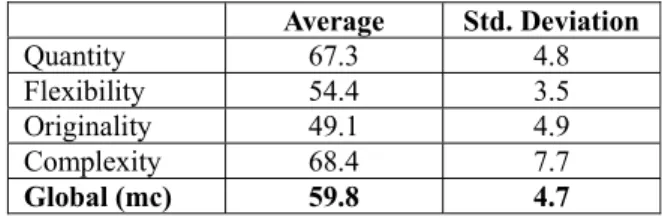
In Table 1 we show the results of the application of this test to the sample, divided by factors, as well as the global measure of the creativity (mc) of the student, which is normalized to the maximum value of 100.
Average Std. Deviation Quantity 67.3 4.8 Flexibility 54.4 3.5 Originality 49.1 4.9 Complexity 68.4 7.7 Global (mc) 59.8 4.7
4.1 Creativity and performance as a programmer.
In order to answer to the Research Question 1 – “Does a correlation exist between the creativity of a student and his or her performance as a programmer?” - we calculate the statistical correlation between the global result of the test and the final grade in the subject Computing Engineering. The result gives as no significant values (N=89; r=0.55; p>0.05).
We then divide the 89 subjects into three subgroups, depending on their final grade in the subject of Computing Engineering, the basic objective of which is to learn the fundamentals of programming. Table 2 summarizes the results in each of the three subgroups (MA- higher grades, ME- average grades, MB – lowest grades). We also show the result of the correlation between the creativity result from the Torrance Test (mc) with the final grade for every subgroup.
mc d.t R p
MA 71.7 3.4 0.76 <0.01
ME 54.6 3.9 0.51 >0,05
MB 45.9 4.1 0.45 >0,05
Table 2. Creativity average in every subgroup (mc), and correlation with the final grade of Computing Engineering with the subjects divided into three subgroups depending on this final grade.
We may notice that the correlation is only significant in subgroup MA; that is to say, only among the best students in the subject with grades between 7.0 and 9.8 can we see a high correlation with the creativity test result. In the other two subgroups, with grades lower than 7.0, we find no significant correlation.
4.2.Creativity and access grade of the student.
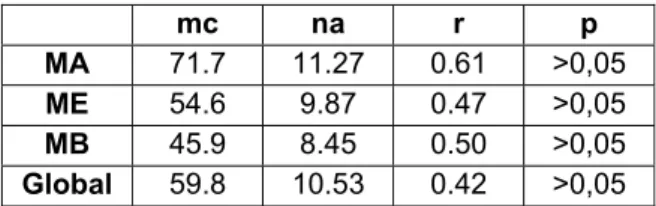
In order to answer to Objective 2 – “Does a correlation exist between creativity and performance as a programmer depending on the subject’s access grade?” - we calculate the statistical correlation between the global result in the test and the student’s access grade. In the cases of students coming from other degrees, the access grade to the first degree was used, and in the case of other access paths, the entrance exam grade was used. Results are shown in Table 3. mc na r p MA 71.7 11.27 0.61 >0,05 ME 54.6 9.87 0.47 >0,05 MB 45.9 8.45 0.50 >0,05 Global 59.8 10.53 0.42 >0,05
Table 3. Creativity (mc), access grade to the degree (na, over 14), correlation coeficient r among variables and statistical significance p
No statistically significant results appear in any of the subgroups or in the group as a whole. It appears that in our sample there is no creativity correlation between the access grade and the degree.
4.3.Correlation of creativity and access grade with the students’ academic performance.
In regard to the next research question - “Is creativity a relevant factor in the performance of the subject as a programmer or are there other factors which are more relevant?” - we propose a linear model. The dependent variable in this model is the final grade of the subject, which is a linear combination of different factors contributing to the final grade with different or unequal importance, as shown in Equation 1.
N
Final Grade = α + ∑ β
if
i i=1Equation 1: Linear model of contributions to the final grade.
Therefore, we assume that the academic performance of the respondents, measured according to their final grades in the subject, is an addition of independent variables (fi) which have an associated weigh. The weight of
every factor (βi) is calculated in the linear regression of our model, and gives us the importance that this factor has in the academic performance of the student. By adding the different contributions multiplied by the corresponding weight, and by adding the independent term α, we obtain a prediction of the final grade of the subject from this regression model.
The factors fi considered in our study are as follows: creativity of the student (result from the test), access grade
to the degree, and access path of the subject. Qualitative values are converted into ordinals (access path), all of which are then normalized to the unity before conducting the calculus of the regression.
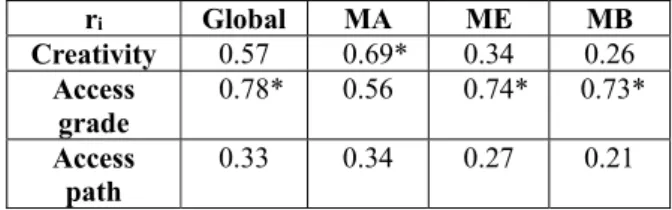
ri Global MA ME MB Creativity 0.57 0.69* 0.34 0.26 Access grade 0.78* 0.56 0.74* 0.73* Access path 0.33 0.34 0.27 0.21
Table 4. Multifactorial analysis of the academic performance of the students (* p<0,01).
We may notice that only in the case of group MA, that is to say, the subjects with better grades in our sample, is creativity the main factor predicting the final grade of the student. If we consider the sample group all together, as well as the other subgroups ME and MB with lower grades, the main factor is the access grade. These results are in accordance with the results previously obtained in [12]. We do not observe any significant results when considering the access path to the subject, and we must note that the number of such cases in our sample is small.
4.4.Relation between gender and academic performance
Regarding Research Question 4 - “Can minorities, such as female students in an engineering class or non-motivated student groups, benefit from creativity instruction, thus fostering their integration in class?” - it is observed that female students are not choosing engineering subjects as often as might be expected, taking into account that more than half the total student population in Europe is female. As a countermeasure for such inequity, as well as for other benefits, among other initiatives it has been suggested [4, 13] that Science and Engineering
curricula should include professional/soft skills training such as teamwork, social awareness, emotional education, or, indeed, creativity.
Only 18 students in our sample of 89 (20.2%) are female, which is a representative percentage of female students enrolling in a programming course for the first year of an engineering degree. In the total group of students who enrolled for the course during the academic year 2014-15, a similar percentage of students (23.4%) is found. When comparing their final grade in the subject, or with the creativity test, we did not find any significant differences between the male and the female student groups. However, the sample of female students is too small to provide any definite conclusion. More importantly, the fact that very few female students register in our Industrial Engineering courses indicates that a majority of them are dissuaded from enrolling in these courses. A more creative and free-thinking environment may play an important role in making these studies more attractive to underrepresented groups such as female first-year students, or other minority groups.
5.
Discussion and Conclusions
We have analyzed the correlation between creativity and academic performance as programmers in a sample of engineering freshman students. We have also studied the importance that other factors have in this performance, such as the access grade to the degree or their previous studies. Results suggest that a positive correlation exists between high creativity and high performance as programmers. However, among all the students in the sample we observe no correlation between creativity and being a good programmer. In addition, we find no significant correlation between the access grade and the creativity of the student.
Results suggest that a high creativity is required in order to become a good programmer, and this is a soft skill that is not addressed in our engineering degree syllabus. More importantly, creativity is not taken into account in most programming courses in engineering.
A number of studies exist in which the effect of teaching creativity to improve this skill among the students [14, 15] has been analyzed by means of the Torrance Test of Creative Thinking, and which yield positive results. The Torrance test is well established as a standard tool that allows us to measure reliably and inexpensively the potential creativity of a subject by conducting open verbal and figurative questions [10, 11]. As a consequence, we could find evidence that creativity can be improved and quantitatively assessed by using this test when the conditions are met in the classroom. Introducing creativity teaching into our universities would certainly improve the excellence of our students as programmers.
Furthermore, this present study is original since we have found very few others in which the relation between performance as a programmer and creativity is studied. Erdogan, Aydin and Kabaca [16] studied the academic performance in programming in a sample of 79 students at the Technical University in Istanbul (Turkey), and they correlated this performance with different subject variables of personality; among them, creativity. These authors found no general correlation between creativity and academic performance, which is in accordance with our results. However, they did not divide the sample into subgroups depending on the final grade in the subject of Computing Engineering. We emphasize that their sample size is similar to ours, so that our results can be compared in terms of the significance of the results.
One of the limitations of our study is that all the students belong to the same degree course (Industrial Engineering) and are studying in the same context and College. However, not all the students shared the same professor or laboratory monitor, each one of these having his or her own style of teaching. This fact reduces the homogeneity of the sample. We did not analyze the results of the subtests (verbal or figurative) as the first analyses were inconclusive. However, the results encourage us to proceed in the future by enlarging the sample. Further studies are needed in different colleges and universities to confirm these results and may further lead to more reliable and decisive conclusions.
We thus conclude that creativity does indeed play a significant role in the achevement of excellence in learning programming on a first-year course in Engineering. Therefore, it is suggested that creativity training be included as a
soft/professional skill in the syllabus of Engineering studies. Enhancing students’ creativity in the classroom is proposed as well as a possible way to promote equal opportunities in the classroom and a more balanced access of female students to engineering studies.
Based on the results of this study, we believe that academic results would improve by promoting creativity in the classroom. At the same time, divergent thinking students, who are underrepresented in the group of students who finish their engineering studies, would feel more motivated in class. Female students, divergent thinking students and students who need to program, but do not have a technological background, are clearly underrepresented in our engineering degrees.
The attempt to attract more women to engineering has for a long time been a matter of policy. The small percentage of women in engineering studies is a general problem in the western world [17]. It has been noted, for example, that female students value learner-driven constructs over content-driven constructs when compared to male students [18]. On the other hand, in a study conducted in Norway [19], it was found that male students had a more positive attitude toward computer systems than woman did. However, their grade expectations were not different. Therefore, we believe that providing a creative environment in the classroom would enhance confidence and self-assurance in women, thus increasing their numbers in college. At this level, a number of courses have been proposed aimed at facilitating the development of creativity among their goals [20, 21]. Among these studies, the basic underlying idea is a change of role for the instructor. Once the basic programming structures have been taught, the teacher should become a facilitator of lateral thinking for the students. This process can be accomplished by providing open programming problems of increasing difficulty, promoting free speaking ideas in class and also proposing female role models throughout the curriculum. This is not a step-by-step process; it is not linear and involves welcoming irrelevant information, answering open questions class and perhaps also teamwork [17]. For example, by facilitating brainstorming in class, all possible ‘patterned’ or ‘vertical solutions’ can be discussed and placed in order. Students may be asked to provide a list of possible solutions in a programming exercise and openly discuss them in class, focusing on female (as a minority) participation. In addition, the instruction can use random stimulation and provocation to urge students to ‘escape’ a pattern and develop lateral solutions [22]. A noteworthy study by Astin [23] reported that women who participated in student associations felt more confident in their first-year at college. Thus, participation of female students in student organizations, programming contests and other competitions may be encouraged to increase motivation, which is the basic requirement for creative thinking to appear.
Notwithstanding the caveat that women’s needs may be totally different from those of minorities or disadvantaged groups, some principles of creative fostering may also apply to these minority groups. For example, some projects have been put into practice [24] in Florida which focus on interdisciplinar engineering projects throughout the curriculum. This can be of interest to programming subjects, as many robotic or electronic projects involve computing programming skills. Moreover, at Purdue University, where minority gropus were seriously underrepresented, a comprehensive program was introduced some years ago to remedy this shortfall [25]. It comprised a number of activities, among them minority introductory workshops and creativity enhancement. An evaluation after 20 years suggested that three missing links existed that were critical; among them, a longitudinal and multicultural evaluation program. Many of the problems that minority groups have to face are also faced by women in Engineering studies; to that end, many solutions that have been suggested, such as providing a free-thinking classroom environment, may also be applied to culturally or social disadvantaged groups. A multicultural engineering comprehensive career program has also been suggested [22, 25].
In economic terms, the underrepresentation of women and minority groups in Engineering studies has been reported as a major problem in many technical universities in the western world [26]. For example, in our University, the Universitat Politècnica de Catalunya (UPC-BarcelonaTech), less than 20% of the students in Engineering studies are women. Handicapped students are also strongly underrepresented (1-2 %) when compared to their percentage in the general population (estimated between 5 and 10% in Spain). Implementing creative thinking in the classroom has a limited cost (it may be estimated as being less than 5,000 euros per year due to teacher training and organizational rescheduling), but has the potential to retain female and minority students in the first year of their studies. In general terms, the first year is the most crucial one in the engineering curriculum
throughout the world, as many of these students drop out of college during their freshman year. For example, in our University, UPC-BarcelonaTech, approximately one third of the students attending the initial phase of their studies either drop out or fail to complete the course. Although not all of them may benefit from creativity enhancement, we can estimate that at least 5% of them may be at risk as part of a minority group. If only a small part of them could be retained, the revenue in academic taxes and future potential wealth generated by graduates for society would easily cover the cost of the suggested measures.
In conclusion, we found that creativity is a factor that correlates with high-performance in a basic programming course. By allowing and promoting creativity in our classrooms, we would be able to provide an environment more conducive to learning and programming, which in turn would lead to greater success in the engineering world. This topic of creativity enhancement has a special relevance for the attraction and retention of minority groups in engineering studies, such as female or disadvantaged groups. Further studies are needed to analyze the role of creative thinking, not only in attracting students belonging to these groups to University Engineering courses but also retaining them, as well as evaluating the impact of creative-enhancing classroom initiatives.
Acknowledgements
We are grateful to all the students who volunteered to take part in this study, to the EUETIB for facilitating the access to the relevant data and to the Education Sciences Institute of UPC-BarcelonaTech (ICE).
References
[1] A. Newell, “Heuristic programming: ill-structured programs”. Progress in operations research. Volume 3, 1969.
[2] J. Kim and F. Lerch, “Why is programming (sometimes) so difficult? Programming as scientific discovery in multiple problem spaces.” Information Systems Research, 8 (1), 1997.
[3] Sacha Chua. “Programming and Creativity.” Blog on line. Accessed on 27-9-2015 in: http://sachachua.com/blog/2014/09/programming-creativity/
[4] Robert L. de Haan. “Teaching creative science thinking”, Science 334 (6062), 1499-1500, 2011.
[5] J. Robston. “Webster’s dictionary definition of creativity”. Online Journal for Workforce Ed. And Development, 3 (2), 2010.
[6] Margaret Boden, “Creativity and artificial intelligence”, Artificial Intelligence, 103 (1), 1998 [7] Margaret Boden, “The creative mind. Myths and mechanisms”, Basic Books, New York, 2010.
[8] J. Couger and G. Dengate, “Measurement of creativity of IS products”, in Proceedings of the XXV International Conference on System Sciences.
[9] E.P. Torrance, “The Torrance Tests of Creative Thinking - Norms - Technical Manual Research Edition.” Princeton, NJ, 1974.
[10] E.P. Torrance, “Tests de Pensée Créative de E.P. Torrance: Manuel (2nd ed.).” París: Centre de Psychologie Appliquee, 1976.
[11] SPSS Solutions for Education. Accessed on 27-09-2015 in: http://www-01.ibm.com/software/analytics/spss/academic/
[12] Antoni Perez-Poch, Fermín Sánchez, Núria Salán and David López, “Análisis multifactorial de la aplicación de metodologías activas en la calidad docente”. ReVisión 8 (1) 41-51 (2015). Accessed on 27-9-2015 on: http://www.aenui.net/ojs/index.php?journal=revision&page=article&op=view&path%5B%5D=150&path%5B%5D=291
[13] Pardamean and Evelin. “Enhancement of creativity through logo programming”. American Journal of Applied Sciences, 11: 528-533, 2014.
[14] Richard S. Mansfield, Thomas V. Busse, Ernest J. Krepelka, “The effectiveness of creativity training.” Review of Educational Research. 48 (4), 517-536 ,1978.
[15] Ginamarie Scott, Lyle E. Lentz, Michael D. Mumford, “The effectiveness of creativity training: a quantitative review.” Creativity Research Journal, 16 (4), 361-388, 2004.
[16] Yavuz Erdogan, Emin Aydin, Tolga Kabaca, “Exploring the psychological predictors of programming achievements.” Journal of Instructional Psychology, 35 (3) 264-270, 2008.
[17] John Heywood, “Women in Engineering”. In Engineering Education, Chapter 3. IEEE Press & Wiley, Hoboken, USA (2005). ISBN 10-0-471-74111-6
[18] C.S. Sankar, P.K. Raju (2000), “Crist Power Plant Case Study”, Taverner Publishers, Anderson, Sc. (2000) [19] H.P. Hornes and O. Royrvik (2000). “Aptitudes, gender and computer algebra systems”. Journal of
Engineering Education, 89 (3), 323-330.
[20] J.D. Monk. Creativity in higher education. In S.A. Gregory (ed.) Creativity and innovation in Engineering. Butterworths, London (1972).
[21] C. Baillie and P.Walker (1998). “Fostering creative thinking in student engineers”. European Journal of Engineering Education, 23 (1), 33-38.
[22] O. Al-Jayyousi (1999). “Introduction to lateral thinking to civil and environmental education”. International Journal of Engineering Education, 15, 3, 199-205.
[23] H. Hartman and M. Hartman (2003). “Empowering Female Students: SWE vs Disciplinary organization participation.” Proceedings Frontiers in Education Conference, 3, S4F-7 to 12.
[24] M. Hoit and M. Ohland (1995). “Institutionalizing curriculum change: a Succed case history.” Proceedings Frontiers in Education Conference. 3a, 1-6 to 11.
[25] D. Budny, M. Blalock and W.K. LeBold (1991). “Supplying the missing link with Mecca-A.” Proceedings Frontiers in Education Conference. 332-333.
[26] John Heywood, “Attrition and Retention”. In Engineering Education, Chapter 17. IEEE Press & Wiley, Hoboken, USA (2005). ISBN 10-0-471-74111-6
Biographies
ANTONI PEREZ-POCH is Deputy Director at the Education Sciences Institute (ICE - UPC, Universitat Politècnica de Catalunya - BarcelonaTECH). Professor of Computer Engineering and Telecommunications at EUETIB (Barcelona Technical College of Industrial Engineering), associated to UPC. His research interests focus on higher education, microgravity and medical image processing. He has a wide experience in industrial design and advanced electronics projects. He has published more than 40 papers national and international conferences, and scientific journals, and has supervising more than 30 Industrial Engineering Final Projects.
NOELIA OLMEDO TORRE has a Ph.D. in Multimedia Engineering from UPC-BarcelonaTECH, Telecommunications Engineer and Post Degree Interactive Multimedia Systems. She has been professor since 1999 in the Graphical Expression in Engineering Department Department of Barcelona College of Industrial Engineering (EUETIB). She teaches several subjects of Projects and Graphic Engineering and working in implementation of electrical, ventilation, safety, gas, plumbing and alternative energy and renewal projects used for development of industrial activities and services such as hospitals, schools and residential areas. She worked in the Multimedia Laboratory coordinating e-learning projects.
FERMÍN SÁNCHEZ CARRACEDO is Master in Industrial Electronics for the E.A. SEAT since 1981, Engineer in Computer Science since 1987 and Doctor in Computer Science since 1996. At present, his research is focused on the development of new multithreading architectures for VLIW processors, education for sustainability and educational Innovation. Since 1987 he has worked in the Computer Architecture Department at UPC, where he has been assistant professor since 1997. Dr. Sánchez has several publications related to his subjects of research and is reviewer of numerous conferences and journals. He is also the author and coauthor of several books and chapters of books. He has been member of the organization committee of different conferences and other national and international events, a member of the board of management of FIB Alumni-Cercle Fiber since 2002, a member of the NGO TxT (Technology for Everybody) since 2004 and Vice-president since 2013, and deputy for innovation at the Barcelona School of Informatics since May 2007.
NÚRIA SALÁN BALLESTEROS has a Ph.D. in Materials Science and Metallurgical Engineering from UPC-BarcelonaTECH, and a Metallurgical (Chemistry) Degree. As professor in the Department of Materials Science and Metallurgical Engineering, since 1992, she teaches several Degree and Master subjects in School of Industrial and Aeronautic Engineering of Terrassa. She is the Academic Coordinator of RIMA Project (Research and Innovation in Learning Methodologies), in which are involved 18 Communities of Practice related to Skills and Learning Methodologies in TECH environments. She is also leading a girls mentoring program (M2m) as a pioneer experience in TECH universities.
DAVID LÓPEZ ÁLVAREZ received a MSc (Univertitat Politècnica de Catalunya - UPC, 1991) and a Ph.D. (UPC, 1998), both in Computer Science. His research interest covers the areas of Computer Architecture (especially Data Centers), and the relationship between Sustainability, Education and Ethics with Computing and Services, with more than 80 papers published on this subject. Since 1991 he has been lecturing on Computer Organization, Storage, Input/Output devices, Operating Systems, and Data Centers. Currently, and since 2001, he has been Associate Professor at the Computer Architecture Department at the Universitat Politècnica de Catalunya. Dr. López is a member and current President of the NGO TxT - Tecnologia per a tothom, Director of the Institute of Education Sciences at UPC and member of ASEE (American Society for Engineering Education) and SEFI (Société Européenne pour la Formation des Ingénieurs)
List of Figures and Tables
Figure 1.Example of outcome from the application of the Torrance Test of Creative Thinking ®.
Table 1. Results of the application of the test for a sample of N=89 students.
Table 2. Creativity average in every subgroup (mc), and correlation with the final grade of Computer Engineering with the subjects divided into three subgroups depending on this final grade.
Table 3. Creativity (mc), access grade to the degree (na, over 14), correlation coeficient r among variables and statistical significance p.