! ! ! ! ! !
Performance Modelling and Resource
Allocation of the Emerging Network
Architectures for Future Internet
! ! !Wang Miao
! ! ! !A dissertation submitted for the degree of
Doctor of Philosophy
in
Computer Science
! ! !College of Engineering, Mathematics and Physical Sciences
University of Exeter
I, Wang Miao, confirm that the work presented in this thesis is my own. Where infor-mation has been derived from other sources, I confirm that this has been indicated in the work.
Abstract
With the rapid development of information and communications technologies, the tradi-tional network architecture has approached to its performance limit, and thus is unable to meet the requirements of various resource-hungry applications. Significant infrastructure improvements to the network domain are urgently needed to guarantee the continuous net-work evolution and innovation. To address this important challenge, tremendous research efforts have been made to foster the evolution to Future Internet. Long-term Evolution Advanced (LTE-A), Software Defined Networking (SDN) and Network Function Virtual-isation (NFV) have been proposed as the key promising network architectures for Future Internet and attract significant attentions in the network and telecom community. This research mainly focuses on the performance modelling and resource allocations of these three architectures. The major contributions are three-fold:
1) LTE-A has been proposed by the 3rd Generation Partnership Project (3GPP) as a promising candidate for the evolution of LTE wireless communication. One of the major features of LTE-A is the concept of Carrier Aggregation (CA). CA enables the network operators to exploit the fragmented spectrum and increase the peak transmission data rate, however, this technical innovation introduces serious unbalanced loads among in the radio resource allocation of LTE-A. To alleviate this problem, a novel QoS-aware resource al-location scheme, termed as Cross-CC User Migration (CUM) scheme, is proposed in this research to support real-time services, taking into consideration the system throughput,
user fairness and QoS constraints.
2) SDN is an emerging technology towards next-generation Internet. In order to improve the performance of the SDN network, a preemption-based packet-scheduling scheme is firstly proposed in this research to improve the global fairness and reduce the packet loss rate in SDN data plane. Furthermore, in order to achieve a comprehensive and deeper understanding of the performance behaviour of SDN network, this work develops two analytical models to investigate the performance of SDN in the presence of Poisson Process and Markov Modulated Poisson Process (MMPP) respectively.
3) NFV is regarded as a disruptive technology for telecommunication service providers to reduce the Capital Expenditure (CAPEX) and Operational Expenditure (OPEX) through decoupling individual network functions from the underlying hardware devices. While NFV faces a significant challenging problem of Service-Level-Agreement (SLA) guar-antee during service provisioning. In order to bridge this gap, a novel comprehensive analytical model based on stochastic network calculus is proposed in this research to in-vestigate end-to-end performance of NFV network.
The resource allocation strategies proposed in this study significantly improve the network performance in terms of packet loss probability, global allocation fairness and throughput per user in LTE-A and SDN networks; the analytical models designed in this study can accurately predict the network performances of SDN and NFV networks. Both theoretical analysis and simulation experiments are conducted to demonstrate the effec-tiveness of the proposed algorithms and the accuracy of the designed models. In addition, the models are used as practical and cost-effective tools to pinpoint the performance bot-tlenecks of SDN and NFV networks under various network conditions.
Acknowledgements
I would like to express my deepest appreciate to my PhD supervisor, Prof. Geyong Min, who guided me in the research path, taught me how to be a good, optimistic, and respon-sible researcher. Thank you so much for providing special funding and encouraging me to attend industry events held in the UK and EU, which make my research much closer to the industry development. I really appreciate what he did for my study.
I would like to thank Dr. Yulei Wu, my second PhD supervisor, for numerous meetings to discuss my research progress and hard work to polish my research papers. Without his guidance, mentoring and knowledge, this study would not have been completed.
In addition, I would like to thank, Dr. Jia Hu, Dr. Chunbo Luo, Mr. Haozhe Wang, Mrs. Noushin Najjari, Mr. Chengqiang Huang, Mr. Yuan Zuo, Mr. Xiangle Chen, Dr. Lejun Chen and so on, who provided a lot of help during my PhD study.
Finally, special thanks to my parents and my wife. They encouraged me when I was frustrated. My wife sacrifices a lot for our family. Especially during the final year of my study, when our little baby, Joyce, arrived at this world, I was very busy with my research and did not provide enough support for her and baby. Thank you so much and I really really love you and Joyce.
Table of Contents
Abstract III
Acknowledgements V
List of Figures XI
List of Tables XIV
List of Abbreviations XV
1 Introduction 1
1.1 Motivations and Challenges . . . 2
1.2 Research Aims and Contributions . . . 4
1.3 Outline of the Thesis . . . 6
2 Background and Literature Review 8 2.1 Emerging Network Architectures and Technologies . . . 8
2.1.1 LTE-A Architecture . . . 8
2.1.2 SDN Architecture . . . 10
2.1.3 NFV Architecture . . . 11
2.2 Traffic Models . . . 14
2.2.2 Markov Modulated Poisson Process (MMPP) . . . 14
2.3 Stochastic Network Calculus . . . 15
2.4 Literature Review . . . 17
2.4.1 Resource Allocation in LTE-A . . . 17
2.4.2 Resource Allocation and Analytical Modelling in SDN . . . 21
2.4.2.1 Resource Allocation of SDN Networks . . . 21
2.4.2.2 Analytical Modelling of SDN Networks . . . 23
2.4.3 NFV and Analytical Modelling of Service Chains . . . 25
2.5 Summary and Contribution . . . 27
3 QoS-Aware Resource Allocation for LTE-A system with Carrier Aggregation 29 3.1 Introduction . . . 29
3.2 Carrier Aggregation in LTE-A System . . . 30
3.3 Cross-CC User Migration Scheme . . . 33
3.3.1 The Higher Level Scheduler . . . 35
3.3.2 The Lower Level Scheduler . . . 38
3.3.3 The Cross-CC User Migration Scheduler . . . 39
3.4 Performance Evaluation . . . 40
3.4.1 Simulation Scenarios . . . 41
3.4.2 Performance Analysis . . . 45
3.4.2.1 Packet Loss Probability . . . 46
3.4.2.2 Average Queue Length . . . 46
3.4.2.3 Throughput per User . . . 48
3.5 Summary . . . 48
in Software Defined Networks 49
4.1 Introduction . . . 49
4.2 Preemption-based Packet Scheduling(P2S)in SDN networks . . . 50
4.2.1 Packet Scheduling in SDN networks . . . 52
4.2.2 Preemption-based Packet Scheduling . . . 52
4.3 Analytical modelling . . . 54
4.4 Performance Comparison and Model Validation . . . 58
4.4.1 Performance Comparison between P2S and FIFO schemes . . . . 59
4.4.1.1 Global Fairness Index . . . 59
4.4.1.2 Packet Loss Probability . . . 60
4.4.2 Validation of the Analytical Model . . . 62
4.4.2.1 Effects of Flow-entry Hit Probability . . . 62
4.4.2.2 Effects of Traffic Arrival Rate and Service Rate of SDN Switch . . . 63
4.5 Applications of the Analytical Model . . . 65
4.6 Summary . . . 66
5 Performance Modelling and Analysis of Software Defined Networking under Bursty Multimedia Traffic 67 5.1 Introduction . . . 67
5.2 Priority-Queue based SDN Architecture . . . 69
5.3 Derivation of the Analytical Model . . . 72
5.3.1 Decomposition of the Priority Queue System . . . 74
5.3.2 Input Traffic Process of the Low Priority Queue . . . 76
5.3.4 Input Traffic Process of the High Priority Queue . . . 80
5.3.5 Total Traffic Process of the Priority Queue System . . . 81
5.3.6 Implementation of the Model . . . 82
5.4 Validation of the Model . . . 84
5.5 Performance Analysis . . . 86
5.5.1 Effects of the Flow Table Hit Probability . . . 86
5.5.2 Effects of the Resource Allocation . . . 89
5.6 Summary . . . 92
6 Stochastic Performance Analysis of Network Function Virtualisation of Fu-ture Internet 93 6.1 Introduction . . . 93
6.2 NFV Service Chain . . . 94
6.3 System Model . . . 96
6.4 Derivation of the Performance Model . . . 101
6.4.1 Moment Generating Function (MGF) and Exponentially Bounded Burstiness (EBB) . . . 102
6.4.2 Stochastic Arrival Curves . . . 103
6.4.2.1 Poisson Traffic . . . 103
6.4.2.2 MMPP Traffic . . . 104
6.4.3 Stochastic Multiplexing . . . 105
6.4.4 Stochastic Service Curves . . . 106
6.4.4.1 On-off Wireless Channel Model . . . 106
6.4.4.2 Exponential Service Model . . . 107
6.4.5 End-to-end Latency Bounds . . . 110 6.5 Numerical Results and Analysis . . . 112 6.5.1 Performance Evaluation . . . 112
6.5.1.1 Comparison of Analytical Model Results with Exact Queueing Results . . . 112 6.5.1.2 Comparison of Analytical Model Results with
Simula-tion Results . . . 115 6.5.2 Performance Analysis . . . 117
6.5.2.1 Impacts of the Number of NFV Nodes on the Upper Latency Bound . . . 117 6.5.2.2 Impacts of Cross Traffic on the Latency Performance
of Through Traffic . . . 118 6.5.2.3 Impacts of Violation Error Probability on the Latency
Performance of Through Traffic . . . 120 6.6 Summary . . . 121
7 Conclusions and Future Work 122
7.1 Conclusions . . . 122 7.2 Future Work . . . 125
List of Figures
2.1 LTE-A Systems with Carrier Aggregation Standardised by 3GPP . . . 9
2.2 Three Layer SDN Architecture Proposed by Open Network Foundation . 10 2.3 MANO NFV Architecture Proposed by European Telecommunications Standards Institute . . . 13
3.1 Network Scenario of LTE-A System with CA . . . 31
3.2 Time-Frequency Resource Block in LTE-A System . . . 31
3.3 CA Scenarios in LTE-A System . . . 32
3.4 Component Carrier Allocation for LTE-A and LTE Users with CA . . . . 33
3.5 Structure of the CUM Scheme in LTE-A System . . . 34
3.6 Real-time Packets Operation in eNBs . . . 35
3.7 Multi-cell Topology for LTE-A System Simulator . . . 42
3.8 Component Structure of LTE-A Simulator. . . 43
3.9 Comparison of Packet Loss Probability. . . 46
3.10 Comparison of Average Queue Length. . . 47
3.11 Comparison of Throughput per User. . . 47
4.1 SDN Architecture with FIFO Scheme . . . 51
4.3 Fairness Index of P2S and FIFO with Different Hit Probabilities in Flow
Table . . . 60 4.4 Average Latency of Packets Hitting and Failing in Matching the Flow
Table of P2S and FIFO . . . 61
4.5 Packet Loss Probability of P2S and FIFO with Different Hit Probability of Flow Table . . . 61 4.6 Average Latency Predicted by the Model and Simulation with Different
Hit Probability of Flow Table . . . 63 4.7 Average Latency Predicted by the Model and Simulation with Different
Traffic Arrival Rate . . . 64 4.8 Average Latency Predicted by the Model and Simulation with Different
Service Rate of SDN Switch . . . 64 5.1 The PQ-based SDN System Architecture . . . 70 5.2 Decomposition of a PQ System to Two SSSQ Systems in SDN
Forward-ing Devices . . . 73 5.3 Average Latency and Throughput Predicted by the Model and Simulation
in Case I . . . 87 5.4 Average Latency and Throughput Predicted by the Model and Simulation
in Case II . . . 87 5.5 Average Latency and Throughput Predicted by the Model and Simulation
in Case IV . . . 88 5.6 Average Latency and Throughput Predicted by the Model and Simulation
in Case IX . . . 88 5.7 Impact of the Flow Table Hit Probability on the Average Latency . . . 90
5.8 Impact of the Service Capacity of SDN Switch on the Average Latency . 90 6.1 End-to-End NFV Chain Deployment . . . 97 6.2 Abstracted Model of NFV Chain . . . 101 6.3 End-to-End Latency Bound from SSC and SAC . . . 110 6.4 Comparison of Exact Theory Results with Those Obtained from the
An-alytical Model by Varying the Server Utilisation Rates . . . 113 6.5 Comparison of Exact Theory Results with These Obtained from the
Ana-lytical Model by Varying the Violation Error . . . 114 6.6 Comparison of Simulation Results with Those Obtained from the
Analyt-ical Model in Case I . . . 116 6.7 Comparison of Simulation Results with Those Obtained from the
Analyt-ical Model in Case II . . . 116 6.8 Impacts of the Number of the NFV Nodes on the Latency Performance of
the Through Traffic . . . 117 6.9 Impacts of the Arrival Rates of the Cross Traffic on the Latency
Perfor-mance of the Through Traffic . . . 119 6.10 Impacts of Violation Error on the Latency Performance of the Through
List of Tables
3.1 LTE-A System Simulation Settings . . . 41
3.2 Channel Parameters in Hata Model . . . 44
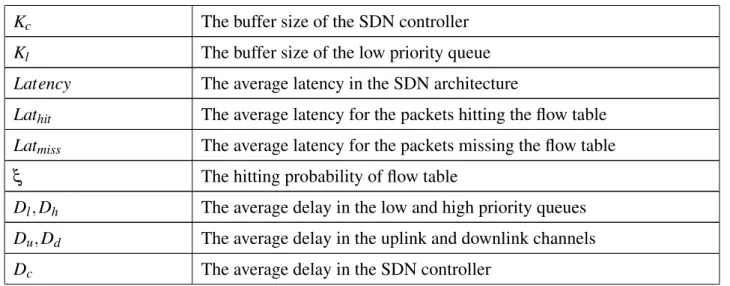
4.1 Key Notations Used in the Derivation of the Model in Chapter 4 . . . 51
5.1 Key Notation Used in the Derivation of the Model in Chapter 5 . . . 70
5.2 System Configuration Parameters for SDN Networks in Performance Eval-uation . . . 85
5.3 System Configuration Parameters for SDN Networks in Performance Anal-ysis . . . 90
6.1 Key Notation Used in the Derivation of the Model in Chapter 6 . . . 98
List of Abbreviations
4G Fourth Generation of Mobile Communication
5G Fifth Generation of Mobile Communication
ACL Access Control List
AMBR Aggregated Maximum Bit Rate APC antigeen-presenterende cel
CA Component Aggregation
CAPEX Capital Expenditures
CC Component Carrier
CDMA Code Division Multiple Access CoMP Coordinated Multi-Point
DC Downlink Channel
DPDK Data Plane Development Kit
DPI Deep Packet Inspection
EBA Empty Buffer Approximation EBB Exponentially Bounded Burstiness
ETSI European Telecommunication Standards Institute FBM Fractional Brownian Motion
GBR Guaranteed Bit Rate
GSM Global System for Mobile Communications HoL Head of Line
LTE-A Long-Term-Evolution Advanced LTP Long Term Perspective
MANO Management and Orchestration MGF Moment Generation Function
MIMO Multiple-Input and Multiple-Output MME Mobility Management Entity
MMPP Markov Modulated Poisson Process MPLS Multi-protocol Label Switch
NAT Network Address Translation NFV Network Function Virtualisation
OFDMA Orthogonal Frequency Division Multiple Access OMNeT++ Objective Modular Network Testbed in C++ ONF Open Networking Foundation
OPEX Operational Expenditures
PCRF Policy and Charging Rules Function PE Provider Edge
PF Proportional Fair PQ Priority Queue
PRB Physical Resource Block QCI QoS Class Identifier
List of Publications
• Wang Miao, Geyong Min, Yulei, Wu, Haozhe Wang, Jia Hu, “Stochastic Perfor-mance Analysis of Network Function Virtualisation with Random Service Model”, to be submitted toIEEE Transactions on Wireless Communications.
• Wang Miao, Geyong Min, Yulei Wu, Haozhe Wang, Jia Hu, “Performance Mod-elling and Analysis of Software Defined Networking with Bursty Traffic”, ACM Transaction on Multimedia Computing, Communications, and Applications (TOMM), Volume 12, Issue 5s, pp.77:1-19, 2016.
• Haozhe Wang, Geyong Min, Jia Hu, Wang Miao, “Performance Evaluation of Information-Centric Networking for Multimedia Service”, in Proceedings of Sym-posium on Service-Oriented System Engineering (SOSE-2016), pp.174-179, 2016. • Wang Miao, Geyong, Min, Yulei Wu, Haozhe Wang, “Performance Modelling of a
New Preemption-based Packet Scheduling (P2S) for Data Plane in SDN Networks”,
inProceedings of IEEE International Conference on Smart City (Smartcity-2015), pp. 60-65, 2015.
• Wang Miao, Geyong Min,Yuming Jiang,Xiaolong Jin,Haozhe Wang, “QoS-aware Resource Allocation for LTE-A Systems with Carrier Aggregation”, inProceedings of IEEE Wireless Communications and Networking Conference (WCNC-2014), pp. 1403-1408, 2014.
• Haozhe Wang, Geyong Min, Jia Hu,Hao Yin, Wang Miao, “Caching of Content-Centric Networking under Bursty Content Requests”, inProceedings of IEEE Wire-less Communications and Networking Conference (WCNC-2014), pp. 2522-2527, 2014.
QoE Quality of Experience QoS Quality of Service
RB Resource Block
SAC Stochastic Arrival Curve
SC-FDMA Single Carrier Frequency Division Multiple Access SDN Software Defined Networking
SLA Service Level Agreement SSC Stochastic Service Curve SSSQ Single Server Single Queue
TD-PSS Time Domain Priority Set Priority TLDS Two Level Downlink Scheduling TOC Cost Of Ownership
TTI Transmit Time Interval
UC Uplink Channel
VIM Virtual Infrastructure Manager VNF Virtual Network Function
Chapter 1
Introduction
With the rapid development of information and communication technologies, such as Cloud Computing, Social Networks, Network Virtualisation and Content Distribution Networks, the traditional network architecture has approached to its performance limit, and thus is unable to meet the requirements of various resource-hungry applications driven by streaming media, Ultra High Definition Video, enhanced reality, and Internet-of-Things. Significant infrastructure improvements to the network domain are urgently needed to guarantee the continuous network evolution and innovation. To address this important challenge, tremendous research efforts have been made from both academia and industry to foster the evolution to Future Internet. Recently, Long-Term-Evolution Advanced (LTE-A), Software Defined Networking (SDN), and Network Function Virtu-alisation (NFV) have been proposed as promising network architectures for Future Inter-net and attracted significant research efforts. This research focuses on the performance improvement of LTE-A, SDN and NFV through deriving the key performance metrics and optimising the network resources.
This chapter is organised as follows: Section 1.1 points out the motivations and chal-lenges in this research; The research aims and major contributions of this thesis are pre-sented in Section 1.2. Finally, the overall organisation of this thesis is introduced in
Section 1.3.
1.1 Motivations and Challenges
Analytical modelling and resource allocation, as efficient approaches to optimise the per-formance of the network system, have been attracted significant interests. Numerous research results have been reported in the literature to investigate the analytical modelling and resource allocation in LTE-A [1] [2] [3] [4], SDN [5] [6] [7] [8], and NFV [9] [10] [11]. However, there are still some practical and open research issues related to resource optimisation and performance modelling that need to be further tackled. For example,
(1) Carrier Aggregation (CA) is a primary feature for LTE-A architecture to achieve large virtual carrier bandwidth. By combining multiple separate spectrums through CA, telecommunication providers are capable of meeting the growing demands for the higher transmission rate and the lower latency and jitter. While, due to the unique transmission features such as interference and fading in wireless communication channels [12], CA poses significant challenges for resource allocation and optimisation in LTE-A networks. In addition, Quality-of-Service (QoS) is of critical importance for service provisioning in wireless communication networks [13]. Therefore, how to optimise wireless network resources to meet the strict user QoS in LTE-A networks with CA is a challenging and timing issue [14]. There have been some research results appeared in the literature [15] [16] [17], however, the majority of them mainly focused on independent Carrier Compo-nent (CC) and did not exploit the statistic multiplexing gain among multiple CCs. This problem becomes even more challenging in the presence of mobile users with different requirements in terms of bandwidth, tolerance to delay, and reliability.
(2) Through decoupling the network control from the underlying network infrastruc-ture in forwarding plane, SDN provides unprecedented network programmability and
con-trol. A lot of research efforts have been made to leveraging these benefits provided by SDN to improve the network innovation and performance of Future Internet. However, most of the existing research sets simple assumption in their study, adopting First-In-First-Out (FIFO) packet scheduling as the primary approach to process arrival packets. Although, FIFO has been widely considered as an effective approach in the literatures [18], it incurs serious issues of low global fairness and performance degradation in SDN paradigm due to the inherent feature of SDN-feedback control loop between data plane and control plane. In order to fully release the potential of the SDN architecture, there is a need to design a more effective packet scheduling algorithm in the SDN network to improve the overall performance of data forwarding.
(3) Analytical modelling is an efficient approach to quantitatively investigate the per-formance of network systems [19] [20] [21] [22] [23] [24]. For SDN networks, several research results of analytical modelling have been recently reported in the literature [5] [6] [7]. Among those studies, analytical modelling has demonstrated its superiority in terms of cost-effectiveness in the evaluation of large-scale networks. However, for analytical tractability and simplification, existing analytical models are derived based on the as-sumptions that the network traffic follows the Poisson process which is suitable to model non-bursty text data and the data plane is modelled by one simplified Single Server Single Queue (SSSQ) system [25] [5] [26]. Recent measurement studies have shown that, due to the features of heavy volume and high velocity, the multimedia big data generated by real-world multimedia applications reveals the bursty and correlated nature in the network transmission [27] [28] [29] [30] [31]. Therefore, in order to achieve a deep understanding of SDN architecture, there is an urgent need to develop a comprehensive analytical model to capture the bursty and correlated feature of network traffic.
brings network operators the significant reduction of Operational Expense (OPEX) and Capital Expense (CAPEX) and the increased flexibility of service design, deployment and management. There have been research efforts to investigate the performance of service provisioning [9] [10] [11]. However, the existing work did not fully consider the dynamic and on-demand features of the NFV service provision. Especially, the service capabilities of VNFs are different due to their different network functions and also may change over the whole life-cycle in the manner of on-demand [32]. Furthermore, the network functions in NFV chain may be added, removed or modified, which form new NFV chain [33] to continuously offer the satisfied performance. To the best of our knowledge, analytical modelling and analysis of NFV network with the features of dynamic service and scalable resource has not been reported in the existing literature. In order to fully harvest the merits of NFV for network operators, there is a need and opportunity to use the probabilistic features of stochastic network function to investigate the dynamic features of NFV.
1.2 Research Aims and Contributions
This research focuses on the performance improvement of SDN, NFV and LTE-A sys-tems through mathematics modelling and resource allocation. The main objectives of this research are:
• To propose a new resource allocation scheme for LTE-A system with CA with the aim of providing the QoS guaranteed network service.
• To propose an efficient resource allocation scheme for SDN network to improve the global fairness and reduce the packet loss probability in SDN data plane.
• To develop a comprehensive analytical model to quantitatively investigate the per-formance limits of SDN networks under the bursty and correlated network traffic.
• To develop a new stochastic analytical tool to capture the dynamic and on-demand features of NFV networks and achieve the end-to-end performance of NFV service chain.
To achieve the above objectives, this research develops new analytical models and resource allocation strategies. The effectiveness and accuracy of the proposed models and algorithms are demonstrated by extensive experimental results with various network conditions. The original contributions of this research are summarised as follows:
• A novel QoS-aware resource allocation scheme, termed as Cross-CC User Migra-tion (CUM) scheme, is proposed to support real-time services in LTE-A down-link transmission with CA by jointly considering the system throughput, QoS con-straints, and user fairness.
• A Peemption-based packet-scheduling scheme (P2S) is proposed to improve the
global fairness and reduce the packet loss rate in the SDN data plane. Compre-hensive simulation experiments are conducted to demonstrate thatP2Scan achieve better system performance compared to the traditional data plane packet scheduling in terms of global fairness index and packet loss probability.
• An analytical model is developed to quantitatively evaluate the performance ofP2S
scheduling scheme. The developed model can capture the loop control, limited buffer resource, and preemption features of theP2Sscheme. The developed model
is further leveraged to analyse and pinpoint the performance bottleneck of the SDN architecture.
• A novel analytical model is designed for SDN networks subject to the input of bursty multimedia traffic. The bursty and correlated nature of the traffic
character-istics on each link and component of SDN network is captured. The QoS perfor-mance metrics in terms of the average latency and average network throughput are derived based on the developed analytical model.
• A versatile method is proposed by extending the Empty Buffer Approximation (EBA) method to facilitate the decomposition of a Priority Queue (PQ) system to two Single-Server-Single-Queue (SSSQ) systems. Compared with the EBA, the proposed method takes the effects of higher priority queue into account and achieves better analytical performance.
• A new stochastic analytical model based on stochastic network calculus is devel-oped to investigate the end-to-end performance of NFV networks. Through jointly exploiting leftover service and stochastic multiplexing technologies, the proposed analytical model provides an efficient and effective approach to capture the dynamic and on-demand features of NFV networks with the strict Service Level Agreement (SLA) requirements.
1.3 Outline of the Thesis
The rest of this thesis is organised as follows.
• Chapter 2 introduces the background knowledge of this thesis, including the ar-chitectures of SDN, NFV and LTE-A, CA, traffic models and analytical tool. A detailed literature review on the analytical model and resource allocation of SDN, NFV, and LTE-A is also presented.
• Chapter 3 designs a QoS-aware resource allocation scheme to support real-time ser-vices in LTE-A downlink transmission by jointly considering the system through-put, QoS constraints, and user fairness.
• Chapter 4 proposes a new packet-forwarding scheme in the SDN data plane and develops a new analytical model to investigate the performance of the proposal scheme. The bottleneck of the SDN network is analysed and feasible solutions are provided based on the developed model.
• Chapter 5 develops an analytical model for SDN networks with priority queue under bursty traffic. The analytical model is used to investigate the effects of the flow-table hit probability and resource allocations.
• Chapter 6 develops an analytical model for NFV networks based on stochastic net-work calculus to investigate the end-to-end performance of NFV netnet-works.
Chapter 2
Background and Literature Review
LTE-A, SDN and NFV, as the promising network architectures for Future Internet, have been attracted significant research interests. This chapter presents the background knowl-edge and related work of LTE-A, SDN and NFV, with the focuses on the resource alloca-tion and performance modelling. Firstly, the network architectures of LTE-A, SDN and NFV will be presented in Sections 2.1. Then, Sections 2.2 and Section 2.3 will intro-duce the fundamental knowledge and basic ideas of traffic models and analytical tools. A detailed literature review in the area of resource allocation and analytical modelling of LTE-A, SDN and NFV will be presented in Section 2.4. Finally, section 2.5 summaries this chapter.
2.1 Emerging Network Architectures and Technologies
2.1.1 LTE-A Architecture
LTE-A is a promising technology that offers high-data-rate transmission for the fourth-generation (4G) mobile communication systems [34] [35]. In order to satisfy the strict technique requirements of International Mobile Telecommunications (IMT), LTE-A in-herits all the characteristics of LTE, such as Orthogonal Frequency Division Multiple Access (OFDMA) [36] for the downlink transmission to enable cost-efficient solutions
for high peak rates and Single-Carrier FDMA (SC-FDMA) for the uplink transmission to conserve power. Furthermore, several new technologies are proposed for LTE-A, in-cluding Carrier Aggregation (CA), enhanced Multiple-input and Multiple-output (MIMO) [37] and Coordinated Multi-Point (CoMP) transmission [38]. For supporting up to 100 MHz bandwidth, 5 Component Carriers (CCs) of 20 MHz are aggregated. The bandwidth of each CC follows the configurations of LTE systems, including 1.4, 3, 5, 10, 15, and 20 MHz [39]. In addition, the support for CCs with various bandwidths offers significant flexibility for efficient spectrum utilisation, and gradual re-farming of frequencies previ-ously being used by other systems such as Global System for Mobile Communications (GSM) [40] or Code Division Multiple Access (CDMA) [41].
Figure 2.1: LTE-A Systems with Carrier Aggregation Standardised by 3GPP
The structure for allocation of radio resource in LTE-A systems is described in Fig. 2.1 [14]. The eNB firstly carries out the admission control process, and then employs CC assignment to allocate the users on different CCs [2]. Once all users are allocated by the CC assignment, the packet scheduling is performed to assign time/frequency resources for each of users allocated on different CCs, taking into account QoS requirements, system efficiency and user fairness. According to the LTE specification in [42], radio resources are divided into Resource Blocks (RBs) spanning over one-time-slot (1ms) in the time domain and over one sub-channel (180kHz) in the frequency domain, which is the small-est radio resource that can be assigned to a User Equipment (UE) for data transmission during resource allocation.
2.1.2 SDN Architecture
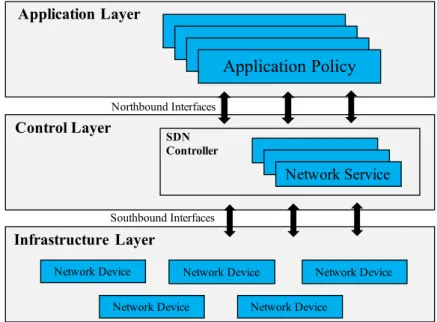
SDN is an approach to allow network administrators to manage network services through the centralised controller. It was proposed to accelerate network innovation and flexible deployment by decoupling the logic of the network control from the forwarding plane, enabling network operators to gain unprecedented programmability, automation, and net-work control [43] [44]. In order to advance the concept of SDN technology, Open Net-working Foundation (ONF) published the white-paper for SDN and proposed a practical network architecture for SDN as shown in Fig. 2.2 [45].
Application Policy
Network Service
Network Device Network Device Network Device
Network Device Network Device
Application Layer Control Layer Infrastructure Layer SDN Controller Northbound Interfaces Southbound Interfaces
Figure 2.2:Three Layer SDN Architecture Proposed by Open Network Foundation
SDN architecture has three cooperative layers: infrastructure layer, control layer and application layer [46]: the infrastructure layer provides network forwarding services un-der the instructions of the control layer. The control layer maintains the network-wide information to manage and optimise the overall network performance. SDN controller uses southbound interfaces such as OpenFlow [47], Open vSwitch Database Manage-ment Protocol (OVSDB) [48] and OpFlex [49] to communicate with the infrastructure layer, and leverages northbound interfaces, for instance Restful APIs [50] to interact with the application layer. The application layer creates various services, e.g., network
topol-ogy discovery, virtual private network provisioning, and path reservations, based on the received network information from the control layer. With the logically centralised control of the network infrastructure, SDN enables the software intelligence to program networks via the well-defined programmatic interfaces, which are highly customisable, scalable, and agile to meet the requirements of transmission QoS.
OpenFlow is the first standard southbound communication protocol between the SDN controller and network forwarding devices [51] and has been implemented in various industry products [43]. In order to identify the network traffic and conduct various net-work functions, OpenFlow protocol defines three domains in the flow table of netnet-work devices, including match field, action field and statistic filed. The match field uses IP 5-tuple (source IP, source port ID, destination IP, destination port ID and protocol in use) to match the arrival packets based on the pre-defined rules. The action field stores the forwarding and routing information for the arrival packets. The statistics field is used to count the number of the packets that hit the match field. The statistical data would be used by the up-level application and service to detect or implement certain security process-ing. With OpenFlow, SDN controller is capable of accessing the flow table, collecting the statistics data and modifying the flow table to realise the intelligent network management and service deployment.
2.1.3 NFV Architecture
NFV is an architectural approach that focuses on decoupling network functions such as Network Address Translation (NAT) [52], Access Control Lists (ACL) [53], Layer 3 rout-ing [54], Intrusion Prevention and Intrusion Detection Systems (IPS and IDS) [55], and more from the underlying hardware platform [56]. Allowing such functions to run in-side virtual machines, on top of standard x86 servers, increases the deployment flexibility
in the network. With the help of NFV, network functions are released from the specific underlying network devices and can be installed or re-installed on any general network servers. This kind of network function migration brings significant benefits for network operation and maintenance. For instance, in the era of 5G, the condition that services and applications become more complex, dynamic and resource hungry, poses a huge challenge for the network service provisioning. NFV provides higher flexibility and programmabil-ity and faster innovation and enables new opportunprogrammabil-ity for network operator to enhance network management. Furthermore, NFV helps network service providers address a criti-cal issue for their business: high Total Cost of Ownership (TCO) and low revenue. For in-stance, in order to continuously meet the user requirements for more resource-hungry and diverse applications, network service providers have to purchase expensive and dedicated physical network equipment, and train high skilled engineers to operate and manage these devices, which involve a huge amount of TCO for service provisioning. However, for the network service providers, these higher CAPEX and OPEX cannot be easily translated into high subscription fees, as they have learned that due to the high competition, both among themselves and from services being provided over-the-top on their data channels, increasing prices only leads to customer losses. Through deploying the network func-tions on common services rather than purchasing new dedicated devices, NFV provides a good solution for network service providers to reduce their CAPEX and OPEX [57], as the common server and network functions can be dynamically re-used in the manner of on-demand.
In order to realise the ambition of NFV technology, European Telecommunication Standards Institute (ETSI) proposed an NFV architecture [58] to guide the implementa-tion and management of NFV, which consists of three main components, NFV Infrastruc-ture (NFVI), Virtual Network Functions (VNFs) and NFV Management and Orchestration
(MANO) as shown in Fig. 2.3. OSS/BSS Orchestrator VNF Manager Virtualised Infrastructure Manager (VIM) EMS EMS VNF1 VNF2 EMS VNF3 Virtual Computing NFV Infrastructure Virtual Storage Virtual Networking
Figure 2.3:MANO NFV Architecture Proposed by European Telecommunications Standards In-stitute
NFVI in the bottom of Fig. 2.3 is the combination of the various virtual and hard-ware resources, including network, storage and computing resources. It is responsible for preparing, deploying and adjusting virtual resources to satisfy the operating requirements of the VNFs [59]. VNFs in the middle of Fig. 2.3 are the software modules of network functions that can be deployed on the virtual resources provided by NFVI. NFV MANO in the right side of Fig. 2.3 is the management and orchestration platform for VNFs and NFVI, consisting of Virtualised Infrastructure Manager (VIM), VNF Manager and Orchestrator. NFV MANO interacts with the right side of NFV architecture through ref-erence points for the purpose of managing and orchestrating NFVI and VNFs. Different interfaces are defined to exchange the information among function blocks. Within NFV MANO, Orchestrator is responsible for the communication with the OSS/BSS to achieve the service and SLA information. Orchestrator analyses the received information from two areas: what kind of VNFs are needed to build the service chain to deploy the network service, and which kind of resource are needed to support the selected VNFs. Orchestra-tor sends the analysed information to VNF Manager and Virtual Infrastructure Manager (VIM). VNF Manager is charging for the VNF configuration to deploy NFV chains, in-cluding building, maintaining and tearing down the NFV chain; and VIM implements the
resource virtualisation and allocation to guarantee the Service Level Agreement (SLA) of NFV chain.
2.2 Traffic Models
In order to comprehensively investigate the performance of future network architecture under various multimedia traffic, the network traffic entering the network devices will be modelled by Poisson process and Markov Modulated Poisson Process (MMPP).
2.2.1 Poisson Process
Poisson process is one of the most well-known model to characterise the traffic in net-work system [60]. It has been widely used to analyse the system performance with the input of the non-bursty traffic, such as message and email data [61]. For Poisson process, the inter-arrival time follows the exponential distribution with arrival rate, l, denoted asP(Tat) =1 e lt witht 0. Poisson traffic exhibits a number of important and
convenient properties, for instance, the superposition of multiple independent Poisson process with arrival rate,liand 1iN, results in a new Poisson process characterised
bylt, calculated as lt =’Ni=1li; the number of arrivals in disjoint intervals is
statisti-cally independent, which is known as independent increment property [60]. Given a time interval, t, the number of arrivals, N(t), of Poisson process follows the distribution of
P(N(t) =n) = (ln!t)ne l.
2.2.2 Markov Modulated Poisson Process (MMPP)
In order to capture the bursty and correlated feature of network traffic, the traffic entering SDN switch will be modelled as MMPP in this research, which is a doubly stochastic Poisson process with the arrival rate varying according to an irreducible continuous-time Markov chain [62] [63]. Due to the capability of capturing the time-varying arrival rate,
MMPP is an effective tool for modelling bursty and correlated traffic [64] [65]. In addi-tion, the superposition and splitting operations of MMMPs generate a new MMPP [66] [67], facilitating the derivation of the analytical model in the complex network environ-ment. A two-state MMPP has been widely used to investigate the performance of the net-work [68] [69] and is parameterised by an infinitesimal generator matrix of the Markov chain and an arrival rate matrix as follows
Qi= 2 6 6 4 j1i j1i j2i j2i 3 7 7 5 Li= 2 6 6 4 l1i 0 0 l2i 3 7 7 5 (2.1)
wherej1iis the transition rate from state 1 to 2, andj2iis the rate out of state 2 to 1.l1i
andl2iare the traffic rates when the Markov chain is in states 1 and 2, respectively. The
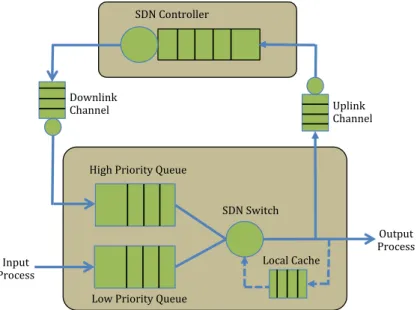
subscript,i, denotes the type of the queue where the traffic arrives within the SDN archi-tecture, e.g., low priority queue, high priority queue, Uplink Channel (UC) and Downlink Channel (DC) queues and the controller queue in SDN networks. Then, the mean arrival rate,lm
i , ofMMPPican be given by
lm
i = l1ijj2i+l2ij1i
1i+j2i (2.2)
2.3 Stochastic Network Calculus
The traditional queuing theory focuses on the steady state of the network behaviour, and is dedicated to achieving the end-to-end average network performance [70]. While, com-pared with the queueing theory, the stochastic network calculus focuses on achieving the end-to-end performance bounds and conducting the QoS analysis from the worst case perspective. The aim of the stochastic network calculus is to probabilistically investigate the capability of providing a QoS-guaranteed service of the network infrastructure with
the constraints of network resources [71]. For instance, the QoS guarantee requirements for a network infrastructure have the following form,
P(Delay>x)e or P(Loss>x)e (2.3)
wherexis the targeted delay and loss;e is the permissible violation probability. The aim of stochastic network calculus is to give the relationship betweenxande.
In stochastic network calculus, the time is discrete [72] [73] andt,n, andt are used to denote the discrete time. During the time interval[0,t], the cumulative traffic generated
by the end user is denoted as A(t); the service available at the system is S(t), and the
cumulative departures from the system isD(t). Assume that the server is a lossless and
work-conserving server, which means there is no packet loss during the service and the server would not stop until the buffer is empty. It is easy to get thatA(t),S(t)andD(t)are
non-negative and non-decreasing functions. At the start of the time 0,A(t),S(t)andD(t)
are assumed to be 0. Further, the notationA(t,t)denotes the cumulative traffic arriving
at time interval[t,t]and is equal toA(t) A(t). S(t)andD(t)have the similar notations
asS(t,t)andD(t,t). According to dynamic server in [72], the relationship betweenA(t),
S(t)andD(t)can be expressed as
D(t) min
t2[0,t]{A(t) +S(t,t)} (2.4)
The right side of the above inequality achieves its minimum when t is equal to the beginning time,t⇤, of the last busy period beforet. At time t⇤, the queueing buffer is
empty andA(t⇤) =D(t⇤). The backlog at timet can be defined asB(t) =A(t) D(t),
which comprises both the bits in the buffer and in the service. From Eq. (2.4),B(t)can
B(t) max
t2[0,t]A(t) +S(t,t) (2.5)
In [74], the system delay at timetis defined as
W(t) =min{n 0,A(t)D(t+n)} (2.6)
which defines the time slot between the arrival and departures for bits that arrive at the system at timet. In network calculus theory, min-plus convolution denoted as operatorN is introduced to simplify the complex equation derivation.
(A⌦S)(t) = max
t2[0,t]{A(t) +S(t,t)} (2.7)
Then Eq. (2.4) can be simplified asD(t) (A⌦S)(t). Min-plus convolution is very useful
for deriving the end-to-end network performance, as it inherits some useful properties from the classic convolution, such as associativity with the condition of independence.
2.4 Literature Review
There has been a significant amount of work on LTE-A, SDN, and NFV. In this section, the existing work related to resource allocation and performance modelling of LTE-A, SDN, and NFV will be surveyed. The contributions of this research will also be discussed.
2.4.1 Resource Allocation in LTE-A
Resource allocation is of utmost importance for LTE-A networks, as the optimal process-ing of the resource allocation can brprocess-ing great system performance improvement [1] [3]. Therefore, a lot of research results [75] [76] [77] [78] [79] [80] [81] have been reported in the literature to find the low complexity, high utilisation and QoS guaranteed resource
allocation approaches. Within wireless 4G communication networks, such algorithms should consider the transmission quality of the wireless channel, user mobility, expected QoS requirements and overall system utilisation.
In [75], a decoupled time and frequency domain packet scheduling algorithm was proposed to study the performance of the dynamic packet scheduling of 3GPP Universal Terrestrial Radio Access Network (UTRAN) downlink. The simulation results were col-lected with different 3GPP macro scenarios and showed that the fairness of the resource allocation can be improved by adopting the time-frequency resource allocation strategy. Following [75], Monghal et al. [76] extended the decoupled time and frequency domain packet scheduling approach by introducing frequency domain metric weighting and Time Domain Priority Set Priority (TD-PSS) to investigate the throughput fairness of OFDMA downlink transmission. In [77], a multiuser scheduler with Proportional Fairness (PF) was proposed for the downlink of LTE cellar communication network with the fairness among users considered. The simulation results showed that compared with the well-known maximum rate algorithm [78], the proposed algorithm achieved the better fairness performance with a slight loss in terms of transmission throughput.
The above research work studied the improvement of throughput and the user fair-ness in packet scheduling, however, did not pay attention to the QoS requirement of the packet loss probability and delay. In this context, there have been many studies focusing on ensuring timely transmission for real-time traffic, providing guarantees on the packet transmission delay. For instance, for supporting the real-time traffic with multi-level de-lay constraints, a dynamic packet scheduling scheme was proposed in [79] for OFDMA system. According to users0 delay constraint level, a mathematical model was developed
in the proposed scheduling scheme to make the resource allocation decision, which de-termines whether the head-of-the-line packets should be transmitted within the current
OFMDA Transmit Time Interval (TTI) or the next TTI. Numerical results showed that the proposed algorithm outperforms the round robin scheme, exponential scheduling scheme as well as the Modified Largest Weighted Delay First (M-LWDF). To provide the real-time services, M. Assaad in [82] investigates the similar problem to [79] by deriving the differentiated behaviours of the diverse average delay constraints. Furthermore, the re-source allocation with the aim of maximising the total achievable throughput for multiple users with diverse QoS requirements was investigated in [80] as an optimisation problem. By intelligently assigning the priorities of different users with multimedia traffic, Chung et al. [16] studied the problem of enhancing system throughput while guaranteeing the QoS requirements in terms of average packet delay. Simulation results demonstrated that compared with the traditional resource allocation schemes, the proposed algorithm pro-vided the better system performance in terms of throughput and fairness and achieved the guarantee of QoS requirements with heavy traffic load. Based on the information of channel state and queue length, a sub-optimal resource allocation algorithm for provid-ing delay guarantee was proposed in [83]. With the information of user wireless channel quality and queue state information, the proposed algorithm classified all users into three categories and allocated the time-frequency resource blocks to three user categories in turn. Through differentiating the resource allocation, the proposed algorithm was proved to have the merits of reducing the data rate and improving the resource exploitation rate.
It can be seen that the above research work of resource allocation in 3G/4G networks focused on the system throughput, allocation fairness and average transmission latency, while did not consider the guarantee of QoS performance, including packet transmission delay. For resource-hungry application and service with strict QoS requirements, such as on-line gaming and interactive social events, it is not sufficient just to provide the guarantee on average transmission latency, but more necessary to enforce guarantees on
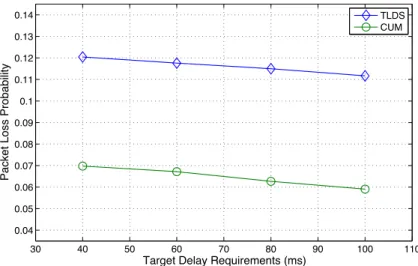
the upper bound of packet delays. In this area, a unified framework was proposed in [84] to provide the real-time service through utilising the stochastic approximation tools and convex optimisation, however, when this strategy is transplanted from LTE system to LTE-A system, there are some problems needed to be carefully dealt with, such as high-complexity and backward compatibility. In addition, a two-level downlink scheduling algorithm was proposed in [81] for real-time multimedia services in LTE networks. The proposed algorithm provided good performance of user fairness and has overcome the limitation of many prior works, however, it did not consider the users who has the pending data approaching to the deadline, and may experience a sudden decrease of the channel quality. For avoiding the violation of the target delay, the Head-of-Line (HoL) packets that need to be transmitted in present frame are not fully guaranteed in the design of [81], which may lead to serious packet loss especially for the edge-cell users, since the data quota calculated by the upper level frame in [81] is larger than that of HoL flows; if the arrival traffic becomes heavier due to service fluctuation, more radio resource will be allocated in [81] to the quota of the users who have good channel condition; in this case the edge-cell users would be forced in the situation of resource starvation. In order to address this issue, the performance of the edge-cell should be enhanced by taking into account of the HoL packet expiration; compared with the flows that sill have chance in the future TTIs, the flow approaching the deadline should be given a higher priority in the resource allocation to avoid the packet lost.
In addition, CA is one of the key technologies in LTE-A towards meeting the required wider bandwidth by aggregating multiple existing LTE carriers together [85]. In CA, LTE and LTE-A users are assigned into different CCs to maximise the diversity gain from the resource allocation perspective. However, the operation of user assignment would intro-duce the serious load unbalance among different CCs that one CC0s load is much heavier
than that of the other CCs due to the different channel quality experienced by mobile users. Load unbalance coupled with the issue of the QoS guarantee pose a challenging problem for resource allocation in LTE-A system. This problem becomes even more chal-lenging in the presence of mobile users with different requirements in terms of bandwidth, tolerance to delay, and reliability.
2.4.2 Resource Allocation and Analytical Modelling in SDN
Resource allocation and analytical model are critical for SDN networks. This section surveys the latest work in the area of resource allocation and analytical modelling in the literature.
2.4.2.1 Resource Allocation of SDN Networks
SDN allows the underlying network to be programmed by the control plane, which makes it easier for the network provider to dynamically control and manage network resource and create value-added services. In this context, several research efforts [86] [87] [88] [89] [90] [91] [92] have been made in the area of the resource allocation to optimise the overall operation for SDN networks and leverage the capability of SDN networks to vir-tualise, deploy and manage emerging applications and services. For instance, in order to jointly optimise application performance and network utilisation, Wang et al. in [86] proposed an application-aware network resource allocation through SDN controller and optical switching. In order to overcome the limited rule space of SDN devices, Dong et al. in [87] designed a two-level rule space strategy in data plane and a novel cache prefetching mechanism to increase the utilisation of network resources. The novelty of this work is the integration of the modification of the flow entries with the prediction of the user mobility to significantly increase the hit probability of the flow table. Authors in [88] leveraged the capability of SDN architecture to realise the virtualisation of radio access network and
optimise the resource allocation for Internet of Things application. In order to provide re-configurable networks for social big data analytics, a big data processing system powered by SDN was designed in [89] through integrating the transmission of SDN networks and the processing of Hadoop architecture. This work exploited the potential of SDN to build a high-performance network infrastructure among different processing units to accelerate the overall data processing; Li et al. [90] proposed an OFScheduler based on OpenFlow and used as a network optimiser for optimising MapReduce operations in a heterogeneous cluster. Qin et al. [91] designed a framework that employs SDN elements in Hadoop to reduce the time taken by data to reach the distributed processing nodes. Within each pro-cessing nodes, an online deduplication energy approach is developed in [92] to minimise the energy cost in data centre.
Although existing SDN work has made significant progress in network management and operation by leveraging SDN centralised controller, little attention is paid to the per-formance improvement in the data plane. Based on the separation of the control and data planes, network logics are implemented in a logically centralised controller; most of the existing work assumed that network switches should become as simple as possible, and adopted First In First Out (FIFO) scheme in data plane to process the arrival packets. Although, FIFO has been widely considered an effective approach to allocate network re-sources [18], it incurs serious issues of low global fairness and performance degradation in SDN paradigm, due to the inherent feature of SDN - feedback control loop between data plane and control plane. Therefore, there is an urgent need to develop an efficient packet scheduling in SDN networks to improve the global fairness and overall performance.
2.4.2.2 Analytical Modelling of SDN Networks
Due to the explosive growth on the volume of Internet traffic and the ever-increasing QoS requirements of emerging network applications, there have been timely and pressing de-mands to study the performance of SDN networks. Currently, the performance of SDN networks are mainly investigated by simulation experiments and analytical modelling. For the simulation experiments, Naous et al. [93] firstly implemented the OpenFlow Eth-ernet switch on the NetFPGA platform to provide high throughput and low complexity of forwarding switches. Antichi et al. [94] extended Naous work by designing a flexible OpenFlow based forwarding architecture through regular expression with the aim of sup-porting more network applications in data plane. The switches in the proposed architec-ture are capable of storing up to 200K flow information while satisfying the requirement of line rate processing. Bianco et al. [95] extended the OpenFlow switch implementa-tion to the Linux platform based on OpenFlow specificaimplementa-tion, also meeting realistic line rates. These implementations of OpenFlow switches, however, were only realised on sin-gle platform, lacking the support for cross-platform implementation. To fill this gap, in [96], a modular and parameterised implementation of a hardware-based OpenFlow switch was proposed to implement SDN on three different platforms, i.e., NetFPGA, ML605 and DE4. Through performance comparison, this study showed that the switch design can be implemented on different platforms with minor performance variations.
As compared to simulation, analytical modelling has the potential to offer a signif-icant reduction of the computation resource and time required for achieving the system performance [97] [98] [99] [100], especially when large-scale Internet with high-volume big data is considered in [12]. Azodolmolky et al. in [5] analysed the performance of the SDN architecture through exploiting the network calculus theory and achieved the boundary condition of the transmission latency and queue length. Based on the
mea-surements of the switching time in hardware OpenFlow switch, Jarschel et al. in [25] proposed an analytical model for SDN networks to estimate the packet sojourn time and packet loss probability. Mahmood et al. in [26] extended the work in [25] to investigate the performance of the SDN architecture with multi-node condition. In this study, both the data plane and control plane were simply modelled as M/M/1 queues. Furthermore, for analytical tractability and simplicity, all these existing models for SDN networks were primarily developed under the nonbursty Poisson arrivals. For big data transmission, the traffic patterns typically exhibit bursty and correlated nature. For instance, Beck et al. [28] revealed that the procedures of the big data analytics lead to the high burstness dur-ing the data transmission and more dynamic resource allocation are required to meet the QoS/QoE requirements. The authors in [27] discovered that the traffic behaviour of the big data exhibits the larger bursty at the range of 10-1000 microsecond. Liu et al. in [30] analysed the four popular big data applications (Hadoop, Spark, Shark and Impala) run-ning on the experimental clusters. The real traffic was collected from the communications among these applications. The experimental results showed that the big data traffic results in the higher use of the network in a short time and exhibits the high degree of fluctuations and burstiness. Although the transmission of the big data presents the bursty pattern and significantly affects the provisioning of the network services, none of the existing analyt-ical models for the SDN networks is capable of capturing such realistic characteristics. There is an urgent need to develop an analytical model that could accurately predicts the performance of SDN networks under the traffic patterns exhibited bursty and correlated features.
2.4.3 NFV and Analytical Modelling of Service Chains
Due to its profound impact in the future network, NFV has gained global awareness [101] [102] [103] and leads to a lot of research results reported in the literatures, for instance, to tackle the problem of the optimal Virtual Network Function (VNF) placement, Xia et al. [32] formulated this problem as a binary integer programming for minimising the overall optical/electronic conversions and designed a heuristic algorithm to achieve high computation efficiency. Moens et al. [33] addressed the similar problem through formu-lating the placement problem as an integer linear program with the aim of allocating a service chain onto the physical network minimising the number of servers used. In order to improve the performance of the NFV virtualised network to achieve the comparable performance with that of the network function deployed on the dedicated network device, Ge et al. [101] firstly conducted the comprehensive research and determine that industry standard servers may not provide satisfied performance for some network functions, such as DPI and NAT, and highlighted that hardware acceleration technology is a good alter-native for improving the performance for VNFs. Yamazaki et al. [104] deployed virtual DPI on Application Specific Instruction-set Processor (ASIP) and achieved much better performances. Compared with ASIP solution, Intel [105] proposed a set of Data Plane Development Kit (DPDK) to accelerate the packet processing speed in the VNFs, which has been adopted by many vendors during designing their NFV solutions. In the standard-isation process of NFV architecture, ETSI [106] launched the specification of “Network Function Virtualisation Performance & Portability Best Practises” to identify the perfor-mance requirements for Virtual Machines (VMs) and hardwares to assure predictable high performance. Experimentation tests were conducted in both bare metal and virtualisation environments for NFV use cases, such as DPI, C-RAN, BRAS, etc. The specification concluded that the predictable high performance could be achieved through following the
best practices listed in the specification. In addition, China Mobile conducted extensive field trails to test the performance of NFV and SDN architectures in C-RAN; the results from China Mobile report in [107] showed that common hardware can support multi-RAT technologies and achieve the comparable performance with traditional systems. The ex-isting research work has achieved a lot of progresses in the performance improvement of NFV network, however based on the simulation trails, existing study can not accurately and quantitatively investigate the performance for the NFV architecture, especially with large scale and complex network configurations.
Modelling and analysis of the network functions and service has been a very chal-lenging and attracts tremendous research efforts [108] [109] because analytical models can capture the inherent features of a complex system and yield significant insights into the system design and performance in a cost-effective way. For performance modelling and analytics, most of the existing studies appealed to the queueing theory [70], which is a fundamental mathematical approach to capture the behaviour of the network system. The classical queueing theory focuses on the average quantities in the equilibrium and derives the average system performances such as average latency, throughput and packet loss probability, however, for the QoS guarantee, it can be hardly used to investigate the performance of the service-guaranteed system due to the dynamic and on-demand fea-tures of the service provisioning. In this area, stochastic network calculus [73] [72] [74] has attracted research interests. Instead of giving the average performance metrics, it de-rives the worst-case of system performance. For instance, in order to achieve the available bandwidth, Lubben et al. [108] explored the properties of stochastic min-plus linear sys-tem theory, which expresses bandwidth availability in terms of bounding functions with defined violation probability, and accurately estimated the available bandwidth with ran-dom server in wireless communication system. This work, however, is only focusing on
modelling the service capability of the access network, lacking the support for modelling the end-to-end service provisioning. As a result, a new model was developed in [109] for characterising the service capability of the converged networks, from access network, core network, to datacenter networks. The analysis technique was developed with the aim of achieving the delay performance of the converged infrastructure and generally ag-nostic to the specific network implementation. However, this work did not consider the on-demand feature of the service provision; especially, when the service capabilities of VNFs are different due to their different network functions and also may change over the whole life-cycle in the manner of on-demand. Furthermore, the network functions in NFV chain may be added, removed or modified in order to continuously offer satisfied perfor-mance and forms new NFV chain. To the best of our knowledge, analytical modelling and analysis of NFV network with the features of dynamic service and scalable resource has not been reported in the existing literature.
2.5 Summary and Contribution
This chapter firstly introduced the fundamental knowledge of the network architectures of LTE-A, SDN and NFV; then the traffic patterns and the analytical tools that will be used in the derivation of the analytical models, were presented. Finally, a detailed state-of-the-art was given with focuses on the resource allocation and analytical modelling of LTE-A, SDN and NFV. In order to bridge the gaps identified in the state-of-the-art of Section 2.4, four aspects of innovation work are conducted in this study and will be in-troduced in the rest of this thesis: 1). to address the unbalanced load problem coupled with the issue of the QoS guarantee in LTE-A, a novel Cross-CC user migrating scheme is proposed, which consists of three cooperative and complemented schedulers to define, fulfil and optimise the transmission quotas in each TTI, with the aim of meeting QoS
re-quirements and optimising the overall resource utilisation; 2). according to the OpenFlow specification 1.3.3 [110], the queue structure in the forwarding devices is recommended to be designed with multiple queues, therefore, a PQ based packet scheduling is proposed in this research to improve the forwarding capability of SDN data plane; 3). in order to achieve a fundamental understanding of the performance of SDN networks, two analyti-cal models are developed in this research to comprehensively investigate the performance of the SDN networks under the inputs of Poisson process and MMPP; and 4). in order to quantitatively study the dynamic and on-demand features of NFV network, stochastic network calculus is used in this research to achieve the capability of service guarantee in NFV network; instead of giving the average QoS metrics, the proposed analytical model based on stochastic network calculus provides the upper latency bound, which is very useful for practical network service provisioning and network planning.
Chapter 3
QoS-Aware Resource Allocation for
LTE-A system with Carrier
Aggregation
3.1 Introduction
Carrier Aggregation (CA) is regarded as a promising technique for LTE-A wireless com-munications to satisfy the ever-increasing bandwidth requirements [39][111]. However, this technical innovation puts forward new challenges on radio resource allocation in LTE-A systems such as serious unbalanced loads among different Component Carriers (CCs). To alleviate this problem, a Cross-CC user migration packet scheduling algorithm is pro-posed to provide real-time service in the LTE-A downlink transmission with CA, jointly considering system throughput, QoS constraints, and user fairness. The proposed scheme has three cooperative components: the higher level scheduler, the lower level scheduler and Cross-CC user migration scheme. (1) In the higher level scheduler, an innovative re-source allocation algorithm defines frame-by-frame the amount of data that each real-time source should transmit to satisfy its delay constraint. (2) Once the higher level has
accom-plished its task, the lower level scheduler, every TTI, assigns Resource Blocks (RBs) using the proportional fair algorithms to fulfil the transmission quotas defined by higher level scheduler, by virtue of considering user average data rate in Proportional Fair (PF) algo-rithm, lower level scheduler achieves a higher fairness among users. (3) When the lower level scheduler finishes its allocation process, the base station will start the Cross-CC user migration process, it is motivated by decreasing the unbalance degree among the different CCs and will increase the system efficiency through globally utilising the resource of CCs that have accomplished their quotas in advance.
The remainder of this chapter is organised as follows. Section 3.2 outlines the radio resource allocation in LTE-A with focus on the architectural and physical aspects. Section 3.3 presents the proposed QoS-aware resource allocation scheme. The simulation results are shown and analysed in Section 3.4. Finally, Section 3.5 concludes the chapter.
3.2 Carrier Aggregation in LTE-A System
According to 3GPP Release10 [112], CA is capable of aggregating several LTE CCs (e.g. up to 5) to achieve a wider bandwidth; therefore, the maximum bandwidth for LTE-A User Equipments (UEs) can be up to 5 CCs of 20 MHz. In this study, LTE-A user and LTE-A UE are exchangeable. As CA leverages the existing LTE CCs to achieve the wider bandwidth, LTE-A system provides seamless backward compatibility to LTE users as shown in Fig. 3.1. The bandwidth of LTE CC supported by Rel-8 [113] specification is 1.4, 3, 5, 10, 15, and 20 MHz. Therefore, flexibility bandwidth can be achieved through appropriate CC configurations. The minimum resource that BS could assign is RB as shown in Fig. 3.2. For high-quality information transmission, the quality of the wireless channel on all CCs should be firstly estimated by Rel08 and LTE-A users and feedback
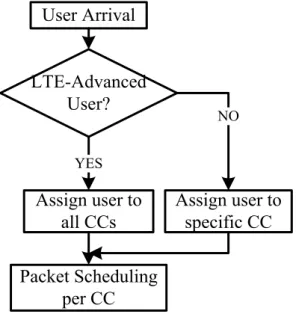
eNB performs various resource allocation strategies to provide network services. While the mobile devices always have limited power and computation, the number of CCs a user can support should be allocated as less as possible. While in order to maxmise the multi-user scheduling diversity, following the work in [81], LTE-A users are assumed to be allocated on all CCs, while the Rel80 users can only be assigned to one CC. The
optimisation of the number of the CCs is an important research and has been arranged as future work in Chapter 7.
eNB LTE UE LTE UE LTE-A User LTE UE LTE-A User LTE-A User Band A Band B f 1 CC CCl ...
Figure 3.1:Network Scenario of LTE-A System with CA
LTE-Advanced frame composed by 10 consecutive TTI 1 TTI composed by 2 time slots of 0.5 each Sub-channel of 180 kHz Resource Block F re qu en cy Time
Figure 3.2:Time-Frequency Resource Block in LTE-A System
According to Release10 [112], there are three CA scenarios that eNB supports in the specification, including intra-band contiguous CA, intra-band non-contiguous CA and