Document downloaded from:
This paper must be cited as:
The final publication is available at
Copyright
http://dx.doi.org/10.1016/j.patrec.2013.06.007
http://hdl.handle.net/10251/40333
Elsevier
González Rubio, J.; Casacuberta Nolla, F. (2014). Cost-sensitive active learning for
computer-assisted translation. Pattern Recognition Letters. 37(1):124-134.
Cost-Sensitive Active Learning for Computer-Assisted Translation
Jes´us Gonz´alez-Rubioa,∗, Francisco Casacubertab
aInstitut Tecnol´ogic d’Informatica, Universitat Polit`ecnica de Val`encia, Camino de Vera s/n, 46022 Val`encia, Spain. bD. Sistemes Inform`atics i Computaci´o, Universitat Polit`ecnica de Val`encia, Camino de Vera s/n, 46022 Val`encia, Spain.
Abstract
Machine translation technology is not perfect. To be successfully embedded in real-world applications, it
must compensate for its imperfections by interacting intelligently with the user within a computer-assisted
translation framework. The interactive-predictive paradigm, where both a statistical translation model and
a human expert collaborate to generate the translation, has been shown to be an effective computer-assisted
translation approach. However, the exhaustive supervision of all translations and the use of non-incremental translation models penalizes the productivity of conventional interactive-predictive systems.
We propose a cost-sensitive active learning framework for computer-assisted translation whose goal is to
make the translation process as painless as possible. In contrast to conventional active learning scenarios, the
proposed active learning framework is designed to minimize not only how many translations the user must
supervise but also how difficult each translation is to supervise. To do that, we address the two potential
drawbacks of the interactive-predictive translation paradigm. On the one hand, user effort is focused to
those translations whose user supervision is considered more “informative”, thus, maximizing the utility of
each user interaction. On the other hand, we use a dynamic machine translation model that is continually
updated with user feedback after deployment. We empirically validated each of the technical components
in simulation and quantify the user effort saved. We conclude that both selective translation supervision and translation model updating lead to important user-effort reductions, and consequently to improved
translation productivity.
Keywords: computer-assisted translation, interactive machine translation, active learning, online learning
1. Introduction
1
Machine translation (MT) is a fundamental technology that is emerging as a core component of natural
2
language processing systems. A good example of multilingualism with high translation needs can be found
3
in the European Union (EU) political institutions. According to (EC, 2009), the EU employs 1,750 full-time
4
∗Corresponding author. Phone: (34) 96 387 70 69, Fax: (34) 96 387 72 39.
y
y
k
x
Interactive
MT System
feedback/interactionsx
^
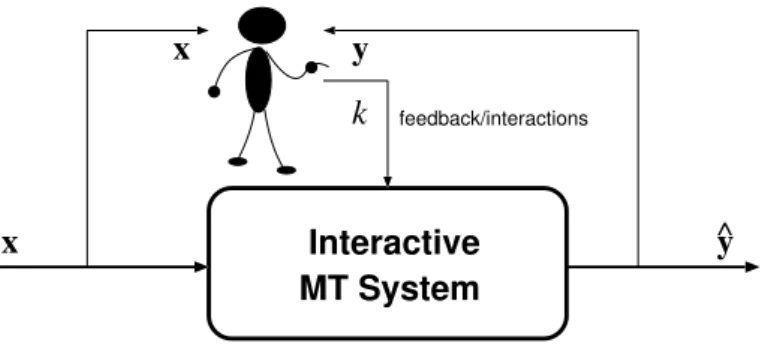
Figure 1: Diagram of an interactive-predictive MT system. To translate a source sentencex, the user interacts with the system accepting or correcting the proposed translationsy. User feedbackkis used by the system to improve its suggestions.
translators. Additionally, to cope with demand fluctuations, the EU uses external translation providers which
5
generate approximately one fourth of its translation output. As a result, in 2008 the EU translation services
6
translated more than 1,800,000 pages and spent about one billion Euros on translation and interpreting.
7
Besides being an expensive and time-consuming task, the problem with translation by human experts
8
is that the demand for high-quality translation has been steadily increasing, to the point where there are
9
just not enough qualified translators available today to satisfy it. This poses a high pressure on translation
10
agencies that must decide how to invest their limited resources (budget, manpower, time, etc.) to generate
11
translations of the maximum quality in the most efficient way.
12
To address this challenge, many translation agencies have focused their interest on MT technology.
13
However, current state-of-the-art MT systems are still far from generating error-free translations (NIST,
14
2006; Lopez, 2008). Indeed, they usually require human experts to post-edit their automatic translations.
15
This serial process prevents MT systems from taking advantage of the knowledge of the human experts, and
16
the users cannot take advantage of the adaptive ability of MT systems.
17
An alternative way to utilize the existing MT technologies is to use them in collaboration with human
18
translators within a computer-assisted translation (CAT) framework (Isabelle and Church, 1998). An
im-19
portant contribution to CAT technology was carried out during the TransType project (Foster et al., 1998;
20
Langlais et al., 2000; Foster, 2002; Langlais and Lapalme, 2002). They proposed the interactive-predictive
21
machine translation (IMT) framework where data-driven MT technologies are embedded within the
transla-22
tion environment. Following these ideas, Barrachina et al. (2009) proposed an innovative embedding where
23
a fully-fledged statistical MT (SMT) system is used to produce complete translations, or portions thereof,
24
which can be accepted or amended by a human expert, see Figure 1. Each corrected text segment is then
25
used by the SMT system as additional information to achieve further, hopefully improved, translations.
26
Despite being an efficient CAT protocol, conventional IMT technology has two potential drawbacks.
27
First, the user is required to supervise all the translations. Each translation supervision involves the user
28
reading and understanding the proposed target language sentence, and deciding if it is an adequate
tion of the source sentence. Even in the case of error-free translations, this process involves a non-negligible
30
cognitive load. Second, conventional IMT systems consider static SMT models. This implies that after
31
being corrected the system may repeat its errors, and the user will be justifiably disappointed.
32
We propose a cost-sensitive active learning (AL) (Angluin, 1988; Atlas et al., 1990; Cohn et al., 1994;
33
Lewis and Gale, 1994) framework for CAT where the IMT user-machine interaction protocol (Figure 2) is
34
used to efficiently supervise automatic translations. Our goal is to make the translation process as efficient
35
as possible. I.e., we want to maximize the translation quality obtained per unit of user supervision effort.
36
Note that this goal differs from the goal of traditional AL scenarios. While they minimize the number of
37
manually-translated sentences to obtain a robust MT system, we aim at minimizing the number of corrective
38
actions required to generate translations of a certain quality.
39
The proposed cost-sensitive AL framework boosts the productivity of IMT technology by addressing
40
its two potential drawbacks. First, we do not require the user to exhaustively supervise all translations.
41
Instead, we propose a selective interaction protocol where the user only supervises a subset of “informative”
42
translations (Gonz´alez-Rubio et al., 2010). Additionally, we test several criteria to measure this
“informa-43
tiveness”. Second, we replace the batch SMT model by an incremental SMT model (Ortiz-Mart´ınez et al.,
44
2010) that utilizes user feedback to continually update its parameters after deployment. The potential user
45
effort reductions of our proposal are twofold. On the one hand, user effort is focused on those translations
46
whose supervision is considered most “informative”. Thus, we maximize the utility of each user interaction.
47
On the other hand, the SMT model is continually updated with user feedback. Thus, the SMT model is
48
able to learn new translations and to adapt its outputs to match the user’s preferences which prevents the
49
user from making repeatedly the same corrections.
50
The remainder of this article is organized as follows. First, we briefly describe the SMT approach to
51
translation, and its application in the IMT framework (Section 2). Next, we present the proposed
cost-52
sensitive AL framework for CAT (Section 3). Then, we show the results of experiments to evaluate our
53
proposal (Section 4). Finally, we summarize the contributions of this article in Section 5.
54
2. Interactive-Predictive Machine Translation
55
The statistical machine translation (SMT) approach considers translation as a decision problem, where
56
it is necessary to decide upon a translationygiven a source language sentencex. Statistical decision theory
57
is used to select the correct translation among all the target language sentences. From the set of all possible
58
target language sentences, we are interested in that with the highest probability according to the following
59
equation (Brown et al., 1993)1:
60
ˆ
y= arg max
y
P r(y|x) (2.1)
source (x): Para ver la lista de recursos
desired translation (ˆy): To view a listing of resources
interaction-0 yp
ys To view the resources list
interaction-1 yp To view k a ys list of resources interaction-2 yp To view a list k listi ys listing resources interaction-3 yp To view a listing k o ys of resources
accept yp To view a listing of resources
Figure 2: IMT session to translate a Spanish sentence into English. At interaction-0, the system suggests a translation (ys).
At interaction-1, the user moves the mouse just before the first error and implicitly validates the first eight characters ”To view ” as a correct prefix (yp). Then, the user introduces a correction by pressing the a key (k). Lastly, the system suggests
completing the translation from the user correction with “list of resources” (a newys). At interaction 2, the user validates “To
view a list” and introduces a correction i which is completed by the systems to form a new translation “To view a listing of resources”. Interaction 3 is similar. Finally, the user accepts the current translation which is equal to the desired translation.
whereP r(y|x) is usually modeled by a maximum entropy MT model (Och and Ney, 2002), also known as
61
log-linear model. The decision rule for log-linear models is given by the expression:
62 ˆ y= arg max y P r(y|x)≈arg max y ( M X m=1 λmhm(y,x) ) (2.2)
where eachhm(y,x) is a feature function that describes a particular aspect of the translation process (e.g. 63
the log-probability log(P(y)) of the translation), and λm is its associated weight. Phrase-based (Koehn 64
et al., 2003) and finite state (Casacuberta and Vidal, 2007) models are two successful implementations of
65
the log-linear approach.
66
However, despite a huge research effort, SMT systems are still not perfect. To obtain high-quality
67
translations, a human expert has to supervise the automatically generated translations. This supervision is
68
usually carried out as a separate post-edition step. The IMT framework (Barrachina et al., 2009) constitutes
69
an alternative to this serial procedure. In an IMT system, an SMT model and a human expert collaborate
70
to generate error-free translations. These translations are generated in a series of interactions between
71
the SMT model and the user. At each interaction, the SMT model generates a translation of the source
sentence which can be partially or completely accepted and corrected by the user. Each partially corrected
73
text segment, called prefix, is then used by the SMT model as additional information to generate better
74
translation suggestions. Figure 2 shows an example of a typical IMT session.
75
The IMT decision rule searches for an extensionysthat completes a user-validated prefixypis given by: 76
ˆ
ys= arg max
ys
P r(ys|x,yp) (2.3)
which can be straightforwardly rewritten as:
77
ˆ
ys= arg max
ys
P r(yp,ys|x) (2.4)
Given that ypys =y, this equation is very similar to Equation (2.1). The main difference is that the 78
search now is performed over the set of suffixes ys that complete yp instead of complete sentences (y in 79
Equation (2.1)). This implies that we can use the same MT models whenever the search procedures are
80
adequately modified (Och et al., 2003). It should be noted that SMT models are defined at word level while
81
the IMT interface depicted in Figure 2 works at character level. This is not an important issue since the
82
transformations that are required in the SMT models for their use at character level are trivial.
83
3. Cost-Sensitive Active Learning for Computer-Assisted Translation
84
Although IMT have been successfully deployed in many practical applications, it still demands the human
85
user to supervise all translations. This exhaustive supervision guarantees that the generated translations are
86
error-free. However, it demands a large amount of cognitive effort by the user which penalizes translation
87
productivity. A translation agency with limited resources, in terms of person-hours, may be willing to
88
sacrifice some translation quality in exchange for improved productivity. Certainly, this is an unrealistic
89
scenario in some cases, for example it is inconceivable not to fully-supervise the translation of a legal
90
document such as a contract, but there are many other translation tasks, e.g. manuals for electronic
91
devices, or twitter and blog postings, that match this productivity-focused scenario.
92
The goal of this section is to present a cost-efficient CAT framework that allows the user to supervise
93
and correct automatic translations as effortlessly as possible. From the existing IMT technology, we import
94
its user-machine interaction process (Figure 2) to efficiently supervise individual translations. However, we
95
implement a different work-flow to address its drawbacks. On the one hand, user effort will be focused to
96
supervise only those translations considered most “informative”. On the other hand, the translation model
97
will be continually updated with the new sentence pairs (x,y) supervised by the user.
98
We implement these ideas as a cost-sensitive AL scenario designed to minimize supervision effort,
Sec-99
tion 3.1. We define a new translation work-flow, Section 3.2, that focuses user-effort to only supervise the
100
subset of most “informative” translations. Section 3.3 describes the different ranking functions implemented
to measure the “informativeness” of each translation, and finally, Section 3.4 presents the incremental SMT
102
model that is continually updated from user feedback.
103
3.1. Active Learning for Computer-Assisted Translation
104
Training an SMT model requires translation examples of source language sentences and its corresponding
105
target language translations. Example annotation is difficult for structured prediction tasks, since each
106
example may have multiple, interacting labels, all of which must be correctly annotated for the example to
107
be of use to the learner. This is particularly true for translation where additionally there may be multiple
108
correct translations for a source sentence.
109
Different alternatives to conventional supervised learning have been proposed to address these
prob-110
lems. For example, semi-supervised learning methods use unlabeled data to help supervised learning
111
tasks (Chapelle et al., 2006). These methods typically assume that the labeled data set is given and
112
fixed. In practice, however, semi-supervised methods are allowed to pick a set of unlabeled examples to be
113
annotated by an expert. In this case, rather than selecting the examples randomly, it may be attractive
114
to let the learning algorithm to proactively tell us which of them to annotate. This approach is known as
115
active learning (AL). The idea is to select which training examples to label and the order in which they are
116
labeled to increase learning efficiency (Angluin, 1988; Atlas et al., 1990; Cohn et al., 1994; Lewis and Gale,
117
1994). An active learner is considered successful if it obtains better performance than a traditional learner
118
given the samenumberof training examples. Therefore, AL expedites annotation by reducing the number
119
of labeled examples required to train an accurate model.
120
In contrast to previous applications of AL to structured prediction tasks, e.g. sequence labeling (Settles
121
and Craven, 2008), natural language parsing and information extraction (Thompson et al., 1999), or machine
122
translation (Haffari et al., 2009), that minimize the number of labeled samples required to train an accurate
123
model, our goal is to reduce the user supervision effort required to generate high-quality translations. Clearly,
124
the amount of work required to supervise a translation will vary between sentences, e.g. based on the size
125
and the complexity of the source sentence. Thus, it is desirable to design an AL supervision scenario that
126
considers not only how many translations the user is required to supervise, but also how difficult each
127
translation is to supervise.
128
3.2. Translation Work-Flow and Supervision Protocol
129
The proposed AL framework for CAT implies a modification of the conventional IMT work-flow depicted
130
in Figure 1. The user no longer supervises the translation of all sentences but only of those selected as
131
“worthy of being supervised”. Since only the most informative sentences are supervised, we maximize the
132
utility of each user interaction. Final translations however may not be error-free as for conventional IMT.
133
In exchange, an important reduction in human effort is potentially achievable. Moreover, we can modify
input :D(stream of source sentences)
M(initial SMT model)
ρ(effort level, percentage of sentences to be supervised)
auxiliar:B (block of consecutive sentences)
S ⊆ B (list of sentences to be supervised by the user)
begin 1 repeat 2 B=getBlockFromStream(D); 3 S=sampling(B, ρ); 4 foreach x∈ Bdo 5 ˆ y=translate(M,x); 6 if x∈ S then 7 y= ˆy; 8 repeat 9 yp=validPrefix(y); 10 ˆ ys=genSuffix(M,x,yp); 11 y=ypyˆs; 12 untilvalidTranslation(y); 13 M=update(M,(x,y)); 14 output(y); 15 else 16 output(ˆy); 17 untilD 6=∅; 18 end 19
Algorithm 1: Pseudo-code of the proposed cost-sensitive AL framework for CAT. Functions translate(M,x), validPrefix(y), genSuffix(M,x,yp), and validTranslation(y) (Section 3.2) denote the IMT user-machine inter-action protocol, see Figure 2. Function sampling(B, ρ) implements the strategy to sample the most “informative” sentences fromB (Section 3.3), and functionupdate(M,(x,y)) returns translation model M updated with the new
sentence pair (x,y) (Section 3.4).
the ratio of sentences to be supervised by the user thus modifying the behavior of our system between an
135
automatic SMT system, and a fully-supervised IMT system. In other words, we can adapt the system’s
136
behavior to the requirements of each particular translation task.
137
Conventional IMT technology is build over the implicit assumption that the inbound text to be translated
behaves as a text stream (see Figure 1). Source sentences are translated separately and no information
139
is stored (or assumed) about the preceding (or following) sentences, e.g. how many sentences remain
140
untranslated. Since the IMT framework uses static SMT models and requires the user to supervise all
141
translations, this is not a strong assumption. However, we have to take it into account because information
142
about previously supervised translations, and particularly, about following sentences may have great impact
143
on the final user effort. We handle the inbound text stream by partitioning the data into blocks of consecutive
144
sentences. Within a block, all sentences are available, but once the algorithm moves to the next block, all
145
sentences in previous blocks become inaccessible. We use the sentences within a block to estimate the current
146
distribution of sentences in the stream, so that the estimation of the “informativeness” of supervising the
147
translation of a sentence can be done as accurately as possible.
148
Algorithm 1 shows the pseudo-code that implements the proposed cost-sensitive AL scenario for CAT.
149
The algorithm takes as input a stream of source sentencesD, a “base” SMT modelM, and an effort levelρ
150
denoting the percentage of sentences of each block to be supervised. First, the next block of sentencesBis
151
read from the data stream (line 3). From this block, we sample the set of sentencesS ⊆ Bthat are worthy
152
of being supervised by the human expert (line 4). For each sentence inB, the current SMT model generates
153
an initial translation, ˆy, (line 6). If the sentence has been sampled as worth of supervision,x∈ S, the user
154
collaborates with the system to translate the sentence (lines 8–13). Then, the new sentence pair (x,y) is
155
used to update the SMT model M (line 14), and the human-supervised translation is returned (line 15). 156
Otherwise, we directly return the automatic translation ˆy as the final translation (line 17). Although both
157
automatic and user-supervised translations are available, preliminary experiments showed that using both
158
translations to update the SMT model resulted in reduced learning rates.
159
Although other translation supervision methods, e.g. post-edition, can be used2, we implement the IMT
160
user-machine interaction protocol (Figure 2) to supervise each individual translation. Functions between
161
lines 8–13 denote this supervision procedure:
162
translate(M,x): It returns the most probable automatic translation of x according to M. If M is a 163
log-linear SMT model, this function implements Equation (2.2).
164
validPrefix(y): It denotes the user actions (positioning and correction of the first error) performed to
165
amendy. It returns the user-validated prefixyp of translationy, including the user correctionk. 166
genSuffix(M,x,yp): It returns the suffixysof maximum probability that extends prefixyp. This function 167
implements Equation (2.4).
168
validTranslation(y): It denotes the user decision of whether translationyis a correct translation or not.
169
It returnsTrueif the user considersyto be correct andFalseotherwise.
170
In addition to the supervision procedure, the two elements that define the performance of Algorithm 1
171
are the sampling strategy sampling(B, ρ) and the SMT model update function update(M,(x,y)). The
172
sampling strategy decides which sentences of B are worthy of being supervised by the user. This is the
173
main component of our framework and has a major impact on the final performance of the algorithm.
174
Section 3.3 describes several strategies implemented to measure each sentence’s “informativeness”. In turn,
175
the update(M,(x,y)) function updates the SMT model M with a new training pair (x,y). Section 3.4 176
describes the implementation of this functionality.
177
3.3. Sentence Sampling Strategies
178
The goal of our AL framework for CAT is to generate high-quality translations as effortlessly as
pos-179
sible. Since good translations are less costly to supervise than bad ones, the aim of a sampling strategy
180
sampling(B, ρ) should be to select those sentencesS ⊆ Bfor which knowing their correct translation allows
181
to improve most the performance of the SMT model for future sentences. To do that, we first use a ranking
182
function Φ(x) to score the sentences in B. Then, the percentage ρ of the highest-scoring sentences are
183
selected to be supervised by the user. We identify three properties that (partially) account for the “worth”
184
of a given sentence:
185
Uncertainty: A sentence is as worthy as uncertain is the SMT model of how to translate it.
186
Representativeness: A sentence is as worthy as it is “representative” of the sentences inB.
187
Unreliability: A sentence is as worthy as the amount of unreliably modeled events that it contains.
188
Next sections describe different sampling strategies designed to measure one (or more) of these
comple-189
mentary properties.
190
3.3.1. Random Ranking (R)
191
Random ranking assigns a random score in the range [0,1] to each sentence. It is the baseline ranking
192
function used in the experimentation. Although simple, random ranking performs surprisingly well in
prac-193
tice. Its success stems from the fact that it always selects sentences according to the underlying distribution.
194
Using a typical AL heuristic, as training proceeds and sentences are sampled, the training set quickly
di-195
verges from the real data distribution. This difficulty known assampling bias (Dasgupta and Hsu, 2008) is
196
the fundamental characteristic that separates AL from other learning methods. However, since by definition
197
random ranking selects sentences according to the underlying distribution, it does not suffer from sampling
198
bias. This fact makes random ranking a very strong baseline to compare with.
3.3.2. Uncertainty Ranking (U)
200
One of the most common AL methods is uncertainty sampling (Lewis and Gale, 1994). This method
201
selects those samples about which the model is least certain how to label. The intuition is clear: much can
202
be learned from the correct output if the model is uncertain of how to label the sample. Formally, a typical
203
uncertainty sampling strategy scores each sample x with one minus the probability of its most probable
204
prediction ˆy= arg maxyP(y|x):
205
Φ(x) = 1−P(ˆy|x) (3.1)
However, due to the peculiarities of SMT models, uncertainty sampling has to be re-considered. Since the
206
normalization term does not influence the decision on the highest-probability translation, it is usually ignored
207
in the model formulation, see Equation (2.2). As a result, instead of true probabilities these models generate
208
simple scores that are not directly comparable between translations. Hence the conventional uncertainty
209
technique cannot be implemented. Instead, under the assumption that the “certainty” of a model in a
210
particular translation is correlated with the quality of that translation, we measure the uncertainty of a
211
translation using an estimation of its quality. Specifically, we use confidence measures (Blatz et al., 2004;
212
Ueffing and Ney, 2007) to estimate the quality of a translation from the confidence estimations of its
213
individual words.
214
Given a translation y = y1. . . yi. . . y|y|3 generated from a source sentence x = x1. . . xj. . . x|x|, the
215
confidence of each target language wordC(yi,x) is computed as described in (Ueffing and Ney, 2005): 216
C(yi,x) = max
0≤j≤|x|P(yi|xj) (3.2)
where P(yi|xj) is a word-to-word probability model, andx0 is the empty source word. Following Ueffing
217
and Ney (2005), we use an SMT model 1 (Brown et al., 1993) although other bilingual lexicon models, e.g.,
218
model 2 (Brown et al., 1993), or hidden Markov model (Vogel et al., 1996), could also be used.
219
The confidence-based uncertainty score is then computed as one minus the ratio of words in the most
220
probable translation ˆy=y1. . . yi. . . y|ˆy|classified as incorrect according to a word-confidence thresholdτw: 221
ΦU(x) = 1−
|{yi|C(yi,x)> τw}|
|yˆ| (3.3)
In the experimentation, threshold value τw was tuned to minimize classification error in a separate 222
development set. Additionally, we use the incremental version of the EM algorithm (Neal and Hinton, 1999)
223
to update the word-to-word probability modelP(yi|xj) each time a new sentence pair is available. 224
3We use the same symbol| · |to denote an absolute value|a|, the length of a sequence|x|, and the cardinality of a set|B|.
3.3.3. Information Density Ranking (ID)
225
Uncertainty sampling bases its decisions on individual instances which makes the technique prone to
sam-226
ple outliers. The least certain sentences may not be “representative” of other sentences in the distribution,
227
in this case, knowing its label is unlikely to improve accuracy on the data as a whole (Roy and McCallum,
228
2001). We can overcome this problem by modeling the input distribution explicitly when scoring a sentence.
229
The information density framework (Settles and Craven, 2008) is a general density-weighting technique.
230
The main idea is that informative instances should not only be those which are uncertain, but also those
231
which are “representative” of the underlying distribution (i.e., inhabit dense regions of the input space). To
232
address this, we compute the information density score:
233 ΦID(x) = ΦU(x)· 1 |B| |B| X b=1 S(x,xb) γ (3.4)
where the uncertainty of a given sentencexis weighted by its average similarityS(x,·) to the rest of sentences
234
in the distribution, subject to a parameterγ that controls the relative importance of the similarity term.
235
Since the distribution is unknown, we use the block of sentencesB={x1, . . . ,xb, . . . ,x|B|}to approximate
236
it. We use uncertainty ranking ΦU(x) to measure the “base” worth of a sentence, but we could use any 237
other instance-level strategies presented in the literature (Settles and Craven, 2008; Haffari et al., 2009).
238
We compute the similarity of two sentences as the geometric mean of the precision ofn-grams (sequences
239
ofnconsecutive words in a sentence) up to size four4 between them:
240 S(x,xb) = 4 Y n=1 X w∈Wn(x) min(#w(x),#w(xb)) X w∈Wn(x) #w(x) 1 4 (3.5)
whereWn(x) is the set ofn-grams of sizenin x, and #w(x) represents the count ofn-gramw in x. This
241
similarity score is closely related to the widespread translation evaluation score BLEU (Papineni et al., 2002)
242
that will be further discussed in section 4.2.1.
243
One potential drawback of information density is that the number of similarity calculations grows
244
quadratically with the number of instances in B. However, similarities only need to be computed once
245
for a givenBand are independent of the base measure. Therefore, we can pre-compute and cache them for
246
efficient look-up during the AL process.
247
3.3.4. Coverage Augmentation Ranking (CA)
248
Sparse data problems are ubiquitous in natural language processing (Zipf, 1935). This implies that some
249
rare events will be missing completely from a training set, even when it is very large. Missing events result
250
in a loss of coverage, a situation when the structure of the model is not rich enough to cover all types of
251
input. As a result, words (or sequences thereof) that do not appear in the training set cannot be adequately
252
translated (Turchi et al., 2009; Haddow and Koehn, 2012).
253
Uncertainty sampling assumes that the model structure is fixed in advance and focus upon improving
254
parameters within that structure. However, this is not appropriate for SMT where the model structure and
255
the associated parameters are determined from training data. The problem is that uncertainty-based
meth-256
ods fail at dealing with sentences with words not covered by the model. To efficiently reduce classification
257
error in SMT, we should explicitly address unreliably trained model parameters. We do that by measuring
258
the coverage augmentation ∆cov(x,T) due to the incorporation of sentencexto the current training setT: 259 ∆cov(x,T) = 4 X n=1 X w∈(Wn(x)−Wn(T)) |B| X b=1 #w(xb) (3.6)
The coverage augmentation for each sentence x is given by the count of n-grams in x missing in the
260
training setT that appear in the rest of sentences in the block. I.e., we measure how many missingn-grams
261
inB would be covered ifxis added to the training set. Again, we considern= 4 as the maximumn-gram
262
length.
263
This coverage augmentation score is biased towards longer sentences since longer sentences can contain
264
a larger amount of unseenn-grams. This is one of the reasons for its successful application in conventional
265
AL scenarios (Haffari et al., 2009) and bilingual sentence selection tasks (Gasc´o et al., 2012). However,
266
longer sentences also imply a higher cognitive effort from the user (Koponen, 2012) which may penalize
267
performance. We address this dilemma by normalizing the coverage augmentation score by an estimation of
268
the user-effort E(x) required to supervise the translation. Since out-of-coverage words cannot be adequately
269
translated and their translations will be corrected by the user, we assume user effort to be proportional to
270
the number of out-coverage-words in the source sentence:
271
E(x)∝ X w∈(W1(x)−W1(T))
#w(x) (3.7)
Finally, the coverage augmentation score measures the potential SMT model improvement per unit of
272 user effort5: 273 ΦCA(x) = ∆cov(x,T) E(x) (3.8)
To avoid selecting several sentences with the same missingn-grams, we update the set ofn-grams seen in
274
training each time a new sentence is selected. First, sentences inBare scored using Equation (3.8). Then,
275
the highest-scoring sentence is selected and removed fromB. The set of trainingn-grams is updated with
276
then-grams present in the selected sentence and, hence, the scores of the rest of the sentences in the block
277
are also updated. This process is repeated until we select the desired ratioρof sentences fromB.
278
3.4. Online Training for SMT
279
After the translation supervision process, we have a new sentence pair (x,y) at our disposal. We now
280
briefly describe the incremental SMT model used in the experimentation, and the online learning techniques
281
implemented to update the model with new sentence pairs in constant time.
282
We implement the online learning techniques proposed in (Ortiz-Mart´ınez et al., 2010). In that work, a
283
state-of-the-art log-linear SMT model (Och and Ney, 2002) was presented. This model is composed of a set
284
of incremental feature functions governing different aspects of the translation process, see Equation (2.2),
285
including a language model, a model of source sentences length, directP(y|x) and inverseP(x|y)
phrase-286
based6 translation models (Koehn et al., 2003), models of the length of the source and target language
287
phrases, and a reordering model.
288
Together with this log-linear SMT model, Ortiz-Mart´ınez et al. (2010) present online learning techniques
289
that, given a training pair, update the incremental features. In contrast to conventional batch learning
290
techniques, the computational complexity of adding a new training pair is constant, i.e., it does not depend
291
on the number of training samples. To do that, a set of sufficient statistics is maintained for each feature
292
function. If the estimation of the feature function does not require the use of the EM algorithm (Dempster
293
et al., 1977) then it is generally easy to incrementally update the feature given the new training sample. For
294
example, to update a language model with the new translation we simply have to update the current count of
295
eachn-gram iny. By contrast, if the EM algorithm is required (e.g. to estimate phrase-based SMT models)
296
the estimation procedure has to be modified because EM is designed to be used in batch learning scenarios.
297
For such feature functions, the incremental version of the EM algorithm (Neal and Hinton, 1999) is applied.
298
For example, phrase-based models are estimated from an hidden Markov (HMM) model (Vogel et al., 1996).
299
Since the HMM model is determined by a hidden alignment variable, the incremental version of the EM
300
algorithm is required to update the model with the new training sample (x,y). A detailed description of
301
the update algorithm for each feature function was presented in (Ortiz-Mart´ınez et al., 2010).
302
4. Experiments
303
We carried out experiments to assess the performance of the proposed cost-sensitive AL framework for
304
CAT. The idea is to simulate a real-world scenario where a translation agency is hired to translate a huge
305
amount of text. The experimentation was divided into two parts. First, Section 4.3 describes a typical
306
AL experimentation, such as the one in (Haffari et al., 2009), where we studied the learning curves of
307
the SMT model as a function of the number of training sentence pairs. Then, Section 4.4 focuses on the
308
productivity of the whole CAT system. There, we measured, for each ranking function, the quality of the
309
6In contrast with word-based translation models where the fundamental translation unit is the word, phrase-based models
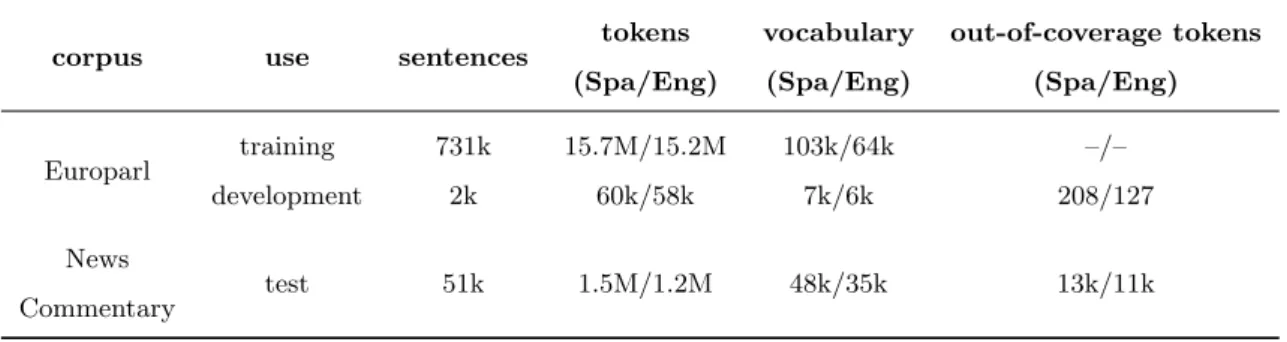
Table 1: Main figures of the Spanish–English corpora used, k and M stand for thousands and millions of elements respectively.
corpus use sentences tokens vocabulary out-of-coverage tokens
(Spa/Eng) (Spa/Eng) (Spa/Eng)
Europarl training 731k 15.7M/15.2M 103k/64k –/–
development 2k 60k/58k 7k/6k 208/127
News
test 51k 1.5M/1.2M 48k/35k 13k/11k
Commentary
final translations generated by the system as a function of the supervision effort required from the user. With
310
this experimentation, we can observe how the improvements of the underlying SMT model are reflected in
311
the productivity of the whole cost-sensitive AL CAT system.
312
4.1. Methodology and Data
313
The experimentation carried out comprises the translation of a test corpus using different setups of
314
the proposed cost-sensitive AL framework. Each setup was defined by the ranking function used. All
315
experiments start with a “base” SMT model whose feature functions are trained on the training partition of
316
the Europarl (Koehn and Monz, 2006) corpus, and its log-linear weights are tuned by minimum error-rate
317
training (Och, 2003) to optimize BLEU (Papineni et al., 2002) in the development partition. Then, we run
318
Algorithm 1 until all sentences of the News Commentary corpus (Callison-Burch et al., 2007) are translated
319
into English. We use blocks of size|B|= 1000 (Gonz´alez-Rubio et al. (2012) show that similar results were
320
obtained with other block sizes), and for information density, we arbitrarily setγ= 1 (i.e., uncertainty and
321
density terms had equal importance). The main figures of the training, development, and test corpora are
322
shown in Table 1.
323
The reasons to choose the News Commentary corpus as test corpus are threefold: its size is large enough
324
to test the proposed techniques in the long term, its sentences come from a different domain (news) than
325
the sentences in the Europarl corpus (proceedings of the European parliament), and it contains sentences
326
of different topics which allows us to test the robustness of our system against topic-changing data streams.
327
Therefore, by translating the News Commentary corpus we simulate a realistic scenario where translation
328
agencies must be ready to fulfill eclectic real-world translation requirements.
329
Since an evaluation involving human users is too expensive, we use the reference translations of the News
330
Commentary corpus to simulate the target translations which a human user would want to obtain. At each
331
interaction (see Figure 2), the prefix validated by the user is computed as the longest common prefix between
332
the translation suggested by the system (ys) and the reference translation (ˆy), and the user correction (k) 333
is given by the first mismatched character betweenys and ˆy. The interaction continued until the longest 334
common prefix is equal to the reference translation.
335
4.2. Evaluation Measures
336
The goal of the proposed cost-sensitive AL framework is to obtain high translation quality with as few
337
user effort as possible. Therefore, the evaluation is twofold: quality of the generated translations and amount
338
of supervision effort required to generate them. Additionally, we describe how we compute the statistical
339
significance of the results.
340
4.2.1. Measuring Translation Quality
341
We evaluate translation quality using the well-established BLEU (Papineni et al., 2002) score. BLEU
342
computes the geometric mean of the precision ofn-grams of various lengths between a candidate translation
343
and a reference translation. This geometric average is multiplied by a factor, namely the brevity penalty,
344
that penalizes candidates shorter than the reference. Following the standard implementation, we consider
345
n= 4 as the maximumn-gram length. BLEU is a percentage that measures to which extent the candidate
346
translation contains the same information as the reference translation. Thus, a BLEU value of 100% denotes
347
a perfect match between the candidate translation and the reference translation.
348
4.2.2. Measuring Supervision Effort
349
We estimate the user effort as the number of user actions required to supervise a translation which depend
350
on the supervision method7. In the interaction protocol described in Section 3.2, the user can perform two
351
different actions to interact with the system. The first action corresponds to the user looking for the next
352
error andmoving the pointerto the corresponding position of the translation hypothesis. The second action
353
corresponds to the user replacing the first erroneous character with akeystroke.
354
Bearing this in mind, we compute the keystroke and mouse-action ratio (KSMR) (Barrachina et al., 2009)
355
which has been extensively used to report user effort results in the IMT literature. KSMR is calculated as
356
the number of keystrokes plus the number of movements (mouse actions) divided by the total number of
357
characters of the reference translation. From a user point of view the two types of actions are different, and
358
may require different types of effort (Macklovitch, 2006). A weighted measure could take this into account;
359
however, in these experiments, we assume each action has unit cost.
360
4.2.3. Statistical Significance
361
We apply statistical significance testing to establish that an observed performance difference between
362
two methods is in fact significant, and has not just arisen by chance. We state a null hypothesis: “Methods
363
7For example, if instead of using the IMT supervision protocol we ask the user to post-edit the translations, user actions
A and B do not differ with respect to the evaluation measure of interest” and determine the probability,
364
namely the p-value, that an observed difference has arisen by chance given the null hypothesis. If the p-value
365
is lower than a certain significance level (usuallyp <0.01, orp <0.05) we can reject the null hypothesis. To
366
do that, we use randomization tests because they free us from worrying about parametric assumptions and
367
they are no less powerful than ordinary t-tests (Noreen, 1989). Specifically, we use a randomization version
368
of the paired t-test based on (Chinchor, 1992):
369
1. Collect the absolute difference in evaluation measureQ(·) for methods A and B
370
|Q(A)−Q(B)|
371
2. ShuffleN times (N = 999 in our experiments)
372
3. Count the number of times (N≥) that
373
|Q(A0)−Q(B0)| ≥ |Q(A)−Q(B)|
374
4. The estimate of the p-value is NN≥+1+1
375
(1 is added to achieve an unbiased estimate)
376
Initially, we use an evaluation measure Q(·) (e.g. BLEU) to determine the absolute difference between
377
the original outcomes of methodsA andB. Then, we repeatedly create shuffled versionsA0 andB0 of the
378
original outcomes, determine the absolute difference between their evaluation metrics, and count the number
379
of timesN≥that this difference is equal or larger than the original difference. To create the shuffled versions
380
of the data sets, we iterate over each data point in the original outcomes and decide based on a simulated
381
coin-flip whether data points should be exchanged between A and B. The p-value is the proportion of
382
iterations in which the absolute difference in evaluation metric was indeed larger for the shuffled version
383
(corrected to achieve an unbiased estimate).
384
4.3. Active Learning Results
385
We first studied the learning rates of the different ranking functions in a typical AL experimentation.
386
Here, the performance of the SMT model is studied as a function of the percentageρof the corpus used to
387
update it. SMT model performance was measured as the translation quality (BLEU) of the initial automatic
388
translations generated during the interactive supervision process (line 6 in Algorithm 1).
389
Figure 3 displays the learning rates observed for each ranking function in Section 3.3: random (R),
390
uncertainty (U), information density (ID) and coverage augmentation (CA). Additionally, we report the
391
significance level of the observed difference for some pairwise comparisons. Similarly as done in (Becker,
392
2008), we present p-values on a logarithmic scale. Note that p = 0.001 is the smallest possible p-value that
393
can be computed with 999 shuffles in the randomized test; lower p-values will be displayed as a flat line.
394
Results in Figure 3 show that coverage augmentation ranking consistently outperformed the random
395
ranking baseline. Additionally, the observed difference was statistically significant as shown in the second
15 17 19 21 23 25 27 BLEU [%] R U ID CA 10-4 10-3 10-2 10-1 CA vs R 10-4 10-3 10-2 10-1 p-value U vs R 10-4 10-3 10-2 10-1 0 20 40 60 80 100 Sentences [%] (ρ) U vs ID
Figure 3: SMT model performance (BLEU) as a function of the percentageρof the corpus used to update it (first panel). We display results for random ranking (R), uncertainty ranking (U), information density ranking (ID), and coverage augmentation ranking (CA). Panels two to four display, on a logarithmic scale, the significance levels (p-values) of the performance differences observed for various pairwise comparisons.
panel of the figure. This result shows that coverage augmentation is the ranking function that more effectively
397
detected those sentences that improve most the performance of the SMT model.
398
Both uncertainty ranking and information density ranking were outperformed by random ranking when
399
supervising up to 50% of the corpus; after that, results for the three ranking functions were very similar and
400
almost no statistical difference was observed (third panel). Additionally, uncertainty ranking and information
401
density ranking obtained virtually the same results; however the slightly better results of uncertainty ranking
402
were statistically significant (fourth panel). I.e., the addition of the “representativeness” in information
403
density deteriorated the performance of uncertainty ranking. This counter-intuitive result can be explained
404
by the intrinsic sparse nature of natural language, and particularly by the eclectic topics, e.g. economic,
405
science, or politics, of the sentences in the test corpus.
406
In the previous experiment, we assumed that all translations were equally costly to supervise. However,
407
different sentences involve different translation costs. Therefore, we then focused on measuring user
super-408
vision effort. We studied the user effort required to supervise translations as a function of the percentage
409
of sentencesρ supervised. Figure 4 shows the KSMR scores obtained by each ranking function, and the
0 4 8 12 16 20 24 28 32 36 KSMR [%] p-value R U ID CA 10-4 10-3 10-2 10-1 CA vs R 10-4 10-3 10-2 10-1 R vs U 10-4 10-3 10-2 10-1 0 20 40 60 80 100 Sentences [%] (ρ) U vs ID
Figure 4: User effort (KSMR) as a function of the percentageρof the corpus used to update the SMT model (first panel). We display results for random ranking (R), uncertainty ranking (U), information density ranking (ID), and coverage augmentation ranking (CA). Panels two to four display, on a logarithmic scale, the significance levels (p-values) of the effort differences observed for various pairwise comparisons.
significance level of some pairwise ranking function comparisons.
411
Results show that sentences selected by coverage augmentation required a statistically significant larger
412
amount of effort than the ones selected by random; except when supervising almost all sentencesρ >96%
413
where coverage augmentation required a lower amount of effort (second panel in Figure 4). This indicates
414
that even when all sentences are supervisedρ= 100% the order in which they are supervised (depending
415
on the ranking function) affects the efficiency of the supervision process.
416
Regarding uncertainty and information density, both ranking functions required a statistically lower
417
amount of effort than random (third panel), and similarly to the results in Figure 3, differences between
418
uncertainty and information density were scarce but statistically significant (fourth panel). In this case,
419
sentences selected by information density required a statistically lower amount of effort to be supervised.
420
4.4. Productivity Results
421
Results in the previous section show that those ranking functions that obtained better learning rates
422
are also those that required more supervision effort, and vice versa. However, from a point of view of
10 20 30 40 50 60 70 80 90 100 0 10 20 30 KSMR [%] BLEU [%] R ID CA static SMT
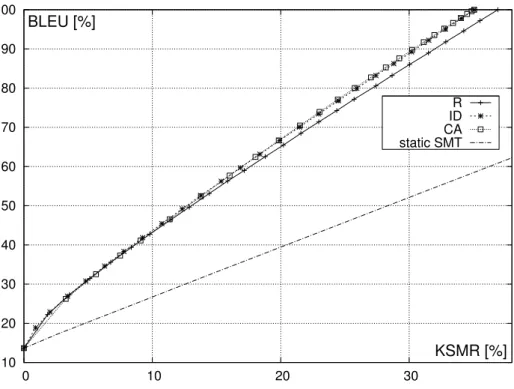
Figure 5: Final translation quality (BLEU) as a function of user effort (KSMR). We display results for random ranking (R), information density ranking (ID), coverage augmentation ranking (CA), and for a setup where the underlying SMT model is not updated (static SMT).
a translation agency that has to invest its limited resources, the key point is how to obtain the better
424
productivity. I.e., given a required translation quality, how to reduce supervision effort; or symmetrically,
425
given an effort level, how to maximize translation quality.
426
To answer these questions, we studied the relation between user effort and final translation quality.
427
In contrast with the experimentation in Figure 3 where we study the learning rates of the SMT model by
428
measuring the quality of its automatic translations, we now are interested in the performance of the complete
429
cost-sensitive AL system. We did that by measuring the translation quality of the translations generated by
430
Algorithm 1 (lines 15 and 17) as a function of the required supervision effort. Note that this final translations
431
are a mixture of automatic and user-supervised translations. The ratio between them is fixed byρwhich
432
permits to adjust system’s behavior between a fully automatic SMT system if none translation is supervised
433
(ρ= 0%), or a conventional IMT system where all translations are supervised (ρ= 100%).
434
Since uncertainty and information density obtain so similar performance in the previous experiments,
435
Figure 5 compares the performance of only random (R), information density (ID), and coverage augmentation
436
(CA) ranking functions. Additionally, we present results of the proposed cost-sensitive AL framework
437
using a static SMT model. The objective was to test the influence of SMT model updating on translation
438
productivity.
Results show a huge leap in productivity when the SMT model was updated with user feedback. This
440
continuous model updating allowed to obtain twice the translation quality with the same level of supervision
441
effort. Regarding the different ranking functions, both information density and coverage augmentation
442
performed similarly yielding slight improvements in productivity with respect to random, particularly for
443
high levels of effort. For example, if a translation quality of 60% BLEU is acceptable, then the human
444
translator would need to modify only a 20% of the characters of the automatically generated translations.
445
5. Conclusions and Future Work
446
We have presented a cost-sensitive AL framework for CAT designed to boost translation productivity.
447
The two cornerstones of our approach are the selective supervision protocol and the continual SMT model
448
updating with user-supervised translations. Regarding selective supervision, we propose to focus user effort
449
on a subset of sentences that are considered “worth of being supervised” according to a ranking function.
450
The percentage of sentences to be supervised is defined by a tunable parameter which allows to adapt the
451
system to meet task requirements in terms of translation quality, or resources availability. Whenever a new
452
user-supervised translation pair is available, we use it to update a log-linear model. Different online learning
453
techniques are implemented to incrementally update the model.
454
We evaluated the proposed cost-sensitive AL framework in a simulated translation of real data. Results
455
showed that the use of user-supervised translations reduced to one half the effort required to translate the
456
data. Additionally, the use of an adequate ranking function further improved translation productivity.
457
The experimental simulation carried out is effective for evaluation, but, to assess the obtained results,
458
we plan to conduct a complete study involving real human users. Productivity could be measured by the
459
actual time it takes a user to translate a test document. This evaluation additionally requires addressing
460
issues of user interface design and user variability, but it is ultimately the most direct evaluation procedure.
461
An additional direction for further research is to study why random ranking performs so well. We have
462
provided some insights of which are the reasons for this, but we hope that a further study will reveal new
463
hints that may guide us towards the definition of sampling strategies that outperform random sampling.
464
Moreover, the study of productivity-focused ranking functions is a wide research field that should also be
465
explored
466
6. Acknowledgments
467
Work supported by the European Union Seventh Framework Program (FP7/2007-2013) under the
Cas-468
MaCat project (grants agreement no 287576), by the Generalitat Valenciana under grant ALMPR
(Prom-469
eteo/2009/014), and by the Spanish government under grant TIN2012-31723. The authors thank Daniel
Ort´ız-Mart´ınez for providing us with the log-linear SMT model with incremental features and the
corre-471
sponding online learning algorithms. The authors also thank the anonymous reviewers for their criticisms
472
and suggestions.
473
References
474
Angluin, D., April 1988. Queries and concept learning. Machine Learning 2, 319–342.
475
Atlas, L., Cohn, D., Ladner, R., El-Sharkawi, M. A., Marks, II, R. J., 1990. Advances in neural information processing systems
476
2. Ch. Training connectionist networks with queries and selective sampling, pp. 566–573.
477
Barrachina, S., Bender, O., Casacuberta, F., Civera, J., Cubel, E., Khadivi, S., Lagarda, A., Ney, H., Tom´as, J., Vidal, E.,
478
Vilar, J.-M., March 2009. Statistical approaches to computer-assisted translation. Computational Linguistics 35, 3–28.
479
Becker, M. A., 2008. Active learning - an explicit treatment of unreliable parameters. Ph.D. thesis, University of Edinburgh.
480
Blatz, J., Fitzgerald, E., Foster, G., Gandrabur, S., Goutte, C., Kulesza, A., Sanchis, A., Ueffing, N., 2004. Confidence
481
estimation for machine translation. In: Proceedings of the international conference on Computational Linguistics. pp. 315–
482
321.
483
Brown, P. F., Pietra, V. J. D., Pietra, S. A. D., Mercer, R. L., 1993. The mathematics of statistical machine translation:
484
parameter estimation. Computational Linguistics 19, 263–311.
485
Callison-Burch, C., Fordyce, C., Koehn, P., Monz, C., Schroeder, J., 2007. (Meta-) evaluation of machine translation. In:
486
Proceedings of the Workshop on Statistical Machine Translation. pp. 136–158.
487
Casacuberta, F., Vidal, E., 2007. Learning finite-state models for machine translation. Machine Learning 66 (1), 69–91.
488
Chapelle, O., Sch¨olkopf, B., Zien, A. (Eds.), 2006. Semi-Supervised Learning. MIT Press, Cambridge, MA.
489
URLhttp://www.kyb.tuebingen.mpg.de/ssl-book
490
Chinchor, N., 1992. The statistical significance of the muc-4 results. In: Proceedings of the Conference on Message
Under-491
standing. pp. 30–50.
492
Cohn, D., Atlas, L., Ladner, R., 1994. Improving generalization with active learning. Machine Learning 15, 201–221.
493
Dasgupta, S., Hsu, D., 2008. Hierarchical sampling for active learning. In: Proceedings of the international conference on
494
Machine learning. pp. 208–215.
495
Dempster, A., Laird, N., Rubin, D., 1977. Maximum likelihood from incomplete data via the EM algorithm. Journal of the
496
Royal Statistical Society. 39 (1), 1–38.
497
EC, 2009. Translating for a multilingual community.http://ec.europa.eu/dgs/translation/index_en.htm, european
Com-498
mision, directorate general for translation.
499
Foster, G., may 2002. Text prediction for translators. Ph.D. thesis, Universit´e de Montr´eal.
500
Foster, G., Isabelle, P., Plamondon, P., January 1998. Target-text mediated interactive machine translation. Machine
Transla-501
tion 12 (1/2), 175–194.
502
Gasc´o, G., Rocha, M.-A., Sanchis-Trilles, G., Andr´es-Ferrer, J., Casacuberta, F., 2012. Does more data always yield better
503
translations? In: Proceedings of the European Chapter of the Association for Computational Linguistics. pp. 152–161.
504
Gonz´alez-Rubio, J., Ortiz-Mart´ınez, D., Casacuberta, F., 2010. Balancing user effort and translation error in interactive
505
machine translation via confidence measures. In: Proceedings of the Association for Computational Linguistics Conference.
506
pp. 173–177.
507
Gonz´alez-Rubio, J., Ortiz-Mart´ınez, D., Casacuberta, F., 2012. Active learning for interactive machine translation. In:
Pro-508
ceedings of the 13th Conference of the European Chapter of the Association for Computational Linguistics. pp. 245–254.
509
Haddow, B., Koehn, P., June 2012. Analysing the effect of out-of-domain data on smt systems. In: Proceedings of the Workshop
510
on Statistical Machine Translation. Association for Computational Linguistics, Montreal, Canada, pp. 422–432.
Haffari, G., Roy, M., Sarkar, A., 2009. Active learning for statistical phrase-based machine translation. In: Proceedings of the
512
North American Chapter of the Association for Computational Linguistics. pp. 415–423.
513
Isabelle, P., Church, K., January 1998. Special issue on: New tools for human translators. Vol. 12. Kluwer Academic Publishers.
514
Koehn, P., Monz, C., 2006. Manual and automatic evaluation of machine translation between european languages. In:
Pro-515
ceedings of the Workshop on Statistical Machine Translation. pp. 102–121.
516
Koehn, P., Och, F. J., Marcu, D., 2003. Statistical phrase-based translation. In: Proceedings of the North American Chapter
517
of the Association for Computational Linguistics on Human Language Technology. pp. 48–54.
518
Koponen, M., June 2012. Comparing human perceptions of post-editing effort with post-editing operations. In: Proceedings
519
of the Workshop on Statistical Machine Translation. Association for Computational Linguistics, Montreal, Canada, pp.
520
181–190.
521
Langlais, P., Foster, G., Lapalme, G., 2000. TransType: a computer-aided translation typing system. In: Proceedings of the
522
Workshop of the North American Chapter of the Association for Computational Linguistics: Embedded Machine Translation
523
Systems. Association for Computational Linguistics, pp. 46–51.
524
Langlais, P., Lapalme, G., September 2002. TransType: development-evaluation cycles to boost translator’s productivity.
525
Machine Translation 17 (2), 77–98.
526
Lewis, D., Gale, W., 1994. A sequential algorithm for training text classifiers. In: Proceedings of the ACM SIGIR conference
527
on Research and development in information retrieval. pp. 3–12.
528
Lopez, A., August 2008. Statistical machine translation. ACM Computational Survey 40, 8:1–8:49.
529
Macklovitch, E., 2006. TransType2: the last word. In: Proceedings of the conference on International Language Resources and
530
Evaluation. pp. 167–17.
531
Neal, R., Hinton, G., 1999. A view of the EM algorithm that justifies incremental, sparse, and other variants. Learning in
532
graphical models, 355–368.
533
NIST, November 2006. NIST 2006 machine translation evaluation official results.http://www.itl.nist.gov/iad/mig/tests/
534
mt/.
535
Noreen, E., 1989. Computer-intensive methods for testing hypotheses: an introduction. A Wiley Interscience publication. Wiley.
536
Och, F., 2003. Minimum error rate training in statistical machine translation. In: Proceedings of the Association for
Compu-537
tational Linguistics. pp. 160–167.
538
Och, F., Ney, H., 2002. Discriminative training and maximum entropy models for statistical machine translation. In: Proceedings
539
of the Association for Computational Linguistics. pp. 295–302.
540
Och, F. J., Zens, R., Ney, H., 2003. Efficient search for interactive statistical machine translation. In: Proceedings of the
541
European chapter of the Association for Computational Linguistics. pp. 387–393.
542
Ortiz-Mart´ınez, D., Garc´ıa-Varea, I., Casacuberta, F., 2010. Online learning for interactive statistical machine translation. In:
543
Proceedings of the North American Chapter of the Association for Computational Linguistics. pp. 546–554.
544
Papineni, K., Roukos, S., Ward, T., Zhu, W.-J., 2002. BLEU: a method for automatic evaluation of machine translation. In:
545
Proceedings of the Association for Computational Linguistics. pp. 311–318.
546
Roy, N., McCallum, A., 2001. Toward optimal active learning through sampling estimation of error reduction. In: Proceedings
547
of the International Conference on Machine Learning. pp. 441–448.
548
Settles, B., Craven, M., 2008. An analysis of active learning strategies for sequence labeling tasks. In: Proceedings of the
549
Conference on Empirical Methods in Natural Language Processing. pp. 1070–1079.
550
Thompson, C. A., Califf, M. E., Mooney, R. J., June 1999. Active learning for natural language parsing and information
551
extraction. In: Proceedings of the International Conference on Machine Learning. Bled, Slovenia, pp. 406–414.
552
Turchi, M., De Bie, T., Cristianini, N., 2009. Learning to translate: a statistical and computational analysis. Tech. rep.,
553
University of Bristol.
URLhttps://patterns.enm.bris.ac.uk/files/LearningCurveMain.pdf
555
Ueffing, N., Ney, H., 2005. Application of word-level confidence measures in interactive statistical machine translation. In:
556
Proceedings of the European Association for Machine Translation conference. pp. 262–270.
557
Ueffing, N., Ney, H., 2007. Word-level confidence estimation for machine translation. Computational Linguistics 33, 9–40.
558
Vogel, S., Ney, H., Tillmann, C., 1996. HMM-based word alignment in statistical translation. In: Proceedings of the Association
559
for Computational linguistics. Association for Computational Linguistics, Stroudsburg, PA, USA, pp. 836–841.
560
Zipf, G. K., 1935. The Psychobiology of Language. Houghton-Mifflin.