HAL Id: inria-00380298
https://hal.inria.fr/inria-00380298
Submitted on 30 Apr 2009
HAL
is a multi-disciplinary open access
archive for the deposit and dissemination of
sci-entific research documents, whether they are
pub-lished or not. The documents may come from
teaching and research institutions in France or
abroad, or from public or private research centers.
L’archive ouverte pluridisciplinaire
HAL
, est
destinée au dépôt et à la diffusion de documents
scientifiques de niveau recherche, publiés ou non,
émanant des établissements d’enseignement et de
recherche français ou étrangers, des laboratoires
publics ou privés.
Multi-Core Processors with Shared Instruction Caches
Damien Hardy, Thomas Piquet, Isabelle Puaut
To cite this version:
Damien Hardy, Thomas Piquet, Isabelle Puaut. Using Bypass to Tighten WCET Estimates for
Multi-Core Processors with Shared Instruction Caches. [Research Report] RR-6907, INRIA. 2009.
�inria-00380298�
a p p o r t
d e r e c h e r c h e
0 2 4 9 -6 3 9 9 IS R N IN R IA /R R --6 9 0 7 --F R + E N G Thème COMUsing Bypass to Tighten WCET Estimates for
Multi-Core Processors with Shared Instruction
Caches
Damien Hardy — Thomas Piquet — Isabelle Puaut
N° 6907
Centre de recherche INRIA Rennes – Bretagne Atlantique
Damien Hardy, Thomas Piquet , Isabelle Puaut
Th`eme COM — Syst`emes communicants ´
Equipe-Projet ALF
Rapport de recherche n° 6907 — Avril 2009 — 20 pages
Abstract: Multi-core chips have been increasingly adopted by the microprocessor
industry. For real-time systems to exploit multi-core architectures, it is required to ob-tain both tight and safe estimates of worst-case execution times (WCETs). Estimating WCETs for multi-core platforms is very challenging because of the possible interfer-ences between cores due to shared hardware resources such as shared caches, memory bus, etc.
This paper proposes a compile-time approach to reduce shared instruction cache in-terferences between cores to tighten WCET estimations. Unlike [29], which accounts for all possible conflicts caused by tasks running on the other cores when estimating the WCET of a task, our approach drastically reduces the amount of core inter-ferences. This is done by controlling the contents of the shared instruction cache(s), by caching only blocks statically known as reused. Experimental results demonstrate the practicality of our approach.
Key-words: WCET, hard real time systems, multi-core processors, memory hierarchy, static analysis, abstract interpretation.
processeurs multi-cœur avec caches d’instructions
partag´es
R´esum´e : Avec l’arriv´ee de mat´eriel complexe dans les syst`emes temps-r´eel embarqu´es (processeurs avec des fonctions d’am´elioration des performances tel que les pipelines, les hi´erarchies de caches, les multi-cœurs), de nombreux processeurs multi-cœurs ont maintenant des caches partag´es. Ainsi, consid´erer les caches partag´es lors de la va-lidation du comportement temporel des syst`emes temps-r´eel, en particulier lors de l’estimation d’une borne sup´erieure du pire temps d’ex´ecution des tˆaches s’ex´ecutant sur le syst`eme devient n´ecessaire.
Dans ce rapport, nous pr´esentons d’une part une approche d’analyse statique pour les caches d’instructions partag´es en pr´esence de tˆaches interf´erentes s’ex´ecutant si-multan´ement sur d’autres cœurs. D’autre part, nous proposons une m´ethode utilisant un m´ecanisme de bypass pour r´eduire le nombre d’interf´erences dans les caches par-tag´es afin de r´eduire l’estimation du pire temps d’ex´ecution. Cette approche se base sur l’estimation statique de non r´eutilisation de blocs de cache pouvant alors ne pas ˆetre mis dans le(s) cache(s) partag´e(s), r´eduisant ainsi le nombre d’interf´erences dans les caches partag´es.
Nous montrons que notre m´ethode permet la plupart du temps une estimation du pire temps d’ex´ecution plus pr´ecise en utilisant notre approche de bypass. Une ´evaluation du temps de calcul est r´ealis´ee montrant que l’analyse est effectu´ee en un temps rai-sonnable.
Mots-cl´es : pire temps d’ex´ecution, temps-r´eel strict, processeurs multi-cœur, hi´erarchie m´emoire, analyse statique, interpr´etation abstraite.
1
Introduction
In real-time systems it is crucial to prove that the execution of a task meets its deadline in all execution situations, including the worst-case. This proof needs an estimation of the worst-case execution time (WCET) of any task in the system. WCET estimates have to be safe, i.e. larger than or equal to any possible execution time. Moreover, they have to be tight, i.e. as close as possible to the actual worst-case execution time, to correctly dimension the resources required by the system. WCET estimation methods have to account for all possible flows in a program and determine the longest execution path (so-called high-level analysis). They also have to account for the hardware the program is running on, through a low-level analysis. A number of static analysis meth-ods have been designed in the last two decades at both levels, mainly for mono-core processors [27].
Multi-cores have been increasingly adopted for both desktop and now embedded applications. However, for multi-core architectures to be used in hard real-time sys-tems, it is required to obtain both tight and safe estimates of WCETs. This is a very challenging task because of the possible interferences between cores due to shared hardware resources such as shared caches. WCET estimation for multi-core platforms has been the subject of very few studies. We present in this paper a new WCET esti-mation method for multi-core platforms with shared instruction caches. The proposed method provides tight WCET estimates, through a control of the contents of the shared instruction cache(s), more precisely by caching only the blocks statically known to be reused.
Related work. Many WCET estimation methods have been designed in the last two
decades (see [27] for a survey). The mostly used static WCET computation technique, called IPET (Implicit Path Enumeration Technique) such as [14] estimates the WCET through the resolution of an Integer Linear Programming (ILP) problem constraining the execution frequencies of the program basic blocks.
Static WCET estimation methods need a low-level analysis phase to determine the worst-case timing behavior of the microarchitectural components: pipelines and out-of-order execution [4, 11], branch predictors [1] and caches. Regarding cache memo-ries on mono-core architectures, two main classes of approaches have been proposed: static cache simulation [16, 17], based on dataflow analysis, and the methods described in [6, 25, 7], based on abstract interpretation. Both classes of methods provide for every memory reference a classification of the outcome of the reference in the worst-case execution scenario (e.g. always-hit, always-miss, first-miss, etc.). These methods, originally designed for code only, and for direct-mapped or set-associative caches with a Least Recently Used (LRU) replacement policy, have been later extended to other replacement policies [10], data and unified caches [26], and caches hierarchies [9]. Related techniques estimate the worst-case delay to reload the cache contents after a preemption by a higher priority task [18, 23].
Very few studies have considered WCET analysis for multi-core platforms so far. The method described in [29] estimates the WCET in presence of shared caches on multi-cores by analysing inter-thread cache conflicts. They assume a dual-core archi-tecture with a private L1 instruction cache and a shared L2 instruction cache. The method aims at analysing the WCET of a real-time task (rtt), running on one core, during the execution of a non real-time task (nrtt) running on the other core. The method detects conflicts in the shared L2 instruction cache, and integrates such
con-flicts by changing the cache classification of the concerned program blocks of the rtt. The classification of a program block in the rtt located in a loop, which would have been classified as a hit if the task was executed alone, is changed to always-except-one if none of the conflicting blocks in the nrtt is located in a loop. This method might underestimate the WCET of the rtt when different cache blocks of the nrtt evict a rtt cache block several times during the execution of the loop, or if the nrtt executes several times while the rtt executes. More generally, the method described in [29] is expected to lack scalability with respect to the task size and number of tasks, because every conflict with every other task has to be considered. Our proposed method, like [29] identifies all inter-task interferences due to cache sharing for the sake of safety. However, it is complemented by a bypass method of the shared instruction cache(s), caching in the shared cache(s) only the blocks statically known to be reused, allowing to drastically reduce the amount of inter-core interferences.
A very different approach for multi-cores with shared instruction caches is pro-posed in [24] and is based on the combined use of cache locking, i.e. temporarily disabling cache replacement, and partitioning, i.e. partitioning the cache among the tasks or cores. The objective of such a joint use of locking and partitioning is to com-pletely avoid intra-task and inter-task conflicts, which then do not need to be analysed. Different combinations of partitioning (per-core/per-task) and locking (static/dynamic) are experimented. With partitioning approaches, interferences caused by shared caches are avoided, thus having a positive impact on the WCET of every task; on the other hand, partitioning comes at the cost of a lower volume of cache available per task/core, having a negative impact on the WCET. In contrast to [24], our approach does neither lock nor partition the shared instruction cache(s). Experiments would be required to assess the respective merits of [24] compared with our approach.
Related cache bypass techniques approaches have already been proposed in [5, 3, 19] for instruction and data caches on mono-core and multi-core architectures. These studies show the presence of cache blocks that are not reused, called single-usage blocks. These blocks generate wasteful conflicts in the cache, which lead to a dete-riorated behavior of this cache. For instance, in [19], they measured for the second level cache of a superscalar processor that in average 33% of the accesses are made to a cache block that will not be reused (with the SPEC CPU 2000 benchmark). To reduce the conflicts generated by these accesses, they propose to bypass cache blocks that are not reused from a cache level. In [19], both the detection and the bypass of single-usage block are dynamic and hardware implemented. The dynamic approach by [19] reduces significantly conflicts in the shared cache of a multi-core architecture, hence the miss rate of the cache is decreased. In [5], they suggest a static (using profiling) and a dynamic solution to select the cache blocks to bypass. All these related studies aim at reducing the average-case execution time, while we focus on a reduction of worst-case execution time estimates. Furthermore, in our case, detection of single-usage blocks is done at compile-time.
Our approach also has some links with the mono-core approach described in [12], designed for single-level data caches. In [12] accesses to data are classified as either hard-to-predict or easy-to-predict at compile-time, and only easy-to-predict data are cached in the L1 data cache. Our approach also implements selective caching based on information computed at compile-time, the relevant information being the reuse of instructions in the shared instruction cache(s) in our case.
Contributions. Our first contribution in this paper is the proposal of a safe WCET estimation method for multi-core architectures with shared instruction cache(s). The proposed method is more general than [29] in the sense that it supports multiple levels of shared caches, set-associative caches and an arbitrary number of real-time tasks and cores competing for the shared caches.
Our second contribution is the static identification of single-usage (not reused) pro-gram blocks in shared instruction caches, thanks to static analysis of the propro-gram code. Finally, our third and main contribution consists in a compiler-directed bypass scheme, which, from the static knowledge of single-usage blocks, allows a drastic re-duction of inter-task and intra-task interferences, and thus a tighter WCET estimate.
Paper outline. The rest of the paper is organized as follows. Section 2 presents
the assumptions our analysis is based on, regarding the target architecture and task scheduling. Section 3 presents a safe WCET estimation method for multi-core archi-tectures with shared instruction caches that considers all interferences for the shared instruction caches. Section 4 then presents the main contribution of the paper, a bypass technique to decrease interferences due to instruction cache sharing, and thus to tighten the WCET estimate. Experimental results are given in Section 5.
2
Assumptions
A multi-core architecture is assumed. Each core has a private first-level (L1) instruction cache, followed by instruction cache levels with at least one shared cache. The caches are set-associative. Each level of the cache hierarchy is non-inclusive:
− A piece of information is searched for in the cache of levelℓif and only if a cache
miss occurred when searching it in the cache of levelℓ−1. Cache of level1is
always accessed.
− Except if the bypass mechanism presented in Section 4 is used, every time a
cache miss occurs at cache levelℓ, the entire cache block containing the missing
piece of information is always loaded into the cache of levelℓ.
− There are no actions on the cache contents (i.e. invalidations, lookups/modifications)
other than the ones mentioned above.
Our study concentrates on instruction caches; it is assumed that the shared caches do not contain data, i.e. in a first step towards a general solution, data is assumed to either be non-cacheable, or the caches are partitioned between code and data.
Our method assumes a LRU (Least Recently Used) cache replacement policy. Fur-thermore, an architecture without timing anomalies [13] is assumed. The access time variability to main memory and shared caches, due to bus contention, is supposed to be bounded and known, by using for instance Time Division Multiple Access (TDMA) like in [22].
Figure 1 illustrates two different supported architectures.
core N−1 . . . . . .private L1 private L1 shared L2 shared L2 shared L3 private L1 private L1 private L1 . . . . . . shared L2 private L1 private L1
core 1 core 2 core N
core 1 core 2 core N
Regarding scheduling, it is assumed that a job does not migrate between cores at run-time. Migrations are allowed between job instances only. No further assumption is made on task scheduling, implying that any part of an interfering task may be executed simultaneously with the analysed task and may thus pollute the shared cache(s). This assumption was made in a first approach to keep WCET estimation and schedulability independent activities, as traditionally done when temporally validating real-time soft-ware. We do not attempt to explore joint WCET estimation and scheduling, which is left for future work. Tasks are independent (i.e. do not synchronize with each other), but might share code, such as libraries (see paragraph 3.2.3).
The focus in this paper is to estimate the WCET of a hard-real time task running on a core, in isolation from the tasks running on the same core, but suffering indirect interferences because of cache sharing from tasks running on the other cores. The com-putation of cache-related preemption delay due to intra-core interferences is considered out of the scope of this paper.
3
WCET Analysis on multi-cores with multiple levels
of instruction caches
In this section, we describe a safe WCET estimation method in presence of shared instruction caches. Paragraph 3.1 first presents our base WCET estimation method for multi-level caches on mono-core processors, initially presented in [9]. Paragraph 3.2 then extends the base method to cope with interfering tasks running on the other cores. No attempt is made in this section to reduce the volume of such inter-task interferences, which will be the subject of Section 4.
3.1
Static multi-level cache analysis for mono-core processors [9]
The cache analysis is applied successively on each level of the cache hierarchy, from the first cache level to the main memory. The analysis is contextual in the sense that it is applied for every call context of functions (functions are virtually inlined). The
references considered by the analysis of cache levelℓdepend on the outcome of the
analysis of cache levelℓ−1 to consider the filtering of memory accesses between
cache levels, as depicted in Figure 2 and detailed below.
Cache analysis Cache access classification references Memory computation WCET Cache hit/miss classification Cache analysis Cache access classification Cache hit/miss classification Cache access classification Levelℓ Levelℓ Levelℓ Levelℓ-1 Levelℓ-1 Levelℓ-1 Levelℓ+1
The outcome of the static cache analysis for every cache levelℓis a Cache Hit/Miss Classification (CHMC) for each reference, determining the worst-case behavior of the
reference with respect to cache levelℓ:
− always-miss (AM): the reference will always result in a cache miss,
− always-hit (AH): the reference will always result in a cache hit,
− first-miss (FM): the reference could neither be classified as hit nor as miss the
first time it occurs but will result in cache hit afterwards,
− not-classified (NC): in all other cases.
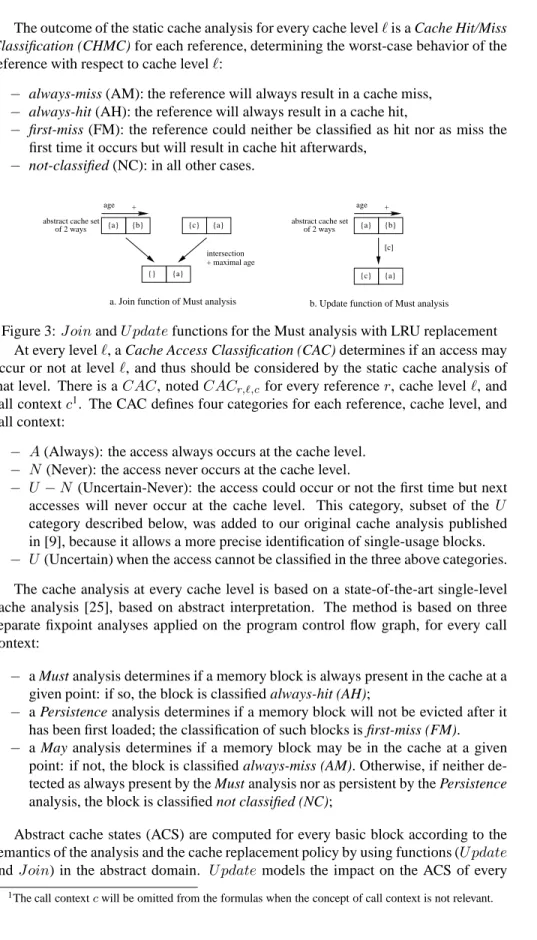
of 2 ways {a} {c} + age {a} {b} intersection + maximal age {a} {c} [c] {} {a} + age {a} {b}
a. Join function of Must analysis b. Update function of Must analysis
abstract cache set abstract cache set of 2 ways
Figure 3:J oinandU pdatefunctions for the Must analysis with LRU replacement
At every levelℓ, a Cache Access Classification (CAC) determines if an access may
occur or not at levelℓ, and thus should be considered by the static cache analysis of
that level. There is aCAC, notedCACr,ℓ,cfor every referencer, cache levelℓ, and
call contextc1. The CAC defines four categories for each reference, cache level, and
call context:
− A(Always): the access always occurs at the cache level.
− N(Never): the access never occurs at the cache level.
− U−N (Uncertain-Never): the access could occur or not the first time but next
accesses will never occur at the cache level. This category, subset of the U
category described below, was added to our original cache analysis published in [9], because it allows a more precise identification of single-usage blocks.
− U(Uncertain) when the access cannot be classified in the three above categories.
The cache analysis at every cache level is based on a state-of-the-art single-level cache analysis [25], based on abstract interpretation. The method is based on three separate fixpoint analyses applied on the program control flow graph, for every call context:
− a Must analysis determines if a memory block is always present in the cache at a
given point: if so, the block is classified always-hit (AH);
− a Persistence analysis determines if a memory block will not be evicted after it
has been first loaded; the classification of such blocks is first-miss (FM).
− a May analysis determines if a memory block may be in the cache at a given
point: if not, the block is classified always-miss (AM). Otherwise, if neither de-tected as always present by the Must analysis nor as persistent by the Persistence analysis, the block is classified not classified (NC);
Abstract cache states (ACS) are computed for every basic block according to the
semantics of the analysis and the cache replacement policy by using functions (U pdate
andJ oin) in the abstract domain. U pdate models the impact on the ACS of every
reference inside a basic block;J oin merges two ACS at convergence points in the control flow graph (e.g. at the end of conditional constructs).
Figure 3 gives an example of an ACS of a 2-way set-associative cache with LRU replacement policy on a Must analysis (only one cache set is depicted). An age is associated to every cache block of a set. The smaller the block age the more recent the access to the block. For the Must and Persistence analyses, each memory block is represented only once in the ACS, with its maximum age. It means that its actual age at run-time will always be lower than or equal to its age in the ACS.
At every cache levelℓ, the three analyses (Must, May, Persistence) consider all
referencesrguaranteed to occur at levelℓ(CACr,ℓ=A). References withCACr,ℓ=
N are not analysed. Regarding uncertain references (CACr,ℓ = U orCACr,ℓ =
U−N), for the sake of safety, the ACS is obtained by exploring the two possibilities
(CACr,ℓ=AandCACr,ℓ=N) and merging the results using theJ oinfunction. For
all referencesr,CACr,1=A, meaning that the L1 cache is always accessed.
The CAC of a referencerfor a cache levelℓdepends on CHMC ofrat levelℓ−1
and the CAC ofrat levelℓ−1(see Figure 2). Table 1 shows all the possible cases of
computation ofCACr,ℓfromCHM Cr,ℓ−1andCACr,ℓ−1.
hh h hhh hh hh hh CACr,ℓ −1 CH M Cr,ℓ −1 AM AH FM NC A A N U-N U N N N N N
U-N U-N N U-N U-N
U U N U-N U
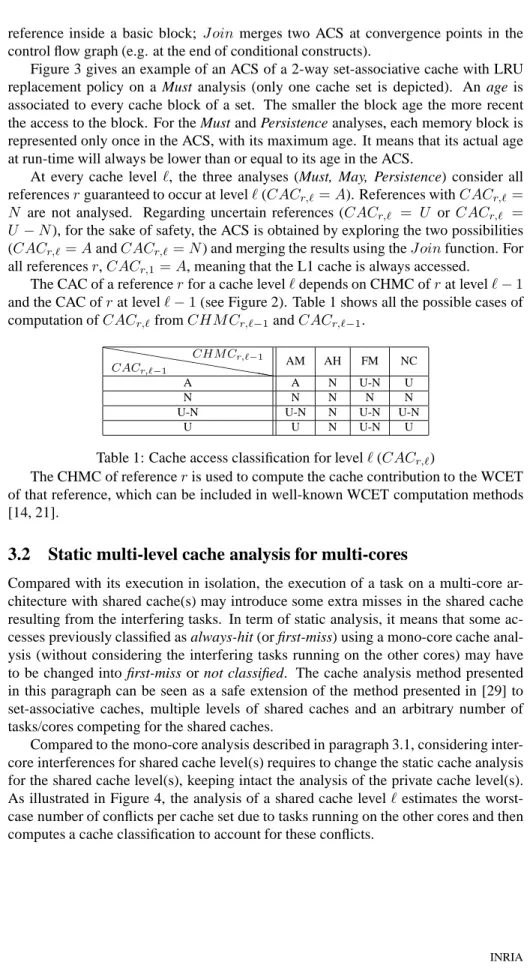
Table 1: Cache access classification for levelℓ(CACr,ℓ)
The CHMC of referenceris used to compute the cache contribution to the WCET
of that reference, which can be included in well-known WCET computation methods [14, 21].
3.2
Static multi-level cache analysis for multi-cores
Compared with its execution in isolation, the execution of a task on a multi-core ar-chitecture with shared cache(s) may introduce some extra misses in the shared cache resulting from the interfering tasks. In term of static analysis, it means that some ac-cesses previously classified as always-hit (or first-miss) using a mono-core cache anal-ysis (without considering the interfering tasks running on the other cores) may have to be changed into first-miss or not classified. The cache analysis method presented in this paragraph can be seen as a safe extension of the method presented in [29] to set-associative caches, multiple levels of shared caches and an arbitrary number of tasks/cores competing for the shared caches.
Compared to the mono-core analysis described in paragraph 3.1, considering inter-core interferences for shared cache level(s) requires to change the static cache analysis for the shared cache level(s), keeping intact the analysis of the private cache level(s).
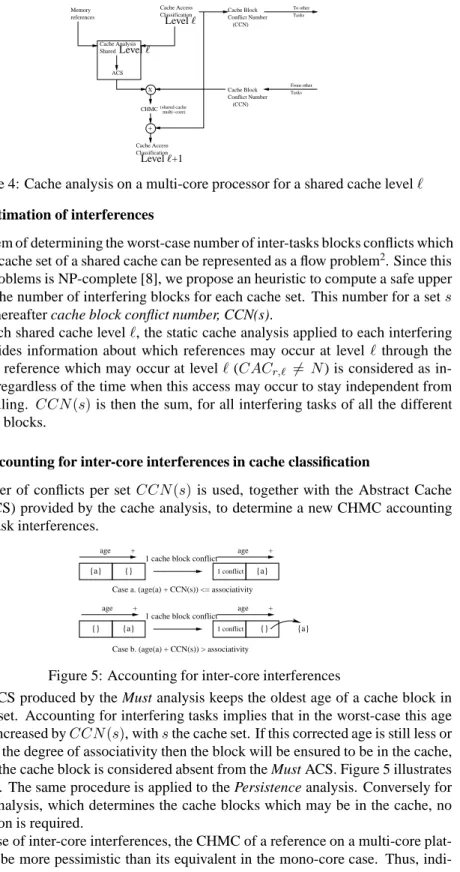
As illustrated in Figure 4, the analysis of a shared cache levelℓestimates the
worst-case number of conflicts per cache set due to tasks running on the other cores and then computes a cache classification to account for these conflicts.
X Cache Block Conflict Number (shared cache multi−core) From other Tasks references Memory To other Tasks CHMC + Cache Access Classification ACS Cache Analysis Cache Access Classification Cache Block Conflict Number (CCN) (CCN) Shared Levelℓ Levelℓ Levelℓ+1
Figure 4: Cache analysis on a multi-core processor for a shared cache levelℓ
3.2.1 Estimation of interferences
The problem of determining the worst-case number of inter-tasks blocks conflicts which
occur in a cache set of a shared cache can be represented as a flow problem2. Since this
class of problems is NP-complete [8], we propose an heuristic to compute a safe upper
bound of the number of interfering blocks for each cache set. This number for a sets
is named hereafter cache block conflict number, CCN(s).
For each shared cache levelℓ, the static cache analysis applied to each interfering
task, provides information about which references may occur at level ℓ through the
CAC. Any reference which may occur at levelℓ(CACr,ℓ 6=N) is considered as
in-terfering, regardless of the time when this access may occur to stay independent from
the scheduling. CCN(s)is then the sum, for all interfering tasks of all the different
interfering blocks.
3.2.2 Accounting for inter-core interferences in cache classification
The number of conflicts per set CCN(s)is used, together with the Abstract Cache
States (ACS) provided by the cache analysis, to determine a new CHMC accounting for inter-task interferences.
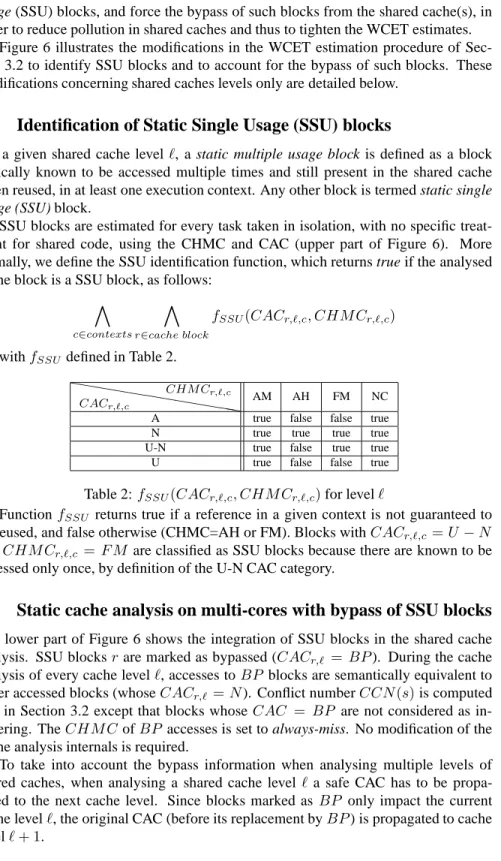
Case b. (age(a) + CCN(s)) > associativity
age + age + age + age + {a} {a} {a} {} {} {} {a} 1 cache block conflict
1 cache block conflict
1 conflict
1 conflict
Case a. (age(a) + CCN(s)) <= associativity
Figure 5: Accounting for inter-core interferences
The ACS produced by the Must analysis keeps the oldest age of a cache block in the cache set. Accounting for interfering tasks implies that in the worst-case this age
has to be increased byCCN(s), withsthe cache set. If this corrected age is still less or
equal than the degree of associativity then the block will be ensured to be in the cache, otherwise the cache block is considered absent from the Must ACS. Figure 5 illustrates both cases. The same procedure is applied to the Persistence analysis. Conversely for the May analysis, which determines the cache blocks which may be in the cache, no modification is required.
Because of inter-core interferences, the CHMC of a reference on a multi-core plat-form may be more pessimistic than its equivalent in the mono-core case. Thus,
rectly, the CAC of the next cache level might also differ. For our approach to be safe for multiple levels of shared caches, we analyse for each task the shared cache levels in sequence and change the resulting CACs before analysing the next shared cache level.
3.2.3 Code sharing
To take into account the effect of code sharing between tasks due to shared libraries, we
divideCCN(s)intoCCNprivate(s)andCCNshared(s, sb). The ranges of addresses
of the shared libraries are assumed to be given as a parameter of the analysis.
CCNprivate(s)represents the number of conflicts per set due to the private code of
interfering tasks, and is computed as before. Conversely,CCNshared(s, sb)represents
the number of conflicts for a shared blocksb mapped to cache sets and is used to
determine the number of effective conflicts withsb.CCNshared(s, sb)is computed in
two steps.
− The first step determines the setShared(s)of shared interfering cache blocks
mapped to set s. Because of code sharing, each block belonging to a shared
library and used by an interfering task has to be considered only once. Thus,
Shared(s)is defined as the union, for all interfering tasks, of the set of used
shared cache blocks mapped to sets(CACr,ℓ6=N).
− The second step to computeCCNshared(s, sb)stems from the fact that the
anal-ysed task may also use some block inShared(s). Regarding Must analysis, at
every program point, a shared block is considered as conflicting with blocksb
present inACSM ustonly if its age inACSM ustis strictly higher than age(sb):
CCNshared(s, sb) =
|Shared(s)\ {b∈ACSM ust, age(b)≤age(sb)} |
Similarly, regarding Persistence analysis:
CCNshared(s, sb) =
|Shared(s)\ {b∈ACSP ersistence, age(b)≤age(sb)} |
Finally, for both the Must and Persistence analysis, the formula which determines
if a cache blocksbis evicted is:
age(sb) +CCNprivate(s) +CCNshared(s, sb)> associativity
Similarly to a system without code sharing, the May analysis needs not be modified.
4
Interference reduction using bypass of static
single-usage blocks
Upon a cache miss, the conventional operation mode of a cache hierarchy is to retrieve the missing block from lower levels and to store them into all upper hierarchy levels. However, it is difficult to assert that storing the block into intermediate levels will be really useful. In some cases, a block stored in the cache after a miss may not be accessed again before its eviction. Such blocks, named single-usage blocks, contribute to the well known cache pollution phenomenon [19].
Static cache analysis methods have the ability to estimate single usage blocks at compile-time. The main contribution of this paper is to estimate such static single
usage (SSU) blocks, and force the bypass of such blocks from the shared cache(s), in order to reduce pollution in shared caches and thus to tighten the WCET estimates.
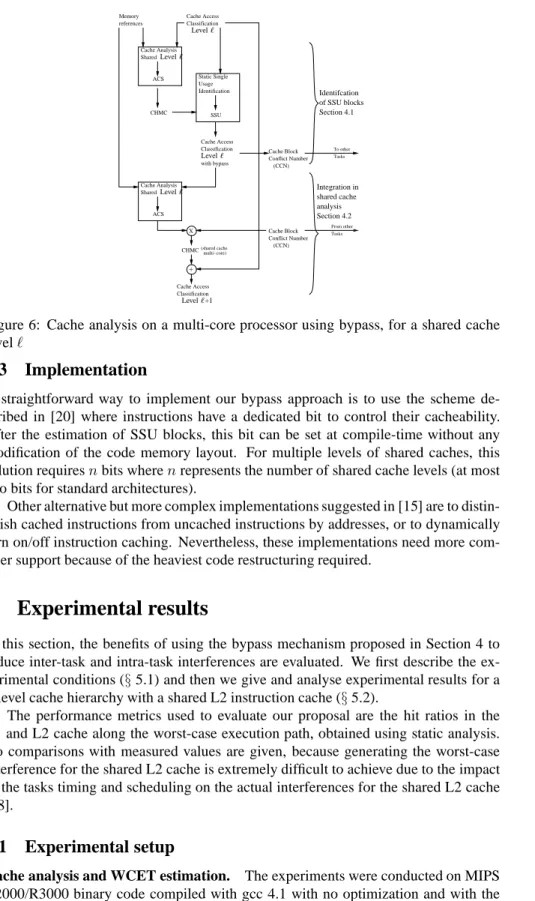
Figure 6 illustrates the modifications in the WCET estimation procedure of Sec-tion 3.2 to identify SSU blocks and to account for the bypass of such blocks. These modifications concerning shared caches levels only are detailed below.
4.1
Identification of Static Single Usage (SSU) blocks
For a given shared cache levelℓ, a static multiple usage block is defined as a block
statically known to be accessed multiple times and still present in the shared cache when reused, in at least one execution context. Any other block is termed static single usage (SSU) block.
SSU blocks are estimated for every task taken in isolation, with no specific treat-ment for shared code, using the CHMC and CAC (upper part of Figure 6). More formally, we define the SSU identification function, which returns true if the analysed cache block is a SSU block, as follows:
^
c∈contexts
^
r∈cache block
fSSU(CACr,ℓ,c, CHM Cr,ℓ,c)
withfSSU defined in Table 2.
hh hh hh hh hhhh CACr,ℓ,c CH M Cr,ℓ,c AM AH FM NC
A true false false true
N true true true true
U-N true false true true
U true false false true
Table 2:fSSU(CACr,ℓ,c, CHM Cr,ℓ,c)for levelℓ
FunctionfSSU returns true if a reference in a given context is not guaranteed to
be reused, and false otherwise (CHMC=AH or FM). Blocks withCACr,ℓ,c=U−N
andCHM Cr,ℓ,c = F M are classified as SSU blocks because there are known to be
accessed only once, by definition of the U-N CAC category.
4.2
Static cache analysis on multi-cores with bypass of SSU blocks
The lower part of Figure 6 shows the integration of SSU blocks in the shared cache
analysis. SSU blocksrare marked as bypassed (CACr,ℓ =BP). During the cache
analysis of every cache levelℓ, accesses toBP blocks are semantically equivalent to
never accessed blocks (whoseCACr,ℓ =N). Conflict numberCCN(s)is computed
like in Section 3.2 except that blocks whoseCAC = BP are not considered as
in-terfering. TheCHM CofBP accesses is set to always-miss. No modification of the
cache analysis internals is required.
To take into account the bypass information when analysing multiple levels of
shared caches, when analysing a shared cache levelℓ a safe CAC has to be
propa-gated to the next cache level. Since blocks marked asBP only impact the current
cache levelℓ, the original CAC (before its replacement byBP) is propagated to cache
Shared Memory Static Single Usage Identification SSU Cache Access Classification with bypass X (shared cache multi−core) To other Tasks From other Tasks CHMC CHMC + Cache Access Classification Cache Block Conflict Number Cache Block Conflict Number (CCN) (CCN) Cache Access Classification of SSU blocks Section 4.1 Identifcation Integration in shared cache analysis Section 4.2 ACS Cache Analysis ACS Cache Analysis Shared references Levelℓ Levelℓ Levelℓ Levelℓ Levelℓ+1
Figure 6: Cache analysis on a multi-core processor using bypass, for a shared cache
levelℓ
4.3
Implementation
A straightforward way to implement our bypass approach is to use the scheme de-scribed in [20] where instructions have a dedicated bit to control their cacheability. After the estimation of SSU blocks, this bit can be set at compile-time without any modification of the code memory layout. For multiple levels of shared caches, this
solution requiresnbits wherenrepresents the number of shared cache levels (at most
two bits for standard architectures).
Other alternative but more complex implementations suggested in [15] are to distin-guish cached instructions from uncached instructions by addresses, or to dynamically turn on/off instruction caching. Nevertheless, these implementations need more com-piler support because of the heaviest code restructuring required.
5
Experimental results
In this section, the benefits of using the bypass mechanism proposed in Section 4 to reduce inter-task and intra-task interferences are evaluated. We first describe the
ex-perimental conditions (§5.1) and then we give and analyse experimental results for a
2-level cache hierarchy with a shared L2 instruction cache (§5.2).
The performance metrics used to evaluate our proposal are the hit ratios in the L1 and L2 cache along the worst-case execution path, obtained using static analysis. No comparisons with measured values are given, because generating the worst-case interference for the shared L2 cache is extremely difficult to achieve due to the impact of the tasks timing and scheduling on the actual interferences for the shared L2 cache [28].
5.1
Experimental setup
Cache analysis and WCET estimation. The experiments were conducted on MIPS
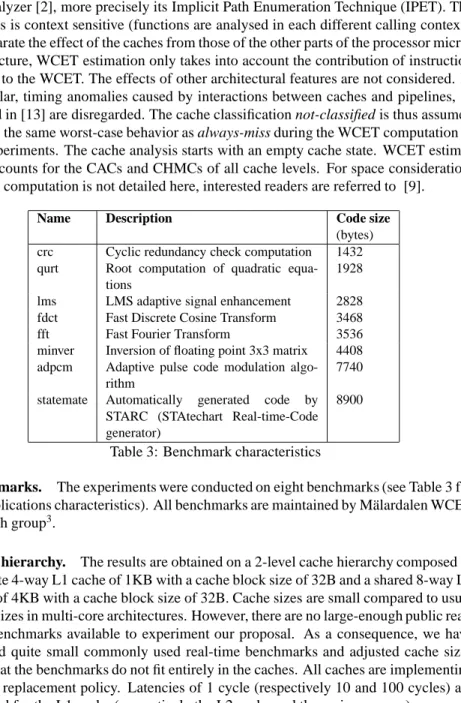
default linker memory layout. The WCETs of tasks are computed by the Heptane tim-ing analyzer [2], more precisely its Implicit Path Enumeration Technique (IPET). The analysis is context sensitive (functions are analysed in each different calling context). To separate the effect of the caches from those of the other parts of the processor micro-architecture, WCET estimation only takes into account the contribution of instruction caches to the WCET. The effects of other architectural features are not considered. In particular, timing anomalies caused by interactions between caches and pipelines, as defined in [13] are disregarded. The cache classification not-classified is thus assumed to have the same worst-case behavior as always-miss during the WCET computation in our experiments. The cache analysis starts with an empty cache state. WCET estima-tion accounts for the CACs and CHMCs of all cache levels. For space consideraestima-tion, WCET computation is not detailed here, interested readers are referred to [9].
Name Description Code size (bytes) crc Cyclic redundancy check computation 1432 qurt Root computation of quadratic
equa-tions
1928
lms LMS adaptive signal enhancement 2828
fdct Fast Discrete Cosine Transform 3468
fft Fast Fourier Transform 3536
minver Inversion of floating point 3x3 matrix 4408 adpcm Adaptive pulse code modulation
algo-rithm
7740 statemate Automatically generated code by
STARC (STAtechart Real-time-Code generator)
8900
Table 3: Benchmark characteristics
Benchmarks. The experiments were conducted on eight benchmarks (see Table 3 for
the applications characteristics). All benchmarks are maintained by M¨alardalen WCET
research group3.
Cache hierarchy. The results are obtained on a 2-level cache hierarchy composed of
a private 4-way L1 cache of 1KB with a cache block size of 32B and a shared 8-way L2 cache of 4KB with a cache block size of 32B. Cache sizes are small compared to usual cache sizes in multi-core architectures. However, there are no large-enough public real-time benchmarks available to experiment our proposal. As a consequence, we have selected quite small commonly used real-time benchmarks and adjusted cache sizes such that the benchmarks do not fit entirely in the caches. All caches are implementing a LRU replacement policy. Latencies of 1 cycle (respectively 10 and 100 cycles) are assumed for the L1 cache (respectively the L2 cache and the main memory).
5.2
Results for a multi-core architecture with a shared L2
instruc-tion cache
5.2.1 Impact of L2 bypass in a system without inter-core interference
An interesting expected side effect of the proposed bypass approach is that it allows a decrease of the WCET estimate of a task without any concurrent task competing for
the L2 cache, compared with the WCET estimate of the same task without any bypass. Indeed, all non-reused program blocks in a shared cache level are bypassed. As a consequence, this can avoid intra-task conflicts for shared cache blocks.
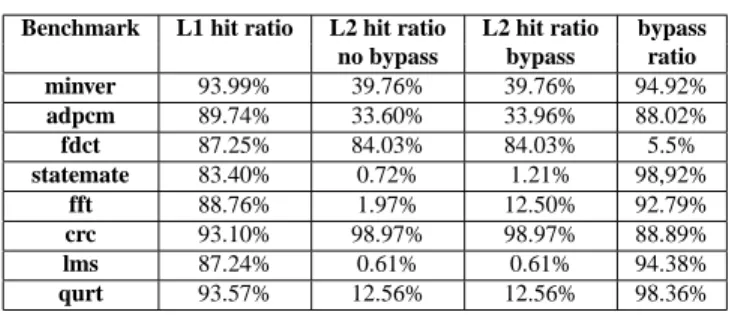
This phenomenon is quantified in Table 4, by considering a task executing on one core without any interfering task running on the other cores competing for the shared L2 cache.
For every benchmark (column 1), we examine the worst-case static hit ratio (number of accessesnumber of hits )
for the analysed task in the L1 cache (fraction of hits in the L1 cache along the worst-case execution path, column 2). Columns 3 and 4 give the worst-worst-case static hit ratio in the L2 cache respectively with and without the L2 bypass scheme proposed in Sec-tion 4. The number of accesses and the number of hits at each level of the cache hier-archy are computed using the frequency of basic blocks returned by the IPET WCET computation. Finally, column 5 gives the percentage of bypassed blocks in the L2 cache (number of bypassed cache blocksnumber of cache blocks ).
Benchmark L1 hit ratio L2 hit ratio L2 hit ratio bypass no bypass bypass ratio minver 93.99% 39.76% 39.76% 94.92% adpcm 89.74% 33.60% 33.96% 88.02% fdct 87.25% 84.03% 84.03% 5.5% statemate 83.40% 0.72% 1.21% 98,92% fft 88.76% 1.97% 12.50% 92.79% crc 93.10% 98.97% 98.97% 88.89% lms 87.24% 0.61% 0.61% 94.38% qurt 93.57% 12.56% 12.56% 98.36%
Table 4: Impact of L2 bypass on WCET estimation with no interference for the L2 cache.
The worst-case hit ratio in the L1 cache indicates the percentage of references stat-ically known to hit in the L1 cache. The higher the hit ratio, the lower the number of references to the shared L2 cache. The percentage of bypassed blocks given in column 5 indicates how much pollution is avoided in the L2 cache. The higher the bypass ratio, the higher the expected reduction of inter-core interference.
As expected, our bypass scheme provides worst-case hit-ratios in the shared L2 cache always larger than or equal to when no bypass mechanism is used. For three benchmarks (statemate, adpcm, fft), the worst-case hit ratio is strictly larger than when not using L2 bypass. In these cases, not storing SSU blocks in the L2 instruction cache may allow to detect the reuse of blocks which where previously classified as misses (because they were in conflict with a SSU block). In the best case (fft), the worst-case
hit ratio is multiplied by a factor10, which significantly reduces the task WCET.
In term of percentage of bypassed cache blocks, the ratio is for all tasks but fdct high, meaning that the degree of pollution in the shared L2 cache is important. For those applications, reducing L2 cache pollution is expected to drastically reduce inter-core interference. For fdct, the percentage of bypassed blocks is low, explained by the code structure, made of two large loops whose code do not fit into the L1 cache but entirely fit in the L2 cache. Note that the percentage of SSU blocks is much higher than when single-usage blocks are detected dynamically, such as in [19], reporting an average number of single-usage blocks of 33% for the SPEC CPU 2000 benchmarks. This difference comes from the fact that static cache analysis, for the sake of safety, underestimates the set of reused blocks compared to real executions.
5.2.2 Multi-core cache analysis with and without bypass
In this paragraph an architecture with two cores is considered. We estimate the WCET of a task running on one core, competing for the shared L2 cache with one of the eight benchmarks of Table 3 running on the other core, in a context without code sharing between tasks.
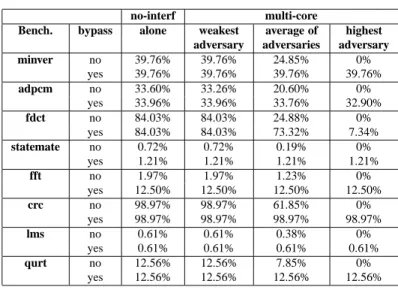
The results are presented in Table 5. For each benchmark, the results without by-pass of the L2 cache (first line) and with byby-pass (second line) are given. For each configuration, we give the worst-case hit ratio in the L2 cache for the analysed task obtained: (i) without interfering task running on the other core (see also Table 4) (ii) with the interfering task having the lowest amount of interference; (iii) with an av-erage of the worst-case hit ratio with each of the eight tasks successively competing for the shared L2 cache ; (iv) with the interfering task having the highest amount of interference.
no-interf multi-core
Bench. bypass alone weakest average of highest adversary adversaries adversary minver no 39.76% 39.76% 24.85% 0% yes 39.76% 39.76% 39.76% 39.76% adpcm no 33.60% 33.26% 20.60% 0% yes 33.96% 33.96% 33.76% 32.90% fdct no 84.03% 84.03% 24.88% 0% yes 84.03% 84.03% 73.32% 7.34% statemate no 0.72% 0.72% 0.19% 0% yes 1.21% 1.21% 1.21% 1.21% fft no 1.97% 1.97% 1.23% 0% yes 12.50% 12.50% 12.50% 12.50% crc no 98.97% 98.97% 61.85% 0% yes 98.97% 98.97% 98.97% 98.97% lms no 0.61% 0.61% 0.38% 0% yes 0.61% 0.61% 0.61% 0.61% qurt no 12.56% 12.56% 7.85% 0% yes 12.56% 12.56% 12.56% 12.56%
Table 5: Estimated worst-case L2 hit ratio of the analysed task (bypass vs no bypass). With the weakest adversary task (column weakest adversary), the increase of worst-case hit ratio compared with a system without L2 bypass is generally slim.
In average (column average of adversaries), the increase of worst-case hit ratio compared with a system without L2 bypass is significant.
In the worst-case (column highest adversary), without bypass, the multi-core cache analysis always results in a hit ratio of 0% in the shared L2 cache. This hit ratio of 0% not always occurs with the same competing task. Moreover, for all benchmarks, the highest adversary is not unique; several adversary tasks result in a hit ratio of 0%. Said differently, the worst-case hit ratio in a system without L2 bypass is extremely poor. This demonstrates the pessimism of methods such as the base method presented in Section 3 and the approach described in [29], that consider all interferences between cores without any mechanism to decrease inter-core interference. If we now compare the worst-case hit ratio in the L2 when bypassing SSU blocks with the worst-case hit ratio without interference, the value is the same for six out of the eight considered benchmarks, and very close for adpcm (1.04%). In contrast, for fdct the difference is significant (76,69%). This case occurs when fdct competes with itself for the shared L2 cache (recall that no code sharing is assumed in this paragraph), and results in a high volume of L2 cache consumed by fdct. When fdct is not competing with itself
anymore, the worst-case hit ratio becomes in the L2 cache 75.06% and the difference of hit ratio in the L2 cache compared to an interference free situation is then less than 9%.
In summary, using our bypass scheme, the amount of inter-core interferences is drastically reduced and the multi-core WCET is generally very close to the WCET without interferences for the shared L2 cache.
5.2.3 Scalability issues
The scalability of our bypass scheme is analysed by considering all benchmarks, each running on a distinct core, as interfering tasks of the analysed task. In this configuration the cumulated size of all interfering tasks is around 8 times bigger than the size of the L2 shared instruction cache.
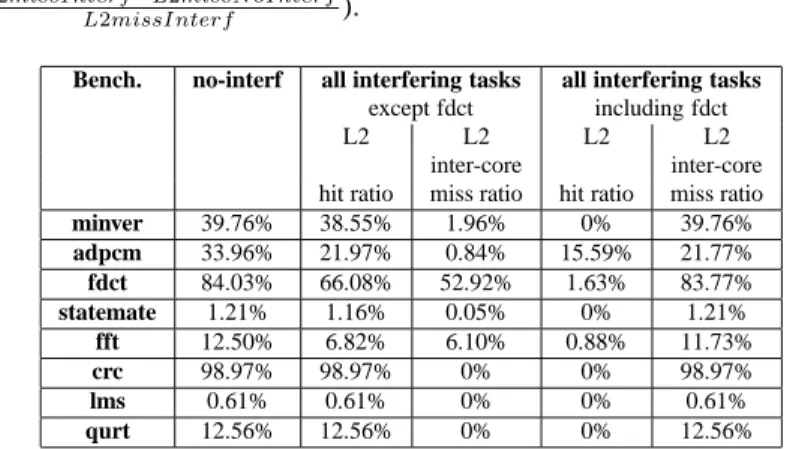
The results are presented in Table 6. The fdct task which needs the higher volume of L2 capacity even in the case of our bypass approach, is left out in the left column and considered in the right column. For each configuration, we give the worst-case inter-core miss ratio resulting from the interferences with the tasks running on the other
cores (L2missInterf−L2missN oInterf
L2missInterf ).
Bench. no-interf all interfering tasks all interfering tasks
except fdct including fdct
L2 L2 L2 L2
inter-core inter-core
hit ratio miss ratio hit ratio miss ratio
minver 39.76% 38.55% 1.96% 0% 39.76% adpcm 33.96% 21.97% 0.84% 15.59% 21.77% fdct 84.03% 66.08% 52.92% 1.63% 83.77% statemate 1.21% 1.16% 0.05% 0% 1.21% fft 12.50% 6.82% 6.10% 0.88% 11.73% crc 98.97% 98.97% 0% 0% 98.97% lms 0.61% 0.61% 0% 0% 0.61% qurt 12.56% 12.56% 0% 0% 12.56%
Table 6: Estimated worst-case L2 hit ratio and inter-core miss ratio of the analysed task (bypass, 7-8 interfering tasks).
When task fdct is left out, for a majority of benchmarks (minver, statemate, crc, lms, qurt) the decrease of the worst-case hit ratio in the L2 cache is low, compared with the worst-case hit ratio in the L2 cache with no adversary task running on the other cores. For the other benchmarks, the decrease of worst-case hit ratio in the L2 cache is larger. However, for all benchmarks, there are still hits in the L2 cache when using bypass. In contrast, no hit in the L2 cache can be guaranteed even with one single task running on the other core when no bypass is used, as previously shown in Table 5.
In contrast, when fdct is kept, the decrease of the worst-case hit ratio in the L2 cache is significant because fdct consumes a large percentage of the L2 cache capacity. With this kind of task, the proposed bypass approach is not sufficient to decrease the amount of interference for the L2 cache. Additional methods such as cache partitioning have to be used to isolate such cache consuming tasks from the other tasks.
5.2.4 Code Sharing.
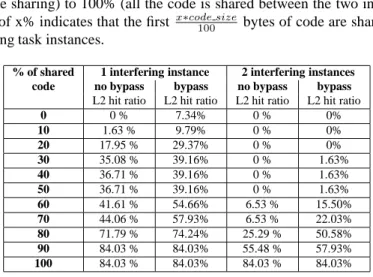
The impact of considerating code sharing (paragraph 3.2.3) is evaluated in Table 7. Due to the difficulties to find different degrees of shared code in real-time benchmarks, the evaluation was achieved with a single task, running on 2 or 3 cores, and considering
in the analysis that a certain percentage of its code was shared by the task instances. Table 7 shows the worst-case hit ratio in the L2 cache for the fdct task, running on one core, when one (respectively two) instance(s) of fdct are running on the other one or two cores. The amount of shared code between the instances is varied between 0% (no code sharing) to 100% (all the code is shared between the two instances). A
percentage of x% indicates that the first x∗code size
100 bytes of code are shared between
the competing task instances.
% of shared 1 interfering instance 2 interfering instances code no bypass bypass no bypass bypass
L2 hit ratio L2 hit ratio L2 hit ratio L2 hit ratio
0 0 % 7.34% 0 % 0% 10 1.63 % 9.79% 0 % 0% 20 17.95 % 29.37% 0 % 0% 30 35.08 % 39.16% 0 % 1.63% 40 36.71 % 39.16% 0 % 1.63% 50 36.71 % 39.16% 0 % 1.63% 60 41.61 % 54.66% 6.53 % 15.50% 70 44.06 % 57.93% 6.53 % 22.03% 80 71.79 % 74.24% 25.29 % 50.58% 90 84.03 % 84.03% 55.48 % 57.93% 100 84.03 % 84.03% 84.03 % 84.03%
Table 7: Estimated worst-case L2 hit ratio of fdct with code sharing (no bypass/bypass, 1-2 fdct interfering instances).
The table shows that code sharing tightens WCET estimation as compared to a system in which code sharing is not considered.
5.2.5 Analysis time
In term of computation time, the most time consuming situation of our experiments was described in paragraph 5.2.3. In this situation, up to nine tasks were analysed to determine the blocks to be bypassed for each of them, followed by a WCET estimation of the analysed task to account for inter-core interferences and bypassed cache blocks. The whole process always took less than 3 minutes on a Intel Core 2 Duo E6700 (2.66 GHz) with 2 GB of RAM.
6
Conclusions and future work
Estimating WCETs for multi-core platforms is very challenging because of the possible interferences between cores due to shared hardware resources such as shared caches. We have proposed in this paper a technique to reduce the amount of task inter-ferences, achieved by caching in the shared instruction caches(s) only blocks statically known as reused. Experimental results have shown that our approach allows to dras-tically reduce the WCET of tasks compared to methods which consider all inter-core conflicts and do not attempt to reduce their amount.
Our ongoing work is to extend our approach to data and unified caches. Another direction for future research is to use bypass for non-shared caches as well, in order to further reduce intra-task conflicts. Another direction would be to explore joint WCET estimation and scheduling to avoid some inter-task conflicts. Finally, a last direction would be to compare our proposal with cache locking and partitioning schemes, which avoid inter-task interference at the cost of a reduced cache volume per task/core.
References
[1] A. Colin and I. Puaut. Worst case execution time analysis for a processor with branch prediction. Real Time Systems, 18(2-3):249–274, May 2000.
[2] A. Colin and I. Puaut. A modular and retargetable framework for tree-based WCET anal-ysis. In Euromicro Conference on Real-Time Systems (ECRTS), pages 37–44, Delft, The Netherlands, June 2001.
[3] H. Dybdahl and P. Stenstr¨om. Enhancing last-level cache performance by block bypassing and early miss determination. In Asia-Pacific Computer Systems Architecture Conference, pages 52–66, 2006.
[4] J. Engblom and A. Ermedahl. Pipeline timing analysis using a trace-driven simulator. In
Proceedings of the 6th International Conference on Real-Time Computing Systems and Applications, Dec. 1999.
[5] M. Farrens, G. Tyson, J. Matthews, and A. R. Pleszkun. A modified approach to data cache management. In In Proceedings of the 28th Annual International Symposium on
Microarchitecture, pages 93–103, 1995.
[6] C. Ferdinand. Cache Behavior Prediction for Real-Time Systems. PhD thesis, Saarland University, 1997.
[7] C. Ferdinand, R. Heckmann, M. Langenbach, F. Martin, M. Schmidt, H. Theiling, S. Thesing, and R. Wilhelm. Reliable and precise WCET determination for real-life pro-cessor. In EMSOFT ’01: Proceedings of the First International Workshop on Embedded
Software, volume 2211 of Lecture Notes in Computer Science, pages 469–485, Tahoe City,
CA, USA, Oct. 2001.
[8] M. R. Garey and D. S. Johnson. Computers and Intractability, A Guide to the Theory of
NP-Completeness, appendix A2-4. W. H. Freeman and company, 1979.
[9] D. Hardy and I. Puaut. WCET analysis of multi-level non-inclusive set-associative instruc-tion caches. In Proceedings of the 29th Real-Time Systems Symposium, pages 456–466, Barcelona, Spain, Dec. 2008.
[10] R. Heckmann, M. Langenbach, S. Thesing, and R. Wilhelm. The influence of processor architecture on the design and the results of WCET tools. Proceedings of the IEEE, vol.9,
n7, 2003.
[11] X. Li, A. Roychoudhury, and T. Mitra. Modeling out-of-order processors for WCET esti-mation. Real Time Systems, 34(3), Nov. 2006.
[12] T. Lundqvist and P. Stenstr¨om. A method to improve the estimated worst-case perfor-mance of data caching. In Proceedings of the 6th International Conference on Real-Time
Computing Systems and Applications, pages 255–262, 1999.
[13] T. Lundqvist and P. Stenstr¨om. Timing anomalies in dynamically scheduled microproces-sors. In Real-Time Systems Symposium, pages 12–21, 1999.
[14] S. Malik and Y. T. S. Li. Performance analysis of embedded software using implicit path enumeration. Design Automation Conference, 0:456–461, 1995.
[15] S. McFarling. Program optimization for instruction caches. SIGARCH Comput. Archit.
News, 17(2):183–191, 1989.
[16] F. Mueller. Static cache simulation and its applications. PhD thesis, Florida State Univer-sity, 1994.
[17] F. Mueller. Timing analysis for instruction caches. Real Time Systems, 18(2-3):217–247, 2000.
[18] H. S. Negi, T. Mitra, and A. Roychoudhury. Accurate estimation of cache-related preemp-tion delay. In CODES+ISSS ’03: Proceedings of the 1st IEEE/ACM/IFIP internapreemp-tional
conference on Hardware/software codesign and system synthesis, pages 201–206, 2003.
[19] T. Piquet, O. Rochecouste, and A. Seznec. Exploiting single-usage for effective memory management. In ACSAC ’07: Proceedings of the 12th Asia-Pacific conference on Advances
in Computer Systems Architecture, pages 90–101. Springer-Verlag, 2007.
[20] G. N. Prasanna. Cache structure and method for improving worst case execution time. Patent Pending, 2001. US 6,272,599 B1.
[21] P. Puschner and C. Koza. Calculating the maximum execution time of real-time programs.
[22] J. Rosen, A. Andrei, P. Eles, and Z. Peng. Bus access optimization for predictable im-plementation of real-time applications on multiprocessor systems-on-chip. In RTSS ’07:
Proceedings of the 28th IEEE International Real-Time Systems Symposium, pages 49–60,
Washington, DC, USA, 2007. IEEE Computer Society.
[23] J. Staschulat and R. Ernst. Multiple process execution in cache related preemption de-lay analysis. In EMSOFT ’04: Proceedings of the 4th ACM international conference on
Embedded software, pages 278–286, 2004.
[24] V. Suhendra and T. Mitra. Exploring locking & partitioning for predictable shared caches on multi-cores. In DAC ’08: Proceedings of the 45th annual conference on Design
au-tomation, pages 300–303, 2008.
[25] H. Theiling, C. Ferdinand, and R. Wilhelm. Fast and precise WCET prediction by sepa-rated cache and path analyses. Real Time Systems, 18(2-3):157–179, 2000.
[26] R. T. White, F. Mueller, C. A. Healy, D. B. Whalley, and M. G. Harmon. Timing analysis for data and wrap-around fill caches. Real Time Systems, 17(2-3):209–233, 1999. [27] R. Wilhelm, J. Engblom, A. Ermedahl, N. Holsti, S. Thesing, D. Whalley, G. Bernat,
C. Ferdinand, R. Heckmann, F. Mueller, I. Puaut, P. Puschner, J. Staschulat, and P. Sten-str¨om. The Determination of Worst-Case Execution Times—Overview of the Methods and Survey of Tools. ACM Transactions on Embedded Computing Systems (TECS), 2008. [28] R. Wilhelm, D. Grund, J. Reineke, M.Schlickling, M. Pister, and C. Ferdinand. Memory hierarchies, pipelines, and buses for future architectures in time-critical embedded systems.
IEEE Transactions on Computer-Aided Design of Integrated Circuits and Systems, 2009,
To be published.
[29] J. Yan and W. Zhang. WCET analysis for multi-core processors with shared l2 instruction caches. In RTAS ’08: Proceedings of the 2008 IEEE Real-Time and Embedded Technology
Contents
1 Introduction 3
2 Assumptions 5
3 WCET Analysis on multi-cores with multiple levels of instruction caches 6
3.1 Static multi-level cache analysis for mono-core processors [9] . . . . 6
3.2 Static multi-level cache analysis for multi-cores . . . 8
3.2.1 Estimation of interferences . . . 9
3.2.2 Accounting for inter-core interferences in cache classification 9 3.2.3 Code sharing . . . 10
4 Interference reduction using bypass of static single-usage blocks 10 4.1 Identification of Static Single Usage (SSU) blocks . . . 11
4.2 Static cache analysis on multi-cores with bypass of SSU blocks . . . . 11
4.3 Implementation . . . 12
5 Experimental results 12 5.1 Experimental setup . . . 12
5.2 Results for a multi-core architecture with a shared L2 instruction cache 13 5.2.1 Impact of L2 bypass in a system without inter-core interference 13 5.2.2 Multi-core cache analysis with and without bypass . . . 15
5.2.3 Scalability issues . . . 16
5.2.4 Code Sharing. . . 16
5.2.5 Analysis time . . . 17
Centre de recherche INRIA Bordeaux – Sud Ouest : Domaine Universitaire - 351, cours de la Libération - 33405 Talence Cedex Centre de recherche INRIA Grenoble – Rhône-Alpes : 655, avenue de l’Europe - 38334 Montbonnot Saint-Ismier Centre de recherche INRIA Lille – Nord Europe : Parc Scientifique de la Haute Borne - 40, avenue Halley - 59650 Villeneuve d’Ascq
Centre de recherche INRIA Nancy – Grand Est : LORIA, Technopôle de Nancy-Brabois - Campus scientifique 615, rue du Jardin Botanique - BP 101 - 54602 Villers-lès-Nancy Cedex
Centre de recherche INRIA Paris – Rocquencourt : Domaine de Voluceau - Rocquencourt - BP 105 - 78153 Le Chesnay Cedex Centre de recherche INRIA Saclay – Île-de-France : Parc Orsay Université - ZAC des Vignes : 4, rue Jacques Monod - 91893 Orsay Cedex
Centre de recherche INRIA Sophia Antipolis – Méditerranée : 2004, route des Lucioles - BP 93 - 06902 Sophia Antipolis Cedex
Éditeur
INRIA - Domaine de Voluceau - Rocquencourt, BP 105 - 78153 Le Chesnay Cedex (France)