HPCA 2017 Submission#50– CAMERA READY DRAFT!!
Hipster: Hybrid Task Manager for
Latency-Critical Cloud Workloads
Rajiv Nishtala
†‡, Paul Carpenter
†, Vinicius Petrucci
∗, Xavier Martorell
†‡†Barcelona Supercomputing Center, Barcelona, Spain ‡Universitat Politècnica de Catalunya, Barcelona, Spain
∗Federal University of Bahia, Bahia, Brazil
{rajiv.nishtala, paul.carpenter, xavier.martorell}@bsc.es
,
[email protected]ABSTRACT
In 2013, U.S. data centers accounted for 2.2% of the country’s total electricity consumption, a figure that is projected to increase rapidly over the next decade. Many important workloads are interactive, and they demand strict levels of quality-of-service (QoS) to meet user expectations, making it challenging to reduce power consumption due to increasing performance demands.
This paper introduces Hipster, a technique that com-bines heuristics and reinforcement learning to manage latency-critical workloads. Hipster’s goal is to improve resource efficiency in data centers while respecting the QoS of the latency-critical workloads. Hipster achieves its goal by exploring heterogeneous multicores and dy-namic voltage and frequency scaling (DVFS). To im-prove data center utilization and make best usage of the available resources, Hipster can dynamically assign re-maining cores to batch workloads without violating the QoS constraints for the latency-critical workloads. We perform experiments using a 64-bit ARM big.LITTLE platform, and show that, compared to prior work, Hip-ster improves the QoS guarantee for Web-Search from 80% to 96%, and for Memcached from 92% to 99%, while reducing the energy consumption by up to 18%.
1.
INTRODUCTION
In 2013, U.S. data centers consumed 91 billion kilowatt-hours, which corresponds to 2.2% of the country’s total electricity consumption and about 100 million metric tons of carbon pollution per year [1–3]. Energy effi-ciency is, in fact, a major issue across the whole comput-ing spectrum, and modern systems have been explor-ing alternative heterogeneous processors [4–10] and Dy-namic Voltage and Frequency Scaling (DVFS) [11–14] to trade-off performance and energy consumption.
Many important cloud workloads are latency-critical, and they require strict levels of quality-of-service (QoS) to meet user expectations [15–17]. A web-search, for ex-ample, must complete within a fraction of a second [18], otherwise users are likely to give up and leave. A previ-ous study [19] has shown that marginal QoS delays (of hundreds of milliseconds) can greatly impact user expe-rience and advertising revenue. In particular, it is im-portant to meet the QoS tail latency, such as the 95th or
Recent works [15–17,21–23] have shown that tradi-tional power management practices and CPU utilization measures are unsuitable to drive task management for data center workloads. This is because prior schemes (like OS-level DVFS) work well to deliver long-term performance for batch workloads, but they can severely hurt the QoS of latency-critical data center workloads. As noticed in prior work [21,24], workload manage-ment can be very challenging in heterogeneous server systems because an application can experience differ-ent behavior in QoS and resource efficiency depending on specific resource allocation decisions. This requires careful resource characterization of the running work-loads to optimize resource usage. In many data cen-ters, there also is a wish to run both latency-critical and batch workloads. Running both latency-critical and batch workloads, in this way, increases cluster utiliza-tion during periods of low demand, reducing operautiliza-tional cost and total energy consumption.
In this paper, we introduce Hipster, a scheme that manages heterogeneous multi-core allocation and DVFS settings for latency-critical workloads given QoS con-straints, while minimizing system power consumption. In addition, Hipster allows collocation of latency-critical and batch workloads in shared data centers to maximize the data center utilization. In such scenarios, the re-sources allocated to latency-critical workloads are just enough to meet the QoS target, and the remaining re-sources are allocated to throttle the batch workloads.
The major contributions of our work are:
1 We presentHipster, which is a hybrid manage-ment solution combining heuristic techniques and re-inforcement learning to make resource-efficient alloca-tion decisions, specifically deciding the best mapping of latency-critical and batch workloads on heterogeneous cores (big and small) and their DVFS setting.
2 Hipster is presented in two variants: HipsterIn
and HipsterCo. HipsterIn (for interactive workloads) is targeted towards allocating resources to latency-critical workloads so that the system power consumption is minimized, whereas HipsterCo (for collocated workloads) enables running both latency-critical and batch work-loads for improved server utilization. Both variants en-sure that QoS for latency-critical workloads is met.
0
100 200 300 400 500 600 700 800
Time (s)
0
20
40
60
80
100
Pe
rce
nt
of
Ma
x c
ap
ac
ity
QPS
Server Power
Figure 1: Power drawn for a diurnal load [15,22,25] for Web-Search running on two big cores of the ARM Juno R1 (64-bit big.LITTLE) platform.
ing a 64-bit big-LITTLE (ARM Juno R1) platform along with back-end services such as Web-Search and Mem-cached. The request generator for each of the back-end services follows a diurnal load pattern typical of pro-duction data centers.
4 We evaluate Hipster against the only other het-erogeneous platform-aware state-of-the-art scheme [21] that dynamically allocates heterogeneous cores to latency-critical workloads. Our results show that HipsterIn out-performs prior work, in energy consumption reduction by 13%, while achieving up to 99% QoS guarantees for the latency-critical workloads. In addition, our results for HipsterCo show that it improves performance by 2.3×compared to a static/conservative policy running batch workloads, while meeting QoS targets for latency-critical workloads.
2.
MOTIVATION
Typical web applications experience large variations in user traffic over time. Figure1, for example, shows how the number of Web-Search queries per second, a typical load at Google data center, varies between about 5% and 80% of maximum capacity [15,22,25]. Similarly, Facebook consistently sees diurnal load variations be-tween 10% and 95% of maximum capacity, across mul-tiple server clusters [26,27].
The periods of low server utilization provide opportu-nity to reduce data center energy consumption [16,21, 24]. As seen in Figure1, although load drops dramati-cally, power consumption is always at 60% or above. For this reason, both academia and industry are working towards better energy proportionality; i.e. that the sys-tem’s power consumption is proportional to utilization. There are also opportunities to improve energy ef-ficiency using heterogeneous servers combined with DVFS. Heterogeneous servers can minimize power consumption at low load by deploying small cores, and can provide maximum performance using big cores to meet the QoS target for latency-critical workloads [5,21,28].
[Mixing different core types with DVFS]: Fig-ure 2 shows the energy efficiency in RPS/Watt (Re-quests Per Second per Watt) and QPS/Watt (Queries Per Second per Watt) when using a state-of-the-art baseline policy [21]. We explore a heterogeneous ar-chitecture mixing different cores types and DVFS (Het-CMP) running Memcached (Figure2a) and Web-Search (Figure 2b) at different load levels. The table at the
bottom of each subfigure shows the configuration se-lected by HetCMP and our baseline policy. In the con-figurations of the embedded table, B and S represent big and small cores, respectively. The configuration space for HetCMP consists of core-mappings (big and small cores) and DVFS combinations for a heteroge-neous platform, whereas the baseline policy consists exclusively of either big or small cores at the highest DVFS. The configurations available for the baseline pol-icy are therefore a subset of HetCMP. For each polpol-icy, among the configurations where the QoS is met at each load level, the configuration with the least power con-sumption is selected. Experimental details in Section4. Figure2raises two main concerns with current state-of-the-art heuristic algorithm [21]. First, Figure2a dem-onstrates in periods of low load (less than 60% of max capacity for Memcached), exclusive use of low perfor-mance cores at lower DVFS ensures QoS is met while reducing static-power, thus making it an excellent op-tion to use for periods of low load. As the load increases, HetCMP transitions from low performance cores to a best combination of small and big cores at a given DVFS (for instance, 2 big and 2 small cores – 2B2S at 0.9 GHz at 89% load) to deliver the required latency. On the other hand, the baseline policy transitions directly from low performance cores to high performance cores at highest DVFS to deliver the required latency, thereby increasing energy consumption by 27.74% (mean). In periods of very high load (more than 90% for Mem-cached), exclusive use of high performance cores at higher DVFS ensures QoS is met with better energy propor-tionality. Similarly results were observed for Web-Search (Figure2b) with up to 25% (mean) energy savings.
In summary, we show that small and big cores are an attractive option for periods of low load and very high load, respectively, while meeting QoS targets at a much lower cost. On the other hand, for intermediate loads, which are generally experienced by data centers during the day [29], harnessing HetCMP provides the opportunity for higher performance at a lower cost.
[Exploring workload particularities]: We note that prior work [21] relies on a single heuristic to allo-cate exclusively big or small cores to workloads. By al-lowing an arbitrary allocation mix of big and small cores with DVFS, this kind of heuristic can be sub-optimal across diverse applications and architectures (evalua-tion details in Sec(evalua-tion4); that is, a single state-machine management (as in prior work) may fail to precisely sat-isfy the QoS targets given distinct workload characteris-tics of diverse applications. To illustrate this point, Fig-ure2cshows two distinct/unique state transition map-pings that are optimal (throughput per watt) at differ-ent load capacities for Memcached and Web-Search.
Figure 3 shows the energy efficiency that would be neglected (ensuring QoS is met at different load lev-els) when using the state-machine built for Web-Search but used for the Memcached workload, normalized to the energy efficiency using the state-machine built ex-clusively for Memcached; and vice-versa. The state-machine configuration for Memcached and Web-Search are represented in blue and red line, respectively, in Figure2c. Figure3demonstrates that different
latency-29% 40% 51% 63% 69% 71% 77% 83% 89% 91% 94% 97% 100% HetCMP
GHz 0.652S 0.653S 0.654S 0.654S 1B3S0.6 2B2S0.6 2B2S0.6 2B2S0.6 2B2S0.9 2B2S1.15 1.152B 1.152B 1.152B BP
GHz 0.652S 0.653S 0.654S 0.654S 1.152B 1.152B 1.152B 1.152B 1.152B 1.152B 1.152B 1.152B 1.152B Percentage of Max Capacity
0 5000 10000 15000 20000 25000 R PS /W at t
HetCMP Baseline policy (BP)
(a) Memcached 18% 25% 33% 40% 47% 55% 62% 69% 76% 84% 91% 96% 100% 3S 0.65 0.653S 0.653S 0.654S 0.654S 0.602B 1B3S0.902B2S0.60 2B2S0.601B3S0.901B3S1.151B3S1.15 1.152B 3S 0.65 0.653S 0.653S 0.654S 0.654S 1.152B 1.152B 1.152B 1.152B 1.152B 1.152B 1.152B 1.152B Percentage of Max Capacity
0 5 10 15 20 Q PS /W at t
HetCMP Baseline policy (BP)
(b) Web-Search
20 30 40 50 60 70 75 85 90 95 100 Percentage of Max load 1S-0.65 2S-0.65 3S-0.65 2B-0.60 1B3S-0.604S-0.65 2B2S-0.60 1B3S-0.902B-0.90 2B2S-0.90 1B3S-1.15 2B2S-1.152B-1.15 Co re-ma pp ing - DV FS Web-Search Memcached (c) State Machine Figure 2: Throughput per watt of Memcached (2a) and Web-Search (2b) with baseline policy (BP) [21] and hetero-geneous platforms with DVFS (HetCMP) at different load levels along with their respective state machines (2c)
20% 30% 40% 50% 60% 70% 75% 85% 90% 95% 100%
Percentage of max load
0.00.2 0.4 0.6 0.81.0 En erg y e ffic ien cy (N orm ali ze d) Memcached Web-Search
Figure 3: Energy efficiency at various load levels for Memcached while meeting QoS, using the state-machine of Web-Search normalized to the state-machine of Mem-cached (lower is worse); converse for Web-Search. critical applications benefit from different state-transition mappings and show improvement in energy efficiency up to 35% for Memcached (at 90% load) and up to 19% for Web-Search (at 50% load). For instance, at low loads and at very high loads both applications use exclu-sively small cores (low static power) or big cores (high static power), respectively. However, for intermediate loads, the configurations in the state-transition for Web-Search are not present in Memcached and vice-versa, thus providing minimal to no energy optimization.
In practical scenarios, each workload has a time-varying load [30] and a QoS target that needs to be met. As shown in Figure 2 and 3, there exists a unique config-uration for each load that optimizes energy efficiency. Moreover, the time-varying load presented in two forms: sudden load spikes [20] or gradual load changes [22,25]. Both these forms present a challenge for a heuristic based approach as it jumps across multiple configura-tions to meet the QoS target, thereby leading to QoS violations due to rampant core oscillations. Also, Kas-ture et al [17] note that core-transitions are far more costly – relative to DVFS changes.
There is a need for application agnostic learning ap-proach that can exploit the energy efficiency benefits of heterogeneous architectures and DVFS features, and can deal with sudden/gradual load changes across dif-ferent levels. This is precisely whatHipsterdelivers.
3.
HIPSTER
In this section, we introduceHipster, a hybrid rein-forcement learning (RL) approach coupled with a feed-back controller that dynamically allocates workloads
to heterogeneous cores while selecting optimized DVFS settings. We propose a variant, called HipsterIn, that is optimized for latency-critical workloads running solo in the system, adjusting the system configuration to reduce energy consumption. The HipsterCo variant, which supports collocation of latency-critical and batch workloads, and focuses on maximizing the throughput of the batch workloads. Both variants of Hipster al-ways ensure that the QoS requirements are met for the latency-critical workload.
3.1
Hipster Reinforcement Learning
The RL problem solved by Hipster is formulated as a Markov Decision Process (MDP). In an MDP, a decision-making process must learn the best course of action to maximize its total reward over time. At each discrete instant, n, the process can observe its current“state”,
wn, and it must choose an“action”cn from a finite set
of alternatives. Depending on the chosen action and current state (but nothing else), there is an unknown probability distribution controlling which state, wn+1,
it enters next and the reward,λn, that it receives. The
problem is to maximize the total discounted reward, given by P∞
n=0γ
nλ
n, where γ is the discounting
fac-tor. The discounting factor γ should be positive and (slightly) less than one, in order to reflect a moderate preference for rewards in the near future.
The hybrid task management problem solved by Hip-ster is translated to an MDP as follows. The state wn
indicates the current load on the latency-critical work-load, measured during the (prior) time intervaltn−1 to tn. Hipster quantizes the load into buckets. Specifically
the latency-critical application provides a measurement of the percentage load during the time interval, in terms of requests per second, queries per second, or similar. The action, cn, which is chosen by Hipster depending
on the state, determines the configuration to be used in the (next) time interval, tn to tn+1; i.e. the
com-bination of cores and DVFS settings allocated to the latency-critical application. These settings are used for the upcoming interval, at the end of which, at timetn+1,
the rewardλn is determined depending on the level of
QoS relative to the target, given a metric of optimiza-tion: either the system power consumption (HipsterIn) or the throughput of the batch workloads (HipsterCo). A precise definition of the calculation of the reward is given in Section3.4.
RL is a type of unsupervised machine learning with a focus on online learning [31]. It solves an MDP by maintaining a table of values,R(w, c), indexed on the possible statesw∈W and possible actionsc∈C. The entryR(w, c) estimates the total discounted reward that will be received, starting from state w, if the decision-making process starts by choosing next action c. As-suming that the lookup table, R(w, c) has close to correct values, then, if the current state iswn, the best
action cn is the one that gives the largest total
dis-counted reward; i.e. cn = arg maxcR(wn, c). The
pro-cess chooses this value ofcn, then it updatesR(wn, cn)
using a particular formula based on the old and new states, wn and wn+1, and the reward λn.1 A classic
problem in RL is known as theexploitation–exploration dilemma, which captures the need not only to exploit the best solution identified so far, but also to fully ex-plore alternatives, which may or may not be better.
Hipster uses a hybrid RL approach [32], which com-bines reinforcement learning with a heuristic, to be used while the algorithm is still learning the optimal behav-ior. For Hipster, the heuristic improves QoS at the be-ginning of the execution and it is also re-used after a change in the characteristics of the problem, e.g. the mix of batch workloads. A hybrid RL [32] has the po-tential to outperform pure RL schemes [33,34] that only deal with the exploitation–exploration dilemma (e.g. Q-learning), for several reasons:
1 During the learning phase, online unsupervised learning without a heuristic generates random decisions, which would produce an unacceptable number of QoS violations.
2 As the complexity of the problem increases, in terms of workloads, number of cores, DVFS settings, and so on, it may take longer to learn the tableR. In contrast, a hybrid RL can find acceptable solutions even during the learning phase.
3 The exploration feature of many RL approaches is necessary to capture a global maximum, but it may cause extra QoS violations. Using a heuristic in the learning phase can reduce the need to explore configu-rations that clearly violate QoS.
3.2
Hipster Design
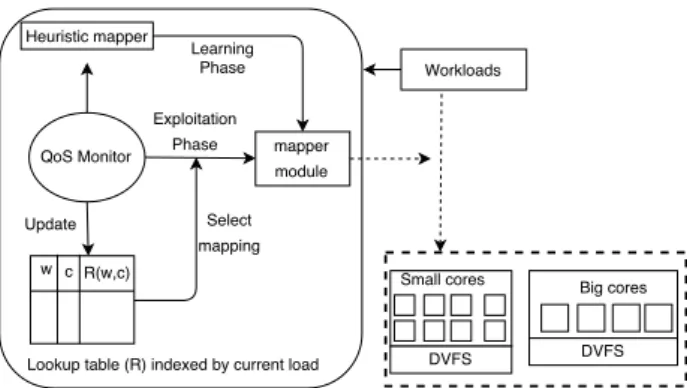
Figure 4 shows a high-level view of Hipster. Hip-ster includes a QoS Monitor, a Learning Phase and an Exploitation Phase. Given a QoS target, an incoming load, and a metric to optimize for, Hipster learns the most adequate core configuration and DVFS settings by managing a lookup table that is used to map the workloads to the available hardware resources.
[QoS Monitor]:The QoS Monitor is responsible for periodically collecting the performance statistics from the critical and batch workloads. For the latency-critical workload, Hipster gathers the appropriate ap-plication-level QoS metrics such as throughput (RPS or QPS) and latency (query tail latency). It also reads the current load on the latency-critical workload and quantizes this value into discrete buckets between 0 and
T−1, for (some) small valueT. HipsterCo uses a
profil-1
The update ofR(wn, cn) is on line 16 of Algorithm1.
Figure 4: High-level view of Hipster runtime system ing tool to measure the throughput of the batch work-loads, using per-core hardware performance counters, such as CPU utilization, cache-misses and instructions per second (IPS).
[Learning and exploitation phases]: The data collected by the QoS monitor is used to make the thread-to-core mapping decisions. In the learning phase, Hip-ster uses a feedback control loop based on heuristics to map the latency-critical workload to resources. Follow-ing the intuition from Section 2, when load is low, the mapper executes the latency-critical workload on small cores at lower DVFS states, and when load is high, it uses a combination of big and small cores at higher DVFS. Hipster also begins populating the lookup ta-ble so that each entry approximates the corresponding total discounted reward. Specifically, Hipster uses the reward mechanism (Section 3.4) to prefer core config-urations that minimize system energy consumption or maximize batch workload throughput, while ensuring as well as possible that at least 95% QoS guarantee is achieved [35].
In the exploitation phase, Hipster uses the lookup table to select the core mapping and DVFS settings, based on the load. It also continues to update the val-ues in the lookup table, in order to continue to improve the mapping decisions. At runtime, Hipster determines when to dynamically switch between the learning and exploitation phases, based on a prefixed time quantum. At deployment stage, we ensure that the bucket size for each workload gives at least 95% QoS guarantee [30] with minimal energy consumption.
3.3
Heuristic Mapper (Learning Phase)
The heuristic mapper is a state machine with a feed-back control loop. The current state identifies the core configuration: the DVFS settings and number and type of cores to use for the latency-critical workload.2 Thechoice of available states depends on the platform; i.e. the total number and types of cores, and the DVFS settings. There is a predefined ordering of the states, approximately from highest to lowest power efficiency. This ordering is determined by measuring the power and performance of each state using a stress
microbench-2State machines and Markov Decision Processes use “state” with different meanings. In Section3.3(only), “state” refers to the core configuration, elsewhere it is the load.
mark consisting of mathematical operations without mem-ory accesses.
Whenever QoS is close to being violated, the state machine transitions into the next-higher power state. The QoS is quantified using the currently measured tail latency at the 95th or 99th percentile, denotedQoScurr.
The target tail latency is denoted by QoStarget. The
state machine transitions to the next-higher state when-ever the time interval ends in the so-calleddanger zone
defined by:
QoScurr> QoStarget×QoSD
where QoSD is a parameter between 0 and 1 that
defines the size of the danger zone. Whether such a state transition improves or degrades performance and whether it actually increases or decreases power de-pends on the characteristics of the platform and the particular workloads. The state machine may have to make several consecutive state transitions until the QoS is met.
In contrast, whenever the QoS is far from being vio-lated, the state machine transitions into the next-lower power state. This happens whenever the time interval ends in the so-calledsafe zonedefined by:
QoScurr< QoStarget×QoSS
whereQoSSis a parameter between 0 andQoSDthat
defines the size of the safe zone. The values ofQoSD
andQoSSare determined to avoid oscillations between
adjacent states. In particular,QoSDis empirically
com-puted in the same way as for Octopus-Man [21,35]. The heuristic proposed by Octopus-Man is attractive because of its simplicity but it can be sub-optimal (see Section2, Figure2c) because there is no common static ordering of configuration states that works for all work-loads. Moreover, in practice, the state machine may respond slowly to rapid changes in load. Nevertheless, we found that such a state machine heuristic is suitable to accelerate the learning phase of the RL algorithm by exploring viable core configurations to quickly populate reasonable values into the lookup table.
3.4
Reward Calculation
During both the learning and exploitation phases, the values in the lookup table are dependent on the reward, which is calculated as defined in Algorithm 1. This reward calculation is invoked after each monitoring interval, and its definition was determined empirically (more details in Section3.6). The reward λn has three
parts: the QoS Reward, Stochastic Reward, and either the Power Reward (for HipsterIn) or the Throughput Reward (for HipsterCo):
[QoS Reward]: The ratio of the measured QoS to the QoS target is known asQoSreward. If this value is
less than one, then the QoS target has been met, and it quantifies how quick the response was as the QoS earliness. In this case, line 7 or 9 applies a positive reward that prefers configurations that approach the QoS target, which acts as a heuristic to reduce energy consumption or improve batch workload throughput. If
QoSreward is greater than one, then the QoS target has
Algorithm 1 Reward mechanism
.Determine rewardλn based on intervaltn. . . tn+1 1 LetQoStargetbe the target QoS of the interactive
work-load.
2 QoScurr=QoSM onitorLatency 3 P ower=QoSM onitorP ower
4 QoSreward=QoScurr/QoStarget
5 P owerreward=T DP/P ower .TDP (thermal design
power)
6 if QoScurr< QoStarget×QoSDthen 7 λn=QoSreward+ 1
8 else if QoScurr< QoStargetthen 9 λn=QoSreward+ 1−Random(0,1) 10 else
11 λn=−QoSreward−1 12 if there exist batch jobsthen 13 λn=λn+ BIPS+SIPS maxIP S(B)+maxIP S(S) 14 else 15 λn=λn+P owerreward 16 R(wn, cn) =R(wn, cn)+ αλn+γmax d∈CR(wn+1, d)−R(wn, cn)
not been met, and it determines how intense the viola-tion was as the QoS tardiness. In this case, line 10 applies a negative QoS reward.
[Stochastic Reward]: When the QoS is below the target, as defined in Section 3.3, but still over the dan-ger zone, then a stochastic penalty is applied (line 9 of Algorithm1). The stochastic penalty offers the possibil-ity to continue to explore the configuration, but with a smaller probability. In future, other external influences for the latency-critical workload like noise, contention on shared resources, pending queue lengths, etc., may cause a QoS violation.
[Power Reward (HipsterIn)]: The ratio of the thermal design power (TDP) to the measured system power consumption is known as P owerreward as shown
in line 15. A smaller value of this term means that the system power consumption was lower, and it increases the reward.
[Throughput Reward (HipsterCo)]: Lines 12 to 13 of Algorithm 1 calculate the Throughput Reward, which is approximately proportional to the total through-put of the batch workloads. Since HipsterCo does not require modifications to the batch workloads, it is only possible to measure their throughput in a generic way using performance counters. Specifically, the through-put is quantified in terms of IPS. The parametersBIPS
and SIPS measure the total IPS of the big and small
clusters running batch workloads, respectively. The de-nominator is constant given by the sum ofmaxIP S(B)
andmaxIP S(S), which measure the maximum IPS, at
highest DVFS, for the big and small cores respectively. More details are given in Section4.1.
Once the rewardλn has been calculated, line 16
up-dates the value of R(wn, cn) in the lookup table, and
this is done in the same way during both the learning and exploitation phases. This update is controlled us-ing two scalar parameters, both between zero and one: the discounting factor,γ, and the learning rate,α.
Algorithm 2Exploitation Phase
1 LetXbe threshold on QoS guarantee to re-enter learn-ing phase
2 Letwnbe observed load for intervaltn−1. . . tn
3 Letcnbe configuration for intervaltn. . . tn+1 4 LetR(w, c) = 0 for allw,c
5 Letn= 0 6 repeat
.At timetn, choose configuration fortntotn+1 7 Letcn=maxd∈CR(wn, d)
8 if there exist batch jobsthen
9 Allocate remaining cores to batch jobs
10 iflatency-critical jobs on a single core typethen 11 Set highest DVFS for other core type 12 else
13 Set lowest DVFS for remaining cores
14 Sleep untiltn+1 .Run for interval tntotn+1 15 Let wn+1 be the quantised load from the
latency-critical workload
16 Call Algorithm1 .Algorithm1updates R(wn, cn)
17 n=n+ 1
18 if QoSGuarantee≤X thenLearning phase 19 untilTerminated
of Algorithm1is the discounting factor, which quanti-fies the preference for short-term rewards [36]. Setting
γ = 0 means that the algorithm only relies on imme-diate short-term rewards. To allow a balance between short-term and future rewards, we setγ = 0.9 (empir-ically determined). In other words, this methodology allows the optimization problem to also take into ac-count future rewards.
[Learning Factor, α]: Theα coefficient in line 16 of Algorithm1is the learning factor, which controls the rate at which the values in the lookup table R(w, c) are updated. A large value ofαclose to one means that the algorithm learns quickly, favoring recent experience, but increasing the susceptibility to noise. In contrast, a small value ofαmeans that the algorithm learns slowly. In our experiments we usedα= 0.6
3.5
Exploitation Phase
The exploitation phase of Hipster is defined by Algo-rithm2. Line 7 determines the configuration,cn, with
the highest estimated total discounted reward. Lines 8 to 13 apply the configuration by mapping the work-loads to the resources, as described below, depending on the specific variant of Hipster (HipsterIn or HipsterCo). Line 14 runs the workload for the next time interval, and line 16 calls Algorithm1 to update the lookup ta-ble, based on the metrics obtained by the QoS Monitor during the time interval. Line 18 re-enters the learning phase when necessary. The mapping of workloads to resources is as follows:
[Reward Mechanism for HipsterIn]: To mini-mize power consumption while meeting the QoS target for latency-critical workloads, the configuration with the highest reward is selected and then DVFS setting for the remaining cores is set to the lowest value (Lines 12 to 13 of Algorithm2).
[Reward Mechanism for HipsterCo]: Corrobo-rating the findings of prior work [16], we observed that collocating both latency-critical and batch workloads degrades QoS at higher loads due to shared resource
contention. If the reward mechanism were not aware of such collocations, it may make decisions that violate QoS for the latency-critical workload and/or reduce the throughput of the batch workloads. As a precursor to this condition, we introduce the following mechanisms. First, to maximize the throughput of the throughput-oriented workloads while meeting QoS targets, all of the remaining cores are allocated to the batch work-loads (lines 8 to 9 in Algorithm2). Second, in case the latency-critical job is allocated exclusively to a given core type, the other core type is set to the highest DVFS to accelerate the batch workloads (lines 10 to 13 in Algo-rithm2). For instance, on a two-socket/cluster system with two cores per socket/cluster, if the latency-critical workload is running on two small cores, the big cores are allocated to the batch workloads at the highest DVFS.
3.6
Responsiveness and Stability
To ensure that QoS is met for latency-critical work-loads, the scheduling policy must quickly respond to fluctuations in load and latency, either due to changes in core mapping, DVFS or any external influence. There-fore, the responsiveness and stability of Hipster is de-termined by (a) the computation latency in migrating cores and setting DVFS. (b) the reaction time of QoS between migrating an application from current mapping to future mapping, and (c) the granularity of monitor-ing for the latency-critical workload’s QoS.
The computational latency for changes in core map-ping and DVFS are negligible [9,37,38]. The default monitoring interval for Memcached and Web-Search is one second. Based on the aforementioned overheads, we determine the sampling interval as a sum of the mon-itoring interval for the latency-critical application, and the overhead to switch the core mapping and DVFS.
3.7
Hipster Implementation
Hipster is implemented in user space, and it uses min-imal hardware support exposed by Linux. It consists of the QoS Monitor and Mapper Module, together with a lookup table, as shown in Figure4.
[QoS Monitor]: Hipster uses a separate process to read the power measurements using native energy me-ters, at the sampling interval of the application. In ad-dition to measuring energy, the QoS Monitor also gath-ers runtime statistics for the query/request latency of the latency-critical workload, using a logfile interface. In the case of HipsterCo, the batch workload aggregate IPS per core are measured using the performance mon-itoring tool, perf [39], specifically using the perf event
instructions[40,41]. Alternatives toperfinclude the pro-filing tools [42] supported by Docker, Kubernetes and LXC [43].
On the ARM Juno platform, there is a known bug that causesperf to generate garbage values for all cores whenever any core enters an idle state. Since perfor-mance statistics are only needed for the HipsterCo vari-ant, we overcome this by disabling CPUidle [40,41]. This prevents Linux from entering the cores in an idle state when changes in the mapping cause idle periods longer than 3500µs.
App Workload Max. Load Target Tail
Configuration latency (ms)
Memcached Twitter caching 36 000 RPS 10 (95%ile)
server of 1.3 GB
Web-Search English Wikipedia 44 QPS|think- 500 (90%ile)
Zipfian distribution time of 2sec [45]
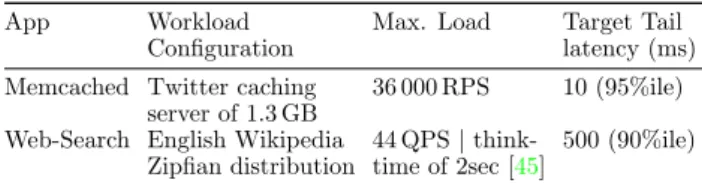
Table 1: Workload configurations, maximum load while meeting the target tail latency with two big cores for latency-critical applications.
cores using the Linux sched setaffinity call and DVFS is controlled using acpi-cpufreq. In addition, Hipster suspends and resumes the batch workloads using the relevant OS signals (SIGSTOPandSIGCONTin Linux).
[Lookup table]: Each iteration of the RL algorithm accesses and modifies several entries in the lookup table. To ensure that these operations take negligible time, the computational complexity to access the table should be at most a few instructions. Therefore, in the prototype implementation of Hipster, the lookup table was im-plemented using a Python dictionary, which uses open addressing to resolve hash collisions, thereby having a computational complexity of O(1) irrespective of the operation [44].
[Runtime overhead]: Hipster has a simple algo-rithm, requiring few control flow statements and main memory accesses, so its runtime overhead is negligi-ble. We measured the execution time overhead (imple-mented in Python and including I/O) to be<2 ms, so triggering Hipster every second, as in our experiments, incurs an overhead<0.2%.
4.
EVALUATION
4.1
Experimental Methodology
[Benchmarks]: We evaluate Hipster using two laten-cy-critical applications,MemcachedandWeb-Search, which have distinct characteristics and impact on shared resources [16]. Memcached[46] is an open source im-plementation of an in-memory key-value store for data caching used in many services from Twitter, Facebook and Google [27,47]. The backend of Web-Search[28, 48] is an instance of Elasticsearch [49], an open source implementation of a search engine used by many com-panies including Netflix and Facebook. The load gen-erator (Faban [45]) for Memcached and Web-Search is adapted from CloudSuite 3.0 [50]. It is configured to model diurnal load changes (Figure1), simulating a pe-riod of 36 hours [22]; each hour in the original workload corresponds to one minute in our experiments. For the batch workloads [51,52], we use the programs from the SPEC CPU 2006 suite [53].
[Tail latency]: For Memcached, we define the tail latency to be the 95th percentile request latency, with a target of 10 ms [15,50]; for Web-Search, we define it to be the 90th percentile query latency, with a target of 500 ms [50]. Table1lists the two latency-critical appli-cations, their configurations, maximum loads, and tar-get tail latency in milliseconds. For each latency-critical workload, the maximum load is chosen so that the
plat-P ower (W atts) P erf.(IP S×106)
Core type (GHz) All cores One core All cores One core
Big A57 (1.15) 2.30 1.62 4,260 2,138
Small A53 (0.65) 1.43 0.95 3,298 826
Table 2: Power and performance characterization on Juno platform.
form is able to meet the tail latency when running on the big cores at maximum DVFS.
[Hardware resources]: We perform the evaluation experiments on an ARM Juno R1 developer board [54] with Linux (kernel 4.3). The Juno board is a 64-bit ARMv8 big.LITTLE architecture with two high-per-formance out-of-order Cortex-A57 (big) cores and four low-power in-order Cortex-A53 (small) cores. The cores are integrated on a single chip with off-chip 8 GB DRAM. The two big cores form a cluster with a shared 2 MB L2 cache, and the four small cores form another cluster with a shared 1 MB L2 cache. The big cores are ca-pable of DVFS from 0.6 GHz up to 1.15 GHz, whereas the small cores are fixed at 0.65 GHz. A cache coher-ent interconnect (CoreLink CCI-400) provides full cache coherency among the heterogeneous cores, allowing a shared memory application to run on both clusters si-multaneously. The workload generator runs on another machine: an AppliedMicro X-Gene2 64-bit ARMv8-A [55] with eight cores at 2.4 GHz and 128 GB DRAM.
[Power efficiency]: The power consumption of the Juno platform is obtained by reading specific hardware registers [56]. These registers report separately the power consumed by the big cluster, small cluster, and the rest of the system (Juno’ssys register [57]). The power con-sumption of the Mali GPU is also available, but it is negligible because the GPU is disabled in all our exper-iments. Performance is quantified using the IPS mea-sured by hardware performance counters.
Table2summarizes the power and performance char-acteristics of the big cluster (2 cores) and the small clus-ter (4 cores). We characclus-terize the heclus-terogeneous plat-form by running a compute-intensive microbenchmark (same as used in Section 3.3) consisting of mathemat-ical operations without memory accesses. We report the system power consumption as the sum of the big and small clusters and the rest of the system (including memory controllers, etc). For the per-cluster compari-son, we run the microbenchmark on all the cores in the cluster (two big cores vs four small cores). For a per-core comparison, we run the microbenchmark either on a single big core or on a single small core.
Considering system power, a single big core is 52% more power-efficient than a single small core, in terms of IPS per watt (Table2). However, taking into account all cores in a cluster, and assuming that all cores can be fully utilized, a small cluster is 25% more power-efficient than a big cluster. This discrepancy is due to the rest of the system, outside the core clusters, which consumes about the same power as a big core at full utilization (0.76 W). If we subtract the power of the rest of the system, a single small core is 2.3× more power-efficient than a big core. We notice that small
0 10 20 30 95 %i le lat . (m
s) LATENCY Danger zone Safe zone Target
0 20000 40000 RP S 0.6 0.65 0.9 1.15 DV FS (G Hz ) Big Core Small Core 0 200 400 600 800 1000 1200 1400 Time (S) 0B1S 0B2S 0B3S 0B4S 1B3S 2B2S 2B0S Co res
Static mapping (all big cores)
M
EM
CA
CHE
D
(a) Static mapping (all big cores)
LATENCY Danger zone Safe zone Target
Big Core Small Core 0 500 1000 1500 Time (S) Octopus-Man (b) Octopus-Man 0 10 20 30 95 %i le lat . (m s)
LATENCY Danger zone Safe zone Target
0 20000 40000 RP S 0.6 0.65 0.9 1.15 DV FS (G Hz ) Big Core Small Core 0 200 400 600 800 1000 1200 1400 Time (S) 0B1S 0B2S 0B3S 0B4S 1B3S 2B2S 2B0S Co res
Hipster’s heuristic mapper
(c) Hipster’s heuristic mapper
0.0 0.5 1.0 90 %i le lat . (m
s) LATENCY Danger zone Safe zone Target
0 20 40 QPS 0.6 0.65 0.9 1.15 DV FS (G Hz ) Big Core Small Core 0 200 400 600 800 1000 Time (S) 0B1S 0B2S 0B3S 0B4S 1B3S 2B2S 2B0S Co res W eb -S ear ch
(d) Static mapping (all big cores)
LATENCY Danger zone Safe zone Target
Big Core Small Core 0 200 400 600 800 1000 Time (S) (e) Octopus-Man 0.0 0.5 1.0 90 %i le lat . (m s)
LATENCY Danger zone Safe zone Target
0 20 40 QPS 0.6 0.65 0.9 1.15 DV FS (G Hz ) Big Core Small Core 0 200 400 600 800 1000 Time (S) 0B1S 0B2S 0B3S 0B4S 1B3S 2B2S 2B0S Co res
(f) Hipster’s heuristic mapper Figure 5: Comparison of Hipster’s heuristic policy (right-hand column) with static mapping (left) and Octopus-Man (centre). Results are shown for Memcached (top) and Web-Search (bottom) on ARM Juno R1.
cores are attractive for throughput-oriented workloads, because of improved power efficiency. Big cores are, however, still needed for latency-critical workloads with tight QoS constraints, as a result of computationally-intensive single-threaded requests.
[Algorithm configuration]:In deploying Octopus-Man, we first performed a sweep on the danger and safe thresholds, and picked the combination of thresholds with the highest QoS guarantee. For HipsterIn, we set the learning phase to be 500 seconds, except when quan-tifying the learning time, where we set it to 200 seconds.
4.2
HipsterIn Results
This section evaluates the effectiveness of HipsterIn, as a policy for managing a single interactive workload. The objective is to minimize system energy consump-tion while satisfying QoS.
4.2.1
Hipster’s Heuristic Policy (interactive only)
We first evaluate the effectiveness of Hipster’s heuris-tic policy alone, for mapping interactive workloads. Fig-ure5shows the results for both workloads: Memcached (top row, subfigures (a), (b) and (c)) and Web-search (bottom row, subfigures (d), (e) and (f)). The columns, from left to right, correspond to static mapping, for which the interactive threads are mapped to the two
big cores at highest DVFS of 1.15 GHz ((a) and (d)), Octopus-Man ((b) and (e)) and Hipster’s heuristic pol-icy ((c) and (f)). For each subfigure, from top to bot-tom, the first plot presents the tail latency (QoS), with the target marked with a dashed line. The second plot shows the achieved throughput in RPS (requests per second). The third plot presents the DVFS of the big and small cores, and the fourth plot represents the choice of core mapping.
Comparing the DVFS and core configuration sub-plots, we observe that Hipster’s heuristic policy is suc-cessfully exploring the DVFS settings available on the Juno platform (third plots), and it is exploring all con-figurations including those that use both big and small cores at the same time (bottom plots). In contrast, Octopus-Man does not adjust the DVFS settings and it uses either the big or small cores, but not both at once. Both Octopus-Man and Hipster’s heuristic policy fre-quently oscillate between consecutive core configura-tions. In the case of Octopus-Man, there are clear oscil-lations between two big cores and four small cores, for example between the 600th and 800th seconds. Using
two big cores satisfies QoS but since it is within the safe zone, Octopus-Man switches to four small cores, which enters the danger zone, generating an alert provoking a return to two big cores. Such oscillations between cores
0 10 20 30 95 %i le lat . (m
s) LATENCY Danger zone Safe zone Target
0 20000 40000 RP S 0.6 0.65 0.9 1.15 DV FS (G Hz ) Big Core Small Core 0 200 400 600 800 1000 1200 1400 Time (S) 0B1S 0B2S 0B3S 0B4S 1B3S 2B2S 2B0S Co res
Figure 6: HipsterIn on Memcached
0.0 0.5 1.0 90 % ile la t. ( s
) LATENCY Danger zone Safe zone Target
0 20 40 QPS 0.6 0.65 0.9 1.15 DV FS (G Hz ) Big Core Small Core 0 200 400 600 800 1000 Time (S) 0B1S 0B2S 0B3S 0B4S 1B3S 2B2S 2B0S Co res
Figure 7: HipsterIn on Web-Search
20 40 60 80 100 Pe rce nta ge of M ax . lo ad 0 20 40 60 80 100 120 140 160 180 Time (s) 0 1 2 3 4 5 6 Qo S T ard ine ss
Octopus-Man HipsterIn Target Figure 8: Percentage of Max. load, and Tail latency (QoS Tar-diness) running Memcached with HipsterIn and Octopus-Man. QoS Guarantee QoS T ardiness Energy Reduction M emcached W eb−Search M emcached W eb−Search M emcached W eb−Search
Static (all big cores) 99.5% 99.5% 1.1 1.3 -
-Static (all small cores) 85.8% 78.4% 1.4 2.0 48.0% 31.0%
Hipster0s Heuristic 89.9% 95.3% 1.8 1.9 18.7% 13.6%
OctopusM an 92.0% 80.0% 2.2 2.1 17.2% 4.3%
HipsterIn 99.4% 96.5% 1.4 2.0 14.3% 17.8%
Table 3: HipsterIn: summary of QoS guarantees, tardiness and energy savings for Memcached and Web-Search. in different clusters leads to severe QoS degradation of
up to 20%. As expected, the static mapping (all big cores) has the least number of violations.
In summary, although Hipster’s heuristic policy alone improves over Octopus-Man by exploiting a wider search space, it still suffers from an unacceptable number of QoS violations.
4.2.2
HipsterIn: Memcached Results
Figure6 shows the results using HipsterIn for Mem-cached. After completing the learning phase, the oscil-latory effect between core mappings is greatly reduced (by 8.3%), and overall the QoS guarantee is improved by 24% compared with the learning phase. HipsterIn per-forms well because it moves directly to the appropriate core configuration for a given load that satisfies QoS. In addition to switching between a combination of different cores, HipsterIn also explores more fine-grained DVFS adaptations, which has lower overheads (of microsec-onds) compared with migrations between cores (order of milliseconds) [17].
4.2.3
HipsterIn: Web-Search Results
Figure7 shows the results using HipsterIn for Web-Search. In contrast to the heuristic policies (Octopus-Man and Hipster’s heuristic), during the exploitation phase, HipsterIn monitors the QoS and dynamically ad-justs the core mapping and DVFS settings to adapt to load fluctuations. Both Hipster’s heuristic and Octopus-Man perform aggressive changes to core mappings to reduce energy, leading to a negative impact on QoS. On the other hand, HipsterIn shows a more balanced behavior, performing 4.7×fewer task migrations than
Octopus-Man for Web-Search, while improving QoS up to 16% and reducing energy consumption by 13.5%.
4.2.4
HipsterIn Summary
Table 3 summarizes the QoS guarantee, QoS tardi-ness and energy reduction for Memcached and Web-Search for different policies: Static (all big cores), Static (all small cores), Hipster’s heuristic mapper, Octopus-Man and HipsterIn. We compare the energy consump-tion of each mapping schema against Static (all big cores). We quantify the QoS behavior at each sam-pling interval by assessing the measured QoS using two metrics: QoS guarantee and QoS tardiness.3 The QoS
Guarantee is the percentage of samples for which the measured QoS did not violate the target (100%-QoS violations%). The QoS tardiness in the table is the av-erage (mean) of the QoS tardiness, including only the samples that violated the QoS target.
As shown in Table3, for Web-Search and Memcached, static (all small cores) cannot meet the required QoS. On the one hand, the heuristic policies reduce energy marginally, but violate QoS due to excessive core migra-tions. On the other hand, HipsterIn meets QoS at 99.4% and 96.4% for Memcached and Web-Search, while hav-ing energy savhav-ings of 14.3% and 17.8%, respectively.
4.2.5
HipsterIn Analysis
[Rapid adaptation to load changes]: Hipster can respond to rapid changes in load by directly mapping to a configuration that satisfies the QoS. Figure8shows
3QoS Tardiness is QoS
curr/QoStarget, using the definitions from Section3.4.
0 1 2 3 4 5 6 7 8 9 10 11 12 13 14 70 80 90 100 Q oS G ua ra nt ee s HipsterIn Octopus-Man
Figure 9: QoS Guarantees of HipsterIn and Octopus-Man. Each data point represents the QoS guarantees over 100 s intervals.
how HipsterIn (during the exploitation phase) and Octo-pus-Man respond to changes in load. From top to bot-tom, we express the input load in terms of the percent-age of maximum load, where it increases from 50% to 100% over a period of 175 seconds for Memcached. In the second graph, we express the 95thpercentile tail
la-tency as QoS Tardiness. A QoS violation has occurred if the QoS Tardiness is above 1, otherwise QoS is sat-isfied. We find that Octopus-Man violates QoS due to aggressive core mappings to minimize energy consump-tion. By contrast, HipsterIn achieves more stable tail latency even at higher load (80%). Note that, from 75% to 90% of the load, the QoS tardiness (extent of vio-lation) experienced by HipsterIn is 3.7×(mean) lower than Octopus-Man.
[Impact of learning time:] HipsterIn aims to de-liver the best balance between QoS guarantee and en-ergy reduction compared to heuristic policies (Table3). In practice, to best optimize for energy efficiency, and to improve QoS, HipsterIn needs a short learning phase. Figure9 shows the QoS guarantee and energy distribu-tion over 100 s intervals for Web-Search, for both Hip-sterIn and Octopus-Man. Each data point in the graph refers to a 100-second interval. The learning phase is set to 200 s. As can be seen, HipsterIn quickly learns during the heuristic phase, which improves QoS guar-antees. On the other hand, for Octopus-Man, the QoS guarantees are consistently around the 80% mark, since it does not use past decisions and their associated effects to improve the future decisions.
[Impact of bucket sizes]: Figure 10 shows the impact on QoS and energy savings when varying the load bucket sizes in Hipster. Thex-axis represents the bucket size, expressed as the percentage of maximum load. Each bar in the figure (y-axis) represents the QoS violations and energy reductions normalized to Static (all big cores). Using a large bucket size forces Hipster to use the same core configuration across a wide range of loads, whereas using a small bucket size allows fine-grained control. A small bucket size therefore improves the energy savings, but it tends to cause rapid changes in core configuration for small changes in load, and do-ing so incurs a larger number of QoS violations. On the other hand, larger bucket sizes provide better QoS guarantee but lower energy savings, because they cate-gorize large variations in load into a single load bucket. Therefore, in tuning Hipster, we empirically determine the bucket size to maximize energy savings subject to at least 98% QoS guarantee.
3% 6% 9% 2% 3% 4% 0 10 20 30 % Re du cti
on
QoS Violations
Energy reduction
Web-Search Memcached
Figure 10: Impact of bucket size on HipsterIn QoS guar-antees, and energy savings, normalized to static (all big cores) on Web-Search and Memcached.
4.3
HipsterCo Results
This section evaluates the effectiveness of HipsterCo, as a policy for collocating a single latency-critical work-load and a mix of batch workwork-loads. The objective is to maximize the throughput of the batch workloads while satisfying QoS of the interactive workloads.
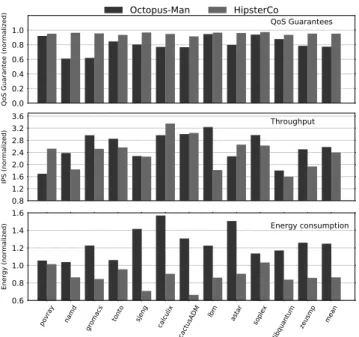
Figure11shows the QoS guarantee (top), throughput (middle) and energy consumption (bottom) for Web-Search collocated with batch workloads, managed by Octopus-Man and HipsterCo. All figures are normalized to a static mapping that allocates the latency-critical workload to the two big cores and the batch workloads to the four small cores. The number of running batch workloads is equal to the number of cores not utilized by Web-Search. We report the system throughput by aggregating the IPS of all batch programs.
As shown in the top plot of Figure11, HipsterCo con-sistently delivers 94% QoS guarantees, whereas Octo-pus-Man has much lower QoS guarantees of 76%. This is because Hipster learns from the QoS behavior and performance history and is able to jump directly to a core mapping and DVFS state that satisfies QoS. As a result, it incurs fewer core migrations compared with Octopus-Man (see Section4.2.3), so it achieves superior QoS guarantees.
As shown in the middle plot of Figure 11, for all benchmarks, Hipster and Octopus-Man deliver much higher throughput compared to static mapping, with an average of 2.3×and 2.6×improvement, respectively. Both task managers improve performance compared with the static mapping because they migrate the latency-critical workload to small cores during periods of low load, allowing the batch workloads to run on big cores (which can be 2.6× more powerful than small cores). For Calculix, a compute-bound application, HipsterCo achieves the highest throughput improvement over static of 3.35×, and for libquantum, a memory-bound pro-gram, the least improvement is still 1.6×.
As shown in the bottom plot of Figure11, HipsterCo reduces the energy consumption to an average of 80% of static, whereas Octopus-Man increases energy to an average of 1.2 times that of static. This is because, as shown in Figure 2, Hipster explores a wider range of core configurations, including DVFS settings and mix-ing core types. In contrast, Octopus-Man only allows the latency-critical workload to occupy a single cluster and each cluster is set to the highest DVFS.
0.0 0.2 0.4 0.6 0.8 1.0 Qo S G ua ran tee (n orm ali ze
d) Octopus-Man HipsterCoQoS Guarantees
0.8 1.2 1.6 2.0 2.4 2.8 3.2 3.6 IPS (n orm ali ze d) Throughput povra y namd groma cs
tonto sjeng calculix cactusA DM lbm astar soplex libqua ntum zeusmp mean 0.6 0.8 1.0 1.2 1.4 1.6 En erg y ( no rm ali ze d) Energy consumption
Figure 11: QoS guarantee (top), Throughput improve-ment (middle) and Energy consumption (bottom) when Web-Search is collocated with batch workloads. The re-sults are normalized to static all big cores.
energy tradeoff than Octopus-Man. An example islbm, a memory bound workload, for which HipsterCo delivers 40% the throughput of Octopus-Man, but 31% lower en-ergy. There are two main reasons for this. Firstly, when HipsterCo uses DVFS for the latency-critical workloads, this DVFS setting also applies to batch workloads run-ning in the same cluster, reducing both batch through-put and system energy. Secondly, HipsterCo sometimes uses a larger number of cores at lower DVFS, leaving fewer resources available for the batch workloads. As a result, on average, HipsterCo marginally reduces per-formance (by 7%) but it delivers energy savings of 33%, both compared with Octopus-Man.
5.
RELATED WORK
Bubble-flux and Bubble-Up [58,59] detect at run-time the memory pressure and find the optimal colloca-tion to avoid negative interference with latency-critical workloads. They also have a mechanism to detect neg-ative interference allocations via execution modulation. However such fall-back mechanism would not adhere to applications like Memcached, as modulations have to be done at a finer granularity. DeepDive [60] identifies and manages performance interference between VM systems collocated on the same system. Q-Clouds [61] develop a feedback based mechanism to tune resource assignment to avoid negative interference to collocated VMs sys-tems. CPI2 [62] enables race-to-finish for low-priority workloads to not have a deadlock with high priority ser-vices.
Octopus-Man [21] was designed for big.LITTLE ar-chitectures to map workloads on big and small cores at highest DVFS using a feedback controller in response
to changes in measured latency. Heracles [16] uses a feedback controller that exploits collocation of latency-critical and batch workloads while increasing the re-source efficiency of CPU, memory and network as long as QoS target is met. However, this work is limited to modern Intel architectures due to its extensive use of cache allocation technology (CAT) and DRAM band-width monitor, which are available from Broadwell pro-cessors released after 2015. Pegasus [15] achieves high CPU energy proportionality for low latency workloads using fine-grained DVFS techniques. TimeTrader [29] and Rubik [17] exploit request queuing latency varia-tion and apply any available slack from queuing delay to throughput-oriented workloads to improve energy ef-ficiency. Quasar [63] use runtime classification to pre-dict interference and collocate workloads to minimize interference.
KnightShift [8] introduces a server architecture that couples commercial available compute nodes to adapt the changes in system load and improve energy pro-portionality. Autoscale [64] is for load-balancing a sin-gle workload, whereas Hipster could be used for multi-tenant data centers (different workloads on different nodes). Also, Autoscale cannot exploit heterogeneity properly. In contrast, at low utilization, Hipster can use the small cores for the latency-critical workloads and leave the big cores for batch workloads.
Tesauro et al [32] use anoffline modelbased on heuris-tics for autonomous resource allocation, which may be limited to specific architectures or applications. Build-ing a lookup table at runtime is important because ap-plications have diverse power and performance charac-teristics which need to be learnt individually (as shown in Section2).
6.
CONCLUSION
We propose Hipster, a hybrid scheme that combines heuristics and reinforcement learning to manage hetero-geneous cores with DVFS control for improved energy efficiency. We show that Hipster performs well across workloads and interactively adapts the system by learn-ing from the QoS/power/performance history to best map workloads to the heterogeneous cores and adjust their DVFS settings. When only latency-critical work-loads are running in the system, Hipster reduces energy consumption by 13% in comparison to prior work. In addition, to improve resource efficiency in shared data centers by running both latency-critical and batch loads on the same system, Hipster improves batch work-load throughput by 2.3×compared to a static and con-servative policy, while meeting the QoS targets for the latency-critical workloads.
Acknowledgment — This work has been partially supported by the European Union FP7 program through the Mont-Blanc-2 project (FP7-ICT-610402), by the Ministerio de Economia y Competitividad under con-tract Computaci´on de Altas Prestaciones VII (TIN2015-65316-P), and the Departament de Innovaci´o, Univer-sitats i Empresa de la Generalitat de Catalunya, under project MPEXPAR: Models de Programaci´o i Entorns d Execuci´o Paral·lels (2014-SGR-1051).
7.
REFERENCES
[1] P. Delforge and J. Whitney, “Data Center Efficiency
Assessment,”Natural Resources Defense Council (NRDC),
2014.
[2] Q. Wu, Q. Deng, L. Ganesh, C.-H. Hsu, Y. Jin, S. Kumar, B. Li, J. Meza, and Y. J. Song, “Dynamo: Facebook’s Data
Center-Wide Power Management System,”2016
ACM/IEEE 43st International Symposium on Computer Architecture (ISCA), 2016.
[3] “Facebook is opening a new wind-powered data center in Texas, http://goo.gl/dKVnSB.”
[4] J. Mars, L. Tang, and R. Hundt, “Heterogeneity in ’Homogeneous’ Warehouse-Scale Computers: A
Performance Opportunity,”IEEE Computer Architecture
Letters, vol. 10, pp. 29–32, 2 2011.
[5] N. Chitlur, G. Srinivasa, S. Hahn, P. K. Gupta, D. Reddy, D. Koufaty, P. Brett, A. Prabhakaran, L. Zhao, N. Ijih, S. Subhaschandra, S. Grover, X. Jiang, and R. Iyer, “QuickIA: Exploring heterogeneous architectures on real
prototypes,” inIEEE International Symposium on
High-Performance Comp Architecture, pp. 1–8, IEEE, 2 2012.
[6] M. Halpern, Y. Zhu, and V. J. Reddi, “Mobile CPU’s rise to power: Quantifying the impact of generational mobile CPU design trends on performance, energy, and user satisfaction,” in2016 IEEE International Symposium on High Performance Computer Architecture (HPCA), pp. 64–76, IEEE, 3 2016.
[7] M. Guevara, B. Lubin, and B. C. Lee, “Navigating
heterogeneous processors with market mechanisms,” in2013
IEEE 19th International Symposium on High Performance Computer Architecture (HPCA), pp. 95–106, IEEE, 2 2013. [8] D. Wong and M. Annavaram, “KnightShift: Scaling the
Energy Proportionality Wall through Server-Level
Heterogeneity,” in2012 45th Annual IEEE/ACM
International Symposium on Microarchitecture, pp. 119–130, IEEE, 12 2012.
[9] J. Cong and B. Yuan, “Energy-efficient scheduling on heterogeneous multi-core architectures,” inProceedings of the 2012 ACM/IEEE international symposium on Low power electronics and design - ISLPED ’12, (New York, New York, USA), p. 345, ACM Press, 7 2012.
[10] R. Nishtala, D. Mosse, and V. Petrucci, “Energy-aware thread co-location in heterogeneous multicore processors,” in2013 Proceedings of the International Conference on Embedded Software (EMSOFT), pp. 1–9, IEEE, 9 2013. [11] W. Wonyoung Kim, M. S. Gupta, G.-Y. Wei, and
D. Brooks, “System level analysis of fast, per-core DVFS using on-chip switching regulators,” in2008 IEEE 14th International Symposium on High Performance Computer Architecture, pp. 123–134, IEEE, 2 2008.
[12] W. Godycki, C. Torng, I. Bukreyev, A. Apsel, and C. Batten, “Enabling Realistic Fine-Grain Voltage Scaling with Reconfigurable Power Distribution Networks,” in2014 47th Annual IEEE/ACM International Symposium on Microarchitecture, pp. 381–393, IEEE, 12 2014. [13] A. Putnam, A. M. Caulfield, E. S. Chung, D. Chiou,
K. Constantinides, J. Demme, H. Esmaeilzadeh, J. Fowers, G. P. Gopal, J. Gray, M. Haselman, S. Hauck, S. Heil, A. Hormati, J.-Y. Kim, S. Lanka, J. Larus, E. Peterson, S. Pope, A. Smith, J. Thong, P. Y. Xiao, and D. Burger, “A reconfigurable fabric for accelerating large-scale datacenter
services,” in2014 ACM/IEEE 41st International
Symposium on Computer Architecture (ISCA), pp. 13–24, IEEE, 6 2014.
[14] D. Lo and C. Kozyrakis, “Dynamic management of
TurboMode in modern multi-core chips,” in2014 IEEE
20th International Symposium on High Performance Computer Architecture (HPCA), pp. 603–613, IEEE, 2 2014.
[15] D. Lo, L. Cheng, R. Govindaraju, L. A. Barroso, and C. Kozyrakis, “Towards energy proportionality for
large-scale latency-critical workloads,”ACM SIGARCH
Computer Architecture News, vol. 42, pp. 301–312, 10 2014. [16] D. Lo, L. Cheng, R. Govindaraju, P. Ranganathan, and
C. Kozyrakis, “Heracles,”ACM SIGARCH Computer
Architecture News, vol. 43, pp. 450–462, 6 2015.
[17] H. Kasture, D. B. Bartolini, N. Beckmann, and D. Sanchez, “Rubik,” inProceedings of the 48th International
Symposium on Microarchitecture - MICRO-48, (New York, New York, USA), pp. 598–610, ACM Press, 12 2015. [18] L. A. Barroso, J. Clidaras, and U. H¨olzle, “The Datacenter
as a Computer: An Introduction to the Design of Warehouse-Scale Machines, Second edition,”Synthesis Lectures on Computer Architecture, vol. 8, pp. 1–154, 7 2013.
[19] S. Eric and B. Jake, “The User and Business Impact of Server Delays, Additional Bytes, and HTTP Chunking in Web Search,”Velocity, 2009.
[20] J. Dean and L. A. Barroso, “The tail at scale,” Communications of the ACM, vol. 56, p. 74, 2 2013. [21] V. Petrucci, M. A. Laurenzano, J. Doherty, Y. Zhang,
D. Mosse, J. Mars, and L. Tang, “Octopus-Man:
QoS-driven task management for heterogeneous multicores
in warehouse-scale computers,” in2015 IEEE 21st
International Symposium on High Performance Computer Architecture (HPCA), pp. 246–258, IEEE, 2 2015.
[22] D. Meisner, C. M. Sadler, L. A. Barroso, W.-D. Weber, and T. F. Wenisch, “Power management of online data-intensive services,” inProceeding of the 38th annual international symposium on Computer architecture - ISCA ’11, vol. 39, (New York, New York, USA), p. 319, ACM Press, 6 2011. [23] Y. Li, D. Wang, S. Ghose, J. Liu, S. Govindan, S. James, E. Peterson, J. Siegler, R. Ausavarungnirun, and O. Mutlu, “SizeCap: Efficiently handling power surges in fuel cell
powered data centers,” in2016 IEEE International Symposium on High Performance Computer Architecture (HPCA), pp. 444–456, IEEE, 3 2016.
[24] C. Delimitrou and C. Kozyrakis, “Paragon: QoS-aware
scheduling for heterogeneous datacenters,”ACM SIGARCH
Computer Architecture News, vol. 41, pp. 77–77, 3 2013. [25] U. Hoelzle and L. A. Barroso,The Datacenter as a
Computer: An Introduction to the Design of Warehouse-Scale Machines. Morgan and Claypool Publishers, 2009.
[26] O. Bilgir, M. Martonosi, and Q. Wu, “Exploring the Potential of CMP Core Count Management on Data Center Energy Savings,” in3rd Workshop on Energy Efficient Design (WEED), 2011.
[27] B. Atikoglu, Y. Xu, E. Frachtenberg, S. Jiang, and M. Paleczny, “Workload analysis of a large-scale key-value store,” inProceedings of the 12th ACM
SIGMETRICS/PERFORMANCE joint international conference on Measurement and Modeling of Computer Systems - SIGMETRICS ’12, vol. 40, (New York, New York, USA), p. 53, ACM Press, 2012.
[28] V. Janapa Reddi, B. C. Lee, T. Chilimbi, and K. Vaid, “Web search using mobile cores,” inProceedings of the 37th
annual international symposium on Computer architecture - ISCA ’10, vol. 38, (New York, New York, USA), p. 314, ACM Press, 6 2010.
[29] B. Vamanan, H. B. Sohail, J. Hasan, and T. N.
Vijaykumar, “TimeTrader: Exploiting Latency Tail to Save Datacenter Energy for Online Search,” in44th Annual IEEE/ACM International Symposium on Microarchitecture - MICRO-48, (Waikiki, Hawaii), ACM Press, 2015, 2015. [30] J. Li, N. K. Sharma, D. R. K. Ports, and S. D. Gribble,
“Tales of the Tail,” inProceedings of the ACM Symposium on Cloud Computing - SOCC ’14, (New York, New York, USA), pp. 1–14, ACM Press, 2014.
[31] V. Mnih, K. Kavukcuoglu, D. Silver, A. A. Rusu, J. Veness, M. G. Bellemare, A. Graves, M. Riedmiller, A. K.
Fidjeland, G. Ostrovski, S. Petersen, C. Beattie, A. Sadik, I. Antonoglou, H. King, D. Kumaran, D. Wierstra, S. Legg, and D. Hassabis, “Human-level control through deep
reinforcement learning,”Nature, vol. 518, pp. 529–533, 2 2015.
[32] G. Tesauro, N. Jong, R. Das, and M. Bennani, “A Hybrid Reinforcement Learning Approach to Autonomic Resource Allocation,” in2006 IEEE International Conference on Autonomic Computing, pp. 65–73, IEEE.
[33] “IBM Research|Technical Paper Search|Model-Based and
Model-Free Approaches to Autonomic Resource Allocation(Search Reports),” 2 2007.
[34] G. Tesauro, “Online Resource Allocation Using
Decompositional Reinforcement Learning.,” inProceedings, The Twentieth National Conference on Artificial
Intelligence and the Seventeenth Innovative Applications of Artificial Intelligence Conference, July 9-13, 2005, Pittsburgh, Pennsylvania, USA, pp. 886–891, 1 2005. [35] T. Horvath, T. Abdelzaher, K. Skadron, and X. Liu,
“Dynamic Voltage Scaling in Multitier Web Servers with
End-to-End Delay Control,”IEEE Transactions on
Computers, vol. 56, pp. 444–458, 4 2007.
[36] Suton. R.S and A. Barto,Reinforcement Learning: An
Introduction. Cambridge, MA: MIT Press, 1998. [37] J. Leverich, M. Monchiero, V. Talwar, P. Ranganathan,
and C. Kozyrakis, “Power Management of Datacenter
Workloads Using Per-Core Power Gating,”IEEE Computer
Architecture Letters, vol. 8, pp. 48–51, 2 2009. [38] N. Madan, A. Buyuktosunoglu, P. Bose, and
M. Annavaram, “A case for guarded power gating for multi-core processors,” in2011 IEEE 17th International Symposium on High Performance Computer Architecture, pp. 291–300, IEEE, 2 2011.
[39] “Perf: Linux profiling with performance counters,https://perf.wiki.kernel.org/.”
[40] ARM Limited, “ARMR CortexR -A53 MPCore
Processor Technical Reference Manual.”
[41] ARM Limited, “ARMR CortexR -A57 MPCore
Processor Revision: r1p0 Technical Reference Manual.” [42] G. Ren, E. Tune, T. Moseley, Y. Shi, S. Rus, and
R. Hundt, “Google-Wide Profiling: A Continuous Profiling Infrastructure for Data Centers,”IEEE Micro, vol. 30, pp. 65–79, 7 2010.
[43] D. Bernstein, “Containers and Cloud: From LXC to Docker to Kubernetes,”IEEE Cloud Computing, vol. 1, pp. 81–84, 9 2014.
[44] R. Pattis, “Complexity of Python Operations, https://www.ics.uci.edu/˜pattis/ICS-33/lectures/complexitypython.txt.” [45] “Faban,http://faban.org/.”
[46] “Memcached, https://memcached.org/.”
[47] R. Nishtala, H. Fugal, S. Grimm, M. Kwiatkowski, H. Lee, H. C. Li, R. McElroy, M. Paleczny, D. Peek, P. Saab, D. Stafford, T. Tung, and V. Venkataramani, “Scaling Memcache at Facebook,” inProceedings of the 10th USENIX conference on Networked Systems Design and Implementation, pp. 385–398, USENIX Association, 2013. [48] L. Barroso, J. Dean, and U. Holzle, “Web search for a
planet: the google cluster architecture,” inIEEE Micro, vol. 23, pp. 22–28, IEEE, 3 2003.
[49] “Elasticsearch,https://github.com/elastic/elasticsearch.” [50] M. Ferdman, B. Falsafi, A. Adileh, O. Kocberber, S. Volos,
M. Alisafaee, D. Jevdjic, C. Kaynak, A. D. Popescu, and
A. Ailamaki, “Clearing the clouds,”ACM SIGARCH
Computer Architecture News, vol. 40, p. 37, 4 2012.
[51] J. Mars and L. Tang, “Whare-map,”ACM SIGARCH
Computer Architecture News, vol. 41, p. 619, 7 2013. [52] H. Yang, A. Breslow, J. Mars, and L. Tang, “Bubble-flux,”
ACM SIGARCH Computer Architecture News, vol. 41, p. 607, 7 2013.
[53] J. L. Henning, “SPEC CPU2006 benchmark descriptions,” ACM SIGARCH Computer Architecture News, vol. 34,
pp. 1–17, 9 2006.
[54] “ARM Juno R1,https://goo.gl/EcamOa.” [55] “Applied Micro XGene2,http://goo.gl/XA04r1.” [56] “ARM Juno Power
Registers,https://github.com/ARM-software/devlib/blob/master/src/readenergy/readenergy.c.” [57] ARM, “SYS POW SYS Register, https://goo.gl/fmTTQi.” [58] H. Yang, A. Breslow, J. Mars, and L. Tang, “Bubble-flux:
precise online QoS management for increased utilization in warehouse scale computers,” inProceedings of the 40th Annual International Symposium on Computer Architecture - ISCA ’13, vol. 41, (New York, New York, USA), p. 607, ACM Press, 2013.
[59] J. Mars, L. Tang, R. Hundt, K. Skadron, and M. L. Soffa, “Bubble-Up: Increasing Utilization in Modern Warehouse
Scale Computers via Sensible Co-locations,” inProceedings of the 44th Annual IEEE/ACM International Symposium on Microarchitecture - MICRO-44 ’11, (New York, New York, USA), p. 248, ACM Press, 2011.
[60] D. Novakovi´c, N. Vasi´c, S. Novakovi´c, D. Kosti´c, and R. Bianchini, “DeepDive: transparently identifying and managing performance interference in virtualized
environments,” inProceedings of the 2013 USENIX
conference on Annual Technical Conference, pp. 219–230, USENIX Association, 2013.
[61] R. Nathuji, A. Kansal, and A. Ghaffarkhah, “Q-clouds,” in Proceedings of the 5th European conference on Computer systems - EuroSys ’10, (New York, New York, USA), p. 237, ACM Press, 4 2010.
[62] X. Zhang, E. Tune, R. Hagmann, R. Jnagal, V. Gokhale, and J. Wilkes, “CPI 2,” inProceedings of the 8th ACM European Conference on Computer Systems - EuroSys ’13, (New York, New York, USA), p. 379, ACM Press, 4 2013. [63] C. Delimitrou and C. Kozyrakis, “Quasar: resource-efficient
and QoS-aware cluster management,”ACM SIGARCH
Computer Architecture News, vol. 42, pp. 127–127, 4 2014. [64] Qiang Wu, “Making Facebook’s software infrastructure
more energy efficient with Autoscale, https://goo.gl/vJi1kf.”
![Figure 1: Power drawn for a diurnal load [15, 22, 25] for Web-Search running on two big cores of the ARM Juno R1 (64-bit big.LITTLE) platform.](https://thumb-us.123doks.com/thumbv2/123dok_us/10226139.2926460/2.892.78.455.83.219/figure-power-drawn-diurnal-search-running-little-platform.webp)
![Figure 2: Throughput per watt of Memcached (2a) and Web-Search (2b) with baseline policy (BP) [21] and hetero- hetero-geneous platforms with DVFS (HetCMP) at different load levels along with their respective state machines (2c)](https://thumb-us.123doks.com/thumbv2/123dok_us/10226139.2926460/3.892.111.831.80.239/figure-throughput-memcached-baseline-platforms-different-respective-machines.webp)