University of Central Florida University of Central Florida
STARS
STARS
Electronic Theses and Dissertations, 2004-2019
2005
Transform Based And Search Aware Text Compression Schemes
Transform Based And Search Aware Text Compression Schemes
And Compressed Domain Text Retrieval
And Compressed Domain Text Retrieval
Nan Zhang
University of Central Florida
Part of the Computer Sciences Commons, and the Engineering Commons Find similar works at: https://stars.library.ucf.edu/etd
University of Central Florida Libraries http://library.ucf.edu
This Doctoral Dissertation (Open Access) is brought to you for free and open access by STARS. It has been accepted for inclusion in Electronic Theses and Dissertations, 2004-2019 by an authorized administrator of STARS. For more information, please contact [email protected].
STARS Citation STARS Citation
Zhang, Nan, "Transform Based And Search Aware Text Compression Schemes And Compressed Domain Text Retrieval" (2005). Electronic Theses and Dissertations, 2004-2019. 419.
Transform Based and Search Aware Text Compression
Schemes and Compressed Domain Text Retrieval
by
Nan Zhang
B.S. Beijing Colloge of Economics, 1990 M.S. National University of Singapore, 1998
A dissertation submitted in partial fulfillment of the requirements for the degree of Doctor of Philosophy
in the School of Computer Science
in the College of College of Engineering and Computer Science at the University of Central Florida
Orlando, Florida
Spring Term 2005
Major Professor: Amar Mukherjee
c
Abstract
In recent times, we have witnessed an unprecedented growth of textual information via the Internet, digital libraries and archival text in many applications. While a good fraction of this information is of transient interest, useful information of archival value will continue to accumulate. We need ways to manage, organize and transport this data from one point to the other on data communications links with limited bandwidth. We must also have means to speedily find the information we need from this huge mass of data. Sometimes, a single site may also contain large collections of data such as a library database, thereby requiring an efficient search mechanism even to search within the local data. To facilitate the information retrieval, an emerging ad hoc standard for uncompressed text is XML which preprocesses the text by putting additional user defined metadata such as DTD or hyperlinks to enable searching with better efficiency and effectiveness. This increases the file size considerably, underscoring the importance of applying text compression. On account of efficiency (in terms of both space and time), there is a need to keep the data in compressed form for as much as possible.
Text compression is concerned with techniques for representing the digital text data in alternate representations that takes less space. Not only does it help conserve the storage space for archival and online data, it also helps system performance by requiring less number
of secondary storage (disk or CD Rom) accesses and improves the network transmission bandwidth utilization by reducing the transmission time. Unlike static images or video, there is no international standard for text compression, although compressed formats like .zip, .gz, .Z files are increasingly being used. In general, data compression methods are classified as lossless or lossy. Lossless compression allows the original data to be recovered exactly. Although used primarily for text data, lossless compression algorithms are useful in special classes of images such as medical imaging, finger print data, astronomical images and data bases containing mostly vital numerical data, tables and text information. Many lossy algorithms use lossless methods at the final stage of the encoding stage underscoring the importance of lossless methods for both lossy and lossless compression applications.
In order to be able to effectively utilize the full potential of compression techniques for the future retrieval systems, we need efficient information retrieval in the compressed domain. This means that techniques must be developed to search the compressed text without decompression or only with partial decompression independent of whether the search is done on the text or on some inversion table corresponding to a set of key words for the text.
In this dissertation, we make the following contributions:
• Star family compression algorithms: We have proposed an approach to develop a
re-versible transformation that can be applied to a source text that improves existing algorithm’s ability to compress. We use a static dictionary to convert the English words into predefined symbol sequences. These transformed sequences create
addi-tional context information that is superior to the original text. Thus we achieve some compression at the preprocessing stage. We have a series of transforms which improve the performance. Star transform requires a static dictionary for a certain size. To avoid the considerable complexity of conversion, we employ the ternary tree data structure that efficiently converts the words in the text to the words in the star dictionary in linear time.
• Exact and approximate pattern matching in Burrows-Wheeler transformed (BWT)
files: We proposed a method to extract the useful context information in linear time from the BWT transformed text. The auxiliary arrays obtained from BWT inverse transform brings logarithm search time. Meanwhile, approximate pattern matching can be performed based on the results of exact pattern matching to extract the possible candidate for the approximate pattern matching. Then fast verifying algorithm can be applied to those candidates which could be just small parts of the original text. We present algorithms for both k-mismatch and k-approximate pattern matching in BWT compressed text. A typical compression system based on BWT has Move-to-Front and Huffman coding stages after the transformation. We propose a novel approach to replace the Move-to-Front stage in order to extend compressed domain search capability all the way to the entropy coding stage. A modification to the Move-to-Front makes it possible to randomly access any part of the compressed text without referring to the part before the access point.
• Modified LZW algorithm that allows random access and partial decoding for the com-pressed text retrieval: Although many compression algorithms provide good compres-sion ratio and/or time complexity, LZW is the first one studied for the compressed pattern matching because of its simplicity and efficiency. Modifications on LZW algo-rithm provide the extra advantage for fast random access and partial decoding ability that is especially useful for text retrieval systems. Based on this algorithm, we can provide a dynamic hierarchical semantic structure for the text, so that the text search can be performed on the expected level of granularity. For example, user can choose to retrieve a single line, a paragraph, or a file, etc. that contains the keywords. More importantly, we will show that parallel encoding and decoding algorithm is trivial with the modified LZW. Both encoding and decoding can be performed with multiple pro-cessors easily and encoding and decoding process are independent with respect to the number of processors.
Acknowledgments
I am grateful to all the help given during my doctoral research. First and foremost, I thank Dr. Amar Mukherjee for his guidance and supervision as my academic advisor and committee Chair. His passion to the knowledge deeply impressed me and will sure motivate my pursuing in the rest of my life. I thank my committee member Dr. Mostafa Bassiouni, Dr. Sheau-Dong Lang, and Dr. Huaxin You for their insightful reviews, comments, and other contributions. I also thank for the financial supports provided by NSF fund IIS-9977336, IIS-0207819, and IIS-0312724.
The M5 group provides countless supplies to my research. It is a pleasure and encour-aging to discuss with my fellow graduate students, Tao Tao, Ravi Vijaya Satya, Robert Franceschini, Fauzia Awan, Weifeng Sun, Raja Iqabal, and Nitin Motgi. My research and publications also reflect their selfless assistance. I am glad to have the communications with my friends Biao Chen, Yubin Huang, Zhiguang Xu, Rong Wang, Ning Jiang, Jun Li, Ji Liu, Yi Wang, Feng Lu, Guoqiang Wang, Yixiao Yang, Dahai Guo, Jiaying Ni, Chun Huang, Chengya Liang, Dr. Karl Chai, and many other warmhearted schoolmates. They made my life in Orlando a happy one.
Finally, I thank my parents Guoheng Zhang and Zhonghui Huang, my wife Liping Chen for their encouragement and love that never end.
TABLE OF CONTENTS
LIST OF TABLES . . . . xiv
LIST OF FIGURES . . . . xvi
CHAPTER 1 MOTIVATION AND INTRODUCTION . . . . 1
1.1 Motivation . . . 1
1.2 Some Background . . . 7
1.2.1 Lossless Text Compression . . . 7
1.2.2 Compressed Pattern Matching . . . 14
1.2.3 Text Information Retrieval in Compressed Text . . . 17
1.3 Our Contribution . . . 21
1.4 Contents of the Thesis . . . 23
CHAPTER 2 REVIEW OF RELATED WORKS . . . . 25
2.1 Classification of Lossless Compression Algorithms . . . 25
2.1.2 Dictionary Methods . . . 31
2.1.3 Transform Based Methods: The Burrows-Wheeler Transform (BWT) 32 2.1.4 Comparison of Performance of Compression Algorithms . . . 34
2.1.5 Transform Based Methods: Star (*) transforms . . . 36
2.2 Compressed Pattern Matching . . . 37
2.2.1 The pattern matching problem and its variants . . . 38
2.2.2 Search strategies for text . . . 42
2.2.3 Relationship between searching and compression . . . 49
2.2.4 Searching compressed data: lossless compression . . . 53
2.3 Indexed Search on Compressed Text . . . 56
CHAPTER 3 STAR TRANSFORM FAMILY . . . . 60
3.1 Transform Based Methods: Star (*) transform . . . 60
3.1.1 Star (*) Transform . . . 61
3.1.2 Class of Length Preserving Transforms (LPT and RLPT) . . . 63
3.1.3 Class of Index Preserving Transforms SCLPT and LIPT . . . 64
3.1.4 StarNT . . . 68
3.2 Search Techniques For Text Retrieval . . . 73
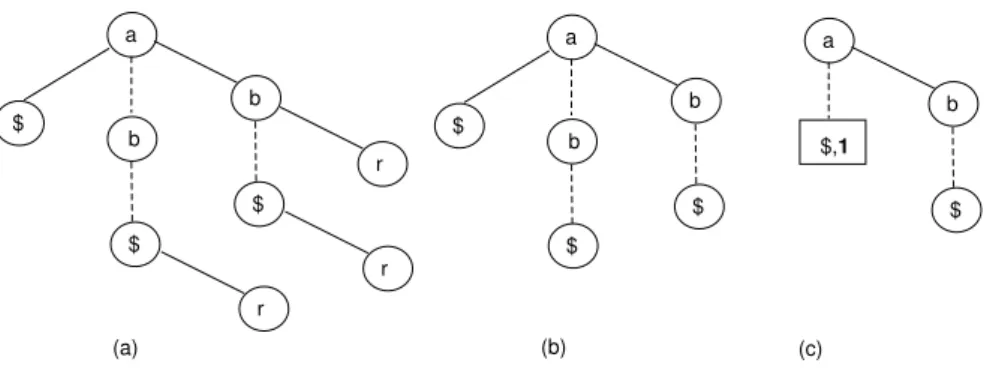
3.2.2 Ternary Suffix Tree . . . 75
3.2.3 Structure of Ternary Suffix Trees . . . 77
3.2.4 Construction of Ternary Suffix Trees . . . 78
3.2.5 Implementation . . . 80
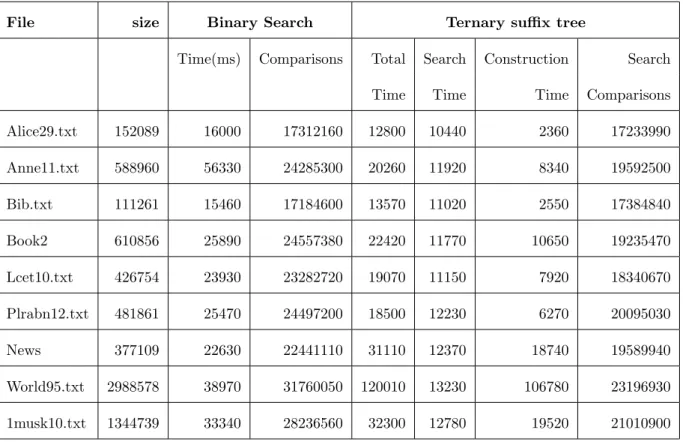
3.2.6 Results . . . 83
CHAPTER 4 COMPRESSED PATTERN MATCHING ON BURROW-WHEELER TRANSFORMED TEXT . . . . 84
4.1 Problem Description . . . 84
4.2 Compressed Pattern Matching on BWT Text . . . 88
4.2.1 Related Works . . . 89
4.2.2 The Burrows-Wheeler Transform . . . 91
4.2.3 Auxiliary Arrays . . . 94
4.3 Exact Matching on BWT Text . . . 102
4.3.1 Generating q-grams from BWT output . . . 102
4.3.2 Fast q-gram generation . . . 106
4.3.3 Fastq-gram intersection . . . 110
4.3.4 The QGREP algorithm . . . 116
4.4 Experimental Results for Exact Pattern Matching . . . 119
4.4.1 Experimental Setup . . . 119
4.4.2 Number of occurrences . . . 120
4.4.3 Number of comparisons . . . 121
4.4.4 Search Time . . . 122
4.4.5 Search time for non-occurrence. . . 122
4.5 Locating k-mismatches . . . 124
4.5.1 Complexity analysis . . . 127
4.6 Locating k-approximate matches . . . 130
4.6.1 Locating potential matches . . . 131
4.6.2 Verifying the matches . . . 133
4.6.3 Faster verification . . . 135
4.6.4 Results . . . 139
CHAPTER 5 TEXT INFORMATION RETRIEVAL ON COMPRESSED TEXT USING MODIFIED LZW . . . . 147
5.1 Problem Description . . . 147
5.1.1 Components of a compressed domain retrieval system . . . 150
5.1.3 Compressed Domain Pattern Search: Direct vs. Indexed . . . 154
5.2 Our Approach . . . 156
5.2.1 The LZW algorithm . . . 156
5.2.2 Modification to the LZW algorithm . . . 158
5.2.3 Indexing method and tag system . . . 168
5.2.4 Partial decoding with the tag system . . . 172
5.2.5 Compression Ratio vs. Random Access . . . 174
5.3 Results . . . 175
5.3.1 Experimental Setup . . . 175
5.3.2 Performance comparison . . . 176
5.4 Conclusion . . . 182
CHAPTER 6 CONCLUSION AND FUTURE WORKS . . . . 186
LIST OF TABLES
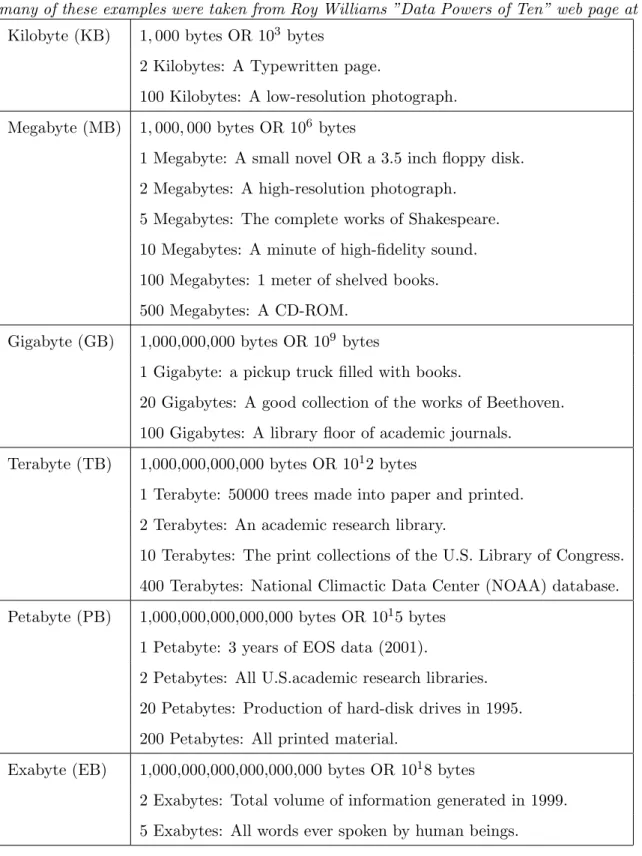
1.1 How Big is an Exabyte? Source: The table is taken from the Berkeley report and
many of these examples were taken from Roy Williams ”Data Powers of Ten” web
page at Caltech. . . . 4
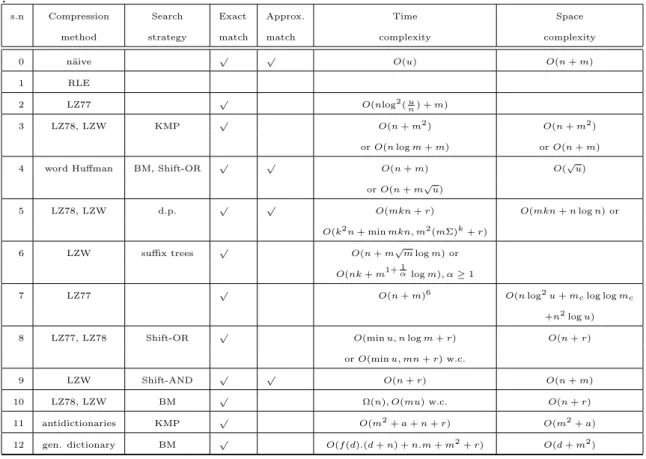
2.1 Methods for compressed pattern matching for text. See Table 2.2 for the corresponding references. Note that Table 2.2 may not be needed if we change the reference format . . . 55
2.2 References for Table 2.1 . . . 56
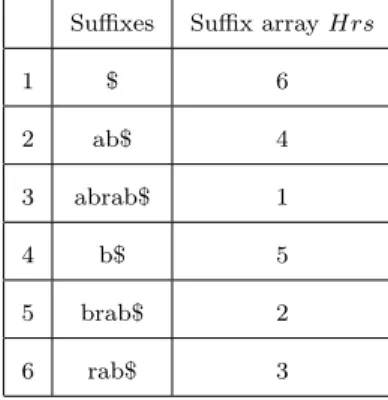
3.1 Suffixes and Suffix array for the text T = “abrab$” . . . 78
3.2 Comparison of search performance . . . 82
4.1 Number of occurrences and number of comparisons for BWT-based pattern matching . . . 121
4.2 Number of occurrences and number of comparisons for BWT-based pattern matching . . . 123
4.3 COMPARATIVE SEARCH TIME (CONTROLLED SET OF PATTERNS, WITH POSSIBLY NO MATCHES) P17: patternmatchingin, P30: bwtcom-pressedtexttobeornottobe, P22: thisishishatitishishat, P26: universityofcen-tralflorida, P44: instituteofelectricalandelectromicsengineers . . . 124 4.4 Construction time for Ukkonen’s DFA . . . 141
LIST OF FIGURES
2.1 (Compressed) Text retrieval system. . . 58
3.1 Frequency of English words versus length of words in the test corpus . . . . 66
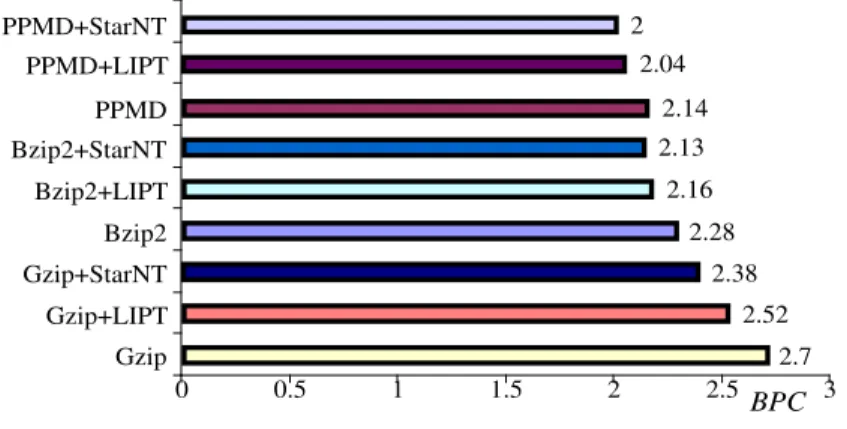
3.2 Compression ratio with/without transform . . . 71
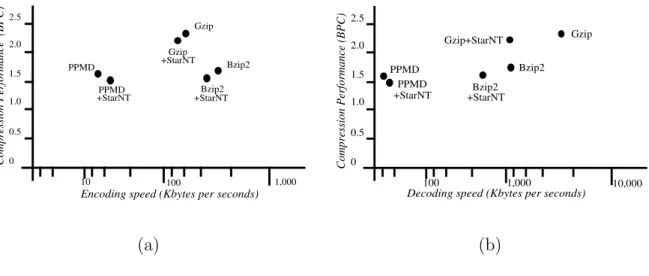
3.3 Compression effectiveness versus (a) Compression (b) Decompression speed 72
3.4 A Ternary Search Tree . . . 74
3.5 Ternary tree example . . . 81
4.1 A typical variation of triplets with matching step (m= 11) . . . 129
4.2 Behavior of number of triplets generated during a search for k-mismatch: (a)
average number of triplets, (b) peak number of triplets . . . 130
4.3 Variation of number of hypothesis ηh, with pattern length. . . 136
4.4 Variation of numberq-grams in the merged neighborhoods, with pattern length.137
4.5 Search time for k-mismatches (a) and k-approximate match (b), for various
4.6 Variation of total search time (including decompression/or array construction
overheads) with (a) number of patterns and (b)file size . . . 146
5.1 Illustration of indexing for an LZW compressed file. . . 158 5.2 Example of online and off-line LZW. . . 159 5.3 Illustration of online, off-line, and public trie LZW approach. The shaded
part of the text in (a) and (b) is used for training the trie. . . 163 5.4 The average compression ratio over the corpus using the trie from each file in
the corpus. . . 167 5.5 The difference between single level partition and multiple level partition of
the text. . . 169
5.6 The tree indexing structure for different granularities. . . 170
5.7 Compression ratio vs. Random access. The block here usually refers to a text size equal to a paragraph or other predefined size. MLZW refers to our
modified LZW algorithm with a pruned trie. The code size is 16 bits. . . . 173
5.8 Encoding time for the modified algorithm vs. file size. . . 178 5.9 Compression ratio with different file sizes. . . 178 5.10 Compression ratio vs. trie size (code length). . . 179 5.11 The performance of the partial decoding time for different file sizes given a
CHAPTER 1
MOTIVATION AND INTRODUCTION
1.1
Motivation
People have long been exploring the ideal methodology of accurate representation, concise storage, and swift communication of the information in the history. The effort does not stop in the modern age and will continue in the foreseeable future. An earliest example might be transmitting the message of ”the enemy comes” by signaling smoke on the top of mountain dating back to around two and half thousand years ago. The representation is simple, precise and easy to be transmitted by relaying the ignition. Language is in fact another example of accurate representation of our minds and is visualized/recorded using written symbols. Text was written on the papyrus, bamboo slices, papers; and now on magnetic tape and disk, compact disk and various media with the development of the modern technology. In the modern digital age, information is mostly processed by the machine automatically. Hence the need request of compact, precise, and efficient representation of the information are also applicable to the computers. With tremendous amount of information accumulated especially in the last few decades, data compression schemes are playing an increasingly
significant role in developing compact representation of information. Moreover, finding the useful information from the mass storage emerged as another major problem today.
People are good at producing the data. In recent times, we have witnessed an unprece-dented growth of textual information via the Internet, digital libraries and archival text data in many applications. The estimation of the growth rate is reflected by the Parkinson’s Law on data that ”data expands to fill the space available for storage”. The TREC [TRE00] database holds around 800 million static pages having 6 trillion bytes of plain text equal to the size of a million books. The Google system routinely accumulates millions of pages of new text information every week. The Alexa.com is collecting over 1,000GB of informa-tion each day from the web and had collected over 35 billion web pages. There have been extensive needs to deal with the overwhelming data.
It is estimated that the memory usage of the computer systems tends to double roughly once every 18 months [LVS03]. Fortunately, the Moore’s Law applies well on the computa-tional and memory capacity. For example, the price curves of DRAM generations fits closest to the Moore’s law. The capacity of other storage media keeps increasing with respect to its physical size. Two decades ago, a 10MB hard disk in a desktop PC was considered lux-ury; 40GB hard disk is almost the lowest configuration when you order a Dimension PC at Dell.com today. The 3.5 inch floppy drive for 1.44MB disk is an option and the 48xCDROM is a must for every PC. We may only see the 5 inch floppy drive in the museum or in the corner of our home garage. On the other hand, the price of the storage media has decreased
drastically with regard to capacity and physical size. The 10MB hard disk in 1986 and a 160GB one in 2004 are sold with same price.
A recent study by the University of California at Berkeley [LVS03] puts the amount of new information generated in 2002 to be 5 exabytes bytes (an exabyte (EB) is bytes) which is approximately equal to all words spoken by human beings. While a good fraction of this information is of transient interest, useful information of archival value will continue to accumulate. Each year more and more information is created and available to the ordinary users at a dramatic rate through books, film, newspaper, television, radio, and various media. Ninety-two percent of the new information was stored on magnetic media, mostly in hard disks. Table 1.1 shows the comparisons of the units to measure the size of the digital data.
The report also estimates that new stored information grew about 30% a year between 1999 and 2002. For the storage distribution, the report points out that hard disks store most new information. Film represents 7% of the total, paper 0.01%, and optical media 0.002%. Furthermore, the information is not simply sleeping in the storage media. It flows through electronic channels – telephone, radio, TV, and the Internet – contained almost 18 exabytes of new information in 2002, three and a half times more than is recorded in storage media [LVS03].
People are not good at managing the data. We need ways to manage, organize and transport this data from one point to the other on data communications links with limited bandwidth. We must also have means to speedily find the information we need from this
Table 1.1: How Big is an Exabyte? Source: The table is taken from the Berkeley report and many of these examples were taken from Roy Williams ”Data Powers of Ten” web page at Caltech.
Kilobyte (KB) 1,000 bytes OR 103 bytes
2 Kilobytes: A Typewritten page.
100 Kilobytes: A low-resolution photograph. Megabyte (MB) 1,000,000 bytes OR 106 bytes
1 Megabyte: A small novel OR a 3.5 inch floppy disk. 2 Megabytes: A high-resolution photograph.
5 Megabytes: The complete works of Shakespeare. 10 Megabytes: A minute of high-fidelity sound. 100 Megabytes: 1 meter of shelved books. 500 Megabytes: A CD-ROM.
Gigabyte (GB) 1,000,000,000 bytes OR 109 bytes
1 Gigabyte: a pickup truck filled with books.
20 Gigabytes: A good collection of the works of Beethoven. 100 Gigabytes: A library floor of academic journals.
Terabyte (TB) 1,000,000,000,000 bytes OR 1012 bytes
1 Terabyte: 50000 trees made into paper and printed. 2 Terabytes: An academic research library.
10 Terabytes: The print collections of the U.S. Library of Congress. 400 Terabytes: National Climactic Data Center (NOAA) database. Petabyte (PB) 1,000,000,000,000,000 bytes OR 1015 bytes
1 Petabyte: 3 years of EOS data (2001).
2 Petabytes: All U.S.academic research libraries. 20 Petabytes: Production of hard-disk drives in 1995. 200 Petabytes: All printed material.
Exabyte (EB) 1,000,000,000,000,000,000 bytes OR 1018 bytes
2 Exabytes: Total volume of information generated in 1999. 5 Exabytes: All words ever spoken by human beings.
huge mass of data. Retrieval system, search engine, browsers, and other information manage-ment software are powerful tools for hunting relevant documanage-ments on the Internet. Although many well known search engines claim to be able to search multimedia information such as image and video using sample images or text description, text documents are still the most frequent targets. According to the Berkeley estimation [LVS03], 70% of the information on the internet is available as text, such as stock exchange data, library information, online books and tutorials, documents, and software, etc. Sometimes, a single site may also con-tain large collections of data such as a library database, thereby requiring an efficient search mechanism even to search within the local data. For example, Google now provides a new function of local search on your own PC and Microsoft will provide similar application soon. To facilitate the information retrieval, an emerging ad hoc standard for uncompressed text is XML which preprocesses the text by putting additional user defined metadata such as DTD or hyperlinks to enable searching with better efficiency and effectiveness. This increases the file size considerably, underscoring the importance of applying text compression. On account of efficiency (in terms of both space and time), there is a need to keep the data in compressed form for as much as possible.
Text compression provides a transformed representation of the text data that is under-standable only by the computer (in this sense, it relates to cryptography to some extent.) The higher the compression ratio, the less disk space is needed to store the data. The advantage of the idea is two fold. First, we use less space to store the information. For example, English text can be compressed to about 30% of the original size, and images may
be compressed by a factor of several hundreds times. Normally, lossless compression must be used for text because we expect the full text to be recovered from the compressed form, unlike audio/video and images which have a much higher degree of redundancy and can be compressed with lossy compression algorithms. Second, we require less bandwidth in the internet transmission compared with transmitting raw data. Obviously, it takes less time to download the text in its compressed form. Berkeley’s report [LVS03] indicates that the World Wide Web contains about 170 terabytes of information on its surface. In volume this is seventeen times the size of the Library of Congress print collections. Instant mes-saging generates five billion messages a day (750GB), or 274 terabytes a year. It will be a considerable saving for the network traffic if the data are transmitted with a much smaller size.
Storage is not the purpose of keeping the data because we need to find useful information hidden in the data for different purposes. For example, data mining is a new area catering the need for exploring the knowledge from the sleeping data. The initial step of mining the knowledge is to retrieve the portion of the text by sending a query, typically using keywords. Then algorithms will be performed on the raw or preprocessed text. Pattern matching is the most popularly used method to search the text using keywords. Although there have been comprehensive studies on text information retrieval [BR99b, FB92b, WMB99], not much work has been done on searching directly on compressed text. The compact representation of text is unreadable for human beings. In order to read the data we need to reproduce the original text from the compressed text. Therefore, it is an extra overhead of decompression
process rather than mining directly from the original form. Current research on compres-sion shows little consideration for the relationship between the comprescompres-sion algorithm and searching algorithm. We will be focusing on minimizing the overhead by considering the optimal combination of compression and searching schemes.
Pattern matching is a typical starting point for knowledge discovering in large databases. There have been various exact and approximate pattern matching algorithms available in the literature. Boyer-Moore (BM) [BM77] and Knuth-Morris-Pratt (KMP) [KMP77] pattern matching algorithms are among the best of them. However, pattern matching on compressed text has not been thoroughly explored with the known compression methods. Efficient stor-age, transmission, searching, and mining the knowledge have become critical and difficult problems to deal with the tremendous data flow. In this dissertation, we will address the problems related to the lossless text compression, compressed pattern matching, and com-pressed text retrieval.
1.2
Some Background
1.2.1
Lossless Text Compression
The amount of digitized data available has heightened the challenge for ways to manage and organize the data (compression, storage, and transmission). Lossless text compression is an old but hard problem. Morse code for telegraphy and Braille code for blind are among
the very early methods to build a new and compact representation of language, although compression is not their initial purpose. Modern data compression began in the late 1940s with the development of information theory. The general approach to text compression is to find a representation of the text requiring less number of binary digits. The standard ASCII code uses 8-bits to encode each character in the alphabet. Such a representation is not very efficient because it treats frequent and less frequent characters equally. If we encode frequent characters with a smaller (less than 8) number of bits and less frequent characters with larger
number of bits (possibly more than 8 bits), it should reduce the averagenumber of bits per
character (BPC). This observation is the basis of the invention of the Morse code and the famous Huffman code developed in the early 50’s. Huffman code typically reduces the size
of the text file by about 50−60% or provides compression rate of 4−5 BPC [WMB99] based
on statistics of frequency of characters. In the late 1940’s, Claude E. Shannon laid down the foundation of the information theory and modeled the text as the output of a source that generates a sequence of symbols from a finite alphabet A according to certain probabilities.
Such a process is known as a stochastic process and in the special case when the probability
of occurrence of the next symbol in the text depends on the previous symbols or its context
it is called aMarkov process. Furthermore, if the probability distribution of a typical sample
represents the distribution of the text it is called an ergodic process [Sha48, SW98]. The
information content of the text source can then be quantified by the entity called entropyH
given by
where pi denotes the probability of occurrence of the ith symbol in the text, sum of all
symbol probabilities is unity and the logarithm is with respect base 2 and −logpi is the
amount of information in bits for the event (occurrence of theith symbol). The expression
ofH is simply the sum of the number of bits required to represent the symbols multiplied by
their respective probabilities. Thus the entropy H can be looked upon as defining the average number of BPC required to represent or encode the symbols of the alphabet. Depending on how the probabilities are computed or modeled, the value of entropy may vary. If the probability of a symbol is computed as the ratio of the number of times it appears in the text to the total number of symbols in the text, the so-called static probability, it is called an Order (0) model. Under this model, it is also possible to compute the dynamic probabilities which can be roughly described as follows. At the beginning when no text symbol has
emerged out of the source, assume that every symbol is equiprobable 1. As new symbols
of the text emerge out of the source, revise the probability values according to the actual
frequency distribution of symbols at that time. In general, an Order(k) model can be defined
where the probabilities are computed based on the probability of distribution of the (k+
1)-grams of symbols or equivalently, by taking into account the context of the preceding k
symbols. A value of k = −1 is allowed and is reserved for the situation when all symbols
are considered equiprobable, that is, pi = 1
|A|, where |A|is the size of the alphabet A. When
k = 1 the probabilities are based on bigram statistics or equivalently on the context of just
1This situation gives rise to what is called the zero-frequency problem. One cannot assume the
probabil-ities to be zero because that will imply an infinite number of bits to encode the first few symbols since -log o is infinity. There are many different methods of handling this problem but the equiprobabilty assumption is a fair and practical one.
one preceding symbol and similarly for higher values ofk. For each value of k, there are two
possibilities, the static and dynamic model as explained above. For practical reasons, a static
model is usually built by collecting statistics over a test corpus, which is a collection of text
samples representing a particular domain of application (viz. English literature, physical sciences, life sciences, etc.). If one is interested in a more precise static model for a given
text, a semi-static model is developed in a two-pass process; in the first pass the text is
read to collect statistics to compute the model and in the second pass an encoding scheme is developed. Another variation of the model is to use a specific text to prime or seed the model at the beginning and then build the model on top of it as new text files come in.
Independent of the model, there is entropy associated with each file under that model. Shannon’s fundamental noiseless source coding theorem says that entropy defines a lower limit of the average number of bits needed to encode the source symbols [SW98]. The “worst”
model from information theoretic point of view is the order (−1) model, the equiprobable
model, giving the maximum value Hm of the entropy. Thus, for the 8-bit ASCII code, the
value of this entropy is 8 bits. The redundancy R is defined to be the difference 2 between
the maximum entropyHm and the actual entropy H. As we build better and better models
by going to higher order k, lower will be the value of entropy yielding a higher value of
redundancy. The crux of lossless compression research boils down to developing compression algorithms that can find an encoding of the source using a model with minimum possible
2Shannon’s original definition isR/H
mwhich is the fraction of the structure of the text message
deter-mined by the inherent property of the language that governs the generation of specific sequence or words in the text [SW98].
entropy and exploiting maximum amount of redundancy. But incorporating a higher order model is computationally expensive and the designer must be aware of other performance metrics such as decoding or decompression complexity (the process of decoding is the re-verse of the encoding process in which the redundancy is restored so that the text is again human readable), speed of execution of compression and decompression algorithms and use of additional memory.
Good compression means less storage space to store or archive the data, and it also means less bandwidth requirement to transmit data from source to destination. This is achieved
with the use of achannelthat may be a simple point-to-point connection or a complex entity
like the Internet. For the purpose of discussion, assume that the channel is noiseless, that is,
it does not introduce error during transmission and it has a channel capacity C that is the
maximum number of bits that can be transmitted per second. Since entropy H denotes the
average number of bits required to encode a symbol, C/H denotes the average number of
symbols that can be transmitted over the channel per second [SW98]. A second fundamental theorem of Shannon says that however clever you may get developing a compression scheme,
you will never be able to transmit on average more than C/H symbols per second [SW98].
In other words, to use the available bandwidth effectively, H should be as low as possible,
which means employing a compression scheme that yields minimum BPC.
To study the various compression algorithms and schemes available, we can categorize the compression methods with different point of view. Here we briefly describe the compression algorithms according to the history and complexity of algorithm design. We will discuss in
more detail in Chapter 2.The lossless text compression algorithm can be categorized into four classes:
• Basic techniques
• Statistical methods
• Dictionary methods
• Transform based methods
Basic techniques are pretty simple and intuitive. Although they are generally inefficient and cannot compete with the more complex methods, they are sometimes incorporated into complex compression schemes as the last stage of compression. Examples are Run Length Coding, Move-to-Front Coding, and Scalar Quantization. The statistical methods explore the probability distribution of the symbols and achieve better compression ratio. They use variable-sized codes based on the statistics of the symbols or group of symbols. The symbol or the group will be assigned shorter length of code if they appeared more often (with a higher frequency of occurrences). Designers aim to minimize the weighted average size to get the maximum compression, and the design of codes should avoid ambiguity so that the decoding process recognizes each code uniquely. The statistics can be obtained online or offline to estimate the source that generates the text. The online methods scan the text only once. The encoding for the current symbol is calculated by the prediction of the local probability based on the history statistics. Prediction is done by using the context (a certain amount of symbols appeared preceding the current symbol). The length of the context is
called the order. The most famous online statistical method is PPM (Predict by Pattern Matching)[CW84] and its variances such as: PPMC, PPMD, PPMD+, PPM*, and PPMZ. The offline methods generally scan the whole text to obtain the statistics and design the code. Then the next step is to scan the text again and assign the code to the symbol or a group of symbols. Typical methods are Huffman coding [Huf52], Arithmetic coding [Ris79], etc.
Dictionary methods usually encode a sequence of symbols with another token. The dictionary stores the mapping of the series of symbols and the corresponding tokens, and it can be either static or dynamic. The dictionary can be implemented in an array or trie data structure for speeding up of the location of information. LZ (Ziv and Lempel) compression algorithm family is a typical set of dictionary based methods. Examples are LZ77 [ZL77], LZ78 [ZL78], etc. LZW is used as unix compress command. LZH is the improvement of LZSS and used as the compression tool gzip. Generally we can estimate the entropy of the text in low orders. For example, compute the first order entropy using Shannon’s equation [Sha51]. The estimation of the second order entropy can be obtained by the statistics of the bigram. Huffman coding and Arithmetic coding are examples of using the first order entropy. The higher order entropy is difficult to compute due to the exponentially increased symbol combinations. For the more complicated algorithms, the actual order is sometimes implicit. For example, PPMC normally use the order up to five. The order in the LZ family is also a mixed one. So it is difficult to estimate the bound of a stationary ergodic source. Shannon made some experiments to estimate the entropy of English, but they do
not prove it. It is hard to compute the entropy of the source up to infinite order. Due to the limitation of computer resources, we have to limit the level of the order when implementing the compression algorithm.
There are some techniques that do not directly compress the text but preprocess the text for the actual compression. One of the basic techniques, the Move-to-Front (MTF) method simply map each symbol into another, but sometimes the first order entropy of the trans-formed text has a lower entropy, hence it can be compressed better using Huffman or arith-metic coding. Another example is the Burrows-Wheeler block sorting algorithm[BW94a]. The block sorting does not compress the text at all, but actually adds an extra element, the index value. The next step, Move-to-Front, also does not compress anything. But the fol-lowing Huffman or arithmetic coding can better compress the text due to the rearrangement of the text that somewhat converts the higher order sequences into the lower order ones. Therefore a good compression algorithm would make the overall performance to be optimal instead of just optimizing a certain step in the whole compression process.
1.2.2
Compressed Pattern Matching
The exact pattern matching problem is defined as follows: given a string P and a text T regarded as a longer string, find all the occurrences, if any, of pattern P in text T. The use of pattern matching is obvious for computers processing digitized information. Common appli-cations of the exact pattern matching are in word processors, in text information retrieval,
in internet search engines such as Google and Yahoo, in online electronic publications, in biology finding patterns of DNA and RNA sequences stored as strings, etc. Numerous other applications can be listed using pattern matching techniques. The exact pattern matching problem has been well solved for typical word processing applications. Typical exact pattern matching algorithms are: BM [BM77], KMP[KMP77], Aho-Corasick (AC) [AC75], Karp-Rabin (KR) [KR81], etc. They all have the linear bound of searching time and BM could even achieve sublinear running time. There are many string representation and processing problems related to the pattern matching such as suffix tree, suffix array, shortest common ancestor, longest common subsequence, etc. Solving those subproblems help us generate the idea of the kind of intermediate results that may expedite the search [Gus97]. When searching on the compressed text, we will try to build such data structures on the fly by (partially) decomposing the compressed text.
It is very common that user requires some highly similar results to the query words be-sides those that match exactly. There may be a typo, or actual words or sequences in the database may not be known precisely. Thus it is reasonable to ask for similar patterns in the database and make the decision based on the degree of similarity to the query. This is equivalent to allowing errors in the search results. This is called the approximate pattern matching problem. The approximate matching problem involves the definition of the dis-tance/similarity between patterns and the degree of error allowed in the searching. Efficient techniques such as dynamic programming are available to solve the approximate pattern matching problem between two sequences. In certain applications, we also need to calculate
the alignments along with the degree of the errors between the comparing patterns. Search-ing efficiently and effectively in the large database is still a challengSearch-ing problem that might involve large amount of local alignment or comparison computation. It was reported that users often suffered from long delays from the on-line catalog of the University of California’s library system. Using a local copy of Genbank (the major U.S. DNA database), it currently takes over four hours to find a string that was not there. The University of Central Florida system currently by default provide only totally exact matched result to the keywords that may lead to the miss of useful information to the user. When large databases are compressed, the problem may be even more significant, especially when allowing errors in the pattern. Text information is available in hundreds of millions of web sites on the internet nowadays. It is natural that more and more of the texts are stored in the compressed form to save the cost of local-disk storage and download time. For example, most academic publications are stored in compact form such as gzip and pdf. Current search engines do not have the ability to search the pattern in the compressed text. But there is demand for such tools from both technical and commercial domains. The intuitive method would be to decompress the whole text and search using the traditional pattern matching methods such as BM or KMP. However, it is not economical in both space and time cost. There are some exact pattern matching algorithms searching directly on the compressed text proposed to search the pattern on Run-length encoded text, LZ77, LZ78, LZW, Word Huffman, and Antidi-tionaries. Approximate pattern matching can be performed on Word Huffman, LZ78, LZW compressed files. BWT compression method has the advantage of having a compression
ratio close to PPM and only slower than gzip. The block sorting algorithm makes it easy to get the needed suffixes from inverse BWT transform in linear time. Hence we can use fast algorithms such as binary search on partially decompressed files to locate all the occurrences of the patterns. It is also possible to perform the approximate pattern matching efficiently based on the exact matching on partially decompressed files.
1.2.3
Text Information Retrieval in Compressed Text
Storing and searching on the explosively increasing amount of data is one of the most im-portant problems in the digital library age. A single site may also contain large collections of data such as library database. It has been pointed out that compression is a key for next-generation text retrieval systems [ZMN00]. A good compression method may facilitate efficient retrieval on compressed files. The amount of storage used and the efficiency of index-ing and searchindex-ing are major design considerations for an information retrieval system. The volume of data can be reduced by using compression techniques. However, search and re-trieval become much more complicated. Usually, there is a tradeoff between the compression performance and the retrieval efficiency. Therefore, most of the existing search or retrieval schemes on compressed text use compression methods that have relatively lower compres-sion ratio, but simpler indexing and searching schemes such as those using Run-length, Huffman, word based Huffman, or BWT [BW94a]. When the database is compressed, ob-viously, it is not efficient to decode the whole collection and locate the portions from the
uncompressed text. Given a query using a keyword, there are two categories of methods to search a matched pattern in general. One is the compressed pattern matching that searches a pattern directly on the compressed file with or without preprocessing discussed in Chapter 5. Both exact and approximate matching can be performed. This method requires no or some offline preprocessing. The other method is the popular information retrieval approach that requires preprocessing by building index with the keyword and document frequency information []. The query is processed and the search is performed on the index files. Then the documents are ranked using some standard so that the precision and recall are optimal. Relevant feedback may also help to refine the query to have more accurate results. For large collections of text, it is difficult to access a piece of a compressed file for both compressed pattern matching method and popular text retrieval system with index files. One option is to break the whole collections into smaller documents [MSW93a]. However, the compression ratio will be poor for small files. The longer the sequence to be compressed, the better is the estimation of the source entropy. Furthermore, the request for retrieval may change for different purposes. For example, only a small portion of the collection that is relevant to the query is required to deliver to the user. A single record, or a paragraph in stead of a whole document might be enough. It is unnecessary to decompress the whole database and then locate the portion that is retrieved. Using a single level document partitioning system may not be the best answer. We propose to add tags into the document. Different tags indicate different granularity. Decoding will be performed within the bounds. The major concerns of compression method for the retrieval purpose, ranked roughly by their importance are: a)
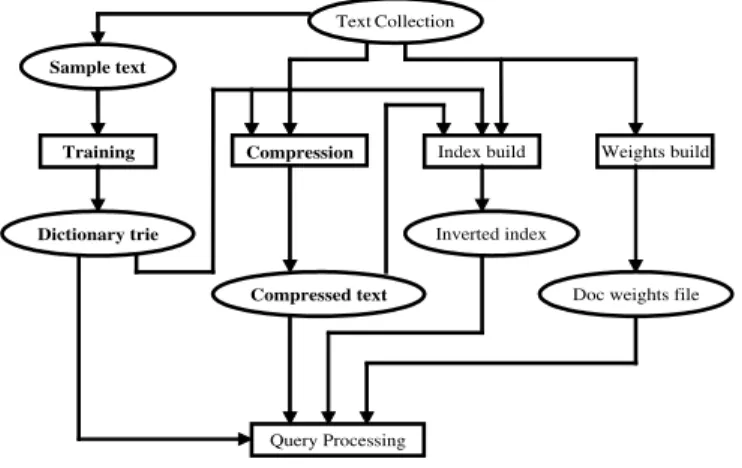
random access and fast (partial) decompression; b) fast and space-efficient indexing. c) good compression ratio. The compression time is not a major concern since the retrieval system usually performs off-line preprocessing to build the index files for the whole corpus. Besides the searching algorithm, random and fast access to the compressed data is critical to the response time to the user query in a text retrieval system. A typical text retrieval system is constructed as follows. First, the keywords are collected from the text database off-line and an inverted index file is built. Each entry points to all the documents that contain the keyword. A popular document ranking scheme is based on the keyword frequency tf and inverted document frequency idf. When a query is given, the search engine will match the words in the inverted index file with the query. Then the document ranking information is computed according to a certain logic and/or frequency rule to obtain the search results that point to the target documents. Finally, only the selected documents are displayed to the user. To find a good compression scheme that meets the given criteria, we first evaluate the performance of text compression algorithms currently in use. Besides the categorization given in Section 1.2.1, the compression schemes can also be categorized as entropy coders and model based coders. Huffman coding and Arithmetic coding are typical entropy coders. LZ family, including LZ77, LZ78, LZW, and their variants [ZL77, ZL78, Wel84] are the most popular compression algorithms because of their speed and good compression ratio. Canon-ical Huffman uses the language model in which English words are considered as symbols in the alphabet that contains all the words in the text. It has a sound compression performance, but it is language dependant. Dynamic Markov Coding (DMC) uses Markov model to
pre-dict the next bit using the history information. It has a good compression ratio. Prepre-diction by Partial Matching (PPM) is currently the algorithm that achieves the best compression ratio. However it has a higher computational complexity. The Burrows-Wheeler Transform (BWT), or block-sorting algorithm has a compression ratio close to PPM and the speed is slightly slower than LZ algorithms. From the compressed searching point of view, there are algorithms that support direct searching and partial decoding. For example, in Huffman coding, given a query keyword, we can obtain the codes from the Huffman tree and then search the codes directly on the compressed file using pattern matching algorithms such as Boyer-Moore or Knuth-Morris-Pratt algorithms. It is possible that some further checking needs to be done. In Canonical Huffman model, a similar method can be used to search the word and decode partially [WMB99]. For the other compression algorithms we have to decode from the beginning of the compressed text and random access is difficult for them. In this thesis, we propose a modified LZW algorithm that supports random access and partial decoding. The original text retrieval system does not need to change on the query evalu-ation process. The data structure of the indexing file is still the same with the content to be changed into the index for the compressed file in place of the raw text file. A new tag system is incorporated with the indexing system to achieve the different levels of details for the text output. In our algorithm, we can decode any part of the text given the index of the dictionary entry and stop decoding until a certain tag is found or decode a given number of symbols.
1.3
Our Contribution
The problems that our research will focus on are:
• Exact and approximate pattern matching on compressed text used for information
retrieval. Development of methods to speedily find the information we need from the huge mass of data. It is important to consider ways to keep the data in the compressed form for as much as possible, even when it is being searched. The algorithms are capable for both exact and inexact search.
• Search aware text compression: compressing text with an acceptable compression ratio
while including the features that make the indexing and searching easier. We aim to develop compression schemes based on the identified class of algorithms that will support compressed domain search directly on the compressed data, with minimal or no decompression of the compressed database text. Some preprocessing may be used to help achieve the goal.
The thesis will make the following contributions on the data compression, compressed pattern matching and retrieval problems.
• Development of new lossless text Star family compression algorithms with better
com-pression performance. We have proposed an approach to develop a reversible trans-formation that can be applied to a source text that improves ability to compress of existing algorithm . The basic idea is to encode every word in the input text file,
which is also found in the English text dictionary that we are using, as a word in our transformed static dictionary. These transformed words create additional context information that is superior to the original text. Thus we achieve some compression at the preprocessing stage. We present a series of transforms which improve the com-prehensive performance. We also propose the use of ternary tree data structure to improve the efficiency of encoding and decoding time.
• Exact and approximate pattern matching in Burrows-Wheeler transformed (BWT)
files: We proposed a method to extract the useful context information in linear time from the BWT transformed text. The auxiliary arrays obtained from BWT inverse transform brings logarithm search time. Meanwhile, approximate pattern matching can be performed based on the results of exact pattern matching to extract the possible candidate for the approximate pattern matching. Then fast verifying algorithm can be applied to those candidates which could be just small parts of the original text. We present algorithms for both k-mismatch and k-approximate pattern matching in BWT compressed text. A typical compression system based on BWT has Move-to-Front and Huffman coding stages after the transformation. We propose a novel approach to replace the Move-to-Front stage in order to extend compressed domain search capability all the way to the entropy coding stage. A modification to the Move-to-Front makes it possible to randomly access any part of the compressed text without referring to the part before the access point.
• Modified LZW algorithm that allows random access and partial decoding for the com-pressed text retrieval: Although many compression algorithms provide good compres-sion ratio and/or time complexity, LZW is the first one studied for the compressed pattern matching because of its simplicity and efficiency. Modifications on LZW algo-rithm provide the extra advantage for fast random access and partial decoding ability that is especially useful for the text retrieval system. Based on this algorithm, we can provide a dynamic hierarchical semantic structure for the text, so that the text search can be performed on the expected level of granularity. That is, search result will be provided at the wanted level of details. For example, user can choose to retrieval a single line, a paragraph, or a file, etc. that contains the keywords. More importantly, we will show that parallel encoding and decoding algorithm is trivial with the modified LZW. Both encoding and decoding can be performed with multiple processor easily and encoding and decoding process are independent with respect to the number of processors.
1.4
Contents of the Thesis
The rest of the thesis is organized as follows. Chapter 2 introduces the background and the review of the current schemes, algorithms, and/or systems for lossless text compression, (compressed) pattern matching, text retrieval in the literature. Traditional compression algorithms and their time/space performance will be discussed. String matching and useful
data structures such as suffix tree will be presented. We will also review the text retrieval methods and typical systems on compressed text such as the one in Managing Gigabyte [WMB99].
By studying those algorithms, we present our new star transformation algorithms to make the text to be compressed at better compression ratio with almost all the existing models in Chapter 3. Method for efficient implementation is also presented. Chapter 4 discusses the pattern matching algorithm for compressed text and approximate pattern matching algorithms. We illustrate the new data structure from the current BWT compression scheme and propose our pattern matching algorithm in BWT transformed text. Chapter 5 describes the modified LZW algorithm that supports efficient text retrieval with the properties of random access and partial decoding. Chapter 6 concludes the works and discusses the possible future works related to this area.
CHAPTER 2
REVIEW OF RELATED WORKS
Data compression and searching have been embedded into numerous computer and internet applications including data storage and transmission. In this chapter, we will provide a more detail overview of text compression, compressed pattern matching and text retrieval on compressed file.
2.1
Classification of Lossless Compression Algorithms
No compression algorithm has yet been discovered that consistently attain the predictions of lower bound of data compression [Sha51] over wide classes of text files. Our goal in the lossless text compression area is to find better algorithms to explore the redundancy of the context and achieve a better compression ratio with a good time complexity. Besides the basic techniques such as Run Length Coding (RLC) and Move-to-Front (MTF), etc.
dictionary methodsand transform based methods. We will give a review of these methods in this section.
2.1.1
Statistical Methods
The classic method of statistical coding is Huffman coding [Huf52]. It formalizes the intuitive notion of assigning shorter codes to more frequent symbols and longer codes to infrequent symbols. It is built bottom-up as a binary tree as follows: given the model or the probability distribution of the list of symbols, the probability values are sorted in ascending order. The symbols are then assigned to the leaf nodes of the tree. Two symbols having the two lowest probability values are then combined to form a parent node representing a composite symbol that replaces the two child symbols in the list and whose probability equals the sum of the probabilities of the child symbols. The parent node is then connected to the child nodes by two edges with labels ‘0’ and ‘1’in any arbitrary order. The process is now repeated with the new list (in which the composite node has replaced the child nodes) until the composite node is the only node remaining in the list. This node is called the root of the tree. The unique sequence of 0’s and 1’s in the path from the root to the leaf node is the Huffman code for the symbol represented by the leaf node. At the decoding end the same binary tree has to be used to decode the symbols from the compressed code. In effect, the tree behaves like a dictionary that has to be transmitted once from the sender to receiver and this constitute
results for Huffman code in literature. The Huffman codes for all the symbols have what
is called the prefix property which is that no code of a symbol is the prefix of the code for
another symbol, which makes the code uniquely decipherable (UD). This allows forming a
code for a sequence of symbols by just concatenating the codes of the individual symbols and the decoding process can retrieve the original sequence of symbols without ambiguity. Note that a prefix code is not necessarily a Huffman code nor may obey the Morse’s principle and a uniquely decipherable code does not have to be a prefix code, but the beauty of Huffman code is that it is UD, prefix and is also optimum within one bit of the entropy H. Huffman
code is indeed optimum if the probabilities are 1/2k where k is a positive integer. There are
also Huffman codes called canonical Huffman codes which uses a look up table or dictionary rather than a binary tree for fast encoding and decoding [Sal00, WMB99].
Note in the construction of the Huffman code, we started with a model. Efficiency of the code will depend on how good this model is. If we use higher order models, the entropy will be smaller resulting in shorter average code length. As an example, a word-based Huffman code is constructed by collecting the statistics of words in the text and building a Huffman tree based on the distribution of probabilities of words rather than the letters of the alphabet. It gives very good results but the overhead to store and transmit the tree is considerable. Since the leaf nodes contain all the distinct words in the text, the storage overhead is equal to having an English words dictionary shared between the sender and the receiver. We will return to this point later when we discuss our transforms. Adaptive Huffman codes takes longer time for both encoding and decoding because the Huffman tree has to be modified at
each step of the process. Finally, Huffman code is sometimes referred to as a variable length code (VLC) because a message of a fixed length may have variable length representations depending on what letters of the alphabet are in the message.
In contrast, thearithmetic codeencodes a variable size message into a fixed length binary
sequence [RL79]. Arithmetic code is inherently adaptive, does not use any lookup table or dictionary and in theory can be optimal for a machine with unlimited precision of arithmetic computation. The basic idea can be explained as follows: at the beginning the semi-closed
interval [0,1) is partitioned into|A|equal sized semi-closed intervals under the equiprobabilty
assumption and each symbol is assigned one of these intervals. The first symbol, say a1 of
the message can be represented by a point in the real number interval assigned to it. To
encode the next symbola2 in the message, the new probabilities of all symbols are calculated
recognizing that the first symbol has occurred one extra time and then the interval assigned
to a1 is partitioned ( as if it were the entire interval) into |A| sub-intervals in accordance
with the new probability distribution. The sequence a1a2 can now be represented without
ambiguity by any real number in the new sub-interval fora2. The process can be continued for
succeeding symbols in the message as long as the intervals are within the specified arithmetic precision of the computer. The number generated at the final iteration is then a code for the message received so far. The machine returns to its initial state and the process is repeated for the next block of symbol. A simpler version of this algorithm could use the same static distribution of probability at each iteration avoiding re-computation of probabilities. The
literature on arithmetic coding is vast and the reader is referred to the texts cited above [Sal00, Say00, WMB99] for further study.
The Huffman and arithmetic coders are sometimes referred to as the entropy coders.
These methods normally use an order (0) model. If a good model with low entropy can be built external to the algorithms, these algorithms can generate the binary codes very
efficiently. One of the most well known modeler is “prediction by partial match” (PPM)
[CW84, Mof90b]. PPM uses a finite context Order (k) model where k is the maximum
context that is specified ahead of execution of the algorithm. The program maintains all the
previous occurrences of context at each level ofk in a trie-like data structure with associated
probability values for each context. If a context at a lower level is a suffix of a context at a higher level, this context is excluded at the lower level. At each level (except the level
with k = −1), an escape character is defined whose frequency of occurrence is assumed
to be equal to the number of distinct context encountered at that context level for the purpose of calculating its probability. During the encoding process, the algorithm estimates
the probability of the occurrence of the next character in the text stream as follows: the
algorithm tries to find the current context of maximum length k in the context table or
trie. If the context is not found, it passes the probability of the escape character at this
level and goes down one level to k −1 context table to find the current context of length
k−1. If it continues to fail to find the context, it may go down ultimately to k =−1 level
corresponding to equiprobable level for which the probability of any next character is 1/|A|.
is estimated to be the product of probabilities of escape characters at levels k, k−1, . . .,
q+ 1 multiplied by the probability of the context found at the qth level. This probability
value is then passed to the backend entropy coder (arithmetic coder) to obtain the encoding. Note, at the beginning there is no context available so the algorithm assumes a model with
k = −1. The context lengths are shorter at the early stage of the encoding when only a
few contexts have been seen. As the encoding proceeds, longer and longer contexts become available. In one version of PPM, called PPM*, an arbitrary length context is allowed which
should give the optimal minimum entropy. In practice a model with k= 5 behaves as good
as PPM* [CT97]. Although the algorithm performs very well in terms of high compression ratio or low BPC, it is very computation intensive and slow due to the enormous amount of computation that is needed as each character is processed for maintaining the context information and updating their probabilities.
Dynamic Markov Compression (DMC) [CH93] is another modeling scheme that is equiv-alent to finite context model but uses finite state machine to estimate the probabilities of the input symbols which are bits rather than bytes as in PPM . The model starts with a single state machine with only one count of ‘0’ and ‘1’ transitions into itself (the zero fre-quency state) and then the machine adopts to future inputs by accumulating the transitions with 0’s and 1’s with revised estimates of probabilities. If a state is used heavily for input transitions (caused either by 1 or 0 input), it is cloned into two states by introducing a new state in which some of the transitions are directed and duplicating the output transitions from the original states for the cloned state in the same ratio of 0 and 1 transitions as the
original state. The bit-wise encoding takes longer time and therefore DMC is very slow but the implementation is much simpler than PPM and it has been shown that the PPM and DMC models are equivalent [BM89].
2.1.2
Dictionary Methods
The dictionary methods, as the name implies, maintain a dictionary or codebook of words
or text strings previously encountered in the text input and data compression is achieved by replacing strings in the text by a reference to the string in the dictionary. The dictionary is dynamic or adaptive in the sense that it is constructed by adding new strings being read and it allows deletion of less frequently used strings if the size of the dictionary exceeds some
limit. It is also possible to use a static dictionary like the word dictionary to compress the
text. The most widely used compression algorithms (Gzip and Gif) are based on Ziv-Lempel or LZ77 coding [ZL77] in which the text prior to the current symbol constitute the dictionary and a greedy search is initiated to determine whether the characters following the current character have already been encountered in the text before, and if yes, they are replaced by a reference giving its relative starting position in the text. Because of the pattern matching operation the encoding takes longer time but the process has been fine tuned with the use of hashing techniques and special data structures. The decoding process is straightforward and fast because it involves a random access of an array to retrieve the character string. A variation of the LZ77 theme, called the LZ78 coding, includes one extra character to a
previously coded string in the encoding scheme. A more popular variant of LZ78 family
is the so-called LZW algorithm which lead to widely used Compress utility. This method
uses a suffix tree to store the strings previously encountered and the text is encoded as a sequence of node numbers in this tree. To encode a string the algorithm will traverse the existing tree as far as possible and a new node is created when the last character in the string fails to traverse a path any more. At this point the last encountered node number is used to compress the string up to that node and a new node is created appending the character that did not lead to a valid path to traverse. In other words, at every step of the process the length of the recognizable strings in the dictionary gets incrementally stretched and is made available to future steps. Many other variants of LZ77 and LZ78 compression family have been reported in the literature (See [Sal00] and [Say00] for further references).
2.1.3
Transform Based Methods: The Burrows-Wheeler
Trans-form (BWT)
The word ’transform’ has been used to describe this method because the text undergoes a transformation, which performs a permutation of the characters in the text so that characters having similar lexical context will cluster together in the output. Given the text input, the forward Burrows-Wheeler transform [BW94a] forms all cyclic rotations of the characters in the text in the form of a matrix M whose rows are lexicographically sorted (with a specified
ordering of the symbols in the alphabet). The last column L of this sorted matrix and an index r of the row where the original text appears in this matrix is the output of the transform. The text could be divided into blocks or the entire text could be considered as one block. The transformation is applied to individual blocks separately, and for this
reason the method is referred to as block sorting transform [Fen96b]. The repetition of the
same character in the block might slow down the sorting process; to avoid this, a run-length encoding (RLE) step could be preceded before the transform step. The Bzip2 compression algorithm based on BWT transform uses this step and other steps as follows: the output of the BWT transform stage then undergoes a final transformation using either move-to-front (MTF) [BST86a] encoding or distance coding (DC) [Arn00] which exploits the clustering of characters in the BWT output to generate a sequence of numbers dominated by small values
(viz. 0,1 or 2) out of possible maximum value of |A|. This sequence of numbers is then
sent to an entropy coder (Huffman or Arithmetic) to obtain the final compressed form. The inverse operation of recovering the original text from the compressed output proceeds by decoding the inverse of the entropy decoder, then inverse of MTF or DC and then an inverse
of BWT. The inverse of BWT obtains the original text given (L, r). This is done easily by
noting that the first column of M, denoted as F, is simply a sorted version of L. Define an
index vector T r of size |L| such that T r[j] = i if and only if both L[j] and F[i] denote the
kth occurrence of a symbol from A. Since the rows of M are cyclic rotations of the text,
![Table 2.2: References for Table 2.1 . s.n Reference 0 1 [EV88] 2 [FT95b] 3 [ABF96a] 4 [ZMN00, MNB00] 5 [KNU00a] 6 [Kos95] 7 [GKP96a, KPR95] 8 [NR99a] 9 [KTS99] 10 [NT00] 11 [STS99] 12 [SMT00]](https://thumb-us.123doks.com/thumbv2/123dok_us/11086886.2995677/74.892.380.536.249.656/table-references-table-reference-abf-zmn-mnb-knu.webp)