2010 College Course Map
2010 College Course Map
Technical Report
January 2012
Michael Bryan RTI International Sean SimoneNational Center for Education Statistics
NCES 2012-162rev
Secretary
Institute of Education Sciences
John Q. Easton
Director
National Center for Education Statistics
Jack Buckley
Commissioner
The National Center for Education Statistics (NCES) is the primary federal entity for collecting, analyzing, and reporting data related to education in the United States and other nations. It fulfills a congressional mandate to collect, collate, analyze, and report full and complete statistics on the condition of education in the United States; conduct and publish reports and specialized analyses of the meaning and significance of such statistics; assist state and local education agencies in improving their statistical systems; and review and report on education activities in foreign countries.
NCES activities are designed to address high-priority education data needs; provide consistent, reliable, complete, and accurate indicators of education status and trends; and report timely, useful, and high-quality data to the U.S. Department of Education, the Congress, the states, other education policymakers, practitioners, data users, and the general public. Unless specifically noted, all information contained herein is in the public domain.
We strive to make our products available in a variety of formats and in language that is appropriate to a variety of audiences. You, as our customer, are the best judge of our success in communicating information effectively. If you have any comments or suggestions about this or any other NCES product or report, we would like to hear from you. Please direct your comments to
NCES, IES, U.S. Department of Education 1990 K Street NW
Washington, DC 20006-5651
January 2012
The NCES Home Page address is http://nces.ed.gov.
The NCES Publications and Products address is http://nces.ed.gov/pubsearch.
This publication is only available online. To download, view, and print the report as a PDF file, go to the NCES World Wide Web Publications and Products address shown above.
This report was prepared for NCES under Contract No. ED-02-CO-0011 with RTI International. Mention of trade names, commercial products, or organizations does not imply endorsement by the U.S.
Government.
Suggested Citation
Bryan, M. & Simone, S. (2012). 2010 College Course Map (NCES 2012-162rev). National Center for
Education Statistics, Institute of Education Sciences, U.S. Department of Education. Washington, DC. Retrieved [date] from http://nces.ed.gov/pubsearch.
Content Contact
Aurora D’Amico (202) 502-7334
Contents
List of Figures...iv
Introduction... 1
Code Categories...4
01 Agriculture, Agriculture Operations, and Related Services ...4
03 Natural Resources and Conservation...13
04 Architecture and Related Services...17
05 Area, Ethnic, Cultural, Gender, and Group Studies...19
09 Communication, Journalism, and Related Programs...25
10 Communications Technologies/Technicians and Support Services...30
11 Computer and Information Sciences and Support Services...33
12 Personal and Culinary Services ...39
13 Education...44
14 Engineering...57
15 Engineering Technologies and Engineering-Related Fields...67
16 Foreign Languages, Literatures, and Linguistics ...78
19 Family and Consumer Sciences/Human Sciences...87
22 Legal Professions and Studies...93
23 English Language and Literature/Letters ...96
24 Liberal Arts and Sciences, General Studies and Humanities...99
25 Library Science ... 100
26 Biological and Biomedical Sciences... 101
27 Mathematics and Statistics... 116
28 Military Science, Leadership and Operational Art. ... 121
29 Military Technologies and Applied Sciences ... 124
30 Multi/Interdisciplinary Studies ... 129
31 Parks, Recreation and Leisure Studies ... 134
32 Basic Skills and Developmental/Remedial Education... 136
33 Citizenship Activities... 137
34 Health-Related Knowledge and Skills... 138
35 Interpersonal and Social Skills ... 139
36 Leisure and Recreational Activities ... 140
37 Personal Awareness and Self-Improvement... 143
38 Philosophy and Religious Studies... 143
39 Theology and Religious Vocations... 147
40 Physical Sciences... 149
41 Science and Technologies/Technicians... 156
42 Psychology ... 157
43 Homeland Security, Law Enforcement, Firefighting and Related Protective Services ... 162
44 Public Administration and Social Service Professions ... 169
45 Social Sciences... 171
46 Construction Trades... 181
47 Mechanic and Repair Technologies/Technicians... 185
49 Transportation and Materials Moving ... 193
50 Visual and Performing Arts... 196
51 Health Professions and Related Programs... 205
52 Business, Management, Marketing, and Related Support Services... 246
53 High School/Secondary Diplomas and Certificates... 262
54 History... 263
60 Residency Programs ... 266
90 Other Courses ... 287
References... 288
List of Figures
1. CIP code diagram: 2009 ...1Introduction
The College Course Map (CCM) is a taxonomy system for coding postsecondary education courses in NCES research studies. Three previous editions have been released. Originally developed in 1988 in support of the postsecondary transcript study in the National Longitudinal Study of the High School Class of 1972 (NLS-72) (Adelman, 1990), the taxonomy was updated 1993 for the High School and Beyond Study (HS&B) (Adelman, 1999) and again in 2000 for the National Educational Longitudinal Study (NELS:88/00) (Adelman, 2003; 2004). The 2010 College Course Map
(CCM:2010) was updated in 2009 in support of two postsecondary education transcript collections. The 2009 Postsecondary Education Transcript Study (PETS:09) incorporated transcript collections for the 2004/09 Beginning Postsecondary Education Students Longitudinal Study (BPS:04/09) and the 2008/09 Baccalaureate and Beyond Study (B&B:08/09). This publication describes how the newest version of the College Course Map was updated and provides a listing of all the course codes used for PETS:09.
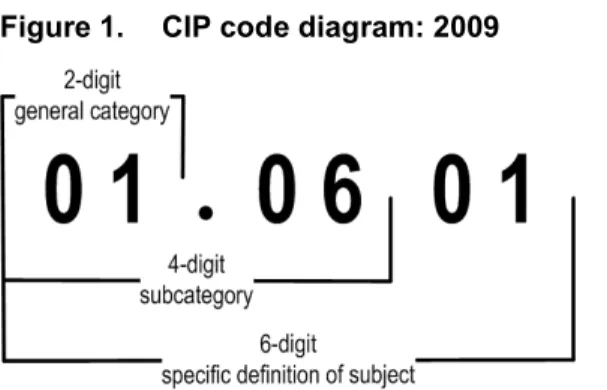
Earlier editions of the College Course Map were developed using faculty review groups in major disciplinary areas (e.g., mathematics, business, chemistry, allied health, English, etc.). These groups were provided descriptions from course catalogs and used NCES postsecondary transcript data to develop recommendations on coding and decision rules. CCM:2010 course codes were updated by integrating selected courses from the College Course Map (CCM) (Adelman, 2003) into the 2010 Classification of Instructional Programs (CIP) taxonomy from NCES. PETS codes were represented by six digits in keeping with the CIP taxonomy: the first 2-digits indicated the most general category; the first 4-digits narrowed the focus to a subcategory; and the complete 6-digit code provided the most specific definition of the subject. Figure 1 provides a visual representation of the structure of the codes.
Figure 1. CIP code diagram: 2009
NOTE: CIP = Classification of Instructional Programs.
SOURCE: U.S. Department of Education, National Center for Education Statistics, 2004/09 Beginning Postsecondary Students Longitudinal Study (BPS:04/09).
Course codes in the CCM taxonomy, which used the same 6-digit structure as the then-current CIP, were developed through extensive transcript analysis and with input from expert advisors, including postsecondary faculty familiar with the fields of study. To create a comprehensive course coder for PETS:09, content from the CCM was merged with the 2010 CIP in two ways: (1) course codes found in the CCM without equivalents in the CIP were added as new codes, and (2) CCM codes with equivalent CIP codes were reviewed and, when additional details or examples were found, they were added to the CIP definitions. The first method resulted in the addition of 352 unique CCM course codes to the CCM:2010. These additions were placed alongside related topics in the 2-digit
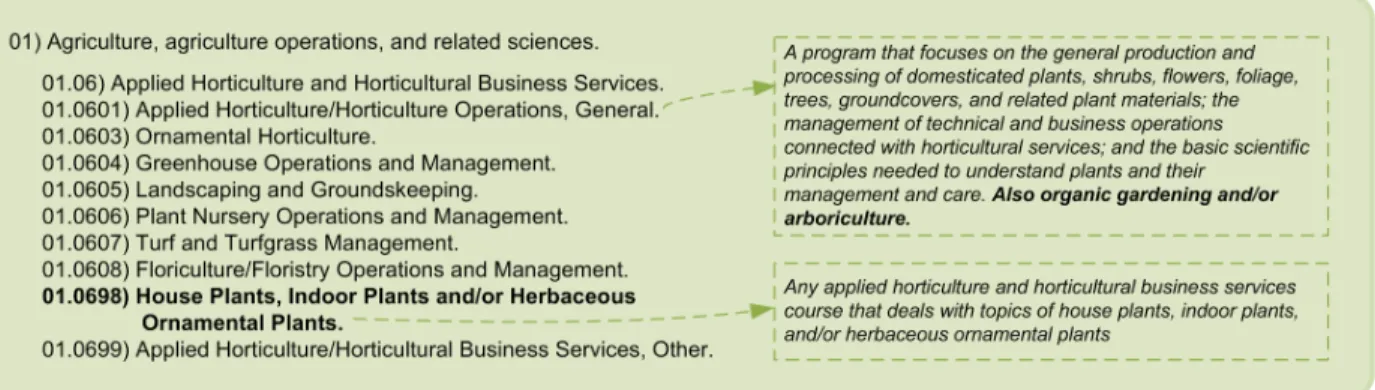
category and 4-digit subcategory structure common to both the CCM and CIP taxonomies. To make these additions easily identifiable, the last 2 digits in their codes used a unique numbering scheme, starting with 98 and descending as needed. An example can be seen in code 01.0698 in figure 2. The second method for integrating the CCM and the 2010 CIP resulted in adding content to the definitions of 316 CIP codes. The additional text increased the likelihood of identifying appropriate course codes using the keyword searchable coding system used in the BPS:04/09 and B&B:08/09 transcript collections. In instances where a CIP code was elaborated, the CCM content was placed at the end of the CIP definition. Finally, in addition to content from the CCM, 47 general and other codes were added to the CCM:2010 using fifth and sixth digit values of “00” for general and “99” for other, when these codes were not already present in the CIP. Figure 2 illustrates a representative set of codes in the CCM.
Figure 2. Course codes layout in the CCM:2010 codes: 2009
NOTE: Bold text represents content and codes added from the College Course Map taxonomy (CCM).
SOURCE: U.S. Department of Education, National Center for Education Statistics, 2004/09 Beginning Postsecondary Students Longitudinal Study (BPS:04/09).
The course codes are divided in the following families or course clusters, which are consistent with the 2010 CIP system for classifying programs:
01 Agriculture, Agriculture Operations, And Related Services
03 Natural Resources and Conservation
04 Architecture and Related Services
05 Area, Ethnic, Cultural, Gender, and Group Studies
09 Communication, Journalism, and Related Programs
10 Communications Technologies/Technicians and Support Services
11 Computer and Information Sciences and Support Services
12 Personal and Culinary Services
13 Education
14 Engineering
15 Engineering Technologies and Engineering-Related Fields 16 Foreign Languages, Literatures, and Linguistics
19 Family and Consumer Sciences/Human Sciences
23 English Language and Literature/Letters
24 Liberal Arts and Sciences, General Studies and Humanities
25 Library Science
26 Biological and Biomedical Sciences
27 Mathematics and Statistics
28 Military Science, Leadership and Operational Art. 29 Military Technologies and Applied Sciences 30 Multi/Interdisciplinary Studies
31 Parks, Recreation and Leisure Studies
32 Basic Skills and Developmental/Remedial Education
33 Citizenship Activities
34 Health-Related Knowledge and Skills
35 Interpersonal and Social Skills 36 Leisure and Recreational Activities
37 Personal Awareness and Self-Improvement
38 Philosophy and Religious Studies
39 Theology and Religious Vocations
40 Physical Sciences
41 Science and Technologies/Technicians
42 Psychology
43 Homeland Security, Law Enforcement, Firefighting and Related Protective Services 44 Public Administration and Social Service Professions
45 Social Sciences
46 Construction Trades
47 Mechanic and Repair Technologies/Technicians
48 Precision Production
49 Transportation and Materials Moving
50 Visual and Performing Arts
51 Health Professions and Related Programs
52 Business, Management, Marketing, and Related Support Services
53 High School/Secondary Diplomas and Certificates
54 History
60 Residency Programs
Code Categories
This section describes each six-digit code used to classify postsecondary education courses in the BPS:04/09 and B&B:08/09 studies.1
01 Agriculture, Agriculture Operations, and Related Services
01.0000 Agriculture, General.
A course that focuses on the general principles and practice of agricultural research and production and that may prepare individuals to apply this knowledge to the solution of practical agricultural problems. Includes instruction in basic animal, plant, and soil science; animal husbandry and plant cultivation; soil conservation; and agricultural operations such as farming, ranching, and agricultural business. Also, agriculture in society.
01.0101 Agricultural Business and Management, General.
A general course that focuses on modern business and economic principles involved in the organization, operation, and management of agricultural enterprises.
01.0102 Agribusiness/Agricultural Business Operations.
A course that prepares individuals to manage agricultural businesses and agriculturally related operations within diversified corporations. Includes instruction in agriculture, agricultural specialization, business management, accounting, finance, marketing,
planning, human resources management, and other managerial responsibilities. Examples include agricultural systems management.
01.0103 Agricultural Economics.
A course that focuses on the application of economics to the analysis of resource allocation, productivity, investment, and trends in the agricultural sector, both
domestically and internationally. Includes instruction in economics and related subfields as well as applicable agricultural fields.
01.0104 Farm/Farm and Ranch Management.
A course that prepares individuals to manage farms, ranches, and similar enterprises. Includes instruction in applicable agricultural specialization, business management, accounting, taxation, capitalization, purchasing, government programs and regulations, operational planning and budgeting, contracts and negotiation, and estate planning. 01.0105 Agricultural/Farm Supplies Retailing and Wholesaling.
A course that prepares individuals to sell agricultural products and supplies, provide support services to agricultural enterprises, and purchase and market agricultural products. Includes instruction in basic business management, marketing, retailing and wholesaling operations, and applicable principles of agriculture and agricultural operations.
01.0106 Agricultural Business Technology.
A course that prepares individuals to perform specialized support functions related to agricultural business offices and operations and to operate agricultural office equipment, software, and information systems. Includes instruction in basic agricultural business principles, office management, equipment operation, standard software, and database management.
01.0198 Agriculture Policy.
Any agriculture business and management course that deals with the topics of agriculture policy.
01.0199 Agricultural Business and Management, Other.
Any course in agricultural business and management not listed above. 01.0201 Agricultural Mechanization, General.
A course that generally prepares individuals to sell, select, and service agricultural or agribusiness technical equipment and facilities, including computers, specialized software, power units, machinery, equipment structures, and utilities. Includes instruction in agricultural power systems; planning and selecting materials for the construction of support facilities; mechanical practices associated with irrigation and water conservation; erosion control; and agricultural data processing systems. 01.0204 Agricultural Power Machinery Operation.
A course that prepares individuals to operate specialized farm, ranch, and agribusiness power equipment of a stationary, mobile, and/or hand-operated nature. Includes instruction in operating specialized equipment such as terrestrial and airborne crop spraying equipment; tractors and hauling equipment; planting and harvesting equipment; cutting equipment; power sources and systems for silos, irrigation, pumping, and
applications such as dairy, feeding and, shearing operations; processing equipment; and applicable electrical, mechanical, and safety principles.
01.0205 Agricultural Mechanics and Equipment/Machine Technology.
A course that prepares individuals to maintain and repair specialized farm, ranch, and agribusiness power equipment and vehicles. Includes instruction in the principles of diesel, combustion, electrical, steam, hydraulic, and mechanical systems and their application to the maintenance of terrestrial and airborne crop spraying equipment; tractors and hauling equipment; planting and harvesting equipment; cutting equipment; power sources and systems for silos; irrigation and pumping equipment; dairy, feeding and, shearing operations; and processing systems. Also agriculture skills and/or farm shop.
01.0298 Agricultural Soil/Water Practices, Hydrology, Irrigation and/or Tillage. Any agricultural mechanization course that deals with the topics of agricultural
soil/water practices, hydrology, irrigation, and/or tillage. Note: hydrology also appears in other codes; only hydrology courses dealing with agriculture mechanization belong in this code.
01.0299 Agricultural Mechanization, Other.
Any course in agricultural mechanization not listed above. Examples include agricultural irrigation.
01.0301 Agricultural Production Operations, General.
A course that focuses on the general planning, economics, and use of facilities, natural resources, equipment, labor, and capital to produce plant and animal products, and that may prepare individuals for work in farming, ranching, and agribusiness.
01.0302 Animal/Livestock Husbandry and Production.
A course that prepares individuals to select, breed, care for, process, and market livestock and small farm animals. Includes instruction in basic animal science, animal nutrition, and animal health as applied to various species and breeds; design and operation of housing, feeding, and processing facilities; and related issues of safety, applicable regulations, logistics, and supply. Also pasture production, large animal evaluation, animal agriculture, and/or meat animal evaluation.
01.0303 Aquaculture.
A course that prepares individuals to select, culture, propagate, harvest, and market domesticated fish, shellfish, and marine plants, both freshwater and saltwater. Includes instruction in the basic principles of aquatic and marine biology; health and nutrition of aquatic and marine life; design and operation of fish farms, breeding facilities, culture beds, and related enterprises; and related issues of safety, applicable regulations, logistics, and supply.
01.0304 Crop Production.
A course that prepares individuals to cultivate grain, fiber, forage, oilseed, fruits and nuts, vegetables, and other domesticated plant products. Includes instruction in basic
principles of plant science, health, and nutrition as applied to particular species and breeds; soil preparation and irrigation; pest management; planting and harvesting operations; product marketing; and applicable issues of safety, regulation, logistics, and supply. Also pasture production and/or greenhouse crop production. Examples include organic farming.
01.0306 Dairy Husbandry and Production.
A course that prepares individuals to manage the selection and care of dairy animals and associated dairy farm and processing facilities and operations. Includes instruction in basic animal and dairy science; dairy animal nutrition and health; design and operation of dairy housing, feeding, and processing facilities and equipment; and related issues of safety, sanitation, shipping and handling, and applicable regulations.
01.0307 Horse Husbandry/Equine Science and Management.
A course that prepares individuals to manage the selection, breeding, care, and maintenance of work, athletic, and show horses; and horse farms, stables, tracks and related equipment and operations. Includes instruction in applicable principles of animal science, care, and health; stable and track management; design and operation of facilities and equipment; and related issues such as regulations, business management; and logistics.
01.0308 Agroecology and Sustainable Agriculture.
A course that focuses on agricultural principles and practices that, over the long term, enhance environmental quality, make efficient use of nonrenewable resources, integrate natural biological cycles and controls, and are economically viable and socially
responsible; and that may prepare individuals to apply this knowledge to the solution of agricultural and environmental problems. Includes instruction in principles of
agroecology, crop and soil sciences, entomology, horticulture, animal science, weed science and management, soil fertility and nutrient cycling, applied ecology, agricultural economics, and rangeland ecology and watershed management. Examples include agroecology; sustainable agriculture.
01.0309 Viticulture and Enology.
A course that focuses on the application of scientific and agribusiness principles to the production of grapes, the making of wine, and the wine business. Includes instruction in grapes and wines of the world; grape production; winemaking technology; plant biology; chemistry; food science, safety, and packaging; soil science; pest management; and marketing and business management.
01.0398 Agricultural Supplies, Agricultural Chemicals and/or Farm Chemicals/Supplies. Any agricultural production operations course that deals with topics of agricultural supplies, agricultural chemicals, and/or farm chemicals/supplies.
01.0399 Agricultural Production Operations, Other.
Any course in agricultural production operations not listed above. 01.0401 Agricultural and Food Products Processing.
A course that prepares individuals to receive, inspect, store, process, and package agricultural products in the form of human food consumables, animal or plant food, or other industrial products. Includes instruction in the nutrient and industrial properties of various agricultural products; logistics and storage procedures; chemical and mechanical processing operations; packaging; safety and health requirements; and related technical and business principles.
01.0500 Agricultural and Domestic Animal Services, General.
Any course dealing with general topics of agricultural and domestic animal services. 01.0504 Dog/Pet/Animal Grooming.
A course that prepares individuals to provide cosmetic services for household pets, show animals, work animals and animal athletes. Includes instruction in skin, coat, and pelt grooming and styling; skin care; hoof, nail, and claw care; animal massage; minor first aid and veterinary referral; animal grooming products and applications; health and safety; and applicable regulations.
01.0505 Animal Training.
A course that prepares individuals to teach and exercise animals for leisure, sport, show, and professional purposes. Includes instruction in animal psychology, health, and safety; human-animal interaction; learning and behavior styles associated with different breeds and species; and the technical and pedagogical aspects of training animals for such
specific functions as obedient household pets, performing show animals, animal athletes, care-giving (e.g., seeing-eye dogs), search and rescue, and police/security work.
01.0507 Equestrian/Equine Studies.
A course that focuses on the horse, horsemanship, and related subjects and prepares individuals to care for horses and horse equipment; ride and drive horses for leisure, sport, show, and professional purposes; and manage the training of horses and riders. Includes instruction in horse breeding, nutrition, health, and safety; history of the horse and horsemanship; horse development and training; riding and equestrian technique; stable, paddock, and track management; and equipment maintenance and repair. Also dressage and/or rodeo.
01.0508 Taxidermy/Taxidermist.
A course that prepares individuals to reproduce life-like three-dimensional
representations of living animals for permanent display using elements of the deceased specimen(s) as well as artificial materials, and to manage taxidermy services and
businesses. Includes instruction in specimen grading and selection, caping and fleshing, preservation procedures, tanning, drying, measurements, form and armature
construction, carpentry and woodworking, molding and casting, drawing, sculptural techniques, painting and finishing techniques, basic business operations, customer communications, and applicable laws and regulations.
01.0599 Agricultural and Domestic Animals Services, Other.
Any course in agricultural and domestic animal services not listed above. 01.0601 Applied Horticulture/Horticultural Operations, General.
A course that focuses on the general production and processing of domesticated plants, shrubs, flowers, foliage, trees, groundcovers, and related plant materials; the management of technical and business operations connected with horticultural services; and the basic scientific principles needed to understand plants and their management and care. Also organic gardening and/or arboriculture.
01.0603 Ornamental Horticulture.
A course that focuses on domesticated plants and plant materials used for decorative and recreational applications and prepares individuals to breed, grow, and utilize ornamental plant varieties for commercial and aesthetic purposes. Includes instruction in applicable plant science subjects, the environmental design and artistic aspects of horticultural product usage, and the management of horticultural operations.
01.0604 Greenhouse Operations and Management.
A course that prepares individuals to produce, store, and deliver plant species in
controlled indoor environments for wholesale, commercial, research, or other purposes. Includes instruction in applicable principles of plant science; climate, irrigation, and nutrition control equipment operation and maintenance; facilities management; inventory control; safety procedures; and personnel supervision.
01.0605 Landscaping and Groundskeeping.
A course that prepares individuals to manage and maintain indoor and/or outdoor ornamental and recreational plants and groundcovers and related conceptual designs established by landscape architects, interior designers, enterprise owners or managers, and individual clients. Includes instruction in applicable principles of horticulture, gardening, plant and soil irrigation and nutrition, turf maintenance, plant maintenance, equipment operation and maintenance, personnel supervision, and purchasing.
01.0606 Plant Nursery Operations and Management.
A course that prepares individuals to operate and manage outdoor plant farms, tree and shrub nurseries, and related facilities that develop domesticated plant products for propagation, harvesting, and transplantation. Includes instruction in applicable principles of plant science; farm and business management; nursery operations; equipment
operation and maintenance; safety procedures; and personnel supervision. 01.0607 Turf and Turfgrass Management.
A course that focuses on turfgrasses and related groundcover plants and prepares individuals to develop ornamental or recreational grasses and related products; plant, transplant, and manage grassed areas; and to produce and store turf used for
transplantation. Includes instruction in applicable plant sciences, genetics of grasses, turf science, use analysis, turf management, and related economics. Examples include golf and sports turf management.
01.0608 Floriculture/Floristry Operations and Management.
A course that prepares individuals to operate and manage commercial and contract florist enterprises, supply and delivery services, and flower catering services. Includes instruction in the applicable principles of plant science; purchasing, storage, and delivery systems; floral design and arranging; and principles of business management.
01.0698 House Plants, Indoor Plants and/or Herbaceous Ornamental Plants.
Any applied horticulture and horticultural business services course that deals with topics of house plants, indoor plants, and/or herbaceous ornamental plants.
01.0699 Applied Horticulture/Horticultural Business Services, Other.
Any course in horticultural service operations not listed above. Examples include aborist; aboriculture.
01.0701 International Agriculture.
A course that focuses on the application of agricultural management and scientific principles to the problems of global food production and distribution, and to the study of the agricultural systems of other countries. Includes instruction in agricultural economics; comparative agricultural systems; international agribusiness and law; third-world development studies and economic development; and global applications of climate, soil, water resources, ecological and environmental studies, and animal and plant sciences.
01.0800 Agricultural Public Services, General.
01.0801 Agricultural and Extension Education Services.
A course that prepares individuals to provide referral, consulting, technical assistance, and educational services to gardeners, farmers, ranchers, agribusinesses, and other organizations. Includes instruction in basic agricultural sciences, agricultural business operations, pest control, adult education methods, public relations, applicable state laws and regulations, and communication skills.
01.0802 Agricultural Communication/Journalism.
A course that prepares individuals to apply journalistic, communication, and
broadcasting principles to the development, production, and transmittal of agricultural information. Includes instruction in basic journalism, broadcasting, film/video, and communication techniques; the production of technically specialized information products for agricultural audiences; and the principles of agricultural sciences and business operations needed to develop and communicate agricultural subject matter in effective ways.
01.0899 Agricultural Public Services, Other.
Any course in general agricultural sciences and related services not listed above. 01.0901 Animal Sciences, General.
A general course that focuses on the scientific principles that underlie the breeding and husbandry of agricultural animals, and the production, processing, and distribution of agricultural animal products. Includes instruction in the animal sciences, animal husbandry and production, and agricultural and food products processing. 01.0902 Agricultural Animal Breeding.
A course that focuses on the application of genetics and genetic engineering to the improvement of agricultural animal health, the development of new animal breeds, and the selective improvement of agricultural animal populations. Includes instruction in genetics, genetic engineering, population genetics, animal health, animal husbandry, and biotechnology. Also animal reproduction, animal artificial insemination and/or animal sire selection.
01.0903 Animal Health.
A course that focuses on the application of biological and chemical principles to the study, prevention, and control of diseases in agricultural animal populations. Includes instruction in environmental science, pharmacology, animal population studies, genetics, animal physiology and diet, disease prevention, treatment methodologies, and laboratory and testing procedures.
01.0904 Animal Nutrition.
A course that focuses on the biology and chemistry of proteins, fats, carbohydrates, water, vitamins, and feed additives as related to animal health and the production of improved animal products. Includes instruction in nutrition science, animal health and physiology, biochemistry, cellular and molecular biology, animal husbandry, and food science.
01.0905 Dairy Science.
A course that focuses on the application of biological and chemical principles to the production and management of dairy animals and the production and handling of dairy products. Includes instruction in animal sciences, nutrition sciences, food science and technology, biochemistry, and related aspects of human and animal health and safety. 01.0906 Livestock Management.
A course that focuses on the application of biological and chemical principles to the production and management of livestock animals and the production and handling of meat and other products. Includes instruction in animal sciences, range science, nutrition sciences, food science and technology, biochemistry, and related aspects of human and animal health and safety. Examples include livestock management; meat science. 01.0907 Poultry Science.
A course that focuses on the application of biological and chemical principles to the production and management of poultry animals and the production and handling of poultry products. Includes instruction in avian sciences, nutrition sciences, food science and technology, biochemistry, hatchery design, and related aspects of human and animal health and safety.
01.0998 Anatomy of Domestic Animals, Physiology of Domestic Animals and/or Animal
Growth.
Any animal sciences course that deals with the topics of anatomy of domestic animals, physiology of domestic animals, and/or animal growth.
01.0999 Animal Sciences, Other.
Any course in the animal sciences not listed above. 01.1001 Food Science.
A course that focuses on the application of biological, chemical, and physical principles to the study of converting raw agricultural products into processed forms suitable for direct human consumption, and the storage of such products. Includes instruction in applicable aspects of the agricultural sciences, human physiology and nutrition, food chemistry, agricultural products processing, food additives, food preparation and packaging, food storage and shipment, and related aspects of human health and safety including toxicology and pathology. Examples include food safety.
01.1002 Food Technology and Processing.
A course that focuses on the application of chemical, physical, and engineering principles to the development and implementation of manufacturing, packaging, storage, and distribution technologies and processes for food products. Includes instruction in food engineering, food preservation and handling, food preparation, food packaging and display, food storage and shipment, and related equipment and facilities design, operation, and maintenance. Also food systems.
01.1099 Food Science and Technology, Other.
01.1101 Plant Sciences, General.
A general course that focuses on the scientific principles that underlie the breeding, cultivation, and production of agricultural plants, and the production, processing, and distribution of agricultural plant products. Includes instruction in the plant sciences, crop cultivation and production, and agricultural and food products processing.
01.1102 Agronomy and Crop Science.
A course that focuses on the chemical, physical, and biological relationships of crops and the soils nurturing them. Includes instruction in the growth and behavior of agricultural crops, the development of new plant varieties, and the scientific management of soils and nutrients for maximum plant nutrition, health, and productivity. Also seed biology and/or tree fruit science.
01.1103 Horticultural Science.
A course that focuses on the scientific principles related to the cultivation of garden and ornamental plants, including fruits, vegetables, flowers, and landscape and nursery crops. Includes instruction in specific types of plants, such as citrus; breeding horticultural varieties; physiology of horticultural species; and the scientific management of horticultural plant development and production through the life cycle.
01.1104 Agricultural and Horticultural Plant Breeding.
A course that focuses on the application of genetics and genetic engineering to the improvement of agricultural plant health, the development of new plant varieties, and the selective improvement of agricultural plant populations. Includes instruction in genetics, genetic engineering, population genetics, agronomy, plant protection, and biotechnology.
01.1105 Plant Protection & Integrated Pest Management.
A course that focuses on the application of scientific principles to the control of animal, insect and weed infestation of domesticated plant populations and other settings, including agricultural crops; the prevention/reduction of attendant economic loss; and the control of environmental pollution and degradation related to pest infestation and pest control measures. Includes instruction in entomology, applicable animal sciences, plant pathology and physiology, weed science, crop science, and environmental toxicology. Also herbicides and/or insecticides. Examples include pest management; extermination.
01.1106 Range Science and Management.
A course that focuses on the scientific study of rangelands, arid regions, grasslands, and other areas of low productivity, as well as the principles of managing such resources for maximum benefit and environmental balance. Includes instruction in livestock
management, wildlife biology, plant sciences, ecology, soil science, and hydrology. 01.1198 Horticultural Botany, Plant Propagation and/or Plant Nutrition.
Any plant sciences course that deals with the topics of horticultural botany, plant propagation and/or plant nutrition.
01.1199 Plant Sciences, Other.
Any course in plant sciences not listed above. 01.1201 Soil Science and Agronomy, General.
A course that generally focuses on the scientific classification of soils, soil properties, and their relationship to agricultural crops. Includes instruction in soil chemistry, soil physics, soil biology, soil fertility, morphogenesis, mineralogy, hydrology, agronomy, and soil conservation and management. Also soil pollution, soil systems, fertilizers, fertilizers and plant nutrition and/or soil resources.
01.1202 Soil Chemistry and Physics.
A course that focuses on the application of chemical and physical principles to research and analysis concerning the nature and properties of soils and the conservation and management of soils. Includes instruction in soil and fluid mechanics, mineralogy, sedimentology, thermodynamics, geomorphology, environmental systems, analytical methods, and organic and inorganic chemistry.
01.1203 Soil Microbiology.
A course that focuses on application of microbiological theory and methods to the study of the organismic properties of soils, soil-plant and soil-animal interactions, and the biological components and effects of soil management strategies. Includes instruction in microbiology and related biological sciences, applicable animal and plant sciences, soil chemistry and physics as related to biological characteristics, and environmental science. 01.1299 Soil Sciences, Other.
Any course in the soil sciences not listed above. Examples include environmental soil science.
01.9997 Agriculture Co-Op/Work Experience.
Any agriculture, agriculture operations, and related sciences course that deals with topics of agriculture co-op/work experience.
01.9998 Computer Applications in Agriculture and Agriculture Data Management.
Any agriculture, agriculture operations, and related sciences course that deals with topics of computer applications in agriculture and agriculture data management.
01.9999 Agriculture, Agriculture Operations and Related Sciences, Other.
Any course in agriculture, agricultural operations, and related sciences not listed above.
03 Natural Resources and Conservation
03.0101 Natural Resources/Conservation, General.
A general course that focuses on the studies and activities relating to the natural environment and its conservation, use, and improvement. Includes instruction in
subjects such as climate, air, soil, water, land, fish and wildlife, and plant resources; in the basic principles of environmental science and natural resources management; and the recreational and economic uses of renewable and nonrenewable natural resources.
03.0103 Environmental Studies.
A course that focuses on environment-related issues using scientific, social scientific, or humanistic approaches or a combination. Includes instruction in the basic principles of ecology and environmental science and related subjects such as policy, politics, law, economics, social aspects, planning, pollution control, natural resources, and the
interactions of human beings and nature. Also international environmental issues and/or international environmental policy. Examples include ecosystem studies.
03.0104 Environmental Science.
A course that focuses on the application of biological, chemical, and physical principles to the study of the physical environment and the solution of environmental problems, including subjects such as abating or controlling environmental pollution and
degradation; the interaction between human society and the natural environment; and natural resources management. Includes instruction in biology, chemistry, physics, geosciences, climatology, statistics, and mathematical modeling. Also environmental technology. Examples include bioenvironmental sciences.
03.0199 Natural Resources Conservation and Research, Other.
Any course in natural resources conservation and research not listed above. 03.0201 Natural Resources Management and Policy.
A course that prepares individuals to plan, develop, manage, and evaluate programs to protect and regulate natural habitats and renewable natural resources. Includes
instruction in the principles of wildlife and conservation biology, environmental science, animal population surveying, natural resource economics, management techniques for various habitats, applicable law and policy, administrative and communications skills, and public relations. Also energy and natural resources, resource measurements, water rights and/or water quality. Examples include ecosystem management.
03.0204 Natural Resource Economics.
A course that focuses on the application of economic concepts and methods to the analysis of issues such as air and water pollution, land use planning, waste disposal, invasive species and pest control, conservation policies, and related environmental problems. Includes instruction in cost-benefit analysis; environmental impact
assessment; evaluation and assessment of alternative resource management strategies; policy evaluation and monitoring; and descriptive and analytic tools for studying how environmental developments affect the economic system. Also economics of
environment.
03.0205 Water, Wetlands, and Marine Resources Management.
A course that prepares individuals to apply the principles of marine/aquatic biology, oceanography, natural resource economics, and natural resources management to the development, conservation, and management of freshwater and saltwater environments. Includes instruction in subjects such as wetlands, riverine, lacustrian, coastal, and oceanic water resources; water conservation and use; flood control; pollution control; water supply logistics; wastewater management; aquatic and marine ecology; aquatic and marine life conservation; and the economic and recreational uses of water resources.
03.0206 Land Use Planning and Management/Development.
A course that focuses on how public and/or private land and associated resources can be preserved, developed, and used for maximum social, economic, and environmental benefit. Includes instruction in natural resources management, natural resource economics, public policy, regional and land use planning, environmental impact assessment, applicable law and regulations, government and politics, principles of business and real estate land use, statistical and analytical tools, computer applications, mapping and report preparation, site analysis, cost analysis, and communications skills. 03.0207 Natural Resource Recreation and Tourism.
A course that prepares individuals to plan, develop, and manage tourism in a natural resource setting, with an emphasis on applying environmentally sound, culturally
sensitive, and economically sustainable principles. Includes instruction in environmental studies; natural resource management and interpretation; tourism planning, management, and policies; public land use management and policies; communications; marketing; and public relations. Examples include ecotourism; resource recreation and tourism; nature-based tourism; natural resources interpretation; hunting and fishing guide.
03.0208 Natural Resources Law Enforcement and Protective Services.
A course that prepares individuals to enforce natural resource and environmental protection regulations and laws; and to perform emergency duties to protect human life, property and natural resources, including fire prevention and control measures, and emergency and rescue procedures. Includes instruction in natural and physical sciences, natural resource management, outdoor field skills, firearms and outdoor equipment and vehicle operation, evidence collection and environmental sampling and monitoring, natural resource legislation, environmental compliance techniques, patrol procedures, investigation and report writing, interpersonal skills and crisis intervention, community liaison, public safety, public education, and public relations. Note: this program was re-instated after being deleted from CIP 2000; previously, it was coded as 03.0203. 03.0298 National Parks/Parklands and Geology of National Parks.
Any natural resources management and policy that deals with topics of national parks/parklands and geology of national parks.
03.0299 Natural Resources Management and Policy, Other.
Any course in natural resources management and policy not listed above. 03.0301 Fishing and Fisheries Sciences and Management.
A course that focuses on the scientific study of the husbandry and production of non-domesticated fish and shellfish populations for recreational and commercial purposes and the management of fishing and marine/aquatic product processing to ensure adequate conservation and efficient utilization. Includes instruction in the principles of marine/aquatic biology, freshwater and saltwater ecosystems, water resources, fishing production operations and management, fishing policy and regulation, and the management of recreational and commercial fishing activities. Also fish culture.
03.0501 Forestry, General.
A course that generally prepares individuals to manage and develop forest areas for economic, recreational, and ecological purposes. Includes instruction in forest-related sciences, mapping, statistics, harvesting and production technology, natural resources management and economics, wildlife sciences, administration, and public relations. Also conservation of forest resources.
03.0502 Forest Sciences and Biology.
A course that focuses on the application of one or more forest-related sciences to the study of environmental factors affecting forests and the growth and management of forest resources. Includes instruction in forest biology, forest hydrology, forest mensuration, silviculture, forest soils, water resources, environmental science, forest resources management, and wood science. Also dendrology, tree growth and development and/or forest pathology.
03.0506 Forest Management/Forest Resources Management.
A course that prepares individuals to apply principles of forestry and natural resources management to the administration of forest lands and related resources. Includes
instruction in silviculture, forest mensuration, forest protection, inventorying, biometrics, geographic information systems, remote sensing, photogrammetry, forest policy and economics, forest land use planning, fire protection and management, and related administrative skills. Examples include silvicutlure; sylviculture.
03.0508 Urban Forestry.
A course that prepares individuals to apply the principles of forestry and related sciences to the development, care, and maintenance of individual trees and forested areas within or close to areas of dense human habitation. Includes instruction in urban environments; effects of pollution on tree species; environmental design and landscaping; urban pest infestation; urban forest management; and applicable policies and regulations.
03.0509 Wood Science and Wood Products/Pulp and Paper Technology.
A course that focuses on the application of chemical, physical, and engineering principles to the analysis of the properties and behavior of wood and wood products and the development of processes for converting wood into paper and other products. Includes instruction in wood classification and testing, product development, manufacturing and processing technologies, and the design and development of related equipment and systems.
03.0510 Forest Resources Production and Management.
A course that focuses on the application of forestry principles to the production, harvesting, and processing of forest resources and that prepares individuals to perform associated technical and managerial functions. Includes instruction in forest production and utilization, industrial forestry, agroforestry, transplantation, timber harvesting, selection and identification of trees, processing technologies and systems, equipment operations and maintenance, and related management skills. Also farm forestry.
03.0511 Forestry Technology/Technician.
A course that prepares individuals to assist foresters in the management and production of forest resources. Includes instruction in woods and field skills, tree identification, timber measurement, logging and timber harvesting, forest propagation and
regeneration, forest fire-fighting, resource management, equipment operation and maintenance, record-keeping, sales and purchasing operations, and personnel supervision.
03.0599 Forestry, Other.
Any course in forestry not listed above.
03.0601 Wildlife, Fish and Wildlands Science and Management.
A course that prepares individuals to conserve and manage wilderness areas and the flora, fauna, marine and aquatic life therein, and manage wildlife reservations and zoological/aquarium facilities for recreational, commercial, and ecological purposes. Includes instruction in wildlife biology; marine/aquatic biology; environmental science; freshwater and saltwater ecosystems; natural resources management and policy; outdoor recreation and parks management; the design and operation of natural and artificial wildlife habitats; applicable law and regulations; and related administrative and communications skills.
03.9998 Renewable Natural Resources.
Any natural resources and conservation course that deals with the other topics of renewable natural resources.
03.9999 Natural Resources and Conservation, Other.
Any course in natural resources and conservation not listed above. Examples include hunting and trapping.
04 Architecture and Related Services
04.0201 Architecture.
A course that prepares individuals for the independent professional practice of
architecture and to conduct research in various aspects of the field. Includes instruction in architectural design, history, and theory; building structures and environmental systems; project and site planning; construction; professional responsibilities and standards; and related cultural, social, economic, and environmental issues. Also architecture design studio, housing design and/or architecture methods.
04.0298 Architecture and Human Behavior.
Any architecture and related services course that deals with topics of architecture and human behavior.
04.0301 City/Urban, Community and Regional Planning.
A course that prepares individuals to apply principles of planning, analysis, and architecture to the development and improvement of urban areas and surrounding regions, and to function as professional planners. Includes instruction in principles of architecture; master plan development; service, communications, and transportation
systems design; community and commercial development; zoning; land use planning; applied economics; policy analysis; applicable laws and regulations; and professional responsibilities and managerial duties. Also cityscape, streetscape, modern city and/or urban form. Examples include urban design.
04.0398 Rural Development.
Any city/urban, community and regional planning course that deals with topics of rural development.
04.0401 Environmental Design/Architecture.
A course that prepares individuals to design public and private spaces, indoor and outdoor, for leisure, recreational, commercial, and living purposes, and for professional practice as environmental designers and architects. Includes instruction in the design and planning of public and private open spaces and their relationship to buildings and other aspects of the built environment; facilities management; related aspects of interior design and architecture, landscape architecture, and urban planning; and professional
responsibilities and standards. Also environmental systems, energy conscious design and/or barrier free environment.
04.0501 Interior Architecture.
A course that prepares individuals to apply architectural principles in the design of structural interiors for living, recreational, and business purposes and to function as professional interior architects. Includes instruction in architecture, structural systems design, heating and cooling systems, occupational and safety standards, interior design, specific end-use applications, and professional responsibilities and standards. Also interior design theory, interior design techniques, commercial space, and renovation. 04.0601 Landscape Architecture.
A course that prepares individuals for the independent professional practice of landscape architecture and research in various aspects of the field. Includes instruction in geology and hydrology; soils, groundcovers, and horticultural elements; project and site planning; landscape design, history, and theory; environmental design; applicable law and
regulations; and professional responsibilities and standards. 04.0801 Architectural History and Criticism, General.
A general course that focuses on the aesthetic, technical, and social development of the built environment and the architectural profession from earliest times to the present. Includes instruction in the principles of architecture and related fields; art history; historiography of architecture; architectural theory and criticism; related aspects of the history of technology and social and economic history; and various period, cultural, and stylistic specializations. Also appreciation of architecture.
04.0901 Architectural Technology/Technician.
A course that prepares individuals to assist architects in developing plans and related documentation and in performing architectural office services. Includes instruction in architectural drafting, computer-assisted drafting and design, construction methods and materials, environmental systems, building codes and standards, structural principles,
cost estimation, planning documentation, visual communication skills, display production, and architectural office management.
04.0902 Architectural and Building Sciences/Technology.
A course that focuses on the application of advanced technology to building design and construction, retrofitting existing buildings, and efficient operation of buildings,
including lighting and daylight design, acoustics, solar design, building conservation, and energy-conscious design. Includes instruction in architecture, building technology, civil and structural engineering, mechanical engineering, environmental control systems, sustainability, and computer tools and applications.
04.0999 Architectural Sciences and Technology, Other. Any course in architecture not listed above. 04.1001 Real Estate Development.
A course that prepares individuals to create and redevelop housing, offices, retail centers, and industrial sites. Includes instruction in architectural design and construction, historic preservation, landscape architecture, urban planning and design, business, real estate and land use law, public policy, and engineering.
04.9999 Architecture and Related Services, Other.
Any course in architecture and related topics not listed above.
05 Area, Ethnic, Cultural, Gender, and Group Studies
05.0100 Area Studies, General.
Any course dealing with general topics of area studies. 05.0101 African Studies.
A course that focuses on the history, society, politics, culture, and economics of one or more of the peoples of the African Continent, usually with an emphasis on Africa south of the Sahara, and including the African diaspora overseas. Also African civilizations, african development, pan-african studies and/or sub-saharan political economy. 05.0102 American/United States Studies/Civilization.
A course that focuses on the history, society, politics, culture, and economics of the United States and its Pre-Columbian and colonial predecessors, and including the flow of immigrants from other societies. Also American character, American utopias, American dreams and/or American ideals.
05.0103 Asian Studies/Civilization.
A course that focuses on the history, society, politics, culture, and economics of one or more of the peoples of the Asian Continent, including the study of the Asian diasporas overseas. Also traditional Asian ideas, traditional Asian values and/or traditional Asian psychology.
05.0104 East Asian Studies.
A course that focuses on the history, society, politics, culture, and economics of one or more of the peoples of East Asia, defined as including China, Korea, Japan, Mongolia, Taiwan, Tibet, related borderlands and island groups, and including the study of the East Asian diasporas overseas. Also civilizations of east asia and east asian humanities.
05.0105 Russian, Central European, East European and Eurasian Studies.
A course that focuses on the history, society, politics, culture, and economics of the region encompassing Russia, Central Europe, Eastern Europe, and Eurasia, including the Balkans, Baltic, Caucasus, and Central Asian states that were republics of the former Soviet Union. Examples include Russian and East European studies; Central and Eastern European studies; CIS studies.
05.0106 European Studies/Civilization.
A course that focuses on the history, society, politics, culture, and economics of one or more of the peoples of the European Continent, including the study of European migration patterns and colonial empires. Also European Union and/or European integration.
05.0107 Latin American Studies.
A course that focuses on the history, society, politics, culture, and economics of one or more of the Hispanic peoples of the North and South American Continents outside Canada and the United States, including the study of the Pre-Columbian period and the flow of immigrants from other societies. Also Latin American civilization and/or Latin American institutions.
05.0108 Near and Middle Eastern Studies.
A course that focuses on the history, society, politics, culture, and economics of one or more of the peoples of North Africa, Southwestern Asia, Asia Minor, and the Arabian Peninsula, related borderlands and island groups, and including emigrant and immigrant groups. Also Arab world, Arab culture, Arab society and/or Arab-Israeli conflict. Examples include Modern Middle Eastern studies.
05.0109 Pacific Area/Pacific Rim Studies.
A course that focuses on the history, society, politics, culture, and economics of one or more of the peoples of Australasia and the Pacific Ocean, related island groups and bordering coastal regions, and including pre- and post-colonial migration patterns. 05.0110 Russian Studies.
A course that focuses on the history, society, politics, culture, and economics of one or more of the peoples of the Russian Federation and its Soviet, Czarist, and medieval predecessors and related borderlands. Also ethnicity in the former Union of Soviet Socialist Republics.
05.0111 Scandinavian Studies.
A course that focuses on the history, society, politics, culture, and economics of one or more of the peoples of Scandinavia, defined as Northern Europe including Denmark,
Finland, Iceland, Norway, Sweden, related island groups (including Greenland), and borderlands.
05.0112 South Asian Studies.
A course that focuses on the history, society, politics, culture, and economics of one or more of the peoples of South Asia, defined as including Afghanistan, India, the
Maldives, Myanmar (Burma), Pakistan, and Sri Lanka and related borderlands and island groups; and including the study of migration patterns and overseas diasporas. Also South Asian identities.
05.0113 Southeast Asian Studies.
A course that focuses on the history, society, politics, culture, and economics of one or more of the peoples of Southeast Asia, defined as including Brunei, Cambodia,
Indonesia, Laos, Malaysia, The Philippines, Singapore, Thailand, and Viet Nam; related borderlands and island groups; and including the study of migration patterns and overseas diasporas.
05.0114 Western European Studies.
A course that focuses on the history, society, politics, culture, and economics of one or more of the peoples of historical Western Europe, defined as including Britain, Ireland, France, the Low Countries, the Iberian Peninsula, Italy, the Western Mediterranean, and related island groups and borderlands.
05.0115 Canadian Studies.
A course that focuses on the history, society, politics, culture, and economics of one or more of the peoples of Canada and its Pre-Columbian, colonial, and pre-federation predecessors, including immigrant flows and related borderlands and island groups. Also Canadian art.
05.0116 Balkans Studies.
A course that focuses on the history, society, politics, culture, and economics of one or more of the peoples inhabiting the Balkan Peninsula and associated island groups and borderlands, Southern Slavic and non-Slavic, during the medieval, Ottoman, and modern periods.
05.0117 Baltic Studies.
A course that focuses on the history, society, politics, culture, and economics of one or more of the peoples inhabiting the coastlands of the Baltic Sea, including Baltic,
Germanic, Scandinavian, and Slavic populations, related borderlands and island groups, and problems of cultural survival and assimilation.
05.0118 Slavic Studies.
A course that focuses on the history, society, politics, culture, and economics of one or more of the Slavic peoples inhabiting Europe, Asia, and in immigrant groups elsewhere, including the study of the emergence and migration patterns of Slavic culture, languages, and populations.
05.0119 Caribbean Studies.
A course that focuses on the history, society, politics, culture, and economics of one or more of the peoples inhabiting the major islands and archipelagoes of the Caribbean Sea and related coastal borderlands, including immigration patterns and Pre-Columbian, colonial, and modern societies.
05.0120 Ural-Altaic and Central Asian Studies.
A course that focuses on the history, society, politics, culture, and economics of one or more of the peoples and countries of Inner/Central Asia, including the Turkic and Mongolian inhabitants of the Caspian, Amur, Tien Shan, Baikal, Gobi, Siberian, and Manchurian areas and the historical Silk Road, in terms of their past and present development.
05.0121 Commonwealth Studies.
A course that focuses on the history, society, politics, culture, and economics of one or more of the peoples and countries comprising components of the historical British Empire and modern British Commonwealth, including migration patterns, shared sociocultural and political features and problems, and contemporary relations. 05.0122 Regional Studies (U.S., Canadian, Foreign).
A course that focuses on the defined geographic subregions and subcultures within modern and historical countries and societies. Includes such topics as Acadian Studies, French Canadian and Quebec Studies, Southern (U.S.) Studies, Appalachian (U.S.) Studies, New England Studies, Southwestern Studies, Northern Studies, and others. 05.0123 Chinese Studies.
A course that focuses on the history, society, politics, culture, and economics of one or more of the peoples of present-day China and its historical predecessors, related borderlands and island groups, and the overseas Chinese diaspora.
05.0124 French Studies.
A course that focuses on the history, society, politics, culture, and economics of France, other Francophone countries inside and outside Europe, and the French colonial experience and the associated French minorities around the world.
05.0125 German Studies.
A course that focuses on the history, society, politics, culture, and economics of
Germany, the neighboring countries of Austria and Switzerland, the German minorities in neighboring European countries, and the historical areas of German influence across Europe and overseas.
05.0126 Italian Studies.
A course that focuses on the history, society, politics, culture, and economics of modern Italy and its predecessors on the Italian Peninsula, including overseas migrations of Italian peoples.
05.0127 Japanese Studies.
A course that focuses on the history, society, politics, culture, and economics of the peoples of Japan, and related island groups and coastal neighbors.
05.0128 Korean Studies.
A course that focuses on the history, society, politics, culture, and economics of the peoples of Korea, including related island groups and borderlands.
05.0129 Polish Studies.
A course that focuses on the history, society, politics, culture, and economics of Poland and the current and historical inhabitants of the Polish lands, including borderlands, from earliest times to the present.
05.0130 Spanish and Iberian Studies.
A course that focuses on the history, society, politics, culture, and economics of the peoples of the Iberian Peninsula and related island groups and border regions from earliest times to the present, with particular emphasis on the development of Spain and Portugal but including other historical and current cultures.
05.0131 Tibetan Studies.
A course that focuses on the history, society, politics, culture, and economics of Tibet and its borderlands, with emphasis on both pre-modern and modern Tibet and associated religious and exile movements.
05.0132 Ukraine Studies.
A course that focuses on the history, society, politics, culture, and economics of the Ukraine and its inhabitants, and related border regions, from earliest times to the present.
05.0133 Irish Studies.
A course that focuses on the history, society, politics, culture, and economics of Ireland and the Irish Diaspora, from the early Christian period to the present.
05.0134 Latin American and Caribbean Studies.
An integrated course that focuses on the history, society, politics, culture, and economics of the peoples and countries of the Latin American and Caribbean region.
05.0199 Area Studies, Other.
Also other courses dealing with topics of western and/or non-western cultures, civilizations, or societies in general.
05.0200 Ethnic Studies.
A course that focuses on the interdisciplinary and comparative study of the history, sociology, politics, culture, and economics of North American racial and ethnic groups, including African Americans, American Indians/Native Americans, Hispanic Americans, and Asian Americans. Examples include comparative ethnic studies; race and ethnicity.
05.0201 African-American/Black Studies.
A course that focuses on the history, sociology, politics, culture, and economics of the North American peoples descended from the African diaspora; focusing on the United States, Canada, and the Caribbean, but also including reference to Latin American elements of the diaspora. Also Afro-American folklore, Afro-American community development, Afro-American dance, Afro-American family, Afro-American church, Afro-American heritage, black writers, black artists and/or black consciousness. 05.0202 American Indian/Native American Studies.
A course that focuses on the history, sociology, politics, culture, and economics of one or more of the American Indian, Aleut, Inuit, Hawaiian and other native peoples of the Americas from earliest times until the present, with particular emphasis on U.S. and Canadian populations and their problems but including reference to Caribbean and Latin American native peoples. Also Native American folklore.
05.0203 Hispanic-American, Puerto Rican, and Mexican- American/Chicano Studies.
A course that focuses on the history, sociology, politics, culture, and economics of one or more of the Hispanic American immigrant populations within the U.S. and Canada, including Mexican-American Studies, Cuban American Studies, Puerto Rican Studies, and others.
05.0206 Asian-American Studies.
A course that focuses on the history, sociology, politics, culture, and economics of Asian population groups who have immigrated to the United States and Canada, or sought refugee asylum, from the colonial period to the present, and including Chinese-Americans, Japanese-Chinese-Americans, Korean-Chinese-Americans, Vietnamese-Chinese-Americans,
Cambodian-Americans, and others. Also Asians (Chinese, Vietnamese, Filipino, etc.) In America, Asian-American literature, Asian-American child, Asian-American media and/or Asian-American institutions.
05.0207 Women’s Studies.
A course that focuses on the history, sociology, politics, culture, and economics of women, and the development of modern feminism in relation to the roles played by women in different periods and locations in North America and the world. Courses may focus on literature, philosophy, and the arts as much as on social studies and policy. Also women and the law, women in business, women in music, women in film, women’s psychology and/or psychology of women. Examples include women’s and gender studies.
05.0208 Gay/Lesbian Studies.
A course that focuses on homosexuality in history, society, politics, and cultural life; usually with an emphasis on the modern emergence of gays and lesbians as a
sociocultural minority movement, the identification of social, literary, and artistic themes and the definition of, and public policy and legal issues surrounding the gay and lesbian community.