Deep learning, then, is not a matter of figuring out the truth. Deep learning is the embodiment of new capabilities for effective action. Embodiment is a developmental process that occurs over time, in a continuous cycle of theoretical action and practical conceptualization. The impatient quest for improve-ment all too often results in superficial changes that leave deeper patterns untouched. Herein lays the core leadership paradox: Action is critical, but the action we need can spring only from a reflective stance. (Kofman & Senge, 2001, p. 5)
The notion of a continuous cycle of theory and practice happening with ample reflection is enticing and downright challenging. Foundation program staff look for tools and processes to help them manage multisite initiatives and support the type of self-assessment and critique that is necessary for this continuous cycle to actually lead to community results. Often outside tools are not aligned with specific foundation values such as resident engagement or collaboration, or with the strategies particular to a specific initiative. This article is about one foundation’s efforts to encourage and engage in deep learning through the assessment of community collabora-tive success. It is about a grounded approach to developing a self-assessment tool and about the foundation learning that occurred in the process of developing that tool. Although it is common to talk about communities sharing in the framing of community problems or issues, in the end this is a story about how a foundation and its community consultants worked with grantees to develop a shared language to frame not issues, but success.
Community collaboration as an approach to com-munity change has a long history as both theory and as a practical foundation strategy for improv-ing the effectiveness of services for children and families through community-based approaches. Collaboration has been explored in areas such as education, health, economic security, and housing as well as with more comprehensive intercon-nected concerns (Frost & Stone, 2009; Innes & Rongerude, 2005; Shaver, Golan, & Wagner, 1996). Initially referred to solely in relation to interorganizational or interagency efforts, col-laboration’s meaning has expanded to include broader involvement predominantly through promotion of various forms of neighborhood-based and comprehensive community efforts.
Constructing Collaborative
Success for Network Learning:
The Story of the Discovery
Community Self-Assessment Tool
Angela Frusciante, Ph.D., and Carmen Siberon, M.P.H., William Caspar Graustein Memorial Fund
Key Points
· Despite conversations about the importance of community collaboration, foundations continue to struggle with how to best frame and support col-laborative success.
· Existing tools to assess collaboration may not fit with either a foundation’s values or a specific program strategy.
· From a foundation perspective, developing a community self-assessment tool reinforced the idea that collaborative functioning is crucial and deserves attention.
· This article shares a story of the development and initial use of the Discovery Community Self-As-sessment Tool as a process of social construction critical to collective action and a possible indicator of network learning.
The concept now encompasses not only formal organizations, but also various stakeholders – including the people whose lives are most directly affected by community interventions (Capper, 1996; Foster-Fishman & Long, 2009; Frusciante, 2004; Kubisch et al., 2002). These people may include community residents or, when children’s services such as education are being considered, specifically parents. Community collaboration has been viewed as a way to support effectiveness by identifying and addressing root causes rather than just symptoms. It encourages innovation and shared accountability that respond directly to unique local contexts and the needs and desires of local residents (Center for Youth and Com-munities, 2001; Connor, Kadel-Taras, & Vinokur-Kaplan, 1999).
Despite conversations about the importance of community collaboration, foundations continue to struggle with how to best frame and support collaborative success (Bayne-Smith, Mizrahi, & Garcia, 2008; Hicks, Larson, Nelson, Olds, & Johnston, 2008). Community collaboration success has occasionally been linked to notions of systems change with collaborative self-assess-ment tools used to docuself-assess-ment characteristics and behaviors and link these to local systemic change (Emshoff, Darnell, A., Darnell, F., Erick-son, Schneider, & Hudgins, 2007). However, the discussion has yet to address how collaborative assessment processes contribute to and perhaps even indicate the presence of a learning network. The notion of a learning network emerges from interest in how individuals, organizations, and communities work together across traditional boundaries to share information and act col-lectively. Of increasing interest to foundations
is when this collective action involves efforts of system building or change and the ability of a network to create and re-create a broader system that responds to shifts in contexts and needs. As foundations reflect on their own beliefs about and desires for community collaboration and seek to develop guidelines and tools that support their ideas, it is critical for both communities and foundations to examine shared efforts. Communi-ties may ask how their collaboratives are working within the local context and if their efforts are indeed contributing to results for children and families. Foundations may want to know how to develop tools and encourage processes that can support practitioners and communities in discussing and defining collaborative success and may ask how to do so in such a way that the dialogue itself contributes to that success. This article is primarily for foundations that engage in grantmaking focused on local com-munity collaboration and who are interested in ways to support collaborative success. It is also for foundations and scholars who want to relate grantmaking approaches to collaborative suc-cess and to explore the meaning of collaborative success to network learning and systems building and change. In applying the essence of this story to their work, foundations may want to ask:
What are our underlying beliefs about commu-t
nity collaboration?
How do these beliefs influence categories and t
indicators of collaborative success embedded within grantmaking requirements and sup-ports?
How can assessment tools direct foundation t
and grantee attention to the importance of col-laborative structures and processes?
How might a tool-development process itself t
reinforce success by engaging community sup-port professionals in making meaning?
What processes can surface the tacit knowledge t
related to community collaborative success? With this understanding, foundations can better explore their own role in the construction of col-laboration success, network learning, and systems change.
Community collaboration has
been viewed as a way to support
effectiveness by identifying and
addressing root causes rather than
just symptoms.
In the context of almost two decades of dedica-tion to community collaboradedica-tion as an essential component for improving early school success in Connecticut, the staff of the William Caspar Graustein Memorial Fund1 found themselves in
the midst of a focused grant initiative, wondering how better to distinguish collaborative success and to help communities assess collaboration. Specific factors of success eluded the staff. They knew it when they saw it, but what led to it? What could be put in place to support it? How did communities come to think about it? These were questions that staff and communities shared; yet existing assessment tools that fit the community-based and collaborative focus of the Memorial Fund’s approach were scarce.
What emerged from this quandary and the Me-morial Fund’s commitment to learning through action was a process to develop a practical tool that communities, consultants, and program staff could use to discuss, develop, and track progress on community collaboration – the Discovery Community Self-Assessment Tool. The result is an instrument that helps communities and the foundation understand what success in collabora-tion looks like, allows communities to share their progress and challenges with the funder, enables common understanding across the many sites of an initiative, supports management by focusing on the shared structures across sites and the com-munities’ self-perceived progress, and represents, to the broader field, the ideas of collaborative structure and process specific to the Discovery approach.
Through this article, the authors share a story of the development process and initial use of this tool as observed by program staff and community liaisons. Carmen Siberon, program officer for the Memorial Fund, provided the leadership for the tool development itself in her role as manager of both the community grants and the work of the community liaisons. Community liaisons are consultants assigned by the foundation to provide direct support to a subset of the funded commu-nities. For this article, she provided her memory of the process and insights about its purpose, use,
1 See Memorial Fund Web site (www.wcgmf.org) for more about its history and mission.
and significance. Angela Frusciante, knowledge development officer, documented the memories of staff and the liaisons and raised questions for reflection about the tool’s development. She fur-ther pushed the boundaries of staff’s understand-ing by commentunderstand-ing on the tool development and its use as a way to make meaning and to express tacit knowledge. This discussion helps to reveal an embedded story of a tool-development process as itself a representation of the network learning capacity necessary for addressing systems build-ing and change. The followbuild-ing sections present the story of the tool development and use includ-ing context; description of tool content; reflec-tions on its development and use; and discussion about its relation to the social construction of meaning, network learning and systems change. Context
Discovery, the primary initiative of the Memo-rial Fund from 2001 to 2009, provided grants to more than 50 Connecticut communities that each committed to developing a local community collaborative to coordinate efforts to address the education needs of their children birth through age eight. The communities were among those identified by the state as qualifying for its School Readiness program.2 The Memorial Fund offered
communities grants to support infrastructure and also provided capacity building and access to tools and peer-learning opportunities. Discovery also supported key statewide policy research and advocacy organizations to coordinate their efforts and help amplify the voice of local communities. The Discovery theory of change is based on the idea that the needs of children are best addressed when the community itself comes together to do so, and that local efforts at collaboration will de-velop a critical mass of connected and committed individuals that, in turn, will form the necessary-base for broader policy and systems change.3 Each
community sought to bring to the local table a group of individuals and organizations to analyze, reflect, organize, and act on behalf of their young children.
2 See Discovery Web site: www.discovery.wcgmf.org. 3 See Discovery evaluation link: www.discovery.wcgmf.org/ category_250.html for the evaluation’s perspective of the theory of change and related evaluation reports. The evalu-ators are the Center for Assessment and Policy Develop-ment at www.capd.org.
As an initiative, Discovery provided intensive capacity building for community grantees in con-cepts like community decision-making, facilitative leadership,4 and results-based accountability, and
in general management issues such as community governance, finance, and data use. Based on com-munity feedback, experience, and the understand-ing of adult learnunderstand-ing, the foundation went from one-day sessions to multiday sessions, called institutes, often involving community teams in real-time activity and bringing the learning back to their communities. Community liaisons served as a key capacity-building support for commu-nity success. The role was designed for liaisons to become “critical friends,” providing feedback and guidance on their community collaborative structure, process, parent engagement, and inclu-sive decision-making. They did this by raising key questions and offering a sounding board and some coaching to the collaborative coordinator and members. They also assisted the collaboratives in interpreting the values and goals of the Memorial Fund and assessing their own capacity-building needs.
For the first few years of Discovery, annual re-views were conducted by the designing program officer, the executive director, and the capacity-building consultant. These reviews involved one-on-one discussions with each of the community liaisons about the specific communities that they each supported. As Carmen began to sit in on these reviews and later took over the management of the community grants, she realized that, even though the focus of the review protocol and ques-tions shifted from year to year, the discussions often took on similar content. Carmen noted:
There were elements that always surfaced that later became the markers of success in the tool. Regard-less of the question being asked of the liaison or how the questions were organized, the liaisons would talk about these items in almost every case. They would speak to the strength and skills of the coordinator, the commitment and the investment of the superinten-dent and mayor, commitment of investment and skills of the collaborative leadership, the collaborative’s 4 See Web site of the Interaction Institute for Social Change at www.interactioninstitute.org.
broadness and inclusiveness, parent engagement and leadership roles, the lack of a champion. … Although the liaisons were interviewed as individuals, and different types of questions asked [from year to year], there were certain themes that they would always gravitate to in describing success or lack of success. Carmen also noted that, although the content was similar across liaison comments, the qualifying or rating of these comments was quite different. For example, one liaison might have rated a superin-tendent as “very engaged” for certain activities, while another liaison might have described the same activities as indicative of “low engagement.” Often individual liaisons would talk about a simi-lar concept in different ways at different times or give varied ratings for similar observations. These differences caused concern because the foundation was using liaisons to help understand community progress toward making better grant decisions, but there was actually little consis-tency or consensus on the criteria being used. The foundation believes in creating opportunities for self-direction and initially resisted provid-ing criteria that may have been viewed as too prescriptive. In addition, despite the foundation’s expressed values for transparency, because they were initially implicit the criteria categories were not fully developed nor publicized to grantees. Communities often requested more direction, but the foundation intuitively moved cautiously. In retrospect, the foundation believes that even if fully developed, if criteria had been offered prematurely, doing so would have interfered with the mutual learning and meaning making that resulted. In addition to readiness and a contin-ued desire to be transparent, the foundation was heading into a more competitive grantmaking ap-proach due to downturns in the economy, making it more important for communities to understand the criteria that foundation staff was using to understand progress.
The Memorial Fund had previously used self-as-sessment protocols and various mechanisms such as conversation, grant application, and grant re-porting, for understanding collaboration in com-munities. Yet the awareness of the need for a new
assessment tool grew – a tool that fit directly with the foundation’s approach to collaboration. At the same time, the foundation was also involved in listening forums with communities as part of a new grantmaking cycle; engaging in such com-munity consultation is standard Memorial Fund practice. Although ideas of an assessment tool were not raised explicitly in these forums, staff did ask communities to provide insights on the value-based nature of the grant approach. Staff asked if, given that the work of community col-laboration and parent engagement is so difficult, the foundation should relieve its grantees of these responsibilities. Communities strongly encour-aged the foundation to hold on to these values as essential to the initiative and even suggested that the foundation perhaps express them more force-fully. For communities who spoke to this issue, value adherence by the Memorial Fund made it easier for collaboratives themselves to emphasize these values with stakeholders and their local leaders. Conversations with communities thus added additional insights to the tool-development process, with communities identifying similar elements as the liaisons had surfaced as indicators of success.
Foundation staff began to explore formats for assessment tools through existing examples. Reflecting on the use of a past guide that the Memorial Fund had developed and used and on some other Likert scale instruments, staff real-ized quickly that the strength of a new tool in practice would come from its observable quality – something existing tools lacked. There needed to be a shared understanding of what was actually happening in communities – behavior that could be easily identified and observed as necessary for success. Much as foundations have come to recognize that communities need to share in framing community “issues,” taking an asset-based perspective, Memorial Fund staff believed communities also needed to be involved in fram-ing “success.”
Through an engaged approach to the managing of the liaisons, the foundation staff and liaisons took on some characteristics of a community of practice, learning and sharing in understanding
community work as situated within Discovery.5
This emerging cohesion made it possible for the tool-development process to become embedded in the liaison dialogue. Foundation staff thus
en-gaged liaisons in an iterative process of discussion about both the content of success and the types of ratings they would give to various markers of suc-cess. Liaison engagement was achieved through regular meetings and a retreat, with this con-versation becoming part of liaison peer-to-peer development.
For the tool development, the liaison dialogue supplied a wealth of exemplary observations that helped to formulate how success in the most common elements might appear. Just one example is in the category of parent engagement, where one observable marker is that the collabor-ative offers annual parent leadership training. In the final stages of the process, Carmen reviewed and revised these observables on various com-ponents, so that they would make sense together as a range of observable actions and progression within key themes. At this point there was also an effort to better align the tool with an overarching framework for the work of Discovery – com-munity decision-making as articulated through
5 In the paper “Structuring and supporting success in multi-community initiatives during harsh economic times: Liaisons at the heart of an innovative engaged strategy,” presented at the 2009 ARNOVA conference, Angela ex-plores how the community liaisons construct their role and community work and how they interact across the struc-tures of a learning organization, learning communities, and a community of practice, raising the question about boundary-crossing activity as critical to the development of a learning network.
Foundation staff thus engaged
liaisons in an iterative process of
discussion about both the content of
success and the types of ratings they
would give to various markers of
success.
research-based work.6
Once the draft tool was complete, the liaisons helped pilot the tool with a small number of com-munities. Collaboratives were given instructions in using the tool and encouraged to include their full collaborative in discussion. The guidance en-couraged collaborative members to review items individually and then collectively discuss their
ratings. Further, collaboratives were asked to look at items they rated low and to identify barriers for achieving progress, and steps needed to improve the community’s status. The guide also prompted collaboratives to identify available resources and assistance that could help in addressing areas needing improvement. This process was in-tended to support dialogue wherein collaborative members jointly came to make meaning out of key concepts and together related these concepts to their specific community context. In the pilot process, and throughout, liaisons were also asked to observe and note any challenges in the collab-oratives’ use of the tool (e.g., the mechanics of the process) as well as the nature of the community
6 See the Center for the Study of Social Policy Web site for the guides that discuss the aspects of community decision-making: www.cssp.org/resources.html.
conversation that the tool content prompted. Since feedback from the pilot communities was very positive and there were no major substantive changes or critiques, the Memorial Fund asked all community grantees to complete the assess-ment in lieu of their interim report. The intent was to alleviate the burden of writing a report and to replace it with a tool and process that would speak more meaningfully to the communities and to foundation staff.7
Going forward, the tool will serve as an annual community grantee self-assessment, with com-munities receiving instructions on how to utilize the tool either on their own or with the support of a liaison. In 2010, the self-assessment ratings for the first time also became part of the criteria for grant decisions for funding under the new phase of Discovery. Grantees needed to state their willingness to use the self-assessment as one criterion for continued foundation support of their collaborative. Today the tool is becoming a framework for communities that are engaging in results-based accountability processes and the creation of performance measures. The tool also provides one type of data that evaluators can use in understanding the work across multiple grant-ees, data that is useful because of the potential to demonstrate community progress that is directly related to the specific grantmaking offerings and requirements and thus to the Discovery theory of change as it is expressed in grantmaking struc-ture.
Categories of Success for a Community Collaborative Body
The Discovery Community Self-Assessment Tool includes five categories that encompass multiple markers of success. These categories – collabora-tion, parent leadership and engagement, local leadership, staff support, and meaningful local match – surfaced when program staff and liaisons contributed to the annual reviews of community progress. Program staff, after noting the themes
7 The process of replacing report requirements with evalu-ation and assessment tasks is common at the Memorial Fund because of the conscious attempt to focus grantee time on the work for children.
The tool also provides one type of
data that evaluators can use in
understanding the work across
multiple grantees, data that is
useful because of the potential to
demonstrate community progress
that is directly related to the
specific grantmaking offerings
and requirements and thus to the
Discovery theory of change as it is
expressed in grantmaking structure.
that arose most often, reflected these back to liaisons for comment. In the final review, the categories were critiqued for greatest alignment with key values and structural aspects of the Dis-covery grantmaking. Here, some categories were subsumed and a few dropped. For example, areas traditionally classified as foundation markers of success – e.g., community use of specific founda-tion offered technical assistance – were omitted because staff believed that these indicators drew attention to the foundation performance rather than community-grounded success.
Here is a narrative overview of the tool’s concepts and contents, along with the key characteristics of foundation support and requirements in these areas. Although there is a specific category titled “Collaboration,” all categories actually relate to the success of community collaboration. Collaboration
The Memorial Fund has always believed that the work of change must include those most affected by the change. In providing support for collabora-tive infrastructure and stressing the importance of the inclusion of multiple stakeholders at the ta-ble, the Memorial Fund has taken a stance on the importance of shared activity and accountability for all children. Although there are no grant re-quirements for specific types of representation on a collaborative table, the Memorial Fund’s values of inclusion are communicated readily. Liaisons note often how, in their work with communities, they reinforce this value by asking communities to explicitly reflect on whose voices are not at the table and plan ways to broaden the diversity of participants.
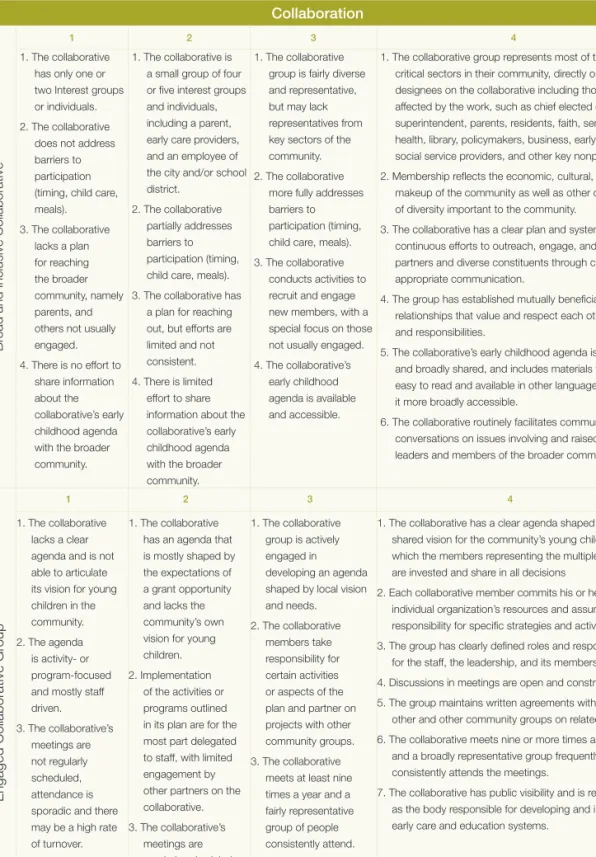
The tool also prompts communities to ask if their collaborative group is broad and inclusive. Re-sponding to this marker involves identifying types of interest groups or individuals, how the group reduces barriers to participation, whether the collaborative has a plan for engaging others, and how the collaborative shares information. Suc-cess is understood as a collaborative that reflects the economic, cultural, and racial makeup of the actual community and that has a plan for engag-ing the broader community. Success includes a
group that has mutually beneficial relationships and respect for roles and responsibilities. A col-laborative can also identify success through the strength of its communication of its work and its facilitation of community conversations that raise awareness and dialogue in the community. Is there an engaged collaborative group? This category refers to items such as the collaborative having a clear agenda – one that is truly reflective of the broader members and to which participat-ing organizations commit resources and time. It also refers to whether a collaborative has regu-lar meetings with members and whether those members and staff have clear roles, constructive conversations, written agreements, and public visibility; and to whether the collaborative is rec-ognized as focused on the key mission.
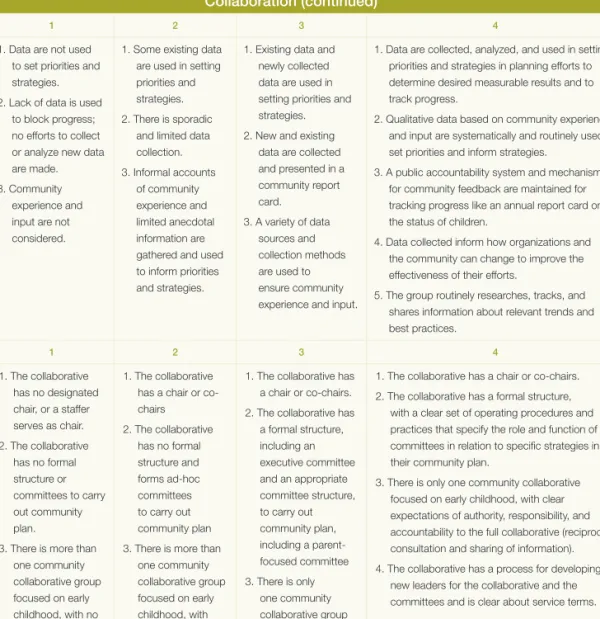
Does this engaged collaborative group dem-onstrate strategic use of data? A results-driven collaborative is committed to collecting and ana-lyzing data and setting priorities based on those data. Effectively incorporating data also involves having mechanisms for community feedback and tracking and reporting on progress. Public accountability efforts include sharing how this in-formation can be used by organizations and what the data means for trends and best practices. Finally, does all of this work operate within the context of a governance structure with working committees? Is a formal structure in place with a chair or co-chairs, and are there procedures that specify the role and function of all committees in relation to the strategies of the community plan? Success here also suggests that the Discovery community collaborative is recognized as the leading authority for sustaining early care and childhood education services for their commu-nity.
Parent Leadership and Engagement
The Memorial Fund encourages attention to par-ent leadership and engagempar-ent in multiple ways as an indicator of a value inherent in the work of educational change, and also as a key com-ponent related to all other categories of success. Providing leadership-training opportunities is
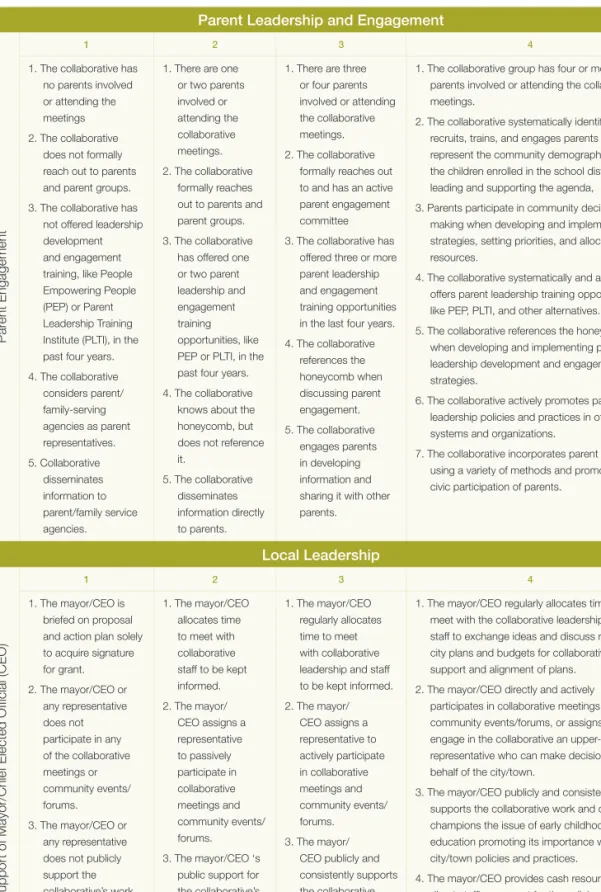
acknowledged locally as a beneficial community collaborative activity. Leadership is also sup-ported through the Memorial Fund’s state-level efforts to leverage public funding for parent leadership-development training, thus provid-ing an infrastructure that communities can tap as they seek to address this issue locally. The tool asks communities to discuss how many parents are involved in collaborative meetings and if they reflect the diversity of the community. How many take on leadership roles? Do they participate meaningfully in decision-making? What develop-ment opportunities and supports are provided to parents and how does the collaborative group incorporate parent voice, support parent civic participation, and promote parent engagement beyond the group? Does the collaborative group draw upon the parent honeycomb tool, developed by the Memorial Fund to describe multiple ways that parents can be engaged?
Local Leadership
Backing of local leadership of the collaborative group is incorporated into the foundation’s grant application by requiring signatures of the mayor or chief elected official, school superintendent, collaborative sponsor agency, a parent, and the chair of the local collaborative. Discovery capaci-ty-building opportunities are also made available to those leaders.
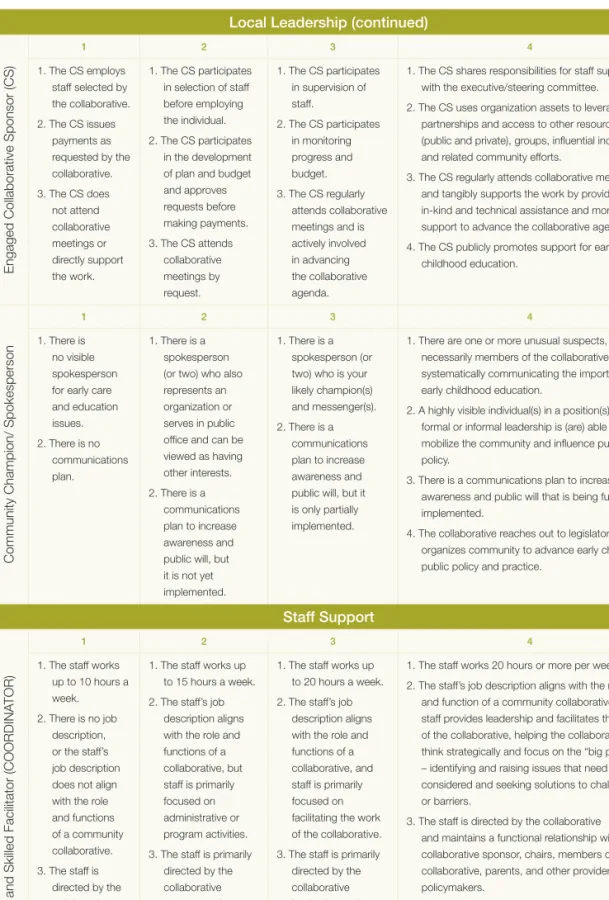
The tool acknowledges a chair who exhibits strong collaborative leadership, and relates suc-cess to the chair’s ability to distribute leadership, be recognized as a leader in the broader commu-nity, be able to bring members to work together, foster new leadership, and think strategically within local and statewide contexts.
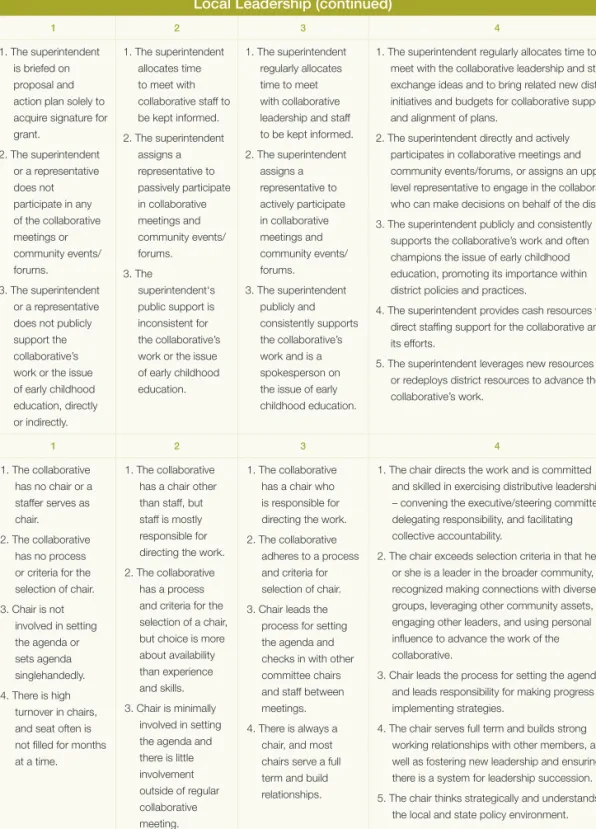
The support of the mayor or chief elected official and the superintendent is seen as their attendance at meetings, allocation of time to meet with the collaborative, and in how they share and seek a conversation about the collaborative’s plans. Sometimes this is done through an assigned but senior representative of the official. Other signs of support are the leader’s promotion of the col-laborative work and the allocation of cash or staff resources to the work.
Discovery collaboratives are required to enlist a collaborative sponsor agency that is a nonprofit serving children and families in their communi-ties. The collaborative sponsor is responsible for managing funds and ensuring additional finan-cial and management guidance. A component of success is the engagement of this sponsor as indicated by attending meetings, sharing respon-sibility, helping to leverage resources and partner-ships, providing technical assistance and in-kind support, and publicly promoting the work of the collaborative.
A collaborative’s success in the area of local lead-ership is also related to having a communication plan and to attracting, cultivating, and retaining community champions who bring higher visibility to the importance of early care and childhood education efforts.
Staff Support
Supporting the infrastructure of the community collaborative demands the allocation of resources for staff. Although volunteer engagement is often at the heart of nonprofit endeavors, research shows that sustaining volunteer activity and ensuring that activity translates into substantive results requires investment in paid support.8
Infrastructure is often overlooked in the eager-ness to devolve resources to the local level and lies at the heart of disappointment in the per-ceived limited results from investing in communi-ties. The Memorial Fund recognizes the need to anchor collaborative community planning and implementation processes and thus encourages the understanding that success is tied to a strong, skilled coordinator. This person should work for the collaborative a minimum of 20 hours a week and maintain relationships with leadership while facilitating community dialogue and decision-making and supporting collaboration and parent engagement.
Coordinators draw heavily on the support of the community liaisons. Liaisons, although their role is broader and more embedded than a traditional
8 See Families and communities raise our children: The role and cost of effective local early childhood councils, produced by Holt, Wexler, & Farnum, LLP.
executive coach, do provide a sounding board for coordinators and may also offer more targeted skill building or discuss other training. Success in this role depends heavily on relationship-building skills, and liaisons often find themselves with the difficult task of raising critical questions and providing feedback to the collaborative as a whole while supporting the coordinators’ ability to facilitate collaborative dynamics.
Meaningful Local Match
A meaningful local match can be both a demon-stration of a collaborative’s skill in establishing itself as the “go to” group in a community and a symbol of the broader community’s willingness to embrace a collaborative and its mission. A local match can be observed in the resources com-mitted by a collaborative sponsor, municipality, school board or other involved organization. A collaborative’s ability to develop and publicize a funding plan that is jointly owned by community groups, institutions, and organizations is another observable step in obtaining local match. The in-tent of Discovery is that gradually each collabora-tive’s local match will increase as the respective communities take greater ownership of the work. The Memorial Fund has needed to be flexible in its expectations of local match, particularly dur-ing economic downturns and in relation to small communities that may lack large nonprofits or the possibility to attract state and federal invest-ments. Nevertheless, using Discovery dollars as leverage to attract additional funds and attention continues to be a structured aspect of Discovery. Some communities have shown great ability to bring together financial support from various stakeholders.
These five categories and the associated indica-tors are fleshed out in the Discovery Community Self-Assessment Tool. The tool is a living docu-ment and, although consistency is important over multiple years to ensure the ability to collect lon-gitudinal data, it may change as the collaboratives and staff learn more about success. Instructions for the tool encourage community collaboratives to discuss indicators, provide a rating through group consensus, document any discussion about specific markers, and consider various initiative tools as they seek to identify next steps to address
issues raised.
Reflections on the Development and Community Use of the Tool
Liaisons and staff saw the tool as an important step in understanding and communicating what success in community collaboration had come to look like in the context of Discovery. This de-velopment sprang from liaison and staff under-standings of community work and was piloted with a sample of communities before being fully implemented. The liaisons felt that the dialogue necessary to develop the tool helped them to clarify their own practice. As one liaison noted, the development process “provided further op-portunity to specifically articulate observations that may otherwise have remained as general and unexpressed impressions,” and offered “a specific opportunity to think through the integration of the values as evidenced in the work.” As another observed, the tool itself “is clear and explicit about community change which, by nature, is abstract and amorphous.”
There were a number of challenges associated with getting the tool to this clarity. Foundation staff stated that the tool-development process was long and sometimes painful, noting that a committee process often produces important information that lacks integration and coherence. Development began in 2006; piloting and the first year of implementation took place in 2009. Toward the end of the process, it was crucial for one person to pull the ideas together to ensure coherence across the tool, and then check with others to make sure she really heard and articu-lated the insights that had been revealed in the years of dialogue. Later, liaisons used the pilot process to check in with communities to see how well the specific categories and markers of success resonated.
Liaisons noted how difficult and beneficial it was to articulate key areas of importance in their community work. One liaison commented:
Sharing and defining with fellow liaisons those indi-cators that make a difference to the work enriched the depth of my understanding of the work with communities. We learned from one another’s
experi-Collaboration
Br
oad and Inclusive Collaborative
1 2 3 4
The collaborative 1.
has only one or two Interest groups or individuals. The collaborative 2.
does not address barriers to participation (timing, child care, meals). The collaborative 3. lacks a plan for reaching the broader community, namely parents, and others not usually engaged. There is no effort to 4. share information about the collaborative’s early childhood agenda with the broader community.
The collaborative is 1.
a small group of four or five interest groups and individuals, including a parent, early care providers, and an employee of the city and/or school district. The collaborative 2. partially addresses barriers to participation (timing, child care, meals). The collaborative has 3.
a plan for reaching out, but efforts are limited and not consistent. There is limited 4.
effort to share information about the collaborative’s early childhood agenda with the broader community.
The collaborative 1.
group is fairly diverse and representative, but may lack representatives from key sectors of the community. The collaborative 2.
more fully addresses barriers to participation (timing, child care, meals). The collaborative 3.
conducts activities to recruit and engage new members, with a special focus on those not usually engaged. The collaborative’s 4.
early childhood agenda is available and accessible.
The collaborative group represents most of the 1.
critical sectors in their community, directly or through designees on the collaborative including those directly affected by the work, such as chief elected official, superintendent, parents, residents, faith, seniors, health, library, policymakers, business, early care and social service providers, and other key nonprofits. Membership reflects the economic, cultural, and racial 2.
makeup of the community as well as other dimensions of diversity important to the community.
The collaborative has a clear plan and systems for 3.
continuous efforts to outreach, engage, and mobilize partners and diverse constituents through culturally appropriate communication.
The group has established mutually beneficial 4.
relationships that value and respect each other’s role and responsibilities.
The collaborative’s early childhood agenda is public 5.
and broadly shared, and includes materials that are easy to read and available in other languages to make it more broadly accessible.
The collaborative routinely facilitates community 6.
conversations on issues involving and raised by public leaders and members of the broader community.
Engaged Collaborative Gr oup 1 2 3 4 The collaborative 1. lacks a clear agenda and is not able to articulate its vision for young children in the community. The agenda 2. is activity- or program-focused and mostly staff driven. The collaborative’s 3. meetings are not regularly scheduled, attendance is sporadic and there may be a high rate of turnover.
The collaborative 1.
has an agenda that is mostly shaped by the expectations of a grant opportunity and lacks the community’s own vision for young children. Implementation 2.
of the activities or programs outlined in its plan are for the most part delegated to staff, with limited engagement by other partners on the collaborative. The collaborative’s 3.
meetings are regularly scheduled and a small core group of people attend most of the time. The collaborative 1. group is actively engaged in developing an agenda shaped by local vision and needs. The collaborative 2. members take responsibility for certain activities or aspects of the plan and partner on projects with other community groups. The collaborative 3.
meets at least nine times a year and a fairly representative group of people consistently attend.
The collaborative has a clear agenda shaped by a 1.
shared vision for the community’s young children, in which the members representing the multiple sectors are invested and share in all decisions
Each collaborative member commits his or her 2.
individual organization’s resources and assumes responsibility for specific strategies and activities. The group has clearly defined roles and responsibilities 3.
for the staff, the leadership, and its membership. Discussions in meetings are open and constructive. 4.
The group maintains written agreements with each 5.
other and other community groups on related agenda. The collaborative meets nine or more times a year 6.
and a broadly representative group frequently and consistently attends the meetings.
The collaborative has public visibility and is recognized 7.
as the body responsible for developing and improving early care and education systems.
Collaboration (continued)
Strategic Use of Data
1 2 3 4
Data are not used 1.
to set priorities and strategies. Lack of data is used 2.
to block progress; no efforts to collect or analyze new data are made. Community 3.
experience and input are not considered.
Some existing data 1.
are used in setting priorities and strategies. There is sporadic 2.
and limited data collection. Informal accounts 3. of community experience and limited anecdotal information are gathered and used to inform priorities and strategies.
Existing data and 1.
newly collected data are used in setting priorities and strategies. New and existing 2.
data are collected and presented in a community report card. A variety of data 3. sources and collection methods are used to ensure community experience and input.
Data are collected, analyzed, and used in setting 1.
priorities and strategies in planning efforts to determine desired measurable results and to track progress.
Qualitative data based on community experience 2.
and input are systematically and routinely used to set priorities and inform strategies.
A public accountability system and mechanisms 3.
for community feedback are maintained for tracking progress like an annual report card on the status of children.
Data collected inform how organizations and 4.
the community can change to improve the effectiveness of their efforts.
The group routinely researches, tracks, and 5.
shares information about relevant trends and best practices. Gover nance Structur e with W orking Committees 1 2 3 4 The collaborative 1. has no designated chair, or a staffer serves as chair. The collaborative 2. has no formal structure or committees to carry out community plan.
There is more than 3. one community collaborative group focused on early childhood, with no clear linkages. The collaborative 1.
has a chair or co-chairs The collaborative 2. has no formal structure and forms ad-hoc committees to carry out community plan There is more than 3. one community collaborative group focused on early childhood, with clear linkages between the groups.
The collaborative has 1.
a chair or co-chairs. The collaborative has 2. a formal structure, including an executive committee and an appropriate committee structure, to carry out community plan, including a parent-focused committee There is only 3. one community collaborative group focused on early childhood.
The collaborative has a chair or co-chairs. 1.
The collaborative has a formal structure, 2.
with a clear set of operating procedures and practices that specify the role and function of all committees in relation to specific strategies in their community plan.
There is only one community collaborative 3.
focused on early childhood, with clear expectations of authority, responsibility, and accountability to the full collaborative (reciprocal consultation and sharing of information). The collaborative has a process for developing 4.
new leaders for the collaborative and the committees and is clear about service terms.
Parent Leadership and Engagement
Par
ent Engagement
1 2 3 4
The collaborative has 1. no parents involved or attending the meetings The collaborative 2.
does not formally reach out to parents and parent groups. The collaborative has 3.
not offered leadership development and engagement training, like People Empowering People (PEP) or Parent Leadership Training Institute (PLTI), in the past four years. The collaborative 4. considers parent/ family-serving agencies as parent representatives. Collaborative 5. disseminates information to parent/family service agencies.
There are one 1. or two parents involved or attending the collaborative meetings. The collaborative 2. formally reaches out to parents and parent groups. The collaborative 3.
has offered one or two parent leadership and engagement training opportunities, like PEP or PLTI, in the past four years. The collaborative 4.
knows about the honeycomb, but does not reference it. The collaborative 5. disseminates information directly to parents.
There are three 1. or four parents involved or attending the collaborative meetings. The collaborative 2.
formally reaches out to and has an active parent engagement committee The collaborative has 3.
offered three or more parent leadership and engagement training opportunities in the last four years. The collaborative 4. references the honeycomb when discussing parent engagement. The collaborative 5. engages parents in developing information and sharing it with other parents.
The collaborative group has four or more 1.
parents involved or attending the collaborative meetings.
The collaborative systematically identifies, 2.
recruits, trains, and engages parents (who represent the community demographics and the children enrolled in the school district) in leading and supporting the agenda, Parents participate in community decision-3.
making when developing and implementing strategies, setting priorities, and allocating resources.
The collaborative systematically and annually 4.
offers parent leadership training opportunities like PEP, PLTI, and other alternatives. The collaborative references the honeycomb 5.
when developing and implementing parent leadership development and engagement strategies.
The collaborative actively promotes parent 6.
leadership policies and practices in other systems and organizations.
The collaborative incorporates parent voice 7.
using a variety of methods and promotes the civic participation of parents.
Local Leadership
Support of Mayor/Chief Elected Of
ficial (CEO)
1 2 3 4
The mayor/CEO is 1.
briefed on proposal and action plan solely to acquire signature for grant. The mayor/CEO or 2. any representative does not participate in any of the collaborative meetings or community events/ forums. The mayor/CEO or 3. any representative does not publicly support the collaborative’s work or the issue of early childhood education, directly or indirectly. The mayor/CEO 1. allocates time to meet with collaborative staff to be kept informed. The mayor/ 2. CEO assigns a representative to passively participate in collaborative meetings and community events/ forums. The mayor/CEO ‘s 3.
public support for the collaborative’s work or the issue of early childhood education is inconsistent. The mayor/CEO 1. regularly allocates time to meet with collaborative leadership and staff to be kept informed. The mayor/ 2. CEO assigns a representative to actively participate in collaborative meetings and community events/ forums. The mayor/ 3.
CEO publicly and consistently supports the collaborative work and is a spokesperson on the issue of early childhood education.
The mayor/CEO regularly allocates time to 1.
meet with the collaborative leadership and staff to exchange ideas and discuss related city plans and budgets for collaborative support and alignment of plans. The mayor/CEO directly and actively 2.
participates in collaborative meetings and community events/forums, or assigns to engage in the collaborative an upper-level representative who can make decisions on behalf of the city/town.
The mayor/CEO publicly and consistently 3.
supports the collaborative work and often champions the issue of early childhood education promoting its importance within city/town policies and practices.
The mayor/CEO provides cash resources for 4.
direct staffing support for the collaborative and its efforts.
The mayor/CEO leverages new resources 5.
and/or redeploys city resources to advance the collaborative’s work.
Local Leadership (continued) Support of Superintendent 1 2 3 4 The superintendent 1. is briefed on proposal and action plan solely to acquire signature for grant. The superintendent 2. or a representative does not participate in any of the collaborative meetings or community events/ forums. The superintendent 3. or a representative does not publicly support the collaborative’s work or the issue of early childhood education, directly or indirectly. The superintendent 1. allocates time to meet with collaborative staff to be kept informed. The superintendent 2. assigns a representative to passively participate in collaborative meetings and community events/ forums. The 3. superintendent‘s public support is inconsistent for the collaborative’s work or the issue of early childhood education. The superintendent 1. regularly allocates time to meet with collaborative leadership and staff to be kept informed. The superintendent 2. assigns a representative to actively participate in collaborative meetings and community events/ forums. The superintendent 3. publicly and consistently supports the collaborative’s work and is a spokesperson on the issue of early childhood education.
The superintendent regularly allocates time to 1.
meet with the collaborative leadership and staff to exchange ideas and to bring related new district initiatives and budgets for collaborative support and alignment of plans.
The superintendent directly and actively 2.
participates in collaborative meetings and community events/forums, or assigns an upper-level representative to engage in the collaborative who can make decisions on behalf of the district. The superintendent publicly and consistently 3.
supports the collaborative’s work and often champions the issue of early childhood education, promoting its importance within district policies and practices.
The superintendent provides cash resources for 4.
direct staffing support for the collaborative and its efforts.
The superintendent leverages new resources 5.
or redeploys district resources to advance the collaborative’s work.
Str
ong Collaborative Leadership (CHAIR)
1 2 3 4 The collaborative 1. has no chair or a staffer serves as chair. The collaborative 2. has no process or criteria for the selection of chair. Chair is not 3. involved in setting the agenda or sets agenda singlehandedly. There is high 4. turnover in chairs, and seat often is not filled for months at a time.
The collaborative 1.
has a chair other than staff, but staff is mostly responsible for directing the work. The collaborative 2.
has a process and criteria for the selection of a chair, but choice is more about availability than experience and skills. Chair is minimally 3. involved in setting the agenda and there is little involvement outside of regular collaborative meeting. There is usually a 4.
chair, but turnover slows down the work.
The collaborative 1.
has a chair who is responsible for directing the work. The collaborative 2.
adheres to a process and criteria for selection of chair. Chair leads the 3.
process for setting the agenda and checks in with other committee chairs and staff between meetings. There is always a 4.
chair, and most chairs serve a full term and build relationships.
The chair directs the work and is committed 1.
and skilled in exercising distributive leadership – convening the executive/steering committee, delegating responsibility, and facilitating collective accountability.
The chair exceeds selection criteria in that he 2.
or she is a leader in the broader community, recognized making connections with diverse groups, leveraging other community assets, engaging other leaders, and using personal influence to advance the work of the collaborative.
Chair leads the process for setting the agenda 3.
and leads responsibility for making progress in implementing strategies.
The chair serves full term and builds strong 4.
working relationships with other members, as well as fostering new leadership and ensuring there is a system for leadership succession. The chair thinks strategically and understands 5.
the local and state policy environment.
Local Leadership (continued)
Engaged Collaborative Sponsor (CS)
1 2 3 4 The CS employs 1. staff selected by the collaborative. The CS issues 2. payments as requested by the collaborative. The CS does 3. not attend collaborative meetings or directly support the work. The CS participates 1. in selection of staff before employing the individual. The CS participates 2. in the development of plan and budget and approves requests before making payments. The CS attends 3. collaborative meetings by request. The CS participates 1. in supervision of staff. The CS participates 2. in monitoring progress and budget. The CS regularly 3. attends collaborative meetings and is actively involved in advancing the collaborative agenda.
The CS shares responsibilities for staff supervision 1.
with the executive/steering committee. The CS uses organization assets to leverage 2.
partnerships and access to other resources (public and private), groups, influential individuals, and related community efforts.
The CS regularly attends collaborative meetings 3.
and tangibly supports the work by providing in-kind and technical assistance and monetary support to advance the collaborative agenda. The CS publicly promotes support for early 4.
childhood education.
Community Champion/ Spokesperson
1 2 3 4
There is 1.
no visible spokesperson for early care and education issues. There is no 2. communications plan. There is a 1. spokesperson (or two) who also represents an organization or serves in public office and can be viewed as having other interests. There is a 2. communications plan to increase awareness and public will, but it is not yet implemented.
There is a 1.
spokesperson (or two) who is your likely champion(s) and messenger(s). There is a 2. communications plan to increase awareness and public will, but it is only partially implemented.
There are one or more unusual suspects, not 1.
necessarily members of the collaborative, systematically communicating the importance of early childhood education.
A highly visible individual(s) in a position(s) of 2.
formal or informal leadership is (are) able to mobilize the community and influence public policy.
There is a communications plan to increase 3.
awareness and public will that is being fully implemented.
The collaborative reaches out to legislators and 4.
organizes community to advance early childhood public policy and practice.
Staff Support
Str
ong and Skilled Facilitator (COORDINA
TOR)
1 2 3 4
The staff works 1. up to 10 hours a week. There is no job 2. description, or the staff’s job description does not align with the role and functions of a community collaborative. The staff is 3. directed by the collaborative sponsor only and gets no direction from the collaborative.
The staff works up 1.
to 15 hours a week. The staff’s job 2.
description aligns with the role and functions of a collaborative, but staff is primarily focused on administrative or program activities. The staff is primarily 3.
directed by the collaborative sponsor and may get some direction from the collaborative.
The staff works up 1.
to 20 hours a week. The staff’s job 2.
description aligns with the role and functions of a collaborative, and staff is primarily focused on facilitating the work of the collaborative. The staff is primarily 3.
directed by the collaborative leadership and committees. The staff exercises 4.
some level of leadership.
The staff works 20 hours or more per week. 1.
The staff’s job description aligns with the role 2.
and function of a community collaborative and staff provides leadership and facilitates the work of the collaborative, helping the collaborative to think strategically and focus on the “big picture” – identifying and raising issues that need to be considered and seeking solutions to challenges or barriers.
The staff is directed by the collaborative 3.
and maintains a functional relationship with collaborative sponsor, chairs, members of the collaborative, parents, and other providers and policymakers.
The staff functions as a neutral facilitator. 4.
The staff demonstrates commitment to the value 5.
of parent engagement and collaboration.
ences. I felt in a better position to guide communities toward a more articulated vision of success.
The tool-development work thus went beyond re-flecting on unique examples to thinking about the work across communities and identifying which areas of the work were most important. Mar-rying clear language to these aspects and then differentiating the various levels for rating proved difficult, as well. Challenges of consistency, clarity, and concreteness were noted along with making the tool “comprehensive, yet manageable.” At one point in the process, Carmen thought that a fresh set of eyes would be useful to bring the process to a close. She brought in Angela because of her experience in evaluation and qualitative re-search to help work with three of the six liaisons in the final revisions. This task proved counter-productive. Inserting an individual new to the organization, its work, and the tool-development process, and who was most recently profession-ally steeped in theories rather than community practice, served to upset the development rather than effectively support it. Conversations moved the tool toward abstraction and a language more familiar to researchers and began to lose its con-nection to observable practice.
In facilitating the tool, liaisons noted the appre-ciation of communities for the level of observable detail. The common language of the tool, free of professional jargon, seemed to help various members of the collaborative groups engage on a more equal footing. It also prompted discussion in communities between members familiar with Discovery terms and structures and newer mem-bers. In specific cases, liaisons stated that the tool helped communities to clarify roles in their work and identify areas for action. Liaisons reported too that communities experienced painful clarity at times when they thought they were really doing well and then saw themselves differently through the specific criteria of the tool. Foundation man-agement was also challenged, particularly when the community self-assessment ratings provided a specificity that altered prior perceptions of the progress of specific communities.
Not surprisingly, the assessment process was engaged and experienced differently by various communities. Some, according to liaisons, em-braced the opportunity to see and constructively discuss differences among members. For other communities, liaisons noted that it led to con-tention. From a foundation perspective, though, the tool reinforced the idea that collaborative Meaningful Local Match
Meaningful Local Match
1 2 3 4
There is no local 1.
match (in-kind, redeployed staff, or cash) from any of the key partners (city/town, district, or collaborative sponsor). CS’s administrative 2. fee exceeds average fee and is not in balance with degree of the CS’s participation and support.
There is some local 1.
in-kind match, like meeting or office space from one of the key partners. CS’s fee is within 2. average that is generally charged given participation and support provided. At least one 3. key partner is contributing some level of personnel support or staff time to achieve work of the collaborative. There is a mix of 1. in-kind, redeployed staff, and up to 20 percent cash match from multiple key partners. CS’s fee is less 2.
than average given participation and support provided. More than one of 3.
the key partners are providing personnel and staff to achieve work of the collaborative.
There is a mix of in-kind, redeployed staff and 1.
more than 20 percent cash match from multiple key partners (public and private).
CS absorbs administrative costs and is fully 2.
invested in work of the collaborative. City/town and/or school system align their 3.
resources by redirecting existing funds and/ or redeploying personnel in support of specific strategies.
Funds from other sources are administered by 4.
the collaborative.
The collaborative has a fund development plan 5.
that is jointly owned by community groups, institutions, and organizations (influences how resource allocation is prioritized) and considers future needs.
The collaborative shares financial information and 6.
funding plans publicly.
functioning is crucial and deserves attention. This was one way of using a requirement to both communicate expectations and prompt the conversations necessary to provide information to the foundation and also contribute to community success. Requiring the assessment ensured that communities would allot time for this reflection. One liaison noted that the assessment time came to be referred to as a shared “experience” by col-laborative members. It provided an opportunity to “develop a common, collective sense of where the work should go.” Still, according to liaison documentation, communities did have questions about the tool and its use. Given that it was re-quired, they asked how the results would be used, if the results would become public data, and how ratings might factor into future Memorial Fund funding.
Ensuring that the tool would support the values and goals of the initiative while encouraging col-laborative potential was indeed difficult, as one liaison noted:
[There was a challenge to] maintaining an openness that didn’t limit participant thinking or lock com-munities into a rigid framework or “one-size-fits-all” design that couldn’t accommodate different com-munity collaborative structures and arrangements and providing an opportunity for communities to recognize and acknowledge strengths at every level. Indeed, the power of such a self-assessment tool, to Memorial Fund staff, comes not from compar-ing communities to each other or from uscompar-ing numerical ratings to establish funding decisions, but rather to gauge community progress in terms of their change over time. The process also encourages communities to make more accu-rate accounts of their own functioning and thus their own readiness or need to take up grant or capacity-building opportunities. It encourages shared accountability.
It is imperative to acknowledge that the learning from the tool process was rooted in grant struc-ture and community collaborative work already in place for a number of years. The tool development was not a story of initial grant design, but rather
one of coming to shared understanding and articulation of the underlying values already being actively expressed in grantmaking. In addition, there is a potential story waiting to be understood in relation to the next steps of Discovery – the tool process as an indicator of network learn-ing and the ability of that network to construct a value-based system of policies and structures to govern its mission.
Pondering the Future: Understanding the Embedded Notions of Social Construction The tool-development process described here has merits in itself as an effort to build shared language and joint accountability within grant-funded community collaboratives, across a group of community practitioners, and with a foundation responsible for stewarding funds for an educational mission. At first glance, this may seem similar to creating a shared vision. Systems reformers have indeed argued for the necessity of having a bold vision to garner public commitment for change (Stephens, Leiderman, Wolf, & McCa-rthy, 1994). However a vision, as it has come to be used in traditional business and planning efforts, often is framed as somewhat elusive, something outside of oneself and achievable as a result of action (e.g., visions for the future, visions for a better economy, visions for peace). Approaches for achieving a local and statewide vision for systems efforts have been framed in terms of “scaling up” local approaches to broader contexts or as combined “top-down, bottom-up” behavior change (Stephens et al., 1994). The Discovery tool development process was not just one of shared visioning, scaling up, or top-down/bottom-up effort; because of the way it was managed, it became a process of deeper social construc-tion. Understanding collaborative management through this tool-development process as a pro-cess of social construction is critical to maximiz-ing the investments of foundations. The notion of social construction of meaning targets our understanding of the importance of language and self-reflection in developing shared accountability and collaborative success beyond local boundar-ies, and is thus critical for foundations who want to move their investments from local impact to broader network learning and systemic change.
Social construction of meaning goes beyond a cognitive visioning in that it is a meaning-making activity, a process of interpreting experience. Through this meaning making, one’s sense of self and action become tied to the socially shared con-cepts. Experience is not divided into thought and action; it is by definition embodied and its inter-pretation is inherently social since people make sense of the world, not in isolation, but through shared language that guides understanding. To the extent that the tool development and use calls forth the tacit knowledge of those involved in community work, it requires participants to engage in dialogue and shared interpretation grounded in their own experiences. This shared meaning making, because it is tied not to just any notion but to the notions of the “work” that people do, requires that those engaged individu-als and groups consciously link their own sense of agency to the concepts being developed. The process of tool development and use is thus a way to deep learning through a reflective stance that we have noted.
Deep learning, then, is not a matter of figuring out the truth. Deep learning is the embodiment of new capabilities for effective action. Embodiment is a developmental process that occurs over time, in a continuous cycle of theoretical action and practical conceptualization. (Kofman & Senge, 2001, p. 5) Regardless of whether the tool is explicitly called an assessment, its focus on the idea of success and the linking of relative ratings to the language of success also ties those involved to a sense of their own contribution, responsibility, accountabil-ity. In the case of Discovery, this work is one of ensuring that children are cared for and nurtured, not by individuals alone, but as a larger commu-nity and societal responsibility.
Deep learning is action oriented, and is a social interpretive act dependent upon shared language. The ability of a network to engage in conversa-tions of success is integral to its learning. It also may indicate the capacity to achieve shared results and possibly participate in social construc-tion in other areas such as building systems, since systems are themselves human constructions
– ideas that become institutionalized through structures of governance and sanctioned daily practices. To be effective, a system requires that people inside and outside acknowledge the existence and the purpose of the system. Be-cause a system’s underlying purpose is stability it has a natural inclination to stagnate, with those involved no longer being engaged in the results but rather tied to the institutionalized practice. For those involved in operating a system, then, the system needs to change only when the context demands. Thus, change requires that a broader network of individuals can learn and continuously socially construct that system to achieve desired results.
Systems structures such as policies, governance rules, rewards and sanctions, and financing are thus not inherently about learning and change. They are mechanisms for promoting stability. How they are designed may be more or less con-ducive to continuous improvement, but change, at the level of reshaping the conception of systems and their structures and components, will rarely be energized from within the structures them-selves. For all those involved – decision-makers, professionals, parents, citizens – to remain en-gaged in results requires a process complementa-ry to that tendency toward stability. This process is one of constant social construction, such as that evidenced in the Discovery learning network. An effective system, defined as one that changes as needs demand, cannot be achieved through its own functioning. It requires a learning network that operates not within or outside of the identi-fied system, but rather through the active agency of all the people involved in both the awareness and operation of the system.
In the case of Connecticut and early childhood, at best there is only a loosely coupled set of poli-cies and structures. For the goal of Discovery as a system-building initiative, the challenge will be how to engage the appropriate range and number of participants in deep learning necessary for a system to emerge and be both sustainable in its tendency toward stability, suitable for achieving desired goals, and also changeable when contexts or needs shift. The question will be whether a