Submission to WESS in May 2000
Do Design Patterns Improve Communication?
An Experiment with Pair Design
Barbara Unger and Walter F. Tichy (unger,[email protected])
Fakultat fur Informatik, Universitat Karlsruhe
D-76128 Karlsruhe, Germany
Abstract
One of the main advantages claimed for software de-sign patterns is improved team communication. This paper reports on an experiment that tests this hypoth-esis. Team communication among pairs of designers with and without design pattern knowledge is observed in a maintenance setting and analyzed by protocol anal-ysis. The results indicate that shared pattern knowl-edge leads to a more condensed explanation phase and a balanced give-and-take among team members during design work.
1 Introduction
Design patterns as described by Gamma et al. [3], Buschmann et al. [2], and others are quite popular. They are thought to improve software maintenance and team communication. The eects of design patterns on maintenance have already been tested in a number of experiments by the authors [4, 5, 6, 7]. This paper re-ports on an experiment regarding team communication. Members of two-person teams received a program de-sign for maintenance. One member of each team was given time to study the design beforehand. In a rst phase, this team member explained the design to his partner. Subsequently, each pair of programmers dis-cussed how to design given requirements changes into the existing program. Protocol analysis of the interac-tions were performed before and after each team took part in a design patterns course. The results showed that without shared pattern knowledge, there is no pro-nounced explanation phase and the discussions were dominated by one individual (not necessarily the person who studied the design beforehand). After the design patterns course, there is a clearly identiable explana-tion phase followed by a balanced give-and-take during the actual design work.
These results conrm what Buschmann et al. describe as follows: "Pattern-sharing establishes a common vo-cabulary for design problems. It allows members of the growing community to identify, name, and discuss both problems and solutions more eectively [2, page
xii]". The net eect of improved communication could be faster work, fewer errors, and lessened architectural drift.
Our results also have implications for pair program-ming, a practice in which two programmers work side-by-side, continuously collaborating on the same design, implementation, or test [1]. Our observations suggest that balanced team work does not simply "happen", at least not in the short term. Instead, a common un-derstanding of problems and solution patterns must be developed. This common understanding, at least in pair design, might be boosted by knowledge of design pat-terns.
2 Description of the Experiment
The experiment tests the following hypothesis: If team members have common design pattern knowledge and vocabulary, they can communicate more eectively than without.The experiment compares teams with and without pat-tern knowledge communicating about program designs. Verbal communication is captured with audio and video and the protocols analyzed. Communication is consid-ered more eective if there are clear episodes of expla-nation by one member and balanced discussions during design work.
2.1 Design
For evaluating the hypothesis one needs to observe sub-jects in situations in which they are talking freely about programs or program designs. There are several ways to observe talking subjects, but one has to be careful that the communication remains natural. Think-aloud protocols or telling answers to an advisor are not natu-ral for team work. Instead, we chose to group subjects into two-person teams and recorded their interactions while performing a design maintenance task.
For eliciting an explanation phase, one subject of each team is given one hour of extra time in advance. During this time, this subject studies requirements and design
documents of the program. This team member will be referred to as the expert. Then the second team mem-ber joins as novice. The expert explains the program design to the novice. Subsequently, both team members collaborate on two maintenance tasks. This strategy provides a chance for observing two interesting com-munication phases: (1) The phase of explanation by expert to novice, and (2) the teamwork phase between two maintainers.
The independent variable is design pattern knowledge. First, teams are given a pretest, then they participate in a three-month lab course on design patterns, and nally they receive a posttest. The course provides practical exercises for all patterns relevant for the tests (as well as other patterns).
The experiment employs two dierent applications. Teams are divided into two experimental groups work-ing on dierent applications. The applications are switched from pre- to posttest. For fairness to the stu-dents, the roles of expert and novice are also switched. Table 1 summarizes the experiment design.
pretest posttest
program1 program2
group1 person1 = expert person2 = expert
person2 = novice person1 = novice program2 program1
group2 person1 = expert person2 = expert
person2 = novice person1 = novice
Table 1: Design of the experiment.
2.2 Applications and tasks
Both applications used in the experiment are from do-mains that are easy to understand.1
Application ChiCo is a front end for version control systems such as RCS, RCE, or others. ChiCoalso con-trols le access on a team basis. It consists of 15 classes and 76 methods and contains the patternsObserver,
Bridge, andSingleton.2 The rst maintenance task
is to enhance the at team structure into a hierarchy. Users from superprojects also have access to les in sub-projects. The second work task is to display all les that are checked out for a user and to delete checked-out, but unchanged, work les.
Application Timmieis a time and defect tracking sys-tem for managing software projects and teams. Is con-sists of 13 classes and 102 methods. It is designed with Composite, Visitor, Chain of Responsibil-ity,Observer, andSingleton. Only the team man-agement and time tracking is provided. The rst main-tenance task is to add the defect management. The
1The original documents including the program designs and
work tasks are available upon request.
2For denition of these patterns, see [3]
subjects' task is to add recording and tracking of de-fects, notication of the appropriate developers, noti-cation of the teams for defect logging, and an undo mechanism. The second work task involves adding time accounting and defect logs of private projects. Private projects are included in private statistics but not in the overall project reports.
2.3 Subjects, teams, and groups
The 15 subjects were computer science graduate stu-dents in their 7.8th semester on average (median 8th
semester). On a preliminary questionnaire they were asked about their previous programming experience. On average they had 5.8 years of programming expe-rience (median 5.5 years) and on a ve level scale they had been programming on average between 3000 and 30000 LOC. In the pretest, three students had prac-tical experience with design patterns relevant for the experiment. Theses cases are discussed separately in the results (see Section 3).
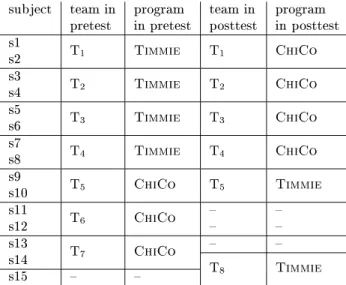
The subjects were allowed to choose their team mem-bers. In the pretest, the partners of only one team did not know each other. Due to subject loss (sub-ject s13 did not participate in the lab course, sub(sub-jects s11 and s12 did not have time for the posttest), one new posttest-only team was established (T8: s14, s15),
see Table 2. The team members of this team did not know each other. The teams were randomly divided into groups.
subject team in program team in program pretest in pretest posttest in posttest s1 s2 T1 Timmie T1 ChiCo s3 s4 T2 Timmie T2 ChiCo s5 s6 T3 Timmie T3 ChiCo s7 s8 T4 Timmie T4 ChiCo s9 s10 T5 ChiCo T5 Timmie s11 { { s12 T6 ChiCo { { s13 { { s14 T7 ChiCo s15 { { T8 Timmie
Table 2: Team composition in pretest and posttest. Due to subject loss, T6 and T7 do not appear in the posttest and
T8 is newly established.
2.4 Experiment conduct
The pretest was performed in April 1999 and the posttest in July and August 1999. The test sessions
were scheduled individually. They took place in a room where the two subjects had a table large enough for all documents, a ip chart for graphical explanations, chairs, paper and pencils. A video camera was set up in one corner of the room and an audio recorder was placed on the table. The experimenter was present through-out all tests for questions, but sat with the back to the team and worked on dierent things, in order not to interfere.
2.5 Threats to validity
This experiment is not a controlled experiment be-cause several important variables were not controlled. Chief among these is learning eect. Subjects could have learned additional communication skills during the pretest. The subjects might have been unexperienced in team discussions and might therefore perform better in the posttest. There are two indicators that mini-mize this concern. First, the expert of team T8 did
not participate in the pretest, so was not exposed to this learning environment. Yet, the results of T8in the
posttest are consistent with other teams. Second, most team members knew each other before, so there should be no eects from getting to know each other. One team, T3, had worked together before for some time
and had pattern knowledge. This team displayed the same characteristics in the posttest as the other teams, though not in the pretest.
There is clear evidence that there were large dierences in interpersonal communication skills. Some teams worked together well while others performed poorly. Changing the expert/novice roles could inuence team performance from pretest to posttest. It is unclear if and how this threat to internal validity biases the re-sults.
External validity concerns are about the small program and task sizes, small team sizes, and the experience of the subjects.
Program and task size: In real situations, programs and tasks are more complex. But if there is a communica-tion improvement it might help even more on complex tasks.
Team size: Larger team sizes increase the required com-munication so if there is a comcom-munication improvement in small teams the improvement is expected to help in larger teams.
Experience: The programming experience varied from small student exercises to students with their own soft-ware company. But in all teams except T3, we observed
similar communication improvements.
3 Results
One of the authors transcribed the audio and video pro-tocols into written propro-tocols and then coded them with
a simple coding scheme. The coding scheme identies the speaker and the type of utterance. See Table 3 for utterance types. Especially important are atomic as-sertions about the designs because they carry crucial design information. Sometimes answers are mixed with assertions ("Yes, because this is a visitor"). In this case the assertion is counted in addition to the question. For graphical analysis of the coded protocols, each as-sertion by the expert is counted as +1 and each asser-tion by the novice as -1. A moving average over 70 data points is computed. The plot of the moving averages is called a communication line. If the contributions of the team members are equal, the moving average should be 0.
utterance type example
atomic assertion This variable counts the number of developers. question What is this variable for?
answer yes, no
feedback Ok, I understand.
Table 3: Types of talking and examples.
The communication lines appear in Figures 1 to 7.3 In
the pretest, all communication lines are heavily unbal-anced (except for T3), while most of the communication
lines in the posttest exhibit a "hump" of explanation at the beginning and then become balanced around 0.
3.1 Results of the Pretest
We can categorize the communication lines from the pretest into two types of unbalanced communications: expert dominated and novice dominated. Expert dom-inance is clearly observable in teams T4 and T5 and
partly in T3, while the novice dominates in the others.
Expert dominance:
The entire conversation isdom-inated by the expert. Either the novice does not gain enough knowledge from the explanation or he does not rely on this knowledge in the design task. Both situa-tions mean that the explanation phase is ineective.
Novice dominance:
The novice takes over thecon-versation almost immediately. Two common situations occur: The novice generates his own hypotheses and conrms them on his own or asks the expert for con-rmation. There is almost no explanation phase. The novice does not even listen to the expert. Again this means that the explanation phase is ineective. What is not obvious from the diagrams is that two teams did not complete their maintenance tasks. Team T1 was stopped after the rst work task because they
didn't get the point of the task. The novice did not rely on the expert at all and often tried to get ad hoc infor-mation from the documents. He missed major points of
3Team T
7 was not evaluated because this was a foreign
-1 -0.5 0 0.5 1 0 50 100 150 200 250 300 350 400 "Pr-T1-70.data" -1 -0.5 0 0.5 1 0 50 100 150 200 250 300 350 400 "Po-T1-70.data"
Figure 1: Communication lines of Team T1. Left: Pretest. Right: Posttest.
-1 -0.5 0 0.5 1 0 100 200 300 400 500 600 700 800 900 "Pr-T2-70.data" -1 -0.5 0 0.5 1 0 50 100 150 200 250 300 "Po-T2-70.data"
Figure 2: Communication lines of Team T2. Left: Pretest. Right: Posttest.
-1 -0.5 0 0.5 1 0 100 200 300 400 500 600 "Pr-T3-70.data" -1 -0.5 0 0.5 1 0 20 40 60 80 100 120 140 160 180 "Po-T3-70.data"
Figure 3: Communication lines of Team T3. Left: Pretest. Right: Posttest.
-1 -0.5 0 0.5 1 0 100 200 300 400 500 600 "Pr-T4-70.data" -1 -0.5 0 0.5 1 0 50 100 150 200 250 300 350 400 450 500 "Po-T4-70.data"
Figure 4: Communication lines of Team T4. Left: Pretest. Right: Posttest.
-1 -0.5 0 0.5 1 0 20 40 60 80 100 120 140 "Pr-T5-70.data" -1 -0.5 0 0.5 1 0 50 100 150 200 250 300 350 400 450 "Po-T5-70.data"
Figure 5: Communication lines of Team T5. Left: Pretest. Right: Posttest.
-1 -0.5 0 0.5 1 0 50 100 150 200 250 300 350 400 450 "Pr-T6-70.data"
Figure 6: Communication line of Team T6 in
pretest. -1 -0.5 0 0.5 1 0 100 200 300 400 500 600 "Po-T8-70.data"
Figure 7: Communication line of Team T8 in
posttest.
the design. Team T2 also stopped after the rst work
task because team members were too exhausted. They had worked for more than three hours. Others took only about 1 1/2 hours for both tasks. In this team the expert provided a lot of wrong information.
Team T6 suered from an uncooperative novice. He
dominated the conversation even though he was aware that he did not understand the program. He frequently tried to break o and go home.
3.2 Results of the Posttest
In all posttest graphs, there is a clear explanation "hump" at the beginning followed by a balanced team-work phase. The explanation phase is close to 1 and the teamwork phase alternates around 0. Even team T8, whose expert did not participate in pretest, shows
this behavior.
team has extensive experience with team work and pat-terns. The explanation "hump" is already visible in the pretest, but in the posttest this "hump" is longer than the others and for about a fourth of the time it is per-fectly 1.
One outlier in the posttest is T2. This team's
com-munication line is still unbalanced. The novice of this team was too tired for the experiment after having a long party the night before. This data can be ignored.
3.3 Implications
Comparing pretest and posttest, clear dierences in the communication lines are observable. First, consider the teams with expert dominance in the pretest. All the communication lines are balanced in the posttest. Re-call that the roles of the team members were switched from pre- to posttest. This behavior could be an indi-cation that the pretest-novice is not as knowledgeable as the pretest-expert. Switching the roles, the weaker person can compensate by studying the materials be-forehand, resulting in sucient knowledge and con-dence. So the balanced work phase in this case does not support the hypothesis.
Now consider the teams with novice dominance during pretest, i.e. teams T1, T2, T6. In the posttest, after
the explanation "hump", the dominating pretest-novice does not dominate the communication in the posttest
even though he now is the expert
. The implicationis that the communication ability of the posttest novice, who was a weak pretest expert, must have increased. Reasons may be that either the weaker pretest-expert has now more condence in his own knowledge gathered from the explanations, or the pretest-novice relies more heavily on the knowledge of his team member. The authors believe that a major part of the improvements are due to shared pattern knowledge.
The observed behaviors show that the communication abilities improved from pre- to posttest. Due to lack of control in this experiment, it is unclear how much learning eects besides the design pattern knowledge the lab course introduced.
4 Conclusion
The results show clear evidence that the communica-tion lines of the design teams changed from pre- to posttest. Without shared pattern knowledge, the expla-nation phase is small or non existent, and the following communication is dominated by one individual. After a three month design pattern course a clearly identiable explanation phase is visible followed by a work phase with balanced communication. These observations sup-port the hypothesis that team members can communi-cate more eectively with design pattern knowledge.
As an implication for team design tasks, especially for pair programming, our observations suggest that col-laborative team behavior not simply happen by chance. Instead a common understanding of problems and so-lutions must be developed. Design patterns can help established shared understanding for design work.
5 Acknowledgments
Thanks to Anneliese von Mayrhauser for helpful and fruitful discussions and to all our students who partici-pated in this experiment.
References
[1] Kent Beck. Extreme Programming Explained: Em-brace Change. Addison Wesley, Reading, PA, 1999. [2] Frank Buschmann, Regine Meunier, Hans Rohn-ert, Peter Sommerlad, and Michael Stahl. Pattern-oriented Software Architecture: A Systems of Pat-tern. John Wiley and Sons, West Sussex PO19 1UD, England, 1996.
[3] Erich Gamma, Richard Helm, Ralph Johnson, and John Vlissides. Entwurfsmuster: Ele-mente wiederverwendbarer objektorientierter Soft-ware. Professional Computing. Addison-Wesley, 1995 (deutsch 1996).
[4] Lutz Prechelt. An experiment on the usefulness of design patterns: Detailed description and eval-uation. Technical Report 9/1997, Fakult"at f"ur Informatik, Universit"at Karlsruhe, D-76128 Karl-sruhe, http://wwwipd.ira.uka.de/ prechelt/Biblio/, June 1997.
[5] Lutz Prechelt and Barbara Unger. A series of con-trolled experiments on design patterns: Method-ology and results. In Proc. Softwaretechnik '98, volume 18 of Softwaretechnik-Trends, pages 53{60, Paderborn, Germany, August 1998. GI.
[6] Lutz Prechelt, Barbara Unger, and Michael Philippsen. Documenting design patterns in code eases program maintenance. In Proceedings ICSE Workshop on Process Modeling and Empirical Stud-ies of Software Evolution, pages 72{76, Boston, MA, May 1997.
[7] Lutz Prechelt, Barbara Unger, and Douglas C. Schmidt. Replication of the rst controlled ex-periment on the usefulness of design patters: De-tailed description and evaluation. Technical Re-port wucs-97-34, Department of Computer Science, Washington University, St. Louis, MO 63130-4899, http://www.cs.wustl.edu/cs/techreports/1997, De-cember 1997.