ABSTRACT
A novel, simple, selective, precise, and accurate reverse-phase high-performance liquid chromatography (RP-HPLC) gradient method was developed for the simultaneous estimation of atorvastatin and fenofibrate in the combined formulation. The drugs atorvastatin calcium and fenofibrate were separated in the presence of their impurities atorvastatin related compound H, fenofibrate related compound A, and fenofibrate related compound B. The drugs and related compounds were separated on Kromasil C18 (250 x 4.6, 5µ) with reverse-phase gradient elution. Water adjusted pH 4.0 with phosphoric acid used as a buffer in pump A and acetonitrile used as a solvent in pump B as a mobile phase with gradient elution. The flow rate was 2.0 mL/min. 254 nm was the detection wavelength. The retention times were about 4.6 minutes for fenofibrate related compound A, 5.2 minutes for atorvastatin calcium, 5.7 minutes for fenofibrate related compound B, 8.7 minutes for atorvastatin related compound H, and 17.6 minutes for fenofibrate. The linearity ranges for atorvastatin calcium and fenofibrate were 5.00 to 15.00 and 80 to 240 mcg/mL, respectively, with correlation coefficient 0.999 for both. The proposed method validated statistically with respect to system suitability, specificity, linearity, precision, accuracy, range, robustness, and ruggedness. The method was accurate, linear, precise, specific, selective, and rapid suitable for the quantitative estimation of atorvastatin and fenofibrate in tablets.
Keywords: Atorvastatin, Fenofibrate, Method development, Related compound, RP-HPLC, Tablets. International Journal of Pharmaceutical Quality Assurance (2020); DOI: 10.25258/ijpqa.11.2.7
How to cite this article: Kudupudi C, Ayyar M. Novel reverse-phase high-performance liquid chromatography (RP-HPLC) method development and validation of atorvastatin and fenofibrate in tablets. International Journal of Pharmaceutical Quality Assurance. 2020;11(2):232-236.
Source of support: Nil
Conflict of interest: None
Novel Reverse-Phase High-Performance Liquid Chromatography
(RP-HPLC) Method Development and Validation of Atorvastatin and
Fenofibrate in Tablets
Chandrasekhar Kudupudi
*, Manikandan Ayyar
Department of Science and Humanities, Bharath Institution of Higher Education and Research, Selaiyur, Chennai-600073, Tamil Nadu, India
Received: 16th March, 2020; Revised: 19th April, 2020; Accepted: 28th May, 2020; Available Online: 25th June, 2020
INTRODUCTION
Atorvastatin calcium chemically (3R,5R)-7-[3-(phenyl- carbamoyl)-5-(4-fluorophenyl)-2-iso-propyl-4-phenyl-1H-pyrrol-1-yl]-3,5-dihydroxyheptanoic acid, calcium salt, monohydrochloride, fenofibrate chemically isopropyl 2-[p-(p-chlorobenzoyl)phenoxy]-2-methylpropanoate. Atorvastatin calcium and fenofibrate are official in Indian,1 United States,2 and European Pharmacopoeia.3 But the combination of atorvastatin calcium and fenofibrate is not official in any one of the pharmacopeias. The tablet combination dosage form in the ratio of 10:160 mg atorvastatin calcium equivalent to atorvastatin and fenofibrate, respectively. The average weight of the tablet is about 312 mg. Many formulations are available with many trade names. Many methods have been reported for this combination by high performance liquid chromatography (HPLC),4-10 and the combination with other drugs,11-14 liquid chromatography (LC) method for the determination of atorvastatin, its related impurities, and its degradation
products,15 from literature reveals no related compounds were separated to estimate the combination of atorvastatin and fenofibrate. Moreover, as per USP, atorvastatin calcium tablets monograph atorvastatin calcium and atorvastatin related compound H used as a system suitability solution preparation and for fenofibrate tablets monograph fenofibrate related compound A and fenofibrate related compound B used as a system suitability preparation for their assay estimation.2 So in this present proposed method, the atorvastatin and fenofibrate simultaneously estimate in tablet formulation by separating its related compounds atorvastatin related compound H, fenofibrate related compound A and B. The proposed method validated as per ICH guidelines.16
MATERIAL AND METHODS Instrumentation
The separation was carried out on the Shimadzu HPLC system with quaternary gradient and UV and 20 MP PDA detectors,
LC solutions software, and Kromasil C18 (250 x 4.6mm, 5 µm) column.
Chemicals and Reagents
The working standards of atorvastatin calcium and fenofibrate were provided as gift samples from Bio-Leo Analytical Labs, Hyderabad. The marketed formulation was purchased from the local market. Related compounds of atorvastatin and fenofibrate were provided as gift samples from JS Labs, Hyderabad. Ortho-phosphoric acid, water, and acetonitrile of HPLC grade from Rankem.
HPLC Conditions
The mobile phase consisting of a buffer, solution A, and acetonitrile, solution B was filtered through 0.45 µm PVDF membrane filter separately before use, degassed pumped into the column at a flow rate of 2.0 mL/min. The LC gradient program was set as (time in minutes/% B) = 0/55, 10/55, 13/80, 20/80, 25/55, and 30/55. The column maintained at 25°C temperature. The detection was monitored at 254 nm, and the run time was 30 minutes. The injection volume was 20 µL. The column was equilibrated for about 30 minutes prior to the injection of the drug solutions with the mobile phase initial % ratio.
Preparation of Buffer Solution A
Adjust the water to a pH 4.0 with dilute ortho-phosphoric acid.
Preparation of Solution B
The HPLC gradient grade acetonitrile.
Preparation of Diluent
The acetonitrile and water in the ratio 70:30.
Preparation of System Suitability Solution
Accurately transferred 10 mg each of atorvastatin calcium,
fenofibrate related compound A and fenofibrate related compound B, and 20 mg each of fenofibrate and atorvastatin related compound H into 100 mL volumetric flask dissolve and diluted to volume with diluent. Further diluted to 10 to 100 mL with diluents.
Preparation of Standard Stock Solutions
Atorvastatin calcium: Weighed accurately 10 mg transferred into 100 mL of volumetric flask dissolve and diluted to volume with diluent and sonicate for 10 minutes.
Fenofibrate: Weighed accurately 160 mg transferred into 100 mL of volumetric flask dissolve and diluted to volume with diluent and sonicate for 10 minutes.
Preparation of Standard Solution
Accurately transferred 10 mL each of atorvastatin calcium and fenofibrate standard stock solutions into 100 mL volumetric flask dissolve and diluted to volume with diluent.
Preparation of Sample Solution
Accurately transferred sample powder not less than 10 tablets, equivalent to 10 mg of atorvastatin and 160 mg of fenofibrate into 100 mL of volumetric flask dissolve and dilute with diluent and sonicate for 10 minutes, passed through 0.45 µ PVDF membrane filter. Further diluted 10 to 100 mL with diluent.
EXPERIMENTAL System Suitability Studies
System suitability testing is an integral part of the analytical procedure, the parameters like resolution, tailing factor, theoretical plates, and area % RSD determined for standard solution and system suitability solution. The system suitability solution chromatogram shown in Figure 1. The standard solution chromatogram is shown in Figure 2. The results tabulated in Table 1.
Table 1: System suitability results
Parameters Fenofibrate related compound A Atorvastatin calcium Fenofibrate related compound B Atorvastatin related compound H Fenofibrate Limit
Retention time (min) 4.619 5.266 5.697 8.740 17.604 –
Resolution (R) – 3.091 1.744 10.363 33.746 R > 1.5
Tailing factor (T) 1.17 1.12 1.17 1.09 1.10 T < 2
Theoretical plates (N) 10,053 8,104 7,644 11,451 125,691 N > 2000
Area % RSD – 0.21 0.14 – – < 2.0 for n ≥ 5
Specificity
Specificity is the ability to assess the analyte unequivocally in the presence of components, which may be expected to be present and to provide an exact content or potency of the analyte in the sample. The test solution monitored on PDA is shown in Figure 3.
Accuracy
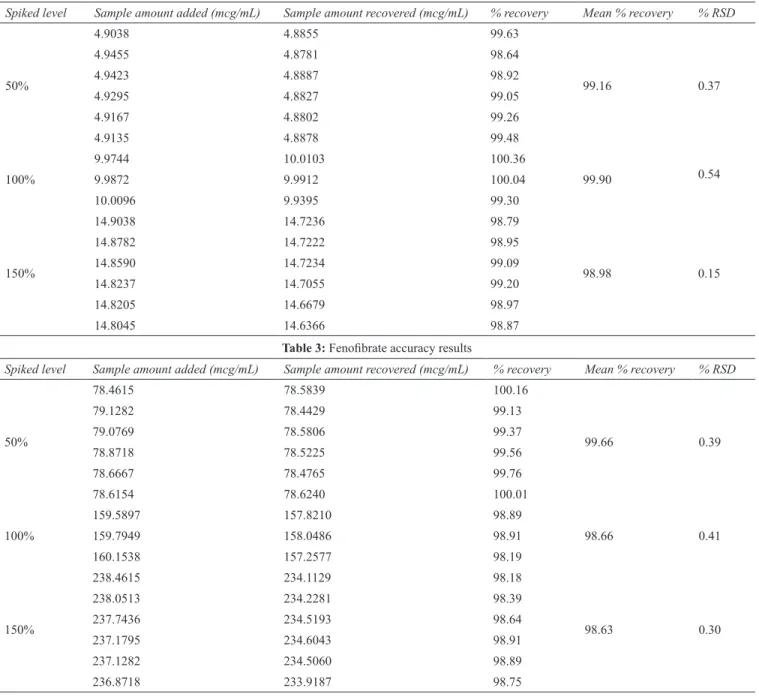
The accuracy of an analytical procedure expresses the closeness of agreement between the value which, is accepted either as a conventional true value, or an accepted reference value, and the value found. The method accuracy was determined based on recovery experiments. The recovery studies were carried out at three concentration levels with triplicate preparations. The percentage recovery, mean recovery, and standard deviation of the percentage recovery were calculated and tabulated in Tables 2 and 3.
Table 3: Fenofibrate accuracy results
Spiked level Sample amount added (mcg/mL) Sample amount recovered (mcg/mL) % recovery Mean % recovery % RSD
50% 78.4615 78.5839 100.16 99.66 0.39 79.1282 78.4429 99.13 79.0769 78.5806 99.37 78.8718 78.5225 99.56 78.6667 78.4765 99.76 78.6154 78.6240 100.01 100% 159.5897 157.8210 98.89 98.66 0.41 159.7949 158.0486 98.91 160.1538 157.2577 98.19 150% 238.4615 234.1129 98.18 98.63 0.30 238.0513 234.2281 98.39 237.7436 234.5193 98.64 237.1795 234.6043 98.91 237.1282 234.5060 98.89 236.8718 233.9187 98.75
Table 2: Atorvastatin accuracy results
Spiked level Sample amount added (mcg/mL) Sample amount recovered (mcg/mL) % recovery Mean % recovery % RSD
50% 4.9038 4.8855 99.63 99.16 0.37 4.9455 4.8781 98.64 4.9423 4.8887 98.92 4.9295 4.8827 99.05 4.9167 4.8802 99.26 4.9135 4.8878 99.48 100% 9.9744 10.0103 100.36 99.90 0.54 9.9872 9.9912 100.04 10.0096 9.9395 99.30 150% 14.9038 14.7236 98.79 98.98 0.15 14.8782 14.7222 98.95 14.8590 14.7234 99.09 14.8237 14.7055 99.20 14.8205 14.6679 98.97 14.8045 14.6366 98.87
Precision
The precision of an analytical procedure expresses the closeness of agreement (degree of scatter) between a series of measurements obtained from multiple sampling of the same homogeneous sample under the prescribed conditions. The % assay calculated for six different preparations of the sample and tabulated in Table 4.
Linearity Range
The analytical procedure linearity is its ability (within a given range) to obtain test results. The results are directly proportional to the concentration (amount) of an analyte in the sample. The interval between the upper and lower concentration (amounts) of analyte in the sample (including these concentrations) has been demonstrated that the range of analytical procedure which has a suitable level of precision, accuracy, and linearity.
Linearity was determined triplicate at each level by plotting peak areas for atorvastatin calcium and fenofibrate against the concentration of solutions. The linearity of atorvastatin calcium and fenofibrate determined in the concentration ranges of 5.00 to 15.00 and 80 to 240 mcg/mL, respectively. The atorvastatin calcium regression equation is y = 25,531x – 5,677, with a coefficient of correlation (R2) of 0.999. The fenofibrate regression equation is y = 22,095x – 44,339, with a coefficient of correlation (R2) of 0.999 and shown in Figures 4 and 5. The range of the analytical method determined for atorvastatin calcium and fenofibrate tabulated in Table 5.
Robustness and Ruggedness
The analytical procedure robustness is small, but deliberate variations in method parameters measurement. The capacity
of the method unaffected and provides as indication of its realibility, when compared to normal usage.
Robustness and ruggedness were determined by a change in column oven ± 5°C, buffer pH ± 0.1%, and different batch of the column with a different analyst.
RESULTS AND DISCUSSION
System suitability results were given by Table 1, and system suitability parameters are retention time, resolution, tailing, resolution, and plate count were within the acceptance limits. So the system is suitable for the analysis. The test chromatogram extracted on PDA detector the peak atorvastatin calcium and fenofibrate purities found 1, respectively, indicates no interference, so the method is specific. Atorvastatin recovery was found 98.64 to 100.36%, and % RSD was 0.15 to 0.37, fenofibrate recovery was found 98.18 to 100.16%, and % RSD was 0.30 to 0.41 indicates the method is accurate 50 to 150% of the target concentration. Six different % assay preparation values of the same homogeneous samples found 99.30 to
Figure 4: Atorvastatin calcium calibration curve
Figure 5: Fenofibrate calibration curve
Table 5: Range results
Parameter Unit Atorvastatin calcium Fenofibrate
Range mcg/mL 5.00–15.00 80.00–240.00
Linearity Correlation coefficient (r2) 0.999 0.999
Accuracy at 50% % recovery 99.16 99.98
Accuracy at 150% % recovery 98.98 98.63
Precision at 50% % RSD 0.37 0.39
Precision at 150% % RSD 0.15 0.30
Table 4: Precision results
S. No.
% assay
(atorvastatin calcium equivalent
to atorvastatin) % assay (fenofibrate)
Preparation-1 100.36 98.89 Preparation-2 100.04 98.91 Preparation-3 99.30 98.19 Preparation-4 99.86 98.51 Preparation-5 100.07 98.64 Preparation-6 100.23 98.72 Average assay 99.98 98.64 Std. dev 0.37 0.27 % RSD 0.37 0.27
100.36% for atorvastatin and 98.19 to 98.91% for fenofibrate indicates the method is precise. Atorvastatin calcium linear correlation was found to be y = 25,531x – 5,677, the correlation coefficient was 0.999, fenofibrate was y = 22,095x – 44,339, and the correlation coefficient was 0.999 indicates the method is linear across the target concentration. The method unaffected due to deliberate changes in flow rate, column oven temperature, and different batch column with different analyst proves the method is robust and rugged. The limit of detection (LoD) and limit of quantitation (LoQ) values were found to be 0.2 and 0.6 mcg/mL for atorvastatin calcium, and 0.3 and 0.9 mcg/mL for dutasteride, respectively. The proposed range 50 to 150% of the target concentration, i.e., 20 to 60 mcg/mL for atorvastatin calcium and 80 to 240 mcg/mL for fenofibrate found linear, accurate, and precise (Table 5).
CONCLUSION
A new, specific, selective, linear, accurate, and precise gradient RP-HPLC method was developed for the estimation of atorvastatin calcium and fenofibrate in their pharmaceutical tablet formulation. The proposed method was successfully separated atorvastatin calcium, fenofibrate, and their related compounds. The proposed method is specific, selective, and stability-indicating power. Hence, the developed method could be adapted to regular quality control analysis and stability analysis.
ACKNOWLEDGMENTS
The authors are thankful to the Department of Science and Humanities, M/s Bharat Institute of Higher Education and Research, Chennai, India, for encouragement.
REFERENCES
1. Indian Pharmacopoeia. Ed.7th, Vol.II, Government of India, The Indian pharmacopoeia commission, Ghaziabad, 2014,1099-1102,1744-1745.
2. United States of Pharmacopoeia and National Formulary. Vol.I, The united states Pharmacopeial convention, Rockville, 2019,410-477, 1793-1800.
3. European Pharmacopoeia, Vol.II, European Directorate for the Quality of Medicines & HealthCare, Council of Europe, France, 2020,1890-1892, 2617-2618.
4. Arunadevi birajdar S, Meyyanathan S.N, Determination of Atorvastatin and Fenofibrate in a fixed dose combination by High Pressure Liquid Chromatography. International journal of pharmacy & Pharmaceutical research. 2015;3(4):83-94. 5. Prakash Diwan V, Anusha N, Sanayaima Huidrom, Surendra N,
Prasad VVLN, Stability Indicating High Performance Liquid
Chromatographic Assay for the Simultaneous Determination
of Atorvastatin calcium and Fenofibrate in Tablet Dosage Form. International Journal of Pharmacy and Industrial Research. 2012;2(3):331-339.
6. Jain N, Raghuwanshi R and Deeti Jain, Development and Validation of RP-HPLC Method for Simultaneous Estimation of atorvastatin Calcium and Fenofibrate in Tablet Dosage Forms. Indian Journal of Pharmaceutical Sciences 2008; 70(2): 263-265. doi: 10.4103/0250-474X.41473.
7. brar, Patnala Ramya, Akula Srinivas, Reena Sowmya P, Tayyaba Mahtab, Simultaneous Method Development and Validation of Atorvastatin and Fenofibrate by RP-HPLC Method in Pharmaceutical Formulation. International Journal of Pharma Sciences and Research 2018; 9(10):131-137.
8. Pravallika S, Srinivas Reddy Malladi, Method Development And Validation Of Simultaneous Estimation Of Atorvastatin Calcium And Fenofibrate In Combined Tablet Dosage Form By RP-HPLC. International Journal Of Pharmacy & Technology 2013; 5(3):5905-5915.
9. Bhinge SD, Malipatil SM, Jondhale A, Hirave R, and Savali AS, A New Approach to the RP-HPLC Method for Simultaneous Estimation of Atorvastatin Calcium and Fenofibrate in Pharmaceutical Dosage Forms. E-Journal of Chemistry 2012; 9(3):1223-1229.
10. Rupali Hirave, Ravindra Bendagude, Manish Kondawar, RP-HPLC Method for Simultaneous Estimation of Atorvastatin Calcium and Fenofibrate in tablet dosage forms. Journal of Pharmacy Research 2010; 3(10):2400-2401.
11. Praveen Kumar, Vidyadhara S, Murthy T.E.G.K, Venkateswara Rao B and Nikhila V, A Novel Reverse Phase Liquid Chromatographic Method Development And Validation for The Simultaneous Estimation of Atorvastatin, Ezetimibe And Fenofibrate In Bulk And Tablet Dosage Form. International Journal of Pharmaceutical Sciences Research 2016; 7(10):4145-4151. doi: 10.13040/IJPSR.0975-8232.7(10).4145-51.
12. Abhijit Dhiware D, Padmanabh Deshpande B, Santosh Gandhi V, Sujith Nair, SuvarnaVanjari, A Simple and Sensitive RP-HPLC Method for Simultaneous Estimation of Atorvastatin Calcium Ezetimibe and Fenofibrate in Combined Tablet Dosage Form. Research J. Pharm. and Tech 2013; 6(10):1085-1088.
13. Susheel John Varghese and Thengungal Kochupappy Ravi, Quantitative Simultaneous Determination Of Fenofibrate, Atorvastatin, And Ezetimibe In Tablets Using Gradient
Highperformance Column Liquid Chromatography And
Highperformance Thin-Layer Chromatography. Journal of Liquid Chromatography & Related Technologies 2014; 37(19):2784-2799. doi.org/10.1080/10826076.2013.873870. 14. Shivani K and Tulja Rani G, Method Development And Validation
For Simultaneous Estimation Of Atorvastatin, Fenofibrate And Folic Acid In Pharmaceutical Dosage Form. Int.J.Pharm Drug Anal 2015; 3(4):140-149.
15. Pallavi Vukkum, Moses Babu J, Muralikrishna R, Stress Degradation Behavior of Atorvastatin Calcium and Development of a Suitable Stability-Indicating LC Method for the Determination
of Atorvastatin, its Related Impurities, and its Degradation
Products. Sci Pharm 2013; 81:93-114.
16. ICH Q2 (R1), Validation of analytical procedure: Text and Methodology, November, 2005.