Using localised
websites across
cultures
Are localised websites culturally adaptable?
Author:
Christina Jacobsen - 288236
Cand.ling.merc. – English IMK & PR
School of Business and Social Sciences, Aarhus University
Department of Business Communication
October 2013
Supervisor: Carmen Heine
Table of contents
1. Introduction ... 1
1.1. Problem statement ... 2
1.2. Method and empirical data ... 2
1.3. Delimitation ... 4 1.4. Scientific background ... 4 2. Theoretical fundament ... 7 2.1. Communication theory ... 7 2.1.1. The SPA-model ... 7 2.1.2. The IMC-model ... 9 2.2. Intercultural communication ... 11
2.2.1. Measurements on culture differences ... 12
2.2.1.1. Hofstede ... 13
2.3. Web communication ... 14
2.3.1. The website in a communicative perspective ... 15
2.3.2. Websites in an intercultural perspective ... 17
2.3.2.1. Internationalisation, globalisation and localisation ... 17
2.3.2.2. Standardised, localised and culturally adapted websites ... 19
2.3.2.3. Translation for the web ... 24
2.3.2.4. Cultural adaption of websites ... 27
2.3.2.4.1. Hofstede’s cultural value index applied on web communication ... 29
2.3.2.5. Non-verbal aspects of website localisation ... 33
3. Case ... 36
3.1. Background ... 37
3.2. The communicative situation ... 37
3.2.1. What is “Danish design” and “Scandinavian design”? ... 39
3.2.2. Hofstede on DEN, UK and GER cultural values ... 41
3.2.3. The websites in the genre perspective ... 44
3.3. The analysis ... 45
3.3.1. RigTig by Stelton ... 46
3.3.1.1. The homepage ... 46
3.3.1.2. The company profile website ... 48
3.3.1.3. The product profile website – rep. 1 ... 51
3.3.1. Erik bagger ... 54
3.3.2.2. The company profile website ... 59
3.3.2.3. The product profile website – rep. 1 ... 61
3.3.2.4. The product profile website – rep. 2 ... 63
3.3.3. Rosendahl ... 66
3.3.3.1. The homepage ... 66
3.3.3.2. The company profile website ... 71
3.3.3.3. The product profile website ... 73
3.3.3.4. The product profile website – rep. 2 ... 75
3.4. Findings... 81 3.4.1. RigTig by Stelton ... 82 3.4.2. Erik bagger ... 83 3.4.3. Rosendahl ... 84 3.4.4. Summary ... 84 4. The questionnaire... 85 4.1. Theoretical approach ... 86 4.2. RigTig by Stelton ... 87 4.3. Erik bagger ... 87 4.4. Rosendahl ... 88 4.5. Summary... 88 5. Discussion ... 89 5.1. RigTig by Stelton ... 89 5.2. Erik bagger ... 90 5.3. Rosendahl ... 90 5.4. Comparison of findings ... 90 6. Conclusion ... 91 7. References ... 95
List of tables and figures
Figure 1: The SPA communication model ... 8
Figure 2: The IMC-model ... 10
Figure 3: “Context” in the IMC-model. How culture relates to the situational context ... 10
Figure 4: The "onion diagram" ... 12
Figure 5: Aspects of web localisation, “What web localisation entails” ... 21
Figure 6: The five fields of website localisation ... 24
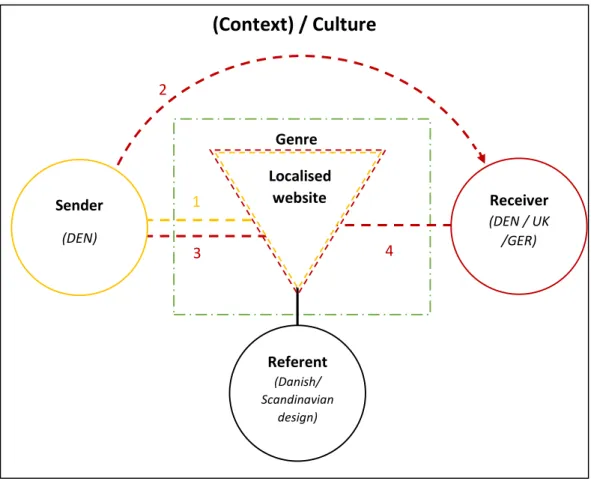
Figure 7: A communication model on the cultural adaption of localised websites ... 38
Table 1: The five stages of website localisation ... 19
Table 2: The five fields of website localisation ... 22
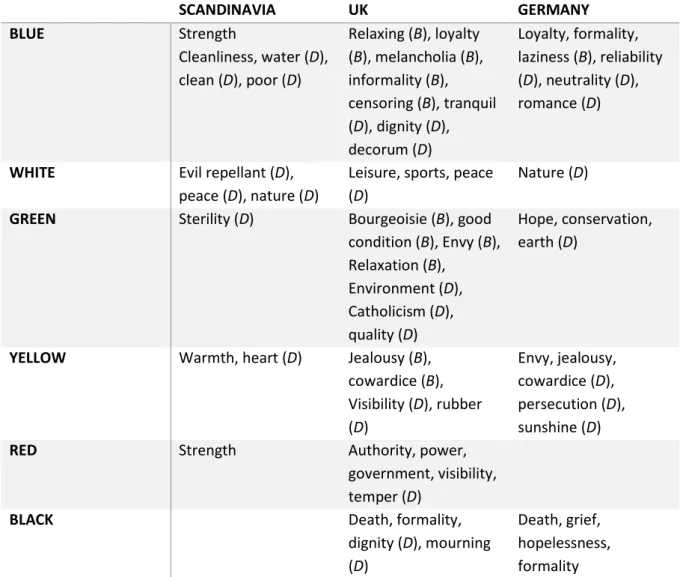
Table 3: The meaning of selected colours in Scandinavia, the UK and Germany ... 34
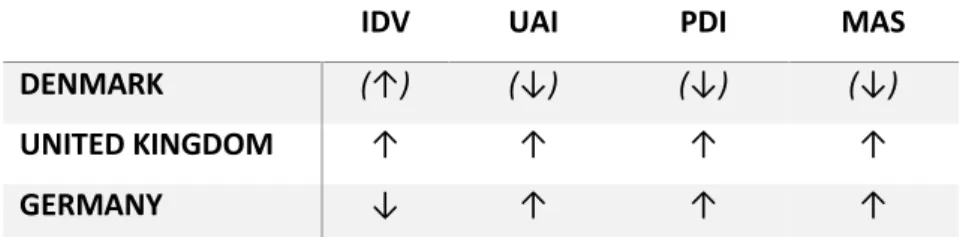
Table 4: Denmark, United Kingdom and Germany index scores... 42
Table 5: Score difference between the native Danish culture and the UK and Germany respectively 43 Table 6: The cultural tendencies of the UK and Germany compared to the Danish values ... 43
Table 7: The cultural values on the homepage of RigTig by Stelton ... 48
Table 8: The cultural values on the company profile website of RigTig by Stelton ... 51
Table 9: The cultural values on the product website of RigTig by Stelton ... 54
Table 10: The cultural values on the homepage of erik bagger ... 58
Table 11: The cultural values on the company profile website of erik bagger ... 61
Table 12: The cultural values on the product profile website of erik bagger – rep. 1 ... 63
Table 13: The cultural values on the product profile website of erik bagger – rep. 2 ... 65
Table 14: The cultural values on the homepage of Rosendahl ... 70
Table 15: The cultural values on the company profile website of Rosendahl ... 73
Table 16: The cultural values on the product profile website of Rosendahl – part 1 ... 75
Table 17: The cultural values on the product profile website of Rosendahl – rep. 1 ... 81
Screenshot 1: The homepage of RigTig by Stelton (DEN) ... 47
Screenshot 2: The company profile website of RigTig by Stelton (DEN) ... 49
Screenshot 3: The product profile website of RigTig by Stelton – rep. 1 (DEN)... 52
Screenshot 4: The homepage of erik bagger – part 1 (DEN) ... 56
Screenshot 5: The homepage of erik bagger – part 2 (DEN) ... 56
Screenshot 6: The company profile website of erik bagger (DEN) ... 59
Screenshot 7: The product profile website of erik bagger – rep. 1 (DEN) ... 62
Screenshot 8: The product profile website of erik bagger – rep. 2 (DEN) ... 64
Screenshot 9: The homepage of Rosendahl - part 1 (DEN) ... 67
Screenshot 10: The homepage of Rosendahl - part 2 (DEN) ... 67
Screenshot 11: The homepage of Rosendahl - part 3 (DEN) ... 68
Screenshot 12: The company profile website of Rosendahl - part 1 (DEN) ... 71
Screenshot 13: The company profile website of Rosendahl - part 2 (DEN) ... 71
Screenshot 14: The product profile website of Rosendahl (DEN) ... 74
Screenshot 15: The product news website of Rosendahl – rep. 2, part 1 (DEN) ... 76
Screenshot 16: The product news website of Rosendahl – rep. 2, part 2 (DEN) ... 76
Screenshot 17: The product news website of Rosendahl – rep. 2, part 3 (DEN) ... 77
Abstract
As websites have become an important intercultural communication platform for companies, there are several ways for the localisation websites. While it is generally suggested that only culturally customised websites are able to successfully communicate to target audience of foreign cultures, many companies opt for offering localised websites, which are translations of a domestic website. This thesis investigates if localised websites bear the cultural values of the sender and if localised websites can be yet adapted to the culturally influenced preferences of foreign target audiences. For answering these questions, selected websites that represented the homepage, the company profile and the product profile of Danish, English and German localised websites of three Danish companies within the tableware branch were analysed for their cultural elements. As all companies defined their products as “Danish design” or “Scandinavian design”, it was assumed that the companies would be especially experienced and aware of communicating cultural values across cultures. In addition, a questionnaire investigated the intercultural web communication approaches of the companies of the analysed websites.
The theoretical part of the thesis focussed on communication theories and the role of culture and Hofstede’s cultural value index was presented as a tool for measuring cultural differences. Further, the issue of intercultural web communication was elaborated and it was focussed how websites can be adapted to the cultural preferences. Here, Hofstede’s cultural value served to explain culturally related preferences in web communication.
The practical part of the thesis accounted for the communicative situation of the selected websites. Here, Hofstede’s classification of the Danish, British and German cultures were combined to account for culturally related preferences in regards to web communication.
The analysis part was introduced by a presentation of the individual companies and their websites. First, the Danish websites were analysed for their cultural elements, and then the English and German websites were analysed for differing cultural values. The results of the individual analyses were then presented for the individual companies, which accounted for the cultural values of the Danish website and whether the English and German websites were culturally adapted to the British and German cultures respectively.
The analyses showed that the Danish versions of the localised websites had a great tendency to reflect Danish cultural values. Although the English and German websites included some cultural adaptions, these could not clearly be related to British and German cultural values respectively; while
the English websites were moderately adapted, the German websites rarely accounted for the German cultural values.
The analyses showed that it is possible to culturally adapt localised websites, although it appeared that the cultural adaptions on the analysed websites were not explicitly suitable for the targeted cultures.
In addition to the website analysis, a questionnaire was presented which was designed to obtain data about the intercultural web communication approach of companies of the analysed websites. The questionnaires were answered by representatives of the companies.
The questionnaire allowed to explain that the domestic localised websites which overall accounted for Danish cultural values were commonly created by persons with a native Danish heritage. It appeared that a low priority of choosing native English or German translators for the adaption of the localised websites can be related to localised websites that generally do not meet the cultural preferences of the target audiences.
In regards to the intercultural awareness of the companies, the questionnaire indicated that the English websites were not considered to target a British audience, but a broad rather a broad
international audience. This information indicated that the companies regard the English language as a culturally neutral communication tool and not as an indicator for culturally adapted content. On the other hand, the German language was only seen in relation to a native German audience.
P a g e
1 | 101
Using localised websites across cultures:
Are localised websites culturally adaptable?1.
Introduction
Websites have become an important communication medium in business communication. The worldwide availability of the internet allows companies to use their website as portal for both domestic and international users, which makes the website an important platform for intercultural communication.
According to communication theories, successful intercultural communication situations demand that the sender adapts his message to the cultural needs and values of the receiver, as “the same message in a uniform style does not produce the same meaning in every country” (Nacar & Burnaz, 2011, p. 274).
The role of the website in a communicative perspective is manifold. While it can be seen as a culturally neutral medium for transmitting messages, it can also be seen as genre and text. In this perspective, websites, their content, visual and functional appearance, communicate cultural values, and hence websites will be influenced by the cultural heritage of their creators (Zhao et al., 2003, p. 81).
However, it appears that many companies communicate to their international consumers through localised websites, which are translated versions of a domestic website, instead of culturally customised websites, which are completely adapted to the target culture (Singh et al., 2005, p. 10). Assuming that localised websites are influenced by the cultural heritage of their creators and exclude the option for cultural adaptions, while these at the same time are frequently used as
communication platform for communicating across cultures, it shall be investigated if localised websites are yet able to include differing cultural approaches which would demonstrate that these are suitable as intercultural communication tools.
This issue shall be exemplified by an analysis of the localised websites of three Danish companies that market their products by a highly culturally related term (“Danish design” or “Scandinavian design”), as it is assumed that these are especially experienced and sensitive in intercultural
communicative situations. As recent localisation studies found Hofstede’s cultural value index highly applicable to relate communicative preferences on websites to certain cultural values, his theory will
P a g e
2 | 101
serve to explain whether the domestic Danish websites, as source for other localised websites, particularly represent the cultural preferences of the Danish culture and if the localised English and German language versions have been culturally adapted to the preferences of a British and German target audience respectively (cf. Schäler (2008), Singh (2011), Singh et al (2005), Marcus et al (2000), Ahmed et al (2008) and Thatcher et al. (2007)).
In a more distant perspective, this investigation shall answer whether the communicative approach of these localised websites is oriented towards the native culture of the sender and if localised websites reflect the culture of the receiver, or if the localised websites account for a mix of cultural approaches.
In addition, a questionnaire shall investigate the motives behind the analysed cultural approaches of the websites.
1.1.
Problem statement
Based on the assumption that localised websites bear a certain cultural heritage and avoid cultural adaptions, although these are frequently used for intercultural communication purposes,
This thesis investigates if the domestic localised websites of three Danish companies account for the Danish cultural website preferences according to Hofstede’s cultural value index, and if the German and English websites have been culturally adapted to suit the website preferences of the German and British cultures respectively.
1.2.
Method and empirical data
The thesis will be introduced by a theoretical fundament in paragraph 2, which focusses on communication in a general, intercultural and web-based perspective.
First, a general approach of communication theories, exemplified by the comprehensive SPA (Sprog på arbejde) communication model and the marketing oriented IMC (International market
communication) communication model, will be given. Second, intercultural communication will be focussed, and the complexity of culture will be highlighted. In this connection, it will be discussed how culture and cultural differences can be measured, and here, Hofstede’s cultural value index will be presented. Third, web-based communication will be focussed, and it will be elaborated how a websites can be interpreted in a communicative perspective. In this connection, it will be focussed how websites are used for intercultural communication purposes. In addition, the role of translation for the web will be briefly discussed. Hereafter, it will be accounted for the cultural adaption of
P a g e
3 | 101
websites, and how Hofstede’s cultural value index can be related to culturally related website preferences. In this connection, alternative non-verbal aspects of website localisation shall be briefly named.
After the theoretical part, the analysis section in paragraph 3 will be introduced. Here, the localised websites of three Danish companies of the tableware branch that market their products as Danish or Scandinavian design will be analysed for their cultural approach in their Danish, English and German language versions respectively. First, it will be accounted for the communicative situation. Then, the terms “Danish design” and “Scandinavian design” will be briefly elaborated, as these account for the referent of the case. Hereafter, the cultural context of the communicative situation will be described by presenting and comparing Hofstede’s cultural values of Denmark, the United Kingdom and Germany as these are assumed to form the cultural background for the sender and the receivers respectively. Finally, it will be briefly accounted for the genre approach of the selected case. The analysis of the selected company websites will be arranged by company and will be introduced by a brief description of the companies. The analysis will first offer a comprehensive description of the individual websites and will then account for the cultural approaches of the domestic Danish website. Then, it will be analysed if the German and English versions differ in their cultural
approaches. The cultural approaches will be described by relating the available website elements in accordance to Hofstede’s cultural values, and these will be categorised by four different main areas of website localisation, which were identified and described in the theoretical part. The analysed cultural values of the websites will then be compared to the cultural values of the Danish, British and German cultures. In this way, it will be elaborated whether the Danish website accounts for typically Danish website preferences, and if the English and German websites are adapted to the website preferences of British and German receivers. Finally, common and individual preferences of the website analyses will be discussed.
As a supplement to the theoretical investigation, a questionnaire that has been answered by representatives of the companies whose websites have been analysed, will be presented in paragraph 4. The questionnaire investigates if the companies are aware of intercultural web
communication issues, and in this way, the questionnaire seeks to answer the question whether the analysed cultural approaches of the websites were intended or not. First, the individual answers will be presented and it will be accounted for eventual common statements.
Finally, the statements of the questionnaire will be related to the results of the website analysis. First, the results of the website analysis and the questionnaire will be discussed for the individual companies. Finally, common approaches will be elaborated and general tendencies will be discussed.
P a g e
4 | 101
1.3.
Delimitation
The websites that shall be investigated in this thesis are chosen due to their localised appearance in their Danish, English and German language versions. All companies are located in Denmark, belong to the tableware industry and market their products as Danish and/or Scandinavian design respectively. The size of the company as well as their national and international market position are not
considered. The English and German websites are only related to cultural values of the United Kingdom and Germany respectively, although other countries with English and German official languages might have been considered as potential target cultures.
Due to the limited extend of this thesis, it was not possible to obtain data about the actual
perception of recipients of the targeted markets. Instead, this thesis relies on the cultural description of Hofstede’s cultural value index, as his cultural theory allowed to compare the selected nations as such. This thesis especially focusses the role of the sender in the intercultural communicative situation. Therefore, the theoretical findings of the website analysis are extended by a questionnaire which researches the sender’s practical approach of web communication.
For offering a detailed description of the case of this thesis, the theoretical findings of the website analysis and the questionnaire follow a qualitative approach. Regarding the website analysis, this means that only three company websites have been chosen and that not the entire websites will be analysed. Instead, certain website types will be selected to account for general tendencies of the websites’ cultural approach.
Further, the analysis will only focus on content that can be interpreted culturally. The analysis will not focus on translation related communicative adaptions, such as the quality of language or general linguistic features of the texts. Likewise, the technical realisations of website localisation will not be considered.
1.4.
Scientific background
This thesis follows an inductive approach, accounting from specific observations to broader
generalisations. Thus, scientific knowledge is obtained through testing and systemising of empirical data.
Further, this thesis accounts for a hermeneutic approach, which seeks to obtain knowledge through the systematic interpretations of actions or texts (Baran & Davis, 2012, p. 13). Looking for hidden or deep meaning in people’s interpretation of different symbol systems, as for example in media texts,
P a g e
5 | 101
hermeneutics can be categorised as interpretive theory approach. In this thesis, it will be interpreted how the content of localised appearing websites include cultural elements and how these reflect the cultural values of the intended targeted audiences. In this relation, the dialectic process of this thesis also follows the hermeneutic circle, which asserts that “the part” (i.e. the text or elements of the text) can only be understood from “the whole” (i.e. the cultural context), while “the whole,” in turn, can only be understood from its “parts”” ( (Prasad A. , 2002) as cited in (Prasad P. , 2005, p. 34f)). Thus, the individual analyses’ outcomes of the three company websites are interpreted and understood in relation to each other. The analyses therefore offer data for a deeper understanding of the entire investigated issue. This includes, that the smallest cultural elements of the websites are understood in terms of a large cultural context (cf. (Cohen M. Z., 2000, p. 72ff). The interpretive nature of hermeneutics also implies that the outcome of the research is influenced by the subjective knowledge and the cultural context of its interpreter. However, I will seek to reduce the present subjectivity by constantly offering the reader theoretically founded background knowledge for reflecting on the issue of this thesis.
Although this thesis is led by a hermeneutic objective, it is inspired by a positivistic approach, as a clear, precise and constructive investigation of a given issue shall contribute positively in a societal manner. In the positivistic perspective, reality is not simple and unchangeable but complex and thus, theories that seek to investigate elements of reality need to embrace this complexity (Langergaard et al., 2006, p. 96ff). In this thesis, there will be used several theoretical approaches in order to form complex theoretical approaches. For instance, theoretical approaches of communication will viewed in an intercultural perspective and this knowledge will be used to discuss the role of intercultural aspects in terms of web communication. Further, theories on website localisation will be combined with general cultural theories for then being able to create a model for analysing the cultural approaches on websites.
Finally, the theoretical findings of this thesis will be supported by empirical data which is obtained through a questionnaire. On the first view, this method accounts for a quantitative approach, as the questionnaire includes standardised questions which shall be answered by all respondents. However, the overall approach is qualitative: First, the three selected participants function as representatives of the companies whose websites have been analysed. Second, the questions have been formulated as open questions, offering the respondents to answer without presented or implied choices. As this thesis in general, the questionnaire follows an inductive approach, which implies that the obtained issue of intercultural communication issues on the web, implied by localised websites, is the source for the questionnaire. Further, the questionnaire follows a naturalistic inquiry, as there is no
P a g e
6 | 101
attempt to manipulate the selected participants for the purpose of evaluation. Relying on a naturalistic inquiry, the collection of qualitative data combined with an inductive approach, the questionnaire can be categorised as exploratory evaluation research. It seeks to understand the outcomes, and to consider which outcomes may be important to identify key variables, which then could be further researched by quantitative methods (Patton, 1987, p. 37).
Following a holistic approach, the questionnaire is interpreted as a qualitative method to understand situations as a whole (Patton, 1987, p. 17f). In this perspective, it is assumed that the description and understanding of an issue’s social and political context is essential for the overall understanding of the given issue. By focussing on the complexity of a situation, the holistic perspective avoids to offer an evaluation, which is isolated, unrelated and out-of-context. Thus, the questionnaire serves as a supplement to the results of the theoretical analysis.
P a g e
7 | 101
2.
Theoretical fundament
The content of the following section will build the theoretical fundament of the thesis. First, I will give an overview of the terms culture and intercultural communication. In this connection, I will investigate how cultural differences can be measured and compared. Hereafter, I will focus on web communication and how websites can be culturally adapted. In this connection, I will examine the concepts of globalisation, glocalisation and localisation. I will then look on the website as a genre for investigating common structures of websites.
2.1.
Communication theory
The following section will give an overview of communication theories, by accounting for a general communication model (the SPA-model) and a communication model on international market communication (IMC-model). The focussing on general communication models shall illustrate the role of culture, and this basic knowledge shall later be used to account for intercultural
communication issues on websites.
2.1.1.
The SPA-model
The “Sprog på arbejde” (SPA) communication model has been created to illustrate relations and connections between text, message, sender and receiver in a dynamic situational perspective of communication and can therefore be categorised as a relational communication model. It was inspired by other relational oriented communication models, such as from Bühler, Jakobsen, Henriksen and Togeby, and in this way, the SPA-model unites the elements of a range of popular communication models and functions hence as a representative communication model. (Ditlevsen et al., 2007, p. 62f)
The central element in the model is the text, as all acts of communication are made through or via texts (Ditlevsen et al., 2007, p. 34). The Latin derivation of the word “text”, “textere” or “textum” which means “(to) weave”, highlights the importance of the cohesion of a text’s elements. Regarding a text as sign, in a semiotic perspective the coherence of a text can explained from a syntactic, semantic and pragmatic perspective, which account for the relation between signs, the relation between sign content and sign expression and the relation between signs and their interpreters.
P a g e
8 | 101
Regarding a text as a tool for reaching a certain objective, a text can also be said to bear certain functions, which the German linguist Bühler categorised as expressive, appellative and informative ( (Bühler, 1934/1982) as cited in (Ditlevsen et al., 2007, p. 39f)). These three functions are directly related to the actors of the communicative situation, namely the sender, the receiver and the referent. Due to this connection, all of the three function will always be present in any
communicative situation, and this linkage is has been highlighted by connecting lines in the SPA-model. Due to their direct relation to the actors of the text, all three functions will always be present in any text (though some functions will be dominating).
The text is surrounded by the context, which refers to all elements that surround the communicative situation and that have an influence on the text. The three main elements, which have a dominant influence on the text in the communication process are the sender, the receiver and the referent. To the left, there is the sender. He is the initiator of the text, and he is hence responsible for the formation of the text.
To the right, there is the receiver of the text. He is the part that is influenced the most by the text, as he registers, processes and retains the text. While a first view on the model would suggest that there is only one receiver, it is crucial to distinguish between the intended and actual receiver, which might not always correlate.
Context
Genre Receiver Referent Sender TextSOURCE: Ditlevsen et al, 2007, p. 34 Figure 1: The SPA communication model
P a g e
9 | 101
Besides the sender and the receiver, also the referent plays an elementary role in the communication model. Representing the element to which the text refers, the referent is a passive element in the production and reception process.
Other elements of the context that influence the communicate situation, but which are not explicitly highlighted in the model are the influences of time, space and persons. In addition, the context is influenced by factors of text publicity, status differences between sender and receiver as well as presuppositions. In this model, also the medium is counted as part of the context.
Finally, the role of genre, which Bathia defines as “an instance of a successful achievement of a specific communicative purpose using conventionalized knowledge of linguistic and discoursal resources” (Bathia, 1993, p. 16) is highlighted. In the communicative situation of the SPA-model, genre is surrounded by striped lines for highlighting that it unites all elements of the communication model; the text, the three actors and the context. Thus, genre also has an important influence on the structure and actual appearance of a text.
2.1.2.
The IMC-model
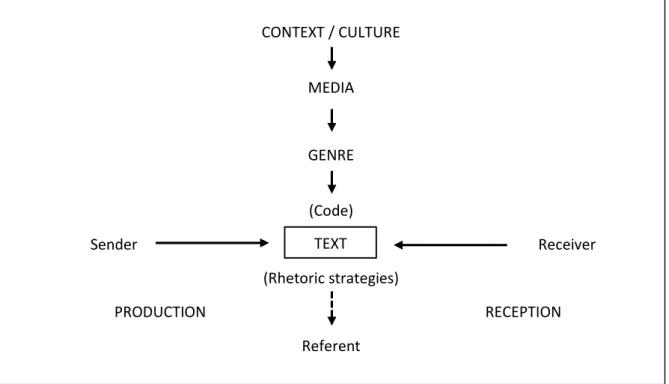
The international market communication (IMC) model has been created by Frandsen et al and is a communication model which focusses on business communication (Frandsen et al., 2005, p. 51ff). Although the model on the first view seems to include the same elements as in the SPA-model, there are some major differences, which allow to view the action of communication from a more culturally focused perspective.
First, the model places the sender as the initiator of the text, which is explicitly highlighted by the “production” process. In this way, the model also indirectly differs between internal and text-external senders or even primary and secondary senders, as these can be counted as actively
influencing the production process of the text. In the same way, the model places the receiver as the actor that is responsible for the reception of a text, and therefore receivers can be categorised as text-internal and text-external as well as primary and secondary in nature.
The text is placed as central element in the model that is structured by rhetoric strategies, which are to a certain degree influenced by genre, media as well as context and culture.
In the IMC-model, the referent is highlighted as the product or brand, and its denotative and connotative meanings.
P a g e
10 | 101
In comparison to the SPA-model, the context element in the IMC-model has been supplemented by the element of culture. In this way, the model distinguishes between the situational context and culture, which influences the situational context (see Figure 3).
The IMC-model illustrates that context and culture have an influence on the choice of medium which in turn influences the genre. In this way, the model emphasises that the medium functions as link between context/culture and genre, as it is argued that the media will have an influence on the communicative characteristic of the text. In turn, genre is not only influenced by the medium, but
Culture Situational
context
Figure 3: “Context” in the IMC-model. How culture relates to the situational context CONTEXT / CULTURE MEDIA GENRE (Code) Sender Receiver (Rhetoric strategies) PRODUCTION RECEPTION Referent TEXT
SOURCE: Frandsen et al, 2005, p. 64 Figure 2: The IMC-model
P a g e
11 | 101
plays an own active part by influencing the text. This activity is explicitly named as coding, referring to how signs are arranged in order to create meaning, and hence coding influences text production and text reception. As the use and perception of codes are culturally influenced, the issue of coding becomes especially interesting in an intercultural perspective, as it bears the potential to imply misperceptions between two different cultures. The following section will therefore focus on the issue of intercultural communication; what culture implies and practical methods for understanding cultural differences.
2.2.
Intercultural communication
Viewing communication as a process of sharing meanings, intercultural communication occurs when the people that create shared meanings have different cultural perspectives and values (Sadri & Flammia, 2011, p. 10). In other words, any communication between two persons that do not share the same cultural background can be described as an act of intercultural communication. As culture shapes a certain group’s shared attitude of what is perceived as normal and appropriate behaviour, it also affects common expectations to what is perceived as “normal” communication. In fact, the role of communication and culture are undeniably interlinked as it is argued that culture, its views and rules, are learned through communication (Wood, 2006, p. 160).
Generally, culture is described as a construct but its definitions vary. In this way, culture can be described as a system of behaviours, meanings, mental characteristics, artefacts or a combination of those elements (Minkov & Hofstede, 2013, p. 16f). While it is argued that the preference for the definition of culture depends on an author’s own cultural background (also known as an ethnocentric perspective), this cultural research of this thesis shall be based on a culture definition which is widely accepted among international scientists. For this reason, the definition of the cultural scientist Geert Hofstede will be used, who defines culture as “the collective programming of the mind that
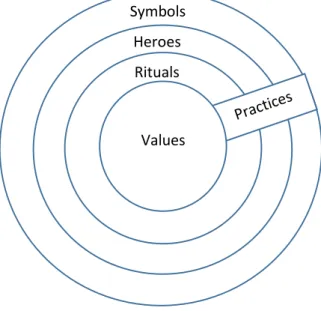
distinguishes the members of one group or category of people from another”. The element “mind” denotes an individual’s thinking, feeling and acting, and hence the mind effects an individual’s beliefs, attitudes and skills, which form the predominantly invisible part of culture, namely values. On the other hand, the visible aspects of culture are symbols, heroes, rituals (as illustrated in Figure 4):
Symbols are defined as “words, gestures, pictures, and objects that carry often complex meanings recognised as such only by those who share the culture” (cited in (Hofstede, 2001, p. 10) referring to (Cohen M. , 1974, p. 23) and (Griswold, 1994, p. 19)).
P a g e
12 | 101
Heroes are defined as “persons, alive or dead, real or imaginary, who possess characteristics that are highly prized in a culture and thus serve as models for behaviour” (Hofstede, 2001, p. 10).
Rituals are defined as “collective activities that are technically unnecessary to the achievement of desired ends, but that within a culture are considered socially essential, keeping the individual bound within the norms of the collectivity”. (Hofstede, 2001, p. 10)
The relation between the visible and invisible elements of culture are illustrated in Figure 4, Hofstede’s “onion diagram”. Here, the practices of symbols, heroes and rituals are visible for an outside observer, while the meaning of these actions are represented as values that are invisible for an outside observer. Depending on the variation of elements of this construction of culture, cultures differ from each other. Keeping in mind that Hofstede’s culture definition denotes a “group or category of people” (see above), the term culture is often used in relation to describe national cultures. In this connection, the following section will account for the systematic description of cultural differences, with a special focus on Hofstede’s cross-cultural index.
2.2.1.
Measurements on culture differences
For explaining cultural phenomena, various scientists have implied systems which allow to compare cultural behaviour and preferences. These studies are commonly based on quantitative researches whose results are then interpreted for making sense of the observed data. Most existing indexes that
Values Rituals Heroes Symbols
Figure 4: The "onion diagram" SOURCE: Hofstede, 2001, p. 9
P a g e
13 | 101
are designed to be used for comparing phenomena across societies rely thus on the collection of comprehensive data from a high range of societies, which ensures the scientific reliability1. (Minkov
& Hofstede, 2013, p. 62ff)
For this thesis, the well-known cultural index by Geert Hofstede has been chosen to explain cultural differences, as his work allows to compare cultural differences by nation.
2.2.1.1.
Hofstede
Geert Hofstede’s cultural value indexes are among the most cited theories for the measurement of cultural differences. His study can be classified as “directly across societies” study, which assigns scores to societies on a variable. The societal indicators are then used for constructing dimensions of national culture (Minkov & Hofstede, 2013, p. 68).
His indexes are based on a comprehensive attitude study on attitudes. From 1967 and 1973, Hofstede collected over 116,000 answered questionnaires by the employees in 20 language and 72 countries of the multinational corporation IBM (Hofstede, 2001, p. 41ff). Based on the analysis and results of the questionnaire, Hofstede accounted for four cultural dimensions on which cultures differ: Power distance, uncertainty avoidance, individualism vs. collectivism and masculinity vs. femininity (later also long-term vs. short-term orientation, which seeks to explain Eastern and Western cultural preferences. However, these shall not be focussed in this thesis).
The power distance (PDI) dimension is an indicator of how people handle human inequality
(Hofstede, 2001, p. 79). Hofstede defines power distance as ”the extent to which the less powerful members of institutions and organizations within a country expect and accept power is distributed unequally” (Hofstede, 2001, p. 98). In this way, the power-distance index illustrates to which degree people of a given society accept inequality, and serves as indicator of how power, prestige and wealth are distributed in a society (Jandt, 2007, p. 172f). Power distance is one of the cultural values which are learned at an early stage of life. For example, in high power distance cultures, children are expected to be obedient towards their parents whereas children in low power distance cultures are treaded as equal persons. Likewise, the relation between persons of low and high status are also represented in the overall society. In high power distance cultures, high status persons are more respected and tend to have a greater influence on issues than persons of a lower status. In this way, countries of high power distance cultures also tend to be more authoritarian. On the other hand, low
1 This approach can also be described as nomothetic approach, focussing to offer a generally applicable
P a g e
14 | 101
power distance cultures are characterised by a more equal distribution of power, prestige and wealth. (Jandt, 2007, p. 172ff)
The uncertainty avoidanceindex (UAI) is defined as “the extent to which the members of a culture feel threatened by uncertain or unknown situations“ (Hofstede, 2001, p. 161). This feeling is expressed through nervous stress and hence, persons that are influenced by a high uncertainty avoidance tend to demand written and unwritten rules for being able to predict the future. High uncertainty cultures can be described as active, aggressive, emotional, compulsive, security seeking and intolerant, while low uncertainty avoidance cultures are contemplative, less aggressive,
unemotional, relaxed, accepting personal risks and relatively tolerant (Jandt, 2007, p. 174). The individualism index (IDV) describes how people define themselves and their relationship with others. In this way, individualism refers to a society “in which the ties between individuals are loose: Everyone is expected to look after him/herself and her/his immediate family only”. Thus, in these cultures the individual interest is more in focus than the interest of a group. On the other hand,
collectivism refers to a society “in which people from birth onwards are integrated into strong, cohesive in-groups, which throughout people’s lifetime continue to protect them in exchange for unquestioning loyalty”. Thus, these cultures value the interests of the group over the interest of the individual. (Hofstede, 2001, p. 225).
The masculinity index (MAS) describes how a culture’s dominant values are assertive or nurturing by focussing on the social role of men varies across cultures (Jandt, 2007, p. 159ff).
“Masculinity stands for a society in which social gender roles are clearly distinct: Men are supposed to be assertive, tough, and focused on material success; women are supposed to be more modest, tender, and concerned with the quality of life. Femininity stands for a society in which social gender roles overlap: Both men and women are supposed to be modest, tender, and concerned with the quality of life.” (Hofstede, 2001, p. 297).
2.3.
Web communication
During the last years, websites have evolved from being a communication supplement to a main communication element in business communication (cf. (Mast et al., 2005, p. 331)). The advantages of websites in businesses relations are that these account for a considerable low-cost communication channel with a worldwide availability, which offers the possibility to combine texts with entertaining multimedia elements. While these are generally created to target a certain target audience, the global reach of websites entails the potential of reaching audiences that were not initially intended. This is especially true for English websites, as these today still account for the dominant language on the web. However, the increasing amount of non-native speakers of English that are accessing the
P a g e
15 | 101
World Wide Web challenges translators and web localisers, as there is an increasing demand for websites that are available in other languages than English. This is especially true for the European region, which on the one hand is a characterised by a large number of people with internet access; on the other hand, these people differ widely in their native language.
On this basis, this section will first account for the website in a communicative perspective. Hereafter, it will be focussed how websites can be culturally adapted and the differences between standardised, localised and culturally adapted websites will explained. In addition, the role of translation for the web will be discussed. Then, it will be accounted how certain website preferences can be related to Hofstede’s cultural value indexes. Finally, the issue of visual website localisation will be briefly named.
2.3.1.
The website in a communicative perspective
Regarding the communicative position of websites, websites can be seen as text, genre and medium (Askehave & Nielsen, 2004, p. 1). These perspectives shall be briefly introduced.
First, the website can be viewed as a text. This perspective would place the website as the central element of a communicative situation, which can be best described by an analysis of the syntactic, semantic and pragmatic characteristics, as well as the language functions (cf. paragraph 2.1). In this connection, Cheung et al defined website functions, which he categorised as: Company overview/ info, products/services, what’s new, search, employment opportunities, interactive feedback, customer service/assistance, index/directory, financial acts, links to other sites, online business services/ utilities, guest book, FAQ, and messages from the CEO (Cheung & Huang, 2002, p. 380f). While these functions shall not be further discussed, this view highlights that the website as a text does not only account for one text, but for a composition of several texts with different functions. Regarding a website as a medium, it can be said to be characterised by three main properties
(Askehave et al., 2004, p. 11f). First, the web is characterised by intertextuality, as websites and their texts are surrounded by other texts by link connections. This relation of web texts is commonly known as hypertext, which can be seen in two perspectives: On the one hand, a content-oriented perspective sees hypertexts as a type of network by regarding it as a “non-sequential text system”. On the other hand, hypertext can be defined by analysing how they are accessed by the reader, focussing on the reading-process of hypertexts (Askehave et al., 2004, p. 13f). Second, the web is characterised by its global reach, which makes websites potentially immediately available for any internet user in the world, making messages available for intended but also unintended receivers. Third, the web is characterised by a certain immateriality, as web texts in comparison to texts in print
P a g e
16 | 101
media can be changed within a short amount of time. Finally, the accessibility and virtuality of the web makes it hard to distinguish between the roles of the actual senders and receivers of a given message.
Despite hypertexts, another important character of websites is its multimedianess, which has the ability to combine and unite different kinds of mediums (text, images, sound and animations) into one format (Askehave et al., 2004, p. ff). In addition, Okazaki highlights the importance of
interactivity and classifies two major categories of interactivity, namely reciprocal communication and personalised choice and/or attention (Okazaki, 2004, p. 85). Accordingly, in a reciprocal communicative situation, the customers’ active responses are encouraged through e-mailing, questionnaires or data registration device, while personalised choice/attention “refers to the function that allows consumers to pinpoint the particular information that interests them, or to identify their problems and access “trouble-shooting” suggestions”. As the focus of this thesis lies in the cultural adaption of websites, this focus on the interaction between sender and receiver of websites will not be further described.
Viewing a website as a genre, the focus lies on the structuring of a text (here: website), and how this structuring is influenced by the sender, receiver and the context (cf. paragraph 2.1.1 and Figure 1). Besides the “purposive nature” of genre, it is influenced by conventionalised verbal and visual rhetorical strategies. Thus, the construction of the website as a genre will highly depend on societal and cultural perceptions, and hence, a website has a great potential of misperception in regards to intercultural communication, as meaningful interpersonal can only appear when members of a culture jointly construct and maintain genres (cf. (Eggins, 2004, p. 50)).
Generally, genre is analysed by three main constituents, namely a communicative purpose, a move structure and rhetorical strategies ( (Swales, 1990) as cited in (Askehave et al., 2004, p. 3f)).
The communicative purpose shapes the genre. In regards to websites as a genre, a website’s receiver (a user) would have certain expectations towards the layout and content of a website. In this
connection, Cheung et al identified four major business purposes of websites, namely general publicity, customer support, online information exchange and www sales (Cheung & Huang, 2002, p. 380).
Move structure account for the rhetorical moves which give genre its characteristic cognitive structure. In this way, every move serves a typical communicative intention, which in turn are realised by verbal and non-verbal rhetorical strategies (Bathia, 1993, p. 30) (cf. (Askehave et al., 2004, p. 17ff). Despite conventionalised structures of certain moves, it appears that a website’s moves are not fixed but rather flexible in regards to their order, and likewise, Askehave et al state
P a g e
17 | 101
the website genre exploits “the entire spectrum of rhetorical creativity” (Askehave et al., 2004, pp. 5f, 24).
In connection with rhetorical strategies, register should be named as it describes the variety of language (syntax) that is influenced by the characteristics of the situation in which it is used. It can be analysed by the dimensions of field, tenor and mode (Collins & Hollo, 2000, p. 259); Field refers to what a text (here: the website) is about and hence often relates to lexis, the language used. Tenor
refers to the social relationship between the interactants. Mode refers to the possibilities of
immediate feedback between interactants. (Andersen, 2012, p. 9)appendix 1. However, as this thesis is focussed on the communicated cultural values of localised websites and not on the linguistic structure, register will not be further focussed.
In any way, the interpretation of the website’s role in a communicative situation is a complex issue, as all three functions are applicable to any communicative context. Relating to the IMC-model, a website can therefore account for a text, as the central element in a communicative situation which is influenced by all present factors, or as part of the context, namely as media and genre which function as influencer on the central text element (cf. Figure 2: The IMC-model). In any perspective, a website will be culturally influenced, as culture influences the context which in turn surrounds all elements in a given communicative situation.
In this thesis, websites will be regarded in their genre and text perspective, as these are culturally influenced. In this way, websites will be focussed in a genre perspective, as it is assumed that a website’s structural and rhetorical realisation is culturally influenced, and at the same time, this thesis will mainly focus the website as a text, as the culturally influenced structural and rhetorical approaches are realised here.
2.3.2.
Websites in an intercultural perspective
Due to the internet’s global reach, many companies are using websites for communicating to international audiences for e.g. attracting new potential customers. Recognising the cultural differences of their consumers, there are various options for companies for adapting their products and communication to the needs of customers of a foreign culture.
2.3.2.1.
Internationalisation, globalisation and localisation
When targeting customers of foreign cultures, businesses have several options to reach their new customers.
The very concept of extending the trade of a product or service outside the domestic market is commonly known as internationalisation, which is defined as “the process of generalising a product
P a g e
18 | 101
so that it can handle multiple languages and cultural conventions without the need for re-design” (The Localization Industry Standards Association as cited in (Pym, 2006, p. 2)). It is important to notice that the targeting of a new audience has been planned, but that the communication process is mainly based on translation, which generally is considered as source-text orientated approach with only little focus on the actual cultural needs of the target audience (Pym, 2010, p. 125).
Eventually, internationalisation becomes a part of globalisation (often abbreviated as “g11n”) which is “the process of making a concept/ process/ product acceptable and usable the world over through internationalisation and localisation” (Gouadec, 2007, p. 39).
Localisation (often abbreviated as “L10n”) is a part of globalisation and refers to the process that makes a product “linguistically and culturally appropriate to the target locale (country / region and language) where it will be used and sold” and includes in terms of website localisation „technical, visual, and textual modifications” (Localization Industry Standards Association (Pym, 2006, p. 2)) (Yunker, 2002, p. 17). Other authors describe a successfully localised product or service as one that through its culturally and linguistically adaption appears to have been developed within the targeted local culture (Cyr et al., 2004, p. 1199) (Schäler, 2008, para. 3). In either way, a successful localisation process will be characterised by its thorough knowledge of the selected target audience and the ability to use communicative channels (media) for reaching this audience.
Localisation is therefore, although it often perceived as new phenomena within the marketing area, a well-known principle of adapting foreign ideas and practices to other cultures2.
The relation between the concepts of globalisation, internationalisation, localisation and translation are also known as “GILT”, which Pym describes as: “Within a company that has been globalized, products are internationalized so they can then be localized quickly and simultaneously, and part of that localization process is translation.” (Pym, 2010, p. 125)
Finally, a recent term in regards to intercultural and transnational activities in marketing relations is
glocalisation which is a combination of the terms globalisation and localisation and refers to “the impact of global issues, trends, ideas and events on the local environment and vice versa” (Douglas & Mills, 2004). In terms of web communication, it has been argued that glocalisation refers to “the consistency of underlying themes, structures, strategy and templates in the adapted approach, but there is a local look and feel” (Sutikno & Cheng, 2012, p. 60). In either way, regarding glocalisation as a factual influence for intercultural web communication, the senders should not only concentrate to adapt the language of their web content, but should consider if and how their target locale has been
2 For instance, Christianity can be named as one of the oldest successful localisation processes; originating in
P a g e
19 | 101
influenced in regards to the issue the intended message.
2.3.2.2.
Standardised, localised and culturally adapted websites
Being accessible to a broad international audience, the web as such has been argued to be “an optimal tool for cross-cultural marketers”, as it is possible to create standardised and localised culture specific content (Luna et al., 2002, p. 399). Therefore, websites are commonly used by
businesses as part of the concepts of internationalisation, globalisation, localisation and glocalisation. As internationalisation and globalisation mostly function as referral to the description of greater superordinate business processes, the linguistic and cultural adaption principles of localisation are commonly used to describe the linguistic and cultural adaption of websites. Hence, Singh defines website localisation as “the process of adapting websites in accordance with linguistic, cultural, technical, functional, legal, and other locale-specific requirements of the target market” (Singh, 2011, p. 7). Thus, culturally adapted websites are able to provide the visitor with culturally appropriate content which corresponds to his values, heroes and rituals. (Luna et al., 2002, p. 399)
In general, domestic websites are taken as source for measuring the extent to which a local website differs from the original counterpart. It is then determined whether a local website can be classified as a standardised website, which is closely related to their source website, as a localised website which is a translation of a source website or a culturally customised website, which is individually designed to satisfy the cultural needs of its target group.
Table 1 illustrates Singh and Pereira’s categorisation of the five different stages of localisation of websites, which take a domestic website as source for other local websites:
Standardised websites The same web content for domestic as well as international users. (The company has not chosen to communicate to their international consumer in terms of translation, internationalisation or localisation)
Semi-localised websites Appear standardised but provide their international users with contact information about foreign subsidiaries
Localised websites Offer international users some country-specific web content which has not been adapted but translated from the source text
Highly localised websites
Include country-specific information such as time and date, postcodes and number formats
Culturally customised websites
Design reflects a complete “immersion” in the culture of the target market. Websites include cultural adaption in respect to the local culture’s perception, symbolism and behaviour
Table 1: The five stages of website localisation SOURCE: Singh et al, 2005, p.10ff
P a g e
20 | 101
Overall, Table 1 highlights that website localisation is appears through the creation of relevant content for the targeted audience. Obviously, an important step toward website localisation is translation which allows the sender to communicate in the same language as his target audience. However, the table also emphasises that the strongest degree of website localisation, namely culturally customised websites, is not reached by translating source texts but by creating content that is adapted or especially designed to the cultural needs of the target audience (translations for the web will be discussed in 2.3.2.3). However, while it seems that a successful localisation requires the full localisation of all source text content, it is argued that it in fact can be culturally appropriate to “only” translate source content. In this way, it is argued that general information can be translated while especially texts with certain marketing objectives cannot be translated but might even require to be exclusively produced by locales of the target culture ( (Singh, 2011, p. 102f), (Esselink, 2000, p. 38f)). Although various studies have shown that consumers prefer localised websites to standardised websites, there is no uniform guideline for the process of successful website localisation (Singh & Pereira, 2005, p. 5)). Hence, it depends on the individual sender to elaborate if and to what extent the content of their source texts can be directly transferred, translated or fully localised for becoming culturally appropriate for the target audience.
In this relation, Luna et al suggest that ideally culturally adapted websites are those that include both culturally customised content and content that appears influenced by the differing culture of the sender. According to the authors, the impact of culture of a website can be best understood by analysing the “cultural integrity” of a website, which is the congruity of a website with a visitor’s culture and the manifestations of that culture. A website’s cultural integrity can be achieved through content congruity and structural congruity. It is argued, that content congruity can be achieved through the cultural adaption of a website’s verbal and non-verbal elements. Structural congruity is reached by customising a website’s structure to the needs and expectations of a (foreign) culture. Thus, a website with a low cultural congruity might be too difficult to process for the website visitor who in turn might reject the website. However, a website with a very high congruity might not be ideally appealing to the website visitor either, as perfectly culturally adapted content might appear boring and odd (Peracchio et al., 1997, as cited in Luna et al., 2002, p. 400). Therefore, it is agued that ideally appealing websites are those with a moderately cultural congruity, as these serve with appropriate content and new, challenging elements that stimulate curousity. (Luna et al., 2002, p. 399f)
A common issue in regards to contemporary intercultural communication on the web is that internationally operating businesses are unaware or do not realise the need for cultural adaption of their websites. Defenders of standardisation approaches in marketing communication argue that
P a g e
21 | 101
2
1
3
4
5
6
consumers anywhere in the world are likely to share the same needs and wants (Okazaki, 2004, p. 82). One explanation for this attitude could be explained by Shneor’s observation: He argues that the lower the sender perceives the cultural distance between him and the targeted market (the
receiver), “the lower are the resource commitment and knowledge necessary for successfully serving that market” (Shneor, 2012, p. 356). If the perceived distance is low, the businesses tend to opt for standardised websites rather than culturally adapted websites. In the same way, it is suggested that internationally operating businesses are often influenced by the “virtuality trap”, which suggests that the “internet enhances perceptions of cultural similarities and blurs cultural differences” (Yamin & Sinkovics, 2006) as cited in (Shneor, 2012, p. 356).
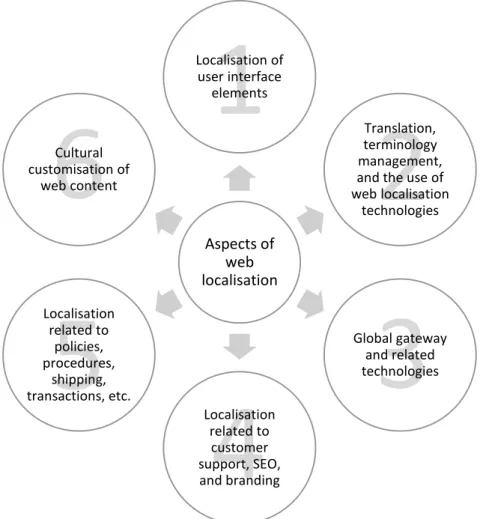
On the basis of guidelines for the localisation of websites, Singh created a figure which illustrates the aspects that need to be considered for the localisation of websites (see Figure 5).
Singh created the figure to highlight that successful localisation of a website includes more tasks than the translation of web content. In this way, his figure is concentrated on the practical tasks which
Aspects of web localisation Localisation of user interface elements Translation, terminology management, and the use of web localisation technologies Global gateway and related technologies Localisation related to customer support, SEO, and branding Localisation related to policies, procedures, shipping, transactions, etc. Cultural customisation of web content
Figure 5: Aspects of web localisation, “What web localisation entails” SOURCE: Singh, 2011, p. 151
P a g e
22 | 101
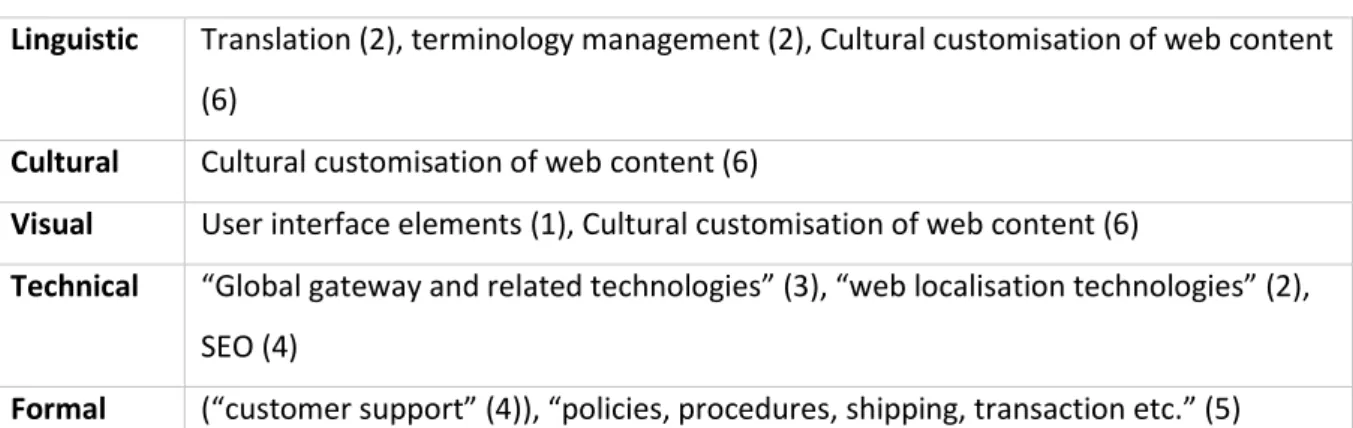
should be included for localising a website successfully. From a linguistic point of view, it is especially interesting how the issues of “cultural customisation of web content” and the “translation and terminology management” are realised, as these elements directly relate to the cultural adaption of the written content of the website. In this perspective, the remaining elements mainly serve as frame for the digital / technological localisation of a website. Further, a more distant perspective of Figure 5 makes it is possible to categorise its practically-oriented elements into five superordinate categories of website localisation, namely linguistic, cultural, visual, technical and formal areas (as illustrated in Table 2)3.
Linguistic Translation (2), terminology management (2), Cultural customisation of web content (6)
Cultural Cultural customisation of web content (6)
Visual User interface elements (1), Cultural customisation of web content (6)
Technical “Global gateway and related technologies” (3), “web localisation technologies” (2), SEO (4)
Formal (“customer support” (4)), “policies, procedures, shipping, transaction etc.” (5) Table 2: The five fields of website localisation
With an exception of two elements, all elements of Singh’s figure can be categorised into five main categories. First, the “cultural customisation of web content” (6) cannot be placed in a single category as it refers to both written and visual content that can function as cultural markers (Singh, 2011, p. 150). In this way, the element can account for a linguistic, cultural and visual area of website adaption. Second, “branding” (4) refers to the adoption of brands or products into a local culture (ibid). Therefore, this term can be viewed as localisation task itself, and it could likewise account for all five main areas of localisation. As the “cultural customisation of web content” despite its
diffuseness is an important step of website localisation, the element is placed in all three main categories. The branding element, however, is due to its autonomous function not found in Table 2. Thus, the categories of Table 2 can be described as follows:
The linguistic area of website localisation includes translation and terminology management as these elements directly relate to the adaption of language.
3 The numbers below the details of the categories refer to the numbered categories from Singh’s figure (Figure
P a g e
23 | 101
The cultural area refers to the “cultural customisation of web content” and is the only element from Singh’s figure which explicitly names the adaption of culture.
The visual area of website localisation is made up by “user interface elements” as it refers to culturally customised website design, such as the adaption of menus, tabs, forms, icons and other visual elements that are not “globally standardised”.
The technical area of website localisation includes “global interface elements” which offers the website visitor to a global landing page for leading the user to local website content, “web localisation technologies” such as translation and project management systems and “SEO” which stands for the website customisation for (local) search engine optimisation. The formal field of website localisation includes elements that refer to the surrounding area of the local setup for the realisation of localisation, namely “customer support” in the local language and “policies, procedures, shipping, transactions” which likewise have to fulfil the rules of the local culture to be accepted. (Singh, 2011, pp. 149-151)
This new categorisation allows to research website location from specific scientific angles. As this thesis focusses on the issue how companies adapt their communication to the needs of audiences of foreign cultures, it is especially the linguistic and cultural areas of website localisation which will be focussed. However, as communication is traditionally regarded as a combination of verbal and non-verbal elements, the visual and technical areas of website localisation will be taken to account as well for evaluating the cultural adaptation of the websites.
Inspired by Singh’s figure on the aspects of website localisation, the five fields of website localisation can be illustrated in a figure ((Singh & Pereira, 2005, p. 10ff) see Figure 5).
P a g e
24 | 101
Figure 6: The five fields of website localisation
2.3.2.3.
Translation for the web
Over time, the web has become available for an increasing number of people worldwide. With a growth of a potential audience, also the role of translations for the web has been strengthened, as it functions as a crucial factor for reaching new target audiences.
Despite the global influences on the web, a recent report on the usage of content languages for websites shows that English is still the dominating language on the internet. Accounting for almost 56 per cent of all websites, the second and third places, held by Russian (6.3 per cent) and German (5.3 per cent) respectively, are placed far beyond English (Danish only accounts for 0.3 per cent of all counted websites) (W³Techs, 2013)(appendix 2). Likewise, a research of the languages spoken by internet users from 2010 shows that English also here takes the lead as it is spoken by almost 536.6 million web users. However, the following popular languages differ widely from the languages that
Fields of
website
localisation
Linguistic Translation, terminology management, cultural customisation of web content Cultural Cultural customisation of web content Visual User interface elements, cultural customosation of web content Technical Global gateway technologies, web localisation technologies, SEO Formal Customer support, policies, procedures, shipping, transaction etc.P a g e
25 | 101
have been found to dominate the web. In this way, the second place is occupied by Chinese-speaking web users, which are estimated to range 444.9 million users. The languages hereafter only range a fraction of this value, such as Spanish (153.3 million), Japanese (99.1 million) Portuguese (82.5 million) and German (75.2 million) (Miniwatts Marketing Group, 2013) (Appendix 3). While there is no definite explanation for this ongoing dominance of English on the web, it is assumed that the fact that the internet was invented in the US might still have an influence on the contemporary language use in the World Wide Web. In either way, these statistics emphasise the dominant role of English on websites and the contemporary mismatch of the used and spoken languages.
The fact that an increasing number of people who do not master the English language are going online, leads to the common argumentation that English will not keep its position as predominant language on the internet in future. Although this trend will not dismiss the importance of English as a dominant lingua franca on the internet, web users can expect a World Wide Web that bears a more diverse language use. Especially for internationally operating companies, the growing language diversity on the internet will make it necessary to not only offer websites in English (used as an universal global language) but also in the local language(s) of their consumers. In this way, translation can be highlighted as an important tool for the processes of internationalisation and localisation (see 2.3.2.1), as it can be said to function as linguistic and/or cultural adaption of a given product so that it can be understood by different locales (Schäler, 2008, p. 196).
A classical definition of the concept of translation is made by Catford who describes translation as
“the replacement of textual material in one language (SL) [the source language] by equivalent textual material in another language (TL) [the target language]”
(Catford, 1965, p. 20, as cited in Schjoldager, 2008, p. 17).
From a semiotic perspective, Jakobson categorised translation further in intralingual (translations within the same language) interlingual (translations from one language to a second) and
intersemiotic (non-linguistic translations) translation types ( (Jakobson, 1959/2000) as cited in (Schjoldager, 2008, p. 18f)). The detailed types of translation, belonging to the microstrategies of translation, will not be described as this thesis focusses on the culturally adaption of website content for different target locales and not on the translational relation between source text and target text as such.
Focussing the macrostrategy, the issue of overt and covert translation approaches, which describes whether readers of a text are aware of the fact that they are confronted with a translated text or not,