Section
Scientific Communications
4
Management of medical waste is a billion-dollar industry driven by concerns about adverse envi-ronmental effect, uncertainty regarding regula-tions, and negative perceptions by waste handlers. Some 700,000 regulated medical waste generators, including hospitals, laboratories, physicians, and dentists, produce waste varying from noninfec-tious refuse to radioactive wastes, hazardous cyto-toxic agents, mercury-containing devices, blood, sharps, and anatomic and pathologic wastes. In the United States, these wastes are largely regu-lated by individual states, with the exception of medical waste incineration, which is regulated by recently promulgated US Environmental Protec-tion Agency (EPA) rules, and medical waste trans-portation, regulated by the US Department of Transportation. Rules governing medical waste management are in place in all but 7 states.
Current waste management practices involve a hierarchy that includes waste reduction, waste treatment, and landfilling. This practice is often referred to as integrated waste management. Waste reduction is probably the most important manage-ment elemanage-ment because it eliminates or minimizes the production of waste, essentially removing the threat of harm to the environment. The College of American Pathologists requires a plan for waste reduction as part of its accreditation procedures. Segregation of infectious and noninfectious waste is an important source reduction approach. How-ever, segregation is only partially successful, since it has been observed that 25%-50% of waste in red bags, which should contain only infectious wastes requiring treatment, is noninfectious. In addition, there is a move toward replacement of disposable items with reusable items, reduction in hazardous components such as mercury, and recycling of noninfectious plastic and glass wastes.
The nonhazardous waste landfill is used to dis-pose of noninfectious medical wastes after
treat-operators are frequently concerned about handling infectious wastes, and often require that these wastes be treated and rendered unrecognizable. Only 15 states permit the disposal of untreated wastes; 17 permit landfilling of recognizable
wastes.1 Historically, incineration has been the
treatment of choice; however, recent EPA regula-tions may lead to closure of half of the 2,400 on-site medical incinerators because of the cost of air pollution control. These regulations have led to the creation of some 50 companies that manufacture alternative treatments using autoclave, chemical, electrothermal, radiation, heat, steam, microwave, plasma, pyrolysis, or gasification processes.
L
Laannddffiillll BBaassiiccss
A landfill is an engineered method of land dis-posal of solid or hazardous wastes in a manner that protects the environment (Fig 1). Within the landfill, biologic, chemical, and physical processes occur that promote degradation of wastes and result in production of leachate (polluted water emanating from the base of the landfill) and gases. Thus landfill design and construction must include elements that permit control of these
C
C EE UU PP DD AA TT EE —— WW AA SS TT EE II
Medical Waste
Management: Where Does
the Solid Waste Go?
From the College of Engineering and Computer Science, University of Central Florida, Orlando. Reprint requests to Dr Reinhart, PO Box 162993, College of Engineering and Computer Science, University of Central Florida, Orlando, FL 32816-2993; e-mail: [email protected] Debra R. Reinhart, PhD, PE Philip T. McCreanor, PhD
To minimize spread of infection, medical
waste must be carefully managed. Current waste
management practices involve a hierarchy that includes
waste reduction, waste treatment, and, ultimately,
landfilling. The modern landfill is designed to control
emissions and minimize adverse effects on the environment.
This article provides an overview of the fate of medical waste
once it is placed in a municipal solid waste landfill.
This is the first article in a 3-part continuing education series on waste. On completion of this article the reader will be able to identify landfill components and processes in place to promote waste stabilization.
ABSTRACT
by guest on January 27, 2016
http://labmed.oxfordjournals.org/
emissions. The design and operation of a munici-pal solid-waste landfill is regulated under Subtitle D of the Resource Conservation and Recovery Act. The major design components of a landfill include the liner, leachate collection and manage-ment system, gas managemanage-ment facilities, and the final cap. A schema of a typical landfill is provided in Figure 2. The liner system is required to prevent migration of leachate from the landfill and to facilitate removal of leachate. It generally consists of multiple layers composed of natural material (clay or silt) and geomembranes (Fig 3). Landfills may be designed with single, composite, or double liners, depending on the applicable local, state, and federal regulations. A single liner provides only a clay or geomembrane layer; a composite liner consists of 2 layers, a clay material overlain by a geomembrane. The 2 layers of a composite liner
are in intimate contact to maximize moisture restriction. A double liner may be either 2 single liners or 2 composite liners, or even 1 of each, sep-arated by a leak detection system, a series of pipes placed between the liners to collect and monitor any water that leaks through the top liner. Clearly, the more layers that are included, the more pro-tective the liner system will be; however, costs will increase dramatically.
Leachate is rapidly directed to low points at the bottom of the landfill by means of an efficient drainage layer composed of sand, gravel, or a geosynthetic net. Perforated pipes are placed at low points to collect leachate, and are sloped to allow the moisture to move out of the landfill. Regulations usually restrict the free liquid depth on the liner to 30 cm or less.
With the introduction of landfill liners, leachate collection and treatment have become necessary. The return of leachate to the landfill (recirculation) is practiced at an increasing num-ber of biologically active landfills because of advantages associated with enhanced waste stabi-lization and gas production, improved leachate quality, on-site leachate storage and treatment, and reduced volume due to evaporation. Gener-ally, when on-site treatment and discharge is used, several unit processes are required to address the range of contaminants present in leachate. Final disposal of leachate may be accomplished through codisposal at a publicly owned treatment works or by on-site treatment followed by direct discharge to a receiving body of water, via deep well injec-tion, land applicainjec-tion, or natural or mechanical evaporation. Pretreatment of leachate may be necessary to address specific contaminants that could create problems at the public treatment works providing final treatment.
Waste is placed in lifts, or layers, on top of the liner and leachate collection system to depths of 60 m or greater. Waste is covered at the end of each working day with soil or alternative cover such as textiles, geomembrane, carpet, foam, or other pro-prietary materials. The landfill sides are sloped to facilitate maintenance and to maximize slope sta-bility. Once the landfill reaches design height, a final cap is placed to minimize infiltration of rain-water, minimize dispersal of wastes, accommodate settling, and facilitate long-term maintenance. The cap may consist (from top to bottom) of vegetation
Fig 1. Municipal solid-waste landfills receive millions of tons of waste each year, including medical waste. Heavy equipment places and compacts the waste on top of the landfill liner.
Fig 2. The modern landfill is a complex engineered facility requiring leachate and gas control and environmental monitoring, as shown in this schematic. Final cover Gas control Methane monitoring Liner (synthetic or natural) Leachate collection sytem Waste Groundwater Groundwater monitoring by guest on January 27, 2016 http://labmed.oxfordjournals.org/ Downloaded from
and supporting soil, a filter and drainage layer, a hydraulic barrier, foundation for the hydraulic barrier, and a gas control layer.
W
Waassttee DDeeggrraaddaattiioonn iinn LLaannddffiillllss
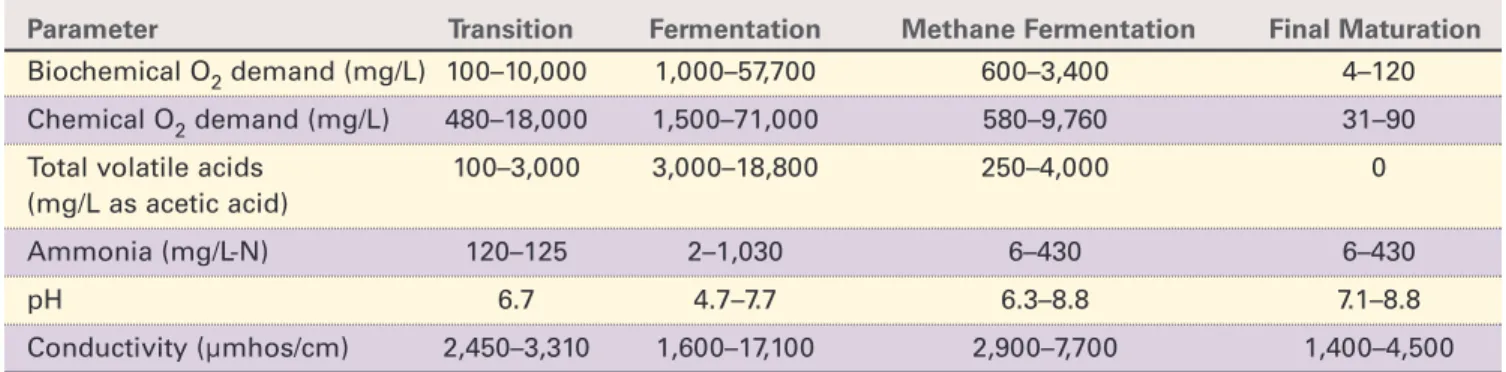
Stabilization of solid waste proceeds through sev-eral discrete phases after placement of waste. The characteristics of leachate and gas vary from one phase to another, and reflect the microbially medi-ated processes taking place. Immediately following waste placement, moisture content increases, pri-marily as a result of precipitation, and microbial activity begins. This activity depletes available oxygen, and a shift to anaerobic microbial activity occurs, accompanied by an increase in leachate strength. The continued hydrolysis of organic matter leads to conversion of the now soluble organic matter into volatile organic acids (fermen-tation), producing a decrease in leachate pH. These volatile acids, in turn, are consumed by methanotrophic (methane producing) organisms, resulting in a dramatic increase in gas production rates. Eventual consumption of nutrients leads to cessation of microbiologic activity and matura-tion of the landfill. Landfill characteristics during 4 of the 5 phases often identified during waste degradation are summarized in Table 1.
The organic content of refuse is approximately 75% to 80%, and includes proteins, lipids, carbo-hydrates (cellulose and hemicellulose), and lignins. Approximately two thirds of this material is biodegradable, and one third recalcitrant. The biodegradable portion can be further divided into a readily biodegradable fraction (food and garden wastes) and moderately biodegradable fraction
(paper, textiles, wood). The predominant
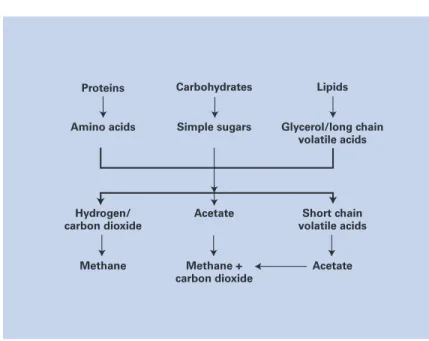
biodegradation pathways for the major organic classes of solid waste are summarized in Figure 4.
The landfill ecosystem is quite diverse, owing to the heterogeneous nature of waste and landfill operating characteristics. The diversity of the ecosystem promotes stability; however, the sys-tem is strongly influenced by environmental con-ditions such as temperature, pH, and presence of toxins, moisture content, and oxidation-reduc-tion potential. The landfill environment tends to be rich in electron donors, primarily organic matter. The dominant electron receptors are car-bon dioxide and sulfate. Seven key physiologic microbial groups, listed in Table 2, participate in rate-limiting stabilization steps of fermentation and methanogenesis.
P
Paatthhooggeenn SSuurrvviivvaall
Studies have shown that a significant bacterial population can be associated with municipal landfill leachates. The actual bacterial content of leachate, particularly the numbers of total col-iforms, fecal colcol-iforms, fecal streptococci, and
Section
Scientific Communications
4
Fig 3. A landfill liner consists of layers of protective materials including plastic liners, low permeable clays, and drainage material. A landfill liner under construction in Florida is shown.
Table 1. Landfill Constituent Concentration Ranges as Function of Degree of Landfill Stabilization
Parameter Transition Fermentation Methane Fermentation Final Maturation
Biochemical O2demand (mg/L) 100–10,000 1,000–57,700 600–3,400 4–120 Chemical O2demand (mg/L) 480–18,000 1,500–71,000 580–9,760 31–90 Total volatile acids 100–3,000 3,000–18,800 250–4,000 0 (mg/L as acetic acid)
Ammonia (mg/L-N) 120–125 2–1,030 6–430 6–430
pH 6.7 4.7–7.7 6.3–8.8 7.1–8.8 Conductivity (µmhos/cm) 2,450–3,310 1,600–17,100 2,900–7,700 1,400–4,500
SOURCE: Pohland FG, Harper SR. Critical Review and Summary of Leachate and Gas Production from Landfills. EPA/600/2-86/073. Cincinnati, OH: US Environmental Protection Agency; 1985.
by guest on January 27, 2016
http://labmed.oxfordjournals.org/
total plate counts, varies dramatically with the age and thus the chemical properties of the
leachate.2 A limited number of bacterial
pathogens have been found in leachates from commercial and experimental landfills, and envi-ronmental lysimeters. A comprehensive review of studies on the survival of bacteria in leachates
was conducted by Ware,3who found increases in
bacterial mortality with time of leaching or waste age due to the bactericidal effects of the leachate and landfill. Relatively high temperatures achieved in the aerobic stage of refuse
biodegra-dation can inhibit bacterial growth and survival.4
Also, bacterial inactivation is more rapid at lower
pH. Together, temperature and pH act to
acceler-ate bacterial inactivation.5
Since municipal solid waste may contain fecal material from a number of different sources, it is possible that enteric viruses are among the pathogens entering leachate. In general, enteric viruses are rarely found in municipal landfill
leachates. Engelbrecht and Amirhor6detected no
viruses in leachates produced by a large, field-scale municipal solid-waste lysimeter that had been experimentally contaminated with poliovirus type 1 during the filling operation. Municipal leachate and landfills apparently pose a harsh environment for the survival of viruses, although the mecha-nisms of viral destruction are not entirely
under-stood.4The rate of viral inactivation in leachates is
temperature-dependent, and proceeds much faster at higher temperatures (20°C to 22°C). Therefore, elevated landfill temperature can accel-erate the inactivation of viruses.
L
Laannddffiillll LLeeaacchhaattee a
anndd GGaass MMaannaaggeemmeenntt
The characteristics of leachate are highly variable, depending on the composition of the solid waste, rate of water application, waste moisture content, and landfill design, operation, and age. In general, leachate emanating from a young landfill (<5 years old) will tend to have high organic strength (largely composed of volatile acids) with a rela-tively low pH (5 to 7). With time, once methano-genesis is established, the organic strength declines and a high ammonia concentration moderates the pH. Inorganic compounds such as chloride, man-ganese, and iron reach very high levels (hundreds of milligrams per liter). A mature landfill pro-duces leachate no stronger than domestic waste-water. Leachate treatment needs depend on the final disposition of the leachate. Treatment is often difficult because of high organic strength, irregular production rates and composition, variation in biodegradability, and low phosphorus content (if biologic treatment is considered).
Because of the prevailing anaerobic conditions within a biologically active landfill, these sites pro-duce large quantities of gas composed of methane, carbon dioxide, water, and various trace compo-nents such as ammonia, sulfide, and nonmethane volatile organic carbon compounds (VOCs). Reported production rates vary from 0.12 to 0.41
m3/kg dry waste.7Landfill gas is generally controlled
Fig 4. Organic waste in a landfill decomposes to produce a gaseous end product primarily consisting of methane and carbon dioxide. The decomposition pathway of important organic groups, proteins, carbohydrates, and lipids is illustrated.
Proteins Amino acids Carbohydrates Simple sugars Lipids Glycerol/long chain volatile acids Short chain volatile acids Acetate Methane + carbon dioxide Methane Hydrogen/ carbon dioxide Acetate
Table 2. Important Microbial Groups Promoting Anaerobic Waste Degradation
Microbial Group Substrate
Amylolytic bacteria Starches Proteolytic bacteria Proteins Cellulolytic bacteria Cellulose Hemicellulolytic bacteria Hemicellulose Hydrogen-oxidizing methanogenic bacteria Hydrogen Acetoclastic methanogenic bacteria Acetic acid Sulfate-reducing bacteria Sulfate
SOURCE: Sleat RC, Harries C, Viney I, et al. Activities and distribution of key microbial groups in landfills. In: Sanitary Landfilling: Process, Technology and Environmental Impact. New York, NY: Academic Press; 1989.
by guest on January 27, 2016
http://labmed.oxfordjournals.org/
by installing vertical or horizontal wells within the landfill. These wells are either vented to the atmos-phere, if gas migration control is the primary intent of the system, or connected to a central blower sys-tem that pulls gas to a flare or treatment process.
The gas can pose an environmental threat owing to the presence of greenhouse gases and other VOCs. In addition, the gas has a high energy content, and can be captured for power, steam, or heat generation. Treatment of gas will be required prior to its beneficial use. Treatment may be lim-ited to condensation of water and some of the organic acids, or may include removal of sulfide, particulates, heavy metals, VOCs, and carbon dioxide. Some of the more innovative uses of gas include power generation using fuel cells, vehicle fuel (compressed or liquid natural gas), and methanol production.
C
Coonncclluussiioonn
The landfill is a complex biologic reactor, in which organic portions of solid waste are con-verted into humiclike matter. Successful treat-ment of solid waste in a landfill is accomplished through the use of engineered barriers to contain and control leachate and gaseous emissions. The biologic processes can be optimized through con-trol of on-site environmental conditions, usually moisture content. Because modern landfills are highly regulated, medical waste disposal in the landfill is a safe alternative. However, source reduction should be practiced to minimize the production of medical waste and any potential
adverse environmental effect.l
References
1. NaQuin D. Medical waste: still healthy after all these years.
Waste Age. 1998;29(7):40-52.
2. Senior E, ed.Microbiology of Landfill Sites. Boca Raton, FL: CRC Press; 1990.
3. Ware SA.A Survey of Pathogen Survival During Municipal Solid Waste and Manual Treatment Processes. EPA-600/8-80-034. Cincinnati, OH: US Environmental Protection Agency; 1980.
4. Lu JCS, Eichenberger B, Stearns RJ, et al, eds.Leachate from Municipal Landfills: Production and Management. Park Ridge, IL: Noyes Publications; 1985.
5. Engelbrecht RS, Weber MS, Amirhor P, et al. Biological properties of sanitary landfill leachates. In: Malina JF, Sagik BP, Eds.Virus Survival in Water and Wastewater Systems. Water Resource Symposium No. 7. Austin, TX: Center for Research in Water Resources, University of Texas; 1974.
6. Engelbrecht RS, Amirhor P.Inactivation of Enteric Bacteria and Viruses in Sanitary Landfill Leachate. NTIS/PB-252 973/AS. Springfield, VA: National Technical Information Service; 1975. 7. Pohland FG, Harper SR.Critical Review and Summary of Leachate and Gas Production from Landfills.EPA/600/2-86/073. Cincinnati, OH: US Environmental Protection Agency; 1985.
Section
Scientific Communications
4
IIn
ntte
errn
ne
ett
R
Re
es
so
ou
urrc
ce
es
s
Here are some Internet sites that offer more information on topics
discussed in this issue ofLaboratory Medicine.
B
Blloooodd SSuubbssttiittuutteess
The Artificial Cells & Organs Research Centre Web site, McGill University, Montreal, Canada, contains information about blood substitutes and includes links to related Web sites.
http://www.artcell.mcgill.ca
Minutes of the US Department of Health and Human Services, Public Health Service, Food and Drug Administration, Center for Biologics Evaluation & Research, National Institutes of Health, National Heart, Lung, & Blood Institute and US Army, “Workshop on criteria for safety and efficacy evaluation of oxygen therapeutics as red cell substitutes,” Natcher Conference Center, NIH, Rockville, MD, September 27-28, 1999, are available on the FDA Web site.
http://www.fda.gov/cber/minutes/oxygen092799.pdf http://www.fda.gov/cber/minutes/oxygen092899.pdf
H
Heemmaattoollooggyy IInnssttrruummeennttss
“Hematology analyzers,” by Sherrie Rice and Raymond Aller, MD (CAP Today. 2000;1:34-42) and “Hematology analyzers in review,” by Raymond D. Aller, MD, and Brian Sheridan, MD (CAP Today. 1998;12:33-42) are available on the College of American Pathologists’ Web site.
ftp://ftp.cap.org/captoday/0100ha.pdf ftp://ftp.cap.org/captoday/1298ha.pdf
M
Meeddiiccaall WWaassttee DDiissppoossaall
“Advanced coal technology offers solutions for growing medical waste management crisis at US hospitals,” from the US Department of Energy (DOE), Fossil Energy Techline, May 15, 1997, is available on the DOE Web site.
http://www.fetc.doe.gov/publications/press/ 1997/tl_vahos.html
X
Xeennoottrraannssppllaannttaattiioonn
A copy of the Department of Health and Human Services, Public Health Service, “Draft public health service guideline on infectious disease issues in xenotransplantation,” published in the Federal Register (September 23, 1996), is available on the US Food and Drug Administration Web site.
http://www.fda.gov/cber/gdlns/xeno.pdf
“Xenotransplantation: animal organs to save human lives,” from the Duke University (Durham, NC) News Service, May 29, 1997, is available on the Duke University Web site.
http://www.dukenews.duke.edu/med/xenobkgd.htm
These sites were accessed January 31, 2000, and are offered for reader information only. A site’s presence on this list does not constitute an
by guest on January 27, 2016
http://labmed.oxfordjournals.org/