econ
stor
www.econstor.eu
Der Open-Access-Publikationsserver der ZBW – Leibniz-Informationszentrum Wirtschaft The Open Access Publication Server of the ZBW – Leibniz Information Centre for EconomicsNutzungsbedingungen:
Die ZBW räumt Ihnen als Nutzerin/Nutzer das unentgeltliche, räumlich unbeschränkte und zeitlich auf die Dauer des Schutzrechts beschränkte einfache Recht ein, das ausgewählte Werk im Rahmen der unter
→ http://www.econstor.eu/dspace/Nutzungsbedingungen nachzulesenden vollständigen Nutzungsbedingungen zu vervielfältigen, mit denen die Nutzerin/der Nutzer sich durch die erste Nutzung einverstanden erklärt.
Terms of use:
The ZBW grants you, the user, the non-exclusive right to use the selected work free of charge, territorially unrestricted and within the time limit of the term of the property rights according to the terms specified at
→ http://www.econstor.eu/dspace/Nutzungsbedingungen By the first use of the selected work the user agrees and declares to comply with these terms of use.
zbw
Leibniz-Informationszentrum Wirtschaft Leibniz Information Centre for Economics Bartholomae, Florian W.Working Paper
Trade And Pension Systems
Diskussionsbeiträge / Institut für Volkswirtschaftslehre, Universität der Bundeswehr München, No. 2006,1
Provided in cooperation with:
Universität der Bundeswehr München (UniBw)
Suggested citation: Bartholomae, Florian W. (2006) : Trade And Pension Systems,
Diskussionsbeiträge / Institut für Volkswirtschaftslehre, Universität der Bundeswehr München, No. 2006,1, http://hdl.handle.net/10419/23030
Trade And Pension Systems
∗
Florian W. Bartholomae†
Universität der Bundeswehr München
Diskussionsbeiträge des Instituts für Volkswirtschaftslehre 18. Jg. (2006), Nr. 1
∗Presented at the ETSG Eight Annual Conference 2006 in Vienna.
†Address: Dipl.-Vw. Florian W. Bartholomae, Fakultät für Wirtschafts- und Organisationswissenschaften,
Univer-sität der Bundeswehr München, D–85577 Neubiberg, Germany, phone: +49–89–6004–4283, fax +49–89–6004– 2374, e-mail: [email protected]
Abstract
This article concentrates on the possible relationship between trade and pension systems. I consider trade between a capital-abundant home and a labor-abundant foreign country. The underlying model is a two-period overlapping generations-model augmented with factor-price changes resulting from price-variations through globalization. First, I analyze the resulting income effects of the young generation and of the retirees in a pay-as-you-go (PAYG) pen-sion system and a fully funded penpen-sion system. Considering contribution rates and population growth, the retirees might improve their income situation in a fully funded system. Second, I analyze the effects on life income when a pension system change is implemented simultaneous with the reduction of trade barriers. A less expensive change can be expected, if free trade is permitted.
Keywords:
Pay-as-you-go pension system, fully funded pension system, Heckscher-Ohlin-Samuelson, trade with low-wage-countries
Zusammenfassung
Dieser Aufsatz versucht einen Zusammenhang zwischen Handelsbeziehungen und dem Renten-system herzustellen. Untersucht wird dabei der Handel zwischen einem kapitalreichen Inland und einem arbeitsreichen Ausland in einem zweiperiodigen OLG-Model, erweitert durch han-delsinduzierte Preisänderungen. Es gibt dabei Auswirkungen auf das Einkommen der jungen sowie der in Rente befindlichen Generation im Umlageverfahren (UV), sowie im kapitalgedeck-tem Rentensyskapitalgedeck-tem (KDV). Während das Einkommen der Rentner im UV teilweise vom Fak-tor Arbeit abhängt, der durch die Handelsaufnahme verliert, besteht es im KDV lediglich aus Kapital, das durch die Liberalisierung gewinnt. Zieht man das Bevölkerungswachstum mit ins Kalkül, so können sich die Rentner im KDV besser als im UV stellen. Im zweiten Teil wird untersucht, inwieweit ein Umstieg vom UV auf das KDV durch Handelsliberalisierungen er-leichtert werden kann.
Schlagworte:
Umlageverfahren, Kapitalgedecktes Rentensystem, Heckscher-Ohlin-Samuelson, Handel mit Niedrig-Lohn-Ländern
Contents
1 Introduction 1
2 Definition of PAYG and fully funded pension system 2 3 Effects of trade-induced price-variations 6
4 Trade and pension systems 7
5 Change of Pension System 10
6 Concluding Remarks 12
A Appendix 16
A.1 Percentage Saving . . . 16 A.2 Total national income . . . 16
1 Introduction 1
1
Introduction
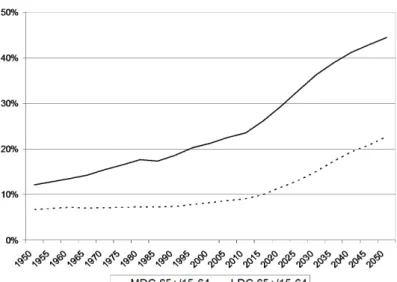
In this article I present an application of the distribution conflict resulting from trade on a new issue, which is getting more and more important. Since most western populations are aging and pay-as-you-go pension systems are not able to face demographic pressure, a change to a fully funded pension system has been taken into consideration in many countries. Such a reform may lead to a change in the structure of capital and labor owners. The effects of interindustrial trade on income distribution of factors are therefore an interesting topic under consideration of a pension system change. I analyze in this paper which conditions have to be fulfilled for a positive effect from trade on the generation of employees and the generation of retirees. Figure 1 shows the dependency ratios—the rate of persons older than 65 years to persons aged 15–64— of the MDC (More Developed Countries) and the LDC (Less Developed Countries) as they are classified by the UN (2006). The figure proves that aging of society is concerning developed countries as well as the less developed world. Problems will occur since the dependency ratio will converge 50% in the year 2050.1
In section 2, I explain how fully funded and pay-as-you-go (PAYG) pension systems work. Section 3 then shows the effects of trade-induced price changes on factor wages as they are known from the Stolper-Samuelson theorem. In section 4, I show the effects of trade liberal-izations on both pension systems as well as implications for trade policy. The implications for a system changeover when trade liberalizations took place are shown in section 5. Section 6 gives some remarks on the model and concludes.
1The Overall dependency ratio—the ratio of people aged 65 and older plus those aged 14 and younger to persons
aged 15–64—was in 1950 54.39% in MDC and 71.01% in LDC. 2005 this ratio fell to 47.65% and 56.93%. According to UN estimations the overall dependency ratio will increase in the MDC to 71.21% and decrease in the LDC to 55.05% until 2050. The ratio of people aged 65 and older to those aged 14–64 increased in both, the LDC and the MDC. From 1950 to 2050, it will increase in the MDC from 22.36% to 62.38% and in the LDC from 9.43% to 41.11%. The rates for 2005 are 47.34% and 15.25%. Source: UN 2006, own calculations.
2 Trade And Pension Systems
Figure 1: Dependency ratios
Source: United Nations (2006), own calculation
2
Definition of PAYG and fully funded pension system
The two pension systems have to be defined in terms of this model.2 According to Sinn
(1999), the definition of a PAY-AS-YOU-GO PENSION SYSTEM in a two-periods-overlapping-generations model is:
1. Pensions are financed through the contributions of the young employed generation of the current period,
NtYCt=NtPPt.
2. Today’s contributors are tomorrow’s retirees, NtY =NtP+1.
The subscript denotes the period and the superscript indicates the affiliation of the group. Let NtY be the number of young, working individuals at timet, Ct the lump-sum contribution per
capita,NP
t the number of retirees at timetandPtthe pension per capita.
This is a very general approach to the pay-as-you-go pension system, since these equations
2To keep this model as simple as possible, several, nonetheless important, aspects of pension systems are ignored.
Some of these aspects are for example the redistribution ambitions among individuals of the same generation or the widely discussed consideration of the benefits of the first generation. Furthermore a constant pension is assumed. This means the rate of return is zero (see Siebert 1997).
2 Definition of PAYG and fully funded pension system 3
Figure 2: Capital stock in pay-as-you-go (left) and fully funded pension system (right)
Source: Author’s model
do not consider the connection between contributions and wages. The aggregate income of the employed generation is
wL+rK −cwL,
whereaswis the wage,Lis the labor supply,ris the capital rent,Kis the endowment of capital of the young andc∈(0,1[is the contribution rate to the pension system in percentage terms of their wage.
Two periods, t and t+ 1, are assumed in this analysis. In the PAYG scenario the retirees,
P, are endowed with KP
t and the young, Y, with KtY, both add up to Kt, which shows the
total endowment of the economy. Neither saving, nor depreciation are assumed in the economy. Thus, the total capital endowment won’t change in t + 1. The young of t are the retirees of t+ 1. They will still own their capital KtY, while the released capital of the retirees of t is distributed (“bequeathed”) to the young int+ 1. The described situation is illustrated in figure 2. For simplicity there is no unemployment assumed and all members of the young generation are working. For obtaining the income of the young int,IY
t ,Lcan be substituted byNtY,
ItY =wt(1−c)NtY +rtKtY. (1)
The income of the retirees in t consists in their pension—the contributions of the young—as well as in their capital income,
4 Trade And Pension Systems
Next the growth rate of the population is considered. If the young generation remains childless, no one could pay the pensions of the retiree generation in the next period. Furthermore, this model assumes that only the young are fertile. This means that the number of the young in the next period is a function of the number of the young in the present period.3 Let n denote the
exogenously determined population growth rate,
(1 +n)NtY =NtY+1 or (1 +n)NtP =NtY, therefore it results that if
n <0, ratio of retirees to young increases,
n= 0, ratio of retirees to young remains constant, n >0, ratio of retirees to young decreases.
There exist many studies about the effects of population growth on the income of the young and the retirees in a PAYG pension system. The main finding e.g. for Germany is, that the pension payments will decrease to 50% for constant contributions or the contribution rates will be doubled for maintaining the present pension level (see e.g. Börsch-Supan 1997).4
In theFULLY FUNDED PENSION SYSTEM, the young have to save money during their work-ing life. When they retire, they will own more capital than in the PAYG scenario. The en-dowment int does not differ from PAYG system but the situation int + 1is varying. This is shown in figure 2. Unlike in a pay-as-you-go system, in a fully funded system an intertemporal, rather than an intergenerational, redistribution takes place. Consumption after retirement is just possible under the condition of savings during working life. In formal terms, letS denote the saving deposit, to get the (disposable) income of the young,5
ItY =wtNtY +rtKtY −St, (3)
3Assuming there is no migration possibility, this will be consistent with the key assumptions of the
Heckscher-Ohlin-Samuelson-model.
4By rearranging the first condition of the pay-as-you-go system, it results C
t = NtP NtY Pt or c = NtP NtY
(Pt/wt). The dependency ratio,NtP
NtY, will more than double for Germany, comparable to the findings in figure 1. Thus ceteris paribus either you double the contributions to the system or you reduce the pension payments to the half of their current level. Both scenarios are intolerable.
5A completely inelastic supply of labor is assumed. Otherwise labor supply might be higher in a fully funded
3 Effects of trade-induced price-variations 5
and the income of the retirees,
ItP =rtKt−Y 1+rt(1 +rt)St−1. (4)
Equation (3) shows, that the young save the lump-sumSof their available income (and therefore consume less). If you compare (3) with (1), you see that now the burdened factor has changed: the pay-as-you-go system burdens the labor, whereas the fully funded system “burdens” the whole income. The situation of the retirees is shown in equation (4). First they have the re-maining capital from their youth. Second there is their saving deposit and the rental earnings. They will live from the rental payments in favor of consuming their capital. Thus, the whole capital stock in the economy is increasing byrS. By comparing (4) with (2) it can be observed that the income of the retirees no longer depends on the factor labor.6 Hence, the demographic aspect does not influence their income any longer.7 Cigno (1993) emphasizes the role of
altru-ism for such a capital-based pension system for avoiding the extinction of the population after introduction.
For the later analysis it is useful to express equations (1) to (4) in per-capita-notation. Thus I divide the aggregate incomes simply by the number of the relevant group. I get the per-capita-income in a pay-as-you-go system for the young from (1),
ItYNtY =wt(1−c) +rt
KtY NY t
, (5)
and for the retirees from (2),
ItPNtP =cwt(1 +n) +rt KP t NP t . (6)
And I get the per-capita-income in a fully funded pension system for the young from (3), ItYNtY =wt+
rtKtY −St
NY t
, (7)
and for the retirees from (4),
ItPNtP =rt KY t−1+ (1 +rt)St−1 NP t . (8)
6Indirectly it depends on labor, since a part of the retirement-income based on the work-income, which partly
depends on the labor supply.
7If capital mobility is given, diverging population growth rates in different countries are influencing the fully
6 Trade And Pension Systems
3
Effects of trade-induced price-variations
Next, I assume an increasing trade relationship with low-wage-countries. These may result from new trade partners, growing existing trade partners or from vanishing trade barriers. This is considered by using a standard 2x2x2-Heckscher-Ohlin-Samuelson-Model (HOS). There are two production factors, capital8,K, and labor, N. Two goods are produced, a capital-intensive
High-Tech good,H, and a labor-intensive Low-Tech good,L. Finally there are two countries, the home country and the foreign country. Foreign in this case might be China or some newly industrializing economies. Furthermore the key assumptions of the HOS-model are valid: con-stant returns to scale of production, identical production technologies in both countries, the production factors are immobile between both countries9, but perfectly mobile between the two perfect competitive sectors (in a country) and finally there exist no transportation costs. Home is assumed to be capital-abundant, whereas Foreign is labor-abundant. Trade will lead to an increasing price of the capital-intensive High-Tech-good in Home and to a decreasing price of the labor-intensive Low-Tech-good, vice versa will happen in Foreign. The connection between good prices and factor prices was shown by the Stolper-Samuelson-Theorem:
If both goods continue to be produced, an increase in the relative price of a good will increase the real return to the factor used intensively in the production of that good and decrease the real return to the other factor of production.10
8For simplicity,Kis only physical capital and not human capital.
9Although this assumption is not realistic, it is very important for the HOS model. Labor, especially in the
low-skilled sectors, is not mobile between countries. Labor mobility is sometimes not even given among national regions (see Europe). Capital therefore should be mobile. However, Feldstein and Horioka (1980) found empirical evidence that capital is not as mobile as widely supposed. They found a kind of home-bias, which leads to higher preferences that capital is spent in the home country (see also French and Poterba 1991). Hence this assumption is not as wrong as it might appear at first glance.
4 Trade and pension systems 7
In this example, the increase of the relative price of the High-Tech-good will lead to declining wages,w, and to rising capital rents,r.11 In formal terms the relation can be expressed as12
w=w PH PL , wherew0 <0and (9) r =r PH PL , wherer0 >0. (10)
Several aspects have to be considered for guarantying the validity of the Stolper-Samuelson-theorem. First, both countries must produce the same homogeneous goods without quality differences. This presumption is not fulfilled if you consider the trade relationship between Europe and China. Europe imports many goods that are no longer produced in Europe, e.g. textiles. Second, factor endowment points of both countries have to be situated within the cone of diversification. Section 6 will show under which conditions these assumptions may be violated. However, for the rest of this paper it is assumed that the economy is within the cone. Furthermore, both Home’s and Foreign’s endowment points are within the cone.
4
Trade and pension systems
In this section a connection between the pension systems described in section 2 and the price variations induced by trade shown in the previous section is considered.13 First I analyze how
the price changes generated by trade will affect the income of both age cohorts in a PAYG pension system. Insert (9) and (10) in (5) to get the per-capita income of the young. Then I examine how income is affected by price changes. Therefore differentiate forPH
PL to get
11Deradorff (1987) simulates a model based on Solow where capital accumulation and diverging population growth
rates between the North (in our example Home) and the South (low-wage country) take place. Therefore r
decreases worldwide in the long run andwincreases as labor becomes the scarce factor. Further, this implicates that the trade pattern will change (in Deardorff’s case many goods are assumed). Home will lose labor-intensive industries and keep the most capital-intensive industries. A fully funded pension system increases the propensity to save in Deardorff’s simulations.
12Note, thatf0is short for∂f(x)/∂x.
13This procedure is possible since any redistribution, such as pension systems, will have no influence on prices—
8 Trade And Pension Systems
the first order condition,
∂ IY NY t ∂ PH PL = (1−c)w 0 + K Y t NY t r0. There are three cases to be distinguished,
r0K >−NY
t (1−c)w 0
, per-capita income of the young increases, r0K =−NY
t (1−c)w 0
, per-capita income of the young remains constant, r0K <−NY
t (1−c)w 0
, per-capita income of the young decreases.
Young people’s benefit from trade is bigger in a pay-as-you-go system with high redistribution than in a PAYG system with low contribution rates.14
For calculating the per-capita income of the retirees insert (9) and (10) in (6), which leads to the first order condition
∂ IP NP t ∂ PH PL =c(1 +nt)w 0 +K P t NP t r0. Distinguish three cases,
r0KP
t >−NtPc(1 +nt)w0, per-capita income of the retirees increases,
r0KP
t =−NtPc(1 +nt)w0, per-capita income of the retirees remains constant,
r0KP
t <−NtPc(1 +nt)w0, per-capita income of the retirees decreases.
Thus, the higher the contribution rates or the higher the population growth, the higher the prob-ability that the retirees will lose from increased trade relationships.
In a system with high redistribution, the retirees will get more of the factor that will lose from trade (in this case labor) compared to a system with lower redistribution. Unlike the retirees, the young generation will have less of the losing factor labor and more of the winning factor (as share of their total income). Thus, the young will benefit from trade. Please note that several PAYG pension systems with continuous contribution rates are considered. The contribution rate is assumed to be constant. I analyze for which of this systems, trade might be advantageous. Higher contributions will lead to a lower overall income of the young.15 The
higher the contribution rates in a pay-as-you-go pension system, the more redistribution takes
14Sincew0<0, both sides are positive.
15You may compare this situation to a portfolio problem: There exist two shares,LandK. The rate of return ofL
4 Trade and pension systems 9
place, the higher the probability that the retirees won’t agree trade liberalizations with low-wage countries. A low (negative) population growth rate means, that there is a higher share (majority) of retirees in the population. However, low values ofnimply that trade might be advantageous for the retirees. A situation with contribution rates exceeding a critical value, retirees having a majority (assuming for the moment a negativen), where retirees are disadvantaged by trade, is possible.16 Politicians, who want to serve another term, will then provide protectionist laws. If
there are high values ofn(this implies a majority of the young) and low values ofc17the young
will oppose trade liberalizations.18
Next, the effects in a fully funded pension system, using the same approach as above, are considered. For this purpose the per-capita income of the young is calculated by inserting (5) and (10) in (7). Subsequently differentiate for price changes to get
∂ IY NY t ∂ PH PL =w 0 +r0 KtY NY t .
Three different cases result, r0KY
t >−w 0NY
t , per-capita income of the young increases,
r0KY
t =−w 0NY
t , per-capita income of the young remains constant,
r0KY
t <−w 0NY
t , per-capita income of the young decreases.
a negative return ofL. Depending on the shares in a portfolio, there arises a net gain or a net loss. Now compare two individuals, a rich one and a poor one. The rich has relatively moreL, while the poor has relatively moreK
in his portfolio. The rich will loose and the poor will win independent of their wealth. Here I only consider the net effect.
16According to Browning (1975) negative values ofnimply that the median voter is aging. An aging median voter,
however, tends to vote for higher contribution rates since he will benefit from higher pensions, but has not to bear the whole burden. The young are against higher contribution rates, because they have to bear the tax burden for their working life without any further gains. If population growth is negative, retirees will vote for a higher contribution rate, but this will make them more sensitive to price shocks through trade. Either they consider this problem in their voting behavior or they ignore it and vote instead for further trade barriers. The outcome might be ambiguous, if the level of redistribution is endogenous.
17This results from the majority owned by the young, compare footnote 16.
18The empirical relevance of Heckscher-Ohlin based income redistributions on attitudes towards globalization is
shown in O’Rourke (2003). The abundant factor in a country tends to be more liberal towards trade as well as towards immigration.
10 Trade And Pension Systems
The saving deposit is irrelevant in this consideration since saving is a lump-sum transfer and therefore independent of the income level.19 For the per-capita income of the retirees I obtain,
∂ IPNtP ∂ PH PL = r0 NP t Kt−Y 1+ (1 + 2r)St−1 .
The retirees own just the factor that wins from trade. This means that they are just benefiting from trade. The higher the price variations—and therefore the increase inr—, the higher will turn out their benefits. Since the young are just distributing their income between two peri-ods and do not lose it, they can choose their favorite saving deposit according to their time preference. Hence, future benefits through trade lead to lower savings in present. Increased consumption expenditures and a decreasing opposition against trade liberalizations may result. An interesting political implication is arising: Capital-abundant countries with a fully funded pension system will pursue trade with labor-abundant, low-wage-countries, especially if there is a declining, aging population where retirees are in the majority.
A further question is how overall national income is affected through trade. Overall national income will increase if there is a change from a PAYG to a fully funded pension system. This is an important insight since capital accumulation is lower in a PAYG pension system compared to other pension systems (Siebert 1997).20
5
Change of Pension System
In this section it is analyzed, how trade liberalization with low-wage countries affects a change of the pension system. In order not to discriminate against the retirees of this period, a lump-sum tax is introduced (only in this period). The tax revenue will be then distributed to the retirees according to their contributions to the pension system in the previous period.21
19see Appendix A.1 20see Appendix A.2
21The claims of the retirees result from the so called inter-generation contract. The first, introducing, generation
was given a gift, because they got pension payments although they did not contribute to this system. Furthermore, each generation who paid contributions acquired claims against the next one. The resulting pension claims are therefore often known as implicit public debt. So a tax is needed to amortize this debt. For further discussion about resulting problems see Sinn (1999).
5 Change of Pension System 11
For simplicity the rate of time preference is assumed equal to zero. Also assume that PtL+1 < PtL, PtH+1 > PtH and therefore wt PtH PtL> wt+1 PtH+1 PtL+1 and rt PtH PtL< rt+1 PtH+1 PtL+1.
I compare the life income—income in this period plus income in the next period—of the young when (i) there is no change in the pension system, with (ii) the situation that would prevail, when a change from the PAYG to the fully funded pension system is implemented.
(i) The life income without a system change is calculated from (1), (9), and (10),
ILifeno change=ItY,PAYG+ItP,+1PAYG = (1−c)wtNtY +rtKtY +cwt+1NtY+1+rt+1KtP+1 =
= [wt(1−c) +cwt+1(1 +nt)]NtY + [rt+rt+1]KtY. (11)
In a pay-as-you-go pension system the capital stock remains unchanged (Siebert 1997 and also figure 2, p. 3), thereforeKtY =KtP+1.
(ii) Now letT denote the explicit tax—in this case a lump-sum-tax—, that could be calculated from the implicit public debt which is used to pay the claims of the retirees in this period (Sinn 1999). The Life income in case of a system change is then calculated from (3), (4), (9), and (10),
ILifechange =ItY,change+ItP,+1FF =wtNtY +rtKtY −St−T +rt+1 KtY + (1 +rt+1)St
= =wtNtY −T + [rt+rt+1]KtY + [rt+1(1 +rt+1)−1]St. (12)
Under which conditions is a system change advantageous—in this case (12) should be larger than (11)? After simplifying and summarizing following inequality results,
cNtY [wt−wt+1(1 +nt)] + [rt+1(1 +rt+1)−1]St≥T. (13)
The higher the population growth rate, the more it is likely that the left part of the inequality is smaller thanT.22 However, the higher the induced price change, the higher the probability that
the left part will be higher. The second term on the left side is positive, because of the increased
22In Germany, according to a recent report by the United Nations (2005), there is a negative population growth rate
12 Trade And Pension Systems
rental rate of tomorrow. Generally the well-known conclusion that a change from a PAYG to a fully funded pension system is advantageous if there is a negative population growth, results. This conclusion is now extended by the argument that a relative price decrease of the labor-intensive good or a price increase in the capital-labor-intensive good makes a change more attractive. Respectively the implicit public debt may be amortized more easily.
In the last step the lump-sum-tax is made endogenous. T should be chosen such that all retirees of periodt will receive their claims without being disadvantaged if the PAYG pension system is maintained. To ensure this, the conditionT =cwN must hold.23 Therefore I get
[rt+1(1 +rt+1)−1]St | {z } A −cwt+1NtY (1 +nt) | {z } B ≥0 (14) The previously derived condition is valid. The higher the population growth rate, the less it is advantageous to change the pension system from a PAYG to a fully funded regime. The higher the new relative price of the labor-intensive good, the lower is the wage of labor and the more a change is advantageous. Be sure to get the following insights:
B will be lower if there is trade with low-wage-countries (there are lower wages of labor
because of a higher relative price of the capital-intensive goodH). Note that only the wage of the second period, after the removal of trade barriers, is relevant.
A will be higher, because the rent of capital in the second period will increase through trade
liberalizations, here again only periodt+ 1is relevant.
6
Concluding Remarks
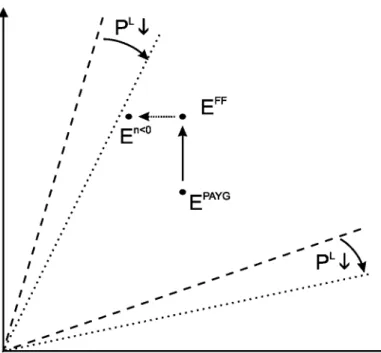
As the previous sections showed several more or less extreme shocks may change the factor endowment of Home. It may happen that the endowment point leaves the cone of diversification and therefore prognoses of the HOS-model are wrong. This problem is shown in the Lerner-Diagram in figure 3.EPAYGis the factor endowment point of an economy with a pay-as-you-go
pension system. Now two shocks occur. First, a change to a fully funded pension system is decided. This will boost the capital stock of this country to the new endowment point EFF.
Finally an (exogenous) demographic change reduces the population growth below zero, the
6 Concluding Remarks 13
population declines, and the new endowment point is En<0. As you will notice each of this shocks increased the relative capital endowment.24 At the same time another effect takes place:
the vanishing trade barriers with the labor-abundant Foreign leads to a decrease in PL. To maintain the profit-maximizing- and zero-profit-conditions, the cone (area between the dashed lines) has to rotate to the right (dotted lines). It may happen that the above described effects were indeed not extreme enough to push the endowment point outside the cone, but the price shock is high enough to do that. To sum up, if one of these shocks is too extreme, the country may leave the cone so that many forecasts of the Heckscher-Ohlin-Samuelson-model won’t occur.
Another aspect of those shocks, which should be mentioned, is the change in the trade pattern. As Home becomes more and more capital-abundant it will concentrate more on the production of the capital-intensive High-Tech good. The price change enforces this effect. If Home leaves the cone as a consequence of the shocks it will completely specialize in the production of the High-Tech good. Accordingly to the assumed production functions this will lead to less or more severe consequences for wages of labor and capital. A quite extreme case was analyzed by Leamer (1998). He assumed Leontieff -production functions which would lead in the considered case to a positive maximal wage ofw0dependent on the position of the unit-value isoquant and
more surprisingly to a capital rent of0.
This model assumed that the young generation owns labor as well as capital, whereas the retirees own capital and/or labor according to the actual pension system. In the case of in-tergenerational redistribution (PAYG pension system) according to the contribution rate, one age cohort will win from increased trade, whereas the other one will lose. However, in the case of intertemporal redistribution (fully funded pension system) the young may win or lose from trade, but the retirees will always win from trade independent of the level of savings deposits but correlative to their relative capital endowment. Therefore the classical redistribution con-flict between labor and capital may change to a generational concon-flict between the young and the retired generation. Especially in the fully funded pension system the retirees are clear winners from trade liberalizations since they obtain the winning factor.25 The change from a PAYG
24Graphically the slope of the ray from the origin to the endowment point raises.
25The analysis is concentrated on a capital-abundant country. In a labor-abundant country retirees will ceteris
14 Trade And Pension Systems
Figure 3: Effects in the Lerner-Diagram
Source: Model described in text
to a fully funded system during a period of vanishing trade barriers may lead to intergenera-tional redistributions if the positive aspects of trade are omitted in the planning of the system changeover.
However, these results emerged from a simple two-period model with an unchanging capital stock in the PAYG pension system. If a dynamic model with more periods and capital accumu-lation is considered other results may occur. The purpose of this paper was mainly to show that there exists a relationship between trade and the pension system. On the one hand, as shown in the literature, trade will redistribute among factors and in this case also among generations. On the other hand the choice of the pension system determines partly the factor endowment of a country and therefore the trade pattern. A country with fully funded pension system will concentrate more on the production of capital-intensive goods than one with a PAYG pension system. Another important aspect analyzed in this paper is the connection between the exist-ing pension system and the attitude towards trade liberalizations. As it was derived in section 4 in a highly redistributive PAYG pension system the young generation may accept increased trade and the retirees may disagree. In a fully funded pension system retiree always will benefit from trade liberalizations and even myopic young persons may accept trade. If the young are
6 Concluding Remarks 15
long term oriented and prefer future consumption at least as much as present consumption, they surely may vote for trade liberalizations if their home country is capital-abundant, although income inequality between the young and the retirees will rise.
The quite progressive development of trade relationships, especially with low-wage labor-abundant countries will lead to more price reductions of labor-intensive goods. This could be a chance for a changeover from the widely, but under demographic aspects in many countries inefficient PAYG to a fully funded, or partly fully funded, pension system. However, changeover costs may be reduced faster. Furthermore, a fully funded pension system will also lead to a higher welfare level respectively to more national income, because there is a higher capital stock in period t + 1 compared to the previous period. Furthermore, this factor gains from trade—as long as the endowment point remains inside the cone of diversification. A secondary aspect emerges. In a fully funded pension system combined with HOS-trade the redistribution conflict may change to a generational conflict, since the young generation will mainly own labor and the retired generation will mainly own capital.
16 Trade And Pension Systems
A
Appendix
A.1
Percentage Saving
The case of percentage savings leads to no further insights. Following essential equalities are given: ItY = (1−st) wtNtY +rtKtY (3a) ItP =rtKt−Y 1+rt(1 +rt)st−1 wt−1Nt−Y 1+rt−1Kt−Y 1 (4a) In per-capita terms I get
ItYNtY = (1−st) wt+rt KY t NY t and (7a) ItPNtP =rt KY t−1 NP t +rt(1 +rt)st−1 wt−1+rt−1 KY t−1 NP t (8a) Therefore I can differentiate (7a) and (8a) to obtain
∂ IY t NY t ∂ PH PL = (1−st) w0+r0K Y t NY t and ∂ ItPNtP ∂ PH PL = r0 NP t Kt−Y 1+ (1 + 2r)st−1 wt−1+rt−1 KY t−1 NP t
Simple rearranging shows that percentage saving leads to no other conditions as lump-sum saving.
A.2
Total national income
Total national income under a PAYG pension system adds toGDPPAYG
t =rtKt+wtNtY and
under a fully funded pension system to GDPtFF = rtKt +wtNtY + [rt(1 +rt)−1]S, for
S = St = St−1. Capital accumulation in a fully funded pension system increases overall
income. Trade will boost this positive aspect, ∂GDPtPAYG ∂ PH PL =r 0 Kt+w0NtY and ∂GDPtF F ∂ PH PL =r 0 Kt+w0NtY +r 0 (1 + 2r)S. If you compare both derivatives you see that an economy with a fully funded pension system will benefit more from trade than one with a PAYG pension system.
References 17
References
BÖRSCH-SUPAN, AXEL(1997): Germany: A Social Security System On The Verge Of Col-lapse, in: Horst Siebert (ed.), Redesigning Social Security, Mohr Siebeck: Tübingen, pp. 129–159.
BÖRSCH-SUPAN, AXEL, LUDWIG, ALEXANDER ANDJOACHIMWINTER(2003): Aging,
Pension Reform, And Capital Flows: A Multi-Country Simulation Model, MEA Discus-sion Paper 28-03, MEA, University of Mannheim.
BROWNING, EDGAR K. (1975): Why The Social Insurance Budget Is Too Large In A Democ-racy, Economic Inquiry, Vol. XIII, pp. 373–388.
CIGNO, ALESSANDRO (1993): Intergenerational transfers without altruism, European Journal of Political Economy 9, pp. 508–518.
DEARDORFF, ALANV. (1987): Trade and Capital Mobility in a World of Diverging Popula-tions, in: Johnson, David Gale and Ronald D. Lee (eds.), Population Growth & Economic Development: Issues and Evidence, Madison, Wisconsin, pp. 561–588.
FELDSTEIN, MARTIN ANDCHARLES HORIOKA(1980): Domestic Saving And International Capital Flows, Economic Journal, Vol. 90, pp. 314–329.
FRENCH, KENNETHR. ANDJAMESM. POTERBA(1991): Investor diversification and inter-national equity markets, American Economic Review, Vol. 81 No. 2, pp. 222–226. LEAMER, EDWARDE. (1998): In Search of Stolper-Samuelson Linkages between
Interna-tional Trade and Lower Wages, in: Collins, Susan Margaret (ed.), Imports, Exports and the American Worker, The Brookings Institution, Washington, DC, pp. 141–202.
MCCULLOCH, RACHEL(2005): Protection and Real Wages: The Stolper-Samuelson Theo-rem, forthcoming in: Szenberg, Michael, Ramrattan, Lall and Aron Gottesman (eds.), Samuelsonian Economics and the Twenty-First Century, Oxford: Oxford University Press. url: http://www.brandeis.edu/~rmccullo/wp/Stolper-Samuelson0405.pdf
O’ROURKE, KEVINH. (2003): Heckscher-Ohlin Theory and Individual Attitudes Towards Globalization, Working Paper 9872, National Bureau of Economic Research.
18 Trade And Pension Systems
UNITEDNATIONS (2005): World Population Prospects - The 2004 Revision - Highlights. url: http://www.un.org/esa/population/publications/WPP2004/2004Highlights_ finalrevised.pdf
UNITEDNATIONS (2006): World Population Prospects: The 2004 Revision Population Data-base, url: http://esa.un.org/unpp/.
SINN, HANS-WERNER(1999): Pension Reform And Demographic Crisis: Why A Funded System Is Needed And Why It Is Not Needed, Working Paper No. 195, CESifo Working Paper Series, CESifo.
SIEBERT, HORST (1997): Pay-as-You-Go Versus Capital-Funded Pension Systems: The Is-sues, in: Horst Siebert (ed.), Redesigning Social Security, Mohr Siebeck: Tübingen, pp. 3–33.
WALZ, UWE AND DIETMAR WELLISCH(1998): Why do rich countries prefer free trade over free migration? The role of the modern welfare state, European Economic Review 42, pp. 1595–1612.