A response to the draft Queensland Plan
By Laura Eadie and Michael Hayman
February 2014
About the authors
Laura Eadie is the Research Director for the Sustainable Economy Program at CPD. She is the
co-author of ‘Stocking up: Securing our marine economy’, ‘Farming smarter not harder: Securing our
agricultural economy’ and ‘Going solar: Renewing Australia’s electricity options’, and the principal
author of ‘Too many ports in a storm: The risks of Queensland’s port duplication’, all published by CPD. Laura’s core skill is providing rigorous thinking to support evidence-based decision-making, with a focus on the intersection of policy, economics and sustainability. Laura has worked as a corporate strategy consultant with Port Jackson Partners, managed climate funds for a green finance company, and as a policy analyst for the Natural Resources Commission. Laura is a UTS Business School Associate and has qualifications in environmental management, finance and investment, and industrial chemistry.
Michael Hayman is a Researcher for the Sustainable Economy Program at CPD. He is a contributing
author to ‘Too many ports in a storm: The risks of Queensland’s port duplication’, published by CPD. Michael worked as a development economist prior to joining CPD. He has consulting experience spanning environmental, resource and agricultural economics issues across various industries and applications, as well as innovative public-private investment schemes. Michael has qualifications in environmental and resource economics, and in finance.
About this report
Published by the Centre for Policy Development | Occasional Paper 36 | 1835-0135
About the Sustainable Economy Program
The Sustainable Economy Program aims to identify options for Australia to flourish while bringing our economy within environmental limits. Australia has tremendous opportunity to leverage our renewable natural resources and skills in innovation to build a fair, sustainable and prosperous economy – one that provides a secure future for all of us. Yet to do so, we need policies to prepare for rapid economic transitions.
‘All boom, no benefit?’ continues a series of reports looking at the costs of short-term thinking to
Australia’s economy, and the long-term benefits of policies to manage resources to support economic prosperity and opportunity.
The Sustainable Economy Program is funded by the Graeme Wood Foundation, the Thomas Foundation, Grant Mathews, Daniel Mathews, the Mullum Trust, the Orgill Family Foundation, the Fairer Futures Fund, the PACE Foundation, and the Curlew Fund, Digger & Shirley Martin Fund, Hamer Family Fund, Melliodora Fund, Koshland Innovation Fund and Johnstone Gumption Fund of the Australian Communities Foundation., as well as the CPD Ideas Sustainers who make regular donations towards our research. CPD thanks all of our funders for their generous support. CPD would like to thank the Thomas Foundation for funding this report through their donation to WWF.
To learn more about the Sustainable Economy Program and find out how you can contribute see
http://cpd.org.au/sustainable-economy/
About the Centre for Policy Development (CPD)
CPD is an independent and non-partisan think tank dedicated to seeking out creative, viable ideas and rigorous research to inject into Australia’s policy debates. CPD gives a diverse community of thinkers space to generate ideas for a fair, sustainable and prosperous future for all Australians. We develop and promote policy proposals to help Australia thrive and lead in a fast-changing global environment over the long-term.
Creative Commons License
All CPD papers are released under a Creative Commons license. Extracts, summaries or the whole paper may be reproduced provided the authors, the title and CPD are attributed, with a link to the publication and our website at http://cpd.org.au. For more details on the Creative Commons Attribution 3.0 Australia licence that applies to this paper, see http://creativecommons.org/licenses/by/3.0/au/
Contents
Main points
5
Queensland’s economic development is at a fork in the road
8
Commodity exports increasingly dominate, driven by expansion in coal 9 There is a global shift away from fossil fuels and towards green growth 10 China’s new growth model will drive demand for value added products 12 Resource price volatility will impact commodity exporters 13 How should Queensland respond to these challenges? 14 How is this relevant to the Queensland Plan? 15
Queensland needs a new economic strategy
17
Queensland’s economic strategy has not lifted incomes to national levels 17 Previous economic strategies have prioritised short-term gains, at the cost
of long-term prosperity 19
A new economic strategy must be more than a slogan 20 Government and industry have complementary roles in economic strategy 22
The government should manage renewable natural resources as strategic infrastructure for
tourism and agriculture
24
Managing reputation will be critical for agriculture and tourism 24 Renewable natural resources should be managed as strategic infrastructure 26 This requires dedicated funding for long-term management 27 Case study: Tourism in the Great Barrier Reef 28
Industry-led strategic plans should focus on sustainable growth opportunities
30
Develop specialised industries in regional areas 31 Develop multiple centres of excellence in urban areas 32
If Queensland stays on its current path, there may be fewer jobs and economic disruption
33
Accelerating mining development creates few jobs and may not build skills 33 A budget reliant on mining revenue will be exposed to shortfalls, particularly
in a volatile commodity market 35
Governance 37
Recommendations 38
List of tables
Table 1 Growth in Queensland’s exports to top 5 destinations 12 Table 2 Statistical summary of Queensland’s economy 18 Table 3 Australian forecast growth in tourist arrivals and expenditure to 2021-22 26 Table 4 Contributions to economic activity and employment of Queensland’s top
industries 33
Table 5 Estimated resource project jobs – short-term and long-term 34 Table 6 Queensland’s mining royalty gap – 2008 to 2012 35
List of figures
Figure 1 Queensland product exports by category – 1988-89 to 2012-13 9 Figure 2 Chinese coal consumption to peak after driving global growth since 2000 10 Figure 3 Volatility in commodity prices has tripled – 1980 to 2012 13 Figure 4 Average household income less farm income per capita of Queensland and
Western Australia, relative to Australia 17
Figure 5 Share of exports, global growth rates and Australian relative advantage in
selected industries 21
Acknowledgements
CPD would like to thank the following people for their generous assistance and advice during the research, writing and editing of this report.
Jim Binney Principal, MainStream Economics and Policy
Diane Tarte Director, Marine Ecosystem Policy Advisors
The Sustainable Economy Reference Group
Mark Burford, Tony Douglas, Lydia Gibson, Francis Grey, Dr Steve Hatfield-Dodds, Nick Heath, Frank Muller, Dr Chris Riedy, Dave West
Particular thanks go to Ian McAuley, John Quiggin, Geoff Shuetrim and Samuel Wills for peer reviewing the report content.
Main points
Queensland is at a fork in the road. The days of easy coal mining revenue are running out, and Queensland’s incomes are yet to match the rest of Australia. The draft Queensland Plan, which outlines a vision for Queensland’s next 30 years, highlights the need for a new growth model. As an example of strategic planning, the draft Queensland Plan represents a step in the right direction toward governing for the future. As an exercise in democratic consultation, it has the potential to strengthen trust between community and government – if it has staying power through multiple election cycles.
The draft Queensland Plan sets ambitious goals, given Queensland’s starting position and global economic headwinds. In particular, outpacing the rest of Australia in income, trade and employment by 2044 will be a challenge:
» Decades of mining investment have failed to close the income gap
between Queensland and the rest of Australia, with Queenslanders currently
receiving only 95 per cent of the national average. Experience from previous mining booms suggests Queensland’s incomes may fall further relative to the rest of Australia as the investment phase of the latest mining boom cools.
» A new era of resource prices and global growth will challenge the
performance of commodity exporting economies. Slowing demand for coal,
a new economic growth model in China, and a tripling in commodity price volatility are likely to be permanent features of the next phase of global growth.
Queensland must chart a new course toward reliable, sustainable and equitably distributed growth – or face rapid economic transition as underperforming industries and their assets become stranded. The draft Queensland Plan shows Queenslanders are well aware of this risk and want to develop a more diverse economy to achieve their vision for sustainably high incomes, trade and employment levels.
This report argues Queensland needs a new economic strategy to catch up to other states, before it can outpace them. Previous economic strategies have prioritised short-term gains, at the cost of long-term prosperity
Fortunately, significant new growth opportunities are around the corner. Queensland can capitalise on them if it acts now to ensure a level playing field for all industries, maintain its natural sources of competitive advantage, and encourage market and business innovation:
» Queensland needs to foster greater diversity of economic activity, and not place undue faith in its current strategy of seeking growth through attracting capital investment and high inward migration.
» Queensland should invest in natural resources as strategic infrastructure to support growth in tourism and agriculture, which may provide a critical path toward a more prosperous future.
» At the same time, Queensland needs to build new sources of competitive advantage by focusing on specialised skills and knowledge.
Navigating a new development path requires deeper thinking about what Queensland is capable of, as well as a new political compact between community, business and government. This report aims to kick start a discussion about what it will take to achieve the economic targets in the draft Queensland Plan.
The next phase of Queensland’s strategic planning process should provide an opportunity for this, as those involved seek to put flesh on the bones of the plan. Key markers of success will be:
» The consistency of targets – for example, the avoidance of potential conflicts between economic and environmental targets.
» Specific goals that will lead to realistic actions based on Queensland’s competitive position – particularly vital is the identification of Queensland’s growth industries and key capabilities, as well as necessary actions to foster their competitive advantage.
» No gaps in the measures of progress – economic diversity does not increase overnight; the Queensland Plan will need a measure of the complexity of economic activity across the state.
» Clear strategic priorities connecting all government areas – for example, focusing on the goal of industry development and diversification should permeate all levels of government. This requires a new economic strategy and an integrated focus on priority industry clusters.
» An independent institution to monitor and evaluate progress, with enough teeth to keep governments focused through election cycles.
The Queensland Plan will take time to implement, but Queensland can start now with 3 measures that would enable economic diversity to flourish.
1. Level the playing field for non-mining industries
» The Queensland Government has offered a range of incentives and advantages to the mining industry that tilt the playing field against other industries.
» The Queensland Government should review all support offered to the mining industry to ensure it is not disadvantaging other industries, creating windfall profits, or providing an implicit guarantee to support investment decisions that turn out to be uncompetitive.
2. Establish an endowment fund to manage renewable natural resources for the long-term
» Tourism and agriculture provide significant economic benefit to Queensland, and are likely to be key growth areas on the path to a more prosperous and equitable future. Queensland needs to manage the renewable natural resources on which these industries depend as strategic assets. Queensland’s reputation as a ‘clean and green’ state relies on this.
» The Queensland Government should set up an endowment fund with enough capital to ensure renewable natural resources can be managed for the long-term. An independent committee should manage and distribute the funds, directing them to the most effective public or private management activities based on independent scientific monitoring of natural resource condition and risks.
» The independent committee should also review Queensland’s management of the Great Barrier Reef to ensure its brand as a World Heritage Area is not at risk. A review of soil management and land allocation policies should ensure they support a sustainable increase in production from existing agricultural land.
3. Convene a State Economic Summit to identify growth opportunities » Queensland needs to shift its productivity focus away from lowering costs for the
mining industry and toward supporting innovation across a range of industry clusters. Queensland needs a strategic plan to build competitive advantage in global value chains across multiple industries.
» The Queensland Government, or a broad coalition of industry representatives, should initiate a State Economic Summit to assess existing industry clusters; consider their competitiveness and key capabilities; and identify barriers to increasing competitive advantage. This should not be dominated by existing large industry; it must allow space to explore the potential of new and emerging industries.
» The Queensland Government should develop the skills and knowledge within industry facing departments to ascertain which barriers to competitive advantage government can tackle, and ensure any policy support comes with clear conditions and timeframes.
If implemented, these recommendations could set Queensland on her way to leading Australia with a thriving culture of innovation, increasing relative incomes, and a secure future for all residents.
Queensland’s economic development is at a fork in the road
Queensland’s days of easy revenue from coal mining are running out. Contrary to expectations, mining led development has failed to generate incomes for Queenslanders that match the rest of Australia. Nor has mining delivered on hopes for diversified industrial economies to develop in Queensland’s remote regions. While Queensland has reaped short-term benefits from mining investment booms, the challenge now is to transition and prepare for the risks and opportunities of the future.
This report looks at how Queensland could develop an economic structure less vulnerable to external shocks and more likely to benefit from changes in the global economy. It reviews Queensland’s incomes compared to the rest of Australia, and recommends Queensland develop a new economic strategy to support reliable, sustainable and equitably distributed growth. As the draft Queensland Plan suggests, Queensland’s economy needs to be much more diversified than it is now.1
Turning resource wealth into sustainable and equitable development is not easy. Yet Queensland is better placed than many resource rich countries to do so. International experience shows policy levers can only soften the negative short-term impacts of investment booms on other industries and the overall economy.2 Australia has adopted many but not all of these – creating a sovereign
wealth fund to smooth out investment over time is a notable exception.3 Compared to some other
resource rich countries, Australia has the benefit of a parliamentary democracy with institutions that limit the influence of corruption in developing and sharing resource wealth.4
Queensland’s capacity to respond to shocks and grasp new opportunities also depends on its economic diversity in the long-term. Economic structure shapes the fabric of society. The character of a society dominated by a few large corporations will be very different from one formed by many smaller, locally owned businesses.5 This has implications for the ability of democratic institutions
to ensure development is in society’s best interest. It also influences a society’s capacity to harness innovation to drive economic growth.
Focusing on economic diversity is now more important because the structure of the global economy is changing rapidly. The transformation underway is unlikely to be smooth. Countries poorly prepared for external shocks may lose competitiveness. Those that fail to develop new growth industries may face long periods of painful economic adjustment as old industries wither or assets become stranded.
The changing international environment requires deeper thinking about how Queensland can respond. Over the past decade, greater demand and higher prices for commodities have narrowed Queensland’s economic structure, leading mining commodity exports to reach new highs. In coming decades, three global trends will be particularly relevant for Queensland:
» A global shift away from fossil fuels and towards green technology means the rapid growth in demand for fossil fuel exports over the past decade is unlikely to be seen again.
» China’s new growth model will reshape Queensland’s economy, since it represents Queensland’s largest export market.
» A tripling in resource price volatility will challenge Queensland’s less competitive commodity producers.
Unless Queensland can shift to a new development path, the combination of unpredictable resource prices and alternative growth models will challenge income, trade and employment levels.
Commodity exports increasingly dominate, driven by expansion in coal
Queensland is currently on a path of commodity dominated economic development. As with other resource rich states, the products of the agricultural, pastoral and mining industries have played a central role in attracting investment, expanding exports and contributing to the material wealth of Queenslanders.6 Although the mix of commodities has shifted over time – from reliance
on agricultural products to the more recent emphasis on mining and energy products – the underlying pattern is production of staple goods.
Commodity products dominate Queensland’s exports. In 2011–12, goods made up 87 per cent of exports. 7 Services contributed 13 per cent, most of which was travel or tourism.8 Coal made up
more than 40 per cent of goods exports, with other mining commodities contributing 9 per cent and agricultural commodities contributing slightly less than 9 per cent.9 Queensland’s exports
of goods grew at an average of 13 per cent per year between 2002 and 2012, with growth in coal exports contributing 57 per cent of this increase.10
The latest mining boom has increased the commodity share of Queensland’s exports. In particular, China’s demand for coal accelerated the narrowing of Queensland’s economic structure to focus on commodities. As Figure 1 shows, as a percentage of product exports mining surpassed 50 per cent in 2008–09. Previous highs were 40 per cent in 1991–93, 1997–99 and 2001–02, followed by 49 per cent in 2005–06.
Figure 1: Queensland product exports by category – 1988-89 to 2012-13
0% 10% 20% 30% 40% 50% 60%
All mining Other primary industry Manufacturing Other
Percentage of products exported
Year ending June
1988-891989-901990-911991-921992-931993-941994-95 1995-961996-971997 -98 1998-991999-0 0 2000-0 1 2001-022002-0 3 2003-0 4 2004-0 5 2005-0 6 2006-0 7 2007-0 8 2008-0 9 2009-1 0 2010-1 1 2011-1 2 2012-13p
Source: CPD analysis based on Queensland Treasury and Trade, 201311
Investment banks are increasingly questioning the future of markets supporting coal, oil and gas projects.12,13 This has significant implications for how Queensland manages existing mines
and infrastructure to maintain competitiveness. It also puts a large question mark over whether Queensland should continue to encourage new mining developments.
The long-term prospects for Queensland’s fossil fuel exports are uncertain. Many Australian coal mines are struggling to break even, with some operating below cost.14,15 Although gas is predicted
to replace some coal use in Asia as demand for the fuel doubles up to 2025, this will not necessarily come from Queensland exports.16 Australia is a relatively high cost producer, and could struggle to
compete as new sources of supply drive Asian prices down towards current United States levels.17,18,19
If the economy remains dominated by commodity exports, the best case is that Queensland faces a future as a price taker exposed to competitive pressures. In the worst case, Queensland would face economic turmoil if its mines and related infrastructure become stranded assets as cheaper new competitors enter the market, or as the world acts to reduce carbon emissions.
There is a global shift away from fossil fuels and towards green growth
Coal prices have turned a corner. Prices for thermal and metallurgical coal have fallen at least 30 to 40 per cent compared to their peaks in 2008.20,21 A shift in the supply and demand balance
for traded coal indicates prices are likely to remain low, and may decline over the long-term. As Figure 2 illustrates, Chinese coal consumption expanded at more than double the global rate between 2000 and 2011, and is now almost as much as the rest of the world combined.22 The main
driver was a tripling in electricity consumption, fuelled primarily by thermal coal.23 Significantly,
China plans to cap coal consumption by 2015.24 Demand for thermal coal exports may decline
even earlier as China sets and implements ambitious targets to shift toward green growth.25 Figure 2: Chinese coal consumption to peak after driving global growth since 2000
0.0 0.5 1.0 1.5 2.0 2.5 3.0 3.5 4.0 4.5 5.0 2000 2001 2002 2003 2004 2005 2006 2007 2008 2009 2010 2011 2012 2013 2014 2015 Year
Global consumption excluding China
China (actual)
China (forecast)
Billion tonnes
Such rapid growth in demand for coal imports from China or other Asian countries is unlikely to be seen again.27 The rest of Asia will not replace falling Chinese demand and many countries will
meet their own needs. India will continue to demand coal even if its rate of urbanisation slows, but has the third largest reserves in the world.28 South-East Asia is expected to see high economic
growth and increasing coal demand, but this coal can be provided by Indonesia. Indeed, in 2012 Indonesia’s coal exports surpassed Australia’s, making it the world’s top coal exporter.29 China’s
own reserves may make it an important exporter as it steers away from local coal consumption towards green growth.
Policy is shifting against carbon intensive power production. The United States government, World Bank and European Investment Bank all have new climate strategies to end overseas coal financing.30,31 The United Kingdom and Nordic nations recently joined this pledge.32,33 The UN
Framework Convention on Climate Change has told the World Coal Association the least efficient power plants must be closed and most fuel must be left in the ground.34
China is preparing for a low carbon future.35 Despite its energy hungry development, China is now
the third most carbon competitive nation in the world - indicating it has high economic output compared to energy use and carbon emissions. China has joined Japan and South Korea in the top 5 most carbon competitive nations.36 Targets set in its 12th five-year plan, produced in 2011,
aim to reduce energy intensity by 16 per cent, increase non-fossil fuel energy to 11 per cent of total energy use, and reduce carbon intensity by 17 per cent, by 2015.37 More recently, a five-year plan
for energy development has committed China to a cap of total energy consumption at 4 billion tonnes of standard coal by 2015, along with raising overall energy efficiency by 38 per cent and cutting energy consumption per unit of GDP by 16 per cent compared with 2010 levels.38
A green technology race is underway in Asia. China is focused on the industries of the future: environmental protection, information technology, new materials, new energy and automobiles.39
These emerging industries will become the biggest growth point of the Chinese economy, with a predicted average annual growth rate of over 21 per cent to 2020.40 China’s green technology
ambitions are part of a deliberate change in the structure of its economy. Similarly, South Korea’s Green Growth Strategy, announced in 2009, aims to make the country one of the top seven global green powerhouses by 2020, and one of the top five by 2050.41 South Korea is developing a
carbon-trading system, leading the global industry in green technology development, and offering green development assistance to other Asian countries.42
China’s new growth model will drive demand for value added products
China’s new growth model must be understood because it represents Queensland’s largest export market. As Table 1 shows, China’s share of Queensland’s exports grew more than nine fold over the past ten years. China now outranks Japan as Queensland’s largest export market. With the United States no longer one of Queensland top 5 export destinations, the European Union remains Queensland’s only significant export market outside of Asia.
Table 1: Growth in Queensland’s exports to top 5 destinations
$ Billions, per cent per annum
Country 2002-03 2012-13 growth rateAnnual
China 1.0 9.3 24% Japan 5.6 8.8 5% South Korea 2.4 5.0 8% India 1.2 4.8 15% European Union 3.2 4.3 3% Other 8.0 12.4 4% Total 21.4 44.4 8%
Note: This table shows the top 5 destinations in 2012-13. In 2002-03 China was not in the top 5, but the United States was.
Source: CPD analysis based on Queensland Treasury and Trade, 2013.43
China is shifting to a new model of economic development, involving a deliberate transition to an advanced economy.44 Their aim is to grow the economy by expanding domestic consumption and
services, rather than through investment in heavy industry and urban infrastructure.45,46 Investment
in more and higher quality education, as well as reform and improvement of legal and institutional structures, is a strategy to support an advanced market economy.47 On the export side, China is
seeking to out-compete other countries in high-technology components of global supply chains.48
China’s transition to a modern economy will impact commodity markets, given the shift away from capital investment and cheap exports as drivers of growth.49 Demand for the raw materials
needed for industrial investment and urban infrastructure is likely to grow more slowly than over the past few decades.
Globally, demand for value added products should grow faster than commodities.50 If China and
successive Asian countries can develop new industries to lift wages, a greater share of global trade is likely to occur between similar countries and in similar products. Winners will be those countries that have cost advantages in specialised products or industries; can maintain trusted brands; and benefit from an informed and agile workforce.
Resource price volatility will impact commodity exporters
The world is experiencing a period of extreme resource stress. Rapid growth in countries like China and India, following two centuries of resource-intensive growth in developed countries, has pushed the prices of food, metals and energy up to new highs. Whether or not technology break-throughs allow the global population to live within the world’s finite limits, resource insecurity will be a concern for some time. Without a collaborative global approach to managing resources, we face supply disruptions, volatile prices, accelerated environmental degradation and rising political tensions over resource access.51,52
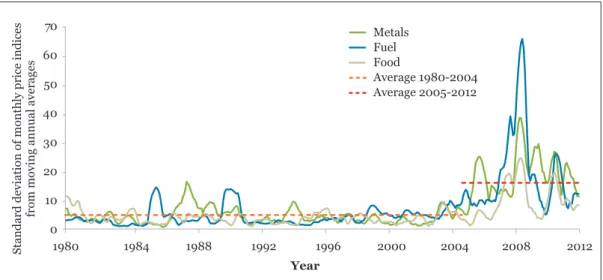
Commodity price volatility has tripled since 2005, as Figure 3 shows. International attention has focused on the impacts of high food and oil prices on developing countries, particularly for their poorer citizens.53 Some governments in resource importing countries have begun to focus on
energy, food and to some extent water security.54 However, few have considered the implications
of extended price volatility for resource rich, commodity exporting countries.
Commodity exporters will face intense competitive pressure. In an era of price volatility, lower cost producers will have a competitive advantage. Countries at the low end of global cost curves will be better placed to weather downturns in world prices, benefit more from upturns, and rely less on long-term supply contracts to secure investment in resource development. By contrast, countries with high cost bases or lower quality resources may be tempted to offer subsidies to attract investors into projects that are more likely to operate at a loss, and may become stranded assets if cheaper producers enter the market.
Governments may suffer unreliable royalty and tax incomes. An economy weighted towards volatile commodities is sensitive to movements in world markets. Any government dependent on royalties tied to resource revenues will be exposed to price volatility, unless their exchange rate shifts to respond to commodity prices. Tax revenues or royalties tied to company profits may also be impacted by commodity price volatility, particularly if companies operate at a loss to maintain market share.
Figure 3: Volatility in commodity prices has tripled – 1980 to 2012
Standard deviation of monthly price indices from moving annual averages
70 50 60 40 30 10 20 0
Standard deviation of monthly price indice
s
from moving annual averages
1980 1984 1988 1992 1996 2000 2004 2008 2012 Metals Fuel Food Average 1980-2004 Average 2005-2012 Year
How should Queensland respond to these challenges?
Lifting Queensland’s productivity is the only way to raise incomes for the long-term. This means developing an economy that is more efficient at producing goods and services. Increasing productivity can raise living standards to an extent, because higher real incomes allow people to spend more, enjoy more leisure time, improve housing and education, and contribute to social improvements. Productivity growth can also help businesses to be more profitable.
Queensland’s problem is that markets chase short-term mining profits, which may not maximise productivity. When mineral prices are high, mining profits increase.i In Australia, this has
encouraged mining companies to expand into lower quality resources that cost more to dig up.56
The result has been higher profits but less efficient production, or lower productivity.57 In contrast
to mining, agriculture and manufacturing have improved their productivity in recent years.58,59
This can lead to missed opportunities for growth in non-mining export industries. These industries may have higher growth or productivity potential than mining. In the short-term they lose competitiveness if high mineral prices drive up the value of the Australian dollar. They may also struggle to compete with mining for land, labour and capital. If the rise in mineral prices and the dollar is longer-term, or structural, some industries may regain competitiveness by increasing their productivity while others will wither. However, if the rise is temporaryii, it
would be dangerous to assume surviving industries will just bounce back with a lower Australian dollar. Short-term loss of skills, assets and investment can lead to long-term loss of growth. This is particularly so for industries that benefit from increasing returns to scale, from learning, or from keeping up with the latest technology.60
National policy settings may not be enough to respond to such challenges. While lowering interest rates should reduce the Australian dollar, this can lead to unsustainable bubbles in other parts of the economy. This is a particular risk for housing. Getting national policy settings right is difficult when states or regions experience different growth rates or inflationary pressures.
Rather, Queensland needs to foster growth in industries that can maintain competitive advantage in the face of rapid changes in global trade. This is more likely to come through supplying reliable, sustainable, specialised products than commodities. Global supply chains are changing rapidly. Two trends are particularly relevant. First, production chains are now spread across many countries, with each specialising in particular components or stages of a good’s production.61 This
means imports from one country are increasingly used to produce exports by another country, rather than going directly to end consumers. Second, supply chain risk has increased in frequency and magnitude, with even small disruptions leading to large impacts.62 New sources of risk
include natural disasters brought on by the effects of climate change, product contamination, and political instability.63 This means reliable, sustainable suppliers will be better placed to win
contracts and maintain high margins.
i A high exchange rate can also increase profits, if it reduces the cost of imports used in production
more than it affects the price of exports.
ii The contraction of non-mining export industries due to a temporary rise in exchange rates driven
by rapid development of mineral or energy deposits is also called the ‘Gregory Effect’ or ‘Dutch Disease’.
Queensland needs policies directed toward increasing productivity across the economy by:
» Levelling the playing field for non-mining industries with high productivity growth. For example, the government may need to be more active in ensuring agriculture can compete with mining for access to land or water resources.
» Managing renewable natural resources sustainably. Queensland has a potential advantage in reliably supplying ‘clean, green’ products to Asian consumers. Once lost, this brand may be hard or impossible to recover.
» Investing in skills and Research & Development (R&D) to continually raise productivity. This should target industry clusters with the potential to compete globally through superior reputation, brand and management.
The challenge for Queensland is not to balance mining with other industries, but to transition its economy so that future growth industries can prosper.
How is this relevant to the Queensland Plan?
The draft Queensland Plan shows that Queenslanders want a more diverse economy as a means to achieve high income levels.64 As an exercise in community consultation, the state planning
process established a new standard for Queensland in setting whole-of-community objectives for strategic government. The next stages of the planning process will determine how well Queensland can establish whole-of-government means for delivering on the vision in the draft Plan. Strategic planning of this sort can build trust in governments, as long as it has staying power through multiple election cycles.
Delivering on Queenslanders’ aspirations for 2044 involves more than setting a vision that outlines stretch targets and goals. A long-term plan should also outline how progress will be measured, connect means to ends, and establish an independent mechanism for monitoring and evaluating performance. The draft Queensland Plan indicates these steps will happen as part of the overall planning process, although the details are yet to be worked out.65
This report aims to kick start a discussion about what it will take to achieve the economic targets in the draft Queensland Plan. Of course, other targets are also important. Many underpin Queenslanders’ ability to achieve their vision for the state’s future economy. Nevertheless, the economic challenges facing Queensland are significant and are our focus given their potential to disrupt the state’s ability to steer a path toward its preferred future.
The next phase of Queensland’s strategic planning process should provide an opportunity for this, as those involved seek to put some flesh on the bones of the plan. Key markers of success will be:
» The consistency of targets – for example, the avoidance of potential conflicts between economic and environmental targets.
» Specific goals that will lead to realistic actions based on Queensland’s competitive position – particularly vital is the identification of Queensland’s growth industries and key capabilities, as well as necessary actions to foster their competitive advantage.
» No gaps in the measures of progress – economic diversity does not increase overnight; the Queensland Plan will need a measure of the complexity of economic activity across the state.
» Clear strategic priorities connecting all government areas – for example, focusing on the goal of industry development and diversification should permeate all levels of government. This requires a new economic strategy and an integrated focus on priority industry clusters.
» An independent institution to monitor and evaluate progress, with enough teeth to keep governments focused through election cycles.
The most relevant findings from this report for the next phase of Queensland’s state planning process are:
1. There is a potential conflict between the economy and environment
targets in the plan. Targeting a ‘best in class’ balance of environmental protection and
economic development overlooks the fact that a strong economy depends on a healthy environment. The two most obvious growth industries for Queensland – agriculture and tourism – both rely on renewable natural resources that are managed for the long-term at the leading edge of world best practice. Queensland must be seen as a global leader in natural resource management to maintain its ‘clean and green’ brand. Queensland needs to go beyond protecting the environment from known threats, and instead manage renewable natural resources as strategic assets.
2. The economy goals should be refined based on the findings of a State Economic Summit. Just as two heads are better than one, Queensland should draw
broadly on industry and government knowledge to identify growth industries and key capabilities from which competitive advantage can be built. Policy support for growth industries should focus on overcoming specific barriers to productivity growth or competitive advantage that industry is unable to tackle by itself. It should also come with clear conditions and timeframes.
3. There are key gaps in the economic measures of progress. In particular,
a measure of progress toward the goal of economic diversity is needed. This should focus on the complexity of economic activity in Queensland, not just the aggregate contribution of different industries to exports or state gross product. Promising
measures focused on economic complexity are being developed.66 Other broad measures
are also being developed to improve measurement of economic progress and social wellbeing.67,68,69,70
4. Focusing on the goal of industry development and diversification should be a strategic priority for the Queensland Government. This requires a new economic
strategy and an overhaul of government policies to ensure a level playing field for all industries.
5. An independent institution needs to monitor and evaluate progress, one
with enough teeth to ensure government remains focused on outcomes regardless of who wins the next 10 elections. Given Queensland lacks an upper house, this institution should be established for the life of the plan, have the freedom to report publicly as well as to parliament, and the right to review relevant legislation to ensure its consistency with the 30-year plan. The plan itself should not be fixed in time, but revised and renewed in consultation with the community.
Queensland needs a new economic strategy
An economic strategy should aim for substantial improvement in the incomes and opportunities of a society. Queensland’s strategy dates from the 1970’s, when the state first started receiving significant mining royalties. However, Queensland still has lower average incomes than the rest of Australia. This suggests a need to revise its economic strategy to catch up with other states.
Queensland’s economic strategy has not lifted incomes to national levels
Since the 1970’s, Queensland household incomes have remained below the Australian average. As Figure 4 shows, this is despite the peak related to the recent mining boom. In contrast, the similarly commodity focused state of Western Australia’s income per capita has continued to rise. At the peak of the previous mining boom, Queensland incomes rose near to 91 per cent of national levels but fell back below 86 per cent by 1988.The other apparent peak in 1993 was due to Queensland being hit less hard by the early 1990’s recession than other states.
Figure 4: Average household income less farm income per capita of Queensland
and Western Australia, relative to Australiaiii
85% 1982 1983 1984 1985 1986 1987 1988 1989 1990 1991 1992 1993 1994 1995 1996 1997 1998 19992000 200120022003200420052006200720082009 2010 2011 2012 2013 90% 95% 100% 105% 110% 115% 120% Year
Western Australia Queensland
Percentage of Australian average Australian average 1982 peak of mining boom 1990’s recession hit Queensland less than
other states mining boom 2009 peak of
Source: CPD analysis based on Australian Bureau of Statistics71
iii This chart is based on ABS National Accounts, with farm income removed because it is particularly volatile yet makes up only a small amount of household income. Other data on average household income, including from the ABS, is based on surveys rather than national accounts. As such, it may differ from Figure 4 by 1 - 2 per cent in some years, but reflects the same general trend in relative incomes.
Some of the income gap may be due to different settlement patterns between Queensland and other states. Queensland has relatively low urbanisation, with around 40 per cent of its population living outside Brisbane and the Gold Coast.72 Queensland is unusual in that high urban incomes
do not lift the overall state average as much as in NSW and Victoria.73 Nor have regions with
mining activity captured high incomes, as is the case in Western Australia.74
Differences in population are another possible, but incomplete, explanation. An extra year of initial schooling was fully introduced across Queensland’s state schools in 2006-07.75 This should
have a positive effect on employment further down the line. However, as Table 2 shows, the gap is not due to higher unemployment, which is similar in Queensland to the rest of Australia.
Table 2: Statistical summary of Queensland’s economy
Queensland Australia
Population 4,638,075 23,032,746
Participation rate (% of
population in workforce) 76 66.1% 65.1%
Gross household income per
capita 77 $ 54,735 $ 57,441
Education – proportion with
post-school qualification 78
Men 57.6% 59.6%
Women 54.2% 58.0%
Unemployment rate 5.9% 5.8%
Source: Australian Bureau of Statistics; Queensland Treasury and Trade
More likely, the persistent income gap indicates boom and bust development cycles do not deliver sustainable increases in living standards.
Incomes may fall behind again as coal prices drop. In 2009, Queensland realised its highest household income per capita relative to the Australian national average since at least 1982. This income peak coincided approximately with the recent boom in coal prices, which have since fallen sharply 79 Thermal coal prices almost tripled between 1999 and 2008, while coking coal prices
increased four-fold without considering inflation. 80,81 Prices have now fallen at least 30 per cent
compared to their peaksiv.82,83 These prices are testing the margins of coal mining companies, who
are finding it difficult to remain profitable.84
iv Between 1999 and 2008 the constant dollar price of thermal coal grew 282 per cent. It has since fallen from a high of US$127 (AU$200) to US$84 (AU$79) per tonne. Similarly, US prices for coking coal grew 435 per cent in constant US dollar prices from US$38 (AU$67) in 2000 Q4 to US$202 (AU$207) in 2011 Q3, before dropping back to US$119 (AU$130) in 2013 Q2. Australian prices per tonne slipped from US$220 (AU$215) in July 2012 down to US$147 (AU$157) in September 2013.
Increasing export volumes may not help maintain incomes. Expanding mining capacity is a significant part of the income and employment growth associated with mining booms. Yet many high wage jobs last only during the construction phase. Wages are also likely to fall for longer-term operational jobs as mining companies lower costs in an attempt to compete for a share of a cooling global market. Australia generally, including Queensland, may see significant wage deflation since many of our thermal coal mines are now in the less competitive half of international cost curve.85
Jobs may actually be lost as the mining investment boom cools. As the expansionary stage of the current mining boom winds down, we can expect the scale of capital investment to decrease, leaving a deficit of economic activity that will be hard to replace. Compared to pre-boom years, private capital investment accounted for at least an extra 10 per cent of Queensland’s economic activity in 2013v.86 Its decline could take out around 3 years of economic growth.
Without a change in economic strategy, Queensland will find itself in a phase where little employment is created by continuing resource extraction and the state experiences lower incomes and slower job growth.
Previous economic strategies have prioritised short-term gains, at
the cost of long-term prosperity
Queensland governments have a history of using slogans to sell the state, rather than re-thinking its economic strategy. Since the 1980’s, a number of brands have been used to market Queensland as being different from rest of Australia.87 Yet apart from Beattie’s Smart State
strategy, governments have paid little attention to contingency planning, or sowing the seeds for future economic growth.
Queensland’s economic strategy dates from the 1970’s, when the state first started receiving significant mining royalties. Since then, it has focused on maintaining mining royalties. Government revenue from mining was distributed to the regions as subsidies for urban infrastructure, driving a property investment boom to follow each mining boom. Queensland used cheap residential land and low taxes to compete with other states for population growth – experiencing an 88 per cent increase in population over the past 20 years compared to the 50 per cent Australian average.88 Many new Queenslanders brought retirement savings and set up small
businesses which drove growth in the rapidly expanding South East Queensland region.
Some changes have been made to the basic strategy. When low productivity became apparent in the 1990’s, the Beattie Government added a focus on education. More recently, the Bligh Government cut subsidies to regional councils, as coal prices fell while spending on public services increased.89 This has left many councils without the revenue streams they previously
relied on from urban development.
v As the recent mining boom took hold at the start of the 21st century, the contribution of capital investment to GSP
increased from 18.1% in 2001 to 27.8% in 2008 and, following a dip around the time of the global financial crisis, rose again to 29.1% in 2013
Yet the basic strategy is still about driving growth by increasing inputs to the economy, rather than by working smarter. The recent Commission of Audit demonstrated that Queensland’s budget problems stem from its taxes being significantly lower than other states.90 What is less
often discussed is that mining productivity is actually falling as the industry taps lower quality reserves which cost more to dig up.91
The social problems of this strategy are becoming obvious. Rapid population growth increases the state’s infrastructure deficit.92 There are well documented housing shortages and soaring
accommodation costs near booming mining centres. With many mining jobs being fly-in fly-out, and limited pathways for entry level jobs, regional populations may see limited benefits 93 Many
local councils lack funds to build infrastructure or provide services, and are being encouraged to sell off assets without enough time to consider the long-term impact on environmental or social wellbeing.94, 95
The economic problems are receiving gradual recognition. The current government proposes that growing Queensland’s ‘four-pillar’ economy will buffer the state against international turbulence. The idea is that tourism, agriculture, resources and construction are four pillar industries that will balance each other out to deliver an economic growth target of four per cent a year.96 Yet it
is questionable whether the construction industry will fire up without continued support from subsidised infrastructure. The high Australian dollar also puts pressure on agriculture and tourism, which are competing with lower cost countries. There is also the issue of reputational risk, given Qld relies on its ‘clean and green’ brand to market food and tourism to increasingly fussy Asian consumers. It would take only one significant environmental accident or scare for Queensland to lose its brand.
The longer-term risk of this strategy is that Queensland may deplete its natural assets, fail to develop a productive diversified economy, and have nothing for the future.
A new economic strategy must be more than a slogan
Queensland needs a new economic strategy that focuses less on attracting capital investment, and more on promoting economic diversity. There are several reasons why:
» A more diverse economy is less exposed to commodity price volatility, and other external shocks.
» A more diverse economy is linked to sustainably higher incomes.97 The key is to
increase the diversity of capabilities – for example, skilled labour – that go into products and services.
» Economic diversity can drive productivity and innovation.98 In regional areas this
can happen when there are specialised industry clusters.99 In urban areas, radical
innovation can happen when there is more than one centre of excellence. 100
The current government’s ‘four pillars’ economy may not provide enough diversity, and risks Queensland maintaining an economic structure dominated by commodity exports. The concept of a ‘four pillar’ economy based on tourism, agriculture, resources and construction is mentioned in many government documents, including rolling six-month action plans.101 However, few details
and sustainable growth industries. Without a clear focus on promoting economic diversity, there is a risk Queensland’s government does lots of things to help business, but overlooks opportunities to support industries that are likely to grow faster and offer higher margins than commodities. Countries that focus on growth industries will do better than those which focus on one or two areas of comparative advantage.102 Recent studies have begun to identify high growth industries.
For example, Figure 5 below shows that tourism and agriculture are likely to grow faster than mining out to 2030. The outlook for mineral demand growth, and especially coal, has ebbed recently and is unlikely to continue at the frantic pace of the past decade.103
Queensland’s challenge is to transition its economy toward growth in industries that can supply reliable, sustainable, specialised products to global supply chains at the right price. Comparing the forecast growth across industries up to 2030 against the proportion that each of these industries contributes to Queensland’s exports, we see a heavy weighting towards commodities, to the detriment of industries highlighted for future growth.
Figure 5: Share of exports, global growth rates and Australian relative advantage in selected industries
Share of Qld exports
(2012) Global growth rate(forecast to 2030)
Australian advantage (relative to world*) High Med High Med Med High Low
* As assessed by Deloitte Access Economics
Global GDP 0% 0% 10% 20% 30% 40% 50% Mining Agribusiness Tourism International Education Gas Wealth Management Health Percent of exports Industry 2.0% 3.0% 4.0% 5.0%
Percent per year
Alternative growth industries are therefore attractive and will be highly competitive globally. The study mentioned above also assesses Australia’s relative advantage in each industry. Building and maintaining a competitive advantage in these industries will require patience, strategic nous and hard work.
While Queensland will need to assess its own competitive advantage, some preliminary indications are:
» Although Australia has a relative advantage in gas, the high cost of new investment in Australian LNG is a risk for the sector in the medium term.106 Arrow Australia’s
recent decision to review staff levels and cut costs at its planned Curtis Island LNG plant suggests Queensland is not cost competitive in gas.107 One of the reasons cited
was to create more value in the project to offer shareholders a more competitive proposition.108
» Tourism and agribusiness are forecast to grow faster than any industry other than gas. Queensland should have a relative advantage in these industries given it has world class renewable natural resources, which are likely to become more valuable over time. With careful soil, marine and biodiversity management, Queensland should be able to leverage this natural source of advantage.
» International education is another area of advantage for Australia, and one in which Queensland has strengths, being the state’s third largest contributor to state export value.109 However, competitiveness will require high international rankings against
increasingly competitive Asian universities, particularly if the Australian dollar remains strong.
» While Queensland has a relatively small health industry, the challenge of dealing with an ageing population provides potential to develop the technologies, skills and industries necessary to respond to these demographic changes.
» Wealth management may also grow with the ageing population. However, Queensland should be cautious of growing the financial services faster than is needed to service the rest of the economy. Recent international research warns that a large or rapidly expanding financial services sector can be a drag on overall economic growth.110
To spur a more diverse economy, Queensland should invest in the assets and capabilities that support a competitive advantage in growth industries.
Government and industry have complementary roles in economic strategy
Governments should get the necessary conditions in place for broad growth, focusing on education levels, infrastructure, trust in institutions and the rule of law. Governments have a role to ensure these capacities support long-term prosperity as well as short-term economic activity. In the case of renewable natural resources, which provide infrastructure for industries such as tourism and agriculture amongst other things,vi this should include managing the way they are used to ensure
they remain healthy and productive.
vi Balance sheet valuations of renewable natural resources do not take into account their indirect use value or non-use value, thereby ignoring benefits that are not bought or sold, and the merit of their existence.
Industry’s role is to create new products, develop new capabilities, and stay at the cutting edge of productivity and efficiency. Research shows sustainable competitive advantage comes largely from activities that happen outside individual firms, as long as industries support competition and collaboration.111 This can occur when industries with related activities cluster in a location.
Clusters are hard to create out of nothing, but where collaboration and strategic industry planning is not happening, governments can reduce the cost to industry of doing so in order to help clusters grow. The Massachusetts Technology Collaborative (MTC) is a high profile example. Established in 1994 at the request of state legislature, the MTC supports the growth of technology industries by sponsoring projects in collaboration with technology industry clusters.112
Governments also have a role as a ‘contingency’ planner, looking ahead at global trends to identify risks and opportunities for future economic prosperity. While it remains to private industry to decide how to respond, governments can provide incentives for industry to act ahead of global competitors, particularly when this is in the best interests of the whole of society and helps to sustain long-term value creation.
What governments should not do is subsidise private industry unconditionally. While governments will always be tempted to use subsidies to attract firms, these are often windfall profits that do not encourage innovation or develop competitive clusters. More often in Australia, they have enticed slow growing or declining industries to shift from urban to regional centres where they benefit from lower rents and wages, with little incentive to invest to maintain a competitive advantage. Subsidies can also skew private decisions in a way that increases risk for the whole of society. For example, the Queensland Government recently offered royalty holidays to attract further coal mining investment in the Galilee Basin, while at the same time large listed mining companies are pulling back from investing elsewhere in Queensland. If Galilee mines go ahead when the business case doesn’t stack up without subsidies, Queensland as a whole risks economic disruption should these investments fail. Hidden subsidies, such as failure to charge for pollution or to enforce environmental standards, can also tilt the playing field against society’s longer-term interests. The next chapter discusses how the Queensland Government should support the key growth industries of tourism and agriculture, as a critical step on the path to a more diverse economy.
The government should manage renewable natural resources
as strategic infrastructure for tourism and agriculture
Tourism and agriculture provide significant economic benefits to Queensland. Many of these benefits are local, and provide much needed opportunities to areas outside of Queensland’s urbanised South East.
These are likely to be key growth areas of the future, and their sustainable development may provide a critical path toward a more prosperous and equitable Queensland. Higher margin products may provide growth opportunities, particularly if an increasingly affluent, mobile and growing Asian middle class drives up demand for ecotourism and quality food products.113
A wide range of infrastructure will be important for tourism and agriculture to compete internationally. This includes the usual suspects of transport infrastructure and facilities at tourist destinations, as well as information technology to support precision agriculture and more reliable weather forecasting. However, all of these build on the renewable natural resources that underpin the long-term viability of tourism and agriculture. Therefore this section focuses on management of renewable natural resources, particularly Queensland’s world class marine assets and fertile soils.
Managing reputation will be critical for agriculture and tourism
Queensland’s ‘clean and green’ reputation is central to competing in global markets. The future of these industries will depend on how well Queensland maintains the condition and reputation of strategic assets like the Great Barrier Reef, the Daintree Rainforest and areas of rich and well watered farming land.
Poor management may see irreparable damage to ecosystems and a decrease in tourism, as well as lost farming potential through direct development of land, water table pollution , and health impacts from air pollution.114 Even perceived risks to Queensland’s renewable natural resources
could damage the brand and reduce the current value of tourism and agriculture. As discussed below, the world watches Queensland’s management of the Reef closely and any threat to its health is broadcast globally.
Agriculture is Queensland’s 2nd largest export sector and may benefit from higher global
food prices if soils are managed well
Agribusiness provides 23 per cent of Queensland exports, worth $5.2 billion in 2012. Australia is ranked in the top 5 exporters of commodities like wheat, beef, dairy, sheep meat and wool, with total agricultural products accounting for over 10 per cent of exports.115 Of all Australian states,
Queensland has the largest area of agricultural land and the highest proportion of land area used for agriculture.116
World food prices are expected to rise 60 per cent by 2050, largely due to Asia’s growing population and higher incomes.117 However, greater price volatility and higher input costs of fossil fuels may
squeeze the margins of producers of agricultural commodities.118 The winners of any food boom
are likely to be those countries or regions with less fossil fuel intensive agriculture, more reliable production and access to healthy land and soils.119 Queensland is endowed with fertile soils and
plentiful rainfall, particularly when compared to other agricultural producing states.
Queensland’s existing agricultural land could support a sustainable increase in production volumes and margins. This would benefit the economy and the long-term health of the soils on which agriculture depends. For example, best practice cropping in some regions is estimated to allow an extra two crops to be harvested every ten years, when rainfall is high and at the right time of year.120 Existing northern grazing areas can maintain long-term viability and more
stable profits through good soil management, rather than by expanding into pristine areas.121 If
Queensland can develop a trusted certification scheme, the state should be well placed to market sustainable grass fed beef products to health conscious Asian consumers.
With the right mix of skills and innovation, Queensland may also be able to add value to its agricultural commodities through food manufacturing and production. However, optimising agriculture’s economic contribution will require consistent funding for research, innovation and farm extension programs, as well as careful management of soil and water to prepare for changing weather patterns associated with climate change. Given what is put on the land often ends up in the ocean, Queensland should also continue to reduce the impact of agricultural land runoff on the Great Barrier Reef.
Tourism is Queensland’s 3rd largest export industry, with momentum to continue growing
if its brand is managed well
Tourism provides 5.1 per cent of exports and 5.9 per cent of jobs in Queensland.122,123 The industry
is low paying but labour intensive. The tourism sector has significant links to regional areas and has been more affected than other industries due to labour constraints associated with the mining boom.124 It is also an industry that allows small businesses to develop and distribute the benefits of
ownership across a wide base. Importantly, there is an increasing trend towards more sustainable tourism practice, particularly around the Great Barrier Reef.125 This illustrates the potential for
tourism to create value while conserving the resources it depends on. Thus, development of tourism could be a source of sustainable income, and also one that shares wealth relatively evenly across the state’s population.
Queensland tourism should be well placed to benefit from its proximity to Asian economies with growing middle class wealth. The Australia in the Asian Century White Paper predicted that Asia Pacific would be home to over 3.2 billion members of the global middle class by 2030.126 The
number of Chinese visitors to Australia and New Zealand is expected to grow from 910,000 in 2012 to 2.2 million in 2020, contributing economic growth that could be comparable to the recent resources boom.127 Industry forecasts for Australia suggest the number of tourists and the amount
Table 3: Australian forecast growth in tourist arrivals and expenditure to 2021-22
Arrivals average annual
growth Expenditure average annual growth
China 6.4% 7.1%
India 7.2% 10.9%
Indonesia 5.5% 3.4%
Malaysia 4.7% 3.9%
Average 3.5% 3.8%
Source: Tourism Forecasting Committee.128
However, Queensland will face competition. While recent surveys of Chinese tourists agree with the Australian tourism industry’s view on growth in overseas travel, they also suggest Australia is unlikely to be their destination of choice. Hong Kong, the USA and Thailand are all very popular.129 To capture this market, Queensland will need to position itself as a unique
destination and maintain its brand.
Renewable natural resources should be managed as strategic
infrastructure
As the world’s population increases, resources are becoming scarcer. The combined effects of climate change, unsustainable farming practices and urbanisation will decrease productive arable land across the world, increasing food prices further. As the imperative to shift to low-carbon growth increases and urbanisation of developing Asian economies slows, renewable natural resources will become increasingly important strategic assets. At the same time, we will see an increased demand for ecotourism.130
Balance sheet valuations of renewable natural resources do not take into account their indirect use value or non-use value, thereby ignoring benefits that are not bought or sold, and the merit of their existence. In addition, further benefit can be realised with technological and societal change. An example of this is the growth in tourism opportunities in the Great Barrier Reef that has been possible since the 1970s. Of course, the health of the Reef is valuable not just to tourism, but also to localised recreation, commercial fishing, scientific research activities, indirect benefits such as protecting the coast from storms, and the intrinsic value to people of the Reef’s existence.131
Analogously, agriculture exists in competition with other potential uses of arable land, such as mining and coal-seam gas extraction, and expanding towns and cities. Mining can also compromise water supplies that are valuable to agriculture and communities, and pollute ground water. A true valuation of ecosystem services should include various future and potential services that are not reflected by existing markets.132,133 The diverse range of social and cultural values placed
financial estimate, and we are likely to see the values that are attributed to these assets rise over time as they become scarcer. Significant gaps in the scientific literature, as well as the complex nature of ecosystems, lead to uncertainty over the level of ecosystem services they can maintain. Queensland’s renewable natural resources should be maintained for the ongoing benefit of current and future generations. Market valuations of assets depend on prevailing economic structures and are sensitive to short term policy, but a holistic long-term focus allows us to more accurately represent the significance of unique renewable natural resources. Changing social and economic preferences will increase the value of natural assets. On top of this, using discount rates that reflect the costs and benefits to future generations can lead to higher valuations. Critical ecosystems are also valuable for their own sake, and as they are lost, society will begin to realise that they are in fact invaluable.
This requires dedicated funding for long-term management
Renewable natural resources are a public asset, yet are not recorded on any balance sheet. This means funds for their maintenance and management are often limited, and may be the first to be cut when government budgets are tight. This includes funds for monitoring the health of natural assets, leaving the communities and industries that depend on these assets lacking essential information needed to demonstrate the benefits of improved management. Enforcing regulations to protect natural assets from the cumulative impact of individual actions is also constrained by limits to funding. All these issues can lead to a death by a thousand cuts, with natural capital gradually being eroded over time.
Queensland will need to invest consistently and sufficiently in natural assets to achieve the economic and environmental targets in the draft Plan. While the draft Plan sets some useful goals for managing renewable natural resources, the primary measures of progress focus on community satisfaction with the balance between the environment and the economy.134 This is
risky if communities lack information required to know whether or not they should be satisfied. Instead, Queensland should focus on measures that ensure economic activity lives off the interest, not the capital, of its natural assets.
This could be achieved through an endowment fund, established to manage natural assets in perpetuity. The idea would be to use the financial returns from the fund to monitor and manage natural assets. While the investment side of the endowment fund should be managed at arms-length by professionals, there are many possible options for how this is done. Queensland may want to set an investment mandate that seeks specific co-benefits. For example, this could include investment overseas to offset trends in the Australian economy, a blended fund with a high percentage in ‘climate sensitive’ assets, or investment in sustainable local industries for future growth.