Calhoun: The NPS Institutional Archive
Reports and Technical Reports All Technical Reports Collection
2011-09-27
When Disaster Strikes: Is Logistics and
Contracting Support Ready?
Apte, Aruna
=
^Åèìáëáíáçå=oÉëÉ~êÅÜ=mêçÖê~ã=
do^ar^qb=p`elli=lc=_rpfkbpp=C=mr_if`=mlif`v= Approved for public release, distribution is unlimited.
Prepared for: Naval Postgraduate School, Monterey, California 93943
NPS-LM-11-185
^`nrfpfqflk=obpb^o`e=
pmlkploba=obmloq=pbofbp=
=
When Disaster Strikes Is Logistics and Contracting Support Ready?
27 September 2011 by
Dr. Aruna Apte, Assistant Professor, and CDR (Ret.) E. Cory Yoder, Senior Lecturer
Graduate School of Business & Public Policy
=
^Åèìáëáíáçå=oÉëÉ~êÅÜ=mêçÖê~ã=
do^ar^qb=p`elli=lc=_rpfkbpp=C=mr_if`=mlif`v= k^s^i=mlpqdo^ar^qb=p`elli=
The research presented in this report was supported by the Acquisition Chair of the Graduate School of Business & Public Policy at the Naval Postgraduate School.
To request Defense Acquisition Research or to become a research sponsor, please contact:
NPS Acquisition Research Program
Attn: James B. Greene, RADM, USN, (Ret.) Acquisition Chair
Graduate School of Business and Public Policy Naval Postgraduate School
555 Dyer Road, Room 332 Monterey, CA 93943-5103 Tel: (831) 656-2092
Fax: (831) 656-2253
E-mail: [email protected]
Copies of the Acquisition Sponsored Research Reports may be printed from our website www.acquisitionresearch.net
= =
^Åèìáëáíáçå=oÉëÉ~êÅÜ=mêçÖê~ã=
do^ar^qb=p`elli=lc=_rpfkbpp=C=mr_if`=mlif`v - i -
Abstract
Recent crisis responses, including the Department of Defense (DoD) and the United States (U.S.) integrated response to the 7.0-magnitude earthquake in Haiti, in which the DoD played a major role, can be examined and analyzed to determine how greater efficiencies and effectiveness may be achieved. Specific examination and analysis of actual logistics and contract capability in real-world response, including the DoD’s ability to deliver the right mix of goods and services when and where they are needed given limited resources, can be utilized to create a more robust capability for future events including the ability to react more effectively and efficiently within the constraints of resources such as budget and manpower if contingency contracting is in place. We examine the planning and management of the DoD’s logistics and contracting support for contingency, expeditionary, and crisis response, and provide specific recommendations for optimizing response capability for future disaster relief.
Keywords: crisis response, actual logistics, real-world response, planning and management, optimizing response capability
= =
^Åèìáëáíáçå=oÉëÉ~êÅÜ=mêçÖê~ã=
do^ar^qb=p`elli=lc=_rpfkbpp=C=mr_if`=mlif`v - ii - k^s^i=mlpqdo^ar^qb=p`elli=
= =
^Åèìáëáíáçå=oÉëÉ~êÅÜ=mêçÖê~ã=
do^ar^qb=p`elli=lc=_rpfkbpp=C=mr_if`=mlif`v - i -
Acknowledgements
The authors are greatly thankful to RADM James Greene, USN (Ret), the NPS Acquisition Research Chair, for securing the sponsor funding for this research. We would also like to acknowledge and thank Keith Snider, Karey Shaffer, and Tera Yoder for their efforts on behalf of the Acquisition Research Program in the
= =
^Åèìáëáíáçå=oÉëÉ~êÅÜ=mêçÖê~ã=
do^ar^qb=p`elli=lc=_rpfkbpp=C=mr_if`=mlif`v - ii - k^s^i=mlpqdo^ar^qb=p`elli=
= =
^Åèìáëáíáçå=oÉëÉ~êÅÜ=mêçÖê~ã=
do^ar^qb=p`elli=lc=_rpfkbpp=C=mr_if`=mlif`v - iii -
About the Authors
Dr.Aruna Apte has successfully completed various research projects, involving application of mathematical models and optimization techniques that have led to over 20 research articles and one patent. Her research interests are in
developing mathematical models for complex, real-world operational problems using optimization tools. She values that her research be applicable. Currently her
research is focused in humanitarian and military logistics. She has several
publications in journals, such as Interfaces, Naval Research Logistics, Production and Operations Management. She has recently published a monograph on
Humanitarian Logistics.
Aruna received her PhD in Operations Research from Southern Methodist University in Dallas. She also has a M. A. in Mathematics, from Temple University, Philadelphia. Before NPS she worked as a consultant at MCI and taught at the Cox School of Business, SMU, where she won the best teacher award. She has over twenty years of experience teaching operations management, operations research, and mathematics courses at the undergraduate and graduate levels. At NPS She teaches mathematical modeling, for which she won the Liskin award for best
teacher. She has advised over 60 students for MBA/Masters reports. She has also advised emergency planners in preparing for disaster response. She is the founding and current president for a new college (focus group) in Humanitarian Operations and Crisis Management under the flagship academic professional society in her intellectual area of study, Production and Operations Management Society.
Aruna Apte, Ph.D.
Graduate School of Business and Public Policy Naval Postgraduate School
Monterey, CA 93943-5000 Tel: 831-656-7583
Fax: (831) 656-3407 E-mail: [email protected]
= =
^Åèìáëáíáçå=oÉëÉ~êÅÜ=mêçÖê~ã=
do^ar^qb=p`elli=lc=_rpfkbpp=C=mr_if`=mlif`v - iv - k^s^i=mlpqdo^ar^qb=p`elli=
CDR (Ret) Cory Yoder is a faculty member of the Naval Postgraduate School’s Graduate School of Business and Public Policy (GSBPP). Yoder was originally assigned to NPS in July 2000 while on active duty commission with the Navy, appointed to a civilian Lecturer position in June 2004, and promoted to Senior Lecturer in May 2008. He has performed duties as Academic Associate (program manager) for the 815 (MBA) (three-year appointment ending July 2005) and currently serves as Academic Associate for the 835 (MSCM- Master of Science in Contract Management program- with an indefinite appointment). Cory has strong acquisition and contracting experience, combined with several challenging
acquisition, logistics, industrial, headquarter, and combat support operations assignments. Yoder received the Rear Admiral John Jay Schieffelin award for
Excellence in Teaching for academic year 2010, presented in June 2011, and was a “Top Five Percent” nominee in academic years 2006, 2007, 2008, and 2009. CDR (Ret) Yoder holds the following degrees: Master of Arts in National Security and Strategic Studies, Naval War College (NWC), Newport, Rhode Island; Master of Science in Management, Naval Postgraduate School, Monterey, CA; B.S. in Business Management, Indiana University “Kelly” School of Business; and, University of Virginia’s Darden Graduate School of Business Administration –
Business Resource Management (certificate program graduate). CDR (Ret) E. Cory Yoder is a Beta Gamma Sigma honor society member with a lifetime appointment, DAWIA Contract Level III, is an active member of the Institute for Supply
Management (ISM) with direct national membership, and holds an active TOP SECRET security clearance.
Graduate School of Business and Public Policy Naval Postgraduate School
Monterey, CA 93943-5000 Tel: 831-656-
Fax: (831) 656-3407 E-mail:
= = = ^Åèìáëáíáçå=oÉëÉ~êÅÜ=mêçÖê~ã= do^ar^qb=p`elli=lc=_rpfkbpp=C=mr_if`=mlif`v - v - k^s^i=mlpqdo^ar^qb=p`elli= NPS-LM-11-185
^`nrfpfqflk=obpb^o`e=
pmlkploba=obmloq=pbofbp=
=
When Disaster Strikes Is Logistics and Contracting Support Ready?
27 September 2011 by
Dr. Aruna Apte, Assistant Professor, and CDR (Ret) E. Cory Yoder, Senior Lecturer
Graduate School of Business & Public Policy
Naval Postgraduate School
Disclaimer: The views represented in this report are those of the author and do not reflect the official policy position of the Navy, the Department of Defense, or the Federal Government.
= = = ^Åèìáëáíáçå=oÉëÉ~êÅÜ=mêçÖê~ã= do^ar^qb=p`elli=lc=_rpfkbpp=C=mr_if`=mlif`v - vi - k^s^i=mlpqdo^ar^qb=p`elli= =
= = ^Åèìáëáíáçå=oÉëÉ~êÅÜ=mêçÖê~ã= do^ar^qb=p`elli=lc=_rpfkbpp=C=mr_if`=mlif`v - vii -
Table of Contents
I. Introduction ... 1II. Literature Review ... 5
A. Academic Literature ... 5
B. Official Documents ... 9
III. Contingency Contracting and Logistics ... 15
A. Needs Assessment and Delivery ... 16
B. Coordination of Efforts ... 18
C. Contracting, Management and Oversight ... 19
IV. Analysis ... 23
= =
^Åèìáëáíáçå=oÉëÉ~êÅÜ=mêçÖê~ã=
do^ar^qb=p`elli=lc=_rpfkbpp=C=mr_if`=mlif`v - viii - k^s^i=mlpqdo^ar^qb=p`elli=
= =
^Åèìáëáíáçå=oÉëÉ~êÅÜ=mêçÖê~ã=
do^ar^qb=p`elli=lc=_rpfkbpp=C=mr_if`=mlif`v= = - 1 -
I.
Introduction
In the last few years, a substantial amount of the population of the world has suffered due to disasters, natural and manmade. In 2009, there were 335 natural disasters reported worldwide that killed 10,655 persons, affected more than 119 million others, and caused over $41.3 billion in economic damages (Vos, Rodriguez, Below, & Guha-Sapir, 2009). Recent crisis responses, including the DoD and U.S. integrated response to the 7.0 magnitude earthquake in Haiti, in which the DoD played a major role, can be examined and analyzed to determine how greater efficiencies and effectiveness may be achieved. Currently, there exists a sub-optimization of capability due to the lack of an integrated analytical approach to creating and executing crisis response. The study of natural disasters such as the earthquake in Haiti, Hurricane Katrina in the United States, the tsunami in the Indian Ocean, the earthquake in Pakistan, and numerous humanitarian challenges arising from such conflicts as that in Sudan have exposed the shortcomings in planning for disasters. The homeland security issues related to domestic as well as international terrorism have made “readiness” the principal priority.
Humanitarian logistics is a critical element of an effective and efficient
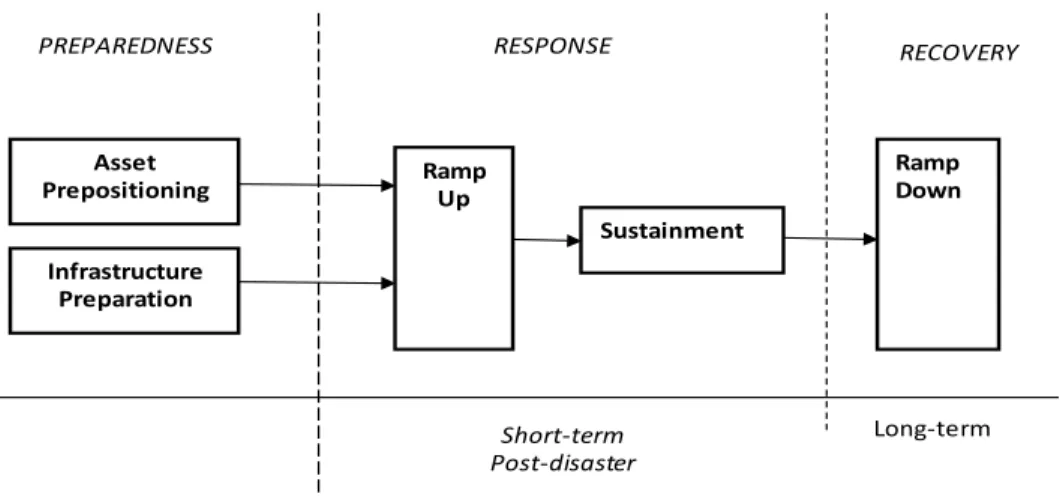
disaster relief process (Apte, 2009) that is manifest in long lead-times and high costs in the acquisition and delivery of critical supplies and services in areas devastated by disaster. The negative effects of the inefficiencies and ineffectiveness of existing systems are felt throughout the lifecycle of the disaster after it strikes. The lifecycle of a disaster can be divided into three stages along a time line (see Figure 1): preparedness efforts before the disaster strikes, response immediately after the disaster strikes, and recovery in the post-disaster period (Apte, 2009).
When a disaster strikes, the response follows: donations and funding are solicited from donors, and sometimes supplies are obtained from pre-contracted vendors. Sometimes the supplies are obtained in advance, especially during the pre-positioning stages. The supplies received from donors and the supplies purchased
= =
^Åèìáëáíáçå=oÉëÉ~êÅÜ=mêçÖê~ã=
do^ar^qb=p`elli=lc=_rpfkbpp=C=mr_if`=mlif`v= = - 2 - k^s^i=mlpqdo^ar^qb=p`elli=
from vendors are then transported by various means to predetermined locations and distributed by emergency responders in the affected areas. However, the nature of the events creates uncertainties. It is therefore critical that logistics and contracting have to create an efficient interface. The complexity of humanitarian logistics can be appreciated when the distribution process through the time line of Humanitarian Supply Chain, along with the factors and characteristics of this supply chain are taken into account.
Figure 1. Time Line of Humanitarian Supply Chain
Specific examination and analysis of actual logistics and contract capability in real-world response, including the DoD’s ability to deliver the right mix of goods and services when and where they are needed given limited resources, can be utilized to create a more robust capability for future events including the ability to react more effectively and efficiently within the constraints of resources such as budget and manpower if contingency contracting is in place.
Examination of the DoD’s crisis response capability indicates that the overall supply chain can be improved (Lodree & Taskin, 2009) if the logistics and
contracting communities collaborate. Specifically, the response time, coordination of providers, contracting, and the capability to deliver the right mix of goods and
services can be enhanced. The Government Accountability Office (GAO, 2008, 2009, & 2010) indicates that coordination and planning efforts for domestic and
Infrastructure Preparation Ramp Up Sustainment Ramp Down
PREPAREDNESS RESPONSE RECOVERY
Disaster Strikes Short‐term Post‐disaster Asset Prepositioning Long‐term
= =
^Åèìáëáíáçå=oÉëÉ~êÅÜ=mêçÖê~ã=
do^ar^qb=p`elli=lc=_rpfkbpp=C=mr_if`=mlif`v= = - 3 -
international disasters must be improved. This call for improved coordination to better response extends to the logistics and contracting support communities within the DoD and can be a key enabler for initial response improvement.
In Haiti, devastation caused by the earthquake dramatically impaired the capability of all rapid response efforts. The resulting extreme conditions made it difficult to deliver and transport much needed equipment, materials, supplies, and services to the Haiti earthquake victims and the first responders on the scene. This study examines how planners and coordinators within DoD contracting and logistics provided relief to those in Haiti. Additionally, a comparative analysis of recent DoD humanitarian assistance operations discloses best practices in DoD disaster relief as this study uncovers what went right, what went wrong, and what was learned in the first critical hours of the Haiti relief effort.
A gap exists in coordinating the capabilities of logistics agencies and contracting communities. The questions that need to be answered are as follows: Are there any examples of effective and efficient logistics and contingency
contracting support? Can we draw any conclusions from the 2010 Haiti disaster and Operation Unified Response (OUR)? How was the support used to mitigate the devastation in Haiti? Were there any specific influential factors that affected the coordination between these two communities? Were logistics and contracting staff integrated in the operational planning phase? Overall, what were the overarching logistics and contracting challenges?
We set out to answer these questions based on academic literature, official documents, and field research. In this article, our next section reviews the literature. In the following sections we discuss various aspects of logistics and contingency contracting support, analyze the situation, and then offer our conclusions.
= =
^Åèìáëáíáçå=oÉëÉ~êÅÜ=mêçÖê~ã=
do^ar^qb=p`elli=lc=_rpfkbpp=C=mr_if`=mlif`v= = - 4 - k^s^i=mlpqdo^ar^qb=p`elli=
= =
^Åèìáëáíáçå=oÉëÉ~êÅÜ=mêçÖê~ã=
do^ar^qb=p`elli=lc=_rpfkbpp=C=mr_if`=mlif`v= = - 5 -
II.
Literature Review
Previous to Haiti Earthquake, humanitarian groups and governments have shown a simple lack of preparation in combating the effects of the disaster (McCoy, 2008). Logistical obstacles have created greater suffering and have highlighted the ineffectiveness caused by a lack of preparedness. Humanitarian groups have not shown significant coordination and communication within organizations. However, the fact remains that all organizations, or groups within the organization, must coordinate their efforts amongst response providers in order to achieve the greatest effect. Oftentimes, lack of coordination causes further problems when certain areas become over serviced and other areas are under serviced. The lack of planning and coordination leads to information gaps and the unclear assignment of participant responsibilities, which negatively affects vital support. As coordination strengthens and improves, duplicative and surplus operations can be eliminated and response efficiency and effectiveness improved. For the purposes of this work the authors define “effectiveness” as providing the needed support at the right place and right time, whereas “efficiency” is providing effective support in the most economic manner possible (considering cost, manpower, and other resources).There are many lessons to be learned from models developed in academic literature, case studies described by practitioners, and official documents explaining military missions.
A. Academic Literature
Logisticians play a vital role in almost all aspects of society, especially so in disaster relief zones (Thomas, 2003). Logistics is the life of any emergency aid operation and without it lives will be lost. Usually logistics is where many relief operations struggle or even fail. Proper coordination between agencies requires adequate preparation before a disaster, when a coordinated logistics plan can alleviate inadequacies. In addition, humanitarian supply chains are very dynamic and complex but only a few organizations place logistics high on their agenda.
= =
^Åèìáëáíáçå=oÉëÉ~êÅÜ=mêçÖê~ã=
do^ar^qb=p`elli=lc=_rpfkbpp=C=mr_if`=mlif`v= = - 6 - k^s^i=mlpqdo^ar^qb=p`elli=
Logistics is viewed as a support function and not a strategic function within
organizations. Inadequate consideration and placement within organizations often leads to underfunding and under resourcing, resulting in inferior logistics and contracting support provided by the organization. Often, logisticians are even left out of the planning process and therefore resort to reactionary measures and support a constant state of “fire fighting” during a crisis.
There are substantial differences between commercial logistics and humanitarian logistics. Humanitarian logistics need to have zero lead times, are often high stakes, sometimes utilize unreliable information, are often ad hoc in many organizations, and utilize varying levels of enabling technology (Beamon, 1999) that is vital due to the unpredictable nature of humanitarian logistics. Logistics must be adaptive and flexible when operating in a disaster area, unlike the familiarity of commercial logistics.
Private sector logistics can and should be applied to improve the performance of disaster logistics, but before embarking on this endeavor the private sector needs to understand the core capabilities of humanitarian logistics (Van Wassenhove, 2005). With this in mind, this paper walks us through the complexities of managing supply chains in emergency relief operations as well as the possibilities of becoming involved through corporate social responsibility. It also outlines strategies for better preparedness and the need for supply chains to be agile, adaptable, and aligned—a core competency of many humanitarian organizations involved in disaster relief and an area that the private sector could draw on to improve their own competitive edge.
The speed of humanitarian aid after a disaster depends on the capability of logisticians to acquire, transport, and receive supplies at the site of humanitarian relief effort (Koavacs & Spens, 2007). The authors create a framework that
distinguishes between the actors, phases, and logistical processes of disaster relief. The authors define humanitarian logistics as the different operations at different times that occur to aid and help those affected by various catastrophes, which could be broken down into two fundamental parts: continuous aid work and disaster relief.
= =
^Åèìáëáíáçå=oÉëÉ~êÅÜ=mêçÖê~ã=
do^ar^qb=p`elli=lc=_rpfkbpp=C=mr_if`=mlif`v= = - 7 -
Furthermore, they define disaster management as a process of several stages in order to implement humanitarian logistics. These stages are preparing for the disaster, immediate disaster response, and reconstruction. In the preparing phase, the authors make the argument that the prevention and prediction of disasters are nearly impossible, thus creating planning difficulty. Disasters are unpredictable with the exception of possible manmade disasters (such as war, terrorism, etc.); however, sufficient preparation can be made due to the likelihood of a disaster occurring, such as preparing for earthquakes in fault zones, volcanic activity in cities near volcanoes, or hurricanes in hurricane-prone regions.
Preparedness has been crucial in many of these areas and the lack of preparedness is evident in those areas not prepared. Of note is that Kovacs and Spens (2007) determined that a significant portion of planning for disasters lacked foresight into logistics and simply focused on reactionary measures such as evacuation routes.
Prepositioning is the key to effective and efficient disaster response. The most common perceptions about prepositioning are “stockpiles” of critical supplies. Two other important aspects included in prepositioning for readiness are the
contracting support for logistics, discussed in this paper, and the capacity expansion discussed by Salmeron and Apte (2010). Salmeron and Apte (2010) developed a two-stage stochastic optimization model to address shortcomings in current disaster planning for humanitarian logistics. A key strategic issue is the pre-establishment of adequate capacity and resources that enable efficient relief operations. The optimization focuses on minimizing the expected number of casualties; therefore, our model includes first-stage decisions to represent the expansion of resources such as warehouses, medical facilities with personnel, ramp spaces, and shelters. Second-stage decisions concern the logistics of the problem, where allocated resources and contracted transportation assets are deployed to rescue critical population (in need of emergency evacuation), the delivery
requirements of commodities to the stay-back population, and the transport of the transfer population displaced by the disaster.
= =
^Åèìáëáíáçå=oÉëÉ~êÅÜ=mêçÖê~ã=
do^ar^qb=p`elli=lc=_rpfkbpp=C=mr_if`=mlif`v= = - 8 - k^s^i=mlpqdo^ar^qb=p`elli=
In addition to the strategic issues, the main operational problem that exists relates to distribution. Balcik, Beamon, and Smilowitz (2008) made the argument for a centralized distribution system consisting of various nodes spread across a
network implemented within the affected region. This network would aid in coordination by providing a systematic model of organization for aid distribution utilizing a centralized system. During a disaster problems arise affecting the infrastructure. These issues were evident in the 2010 Haiti earthquake. However, with a lack of such infrastructure, a new solution to move disaster relief supplies around the region was needed in Haiti and will be critical for future disasters as well. For the most part, the physical delivery of aid is a non-factor due to the ability to air drop supplies to even the most remote areas. There are several factors and
variables that must be taken into account that determine the means and methods of delivery.
Before the 2010 Haiti earthquake, numerous case studies had pointed out the importance of logistics as well as the criticality of coordination amongst agencies that are downstream or upstream from the logistics in the entire supply chain. A 7.9-magnitude earthquake struck Gujarat, India, during a holiday in 2001. This
earthquake was massive and widespread, and the region’s lack of codes and general unpreparedness for the earthquake caused more damage than was necessary. The earthquake’s scale made the implementation of any logistics plan difficult. There was significant use of an Integrated Product Team (IPT) structure consisting of engineers, sanitation experts, earthquake specialists, and health experts set up to assess the damage and needs of the resulting humanitarian mission (Samii, Van Wassenhove, Kumar, & Becerra-Fernandez, 2002). The
logistics unit for this disaster had two separate groups that divided logistics between field activity and resource management. Additionally, they had specialists pertaining to planning, coordination, and reporting. They also had a distribution specialist. The Red Cross had focused on their disaster management capability. The International Federation of Red Cross (IFRC) maintain a network of supplies throughout the world
= =
^Åèìáëáíáçå=oÉëÉ~êÅÜ=mêçÖê~ã=
do^ar^qb=p`elli=lc=_rpfkbpp=C=mr_if`=mlif`v= = - 9 -
as well as numerous well stocked donation centers in order to rapidly deploy resources in the event of a disaster.
By the end of its six-month mandate in Afghanistan, the United Nations Joint Logistics Center (UNJLC), an interagency emergency response coordination
mechanism administered by the Word Food Program (WFP), had accomplished its goals (Samii & Van Wassenhove, 2003a). It had supported humanitarian logistics planners in their efforts throughout the 2001/2002 Afghan winter and had addressed cross-border and in-theater logistic bottlenecks. The UNJLC utilized a pre-planned strategy that consisted of pre-positioning aid, ensuring corridor accessibility, and developing contingency airlift capacity.
Relief efforts organized to combat the affects of a quick succession of floods in Mozambique (Samii & Van Wassenhove, 2003b) had the problem of which
humanitarian UN agency or Non-Government Organization (NGO) was supposed to coordinate the use of the available air assets. The UNJLC coordinated and
communicated among the various aid agencies within the affected region. They became the center point for all operations within the region. This coordination reduced the confusion and redundancy of multiple agencies trying to provide aid.
B. Official Documents
Recent disasters and the ability to effectively and efficiently respond, has spawned several official published works related to disaster response. Of note are those from the Congressional Research Service (CRS), the GAO, the UN, the
Federal Emergency Management Agency (FEMA), the RAND Corporation, and U.S. military commands, including the Naval Postgraduate School (NPS). Particularly noteworthy, is that few official documents deal specifically with logistics and
contracting as a means to support disaster relief. Even fewer sources examine or champion the integration of logistics and contracting capabilities as an element of disaster response posture. Some of the most pertinent of the official documents are addressed in the following section.
= =
^Åèìáëáíáçå=oÉëÉ~êÅÜ=mêçÖê~ã=
do^ar^qb=p`elli=lc=_rpfkbpp=C=mr_if`=mlif`v= = - 10 - k^s^i=mlpqdo^ar^qb=p`elli=
The RAND Corporation published a comprehensive, albeit interim work, on response capabilities and organizations responsible for response and recovery efforts (Moore and Wermuth, 2010). The RAND study determined that despite clear recognition that most disasters occur locally—or at least start that way—most
attention to date seems to have been on “top-down” planning from the federal level, representing stovepipe initiatives from different federal agencies. With that in mind, the Office of the Assistant Secretary of Defense for Health Affairs in the U.S.
Department of Defense saw an opportunity to strengthen local level disaster
preparedness planning by military installations and their civilian counterparts—local governments and local health-care providers, especially the U.S. Department of Veterans Affairs. The report examines the national policies for preparedness
planning, preparedness utilizing a notional “risk-informed, capability-based” planning framework, local civil and military preparedness, and local support networks. RAND intends to continue research in this area in an effort to create and test a “concept of operations” for more coherent response capability. The proposed model will be specifically tailored to U.S. domestic response capability. However, the current report fails to examine or recognize logistics and contracting in their concepts or as an element or means of preparedness.
The GAO in March 2011, published a report describing FEMA’s progress (GAO, 2011). Congress acted to address shortcomings in the preparation for and response to Hurricane Katrina that, among other things, gave FEMA responsibility for leading the nation in developing a national preparedness system. The Post-Katrina Act requires that FEMA develop a national preparedness system, assess preparedness capabilities, and determine the nation’s preparedness capability levels and the resources needed to achieve the desired levels of capability. In September 2007, the Department of Homeland Security (DHS) issued the National
Preparedness Guidelines that describe a national framework for capabilities-based preparedness as a systematic effort that includes sequential steps to first determine capability requirements and then assess current capability levels. According to the guidelines, the results of this analysis provide a basis to identify, analyze, and
= =
^Åèìáëáíáçå=oÉëÉ~êÅÜ=mêçÖê~ã=
do^ar^qb=p`elli=lc=_rpfkbpp=C=mr_if`=mlif`v= = - 11 -
choose options to address capability gaps and deficiencies, allocate funds, and assess and report the results. This proposed framework reflects critical practices we have identified for government performance and results. The report is significant in that it emphasizes the need to have measurable and demonstrable metrics to determine the state of preparedness and the capability to respond effectively and efficiently.
The GAO, specifically addresses the planning and conduct of contracting in relation to Hurricane Katrina (GAO, 2006). The testimony report discusses how three agencies—the General Services Administration, FEMA, and the U.S. Army Corps of Engineers conducted oversight of key contracts used in response to the hurricanes. The GAO found three primary and specific deficiencies. First, there was inadequate planning and preparation in anticipating requirements for needed goods and
services. Second, there was a lack of clearly communicated responsibilities across agencies and jurisdictions to ensure effective outcomes. And third, there were
insufficient numbers and inadequate deployment of personnel to provide for effective contractor oversight. Mr. Woods recommended several actionable items to remedy the deficiencies, including, but not limited to, the need to have competitively awarded contracts in place prior to the event against which orders can be placed as needed and better pre-planning and communications with other agencies to align
responsibilities among the key officials in managing the award and oversight of contracts. This testimony is but one of the many reports published by the GAO on the Hurricane Katrina response. In total, there are well over a dozen reports; most indicate a lack of planning, coordination, and communication as key problems in effective response capability.
The GAO (GAO-10-364) in its March 2010 report, emphasized a current lack of interagency coordination. The GAO noted that key DoD documents and
instructions governing the structure of conduct of operations are outdated, not integrated with supporting doctrine, and not comprehensive enough to provide clear guidance and direction to operational commanders. The DoD identified over 30
= =
^Åèìáëáíáçå=oÉëÉ~êÅÜ=mêçÖê~ã=
do^ar^qb=p`elli=lc=_rpfkbpp=C=mr_if`=mlif`v= = - 12 - k^s^i=mlpqdo^ar^qb=p`elli=
documents that embody its approach and processes for interagency coordination. They recommend creating a single guide for the DoD and other agencies’
information that could enhance their mutual understanding and facilitate a unified and institutionalized approach to interagency coordination.
Other GAO Reports may be useful and support our conclusions, including, for example, Better Plans and Exercises Need to Guide the Military’s Response to Catastrophic Natural Disasters (GAO-06-643), Enhanced Leadership, Capabilities, and Accountability Controls Will Improve the Effectiveness of the Nation’s
Preparedness, Response, and Recovery System (GAO-06-618), U.S. Southern Command Demonstrates Interagency Collaboration, but Its Haiti Disaster Response Revealed Challenges Conducting Large Military Operations (GAO-10-801).
A prime example of outdated DoD and service documents that most likely need comprehensive updating are the Department of the Army and the U.S. Marine Corps’ Field Manual 100-19 Domestic Support Operations (Department of the Army, 1993). This is a primary document in the force structure, planning, and conduct of domestic operations, including disaster response capabilities on U.S. soil. The manual includes comprehensive chapters on concepts of operations, roles and responsibilities, legal considerations, logistics and support operations, community assistance, and training and education in domestic support. Chapter 5 of this
document, entitled Disasters and Domestic Emergencies, is a comprehensive guide on interagency roles and responsibilities, stages of response, and associated
capabilities. Despite being authored in 1993, the Army still utilizes this manual, at least nominally. We contend that because many changes have occurred in statutes and policies, including revisions to the Stafford Act, this publication should be
revised to reflect those changes and to include recent recommendations on logistics and contracting as required.
Joint Publication 4-10, Operational Contract Support, published in October 2008, is the first strategic-level DoD publication that addresses planning and integration of contracting into broader operations plans (CJCS, 2008)). This
= =
^Åèìáëáíáçå=oÉëÉ~êÅÜ=mêçÖê~ã=
do^ar^qb=p`elli=lc=_rpfkbpp=C=mr_if`=mlif`v= = - 13 -
Operational Contract Support (OCS) document is a result of recognized recent failures in combat theater contracting. The failures resulted from a lack of comprehensive planning and integration of contracting with logistics and other operational elements within the military. It mandates new protocols and a new OPLAN document, Annex W, the Contract Support Integration Plan (CSIP). A hallmark is that the generation of Annex W will require comprehensive analysis of logistics and contracting capabilities in harmony with broader Combatant Command objectives for a particular operation. The relevance for this analysis is striking: JP 4-10, along with some other academic works cited below, call for logistics and
contracting to conduct an analysis of capability gaps and for determining the optimal support package to be iterated within the OPLAN. Joint Publications are strategic-level guidance that should be utilized to shape planning and operations. Joint Pub 4-10, Operational Contract Support, should be examined in the context of other joint doctrine publications such as Joint Pub 5-0, Joint Strategic Planning, and Joint Pub 4-0, Joint Logistics.
A three-tiered credentialed-based personnel hierarchy for integrative
planning, coordination, and execution of contracting operations model (Yoder, 2004) proposes that without well-credentialed planners and executors, mission
accomplishment will be sub-optimized, and better stakeholder integration can only be accomplished by having well-credentialed participants at the top tiers of planning staffs. This work was referenced and cited in the Gansler Commission Report, (Gansler, 2007) and was briefed to the Commission on Wartime Contracting in Iraq and Afghanistan, among others.
Another report that is particularly germane to this work(Yoder, 2010) demonstrated that improved effectiveness and efficiencies occur when personnel specifically credentialed, in accordance with Yoder’s recommendations under the Yoder Three-tier Model, are integrated into strategic operations planning and execution. This integration calls specifically for contract and logistics integration in all operations plans, a concept now championed in the strategic-level Joint
= =
^Åèìáëáíáçå=oÉëÉ~êÅÜ=mêçÖê~ã=
do^ar^qb=p`elli=lc=_rpfkbpp=C=mr_if`=mlif`v= = - 14 - k^s^i=mlpqdo^ar^qb=p`elli=
Publication 4-10, discussed earlier (CJCS, 2008). Yoder contends that significant reductions in initial crisis response times can occur when the right mixes of
credentialed contracting personnel, advanced planning, utilization of the JOPES execution platform, and utilization of advanced contracting concepts and protocols (some authorized under declared contingencies) are employed in harmony. A quicker and more effective response was demonstrated in a modeling and
simulation of the Yoder Three-tier Model in combination with Phase Zero advanced planning by Poree, K., Curtis, K., Morrill, J., and Sherwood, S. (2008). These proven concepts are particularly important in an actual humanitarian crisis event, where the works demonstrated that integrated contracting and logistics and advanced planning improve response in the event of an actual crisis.
The Defense Contingency Contracting Handbook (Christianson, A., Coombs, J., Harbin, S., Ingram, P., Long, B., Yoder, E. C., (et. al.), 2010, June). provides a solid and fundamental guide for all DoD practitioners for humanitarian and
expeditionary operations. In particular, Chapter 9, Domestic and Overseas Disaster Response, is wholly dedicated to the topic of contracting for disaster response. Within the text, the unique roles of various federal agencies, including FEMA and the DoD, are addressed along with the specific roles of the contracting officer and
unique protocols available in declared emergencies. However, the book does not address contracting and logistics integration specifically, something the authors of the Defense Contingency Contracting Handbook intend to include in the 2nd edition, which is being drafted at this time with an anticipated publication date of June 2012.
= =
^Åèìáëáíáçå=oÉëÉ~êÅÜ=mêçÖê~ã=
do^ar^qb=p`elli=lc=_rpfkbpp=C=mr_if`=mlif`v= = - 15 -
III.
Contingency Contracting and Logistics
The term logistics has different meanings to different organizations and people. In the business sector, logistics is defined as a “planning framework for the management of material, service, information, and capital flows and includes the increasingly complex information, material, communication, and control systems required in today’s business environment” (Van Wassenhove, page 476, 2006). However, humanitarian organizations agree that humanitarian logistics is “the process of planning, implementing, and controlling the efficient, cost-effective, flow and storage of goods and materials, as well as related information, from point of origin to point of consumption for the purpose of meeting the end beneficiary’s requirements” (Thomas & Mizushima, page 60, 2005). Military logistics sustains military operations by looking at strategic logistics such as infrastructure, national stockpile, and tactical logistics (Kres, 2002).
Humanitarianlogistics is defined“as that special branch of logistics which manages response supply chain of critical supplies and services with challenges such as demand surges, uncertain supplies, critical time-windows in face of
infrastructure vulnerabilities and vast scope and size of the operations” (Apte, page 12, 2009). “A contingency is an event that requires the deployment of military forces in response to natural disasters, terrorist or subversive activities, collapse of law and order, political instability, or other military operations” (Yoder, 2010). Due to the extreme nature of the response, supply chain planners of humanitarian logistics must understand that one of the most critical factors in addressing the challenge of disaster response is contingency contracting, which is a functional component of defense contracting (Obayuwana, S., & Lockett, E., 2011, March).
Contingency operations span a wide range of military operations that include domestic and international disaster relief as well as humanitarian operations.
= =
^Åèìáëáíáçå=oÉëÉ~êÅÜ=mêçÖê~ã=
do^ar^qb=p`elli=lc=_rpfkbpp=C=mr_if`=mlif`v= = - 16 - k^s^i=mlpqdo^ar^qb=p`elli=
requirements. Logistics being the major part of disaster relief and humanitarian operations, contracting to support logistics plays a critical role in such planning.
If the environment in the host country of disaster is immature in terms of infrastructure, governance, and economy, it is all the more essential that contracting support be well established for humanitarian logistics to be effective. In Haiti, the January 12, 2010, earthquake occurred with a magnitude of 7.0 and an epicenter 10 miles southwest of the capital of Port-au-Prince; more than 3 million people were affected by the disaster. There were over 230,000 fatalities and 1.2 million
displaced individuals (USAID/OFDA, 2010). Haiti’s economic plight is rooted in its socio-political instability and lack of developed infrastructure. Following the
earthquake, the first responders had to overcome the inadequate indigenous Haitian national response capability. For all practical purposes, communication networks were non-existent. The seaport was destroyed and so was the airport control tower. The only way to distribute critical supplies was via trucks. Unfortunately, the drive times were three times greater than normal due to traffic jams and impaired road networks. The other possible means of distribution was vertical lift air transport. In addition, there were no disaster readiness and preparedness measures in place. There were few staff members left to respond to the disaster that were not corrupt or ineffective.
As a lesson from Haiti, and in similar cases, outside response providers have an added responsibility to be even more efficient and effective. Therefore, it is imperative that the performance by the DoD be studied to learn from the disaster response and implement those lessons the next time around. As understood from the Haiti disaster, logistics and contracting support can be studied from initial needs assessment, delivery of supplies, and coordination of effort, contracts, and oversight.
A. Needs Assessment and Delivery
In Haiti, the immediate needs assessment identified typical requirements common to phase one (Yoder, 2004) contingency operations: medical services,
= =
^Åèìáëáíáçå=oÉëÉ~êÅÜ=mêçÖê~ã=
do^ar^qb=p`elli=lc=_rpfkbpp=C=mr_if`=mlif`v= = - 17 -
food, fuel, water, shelter, and security. Heavy equipment for construction, barges for port services, transportation vehicles, fuel for vehicles, equipment and aircrafts, and mobile phones for communications were some of the vital immediate logistics requirements during the first critical hours of OUR (Obayuwana, S., & Lockett, E. 2011, March).
Although initial requirements were determined by the United States Agency for International Development (USAID), the specific quantities were unknown,
primarily because the numbers and locations of casualties and afflicted people were constantly changing during the first critical hours of the operation. The USAID’s Office of Federal Disaster Assistance (OFDA) is chartered as the “lead” federal agency in responding to international disasters and coordinating humanitarian aid requests, including making initial assessments. Normally, the Federal Emergency Management Agency (FEMA) is the federal government’s lead in domestic disaster response and recovery coordination. In addition, initial phase one response was negatively impacted by the lack of clarity in the supporting and supported roles. There was confusion as to who the lead organization was, which further extended the lead times for getting the “right” requirements to the right place at the right time (Obayuwana, S., & Lockett, E. 2011, March). Supplying fuel to Haiti for
transportation vehicles was a challenge as well. The fuel shortage and the
destruction of Haiti’s only refinery added to transportation challenges. The lack of fuel, inadequate space for offloading and staging cargo, and unclear command, control, and communications only aggravated the distribution.
However, there were some bright spots. The military indefinite
delivery/indefinite quantity (IDIQ) contracts and the Navy’s husbanding contracts were quick sources of supplies and services, tantamount to a pre-positioned
capability. Supplies were also taken off of naval ships, from the U.S. embassy, and other assets not pre-designated or specifically slated to respond to contingencies within/close to the United States Southern Command (SOUTHCOM) Area of Operation (AOR). Other sources of supplies were countries like the Dominican
= =
^Åèìáëáíáçå=oÉëÉ~êÅÜ=mêçÖê~ã=
do^ar^qb=p`elli=lc=_rpfkbpp=C=mr_if`=mlif`v= = - 18 - k^s^i=mlpqdo^ar^qb=p`elli=
Republic and Columbia as well as foreign military, governments, institutions, and civilian volunteer entities from other countries. The Dominican Republic was instrumental in getting supplies and services to Haiti mainly because it shares its eastern boundary with Haiti and there is ground continuity between them. Locating distribution nodes and obtaining accurate counts of the requiring population location was difficult, which added to greater delays and sub-optimization of relief. Further compounding problems for initial providers, was the poor labeling and identification of humanitarian rations. This lack of clear labeling slowed the distribution process due to the providers’ need to sort through hundreds, if not thousands, of pallets of commodities that were arriving on scene awaiting further distribution.
B. Coordination of Efforts
Within the first critical hours of OUR and throughout much of the time that followed, the coordination efforts between the DoD and USAID changed daily. At the start there was no clear distinction of responsibilities between the two, or between other businesses and agencies. In spite of the needs assessment for water, food, shelters, heavy equipment, and fuel, there was no guidance as to which agency would meet the requirements (SOUTHCOM-3, 2010). Another coordination issue was that supporting contracting and logistics personnel were not integrated in the operation-planning phase. Yoder (2010) designates the planning phase as “phase zero.” Phase zero is part of the deliberate planning process and crisis action
planning, and requires development of integrative plans for contracting and logistics support. Over the last two decades, only logisticians (J-4) developed robust plans, with contracting virtually non-existent in the process (Yoder, 2010). Because, the need to involve contracting personnel at the OPLAN level was not perceived, only logisticians were involved in OPLAN development. Reasons for this could be because the local contracting effort is considered a USAID activity during contingencies.
Contracting at the local level was not SOUTHCOM’s primary responsibility in Haiti. This led to a lack of construction and support equipment and personnel
= =
^Åèìáëáíáçå=oÉëÉ~êÅÜ=mêçÖê~ã=
do^ar^qb=p`elli=lc=_rpfkbpp=C=mr_if`=mlif`v= = - 19 -
required for debris clearing. Due to extreme conditions, local Haitian contractors could only provide a limited amount of the actual requirements. The long contract award timelines and lack of pre-awarded (disaster response) contracts was due to the lack of coordination effort between logistics and contracting. Command and Control (C2) issues challenged logistics and contracting coordination efforts. Ineffective C2 and the difficulty involved in indentifying who was being supported and by whom, led to challenges in coordination between emergency and relief personnel and to delays in task assignments that resulted in a delay for essential supplies and services to be distributed to the affected population.
One of the reasons that the coordination effort between logistics and contracting was marginalized was that there were practically no requirements for contracting support during the first critical hours of OUR. Because combatant commanders usually do not have procurement authority, there was a delay in designating a lead contracting support component during the response phase of OUR. This delay increased procurement lead times and costs and prolonged requirements delivery schedules.
C. Contracting, Management and Oversight
The pre-awarded contracts in place during OUR were IDIQ type contracts such as the Logistics Civil Augmentation Program (LOGCAP), the Navy’s Global Contingency Logistics Contract (GCLS), the Global Contingency Construction Contract(GCCC)/Navy Facility Engineering Command (NAVFAC), the Air Force Contract Augmentation Program (AFCAP), and the Navy’s Husbanding Contracts. Although these existing contract vehicles allowed for a fast response, to ensure that the contract covered the scope of work required, ideally, most of the contracts should have been reviewed and planned prior to the disaster. From a DoD perspective, there was no phase zero “deliberate planning process” with
corresponding exercise and rehearsal of the germane OPLAN, in particular, the logistics and contracting annexes. In essence, many of the Indefinite Delivery Indefinite Quantity (IDIQ) type contracts were not utilized initially, as the availability
= =
^Åèìáëáíáçå=oÉëÉ~êÅÜ=mêçÖê~ã=
do^ar^qb=p`elli=lc=_rpfkbpp=C=mr_if`=mlif`v= = - 20 - k^s^i=mlpqdo^ar^qb=p`elli=
and scope of these existing instruments were not well known until later in the operation. Most of these contracts eventually became useful, but not in the first critical hours of OUR. Also, executing the pre-existing contracts was very expensive (Obayuwana, S., & Lockett, E. 2011, March).
Because the IDIQ contract vehicles were not well known during the initial response period, Firm Fixed-Price (FFP) contracts awarded to commercial sources were the main type of contract vehicle and protocol used during the response phase of OUR. As outlined in the Federal Acquisition Regulation (FAR) Part 12.207 (a), FFP contracts assign the government fewer risks than other forms of contracts, and allow for “streamlined” protocols when combined with commercial item acquisition provisions of FAR Parts 12, 13, and 18 (FAR, 2011).
In Haiti, the exact type of items, quantities, and delivery requirements were unknown during the first critical hours, thus immediate utilization of IDIQ contracts was not possible. However, IDIQ contracts and Blanket Purchase Agreements (BPA) provide a sound business approach to filling anticipated repetitive needs for supplies or services. BPAs, for example, establish “charge accounts’’ with qualified sources of supply, preventing the writing of numerous individual purchase orders, which could be challenging during crisis situations such as the Haiti earthquake. However, because the identification of commodity and service providers, and the identification of actual requirements, were unknown, establishing these instruments was not practical in the initial response during phase one.
In Haiti, there was little or no competition, as mandated by the Competition in Contracting Act (CICA) and FAR Part 6, because most of the local contractors were displaced and/or disoriented by the earthquake. There were very few qualified contractors available and willing to compete for, and provide, supplies and services. If competition existed, it resulted in the vendors working as one team (SOUTHCOM-1, 2010), which under normal circumstances would be classified as “collusion” (FAR, 2005, Part 3.3), and would be grounds to disqualify the contractors involved.
= =
^Åèìáëáíáçå=oÉëÉ~êÅÜ=mêçÖê~ã=
do^ar^qb=p`elli=lc=_rpfkbpp=C=mr_if`=mlif`v= = - 21 -
the directives in FAR Part 6.302, which permits contracting without full and open competition under documented “urgent and compelling” circumstances. This provision allows for a more rapid contracting response in order to get resources to the customers in a timely manner (Yoder, 2010).
Simplified Acquisition Procedure (SAP), IDIQ, BPA, and Letter Contracts were used for contracting methods and procedures in Haiti (SOUTHCOM-1, 2010). However, during the immediate response in phase one, the primary contract vehicle was individually awarded FFP contracts.
The Army Expeditionary Contracting Command (ECC) was deployed and on Haitian soil within 48 hours of the initial earthquake. The ECC established the Joint Acquisition Board (JAB) to aid in requirements determination and in vetting larger dollar value requests for prioritization, potential consolidation, and determination of best protocols. The ECC also brought battlefield management tools, developed for Iraq operations, to the relief effort. For example, the Synchronized Pre-deployment and Operational Tracker (SPOT) provided contractor identification and control. In Haiti, SPOT was set up to track contractors’ movements and activities. All
contractors were required to provide data input to SPOT within 5 days of contract award. However, implementing SPOT in Haiti was very difficult due to the chaos created by the disaster, and the lack of mature infrastructure to allow for timely updates. Contractors and some DoD personnel also lacked training, and SPOT guidelines were not easy to follow.
Overall, there were contract administration, management, and oversight processes as well as Quality Assurance (QA) in place during the Haiti disaster response operation. But it was not until the later phases of the operation that they were fully established. The Defense Contract Management Agency (DCMA) and the Defense Contract Audit Agency (DCAA) representatives, chartered with
responsibility for contract management, oversight, and auditing, were marginally involved in the SOUTHCOM contingency planning phase. However, they had limited participation and a limited role in the overall plan development. Specifically,
= =
^Åèìáëáíáçå=oÉëÉ~êÅÜ=mêçÖê~ã=
do^ar^qb=p`elli=lc=_rpfkbpp=C=mr_if`=mlif`v= = - 22 - k^s^i=mlpqdo^ar^qb=p`elli=
they only attended daily operations meetings to provide counseling and guidance. These meetings were termed “Contract Community Boards (CCB).” Their expertise was not utilized for Haiti’s contract administration because there was supposedly no need for such oversight. DCAA effort was also not required for pricing
= =
^Åèìáëáíáçå=oÉëÉ~êÅÜ=mêçÖê~ã=
do^ar^qb=p`elli=lc=_rpfkbpp=C=mr_if`=mlif`v= = - 23 -
IV.
Analysis
The cause for ineffective contracting and logistics support within the first critical hours of the 2010 Haiti disaster can be traced to three primary factors: Needs Assessment and Delivery (NAD); coordination effort through command, control, and communications (C3); and contracting award, oversight, and management as
described in the previous section. More positively, these observations offer lessons promoting better readiness in logistics and contracting support when a future
disaster strikes. We believe that the delay in establishing functioning C3 was an overarching contributor to the DoD’s less-than-effective response effort in Haiti. The delayed establishment of C3 hindered communications among DoD responders. This resulted in degraded or sub-optimized contracting and logistics coordination and provision.
Establishing a fully functional command center in Haiti was delayed. In a joint environment, it is critical that a fully functional temporary command post is
established in the forward operating area within 96 hours of an operation (SOUTHCOM, 2010). We believe the time frame must be within 48 hours for planning purposes. The Deployable Joint Command and Control (DJC2) system, embedded with an early entry configuration, enables a commander to rapidly deploy such a command, which was not the case in Haiti. Although the DJC2 arrived in Haiti within 48 hours of OUR, it was not fully functional until 10 days into OUR, due largely in part to the heavy debris and harsh environmental conditions from the initial immaturity of the nation and then from the subsequent earthquake (SOUTHCOM, 2010). The delay adversely impacted the synchronization of efforts between planners, operators, and subordinate commands during the critical phase of the operation.
In the Haiti disaster, humanitarian logistics in SOUTHCOM suffered in terms of provision of critical supplies and services. Because the C3 center (DJC2) for the Joint Task Force – Haiti (JTF-H) during OUR was not established or fully functional
= =
^Åèìáëáíáçå=oÉëÉ~êÅÜ=mêçÖê~ã=
do^ar^qb=p`elli=lc=_rpfkbpp=C=mr_if`=mlif`v= = - 24 - k^s^i=mlpqdo^ar^qb=p`elli=
until ten days into the operation, the logistics function suffered because the CCO had to depend on the host embassy and other agencies for critical information.
Lack of supply-chain security proved disruptive and added to the chaos, and had negative effects on logistics and contract management. Although organically inherent characteristics of the host nation (governance, economic, infrastructure) cannot be rapidly changed, adverse affects can be mitigated or even avoided if prepositioning processes are in place. Here, one of the most important steps in prepositioning is establishing command, control, and communication for fundamental support with logistics and contracting personnel. Some of the resources necessary for CCO depend on the scale and scope of the contracting effort, the operational picture of contracting available, and the oversight of such contracts. Inadequate command and control functionality has to be mitigated using the usual and traditional Mission, Enemy, Terrain, Troops, Time and Civil METT-TC analysis phases in establishing the contingency contracting deployment package.
Figure 2. Capability Gaps Have Detrimental Effects
(GAO, 2011)
The 2010 Haiti earthquake emphasizes certain challenges in humanitarian logistics such as critical supplies and services with demand surges, uncertain
= =
^Åèìáëáíáçå=oÉëÉ~êÅÜ=mêçÖê~ã=
do^ar^qb=p`elli=lc=_rpfkbpp=C=mr_if`=mlif`v= = - 25 -
supplies, critical time-windows, infrastructure vulnerabilities, and vast scope and size of the operations. Some parallel challenges in contingency contracting are statutory and regulatory compliance (CICA, FAR, etc.), lack of surge capacity in contracting organizations, critical response time at odds with procurement lead times, uncertain scope and size of requirements, and coordination amongst requirements generators, providers, and contracting personnel.
As Figure 2 indicates, in most disasters, including Haiti, the relief and aid resources provided often lag behind actual requirements (GAO, 2011). We contend that with proper integration of logistics and contracting in the planning phases prior to an actual emergency, the “capability gap” and corresponding response time can be minimized.
Integrating logistics and contracting is one of the key factors for creating effective response. Prepositioning may be viewed in terms of traditional logistics material stocks and in more advanced contingency contracting circles as having advance awarded contracts in place. No response can be efficient unless
appropriate supplies and provisions are available and properly distributed. Many relief agencies tend to have purchasing agreements with companies that provide many of these disaster relief supplies. However, the gap may be within the coordination between the capabilities of logistics agencies and the contracting community.
Integrated logistics and contracting planning can be achieved by exploring methods to improve pre-planning in contingency contracting to complement logistics planning by shifting response capability earlier to minimize lag and gaps. Such methods include, but are not limited to, utilizing existing statutes and regulations under the provisions of 10 USC formal declaration of a contingency, meeting CICA and other mandates via IDIQ and Multiple Award Contract (MAC) methodologies and vehicles, and exploiting authorized protocols of FAR Parts 13 and 18, which are all designed to improve effectiveness. Defense Contingency Contracting Handbook, Chapter 4 details 10 United States Code provisions related to specific statutory
= =
^Åèìáëáíáçå=oÉëÉ~êÅÜ=mêçÖê~ã=
do^ar^qb=p`elli=lc=_rpfkbpp=C=mr_if`=mlif`v= = - 26 - k^s^i=mlpqdo^ar^qb=p`elli=
provisions. Additional possibilities are exploring methods to improve response posture in logistics and contracting through “reach-back” and other capabilities. Applying these measures early on—integrating contracting, logistics, and other components early in planning during phase zero within the Deliberate Planning Process, exercising and rehearsing CONPLAN and OPLAN responses, and tailoring response packages to the scope, size, and nature of the actual crisis event—will improve chances of greater effectiveness and reduction of initial response time.
= =
^Åèìáëáíáçå=oÉëÉ~êÅÜ=mêçÖê~ã=
do^ar^qb=p`elli=lc=_rpfkbpp=C=mr_if`=mlif`v= = - 27 -
V.
Conclusion
We studied the response to the 2010 Haiti earthquake for the first critical period of 100 hours. Our observations directed us to conduct further analysis to understand what influential factors existed for the integration of logistics and contracting to provide efficient and effective humanitarian support when a disaster strikes. Our analysis guided us to the following conclusions.
First, the DoD must establish the Integrated Planner and Executor (IPE) and supporting staff for contracting (Yoder, 2010), and the Logistics Task Team (LTT; Obayuwana & Lockett, 2011). These functional units must be strategically placed within planning cells at the services and combatant commands. These IPE and LTT functional groups will work to fully integrate contracting and logistics in phase zero before disaster strikes. Each team member of the IPE and LTT will create a comprehensive response plan, exercise and rehearse it, and be responsible for implementation in case a disaster strikes. Such planning ahead of time will help in executing as well as in managing disaster response operations.
The participating members of the IPE and LTT must be credentialed and certified so that the team members can assist with contracting efforts in phase zero and beyond. Most important, the IPE and LTT can plan and develop logistics and contracting support as well as recommend specific service component actions such as pre-awarded contracts for effective disaster response operations. Any capability gaps in logistics can be identified in phase zero exercises with corresponding gaps filled by contracting. The credentials and certification will help optimize the logistics and contracting support to operational readiness for disaster response.
In conclusion, the creation and utilization of fully integrated logistics and contracting in the non-crisis planning stages of the Deliberate Planning Process will help to ensure that capability gaps and response times are reduced in future
= =
^Åèìáëáíáçå=oÉëÉ~êÅÜ=mêçÖê~ã=
do^ar^qb=p`elli=lc=_rpfkbpp=C=mr_if`=mlif`v= = - 28 - k^s^i=mlpqdo^ar^qb=p`elli=
disasters and emergencies. The result of integration is greater effectiveness—by allowing DoD responders to get the right support to the right place at the right time.
= =
^Åèìáëáíáçå=oÉëÉ~êÅÜ=mêçÖê~ã=
do^ar^qb=p`elli=lc=_rpfkbpp=C=mr_if`=mlif`v= = - 29 -
List of References
Apte, A. (2009). Humanitarian logistics: A new field of research and action.
Foundations and Trends® in Technology, Information and OM, 3(1), 1–100. Balcik, B., Beamon, B. M., & Smilowitz, K. (2008). Last mile distributionin
humanitarian relief. Journal of Intelligent Transportation Systems, 12(2), 51– 63.
Beamon, B. M. (1999). Measuring supply chain performance. International Journal of Operations & Production Management, 19(3), 275–292.
Chairman of the Joint Chiefs of Staff (CJCS) (2008). Joint Publication 4-10, Operational Contract Support, Washington, DC.
Christianson, A., Coombs, J., Harbin, S., Ingram, P., Long, B., Yoder, E. C., (et. al.) (2010, June). Defense Contingency Contracting Handbook, AFMLC, Maxwell AFB and Defense Procurement and Acquisition Policy, Washington, DC.
Elsea, J., & Mason, C. (2008, November). The use of federal troops for disaster assistance: Legal issues (Report No.RS2226).. Washington, DC:
Congressional Research Service.
Department of Homeland Security (DHS). (2010, September). Risk steering committee DHS risk lexicon—2010 edition. Washington, DC: Author. Federal Acquisition Regulation (FAR), 48 C.F.R. ch.1 (2005).
Government Accountability Office (GAO). (2006, April). Hurricane Katrina, planning for and management of federal disaster recovery contracts—Statement of William T. Woods, Director Acquisition and Sourcing Management (GAO-06-622T). Washington, DC: Author.
Government Accountability Office (GAO). (2010, March). DoD needs to take actions to enhance interagency coordination for its homeland defense and civil
support missions (GAO-10-364). Washington, DC: Author.
Government Accountability Office (GAO). (2011, March). Measuring disaster preparedness—FEMA has made limited progress in assessing national capabilities—Statement of William O. Jenkins, Jr., Director Homeland Security and Justice Issues (GAO-11-260T). Washington, DC: Author. Kovács, G., & Spens, K. M. (2007). Humanitarian logistics in disaster relief
operations. International Journal of Physical Distribution & Logistics Management, 37(2), 99–114.
= =
^Åèìáëáíáçå=oÉëÉ~êÅÜ=mêçÖê~ã=
do^ar^qb=p`elli=lc=_rpfkbpp=C=mr_if`=mlif`v= = - 30 - k^s^i=mlpqdo^ar^qb=p`elli=
Kres. (2002). Operational Logistics: The Art and Science of Sustaining Military Operations. Boston: Kluwer Academic Publishers, 2002.
McCoy, J. H. (2008). Humanitarian response: Improving logistics to save lives.
American Journal of Disaster Medicine,3(5), 283–293.
Meredith, L., Shugarman, L., Chandra, A., Taylor, S., Stern, S., Beckjord, E., (et. al.) (2008, December). Analysis of risk communication strategies and approaches with at-risk populations to enhance emergency preparedness, response and recovery (RAND Working Paper No.WR-598-HHS). Santa Monica, CA: RAND.
Moore, M., Wermuth, M., Castaneda, L., Chandra, A., Noricks, D., Resnick, A., et al. (2010). Bridging the gap—Developing a tool to support local civilian and military disaster preparedness (RAND Report TR-764). Santa Monica, CA: RAND.
Obayuwana, S., & Lockett, E. (2011, March). Analysis of the U.S. Department of Defense’s contracting and logistics support during the first 100 hours of the 2010 Haitian disaster response operation. Retrieved from the Naval
Postgraduate School, Acquisition Research Program website:
http://www.acquisitionresearch.net
Poree, K., Curtis, K., Morrill, J., and Sherwood, S. (2008, December). The Joint Effects-based Contracting Execution System: A Proposed Enabling Concept for Future Joint Expeditionary Contracting Execution. MBA Professional Report, Naval Postgraduate School, Monterey, CA
Salmeron, & Apte. (2010). “Stochastic Optimization for Natural Disaster Asset Prepositioning”, Production and Operations Management, 19(5), 2010, pp 561 – 575.
Samii, R., & Van Wassenhove, L. N. (2003a). The United Nations Joint Logistics Centre: The Afghanistan crisis (No.052003-5092). Fontainebleau, France: INSEAD.
Samii, R., & Van Wassenhove, L. N. (2003b). The United Nations Joint Logistics Centre (UNJLC): The genesis of a humanitarian relief coordination platform
(No.04/2003-5093). Fontainebleau, France: INSEAD.
Samii, R., Van Wassenhove, L. N., Kumar, K., & Becerra-Fernandez, I. (2002).
Choreographer of disaster management: The Gujarat earthquake (No. 602/046/1). Fontainebleau, France: INSEAD.
SOUTHCOM (2010). Humanitarian Assistance. Retrieved from