NOVICE PRINCIPAL MENTORING: AN EXAMINATION OF HOW MENTORING RELATIONSHIPS INFLUENCE PROFESSIONAL DEVELOPMENT
BY
RICHARD ANDREW YOUNG
DISSERTATION
Submitted in partial fulfillment of the requirements
for the degree of Doctor of Education in Educational Organization and Leadership in the Graduate College of the
University of Illinois at Urbana-Champaign, 2017
Urbana, Illinois Doctoral Committee:
Professor Donald G Hackmann, Chair Dr. Mary Herrmann
Associate Professor Yoon Pak Associate Professor Anjalé Welton
Abstract
The school principalship is a highly complex role (Augustine-Shaw, 2015; Crow, 2006.) The expectation for principals to be responsible for matters such as instructional leadership, student achievement, implementation of federal and state policy mandates, school culture, hiring, and professional development of staff (Crow, 2005; Leithwood, 2005; Metzger, 2003; Shoho & Barnett, 2010) speak to the need for effective mentoring and continuing developing of novice principals. Although the demands for principals continue to mount, support systems for novice principals have not changed or received significant momentum (Hale & Moorman, 2003). This qualitative phenomenological study examined the experiences of principal mentoring dyads in order to understand how relational structures influenced the experiences, professional supports and practices, and the overall outcomes for both participants. This project explored how principal mentoring relationships could serve as a catalyst for on-the-job professional development.
To understand these experiences, a conceptual framework was developed, Principal Mentoring Framework, which integrated professional mentoring literature and Social Capital Theory. This study addressed the following overarching research question: What elements of the mentor-mentee relationship support a novice principal’s ability to fulfill the expectations and professional responsibilities of their role? Four subquestions supplemented this question: (a) What approaches have novice principals and their mentors used to form and sustain trusting, supportive professional mentor relationships? (b) How has participant identity, investment, and intent affected the mentoring experience? (c) How has participants' professional practice been affected by the resources or forms of capital (career oriented and psychosocial) exchanged and reciprocated within a principal mentor-mentee relationship? and (d) How do mentoring
mentoring dyads (20 participants) were selected for this study from Illinois public schools. In person semi-structured interviews were conducted as the primary data source.
Findings noted relational structures, including trust; formal and informal mentoring format; and participant identity, intent, and investment influenced participants’ overall
experiences and the types of capital exchanged. Informal relationships exhibited more intense career-oriented and psychosocial supports relative to formal mentorships; differences between formal and informal relationships were evident throughout the data. Additionally, issues of identity, particularly a participant’s philosophical views, personality, values, and gender were foundational to the overall success of the mentoring experience. Finally, reciprocal benefits for mentors were found, specifically in dyads associated with a positive experience.
Implications from this project focused on how novice principals, principal mentors, school district leaders, and state education officials can better utilize and support mentoring as a form of professional development for novice principals in Illinois. Recommendations for policy, practice, and future research are addressed and highlight the need for a mentoring framework of best practices relative to supporting novice principals.
This project is dedicated to my family:
Tara, thank you for giving me the time to make this work happen. For all of the moments I missed over the last four and half years, I am truly grateful for your support and patience. I could not have started or completed this program without you by my side. I think back to all of the nights I just wanted to stop or wondered why I was doing this, you gave me the will to push forward. Vivian and Eliza, I am tired of seeing so many of your hilarious and sweet moments
from mom’s phone. Those days are over.
Mom, Dad, Jamie, and Emily, I carry a piece of you everywhere I go. I am grateful for the support and love from each of you. Emily, you inspire me every day. Our hope will always be in
something greater, no matter what Friedreich’s Ataxia will bring. Together we will cure FA! Grandma Thelma, you always thought I should have a degree from the University of Illinois.
Acknowledgments
Dr. Alexander, along the way you reminded our cohort the best dissertation, is a “done” dissertation. I honestly cannot agree more. Dr. Hackmann, I cannot express how grateful I am for your guidance during this process and throughout the entire doctoral program. You had an answer for every question, and man, there were A LOT of questions. Thank you for dealing with my obsessive emails and questions; I am not a patient guy. I sincerely appreciate your feedback, advice, and hours spent reading and editing my work. I hope you are proud to put your name on this project.
To the committee, Dr. Welton, Dr. Pak, and Dr. Herrmann, thank you for your time and energy spent on this dissertation. I picked each of you for very specific reasons. Your feedback and time dedicated to this project is appreciated, but your expertise in the classroom is ultimately why I wanted to work with you. I am grateful to each of you for your exceptional leadership and teaching throughout this program.
To the Oakbrook, Naperville, and Oakton cohort who survived the past four and half years. Thanks for the push to finish and all of the laughs. Michael Kucera, your frequent calls, unyielding opinions, feedback, lengthy commentary on topics unrelated to this work, and your friendship got me through this program. Thank you, Dr. Kucera. Finally, Dr. Jon Guillaume and Mrs. Rosa Alanis, thank you for your gracious support and providing me the time and flexibility to complete this program. You are both exceptional principals.
Table of Contents
Chapter 1 Introduction...1
Chapter 2 Literature Review ... 15
Chapter 3 Research Methodology ... 68
Chapter 4 Findings ... 85
Chapter 5 Discussion, Implications, and Recommendations ...155
References ...194
Appendix A Email Soliciting Candidates ...208
Appendix B Mentor Screening Interview ...209
Appendix C Email Notifying Candidates of Their Nomination ...211
Appendix D Consent Form ...213
Appendix E Interview Protocol and Questions for Selected Principal Mentor ...215
Chapter 1 Introduction
The expectations placed on school principals are complex and increasingly demanding. At no time in the history of public school education in the United States have the challenges facing principals been greater (Levine, 2005). As they guide their schools, principals historically have juggled the competing duties of manager, supervisor, instructional leader, and politician (Kafka, 2009). However, given that “the job of a school leader has been transformed by
extraordinary economic, demographic, technological, and global change” (Levine, 2005, p. 12), even traditional responsibilities are fluid and increasingly complex. Principals often feel they are overloaded, and their duties are constantly expanding; thus, they are challenged to fulfill their role, particularly their instructional leadership functions (Grubb & Flessa, 2006). Although many responsibilities fall under his/her purview, a modern principal’s effectiveness as a learning leader is uniformly seen as the most essential and critical responsibility. Often tied directly to the
leadership for student learning role, accountability mandates have proliferated over the past two decades in the form of student learning measures (Crow, 2006; Leithwood, 2005), such as calls to reduce dropout rates, increase promotion and graduation rates, and improve student
achievement (Levine, 2005). School leaders must implement state and federal policy reform levers (Leone, Warnimont, & Zimmerman, 2009), which often limit autonomy and flexibility in responding to the contextual needs of individual schools (Leithwood, 2005). The current policy environment rewards principals in schools that show student achievement gains, while punishing school leaders and their faculty members in underperforming schools (Archer, 2004).
Given the complexity and accountability pressures for school improvement, fewer
position are increasingly choosing to leave the profession. In recent years, principal turnover in Illinois has been a growing phenomenon. From 2001 through 2008, yearly principal retention in Illinois fell from 86% to 79% (White & Agarwal, 2011). Only 28% of novice principals
remained at the same school for at least 6 years as compared to 38% in the previous decade (DeAngelis & White, 2011). Most concerning, 40% of Illinois principals who left their schools during this 6-year period left the education field entirely (DeAngelis & White, 2011). Concerns linked to mobility trends of Illinois principals were prominent for multiple reasons, including leaving one’s current school for a more advantaged school; personal feelings of stress, inadequacy, and lack of preparation for the job; and concerns over salary, school culture, or relationships with district personnel (DeAngelis & White, 2011). White and Agarwal (2011) found a significant factor influencing principal turnover rates was projected retirements of the baby boomer generation, which resulted in a lower mean age of Illinois principals as retiring principals were replaced. From 2001 to 2008, the proportion of Illinois principals under 40 years of age doubled from 15% to 30%. Principal turnover matters, according to Bowers and White (2014), who studied 3,154 Illinois school principals from 2000-2001 through 2005-2006. Results indicated that student achievement was positively correlated in schools with principals who had several years of prior teaching and leadership experience, effective on-the-job professional development, were not first-year principals, and attended a high quality leadership preparation program.
Of the numerous factors contributing to principal turnover, stress is cited consistently (Daresh, 2004; Farley-Ripple, Raffel, & Welch, 2012; Metzger, 2003; Shoho & Barnett, 2010). School leaders often resign from their administrative posts due to their inability to cope with stress and form positive relationships (Daresh, 2004; Dziczkowski, 2013) due to the isolation
they experience as administrators (Bush & Chew, 1999; Playko, 1995). Pressures mount in numerous areas. In particular, a new principal must develop the ability to maintain a healthy work-life balance between personal issues and professional responsibilities (Shoho & Barnett). Due to perceptions of their ability to handle the stress associated with the position, Daresh (2004) noted that educators who are contemplating the principalship often reconsider, due to their fear of isolation and lack of support.
As novice principals begin their jobs and acclimate to their responsibilities, it is important for them to be supported and to receive professional development; yet, deficiencies in on-the-job training for new principals is an area of concern. Relative to the resources, time, energy, and financial allocations dedicated to teacher professional development, principal and school leader development is largely ignored and rarely included in school district budgets (Lochmiller,
2014b). Citing a need for highly qualified and effective principals, the Illinois General Assembly enacted Public Act 96-0903 in 2010, which overhauled principal preparation program
requirements (Brown & White, 2010). This legislation upgraded principal preparation program requirements and licensure regulations, including admissions processes, school leadership standards, assessment of candidates and graduates, and school and university partnerships. The state of Illinois also required first- and second-year principals to participate in a state-funded mentoring program (105 ILCS 5/2-3.53a). However, due to significant state budgetary shortfalls, Illinois no longer provides funding for its principal mentoring program. Currently, the only viable options for novice principals are to participate in a mentoring program offered by the Illinois Principals Association (IPA, 2016), sponsored within their local school districts, or other third-party professional organizations.
Statement of the Problem
The school principalship has become an increasingly complex profession, particularly for novice principals who seek to meet the demands of the role (Augustine-Shaw, 2015; Crow, 2006; Shoho & Barnett, 2010; White, Brown, Hunt, & Klostermann, 2011). Principals consistently have noted a diverse array of responsibilities, including an intense focus on instructional leadership, individual and school-wide accountability through student achievement measures, personnel relationships and management, implementation of federal and state mandates, fiscal planning, school culture, and managing personal stress and family time management (Crow, 2006; Kafka, 2009; Leithwood, 2005; Metzger, 2003; Shoho & Barnett, 2010). Although the principalship has changed over the years, the professional development available to principals has not, especially in terms of assisting novice principals with the demands of accountability measures (Hale & Moorman, 2003). The quality of principal preparation programs varies and, and university faculty can only do so much in preparing a school leader to enter this role; principals need support upon graduating from their university programs as they begin their jobs (Daresh, 2004). Although concerns of the quality and content of university programs exist (Crow, 2006; Daresh, 2004; Metzger, 2003; Shoho & Barnett), even exemplary principal preparation programs are only able to provide entry-level skills, knowledge, and theory as a necessary foundation for the job. Expanding upon the initial training delivered by university preparation programs, localized on-the-job professional development provides novice principals with context related to the unique needs and culture of the school, district, and community.
Given the complexities and demands of the principalship, the need for novice principal the-job support and development is clear. The empirical research suggests that supporting on-the-job principals is critical, and mentoring has been advanced as an effective form of support
(Augustine-Shaw, 2015; Coelli & Green, 2012; Daresh, 2004; Dziczkowski, 2013; Playko, 1995; Saban & Wolfe, 2009; Samier, 2000; Wolfe, 2005). Mentoring is a standard practice and
commonplace for success in the corporate and private sector (Daresh, 2004; Kram, 1985) and several notable mentoring studies exist in these fields (Allen & Eby, 2004; Allen, Eby, Poteet, Lentz, & Lima; 2004; Allen, Poteet, & Burroughs, 1997; Ensher & Murphy, 1997; Fagenson-Eland, Marks, & Amendola, 1997; Ragins & Cotton, 1999). Yet, few principal mentoring studies exist that focus on relational formation and mentoring structures, which contextualize factors that influence the mentoring experience and leadership practices for both the mentor and mentee. Additionally, few studies in educational leadership research examine the benefits and
experiences for the mentor (Allen et al., 1997; Mertz, 2004). Thus, examining how principals utilize mentoring relationships as on-the-job professional development to support their entry into the profession is essential. The need exists to understand how principal mentoring dyads leverage this relationship as a means to support both the novice principal and mentor, and to understand the relational components that influence the outcomes of the relationship. To guide and support principals’ professional development and practice, central office administrators must understand how novice principals form and utilize professional mentor relationships to effectively meet the demands of their job, and to further understand the reciprocal nature of the relationship.
Purpose of the Study
The purposes of this qualitative phenomenological study were (a) to examine the experiences of principal mentoring dyads; (b) to understand how relational structures influence the experiences, professional supports, and practices; and (c) to analyze and understand the overall outcomes for both participants. Ultimately, this study explored how supportive principal mentoring relationships served as a catalyst for on-the-job professional development. My
conceptual framework, noted later in this chapter, offers a promising lens with which to examine the nature of the relationships principals form with their professional mentors, but more
essentially, to understand how the relational structures influence the reciprocity of capital exchanged between a novice principal and their mentor (Bourdieu, 1986). Using my conceptual framework, this study examined how the formation and outcomes of the mentoring relationship is influenced directly by structural components including construction of an informal versus formal dyad; establishment of trust; and participant identity, intent, investment. Finally, my research helped to understand how relational structures influenced the type of capital exchanged and the potential for reciprocal benefits for mentors.
Research Questions
This study addressed the following overarching research question: What elements of the mentor-mentee relationship support a novice principal’s ability to fulfill the expectations and professional responsibilities of their role? Four subquestions supplemented this question:
1. What approaches have novice principals and their mentors used to form and sustain trusting, supportive professional mentor relationships?
2. How has participant identity, investment, and intent affected the mentoring experience? 3. How has participants' professional practice been affected by the resources or forms of
capital (career oriented and psychosocial) exchanged and reciprocated within a principal mentor-mentee relationship?
4. How do mentoring participants negotiate challenges or disagreements that arise as a result of their relationship?
Significance of the Study
This study was noteworthy for multiple reasons. First, and most importantly, this study developed an understanding of the effectiveness of professional mentor relationships as a primary component of on-the-job development for novice school principals. Recent scholarship has noted principal turnover in Illinois as a growing phenomenon as well as the trend for younger
and less experienced principals entering the profession (DeAngelis & White, 2011; White & Agarwal, 2011); yet, their responsibilities continue to become more complex and demanding (Crow, 2006; Farley-Ripple et al., 2012; Leithwood, 2005; Shoho & Barnett, 2010). Few
scholars have engaged in empirically designed studies to specifically examine how principals are effectively mentored into their roles. Hall (2008) argued there is not a clear and consistent approach for the implementation of mentoring for educational leaders. This research study provides school principals, school district leadership teams, state policymakers, and stakeholders within university pre-service programs, new knowledge implicit to the benefits of a novice principal mentorship, including benefits to the mentor and mentee, something that is often missing in mentoring scholarship. Although potential benefits to principal mentors is noted in literature, these reports tend to be anecdotal (Daresh, 2004; Dziczkowski, 2013; Playko, 1995). This study is significant because it highlights the potential for reciprocity of capital within the mentor-mentee relationship.
Additionally, this study applied my conceptual model as a means to examine novice principal relationships. This framework provides insight on how the formation and structure of a mentor relationship influences the reciprocity of resources exchanged and the quality of
participants’ overall experience. The notion of a mentorship is not new to the field of education or even school leaders. Although formal principal mentoring studies do exist (Villani, 2006; Weingartner, 2009; Young, Sheets, & Knight, 2005), their core tenets are rarely grounded in a conceptual framework and do not incorporate findings from empirical research. Although relationships are often mentioned as the most important attribute of a formal or informal mentoring experience, principal mentoring research lacks an understanding of how relational formation and structural influences the participant experience and outcome. Finally, school
leader mentoring literature is unclear due to the varying definitions of the term mentoring (Daresh, 2004). Because formal principal mentoring programs are rarely funded (Lochmiller, 2014b) nor consistently implemented (Smith, 2009), understanding the supports necessary for a principal to persist in the profession is evolving. This study contributes to the scholarship
necessary to inform stakeholders of the potential benefits associated with mentorship experiences for principals and serves as a primary component of their on-the-job professional development. Conceptual Framework
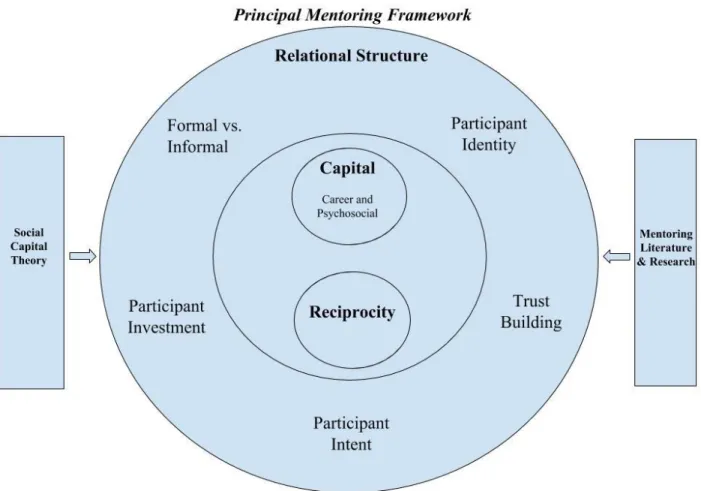
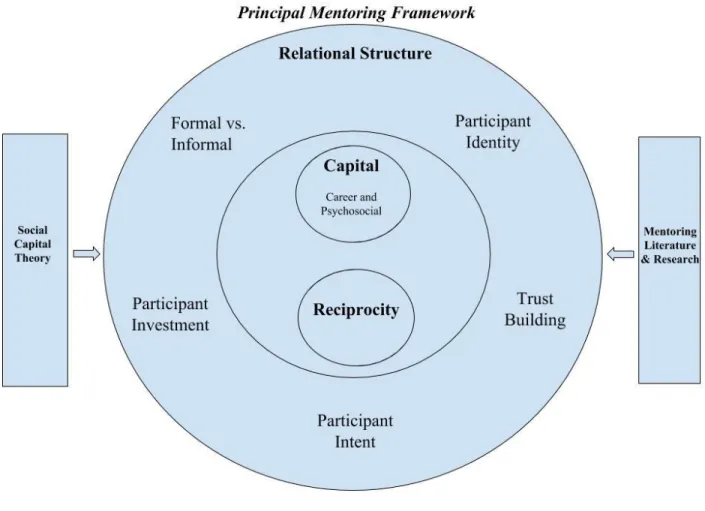
To provide the greatest opportunity to understand this study’s central phenomenon, mentor relationships and experiences, conceptual components from the tenets of Social Capital Theory and professional mentoring literature were merged to create the Principal Mentoring Framework. My conceptual framework was constructed using consistent themes found
throughout professional and educational mentoring in conjunction with social capital literature. Research suggests that mentoring relationships are influenced by building trust between
participants, participants’ personal level of investment and intent within mentorship (Bourdieu, 1986; Coleman, 1988; Daresh, 2004; Lin, 2001; Liou & Daly, 2014; Putnam, 2000), formal versus informal relationship (Allen, Eby, & Lentz, 2006; Alsbury & Hackmann, 2006; Bush & Chew, 1999; Clayton, Sanzo, & Myran, 2013; Eby & Lockwood, 2005; Ensher & Murphy, 1997; Henderson, 1985), and participant identity (Allen & Eby, 2004; Chandler, 1996; Ensher & Murphy; Henderson; Portillo, 2007; Ragins, 1997). Each of these factors influence the potential for the exchange of capital, reciprocity, and the quality of participant experiences. The
conceptual framework establishes the lens through which my research will be collected, analyzed, and presented using the units of analysis and themes grounded in literature.
Figure 1: Principal mentoring framework. Overview of Research Methodology
This research study applied qualitative research methods through the use of interview techniques. I used a phenomenological strategy to examine the experiences of my participants: novice principals and their identified mentors. A phenomenological approach highlighted the voices, experiences, events, and perspectives of participants (Merriam, 2002: Saldaña, 2011); thus, this strategy was directly aligned with the purpose of this research. In order to understand my phenomenon to the greatest extent possible, participants were purposely selected (Merriam, 2002). Selection of participants was influenced by mentoring literature, which noted the
importance of uniqueness of participant identity. Therefore, participant locality, gender,
the most representative perspective of novice principals. The study’s participants were required to have engaged in an active mentorship, functioning in their positions for a minimum of 6 months, and included novice principals (1 to 3 years) from any Illinois public elementary, middle or high school. In this study, I explored the perceptions of participants’ (mentee and mentor) experiences through in-depth, in-person, semi-structured interviews, which is the most utilized qualitative data collection strategy (Saldaña, 2011). I relied on data elicited by mentorship dyads through an investigation of participant perceptions of their relationship and how the relationship influenced their professional practice. The data was gathered, analyzed, and presented by themes through the lens of my conceptual framework.
Limitations
As with all research studies, limitations existed in the design and implementation of my proposed study (Krathwohl & Smith, 2005). One potential limitation was the use of interviews as my primary data collection method. Data collected from the participants were self-reported and based on their personal perceptions, emotions, experiences, and memories. Although those individual perceptions may be warranted, valued, and justified, the data presented consist of each individual’s sole voice. Additionally, as with all personal interviews, participants must be willing to share their experiences honestly and with integrity. I attempted to put all participants at ease; however, there was potential for someone to be unwilling to share their entire perspective and to be completely candid. This situation is possible as I interviewed principal mentoring dyads, of which some dyads included a principal and their direct supervisor or other central office administrator within his or her school district. Although the participants’ experiences and the formal descriptions within this dissertation were confidential, two mentoring relationships were
found to be strained due to varying factors, therefore potentially causing an unwillingness for a participants to share candidly and honestly.
In conjunction with the qualitative interviews, the source of the interviews and mentoring dyads was also a limitation of this proposed study. I attempted to locate mentoring pairs that represented the diverse nature of relationships and educational leaders in Illinois. Specifically, I intended to include principal dyads located in urban, suburban, and rural areas. Grounded in my conceptual framework, my hope was to find novice principal mentoring dyads that represented a range of ethnicities, gender compositions, and professional backgrounds. However, a diverse and representative participant sample was not found in terms of race and locality of school. Thus, a lack of participant diversity in mentoring dyads is a limitation of this study. Selection of
participants was purposeful in nature; however, it was dependent on their awareness of the study and the willingness of both the protégé and the mentor to volunteer their time. Additionally, if a novice principal did not have a positive mentoring experience, there is a chance they opted not to volunteer for this study.
As with any qualitative study, there was potential for researcher bias in my data analysis due to my personal worldview and experiences (Creswell, 2009). I was committed to the highest ethical standards and practices to ensure my data collection, coding, analysis, and findings accurately represented the sources from which they were gathered. I address in greater detail the credibility, trustworthiness, reliability, and validity of my data analysis and findings in Chapter 3. Finally, this study cannot be generalized to other mentoring participants and sites, since the qualitative findings were unique to the perceptions and experiences of the mentoring dyads represented in my study. Although this study provided insights to the relationship structures that
influence the type of resources exchanged and overall participant experiences, they are unique to the sample in this study.
Delimitations
Delimitations assist the research in narrowing the study in size and scope (Creswell, 2009). The sample of targeted participants in this study included novice public school principals and their identified mentors, within the confines of Illinois. The novice principal, within the first 3 years of their tenure in her/his first principalship, was working in an Illinois public school and participating in formal or informal mentorship for at least 4 months. Finally, the primary avenue to solicit participants was utilizing the working groups and networking of superintendents and other district level administrators throughout Illinois.
Definition of Terms
Capital. Capital is considered an investment of resources with expected returns (Lin, 2001; Portes, 1998). In this study, capital will include psychosocial and career function supports that are provided and internalized as a result of the mentoring relationship (Kram, 1983). Capital and resources are used interchangeably through this study’s research design and findings.
Formal mentorship. “Formal mentoring relationships develop with organizational assistance or intervention usually in the form of voluntary assignment or matching of mentors and protégés” (Ragins & Cotton, 1999, p. 529) and “are managed and endorsed by the
organization” (Bynum, 2015, p. 70). In this study, a formal mentorship is also called a formal dyad. A dyad a singularly composed relationship between a mentor and mentee.
Informal mentorship. “Informal mentoring relationships form by chance, without any rearranged schedule or agenda. They are less structured, spontaneous, self-directed and not recognized by the organization” (Bynum, 2015, p. 70). In this study, an informal mentorship is
also called an informal dyad. A dyad a singularly composed relationship between a mentor and mentee.
Mentee. A novice principal, in the first 3 years of his/her career, who is receiving mentoring support and guidance from an experienced professional. A mentee is the less
experienced professional and will be used interchangeably with protégé throughout this study. Mentor. A person dedicated to the developmental needs of another person by providing support, guidance, knowledge, and skills (Daresh, 2004). A mentor also may be identified as a coach, role model, counselor, or sponsor (Kram, 1985). A mentor in this study can be formally matched to a novice principal or informally identified by the protégé as their active and primary support.
Mentoring. A professional relationship in which a more experienced professional (Schechter, 2014) assists and supports a less experienced person to develop their skills and knowledge and enhance opportunities for professional and personal growth (Kram, 1985).
Novice principal. Any principal or school leader who is in the first 3 years of his or her initial principalship (Shoho & Barnett, 2010).
Reciprocity. Reciprocity is the notion of sharing capital and resources with an opportunity for exchange or return for each participant (Portes, 1998).
Social capital. Social capital is the ability to access resources from others within one’s relational network. Resources or capital can include information, influence, support, and competencies (Lin, 2001).
Summary
This chapter provided an introduction to my research study. A concise overview of the problem, purpose, and significance of this study were presented. Additionally, the chapter
included the research questions and conceptual framework used to guide the project, the research methodology, limitations, delimitations, and a definition of terms.
Following this chapter, Chapter 2 provides relevant research and literature imperative to the development and implementation of the study. There are multiple topics examined in Chapter 2: (a) an overview of principalship, (b) complexity and responsibilities of modern principal leadership, (c) professional mentoring literature, (d) literature in educational arenas, (e) principal mentoring, and (f) social capital and development of conceptual framework. The culmination of Chapter 2 is the development of my conceptual framework through conceptualizing mentoring scholarship with social capital theory.
In Chapter 3, this study’s processes and structure is presented through a discussion of my research design. This chapter includes the following components: research questions, description of the methodology, site and participant selection, data collection, data analysis procedures, and issues related reliability and validly.
Chapter 4 includes this study’s findings through my conceptual lens, Principal Mentoring Framework. The results from this study are presented by each research subquestion and then address the overarching research question. Chapter 4 highlights the results by organizing the data into multiple themes and subthemes.
In Chapter 5, an analysis and interpretation of this study’s findings by presenting the following sections: discussion, implications, and recommendations. The discussion is organized and presented through the units of my conceptual framework. Findings are connected to this study’s conceptual framework and prior research. Finally, the implications of this study’s results, and recommendations for policy, practice, and future research are addressed.
Chapter 2 Literature Review
This review of literature focuses on the complexity of the principalship and the
opportunity for the mentorship of novice principals as an approach to support their on-the-job development. First, a concise overview of the background, current complexities and
responsibilities, and current expectations of principal school leadership are highlighted. Second, a review of professional mentoring scholarship is coupled with educational related mentoring in the following areas: (a) academia, (b) teaching, and (c) the principalship. Next, a conceptual framework that pulls from professional mentoring literature and social capital theory is presented as a lens to analyze supportive principal mentoring dyads. Finally, deficiencies within prior principal mentoring research are addressed in conjunction with this research project. The Principalship
This section provides an overview of the principalship. A clear understanding of who becomes a school principal and the responsibilities associated with the role is warranted to justify the need for principal professional development. Specifically, I address the following issues: (a) why someone becomes principal, (b) the complexity of the role, (c) the pressures of principal and school accountability, (d) principal influence on student achievement, (e) an understanding of institutional changes, (f) modern school leadership frameworks, (g) balancing personal and professional life, and (h) principal attrition.
Why someone becomes a principal. Effective principals have a critical influence on the outcomes for both a school and its students; thus, understanding what type of person assumes the role of principal is essential to recruiting, developing, and sustaining effective principals. It is important to understand who becomes a principal and recognizing the trajectory of their career
path that ultimately resulted in their decision to lead a school (Farley-Ripple et al., 2012; McGough, 2003). A study of 23 veteran public school principals’ personal narratives examined how principals reflected upon their roles as leaders and the connections they made throughout their lifetimes (McGough, 2003). Principals’ reflections of childhood and professional
experiences noted multiple trends from their qualitative interview data. The study showed that the principals tended to follow four primary routes to the building leader role: (a) they directly came from a classroom or internship position; (b) they followed a traditional role of classroom teacher to assistant principal, and ultimately to principal; (c) they served in a teacher-leader position, most often as a department head, athletic director, or curriculum director; or (d) they left a leadership role in a non-educational setting or non-public school setting (McGough, 2003).
Why someone becomes principal. Principal career paths are also influenced by prior personal relationships. A qualitative study of 48 Delaware principals and assistant principals was conducted to examine administrators’ career decisions (Farley-Ripple et al., 2012). In several cases, administrators stated that they actively made a decision to apply for an open position; however, it was common for outside actors to either encourage the leader to apply or recommend them to the interview team. The Farley-Ripple et al. (2012) and McGough (2003) studies
demonstrated that, in both cases, influential relationships were leading contributors to a person’s ultimate decision to become a principal. Evidence from these studies suggested that personal relationships that developed early in the principals’ lives influenced their decisions to enter the profession (McGough). Specifically, some principals noted that positive experiences in their formal childhood education led them to eventually help others and give back to a system that provided them opportunities, while other educators may strive to become principal in order to make a meaningful difference, to help a large number of people, to support other teachers, to
ensure all students have an opportunity to learn, or to serve as the lead decision maker and ultimately find the best solution for kids (Villani, 2006). Regardless if their reason, it is important for principals to be self-aware of their prior experiences and understand that such experiences may have a direct link to their leadership practices (McGough). In order to fully conceptualize one’s motivations for the principalship, it is important to recognize that prior roles, recruitment, development, complexity of the role, unique organizational influences, professional relationships, and personal and family circumstances are all factors that may influence one’s career and why he or she chose to enter and exit the profession (Farley-Ripple et al.). Most importantly, Farley-Ripple et al. suggested researchers continue to assess the complexity of a principal’s role in order support their on-the-job development and effectiveness.
Complexity of responsibilities. The on-the-job development of principals, especially novice principals, is an opportunity to meet the challenges associated with the principalship. Research has highlighted the increasing complexity of a school leader’s role and noted that the challenges for new principals often began immediately. A qualitative case study of two novice principals noted the immediate need for newly hired principals to develop effective relationships with all stakeholders, understand their personal leadership strengths, routinize management related tasks, and know where to find support or resources (Armstrong, 2000). Immediately within the first few days on the job, a school leader may be confronted with unexpected staff resignations, incomplete construction projects, technology failures, inadequate student supplies, overcrowded classrooms, parent demands relative to student need, or any number of other scenarios (Villani, 2006). Although prior administrative experience is valuable, there are notable differences between the principalship and the other administrative roles. For example, a multi-year qualitative study of 62 novice principals found they noted key differences between the role
of a principal and the responsibilities of an assistant principal (Shoho & Barnett, 2010). Assistant principals often have specialized focus areas such as curriculum and instruction, building
operations, or student discipline, while a principal is general oversight of all matters pertaining to the school (Shoho & Barnett, 2010). Several principals in the Shoho and Barnett (2010) study had no idea “how big the principal’s sphere is” (p. 575) prior to entering their positions. The principalship requires a multifaceted skillset, a strong knowledge base, and includes numerous responsibilities. The principalship has shifted away from a focus on management to pedagogical and content expertise, understanding student needs, interpreting and using data, and working directly with teachers to improve their classroom practices (Hale & Moorman, 2003). Of all the pressures placed on this principal, none are more influential than expectations for student achievement.
Era of accountability. A mounting challenge that school principals continuously face is an emphasis on meeting or exceeding accountability measures, particularly with regard to expectations or requirements driven by state and federal legislation (Villani, 2006). Specifically, scholarship has noted an increase in accountability measures related to student achievement and overall school performance, resulting in additional pressures on the principalship (Crow, 2006; Duncan, Range, & Scherz, 2011; Levine, 2005). Over the past 15 years, the demands of the No Child Left Behind Act, a federal law that was passed in 2001, were a central cause for the added pressure on schools to raise student achievement (Crow, 2006; Weingartner, 2009). In 2009, Race to the Top (RttT) offered federal grants to states that included student performance measures using test scores in their principal and teacher evaluations systems (Carbaugh, Marzano, & Toth, 2015, p. 1), and the state of Illinois was awarded RttT funding in 2011. The
expectations for the modern school leader are unprecedented, as noted by DuFour and Marzano (2011):
Contemporary American educators confront the most daunting challenge in the history of public schooling in the United States: they are called upon to raise academic standards to the highest level in the history with common core standards . . . [and] . . . are to bring every student to these dramatically higher standards of achievement. (p. 5)
Continued federal oversight and legislation, which provides “undiminished governmental pressure for standards and accountability will most likely drive school reform in the second decade of the twenty-first century” (Leone et al., 2009, p. 88). With this in mind, it is the responsibility of a school leader remain current on all federal and state legislation and the implications for school practices, but more importantly, the principal must ensure that all stakeholders understand relevant polices and mandates (Leone et al., 2009). It is a principal’s responsibility to ensure their school is compliant and proactive, keeping apprised and ahead of the evolving requirements relative to policy, assessment, and other accountability areas (Leone et al.).
Increased principal accountability and pressure as a result of legislation demands an increase in student achievement, as measured through standardized testing (Crow, 2006). A recent survey of Illinois public school principals found over 50% of school leaders reported that student achievement accountability pressures added stress to their role (White & Agarwal, 2011). Furthermore, the recent passage of Illinois’ Performance Evaluation Reform Act (PERA), which requires schools to utilize student growth data in their teacher and principal evaluation systems, further demonstrates a growing trend to link student learning to the individual success of a teacher, principal, and school (White & Agarwal, 2011). Principals often deal with mounting criticism from the media, families, and politicians over the “failing” public school system (Crow, 2006). Mandatory state tests and unsatisfactory student achievement results have led some
districts to have principals “reassigned or fired where school scores have not improved, regardless of the population challenges or needs of the students” (Villani, 2006, p. 8). The increased attention on student achievement scores, particularly for underrepresented students, is not going away given the current educational environment (Leone et al., 2009). However, the passage of Every Student Succeeds Act through the reauthorization of Elementary and
Secondary Education Act does provide schools and states some flexibility with accountability measures (Klein, 2015). Although each state is still required to test students and analyze
subgroups’ achievement by students’ race, socio-economic status, and disability, states and local districts have the autonomy to decide their accountability measures and determine how to
support struggling schools with federal oversight (Klein, 2015).
Effect on student achievement. Although concerns over increasing accountability pressures relative to student achievement exist, principals influence student achievement within their schools, albeit indirectly. Effective principal leadership “is second only to classroom instruction among all school-related factors that contribute to what students learn at school” (Leithwood, Seashore Louis, Anderson, & Wahlstrom, 2004, p. 3). A meta-analysis of 69 research studies also concurred that effective school leadership is second only to teacher quality in terms of student learning (Marzano, Waters, & McNulty, 2005). Outstanding leadership and its positive influence on schools is also associated with schools with varying student and community needs. The Leithwood et al. (2004) report showed that effective principals who served in schools with difficult circumstances were able to have the greatest effect on student learning. There is no documented evidence of an ineffective leader turning around a struggling school or improving student learning (Leithwood et al.). The prior leadership experiences of principals can also influence student achievement: A comprehensive study of Illinois principals
found building leaders who previously served as assistant principals and earned advanced degrees at research-based institutions which offered doctoral degrees, also were more likely to lead schools associated with higher rates of student achievement (White & Agarwal, 2011).
Institutional and organizational changes over time. The role of a school principal has evolved, in part, due to changes in the students they serve and also the organizational structure of school systems (Levine, 2005). Crow (2006) argued the dramatic changes from a pre- to post-industrial society have radically changed the expectations for student learning and their preparation for college and careers. Specifically, principals are responsible for ensured that students are provided with the skillsets necessary to thrive in a post industrialized 21st century. According to Crow, post-industrial societies have shaped schools to value innovation, problem-solving, customization, and individuality, and are predicated on building strong relationships. Effective organizations have shifted away from individual leaders who lead from the top of an organizational chart to leaders who value collaborative and distributed decision-making processes (DuFour & Marzano, 2011).
These postindustrial values also intersect with changing student needs and demographics. The U.S. student population has seen dramatic demographic changes between 1995 and 2013. In 1995, 35% of students enrolled in American public schools identified as an ethnic minority, which included Hispanic, African American, Asian American, Native American, or Pacific Islander students (U.S. Department of Education, 2014). By 2013, students of color in American public schools comprised half of the overall student enrollments (U.S Department of Education, 2014). Building knowledge and capital within a diverse school setting requires a commitment from a school leader to employ effective strategies that address issues of a multi-cultural
will need training and development that offers culturally relative resources and language that teachers can use in classrooms (Leone et al., 2009). An emphasis on diversity, while likely imperfect, offers the hope of a rich and individualized student experience. A principal’s ability to foster a highly relational and individual student experiences has become more challenging as a result of the unique mobility, language, cultural, and socioeconomic needs of the student population (Crow, 2006). Given the growing variety of student needs, principals must provide the resources and training necessary for their staff to support all students, but particularly students of color and those living in poverty (Leone et al., 2009). Crow (2006) expands the meaning of student diversity to include socio-economic status, race, ethnicity, disabilities, immigrants, healthcare and other health related concerns, mobility, and the technology divide as factors that influence students’ success in schools.
The digital divide, in particular, is of growing concern in schools. For example, Crow (2006) and Leone et al. (2009) noted that as technology changes rapidly, not all student
populations have equitable access to new technology; thus, their lack of digital literacy becomes another disadvantage when they enter the school system. In light of the mounting challenges and changing student needs, effective school principals must remain student-centered by prioritizing their needs, listening to their opinions, and believing in their potential to achieve anything (Gurr, Drysdale, & Mulford, 2006). This mentality will guide a principal’s ability to address changing and individualized student needs while navigating the intense and increasing complexities of the role.
Modern leadership attributes. The term leadership and its association with the
principalship is critical to recognizing the importance of principal leadership. A comprehensive case study through the International Successful School Principal Project (ISSPP) studied 14
principals to identify leadership attributes necessary to be an effective leader and influence student learning (Gurr et al., 2006). Findings noted that the following attributes: (a)
understanding the values, norms, and traditions of the local community, school, and staff; (b) actively exhibiting personality traits such as empathy, honesty, and caring about others; (c) ability to communicate with all stakeholders; (d) valuing decision making and a vision that empowered others; (e) developing a school climate with built upon trust and support; and (f) viewing leadership through the lens of social justice (Gurr et al., 2006). Ultimately, effective leadership is dependent upon the principal’s ability to utilize the most appropriate strategy given the context of the situation (Gurr et al., 2006).
Additional conceptual frameworks attribute specific practices of a principal to highly effective leadership. Commonly associated attributes or practices of effective principals include focusing on people and making positive relationships their number one priority, engaging in self-reflection and seeking to improve their weaknesses, consistently having a positive attitude, hiring the best people and improving or removing ineffective staff, keeping student learning the focus, shifting away from standardized tests, knowing when to focus on behaviors or beliefs, and anticipating teacher, student, and community reactions (Whitaker, 2012). It is also imperative to recognize principals must learn effective practices and then apply them to their unique local context (Leithwood et al., 2004). Leithwood and colleagues conceptualized principal leadership in three overarching themes: setting directions, development people, and redesigning the
organization. They also argued there are no universal leadership styles. The principal as an individual, their prior life experiences, and the uniqueness of the context of their current role dictate their needs, which is why “we need to be developing leaders with large repertoires of practices and the capacity to choose from that repertoire as needed, not leaders trained in the
delivery of one ‘ideal’ set of practices” (Leithwood et al., 2004, p. 8). The next section addresses instructional leadership and is one of the most commonly discussed aspects of the principalship.
Leadership for learning. The importance and expectation of a principal exhibiting effective instructional leadership oversight is cited throughout scholarship (Brown & White, 2010; Carbaugh et al., 2015; Duncan et al., 2011; Gettys et al., 2010; Grubb & Flessa, 2006; Hale & Moorman, 2003; Shoho & Barnett, 2010; Weingartner, 2009). Augustine-Shaw (2015) argued a principal’s largest sphere of influence toward positively affecting student achievement is his or her ability to employ effective instructional learning practice. Leithwood et al. (2004) defined instructional leadership as “a focus on improvement of classroom practices of teachers as the direction for the school” (p. 4). In other words, instructional leadership is the principal’s ability to influence classroom teaching and learning practices (Augustine-Shaw; Gurr et al., 2006).
More recently, Knapp and colleagues (2003) developed a framework, Leadership for Learning, to describe how school leaders promote improved learning within their organizations. Leadership for learning expands beyond merely instructional leadership, which traditionally has focused on the act of teaching; in contrast, the leadership for learning framework addresses student learning, with an emphasis on effective teaching and learning practices that include, curriculum, instruction, and assessment. Leading for learning incorporates the following areas of action: (a) establishing a focus on learning, (b) building professional communities that value learning, (c) engaging external environments that matter for learning, (d) acting strategically and sharing leadership, and (e) creating coherence. This framework does not provide a step-by-step process, instead it suggests each area influences the other simultaneously as “the five areas of action are likely to have a mutually reinforcing effect on each other” (Knapp et al., p. 18).
Further research examining leadership for learning in practice throughout Atlanta Public Schools and New York City schools yielded results specific to how a principal improves the learning environment (Knapp, Copland, Honig, Plecki, & Portin, 2010). Specific themes emerged as essential to the conditions necessary for school-wide instructional improvements: (a) school goals focus on quality and equity of instruction; (b) collaborative work at all levels of the
organization dedicated to teaching and learning; (c) expand the meaning of instructional leader to include a focus on activities that include inquiry and evidence while establishing accountability systems for all staff; and (d) provide time for building leaders to meet, problem-solve, and form effective relationships (Knapp et al., 2010). Although leadership for learning is a prominent framework for principal leadership, challenges do exist.
A principal’s ability to serve as a catalyst with learning strategies in the classroom is one of the biggest challenges a principal faces (Shoho & Barnett, 2010). Augustine-Shaw (2015) highlighted the difficulty of finding the time and dedication necessary to effectively provide classroom teaching and learning supports to teachers. Though important, the value of supervisory feedback, including through the formal evaluation process, is only one area within the scope of leadership for learning (Gurr et al., 2006). According to Gurr et al.’s (2006) findings, leadership aspects such as curriculum and assessment design, instructional pedagogy, professional
development through internal and other external professional organizations all influence the instruction of classroom teachers. Within the realm of instructional leadership, Shoho and
Barnett’s (2010) study found that secondary principals felt less prepared to lead given the variety of disciplinary offerings at the high school level. Shoho and Barnett’s research included a
participant sample that was disproportionately female and at the elementary level. How this unique sample influenced the findings is unknown. Additionally, this study did not utilize a
theoretical framework in its research design nor implement follow-up interviews with
participants to further investigate or valid themes. Both issues are recommendations critical to effective research design and implement in this research proposal.
Ultimately, a principal must be “competent and act as a bridge of knowledge to provide teachers with professional learning opportunities in educational trends and technology, changes in the law, and changes in policy” (Leone et al., 2009, p. 90). Leone et al. (2009) expanded the role of instructional leader to include all factors that affect instruction, including legislation and policy. Through the literature is evident that the role of instructional leader implies that a principal is the central teacher of the school building and ultimately has the immense
responsibility of creating a learning environment dedicated to increasing the professional capital of the staff (Hargreaves & Fullan, 2012).
Leadership and learning has also developed in conjunction with other leadership
philosophies. Transformational leadership is model in which school leaders lead by example and utilize collaboration and inspiration to motivate people within the organization (Burns, 2003). A national mix-methods study of 24 elementary, middle, and high schools examined the role of instructional and transformational leadership practices as a catalyst for school improvement (Marks & Printy, 2003). The study coupled instructional leadership (instructional and supervision) with transformational leadership (use of ideas, influence, collaboration, consideration of individuals to still school-wide change) to develop integrated leadership.
Findings from this study articulated the importance of a principal’s ability to distribute and share leadership practices with teachers. Overall, “teachers have both the desire and expertise to lead . . . and the research noted examples of teacher leadership have a direct influence on school
Additionally, contemporary principals cannot lead instructionally or make improvements within their curriculum without addressing the role and use of technology (Leone et al., 2009). Given the role of technology in the classroom, school leaders have an enormous task of
developing teachers’ technological literacy and preparing classrooms for the trend of ubiquitous learning opportunities. Finally, principals noted concerns in understanding special education policy and managing a special education program (Shoho & Barnett, 2010).
Management. Responsibilities as learning leader are often a visible aspect of the role of a school leader, but a complexity of the principalship that tends to be overlooked is the
management of personnel and school operations. Shoho and Barnett (2010) found that principals were often unware of the process or had difficulties developing a budget. Specifically, school leaders struggled to allocate resources and finances in line with local, state, and federal policy. Shoho and Barnett’s findings correlate with other research that noted challenges specific to school personnel. The research of Farley-Ripple and colleagues (2012) yielded a confirmation from principals that working with adults is challenging, and that challenge was often a reason a leader elected to remain in the position, find alternative employment, or leave the profession entirely. The findings suggested principals’ relationships with their teachers, central office staff, and board members had a larger influence on their career choices than stress or the overall workload.
Balancing stress, emotion, and time demands. In addition to the complexities presented by learning leadership and organizational management, the stress and workload of the
principalship is well documented throughout the literature. A mixed-methods study of 40 superintendents and college deans found a direct connection between high levels of stress, inability to cope, and challenging relationships and administrator turnover (Metzger, 2003). This
study was limited in scope in that it only included urban and suburban schools, it did not include rural or small schools in its participant sample. Further research is necessary to understand if these findings apply to administrators in all school settings.
Novice principals, especially those with young children, reported struggling to maintain a work-life balance (Farley-Ripple et al., 2012; Shoho & Barnett, 2010). Shoho and Barnett (2010) noted, “it was readily apparent that being single and having no kids made it easier for new principals to fully engage in their job without any outside concerns for neglecting other commitments” (p. 578). Thus, it is naïve to argue or conclude that the role of principal is only challenging for someone who has children. Additional factors that contributed to significant stress for school leaders included long work commutes and spending time toward completing an advanced degree (Shoho & Barnett). Additionally, Farley and colleagues’(2012) research found ill family members and/or spouses weighed heavily on a principal’s ability to fulfill the multitude of responsibilities for which they are accountable. In fact, Farley et al. noted it was a
combination of the aforementioned factors that drove principals into other careers or into
different education positions. Emotionally charged and invisible stresses are exhibited through a principal working in isolation, fears of incompetency, and personally dealing with moral and ethical issues (Villani, 2006). On-the-job development provides opportunities for principals to seek advice relative to the law and allow one to reflect upon their beliefs and the situation presented (Villani, 2006). Undoubtedly, the emotional and physical stress of the principalship is cause for concern, especially if schools are in need of highly effective principals who persist and continue to grow their professional capital.
Turnover. The multitude of challenges facing principals can lead to turnover (Gates et al., 2006). A longitudinal study focusing on principal mobility in Illinois and North Carolina
from 1987-1998 to 2000-2001 found that 20% of novice principals leave the position within their first 6 years on the job (Gates et al., 2006). Additionally, principals in schools where the majority of the student body is made up of students of color were more likely to leave the school.
However, principals who identified as the same race as the majority of the student body were more often to stay in their position (Gates et al., 2006). A North Carolina study analyzed 12 years of public data to examine the effect of principal turnover on student achievement and consistently found a decrease in student achievement scores for at least 2 years following a principal’s departure (Miller, 2013). Principal turnover can be associated with varying factors, including the school leader’s compensation and benefits (Villani, 2006), school culture, central office support, and ability to enact organizational change (White et al., 2011).
Leadership preparation program quality. Principal turnover and/or principals feeling ill-prepared for their role has often caused scrutiny of university-based leadership preparation programs (Hale & Moorman, 2003). As the complexity of the principalship as morphed into a central focus on learning leadership and accountability pressures relative to student achievement scores, Hale and Moorman (2003) argued some preparation programs have not necessarily changed their training practices. The principals studied noted inconsistencies between the content taught by some university preparation programs and its overall relevance to the role of school leader (Duncan et al., 2011; Levine, 2005). A qualitative study of six Missouri principals participating in district and state mentoring programs found novice principals reported that their university coursework often focused on managerial related tasks, rather than instructional development strategies which provide greater opportunities for student achievement (Gettys, Martin, & Bigby, 2010).
In reality, even highly effective principal preparation programs can only provide aspiring leaders with entry-level knowledge and skills and are unable to prepare them for every challenge they may experience. A case study exploring the experiences of 18 educational practitioners as they progressed through a principal preparation program noted that “students who enroll without clearly defined personal reasons and later discover that the program fails to provide meaningful professional application for them, learner disengagement and frustration can occur” (Browne-Ferrigno, 2003, p. 497). Many graduate students who acquire their principal license often do not enter into an administrative position until several years later, if at all (Browne-Ferrigno, 2003). Educators in preparation programs often fail to recognize their need for support as they move through future phases of their career (Browne-Ferrigno, 2003). Principal development “should be an on-going process embedded throughout the careers of educational leaders” (Duncan et al., 2011, p. 16). In addition, a quantitative study of 106 Wyoming principals asserted professional support for principals at the local, district, or state levels, school districts should seek to leverage partnerships with universities to further the training of principals (Duncan et al., 2011) This study was unique in that most participants lead small, rural schools throughout Wyoming to examine how university preparation programs could further prepare school leaders for the challenges they face by partnering current school leaders. An opportunity to continue a principal’s on-the-job professional growth is the influence of a mentor.
The need for mentors. A description of the need and practicality for principal mentoring and induction is found throughout scholarship, as a mechanism to support novice principals as they learn to negotiate through the demands and responsibilities of this position. A mixed-methods mentoring study of eight Illinois principals found protégés perceived the importance of instilling confidence to deal with the challenge of their responsibilities as invaluable in their
professional experience (Swift, 2004). Although the growing pressures of principal and leader turnover have stimulated a need for principal mentoring, relatively little research exits (Brown, 2005). School districts need additional research to establish what aspects of principal mentoring practices are effective in supporting novice principals in the context of their local organization. Professional Mentoring
Research pertaining to mentoring is often limited to corporate or business related fields (Daresh, 2004). Yet, findings from these fields help to develop a trend in consistent patterns of mentoring scholarship. This section presents relevant research pertaining to professional mentoring and the dynamics that affect the relationship between mentor and protégé.
Specifically, the relevant literature pertaining to professional mentoring provides an overview of (a) Kram’s (1985) conceptual model of mentoring, (b) the influence of participant identity on outcomes, (c) the influence of formal and informal programs, and (d) the possibility for positive and negative participant outcomes.
Kram’s conceptual model. Scholarship dedicated to mentoring as a form of professional development, training, and career advancement outside of education, especially in the corporate or private sector, is abundant. The most widely cited and relevant framework on professional mentoring was developed by Kram (1985), through her in-depth study of 18 junior and senior corporate relationship pairs. Although mentoring literature within the private sector is prevalent, some inconsistencies existed, and no universal definition permeates mentoring scholarship (Kram). In fact, Kram noted the use of the word mentor was detrimental to the study; instead, she utilized development relationship in place of mentor throughout the study. Kram’s significant contribution to the literature is the development of two distinct mentoring support functions: career and psychosocial. According to Kram, “career functions are those aspects of the
relationship that enhance career advancement. Psychosocial functions are those aspects of the relationship that enhance sense of competence, identity, and effectiveness in a professional role” (p. 23). Components of career functions include sponsorship, exposure-and-visibility, coaching, protection, and challenging assignments while psychosocial functions include role modeling acceptance-and-confirmation, counseling, and friendship. Allen et al. (2004) conducted a meta-analysis of mentoring literature and found Kram’s behaviors of psychosocial mentoring, such as friendship, confirmation, acceptance, and counseling, were linked to protégés’ higher levels of mentor satisfaction as compared to career mentoring. However, the analysis also noted that career-oriented and psychosocial mentoring equally influenced job and career satisfaction, consistent with results reported by Ensher and Murphy (1997). The Ensher and Murphy study found both components of Kram’s conceptual model were integral to a successful mentorship. Empirical findings of career and psychosocial support are prevalent within professional mentoring literature and will be discussed throughout this paper.
Kram’s (1985) mentoring framework was expanded by replacing the traditional single dyadic relationship with the notion of a multiple dyadic relationship (Higgins & Kram, 2001). Known as the developmental network perspective and derived from social network and
developmental network theories, Higgins and Kram (2001) suggested multiple relationships can influence a protégé’s professional development. The conceptual model is grounded in the strength of an informal diverse network of relationships developed through associations in the community, school, or organizational setting. The developmental network perspective
encouraged protégés to identity multiple people who influenced their professional growth and development, including relationships with professionals outside of the organization. This
mentoring model also focused on reciprocal learning within the relationship, rather than the learning of only the novice.
Kram’s (1983) work also yielded developmental phases of a mentoring relationship. Unique phases within the relationship include the following: initiation (six months to a year as the relationship begins), cultivation (2-5 years and is the time most career and psychosocial functions are exchanged), separation (6 months to 2 years after a significant change in the relationship), and redefinition (relationship ends or becomes peer-like). The mentoring phases and functions established by Kram are essential findings within the literature and will influence the development of my conceptual framework and future research methods.
Relational components. The relational aspect between a protégé and mentor is
fundamental to the mentorship. Literature in this section establishes how professional mentoring experiences are influenced by the identity of participants, formal or informal structures in place, and overall outcomes of their mentorships.
Participant identity influences the relationship. The uniqueness of the mentor-protégé relationship and how the identity of each actor influences the development of the relationship are prominent throughout mentoring literature. A quantitative study involving the perceptions of 249 mentors from accounting-related occupations examined how mentor and protégé characteristics and gender influence the relationship (Allen & Eby, 2004). This study is unique within the literature in that it focused specifically on mentor perspectives, rather than those of the protégés (Allen & Eby, 2004). Findings suggested male mentors offered more career-oriented mentoring to protégés compared to female mentors, who primarily focused on psychosocial mentoring functions (Allen & Eby, 2004). Mentors, both male and female, also tended to provide more psychosocial mentoring to female protégés as compared to male protégés. Ensher and Murphy’s