Process development of co-production of synthetic
natural gas (Green SNG) and Fischer-Tropsch diesel
(Processutveckling av samtidig produktion av syntetisk naturgas
(grön SNG) och Fischer-Tropsch diesel)
Matteo Lualdi, Magali Boutonnet, Sven Järås
”Catalyzing energygas development
for sustainable solutions”
Svenskt Gastekniskt Center/Swedish Gas Technology Centre Scheelegatan 3
SE-211 28 MALMÖ +46 40 6800760
Om SGC
SGC är ett spjutspetsföretag inom hållbar utveckling med ett nationellt uppdrag. Vi arbetar under devisen”Catalyzing energy gas development for sustainable solutions”. Vi samord-nar branschgemensam utveckling kring framställning, distribution och användning av energigaser och sprider kunskap om energigaser. Fokus ligger på förnybara gaser från rötning och förgasning. Tillsammans med företag och med Energimyndigheten och dess kollektivforskningsprogram Energigastekniskt utvecklingsprogramutvecklar vi nya möjlig-heter för energigaserna att bidra till ett hållbart samhälle. Tillsammans med våra program-råd inomRötning,Förgasning och bränslesyntes,Distribution och lagring,Kraft/Värme
ochGasformiga drivmedelidentifierar vi frågeställningar av branschgemensamt intresse att genomföra forsknings-, utvecklings- och/eller demonstrationsprojekt kring. Beslut om eventuell statlig medfinansiering från Energimyndigheten fattas av den externa Besluts-nämnden inom ramen för kollektivforskningsprogrammet som f.n. löper under tiden 090401–130331.
Resultaten från projekt drivna av SGC publiceras i en särskild rapportserie – SGC Rap-port. Rapporterna kan laddas ned från hemsidan –www.sgc.se. Det är också möjligt att prenumerera på de tryckta rapporterna. SGC svarar för utgivningen av rapporterna medan rapportförfattarna svarar för rapporternas innehåll.
SGC ger också ut faktabroschyrer kring olika aspekter av energigasers framställning, distribution och användning. Broschyrer kan köpas via SGC:s kansli.
SGC har sedan starten 1990 sitt säte i Malmö. Vi ägs av Eon Gas Sverige AB, Energi-gas Sverige, SwedeEnergi-gas AB, Göteborg Energi AB, Lunds Energikoncernen AB (publ) och Öresundskraft AB.
Finansiering av det här projektet
Göteborg Energi AB, E. ON Gasification Development AB, Öresundskraft AB, CORTUS AB, Scandinavian Biogas Fuels AB, Perstorp Bioproducts AB och SGC via Energimyndig-heten.
Malmö 2013
Martin Ragnar
Swedish Gas Technology Centre, SGC
About SGC
SGC is a leading-edge company within the field of sustainable development having a na-tional Swedish assignment. We work under the vision of “Catalyzing energy gas develop-ment for sustainable solutions”. We co-ordinate technical development including manufac-ture, distribution and utilization of energy gases and spread knowledge on energy gases. Focus is on renewable gases from anaerobic digestion and gasification. Together with private companies and the Swedish Energy Agency and its frame programDevelopment
program for energy gas technologywe develop new solutions where the energy gases
could provide benefits for a sustainable society. Together with our program committees withinAnaerobic digestion,Gasification and fuel synthesis,Distribution and storage, Pow-er/HeatandGaseous fuelswe identify issues of joint interest for the industry to build common research, development and/or demonstrations projects around. Decisions on any financial support from the Swedish Energy Agency are made by the external
Beslutsnämnden within the framework of the current 090401–130331 program. Results from the SGC projects are published in a report series –SGC Rapport. The reports may be downloaded from our website –www.sgc.se. It is also possible to sub-scribe to the printed reports. SGC is responsible for publishing the reports, whereas the authors are responsible for their content.
SGC also publishes fact brochures and the results from our research projects in the report seriesSGC Rapport. Brochures may be purchased from the website.
SGC is since its start in 1990 located in Malmö. We are owned by Eon Gas Sverige AB, Energigas Sverige, Swedegas AB, Göteborg Energi AB, Lunds Energikoncernen AB (publ) and Öresundskraft AB.
Financing of this project
This project has been financed by Göteborg Energi AB, E.ON Gasification Development AB, Öresundskraft AB, CORTUS AB, Scandinavian Biogas Fuels AB, Perstorp Bio-products AB and SGC through the Swedish Energy Agency.
Malmö, Sweden 2013
Martin Ragnar
Förord
Till projektet med titel ”Processutveckling av samtidig produktion av syntetisk na-turgas (grön SNG) och Fischer-Tropsch diesel” har följande referensgrupp knutits: Staffan Karlsson, Jörgen Held, SGC (programansvarig)
Ingemar Gunnarsson, Göteborg Energi AB
Owe Jönsson, Anders Molin, EON Gas Sverige AB Jesper Baaring, Öresundskraft AB
Rolf Ljunggren CORTUS AB
Anders Hultgren, Perstorp Bioproducts AB Sören Eriksson, Preem AB (kortare tid)
Projektet har bedrivits som ett doktorandarbete med civ. ing. Matteo Lualdi som doktorand. Handledare har varit docent Magali Boutonnet och professor Sven Jä-rås. Projektet har bedrivits under tiden 2008-01-01 – 2012-09-15.
För en mer detaljerad rapport se Matteo Lualdis doktorsavhandling:
Matteo Lualdi, ”Fischer-Tropsch synthesis over Cobalt-based catalysts for BTL applications”, KTH, Doctoral Thesis in Chemical Engineering, Sept 2012.
Foreword
The following reference group has been created for the project titled “Process de-velopment of co-production of synthetic natural gas and Fischer-Tropsch diesel”: Staffan Karlsson, Jörgen Held, SGC (program responsible)
Ingemar Gunnarsson, Göteborg Energi AB
Owe Jönsson, Anders Molin, EON Gas Sverige AB Jesper Baaring, Öresunds Kraft AB
Rolf Ljunggren CORTUS AB
Anders Hultgren, Perstorp Bioproducts AB Sören Eriksson, Preem AB (for a short period)
The project has been carried out as a PhD project with MSc. Matteo Lualdi as PhD candidate. Supervisors were Ass. Professor Magali Boutonnet and Professor Sven Järås.
The project has been carried out during the period 2008-01-01 - 2012-09-15. For a more detailed report, see Matteo Lualdi´s Doctoral Thesis:
Matteo Lualdi, ”Fischer-Tropsch synthesis over Cobalt-based catalysts for BTL applications”, KTH, Doctoral Thesis in Chemical Engineering, Sept 2012.
Summary
The present study focuses on methanation and the Fischer-Tropsch synthesis (FTS) which are technologies that allow converting synthesis gas, a mixture of CO and H2, into fuels. This technology has great potential for producing synthetic fuels
from renewable sources, such as biomass, after its thermochemical conversion (gasification) into synthesis gas. In the methanation reaction, the synthesis gas is converted into methane and short-chain gaseous hydrocarbons while in the FTS a broad spectrum of products are formed, ranging from short-chain gaseous hydro-carbons (mostly methane) to very long ones (waxes).
The combination of these two processes can increase the energy efficiency and plant economy, since during FTS gaseous products are usually considered as a loss and these hydrocarbons are usually recycled to a reformer to be converted back into CO and H2, while in this case they become desired products.
For the FTS, different cobalt-based catalysts have been tested and the effects of process parameters, such as a low H2/CO ratio, typical of a biomass-derived
syn-thesis gas, and water partial pressure have been studied.
Different catalysts for the methanation reaction were tested, with synthesis gas derived from biomass, focusing on the catalytic properties (activity, selectivity and catalyst life) and identifying the main deactivation causes as functions of operating conditions (temperature, pressure and composition); carbon formation was a focus of catalyst deactivation behavior.
Sammanfattning på svenska
Denna rapport avser ett projekt för samtidig produktion av syntetisk naturgas (green SNG) och Fischer-Tropsch-bränslen. Projektet bygger på att med utgångs-punkt från syntesgas (CO + H2från förgasad biomassa) framställa SNG och
synte-tisk diesel i Sverige. Användningen av SNG utgör ungefär drygt 20% av konsum-tionen av totala SNG plus diesel i Sverige. En studie av ECN i Holland har visat att för Holland kan effektiviteten öka med mer än 25% om SNG och diesel framställs i samma process jämfört med i två separata processer. Skillnaden mellan Holland och Sverige är andelen SNG av summan SNG + diesel som är drygt 20% för Sve-rige. Med ett metaniseringssteg direkt efter ett Fischer-Tropsch-steg kan den svenska marknadskvoten erhållas. I ett metaniseringssteg omvandlas CO och H2
till metan och gasformiga korta kolkedjor medan i ett FT-steg omvandlas syntes-gasen till ett brett spektrum av kolväten. I ett FT-steg kan man således erhålla allt från metan (CH4) till vaxer (långa kolkedjor). Vaxerna kan sedan i ett separat steg
hydrokrackas till diesel. I en separat FT-process betraktas de gasformiga produk-terna som förlust och recirkuleras därför normalt till en reformer för att göra mer CO och H2. Men om FT-processen följs direkt av ett metaniseringssteg kan
såle-des en mer än 25%-ig effektivisering erhållas.
I FT-processen har Co-baserade katalysatorer studerats. Processparametrar såsom en låg H2/CO-kvot (erhålls normalt från förgasning av biomassa),
vattentill-satser och olika specifika flöden har också studerats. Speciellt har en blandning av vattengasskiftkatalysator (WGS) och FT-katalysator studerats för att följa det in-terna vattengasskiftet (CO + H2O → CO2+ H2). Med intern WGS kan lägre H2
/CO-kvoter användas utan ett separat WGS-steg. Slutsatsen är att för Sverige kan den svenska marknadskvoten för SNG/(SNG + diesel) uppfyllas. En mindre ökning av SNG kan tillgodoses med processjusteringar medan en större SNG-andel kräver ett separat parallellt SNG-steg.
Vidare har metaniseringskatalysatorer (Ni) studerats. Aktivitet, selektivitet och katalysatorlivslängd har undersökts. Speciellt har deaktiveringsförloppet studerats. Med tiden deaktiveras katalysatorn. Orsakerna till detta är olika för olika bärarma-terial. Processparametrar som temperatur, tryck och gassammansättning har följts. Två typer av deaktivering kunde visas; dels agglomerering av den aktiva fasen till större kristalliter, dels kolbildning (olika typer av kol).
Som en slutlig sammanfattning har en kombination av en Co-baserad FT-katalysator och en Ni/TiO2-baserad metaniseringskatalysator visat potential för en
effektiv SNG- och dieselproduktion anpassad för svenska förhållanden. De stude-rade katalysatorerna har utvecklats av Kemisk Teknologi, KTH, inom ramen för projektet.
Innehåll
1. Background ... 8
2. Experimental ... 10
3. Results and discussion... 12
4. Conclusions... 25
5. Acknowledgements ... 27
6. Literature ... 28
1. Background
Depletion of fossil energy sources is one of the important challenges that mankind will have to face in the coming years. Oil in particular, which has been the most important energy source in the 20th century, is expected to reach its production peak in the next few years, if it has not already been reached [1]. Furthermore, awareness of environmental issues caused by fossil fuel utilization has increased with the years. In fact, the use of fossil fuel through combustion is causing global and local environmental issues: on a global scale, the climate change resulting from anthropogenic greenhouse gas emissions (primarily CO2) and, at local level,
poisonous emissions such as SO2, NOx and particulates. Therefore, an increasing
energy demand, which would cause a fossil-fuel supply limitation with large eco-nomic impact, and the environmental problems are both driving forces for actions towards a more sustainable energy system. These actions include rationalization of energy consumption, increasing energy efficiency, use of lower carbon-content fuels (e.g. natural gas), CO2capture and storage, which could allow for the use of
more abundant resources such as coal, and the use of renewable energy sources. Moreover, focusing the attention on energy consumption in the transportation sec-tor, biomass and natural gas can play a role in the reduction of the oil share. No other renewable source but biomass can, at the moment, be directly utilized for this sector. These two issues make the conversion of biomass to fuels (liquid and gaseous) interesting processes.
The FTS is a polymerization reaction that produces a broad spectrum of prod-ucts ranging from short-chain hydrocarbons (HC) such as methane to long chains such as waxes. The general reaction is as follows:
CO + 2H2”-CH2-” + H2O (eq. 1)
The desired products of the FTS are hard waxes that would subsequently be converted into diesel fuel. The gaseous HC are usually considered a loss and are recycled to a reformer to be converted back into synthesis gas.
Moreover, according to a study performed by ECN [1], a more economical solu-tion is to couple the producsolu-tion of synthetic diesel (via FTS) and synthetic natural gas (SNG) according to the so called “integrated co-production concept” in which the synthesis gas produced from a gasifier is fed, after conditioning and cleaning, to a FT reactor followed by a methanation reactor, as shown in Fig. 1.
Figure 1. Integrated co-production concept [1].
The main advantage of the concept is that the off-gases from the FT reactor, composed of unreacted synthesis gas and the short-chain hydrocarbons produced in the synthesis, are not recycled to be converted back into synthesis gas but they become desired products. The difference between the ECN study and this study is mainly the Swedish market situation. Sweden consumes much less natural gas than Holland. This project has therefore focused on this difference.
Considering the Swedish energy market, in which the natural gas consumption is about 12 TWh/y and the diesel consumption around 47 TWh/y (varying slightly over the year), a conventional Fischer-Tropsch catalyst produces a ratio of gase-ous HCs to liquid fuels resembling that of the Swedish market with about 22% C1
-C4 HCs (energy based). If a different ratio is desired an extra methanation reactor
is required.
THE OBJECTIVE OF THIS WORK is to optimize the SNG and diesel production in Sweden (from synthesis gas) through studying the effects of catalysts and pro-cess parameters. This means specially to study the low-temperature Fischer-Tropsch reaction parameters and their effect on product distribution and ratio be-tween gaseous and wax products. The project also focuses on the catalyst ageing effects in the methanation step. More in detail, the work concerns Co-based cata-lysts used with a low H2/CO-ratio syngas, typical of a biomass-derived syngas.
Since water is the main product of the FTS and since cobalt catalysts have very poor water-gas shift (WGS) activity, the possibility of the direct use of H2-poor
syn-gas has been investigated by mechanically mixing a copper-based WGS catalyst and a cobalt-based FT catalyst in order to carry out internal shifting. This centers on the importance of water on both activity and selectivity to gaseous HCs as well as waxes. By performing internal shifting in the FT catalyst bed a separate WGS unit can be avoided increasing the efficiency of the process and reducing the in-vestment costs.
Moreover, as concerns methanation over nickel-based catalysts, the work has been focused on the catalytic properties of methanation catalysts (activity, selec-tivity and especially catalyst life), identifying the main deactivation causes and the effects of operating conditions (temperature and reactant pressure) on catalyst deactivation, especially on carbon formation. Catalyst stability and life time are crucial factors for plant economy.
2. Experimental
Catalyst preparation FT catalyst
The catalyst used in this study for Fischer-Tropsch synthesis consists of 12 wt. %
Co supported on narrow-pore γ-Al2O3. The support was chosen since alumina is
one of the most commercially used supports with high hydrothermal stability. The phases active for FT synthesis and used industrially are Fe and Co. The choice of Co was related to the fact that it can ensure higher conversion per pass compared to Fe.
Also, for comparison, as an example of the possibilities of catalyst development, a novel support was used to prepare a FT catalyst. The support used was SBA-15, a mesostructured support characterized by high hydrothermal stability and uniform pore size distribution.
WGS catalyst
A Cu-based water-gas shift catalyst was also prepared. A co-precipitated 30wt%Cu/30wt%ZnO/Al2O3 catalyst was prepared according to ref. [2]. Cu was
chosen since it is the most used active phase for WGS at temperatures close to the ones of FT.
Methanation catalyst
Titania-supported and γ-alumina-supported nickel catalysts were prepared and
tested in the methanation reaction. The Ni loading used for these catalysts was 20%, which is a typical value for a commercial catalyst. Just as for the FT catalyst, alumina was chosen as support because of its high hydrothermal stability and be-cause the commercial methanation catalyst, produced by Topsøe, uses the same support type. Titania was instead chosen to increase the metal-support interaction as a means to prevent active-phase sintering.
Fischer-Tropsch synthesis
The Fischer-Tropsch (FT) synthesis was carried out in a down-flow stainless-steel fixed-bed reactor (i.d. 9 mm) with a loading of about 1 g Co catalyst (pellet size: 53
- 90 μm) mixed in different proportions with the WGS catalyst (pellet size: 53 - 90 μm) and diluted with 5 g SiC (average pellet size: 88 μm), resulting in a bed length
of ~5-7 cm. The small pellet size used for the Co catalyst assures the absence of any mass-transfer limitations on the observed Co-catalyst-time yields. The differ-ent mechanical mixtures investigated were 0WGS-100FT, 15WGS-85FT, 33WGS-67FT and 50WGS-50FT, where the figures indicate wt.% of catalyst in the mixture.
Prior to reaction, the Co-catalyst (or catalyst mixture) was activated in situ in pure H2(200 Ncm3/gCo cat, min) at atmospheric pressure at 493 K for 2 h (heating
rate: 5 K/min). After activation, the reactor was cooled to 443 K and then flushed with He before increasing the pressure to the desired level. Then, the feed was switched to syngas, containing 3% N2 as internal standard. Subsequently, the
temperature was slowly increased to 483 K (rate = 0.15 K/min). The initial gas hourly space velocity (GHSV) was about 8200 Ncm3/gCo cat, h (period A) and held
for approximately 24 h in order to reach a (pseudo) steady state condition. Then, the GHSV was lowered to ~1700-3300 Ncm3/g
Co cat, h (period B) in order to
in-crease the CO conversion and held for another 24 h.
The heavy HCs and most of the water were condensed in two consecutive traps kept at 393 K and room temperature, respectively. The product gases leaving the traps were depressurized and analyzed on-line by means of a gas chromatograph (GC) Agilent 6890 equipped with a TCD and a flame ionization detector (FID). H2,
N2, CO, CH4and CO2were separated by a Carbosieve II packed column and
ana-lyzed on the TCD. C1 – C6 products were separated by an alumina-plot column
and quantified on the FID allowing for determination of the C5+ selectivity (SC5+).
The CO2-free SC5+ (i.e., SC5+if excluding CO2from the C-atom balance) is defined
as follows:
The reported HC selectivities are all C-atom based and CO2 free. Aqueous
products were analyzed off-line with a GC Agilent 6890 equipped with a FID and a capillary column (Hewlett-Packard HP-5). An internal standard (CH3CN) was
add-ed to the aqueous phase prior to the injection.
The H2/CO usage ratio (u.r.) is used as a measure of the relative WGS activity
and defined as follows:
The lower the usage ratio, the higher the relative WGS activity. If all water pro-duced in the FT reaction is used in WGS, the usage ratio is 0.5. For a process to be able to reach 100% syngas conversion (theoretically), the inlet H2/CO ratio
must equal the H2/CO usage ratio.
Methanation Synthesis
The methanation synthesis was carried out in the same equipment as for the FT synthesis tests. The catalyst was mixed with SiC in order to dilute the catalyst. The catalyst was reduced in situ with a flow rate of 100 Nml/min of pure H2. During the
reduction the temperature was raised from ambient to 773 K at a rate of 5 K/min and subsequently kept constant during 9 h at 773 K. The procedure varied de-pending on the purpose of the experiment. Small amounts of catalyst (approxi-mately 0.02 g and 1 cm bed) and large syngas flows (approxi(approxi-mately 100 Nml/min), which were introduced into the reactor in a single step, were used to determine the initial activities in the different experiments. Making use of these operating condi-tions, the CO conversion level was low, and so the heat of reaction was easily
re-) 2 ( 4 3 2 1 ) 2 ( 5 CO free 100 ( C C C C )CO free C S S S S S 100 2 1 . 2 3 . .r SC1 SC2 C4 SC5 SCO2 u
moved by the aluminum jacketing and the large unreacted flow. The temperature did not increase significantly during the starting up of the operation (approximately 1 K). Unfortunately, no further characterization of the catalyst was possible with such small quantities, so a different procedure was performed if characterization was needed. A minimum of 0.1 g of catalyst was necessary for further characteri-zation. When these larger amounts of catalyst were used, it was necessary to start the experiments with a stepwise increase of the syngas flow up to the desired level in order to prevent a large temperature increase in the catalyst bed due to the exothermicity of the reaction. The starting up lasted approximately 30 min, so it was not possible to measure initial activities.
The reaction products were analyzed by means of GC as for the FT products.
3. Results and discussion
Fischer-Tropsch activity results
The catalytic performances in period A (higher GSHV, lower conversion) and B (lower GHSV, higher conversion) are summarized in Table 1. As expected, by in-creasing the fraction of WGS catalyst in the mixture an increase in CO2selectivity
(SCO2) (see eq. 2) and a decrease in usage ratio is generally seen for both periods
A and B. These two parameters are a measurement of the WGS activity of the mixture.
From Table 1 it can also be seen that there is no correlation between the fraction of WGS catalyst in the mixture and the HC selectivities. One would expect the SC5+
to decrease and SC1 to increase with increased WGS activity as the H2/CO ratio in
the reactor is higher [3] and the water partial pressure is lower [4]. It can be also noticed that the ratio between the selectivity to methane and SC5+ is lower
com-pared to that of the Swedish energy market. The lower selectivity to short-chain HCs can be ascribed to the low H2/CO ratio of the syngas feed.
The usage ratios show only a weak dependence on GHSV, being around 2 for the pure Co catalyst and about 0.65-0.75 for the WGS catalyst-rich mixtures. A usage ratio equal to the inlet ratio is the requirement for complete conversion of the syn-gas.
The addition of WGS activity which converts part of the CO into H2 resulting in
an increase in average partial pressure of H2 and a decrease in average partial
pressure of CO. A conventional kinetic expression for FT rate over Co catalysts is as follows: b CO a H FT A P P r 2
catalyst-time yield to HCs is shown, indicating that at the present process condi-tions water has a larger positive effect on the FT rate than has hydrogen.
Figure 2. Co catalyst-time yields and reactor-average PH2O vs. weight percent of
WGS catalyst in the mixtures during periods A (upper) and B (lower). Experimental conditions: 483 K, 20 bar, H2/CO = 1.0.
This has been reported to be due to olefins undergoing secondary hydrogena-tion over Cu-based catalysts [5], which seems as a reasonable explanahydrogena-tion since the hydrogenation activity of the Co-catalyst, apparently, is invariant in the range of the studied process conditions. Since the used WGS catalyst is also a methanol
0 15 33 50 --0.00 0.02 0.04 0.06 0.08 0.10 0.12 0.14 0.16 0.18 0.20
Weight percent of WGS-catalyst in the mixture
C o-ca ta ly st -t im e yi el d of H C s (g /g C o -c at ,h ) Period A 0.0 0.5 1.0 1.5 2.0 2.5 3.0 P H 2O ,a vg (b a r) 0 15 33 50 --0.00 0.02 0.04 0.06 0.08 0.10 0.12 0.14 0.16 0.18 0.20 C o -c a ta ly st -t im e yi el d of H C s (g /g C o -c a t ,h )
Weight percent of WGS-catalyst in the mixture
0.0 0.5 1.0 1.5 2.0 2.5 3.0 P H 2O ,a vg (b ar ) Period B
synthesis catalyst, it is worth mentioning that the C atom selectivity to alcohols (in particular to methanol) was below 1% for all mixtures at the studied process condi-tions.
Table 1. Activity and selectivity data for periods A (left) and B (right). Experimental conditions: 483 K, 20 bar, inlet H2/CO = 1.0. FT catalyst: 12% Co/Al2O3. WGS
cat-alyst: Cu/ZnO/Al2O.
aSelectivities are CO
2free.
On a pure Co catalyst supported on alumina the rate to HC was seen to increase upon external water addition only when the partial pressures of the reactant were kept constant. An increase in water partial pressure along the reactor corresponds to a typical effect of high conversion in industrial slurry reactors. When the water in the feed is increased, the selectivity to gaseous HCs decreases, especially to me-thane as shown in Fig. 3.
Period A Period B Sample GHSV (Ncm3/ gCo-cat, h) XCO (%) Mol CO conv. to HCs * 106 (mol / gCo.cat, s) SCO2 (%) SC1a (%) SC5+a (%) GHSV (Ncm3/ gCo-cat, h) XCO (%) Mol CO conv. to HCs * 106 (mol / gCo-cat, s) SCO2 (%) SC1a (%) SC5+a (%) u.r. 0WGS-100FT 8000 6.5 2.95 0.8 6.0 87.3 3245 19.3 3.45 0.5 5.3 88.5 2.05 15WGS-85FT 8000 5.8 2.25 14.8 4.1 90.8 3280 15.2 2.33 18.8 6.2 86.7 1.49 33WGS-67FT 8000 8.0 2.06 43.2 5.2 88.8 1657 43.5 2.22 43.9 5.0 89.5 0.71 50WGS-50FT 8000 6.5 1.81 41.0 4.2 89.3 3309 17.3 1.72 45.6 5.0 88.1 0.65
0 20 40 60 80 100 120 60 65 70 75 80 85 90 Period E dry again as period B Period D 33% H 2O in the feed Period C 20% H 2O in the feed Period B Conv ~ 40% Period A GHSV=11000 Nml/h/gcat S C 5 + [% ] T.o.S. [h] 0 5 10 15 20 25 30 35 40 SC 1 [% ]
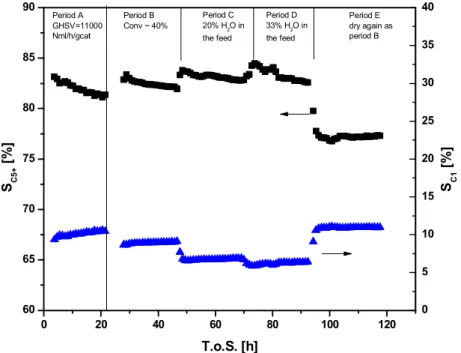
Figure 3.Effect of external water addition on the selectivities in FT over Co/Al2O3
Experimental conditions: 483 K, 20 bar, H2/CO = 2.1.
Summarizing experimental data about the mixtures with the WGS catalyst where indigenous water is removed showed that no significant changes in product distri-bution but significant changes in the space-time yield to HCs. On the other hand, when larger amounts of water are co-fed to the reactor to simulate high conversion a significant inhibition of methane production is observed.
To give an example of other possibilities of catalyst development, Figure 3 shows a 12%Co on SBA-15 undergoing the same experimental sequence as for the catalyst shown in Figure 4. It can be seen that in the case of the 12%Co on SBA-15 catalyst, the selectivity to methane is higher in period A (high space veloc-ity) and even more dependent on operating conditions such as conversion level and extent of water addition. It can be noticed that with a Co/Al2O3 catalyst, the
ratio between SNG (C1-C4) and liquid HCs is similar to that of the Swedish market.
A change in operating conditions such as an increase of temperature or H2/CO
ratio would result in an increase of the short-chain HC selectivities making possi-ble a small adjustment of the ratio of SNG to liquid HCs.
0 20 40 60 80 100 120 60 65 70 75 80 85
90 Period Edry again as
period B Period D 33% H2O in the feed Period C 20% H2O in the feed Period B Conv ~ 40% Period A GHSV=11000 Nml/h/gcat S C 5+ [% ] T.o.S. [h] 0 5 10 15 20 25 30 35 40 S C 1 [% ]
Figure 4.Effect of external water addition on the selectivities in FT over Co/SBA-15. Experimental conditions: 483 K, 20 bar, H2/CO = 2.1.
Methanation activity results: comparison between Al2O3and TiO2supports
The methanation experiments using the 20%Ni/TiO2 catalysts differed from the
one of 20%Ni/Al2O3. The overall initial activity was higher over alumina-supported
than over titania-supported catalysts (see Figure 5), as expected, due to the differ-ence in metal dispersion.
In agreement with other studies [6, 7], the results of these experiments also showed that the titania-supported nickel catalysts provide higher selectivity to longer chain hydrocarbons than alumina-supported (see Table 2).
These two differently supported nickel catalysts not only presented differences in their activity and selectivity but also in their deactivation behavior. While the alumi-na-supported catalysts gave a complete loss of activity the titania-supported ones showed a more stable behavior, in which the rate of deactivation slows down sig-nificantly after some hours on stream (see Figure 5).
Figure 5: Deactivation on 20% Ni/TiO2and 20% Ni/Al2O3.
Table 2: Selectivities of titania and alumina-supported nickel catalysts after 5 h on stream.
Catalyst Selectivity (%)
C1 C2-C4 C5+
20%Ni/TiO2 50.2 38.8 11
20%Ni/Al2O3 58.1 35.5 6.4
Two possibilities have been investigated as causes for the deactivation behavior for these catalysts through X-ray diffraction (XRD) and Temperature Programmed Hydrogenation (TPH) (see also Appendix A). The former was used to investigate the active phase (nickel) particle size before and after reaction to validate the hy-pothesis of sintering as deactivation cause, the latter was use to quantify the amount of carbon formed and characterize the species of carbon present on the nickel surface. 0 5 10 15 20 25 0 10 20 30 40 50 60 70
20% Ni/TiO2 SVsyngas= 1241 Nml/(min·g) 20% Ni/-Al2O3 SVsyngas= 2498 Nml/(min·g)
X CO (% ) ToS (h) T= 583 K Psyngas= PT= 20 bar
Table 3: Nickel crystallite size for Ni/TiO2and Ni/Al2O3
Sample Fresh catalyst
DNi(nm)
Spent catalyst DNi(nm)
20% Ni/Al2O3 9 82
20% Ni/TiO2 24 35
The results from XRD investigations are presented in Table 3. The results ob-tained show that the main reason for deactivation on Ni/Al2O3 is sintering of the
active-phase particles.
On the other hand, the Ni/TiO2 did not present such a significant particle growth
which leads to the conclusion that the main reason for deactivation of this catalyst is probably carbon formation.
The catalysts were exposed to methanation conditions after TPH in order to see if the removal of carbon resulted in a recovery of activity.
0 2 4 6 8 10 12 2 4 6 8 10 12 14 16
First run After hydrogenation
X C O (% ) ToS (h) 20% Ni/TiO2
after TPH, confirming the main cause of deactivation for the alumina-supported catalyst to be sintering.
Figure 7: Regeneration on 20% Ni/Al2O3
Deactivation and carbon formation for 20%Ni/TiO2as function of process
condi-tions.
Effect of H2/CO ratio
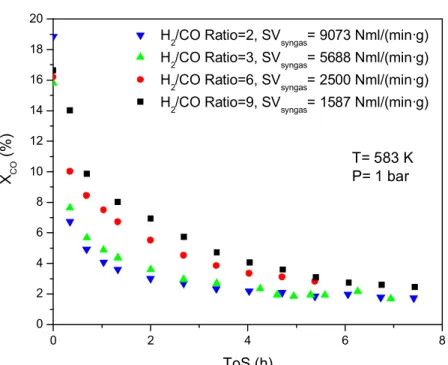
The effect of H2/CO ratio on the deactivation behavior and carbon formation was
studied for the Ni/TiO2 catalyst. Four experiments with different inlet H2/CO ratios
(2, 3, 6 and 9) were designed to start from the same conversion value (around 16%).
The experiments differed in their rate of deactivation (see Figure 8). The lower the initial H2/CO ratio, the faster the deactivation of the catalyst.
The results obtained from TPH of these samples are presented in Figure 9 show-ing a clear correlation between the rate of deactivation and the amount of carbon accumulating on the surface.
0 5 10 15 20 25 30 35 40 0 10 20 30 40 50 60 70 80
First run After TPH
X C
O
(%
)
ToS (h)
Psyngas= 5bar, PHe= 5 bar, T=583 K, inlet H2/CO ratio= 3
SVsyngas=2500 Nml/(min·g)
Figure 8: Effect of H2/CO ratio on deactivation
The amount of carbon formed for all experiments during these 6 hours on stream could be enough to cover the entire nickel surface.
According to Bartholomew [7] the only carbon species that can be formed are Cα,
Cβ, and Cv, whose hydrogenation peak temperatures are 473, 673 and 673-873 K,
respectively. This leads to the conclusion that, probably, the first peak corresponds to Cα. A possible explanation for the fact that this first peak changes in its
hydro-genating temperature is that the nature of this carbon is an intermediate between Cα and Cβ, from monoatomic to polymeric carbon. It is still uncertain which species
correspond to the other peaks but three peaks can be observed in the experiment with inlet H2/CO ratio 6, so three carbon species are probably present.
0 2 4 6 8 0 2 4 6 8 10 12 14 16 18 20
H2/CO Ratio=2, SVsyngas= 9073 Nml/(min·g) H2/CO Ratio=3, SVsyngas= 5688 Nml/(min·g) H2/CO Ratio=6, SVsyngas= 2500 Nml/(min·g) H2/CO Ratio=9, SVsyngas= 1587 Nml/(min·g)
X C O (% ) ToS (h) T= 583 K P= 1 bar
Figure 9: Effect of H2/CO ratio on carbon formation (measure as methane signal)
Effect of temperature
Three experiments on methanation reactions at three different temperatures, 553, 583 and 613 K, were carried out at atmospheric pressure in order to investigate the effects of temperature on deactivation and carbon formation. In fact, a typical methanation reactor is an adiabatic fixed bed reactor in which the temperature in-creases along the bed length.
From Figure 10 it can be noticed that the higher the temperature of reaction the faster the loss of activity during the first hours on stream.
After 6 hours of operation, the reaction was stopped and a TPH was performed. The results from TPH are presented in Figure 11. The amount of carbon formed in all three experiments is likely to be enough to deactivate the catalyst completely.
The results do not present a significant difference between the experiments per-formed at 553 and 583 K. However, deactivation is much faster for the experiment carried out at 613 K and larger amounts of carbon deposits are found.
It can be noticed that the amount of carbon reduction between 700 and 900 K was larger at higher operating temperature. Therefore, the effect of temperature on the deactivation behavior seems to be related to the amount of hard-to-reduce carbon species, which according to Bartholomew [7] could be Cβ and/or Cv. In
contrast to the H2/CO ratio, temperature does not affect in the hydrogenating
tem-perature of the first peak.
200 400 600 800 1000 1200 H2/CO ratio=2 H2/CO ratio=3 H2/CO ratio=6 H2/CO ratio=9 C H 4 si gn al [-] T (K)
Figure 10: Effect of temperature on deactivation
Figure 11: Effect of temperature on carbon formation (measured as methane
sig-0 1 2 3 4 5 6 0 10 20 30 40 50 T= 553 K, SVsyngas= 246 Nml/(min·g) T= 583 K, SVsyngas= 980 Nml/(min·g) T= 613 K, SVsyngas= 3308 Nml/(min·g) X C O (% ) ToS (h) P= 1 bar
inlet H2/CO ratio= 3
200 400 600 800 1000 1200 C H 4 si g n a l[ -] T (K) T= 553 K T= 583 K T= 613 K
mation at atmospheric pressure. However, it is necessary to study the same effect at higher pressure, closer to the industrial operating conditions.
In this section, the results of three experiments at a total pressure of 20 bar at the inlet H2/CO ratios 2, 3 and 6 are presented. The H2/CO ratio had the same
ef-fect at 20 bar as at atmospheric pressure. The lower the H2/CO ratio, the faster the
deactivation rate (see Figure 12).
In order to evaluate the effect of reactant pressure, it is necessary to compare the experiments at atmospheric pressure with the ones at 20 bar. The relative loss of activity of the experiments was higher at atmospheric pressure than at 20 bar (see Figure 13). Moreover, the amount of carbon formed at 20 bar was lower than at atmospheric pressure for the three inlet H2/CO ratios studied.
Figure 12:Effect of H2/CO ratio on deactivation at 20 bar
0 1 2 3 4 5 6 0 10 20 30 40 50 60 70 80 90 100
H2/CO Ratio= 2, 20% He, SVsyngas= 1621 Nml/(min·g) H2/CO Ratio= 3, 5% He, SVsyngas= 2564 Nml/(min·g) H2/CO Ratio= 6, 20% He, SVsyngas= 3143 Nml/(min·g)
X C O (% ) ToS (h) P= 20 bar T= 583 K
0 1 2 3 4 5 6 0 10 20 30 40 50 60 70 80 90 100 200 400 600 800 1000 1200 0 1x10⁻³ 2x10⁻³ 3x10⁻³ 4x10⁻³ 5x10⁻³ C H4 si gn al [-] T (K) P=1bar P=20bar H2/CO ratio= 2 Psyngas=1 bar
Psyngas=16 bar PHe=4 bar
XCO
(%
)
ToS (h) Inlet H2/CO ratio= 2, T= 583 K
0 1 2 3 4 5 6 0 10 20 30 40 50 60 70 80 90 100 200 400 600 800 1000 1200 0 1x10⁻³ 2x10⁻³ 3x10⁻³ 4x10⁻³ 5x10⁻³ C H4 si g n a l[ -] T (K) P=1bar P=20bar H2/CO ratio= 3 Psyngas=1 bar
Psyngas=19 bar; PHe=1 bar
XC
O
(%
)
ToS (h) Inlet H2/CO ratio= 3, T= 583 K
Figure 13: Effect of reactant pressure at different inlet H2/CO ratios.
4. Conclusions and outlooks
Overall
The catalysts Co/Al2O3 and Ni/TiO2 prepared and tested in this study could be
used in commercial reactors. However, it is difficult to compare performances for commercial catalysts which have not been tested under the same conditions.
The results from this study also show that it is possible to obtain around 20-22% SNG with only a FT reactor. For small changes of this percentage, the amount of C1-C4can be adjusted by changing process parameters in the FTS, such as higher
temperature or increased inlet H2/CO ratio, while for large changes a methanation
reaction is required. Fischer-Tropsch
A narrow-pore Co/γ-Al2O3catalyst was mixed in different proportions with a WGS
catalyst in a fixed-bed reactor with the initial intention to increase the production rate of HCs by increasing the partial pressure of hydrogen and decreasing that of CO inside the reactor. The usage H2/CO ratio could be adjusted to match the inlet
H2/CO ratio of 1.0 by choosing the correct amounts of the two catalysts. However,
the Co catalyst-time yields to HCs of the WGS catalyst-containing mixtures were lower than for the pure Co catalyst. Moreover, water which is one of the main products of the synthesis and whose concentration is related to the conversion level in the reactor (as well as the reactor of choice), showed a positive kinetic ef-fect and inhibited methane formation, shifting the selectivity towards longer-chain HCs (organic liquid products and waxes). The nature of the water effect still re-mains unclear and requires further studies. In particular cases, it seems possible to replace a costly WGS unit and perform internal shifting in a FT reactor accept-ing a decrease of the rate to HC but a larger selectivity to C5+.
Methanation
In this study it has been shown that, at the operating conditions used, the main reason for deactivation for titania-supported nickel catalysts is carbon formation
0 1 2 3 4 5 6 0 10 20 30 40 50 60 70 80 90 100 200 400 600 800 1000 1200 0 1x10⁻³ 2x10⁻³ 3x10⁻³ 4x10⁻³ 5x10⁻³ C H4 si g n a l[ -] T (K) P=1bar P=20bar H2/CO ratio= 6
Inlet H2/CO ratio= 6, T= 583 K
Psyngas=1 bar
Psyngas=16 bar PHe=4 bar
XC
O
(%
)
while for alumina-supported catalysts it is sintering. Titania-supported nickel cata-lyst has a higher selectivity towards C2, C3and C4hydrocarbons.
Furthermore, it was found that, for titania-supported nickel catalysts, the deacti-vation and thus the formation of carbon is enhanced at low H2/CO ratios, high
temperature and low reactant pressures. Further studies could focus on the quan-tification of the deactivation effects to relate catalyst life time and operating condi-tions to a kinetic expression for deactivation. On-line regeneration could be per-formed industrially to handle the type of deactivation which affects TiO2. As
cata-lyst replacement is a costly operation it seems important to follow up this finding with other projects.
5. Acknowledgements
The authors acknowledge the financial support provided by the Swedish Energy Agency and the gas industry via SGC (Swedish Gas Technology Centre).
6. Literature
[1] R. W. R. Zwart and H. Boerrigter, Energy Fuels,19 (2) (2005) 591–597 [2] Y. Tanaka, T. Utaka, R. Kikuchi, K. Sasaki, and K. Eguchi, Appl. Catal., A 238
(2002) 11-18.
[3] D. Tristantini, S. Lögdberg, B. Gevert, Ø. Borg, and A. Holmen, Fuel Process. Technol. 88 (2007) 643-649
[4] S. Storsæter, Ø. Borg, E.A. Blekkan, and A. Holmen, J. Catal. 231 (2005) 405-419.
[5] C.A. Chanenchuk, I.C. Yates, and C.N. Satterfield, Energy and Fuels 5 (1991) 847-855.
[6] J. van de Loosdrecht, A. M. van der Kraan, A. J. van Dillen, and J. W. Geus, Journal of Catalysis 170 (1997) 217–226.
[7] C.H. Bartholomew, Applied Catalysis A: General 212 (2001) 17–60.
[8] Ø. Borg, M. Rønning, S. Storæster, W. van Beek, and A. Holmen, Stud. Surf. Sci. Catal. 163 (2007) 255-272.
7. Appendix A: Characterization methods and results
Catalyst characterization methods
Brunauer-Emmet-Teller (BET) surface area and porosity measurements were per-formed in a Micromeritics ASAP 2000 unit. The samples were evacuated and dried at 523 K overnight prior to analysis. The BET area was estimated by N2adsorption
at liquid nitrogen temperature at relative pressures between 0.06 and 0.2.
Hydrogen temperatuprogrammed-reduction (TPR) was used to study the re-ducibility of the catalyst. TPR of the calcined catalyst (0.15 g) was conducted in a Micromeritics Autochem 2910 flowing 5% H2in Ar increasing the temperature from
ambient to 1200 K (10 K/min) while monitoring the H2 consumption on a thermal
conductivity detector (TCD). The degree of reduction (DOR, %) was estimated with H2-TPR of the in-situ reduced catalysts. 0.15 g of calcined catalyst was
re-duced at 623 K (heating rate: 1 K/min) for 16 h in flowing H2, then flushed with
in-ert gas for 30 min. Afterwards, the flowing gas was changed to 5% H2 in Ar and
the temperature was increased from 623 to 1200 K (10 K/min) monitoring H2
con-sumption. The TCD was calibrated with Ag2O as standard.
In order to estimate the cobalt dispersion (D, %) and the cobalt crystallite size (d, nm), hydrogen static chemisorption was performed on the reduced catalysts. The chemisorption measurements were conducted on a Micromeritics ASAP 2020C unit at 308 K, after reducing about 0.15 g of the calcined catalysts in flowing hy-drogen at 623 K (heating rate: 1 K/min) for 16 h. The average particle size of Co0, assuming spherical shape, was estimated according to [3]:
where DOR is the degree of reduction.
Wide angle X-ray diffraction (XRD) measurements on the calcined catalysts
were performed on a Siemens D5000 instrument with Cu-Kα radiation (2θ = 10 -
90º, step size = 0.02º) equipped with a Ni filter. An independent measurement of the crystallite diameters of Co3O4 and Ni metallic and NiO were carried out by
us-ing the Scherrer equation and assumus-ing spherical crystallites. The Co crystallite size was estimated from that of Co3O4using the following formula [3]:
according to the relative molar volumes of metallic cobalt and Co3O4.
Methanation
Carbon deposition studies: Temperature-Programmed Hydrogenation
Temperature-programmed hydrogenation (TPH) was used to determine the spe-cies and amount of carbon present in the methanation synthesis. Once the reac-tion was stopped, a He flow was run through the reactor, the reactor was cooled down to ambient temperature and driven to atmospheric pressure. Then, the outlet of the reactor was attached to a mass spectrometer and a flow of pure H was run
DOR D Co d( 0)H 96 ) ( 75 . 0 ) (Co0 d Co3O4 d
through the reactor. The hydrogen space velocity used for the hydrogenation of carbon present on the nickel surface was 233 Nml/(min•g). During the hydrogena-tion the temperature was linearly raised form ambient to 963 K with a ramp of 5 K/min.
A mass spectrometer monitored the signals for hydrogen, water and methane during the TPH.
Catalyst characterization Fischer-Tropsch
Table 1 shows the physical properties of the pure support of the Co catalyst, a
narrow pore γ-Al2O3 (10 nm), and of the Co and WGS catalysts. The typical
de-crease in surface area, pore volume and pore diameter of the pure support upon impregnation is seen.
Table 2 shows the physicochemical properties of the Co catalyst. The DOR after activation is similar for the ex-situ reduced and passivated sample to the in-situ reduced sample, and hence the Co particle-size estimation for the ex-situ reduced sample is similar to that for the in situ reduced sample.
The TPR profiles of the Co catalyst before and after the reduction and pas-sivation treatments are shown in Fig. 1. The calcined catalyst (Fig. 1a) shows three peaks: peak I at 540 K has been attributed to removal of residual nitrates from the catalyst preparation [3]. Increasing the temperature, a two-step reduction of cobalt oxides [8] can be observed: peak II at 625 K is ascribed to reduction of Co3O4to CoO, while the broad peak III at around 895 K corresponds to the
reduc-tion of differently sized CoO crystallites into Co.
The TPR profile of the reduced and passivated sample (Fig. 1b) shows a sharp peak at around 539 K which could probably be ascribed to the reduction of the
Table 1.ATextural properties of support and catalysts (calcined) as determined by N2adsorption. Sample BET sur-face area (m2/g) Pore vol-ume (cm3/g) Pore diametera (nm) γ-Al2O3 193 0.50 10.4 12Co/γ-Al2O3 173 0.40 9.2 30Cu/30ZnO/Al2O3 75 0.12 6.4 a The average pore diameter (dp) estimated from surface
Table 2.APhysicochemical properties of the Co catalyst. Sample DOR (%) Metal dispersion XRD H2-chemisorption d(Co3O4 ) (nm) d(Co 0)c (nm) D d (%) Dcorr e (%) d(Co0)H f (nm) 12Co/γ-Al2O3 64a 16.8 13 5.5 8.6 11.2 12Co/γ-Al2O3red+pass 62b - - - - -aEstimated by H
2-TPR after reduction at 623 K for 16 h in H2. bEstimated by H
2-TPR after activation at 493 K for 2 h in H2. cCobalt particle size according to Eq. (2).
dMetal dispersion, after reduction at 623 K for 16 h in H 2. eDispersion corrected for DOR.
f Cobalt particle size according to Eq. (1).
Methanation
The BET surface areas calculated are 18 m2/g and 143 m2/g for TiO2and Al2O3
supports, respectively.
The particle size was determined by XRD on the catalysts in their nickel oxide and nickel metallic states. The results are presented in Table 1.
Table 3.A: Particle size before and after reduction of the catalysts determined by XRD
Catalyst Before reduction (nm) After reduction (nm)
20%Ni/Al2O3 - 9
20%Ni/TiO2 24 24
Due to the size of the molecules of NiO and Ni(0), the crystal diameter should
decrease after reduction. However, the nickel diameter was the same as the nickel oxide diameter when supported on titania. A possible explanation for this particle growth is that the particles sintered during the reduction at 773 K.
Observing these TPR results, it can be assumed that the DOR of the reduction treatment used for the titania-supported catalysts (4h at 773 K with pure hydrogen) would be close to 100%. Therefore, another TPR after the reduction treatment to calculate the DoR was not performed. However, this evaluation was performed on the alumina-supported catalyst. The calculated DOR reduction of 20%Ni/Al2O3
was 96%.
The hydrogen chemisorption data obtained from the analysis of the previously reduced titania-supported nickel catalyst turned out to be incoherent due to the fact that the physisorbed quantity was almost the same as the physisorbed and chemisorbed quantities together. It is stated in [9], that the H2 adsorption
and that the H2adsorption capacity decreases if TiOx is present on the nickel
sur-face. Therefore, H2chemisorption is probably not an accurate method for
calculat-ing dispersion on titania-supported catalysts. In contrast, the alumina-supported catalyst could be analyzed with H2 chemisorption. The dispersion obtained was
9%.
Figure 1.AH2-TPR profile for calcined Co catalyst (a) and reduced and passivated
Co catalyst (b). 200 400 600 800 1000 1200 1400 1600 540 539 898 H 2 -u pt ak e p er gr a m ca ta ly st (a . u. ) Temperature (K) Isothermal (a) (b) 895 625
![Figure 1. Integrated co-production concept [1].](https://thumb-us.123doks.com/thumbv2/123dok_us/10725950.2960947/11.892.273.650.144.337/figure-integrated-co-production-concept.webp)