Delta State University (DSU), through its Division of Biological and Physical Sciences (Division) in the College of Arts and Sciences, offers a Bachelor of Science (B.S.) degree with a major in Biology and a concentration in Biology Education and a B.S. degree with a major in Chemistry and a concentration in Chemistry Education. (The Biology Education concentration is one of five concentrations available to biology majors while the Chemistry Education concentration is one of four concentrations that can be selected by chemistry majors.) In addition to B.S. degrees in Biology and Chemistry the Division offers a B.S. degree in Environmental Science. On the graduate level the Division offers a Master of Science in Natural Sciences (M.S.N.S.) degree with a major in Natural Sciences and an emphasis in either Biological Sciences or Physical Sciences. This degree program includes separate options for students already engaged in a teaching career in the biological or physical sciences versus those desiring a technical/research career in the sciences. (Neither option in the master’s degree program leads to initial teacher licensure.) Students who graduate from DSU with a B.S. in Biology (Biology Education concentration) or Chemistry (Chemistry Education concentration) are eligible for teacher licensure at the Class A level in the state of Mississippi. Student enrollment for the last three years in the DSU program is summarized in Attachment A. Information concerning the faculty member who coordinates the program appears in Attachment B.
Knowledge base and goals of the program
The biology education and chemistry education programs—subsequently also referred to as the “science education program”—include coursework that can be grouped into four categories: general education courses, special degree requirements, professional education courses, and major courses (Attachment C.) A listing of science and math course numbers and the full title corresponding to each course is provided in Attachment D. The “special degree requirements” and “major” categories include required science and math courses. This traditional categorization of courses in the degree program provides a general idea of the scope of the program. Required science courses are sequenced from the introductory level to upper division (300+) with many of the upper division courses carrying specific prerequisites for admission. Progression from lower division science courses to upper division work is regulated by a formal admissions policy insuring that students attain a specific minimum grade point average in the introductory biology and chemistry sequences. Required one semester biology courses included in the biology education concentration are “Principles of Biology”, “General Botany”, “General Zoology”, “Cell Biology”, “Genetics”, “Microbiology”, and
“Ecology”. To round out the biology portion of the curriculum, students elect one upper division course from field biology or physiology offerings. Students with a biology education concentration complete supporting coursework in chemistry (15 semester hours), physics (3 semester hours), astronomy (3 semester hours), and mathematics (6 semester hours). Students pursuing the chemistry education concentration are required to take two semesters of “General Chemistry” and one semester of each of the following: “Survey of Organic and Biochemistry”, “Quantitative Analysis”, and “Physical
mathematics (11 semester hours). The science courses appearing in these concentrations address content recommended by the NSTA Standards for Science Teacher Preparation for inclusion in the initial preparation of biology and chemistry teachers. Attachment E contains the Content Analysis for Secondary Science associated with the DSU
undergraduate secondary biology program while Attachment F addresses the undergraduate secondary chemistry program.
Two science methods courses, CUR 493 and BIO 435, are included in the biology education concentration while one, CUR 493, is contained in the chemistry education concentration. CUR 493, “Teaching the Sciences,” is a general methods course in science teaching which focuses on such issues as teaching strategies, lesson planning, science curriculum, laboratory safety, etc. This course, carrying four semester hours of credit, includes a field experiences component. BIO 435, “Methods and Materials in the Biological Sciences,” focuses on pedagogical content knowledge associated with the field. Consequently, in BIO 435 many of the topics addressed in CUR 493 are further developed with specific applications to biology teaching. Additionally, alternative conceptions (misconceptions) in science commonly held by students and associated with specific concepts within the subdisciplines of biology are explored in depth. Strategies and activities for addressing these misconceptions are developed and practiced by the preservice teachers (candidates).
Historically, three major tenets have served as the guiding principles behind the DSU science education program: (1) teachers cannot effectively teach a content area they do not understand, (2) possessing content knowledge is a necessary but not sufficient condition for effective teaching, (3) the manner in which a science class is taught can be as important as the content taught in the class. With these considerations in mind, the science education program has been structured to insure that majors receive a solid grounding in science content along with an understanding of how to involve their future students in exploring science through relevant and meaningful experiences. These tenets are reflected in the goals of the science education program:
• Assist candidates in developing fundamental science knowledge that can be related to major unifying principles of science.
• Provide program experiences which aid candidates in developing an
understanding of, and ability to use, the processes and methods of scientific inquiry.
• Provide opportunities for candidates to explore and become proficient in using innovative teaching strategies in the science classroom
• Assist candidates in understanding the interdependence of science, technology, and society in the modern world.
• Provide program experiences that allow candidates to integrate science content knowledge with pedagogical content knowledge within the discipline.
Field and clinical experiences in the program
300, “Survey of Education with Field Experiences”, where they are required to perform 20 hours of service in a precollege science classroom in cooperating schools. This is followed by field experiences in CUR 493, “Teaching the Sciences”, where candidates work through the DSU Center for Science and Environmental Education (CSEE) to assist teachers with materials for science lessons and to develop and teach selected science lessons during the semester. Students spend approximately 10 hours in this program. Student teaching, completed during the candidate’s last semester of undergraduate enrollment, is 12 weeks in duration.
Admission, retention, and exit from the program
Students entering DSU who declare a major offered through the Division are initially admitted with provisional status. Students who satisfactorally complete the introductory science courses listed below are granted full admission to the major.
Biology majors (all concentrations) and Environmental Science majors: BIO 100, BIO 102, BIO 103, CHE 101, CHE 102, CHE 103, CHE 104 Chemistry majors (all concentrations):
MAT 104/105 or MAT 106, CHE 101, CHE 102, CHE 103, CHE 104
Satisfactory completion is defined as completing a course with a grade of C or better. Any grade below C must be removed by repeating the course to improve the grade. A student who has not been granted full admission is not permitted to register for any course numbered 200 or above in the major. At the close of each semester, students’ records are reviewed by their advisors. Students are notified upon reaching full
admission status.
Requirements for full admission also apply to students who transfer credit from other institutions. Courses equivalent to the introductory courses listed above must have been completed with grades of C or better to be accepted for transfer credit.
In addition to the DSU graduation requirements, the Division requires satisfactory academic performance in all major courses. Specifically, this means that no grade below C in a required major course may be applied toward graduation. Any grade below C must be removed by repeating the course and earning a better grade. This requirement is in addition to the University requirement for maintaining a 2.0 quality point average for all major course work.
A student with full admission status who fails to maintain good academic standing is placed on Division academic probation. When students first receive a grade below C in an upper-division major course, they are warned of the danger of being placed on probation and that the problem course or courses must be retaken. A student who fails to improve such grades to C or better within two semesters is placed on probationary status and is not permitted to advance in major course work until such time that all probationary problems have been corrected.
ATTACHMENT A Candidate Information
Program:
Science Education (baccalaureate) Academic
Year # of Candidates Enrolled in the Program
# of Program Completers
2003-2004 10 4
2004-2005 11 5
2005-2006 7 3
ATTACHMENT B Faculty Information Faculty Member Name Highest Degree, Field, & University Assignment: Indicate the role of the
faculty member Faculty Rank Tenure Track (Yes/ No) Scholarship, Leadership in Professional Associations, and Service: List up to 3 major contributions in
the past 3 years
Teaching or other professional experience in P-12 schools Malcolm K. McEwen Ed.D. in Curriculum and Instruction, West Virginia University
Faculty Professor Yes,
tenured 1. Director of the DSU Center for Science and Environmental
Education, a unit of the university which
provides services to precollege science teachers in 19 Mississippi counties
2. Compiled and co-edited, with Janice Strickland, three volumes of science activities correlated with the Mississippi Science Curriculum Framework and the National Science Education Standards. One volume is for use with K-2 students, one for 3-6 students, and one for grades 7 and 8 students
3. Member of the Board of Directors of the Mississippi Science Teachers Association (MSTA)
1. university content area student teaching supervisor for all 7-12 science teaching candidates
ATTACHMENT C
CHECKLIST OF REQUIREMENTS: 2006-2007 CATALOG
Bachelor of Science Degree Biology Education Concentration
Name _________________________ Campus box number __________________________ Home address___________________ Home phone number __________________________ _______________________________ Campus phone number ________________________
B.S. DEGREE IN BIOLOGY WITH BIOLOGY EDUCATION CONCENTRATION
GENERAL EDUCATION MAJOR
ENG 101 Composition 3( ) BIO 100 Principles of Biology 4( )
ENG 102 or 103 3( ) BIO 102 General Botany 4( )
SPE 101 Fundamentals of Speech 3( ) BIO 103 General Zoology 4( )
Literature elective 3( ) BIO 217 Microbiology 4( )
Literature elective 3( ) BIO 300 Cell Biology 4( )
Fine arts elective1 3( ) BIO 301 Ecology 4( )
History elective2 3( ) BIO 328 Genetics 4( )
History elective2 3( ) BIO 435 Meth./Mat. in Biology 3( )
Science elective (lab-based)3 3( ) BIO 300+ elective5 3-4
Science elective (lab-based)3 3( ) ________________________ ( )
PSY 101 General Psychology 3( ) CHE 212 Survey of Organic Chem. 5( )
Perspective on Society elective4 3( ) PHY 110 The Physical World 3( ) Perspective on Society elective4 3( ) PHY 205 Astronomy 3( )
CIS 205 Microcomputer Applications 3( ) or
PHY 314 Physical Geology 4( )
TOTAL 42 TOTAL 45-47
SPECIAL DEGREE REQUIREMENTS PROFESSIONAL EDUCATION
CHE 101 General Chemistry 3( ) PSY 313 Adolescent Psychology 3( ) CHE 102 General Chemistry 3( ) EPY 341 Educational Psychology 3( ) CHE 103 General Chemistry lab 2( ) CSP 340 Survey of the Excep. Child 3( ) CHE 104 General Chemistry lab 2( ) CUR 300 Survey of Education 3( ) MAT 104 College Algebra 3( ) CUR 493 Teaching the Sciences 4( ) MAT 105 Plane Trigonometry 3( ) *CUR 393 Classroom Management 3( ) or *CUR 498 Directed Teaching 9( ) MAT 106 Precalculus 3( ) *HSE 144 First Aid/CPR 1( )
Biology Education: 2006-2007 Catalog
ALWAYS REFER TO SPECIFIC DEGREE REQUIREMENTS LISTED IN THE UNIVERSITY CATALOG
1. Fine Arts
Select one art, music, or theater appreciation, history, or introduction course. We suggest that you select one course from the following list (all carry 3 semester hours of course credit):
ART 101 Introduction to Art
ART 212 Art Appreciation recommended for biology ed. majors MUS 114 Music in American Culture
MUS 115 Music in Western Culture THE 225 Introduction to Theater
2. History
Select two history courses (100 or 200 level). We suggest that you select the two courses from the following list (all carry 3 semester hours of course credit):
HIS 101 History of Civilization to 1648 HIS 102 History of Civilization, 1648-present HIS 201 United States History to 1865 HIS 202 United States History, 1865-present
HIS 203 History of the Americas through Colonial Times
HIS 204 History of the Americas, Independence Period to Present
3. Laboratory Science
Select two science courses with labs for a minimum of six semester hours total credit. Biology education majors will use science courses included in the major to fulfill this requirement.
4. Perspectives on Society
Select two courses from the following (all carry 3 semester hours of course credit): ANT 101 Introduction to Anthropology
ECO 210 Principles of Macroeconomics ECO 211 Principles of Microeconomics GEO 201 Introduction to Human Geography GEO 303 World Regional Geography PHI 201 Introduction to Philosophy PSC 103 Introduction to Political Science PSC 201 American National Government
SOC 101 Principles of Sociology recommended for biology ed. majors
5. The biology elective must be selected from field biology or physiology courses listed below: BIO 312 Dendrology 3 semester hours
CHECKLIST OF REQUIREMENTS: 2006-2007 CATALOG
Bachelor of Science Degree Chemistry Education Concentration
Name _________________________ Campus box number __________________________ Home address___________________ Home phone number __________________________ _______________________________ Campus phone number ________________________
B.S. DEGREE IN CHEMISTRY WITH CHEMISTRY EDUCATION CONCENTRATION
GENERAL EDUCATION MAJOR
ENG 101 Composition 3( ) BIO 100 Principles of Biology 4( )
ENG 102 or 103 3( ) BIO 102 General Botany 4( )
SPE 101 Fundamentals of Speech 3( ) BIO 103 General Zoology 4( )
Literature elective 3( ) CHE 101 General Chemistry 3( )
Literature elective 3( ) CHE 102 General Chemistry 3( )
Fine arts elective1 3( ) CHE 103 General Chemistry 2( )
History elective2 3( ) CHE 104 General Chemistry lab 2( )
History elective2 3( ) CHE 212 Survey of Organic Chem. 5( )
Science elective (lab-based)3 3( ) CHE 311 Quantitative Analysis 5( )
Science elective (lab-based)3 3( ) CHE 351 P. Chem. for Life Sci. 4( )
PSY 101 General Psychology 3( ) PHY 202 Physical Geography 3( )
Perspective on Society elective4 3( ) or
Perspective on Society elective4 3( ) PHY 205 Astronomy 3( ) CIS 205 Microcomputer Applications 3( )
TOTAL 42 TOTAL 39
SPECIAL DEGREE REQUIREMENTS PROFESSIONAL EDUCATION
PHY 221 Physics for Life Sciences 3( ) PSY 313 Adolescent Psychology 3( ) PHY 233 Physics lab 1( ) EPY 341 Educational Psychology 3( ) PHY 222 Physics for Life Sciences 3( ) CSP 340 Survey of the Excep. Child 3( ) PHY 234 Physics lab 1( ) CUR 300 Survey of Education 3( ) MAT 104 College Algebra 3( ) CUR 493 Teaching the Sciences 4( ) MAT 105 Plane Trigonometry 3( ) *CUR 393 Classroom Management 3( )
or *CUR 498 Directed Teaching 9( )
MAT 106 Precalculus 3( ) *HSE 144 First Aid/CPR 1( )
MAT 205 Calculus 5( )
or
MAT 300 Probability and Statistics 3( )
Chemistry education major: 2006-2007 Catalog
ALWAYS REFER TO SPECIFIC DEGREE REQUIREMENTS LISTED IN THE UNIVERSITY CATALOG
1. Fine Arts
Select one art, music, or theater appreciation, history, or introduction course. We suggest that you select one course from the following list (all carry 3 semester hours of course credit):
ART 101 Introduction to Art
ART 212 Art Appreciation recommended for chemistry ed. majors MUS 114 Music in American Culture
MUS 115 Music in Western Culture THE 225 Introduction to Theater
2. History
Select two history courses (100 or 200 level). We suggest that you select the two courses from the following (all carry 3 semester hours of course credit):
HIS 101 History of Civilization to 1648 HIS 102 History of Civilization, 1648-present HIS 201 United States History to 1865 HIS 202 United States History, 1865-present
HIS 203 History of the Americas through Colonial Times
HIS 204 History of the Americas, Independence Period to Present
3. Laboratory Science
Select two science courses with labs for a minimum of six semester hours total credit. Chemistry education majors will use science courses included in the major to fulfill this requirement.
4. Perspectives on Society
Select two courses from the following (all carry 3 semester hours of course credit): ANT 101 Introduction to Anthropology
ECO 210 Principles of Macroeconomics ECO 211 Principles of Microeconomics GEO 201 Introduction to Human Geography GEO 303 World Regional Geography PHI 201 Introduction to Philosophy PSC 103 Introduction to Political Science PSC 201 American National Government
ATTACHMENT D
MATH AND SCIENCE COURSES INCLUDED IN DSU SCIENCE EDUCATION PROGRAM
Course number Complete course title
BIO 100 Principles of Biology
BIO 102 General Botany
BIO 103 General Zoology
BIO 217 Introduction to Microbiology
BIO 300 Cell Biology
BIO 301 Ecology
BIO 328 Genetics
BIO 435 Methods and Materials in the Biological Sciences
CHE 101 General Chemistry
CHE 102 General Chemistry
CHE 103 General Chemistry Laboratory
CHE 104 General Chemistry Laboratory
CHE 212 Survey of Organic and Biochemistry
CHE 311 Quantitative Analysis
CHE 351 Physical Chemistry for the Life Sciences
MAT 104 College Algebra
MAT 105 Plane Trigonometry
MAT 106 Precalculus
MAT 205 Unified Calculus and Analytics
MAT 300 Applied Probability and Statistical Methods
PHY 110 The Physical World
PHY 202 Physical Geography
PHY 205 Astronomy
PHY 221 Physics for the Life Sciences
PHY 222 Physics for the Life Sciences
PHY 233 General Physics Laboratory
PHY 234 General Physics Laboratory
CONTENT ANALYSIS FOR SECONDARY SCIENCE 7-12 Undergraduate Secondary Biology Program
Competency Requirements for All Science Teachers
A: Competency B: Required Courses C: Advising Requirements Multiple ways we organize our
perceptions of the world and how systems organize the studies and knowledge of science.
BIO 100, 102, 103, 217, 301, 328, CHE 101, 102, 103, 104, 212
Nature of scientific evidence and the use of models for
explanation.
BIO 100, 102, 103, 217, 301, 328, CHE 101, 102, 103, 104, 212
Measurement as a way of knowing and organizing observations of constancy and change.
BIO 100, 102, 103, 217, 301, 328, CHE 101, 102, 103, 104, 212
Evolution of natural systems and factors that result in evolution or equilibrium.
BIO 100, 102, 103, 217, 301, 328
Interrelationships of form, function, and behaviors in living and nonliving systems.
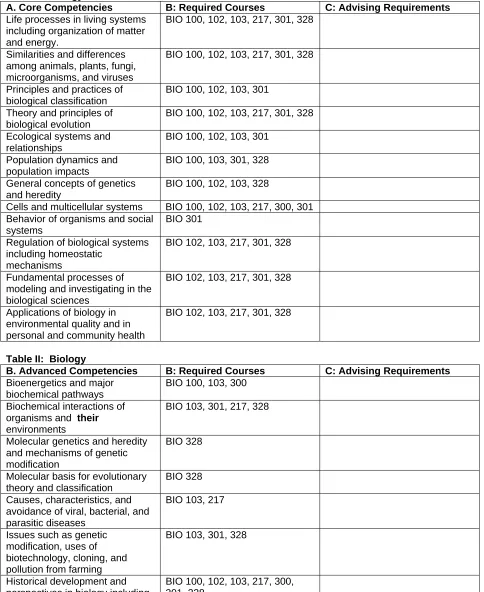
Science Content Requirement Analysis Tables I, II, III for Biology
Table I: Biology
A. Core Competencies B: Required Courses C: Advising Requirements Life processes in living systems
including organization of matter and energy.
BIO 100, 102, 103, 217, 301, 328
Similarities and differences among animals, plants, fungi, microorganisms, and viruses
BIO 100, 102, 103, 217, 301, 328
Principles and practices of biological classification
BIO 100, 102, 103, 301
Theory and principles of biological evolution
BIO 100, 102, 103, 217, 301, 328
Ecological systems and relationships
BIO 100, 102, 103, 301
Population dynamics and population impacts
BIO 100, 103, 301, 328
General concepts of genetics and heredity
BIO 100, 102, 103, 328
Cells and multicellular systems BIO 100, 102, 103, 217, 300, 301 Behavior of organisms and social
systems
BIO 301
Regulation of biological systems including homeostatic
mechanisms
BIO 102, 103, 217, 301, 328
Fundamental processes of modeling and investigating in the biological sciences
BIO 102, 103, 217, 301, 328
Applications of biology in environmental quality and in personal and community health
BIO 102, 103, 217, 301, 328
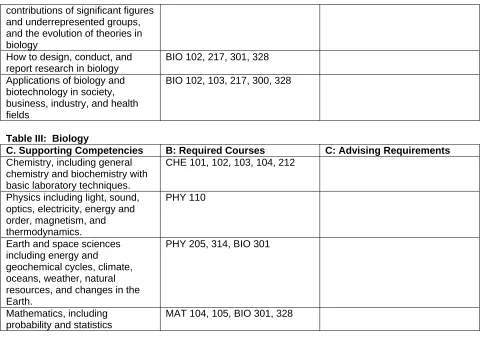
Table II: Biology
B. Advanced Competencies B: Required Courses C: Advising Requirements Bioenergetics and major
biochemical pathways
BIO 100, 103, 300
Biochemical interactions of organisms and their environments
BIO 103, 301, 217, 328
Molecular genetics and heredity and mechanisms of genetic modification
BIO 328
Molecular basis for evolutionary theory and classification
BIO 328
Causes, characteristics, and avoidance of viral, bacterial, and parasitic diseases
BIO 103, 217
Issues such as genetic modification, uses of biotechnology, cloning, and pollution from farming
BIO 103, 301, 328
Historical development and perspectives in biology including
and underrepresented groups, and the evolution of theories in biology
How to design, conduct, and report research in biology
BIO 102, 217, 301, 328
Applications of biology and biotechnology in society, business, industry, and health fields
[image:13.612.66.546.68.408.2]BIO 102, 103, 217, 300, 328
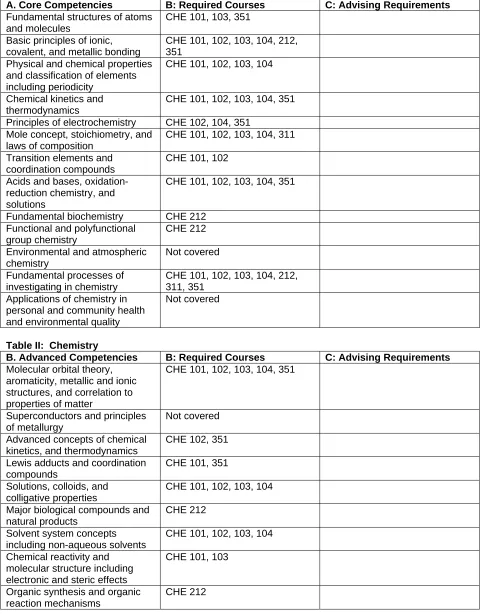
Table III: Biology
C. Supporting Competencies B: Required Courses C: Advising Requirements Chemistry, including general
chemistry and biochemistry with basic laboratory techniques.
CHE 101, 102, 103, 104, 212
Physics including light, sound, optics, electricity, energy and order, magnetism, and thermodynamics.
PHY 110
Earth and space sciences including energy and
geochemical cycles, climate, oceans, weather, natural resources, and changes in the Earth.
PHY 205, 314, BIO 301
Mathematics, including probability and statistics
ATTACHMENT F
CONTENT ANALYSIS FOR SECONDARY SCIENCE 7-12 Undergraduate Secondary Chemistry Program
Competency Requirements for All Science Teachers
A: Competency B: Required Courses C: Advising Requirements Multiple ways we organize our
perceptions of the world and how systems organize the studies and knowledge of science.
BIO 100, 102, CHE 101, 102, 103, 104, 212, 311, 351, PHY 205, 221, 222, 233, 234
Nature of scientific evidence and the use of models for
explanation.
BIO 100, 102, CHE 101, 102, 103, 104, 212, 311, 351, PHY 205, 221, 222, 233, 234 Measurement as a way of
knowing and organizing observations of constancy and change.
BIO 100, 102, CHE 101, 102, 103, 104, 212, 311, 351, PHY 221, 222, 233, 234
Evolution of natural systems and factors that result in evolution or equilibrium.
BIO 100, 102
Interrelationships of form, function, and behaviors in living and nonliving systems.
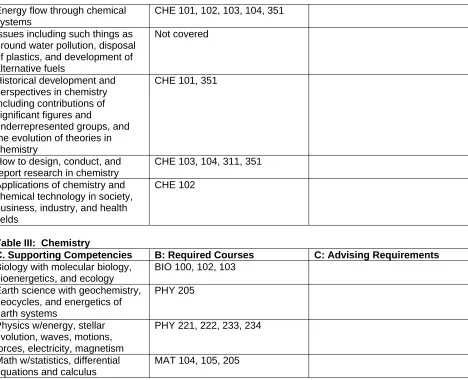
Table I: Chemistry
A. Core Competencies B: Required Courses C: Advising Requirements Fundamental structures of atoms
and molecules
CHE 101, 103, 351
Basic principles of ionic, covalent, and metallic bonding
CHE 101, 102, 103, 104, 212, 351
Physical and chemical properties and classification of elements including periodicity
CHE 101, 102, 103, 104
Chemical kinetics and thermodynamics
CHE 101, 102, 103, 104, 351
Principles of electrochemistry CHE 102, 104, 351 Mole concept, stoichiometry, and
laws of composition
CHE 101, 102, 103, 104, 311
Transition elements and coordination compounds
CHE 101, 102
Acids and bases, oxidation-reduction chemistry, and solutions
CHE 101, 102, 103, 104, 351
Fundamental biochemistry CHE 212 Functional and polyfunctional
group chemistry
CHE 212
Environmental and atmospheric chemistry
Not covered
Fundamental processes of investigating in chemistry
CHE 101, 102, 103, 104, 212, 311, 351
Applications of chemistry in personal and community health and environmental quality
Not covered
Table II: Chemistry
B. Advanced Competencies B: Required Courses C: Advising Requirements Molecular orbital theory,
aromaticity, metallic and ionic structures, and correlation to properties of matter
CHE 101, 102, 103, 104, 351
Superconductors and principles of metallurgy
Not covered
Advanced concepts of chemical kinetics, and thermodynamics
CHE 102, 351
Lewis adducts and coordination compounds
CHE 101, 351
Solutions, colloids, and colligative properties
CHE 101, 102, 103, 104
Major biological compounds and natural products
CHE 212
Solvent system concepts including non-aqueous solvents
CHE 101, 102, 103, 104
Chemical reactivity and molecular structure including electronic and steric effects
CHE 101, 103
Organic synthesis and organic reaction mechanisms
Energy flow through chemical systems
CHE 101, 102, 103, 104, 351
Issues including such things as ground water pollution, disposal of plastics, and development of alternative fuels
Not covered
Historical development and perspectives in chemistry including contributions of significant figures and
underrepresented groups, and the evolution of theories in chemistry
CHE 101, 351
How to design, conduct, and report research in chemistry
CHE 103, 104, 311, 351
Applications of chemistry and chemical technology in society, business, industry, and health fields
[image:16.612.77.545.68.448.2]CHE 102
Table III: Chemistry
C. Supporting Competencies B: Required Courses C: Advising Requirements Biology with molecular biology,
bioenergetics, and ecology
BIO 100, 102, 103
Earth science with geochemistry, geocycles, and energetics of earth systems
PHY 205
Physics w/energy, stellar evolution, waves, motions, forces, electricity, magnetism
PHY 221, 222, 233, 234
Math w/statistics, differential equations and calculus
REQUIREMENTS FOR ADMISSION TO THE DSU TEACHER EDUCATION PROGRAM
In order for a student to be admitted to the Teacher Education Program, the student must:
1. Complete CUR 300, Survey of Education with Field Experiences; OR CUR 302, Orientation and Field Experiences; OR CEL 301, Introduction to Elementary Education;
2. Make application for admission to the Teacher Education Program;
3. Meet test requirements for one of the following:
• Praxis I—PPST (Pre-Professional Skills Test)
• Praxis C-PPST (Computer-Based Pre-Professional Skills Test)
• ACT composite score of 21 with no subtest below 18 or a SAT composite of 860 on tests taken prior to college or university admission. Candidates with this exemption must also satisfy the university writing proficiency
requirement by passing either ENG 300 (Writing Proficiency Examination) or the PPST/C-PPST Writing test or ENG 301or receiving a score of 3 or higher on the CAAP Writing Essay Examination
4. Have at least a 2.5 grade point average on the 44 hours of General Education coursework;
5. Have a recommendation by majority of department/division faculty based on evidence of appropriate knowledge, skills, and dispositions essential to successful teaching.
6. Successfully complete the Technology Proficiency Requirement
ATTACHMENT H
REQUIREMENTS FOR ADMISSION TO THE DSU STUDENT TEACHING PROGRAM
All requirements for student teaching must be met before a student is admitted to the student teaching semester.
Prerequisites for ALL student teachers:
1. Senior standing (87 and over semester hours);
2. Nine hours in residence in the teaching field;
3. Grade point average of 2.5 on all course work taken;
4. Completion of prerequisite courses as shown in the catalog. For chemistry education majors this includes the following courses: EPY 341, PSY 313, CSP 340, CUR 493, BIO 100, 102, 103, CHE 101, 102, 103, 104, 212, 311, 351, PHY 202 or 205, 221, 222, 233, 234, MAT 105 or 106, CIS 205;
5. Submission of application for admission to the Student Teaching Program by deadline dates established by the Teacher Education Council. The fall student teaching
deadline is the week of February 15, and the spring student teaching deadline is the week of September 15;
6. Recommendation by majority of department/division faculty;
Name of Assessment Type or
Form of Assessment When the Assessment Is Administered 1 Praxis tests Mississippi licensure tests Praxis I must be passed as a condition
of admission to the Teacher Education Program; Praxis II PLT and Praxis II Content Knowledge tests must be passed as a condition of admission to the Student Teaching Program 2 Required minimum grade point average in
content courses Grade point average Minimum grade of C in specified introductory science courses required for full admission to the major
3 Instructional unit based on Student Teacher Assessment Instrument (STAI) guidelines
Portfolio Unit is completed during science methods course (CUR 493, “Teaching the Sciences)
4 Instructional unit based on Student Teacher Assessment Instrument (STAI) guidelines; Student Teaching Evaluation rubric
Portfolio Unit is completed, evaluated, and taught during CUR 498, “Directed
Teaching (Science)”
5 Instructional units based on STAI
guidelines Portfolios CUR 493 and CUR 498
6 Laboratory Safety Unit Project CUR 493, “Teaching the Sciences”
7 Team-based science investigation Project BIO 301, “Ecology”
SECTION III—RELATIONSHIP OF ASSESSMENT TO STANDARDS
NSTA STANDARD APPLICABLE ASSESSMENTS FROM SECTION II
1. Content. Teachers of science understand and can articulate the knowledge and practices of
contemporary science. They can interrelate and interpret important concepts, ideas, and applications in their fields of licensure; and can conduct scientific investigations. To show that they are prepared in content, teachers of science must demonstrate that they
(a) understand and can successfully convey to students the major concepts, principles, theories, laws,
and interrelationships of their fields of licensure and supporting fields as recommended by the
National Science Teachers Association;
⌧
#1⌧
#2□
#3□
#4⌧
#5□
#6□
#7□
#8(b) understand and can successfully convey to students the unifying concepts of science delineated
by the National Science Education Standards;
□
#1□
#2□
#3□
#4⌧
#5□
#6□
#7⌧
#8(c) understand and can successfully convey to students important personal and technological
applications of science in their fields of licensure;
□
#1□
#2□
#3□
#4⌧
#5□
#6□
#7⌧
#8d) understand research and can successfully design, conduct, report evaluate investigations in
science
□
#1□
#2□
#3□
#4□
#5□
#6⌧
#7□
#8 (e); and understand and can successfully use mathematics to process and report data, and solveproblems, in their field(s) of licensure.
□
#1□
#2□
#3□
#4□
#5□
#6⌧
#7□
#82. Nature of Science. Teachers of science engage students effectively in studies of the history,
NSTA STANDARD SECTION II
teachers of science must demonstrate that they:
(a) understand the historical and cultural development of science and the evolution of knowledge in
their discipline;
□
#1□
#2□
#3□
#4□
#5□
#6□
#7⌧
#8(b) understand the philosophical tenets, assumptions, goals, and values that distinguish science from
technology and from other ways of knowing the world;
□
#1□
#2□
#3□
#4□
#5□
#6□
#7⌧
#8(c) engage students successfully in studies of the nature of science including, when possible, the
critical analysis of false or doubtful assertions made in the name of science
□
#1□
#2□
#3□
#4⌧
#5□
#6□
#7□
#83. Inquiry. Teachers of science engage students both in studies of various methods of scientific
inquiry and in active learning through scientific inquiry. They encourage students, individually and collaboratively, to observe, ask questions, design inquiries, and collect and interpret data in order to develop concepts and relationships from empirical experiences. To show that they are prepared to teach through inquiry, teachers of science must demonstrate that they:
(a) understand the processes, tenets, and assumptions of multiple methods of inquiry leading to
scientific knowledge;
□
#1□
#2□
#3□
#4□
#5□
#6⌧
#7□
#8(b) engage students successfully in developmentally appropriate inquiries that require them to
develop concepts and relationships from their observations, data, and inferences in a scientific manner.
□
#1□
#2□
#3□
#4⌧
#5□
#6□
#7□
#84. Issues. Teachers of science recognize that informed citizens must be prepared to make decisions
and take action on contemporary science- and technology-related issues of interest to the general society. They require students to conduct inquiries into the factual basis of such issues and to assess possible actions and outcomes based upon their goals and values. To show that they are prepared to engage students in studies of issues related to science, teachers of science must demonstrate that they:
(a) understand socially important issues related to science and technology in their field of licensure,
NSTA STANDARD APPLICABLE ASSESSMENTS FROM SECTION II
as well as processes used to analyze and make decisions on such issues;
□
#5
□
#6□
#7⌧
#8(b) engage students successfully in the analysis of problems, including considerations of risks, costs,
and benefits of alternative solutions; relating these to the knowledge, goals and values of the students.
□
#1□
#2□
#3□
#4⌧
#5□
#6□
#7□
#85. General Skills of Teaching. Teachers of science create a community of diverse learners who
construct meaning from their science experiences and possess a disposition for further exploration and learning. They use, and can justify, a variety of classroom arrangements, groupings, actions, strategies, and methodologies. To show that they are prepared to create a community of diverse learners, teachers of science must demonstrate that they
(a) vary their teaching actions, strategies, and methods to promote the development of multiple
student skills and levels of understanding;
□
#1□
#2□
#3⌧
#4□
#5⌧
#6□
#7□
#8(b) successfully promote the learning of science by students with different abilities, needs, interests,
and backgrounds;
□
#1□
#2□
#3⌧
#4□
#5⌧
#6□
#7□
#8(c) successfully organize and engage students in collaborative learning using different student group
learning strategies;
□
#1□
#2□
#3⌧
#4□
#5⌧
#6□
#7□
#8(d) successfully use technological tools, including but not limited to computer technology, to access
resources, collect and process data, and facilitate the learning of science;
□
#1□
#2□
#3⌧
#4□
#5⌧
#6□
#7□
#8(e) understand and build effectively upon the prior beliefs, knowledge, experiences, and interests of
students; and
□
#1□
#2□
#3⌧
#4□
#5⌧
#6□
#7□
#8(f) create and maintain a psychologically and socially safe and supportive learning environment.
□
NSTA STANDARD SECTION II
□
#5⌧
#6□
#7□
#86. Curriculum. Teachers of science plan and implement an active, coherent, and effective
curriculum that is consistent with the goals and recommendations of the National Science Education Standards. They begin with the end in mind and effectively incorporate contemporary practices and resources into their planning and teaching. To show that they are prepared to plan and implement an effective science curriculum, teachers of science must demonstrate that they:
(a) understand the curricular recommendations of the National Science Education Standards, and
can identify, access, and/or create resources and activities for science education that are consistent with the standards;
□
#1□
#2⌧
#3⌧
#4□
#5□
#6□
#7□
#8(b) plan and implement internally consistent units of study that address the diverse goals of the
National Science Education Standards and the needs and abilities of students.
□
#1□
#2⌧
#3⌧
#4□
#5□
#6□
#7□
#87. Science in the Community. Teachers of science relate their discipline to their local and regional
communities, involving stakeholders and using the individual, institutional, and natural resources of the community in their teaching. They actively engage students in science-related studies or activities related to locally important issues. To show that they are prepared to relate science to the community, teachers of science must demonstrate that they:
(a) identify ways to relate science to the community, involve stakeholders, and use community
resources to promote the learning of science;
□
#1□
#2□
#3□
#4□
#5□
#6□
#7⌧
#8(b) involve students successfully in activities that relate science to resources and stakeholders in the
community or to the resolution of issues important to the community.
□
#1□
#2□
#3□
#4⌧
#5□
#6□
#7□
#88. Assessment. Teachers of science construct and use effective assessment strategies to determine
NSTA STANDARD APPLICABLE ASSESSMENTS FROM SECTION II
must demonstrate that they:
(a) use multiple assessment tools and strategies to achieve important goals for instruction that are
aligned with methods of instruction and the needs of students;
□
#1□
#2⌧
#3⌧
#4□
#5□
#6□
#7□
#8(b) use the results of multiple assessments to guide and modify instruction, the classroom
environment, or the assessment process;
□
#1□
#2⌧
#3⌧
#4□
#5□
#6□
#7□
#8(c) use the results of assessments as vehicles for students to analyze their own learning, engaging
students in reflective self-analysis of their own work.
□
#1□
#2⌧
#3⌧
#4□
#5□
#6□
#7□
#89. Safety and Welfare. Teachers of science organize safe and effective learning environments that
promote the success of students and the welfare of all living things. They require and promote knowledge and respect for safety, and oversee the welfare of all living things used in the classroom or found in the field. To show that they are prepared, teachers of science must demonstrate that they:
(a) understand the legal and ethical responsibilities of science teachers for the welfare of their
students, the proper treatment of animals, and the maintenance and disposal of materials;
□
#1□
#2□
#3⌧
#4□
#5⌧
#6□
#7□
#8(b) know and practice safe and proper techniques for the preparation, storage, dispensing,
supervision, and disposal of all materials used in science instruction;
□
#1□
#2□
#3⌧
#4□
#5⌧
#6□
#7□
#8(c) know and follow emergency procedures, maintain safety equipment, and ensure safety
procedures appropriate for the activities and the abilities of students;
□
#1□
#2□
#3⌧
#4□
#5⌧
#6□
#7□
#8(d) treat all living organisms used in the classroom or found in the field in a safe, humane, and
ethical manner and respect legal restrictions on their collection, keeping, and use.
□
#1□
#2□
#3⌧
#4□
#5⌧
#6□
#7□
#810. Professional Growth. Teachers of science strive continuously to grow and change, personally
NSTA STANDARD SECTION II
They have a desire and disposition for growth and betterment. To show their disposition for growth, teachers of science must demonstrate that they:
(a) engage actively and continuously in opportunities for professional learning and leadership that
reach beyond minimum job requirements;
□
#1□
#2□
#3⌧
#4□
#5□
#6□
#7□
#8(b) reflect constantly upon their teaching and identify ways and means through which they may grow
professionally;
□
#1□
#2□
#3⌧
#4□
#5□
#6□
#7□
#8(c) use information from students, supervisors, colleagues and others to improve their teaching and
facilitate their professional growth;
□
#1□
#2□
#3⌧
#4□
#5□
#6□
#7□
#8(d) interact effectively with colleagues, parents, and students; mentor new colleagues; and foster
SECTION IV—EVIDENCE FOR MEETING STANDARDS
#1—CONTENT KNOWLEDGE: Data from licensure tests of content knowledge in science education.
Successful passage of Praxis I (reading, writing, and math) and Praxis II (Principles of Learning and Teaching and the content test) is required by the state of Mississippi for teacher licensure. The specific content test required of DSU biology majors with a concentration in biology education is the Praxis II Biology: Content Knowledge test while chemistry majors with a concentration in chemistry education must pass the Praxis II Chemistry: Content Knowledge test. Minimum Praxis passing scores adopted by the state of Mississippi for educator licensure are provided as Attachment A. Most science educators feel that the Praxis II science content tests correlate adequately with the NSTA Content Standard 1a particularly as the tests address the major concepts, principles, theories, laws, and interrelationships of scientific fields of study.
DSU requires that all candidates pass the Praxis I test at the state-mandated level prior to admission to the Teacher Education Program. Similarly, candidates must pass the Praxis II PLT and Praxis II Biology: Content Knowledge or Praxis II Chemistry: Content Knowledge tests prior to admission to the Student Teaching Program.
PRAXIS TEST SCORE REQUIREMENTS FOR EDUCATOR LICENSURE IN MISSISSIPPI
Praxis I
Pre-Professional Skills Test (PPST) Passing Score
Reading 170
Writing 172
Mathematics 169
Computerized PPST
Reading 170
Writing 172
Mathematics 169
Praxis II Principles of Learning and Teaching (PLT)
Grade Level 7-12 152
Biology Content Test 150
Chemistry Content Test 151
ATTACHMENT B
PRAXIS SCORES OF DSU SCIENCE EDUCATION PROGRAM COMPLETERS 2003-2006
PRAXIS I PRAXIS II
Candidate ID
Semester/Year Reading Writing Math PLT Biology Content
1 Fall, 2003 * * * 175 156
2 Fall, 2003 183 178 169 172 151
3 Fall, 2003 177 180 183 163 152
4 Spring, 2004 * * * 163 164
5 Fall, 2004 * * * 184 163
6 Fall, 2004 * * * 169 152
7 Fall, 2004 173 172 184 162 160
8 Fall, 2004 183 175 177 178 154
9 Spring, 2005 * * * 174 152
10 Fall, 2005 * * * 154 153
11 Fall, 2005 180 172 181 152 155
12 Spring, 2006 181 175 171 173 151
Means 180 175 178 168 155
*Met ACT required score for PRAXIS I exemption
**DSU had no program completers in chemistry education during the years 2003-2006; consequently, the Praxis II Chemistry Content
ATTACHMENT C
PRAXIS II SUBSCALE SCORES OF
DSU SCIENCE EDUCATION PROGRAM COMPLETERS 2005-2006
PRAXIS II BIOLOGY: CONTENT KNOWLEDGE TEST
Subscale Subscore (N=2)*
Candidate 1 Candidate 2
I. Basic Principles of Science
7 6
II. Molecular and Cellular Biology
24 27
III. Classical Genetics and Evolution
17 11
IV. Diversity of Life, Plants and Animals
22 22
V. Ecology 13 10
VI. Science, Technology, and Society
3 8
ATTACHMENT D
PRAXIS II SUBSCALE SCORES OF
DSU SCIENCE EDUCATION PROGRAM COMPLETERS 2005-2006
PRAXIS II PRINCIPLES OF LEARNING AND TEACHING TEST
Subscale Subscore (N=2)*
Candidate 1 Candidate 2
I. Students as Learners 4 5
II. Instruction and Assessment 5 7
III. Teacher Professionalism 6 6
IV. Students as Learners 12 10
V. Instruction and Assessment 10 10
VI. Communication Techniques 6 4
VII. Teacher Professionalism 6 6
#2—CONTENT KNOWLEDGE: An assessment that demonstrates candidate knowledge of the conceptual science to be taught and related fields.
The DSU science education program uses grade point averages and minimum grade requirements as a second assessment of content knowledge competence of candidates. Specific information regarding grade point averages and minimum grade requirements can be summarized as follows:
• minimum of C grade in introductory biology and chemistry courses to obtain full admission to the major
• minimum of C grade in each science course included in the major
• minimum grade requirements apply to candidates transferring from other institutions
• minimum grade point average of 2.5 on general education course work for admission to the Teacher Education Program
• minimum grade point average of 2.5 on all course work for admission to the Student Teaching Program
Attachment A provides a summary of the admission status of biology education and chemistry education candidates for the years 2003-2006. Attachments B and C include science course grades for biology education and chemistry education candidates for the years 2003-2006, respectively. Analysis of the data indicates that most candidates during this time period earned an adequate grade point average to continue in the program. Candidates with sustained deficient grade point averages were advised to reconsider their future in the program.
The content of science courses required in the biology education and chemistry education programs are correlated with the core competencies and advanced
competencies included in the Science Content Recommendations (Standard 1) of NSTA’s Standards for Science Teacher Preparation. Correlation of the courses to these
ATTACHMENT A
ADMISSION STATUS OF 7-12 UNDERGRADUATE SECONDARY BIOLOGY CANDIDATES, 2003-2006
Division of Biological and Physical Sciences
Admission Status Number of Candidates (N=26)
Provisional Admission 10
Full Admission 16
ADMISSION STATUS OF 7-12 UNDERGRADUATE SECONDARY CHEMISTRY CANDIDATES, 2003-2006
Division of Biological and Physical Sciences
Admission Status Number of Candidates (N=26)
Provisional Admission 2
SCIENCE COURSE GRADES FOR
7-12 UNDERGRADUATE SECONDARY BIOLOGY CANDIDATES, 2003-2006 (N=26)
Distribution of GPA’s where A = 4 1.50 – 3.53
Mean GPA for all 26 candidates 2.65
Total number of A’s 101
Total number of B’s 107
Total number of C’s 102
Total number of D’s 12
ATTACHMENT C
SCIENCE COURSE GRADES FOR
7-12 UNDERGRADUATE SECONDARY CHEMISTRY CANDIDATES, 2003-2006
(N=2)
Distribution of GPA’s where A = 4 2.94 – 3.30
Mean GPA for all 26 candidates 3.12
Total number of A’s 3
Total number of B’s 10
Total number of C’s 1
Total number of D’s 0
Total number of F’s 0
#3—PEDAGOGICAL AND PROFESSIONAL KNOWLEDGE, SKILLS, AND DISPOSITIONS: An assessment that demonstrates candidates can plan effective classroom-based instruction, and design assessments, consistent with goals of the National Science Education Standards.
During CUR 493 all science education candidates learn to plan science lessons using available resources. Prior to beginning instruction in lesson planning candidates are introduced to the National Science Education Standards (NSES), the Benchmarks for Science Literacy (Benchmarks), and the Mississippi Science Curriculum Framework (MSCF). In addressing the NSES, particular attention is paid to the content standards included in the document along with the NSES conceptualization of inquiry-based science teaching described in the science teaching standards section. Candidates then learn the components of a typical lesson plan—objectives, procedures, materials, assessment—and practice constructing each component. Class time is spent helping candidates become proficient in preparing instructional objectives using Robert Mager’s approach and in understanding and utilizing Bloom’s Taxonomy of Educational
Objectives. Candidates prepare four lesson plans each of which covers a single 50-minute class period and utilizes different teaching strategies. One of the four plans must describe a guided inquiry lesson that utilizes the 5E model. In each of their lesson plans candidates must identify which NSES content standard(s) is/are being addressed in the lesson along with the MSCF competency and objective(s).
Activities described above lay the foundation for a major assignment in CUR 493 that spans the remaining part of the semester. Candidates are required to prepare a 10-day instructional unit (referred to here at DSU as a portfolio) addressing all elements included in the Student Teacher Assessment Instrument (STAI). Since candidates are only briefly introduced to the STAI in CUR 300 some class time in CUR 493 is spent examining in detail each domain, indicator, and descriptor comprising the instrument. This is an important portion of the course since candidates’ portfolios created in CUR 493 and during student teaching (CUR 498) are evaluated using the STAI. A copy of the STAI is included in this report as Attachment A. The STAI is aligned with the Interstate New Teacher Assessment Consortium (INTASC) standards and has been correlated to the NSTA Standards for Science Teacher Preparation. (Correlation matrices of STAI indicators to INTASC and NSTA standards are shown as Attachments B and C,
Domain I of the STAI focuses on planning and preparation for teaching and consists of eight indicators. Candidates’ portfolios from fall semester, 2005—CUR 493 is only offered during fall semesters—were scored using these indicators and the
associated rubric. Data from this assessment appear in Attachment D. Due to the small number of candidates enrolled in CUR 493 during fall, 2005 individual candidate scores are reported rather than ranges and means. Inspection of the data reveals that the
STUDENT TEACHER ASSESSMENT INSTRUMENT (STAI)
DELTA STATE UNIVERSITY
REFERENCE GUIDE
I. PLANNING AND PREPARATION (PORTFOLIO)* 1. Specifies or selects learner objectives for lessons. (IN 1, 7)
Well-planned objectives guide student learning and are aligned with curriculum goals. Objectives should be written in specific behavioral terms. One purpose for writing objectives in specific behavioral terms is to be able to assess with precision whether the instruction has resulted in the desired behavior. Effective teaching reflects careful planning. The objectives should be appropriate for the lessons. 1. No objectives are present or are not stated as performance outcomes. 2. Objectives are stated as performance outcomes, but are out of sequence. 3. Objectives are stated in performance outcomes and are properly sequenced. 4. In addition to 3, objectives are planned for different instructional levels (knowledge, comprehension, application, analysis, synthesis, and evaluation).
2. Specifies or selects procedures for lessons. (IN 1, 7)
Instructional procedures are the various ways in which teachers can structure learning activities. These activities can involve students in large groups, small groups, or individually, and are designed to foster student involvement and enhance the learning experience. Activities range from teacher directed to student initiated.
1. No procedures are included, or procedures are not referenced to objectives. 2. Procedures are referenced to objectives, but are inappropriate for learners. 3. Procedures are referenced to objectives and are appropriate for learners.
4. In addition to 3, procedures are both learner-centered and student teacher-centered.
3. Specifies or selects content materials and media for lessons. (IN 1, 7)
Instructional materials are concrete resources that students use to learn the content of the lesson. Materials need not be elaborate or expensive. Teachers should be able to incorporate into their lessons relevant materials that students may bring to class. Materials and resources must be appropriate to the students. In a diverse classroom, this will require the use of a variety of types of materials.
1. No supplementary material is specified or is limited to textbooks and worksheets. 2. Supplementary materials other than textbooks and worksheets are specified and
are related to procedures. (For example - two instances in a plan.)
original materials.
4. Specifies or selects materials and procedures for assessing learner progress. (IN 1, 7)
Assessment is an integral part of an ongoing educational process. In order to effectively assess how students are progressing, teachers must plan the means of assessment. The teachers may create evaluation strategies or select them from instructional materials. For certain objectives, tests may be less appropriate than other strategies such as observation of student performance. Whatever the strategy, the evaluation must provide the teachers with useful information about the extent to which the instructional goals have been met.
1. No assessment procedures are specified in the plans or are inappropriate for learners or not matched to objective.
2. Assessment procedures are included which are related to the objectives and appropriate for learners.
3. Multiple assessment procedures are included (four or more).
4. In addition to 3, attitudes of learners toward content and method of instruction are assessed.
5. Uses information about students to plan and organize instruction to
accommodate differences in developmental and individual needs. (IN 2,7) The teacher plans instruction and activities at multiple levels to meet the developmental and individual needs of diverse learners. A variety of teaching techniques and learning experiences accommodates differences such as learning styles, multiple intelligences, and special education/gifted education needs. 1. Planning does not address developmental or individual needs.
2. Planning addresses the developmental and individual needs of some students. 3. Planning addresses the developmental and individual needs of most students. 4. Planning addresses the developmental and individual needs of all students in the classroom.
6. Uses knowledge of students' needs, interests, and experiences. (IN 2, 5)
Teachers need to be aware of student interests and experiences based on information they gather by talking with students, listening to student discussions, and using interest
surveys. This acknowledgment should be evident in the presentation of lessons. 1. Student teacher lacks familiarity with the students' background interests and experiences.
2. Student teacher demonstrates some understanding of students' background experiences, interests, and needs, but does not use this knowledge in developing learning experiences.
3. Student teacher demonstrates some understanding of students' background experiences, interests, and needs, and sometimes uses this knowledge in developing learning experiences.
4. Student teacher demonstrates a thorough understanding of students' background experiences, interests, and needs, and consistently uses this knowledge in
7. Plans lessons that integrate knowledge from several subject areas. (IN 1, 7) Teachers develop instruction to engage students and enhance learning. When lessons integrate knowledge from several subject areas, the information presented gains a sense of cohesiveness and provides structure to student learning, avoiding the piece-meal approach that might otherwise occur. Instruction that integrates knowledge from several subject areas may take the form of thematic units, integrated units, or interdisciplinary units.
1. Student teacher provides instruction that relates only to one subject and focuses on specific skills.
2. Student teacher maintains a discipline-centered focus and offers limited assistance in helping students make connections across disciplines.
3. Student teacher maintains a discipline-centered focus and frequently attempts to help students to make connections across disciplines.
4. Student teacher designs discipline-centered tasks which require students to
integrate multiple disciplines where possible (e.g., primary level). Student teacher assumes responsibility for more than one discipline and assists students in
realizing the natural connections across disciplines.
8. Incorporates multiculturalism and diversity in lessons. (IN 3)
Cultural differences present both opportunities and challenges for teachers. To
maximize learning opportunities, teachers must learn about the cultures represented in their classrooms, then translate this knowledge into instructional practice. Teachers who lack sensitivity to cultural differences may misinterpret the behavior of minority students in ways that may lead to underestimating the academic potential of these pupils. To work successfully and effectively with children of diverse backgrounds, teachers must develop special skills that include the following:
• Promoting cross-cultural competency and inter-group understanding and collegiality in the classroom and in the larger community
• Communicating positively with each student and parent/guardian
• Establishing a classroom climate in which each student feels he or she can learn and wants to learn
• Maintaining high expectations for each student
• Involving students in a democratic classroom environment in which they are encouraged to understand and make important decisions about their own learning • Personalizing learning and assessment for each student, and using knowledge
about the culture and family background of each to develop a culturally relevant learning environment
• Teaching using a variety of strategies which match the students' strengths, interests, cultures, and learning styles
• Using techniques that emphasize cooperative learning and de-emphasize competitive learning
• Integrating multicultural content into the curriculum so that the experiences, beliefs, and perspectives of various cultural groups are represented
2. Student teacher superficially acknowledges differences within the class.
3. Student teacher often plans opportunities for students to share their diversities and cultural heritage.
4. In addition to 3, sensitivity and awareness are consistently evident. * These items may be assessed by interviewing and reviewing data.
II. COMMUNICATION AND INTERACTION
9. Uses acceptable written, oral, and nonverbal communication with students. (IN 6)
The teacher appropriately models verbal and nonverbal communication. This includes the use of correct grammatical structures, subject-verb agreement, and proper tense, etc. Spelling is correct in written work. Written materials are easily read, including work on chalkboards, handouts, transparencies, and comments on student work. Nonverbal communications are appropriate and meaningful.
1. Student teacher frequently demonstrates inappropriate use of written and/or oral language. Appropriate nonverbal communication is not apparent.
2. Student teacher usually demonstrates appropriate use of written and oral language. Appropriate nonverbal communication is limited.
3. Student teacher frequently demonstrates appropriate use of written and oral language. Nonverbal communication occurs frequently and is appropriate.
4. Student teacher consistently demonstrates high levels of proficiency in written and oral language. Nonverbal communication is consistent and appropriate.
10. Communicates high expectations for learning to all students. (IN 3)
Research substantiates that student achievement and behavior conform closely to the teacher’s expectations. Students for whom teachers hold high expectations give more correct answers and achieve higher average scores on year-end standardized tests than do students for whom the teacher holds low expectations. If students feel their efforts will produce results in schools, and if the teachers and school are supportive of their efforts, they are more likely to succeed.
1. Student teacher communicates to individuals, groups, or the class as a whole that they are incapable of learning.
2. Student teacher communicates to a few students that they are capable of meeting learning expectations.
3. Student teacher encourages most students to meet challenging learning expectations.
4. Student teacher actively encourages all students to meet challenging learning expectations.
students, and demonstrate, through words and actions, their respect for a range of student diversity. To work successfully with students of diverse backgrounds, teachers must build the learning around the students' individual learning styles, communicate positively with students, establish a classroom climate in which
students want to learn, hold and maintain high expectations for each student, involve students in understanding and in making important decisions about their own
learning, personalize learning for each student, provide learning activities adapted to individual students' skill levels, teach to individuals by using a variety of strategies, and use techniques that emphasize cooperative learning and that de-emphasize competitive learning.
1. Student teacher seldom recognizes diversity within the classroom.
2. Student teacher is aware of diversity within the classroom, but seldom adjusts communications and actions.
3. Student teacher is aware of diversity within the classroom and often adjusts communications and actions to demonstrate sensitivity to the various cultures. 4. Student teacher is aware of and celebrates diversity, encourages appreciation of diversity, and demonstrates sensitivity through communications and actions.
12. Listens to students and demonstrates interest in what they are saying by responding appropriately. (IN 2, 6)
Listening is an important aspect of the learning environment. Effective teachers make time to listen to individual students and show a sincere interest in what they are saying. They also demonstrate active listening skills, listening carefully and
attentively to gain information that students share.
1. Student teacher does not respond to student comments.
2. Student teacher is inconsistent in responding to what students are saying. 3. Student teacher looks at students and acknowledges with brief verbal and nonverbal feedback what they are sharing.
4. Student teacher responds to students with appropriate nonverbal feedback and by summarizing what students have shared.
13. Builds and sustains a classroom climate of acceptance, encouraging creativity, inquisitiveness, and risk-taking. (IN 6)
Without a classroom climate that encourages inquiry and risk-taking, little critical, creative, or higher-level thinking can take place. The effective teacher builds a climate of openness where students feel free to express and try out ideas. Such a climate promotes mutual respect and acceptance and is free of ridicule and sarcasm. Students' efforts are recognized and encouraged.
1. Student teacher has limited rapport with students, rarely encourages inquisitiveness, and discourages interaction and questioning.
2. Student teacher establishes rapport with students, or develops an atmosphere of limited inquiry.