16
Exercises for Unit I
I
I
(Basic Euclidean concepts and theorems)
Default assumption:
All points, etc. are assumed to lie in
R
R
R
R
2 orR
R
R
R
3.
I
I
I.1 : Perpendicular lines and planes
1. Suppose that P, Q and T are three distinct planes, and suppose that they have at least one point in common but do not have a line in common. Prove that they have exactly one point in common
.
2. Suppose P and Q are two planes which intersect in the line L
=
x+
U, where the 1–
dimensional vector subspace U spanned by the unit vector u. Express these planes as translates of two dimensional subspaces, with P=
x+
V and Q=
x+
W. Let a and b be unit vectors in V and W respectively such that a and b are perpendicular (or normal) to u. Prove that the (cosine of the) angle∠
∠
∠
∠
(x+
a)x(x+
b) is equal to the (cosine of the) angle between the normals to P and Q; note that these normals are given by a×
u and b×
u. [Hint: Express the dot product of the normals in terms of the dot product of a and b. Apply the formula for (v×
w)⋅⋅⋅⋅
(y×
z) derived in Section I.2.
]Note. If we let
[
L(x+
a) denotes the union of L with the set of all points on the same side of P as x+
a, and we let[
L(x+
b) denotes the union of L with the set of all points on the same side of Q as x+
b, then the union of[
L(x+
a) and[
L(x+
b) is an example of a dihedral angle, and the result of the exercise states that two standard methods for defining the measure of this dihedral angle yield the same value.
17
4. Assume the setting of the previous exercise, but also assume that P is contained in
R
R
R
R
3. Prove that there is a unique line
K through X which is perpendicular to both L and M.5. Let L and M be lines which intersect at Y, and for each X in L
–
{
Y}
, let MX denote the foot of the unique perpendicular from X to M. Prove that for eachpositive real number
a
there are exactly two choices of X for whichd
(
X,MX)
=
a.
[Hint: Parametrize the line in the form Y
+
t
V for some nonzero vector v, let W be a nonzero vector such that L and M lie in the plane determined by Y, Y+
V, and Y+
W with W perpendicular to V, and expressd
(
X,MX)
in terms of
t
and thelength of W.]
I
I
I.2 : Basic theorems on triangles
1. (Review of topics from Section II.4) Suppose that we are given ABC and
DEF, and let G and H denote the midpoints of [BC] and [EF] respectively. Prove that ABC
≅
≅
≅
≅
DEF if and only if GAB≅
≅
≅
≅
HDE.2. Suppose that ABC is an isosceles triangle with
d
(
A, B)
=
d
(
A, C)
, and D is a point of (BC) such that [AD bisects∠
∠
∠
∠
BAC. Prove that D is the midpoint of (BC) and that|
∠
∠
∠
∠
ADB|
=
|
∠
∠
∠
∠
ADC|
=
90
°°°°
.3. Suppose we are given isosceles PRL with
d
(
R, P)
=
d
(
L, P)
. Let S and T be points on (RL) such that R∗
S∗
T,d
(
R, S)
=
d
(
L, T)
, andd
(
P, S)
=
d
(
P, T)
.Prove that RTP
≅
≅
≅
≅
LSP and|
∠
∠
∠
∠
PSR|
=
|
∠
∠
∠
∠
PTL|
.4. Suppose we are given two lines AE and CD, and suppose that they meet at a point B which is the midpoint of [AE] and [CD]. Prove that AC
||
DE.5. Suppose that we are given lines AE,BD and FG which contain a common point C and also satisfy A
∗
F∗
B, B∗
C∗
D, and D∗
G∗
E. Suppose also thatd
(
A, C)
=
d
(
E, C) and
d
(
B, C)
=
d
(
C, D)
. Prove that ABC≅
≅
≅
≅
EDC and AFC≅
≅
≅
≅
18
6. Suppose that ABC is an isosceles triangle with
d
(
A, B)
=
d
(
A, C)
, and let D and E be points of (AB) and (AC) respectively such thatd
(
A, D)
=
d
(
A, E)
. Prove that BC||
DE.7. Suppose that we are given ABC, and let D be a point in the interior of
ABC such that [AD bisects
∠
∠
∠
∠
CAB, [BD bisects∠
∠
∠
∠
CBA, and|
∠
∠
∠
∠
ADB|
=
130
°°°°
. Find the value of|
∠
∠
∠
∠
ACB|
.8. Suppose that we are given points A, B, C such that A
∗
B∗
C, and let DE≠
AC such that D∗
B∗
E, CE ⊥⊥⊥⊥ AC, and DE ⊥⊥⊥⊥ AD. Prove that|
∠
∠
∠
∠
DAB|
=
|
∠
∠
∠
∠
BEC|
.9. Prove the following result due to Heron of Alexandria: Let P be a plane, let L be a line, let A and B be points on the same side of L in P, and let C be the mirror image of B with respect to L (formally, choose C so that L is the perpendicular bisector of [BC]). Define a positive real valued function f on L by f(X)
=
d
(
A,
X)
+
d
(
X,
B)
.
Then the minimum value of f(X) occurs when X lies on (AC).[Hint: Why is
d
(
X,
B)
=
d
(
X,
C), and how is this relevant to the problem
?]10. Given ABC, let X, Y and Z be points on the open segments (AB), (BC) and (AC) respectively. Prove that the sum of the lengths of the sides of ABC is greater than the sum of the lengths of the sides of XYZ.
11. Given ABC, let D and E be the midpoints of (BC) and (AC) respectively. Prove that
d
(
D,
E)
=
½
d
(
A,
B).
19
13. Given ABC, let X be a point in the interior of ABC. Prove that
|
∠∠∠∠AXB|
+
|
∠∠∠∠BXC|
+
|
∠∠∠∠CXA|
=
360
°
.
[Hint: There is one large triangle in the picture, and it is split into three smaller ones; the angle sum for each triangle is equal to 180
°
.
]14. Prove the Sloping Ladder Theorem: Suppose we are given right triangles
ABC and DEF with right angles at C and F respectively such that the
hypotenuses satisfy
d
(
A,
B)
=
d
(
D,
E)
andd
(
E,
F)
<
d
(
B,
C). Then
d
(
A,
C)
<
d
(
D,
F).
15. In ABC, suppose that
d
(
A,
C)
<
d
(
B,
C) and
E is the midpoint of [AB]. Is ∠∠∠∠CEA acute(
measurement less than 90°
)
or obtuse(
measurement greater than90
°
)
? Why?16. Using the strong triangle inequality for noncollinear triples of points, determine which of the following triples cannot be the set of lengths for the sides of a triangle.
(a)
1, 2, 3
(b)4, 5, 6
(c)15, 15, 1
(d)5, 1, 8
17. Two sides of a triangle have lengths 10 and 15. Between what two numbers must the length of the third side lie?
18. Let
n
be a positive integer. Explain why there is a right triangle ABC with a right angle at C such that (i
) the sides all have integral lengths, (
ii
)
d
(
A,
B)
=
20
ABC with right angle at C satisfying (
i
) and (
ii
). Find all
n
<
100 for which
such triangles exist. [Hint: Recall that the sum of the firstk
odd (positive) integers is equal tok
2.
]19. Prove the Hinge Theorem: Given triangles ABC and ABD which satisfy
d
(
A,
C)
=
d
(
A,
D),
thend
(
B,
C)
<
d
(
B,
D) if and only if
|∠∠∠∠CAB|<
|∠∠∠∠DAB|
.
20. Assume that we are given ABC such that the sides opposite vertices A, B, C have lengths
a
,
b
,
c
and the vertex angles at A, B, C have measuresα
α
α
α
,
β
β
β
β
,
γγγγ
respectively. Then several results of this section show that
a
,
b
,
c
andα
α
α
α
,
β
β
β
β
,
γγγγ
satisfy certain restrictions. For example, we have [1] the sum of any two lengths is greater than the third, [2]b
=
c
if and only ifγγγγ
=
β
β
β
β
and similarly if the roles of the variables are interchanged, [3]α
α
α
α
+
β
β
β
β
+
γγγγ
=
180
°
,
[4]c
2<
a
2+
b
2 if and only ifγγγγ
<
90
°
. Determine which of these reasons imply that one cannot construct a triangle whose measures are partially given as follows (in any given example more than one reason might be needed):(a)
a
=
8,
b
=
c
=
6,
β
β
β
β
=
γγγγ
=
60
°
.
(b)
a
=
6,
b
=
7,
c
=
9,
γγγγ
=
93
°
.
21. In Section I
I.4 we noted that there is no general Side – Side – Angle
(SSA)
congruence theorem in geometry. One easy way to construct an explicit
counterexample is to start with an isosceles righttriangle ABC with a right angle at the vertex B, take the point D such that A
∗
C∗
D andd
(
B,
C)
=
d
(
C,
D),
andconsider the triangle correspondenceBDC
↔
↔
↔
↔
BDA, which satisfies the SSA condition. Find the measures of ∠∠∠∠CBD, ∠∠∠∠ABD, ∠∠∠∠DAB and ∠∠∠∠DCB. [ Hint: Whyis BCD isosceles?]I
I
I.3 : Convex polygons
1. Suppose that A, B, C, D form the vertices of a convex quadrilateral, and let P, Q, R, S be the midpoints of [AB], [BC], [CD] and [DA] respectively. Prove that PQ || RS and QR || PS. [Hint: In each case, the lines are parallel to one of the
diagonals of the original convex quadrilateral.]
21
3. Suppose that A, B, C, D form the vertices of a parallelogram, and suppose that E and F are the midpoints of [AB] and [CD] respectively. Prove that E, B, F, D form the vertices of a parallelogram. [Hint: There is a simple proof using vectors.]
4. Suppose that A, B, C, D form the vertices of a trapezoid, with AB || CD, and assume that
d
(
A, D)
=
d
(
C, D)
. Prove that [AC bisects∠
∠
∠
∠
DAB.5. Suppose that A, B, C, D form the vertices of a parallelogram, and suppose that E and F are points of (BD) such that B
∗
F∗
E andd
(
B, F)
=
d
(
D, E)
. Prove that AE || CF.6. A parallelogram is a rhombus if its four sides have equal length. Prove that a parallelogram is a rhombus if and only if its diagonals are perpendicular to each other.
7. Suppose that A, B, C, D form the vertices of a square, and let E be a point in the square’s interior such that ABE is an equilateral triangle. Find
|
∠∠∠∠EDC|
and|
∠∠∠∠ECD|
.
8. Prove a converse to Proposition
I
I
I.3.1: If
A, B, C, D are coplanar points such that no three are collinear, then they form the vertices of a convex quadrilateral if the open diagonal segments (AC) and (BD) have a point in common.9. Suppose that A, B, C, D are points in
R
R
R
R
3 such that no three are collinear. Prove that they form the vertices of a convex quadrilateral if and only if D lies in the interior of ∠∠∠∠ABC and D and B lie on opposite sides of AC. [Hint: Recall that they form the vertices of a convex quadrilateral if and only if the open diagonal segments (AC) and (BD) have a point in common.]10. Suppose that A, B, C, D are points in
R
R
R
R
2 such that no three are collinear,22
x
+
y
+
z
=
1
.
Using the preceding exercise, show that A, B, C, D form the vertices of a convex quadrilateral if and only ifx
andz
are positive andy
is negative.
11. Suppose that A, B, C, D are points in
R
R
R
R
2 such that no three are collinear, and suppose that AB || CD. Prove that A, B, C, D form the vertices of a convex quadrilateral if and only if C–
D is a positive multiple of B–
A (such a quadrilateral is a parallelogram if C–
D=
B–
A and it is a trapezoid in the other cases).Standing hypotheses: In Exercises 12
–
16 below
, points A, B, C, D inR
R
R
R
2 form the vertices of a convex quadrilateral such that AB || CD. The lengths of C–
D and B–
A will be denoted byx
andy
respectively.12. Prove that the line joining the midpoints of [AD] and [BC] is parallel to AB and CD, and its length is ½
(
x
+
y
)
. Also
, prove that the line joining the midpoints of the diagonals [AC] and [BD] is parallel to AB and CD.13. Suppose that
x
<
y
, and let
E be the unique point on (AB such thatd
(
A,
E)
=
x
. Prove that
E lies on (AB) and
AD || CE (hence A, E, C, D form the vertices of a parallelogram).14. Suppose again that
x
<
y
, and let
E be as in the preceding exercise. Prove that the following are equivalent:(1)
d
(
A,
D)
=
d
(
B,
C)
(2)
|
∠∠∠∠DAB|
=
|
∠∠∠∠CBA|
(3)
|
∠∠∠∠ADC|
=
|
∠∠∠∠BCD|
A trapezoid satisfying one (and hence all) of these conditions is called an isosceles trapezoid.
15. Suppose that A, B, C, D as aboveare the vertices of an isosceles trapezoid. Prove that the line joining the midpoints of [AB] and [CD] is the perpendicular bisector of these segments.
16. Suppose we are given an isosceles trapezoid as in the preceding exercise such that A
=
(
–
½y
, 0),
B=
(
½y
, 0),
C=
(
½x
,
h
), and
D=
(
–
½x
,
h
), where
h
>
0. Prove that the open diagonal segments
(AC) and (BD) meet at a point23
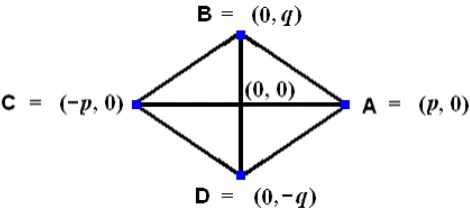
17. Suppose that we are given A, B, C, D in
R
R
R
R
2 whose coordinates are given byA
=
(
p
, 0),
B=
(0,
q
),
C=
(
–
p
, 0)
and D=
(0,
–
q
), where
p
,
q
>
0.
[image:8.612.187.422.311.417.2](
a
)
Prove that A, B, C, D form the vertices of a rhombus. [Hint: First of all, show thatd
(
A,
B)
=
d
(
B,
C)
=
d
(
C,
D)
=
d
(
D,
A). Next
, note that A–
B=
D–
C and use this to show that AB || CD. Finally, modify the preceding step to show that AD || BC.](
b
)
Prove that the distance between the parallel lines AB and CD is equal to the distance between the parallel lines AD and BC. [Hint: Let T be the orthogonal linear transformation defined by T(
x
,
y
)
=
(
x
,
–
y
),
and view T as an isometry ofR
R
R
R
2. What are the images of
A, B, C, D under T? What are the images of the lines AB, AD, BC and CD under T? Using these conclusions, prove that if F∈
∈
∈
∈
AB and G
∈
∈
∈
∈
CD are such that the line FG is perpendicular to both AB and CD, then T(F)∈
∈
∈
∈
AD and T(G)∈
∈
∈
∈
BC are such that the line T(F)T(G) is perpendicular to both AD and BC. Why will the result follow from this?]
18. Given a square whose sides all have length
a
,
it is possible to obtain a regularoctagon by cutting away four isosceles right triangles at the edges as suggested by the figure below. Suppose that
b
is the length of the sides of the regular octagonconstructed in this fashion. Express the value of
b
in terms ofa.
[Hint: Letc
be equal to the lengths of the legs of the isosceles right triangles that are removed to form the octagon. Find two equations relatinga
,
b
andc.
]24
the foot of the perpendicular from E to AB. Prove that if F lies on (AB), then (EF) is contained in the interior of the convex quadrilateral ABCD.
20. Prove an analog of Pasch’s Theorem for convex quadrilaterals: Suppose that A, B, C, D in
R
R
R
R
2 form the vertices of a convex quadrilateral and L is a line inR
R
R
R
2 which contains exactly one point of (AB). Prove that either L contains one of the vertices C, D or else it contains a point from one of (BC), (CD) or (AD).21. Suppose we are given four points A1, A2, A3, A4 in
R
R
R
R
2such that no three are
collinear, let A5
=
A1, and let Li=
A iA i+1, so that exactly two of the given fourpoints are on the line Li and the other two are not. Prove that for at least one choice of
i
the “remaining two” points of{
A1, A2, A3, A4}
both lie on the same side of
Li.22. A convex quadrilateral ABCD is said to be a convex kite (or deltoid) if
d
(
A,
B)
=
d
(
A,
D) and
d
(
C,
B)
=
d
(
C,
D). Prove that the line of the diagonal
AC in such a quadrilateral is the perpendicular bisector of the diagonal segment [BD], and also prove that|
∠∠∠∠ABC|
=
|
∠∠∠∠ADC|
. Also
, prove that|
∠∠∠∠BCD|
=
|
∠∠∠∠DAB|
if and only if convex quadrilateral ABCD is a rhombus.I
I
I.4 : Concurrence theorems
1. Let ABC be a triangle in
R
R
R
R
2. Define a real valued function
g onR
R
R
R
2 byg(X)
=
d
(
X,
A)
2+
d
(
X,
B)
2+
d
(
X,
C)
2. Prove that
g(X) takes a minimum value when X is the centroid of ABC.2. Suppose that the circumcenter V of ABC lies in the interior of that triangle. Prove that all three vertex angles of that triangle are acute (
i.e
., measure less than 90
°
). [Hint: Consider the three triangles VBC, VAB, VAC. Explain why they are isosceles, and show that |∠∠∠∠VBC|+
|∠∠∠∠VAB|+
|∠∠∠∠VAC|=
90
°
.
]25
4. Suppose that we have a triangle ABC suchthat the circumcenter V lies in the interior of the triangle, and let
R
be the radius of that circle. Let |∠∠∠∠BAC|=
β
β
β
β
.
Prove the following strong version of the Law of Sines:
R b ==== ⋅⋅⋅⋅
β β β β
2 1 sin
[Hint: Let D be the midpoint of [AC], and find
d
(
V,
A) and
|∠∠∠∠VAC| in terms ofb
,
β
β
β
β
andR
.
What does this imply aboutd
(
A,
D)
=
½b
? You might want to use some of the conclusions obtained in the solution to Exercise 2.]Note. The solution to Exercise 3 implies similar results for triangles with one right angle, and in fact the same conclusion holds if one of the angles in the triangle is obtuse (the argument is similar but slightly more complicated).
5. The following instructions were found on an old map:
Start from the right angle crossing of King’s Road and Queen’s Road.
Proceed due north on King’s Road and find a large pine tree and then a
maple tree. Return to the crossroads. Due west on Queen’s Road there
is an elm, and due east on Queen’s Road there is a spruce. One magical
point is the intersection of the elm – pine line with the maple – spruce line.
The other magical point is the intersection of the spruce – pine line with
the elm – maple line. The treasure lies where the line through the
magical points meets Queen’s Road.
A search party found the elm 4 miles from the crossing, the spruce 2 miles from the crossing, and the pine 3 miles from the crossing, but they found no trace of the maple. Nevertheless, they were able to locate the treasure from the instructions. Show how they were able to do this. [Hints: The treasure was eight miles east of the crossing. Probably the best way to do this problem is to set up Cartesian coordinates with King’s Road and Queen’s Road as the coordinate axes.]
26
7. Find the orthocenter of the triangle in the coordinate plane with vertices (
±
1, 0)
and (0, 2). [Hint: The line L joining (1, 0) and (0, 2) has equationy
+
2
x
=
2. Find the equation of the line
M which is perpendicular to L and passes through(1, 0). Explain why the orthocenter is the point where
M meets they
–
axis.]Note. For both Exercises 6 and 7, the numerical answers for the coordinates are expressible in relatively neat terms. The same applies to Exercise
9
.8. Find the incenter of ABC if A
=
(
1, 0
),
B=
(
0, 0
), and
C=
(
0, sqrt(3)
)
; the conditions of the problem imply that there is a right angle at B and a60
°
angle at C.
[Hint: The bisector for the angle at B has equationy
=
x
. Find
the equation of the line which bisects the angle at A.
]9. Find the circumcenter of the triangle in
R
R
R
R
2 with vertices(0, 0),
(3, 4),
and(6, 0),
and determine the circumradius of this triangle.10. Given a 120
°
–
30
°
–
30
°
isosceles triangle ABC, determine whether each of the circumcenter and orthocenter liesinside the triangle, on one of the vertices, on one of the sides between two vertices, or outside the triangle. You may assume that the legs of the isosceles triangle are [AB] and [AC], where A lies on they
–
axis and [BC] is contained in thex
–
axis.11. Suppose that we are given three noncollinear points a, b, c in
R
R
R
R
2 orR
R
R
R
3.Prove that the angle bisector for ∠∠∠∠abc is the ray [bx, where x
=
b+
y and y is given by . 2 1 − − − − − − − − + + + + − − − − − − − − b c b c b a b a[Hint: Let u and v be the unit vectors in the displayed expression, and let p
=
b+
u and q=
b+
v, so that ∠∠∠∠ abc=
∠∠∠∠ pbq. Then x is the midpoint of [pq]; note that qbp is isosceles
.
]12. Apply the result of the previous exercise to the angle in
R
R
R
R
2 with a=
(3, 4)
,b
=
(0, 0) and
c=
(2, 1)
to find a point x on the bisector of ∠∠∠∠abc other than b, and find the slope of the line bx (which goes through the origin).I
I
I.5 : Similarity
1. Prove that an affine transformation which preserves perpendicularity must be a similarity transformation.
27
T(z)
=
k
Az+
b, where A is given by an orthogonal matrix. Then the conclusion is equivalent to saying that there is a unique z such that (k
A–
I
) z=
b. By linearalgebra the latter happens if and only if there is no nonzero vector v such that
k
Av=
v. Assume to the contrary that such a vector exists, and, using the orthogonality of A, explain why the length of the vector on the left side is equal tok
|
v|
, and note that the length of the vector on the right side is just|
v|
. Why does this yield a contradiction?]3. Let ABC be a 3
–
4
–
5 right triangle with a right angle at
C such thatd
(
A,
C)
=
3,
d
(
B,
C)
=
4, and
d
(
A,
B)
=
5. Let
D be the point on (BC) such that [CD bisects ∠∠∠∠ACB. Compute the distancesd
(
A,
D)
and
d
(
D,
B).
4. Suppose we are given ABC
,
and let D∈
∈
∈
∈
(AB) be such that|
∠∠∠∠DCA|
=
|
∠∠∠∠ABC|
. Prove thatd
(
A,
C)
is the mean proportional betweend
(
A,
B)
andd
(
A,
D).
5. Let ABC be given, and let Z be a point on (AB. Let X and Y be points on the same side of AB as C such that AX, CZ and BY are all parallel to each other, and also assume that B
∗
C∗
X and A∗
C∗
Y. Prove that. ) , (
1 )
, (
1 )
, (
1
Y B X
A Z
C d d
d ==== ++++
6. Suppose that we are given positive real numbers
a
1, … ,a
n andb
1, … ,b
n such that1 1
b
a
b
a
i i
=
=
=
=
28
.
1 1 1 1b
a
b
b
a
a
n n=
=
=
=
+
+
+
+
+
+
+
+
+
+
+
+
+
+
+
+
L
L
7.
(
i
) Suppose that
ABC and DEF satisfy ABC~
DEF withd
(
B,
C)
≤
d
(
A,
C)
≤
d
(
A,
B).
Prove thatd
(
E,
F)
≤
d
(
D,
F)
≤
d
(
D,
E).
(
ii
) Suppose that we are given
ABC withd
(
B,
C)
≤
d
(
A,
C)
≤
d
(
A,
B)
and that (A′′′′, B′′′′, C′′′′) is a rearrangement of (A, B, C) such that ABC~
k A′′′′B′′′′C′′′′. Prove thatk
=
1.
[Hint: Split the proof into cases depending upon whether ABC is equilateral, isosceles with the base shorter than the legs, isosceles with the legs shorter than the base, or scalene;i.e.
, no two sides have equal length.]8. Suppose that we are given ABC
~
DEF, and let G and H be the midpoints of [BC] and [EF] respectively. Prove that ABG~
DEH.9. Suppose we are given the right triangle ABC such that
d
(
A,
B)
=
13,
d
(
A,
C)
=
5 and
d
(
B,
C)
=
12
, so that C is the right angle vertex. If X∈
∈
∈
∈
(AB) is such that [CX bisects ∠∠∠∠ACB, findd
(
A,
X).
10. Suppose we are given an isosceles triangle ABC in the coordinate plane
R
R
R
R
2whose vertices are given by A
=
(0,
h
),
B=
(
–
x
, 0),
and C=
(
x
, 0).
Then the incenter J (where the angle bisectors meet) lies on they
–
axis. Find itsy
–
coordinate. [Hint: What does the Angle Bisector Theorem imply?]I
I
I.6 : Circles and classical constructions
1. Let
Γ
Γ
Γ
Γ
be a circle with center Q, let [AB] and [CD] be chords ofΓ
Γ
Γ
Γ
(so that the endpoints lie on the circle), and let G and H be the midpoints of [AB] and [CD]. Prove thatd
(
Q, G)
=
d
(
Q, H)
if and only ifd
(
A, B)
=
d
(
C, D), andd
(
Q, G)
<
d
(
Q,H) if and only if
d
(
A, B)
>
d
(
C, D)
.2. Let
Γ
Γ
Γ
Γ
be a circle with center Q, and let L be a line containing a point X onΓ
Γ
Γ
Γ
. Prove that X is the only common point ofΓ
Γ
Γ
Γ
and L if and only if QX isperpendicular to L. (These are the usual synthetic descriptions for thetangent lineto
Γ
Γ
Γ
Γ
at X.)[Hint: If L also meets
Γ
Γ
Γ
Γ
at another point Y, explain why ∠∠∠∠QXY is acute.]29
4. Let
Γ
Γ
Γ
Γ
be a circle in the plane, let A be a point in the interior ofΓ
Γ,,,,
Γ
Γ
and let X be a point different from A. Prove that the ray [AX meetsΓ
Γ
Γ
Γ
in exactly one point. [Hint: By the line – circle theorem, the line AX meetsΓ
Γ
Γ
Γ
in two points B and C. Why do these points lie on opposite rays?]5.
(
SsA
Congruence Theorem for Triangles
)
Suppose we have ABC and DEF such that
|
∠∠∠∠CAB|
=
|
∠∠∠∠FDE|
andd
(
B,
C)
=
d
(
E,
F)
>
d
(
A,
B)
=
d
(
D,
E)
. Prove that
ABC≅
≅
≅
≅
DEF by supplying reasons for the steps listed below:(1) There is a point G
∈
∈
∈
∈
(AC such thatd
(
A,
G)
=
d
(
E,
F)
.
(2) GAB
≅
≅
≅
≅
FDE
.
(3)
d
(
B,
G)
=
d
(
E,
F)
=
d
(
B,
C)
.
(4) G lies on the circle
Γ
Γ
Γ
Γ
with center B and radiusd
(
B,
C)
.
(5) A lies in the interior ofΓ
Γ
Γ
Γ
.(6) (AG meets
Γ
Γ
Γ
Γ
in exactly one point. (7) C lies on (AG andΓ
Γ
Γ
Γ
.(8) C
=
G.(9) ABC
=
ABG, and ABC≅
≅
≅
≅
DEF
.
6. Let
Γ
Γ
Γ
Γ
be a circle whose center is Q, and let A be a point in the same plane that is not onΓ
Γ
Γ
Γ
and not equal to Q. Prove that the distance from A to a point X onΓ
Γ
Γ
Γ
is minimized for a point Y which also lies on the open ray (QA. [Hint: There are two separate cases depending upon whether A is in the interior or exterior of the circle. In the first case the point Y satisfies Q∗
A∗
Y, and in the second case it satisfiesQ
∗
Y∗
A. Show first that if W is the other point onΓ
Γ
Γ
Γ
∩
∩
∩
∩
QA, then the distance is not minimized at W; this leaves us with the cases where X does not lie on QA. The “larger angle is opposite the greater side” theorem is useful in the two separate cases when X does not lie on QA....
]7. Let
Γ
Γ
Γ
Γ
1111and
Γ
Γ
Γ
Γ
2222be concentric circles in the same plane, let Q be their center, and suppose that the radius
p
ofΓ
Γ
Γ
Γ
1111 is less than the radiusq
ofΓ
Γ
Γ
Γ
2222....
Whatis the set of all points X such that the shortest distance from X toΓ
Γ
Γ
Γ
1111 equals the shortest distance from X toΓ
Γ
Γ
Γ
2222 ? Give a proof that your assertion is correct.8. Prove the assertion in the notes about finding a triangle with given
SAS
data: Specifically, if we are given positive real numbersb
andc
, and
α
α
α
α
is a real number between 0 and 180, then there is a triangle ABC such thatd
(
A,
B)
=
c
,
d
(
A,
C)
=
b
, and
|
∠∠∠∠CAB|
=
α
α
α
α
°
....
30
center Q and radius
r
. There are two cases depending upon whether or not Q∈
∈
∈
∈
L. Use the Ruler Axiom to prove the result in the first case. In the second case, if the circle contains three points of the circle, explain why we can label then X, Y, Z such that X
∗
Y∗
Z. Show that|
∠∠∠∠QXY|
=
|
∠∠∠∠QYX|
=
|
∠∠∠∠QZY|
=
|
∠∠∠∠QXY|
using the Isosceles Triangle Theorem. On the other hand, why do we also know that|
∠∠∠∠QYX|
+
|
∠∠∠∠QXY|
=
180
°
,and why does this yield a contradiction?]
10. Let A, B, C be three distinct noncollinear points. Prove that there is a unique circle containing them.
11. Let A and B be distinct points, let D be the midpoint of [AB], and let
Ω
be the set of all points X such that X=
A, X=
B, or X does not lie on AB and AX ⊥⊥⊥⊥ XB. Prove thatΩ
is the circle with center D and radius ½d
(
A,
B).
12. Let L and M be the coordinate axes in
R
R
R
R
2, and let S be the set of all pointsZ such that
d
(Z, L)+
d
(Z, M)=
d
(Z, Q)2, whered
(Z, K) is distance from a point Z to the foot of the perpendicular to the line K containing Z and Q denotes the origin. Prove that S is the union of four circular arcs; describe each arc in terms of itsendpoints, the centers of the circles, and whether it is a minor arc, semicircle or major arc. [Hint: Look first at the set of points in S which also lie in the closed first quadrant of points whose coordinates are both nonnegative
.
]13. Let
Γ
Γ
Γ
Γ
be a circle with center Q, let A be a point on that circle, and letΩ
be the set of all points X such that either X=
A or else is the midpoint of the segment[AB] for some B
∈
∈
∈
∈
Γ
Γ
Γ
Γ
. Prove thatΩ
is a circle whose center is the midpoint of [AQ]. [Hint: First consider the special case where Q is the origin and A is the point with coordinates (a
, 0); use coordinates to prove the result in this case
. One can then modify the argument to work in the general case by taking U to be the unit vector in the direction of A–
Q and defining V to be a unit vector in a perpendicular direction.
]14. Let
Γ
Γ
Γ
Γ
be a circle with center Q, let A, B, C, D be four points onΓ
Γ
Γ
Γ
such that Q does not lie on AB or CD, and let E and F be the feet of the perpendiculars from Q to AB and CD respectively. Prove thatd
(A, B)=
d
(C, D) if and only ifd
(Q, E)=
d
(Q, F). [This is often stated in the form, two chords of a circle have equal length if and only if the distances from the center of the circle to these chords are equal.]15. Suppose that A, B, C, D are the vertices of a convex kite as defined in Exercise I
I
I.3.22. Prove that there is a circle
Γ
Γ
Γ
Γ
such that all four sides of the31
I
I
I.7 : Areas and volumes
1. Prove that the area of the region bounded by a rhombus is equal to half the product of the lengths of its diagonals.
2. Using Heron’s Formula, derive a formula for the area of the region bounded by an equilateral triangle whose sides all have length equal to
a
.
3. Is there a formula for the area of the region bounded by a convex quadrilateral in terms of the lengths of the four sides (and nothing else)? Give reasons for your answer. [Footnote: Compare this with the formula of Brahmagupta, which is stated in the notes and is valid if the vertices all lie on a circle.]
4. Suppose that the radius of the circle inscribed in ABC is equal to
q
. Using Heron’s Formula, prove thatq
is equal to sqrt(
(
s
–
a
)(
s
–
b
)(
s
–
c
)
/
s
)
.
[Hint:Look at the drawing for Theorem I
I
I.4.8, and explain why this figure leads to a formula
for the area of the triangle in terms ofq
ands
.
]5. In the drawing below, the blue lines are the axes in the coordinate plane, the points S, T, U and V have coordinates (1, 1), (
–
1, 1), (
–
1,
–
1) and (1,
–
1)
respectively, and the large circle containing them has equationx
2+
y
2=
2. The
point Q is the center of this circle, the point X is (0, 1), the smaller semicircles have radius 1, and the numbers A, B, C denote the areas of the regions bounded by the appropriate curves. Using the standard formula AREA(Γ
Γ
Γ
Γ
)
=
π
π
π
π
r
2
for a solid region
bounded by a circleΓ
Γ
Γ
Γ
of radius
r
, show that A=
C and use this to evaluate C explicitly as a radical expression involving positive integers. An informal argument will be acceptable. Here is a drawing which depicts the data of the problem:32
Notes: This relationship was discovered by Hippocrates of Chios (470 – 410 B. C. E.), who was not the same person as the celebrated physician Hippocrates of Kos (460 – 377 B. C. E.). Further information on problems of this sort is summarized following the solution to this exercise (see the solutions file for this section), and there also is a detailed discussion of the topic at a fairly elementary level in Chapter 10 of the following book:
T. Dantzig, Mathematics in Ancient Greece (Reprint of the 1955
book,The Bequest of the Greeks). Dover, New York, 2006.
The original edition of this book is also available at the following online site: