FM 7-1
(FM 25-101)
BATTLE FOCUSED
TRAINING
DISTRIBUTION RESTRICTION:
Approved for public release; distribution is unlimited.
Field Manual
No. 7-1
Headquarters
Department of the Army
Washington, DC, 15 September 2003
Battle Focused Training
Contents
Page
Preface ... XII
Training Objectives...3-29 Summary ...3-36 Chapter 4 PLANNING ...4-1 Training Planning Process...4-2
Section I. Training Assessment ...4-3
Assessments by Commanders of Battalions, Brigades, and Above ...4-4 Assessments by Commanders of Companies, Batteries, and Troops...4-5 Assessments by Noncommissioned Officers ...4-5 Assessment Ratings...4-6 Evaluation Ratings...4-6 Brigade Combat Team Commander Assessment Example...4-6
Section II. Training Strategy ...4-27
Overview...4-27 Combined Arms Training Strategy (CATS) ...4-30 Training Adaptive Leaders and Units ...4-30 Live, Virtual, and Constructive Training...4-32 Sample Commander Training Strategies ...4-34
Section III. Command Training Guidance ...4-45 Section IV. Training Plans ...4-46
Planning Calendars ...4-47 Time Management...4-49 Long-Range Planning...4-52 Short-Range Planning ...4-56 Near-Term Planning ...4-71 Training Meetings ...4-75 Training Schedules...4-78 Summary ...4-81 Chapter 5 EXECUTION...5-1
Section I: Training Execution ...5-2
The Role of Commanders ...5-3 The Role of Noncommissioned Officers...5-3 Sergeants Time Training ...5-3 Crawl-Walk-Run Training ...5-4 Efficient and Effective Training ...5-5 Presentation of Training ...5-6 Situational Training Exercises ...5-7 Live Fire Exercises ...5-8 Staff Training ...5-9
Section II: Preparation for Training ...5-11
Train the Trainer ...5-13 Conduct Pre-Execution Checks ...5-15 Preparation for Training Examples...5-15
Section III: Conduct of Training ...5-62
Conduct Pre-Combat Checks...5-63 Execute Training...5-64 Conduct After Action Reviews ...5-65 Retraining ...5-65
Section IV: Recovery from Training ...5-66
Chapter 6 ASSESSMENT...6-1 Assessment ...6-2 Organizational Assessment...6-2 Training Assessment ...6-4 Training Evaluation...6-4 Certification...6-10 After Action Review ...6-11 Lessons and Lessons Learned ...6-12 Example Training Assessments ...6-12 The Role of Commanders and Leaders ...6-27 Summary ...6-29 Appendix A LEADER TRAINING AND LEADER DEVELOPMENT IN UNITS... A-1
Appendix B COMPANY TRAINING MEETING ... B-1
Appendix C AFTER ACTION REVIEW (AAR) ... C-1
Appendix D TRAINING EXERCISE DEVELOPMENT ... D-1
Appendix E EXAMPLE TRAINING GUIDANCE ... E-1
Appendix F EXAMPLE QTB AND YTB... F-1
Appendix G TRAINING SUPPORT SYSTEM (TSS) ...G-1
Appendix H RISK MANAGEMENT... H-1
Glossary ... Glossary-1
References ... References-1
Figures
Figure 1-1. Army Training and Leader Development Model ... 1-4 Figure 1-2. The Operational Army ... 1-6 Figure 1-3. The Institutional Army ... 1-8 Figure 2-1. Principles of Training ... 2-1 Figure 2-2. Brigade Combat Team Organization ... 2-4 Figure 2-3. Combined Arms Training—Scope and Scale ... 2-5 Figure 2-4. Band of Excellence ... 2-10 Figure 2-5. Overlapping Training Responsibilities... 2-12 Figure 2-6. Integration of Collective and Individual Training ... 2-15 Figure 2-7. Army Training Management Cycle... 2-17 Figure 3-1. Mission Essential Task List Development Process ... 3-3 Figure 3-2. UJTL–AUTL–ARTEP-MTP Crosswalk... 3-4 Figure 3-3. Fundamental Concepts Used in METL Development... 3-6 Figure 3-4. Relationships between Mission, METL, Critical Tasks, and Battle Task ... 3-9 Figure 3-5. Brigade METL Development Sequence ... 3-10 Figure 3-6. Battalion METL Development Sequence ... 3-11 Figure 3-7. METL Crosswalk ... 3-12 Figure 3-8. Company METL Development Sequence ... 3-13 Figure 3-9. Company METL Development... 3-14 Figure 3-10. Infantry Company METL Development... 3-15 Figure 3-11. Battery METL Development... 3-15 Figure 3-12. Brigade Support Medical Company METL Development ... 3-16 Figure 3-13. Selection of Platoon Critical Tasks and Platoon-Level Leader Tasks ... 3-17 Figure 3-14. Selection of Infantry Platoon Critical Tasks and Platoon-Level Leader
Tasks... 3-17 Figure 3-15. Selection of Platoon, Section, and Team Critical Tasks ... 3-18 Figure 3-16. Selection of Ambulance Platoon Critical Tasks and
Platoon-Level Leader Tasks ... 3-18 Figure 3-17. Selection of Squad Critical Tasks and Drills, and Squad-Level Leader
Tasks... 3-19 Figure 3-18. Selection of Infantry Squad Critical Tasks and Squad-Level Leader
Tasks... 3-20 Figure 3-19. Selection of Section Critical Tasks and Section-Level Leader Tasks... 3-20 Figure 3-20. Selection of Ambulance Squad Critical Tasks and Squad-Level Leader
Figure 3-26. Direct Support (DS) Field Artillery Battalion Staff METL Development ... 3-25 Figure 3-27. Direct Support (DS) Field Artillery Battalion Staff Officer Task
Development ...3-25 Figure 3-28. Brigade Support Battalion (BSB) Staff METL Development ... 3-26 Figure 3-29. Garrison METL Development ...3-28 Figure 3-30. Example of Training Objective for a BCT Mission Essential Task... 3-31 Figure 3-31. Example of Training Objective for an Infantry Battalion,
BCT Mission Essential Task ... 3-32 Figure 3-32. Example of Training Objective for an Infantry Company
Mission Essential Task ... 3-32 Figure 3-33. Example of Training Objective for an Infantry Platoon Task ... 3-33 Figure 3-34. Example of Training Objective for an Infantry Squad Task ... 3-33 Figure 3-35. Example of Training Objective for an Infantry Individual Soldier Task ... 3-33 Figure 3-36. Example of Training Objective for a Brigade Support Battalion,
BCT Mission Essential Task ... 3-34 Figure 3-37. Example of Training Objective for a Brigade Support Medical
Company Mission Essential Task ... 3-34 Figure 3-38. Example of Training Objective for an Ambulance Platoon Task ... 3-35 Figure 3-39. Example of Training Objective for an Ambulance Squad Task ...3-35 Figure 3-40. Example of Training Objective for Individual Soldier Task ... 3-35 Figure 4-1. Training Planning Process ... 4-2 Figure 4-2. Training Planning Process (Training Assessment)... 4-4 Figure 4-3. METL Crosswalk ... 4-8 Figure 4-4. “Bottom-Up” Input (Conduct an Attack) ... 4-9 Figure 4-5. “Bottom-Up” Input (Coordinate Fire Support) ... 4-15 Figure 4-6. “Bottom-up” Input (Acquire Targets) ... 4-16 Figure 4-7. “Bottom-Up” Input (Defend Against Level I and II Threats and Provide
Direct Support (DS) Level Combat Service Support) ... 4-20 Figure 4-8. Training Planning Process (Training Strategy) ... 4-28 Figure 4-9. Training Strategy... 4-29 Figure 4-10. Training Adaptive Leaders and Units... 4-31 Figure 4-11. Training Adaptability ... 4-32 Figure 4-12. Selected Training Tasks to Improve BCT METL Proficiency for METL
Task: “Conduct an Attack” ... 4-34 Figure 4-13. 1st BCT Commander’s Training Strategy ... 4-35 Figure 4-14. Selected Training Tasks to Improve 1-77 IN METL Proficiency for METL
Tasks: “Assault an Objective” and “Breach an Obstacle” ... 4-37 Figure 4-15. 1-77 IN Commander’s Training Strategy ... 4-38 Figure 4-16. Selected Training Tasks to Improve A/1-77 IN METL Proficiency for
METL Tasks: “Assault an Objective,” “Integrate Indirect Fire Support,”
and “Breach an Obstacle” ... 4-39 Figure 4-17. A/1-77 IN Commander’s Training Strategy ... 4-40 Figure 4-18. A/1-77 IN Commander’s Training Strategy (continued)... 4-41 Figure 4-19. A/1-77 IN Leader, Individual, Collective, and OPFOR Training Strategy ... 4-43 Figure 4-20. Selected Training Tasks to Improve 1-77 IN METL Proficiency for METL
Tasks: “Defend Against Level I and II Threats” and “Provide DS Level
Figure 4-21. Training Strategy Summary ... 4-44 Figure 4-22. Training Planning Process (Commander’s Guidance)... 4-45 Figure 4-23. Training Planning Process (Training Plans) ... 4-46 Figure 4-24. Green-Amber-Red Time Management System ... 4-50 Figure 4-25. Green-Red Time Management System ... 4-51 Figure 4-26. Training Planning Process (Long-Range Planning)... 4-53 Figure 4-27. 52nd Infantry Division (Mech) Long-Range Planning Calendar Major
Training Events ... 4-56 Figure 4-28. Training Planning Process (Short-Range Planning) ... 4-57 Figure 4-29. 52nd Infantry Division (Mech) Major Training Events, 2nd Quarter, FY
XX ... 4-58 Figure 4-30. 52nd Infantry Division (Mech) Short-Range Planning Cycle ... 4-60 Figure 4-31. Multiechelon Training ... 4-62 Figure 4-32. 1st BCT Major Training Events, 2nd Quarter, FY XX ... 4-63 Figure 4-33. 1st BCT Short-Range Planning Cycle... 4-63 Figure 4-34. 1-77 Infantry Battalion Major Training Events, 2nd Quarter, FY XX... 4-64 Figure 4-35. 1-77 Infantry Battalion Short-Range Planning Cycle ... 4-65 Figure 4-36. 1st BSB Major Training Events, 2nd Quarter, FY XX ... 4-66 Figure 4-37. RC IN Battalion and Company Short-Range Training Plans (Major
Events) ... 4-67 Figure 4-38. RC BSB, Forward Maintenance Company, and Medical Company
Figure 5-8. Sample Pre-Execution Checklist... 5-15 Figure 5-9. Selected Training Tasks to Improve A/1-77 IN METL Proficiency for
METL Tasks: “Assault an Objective,” “Integrate Indirect Fire Support,”
and “Breach an Obstacle” ... 5-17 Figure 5-10. A/1-77 IN Commander’s Training Strategy ... 5-18 Figure 5-11. 1st BCT and 1-77 IN 2nd Quarter Training (Major Events) ... 5-19 Figure 5-12. STX/LFX Training Plan ... 5-20 Figure 5-13. A/1-77 Leader Training ... 5-21 Figure 5-14. A/1-77 IN Near-Term Training Plan (Jan-Feb XX)... 5-22 Figure 5-15. RC Infantry Battalion Near-Term Training Plan (Major Events) ... 5-23 Figure 5-16. A/1-77 IN Trainer, Evaluator, and OC Training (Squad EVAL Force on
Force Phase and LFX)... 5-26 Figure 5-17. A/1-77 IN Squad EVAL OPFOR Preparation (Force On Force Phase)... 5-27 Figure 5-18. A/1-77 IN Leader, Individual, Collective, and OPFOR Training Strategy ... 5-28 Figure 5-19. A/1-77 IN Squad EVAL STX Site Preparation and Pre-Execution Checks
(Force on Force and LFX Phases...5-29 Figure 5-20. “Bottom-Up” METL Assessment Input (Headquarters and Distribution
Company)... 5-32 Figure 5-21. “Bottom-Up” METL Assessment Input (Forward Maintenance Company) ... 5-33 Figure 5-22. “Bottom-up” METL Assessment Input (Brigade Support Medical
Company)... 5-35 Figure 5-23. BSB Commander’s Training Strategy ... 5-36 Figure 5-24. BSB Company Commanders’ Training Strategies... 5-37 Figure 5-25. 1st BSB and 1st BCT 2nd Quarter Training (Major Events) ... 5-38 Figure 5-26. HQ/Distribution Company, Forward Maintenance Company, and Brigade
Support Medical Company 2nd Quarter Training (Major Events)... 5-40 Figure 5-27. BSB QRF OPFOR Preparation for 2nd Quarter Training (Major Events)... 5-43 Figure 5-28. 1st BSB Pre-Execution Checks for BSB FTX ... 5-44 Figure 5-29. RC BSB Near-Term Training Plan (Major Events) ... 5-45 Figure 5-30. Selected Main CP Cell and Element Training Tasks to Improve R&S
Team Proficiency on the Staff Group Task: “Develop an R&S Plan” ... 5-47 Figure 5-31. Selected Main CP Cell and Element Training Tasks to Improve
Targeting Team Proficiency on the Staff Group Task: “Execute Targeting
Process” ... 5-47 Figure 5-32. Selected Training Tasks to Improve BCT Targeting Team Proficiency on
Staff Task: “Execute Targeting Process” ... 5-49 Figure 5-33. Selected Intelligence Cell and BCT MI Company Training Tasks to
Improve BCT Staff Proficiency for “Develop an R&S Plan” ... 5-50 Figure 5-34. Selected Training Tasks to Improve BCT METL Proficiency for METL
Task: “Conduct an Attack” ... 5-51 Figure 5-35. 1st BCT Commander’s Training Strategy ... 5-52 Figure 5-36. 52nd IN Division and 1st BCT 2nd Quarter Training (Major Events)... 5-53 Figure 5-37. 1st BCT Main CP Staff Near-Term Training Plan (Jan-Mar XX) ... 5-54 Figure 5-38. 1st BCT Main Command Post ATCCS/FBCB2 Systems Training to
Support R&S and Targeting Teams’ Preparation for Shaping Operations
Figure 5-40. Staff Group Training—R&S Team Task: “Develop an R&S Plan” ... 5-57 Figure 5-41. Staff Group Training—Targeting Team Task: “Execute Targeting
Process” ... 5-58 Figure 5-42. Multiechelon Training Event in the 1st BCT Main CP Staff Near-Term
Training Plan ...5-59 Figure 5-43. 1st BCT Staff Trainer, Evaluator/OC Training (2nd BCT EXEVAL)... 5-60 Figure 5-44. 2nd BCT EXEVAL OPFOR Preparation ... 5-61 Figure 5-45. Site Preparation and Pre-Execution Checks for 1st BCT Shaping
Operations Exercise... 5-62 Figure 5-46. Training Execution (Conduct of Training) ... 5-63 Figure 5-47. Sample Pre-Combat Checks ... 5-64 Figure 5-48. Retraining... 5-66 Figure 5-49. Training Execution (Recovery from Training) ... 5-67 Figure 5-50. Overall Training Effectiveness AAR... 5-68 Figure 5-51. Training Execution ... 5-69 Figure 6-1. Sources of Evaluation Data for Organizational Assessments ... 6-3 Figure 6-2. Uses of Types of Evaluations ... 6-6 Figure 6-3. Contents of Evaluation and Control Plan ... 6-7 Figure 6-4. Sample Evaluator Group Organization Worksheet... 6-8 Figure 6-5. Evaluator Training Topics ... 6-10 Figure 6-6. Training Assessment... 6-19 Figure 6-7. Army Training Management Cycle... 6-29 Figure 6-8. Operations Process... 6-30 Figure 6-9. Army Training Management Cycle... 6-30 Figure A-1. The Goal ...A-2 Figure A-2. Key Elements of Leader Training and Leader Development Action Plan ...A-7 Figure B-1. Suggested Company Training Meeting Participants ...B-2 Figure B-2. Sample Training Meeting Agenda ...B-4 Figure B-3. Assessment of Completed Training...B-5 Figure B-4. Preparation for Near-Term Training ...B-6 Figure D-1. Training Exercise Selection Process... D-2 Figure D-2. Training for Mission Command—Nested Concepts ... D-4 Figure D-3. Training for Mission Command (1st BCT) ... D-6 Figure D-4. Training for Mission Command (1-77 IN) ... D-7 Figure D-5. 1st BCT Main CP Staff Training Exercises ... D-8 Figure D-6. BCT Shaping Operations Live Fire Exercise Concept ... D-9 Figure D-7. BCT Shaping Operations Live Fire Exercise: UAV Platoon Conducting
Surveillance and Target Acquisition Operations... D-10 Figure D-8. BCT Shaping Operations Live Fire Exercise: FA BN Acquire Targets and
Deliver Fires ... D-11 Figure D-9. BCT Shaping Operations Live Fire Exercise: FA BN Suppress Enemy Air
Defenses ... D-11 Figure D-10. BCT Shaping Operations Live Fire Exercise: Employ Attack Helicopters
Figure D-12. Linking a Tank Company and Battalion Task Force Home Station
Tables
Table 3-1. RC Training Management Roles... 3-27 Table 4-1. BCT Commander’s Combined Arms Training Assessment, METL Task:
“Conduct an Attack”: “P” ... 4-7 Table 4-2. Squad Leader’s Training Assessment, Squad Critical Task: “Knock Out a
Bunker”: “P”...4-10 Table 4-3. 1st Platoon Leader’s Training Assessment, Platoon Critical Task:
“Assault an Objective”: “P” ... 4-11 Table 4-4. Company Commander’s Training Assessment, METL Task: “Assault an
Objective”: “P” ... 4-12 Table 4-5. Battalion Commander’s Training Assessment, METL Task: “Conduct an
Attack”: “P”... 4-14 Table 4-6. Company FSO’s Training Assessment, Critical Task: “Coordinate Fire
Support”: “P”...4-17 Table 4-7. Battalion FSO’s Training Assessment, Critical Task: “Coordinate Fire
Support”: “P”...4-18 Table 4-8. ECOORD’s Training Assessment, METL Task: “Coordinate Fire
Support”: “P”...4-19 Table 4-9. Squad Leader’s Task Assessment, Squad Critical Tasks: “Set-up Squad
Defense” and “Operate AXPs”: “P” ...4-21 Table 4-10. Ambulance Platoon Leader’s Training Assessment, Platoon Critical
Tasks: “Set-up Platoon Defense” and “Provide Ground Ambulance
Evacuation Support”: “P”... 4-22 Table 4-11. Company Commander’s Training Assessment, Company METL Tasks:
“Defend Unit Area” and “Perform Combat Health Support Operations”:
“P” ...4-23 Table 4-12. Battalion Commander’s Training Assessment, METL Tasks: “Defend
Against Level I and II Threats” and “Provide DS Level Combat Service
Support”: “P”...4-24 Table 4-13. BCT Staff Training Assessment, METL Task: “Conduct an Attack”:”P”... 4-25 Table 4-14. BCT Commander’s Combined Arms Training Assessment, METL Task:
“Conduct an Attack”: “P” ... 4-26 Table 4-15. BCT Commander’s BOS Training Assessment, METL Task: “Conduct
Attack”: “P” ... 4-27 Table 4-16. Live, Virtual, and Constructive Training Mix... 4-33 Table 4-17. Comparison of Long-Range, Short-Range, and Near-Term Training
Table 5-1. Individual Training Example: M16A2 Preliminary Marksmanship
Instruction (PMI)... 5-24 Table 6-1. Task Evaluation Matrix ... 6-9 Table 6-2. Battalion Commander’s Training Assessment, METL Tasks: “Defend
Against Level I and II Threats” and “Provide DS Level Combat Service
Preface
FM 7-1 is the Army’s doctrinal foundation for how to train, and it is applicable to all units and organizations of the Army. It explains how the Army assesses, plans, prepares, and executes training and leader development; it is critical to all the Army does. The goal of this manual is to create leaders who know how to think and apply enduring training principles to their units and organizations.
FM 7-0 introduces the training cycle, the linkage of Army training and leader development, and the three domains where training occurs—the operational, institutional, and self-development domains. FM 7-1 defines The Army Training System, outlines who is responsible for training and training support, and describes how to conduct training. This top-to-bottom understanding of training—ranging from policy and resources allocation at Headquarters, Department of the Army to unit and organization methods—is critical to executing training successfully and to linking the three domains where training occurs.
The training doctrine in this manual will shape Army training regulations and support unit and organization training plans. The emphasis is on teaching leaders to think through the training process, as opposed to simply following a prescribed method. There is no training model or strategy that can achieve warfighting readiness in a unit without intensive leadership to build both competence and confidence.
FM 7-1 builds on task, condition, and standards-based training. Knowing the task, assessing the level of proficiency against the standard, and developing a sustaining or improving training plan is the essence of all Army training and development. But warfighting readiness is about more than just technical competence. It is about developing confidence through trust—soldier-to-soldier, leader-to-led, and unit-to-unit—and the will to succeed. It is about leadership.
Understanding how to conduct tough, realistic training at every echelon of the Army sets the foundation for successful multiechelon, joint, interagency, and coalition operations. Leaders train the unit and organizational capabilities required to fight and win across the full spectrum of operations. This manual provides leaders with the doctrinal guidelines for how to train, and is the basis for successful training and operations. Soldiers have never let the nation fail—it is essential to train soldiers and units to uphold the Army’s nonnegotiable contract with the American people—to fight and win the nation’s wars, decisively.
The proponent for this publication is U. S. Army Training and Doctrine Command (TRADOC).
Send comments and recommendations on DA Form 2028 (Recommended Changes to Publications and
Blank Forms) to Commander, U.S. Army Combined Arms Center, CAC-T, Collective Training
Directorate, ATTN: ATZL-CTD, Fort Leavenworth, Kansas 66027-6900.
Direct email questions to the CTD Operations Officer at [email protected]
Copyright Permissions
The copyright owners listed below have granted permission to reproduce material from their works. Other sources of quotations and material used in this book are listed in the References section.
The quotation by General Douglas MacArthur in chapter 5 is reprinted from Robert D. Heinl, Dictionary of Military and Naval Quotations (Annapolis: U.S. Naval Institute Press, 1966) page 329.
The quotation attributed to Confucius in chapter 6 is reprinted from Robert D. Heinl, Dictionary of Military and Naval Quotations (Annapolis: U.S. Naval Institute Press, 1966) page 328.
The quotation by SMA Silas L. Copeland in appendix B is reprinted from “The NCO Must Grow with the Army” Army Magazine, Arlington, VA, October 1972, page 25. Used with permission.
The quotation by SMA William A. Connelly in appendix C is reprinted from “NCOs: It’s Time to Get Tough” Army Magazine, Arlington, VA, October 1981, page 30. Used with permission.
CONTENTS
Training Overview ... 1-1 The Training Challenge ... 1-2 Joint, Interagency,
intergovernmental,
Multinational Training ... 1-2 The Army Training System... 1-3 The Army Training and Leader
Development Model ... 1-4 The Operational Army... 1-5 The Institutional Army ... 1-7 Individual Self-Development ... 1-10 Reserve Component Training ... 1-12 Premobilization and
Postmobilization Training... 1-12 Summary... 1-13
Chapter 1
How the Army Trains
Every day in the Army we try to do two things well—train soldiers and grow them into leaders.
General Eric K. Shinseki
TRAINING OVERVIEW
1-1. Field manual (FM) 7-0 establishes Army training doctrine. FM 7-1
applies this doctrine to help unit leaders develop and execute training programs. It provides practical “how to” guidelines for officers and noncommissioned officers (NCO), including techniques and procedures for planning, preparing, executing, and assessing training. Above all, FM 7-1 builds on and emphasizes the importance of battle focused training described in FM 7-0.
1-2. FM 7-1 defines the roles,
responsibilities, and linkages of the institutional, operational, and self-development domains within the Army Training and Leader Development Model (ATLDM). It provides training doctrine
for current and future operating environments. FM 7-1 describes in detail Army training management at the brigade level and below; however, the principles and the fundamentals in FM 7-1 are applicable to the entire Army. Every day, every person in the Army is involved directly or indirectly in training soldiers and developing leaders.
1-3. FM 7-1 provides a common training language for the Army. To this end,
it describes—
Standardized training terms of reference.
Training management and execution systems and processes that support unit readiness.
Processes and products that support training and leader development.
Roles and responsibilities of the institutional, operational, and self-development domains to support full spectrum operations.
1-4. While senior leaders determine the direction and goals of training, it is
THE TRAINING CHALLENGE
1-5. Since the end of the Cold War, the world has been in a state of
significant transition marked by increased uncertainty and vulnerability. The strategic environment is much less stable than in the past, and threats to American interests are more diverse and less predictable. In this era of complex national security requirements, the Army must embrace a wider range of missions that present even greater training challenges. To “train the way we fight,” commanders and leaders must conduct training in a way that ensures mission performance in the contemporary operating environment.
1-6. Training for warfighting readiness is the Army’s number one priority in
peace and war. Army leaders at all levels are responsible for success on the battlefield. Training is a continuous, lifelong endeavor that produces competent, confident, disciplined, and adaptive soldiers and leaders with the warrior ethos in our Army. Commanders have two major training responsibilities: train their unit to accomplish the assigned mission, and develop soldiers and leaders for future responsibilities.
1-7. Personnel turbulence, key-leader turnover, high operating tempo
(OPTEMPO), and new equipment and systems fielding present a demanding set of training challenges. Resources for training are not unconstrained—they compete with other resource demands. Time is the inelastic resource—there is never enough, and it cannot be increased. All leaders must focus training on warfighting skills, and make that training the priority. Compliance training and non-mission activities are lower priority. If training cannot be conducted to standard, then commanders use readiness reports to inform the Army’s leadership of the risks being assumed.
JOINT, INTERAGENCY, INTERGOVERNMENTAL, MULTINATIONAL TRAINING
1-8. The purpose of joint training is to prepare the Army to execute missions
as part of a joint force conducting joint military operations across the full spectrum of operations. Employing Army forces at the right place and time allows combatant commanders to conduct decisive land operations along with air, sea, and space-based operations. The Army provides either a Joint Force Land Component Commander (JFLCC) or a joint force commander (JFC) with trained and ready forces that expand the commander’s range of military options. Army commanders tailor and train forces to react quickly to any crisis.
1-9. Commanders of major Army headquarters (Army Service component
commander, corps or division) may serve as the joint or coalition force land component commander (JFLCC/CFLCC), as a combined forces commander (CFC), or as the joint task force commander (JTFC). To prepare to conduct these operations these headquarters conduct joint, interagency, intergovernmental, multinational, and Service-specific training.
1-10. Joint training uses joint doctrine, tactics, techniques, and procedures
(TTP), and involves more than one Service component.
1-11. When two or more Services train together using their respective
1-12. Interagency training is training based on applicable standing operating procedures (SOPs). It is designed to prepare the Army to operate with other federal agencies (such as the Federal Bureau of Investigation, Central Intelligence Agency, Defense Intelligence Agency), private voluntary organizations, non-governmental organizations, and international organizations.
1-13. Intergovernmental training is training based on applicable standing
operating procedures (SOPs). It is designed to prepare the Army to operate with state and local government (for example, in a homeland defense role).
1-14. Multinational training is training based on applicable multinational,
joint and/or Service doctrine. It is designed to prepare organizations for multinational operations with other nations.
1-15. The Army training doctrine in this manual provides commanders with
the tools to develop adaptive leaders and organizations prepared to exercise command and control (C2) of joint and multinational forces and to operate with interagency and intergovernmental organizations. This training facilitates unity of effort.
THE ARMY TRAINING SYSTEM
1-16. The Army training system is a cooperative effort between the
institutional Army, units and organizations, and individuals. The systems approach to training is the foundation of the Army training system.
1-17. The systems approach to training is an analytical method that
determines what tasks units are expected to perform on the battlefield, under what conditions they will perform the tasks, and the standard that they must achieve. It further identifies leader and individual tasks that units must perform to be successful in their battlefield tasks. Some of these tasks are designated as critical.
1-18. The systems approach to training is the engine that drives many
elements of the Army training system. It is the foundation for—
Doctrinal publications, such as Army Training and Evaluation Program-mission training plans (ARTEP-MTPs) and soldier training publications (STPs).
Institutional training programs of instruction (POIs) for initial military training (IMT) and within the Officer Education System (OES), the Warrant Officer Education System (WOES), and the Noncommissioned Officer Education System (NCOES).
Collective training strategies.
1-19. The systems approach to training is the analytical basis for unit,
leader, and individual training proficiency. It is the science of the training system. Commanders combine this science with the art of leadership to train their units to perform their warfighting missions.
1-20. The Army training system focuses the Army’s training efforts on
THE ARMY TRAINING AND LEADER DEVELOPMENT MODEL
1-21. The Army Training and Leader Development Model (ATLDM)
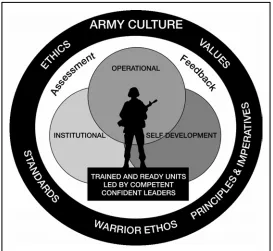
[image:19.612.170.443.204.455.2](figure 1-1) centers on developing trained and ready units led by competent and confident leaders. The model identifies the important interaction necessary to train soldiers now and to develop leaders for the future. The three core domains that shape the critical learning experiences throughout a soldier’s and leader’s career are the operational, institutional, and self-development domains. These domains interact to focus Army energy and resources on training and leader development.
Figure 1-1. Army Training and Leader Development Model
1-22. The Army is a profession, the profession of arms. Warfighting in
COMMANDER’S RESPONSIBILITY
1-23. The commander is responsible for the wartime readiness of all elements
in the formation and is, therefore, the primary trainer. Training soldiers and developing leaders is the commander’s number one priority. Commanders observe and evaluate training and leader development at all levels of the organization. They provide feedback as coach, teacher, and mentor. They train to standard, not to time.
NONCOMMISSIONED OFFICER’S RESPONSIBILITY
1-24. A great strength of the U.S. Army is its professional noncommissioned
officer (NCO) corps, which takes pride in being responsible for the individual training of soldiers, crews, and small teams. NCOs conduct standards-based, performance-oriented, battle focused training. They—
Identify specific individual, crew, and small team tasks that support the unit’s collective mission essential tasks.
Plan, prepare, rehearse, and execute training.
Evaluate training and conduct after action reviews (AARs) to provide feedback to the commander on individual, crew, and small team proficiency.
Fulfill an important role by assisting in the professional development of the officer corps.
THE OPERATIONAL ARMY
1-25. Training in the operational Army includes home station training,
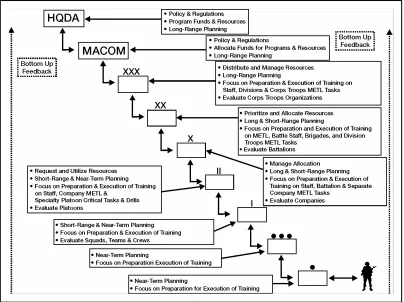
Figure 1-2. The Operational Army
HEADQUARTERS, DEPARTMENT OF THE ARMY
1-26. Headquarters, Department of the Army (HQDA) is responsible for
providing trained and equipped forces to combatant commanders. The HQDA staff proponent for discharging training-related responsibilities is the Army Assistant Chief of Staff for Operations and Plans (G3). The Army G3 exercises staff supervision for—
Setting Army-wide training policy.
Developing Army capstone training concepts and doctrine. Developing training-related strategies.
Obtaining funding and allocating resources for the Army Training Support System (TSS), training aids devices, simulators and simulations (TADSS), and range modernization and standardization plans.
Formulating and obtaining funding for CTC and home station training (HST) master plans.
Planning, coordinating, and scheduling new equipment fielding and training.
MAJOR COMMANDS
1-27. Major command (MACOM) key training roles and responsibilities are
to—
Allocate funds for training programs and resources. Establish command training policy.
Publish training guidance and major training event calendars. Develop and publish mission essential task lists (METLs). Supervise CTCs.
Support the Joint Chiefs of Staff (JCS) exercise program.
Coordinate, manage, and resource new equipment training teams (NETT) to support new equipment training (NET).
Train and evaluate Army forces.
Manage, resource, and support the NCOES.
CORPS
1-28. Corps headquarters key training roles and responsibilities are to—
Distribute and manage training resources. Establish command training policy.
Publish training guidance and major training event calendars. Develop and publish METLs.
Designate corps battle tasks from subordinate divisions and corps troops METL.
Focus on preparation and execution of training on METL, corps staff, subordinate divisions, and corps troops METL tasks.
Evaluate corps troops organizations.
DIVISIONS
1-29. Division headquarters key training roles and responsibilities are to—
Prioritize and allocate training resources. Establish command training policy.
Publish training guidance and major training event calendars. Develop and publish METLs.
Designate division battle tasks from subordinate brigades and division troops METL.
Focus on preparation and execution of training on METL, division staff, subordinate brigades, and division troops METL tasks.
Evaluate battalions and division troops organizations.
THE INSTITUTIONAL ARMY
1-30. The institutional Army focuses on educating and training soldiers,
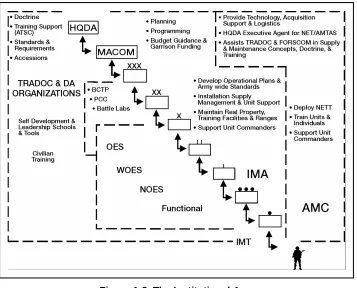
Command (TRADOC) and Department of the Army schools, the Army Installation Management Agency (IMA), and the Army Materiel Command (AMC). Together, they support collective and individual training, provide lifelong access to training resources for individual soldier or unit training, and provide and maintain necessary training, support facilities, and materiel.
Figure 1-3. The Institutional Army
TRAINING AND DOCTRINE COMMAND AND DEPARTMENT OF THE ARMY ORGANIZATIONS
1-31. TRADOC and DA organizations provide institutional support to every
soldier and civilian in the force throughout their Army career. Their primary contributions to the institutional Army include—
Recruiting and accessing officers, soldiers, and civilians into the force. Conducting individual training for all ranks, including IMT, training within the OES, WOES, and NCOES, and continued developmental and sustainment training. IMT instills an appreciation for the Army, inspires the Army warrior ethos, and establishes Army values of loyalty, duty, respect, selfless service, honor, integrity, and personal courage.
Conducting civilian leadership training for all grades to include managers, supervisors, and interns.
Providing leadership training and support for self-development. Developing, producing, and distributing training support products to institutions, units, and individuals.
Developing concepts, requirements, and products in doctrine, organizations, training, material, leadership and education, personnel, and facilities.
Providing infrastructure for institutional training.
ARMY INSTALLATION MANAGEMENT AGENCY
1-32. The Army Installation Management Agency (IMA) provides efficient
and effective management of installations worldwide to support readiness and training. IMA contributes to training by—
Providing planning, programming, and budgeting guidance and funding for installations.
Developing installation operational plans and standards.
Providing support to tenants and designated geographic area active component (AC) and reserve component (RC) units and activities. Providing installation supply management and support to all organizations.
Maintaining real property, training facilities, and ranges.
Supporting tenant and mobilizing organizations to enable them to prepare for and execute operational missions.
ARMY MATERIEL COMMAND
1-33. The Army Materiel Command (AMC) is the Army’s primary provider of
materiel readiness. It is a main source of technology, acquisition support, and logistics. AMC contributes to training by—
Conducting specialized materiel readiness training.
Serving as the HQDA G3 executive agent for planning and NET in coordination with the HQDA staff, TRADOC, FORSCOM, and other organizations.
Assisting TRADOC and FORSCOM with the development of supply and maintenance concepts and doctrine.
Assisting in the development and acquisition of specialized individual and collective training products.
INSTITUTIONAL ARMY SUPPORT OF TRAINING
1-34. The challenge for the institutional Army is to provide synchronized
schooling, doctrine, training, and training support to the correct organizational levels of the Army—from HQDA to the individual—at the correct time to support and enable operational commanders. Providing synchronized support includes, for example—
Accessing and training new soldiers in the proper military occupational specialty (MOS) so they arrive in units at the right time trained in the right skills.
Providing doctrinal tools for planning, executing, and assessing training at all levels.
Creating new training courses and training support materials to keep pace with new doctrine and equipment.
Providing installation and logistical support to enhance unit operations, regardless of their mission.
INDIVIDUAL SELF-DEVELOPMENT
1-35. Individual self-development, both structured and informal, focuses on
taking those actions necessary to reduce or eliminate the gap between operational and institutional experiences. Individual self-development is continuous. It should be emphasized in both institutional and operational assignments. Commanders and leaders provide feedback to enable subordinates to identify their own strengths and weaknesses and to determine the reasons for them. Together the senior and subordinate prioritize the subordinate’s self-development goals and determine courses of action to improve performance.
1-36. Institutional and operational training and assignments and leader
development programs alone cannot provide the insight, intuition, imagination, and judgment needed in combat. The gravity of the military profession requires comprehensive study and training. Individual self-development affects soldiers, civilian work force members, leaders, and supervisors of all grades, regardless of unit assignment, type of organization, current duty position, or location. The need for individual self-development requires commanders and leaders in the operational and institutional Armies, at all levels, to create an environment that encourages subordinates to establish personal and professional development goals. Successful self-development requires a team effort.
1-37. The ATLDM identifies an important interaction that trains soldiers
now and develops leaders for the future. Self-development plays an important part in this. Initially focused on basic individual soldier/leader skills, self-development expands to sustain those skills and evolves to support new technical skills, tactical skills, leader skills, and personal education goals. The key to success is self-assessment with feedback provided by the leader or supervisor.
1-38. Self-development starts with an assessment of individual strengths,
weaknesses, potential, and developmental needs. Commanders and leaders provide feedback that enables subordinates to determine the reasons for their strengths and weaknesses. Together, they prioritize self-development near-term and long-near-term goals and denear-termine courses of action to improve performance. Self-development is—
• A planned process involving the leader and the subordinate being
developed. It enhances previously acquired skills, knowledge, behaviors, and experience; contributes to personal development; and highlights the potential for progressively more complex and higher-level assignments. Self-development focuses on maximizing individual strengths, minimizing weaknesses, and achieving individual personal and professional development goals.
• Initially very structured and generally narrow in focus. The focus
RESPONSIBILITIES
1-39. Leaders are responsible for their subordinate’s professional
development as well as their own. Commanders must provide subordinates with the time and opportunity for self-development programs. The integration of self-development, leader development, and operational assignments comes from the feedback, coaching, mentoring, and guidance provided by leaders.
1-40. The pattern for Army civilian employees and leaders in operational or
institutional assignments following their initial training and education is similar to that of their uniformed counterparts. The assignment path along which civilian employees generally progress consists of four broad phases: intern, supervisory, managerial, and executive. Because of the range of skills and entry positions of first-time-hire DA civilians and their career development models, they are not required to pass through each phase sequentially. This is where a carefully planned self-development program, closely coordinated with one’s supervisor, becomes critical.
1-41. Commanders and supervisors must understand why self-development
activities are an integral part of their organizational training plan. Senior leaders are often judged by how well their subordinates perform as much as by how they themselves perform.
INDIVIDUAL SELF-DEVELOPMENT SUPPORT OF UNIT TRAINING
1-42. Operational assignments translate theory into practice. They place
soldiers, leaders, and civilians in positions to apply skills acquired during institutional training and education and self-development programs. Individuals learn and practice skills necessary for individual and collective training as they continually go through the planning, execution, and assessment phases of the self-development process.
1-43. Individual self-development is linked with both institutional and
operational assignments—
Individual self-development programs continue regardless of duty assignment.
Individual self-development programs are transient and move with the individual between the various operational and institutional assignments.
Institutional assignments provide resident self-development courses, distributed learning tools, and exportable educational technologies that support self-development.
Operational assignments provide current and future self-development opportunities.
Individual self-development reinforces the values, warrior ethos, ethics, and standards that permeate Army culture.
RESERVE COMPONENT TRAINING
1-44. The Army consists of the active component (AC) and the reserve
component (RC). The AC is a Federal force of full-time soldiers and DA civilians. The RC consists of the Army National Guard (ARNG), the United States Army Reserve (USAR), and their civilian support personnel. While each component is established under different statutes and has unique and discrete characteristics, all share the same doctrine and training management process, and they train to the same standard. However, the RC trains at lower echelons, and the number of tasks trained differs as a result of the organization and training time available. While the process is the same, there is a significant difference between AC and RC planning timelines. Commanders at all echelons in RC organizations and units assess training, provide guidance, and publish training plans.
1-45. The RC represents a large portion of the Army’s deterrence and
warfighting power. They are an integral part of the force. However, available training time has a significant impact on RC training. RC units have a limited number of available training days. Geographic dispersion of units also impacts RC training. An average reserve battalion is spread over a 150 to 300 mile radius. Additionally, most reserve units travel an average of 150 miles to the nearest training area. Individual soldiers often travel an average of 40 miles to their training sites.
1-46. Some RC soldiers may be assigned to a unit prior to MOS qualification;
therefore, the RC may have fewer MOS-qualified personnel assigned than their AC counterparts. Additionally, even though doctrine requires trained leaders to train units and soldiers, RC leaders may be unable to attend professional military education until after assignment to their units. Priority of training for RC units is given to individual duty military occupational specialty qualification (DMOSQ) and professional development to produce qualified soldiers and leaders.
1-47. Training readiness oversight (TRO) is the authority executed over
assigned Army forces, including the RC forces, when they are not on active duty, and when they are on active duty for training (ADT). It includes authority to—
Establish training criteria, and evaluate and oversee the training of assigned RC forces.
Coordinate and approve participation by assigned RC forces in joint exercises and other joint training when on ADT or performing initial active duty for training (IADT).
Obtain and review readiness and inspection reports of assigned RC forces.
Review mobilization plans developed for assigned RC forces.
PREMOBILIZATION AND POSTMOBILIZATION TRAINING
1-48. Mobilization is not the start point for planning battle focused training.
1-49. Premobilization training is directly linked to postmobilization training. A critical objective is to identify achievable, sustainable training requirements, which provide the focus for effective premobilization unit training. RC commanders train their units to standard on established premobilization tasks.
1-50. Postmobilization expands organizational training, raises the echelon
trained, and increases the amount of multiechelon and combined arms training accordingly. Postmobilization plans are created at the same time as premobilization plans and are updated regularly as premobilization training and revised commanders training assessments are completed.
PREMOBILIZATION TRAINING PLANS
1-51. Premobilization training focuses on company-level individual and
collective tasks. Staffs train on individual and collective tasks at the level organized. Premobilization training plans identify training requirements, training events, equipment, and training support packages to train to sustain task proficiency. Proficiency in these tasks enables training to full METL proficiency when the unit is mobilized. The annual training (AT) plan generally focuses on preparation for and execution of AT.
POSTMOBILIZATION TRAINING PLANS
1-52. Postmobilization training focuses on company-level and above collective
tasks. These plans identify training requirements, training events, equipment, and training support packages needed to train the unit to full METL proficiency upon mobilization. Postmobilization plans are updated annually and reflect input from the execution of the premobilization plan. The commander who approves the unit’s METL and yearly training plan (YTP) also approves the postmobilization plan. The plan is then provided to the mobilization station commander where the postmobilization training will occur.
1-53. Garrison commanders are responsible for supporting the execution of
postmobilization training activities. They determine resource requirements and develop plans to support the unit to reach its deployment training requirement. RC commanders conduct periodic visits with the supporting garrison commander to inspect training areas and facilities, identify and resolve support challenges, and clarify and refine training support requirements.
SUMMARY
1-54. Army training has one purpose—to produce competent, confident,
CONTENTS
Principles of Training ... 2-1 Commanders and Training... 2-11 Top-Down/Bottom-Up Approach to
Training ... 2-14 Battle Focus ... 2-14 Army Training Management Cycle .. 2-16 Summary ... 2-16
Chapter 2
Battle Focused Training
The key to fighting and winning is an understanding of “how we train to fight” at every echelon. Training programs must result in demonstrated tactical and technical competence, confidence, and initiative in our soldiers and their leaders. Training will remain the Army’s top priority because it is the cornerstone of combat readiness!
General Carl E. Vuono
2-1. Commanders train their units to be combat ready. Training is their
number one priority. Commanders achieve combat readiness using tough, realistic, and challenging training. At
every level, commanders must train to the Army standard. Battle focus is a concept used to derive peacetime training requirements from the wartime operational mission. This enables the commander to plan and execute training that produces lethal units for success on the battlefield. Using the Army Training Management Cycle, the commander
continuously plans, prepares, executes, and assesses the state of training in the unit. This cycle provides the framework for commanders to develop their unit’s METL, establish training priorities, and allocate resources.
2-2. Commanders and leaders at all levels use the principles of training
to develop and execute effective training. As commanders train their units on METL tasks, senior commanders reinforce training by approving and protecting training priorities and providing resources.
PRINCIPLES OF TRAINING
2-3. There are ten principles of training. The principles are shown in
figure 2-1.
Commanders are Responsible for Training NCOs Train Individuals, Crews, and Small Teams Train as a Combined Arms and Joint Team Train for Combat Proficiency
Realistic Conditions Performance-Oriented
Train to Standard Using Appropriate Doctrine Train to Adapt
Train to Maintain and Sustain
Train Using Multiechelon Techniques Train to Sustain Proficiency
Train and Develop Leaders
COMMANDERS ARE RESPONSIBLE FOR TRAINING
2-4. Commanders are responsible for the training and performance of
their soldiers and units. They are the primary training managers and trainers for their organization, are actively engaged in the training process, and adhere to the principles of training. To fulfill their training responsibility, commanders and leaders at each echelon—
Should be present and lead training. Base training on the METL.
Provide the required resources. Train to the Army standard.
Develop and execute training plans that result in proficient individuals, leaders, and units.
Incorporate risk management into all aspects of training. Assess current levels of proficiency.
2-5. Commanders and leaders at all levels must be personally involved in
training. Brigade commanders train battalion commanders and staffs. Battalion commanders train company commanders with their companies; company commanders train platoon leaders with their platoons; platoon leaders train squad leaders with their squads; and NCOs train individuals, crews, and small teams. The command sergeant major (CSM), first sergeant (1SG), and platoon sergeant (PSG) actively participate in leader training and leader development. A detailed discussion of leader training and leader development is found in appendix A.
NONCOMMISSIONED OFFICERS TRAIN INDIVIDUALS, CREWS, AND SMALL TEAMS
2-6. Noncommissioned officers (NCOs) are responsible for conducting
standards-based, performance-oriented, battle focused training. They identify specific individual, crew, and small team tasks that support the unit’s collective mission essential tasks. They plan, prepare, rehearse, and execute training; evaluate training, conduct AARs and provide feedback to the commander on individual, crew, and small team proficiency. Senior NCOs coach junior NCOs and officers to master a wide range of individual and leader tasks. They use the training management process to focus training on the most important individual tasks—those critical to the collective tasks being trained.
2-7. NCOs continue the soldierization process of newly assigned enlisted
TRAIN AS A COMBINED ARMS AND JOINT TEAM
2-8. The Army provides the JFC with a trained and ready force able to
execute full spectrum operations. This force provides the JFC with the capability to—
Seize areas previously denied by the enemy. Dominate land operations.
Provide support to civil authorities.
2-9. Army forces seldom operate unilaterally. Corps and division
headquarters may serve as either a joint task force headquarters or as a joint or combined force land component headquarters to provide command and control of joint or coalition forces. Many of the tasks necessary to execute these missions are the same as for Army forces, but are based on joint and multinational doctrine. Corps and division headquarters train on these tasks periodically, based on MACOM guidance or contingency plans.
2-10. The basis for the organization and operation of Army forces is
combined arms. Combined arms is the integrated application of several arms to achieve an effect on the enemy that is greater than if each arm was used separately or in sequence. Integration involves the arrangement of battlefield actions in time, space, and purpose for maximum effects of combat power at a decisive place and time. Commanders and their staffs integrate and synchronize the battlefield operating systems (BOS) to achieve combined arms effects and accomplish the mission.
2-11. Today’s Army doctrine emphasizes teamwork at all echelons. When
committed to battle, each unit must be prepared to execute operations without additional training or lengthy adjustment periods. Leaders must regularly practice task organization of all combat, combat support (CS), and combat service support (CSS) units. Teams achieve combined arms proficiency and cohesiveness when they train together. Peacetime training relationships must mirror wartime task organization to the greatest extent possible.
2-12. Commanders are responsible for training all warfighting systems.
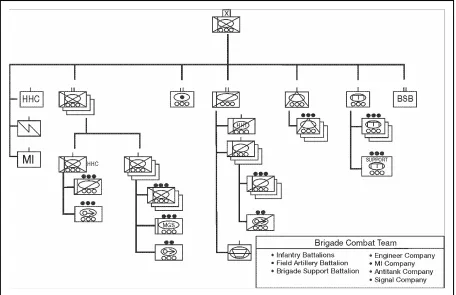
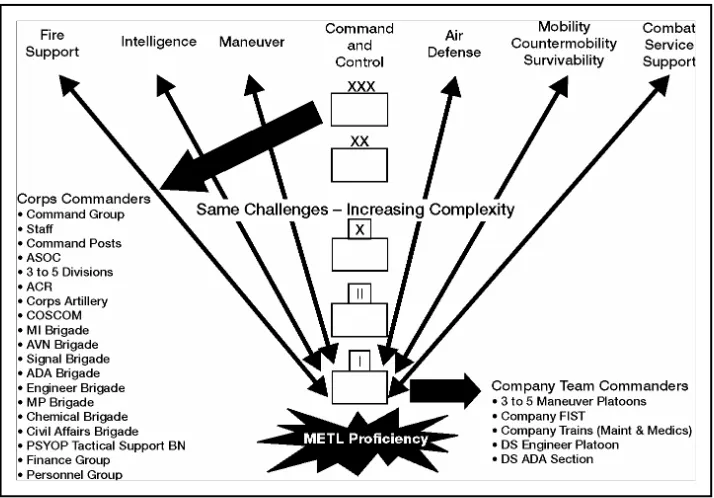
The full integration of the combined arms team is attained through the task organization approach to training management. Task organizing is a temporary grouping of forces to accomplish a particular mission, and they are habitually associated for peacetime training. An example of a task-organized brigade and its warfighting systems is depicted in figure 2-2.
2-13. The commander is responsible for the training of all elements of the
Figure 2-2. Brigade Combat Team Organization
2-14. Functional task proficiency of subordinate units is an essential
prerequisite for effective combined arms training. Each supporting unit commander performs an analysis to determine specific functional and technical training requirements necessary for effective execution of a deliberate attack. For example, the corps or division engineer coordinator (ENCOORD) could identify “conduct mobility operations” as the critical engineer functional task.
2-15. The combined arms training challenge is the same for all echelons
Figure 2-3. Combined Arms Training—Scope and Scale
TRAIN FOR COMBAT PROFICIENCY
2-16. The goal of all training is to achieve the Army standard. Within the
confines of safety and common sense, commanders and leaders must be willing to accept less than perfect results initially and demand realism in training. Commanders integrate realistic conditions such as imperfect intelligence; reduced communications; smoke; noise; rules of engagement (ROE); simulated nuclear, biological, and chemical (NBC) environments; battlefield debris; loss of key leaders; civilians on the battlefield; joint, interagency, intergovernmental, and multiagency (JIIM) requirements; and varying extremes in weather. Commanders take every opportunity to move soldiers out of the classroom into the field, fire weapons, maneuver as a combined arms team, and incorporate protective measures against enemy actions. CTCs provide the most realistic and challenging training experience in the Army; however, they should not be viewed as an “end point” in the unit training life cycle. Rather, they provide a “go to war experience” that allows commanders to assess their METL proficiency and determine the effectiveness of their training program. Additionally, commanders must maximize resources and time by training in all available training environments—live, virtual, and constructive (L-V-C). Realistic Conditions
2-17. Tough, realistic, and intellectually and physically challenging
training excites and motivates soldiers and leaders. Realistic training— Builds competence and confidence by developing and honing skills.
Inspires excellence by fostering initiative, enthusiasm, and eagerness to learn.
Develops aggressive, well-trained, disciplined soldiers.
2-18. Leaders must make conditions in training as close to wartime
conditions as possible. Innovative leaders seize every opportunity to increase training challenges for soldiers, leaders, and units. Successful completion of each training event increases the capability and motivation of individuals and units for more sophisticated and advanced training. This is the commanders’ continuous quest.
2-19. Conducting realistic training is challenging business. Commanders
incorporate risk management throughout their mission planning and execution to identify risk or other factors that will hinder mission accomplishment, and take action to reduce or mitigate the risk. Accordingly, risk management is a critical command and leader function that encompasses more than a single event or a learned process. It is both an art and a science. Risk management enables commanders and leaders to identify, control, and mitigate hazards proactively.
2-20. The scope of risk management extends well beyond the “enemy” in
mission, enemy, terrain and weather, troops and support available, time available, and civil considerations (METT-TC). Commanders must also consider potential risks, such as the experience of their soldiers and leaders, their training proficiency, adverse terrain, the weather, and the time available to accomplish the mission. Because training and combat conditions are dynamic, risk management must be a continuous process throughout training and combat operations and be embedded in the military decisionmaking process (MDMP).
Performance-Oriented
2-21. Performance-oriented training is hands-on and conducts the task
under the conditions and to the standard specified. Soldiers and leaders must be proficient in the basic skills required to perform their wartime missions under battlefield conditions. Units become proficient in the performance of critical tasks and missions by repeatedly practicing the tasks and missions to standard. Soldiers learn best through repetition, using a hands-on approach.
2-22. Soldiers train better, faster, and to a higher degree of proficiency
when they know the task, condition, and standard. Likewise, training is more effective when it is performance-oriented and standards-based. Enforcing standards allows leaders to identify and correct training deficiencies, resulting in a more accurate assessment of combat capabilities.
2-23. The complexity of the conditions is increased as soldier performance
levels increase, while the standard remains constant. Soldiers and leaders must execute the planned training, evaluate performance, and retrain until the Army standard is achieved under the most realistic conditions possible. They must evaluate and reinforce individual skills at each opportunity.
2-24. The same standard must be enforced whether performed
well as when the techniques are executed as part of a company attack exercise. Soldier and leader task training must occur continuously and be fully integrated into the collective training plan.
TRAIN TO STANDARD USING APPROPRIATE DOCTRINE
2-25. Training must be done to the Army standard and conform to Army
doctrine. When mission tasks involve emerging doctrine or non-standard tasks, commanders establish the tasks, conditions, and standards using mission orders and guidance, lessons learned from similar operations, and their professional judgment. The next higher commander approves the standards for these tasks. FM 3-0 provides the doctrinal foundations. Supporting doctrinal manuals describe common TTP that permit commanders and organizations to adjust rapidly to changing situations. Doctrine provides the basis for a common vocabulary across the force. Therefore, units must train to the Army standard contained in ARTEP-MTPs and STPs, while applying Army doctrine and current regulatory guidance.
2-26. While serving as a joint headquarters and performing joint tasks,
Army organizations use joint doctrine and TTP. Joint doctrine establishes the fundamentals of joint operations and provides guidance on how best to employ joint forces. Army doctrine is consistent with and nested in joint doctrine.
TRAIN TO ADAPT
2-27. Commanders train and develop adaptive leaders and units, and
prepare their subordinates to operate in positions of increased responsibility. Commanders intensify training experiences by varying training conditions, making them increasingly difficult and unpredictable. Repetitive and increasingly complex training gives soldiers and leaders a foundation that can be used to adapt to new situations. Commanders establish a training environment that encourages initiative and innovation, and recognize the benefits of allowing leaders the opportunity to learn from their mistakes.
2-28. Training experiences coupled with timely feedback build
competence. Leaders build confidence when they consistently demonstrate competence in tasks. Competence, confidence, and discipline promote initiative and enable leaders to adapt to changing situations and conditions. Leaders improvise with the resources at hand, exploit opportunities, and accomplish the assigned mission within the commander’s intent in the absence of orders. Commanders at every echelon integrate training events in their training plans to develop and train imaginative, adaptive leaders and units.
TRAIN TO MAINTAIN AND SUSTAIN
2-29. Maintenance is essential for sustained operations; therefore,
between operations and maintenance is vital to mission success and must be emphasized in training.
2-30. The standard for the Army is to train to maintain to the published
standards in the technical manual (TM)-10 series and TM-20 series. Maintenance is vital to mission accomplishment. METL cannot be executed if essential equipment and systems (such as tracks, weapons, wheeled vehicles, or radios) are non-mission capable (NMC). Everyone— leaders, maintenance personnel, and operators—must be trained and involved in maintaining and sustaining the organization.
2-31. In war, soldiers and crews perform preventive maintenance checks
and services (PMCS) under combat conditions. This requires equipment and vehicle operators and maintenance personnel who are proficient in their maintenance duties. Leaders must carefully plan training objectives for maintenance periods and ensure that the objectives are achieved. Leaders must train soldiers to meet Army maintenance standards. Success on the battlefield requires well-honed tactical and maintenance skills.
2-32. Commanders must ensure that the unit is prepared to maintain
equipment under battlefield conditions. Organizations must train all levels of maintenance to include maintenance of—
Individual soldier equipment, such as common table of allowances (CTA) 50, individual weapons, protective masks, and other individual NBC clothing, and equipment.
Crew served weapons and equipment, such as NBC monitoring and detection equipment, night vision and position locating devices, etc.
Major end items, such as tracked and wheeled vehicles, helicopters, shop vans and their associated subsystems (such as armament, automotive, communications, electronics, and computers).
2-33. Maintenance is training. Scheduled maintenance allows units to
train to maintain and sustain. Time must be allotted for maintenance and other logistical personnel (for example, supply, cooks, medics, and mechanics) to maintain their equipment to standard.
2-34. The training schedule also includes PMCS, equipment services, and
command maintenance periods. Soldiers must understand PMCS requirements and how they are executed. Leaders must train soldiers to maintain entire systems, not just pieces of a system. For example, a Bradley fighting vehicle (BFV) squad focuses on maintaining weapons, radios, basic issue items (BII), and NBC equipment, as well as the vehicle. Maintenance training periods must be planned, prepared, executed, and evaluated (have AARs conducted) with the same intensity as other training events. These periods should have clear, focused, and measurable objectives. Normally, they are informally evaluated by the chain of command.
2-35. The commanders, CSMs, and 1SGs instill in soldiers and leaders
maintenance training program to correct identified shortcomings during the weekly training meeting.
TRAIN USING MULTIECHELON TECHNIQUES
2-36. Multiechelon training is the most effective and efficient way to
sustain proficiency on mission essential tasks with limited time and resources. Commanders use multiechelon training to—
Train leaders, staffs, units, and individuals at each echelon of the organization simultaneously.
Maximize use of allocated resources and available time. Reduce the effects of personnel turbulence.
2-37. All multiechelon training techniques have the following distinct
characteristics:
They require detailed planning and coordination by commanders and leaders at each echelon.
They habitually train at least two echelons simultaneously on selected METL tasks, associated battle tasks, or supporting collective and individual tasks.
TRAIN TO SUSTAIN PROFICIENCY
2-38. Once individuals and units have trained to the required level of
proficiency, leaders must structure individual and collective training strategies to retrain critical tasks at the minimum frequency necessary for sustainment. Sustainment training is the key to maintain unit proficiency through, for example, personnel turbulence, operational deployments, and NET. ARTEP-MTPs and STPs are tools to help achieve and sustain collective and individual proficiency. Sustainment training must occur often enough to train new soldiers as they arrive in the unit and minimize skill decay. Army units train to accomplish their missions by frequent sustainment training on critical tasks. Infrequent “peaking” of training for an event (CTC rotation, for example) does not sustain wartime proficiency. Battle focused training is training on wartime tasks. Many of the METL tasks on which a unit trains for its wartime mission are the same as those required for a stability or support operation. This prepares a unit for the entire spectrum of missions that it may execute.
2-39. Sustainment training enables units to operate in a Band of
Excellence through appropriate repetition of critical tasks using a mixture of L-V-C training. The Band of Excellence is the range of proficiency within which a unit is capable of executing its critical wartime METL tasks. Training to sustain proficiency in the Band of Excellence includes training leaders, staffs, and units. Units fluctuate in proficiency because of many factors, such as training frequency, key personnel turnover, new equipment fielding, and resource constraints. The commander takes these factors into consideration when assessing the unit’s readiness and developing the training strategy. Well-trained units minimize peaking for selected events or at predetermined times.
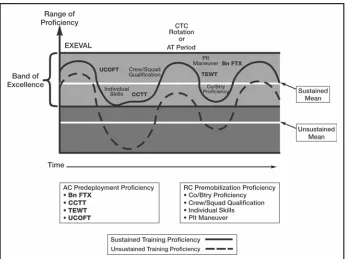
2-40. An example of how a commander planned the yearly sustainment
within the Band of Excellence. The plan schedules critical training at the minimum frequency necessary for sustainment. The dotted black line shows an ineffective training strategy that often causes the unit to fall outside the Band of Excellence, requiring significant additional training before the unit is capable of executing its critical wartime tasks.
Figure 2-4. Band of Excellence
2-41. This common sense approach of training to sustain proficiency
precludes deep valleys in proficiency that would otherwise require a significant amount of resources and time to retrain the unit to standard on its wartime mission. This strategy keeps proficiency within the Band of Excellence.
TRAIN AND DEVELOP LEADERS
2-42. Commanders have a vital role in leader training and leader
COMMANDERS AND TRAINING
2-43. Effective training is the number one priority of commanders. The
commander is the primary trainer. In war, training continues with a priority second only to combat or to the support of combat operations. Commanders and senior leaders must extract the greatest training value from every training opportunity. Effective training requires the commander’s continuous personal time and energy to accomplish the following goals:
Develop and communicate a clear vision.
Train one echelon below and evaluate two echelons below.
Require subordinates to understand and perform their roles in training.
Train all elements to be proficient in their mission essential tasks.
Train and develop subordinates.
Assist subordinates with self-development program.
Involve themselves personally in planning, preparing, executing, and assessing training.
Demand that training standards be achieved. Ensure proper task and event discipline.
Foster a command climate that is conducive to good training. Manage training distracters.
Incorporate risk management.
DEVELOP AND COMMUNICATE A CLEAR VISION
2-44. The senior leader’s training vision provides the direction, purpose,
and motivation necessary to prepare individuals and organizations to win in battle. It is based on a comprehensive understanding of the following:
Mission, doctrine, and history. Enemy/threat capabilities. Operational environment.
Organizational and personnel strengths and weaknesses. Training environment.
TRAIN ONE ECHELON BELOW AND EVALUATE TWO ECHELONS BELOW
2-45. Commanders are responsible for training their own unit and one
echelon below. Commanders evaluate units two echelons below. For example, brigade commanders train battalions and evaluate companies; battalion commanders train companies and evaluate platoons.
REQUIRE SUBORDINATES TO UNDERSTAND AND PERFORM THEIR ROLES IN TRAINING
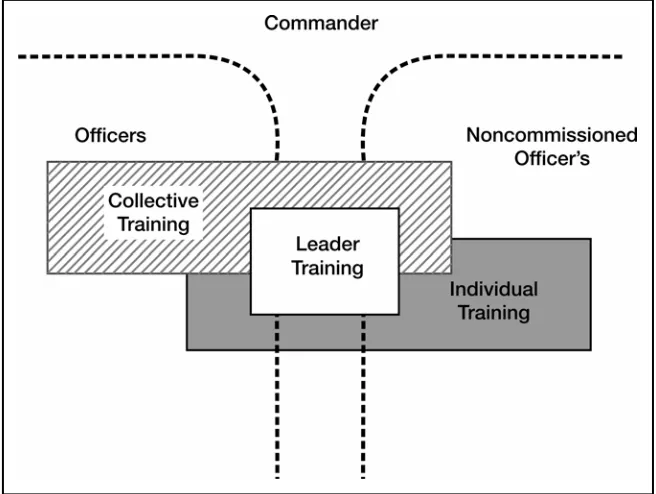
2-46. Because good training results from leader involvement, one of the
small team training (see figure 2-5). The commander, as the primary trainer, uses multiechelon techniques to meld leader, staff, and individual training requirements into collective training events, while recognizing the overlap in training responsibilities. Commanders teach, coach, and mentor subordinates throughout the training process.
Figure 2-5. Overlapping Training Responsibilities
TRAIN ALL ELEMENTS TO BE PROFICIENT ON THEIR MISSION ESSENTIAL TASKS
2-47. Commanders must integrate and train to Army standard personnel
under all BOS—those both within and supporting their command—on their selected mission essential tasks. An important requirement for leaders is to project training plans