Citation:
Effect of Decomposition on the Compressibility of Fibrous Peat
S. Pichan1 and B.C. O’Kelly2
1
Department of Civil, Structural and Environmental Engineering, Trinity College Dublin, Dublin 2, Ireland; email: [email protected]
2
Department of Civil, Structural and Environmental Engineering, Trinity College Dublin, Dublin 2, Ireland; email: [email protected]
ABSTRACT
This paper reviews the mechanisms of decomposition and, in particular, its effect on the compressibility of fibrous peat. Decomposition refers to the breakdown of fresh plant tissue, with the detritus becoming progressively finer, until eventually all vestiges of the original fibrous structure are lost and the peat has an amorphous, almost granular form. From a geotechnical perspective, the partly decomposed plant matter has a major influence on peat behavior, with the peat properties closely related to the average state of decomposition. The destruction of the plant tissue causes a reduction in the material’s water holding capacity and weakens the absorption complex which results in the reduction of both its water content and liquid limit values. The reduction in the organic content and the destruction of the inherent fibrous structure also causes an increase in bulk density. An evaluation of the compressibility characteristics of peats at different states of decomposition has been performed from a review of previous research reported in literature. The C /Cc ratio
of peat ranges between 0.035 and 0.1, with the lower value corresponding to amorphous peat. Hence, it is expected that the more decomposed the peat material, the lower its compressibility. This paper also presents a preliminary study on the potential for decomposition of peats maintained at a constant temperature of 30 C and under partially-saturated conditions over an extended period.
INTRODUCTION
geotechnical properties of peat have not been studied in any great detail. In particular, no study has been conducted on the direct effect of decomposition on the compressibility of peat and the authors have concluded that this may be because most researchers believe that the natural process occurs extremely slowly and hence would have an insignificant impact over the design life of pertinent engineering works. For example, Hobbs (1986) suggested that questions regarding the decomposition of peat were more of academic and scientific rather than engineering interest. Hence, while an abundance of high quality data exist in literature on the geotechnical properties of fibrous peat, less is understood about the microstructure and geotechnical behavior and properties of amorphous peats (Santagata et al., 2008). Presumably the decomposition rate could be accelerated before the start of construction work provided that the influencing factors and environment are favorable. Hence, the compression behavior of peat could be positively altered over the design life of the engineering works.
The aims of this paper are to: (i) describe the stages and mechanisms of the decomposition process and its effect on the compression behavior of peat; (ii) provide an indication of the anticipated compression of peat deposits that are undergoing accelerated decomposition.
DECOMPOSITION PROCESS OF ORGANIC MATTER IN PEATS
The decomposition process changes the state of organic matter from originally fresh plant material into finer detritus by the action of microorganisms that use the decaying organic matter as both an energy source and building material (Hobbs, 1986). The breakdown of the cellular structure of plant remains can be enhanced by earthworms under certain conditions (e.g. non-acidic soils) before further transformation occurs by bacteria and fungi. This microbial process normally occurs in two separate but interrelated stages (Wardwell et al., 1980). Firstly, acid-forming bacteria hydrolyze complex carbohydrates in the form of cellulose into glucose which is subsequently used for the metabolism of bacteria during the second stage. In an oxygen-rich environment, aerobic bacteria oxidize the glucose into carbon dioxide and water. However, in an oxygen-deficient environment, two groups of bacteria are required to achieve the destruction of organic matter; namely non-methanogenic and methanogenic. During the nonmethanogenic stage, acid-forming bacteria hydrolyze the cellulose into glucose which is subsequently converted into low-molecular-weight fatty acids (volatile acids). In the latter stage, these organic acids are used by anaerobic methane-forming bacteria, ultimately producing primary end-products of carbon dioxide and methane.
Destruction of the Physical Structure
amorphous, almost granular texture. The changes in the physical structure of the peat fibers have been reported by Landva and Pheeney (1980), with dramatic structural changes occurring for both the plant leave and stems for greater levels of decomposition. The organic grains of more highly decomposed peats are smaller, almost equi-dimensional in size, as a result of the decomposition process (Mesri and Ajlouni, 2007).
Transformation into Humic Substances
Decomposition also transforms organic matter into humic substances, which generally consist of three major classes of chemicals (Tate, 1987): (i) humic acids; (ii) fulvic acids; (iii) humin. These are a complex series of relatively high molecular weight, yellow-black organic substances formed by secondary synthesis reactions in organic soils (Santagata et al., 2008). Fulvic acids are the most active fraction, with lower molecular weight, higher acidity and higher oxygen content. Humic acids are the most recalcitrant faction. The final conversion of humic substances results in an accumulation of ashes and a small proportion of biogas and water, which indirectly produces a reduction in the peat organic content.
Conversion into Gases
The final stage of the decomposition process involves the conversion of humic substances into gases, including carbon dioxide and methane, or dissolved organic carbon as end products. The total gas voids content for peats and other organic soils is generally in the range of 5% to 10% (Hobbs, 1986). An abundance of methane gas bubbles generally occurs within the deeper layers of the peat deposits (Kellner et al., 2004). Under near saturated conditions, these gases accumulate into bubbles that remain trapped within the deposit, before being released to atmosphere through an ebullition process (Couwenberg, 2009).
FACTORS INFLUENCING DECOMPOSITION
The main factor influencing the decomposition of organic matter is the availability of an oxygen supply which controls the interaction of the aerobic and anaerobic processes in peats. Submerged peat material occurring in natural ecosystems has very limited available oxygen. In this oxygen depleted environment, the decomposition process becomes anaerobic, with slow microbial activity (Hobbs, 1986). The oxygen supply is greatly enhanced when the peat deposit is drained, either intermittently through natural fluctuations of the groundwater table or artificially induced by anthropogenic activity. For example, the ingress of oxygen down into the peat deposit may increase by as much as four orders of magnitude due to drainage (Matthiesen, 2004).
each 10 C increase over the temperature range for biological activity (Wardwell et al., 1980), although the optimum temperature for the decomposition of organic matter present as cellulose lies within the range of 35 C to 40 C (Hobbs, 1986).
Furthermore, the entire decomposition process requires a near neutral pH in order to ensure a balanced reaction, with all of the volatile acids produced by acid-forming bacteria being subsequently used by methanogenic bacteria (Wardwell et al., 1980). In an acidic environment, the function of the methane-forming bacteria will be seriously inhibited, particularly for pH 6.6. The cellulose can still be hydrolyzed for the formation of volatile acids provided that sufficient nutrients are available, although anaerobic decomposition will be incomplete due to insufficient amounts of methanogenic bacteria for its final conversion into gaseous byproducts. In the case of this imbalanced reaction, large amounts of excess volatile acids formed by first-stage anaerobic bacteria cause a reduction in pH which inhibits the growth of second-stage bacteria even further. Therefore, the decomposers tend to be most active in neutral to weakly alkaline conditions (pH = 7.0–7.5).
The availability of nutrients and the amount of available carbon are also important factors controlling the amount of cellulose decomposition since bacteria require nutrients for optimum growth (Wardwell et al., 1980). Hence, an appropriate proportion of nutrients such as nitrogen, phosphorus and other traces minerals should be available in the peat deposit for the microbes to function properly. Furthermore, the growth of the microbes depends on the carbon to nitrogen (C:N) ratio, with a higher proportion of available nitrogen resulting in higher microbial activity (Hobbs, 1986). The optimum C:N ratio for the decomposition of peat is expected to occur within the range of 15 to 30, although this range is based on the decomposition of sludge material reported by Wardwell et al. (1980).
The decomposition rate depends on the constituents of the organic matter which can comprise of various chemical compositions, ranging from easily decomposable to more resistant substances. Soluble substances are most susceptible to decomposition followed by sugars, proteins, hemicelluloses and cellulose with lignin, waxes and phenols remaining until the final stage of the process. Strongly resistant substances such as lignin can only be decomposed by a limited number of microorganisms, including basidiomycrete fungi, which have the capacity to metabolize the intact molecule. Hence, it can be concluded that the more a plant residual is lignified, the slower its decomposition rate, particularly under anaerobic conditions (Wardwell et al., 1980).
CHANGES IN COMPRESSION BEHAVIOR DUE TO DECOMPOSITION
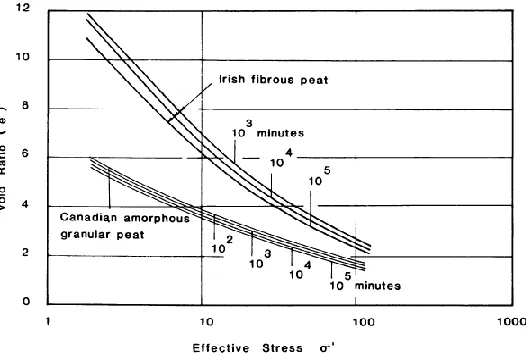
will generally be less compressible. This hypothesis is supported by the experimental data shown in Figure 1, with the amorphous peat significantly less compressible than the fibrous peat.
Figure 1: Experimental void ratio–effective stress–time relationships for fibrous and amorphous peats (Hobbs, 1986).
Secondary compression settlement in peat deposits is significant on account of the manner in which the pore water is retained and expelled, especially for more fibrous peats. This behavior can be predicted by the C /Cc law of compressibility
(Mesri et al., 1997), with values of C /Cc = 0.01–0.075 for practically all mineral
soils, and depends on the soil compressibility and deformability of the solid particles themselves. However, C /Cc = 0.035–0.1 for peats (Hobbs, 1986; Mesri and Ajlouni,
2007) since the constituent solids comprise systems of cells and baffle walls which are highly compressible. Fibrous peats generally have values of C /Cc at the higher
end of this range (i.e. 0.06–0.10), with primary consolidation normally substantially complete within a few weeks or months (Mesri and Ajlouni, 2007). Hence, lower C /Cc values are generally associated with amorphous peats (Hobbs, 1986).
Figure 2: Settlement–time behavior for Italian peats (Colleselli et al., 2000)
In the field, the biogas from the decomposition process has a significant influence on physical properties (e.g. bulk density, hydraulic conductivity) and on the settlement response, including the initial settlement, rate of consolidation and excess pore pressures (Wardwell et al., 1980; Hobbs, 1986; Beckwith and Baird, 2001; Kellner et al., 2004; Kellner et al., 2005). A complete conversion of organic matter to a more recalcitrant state does not cause a significant increase in the compressibility of an organic deposit (Wardwell et al., 1980). Hence, a prior conversion of the constituent organic matter into more stable humic substances, which are more resistant to further decomposition, may provide the basis for a ground improvement strategy that would reduce the risk of excessive settlements occurring over the design life of engineering structures constructed on such deposits.
PRELIMINARY STUDY ON POTENTIAL FOR PEAT DECOMPOSITION
The authors have performed some preliminary studies on the potential for accelerated decomposition in fibrous peat. Two undisturbed peat specimens A and B, (categorized as H5 on the von Post scale) were obtained from below the groundwater
[image:7.612.217.428.70.231.2]months. No confining stresses were applied to the specimens. Peat water from the bog was used to fill the bath to prevent any effects due to changes in water chemistry on the decomposition process.
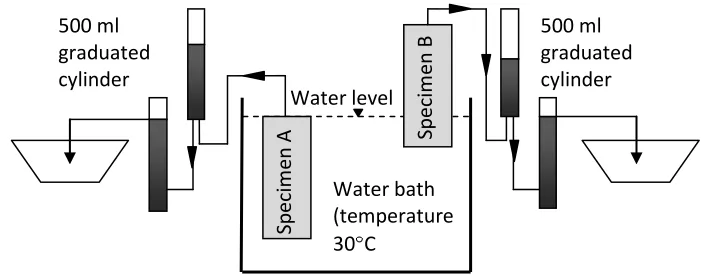
[image:8.612.130.483.262.401.2]Specimen A was fully submerged whereas the top of specimen B was maintained at a distance of 200 mm above the water surface in the bath (Figure 3). The lower end of the specimens was supported by a geotextile layer that allowed the flow of water to occur between the bath and specimen base. The decomposition rate was monitored indirectly by measuring the volume of biogas produced during the incubation period. The biogas was collected under water using inverted 500ml graduated cylinders that were connected via tubing to the top caps of the sampling tubes. At the end of the incubation period, the specimens were extruded and cut into 50-mm long slices for post-treatment water content determinations and index tests.
Figure 3: Measurement of volume of biogas evolving from incubated specimens
Results and Discussion
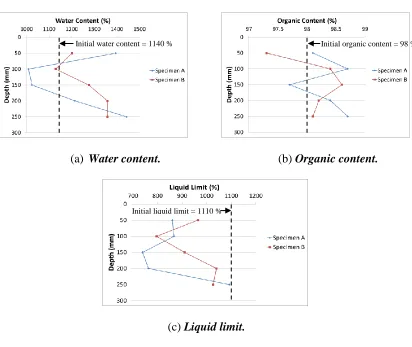
A visual inspection indicated that the specimens were mainly comprised of sphagnum plant material in which most of its structure had been moderately decomposed. The specific gravity of solids for the natural peat was 1.42, in the range of 1.4 to 1.5 reported for cellulose and lignin (Hobbs, 1986), and is consistent with the high fiber content of 82% which was determined in accordance with ASTM (2008). Hence, following from the findings of Colleselli et al. (2000), this peat would be expected to undergo significant secondary and tertiary settlement under compression. Other physical properties of the natural material and of the two incubated specimens are summarized in Figure 4.
The physical properties were highly variable over the length of the specimen cores which can be explained by the inherent heterogeneity of peat deposits, even over short distances. Although no clear relationships could be established and further studies must be performed to substantiate these preliminary findings, the following trends regarding the effect of decomposition are observed for the incubated specimens:
Water level
Water bath (temperature 30 C
Sp
ecim
en
A Sp
ecim
en
B
500 ml graduated cylinder
Water contents were generally equal or greater than that measured for the natural material, possibly due to slight swelling of the unconfined specimens over the incubation period and some additional pore water generated within the specimens due to the decomposition process;
The organic content, determined indirect by loss of ignition tests, remained largely unchanged at about 98% overall;
The liquid limit of 750% to 1050% was significantly lower than that measured for the natural material due to a reduction in water holding capacity of the incubated material as a result of the progressive destruction of the fibers.
(a) Water content. (b) Organic content.
[image:9.612.101.513.214.561.2](c) Liquid limit.
Figure 3: Physical properties measured over depth of incubated specimens.
The partially-submerged specimen B underwent ≈ 2% axial expansion (about half that for specimen A) over the incubation period. A change in color of the peat material was only observed near the top of specimen B (Figure 5) which had been maintained at a distance of 200 mm above the above the water surface in the bath during incubation. The volume of biogas collected from specimens A and B was 230 and 400 ml, respectively, indicating that the amount of decomposition achieved by the end of the two-month incubation period was relatively small. Only the soil temperature, and to a lesser extent the water level, had been controlled in these preliminary tests and other significant factors (including C:N ratio, pH and oxygen
Initial water content = 1140 %
Initial liquid limit = 1110 %
supply) were not adjusted for optimum conditions which would explain the slow decomposition rate. The decomposition rate (indicated by the relative volumes of biogas generated and the change in material color) was slightly greater for the partially-submerged specimen B. It is postulated that the rate of decomposition experienced near the top of specimen B had been accelerated somewhat due to greater availability of oxygen as a result of the lowered water level. Hence, this preliminary study has established the effect of changes in the water level on the decomposition rate of peat.
Figure 5: Physical condition of specimen B after incubation period
CONCLUSIONS
The simple experiment performed by the authors indicated that fibrous peat has the potential to be decomposed further and its decomposition rate could be accelerate by controlling the influencing factors (namely oxygen supply, C:N ratio, pH, temperature) for optimum conditions. Since the decomposition of organic material has a significant effect on the compression behavior of a peat deposit, the ability to pre-decompose this material may mitigate against the possibility of an increase in the compression rate which has been observed to occur during the secondary compression stage for fibrous peats (Mesri et al., 2007). This approach would be more sustainable compared to conventional ground improvement or excavate and replace techniques used for construction on such soft deposits.
REFERENCES
Beckwith, C.W., and Baird, A.J. (2001). “Effect of biogenic gas bubbles on water flow through poorly decomposed blanket peat.” Water Resources Research, 37(3), 551–558.
Berry, P.L. (1983). “Application of consolidation theory for peat to the design of a reclamation scheme by preloading.” Quarterly Journal of Engineering Geology, 16, 103–112.
Edil and P.J. Fox, Eds., American Society of Testing and Material, West Conshohocken, PA, 226–240.
Couwenberg, J. (2009). “Methane emission from peat soils (organic soils, histosols)-facts, MRV-ability, emission factors.” Wetland International, Proceedings for UN-FCCC Meeting in Bonn.
ASTM (2008). Standard Test Method for Laboratory Determination of the Fiber Content of Peat Samples by Dry Mass. ASTM D1997–91(2008). American Society of Testing and Material, West Conshohocken, PA.
Hobbs, N.B. (1986). “Mire morphology and the properties and behaviour of some British and foreign peats.” Quarterly Journal of Engineering Geology, 19, 7– 80.
Kellner, E., and Waddington, J.M. (2005). “Dynamics of biogenic gas bubbles in peat: potential effects on water storage and peat deformation.” Water Resources Research, 41, W08417, doi:10.1029/2004WR003732.
Landva, A.O., and Pheeney, P.E. (1980). “Peat fabric and structure.” Canadian Geotechnical Journal, 17, 416–435.
Matthiesen, H. (2004). State of Preservation and Possible Settling of Cultural Layers Below Bredsgarden and Bugaden Tenements, Bryggen, Bergen. Department of Conservation, National Museum of Denmark, Report No. 10832–0004–3. Mesri, G., Stark, T.D., and Ajlouni, M.A. (1997). “Secondary compression of peat
with or without surcharging.” Geotechnical and Geoenvironmental Engineering, 123, 411–421.
Mesri, G., and Ajlouni, M.A. (2007). “Engineering properties of fibrous peat.” Geotechnical and Geoenvironmental Engineering, 133, 850–866.
O’Kelly, B.C. (2005a). “Method to compare water content values determined on the basis of different oven drying temperatures.” Géotechnique, 55(4), 329–332. O’Kelly, B.C. (2005b). “New method to determine the true water content of organic
soils.” Geotechnical Testing Journal, 28(4), 365–269.
Price, J.S., Cagampan, J., and Kellner, E. (2005). “Assessment of peat compressibility: Is there an easy way?.” Hydrological Processes, 19, 3469– 3475.
Santagata, M., Bobet, A., Johnston, C.T., and Hwang, J. (2008). “One dimensional compression behaviour of a soil with a high organic matter content.” Geotechnical and Geoenvironmental Engineering, 134, 1–13.
Tate, R.L. (1987). Soil Organic Matter Biological and Ecological Effect, John Wiley & Sons, New York.