The circular discs are structural elements widely used in the structural and processing applications. One of the most used geometric shape for process-ing and cuttprocess-ing operation material is thin circular disc – circular saw blade. Dynamical properties of circular saw blade are investigated in this paper. Circular saw blades are widely used for cutting and forming metal and non-metal materials. The qual-ity of the cutting is mostly influenced by dynamical behaviour of circular saw blade in cutting process. The large transversal displacements of circular saw blade, induced by rotation of circular saw blade and external effects, occur during cutting process. In many cases, the loss of dynamical stability and arising of resonance state are caused by the reduc-tion of natural frequencies of the disc due to the thermal compressive stress induced by cutting heat in the peripheral region. In dependence on cutting conditions, the temperature of cutting in the pe-ripheral region increases up to 500°C. It is necessary to eliminate these inconvenient effects by design or technological treatments.
One of the techniques of the disc modifications to achieve the required dynamic properties is to initiate pre-stress (MARKUŠ, NÁNÁSI 1981) in disc plane. This is concerned primarily with “tuning”
of dynamical properties of vibrating circular discs by technological treatments inducing the residual plane stresses. It is possible to obtain the disc in-plane stress either by roll-tensioning of disc surface or by volume transformation of disc segment. In the roll-tensioning process, the disc is compressed within a certain annular contact zone between two opposing rollers. Plastic deformations in the contact zone of circular saw blade result residual stresses in whole disc plane. The effects of residual stresses induced by roll-tensioning on dynamical properties are analysed. The natural frequency characteristics for various rolling position and various rolling depth of the annulus are obtained by modal analysis using Finite Element Method (FEM). The role of residual stresses obtained by rolling is assessed from the changes in natural frequencies and modal shapes.
FORMULATION OF THE PROBLEM
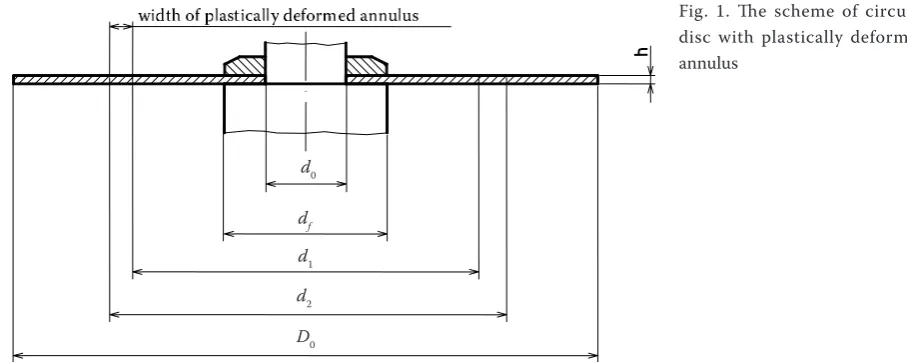
The circular saw blade, which is analysed, has the shape of circular disc. In the following, we con-sider an isotropic homogeneous circular disc of an outer diameter D0, inner diameter d0 and thickness h (Fig. 1). The diameterdf specifies a circle where the
disc is clamped by flanges. The plastically deformed
Supported by the Scientific Grant Agency VEGA, Projects No. 1/2076/05 and No. 1/2073/05.
Structural dynamic modification of circular disc
using pre-stressed fields
M. NAĎ
Faculty of Materials Science and Technology, Slovak University of Technology in Trnava,
Trnava, Slovak Republic
ABSTRACT: Dynamical properties of circular discs are investigated in this paper. One of the techniques of the disc modifications to achieve the required dynamic properties is to initiate pre-stress in disc plane. To obtain appropriate in-plane stress either roll-tensioning of disc surface or volume transformation of disc segment can be used. The role of in-plane stresses is assessed from the change in natural frequencies and modal shapes. The natural frequency char-acteristics for various rolling position and various rolling depth of the annulus are obtained by modal analysis using Finite Element Method (FEM).
zone of is determined by inner diameter d1 and outer diameter d2.
The fundamental considerations and derivation of equations of motion are based on Kirchhoff’s assumptions. The assumptions are valid only for thin circular disc. The field of displacements in the cylindrical coordinates r, φ, z, using Kirchhoff plate theory, can be written as
∂w (r, φ, t) ur (r, φ, z, t) = u (r, φ) – z ————— ∂r z ∂w (r, φ, t)
vφ (r, φ, z, t) = v (r, φ) – — ————— (1)
˜
r ∂φ
wz (r, φ, z, t) = w (r, φ)
where: u(r, φ), v(r, φ), w(r, φ) – displacements of point lay-ing on neutral plane of the circular disc in coordinate directions.
Generally, the stress-strain relations under con-sideration of initial stresses and initial strains are given by
σ = D (ε – ε0) + σ0 (2)
where: σ, ε – stress and strain vector,
σ0, ε0 – initial stress and initial strain vector,
D – elasticity matrix.
Using the finite element formulation (ZIENKIE-WICZ, TAYLOR 2000), the equation of motion for a free vibration of in-plane stressed disc is described by expression
Mü + (K + Kσ) u = 0 (3)
where: M – mass matrix,
K – tiffness matrix,
Kσ – stiffness matrix resulting from stress distribu-tion induced by rolling,
ü, u – vector of nodal accelerations and vector of nodal displacements, respectively.
We note, that the mass distribution of circular disc after rolling is not changed, but the bending stiffness is considerably changed.
Equations (3) can be transformed to modal coor-dinates using the transformation equations
u(t) = φq(t) (4)
where: φ – modal vector,
q(t) – normal coordinate of the system.
After applying the above transformation, the equa-tion of moequa-tion (3) can be used to determinaequa-tion of the natural angular frequencies and mode shapes of the circular disc with roll-tensioning induced residual stress distribution. We obtain the following eigenvalue problem
(K + Kσ – ωi2M) φi = 0 (5)
where: φ
iT (K + Kσ) φi
ωi =
√
——————— – natural angular frequency, φiT Mφiφi – eigenvector describing i-th modal shape of the cir-cular disc.
In order to calculate the modification of disc stiffness Kσ after rolling, we must know the residual stress
distri-bution in a disc plane. To determine the residual stress distribution, the method of thermal stress loading is used (KURATANI, YANO 2000). The thermal expansion induces a stress distribution, which is analogous to the stress distribution initiated by rolling. The dependence between temperature and depth of roll-tensioning is approximately described by equation
µ
∆T ≈ ——∆z (6)
hα
where: µ – Poisson number,
α – temperature expansion coefficient, h – disc thickness,
∆z – depth of roll-tensioning.
�
Fig. 1. The scheme of circular disc with plastically deformed annulus
d0
D0 d2
[image:2.595.67.521.55.236.2]The matricesM, K and additional matrix Kσ,which
follow from stress distribution arising from rolling (in this model analogy with thermal expansion is used), are calculated automatically by ANSYS (ANSYS 2001). Solution processes for determination of natural angular frequencies and modal shapes are realised by ANSYS.
The natural angular frequencies and modal shapes of circular disc with residual stress distribution for different position, depth and width of roll-tension-ing can be determined from equation (5). To obtain appropriate dynamical properties of circular disc, it is necessary to determine the natural frequency curves for the various positions of mean radius of the roll-tensioning annulus R = (d2 + d1)/4.
NUMERICAL EXAMPLE AND CONSIDERATIONS
We consider a circular disc (Fig. 1) of the outer diam-eter D0 = 240 mm, inner diameter d0 = 30 mm, thick-ness h = 1.8 mm and flange diameter isdf = 50mm.
The width of plastically deformed annulus is assumed
as 10 mm. This width is selected arbitrarily and it is considered as a representative value for planned ex-perimental verification of investigated phenomenon. The rest of input data used for following numerical analysis of circular disc are introduced in Table 1. The analysed disc is assumed to be perfectly fixed in region r ≤ rf . The outer edge of circular disc is free.
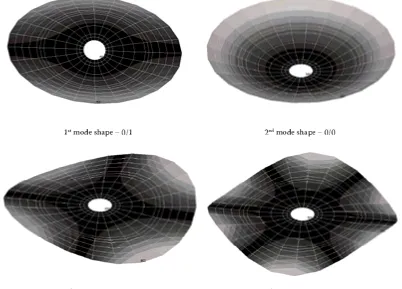
The solution of the eigenvalue problem (5) for free vibration of circular disc (Fig. 1) consists of the natural frequencies and the corresponding mode shapes. The individual mode shapes are represented by nodal lines and nodal circles and each mode shape is described by number of nodal circles/number of nodal lines. Nodal circles and nodal lines are sets of points of disc with zero deflection. The first four mode shapes of circular disc are plotted on Fig. 2 (black areas are parts of disc with zero deflections).
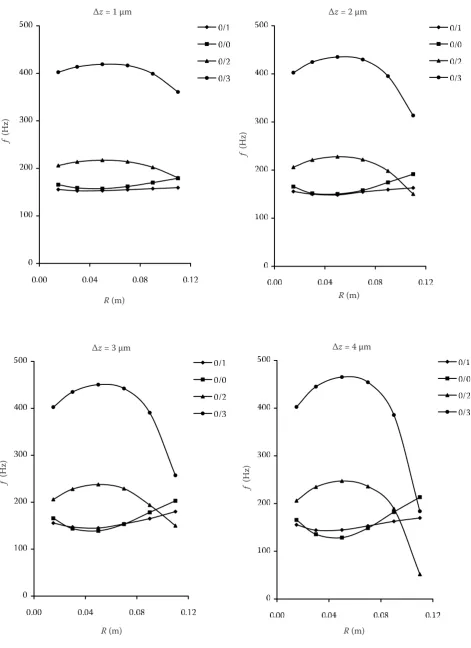
[image:3.595.94.497.440.729.2]The effect of the mean radius of roll-tensioning annulus R on natural frequencies of circular disc is investigated. Fig. 3 shows the influence of rolling radius and depth of rolling on the natural frequen-cies for mode shapes 0/1, 0/0, 0/2, 0/3 (number Table 1. Material properties of circular disc
Young modulus E (GPa) Poisson number µ (–) Density ρ (kg/m3)
210.0 0.3 7,800.0
� �
�
�
�
�
�
Fig. 3. Effect of rolling depth ∆z and mean rolling radius R on the first four natural frequencies
∆z = 1 µm ∆z = 2 µm
∆z = 3 µm ∆z = 4 µm
f
(
H
z)
f
(
H
z)
f
(
H
z)
f
(
H
z)
R (m)
R (m) R (m)
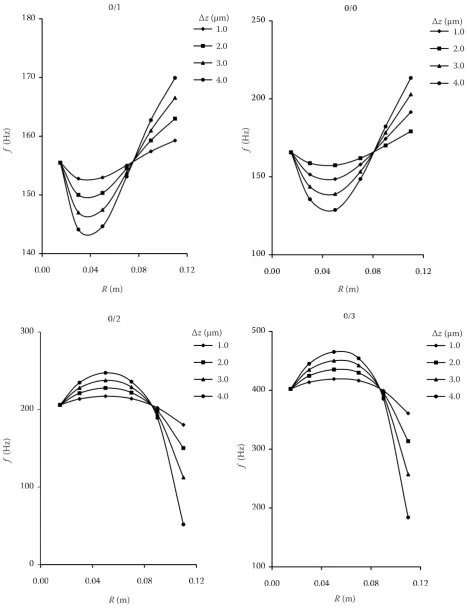
Fig. 4. Influence of rolling radiusR and rolling depth ∆z on the individual natural frequencies ∆z (µm)
1.0 2.0 3.0 4.0
∆z (µm) ∆z (µm)
∆z (µm)
1.0 2.0 3.0 4.0 1.0
2.0 3.0 4.0
1.0 2.0 3.0 4.0
f
(
H
z)
f
(
H
z)
f
(
H
z)
f
(
H
z)
R (m) R (m)
of nodal circles/number of nodal lines) calculated by FEM. The mean radius of rollingR varies from 30 mm to 110 mm and depths of rolling are 0.1 µm, 0.2 µm, 0.3 µm and 0.4 µm. The natural frequencies of circular disc before rolling are marked by R = 15 mm. The tendency of frequency curves for modal shapes 0/1 and 0/0 differs from frequency curves for modal shapes 0/2 and 0/3. The natural frequencies of the mo-dal shapes 0/2 and 0/3 increase with R until the maxi-mum values near R = 60 mm are reached; then they decrease. Contrary to this, the natural frequencies of the modal shapes 0/1 and 0/0 decrease with R and for
R = 50 mm reach the minimum; then they increase. The effect of thermal compressive stress induced by cutting heat in the peripheral region can be seen for R = 0.11 m, where natural frequencies of the modal shapes 0/2 and 0/3 for different depths of roll-ing are lower then natural frequencies of the modal shapes 0/1 and 0/0. For this case, the resonance of circular disc arises for lower frequencies. The reason why natural frequencies are varied due to rolling is that stiffness characteristics within the disc are lo-cally changed by stress distribution. The influence of mean radius R and depth ∆z of plastically deformed annulus on the natural frequencies for individual modal shapes is shown on Fig. 4.
CONCLUSIONS
The theoretical formulation and mathematical model for analysis of dynamical properties of circu-lar disc with residual stress distribution are presented. Finite element analysis for estimating the natural
fre-quencies was used. For certain mean rolling radius
R the natural frequencies of modal shapes 0/2 and 0/3 become smaller than those before rolling and the desired effect of tension stresses cannot be achieved. Therefore, the appropriate rolling position is neces-sary to be determined from natural frequency char-acteristics calculated for various mean rolling radius. This method of structural modification can be used to solve the various design problems of mechanical systems and it is very effective in changing the dy-namic properties of similar structural elements, see for example BODNICKI (2000).
References
ANSYS, Release 5. 7. 2001. SAS IP, Inc., Canonsburg, USA. BODNICKI M., 2000. Problems of design and
applica-tion of rotary torque meters for measurement of a small torque. Journal of Theoretical and Applied Mechanics,38: 499–522.
KURATANI F., YANO S., 2000. Vibration Analysis of a Circu-lar Disc Tensioned by Rolling Using Finite Element Method. Archive of Applied Mechanics, 70: 279–288.
MARKUŠ S., NÁNÁSI T., 1981. Significance of In-plane Iner-tia Forces in the Vibration Analysis of Three-layered Circu-lar Plates. Journal of Sound and Vibration, 76: 421–441. ZIENKIEWICZ O.C., TAYLOR R.L., 2000. The Finite Element
Method, Volume 1–3. Oxford, Butherword-Heinemann: 1423.
Received for publication April 1, 2005 Accepted after corrections June 20, 2005
Štrukturálna dynamická modifikácia kruhového kotúča pomocou �
predpätých oblastí
ABSTRAKT:V článku sú skúmané dynamické vlastnosti kruhových kotúčov. Jednou z možností, ako dosiahnuť požadované
dynamické vlastnosti, je modifikovať kotúč vytvorením predpätých oblastí v rovine kotúča. Vhodné predpätie môže byť vytvorené pomocou valcovania povrchu kotúča alebo vhodnou zmenou objemu časti kotúča. Vplyv napätí v rovine kotúča je hodnotený na základe zmeny vlastných frekvencií a vlastných tvarov kotúča. Závislosti vlastných frekvencií pre rôzne polohy valcovania a rôzne hĺbky valcovania prstenca sú určené pomocou modálnej analýzy použitím metódy konečných prvkov (MKP).
Kľúčové slová: kmitanie; kruhový kotúč; predpätie; vlastná frekvencia; metóda konečných prvkov
Corresponding author:
Ing. MILAN NAĎ, CSc., Slovenská technická univerzita v Trnave, Materiálovotechnologická fakulta, Katedra aplikovanej mechaniky, Paulínska 16, 917 24 Trnava, Slovenská republika